




Abstract
Agricultural policies can only be effective if intended beneficiaries are sufficiently aware of them. This basic condition for policy success is substantially challenged by smallholder farmers’ lack of awareness of existing support schemes. We studied the perceptions of 600 farmers of preservation policies for the traditional Indonesian Ongole cattle breed. We measured farmers’ knowledge of existing policies, their perceived ease of participation, their participation level and their satisfaction with the benefits obtained. We found that the target group has little awareness of existing policies. Policy awareness increases with education, the less remote the farm is, and with increasing specialization in cattle farming. We recommend therefore that policymakers should simplify and redesign existing policy schemes to create one coordinated policy. The various support schemes currently implemented should be combined in this policy and it should be presented in such a way that is easily understood by farmers. Incentives for Ongole breeders should be tailored, the establishment of farmers groups facilitated, and a breeding and selection programme initiated to improve the genetic potential of Ongole for domestic beef production.
Keywords
Introduction
Ongole is the most common cattle breed kept in Indonesia (Hadi et al., 2002). Ongole cattle are tall and strong, docile, tolerate heat, and have the ability to survive under harsh conditions (Maule, 1990). In Indonesia, the breed is frequently crossed with European breeds such as Limousin and Simmental yielding Limousin-Ongole (LO) and Simmental-Ongole crosses (SO) to obtain hybrid vigour for beef production. However, the promotion of European breeds mainly in the period 2006–2011 by the artificial insemination (AI) centre (Widi et al., 2015) and the increasing slaughter of traditional Ongole cows as a response to high meat prices (Tawaf et al., 2013) may threaten the existence of the traditional Ongole breed in Indonesia. Tawaf et al. (2013) found that reproductive Ongole cows represented 31% of the total number of animals slaughtered in some Indonesian regions.
In order to foster the country’s food self-sufficiency, the Government of Indonesia (GoI) intends to reduce beef imports by raising the amount of beef produced domestically (Hamilton-Hart, 2019). Maintaining the traditional Ongole breed is part of this strategy for which a number of policies have been implemented. Agricultural policies can only be effective if intended beneficiaries are sufficiently aware of them. Because the many smallholder farmers are intended beneficiaries, this basic condition for policy success is significantly challenged if farmers are only partially aware of the existence, participation conditions, and potential benefits of support schemes.
To the best of our knowledge, no systematic research has been published about farmers’ perceptions of policies targeting the preservation of traditional cattle breeds and their motivations for participation. The objective of the present paper is therefore to empirically assess the effectiveness of existing policies aiming at the preservation of traditional cattle breeds in the context of South-East Asia. In particular, we study the perceptions of existing Ongole preservation policies among the intended beneficiaries of these policies, i.e. cattle farmers, in Indonesia. We consider the following four perception aspects: farmers’ awareness of the policy, their perceived ease of participation in a given policy, their participation level in a policy, and the benefits perceived to be obtained from a particular policy. We analyse the explanatory factors underlying these perceptions. We also investigate why some farmers decide to stop keeping Ongole.
As far as we know, this analysis is the first that assesses the awareness of cattle-related policies from the perspective of the intended beneficiaries. Our results should contribute to improving the design and targeting of agricultural policies in Indonesia as well as in South-East Asia and beyond. Moreover, our study contributes to the very sparse literature about preservation policies for the maintenance of genetic diversity in the form of traditional animal breeds in developing countries. We introduce the idea that for this kind of policy to be effective in reaching the intended beneficiaries, the target group should be aware of it, should perceive participation as relatively easy and, when participating, should perceive tangible benefits from it. This approach is likely to be useful for measuring the quality of policy design from the beneficiary’s perspective in a wide range of real-world policymaking scenarios.
Theoretical background
The Directorate General of Livestock Service and Health (DGLSH) promotes six policies related the preservation of Ongole cattle in East Java (Table 1). All policies are part of the current general aim of the Indonesian government to increase the country’s food self-sufficiency (Hamilton-Hart, 2019). These beef policies belong to two categories: targeted and broad-based policies as defined by the Organisation for Economic Co-operation and Development (OECD, 2007).
Government beef policies implemented in East Java.
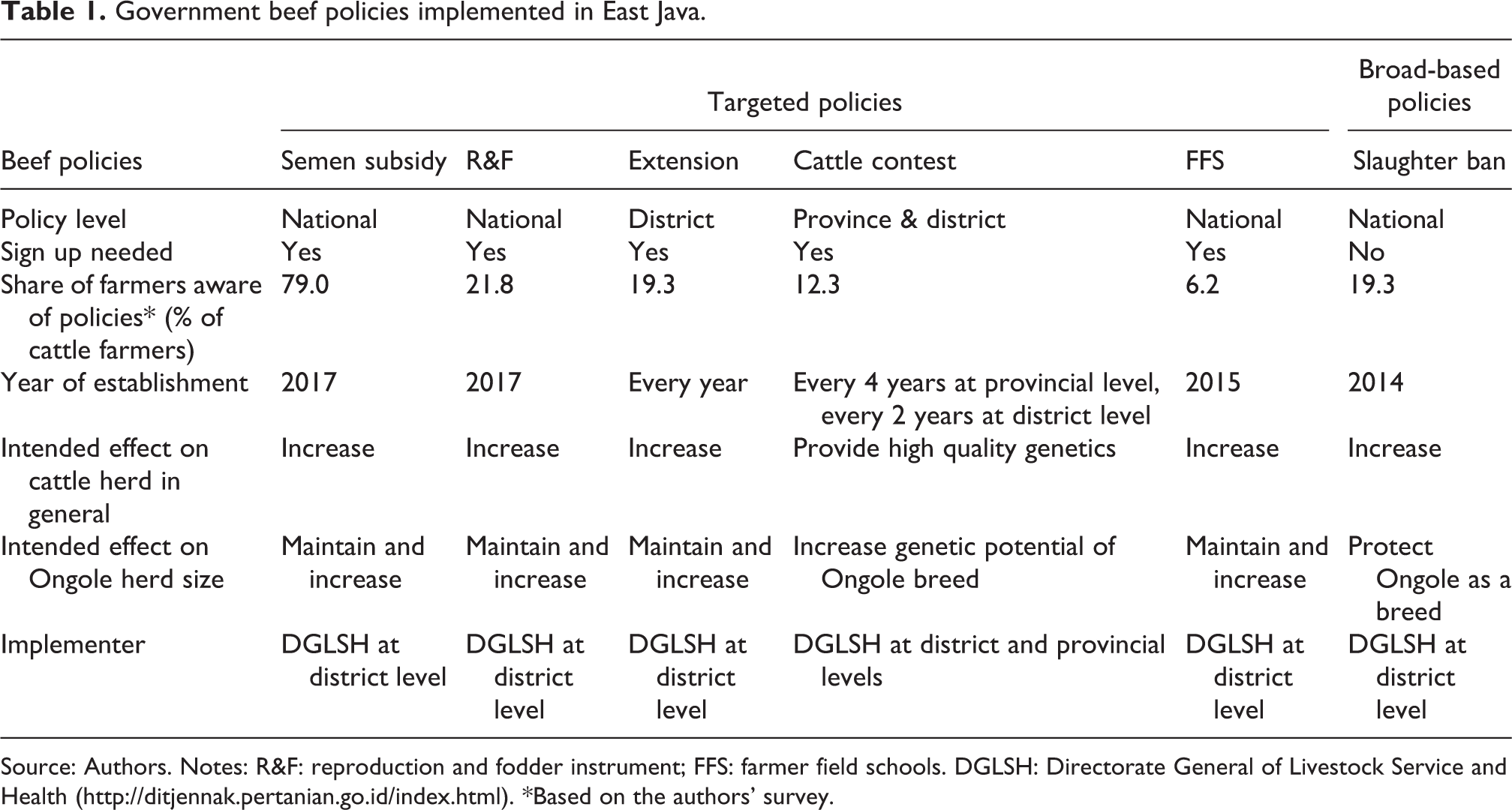
Source: Authors. Notes: R&F: reproduction and fodder instrument; FFS: farmer field schools. DGLSH: Directorate General of Livestock Service and Health (http://ditjennak.pertanian.go.id/index.html). *Based on the authors’ survey.
Policies targeted at a specific group of farmers require farmers to actively sign up for participation so they can obtain the support offered. These policies are designed to achieve their goal(s) by rewarding the farmer for a behaviour change. Thus, for this type of policy to be effective, farmers, as the intended beneficiaries, need to be aware of the policy, need to know the conditions for participating in it, need to sign up voluntarily, and actually participate in it before they can benefit.
The present targeted policies are aimed at supporting Ongole production by maintaining and increasing the Ongole herd size or by increasing the genetic potential of the Ongole breed. At the national level, the (DGLSH) implements three targeted policies intended to increase the Ongole population (Table 1). First, the DGLSH provides insemination with Ongole semen for free (MoA, 2016). Second, the ‘reproduction and fodder’ (R&F) policy was set up to achieve 100% self-sufficiency in beef supply by 2026 (DJPKH, 2017). This policy consists of cow pregnancy diagnosis, reproductive disorder examination, and provision of seeds for forage crops to farmers. Third, the DGLSH also established farmer field schools (FFS) for training farmers to develop collective and professionally run Ongole cattle farms (DJPKH, 2015). In addition, cattle contests and extension are targeted policies implemented at the provincial and district levels, respectively. Cattle contests in which the best bull or cow is selected and awarded a prize stimulate quality breeding, whereas extension disseminates knowledge about general aspects of cattle production including how to maintain reproductive cattle.
Broad-based policies are designed in such a way that all farmers producing the relevant commodity are automatically subject to them without having to actively sign up. An example of such a broad-based policy implemented for preserving Ongole in Indonesia is the cow slaughter ban: the slaughter of female cattle is not permitted so as to maintain a sufficiently large herd of reproductive animals. This slaughter ban applies to all breeds including Ongole. This policy places limits on all farmers’ production options and can only be successful if it is actively enforced by the government.
Dowler et al. (2006) argue that taking public perceptions into account can improve the effectiveness of a public policy. Hence, farmers’ perceptions of a policy are crucial in determining its success. To assess smallholders’ perceptions of policies for preserving the traditional Ongole breed, we consider four perception aspects: awareness, perceived ease of participation, participation level, and perceived benefits obtained from the policies. We have selected these aspects as they have been used to study smallholders’ perceptions of policies in various contexts (Alomia-Hinojosa et al., 2018; Meijer et al., 2015; Warriach et al., 2019).
Material and methods
Data collection and analysis
The primary data were collected in the Bojonegoro district of the Indonesian province of East Java from July to December 2017. This district is considered one of the most important cattle production areas of the country, having a population of about 200,000 head of cattle (BPSJ, 2017). Following Takasaki et al. (2000), we conducted a rapid rural appraisal (RRA) to obtain an inventory of existing policies relevant for the preservation of Ongole cattle. The stakeholders we approached were the staff of the DGLSH, animal experts at Brawijaya University in Malang, government officers at district and sub-district levels, village officers, and the heads of farmers groups.
To cover all farming systems referred to the supplementary Table S1, we collected a representative sample of 600 farmers out of 210,350 farmers in three farming system regions of the Bojonegoro district. In each of these regions, we selected one sub-district with high cattle density and one with low cattle density, yielding six sub-districts in total. The number of sampled farmers in each of these sub-districts was proportional to the total number of farmers in the sub-districts (see Table S1). In consultation with the sub-district officers, we selected 4 to 15 villages per sub-district depending on accessibility and concentration of cattle farmers. We took an equal number of sample farmers per village, regardless of the size of the village in each sub-district. In each village, we used the snowball technique to choose farmers to interview, starting with farmers nominated by the village officers. Farmers were included if they had been keeping cattle for at least 1 year and were operating less than 1 ha of agricultural land (this applied to approximately 90% of the farmers in the study area).
We conducted individual interviews with these farmers using a structured questionnaire 1 , consisting of five sections. The first section assessed the farm household’s socio-economic characteristics: age, education, experience in cattle keeping, farm size, geographical location and poverty level. The second section assessed household income. The third section assessed characteristics of cattle production, the fourth section assessed the farmer’s perceptions of the existing Ongole preservation policies, and the fifth section assessed to what extent farmers make use of forest resources.
As our analysis focuses on the perceptions of existing Ongole preservation policies among the intended beneficiaries of these policies, we split the sample into four categories: 1) farmers that, at the time of the survey, had kept Ongole for the last 10 years; 2) farmers that had kept Ongole within the last 10 years but at the time of the survey were no longer keeping them but other breeds instead; 3) farmers that had never kept Ongole during the last 10 years; and 4) farmers who simultaneously kept Ongole and fattened non-Ongole breeds. 2
For the first step of the analysis, we compared household socio-economic characteristics, forest usage, geographical location, cattle production characteristics and household income between Ongole and non-Ongole farmers using t-tests. Next, we compared how Ongole preservation policies were perceived by both groups of farmers. For this, we compared the means of all four perception aspects between both groups using ANOVA followed by post-hoc Bonferroni tests. To analyse whether the scores reported by the farmers on the aspects ‘ease of participation’ and ‘perceived benefits received’ differed between both groups, we considered only those respondents who were aware of the respective policies.
Next, we studied which socio-economic characteristics contributed to each perception aspect of the policies. We did this by analysing the relationship between the score

where
Last, we assessed the determinants influencing farmers’ decisions for discontinuing keeping Ongole for the sub-sample of ‘former Ongole farmers’ using the logistic model:

where Pi is the observed binary outcome indicating 1 if farmer i had discontinued breeding Ongole during the past 10 years and 0 otherwise. The vector
Results
Characteristics of farms with different production aim preferences
Overall, about one quarter of all farmers surveyed kept Ongole. Most farmers interviewed (77.3%) were breeders, and about 25% of them kept Ongole, while the rest only kept other breeds such as LO and SO (Table S2 in supplement).
Ongole farmers were significantly older, poorer and had a lower educational background than non-Ongole farmers. The number of Ongole farmers that belong to a forest user group and collect forage from the forest was significantly higher than that of non-Ongole farmers, despite the fact that Ongole farmers lived farther away from forests. Moreover, Ongole farmers owned significantly more cattle than non-Ongole farmers. Ongole farmers’ share of total income derived from crops was lower than that of non-Ongole farmers, while their share of total income derived from forest related activities was higher (Table 2).
Mean (SE) comparison of farmers’ characteristics.
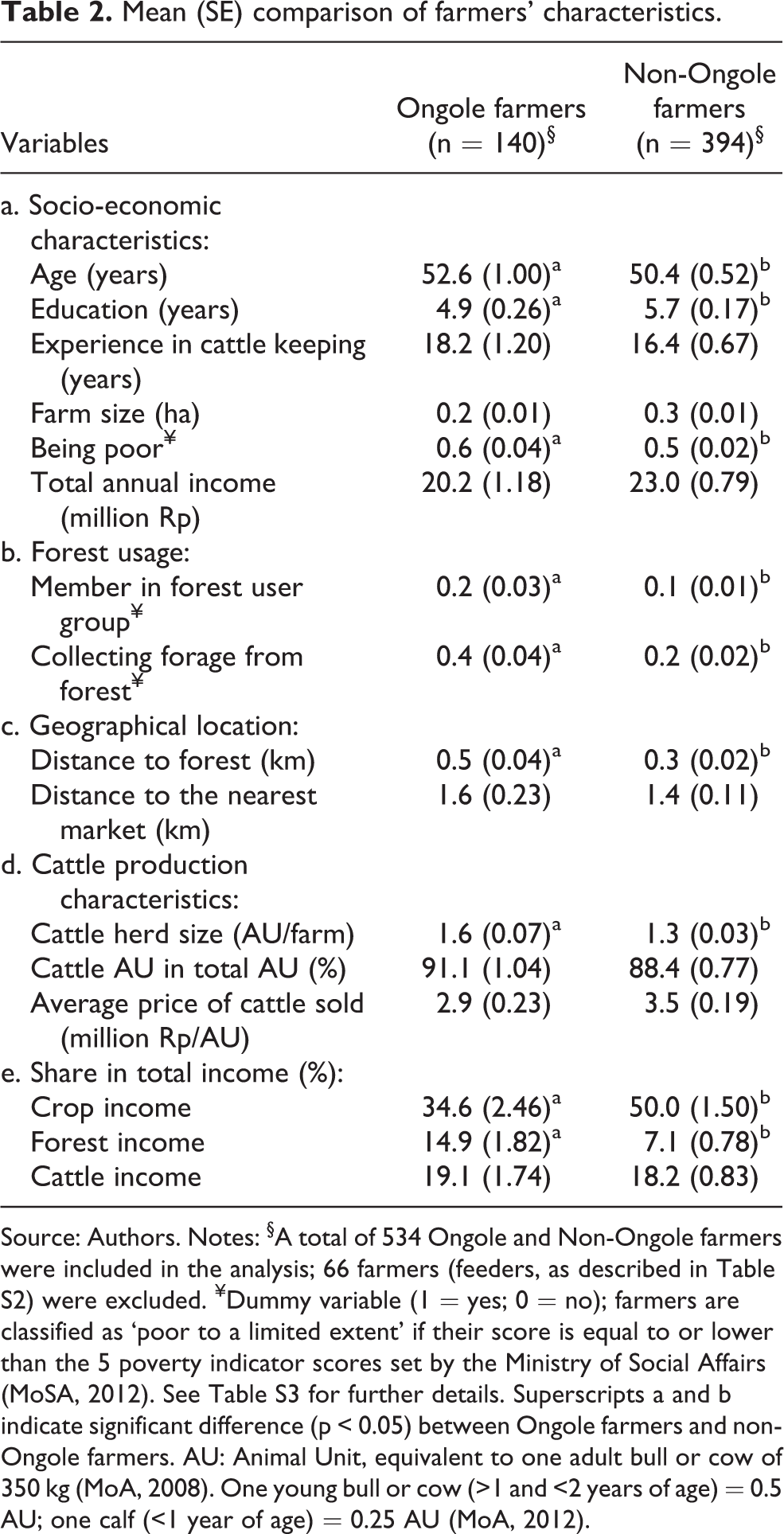
Source: Authors. Notes: §A total of 534 Ongole and Non-Ongole farmers were included in the analysis; 66 farmers (feeders, as described in Table S2) were excluded. ¥Dummy variable (1 = yes; 0 = no); farmers are classified as ‘poor to a limited extent’ if their score is equal to or lower than the 5 poverty indicator scores set by the Ministry of Social Affairs (MoSA, 2012). See Table S3 for further details. Superscripts a and b indicate significant difference (p < 0.05) between Ongole farmers and non-Ongole farmers. AU: Animal Unit, equivalent to one adult bull or cow of 350 kg (MoA, 2008). One young bull or cow (>1 and <2 years of age) = 0.5 AU; one calf (<1 year of age) = 0.25 AU (MoA, 2012).
Farmers’ perceptions of Ongole preservation policies
Both Ongole and non-Ongole farmers had different perceptions of the semen subsidy in terms of ‘awareness’ and ‘participation level’ compared to their perceptions of the other policies (see Table S4 in the supplement). The non-Ongole farmers’ perceptions of the semen subsidy were significantly different from their perceptions of the slaughter ban and cattle contests regarding ‘ease of participation’ and ‘perceived benefits’.
We found that Ongole farmers were significantly more aware of the R&F policy but less aware of the cattle contest policy than non-Ongole farmers. No differences existed between Ongole and non-Ongole farmers for any of the policies regarding perceived ease of participation and perceived benefits. Ongole farmers had a significantly higher participation level in the semen subsidy and in R&F policies than non-Ongole farmers.
Table 3 summarizes the determinants which contribute positively and significantly to each perception aspect of the policies for the sub-sample of farmers currently keeping Ongole. The coefficients of the ordered logistic regression and odds ratios are given in Tables S5 to S8 as formulated in equation (1).
Factors contributing positively and significantly to Ongole farmers’ perception aspects of the Ongole preservation policies.
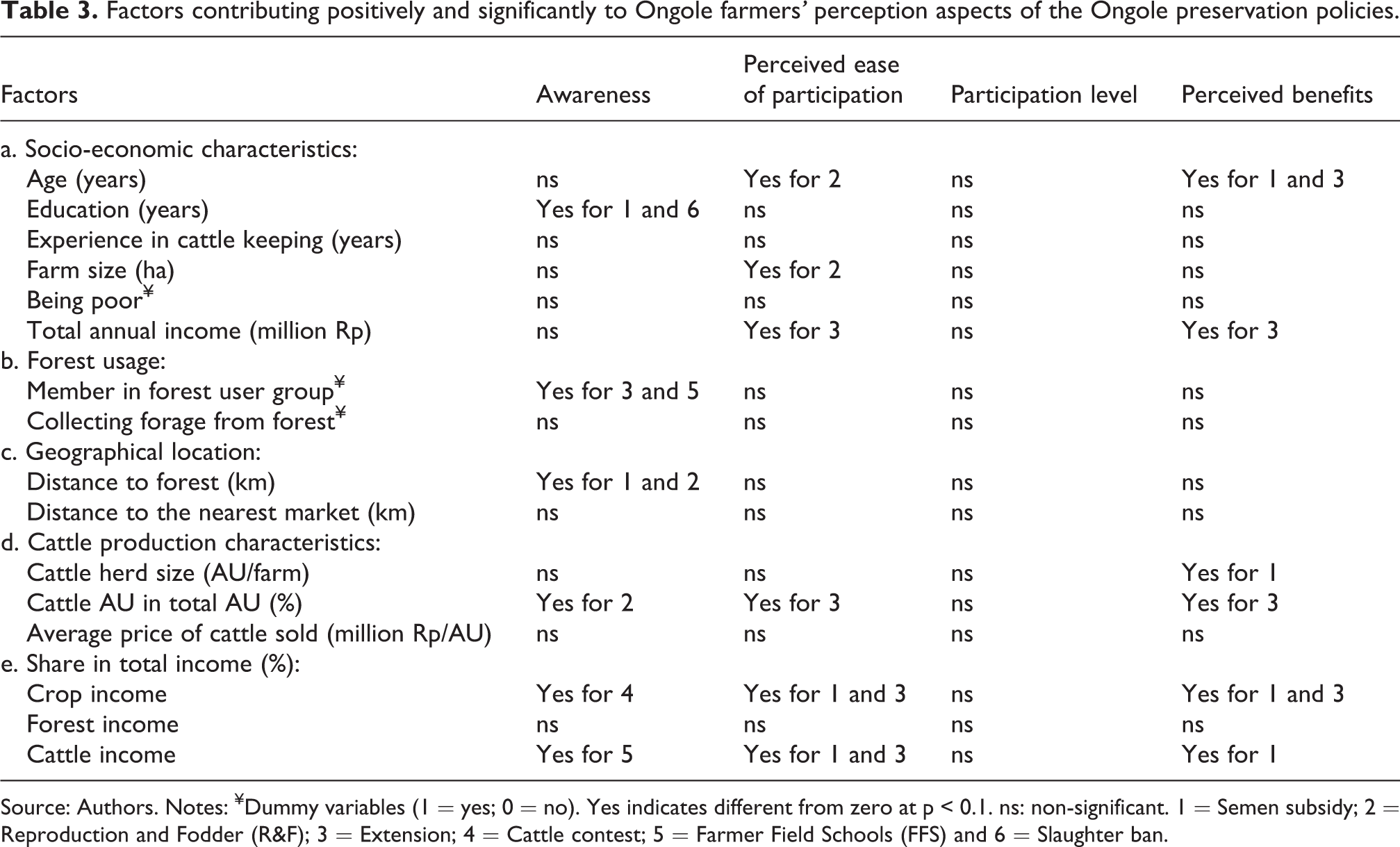
Source: Authors. Notes: ¥Dummy variables (1 = yes; 0 = no). Yes indicates different from zero at p < 0.1. ns: non-significant. 1 = Semen subsidy; 2 = Reproduction and Fodder (R&F); 3 = Extension; 4 = Cattle contest; 5 = Farmer Field Schools (FFS) and 6 = Slaughter ban.
Table 3 shows that an Ongole farmer’s awareness of all six or at least some of the existing policies increases if they have higher education, are a member in a forest user group, live farther from forests, possess more cattle, and the higher the share of total household income generated from crop and cattle marketing. Ongole farmers who are older and operate a larger farm, and have higher total annual income, more cattle, and a higher share of crop and cattle in total income reported a higher score for ‘ease of participating’ in all or some of the existing policies. Table 3 also shows that there is no association between the five factor categories and level of participation in the policies. Last, Ongole farmers who are older, and have a higher annual income, more cattle, and a higher share of crop and cattle in total income reported that they obtained higher benefits from the policies (Table 3).
We found that farmers’ perceived ease of participation correlates positively with farmers’ participation level in all policies (p < 0.01). Farmers’ perceived benefits from extension correlate positively with farmers’ participation level (p < 0.01) (see Table S9).
Determinants of farmers’ decisions to stop keeping Ongole
As highlighted in Table S2, 89 farmers stopped keeping Ongole during the last 10 years. The most important reasons given for this decision are that keeping Ongole was not profitable (83% of farmers) and the low market value of Ongole calves (74% of farmers). Only a few farmers mentioned the following as reasons to stop keeping Ongole: breeding reproductive Ongole cows, being picky eaters and that they require more inputs (capital, labour and feed) (Figure 1).
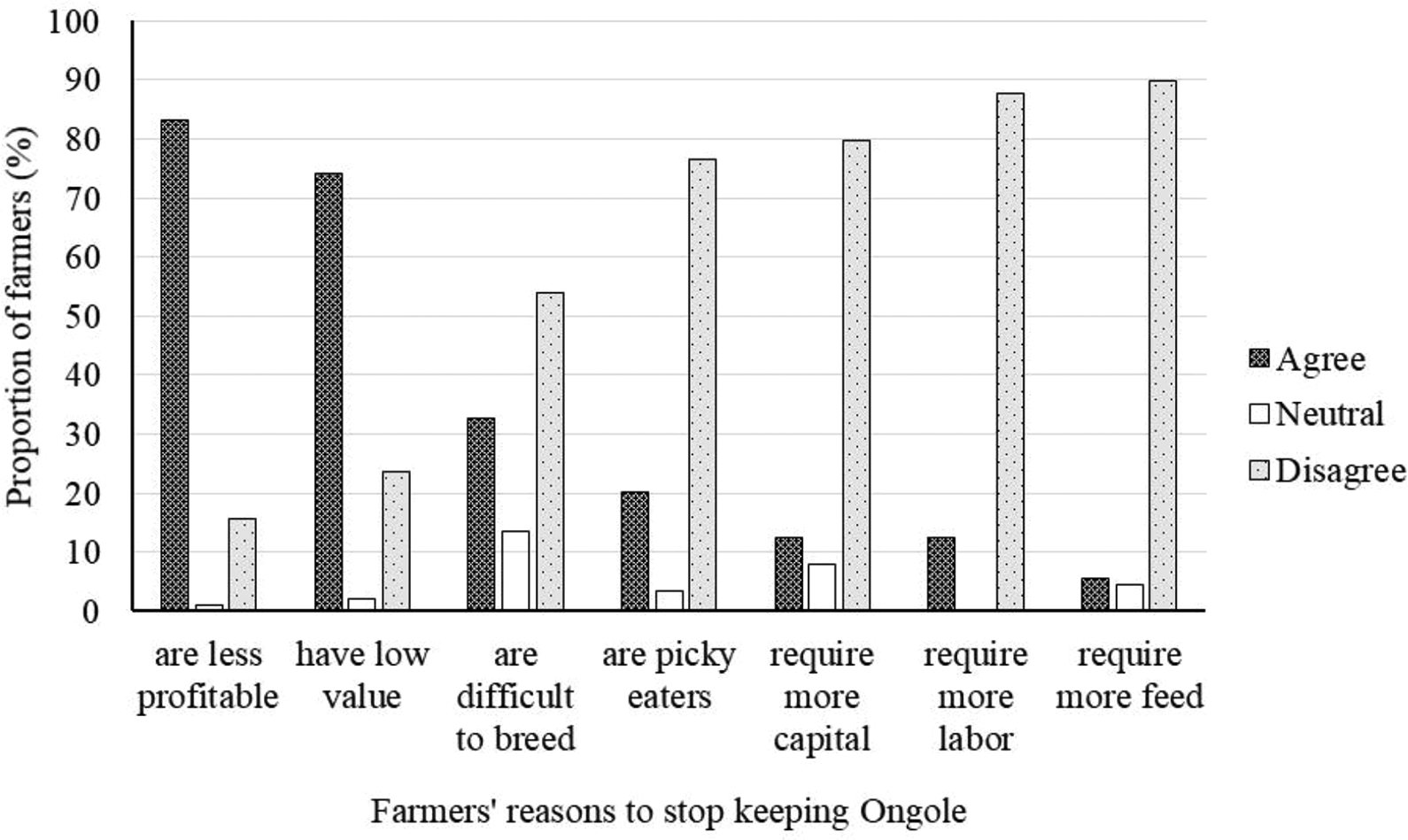
Farmers’ reasons to stop keeping Ongole. Notes: ‘Agree’ combines farmers’ answers in classes ‘agree’ and ‘strongly agree’; ‘Disagree’ combines farmers’ answers in classes ‘disagree’ and ‘strongly disagree’.
Table S10 presents factors associated with farmers’ decision to stop keeping Ongole 4 as formulated in equation (2). The awareness of cattle contests and the average selling price of cattle are significantly positively associated with this decision. Forage collection in the forest and cattle herd size are significantly negatively associated with farmers’ decision to quit keeping Ongole.
Discussion
The teak forests in the study area are owned and administered by the state-owned forest company. Local smallholders are allowed to collect forest products such as fuelwood, charcoal, teak wood, teak branches, teak leaves and forest grass. Due to limited grazing areas, both Ongole and non-Ongole farmers keep cattle in barns and feed forages using a cut-and-carry system as observed by Widi et al. (2015). We found that Ongole farmers relied more on teak forest resources for ensuring their livelihoods than non-Ongole farmers (Table 2).
Farmers keeping the traditional Ongole breed perceive themselves as poorer than the reference group and we found that they were getting less income from crop production and also lower prices from cattle sales than the other farmers. This Asian context finding is backed up Traoré et al. (2017), who report that in the context of Africa poorer farmers prefer to keep traditional cattle breeds because of lower input costs and risks. This association of the breed choice with socio-economic status of the breeders might facilitate targeting social policies in rural areas for supporting the poor – as they can be identified as Ongole farmers – and also implies that any policies tailored to support farmers who have chosen the traditional breed will also yield socio-economic side effects.
Farmers with more education were more aware of the policies (Table 3). Hence, education and training seem to create an enabling environment for policy awareness and thus would represent a first step towards successful uptake of the existing policies. Our results also concur with those of Meijer et al. (2015), in particular the finding that farmers living farther away from the forest were more aware of the policies, possibly because they have more immediate access to sources of policy information, e.g. the village office or extension officers. This indicates a vicious cycle between remoteness and information asymmetries among farmers: those living in more remote locations face more difficulties of accessing information about governmental policies they might potentially profit from and therefore stay poor. This implies that general efforts for improving education and infrastructure in disadvantaged regions will yield positive externalities in this respect.
The semen subsidy, which provides a direct economic benefit to breeders by eliminating their insemination costs (MoA, 2016), was rated highest of the existing policies by all types of farmers for all four perception aspects. 5 Ongole farmers were found to make significantly more use of this subsidy than non-Ongole farmers (Table S4), perhaps because they profited more from it.
Although farmers gave the reproduction and fodder and the extension policies similar ratings for awareness, perceived ease of participation and perceived benefits as they did for these aspects of the semen subsidy, participation levels were reported to be much lower. This may be because these do not provide direct economic benefits to farmers. For example, providing seed for forage crops to farmers requires availability of land to be successful, but farmers cultivate only very small areas of about 0.2 ha, and these are used mainly for growing staple crops for human nutrition. Extension requires farmers to allocate their time and labour to participate in it as observed by Suvedi et al. (2017). Time is an important constraint for the smallholder farmers we interviewed as also observed by Oosting et al. (2014) since they depend on farm activities, forest activities and non-farm jobs for ensuring their livelihoods.
The other Ongole preservation policies, i.e. cattle contests, farmer field schools and the slaughter ban, are less successful in reaching their goals, as shown by the low scores regarding the four perception aspects (Table S4). Smallholder farmers have not enough capital and labour available to participate in cattle contests. The slaughter ban is less relevant to farmers who focus on maintaining the breed as they rarely slaughter reproductive cows, and farmers do not have to actively sign up to participate in it. Traders, butchers and slaughterhouse operators are directly affected by the slaughter ban since it prohibits them from slaughtering reproductive cows.
Most of the existing preservation policies appeared to be based on only very limited awareness among the intended beneficiaries and participation in them was perceived as being rather difficult. Policies that are not widely known unlikely to be successful in terms of reaching the goals they were created for. Hence, if the GoI is interested in raising the effectiveness of its support schemes for farmers, more effective dissemination of the existing options will be needed. Farmer groups appear to be a helpful tool for policy dissemination, as we found that farmers who are members of forest user groups are more aware of policies. This is supported by the findings of Gayatri and Vaarst (2015) who observed that information about Indonesia’s beef self-sufficiency programme was disseminated easily through farmer groups.
A major problem is the poor targeting of the existing policies, as most of them are not tailored to support farmers who keep the traditional breed but rather to incentivize cattle keeping in general. This means the policies provide few incentives for farmers to switch to keeping the traditional breed. In fact, only farmer field schools specifically stimulate Ongole breeding. Hence, it would be advisable for policymakers to simplify and redesign the existing policy portfolio by making support for a number of explicitly named traditional breeds relatively more attractive in comparison to the support for other breeds as a better way of stimulating the maintenance of genetic diversity. In addition to giving semen subsidy to Ongole breeders, the AI centre together with the DGLSH could take steps to better limit the distribution of semen of non-traditional breeds in the areas targeted specifically for Ongole breeding.
Cattle contests could raise appreciation of the traditional Ongole breeding stock, putting it on a par with non-Ongole breeding stocks, as relying on giving subsidies and financial incentives is unlikely to improve farmers’ perception of traditional breeds. The positive association of farmers’ decision to stop keeping Ongole with selling price (Table S10) indicates that economic benefits appear to be a key determinant for farmers to switch to other breeds. However, Widi et al. (2015) and Priyanti et al. (2015) report that the genetic and the economic potential of Ongole can match that of Limousin-Ongole and Simmental-Ongole. Hence, breeding and selection within the Ongole population to increase the genetic potential for beef production could increase the economic attractiveness of the breed.
Conclusions
We studied farmers’ perceptions of six existing policy schemes relevant for the preservation of a traditional South-East Asian cattle breed, Ongole. We chose the Indonesian province of East Java for our case study, which is considered one of the country’s most prominent cattle production areas. We evaluated four perception aspects: farmers’ awareness, perceived ease of participation, participation level and perceived benefits obtained from the respective policies.
We found that most of the existing policies intended to stimulate domestic beef production in Indonesia do not provide farmers with incentives to continue or to start Ongole breeding. This implies that (re-)targeting existing support schemes – as suggested by the OECD (2007) – to specific breeds (e.g. by introducing support that is tailored to incentivizing Ongole breeding) would be desirable as scarce public funds would be put to use in the best interest of the Indonesian public and towards the strategic policy goal of food self-sufficiency (Hamilton-Hart, 2019).
Another option for the design of successful Ongole preservation policies could be to create one coordinated policy combining the various support schemes currently implemented. The government could also facilitate the establishment of farmers groups and reinforce and extend dissemination channels to more effectively disseminate knowledge about policies to farmers.
Third, the government should increase the ease of participation and benefits from existing policies by designing conditions and rules for the policy that are easily understood by farmers. Finally, the government should initiate a program to improve the genetic potential of Ongole for beef production through breeding and selection within the existing population. As the establishment of specialized regions of agricultural production has been found to reduce poverty (Wardhana et al., 2017), such a regionalized policy approach might bring about a number of positive livelihood side-effects for the disadvantaged Ongole breeders as well as for the general economic development of the target regions.
Our results have several implications for policymaking in the context of South-East Asia. They suggest that policy awareness increases with education, the less remote the farm, and with increasing specialization in cattle farming. Hence, in order to promote the awareness of existing support policies among farmers, general efforts to improve their education and to facilitate their specialization would probably have a positive effect. Special attention should be given to farmers living in remote regions. We also find that the target group are barely aware of existing policies intended to stimulate domestic beef. Thus, the effectiveness of policy measures can be improved by taking public perceptions into account, as also suggested by Dowler et al. (2006).
Supplemental material
Supplemental Material, 2020-12-04_paper3_supplemental_material - Smallholders’ perceptions of policies for preserving the traditional Ongole cattle breed of Indonesia
Supplemental Material, 2020-12-04_paper3_supplemental_material for Smallholders’ perceptions of policies for preserving the traditional Ongole cattle breed of Indonesia by Eko Nugroho, Simon J Oosting, Rico Ihle and Wim JM Heijman in Outlook on Agriculture
Footnotes
Acknowledgements
The first author gratefully acknowledges financial support from an Indonesia Endowment Fund for Education (Lembaga Pengelola Dana Pendidikan/LPDP) scholarship. The authors are furthermore grateful to the government of Bojonegoro and its livestock service agency for granting the research permit and supporting the survey. We also grateful to two anonymous reviewers for providing constructive criticism on earlier version of this manuscript.
Declaration of conflicting interests
The author(s) declared no potential conflicts of interest with respect to the research, authorship, and/or publication of this article.
Funding
The author(s) disclosed receipt of the following financial support for the research, authorship, and/or publication of this article: This research was supported from an Indonesia Endowment Fund for Education (Lembaga Pengelola Dana Pendidikan/LPDP) scholarship.

Supplemental material
Supplemental material for this article is available online.
Notes
References
Supplementary Material
Please find the following supplemental material available below.
For Open Access articles published under a Creative Commons License, all supplemental material carries the same license as the article it is associated with.
For non-Open Access articles published, all supplemental material carries a non-exclusive license, and permission requests for re-use of supplemental material or any part of supplemental material shall be sent directly to the copyright owner as specified in the copyright notice associated with the article.
