




Abstract
This article outlines a tension that plays itself out in rural areas throughout Africa. On the one hand, it is recognized that children throughout the world engage in economic activity, and this is particularly so in rural areas. On the other hand, is the policy, corporate and NGO focus on the elimination of child labour from the production of a small number of African export commodities. We argue that a key to resolving this tension and opening the door to more effective interventions to address children’s harmful work is to reframe the problem of, and debates around, child labour by changing the focus to children’s work. The article briefly explores some implications of this shift.
Children and work: Some home and farm truths
A visit to any village in rural Africa will reveal children, 1 some of a very young age, involved in domestic and farm-related work. They may be cooking, cleaning, caring for siblings, carrying, sorting, weeding, watering, picking or spraying or gathering feed and tending livestock. Much of this work will be on the farms of parents or relatives, some children work for wages and some older children may farm on their own account. In many cases, they engage in this work willingly and exercise agency in relation to the work they undertake and the terms of their engagement. In other cases, their work is part of a family strategy to assure food or income security. In addition, some children are forced to work.
On the face of it, there is little that is unusual or disturbing about the scene sketched out above. Children throughout the world engage in paid and unpaid work, and this cuts across common categories like north and south, developed and developing, rural and urban, rich and poor, female and male. It is particularly the case that children who grow up on farms – whether in Ghana, China, Germany or Canada – will be expected to lend a hand, be given chores or will take on a particular farm or household responsibility. Where school is accessible, most will combine these work activities with school attendance – indeed, in many situations, the opportunities that the farm provides for children to ‘learn to work’ are considered an important part of their education.
This article highlights the apparent tension between, on the one hand, the widespread and largely positive engagement of children in farm work across rural Africa and, on the other, the significant and long-standing policy, corporate and NGO focus on the elimination of child labour (note the shift in language from work to labour) in the production of a small number of African export commodities. These commodities are critically important both economically and politically.
We argue that this tension arises for reasons that are largely independent of the underlying forms, prevalence or drivers of either rural children’s involvement in agricultural work or, more importantly, their involvement in agricultural work that results in harm (children’s harmful work). Until and unless this tension is resolved, policy and programmes aimed at addressing and eliminating harm arising from children’s work in African agriculture are unlikely to succeed.
What goes around comes around
The Fairtrade International logo on a package of coffee assures the consumer, among other things, that the product is not tainted by child labour. Specifically, the standards behind the logo mandate that: 2
no children below the age of 15 (or under the age defined by local law whichever is lower) were employed in its production (standard 3.3.8),
producers’ children worked on their parents’ farm only under ‘strict conditions’ (standard 3.3.9),
no workers under 18 were submitted to the ‘unconditional worst forms of child labour’ or any type or conditions of work which was likely to jeopardize their ‘health, safety, morals or their school attendance’ (standard 3.3.10),
if in the past, children under 15 were employed for any type of work, or children under 18 for dangerous and exploitative work, that ‘those children did not enter or are not at risk of entering into even worse forms of labour including hazardous work, slave-like practices, recruitment into armed conflict, sex work, trafficking for labour purposes and/or illicit activities’ (standard 3.3.11),
if child labour was identified as a risk, relevant policies and procedures were implemented ‘to prevent children below the age of 15 from being employed for any work and children below the age of 18 from being employed in dangerous or exploitative work’ (standard 3.3.12).
Most other certification schemes relevant to African agriculture – including Rainforest Alliance, Organic, Better Cotton Initiative – and some global agribusiness corporations have similar standards relating to child labour. However, while to the casual observer the absence of child labour might appear simply as one of a number of certifiable qualities of an agricultural commodity, alongside GM-free, ethical, environmentally sustainable or pesticide free, it is a mistake to assume that the interest in child labour is rooted in the modern sustainability or ethical consumption movements.
Following World War I, there was a shared desire to extend the protections against the abuse and exploitation of children provided by legislation enacted in Europe and North America during later stages of the Industrial Revolution (Dahlén, 2007). In part, this reflected how childhood was increasingly sentimentalized in the 19th century (Cunningham, 2005). The abolition of child labour has been a principle objective of the International Labour Organisation (ILO) from the time of its founding in 1919 (van Daalen and Hanson, 2019). In the intervening 100 years, the ILO’s approach to child labour has shifted from abolition to ‘combining the progressive elimination of child labour with its regulation and humanisation’ and back to abolition (van Daalen and Hanson, 2019). Meanwhile, efforts to abolish child labour have been framed by an increasingly complex, multilayered body of international conventions, legislation, nomenclature, definitions, regulations and frameworks, which together set out the kinds and conditions of work that are and are not acceptable for children of specific ages.
In some cases, there are sector-specific guidelines, such as the Hazardous Child Labour Activity Framework for the Cocoa Sector in Ghana (Amoo, 2008), which provides very detailed guidance in relation to, for example, acceptable tasks, loads, tools, hours of work and so on. In the case of Ghana, this framework provides the basis on which recent progress toward the elimination of child labour in cocoa has been evaluated (Tulane University, 2015).
Shifts within ILO notwithstanding, the continuity observed in efforts to address child labour globally has been reinforced by important changes in the international context. These include the consolidation of global food and drink value chains around a relatively small number of large international corporations; the imperative on the part of agri-food corporations to comply with national or regional human rights due diligence legislation, assure traceability and to protect their reputations and brands; the development of significant niche markets for high-quality chocolate and coffee and the growing importance of extrinsic qualities (relating to provenience, sustainability and ethics) in marketing and their increasing importance in consumer food choice (Brecic et al., 2017). Together, these have helped focus renewed attention on child labour in key African commodities including cocoa, tea and tobacco. The problem of child labour in the West African cocoa sector has been recognized for many years (International Institute of Tropical Agriculture and Sustainable Tree Crops Programme, 2002; Sutton, 1983), but the 2001 Harkin–Engel Protocol was a key development (Bertrand and de Buhr, 2015). The protocol is an international, voluntary, public–private agreement aimed at ending the worst forms of child labour and forced labour in the production of cocoa. The industry’s pledge to reduce child labour in Ghana and Côte d’Ivoire by 70% had not been met as of late 2015, and the deadline was extended to 2020. Harkin–Engel stimulated a variety of new initiatives and programmes by governments, international agencies (Khan and Murray, 2007), firms (Nestle Cocoa Plan and ICI, 2017), certification bodies (Ingram et al., 2017) and NGOs.
What is the problem? The importance of framing
Building on an emerging body of critical social science research (e.g. Goddard and White, 1982, and the associated special issue of the journal Development and Change), beginning in the 1990s, a handful of scholars began to argue that there was much to be gained by reframing the problem of, and debates around, child labour by changing the focus to ‘children’s work’ (Boyden and Ling, 1998; Bourdillon et al., 2010). Their ambition was much more profound than a simple semantic or definitional shift, nor did they seek to deny or diminish the exploitation and harm that some children experience while working. Rather their goal was to situate the discussion of children’s work, and children’s harmful work, within a more nuanced understanding of childhood, children’s agency, child and household vulnerabilities, labour and economic relations. Central to this was a recognition that much of children’s economic activity is experienced as positive and empowering, or at least necessary, by children themselves, their families and communities.
Figure 1 illustrates some aspects of the argument. In the framing illustrated on the left-hand side of the figure, the problem of child labour is so strongly foregrounded, and de-contextualized as a result, that it leaves no possibility of children’s work that is not child labour. It thus sets the stage for a very large and potentially damaging inclusion error. The language itself – with, at least in English, labour being commonly associated with a string of negative adjectives including ‘hard’, ‘forced’, ‘exploitative’, ‘slave’, ‘bonded’ and so on – acts to heighten the sense of pervasiveness and crisis.
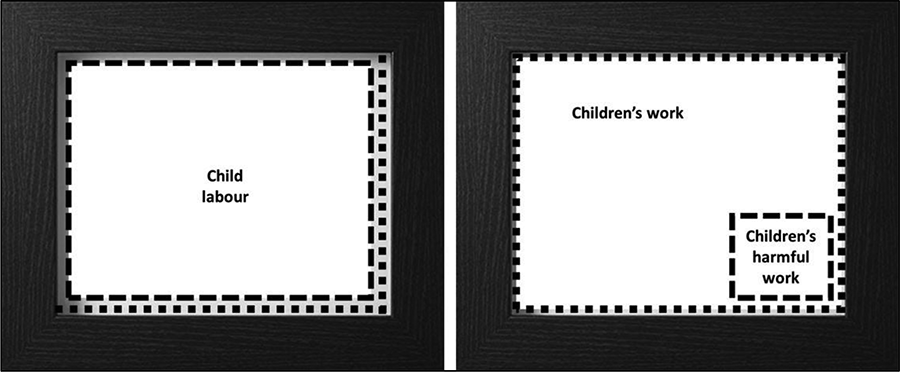
Two problem frames.
The right-hand side of the figure frames the problem of children’s harmful work as a part of the broader canvass of children’s work. Of course, the extent of harmful work, and thus the size of the problem (the square in the bottom right corner), is an empirical question – our purpose here is to illustrate the issue. This simple change of language, and the introduction of a new relational element to the problem framing, opens important analytical possibilities. For example, at the level of individual children, families, communities, commodities or generations, what are the dynamics between work and harmful work? How are these dynamics affected by poverty, the quality of educational provision, technological change in agriculture and beyond, new models of value chain governance and so forth? The suggestion here is that the key to addressing children’s harmful work lies in the understanding of these dynamics and drivers.
The ILO is the most important global player in debates around, and efforts to address child labour and eliminate it worse forms. It too now recognizes that ‘Not all work done by children should be classified as child labour that is to be targeted for elimination’ and that ‘Children’s or adolescents’ participation in work that does not affect their health and personal development or interfere with their schooling, is generally regarded as being something positive’ 3 (also see ILO, 2018). Unfortunately, these positive aspects of children’s work, and the importance of situating children’s harmful work on a broader agentive, social and political canvass, are still most often forgotten in the dominant child labour discourse. This is evidence of the continuing discursive power of the formal, institutional understanding of child labour and its abolitionist underpinnings.
Future directions
Let’s assume there is broad agreement that all efforts should be made to minimize the risk of harm to children or to anyone else working in African agriculture. Let’s also assume that this holds equally across the whole agricultural sector – from international agribusiness to smallholders, and from commodities produced for export to those produced for domestic markets and own consumption.
Agriculture is a hazardous business, and, as in all hazardous work environments, the first line of defence against harm is to reduce and manage hazards. Appropriately sized and ergonomically designed tools, protective equipment, secure chemical storage, training and regulation are some obvious ways to reduce and manage common hazards associated with farming. Measures like these could be designed to benefit both child and adult workers. However, their impact will depend on availability and affordability, and on the state’s communication and enforcement capacities (which cannot be taken for granted in much of rural Africa or in rural areas throughout the globe). Such measures also require appropriate forms of coordination within the agricultural sector to identify different types of hazard and entry points for action across the whole range of stakeholders. There may be an important opportunity to promote local production of child-appropriate equipment and protective gear.
With specific reference to children’s harmful work in African agriculture, it is now time to seriously consider more realistic and grounded approaches (Sabates-Wheeler and Sumberg, 2020). For example, these approaches must recognize the very stark trade-offs faced daily by children and their families, trade-offs that pit a contribution to food security, or the ability to purchase medicine, against fees to attend a poorly staffed and possible ineffective rural school. Another important trade-off sets hazard and potential harm on the farm, against the hazard and potential harm that especially girl children can experience at school (or moving between home and school). In too many cases, the frameworks, regulations and language of rights that specify the details of the work that is allowed for children of different ages are too rigid and not fit for purpose. They result in impossible choices for children and households that face multiple and multidimensional challenges. Framing children’s economic activities as children’s work instead of child labour, and situating their activities on a broader canvass, should promote better and more effective policy by making children’s and their families’ understandings of these trade-offs more explicit. More broadly, there is a need for research on local, age and gender disaggregated understandings of the hazard- and harm-scapes associated with different forms of children’s work in agriculture (Maconachie et al., 2020). Grass-roots initiatives to mitigate hazards and harms also deserve attention, including collective action by child workers (e.g. Van Hear, 1982).
For too long in this domain, the perfect has been allowed to be the enemy of the good. It is now time to replace the narrow focus on child labour with a broader appreciation of the interplay between the governance of agricultural value chains, children’s work and its wider contribution to the family unit, and children’s involvement in work that harms them. Such a shift provides an important opportunity to begin to right this wrong.
Footnotes
Authors’ note
The opinions expressed are those of the authors and do not necessarily reflect the views or policies of the UK government.
Declaration of conflicting interests
The author(s) declared no potential conflicts of interest with respect to the research, authorship, and/or publication of this article.
Funding
The author(s) disclosed receipt of the following financial support for the research, authorship, and/or publication of this article: This research is an output of the programme Action on Children’s Harmful Work in African Agriculture (ACHA). ACHA is funded by the UK Department for International Development.
