




Abstract
Co-innovation can be effective for complex challenges – involving interactions amongst multiple stakeholders, viewpoints, perceptions, practices and interests across programmes, sectors and national systems. Approaches to challenges in the primary sector have tended to be linear, where tools and outputs are developed by a few, mostly scientists/researchers, and then extended to stakeholders. A co-innovation approach first deciphers and delineates the biophysical, societal, regulatory, policy, economic and environmental drivers, constraints and controls influencing these challenges at multiple levels. Second, stakeholder interactions and perspectives can inform and change the focus as well as help in co-developing solutions to deliver agreed outcomes. However, there is limited systematic and comparative research on how co-innovation works out in different projects. Here we analyse the results of applying a co-innovation approach to five research projects in the New Zealand primary sector. The projects varied in depth and breadth of stakeholder engagement, availability of ready-made solutions and prevalence of interests and conflicts. The projects show how and why co-innovation approaches in some cases contributed to a shared understanding of complex problems. Our results confirm the context specificity of co-innovation practices.
Keywords
Introduction
Understanding how innovation happens and ways research projects can be optimized to increase their innovation potential may enhance rates of adaptation and adoption of technologies from research, science and technology investments (Douthwaite et al., 2001; Hall et al., 2001; Schut et al., 2014). To address shortcomings in technology diffusion and uptake approaches, there is increased focus on bringing together relevant agricultural sector actors in a coordinated, interactive fashion through co-innovation (Dogliotti et al., 2014; Hall et al., 2001; Klerkx et al., 2012). Literature on agricultural innovation processes (Klerkx et al., 2012; World Bank, 2006) indicates an evolution and broadening of theoretical perspectives and points at a shift from linear, technology-transfer-oriented approaches, to co-innovation approaches, these being more evolutionary, multidisciplinary, using multistakeholder input, and considering social, economic and institutional as well as technical changes (Klerkx et al., 2012).
Co-innovation is an iterative process that brings together knowledge from many stakeholders, to support changes in technology, markets, regulations and other practices that support the commercialization and implementation of the knowledge to improve production, exports, profits and/or the environment (Garb and Friedlander, 2014; Klerkx et al., 2010; Leeuwis, 2004; Röling, 2009). This process requires negotiation amongst previously unconnected stakeholders with competing values, worldviews, interests, planning horizons, incentives and accountability mechanisms (Botha et al., 2014; Johnson and Gregersen, 1995; Schut et al., 2014). Co-innovation practice is context-specific and adaptive: how and when co-innovation is implemented must be tailored to the particular situation and may change over time (Hall, 2005; Klerkx et al., 2017; Neef and Neubert, 2011; Schut et al., 2015). ‘Explicit or implicit choices are usually made as to who might take part’ and ‘the question of who participates – as well as who is excluded and who exclude themselves – is a crucial one’ (Cornwall, 2008: 275), especially when the transaction costs associated with increased interactions amongst stakeholders outweigh perceived benefits (Ortiz et al., 2013). While this is increasingly acknowledged, there is relatively limited comparative research unravelling how under a given overarching programme, different co-innovation projects may work differently (except, e.g., Klerkx et al., 2017), though this is highly important to stimulate learning within a programme context (Thiele et al., 2007).
These implementation differences are assessed in a large New Zealand (NZ) government-funded research programme termed primary innovation (PI) initiated in 2012 with two aims: (i) implement and evaluate the effectiveness of co-innovation approaches in the primary sector (Botha et al., 2014) and (ii) identify barriers and enablers to co-innovation in the NZ primary sector (Turner et al., 2016, 2013). To achieve the first aim, the PI programme became involved in five NZ primary-sector research projects where attempts have been made to apply a co-innovation approach. Each of the projects applied nine principles of co-innovation that underpin and inform activity. These principles were adapted from Nederlof et al. (2011) and were deliberated on by Coutts et al. (2016).
Here we focus on two co-innovation principles that were applied in practice across all innovation projects: (i) take time to understand the problem from many different views and (ii) be inclusive in terms of diversity of stakeholders. These principles were seen as those that could most affect a project’s focus and direction. We use interpretations of what constitutes innovation, following stylized innovation models articulated in Klerkx et al. (2012) to indicate the position of each project in the range from technology transfer to co-innovation in the agricultural innovation system (AIS). We also use Pretty’s typology of stakeholder participation to identify different types and degrees of participation reflecting the diversification of the projects’ goals and structures (Pretty, 1995), namely (i) manipulative participation, (ii) passive participation, (iii) participation by consultation, (iv) participation for material incentives, (v) functional participation, (vi) interactive participation and (vii) self-mobilization. This typology has its constraints (Leeuwis, 2004; Neef and Neubert, 2011) but highlights the importance of genuine and meaningful participation. We argue that Pretty’s typology remains useful for analysis of projects over time and across different projects. Three research questions, primarily focusing on stakeholder involvement in problem definition in the research projects, guided our analysis: (i) did the co-innovation process result in a change of problem definition? (ii) if the definition had changed, to what extent can it be attributed to stakeholder involvement? and (iii) what were the barriers and opportunities to stakeholder participation shaping problem definition?
Innovation project descriptions
Three projects (water use efficiency (WUE), tomato potato psyllid (TPP) and timber segregation) were led by research organizations, and the other two (heifer rearing and nutrient management) were led by industry organizations. The projects started independently at different times, some before the PI programme started in October 2012 and some after. Each has progressed at a different rate because of various degrees of stakeholder involvement, a key part of co-innovation, and varying divergence of worldviews, interests, norms and values, planning horizons, incentives and accountability mechanisms of those involved (Botha et al., 2014; Klerkx et al., 2012). In the following sections, we introduce the projects to provide context for the interactions taking place. The projects serve as case studies deliberately chosen to cover two interdependent characteristics of problems in NZ primary industries that influence the effectiveness of co-innovation, including knowledge contestability (Andresen et al., 2000) and a choice of mechanism for change; regulation (e.g. targets), market signals (e.g. pricing) and voluntary approaches (e.g. information distribution, extension, education) (Röling, 2009). None of the mechanisms for change function in isolation, but some have more influence in certain circumstances than others. The five projects investigate problems ranging from where knowledge is uncontested to where it is highly contested. Where knowledge is uncontested, the scope of the problem is well agreed, while with highly contested knowledge, different stakeholders view the problem scope differently. Knowledge becomes more contested at larger scales as the number of stakeholders increase and therefore competing values and perspectives and potential solutions also correspondingly increase (Andresen et al., 2000).
Water use efficiency
The aim of the WUE project was to improve on-farm irrigation decisions using better characterization of current irrigation demands and accurate, accessible short-term weather forecasting. This project was piloted on five NZ South Island farms within an irrigation scheme. The research and PI projects started in October 2012. The farmers were provided with farm-specific observed data on current rainfall, soil moisture, soil temperature, drainage and evapotranspiration, and region-specific 2-, 6- and 15-day rainfall forecasts (Srinivasan et al., 2015). The data were shared with farmers in real time via a dedicated website and daily email. Based on these data, farmers make informed irrigation application decisions. Annually, the farmers, irrigation scheme managers, researchers and other relevant stakeholders (e.g. members of a local catchment committee, personnel from neighbouring irrigation schemes and regulatory and government agencies) meet to review the irrigation decisions made during the season. These meetings are a forum for sharing and discussing ideas as well as reviewing and refining the information provided. These workshops and other formal and informal meetings also reshape the problem as well as the solutions achievable (Srinivasan et al., 2016).
Tomato potato psyllid
TPP is a vector of the bacterium Candidatus Liberibacter solanacearum (CLso) which became a major problem in NZ potato crops in 2008. The aim of the TPP project was to assist the NZ potato industry to realize export growth by addressing the industry’s pressing need for economically and environmentally sustainable control solutions for the TPP/CLso complex. The research project commenced in October 2013, with the PI programme involved from June 2014. The research project entails fundamental research in three mainly laboratory-based objectives: (i) sensory cues, (ii) population genetic variability and (iii) host plant response, while the fourth objective was initially stated as ‘knowledge transfer to stakeholders’. The science objectives each had an objective leader, while the fourth objective did not. Knowledge transfer was not planned in the original project set-up until complete tools or knowledge were available (at project completion). Unlike in the other case studies, the innovation project leader was not the TPP research project leader.
Heifer rearing
This project was a DairyNZ-led initiative focusing on the improvement of dairy herd reproductive performance by lifting the proportion of heifers entering the national herd at target live weight. Industry data indicated that 73% of such heifers were 5% or more below target (McNaughton and Lopdell, 2012). This represents a national loss of $120 million p.a. in dairy farm profit industry-wide (Brazendale and Dirks, 2014). The research project and PI commenced in September 2013. The project initially formed a stakeholder industry advisory group which completed a causal analysis for understanding the influences on under-grown heifers in October 2013. Drivers and obstacles for improvement were identified; however, the number of farmer participants was proportionally low.
Nutrient management
This project focused on activities on a network of Canterbury commercial farms, in NZ’s South Island. This network is part of a large government-funded research programme combining the expertise and resources of three Crown Research Institutes, one University and two industry-good bodies and targets the twin challenges of reducing nitrate leaching and increasing profitability of arable, sheep and beef, and dairy farms. Experiments were conducted on pasture mixtures and crop sequences, and modelling of plant/soil and animal components as well as farm systems incorporating the options developed. While the topics were technical (Pinxterhuis et al., 2015), the programme approach was based on co-innovation principles to achieve maximum uptake of options (Edwards et al., 2015). The farmers’ network is involved to co-develop the options with the research and development (R & D) community, test them on-farm and demonstrate to the wider community. The project started with the development of the research proposal from late 2012, incorporating co-innovation principles from the PI programme.
Timber segregation
This project was part of a larger government and industry co-funded programme that aimed to increase the value realized from existing forests through the development of cost-effective approaches to characterize and deal with variation in wood properties within and between trees (Moore and Cown, 2015). This would give wood processors increased confidence in the properties of the resource, so that more of the harvested resource was processed into added-value products, rather than exported as raw logs. The project started in October 2013, having been identified as a PI case study 12 months earlier. It thus deliberately set out to take a co-innovation approach during the proposal writing stage as well as during the project itself, particularly as a wide spectrum of views on the benefits of segregation was recognized. The specific research aim was developed through a series of workshops and roadshows with stakeholders from the forestry and wood-processing sectors including technical managers, executive managers and staff from government and sector research organizations. Once the project funding was approved, the detail was revised with the industry co-funding partners. In addition to a governance group, an innovation cluster group was formed whose membership included researchers, forest growers, wood processors, industry associations and segregation tool manufacturers. This group meets annually to share ideas, discuss the research and develop a deepening understanding of problems and potential solutions.
Methods and analytical framework
To compare the five projects, the innovation project leaders, all biophysical scientists and/or other project team members and a social science research team conducted a workshop in February 2016. The people most heavily involved in managing the projects and monitoring outcomes brainstormed the project goals, stakeholders and progress from the proposal stages to the present (February 2016; 2–3 years in for all projects). This article uses data collected from the five individual projects as well as personal experiences of the project teams and leaders. Each project was considered in relation to their type of stakeholder inclusion (Pretty, 1995) and their position on the AIS continuum from technology transfer to co-innovation, particularly project flexibility over time, on a scale of 1–5 (Klerkx et al., 2012). This enabled comparisons in terms of project goals, structure and stakeholder involvement, and their effects on stakeholders’ understanding of the problem and project focus to be determined.
How the innovation projects have changed
Innovation projects at proposal-writing stage
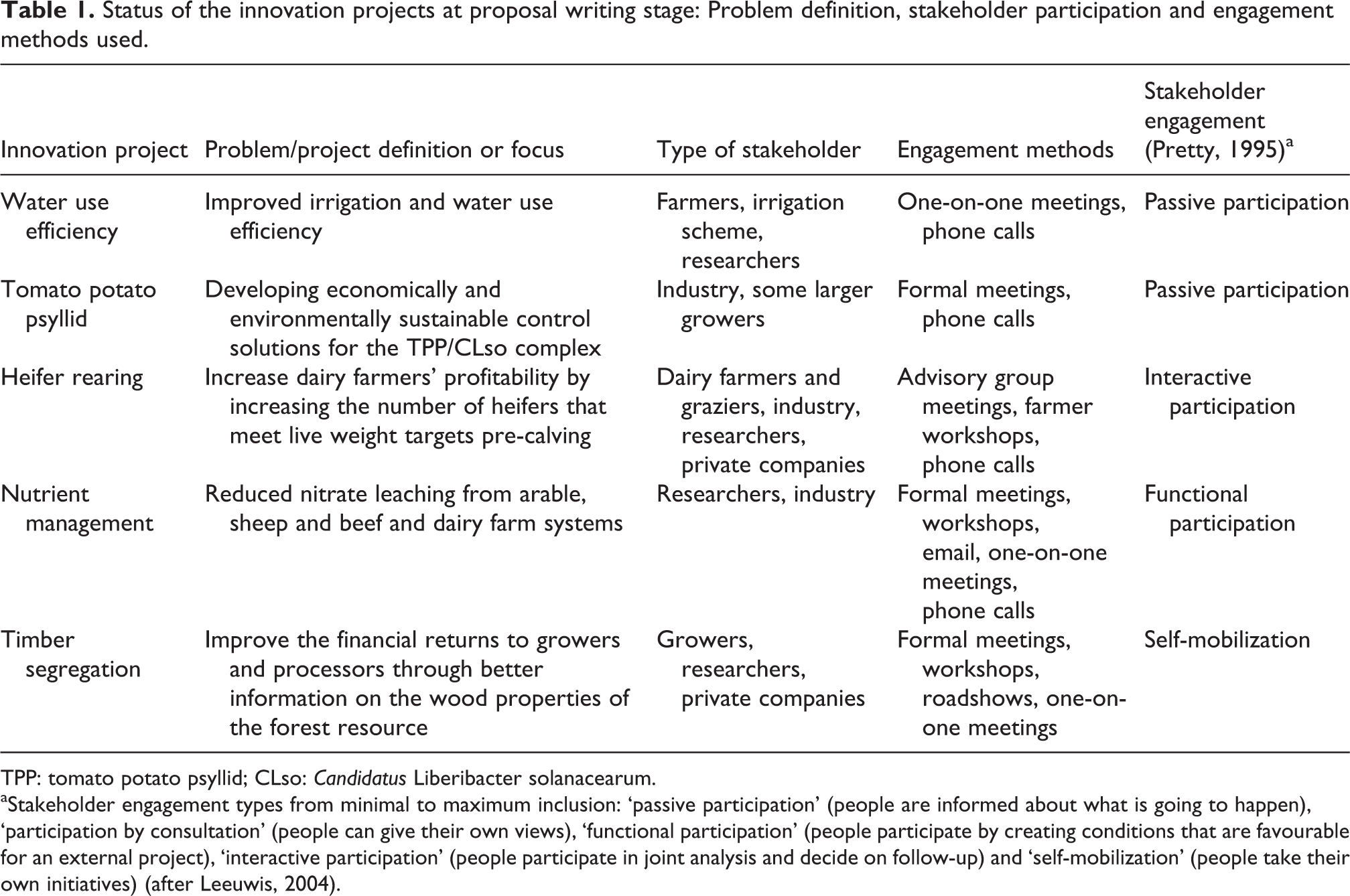
In all projects, stakeholders were involved at proposal-writing stage, giving formal and informal input (Table 1) (Pretty, 1995). The projects were also assessed for conceptual, organizational and institutional features connected with theoretical perspectives on agricultural innovation (Table 2) (Klerkx et al., 2012). Nutrient management and timber segregation, and to a lesser extent heifer rearing, used more of an AIS perspective at the proposal-writing stage than the other projects, which resulted in an opportunity to create a shared understanding of the problem and build trust.
Status of the innovation projects at proposal writing stage: Problem definition, stakeholder participation and engagement methods used.
TPP: tomato potato psyllid; CLso: Candidatus Liberibacter solanacearum.
aStakeholder engagement types from minimal to maximum inclusion: ‘passive participation’ (people are informed about what is going to happen), ‘participation by consultation’ (people can give their own views), ‘functional participation’ (people participate by creating conditions that are favourable for an external project), ‘interactive participation’ (people participate in joint analysis and decide on follow-up) and ‘self-mobilization’ (people take their own initiatives) (after Leeuwis, 2004).
Analysis of the five innovation projects at proposal-writing stage using six characteristics of AIS.a,b
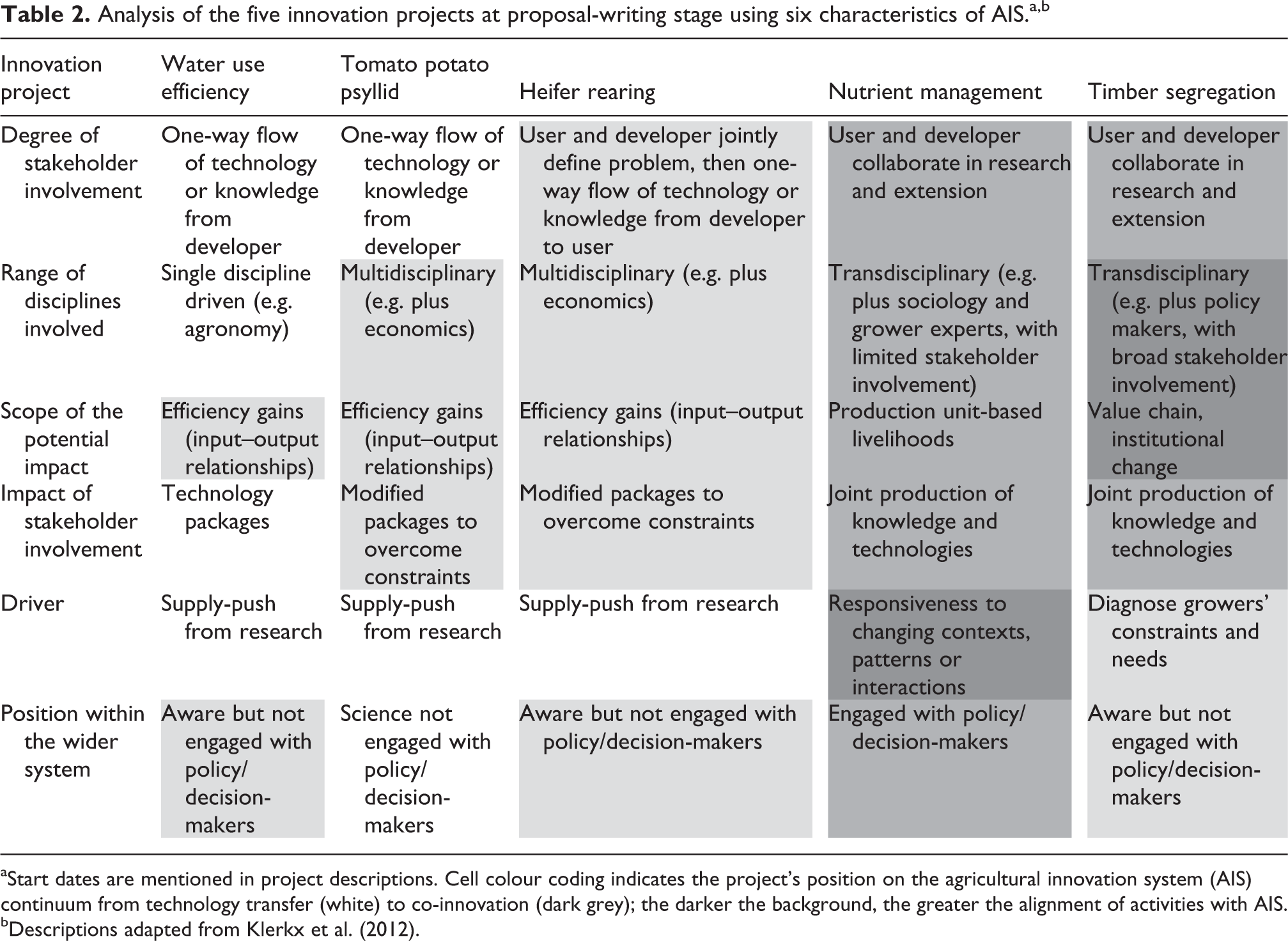
aStart dates are mentioned in project descriptions. Cell colour coding indicates the project’s position on the agricultural innovation system (AIS) continuum from technology transfer (white) to co-innovation (dark grey); the darker the background, the greater the alignment of activities with AIS.
bDescriptions adapted from Klerkx et al. (2012).
Innovation projects in 2016
In February 2016, the application of co-innovation principles in the projects had led to a reshaping of the problem/project focus, except in the TPP project (Table 3), which is locked into contracted milestones with a government funding agency, thus scored ‘inflexible’ in terms of capacity to reshape the problem (Table 4). All the projects moved more towards AIS in most categories over the period in which the co-innovation principles were applied (Table 4). The type of stakeholder and the engagement methods increased for all projects, except for TPP, since solutions are still under development through tightly managed research aims (Tables 1 and 3). Two barriers were identified for TPP. Firstly, the research project had already started before the PI team became involved, so co-innovation was introduced to project team members after traditional project development and delivery processes were established. Secondly, the PI team identified through interviews with key people that the intended knowledge exchange with stakeholders was seen as largely linear (Vereijssen et al., 2015) and engagement awaits the production of technical solutions (e.g. resistant/tolerant cultivars). The PI team has therefore offered support to deliver the knowledge transfer objective.
Status of the innovation projects after applying co-innovation principles: Problem definition and stakeholder participation (February 2016).
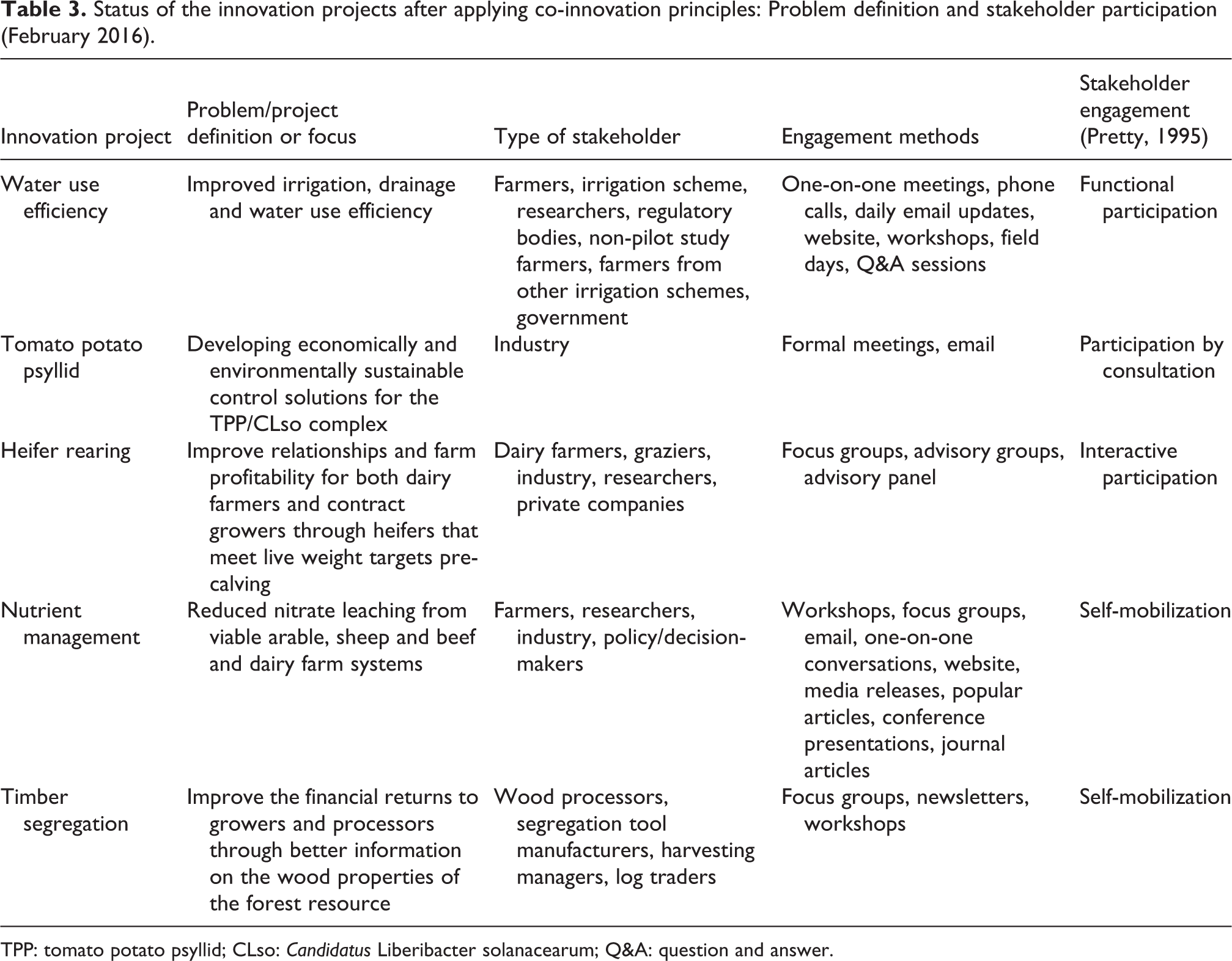
TPP: tomato potato psyllid; CLso: Candidatus Liberibacter solanacearum; Q&A: question and answer.
Analysis of the five innovation projects in February 2016 using six characteristics of AIS.a,b
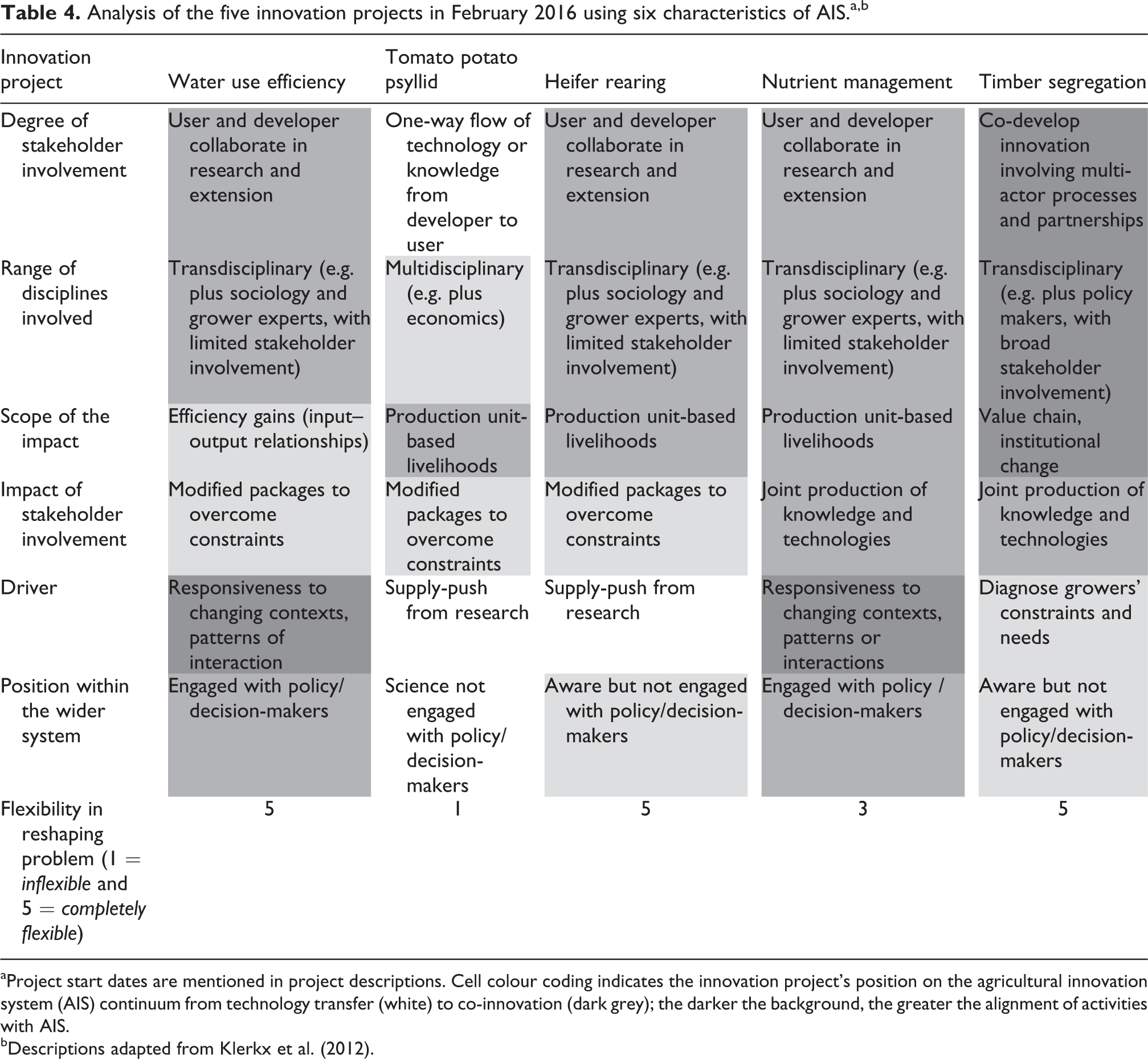
aProject start dates are mentioned in project descriptions. Cell colour coding indicates the innovation project’s position on the agricultural innovation system (AIS) continuum from technology transfer (white) to co-innovation (dark grey); the darker the background, the greater the alignment of activities with AIS.
bDescriptions adapted from Klerkx et al. (2012).
A significant change in stakeholder type and engagement happened in WUE and heifer rearing. In WUE, a co-innovation approach was deliberately embedded from the outset. Stakeholders were involved in evaluating the use of weather-forecast-based irrigation practices. Stakeholder views were sought through workshops and one-on-one meetings to ensure the processes and the resulting products were viable and practical. In heifer rearing, the project leader, DairyNZ, proposed a series of regional focus groups in November 2013 to address the lack of farmer involvement with advisory groups. The purpose of the focus groups was to derive perspectives and solutions from farmers that were most likely to implement any changes to their practices. The emphasis for the solution shifted as a result of these focus groups from a technical approach to increasing heifer live weight to emphasizing the relationship between contract heifer graziers and stock owners. Focus groups identified key stakeholders as Beef+Lamb New Zealand and the Livestock Improvement Corporation. In response to the feedback, industry advisory group members were integrated into area-of-expertise working groups and a governance group for the project was established with key stakeholders.
Discussion
Changes in the projects described over time (Tables 2 and 4) suggest a shift in the spectrum towards increasing application of co-innovation principles. There can be a perception that using a co-innovation approach in research projects is more advanced because it is a newer development in social science thinking. However, when a problem is less complex and science can provide a simple solution, a technology-transfer method may be the simplest, most economically viable option, as organizational, and regional/state/national policy has little influence on improvements or outcomes. So depending on the problems’ complexity, different approaches need to be chosen, defined as dynamic research configurations by Schut et al. (2014), or these are dictated by circumstances. The question for each project faced was: ‘which one(s) of the nine co-innovation principles (Coutts et al., 2016) is/are most important to achieve change and when should they be applied to best effect?’ The extent and depth to which co-innovation principles were applied differed between projects. Here we discuss how implementing co-innovation approaches affected the first and second co-innovation principles to (i) take time to understand the problem from many different views and (ii) be inclusive.
Did the co-innovation process result in a change in problem definition?
When evaluating the shift towards co-innovation, the projects most quickly able to change and adapt were timber segregation, nutrient management and heifer rearing. In all three, their intent to apply co-innovation came before the establishment of project milestones at the proposal-writing stage, in two cases (timber segregation and nutrient management) before funding confirmation. Nutrient management has not seen changes in the problem definition as such, but because of the approach (Edwards et al., 2015) and continued engagement of end users (industry bodies and farmers in the network), some changes to the approach have been made and new R & D questions have been formulated. These guide the project activities, with an emphasis on integrating solutions in farm systems and supporting solution implementation on-farm. Similarly for timber segregation, the upfront and ongoing engagement with end users have resulted in changes in the approach to addressing the problem, rather than the problem definition itself. Within this project, the problem definition and approach are constantly revisited.
WUE has witnessed the most transformational change, with co-innovation principles becoming embedded in the project over 4 years rather than just before funding confirmation, as in timber segregation, nutrient management and heifer rearing. WUE integrated flexibility by facilitating stakeholder interactions and bringing in additional stakeholders as necessary. The project expanded the stakeholders’ thinking by looking for other opportunities (e.g. economic value of irrigation and drainage management) to enhance their farming, economically and environmentally. For heifer rearing, the application of the defined co-innovation principles did not influence every level of the project because the problem of under-grown heifers is neither highly complex nor constrained by organizational/national policy. TPP has faced the greatest challenge in integrating co-innovation, as the PI became involved after project commencement. While the PI team may have a wider view of the activities required to address the TPP problem, milestones were written with a defined view of the science required. Overall, the integration of co-innovation principles at the inception of a project accelerated uptake of the approach and improved responsiveness and buy-in, leading to better shared understanding of the problem and processes required to address it.
To what extent can the change in problem definition be attributed to stakeholder involvement?
Except for TPP, the type of stakeholders and engagement methods increased when co-innovation principles were adopted. Managing stakeholder participation is a time-consuming and ongoing process mostly led by project leaders. In WUE, an external driver forced change in stakeholder behaviour and thinking. During the study, the regulatory authority introduced limits to on-farm water use and capped the amount of irrigation that can be lost as drainage. This provided an external policy stimulant for farmers to look for supporting technologies. The driver to adopt new practices thus changed from a research-based supply push to stakeholder demand to improve the ability to respond to emerging contexts.
In heifer rearing, shifts in the problem definition were incremental, with wider stakeholder engagement and problem exploration having two effects: (i) widening the base of stakeholders and organizations involved and (ii) redefining the scope and potential impact, from efficiency gains for dairy farmers to production livelihoods of contract graziers. Widening stakeholder engagement did not change the view of the problem but confirmed its parameters. The apparent failure of earlier attempts to address problems associated with heifer rearing may be from a lack of emphasis on the relationship between stock owners and their contract graziers and mechanisms for optimizing the business practices of both. In timber segregation, engagement was organized two-way, with science managers from Scion and industry research brokers involved in formally building support, and a small group of science leaders engaging with a wide range of forestry sector stakeholders to co-develop the scope of the proposed research. Stakeholder engagement had two broad aims: (i) to develop an agreed science programme and (ii) to build co-funding support.
What were the barriers and opportunities to stakeholder participation shaping problem definition?
Several project-specific barriers and opportunities were identified that hindered or enhanced the co-innovation process. The ability to respond to stakeholder feedback and insights and therefore the flexibility of the project is driven by individuals within projects (Röling, 2009), more so than the limitations or context of funding mechanisms. Project leaders’ comfort with loosely defined milestones or their willingness to renegotiate milestones with funding bodies has been the greatest influence on adaptability. In timber segregation, the industry could ‘adapt or die’, so sector motivation for co-innovation was high; while in WUE, the social context shifted, providing an opportunity ‘too good to miss’, with researchers and stakeholders ‘riding the wave’ in response (project leader quotes). This leads to the question ‘Does a co-innovation project have to be the source of innovation (creating new technologies or practices), or by applying co-innovation is it possible to adapt existing technologies and practices for application by engaging with the wider context?’ resonating with ideas by Douthwaite et al. (2001). Hence, while co-innovation may have a different aim, it is always useful for adapting technologies to users’ needs or for creating an enabling environment (see also Garb and Friedlander, 2014). Overall, flexibility and adaptability, common themes across the projects, were important in achieving positive results from a co-innovation approach. However, the institutional setting and the ability to create the space and buy-in for co-innovation also mattered (see also Neef and Neubert, 2011).
Conclusions
Our experience confirms the context-specificity of co-innovation practices (e.g. Hall, 2005; Klerkx et al., 2017; Schut et al., 2015). By adopting at least the first two co-innovation principles when developing the proposal, or very early in the project, some projects have adapted to new knowledge brought by stakeholders. In some, the focus of the project was changed, and in others, the approach taken to develop solutions changed. The willingness and ability of project leadership (innovation project leaders generally being natural scientists normally doing biophysical research) to engage with a range of stakeholders, to change project scope or its research approach, was crucial for continued stakeholder engagement. We conclude from our experience that to be successfully implemented, co-innovation requires an adaptable mindset rather than strict adherence to a single method.
Footnotes
Acknowledgement
We thank the Primary Innovation team for their valuable input over the last 2.5 years and the wider innovation project teams for their support.
Declaration of conflicting interests
The author(s) declared no potential conflicts of interest with respect to the research, authorship and/or publication of this article.
Funding
The author(s) disclosed receipt of the following financial support for the research, authorship, and/or publication of this article: We acknowledge the Ministry of Business, Innovation and Employment, and New Zealand dairy farmers through DairyNZ (RD1429) for funding the ‘Co-learning and co-innovation for increased impact’ project (CONT-30071- BITR-AGR).