




Abstract
This article describes a process for stimulating engagement among change agents to develop a shared understanding of systemic problems in the agricultural innovation system (AIS), challenge prevalent institutional logics and identify actions they might undertake to stimulate system innovation. The process included (i) multiple actors from the AIS, (ii) reflexivity regarding underlying institutional logics, (iii) an iterative process of practical experimentation to challenge current practices and (iv) actions to encourage generative collaboration. Problem structuring supported change agents’ development of a shared understanding of systemic problems and the role that interrelationships, perspectives and boundaries play in reinforcing or destabilizing current practices and institutional logics. Involving multiple actors from the AIS in challenging underlying institutional logics and encouraging collaboration appeared to stimulate project-level actions and recognition of wider AIS barriers. Collective system analyses for addressing structural changes, including the potential for system innovation, were beneficial. Simultaneously resolving innovation project actions with AIS actions remains a challenge.
Keywords
Introduction
In response to earlier identified shortcomings of a science-driven, linear, technology transfer approach to innovation in New Zealand (NZ) (Davenport et al., 2003; Leitch and Davenport, 2005), there is interest in bringing together relevant actors from the primary sector to increase innovation in a coordinated and interactive fashion through co-innovation (Dogliotti et al., 2014; Klerkx et al., 2012). However, the ability of actors to co-innovate is influenced by the structural composition of the agricultural innovation system (AIS): the presence of actors, their interactions, the institutions that influence their behaviour, and supportive physical, financial and knowledge infrastructure and incentives (Nettle et al., 2013; Wieczorek and Hekkert, 2012).
Often systemic problems are related to the absence or weakness of these structures (Wieczorek and Hekkert, 2012). To address this, policies that proactively stimulate and support co-innovation at the systems level are needed (Wieczorek and Hekkert, 2012). Many countries, including NZ, have yet to fully embed such policies (Nettle et al., 2013) by addressing the institutional logics underpinning systemic problems (Fuenfschilling and Truffer, 2013; Kivimaa and Kern, 2016). Institutional logics are ‘the socially constructed, historical patterns of material practices, assumptions, values, beliefs, and rules by which individuals produce and reproduce their material subsistence, organize time and space, and provide meaning to their social reality’ (Thornton and Ocasio, 1999: 804).
Some authors (Leitch et al., 2013) argue that innovation policy learning therefore needs to make visible these underpinning institutional logics in order to generate new analyses and potential solutions for systemic problems that have proven difficult to resolve. Research on system innovation (e.g. Fischer et al., 2012) has shown this requires active engagement with potential change agents, such as policymakers, researchers and industry leaders, who may hold different and potentially conflicting perspectives about broader systemic problems and underpinning institutional logics (Beers et al., 2015; Turner et al., 2016). This engagement would seek to develop a shared understanding of systemic problems, challenge prevalent institutional logics and identify actions that potential change agents might individually and collectively undertake to bring about system innovation in the AIS.
The aim of this article was to describe a process for achieving this using key systemic problems and their underlying institutional logics to stimulate dialogue, formation and ongoing interaction among actors, in what we refer to as communities for change (CfC). The activity described in this article is part of a large government-funded programme, Primary Innovation, that seeks to facilitate change in the NZ AIS to effectively support co-innovation in the primary sector (Botha et al., 2014). Our contribution to the literature on AIS is addressing a challenge identified by Turner et al. (2016) – that of developing interventions in the AIS in order to institutionalize policies to stimulate co-innovation (Howells and Edler, 2011).
Methodology
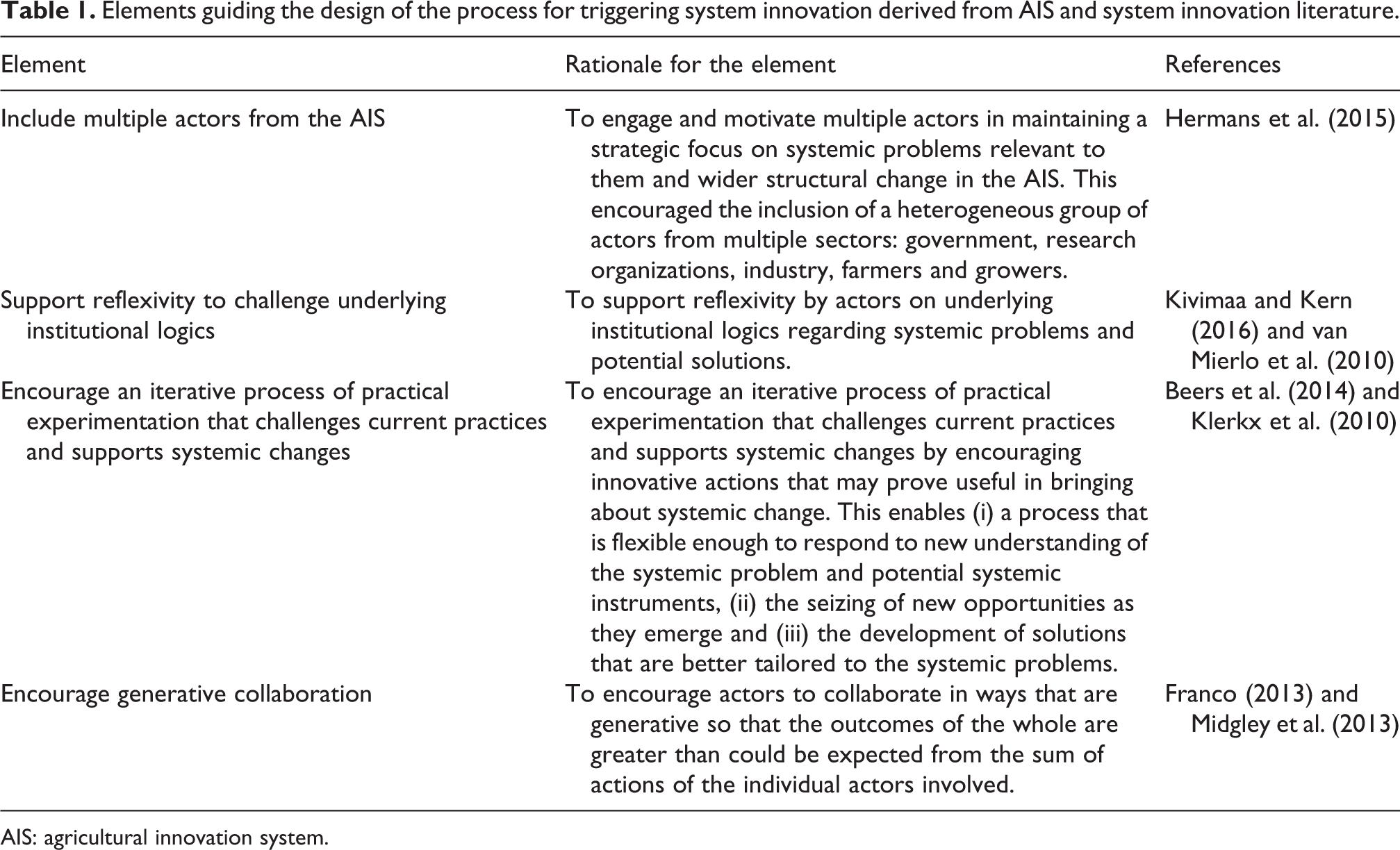
The aim of the process described here was to actively engage a diverse and distributed CfC in reflexive policy learning to collectively challenge and address institutional logics underpinning systemic problems. To achieve this, a collaborative process was designed with four elements (Table 1). These elements were used to guide process design. Additionally, the process also needed to utilize fit-for-purpose, low-cost processes and infrastructure to work with a CfC distributed throughout NZ and with limited time to contribute. This limited opportunities for face-to-face meetings.
Elements guiding the design of the process for triggering system innovation derived from AIS and system innovation literature.
AIS: agricultural innovation system.
Identifying key systemic problems in the AIS
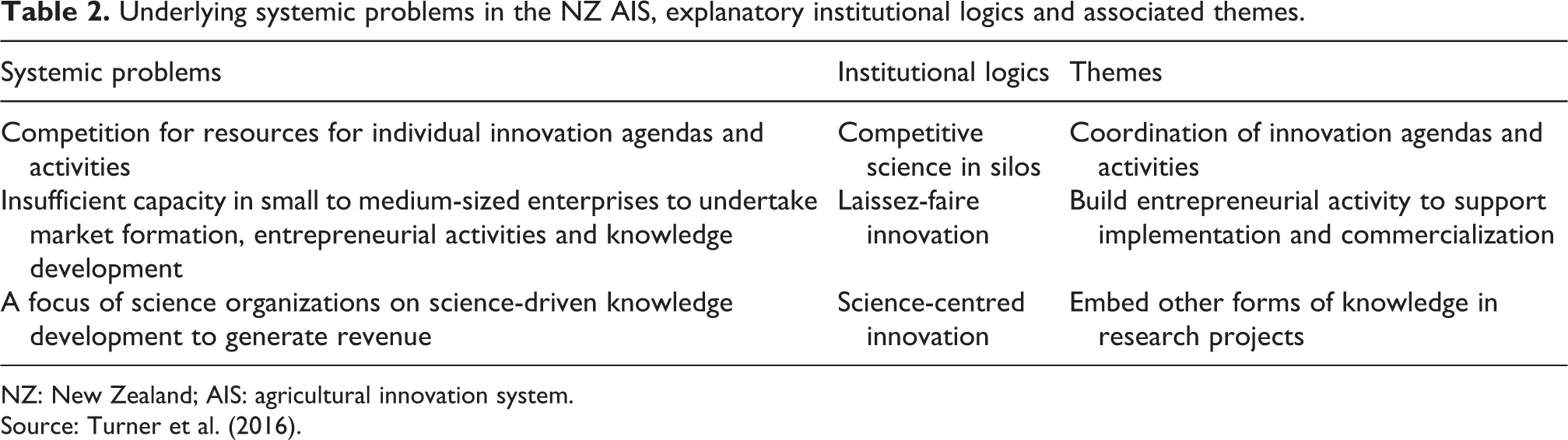
To engage and motivate multiple actors to maintain a strategic focus on systemic problems relevant to them and wider structural change in the AIS, 30 actors in the AIS were interviewed using a systemic policy analysis framework (Wieczorek and Hekkert, 2012) to take a holistic innovation systems view (see Turner et al., 2016 for details). The individuals interviewed were assumed to play a key and catalysing role in shaping the direction and speed of innovation (Turner et al., 2016). The semi-structured interviews probed the actors’ roles in the NZ AIS and the perceived systemic problems (or barriers) to innovation. The interviews were also used to identify different needs from enhanced innovation. This information was used to link potential solutions to actor needs. Interviewees were then brought together in a workshop to collectively validate, reflect on and explore the key systemic problems. The interviews, workshop and subsequent data analysis identified underlying causes of systemic problems that hinder effective functioning of the NZ AIS, which were then clustered into three themes (Turner et al., 2016). Table 2 describes these themes, the systemic problems they relate to and the underlying institutional logics.
Underlying systemic problems in the NZ AIS, explanatory institutional logics and associated themes.
NZ: New Zealand; AIS: agricultural innovation system.
Source: Turner et al. (2016).
We used value-added documents (VADs) (Beers et al., 2015) to describe the three themes (Table 2) in order to support actors’ reflexivity on institutional logics underlying systemic problems and potential solutions. Each VAD was structured to include (Beers et al., 2015) (i) a description of Primary Innovation research activities; (ii) identification of a systemic problem in the NZ AIS, from the multiple perspectives of different actors in the AIS; (iii) relevant research results; and (iv) multiple potential activities that different actors might carry out to deal with the problem. The three systemic problems have distinct foci that overlap. The VADs were not intended to provide change agents with a definitive diagnosis and prescription for change but served to stimulate discussion among them about what actions might be possible and/or desirable by different actors in the AIS.
Stimulating reflexivity and coordinated action in the AIS
The purpose of establishing CfC was to engage AIS actors with innovation system level change in a way that would stimulate reflexivity and lead to coordinated action in the AIS. To encourage actors to collaborate around each of the three systemic problems (Table 2) in ways that are generative, problem structuring methodologies (see below) were used to support change agents to develop not only a shared understanding of these problems but also to understand the role that interrelationships, perspectives and boundaries play in defining issues and potential solutions (Midgley et al., 2013). This explicitly systemic approach opens up new framings, strategies and actions (Franco, 2013).
CfC workshops
To date, there have been two workshops aimed at establishing the CfC drawing on invitees from across industry, government and research organizations in the NZ AIS. The first, with seven participants, had the explicit purposes of (i) creating a shared ambition for change, (ii) beginning collaborative problem structuring to understand and plan for relevant change and (iii) forming CfC around each systemic problem. The second workshop, with 20 participants, had a similar purpose. Each of the workshops used the VADs as ‘catalysts’ for problem structuring and as triggers for action. As such they can be considered boundary objects (Klerkx et al., 2012); an entity that has sufficient shared meaning between diverse actors to enable collaboration but sufficient plasticity of meaning to enable each actor to use the object in their own situation (Star and Griesemer, 1989). The workshops followed the four design elements (Table 1): Multiple participants from a range of expertise were gathered; Systems thinking tools were used to support critical reflection on what constitutes the problem area and prompt new problem framings leading to alternative institutional logics that might contribute to systemic change (‘problem structuring’ – Mingers and Rosenhead, 2004); Possible change initiatives that were co-created in an interactive and iterative manner; and The process brokered the bringing together of solution elements to promote outcomes greater than participants could devise separately.
The core of the workshops was the second element, which makes visible how different institutional logics shaped how problems were understood to structure dialogue among participants with differing viewpoints and generate fresh perspectives on ‘the problem’ and action planning. Soft systems methodology helped participants from diverse perspectives consider how to express the desired system transformation, who that transformation may affect, who may be needed to make it happen, what underlying assumptions may shape the transformation, who functions as the effective ‘owner’ of the system and what factors are given in the environment around the system that may influence outcomes. Activity theory (Engeström, 2001) teased out potential components operating together in key activities. This enables groups with diverse viewpoints to consider what formal or informal procedures, enabling technologies, divisions of labour and collaborations make up a given activity, and what might be worth introducing in an improved activity.
Evaluation of the process for triggering system innovation
In the two CfC workshops, feedback sheets were used to (i) evaluate the extent to which participants experienced the process design elements (Table 1), (ii) evaluate the extent to which participants identified with the description of the systemic problems (Table 2) and (iii) gather intended actions for systemic change. Workshop participants scored statements from 1 Strongly disagree to 10 Strongly agree. The data from feedback sheets were supplemented with outputs from the workshops. Follow-up interviews, 3 months after the last workshop, were undertaken with 14 of the workshop participants. The interviews, conducted by three programme team members, explored four themes through semi-structured questions: (i) the extent to which participants experienced the process design elements in the workshop, (ii) to what extent participation in the workshops is supporting their understanding of co-innovation and encouraging them to take relevant actions in the NZ AIS, (iii) actions taken and intent to take further actions at the system level and (iv) what participants need in order to effectively work as a group to improve primary sector innovation.
Results
Here we present evidence to date of progress towards triggering system innovation, organized by the extent to which the participants experienced the guiding elements for the design of the process (Table 1), identified systemic problems and motivated actions.
Evidence of process design elements
Feedback sheets and follow-up interviews provided evidence that participants perceived the design elements (Table 1) as present, especially in the face-to-face workshops. In particular, there was a sense that the process was accommodating multiple perspectives and providing a systems view of innovation.
Including multiple actors from the AIS
Interviewees agreed that a range of perspectives were present, and this enabled consideration of the wider context of innovation and an understanding of others’ points of view, including recognition of shared issues. The breadth of perspectives made it difficult to identify a focus (goal or vision) for action. A few interviewees identified the need for more industry representation in the CfC, including farm advisors, especially as these actors were seen as key to implementing co-innovation.
Reflexivity to challenge institutional logics
There was limited evidence that reflexivity to challenge underlying institutional logics was achieved; however, one interviewee observed: ‘By having industry present at the workshop and enabling them to voice their concerns you opened up the dialogue and enable that to challenge the current regime’. Interviewees from research organizations did, however, identify tensions in the current AIS: (i) an emphasis on science outputs that encouraged scientists to share ideas only once they were well formed and (ii) an emphasis on generating revenue for research organizations that did not encourage time to understand multiple innovation agendas and actor expectations. This suggests that these members of the CfC were beginning to question embedded institutional logics.
Process of practical experimentation
Interviewees identified a number of existing and planned actions that challenge current practices. These tended to be at the project level, for example, by providing practical, readily accessible tools such as monitoring and evaluation, AIS diagnostic questions and experts to support the implementation of co-innovation. More broadly, there was reference to investigating different models of science–industry interaction. These models and associated practices were identified as more tangible for actors to work on as a group and have ‘better scope for change and influence’. The need for focus within the CfC around a practical area (or project) in which to collectively test systemic actions (perhaps through identifying and experimenting first at a project level) was called for. There were fewer examples of practical experimentation with systemic changes, although one interviewee highlighted the need for government agencies to resource the collection of statistics that evidence the impact of co-innovation.
Generative collaboration
Interviewees suggested that the beginnings of generative collaboration were present, referring to trust, a common language and hence the opportunity to share perspectives, which stimulated a recognition of new perspectives. Examples of the need for generative collaboration were identified, such as the desire from a research organization member for research funders to stimulate demand for co-innovation. The need for generative collaboration was also recognized in terms of the interrelationships among the systemic problems (Table 2).
Evidence of being motivated and able to take action
Identifying with systemic problems
Feedback sheets from the workshops provided evidence that participants did identify with the systemic problems and they themselves experienced them in their day-to-day activities. Participants at the second workshop agreed that the systemic problems identified (Table 2) were ones they recognized (average score = 7.9 out of 10, with a range of 4 to 10, from 14 responses) and that they were also dealing with (8.0, range 5 to 10). However, there was less agreement with the solutions identified prior to the workshop (6.4, range 3 to 10) or confirmation that they might be able to contribute to the solutions (7.0, range 3 to 10). The aim of the second workshop was to increase the intent of participants to embark upon solutions by involving them in identifying solutions that they could contribute to. To this end, participants at the second workshop were more positive about where possible changes could be made (7.4, range 3 to 9) and felt challenged to take action (7.5, range 6 to 10). The follow-up interviews suggest that members of the CfC identified with the desire to implement co-innovation in projects, for example, better understanding what co-innovation means in practice for different government, industry and research actors.
Planned actions by the CfC
We found limited evidence of actors beginning to develop systemic instruments. Actions are being taken; however, these tend to be at the project level, for example, implementing co-innovation in existing projects, tools to support co-innovation and ways to extend the use of co-innovation into other projects. Other actions described linking with other participants to share knowledge or to take coordinated action by linking separate activities in their organizations, for example, learning how another research organization had developed key performance indicators for encouraging co-innovation.
Discussion
There is evidence of the beginnings of a CfC through multiple actors developing wider perspectives of innovation and the AIS and identifying opportunities to challenge underlying institutional logics. Such collective system-level learning towards transformative structural changes has previously been observed in the Dutch poultry (van Mierlo et al., 2013) and agricultural (van Mierlo et al., 2010) sectors. This system-level learning has already increased networking and coordination of activities among the CfC to support co-innovation; however, actions planned tend to be at the innovation project level, rather than the AIS level. This may be due to participants in the NZ context (i) still developing their understanding of co-innovation as a practice within their own realms of experience and influence before committing to actions that might embed it across the AIS and (ii) feeling limited in their capacity to enact change at the AIS level.
Moving from project to AIS changes
Our findings suggest that moving from project to AIS change remains a challenge. Members expressed a desire to investigate different models of science–industry interaction, such as co-innovation. These were identified as more tangible to work on as a group and have ‘better scope for change and influence’. Simultaneously, there were calls for top-down commitment to co-innovation, for example, in requests for proposals, so that the co-innovation practices are first mandated and then become business as usual.
Simultaneous AIS and project change suggests a need for better linking of project-level implementation of co-innovation with barriers and opportunities in the NZ AIS. This is similar to niche and regime relationships in the multilevel perspective (Geels, 2010), where transitions in the making feature important boundary-crossing processes between initiatives and their environment (Beers et al., 2015). The CfC included tactics to support these boundary-crossing processes through (i) the inclusion of project-level actors with system-level actors in the CfC and (ii) the VAD translation of innovation project insights into potential strategic-level actions (Beers et al., 2015). A future step could be organizing the CfC around a specific innovation project to identify actions they can simultaneously take at these different levels in order to further stimulate co-innovation in the project.
Agency in the AIS
A need for leadership to stimulate AIS change was identified and expressed as a sense that large changes are needed at the organizational and AIS levels, which are beyond their individual influence. The concept of institutional entrepreneurship may help to resolve this tension between system-level institutional change and limited actor agency to enact this change (Battilana et al., 2009; Bremmer et al., 2014) by identifying actors who are able to strategically transform existing or create new institutions (DiMaggio, 1988). Tactics that these institutional entrepreneurs may apply to implement change projects (Battilana et al., 2009) include (i) framing and reframing by developing a vision that can convince others, (ii) coalition building by mobilizing others to support change and (iii) motivating others to achieve and sustain the vision.
There is evidence of some members of the CfC implementing the first tactic. For example, the inclusion of the Ministry for Primary Industries’ extension framework, which includes co-innovation as an approach, in Over the Fence (Casey et al., 2015) and in the Ministry’s Science Strategy (Ministry for Primary Industries, 2015). This high-level endorsement of co-innovation as a desirable practice is shaping expectations of innovation project funders and influencing project planning and management across primary sectors. This example and other institutional entrepreneurship tactics could be concrete actions encouraged and supported in the CfC.
Conclusions
Our findings provide early evidence that involving multiple actors from the AIS in challenging underlying institutional logics and encouraging generative collaboration is stimulating project-level actions to enable co-innovation and recognition of AIS barriers. This confirms the benefits of collective system analyses using an innovation systems perspective to identify and address structural changes in the AIS (Bremmer et al., 2014; van Mierlo et al., 2010; van Mierlo et al., 2013). It also suggests that such collective system analyses can enable identification of actions that may address underpinning institutional logics with the intention of enhancing the performance of the AIS. A challenge still to be addressed is how to simultaneously resolve innovation project-level actions with AIS actions, reflecting niche and regime relationships in the multilevel perspective (Geels, 2010).
Footnotes
Acknowledgement
PJ Beers provided considerable input to concept, design and implementation of the VADs. A special thank you to all of the interview and workshop participants.
Declaration of conflicting interests
The author(s) declared no potential conflicts of interest with respect to the research, authorship, and/or publication of this article.
Funding
The author(s) disclosed receipt of the following financial support for the research, authorship, and/or publication of this article: The authors acknowledge the Ministry of Business, Innovation and Employment contract No. CONT-30071-BITR-AGR and New Zealand dairy farmers through DairyNZ contract No. RD1429 for funding Primary Innovation.