



Abstract
The shift from the detachment model of mourning to the continuing bonds paradigm in bereavement placed relationships to the deceased alongside relationships to the living. This emphasis on the continuation of the connection to the other person after death paradoxically narrowed the gap between relationships in life and after death. We explore and expand the concept of continuing bonds as it is now used in the field of loss and bereavement by comparing spousal relationships in the living, deceased and divorced. The Two-Track Model of Loss and Bereavement is a framework and clinical paradigm that clarifies similarities and differences in these three pair-bond relationships. The focus on continuing bonds adds and deepens theory, clinical and research aspects of assessing spousal relationship for the living as well as the bereaved and divorced.
The shift from the detachment model of grief and mourning to the continuing bonds model in bereavement placed relationships to the deceased alongside relationships to the living. This was accomplished by bringing clinical and empirical data that demonstrated that in death as in life, the involvement and dynamic nature of the kinship bond remains active and significant (Klass et al., 1996; Klass & Steffen, 2018; Rubin, 1981, 1999). The emphasis on the continuation of the connection to the other person after death narrowed the gap between relationships in life and after death. This perspective prioritized looking from within the individual at the continuation of close relationships as they are experienced and remembered, rather than focusing on the ongoing interactions and shared life experiences that continue to accrue. The shift from detachment to ongoing connections to the deceased served to paradoxically deflect attention from the similarities and differences of these relationships and the potential implications for theoretical, research and clinical purposes.
The aim of the present article is to explore and expand the concept of continuing bonds as it is now used in the field of loss and bereavement and to compare and contrast it to bonds with the living. We will begin with a brief consideration of the formation and representation of bonds between individual before turning to focus upon the pair-bond spousal relationship. Next we to turn to examine the continuing bonds paradigm more fully and its centrality to the field of bereavement. To more fully illustrate the concepts involved in the formation, maintenance, and radical realignment of relationships, we introduce cases under three conditions of the pair-bond relationships.
The currently married, widow, and divorced couple are shown to have different trajectories although the parameters of relationship involved share a number of characteristics related to the continuing bonds framework. We then offer a theoretical framework and clinical paradigm for assessing pair-bond relationships by turning to the Two-Track Model of Loss and Bereavement (Rubin, 1981, 1999; Rubin et al., 2020). This allows for the examination and comparisons of these three relationships – to the living, the deceased and the divorced – with an eye to explaining how the continuing bonds concept is enriched by these comparisons. We conclude by summarizing how a focus on the nature of the continuing bonds can add and deepen clinical aspects of assessing spousal relationship for the living as well as the bereaved and divorced.
“The Name is Bonds, Continuing Bonds”: Mapping out the Self and the Self In Relationship to Spouse
In the interpersonal realm, mental representations of highly significant other persons are the product of what is encountered and learned experientially, emotionally and cognitively (Blatt, 1997; Mikulincer, 1995; Sadeh et al., 1993). The significance of relationships with family members such as parents, siblings, partners and children have implications for the development of the self as an individual as well as a socially and interpersonally connected person. Relationships with persons who serve as attachment figures are from the perspective of the self, a class of interpersonal connections that are themselves multilayered (Bowlby, 1969-1980). Significant attachment relationships meet one or more of the following characteristics: a) they serve or have served critical instrumental and caretaking functions of importance to the individual; b) they are or have been important for their emotional meanings; c) the history of interactional and emotional experiences coalesced to form mental representations that are robust though not necessarily consciously appreciated; d) these representations are not dependent on continuing interactions and may not be currently active.
The relationship to the significant other may be current or only historical, the affect encountered surrounding the schema of the other and the relationship may be powerful or mild, predominantly positive, negative, or ambivalent. For our most significant attachment relationships, the sense of connection, identification with the other, and relaxation of the boundary between the self and the other is organized as a representation of an amalgam of self and other. When it comes to the pair bond and spousal relationship, this kind of amalgam is present. At the same time, the representations of self and other are also organized as representations of two distinct individuals (Courtney & Meyer, 2019).
The continuing bonds for pair-bond and spousal relationships that are ongoing are both similar and different than relationships where one of the partners has died. The focus on spousal relationship has a number of characteristics that make it a particularly good candidate for understanding attachment and loss with the contrasts and comparisons of self and other in life and after death. Among them: a) Generally, the bond develops after childhood and adolescence, thereby assuring that the relationship is between two relatively mature individuals who form a pair unit or dyad, while maintaining a well-established schema and readily identified individual monadic selves. On the one hand, the boundaries of each of the partners encompass physical and psychologically distinct personalities. Yet on the other hand, in addition to the schema representing distinct self and distinct other, there is also a schema of the joint unit. b) The mental representations, i.e., of self and other and of the dyad, are contained within each of the two persons. As both individuals and their partner in the dyadic relationship evolve and change over time, one can assess both continuity and discontinuity in these relationships. Mental representations or schemas refers to the mental maps, the matrices of memories and emotions, associated with the self, the partner, and the dyad (Parvan, 2017; Pietromonaco & Barrett, 2000). Mental representations can be thinly or thickly constructed, with individual memories and summary hierarchies that reflect the cognitive and emotional organization of self, other and dyadic relationship (Aron et al., 1991).
In lived experience, the spousal relationship typically combines elements of repeated interpersonal interaction across a broad range of life tasks and challenges that have neurobiological, cognitive-emotional, and historical correlates within each of the partners (Zayas et al., 2015). The pair-bond relationship interweaves some or all of these: mutual responsibility, romantic love, physical intimacy, having and raising children, reciprocal caregiving, financial cooperation and much more that serve to create and develop the dyad as a unit coexisting alongside the schema of self. When functioning most adaptively, the individual partners have their own individual identity that they bring to the relationship, as well as their dyadic identity which develops in the relationship (Zayas et al., 2015).
When the partners are married and living together, the degree of physical interaction and time spent together is generally reasonably high. Of course, over the course of the relationship, there are ebbs and flows in the intensity of the interactions as well as in the meanings of the relationship, but for most people who remain married, the marital dyad is part of their deep personal identity. It is important to differentiate between the mental representations of self, the partner, and the marital dyad on the one hand, and the behavioral interactions which accompany so much of the experience of self, other and marital unit on the other hand (Field & Friedrichs, 2004).
Bereavement and Continuing Bonds
Bereavement and loss are life situations that have far reaching implications for the individual and the family. Grief and mourning for the bereaved are interwoven with coping and the mobilization of resources to manage the challenges that losses bring with them. In its most instrumental and reductionist analysis, a significant portion of the tasks faced by the bereaved are similar to those of all major life changing situations. They include the ability to function and live with physical and emotional health, to maintain connections with oneself and significant others, and to manage the small and large challenges of life adaptively. For most or all of these life tasks, we have formal measures and intuitive judgements to help us assess degrees of success in the progression towards these goals. The uniquely interpersonal aspect of bereavement, however, is intimately tied to the attachment bond and history of connection to the now deceased individual (Bowlby, 1969; Kosminsky & Jordan, 2024). The triggering event of death opens the door to the grief and mourning processes that occur in response to the loss of the real life connection with a significant person. At the same time that responding to the loss of the living person begins, the grief and mourning also reflect the challenges to the psychological meanings and connections of the relationship and how these play out after death (Doka, 2002; Neimeyer, 2001). Grief and mourning are not only the response to the loss of the other insofar as they reflect the focus on the tragedy of a life extinguished.
Grief and mourning are also about the loss of a part of what had been important to the bereaved, and which will no longer be available. For the most significant relationships, it is also the loss of a part of the self and the interconnections with the lost person and the experiences bound up in connection between the two. The renegotiation and reconfiguration of the perception of the now deceased person, and the creation and rebalancing of the connections to them, are a major challenge for the bereaved following the death of a loved one. Mourning is almost always about this double loss, the ending of the life of a unique individual, and the loss of something important to the griever in their own mix of instrumental and psychological meanings attached to the relationship that are ultimately of significance to the self.
It may seem counterintuitive to locate a discussion of the bonds between persons in life and after death by expanding a consideration of these bonds after loss and death. Certainly, the bonds were formed when both persons were alive. We do so for at least three reasons. First, the field of bereavement was heavily influenced by Freud’s (1917) portrayal of grief and mourning as the process of withdrawing emotional investment (libidinal cathexis in the original) from the relationship to the deceased so as to effectively free up the bereaved to form and invest in new relationships. In his treatment of bereavement in the article “mourning and melancholia”, the article was focused on the dissolution rather than the formation of these bonds. The dominance of this perspective, often termed the detachment model of grief, emphasized the “acceptance of reality” and the need to end the emotional connection to the other and the relationship. The wide acceptance of this view transcended divisions of theory and clinical practice. The adoption of the detachment worldview as the paradigm for adaptive grieving effectively pathologized ongoing emotional connections to the memory of the deceased and ongoing emotional investment and continued grief and mourning focused on the relationship to the deceased.
Second, the publication of Klass et al.’s (1996) highly influential book titled “Continuing Bonds: New Theory of Grief” brought together a group of researchers and clinicians was a milestone in the field. The volume effectively knit theory and empirical data to underscore that bonds were generally not severed, but rather, were repurposed so as to permit the connection with the deceased to be maintained across the life cycle. This perspective accomplished a conceptual revolution in the field and effectively shifted the default position around adaptive grief such that the relationship to the deceased is understood as typically continuing after death without an end point. The shift from the detachment model of grief and mourning to the continuing bonds model placed relationships to the deceased alongside relationships to the living in important ways. As this perspective gained traction, grief and mourning were no longer seen primarily as the processes by which individuals adapted to the death of significant persons and the reality of their demise by emotionally separating from them and “moving on.” The cognitive and emotional acceptance of the real life consequences of these losses was now seen as only part of the process where the bereaved came to integrate the impact of the loss and adjust to a world without the deceased while maintaining an emotional connection to him or her. With the acceptance of the continuing bonds view of bereavement, the significance and the ubiquitous-ness of ongoing attachment bonds to the most significant relationships from within the bereaved after the death of the loved figure has become the current paradigm for conceptualizing the processes and foci of interpersonal bereavement.
The concept of continuing bonds brings the relationship between the living and the deceased as well as the living and the living into closer alignment. This is because the memories, mental representations and emotional connections to the deceased remain viable and accessible after death, in many of the same ways that connections with the living are present cognitively and emotionally. The resemblance between one’s connections to significant persons who are living and those who are dead need not be identical for them to be sufficiently similar to allow for comparisons in clinical and research examination (e.g., Bar-Nadav & Rubin, 2016; Rubin et al., 2008; Yehene et al., 2021).
Thirdly, for most clinicians as well as those engaged in theory and research about relationships, there is an appreciation that interpersonal relationships are dynamic, ongoing and in need of specification and multifactorial consideration. This is reflected in approaches emphasizing the schema that are constructed about the other person, the internal working model (IWM) of self and other, and systems analyses that look at combinatory units such as dyads, triads, and other family units that structure and organize the interrelationships of the individuals in a matrix with significant others in a family from within (Pietromonaco & Barrett, 2000; Zayas et al., 2015). The focus on couples pays attention to the establishment of mental representations as schemas that reflect the interweaving of the couple unit as cognitive-emotion representations that also overlap with that of the individual self as well as that of the spousal other —as they are represented and organized within the individual. We believe distinguishing self, spouse and the amalgam of self and spouse is valuable.
Notwithstanding the similarities between emotional ongoing connections to the deceased spouse whose representation lives on within the bereaved and the connection to a living spouse whose representation is also contained within the partner, there are differences that are highly important and require additional clarification. To better understand and clarify how these ongoing relationships, with the living and the no-longer living, are operant, we consider areas of convergence as well as divergence. And certainly, when we bring in a life cycle perspective, examining of the ongoing trajectory of these relationships to the living and the dead, over the months, years and decades invite further analyses and specification (Yehene et al., 2021a, 2021b).
When behavioral interactions between the couple continue, but the mental representation of the partner and the marital dyad become progressively and predominantly negative, we recognize the potential threat to the self, the perception of the other, and to the marital dyad. Each of these representations are susceptible to a shifting re-evaluation, and this evaluation may bring with it negative appraisal, a sense of failure and pessimism, and thoughts regarding potential avenues for responding to the negative appraisal. Descriptively speaking, one may experience changes in the representations of self, partner, and/or dyad, without any noticeable behavioral shifts. Other situations may produce changes in behaviors, but without any noticeable shifts in the representational model of the other. Among the most pronounced changes in representational experience of the self in relationship to the spouse are the conditions that result in the dissolution of the pair-bond in situations of divorce. The case of divorced partners help elucidate the parameters most relevant in loss. In divorce, both the pre-loss bond and the post-separation schema and bond are important to specify. These clarify the nature of the current (post – divorce) bond emotionally and behaviorally. The narrative of the relationship will combine elements of the earlier phases of the relationship as well as the revised version. The behaviors, feelings and schema changes typically contain earlier aspects of the schema of the other and the relationship before the decision to divorce fully matured, as well as the revisions that followed that “decision”. In situations of loss due to divorce, the nature of the relationship and the schema involved are driven by how the partner and the relationship to the partner are experienced in the present as well as in the past.
Comparing Three Variations of Spousal Relations
In this section, we focus on the similarities and differences between the bereaved and the non-bereaved with regard to their spousal relationships. A critical factor to keep in mind here is that when partners continuing bonds take place within an ongoing committed relationship, both will be contributing to emotional and behavioral interactions that continue to impact the relationship. This contrasts with the situation in which a spouse has died (Yehene, Manevich, & Rubin, 2021). The addition of the third comparison group, divorced partners 1 , allows us to introduce the configuration of highly significant relationships that have been transformed and often, but not always, limited or ended.
In divorce, the partners themselves are alive and the full complement of cognitive elements in which the encoding of the full range of memories and working models of the partner over time, together with their emotional valences, are accessible to each of the partners. For the divorced (who are not tightly linked by children or finances), the shared elements of the past are typically no longer supplemented by interactions rooted in the relationship in the present and the anticipated future. For the divorced and the bereaved, the sense of the shared may continue weakly or strongly, but the balance between psychological preoccupation with the spouse and their presence in the present and future are overwhelmingly determined by the psychological representations rather than behavioral interactions. Depending on the ways the history of the relationship is processed and integrated into the life narrative of the divorced and the bereaved, and depending on the sense of dyadic continuity or discontinuity, we can speak of the valence of the continuing bonds in these relationships.
In contrast to divorce, however, death of the partner contributes to fundamental transformations in the representational model and experience of the other. This effectively changes the pair-bond dyadic representations and the experience of the relationship which was not dissolved during the life of the partner. It is now changed but also continues in many ways. In order to make the issues we are discussing more accessible, we set forth three case vignettes to illustrate these points.
The three couples above differ in many ways, but they all share being or having been in a significant couple or marital relationship over the course of years. They have spent considerable portions of their adult lives with each other, have bonded, and have had meaningful connections. Metaphorically speaking, one can depict the individual “atoms” as also part of the pair bond “molecule”. The individual, other and spousal dyad internal working models that are the mental representations of these components contain a trove of memories, cognitions, and emotions that exist within each individual.
We now turn to some of the questions that follow from the comparison of these three cases. These include: a) To what extent and in what ways might the self/individual’s relationships to a living partner in an ongoing dynamic relationship differ and resemble the individual’s relationships to a deceased or divorced partner?; b) What sorts of continuity and what types of change do we envision for the self in relationships with the living, the deceased, and the divorced?; c) What elements of the relationship vis a vis the deceased remain unchanged, what does change, and what remains viable after the death, and what types of change might we envision over time?; d) How do these resemble and differ from the relationship vis a vis a living divorced partner?; e) And how do the bereaved and divorced resemble and differ from the ongoing marital relationship that continues to mature and develop over time as well. These questions and our responses to them, can assist in deepening our understanding of the continuum of pair-bond relationships in life and after separation and death.
Ultimately, from a continuing bonds perspective on the pair-bond relationship, comparing and contrasting the living, deceased and divorced should be reflected in a framework suitable for all of these cases of the spousal relationship. At either pole are ongoing living relationships on the one hand, and relationships where death has taken one of the partners on the other. In both cases, the relationship continues. The introduction of a third category of divorced spouses, takes us to territory involving bonds and ties within the spousal pair that have undergone change and decoupling. In common with the relationship with the deceased spouse, the relationship to the divorced spouse is typically located primarily in the past. When death occurs suddenly, it sets in motion the beginning of a separation-transformation of the relationship. In contrast, divorce is typically the end product of the separation process and the dissolution of the couple bond that typically develops over time.
The relationship history and the relationship narrative prior to death or divorce have both valence and intensity. Valence refers to the positive and negative emotions and cognitions accompanying aspects of the narrative, while intensity refers to the degree to which these elements are active and predominant in the lived experience of the individual. In most situations of divorce, the relationship that is experienced is based primarily on what was in the past and the changes that accompanied the breakup over time. In the present, the absence of behavioral interactions effectively sets up a situation where death and divorce share an absence of interaction while the narrative of the past becomes the predominant keeper of the way that the relationship is remembered.
We suggest that in ongoing successful spousal relationships of many years, the representations of the other and the relation is generally positive and the intensity low. This is in contrast to the phase of the establishment of these relationships, the courtship and accompanying affiliative and sexual bonding, where intensity is typically very high. With the progression of time, the security of the relationship becomes dominant and the positivity is a given and is bound up with security. The threefold mix, comprised of representations of self, self and spouse, and spouse as other continue to evolve, but in the absence of major crises, do not typically undergo dramatic change.
In cases of spousal death, however, the death is a major assault on the relationship in the present and future, although it does influence the perception of the past as well. The intensity is very high, and the generally positive valence is buffeted by the turbulence accompanying the processing of the death. The pre-loss relationship is also activated, and this matrix of memories, emotions, and representations of the other, of the marital dyad, and of the self will reflect a mixed valence. Positive memories and feelings of closeness are now also connected to feelings of longing, and the highly negative knowledge that one is now alone in what had been a partnership.
With death, the mental representations and understanding of the self, other and the marital dyad enter a period of turbulence and reorganization. The threefold mix of representations of the self, the spouse and the dyad are challenged to integrate the bereaved and grieving self, the grief and mourning due to the death of the spouse as a separate other person who is no longer alive, and finally, the changes to the marital dyad. In place of the self and spouse together in life, forging a different connection to the inner companionship built upon the memories and experiences of the past, the ability to hold onto closeness in the present and to leave a place for this to continue in the future. The grief and mourning processes reflect the heightened valence and turbocharged intensity, primacy and predominance of the connection to the schema representations we have been discussing. The feelings that are aroused are often elevated during the acute phases of the grief response.
In divorce, the past pre-rupture relationship may be relatively unchanged with a narrative and representations of self, spouse and dyad that reflects the nature of the relationship as it was. For many divorcing couples, of course, the earlier history, memories, feelings and representations of self, other and the dyad undergo a reworking that may bear no resemblance to what would have been encountered had the couple been interviewed then. Post-rupture and divorce, the revised and amended history rework the mental representations and working models of self, spouse and marital dyad. The new history of the pre-rupture relationship may include any number of additions and revisions of the story of the relationship and the people in it.
In situations of prolonged, traumatic or complicated grief, these features often remain elevated as well. During the processes of grief and mourning, the experience of the self as consistent and familiar may be lost, and at the same time, the homeostasis characterizing the domain of biopsychosocial functioning is often disordered for a period of time. The preoccupation with the spouse and the connections to him or her are elevated with the result that the memoires and representations of the deceased and the emotions attached to them are powerful and predominant. The same is true of the joint amalgam of the marital dyad. The extent to which the self, the amalgam of self and spouse, and the connection to the spouse as a valued and yearned for other are ever present in the experience of the bereaved across the life cycle varies greatly, but all three of these domains are typically “in play” during the initial phases of grief and mourning. Not surprisingly, much of this description is often true to an extent in cases of divorce as well. Whereas in divorce, there are typically many opportunities for having begun the process of separation and schema modification during the estrangement process, nonetheless, the changes impact self, other and dyadic amalgam as the separation progresses.
We turn now to the Two-Track Model of Loss and Bereavement (TTMB) as a conceptual model and clinical framework for assessment of the partners in the spousal relationship (Rubin, 1999; Rubin et al., 2020)
The Two-Track Model: Focus on Biopsychosocial Function and Continuing Bonds
When a spouse dies, it is the centrality of the relational bond to the deceased that sets the grief and mourning in motion. The response to interpersonal loss occurs because of the bond with the deceased, with grief impacting the individual in multiple areas. The impact of bereavement is a major stressor with potential to dramatically impact the biological, psychological and social functioning of the bereaved in the short and long run. The need for a parallel focus on functioning and adaptation throughout the course of grief and mourning together with a focus on the nature and accessibility of the bond and relationship to the deceased give a comprehensive view of response to loss over time. While this bifocal perspective was initially proposed as a result of research on bereaved mothers (Rubin, 1981), the evolution of this model continued for over four decades (e.g., Rubin, 1985, 1999; Rubin et al., 2022). The marshalling of empirical data looking at both biopsychosocial functioning as the first domain or track of the model, and the nature of the continuing bond or relationship to the deceased as the second domain or track of the model are core features of the model. Empirical studies of bereaved parents, siblings and spouses using a non-bereaved comparison group examine both biopsychosocial functioning as well as the relationship to the significant family member. Comparing the relationship to the deceased with the relationship to the living shed important light on the similarities and differences present (e.g., Bar-Nadav & Rubin, 2016; Manevich et al., 2023; Yehene, Brezner, et al., 2021; Yehene, Manevich, & Rubin, 2021). The degree of investment and preoccupation with the other is an important parameter of the nature of both grieving for the deceased as well as connections in ongoing relationships.
It is a consistent feature of bereavement assessment in the clinical realm that there is a concern with areas of dysfunction in the biopsychosocial sphere together with a linkage to the death of the relative and the response linked to the relationship (DSM-5, ICD-11, Rubin et al., 2008, 2020).
Research and clinical assessment with the TTMB has specified a variety of categories that merit evaluation in assessing response to the death of another over time. Whether for the domain of Track I’s Biopsychosocial Functioning or considering Track II’s Ongoing Relationship with the Deceased and Death Story, the underlying paradigm is suited for evaluating responses of the individual within each of the categories of married, bereaved, or divorced. In order to illustrate how this approach helps elucidate the continuing bonds of the married, bereaved and divorced, we begin with an understanding that both tracks are relevant. Track I biopsychosocial functioning, begins with a focus on difficulties and strengths involving emotions, cognitions, social interactions and self-modulation. For Track II’s relationship, we focus on two elements: Positive evaluation of the other and the degree of psychological preoccupation/involvementpreoccupation/involvement or intensity of the focus on the relationship with the other.
The Living, Deceased and Divorced: Assessing the Individual on Functioning and Relationship with the Two-Track Model (of Loss and Bereavement)
We turn now to compare the three types of spousal relationships with a view to conceptual and clinical assessment. Working with the Two-Track Model (TTM), the leitmotif of the continuing bonds perspective is balanced by the domain of biopsychosocial functioning as well as by attention to additional issues impacting the relational bond as we will see shortly.
The assessment of the marital couple’s schema of self and other, the history of the relationship, as well as the nature of the communication and behavioral interactions of the partners, are important aspects of couple assessment. At the same time, the assessment of each of the individuals independently of their dyadic relationship, is needed as well. Particularly after death or divorce, the focus on the individuals who were previously part of a marital dyad, and who are no longer currently in a living and evolving marital dyad, involve this tripartite examination of self, other and dyadic relationship. In the tables that follow, we present the three conditions of marital status for easy comparison.
The bifocal orientation placing Biopsychosocial Functioning (Track I) of the individual as one domain of the evaluation framework, and the nature of the ongoing relationship and the continuing bond with the partner (Track II) as the other. For the present we assess both Intensity/Prevalence of Involvement with the relationship to the other, and also the positive and negative valences associated with the other.
A Comparison of Content Areas for the Married, Divorced and Deceased.
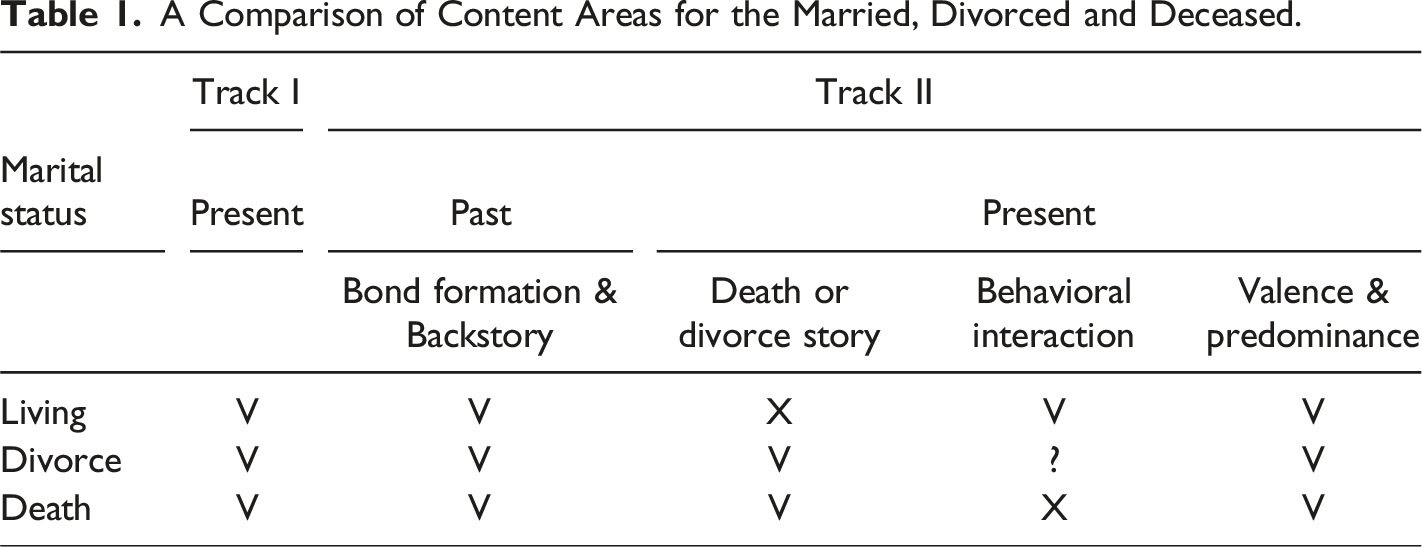
For all three marital conditions, the examination of the ways in which the marital partner is experienced currently as well as in the past is essentially similar. The psychological schema and representations of the other and self in relationship to the other and the experience of the relationship are significant. The content and structure of the descriptions of the marital partner and the marital dyad allow for the construction of a map of the mental representations and schema of the partner and dyad in past and present.
The examination and comparison of the marital situations the focus on the distribution of major features of the relationship across time is bracketed by queries related to the formation and transformation of the relational bond at present. The formation of the relationship as well as the nature of the death or divorce stories yield a more highly focused narrative. The story of how the relationship began as well as what “ended” the living relationship. While in taking a history there is no natural limit to how one might access the evolution of the relationship at any number of various time points, the more directed formation and dissolution narratives are themselves particularly rich and meaningful in the assessment of the emblematic formation of the bond and how it continues.
Based on the comparisons above, the nature of the development and current experience of the relational bond to the spouse emerges as a major focus of the relationship across all three marital dyads. As can be seen in the tables, specifying the significant elements of these bonds in the past, present and anticipated future emphasize the similarities and differences inherent in the continuing bonds of the various dyads. In this way, the degree to which the continuing bonds of the three groups overlap as well as diverge, includes connections to living spouses in intact relationships as well as other relationships following divorce.
Concluding Remarks
The relationship to the spouse is a focus of continuing bonds in life as well as after death or divorce. Restricting the consideration of continuing bonds to a focus only upon the relationship to the deceased paradoxically limits the understanding of the processes in the formation, maintenance, and transformation of relationships with others. The Two-Track Model divides the consideration of an individual in relationships has relevance for theoretical, clinical and research work in the examination of functioning and relationships over time. Cognitive and emotional matrices characterizing the significant figure and the relationship to them are at the heart of the Track II relationship to the other axis for both the living and the deceased (Calabrese et al., 2005; Rubin et al., 2012). A broad assumption that the biopsychosocial indicators of Track I difficulties are indicators of the status of the grief progression is often assumed, when this need not be so. Difficulties in the management of grieving the loss and accepting the death of the loved one often are accompanied by difficulties in functioning.
The challenges of reworking the representations and experience of the self after interpersonal loss and the challenge of reworking the connection to the representation of the deceased are aspects of grief that are often interrelated. Nonetheless, one or the other may take primacy or may proceed adaptively while the other may be problematic. In divorce, many of these same processes are operant. The nature of the relationship to the other is clinically relevant, measurable and has major implications for the representation of the other under conditions of physical absence (death and divorce) as well as in a living relationship (Bar-Nadav & Rubin, 2016; Gaitini, 2009; Manevich et al., 2023; Sadeh et al., 1993; Shechory-Stahl, 2018). Leaving aside the way these representations impact biopsychosocial function, elucidating the internal psychological schemas of self and other and how they are experienced is critical to understanding interpersonal relationships.
Continuing bonds is a valuable construct that is further enriched by the comparison of interpersonal relationships that are continuing in life with those that are not continuing behaviorally. In this article, we used the case of married, divorced and widowed persons to illustrate our point of view.
Footnotes
Declaration of Conflicting Interests
The author(s) declared no potential conflicts of interest with respect to the research, authorship, and/or publication of this article.
Funding
The author(s) received no financial support for the research, authorship, and/or publication of this article.
Note
Author Biographies
 .
.
). Her research focuses on the psychological mechanisms and personality factors that affect loss perception and adjustment in various death and non-death conditions. In addition to consulting and training therapists in various organizations, she maintains a psychotherapy private practice.