




Abstract
Determining sex is a critical process in estimating biological profiles from skeletal remains. The clavicle is interesting in studying sex determination because it is durable to the environment, slow to decay, challenging to destroy, making the clavicle useful in autopsies and identification which can then lead to verification. The goal of this study was to use deep learning in determining sex from clavicles within the Thai population and obtain the accuracies for the validation set using a convolutional neural network (GoogLeNet). A total of 200 pairs of clavicles were obtained from 200 Thai persons (100 males and 100 females) as part of a training group. For the deep learning approach, the clavicle was photographed, and each clavicle image was submitted to the training model for sex determination. Training groups of 200 samples were made. Images of the same size were input into the training model. The percentage of the validation set accuracy was calculated from the MATLAB program. GoogLeNet was the best training model and get the result of validation set accuracy. The results of this study found accuracies for a validation set with the highest overall right lateral view of the clavicle with an accuracy of 95%. Accuracy from the validation set of each view of the clavicle can demonstrate the forensic value of sex determination. A deep learning approach with clavicles can determine the sex and is simple to utilize for forensic anthropology professionals.
Introduction
Forensic anthropology is essential in biologically identifying skeletal remains from humans. In Thailand, the field of forensic anthropology realized its significance in the 2004 Tsunami disaster. The paucity of such information was graphically illustrated in a country in desperate need of tools or techniques to assist in identifying a significant number of skeletal remains of victims while also in need of services to identify a significant number of fatalities. 1 In some cases objects found at the scene were mixed skeletal remains. Bones may be damaged and broken into small fragments. Skeletal remains may be incomplete or contaminated with other debris. It is very challenging for the staff involved to isolate bone parts and perform accurate verification to accurately identify the human body. 2 Sex determination from skeletal remains is a fundamental approach that can use preliminary information to identify biological humans since anticipating sex can lower the number of viable matches by 50%. 3 The size and shape of the skeleton are affected by the development of the skeleton as well as by life events from birth to death. The proportions of the skeleton differ between populations based on different geographic areas. Studies have found that male bones and female bones are different. Many factors cause differences in the skeleton of each sex, including hormones, and bone function. 4
The clavicle is a long bone that is longer than its width. The components of the bone are very hard or compact bones. 5 The clavicle offers various advantages, including protection in opposition to contamination and decomposition since it is particularly resistant to postmortem disintegration and fragmentation when compared to other human body tissues. This section of the human skeleton, particularly the clavicle bone, is simple to detach during an autopsy after the breastplate is removed for exploration of the thoracic viscera, without jeopardizing the body's integrity. 6
Artificial intelligence (AI) techniques give a measurable and repeatable answer to the sex determination challenges. 7 Artificial neural networks are in the research of the principles and use of computer literacy and have an impact on the design of the human brain and made up of numerous layers and interconnected neurons that consider distinct parts of a picture before merging to provide a probability that an input picture relates to a preset classification. They are suitable for the binary duty of sex determination. 7 A subset of machine learning is deep learning, which is a part of AI. Deep learning includes the convolutional neural network (CNN) developed to assess images composed of two-dimensional (2D) or three-dimensional (3D) array datasets, and CNN is the most powerful to detect objects and categorize them, using GoogLeNet as an example. 8
Abroad, there have been many studies of sex determination in the clavicle, but data from populations are not interchangeable. Therefore, more studies are needed for each specific population group in different regions. In Thailand, few studies use clavicles to separate the sexes. More studies on sex determination from the clavicle could be useful in anthropology and forensic science work. These could be added to a database in the Thai population that would add to accuracy in sex determination.
In this study, we applied a technique from deep learning that was used to differentiate sex in the clavicle. This is a method that allows for quick information, saves manpower, and resources by sex determination of the clavicle, and develops sex determination of the clavicle in the Thai population as well. We trained a model with the GoogLeNet deep network designer (a subset of the convolutional neural network) to obtain the best training model for the study. Therefore, this work aimed to use a deep learning approach to perform sex determination from clavicles and obtain the accuracies for the validation set using a convolutional neural network (GoogLeNet).
Materials and methods
The Committee on Research Ethics at Chiang Mai University's Faculty of Medicine authorized this study (Research ID: ANA-2565-09052). Clavicles were supplied by the Osteology Research and Training Center, Faculty of Medicine, Chiang Mai University. The overall sample size was 200 pairs of clavicles as part of a training group. The training group was divided into 100 females and 100 males. Clavicles were collected between 2002 and 2013 and donor ages ranged from 20 to 90 years. The clavicles employed in this work were all complete, right, and left sided. The following factors led to the sample's exclusion from the study: samples without known sex and age, a shattered or incomplete clavicle, report about pathology, from a non-Thai individual, and under 20 years old.
Technical photography
The clavicle's imaging method was divided into four parts: superior, inferior, medial, and lateral views (Figure 1). The clavicle was captured using the deep learning approach and a Sony 57 digital camera set on a tripod. The same zoom range was utilized throughout all photos and ISO 3200 was used with the image saved in JPG format. The clavicle's left and right sides were photographed in this investigation. A superior view or inferior view of the clavicle was set on a black silk velvet backdrop on the landmark, and the bone was positioned in a superior or inferior orientation. The medial view or lateral view of the clavicle was set on a studio box with a black silk velvet backdrop on the landmark and the bone was positioned in a medial or lateral orientation. All image views of the clavicle set bone locations, cameras, and photographic equipment was standardized in every photograph.
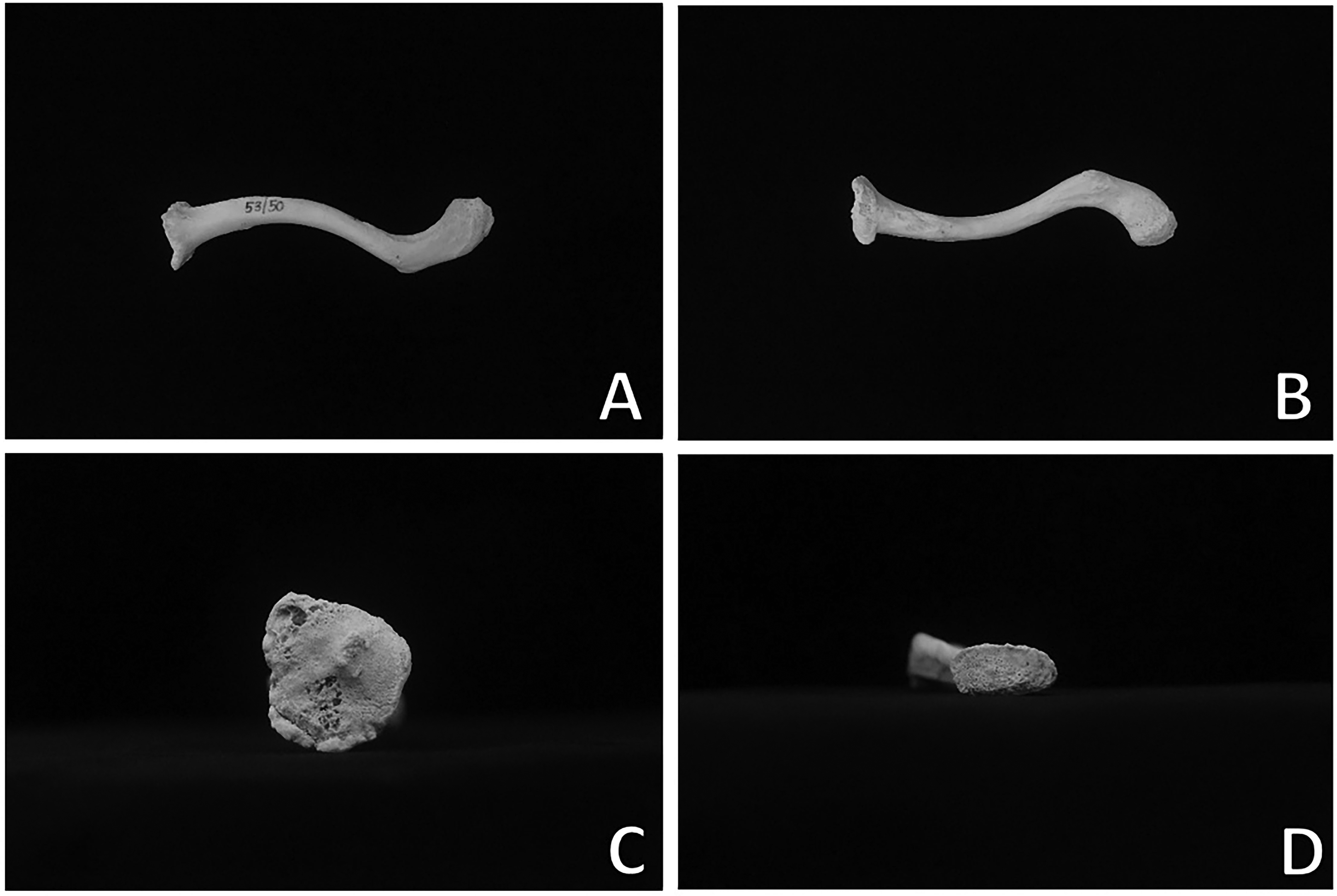
The image of the right clavicle was divided into four parts: superior view (A), inferior view (B), medial view (C), and lateral view (D).
Deep learning: Convolutional neural networks
Every view of the clavicle consists of 1600 images. Each view of the clavicle consists of 200 images. This work tries to organize the images of the superior, inferior, medial, or lateral views of the clavicle to evaluate sex determination performance. More specifically, we trained each group separately on superior, inferior, medial, and lateral clavicle images independently. GoogLeNet, CNN intended for classification of the image, performed well.
CNN supported the imported image dataset and training data. CNN for the training process is a training set. To train the sex determination of each image view of the clavicle. Images of the same size are input into the program. The sample group was a training group of 200 samples. Image data was divided into 140 training, and 60 validations. (The validation set was 30% separated from the training data.) We utilized transfer learning to tweak two final layers of deep network designer on GoogLeNet to learn clavicle images. The new fully connected layer was created by reducing the number of outputs from 10 to 2 and used the final class Output Layer. After the image data was imported, the augmentation options were adjusted. GoogLeNet's augmentation options include (1) random reflection x-axis; (2) random rotation degrees (between −25 and 25); (3) random rescaling from 1 to 1.2; (4) random horizontal translations (between −20 and 20); and (5) random vertical translations (between −20 and 20), which increased training performance and avoided the over-fitting of a few training images. To achieve optimal accuracy for training options, Tuning was improved by changing hyperparameters to the initial Learning Rate, validation frequency, MiniBatchSize (Size of the mini-batch to use for each training iterations, specified as a positive integer. A mini-batch is a subset of the training set that is used to evaluate the gradient of the loss function and update the weights.), 9 and MaxEpochs (maximum number of epochs to use for training, specified as a positive integer). 9 After the training, validation accuracy was calculated. The outcomes were exported (Figure 2). Experiments with the deep learning method were performed on Notebook Acer Nitro AN515-45-R0ZA/T00A with 512 GB and RAM DDR4 8GB. The training model was used and run on GoogLeNet, and MATLAB 2020a.
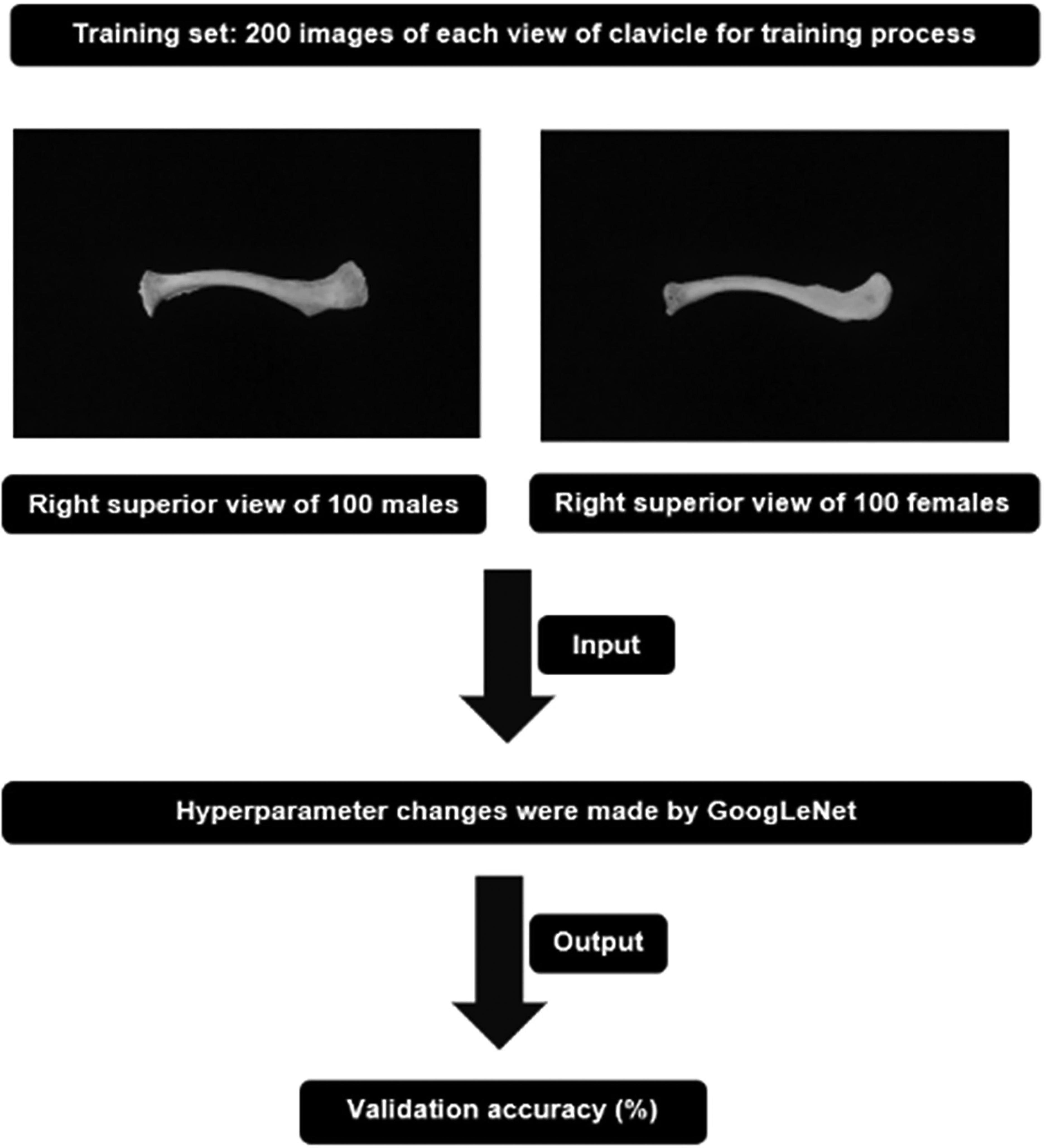
Deep learning algorithm framework for sex determination in training sets. We used the GoogLeNet to be training model of sex determination of each image view of the clavicle.
Statistical analysis
The validation accuracy is calculated from the MATLAB program.
Results
Superior view
From the deep learning method for sex determination of the clavicle and the accuracies for the validation set (training set), the following overall accuracy values were obtained (Table 1). The optimal hyperparameters of the right superior view of the clavicle in this experiment were the initial Learning Rate = 0.001, validation frequency = 50, MiniBatchSize = 8, MaxEpochs = 100. The training lasted for 78 min in total and the accuracies for the validation set were 91.67%.
The accuracies for the validation set using convolutional neural network (GoogLeNet).
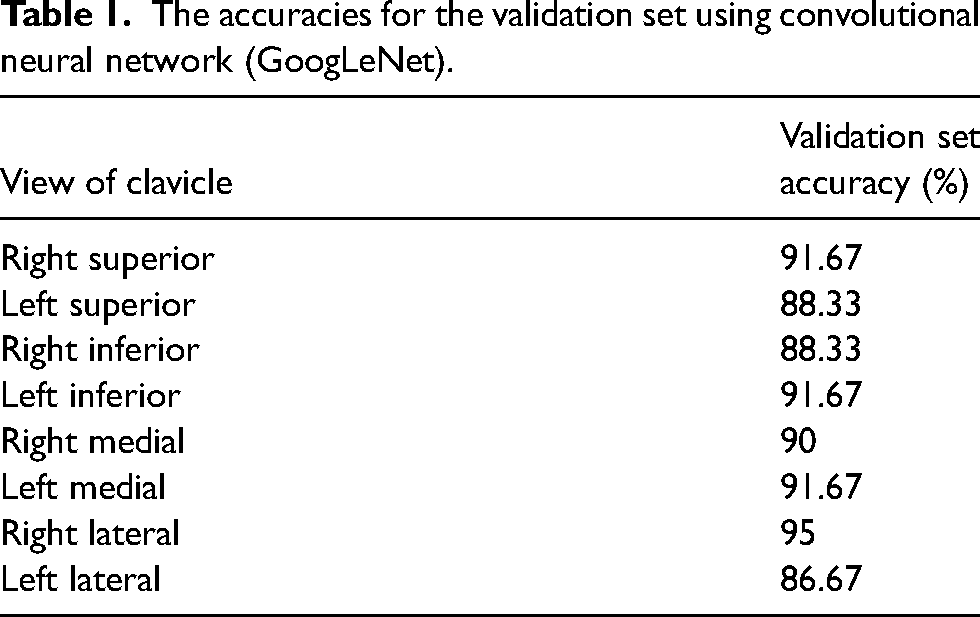
The optimal hyperparameters of the left superior view of the clavicle in this experiment were the initial Learning Rate = 0.001, validation frequency = 50, MiniBatchSize = 16, MaxEpochs = 100. The training lasted for 57 min in total and the accuracies for the validation set were 88.33%.
Inferior view
The optimal hyperparameters of the right inferior view of the clavicle in this experiment were the initial Learning Rate = 0.001, validation frequency = 50, MiniBatchSize = 32, MaxEpochs = 100. The training lasted for 29 min in total and the accuracies for the validation set were 88.33%.
The optimal hyperparameters of the left inferior view of the clavicle in this experiment were the initial Learning Rate = 0.001, validation frequency = 50, MiniBatchSize = 8, MaxEpochs = 100. The training lasted for 209 min in total and the accuracies for the validation set were 91.67%.
Medial view
The optimal hyperparameters of the right medial view of the clavicle in this experiment were the initial Learning Rate = 0.001, validation frequency = 25, MiniBatchSize = 16, MaxEpochs = 50. The training lasted for 13 min in total and the accuracies for the validation set were 90%
The optimal hyperparameters of the left medial view of the clavicle in this experiment were the initial Learning Rate = 0.001, validation frequency = 50, MiniBatchSize = 16, MaxEpochs =100. The training lasted for 29 min in total and the accuracies for the validation set were 91.67%.
Lateral view
The optimal hyperparameters of the right lateral view of the clavicle in this experiment were the initial Learning Rate = 0.001, validation frequency = 50, MiniBatchSize = 16, MaxEpochs = 50. The training lasted for 12 min in total and the accuracies for the validation set were 95% (Figure 3).
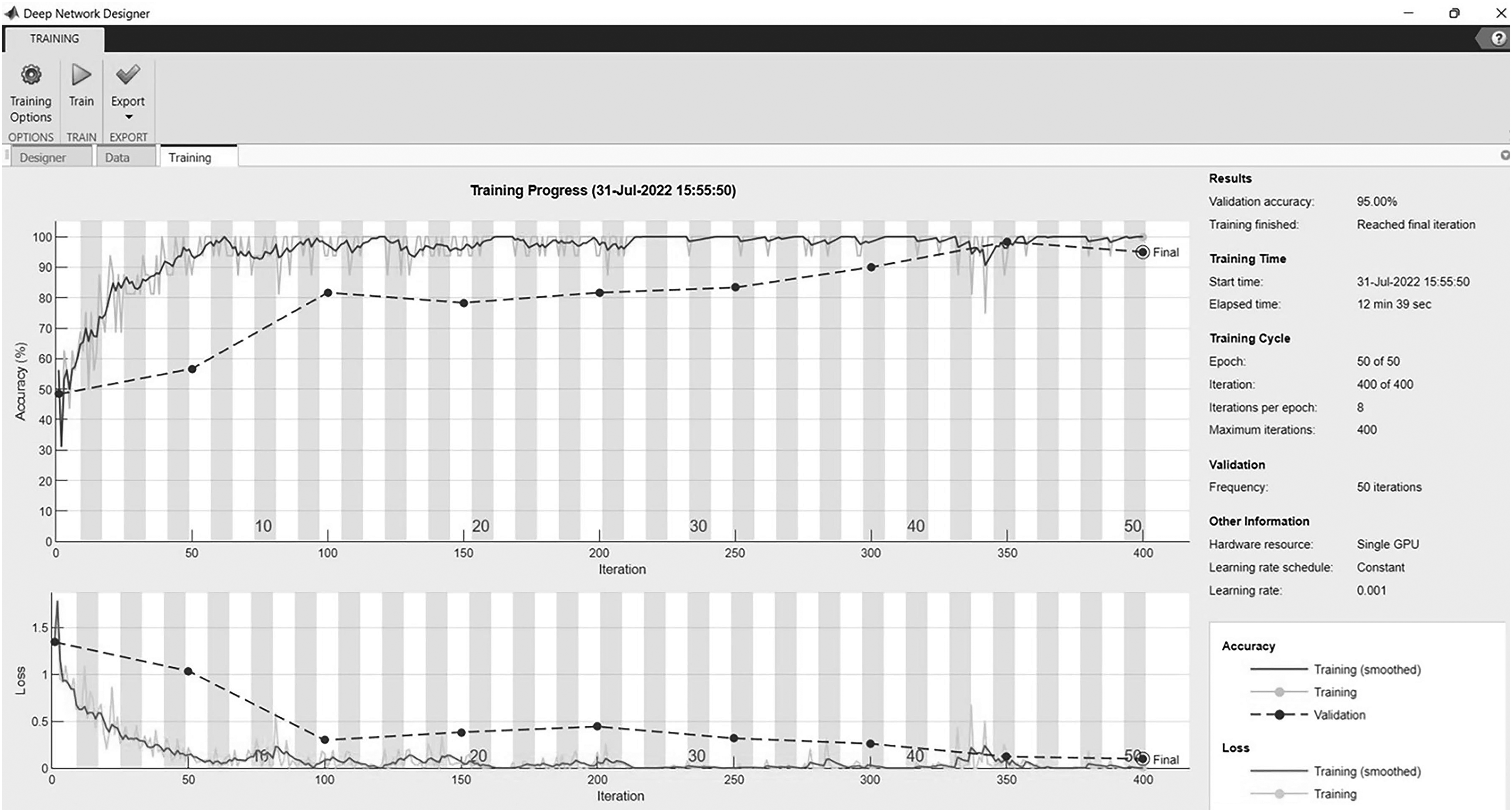
Display a validation set accuracy of right lateral view of clavicle for sex determination of clavicle (training model) ran on CNN, GoogLeNet, MATLAB 2020a. CNN: convolutional neural network.
The optimal hyperparameters of the left lateral view of the clavicle in this experiment were the initial Learning Rate = 0.001, validation frequency = 50, MiniBatchSize = 32, MaxEpochs =100. The training lasted for 124 min in total and the accuracies for the validation set were 86.67%.
Discussion
The study results, in Table 1 show accuracy for a validation set. The accuracy for a validation set (training set) with the highest right lateral view of the clavicle was 95%. As a result, the best training model for the right lateral view image of the clavicle is the most appropriate for determining sex in Thai people. The right superior view, left inferior view, and left medial view of the clavicle were found to have the same accuracy, 91.67%, and the left superior view, and right inferior view of the clavicle were found to have the same accuracy, 88.33% shows that the models trained from these each view images gave the same accuracy values. The right medial view of the clavicle was with an accuracy of 90%. The left lateral view of the clavicle was with an accuracy of 86.67%. Because the specimen of the right and left clavicle from the same view is different, the overall accuracy of all right and left views of the clavicle varied.
In the study of sex determination from bones, several studies have used the pelvis and skull, the two bones with relatively high accuracy for sex determination. 10 However, although the pelvis and skull bones will have a high ability to distinguish between sexes, if the bones found at the scene were incomplete, they could not be used for sex determination. Therefore, studies must be developed for separating sex by using other bones, such as the clavicle. 11 As for the clavicle, it is interesting to study sex determination because it is a compact bone. It is a long bone that is durable in the environment. The clavicle is slow to decay and difficult to destroy. 5 Male and female bones are distinctly different. One factor that causes differences in the skeleton of each sex is testosterone in males. Sex determination from the skeleton can be divided into two categories: the morphological method, is a general way of looking at bone characteristics. This study looked at the variations in bones between men and women. Another method, the metric method, is popular because it measures the width, length, or height of distances or points on the bone fragments of a skeleton. 12 A well-known method for determining the sex of a clavicle is the metric method of measuring the clavicles, which can be used to create an equation of sex determination. 13 To determine the rate of accuracy in sex determination, clavicular measurements such as clavicular maximum length is the length between the acromial end and sternal end of the clavicle, measured using an osteometric board. 14 Recent research found deep learning outperforms the morphometric technique in identifying sex. Furthermore, subjectivity and measurement from the metric method mistakes are reduced.15,16 Therefore, we use the deep learning method for sex determination of the clavicle seeing as this method is simple to use, has excellent accuracy, and gives rapid results.
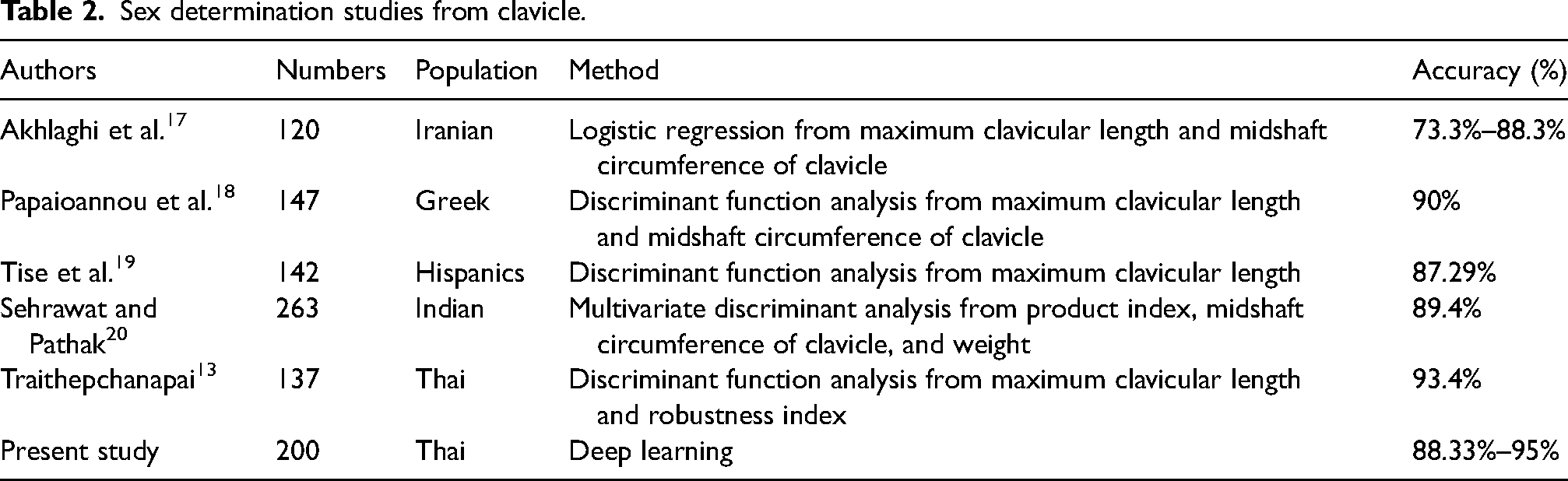
In our study, the highest accuracy for a validation set with the clavicle was 95% demonstrating higher accuracy than the several studies of a metric approach for clavicle sex determination such as Akhlaghi et al. 17 with an accuracy of 88.3%, Papaioannou et al. 18 with an accuracy of 89%, Tise et al. 19 with an accuracy of 87.29%, Sehrawat and Pathak 20 with an accuracy of 89.5%, and Traithepchanapai 13 with an accuracy of 93.4% (Table 2). Previously, CNN was used in research (GoogLeNet) for high-accuracy bone image classification for instance Bewes et al. 7 for sex determination of human skulls with an accuracy of 95%, Malatong et al. 15 for sex determination of lumbar vertebrae with an accuracy of 92.5%, and Intasuwan et al. 16 for sex determination of os coxae with an accuracy of 93.33%. Previous research and this work show that deep learning can successfully use bone sex determination from bone by image classification in forensic anthropology research. In this study, we trained a model with the GoogLeNet to obtain the optimal training model for the study results. The results were exported, and in practice, we apply the optimal training model of the clavicle by inserting the dry bone image to be tested into the program for evaluation in the sex determination. We developed tools for sex determination by the clavicle to appropriate a Thai population that can be easily used, have high accuracy, and produce a fast classification. The results of this study used AI technology by the clavicle applied to biological identification in forensic anthropology. Deep learning approaches can eliminate subjectivity in the conventional method and make forensic anthropology practitioners more user-friendly. Furthermore, this method may be used for internet-based deliberation for sex determination. Our study's limitation was the inadequate samples (training group for each view = 200 images) for effective deep-learning training. In comparison to other research that used more than 200 training images to develop a deep learning model for sex determination such as Rajput and Sable 21 use 400 training images, Fukuta et al. 22 use 600 training images, and Bewes et al. 7 use 900 training images. This work, recommends that future studies include more samples that could result in a more accurate training set, and future research in different populations is needed to improve the clavicle's sex determination accuracy.
Sex determination studies from clavicle.
Conclusion
In this paper, we presented the deep learning method for clavicle sex determination and obtained the accuracies for the validation set. A validation set with the highest right lateral view of the clavicle had 95% accuracy. As a result, the best training model for the clavicle's right lateral view image is the best for determining sex in Thai people.
Deep learning approaches such as CNN are being used on the Thai population and can eliminate subjectivity in the conventional method. This method can determine the sex of the clavicle without depending on professional human anthropological knowledge. As a result, sex determination of skeletal remains might be conducted quickly and easily. In future studies, to improve the validation set accuracy of sex determination from the clavicle, more samples should be added for the higher accuracy of each view of the clavicle. Furthermore, in prospective studies, it might be feasible to estimate stature from clavicles utilizing deep learning techniques in biological identification.
Footnotes
Acknowledgements
The authors are appreciative of the Excellence of the Osteology Research and Training Center (ORTC) for their assistance, which was partly upheld by Chiang Mai University. Special thanks to Ruth Leatherman for the linguistic review.
Declaration of conflicting interests
The authors declared no potential conflicts of interest with respect to the research, authorship, and/or publication of this article.
Funding
The authors disclosed receipt of the following financial support for the research, authorship, and/or publication of this article: This work was supported by the Faculty of Medicine, Chiang Mai University (Grant number: 78-2566).
