




Abstract
One of the predominant questions asked in phonological research refers to the way in which strings of vowels and consonants are perceived and processed by native speakers. In this paper, we make an attempt at uncovering the mental processes that underlie the online processing of phonotactics in Polish; a language featuring an unusual array of strings of consonants. We report on a reaction time experiment using nonce monosyllables with final consonant clusters and identify phonological factors that determine their acceptability. The factors include cluster (non-)existence in the lexicon of Polish, cluster well-formedness in terms of the universally preferred sonority slope, and the quality of the nuclear vowel. The findings testify to the facilitative role of cluster existence and well-formedness on phonotactic intuitions. That is, universally preferred and existent clusters are easily identified as possible and involve the shortest reaction times. Moreover, we detected a systematic perceptual contribution of vowels, whereby the front-back dimension (rather than sonority-related high-low dimension) seems to facilitate the decision-making process.
1 Introduction
Constraints on admissible sequences of segments in a language constitute one of the core areas of phonological research. For over a century, attention has been drawn to the restrictions that regulate the structure of a universally preferred syllable. Such restriction refers to the number of consonants admissible at syllable margins (e.g., Gordon, 2016; Greenberg, 1978), the principles of their syntagmatic organization based on, for instance, the minimal phonological contrast (Trnka, 1939), sound loudness (or sonority, Jespersen, 1904; Parker, 2002; Selkirk, 1984) or the (non-)identical place of articulation (Leben, 1973; McCarthy, 1988) (see Parker, 2017 and numerous references therein). Although focus has been placed on restrictions between sequences of consonants (or clusters), some studies have investigated the possible consonant-vowel combinations (e.g., Kessler & Treiman, 1997; Randolph, 1989; Trnka, 1966). With the advent of psycholinguistic methods, researchers have investigated cognitive mechanisms that underlie the processing of phonological properties of adjacent segments (e.g., Berent et al., 2007; Moreton, 2002; Pitt, 1998).
The present paper casts light on the cognitive representations of sub-lexical properties of Polish, a language that displays “enormous complexity of consonantal sequences” (Rochoń, 2000, p. 1) and numerous “odd-looking” (Cyran & Gussmann, 1999, p. 219f.) and “unusual” (Rubach & Booij, 1990, p. 454) clusters. To reach this goal, we investigate native speakers’ intuitions concerning the phonological properties of vowels and two-member clusters following them.
2 Phonotactics and phonotactic principles
Complex consonant clusters in Polish are attributed to the violations of phonological principles and universals, the lack of syllabic consonants, and the intervention of morphology. Moreover, such complex structures are by no means rare. The uniqueness of Polish phonotactics is reflected in the fact that all these complexity aspects can co-occur in a single cluster type, as illustrated in (1).
(1) Examples of complex clusters in Polish
(1a) initial: /fkw/ w + kładać ‘to put into’-perfective
/brvj/ brwiowy ‘eyebrow-like’
/drgn/ drg + nąć ‘to vibrate’-perfective
(1b) final: /jɕʨ/ przyjś + ć ‘to come’
/wdw/ zwięd + ł ‘(a flower) wilted’
/mpstf/ przestępstw + ∅ ‘crime’-genitive plural
Consonant sequences in (1a) and (1b) violate the universal syllable structure, which is typically represented as a combination of a consonant (C) and a vowel (V) (the so-called CV, e.g., Greenberg, 1978; Maddieson, 2013), and—with the exception of /jɕʨ/—are phonologically marked. Here, the markedness status of a cluster is determined by the Sonority Sequencing Generalization, which we shall refer to as the sonority principle (Jespersen, 1904; Selkirk, 1984; Steriade, 1982). It requires that the sonority level of segments increase from the syllable margins toward the nucleus. Following the sonority hierarchy of Goldsmith (1990) (vowel > glide > liquid > nasal > fricative > affricate > plosive), in a well-formed monosyllable cramp /kræmp/, /r m/ adjacent to the vowel displays higher sonority than /k p/ found at the syllable margins, which is the case with most of onset and coda clusters in English (Trnka, 1966). In Polish, however, violations of the principle are relatively common. One of the reasons is that complex clusters can be triggered by morphology (Dressler & Dziubalska-Kołaczyk, 2006), for instance, in the affixation of perfectivizing morphemes {w-, -nąć}, which generate initial clusters in w + kładać and drg + nąć in (1a) or in the truncation of {-o} in genitive plural forms, which generates the longest final five-member cluster in przestępstw (← przestępstw + o-nominative singular) (1b).
Such long and sonority-violating clusters have been well-documented, for example, in theoretical accounts on the syllable (e.g., Cyran & Gussmann, 1999; Rochoń, 2000; Rubach & Booij, 1990), or in corpus studies on word edge phonotactics (e.g., Dobrogowska, 1992; Orzechowska, 2019; Zydorowicz et al., 2016). As to word margins, the sources have listed over 400 cluster types in word initial position and 200 types in word-final position, a third of which is phonotactically marked. For example, Orzechowska (2019) reported that out of 759 cluster types permitted at word margins, 351 (= 46%) violate the sonority principle.
The sonority hierarchy has been also established for vowels. It has been viewed as a function of height and peripherality. Vowel peripherality in the acoustic space teases apart the central vowels from the others, while height further specifies the degree of lowering of the mandible. It has been generally agreed that higher vowels are less sonorous than lower vowels (e.g., Dell & Elmedlaoui, 1985; Goldsmith, 1990; Parker, 2002), and that the latter are preferred as syllable nuclei (e.g., Gordon et al., 2012; Kenstowicz, 1996). Given these sonority hierarchies and the distribution of six Polish vowels in the vowel space (Jassem, 2003), the following sonority hierarchy can be proposed: low /a ɛ ɔ/ > high /i u/ > high central /ɨ/.
From the aforementioned restrictions, we can derive a VCC structure that best serves perceptibility and facilitates processing: The nucleus should contain vowel /a/, and the final cluster should display a decrease in sonority. Following a common view, which relates the sonority hierarchy to the “inherent loudness of individual segment-types” (Laver, 1994, p. 156), resulting in well-defined acoustic correlates (e.g., Blevins, 1995; Gordon et al., 2012; Parker, 2002), sequences composed of /a/ + sonority fall are expected to be universally preferred in production, acoustically more salient than sequences violating the sonority profile, and in consequence, facilitate perception and minimize cognitive load. The facilitating and hindering effects of well-formed and ill-formed syllables for perception are outlined in Section 3.
3 Processing of phonotactic constraints (in Polish)
A reliable source of information about the implicit knowledge of the phonotactic grammar of a language comes from the way in which native speakers apply this knowledge to novel words. Thus, in psycho- and neuro-linguistic research, the nonce-word paradigm has been employed to investigate the principles underlying the internal organization of words in terms of legal and illegal phonotactics (e.g., Domahs et al., 2009; Rossi et al., 2011; Wiese et al., 2017), the hierarchical organization of the syllable (e.g., Treiman, 1984; Treiman et al., 1995), and phoneme probabilities (e.g., Vitevitch & Luce, 1999; Weber & Cutler, 2006). Generally, it has been demonstrated that novel sequences of sounds tend to be misperceived and mispronounced and filtered through the phonotactic possibilities of the mother tongue. That is, illicit phonotactics entails a strong perceptual bias toward a familiar form (e.g., Dupoux et al., 1999; Hallé et al., 1998) and different articulatory coordination compared to forms existent in the native language (e.g., Browman & Goldstein, 1992; Davidson, 2006). Thus, in phonological research, novel items and illicit phonotactics have been used to investigate the organization of grammar in the minds of speakers.
An example of such an illegal initial cluster in English is /tl/. Although the cluster is common across the languages of the world (Greenberg, 1978), represents the most natural ordering of consonants (Clements, 1990), and is difficult neither for production nor perception (Blevins & Grawunder, 2009), it is disfavoured by native speakers of English and is systematically rejected in experimental conditions. Pitt (1998) showed that speakers misperceive /tlV/ as disyllabic /tela/, while the effect was not observed for existent syllable onsets. Hallé and Best (2007) demonstrated that listeners tend to categorize the initial plosives in /tl dl/ as /k g/, respectively, suggesting that non-existent clusters undergo phonotactic perceptual assimilation to the phonetically most similar existing clusters. Similar observations were made for other sonority-obeying and unattested cluster types. Moreton’s (2002) work on nonce onsets /dl bw/ showed a perceptual bias only against /dl/ due to smaller sonority distance. The findings were confirmed in an fMRI study in Berent et al. (2014) who demonstrated that the hemodynamic response in the brain is modulated by sonority distances in onsets, with larger distances being preferred over small distances (i.e., large rise in /blif/ > small rise in /bnif/ > plateau in /bdif/ > fall in /lbif/). Daland et al. (2011) argued that onset clusters representing more severe phonotactic violations (i.e., sonority fall) were evaluated as worse than clusters with no sonority differential (i.e., plateaus) in English. Similar questions on the processing of (il)licit, familiar and sonority-violating phonotactics were asked in a series of online and offline studies on Polish (Orzechowska, 2019; Szpyra-Kozłowska & Zydorowicz, 2020; Wagner et al., 2012; Wiese et al., 2017).
The nonce-word paradigm is employed to determine the cognitive resources allocated to completing different tasks. For example, Wagner et al. (2012) investigated the perception of /pt/ by native English and Polish speakers and concluded that in onset position, the cluster is correctly identified only by the latter group of subjects. Polish speakers distinguish between nonce words starting with an existent cluster /pt/ (e.g., ptak ‘bird’) and with a syllable /pet/ (e.g., petycja ‘petition’), in contrast to English speakers, who misperceive /pt/ despite the presence of the /pt/ vs. /pet/ contrast word-finally (kept vs. trumpet). The findings suggest that the exposure to prosodically-constrained phoneme sequences determines accurate perception.
In a learnability study using event-related potentials (henceforth ERPs), Wiese et al. (2017) asked subjects to learn nonce monosyllables containing final well-formed and ill-formed CCs, for example, /fars/, /nɔpx/. The study compared brain responses to three conditions: cluster existence (existent vs. non-existent), its sonority slope (well-formed vs. ill-formed), and learning spread across several days (EEG 1 vs. EEG 2). The facilitating effect of existent and WF clusters (e.g., /jp lk rs/) for processing was identified only in the late time window (700–1,050 ms), which is generally associated with learning and attention, and not in the early time window (450–550 ms), associated with the processing of nonce words, pseudowords or neologisms. As regards the behavioral data, the main effects were reported for exposure: correctness rates increased from the first to the second EEG session.
It can be thus speculated that other phonological factors play a role in accepting existent and non-existent clusters in Polish. To test this hypothesis, Orzechowska (2019) measured reaction times of native speakers to the same set of stimuli as in Wiese et al. (2017). In addition, the clusters were matched in terms of the place of articulation distance between consonants, for example, /fars/ (well-formed, dist = 1), /nɔpx/ (ill-formed, dist = 6). The results testified to a division of labor between the manner of articulation and the place of articulation features. Although accuracy rates were the highest for well-formed existent CCs, processing was facilitated by large place distances. The shortest latencies were observed for sequences of labial and dorsal consonants in either order (e.g., /mk gb xm/), compared to, for instance, dental-dental, alveolar-palatoalveolar sequences, regardless of their sonority profile and existence. The findings point to a lower cognitive load in the processing of place features and suggest that perceived place constraints outweigh perceived manner constraints.
Polish speakers’ sensitivity to sonority violations on the metalinguistic level was also reported in an offline study in Szpyra-Kozłowska and Zydorowicz (2020), which measured acceptability responses to different CCs embedded in nonce words. The study suggested that the majority of accepted items (75% of words with initial CCs; 61.5% of words with final CCs) follow the sonority principle. This result aligns with Orzechowska (2019), who reported the facilitating effect of sonority in the accuracy data.
4 The study
4.1 Goals
The goal of the study is to test the contribution of three word-internal factors to the processing of novel forms: cluster existence, its phonological structure in terms of sonority, and the phonological properties of the neighboring vowel. Another question is whether the findings reported in previous studies on the processing of Polish final phonotactics (e.g., Orzechowska, 2019; Wiese et al., 2017) can be corroborated when new variables are considered (here vowel quality). Eventually, the statistical analyses have the potential of revealing a (relative) functional load of phonological primitives such as vowel features and principles of segmental organization.
4.2 Conditions
This study tests three phonotactic conditions: (1) the existence of a cluster, (2) its sonority profile, and (3) the quality of the preceding vowel.
The
The
The
4.3 Hypotheses
We expect to observe an effect of
Specific hypotheses (H) for behavioral data (
(H1)
(H3) To be further inferred from (H1) and (H2): the highest rate of CVCC monosyllables accepted as potential Polish words is expected in existent and sonority-obeying forms.
A specific hypothesis for processing data (
(H4)
As the effects of vowel quality on the processing of syllables have not been reported in the literature on Polish (compare with a similar study on German, Orzechowska & Wiese, 2024), there are at least two potential options (O) regarding the contribution of vowels:
(O1)
(O2)
The decision-making process on the acceptability of a form is related to cognitive effort (for an overview see Westbrook & Braver, 2015 and references therein). In its broadest sense, the term has been coupled with attention and difficulty: the execution of high-engagement tasks requires the allocation of cognitive resources, extra attention, and working memory. In line with the previous studies, we assume that longer reaction times reflect greater difficulty, cognitive cost, and more attention needed to process a word.
4.4 Subjects
Forty-one native speakers of Polish volunteered to take part in the study. The subjects (mean age = 22; 8 males, 33 females) were students at Adam Mickiewicz University (henceforth AMU) in Poznań. The largest number of students was recruited from the Faculty of English. Most of the subjects came from the Great Poland region. In the questionnaire completed prior to the experiment, no subject reported having visual or hearing disorders, or being under the influence of medication affecting reaction times and attention. The majority of subjects were right-handed (93%).
4.5 Stimuli and apparatus
Stimuli were nonce monosyllables CVCC. In the selection of WF-IF pairs, we first included clusters for which equivalents with the reversed ordering of segments were available, for instance, WF /-sp/ versus IF /-ps/, or with the same voicing characteristics, for example, WF /-rk/ versus /-tr/. WF and IF clusters were also matched in terms of their logarithmic token frequencies (base 10) extracted from the corpus of the Rzeczpospolita newspaper (2000–2001; see Zydorowicz et al., 2016 for a detailed presentation). The log frequencies, spanned on a 6-point scale, 2 were used to match /-sp/ and /-ps/ (log freq = 3), as well as /-rk/ (log freq = 3) and /-tr/ (log freq = 2). The final set embraced 33 existent cluster types: 15 WF, 15 IF, and 3 plateaus. The corresponding set of 33 NEX types was constructed in a way to ensure maximum phonetic similarity to the existent clusters. 3 The complete list of cluster types is given in Table 1 and Appendix A.
Clusters Used as Stimuli, Ordered Alphabetically.
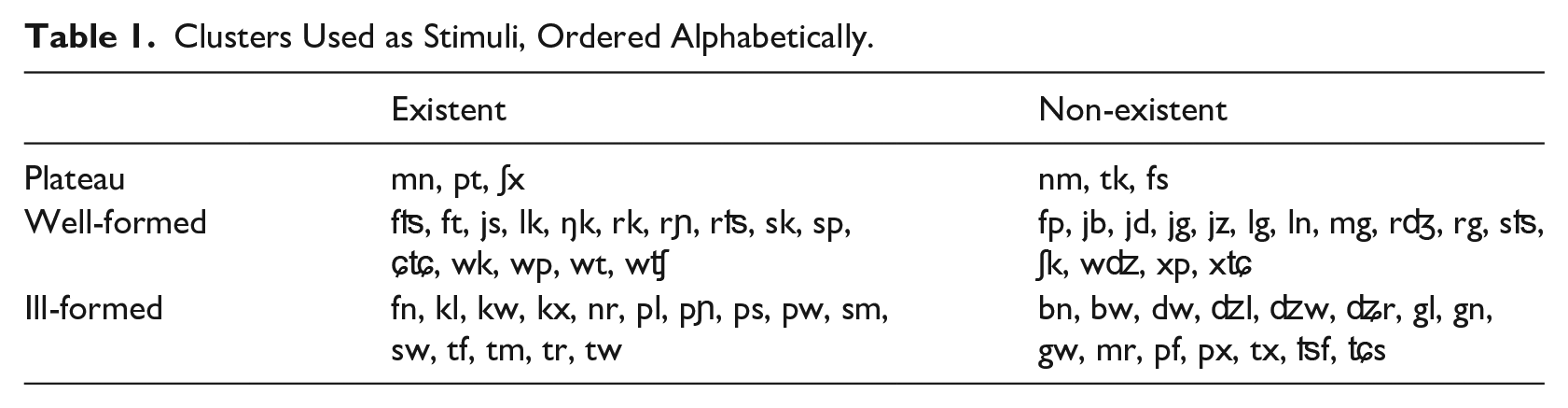
To form a monosyllable, the CV- prefixes /gɛ-/, /fa-/, /nɔ-/ were used with each cluster. The prefixes ensured a three-fold repetition of the same cluster type, for example, /gɛkl/, /fakl/, /nɔkl/ (see Orzechowska, 2019; Ulbrich et al., 2016; Wiese et al., 2017 for the use of the prefixes in similar studies). /g f n/ represent different consonant classes in terms of voicing, place, and manner features. Vowels /ɛ a ɔ/ are phonetically the most neutral as they represent symmetrical and maximally dispersed qualities in the low dimension of the vowel chart, where /ɛ ɔ/ are half-open and /a/ is open. In some stimuli, vowels were changed to avoid identity with real words: /gatr/ and /fɛwt/ were used to substitute for nominative/accusative singular getr /gɛtr/ (‘leggings’) and for genitive plural fałd /fawt/ (‘fold’). The final list included 198 stimuli; 15 types × 2 (EX-NEX) × 2 (WF-IF) × 3 (gɛ- fa- nɔ-), plus 3 plateaus × 2 (EX-NEX) × 3 (prefixes).
The stimuli were recorded by a phonetically-trained female, a native speaker of Polish. The recordings took place in a sound-proof cabin in the Speech and Language Processing Laboratory at the Faculty of English at AMU. The words were recorded with the MXL 770 microphone and the Roland Duo-Capture EX (24-bit digital) interface onto a Mac computer equipped with the waveform editor Amadeus Pro (2009) and were digitized at 44.1 kHz using a 16-bit resolution. To avoid untypical production of some articulatorily demanding NEX items, the recordings were evaluated by another linguist and re-recorded when necessary. The stimuli were cut using the Praat software (Boersma & Weenink, 2020).
4.6 Procedure
The task was for subjects to decide (as quickly as possible) whether a word heard sounded like a possible Polish word. Instructions read: “Decide if the word sounds as if it could exist in Polish.” Responses were provided by pressing either < left Ctrl > or < right arrow > . The assignment of the buttons to responses was randomized, that is < left Ctrl > and < right arrow > were “yes” and “no” buttons for subjects coded with even numbers, and “no” and “yes” for subjects coded with uneven numbers.
The stimuli were played to subjects via headphones. Reaction times were measured from the onset of the auditory stimulus to the response, with a timeout of 3,500 ms and an inter-trial interval of 2,000 ms. Missed trials were automatically coded as missing response, after which a new trial was initiated. The general timeline of a single trial is presented in Table 2.
The Temporal Structure of a Single Trial.

The stimuli were arranged in two blocks. It was ensured that three words featuring a specific CC type were split between the blocks. For example, /farɲ/ and /gɛps nɔps/ were assigned to block 1, while /gɛrɲ nɔrɲ/ and /faps/ were allocated to block 2. Randomizations were performed for cluster lists in each block and “yes”–“no” response button assignment. As a result, each subject was given a different version of the experiment. Before the experiment started, subjects were provided with a list of 10 training items to get familiar with the task.
The experimental session took place in the Language and Communication Laboratory (Faculty of English, AMU). Eight students were tested at a time. Subjects were monitored from a control room via a glass window and ceiling-mounted video cameras. When necessary, subjects were attended to by the experimenters during a break between the blocks. The total duration of the experiment was about 20 minutes. Reaction times and responses were registered by means of the E-Prime software (version 2.0, Schneider et al., 2002).
4.7 Phonetic analysis of stimuli
To exclude potential artifacts (resulting from the differences in the phonetic realization of words), we first compared the mean duration of the stimuli. Table 3 summarizes the results for each condition. For theoretical and methodological reasons, further discussed in Section 4.8, plateaus were merged with the class of IF clusters.
Mean Duration of Stimuli (in s), Grouped by Condition.
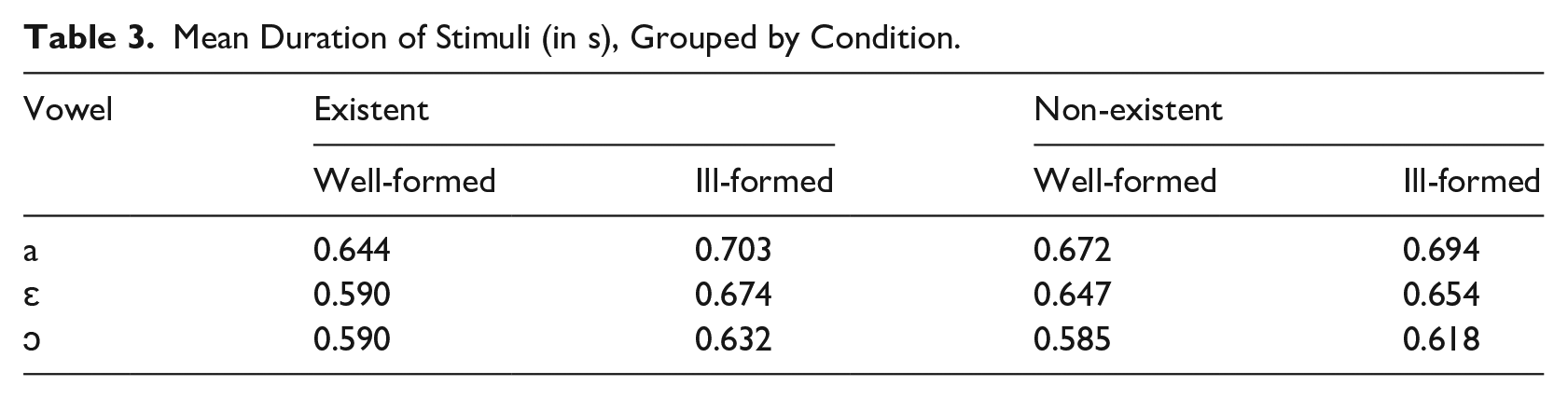
As the three-way ANOVA suggests, stimuli durations are significantly different across the
The largest differences are found between the WF-EX and IF-EX conditions, whereby EX-WF forms are shorter than EX-IF items. The extremes of duration range between 0.590 s for /ɔ/-EX-WF words and 0.703 s for /a/-EX-IF. As to vowels, the mean duration of /ɛ a ɔ/ words is significantly different in each condition. Although all Polish vowels are phonemically short, the phonetic variation can be explained by an inverse correlation between vowel height and intensity, such that lower vowels tend to be longer and more intense than higher vowels (Lehiste, 1970).
The phonetic differences between conditions are highly unlikely to affect subjects’ reactions to the clusters and the vowel because they are processed already at the beginning of the vowel, while the duration of the whole word is evaluated only at its end. Nevertheless, to ensure that the phonetic variation is not a confounding factor, the reaction time statistics in Section 4.9 (Tables 5 and 7) include stimulus duration as an independent variable. In addition, the influence of potential variation in other phonetic properties such as intensity and F0 is partly modeled by the inclusion of the “audio” random intercept in the random-effect structure. In consequence, the interpretation of the results makes it possible to abstract from the phonetic properties of vowels and focus on the phonological differences in height and frontness.
4.8 Methodological clarifications
The pre-processing of the data entailed eliminating trials coded as training and rest phase. From the total number of observations (N = 8,118), some were excluded: failure to react (N = 229) and reaction times lower than 400 ms (N = 103). The 400 ms cutoff point, established on the basis of visual inspection, eliminated obvious outliers and errors (e.g., reaction times at 6 ms). Responses and reaction times were based on all the remaining observations (N = 7,786), found in the range 418–2,996 ms. We considered both logarithmic transformation and Box-Cox transformation (with parameter of transformation equal to −0.5858586) of reaction times. The final model was based on the logarithmized values, as they displayed a near-normal distribution and improved model fit. In the analysis to follow, “RT” denotes the logarithmized reaction times, where higher RT corresponds to longer processing times.
Statistical analyses were conducted using the R software (v. 4.1.0) (R Core Team, 2021) and packages: readxl (Wickham & Bryan, 2019), dplyr (Wickham et al., 2021), lme4 (Bates et al., 2015), afex (Singmann et al., 2021), MASS (Venables & Ripley, 2002).
For responses, logistic mixed-effects models (henceforth GLMEs) were used. They were estimated using a function (f: lme4:: glmer(family = binomial)). GLMEs were fitted by maximum likelihood method using Laplace approximation.
For reaction times, we ran a series of linear mixed-effects models (henceforth LMEs) using a function (f: lme4:: lmer). LMEs were fitted by restricted maximum likelihood (REML). T-tests of coefficients used the Satterthwaite’s method. The competing GLMEs and LMEs were compared in terms of the goodness-of-fit ratios and significance tests of parametric coefficients. The goodness of fit was determined using adjusted REML, deviance, and Akaike information criterion (henceforth AIC).
Based on a function (f: afex:: allFit), the bobyqa optimizer achieved the best performance and was used to construct both GLMEs and LMEs.
We did not exclude the possibility of statistical significance based on the premise that p-value exceeds .05. Although the .05 level is the ubiquitous threshold for statistical significance, our interpretation of the results rests upon the idea that the threshold is somewhat arbitrary, and that reporting, for instance, p = .08 as potentially significant is also methodologically valid (e.g., Wainer & Robinson, 2003; Wasserstein, 2016).
We ran models for two dependent variables:
Moreover, the effect of stimulus duration was controlled by including the
All the models also included appropriate random effects: intercepts for subjects (
As stated in Section 4.2, plateaus have been largely considered IF in phonological theory. Accordingly, only two sonority levels (i.e., WF vs. IF and plateaus) would be used in the analysis. In order to verify whether grouping IF and plateau clusters under a single class is empirically valid, the following models were compared: one with three levels of sonority (WF vs. IF vs. plateau), and two with two levels (where plateaus were classified either as WF or IF).
The decision to include plateaus in the IF category was fully consistent with the model for
Hence, considering theoretical and methodological consistency, it is justified to select the IF coding of plateaus for both models.
4.9 Results
The presentation of the results starts with the subjects’ behavioral responses. The descriptive statistics in Table 4 show the averaged acceptability rates (= percent of pressing “yes”) per condition.
Percentage of “Yes” Responses, Grouped by Conditions.
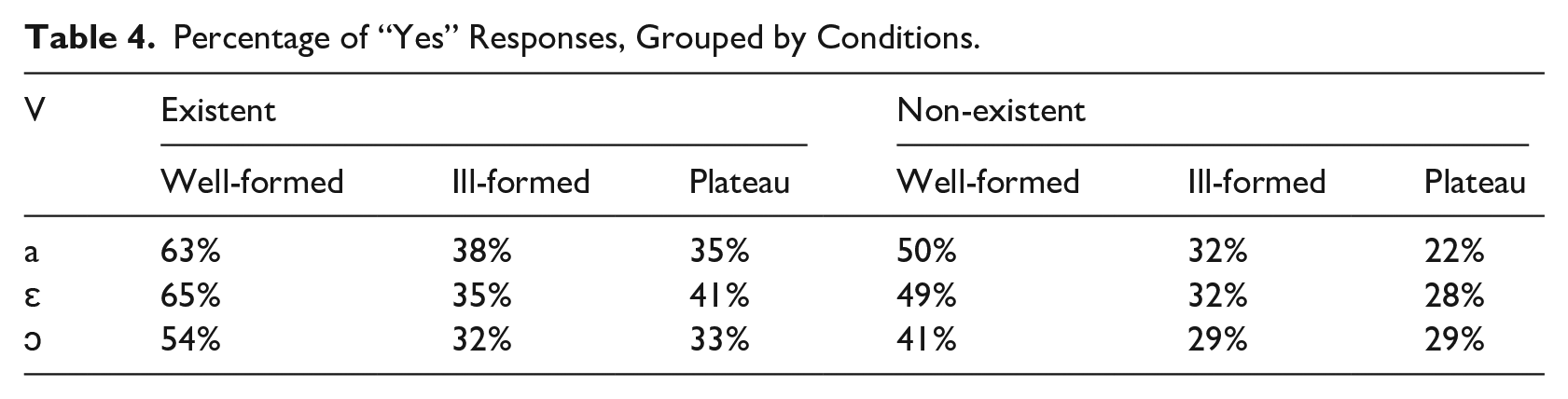
Subject responses suggest a bias toward “yes” in EX-WF clusters, while IF clusters are endorsed as potential words at the same rate disregarding their existence status. Note that acceptability ratings for EX-IF and NEX-IF forms are similar across different vowel qualities, with only a slight preference for EX. The rates for plateau clusters are highly similar to IF and highly different from WF, which corroborates their classification as IF. As to vowel quality, /ɔ/ is typically associated with the lowest acceptability rates.
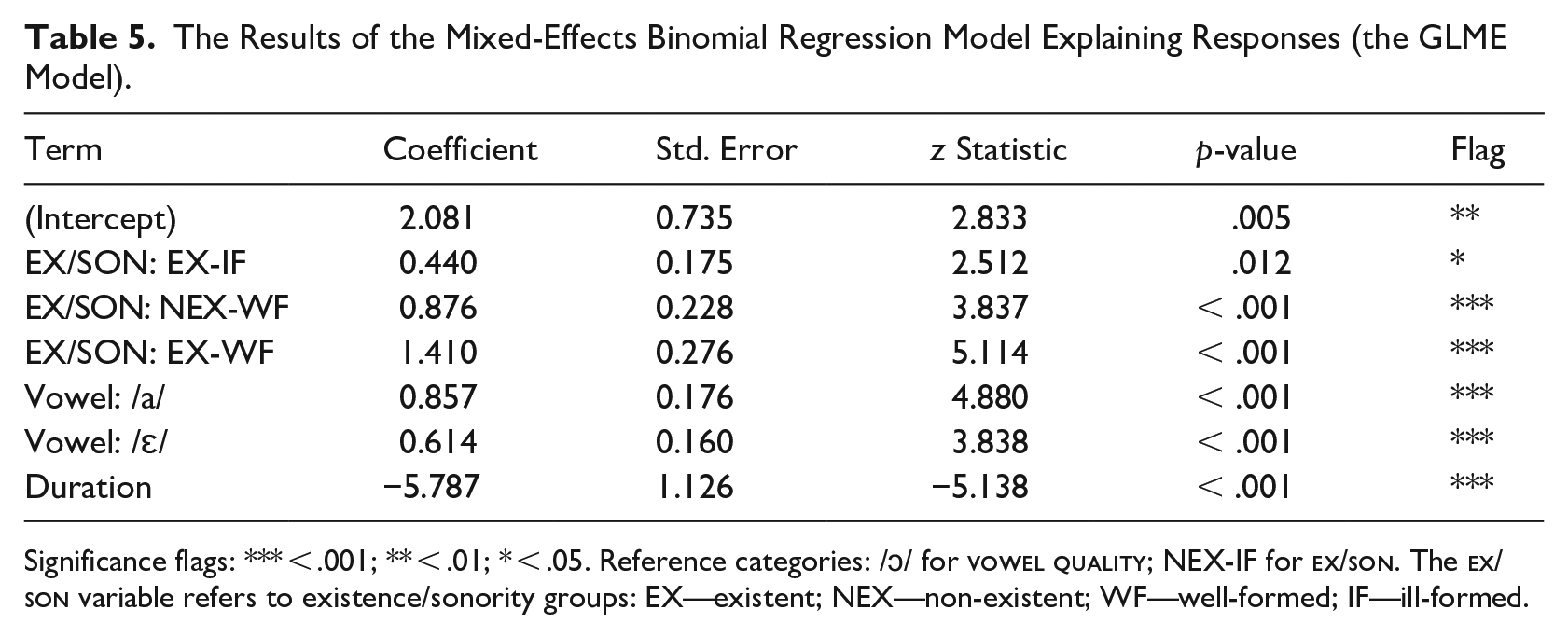
To further explore the relationship between the variables, we ran statistical analyses on all responses to estimate the probability of considering an item as possible in Polish using GLMEs including random intercepts and random slopes. The results are presented in Table 5. Characteristics of the random effects and selected measures of model quality are detailed in Appendix B.
The Results of the Mixed-Effects Binomial Regression Model Explaining Responses (the GLME Model).
Significance flags: *** < .001; ** < .01; * < .05. Reference categories: /ɔ/ for
In their phonological judgment, Polish speakers rely on the clusters’ sonority profile, existence status, and vowel type. The overall probability hierarchy capturing the acceptability of a form is the following: the most acceptable—EX-WF > NEX-WF > EX-IF > NEX-IF—the least acceptable. Each of the differences between the groups of the
Speakers endorse items containing sonority-obeying clusters attested in Polish: WF and existent types substantially increase the probability for the subjects to accept a nonword as a possible one. In turn, IF and non-existent clusters significantly increase the likelihood of the subjects rejecting a nonce word as a potential Polish word. The scale suggests that, first, sonority-obeying clusters are largely favored, and, second, some facilitating influence is also exerted by the existence of a CC, although the effect is stronger for sonority: changing from IF to WF ceteris paribus changes the dependent variable by as much as ca. 0.9, while changing from NEX to EX only by ca. 0.4. In addition, note that there is no interaction between
Moreover, we found a similar effect of vowels /ɛ/ and /a/ versus /ɔ/. The presence of /ɛ a/ increases the probability of judging a form as possible compared to /ɔ/. This probability is slightly higher for /a/ than /ɛ/ in the sample, but in this study there is too weak a basis for considering the difference to be significant (results of Z test of the /a/ coefficient in the model with /ɛ/ as a reference category: z = 1.550, p = .121). This leads to the following hierarchy of preferability: the most acceptable—/a/ ⩾ /ɛ/ > /ɔ/—the least acceptable. This result suggests that vowel /ɔ/ hinders the “yes” response in the decision-making process. The findings are consistent with the data in Table 4.
Apart from collecting responses, we measured reaction times. Let us start with an overview of the descriptive statistics, presented as Table 6. In the sample, EX-WF clusters are processed the shortest (M = 1,247 ms), while NEX-WF are processed the longest (M = 1,312 ms). Among vowels, words containing /ɔ/ evoke the shortest response latencies, containing /a/—the longest, and /ɛ/—merging between the two classes. This pattern holds for all the conditions with the exception of EX-WF. The overall mean (for the whole sample) of reaction times is M = 1,241 ms for /ɔ/, M = 1,270 ms for /ɛ/, and M = 1,325 ms for /a/.
Mean Raw Reaction Times (in ms), Grouped by Conditions.
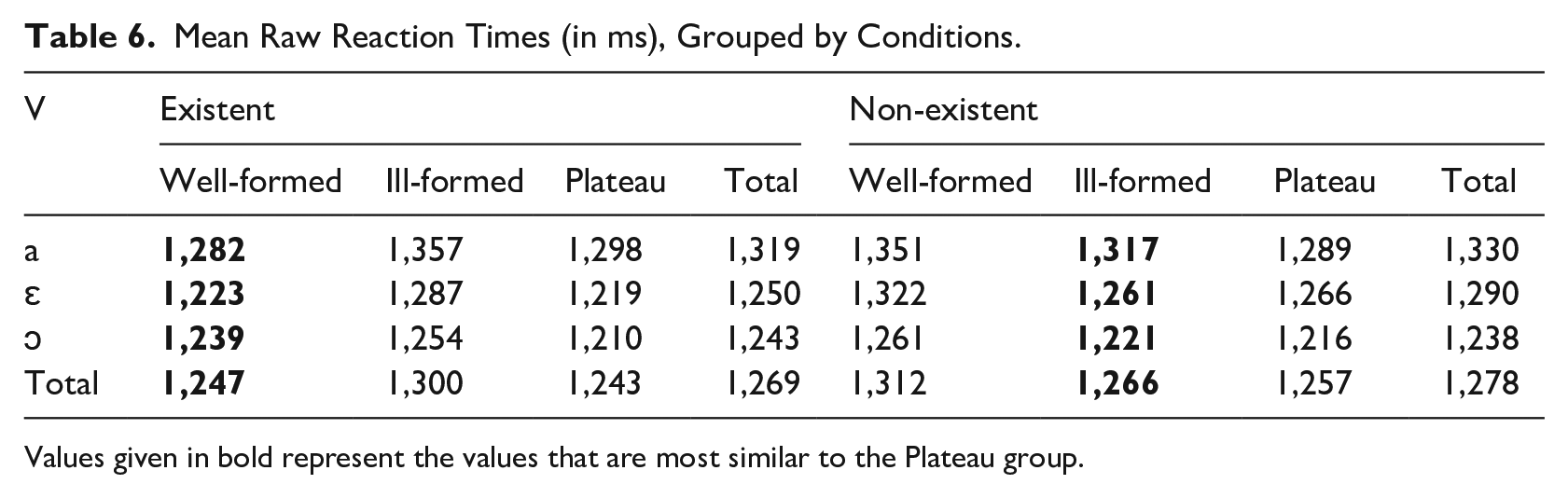
Values given in bold represent the values that are most similar to the Plateau group.
Raw reaction time data are ambiguous in terms of plateaus’ affinity to WF or IF CCs. In Table 6, values given in bold type indicate the categories’ similarity to plateaus. The pattern is consistent for each existence class: NEX plateaus are processed more similarly to IF CCs, while EX plateaus are processed more similarly to WF CCs. However, this dissimilarity does not undermine the conclusions drawn from comparing the three-level and two-level models, as indicated earlier.
The LME model for RT is summarized in Table 7. Tests of significance give strong premises to infer the significance of the difference between the NEX-WF group, compared to other groups, t(66.8) = 3.213, p = .002. In contrast, no significant differences are observed for comparisons of the EX-WF versus NEX-IF, t(52.0) = 0.083, p = .934, and EX-IF versus NEX-IF, t(60.8) = 1.334, p = .187. More specifically:
(1) EX-WF and NEX-IF clusters entail the shortest reaction times for subjects to respond to. That is, it is the easiest for Polish speakers to judge the possibility of EX-WF and NEX-IF clusters occurring in Polish compared to other cluster types.
(2) NEX-WF clusters entail the longest reaction times for subjects to answer to. That is, it is the most cognitively challenging for Polish speakers to judge the existence of NEX-WF.
(3) The present study gives no indication of an EX-IF difference relative to the two groups with the shortest response time, t(60.8) = 1.334, p = .187. At the same time, both the p-value and the coefficient (0.013) for this group appear to be different from EX-WF, which may suggest that there is some basis for recognizing the relationship in future studies, but which cannot be detected with the sample tested here.
(4) The overall scale of reaction times is the following:
the longest—NEX-WF > EX-IF = EX-WF = NEX-IF—the shortest. 4
The Results of the Mixed-Effects Linear Regression Model Explaining Logarithmized Reaction Times (the LME Model).
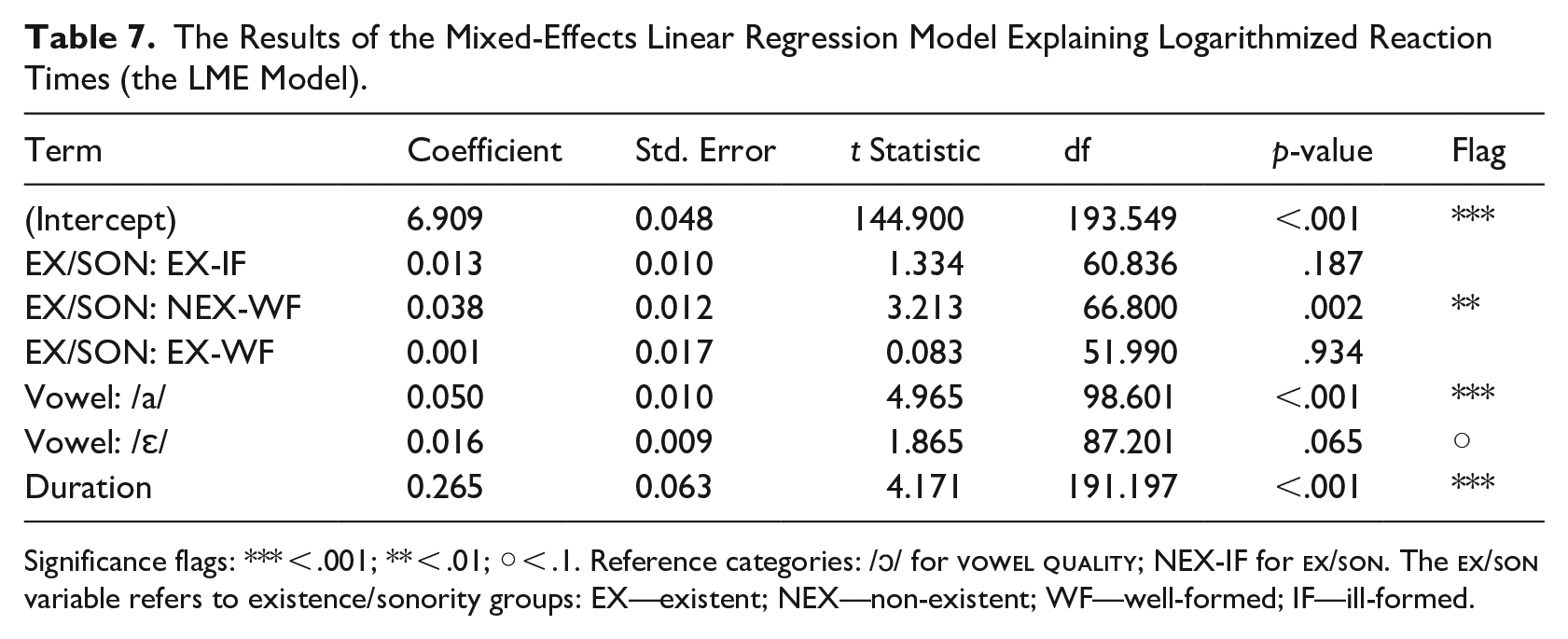
Significance flags: *** < .001; ** < .01; ○ < .1. Reference categories: /ɔ/ for
As for vowels, we found significant differences between /a/ and /ɔ/, t(98.6) = 4.965, p < .001, and some evidence for the difference between /ɛ/ and /ɔ/, t(87.2) = 1.865, p = .065. The difference between /a/ and /ɛ/ is also significant, t(191.2) = 3.921, p < .001. The presence of /a/ evokes longer response latencies than /ɔ/, and /ɛ/ has a comparable effect, albeit much weaker (0.05 vs. 0.016 change in RT).
As has been mentioned before, when testing models, we used
5 Discussion
The goal of the paper was to report on a reaction time study on word-final CC clusters and neighboring vowels in Polish. We tested how cluster
5.1 Existence and sonority
First of all, EX-WF, NEX-IF, and EX-IF clusters involve shorter response latencies, revealing that they are cognitively less costly to recognize and evaluate, while NEX-WF clusters elicit longer response latencies, suggesting greater processing effort for the decision-making process. Overall, ill-formedness contributes to rapid evaluation of clusters, while the difficulty of evaluating WF clusters depends on their (non-)existence status. Acceptability rates partially mirror the pattern: words with EX-WF clusters are largely considered to be legitimate Polish words, making them cognitively more accessible. Forms which tend to be rejected as Polish words contain sonority-offending CCs; thus sonority violations constitute the prime benchmark in cluster evaluation, rendering these forms easy to judge. Moreover, the fact that NEX-WF items are most difficult to judge suggests that the sonority profile is an important cue in phonological decision. Thus, the non-existent status of WF clusters leads to cognitive dissonance during processing. This result is compelling; it might reflect the clusters’ markedness status in the cognitive grammar of native speakers of Polish.
It must be borne in mind that the relationship between
Moreover, the present study offers insights into the processing of plateau clusters. Although clusters lacking sonority distance are generally deemed marked—since a minimum sonority difference between two adjacent positions in a syllable is required (e.g., Clements, 1990; Parker, 2002; Steriade, 1982)—the absence of sonority distance was argued to be universally unproblematic in Berent et al. (2007). Also in Polish, a lack of minimal sonority distance was permitted in obstruent onsets (with the exception of geminates) in Rubach and Booij (1990). This constraint reflects a syllabification algorithm, according to which a plateau such as /tk/ in matka “mother” tends to be tautosyllabified (ma.tka) rather than heterosyllabified (mat.ka) by native speakers. Further theoretically-based exclusions of plateaus were proposed in Rochoń (2000), who posited constraints prohibiting the occurrence of onsets featuring two nasals, liquids or glides. The statistical modeling in the present paper lends support to Government Phonology and Optimality Theory constraints by showing that reactions to plateaus largely parallel reactions to sonority-violating clusters. This finding shows that at least a minimal sonority distance is required in word-final phonotactics in Polish, further supporting principles mandating a minimal sonority distance (Harris, 1983; Selkirk, 1984; Steriade, 1982). Stating whether this behavior is systematic and symmetrical requires further research focusing on the role of distances in Polish onsets and codas, which we are currently pursuing.
5.2 Vowel quality
A novel finding is that vowel quality is a significant predictor of the speed of cognitive access in Polish speakers, with /ɔ/ displaying the strongest facilitative effect on processing, in opposition to /a/. The hierarchy established for “yes” responses is shown in (2), where the probability of accepting a form as a potential Polish word was facilitated more by /a ɛ/ than by /ɔ/. These findings can be integrated into the theory on sonority distinctions between vowels and theoretical approaches to phonotactics, which we discuss in the following sections.
The results suggest that the discussion of phonotactics can well incorporate the phonological characteristics of vowels, although very few contributions have used both vowel quality and cluster well-formedness in the analysis of syllable structure (e.g., Parker, 2008). Typically, studies on phonotactics have used vowels as a benchmark for the evaluation of cluster formedness (preceeding vowels or following them), without considering their sub-segmental properties. The phonotactic principle that takes into account vowel quality in the computation of cluster preferability is Net Auditory Distance (henceforth NAD, e.g., Dziubalska-Kołaczyk, 2019; Dziubalska-Kołaczyk et al., 2014), in which a distinction is made between vowels of different height and frontness. This model predicts that a structure such as /ɛ/CC is more preferred than /a/CC or /ɔ/CC in Polish, disregarding a cluster type. This prediction partially aligns with the results for the
Previous research has highlighted the word-final or coda position as particularly important for understanding the relationship between vowels and consonants. For example, in CVC strings in English, vowels were shown to display greater cohesion with the following consonant, especially if this consonant was represented by a liquid (e.g., Stemberger, 1983; Treiman, 1984). Experimental work of Treiman (1984) revealed that native speakers tend to group the postvocalic liquid with the vowel, while consonant clusters beginning with obstruents form cohesive units on their own. These results support the psychological reality of the sonority hierarchy, which we have also reported in the current study on Polish.
Moreover, the observed latencies and behavioral responses to vowel quality tip the balance in favor of sonority scales, which capture a degree of granularity within the class of vowels (for an overview see Parker, 2017). The universal sonority scale generally predicts an increase in loudness from high to low for peripheral vowel qualities. In the present analysis, two vowel hierarchies emerge based on the reaction time and response data, as summarized in (2).
(2) Preferred vowel hierarchies
(a) the cognitive domain: the greatest effort—/a/ > /ɛ/ > /ɔ/—the least effort
(b) the metalinguistic domain: the most probable—/a/ ⩾ /ɛ/ > /ɔ/—the least probable
As can be seen in (2a), half-open back /ɔ/ facilitates processing the most, followed by half-open front /ɛ/, while the most sonorous open low /a/ leads to slower access times. In contrast, the most cognitively costly vowel /a/ is favored by Polish speakers at the metalinguistic level (2b). Moreover, in (2b), the preferability of /a/ and /ɛ/ is comparable. The rejection of nonce words featuring /ɔ/ might suggest that the front-back distinction (rather than the universally expected high-low distinction) is consulted in the decision-making process. We can, thus, conclude that Polish speakers use fine-grained distinctions mainly in frontness (i.e., front /ɛ/ and central /a/ vs. back /ɔ/), rather than in height (i.e., lower /a/ vs. higher /ɛ ɔ/), in which /ɛ/ and /ɔ/ form a joint group. This result is consistent with a recent study on German qu-words (Orzechowska & Wiese, 2024). The processing of the initial phonemic cluster, phonetically realized as either [kf- kv- kʋ-], is facilitated by vowels based on their front-back relation, rather than on the widely acknowledged height dimension.
Finally, it must be noted that the findings of the study trigger questions on the representation of syllable structure in the mental lexicon of Polish speakers. For English, studies based on polysyllables (Fowler et al., 1993; Treiman et al., 1995) provided compelling evidence supporting the hierarchical organization of the syllable, in which the rhyme consists of a vowel and the remaining consonantal material. Although the results of the present study testify to the psychological reality of the sonority principle and degrees of vowel frontness, they cannot be generalized to the rhyme unit. As Davis (1989) rightly argued, conclusions drawn on the structure of monosyllables may be well interpreted as effects characteristic of the word. This means that we are not able to unambiguously interpret the present findings in relation to the onset/rhyme division of the syllable. Moreover, the stimuli were controlled for the phonological properties of vowels and clusters in isolation, but not for rhymes. For this reason, we refrain from making claims on the internal organization of the syllable in Polish, and declare it as a limitation of the study. This question remains open for further research.
5.3 Conflicting results on sonority—an interpretation
Placing the present study in a broader empirical context shows that in spite of the fact that native speakers of Polish are continuously exposed to sonority-offending clusters (see examples in (1)), the effects of sonority are reserved for selected cognitive functions. Based on the literature overview and her empirical work, Orzechowska (2019) suggested that although the sonority principle is available to Polish speakers, it is restricted to specific experimental tasks, for instance, by being applicable in learning and memorization, but not in phonological discrimination. Let us outline some competing evidence from syllabification and production studies.
Syllabification in Polish was argued to be sonority-driven in, inter alia, Bethin (1992), Cyran and Gussmann (1999) and Cetnarowska and Żygis (2007). However, a number of studies showed that sonority-based syllabification is far too simple. Szpyra-Kozłowska (1998) reported a high degree of variability in phonetic division of medial clusters, and Szpyra-Kozłowska (2000) observed that other factors (such as morphology) might be involved. In addition, the effects of sonority seem to be constrained by prosodic position. While sonority was shown to play a crucial role in the phonetic syllabification of prefixed words in Cetnarowska and Żygis (2007), Szpyra-Kozłowska (2000) argued that Polish speakers also consider highly productive and fully transparent suffixes in their parsing strategies. Similarly in production studies, sonority was shown to affect acquisition of clusters (e.g., Łukaszewicz, 2010; Jarosz, 2017), while other factors were shown to affect spontaneous speech in adults. For instance, phonostylistic processes in adults tend to be modulated by cluster frequency in word initial position, and features such as stridency, coronality, or vowel quality in word-final position (Orzechowska, 2019). Furthermore, the psycholinguistic studies discussed in Section 3 point to a division of labor at the neuro-cognitive level, whereby sonority facilitates learning and recollection, but is inactive in phonological discrimination (Wiese et al., 2017). This result suggests that other principles might be active when Polish speakers engage in phonological judgment.
Overall, the body of accumulated evidence indicates that the sonority principle is generally available to Polish speakers; however, its retrieval depends on a type of a linguistic modality” activated. The role of the sonority principle in Polish is task-dependent and should be interpreted only in relation to a specific information-processing task. When viewed from this perspective, the findings of the current study have wide-ranging implications for phonological research and phonotactic models, to be discussed in Section 5.4.
Another potential explanation is that the effect of the sonority slope depends on the control of other variables in statistical models. Thus, it is strongly advisable that future research includes hierarchical models, which make it possible to trace the effects of additional variables on the processing of clusters. Sonority distances are one of such variables. In principle, clusters displaying a large sonority distance are easier to recognize and process than clusters characterized by a small distance (e.g., Berent et al., 2014; Moreton, 2002; Pitt, 1998; for further references, see Section 3). Another factor that was shown to affect the processing of phonotactics is the morphological status of clusters, whereby morphologically complex clusters facilitate processing and are prone to fewer errors (e.g., Korecky-Kroll et al., 2014).
5.4 Implications for phonological theory
Highly significant parametric coefficients of the
Work on segmental neighbors revealed that spoken words are easier to recognize when phonologically similar words are activated in memory. Speakers provide delayed and less accurate responses to real items in high-frequency and/or dense neighborhoods, compared to words that occur in lower frequency and/or lower density phonological neighbors. The reverse pattern is found for nonce words (Luce & Pisoni, 1998). Although the data analyzed in this paper do not make it possible to address this question for Polish consistently, some comparison can be made. All nonce monosyllables presented to speakers have frequency equal to zero, while stimuli containing existent CCs naturally offer greater lexical support. As a consequence, we should expect a statistically significant difference in the processing of EX and NEX targets. In line with Luce and Pisoni (1998), monosyllables ending in existent clusters should be processed faster. As shown in Section 4.9, a difference between EX and NEX items is attested in relation to well-formedness, where EX-WF and NEX-IF involve the shortest reaction times. Stimuli featuring EX clusters display greater inter-segmental frequency than NEX clusters, which results in an increase in the activation level of the acoustic patterns heard. In turn, this activation leads to shorter response latencies.
The observed sensitivity to vowel characteristics shows that the evaluation of nonce words involves multiple levels: Apart from the phonological structure of final clusters, Polish speakers consult feature-based grammaticality. This interpretation has received great support from previous research, which stressed the relevance of sub-segmental cues in computing phonological information. Numerous approaches proposed to describe language structure using abstract feature patterns to describe and predict phonological structures and model the learning paths of language users. For instance, Hayes and Wilson (2008) proposed a phonotactic learner that operates on constraints constructed on the basis of natural classes and showed that it can successfully acquire the grammar of constraint-based languages based on several phonological features. Albright and Hayes (2003) argued that phonotactic grammar is discovered by learners in the process of identifying abstract feature patterns, which are shared over pairs of strings. The idea was also captured in Albright (2009) who proposed a feature-based approach to gradient phonological judgments, whereby the acceptability of nonce forms is based on the most probable combination of natural classes.
Given the present data, we can conclude that phonotactic intuitions, at least at some level of processing, rely on feature-based phonological representations. Apart from vowel features, well-formedness is also expressed in terms of manner features. The sonority scale, disregarding the degree of detail that it involves, embraces undisputed junctures between vowels and sonorants as well as between sonorants and obstruents captured by features [± consonant], [±sonorant]. Finer, and language-specific differences are related to the classification of rhotics and laterals, affricates and stops/fricatives, and the voiced and voiceless contrast. Thus, we argue that cognitive representations cannot be discussed in isolation from the sub-segmental structure of sounds and their sequences, and that cognitive processes operate on high-level constraints.
The feature-based interpretation questions a body of research that advocates for segmental representations, and distinctiveness of vowels and consonants. It has been shown that the processing of vowels and consonants (or clusters) requires access to different processing levels or mechanisms, and that vowels and consonants are represented independently in the mind of speakers. Evidence in favor of this interpretation was offered by Caramazza et al.’s (2000) study on aphasic speakers, which led to the conclusion that vowels and consonants are categorically distinct entities at the underlying level, in spite of their phonetic similarities. Roelofs’s (1999) articulatory data also revealed that segments, rather than features, facilitate word planning, which suggests that phonological encoding involves vowels and consonants as distinct entities. A neurolinguistic study by Boatman et al. (1997) corroborated the hypothesis: At the cortical level, consonant and vowel perception represent distinct perceptual phenomena. Further evidence in favor of the distinction was provided in studies on phonotactic learning. Newport and Aslin (2004) demonstrated that listeners easily acquire patterns between non-adjacent consonants, which required skipping over vowels. Similarly, Chambers et al. (2010) showed that learners rapidly recognize CVC generalizations disregarding the vowel quality. Overall, the results support the distinction between vowels and consonants as basic functional units (see Nespor et al., 2003 for a detailed discussion). At present, the verification of this proposal is not possible as it would require another study designed specifically to address the dissociation between vowels and consonants. It might be the case, however, that depending on a task, Polish speakers access different phonological levels in their decision units.
It must be stressed that the present conclusions hold for the final, and thus prosodically weaker, word position. Extensions of this study will involve investigating native speakers’ sensitivity to the sub-constituents of the syllable in polysyllabic words, as well as their sensitivity to vowels and gradient markedness in terms of sonority distances in both word positions. Further work on initial phonotactics has the potential of revealing whether the cognitive behavior of Polish speakers is symmetrical. As to statistics, apart from the aforementioned hierarchical regression, future analyses could involve quantile regression as it offers an in-depth analysis of predictors by looking into consecutive fragments of the distribution of the observed latencies.
6 Conclusions
The goal of the paper was to investigate psychological factors that contribute to the processing of final CC clusters in Polish. The literature on the topic is sparse and has mainly focused on cluster existence and well-formedness. We expanded upon previous analyses by testing whether phonotactic intuitions are affected not only by cluster status and its positive or negative sonority slope, but also by the quality of the vowel preceding the sequence. The results of the analysis are twofold. First, we demonstrated that universally unmarked syllables in terms of sonority are easily identified as possible and involve fewer errors, while marked syllables are easily identified as unlikely to occur in Polish. The fact that speakers experienced difficulties judging sonority-violating clusters as possible suggests that the sonority principle is part of speakers’ phonological knowledge. Second, we observed a systematic perceptual contribution of vowels to the evaluation of novel forms. The paper also offers evidence in favor of the fact that phonological information and phonological access in a phonotactically complex language require feature representations, and that cognitive processes operate on high-level phonological information.
Footnotes
Appendix
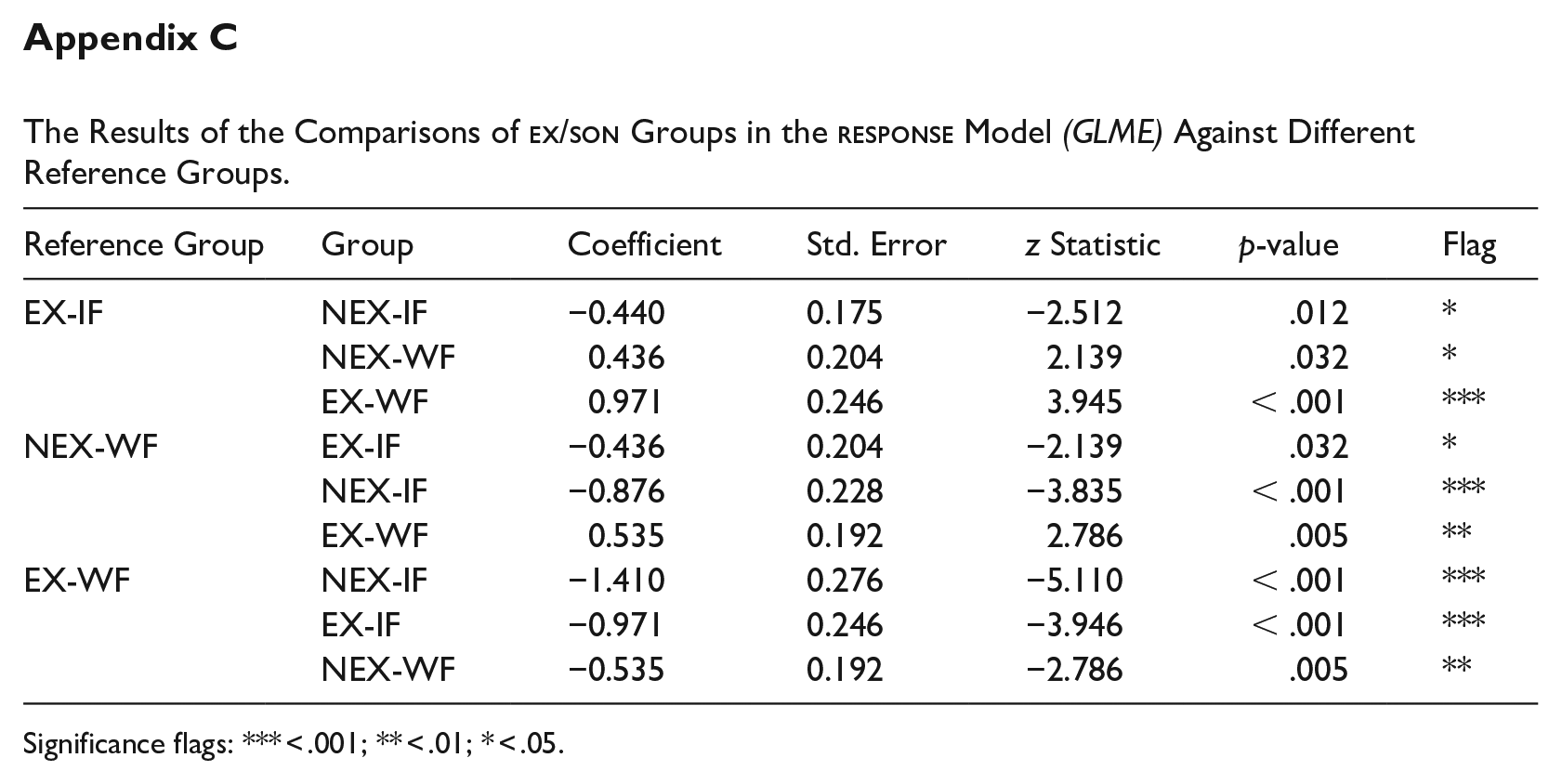
The Results of the Comparisons of
| Reference Group | Group | Coefficient | Std. Error | z Statistic | p-value | Flag |
|---|---|---|---|---|---|---|
| EX-IF | NEX-IF | −0.440 | 0.175 | −2.512 | .012 | * |
| NEX-WF | 0.436 | 0.204 | 2.139 | .032 | * | |
| EX-WF | 0.971 | 0.246 | 3.945 | < .001 | *** | |
| NEX-WF | EX-IF | −0.436 | 0.204 | −2.139 | .032 | * |
| NEX-IF | −0.876 | 0.228 | −3.835 | < .001 | *** | |
| EX-WF | 0.535 | 0.192 | 2.786 | .005 | ** | |
| EX-WF | NEX-IF | −1.410 | 0.276 | −5.110 | < .001 | *** |
| EX-IF | −0.971 | 0.246 | −3.946 | < .001 | *** | |
| NEX-WF | −0.535 | 0.192 | −2.786 | .005 | ** |
Significance flags: *** < .001; ** < .01; * < .05.
Funding
The author(s) disclosed receipt of the following financial support for the research, authorship, and/or publication of this article: This research was financed by the National Science Center, Poland, under grant number 2015/18/E/HS2/00066: The role of phonological features in phonotactics: A study on structure and learnability of consonant clusters in Slavic and Germanic languages.
