



Abstract
The Institut Pasteur has set the ambition to encourage all staff to get involved in sustainable development across all departments on campus. The animal facility staff joined the efforts of the sustainable development department to analyse current and future processes and identify potential solutions and related brakes and leverages for the reduction of the animal facilities’ environmental impact. The first step was to collect the managers’ experience on the local initiatives. Then, the managers attended a workshop to share information on networks and initiatives relevant to the topic and community, and to discuss the use of consumables, including personal protective equipment, single use plastics, bedding, feed, water, chemicals, and waste management. On the topics of interest, local initiatives were specifically detailed to assess their eventual implementation in all the institute’s animal facilities, and tasks were set to pursue the managers’ efforts in the longer term. A scenario was used to teach how to compare the carbon footprints of washing and disinfection equipment and process and to decide on the design of an animal facility. Finally, a summary is drawn of the brakes and leverages for the reduction of the environmental impact of the institute’s animal facilities.
Introduction
The activities of the Institut Pasteur engage with a responsible, societal and environmental approach. As reflected in its Green Campus programme (https://www.pasteur.fr/en/institut-pasteur/our-commitments), the Institut Pasteur is acutely aware of environmental challenges, which affect all generations at every level of society. In line with the Institut Pasteur’s ambitions to encourage all staff to get involved with environmental challenges both now and in the future, a master plan for environmental development is currently being developed jointly with dedicated staff and volunteers from some departments working on campus, to reduce the environmental impacts of their activities, especially energy consumption and greenhouse gas emissions.
In this context, the animal facility staff joined the efforts of the sustainable development department to analyse current and future processes, and to identify potential solutions and related brakes and leverages for the reduction of the animal facilities’ environmental impact. This work was led with the help of an external collaborator. The first step was to collect the managers’ experience on environmental impact reduction across the animal facilities, such as local and common initiatives, and brakes and leverages for further reduction. Specific topics of focus were then identified (e.g. experience sharing, biosecurity and animal housing), whilst wider topics such as lighting and ventilation are considered by other of the institute’s departments.
Then, to facilitate experience sharing, a one-day workshop was organised to further the discussions and to empower the animal facility managers with knowledge of where to find information, which networks to reach for specific questions, and how to estimate carbon footprints. Initiatives across the animal facilities to reduce the environmental impact of consumables (e.g. single use plastics, waste management, bedding, feed, water, chemicals including veterinary medicine) were already in place. The aim of the workshop was to open discussions on the best ways to optimise these initiatives. This was of specific interest since all workshop participants had raised a common concern for single-use personal protective equipment (PPE; such as hairnet, mask, gloves, over-shoes and gown). For carbon footprint estimation, a scenario based on the comparison of potential biosecurity processes was developed. Nevertheless, the efficacy of the institute’s initiatives depends on external service providers and suppliers, and on internal buy-ins from various stakeholders. Therefore, the workshop also aimed to improve internal collaboration and the use of external resources. We will discuss the output of the workshop as a set of local tasks initiated following the discussions. This will help us identify the brakes and leverages to further reduce the environmental impact of the institute’s laboratory animal facilities.
Workshop topics
Topic 1 – ethical challenge
Reducing the environmental impact in the laboratory animal facility is first an ethical challenge. The use of animals for scientific research is approved by ethics committees and authorised by competent authorities following an assessment of how the potential benefits of the research (e.g. new treatments, new knowledge) outweigh the harm induced to animals. 1 Even when in compliance with Article 38-1.(c) of Directive 2010/63/EU ‘the project is designed so as to enable procedures to be carried out in the most humane and environmentally sensitive manner possible’, 1 if the scientific project impacts the environment in a non-neglectable manner, a complementary environmental harm/benefits assessment should take this into account. 2 It might seem unlikely that the environmental harm of the project induces more harm (including impact on human welfare and even deaths) than the studied disease, but we ought not to ignore this ethical challenge. If the ethical evaluation of the projects using animals also helped reduce waste and energy consumption, it would carry even more responsibility and impact on environmental protection. Although the growing interest of staff, public and funders on such questions is sometimes palpable,3 –5 there is still no ethical evaluation process in place to evaluate this aspect of the scientific projects or means to give recommendations prior to their implementation.
Topic 2 – request life-cycle data from suppliers
Political powers are not foreign to environmental concerns, and some regulations could help laboratories by requesting suppliers to provide life-cycle costs and setting rules on procurement with sustainability in mind.6 –8 Notwithstanding these regulations mostly aiming towards the wise spending of public funds, they would raise the standards for suppliers and help laboratories lobby for better access to the required information. Now that life-cycle costs data are produced by manufacturers and suppliers, laboratories acquire the responsibility to make use of the data by choosing their purchases based on the products’ life-cycles. Thereby, the Institut Pasteur has engaged in requesting these data from its suppliers, through collaboration with the purchasing department. These data are not always available, but this is a first step in improving the Source-to-Pay process. The aim is to enable the end user to compare the Product Carbon Footprint index in addition to other characteristics, and make their choice based on this criterion, when ordering products.
Topic 3 – external networks
Reducing the facility’s environmental impact can also be facilitated by soliciting networks of initiatives and laboratories with the same goals (e.g. https://labos1point5.org/, https://felasa.eu/about-us/library/3rs-reduce-reuse-recycle, https://www.ecoveto.org/, https://vetsustain.org/, https://anaesthetists.org/Home/Resources-publications/Environment).9 –13 For example, the International Laboratory Freezer Challenge 14 helps reduce the energy consumption of ultra-low temperature freezers by providing guidance on good maintenance practice and stock management, and by sharing data on raising the temperature set-point from −80°C to −70°C or warmer without compromising sample quality. 15 This last point remains very much debated at the Institut Pasteur owing to the risk for biological samples’ integrity. Accreditation schemes are also available and sometimes adapted to animal facilities.16,17 Noticeably, the Laboratory Efficiency Assessment Framework (LEAF) proposes a global approach where ‘3R – Replace, Reuse, Recycle’ sometimes echoes with ‘3R – Replace, Reduce, Refine’. For example, the reduction and replacement of animal use can lead to the reduction of waste and energy consumption and justifies the exhaustive archiving and sharing of positive and negative results. Training of personnel is another major component of a sustainability programme accredited by LEAF. It is essential to ensure compliance with the organisation’s efforts towards the reduction of its environmental impact. For instance, training of personnel is the opportunity to infuse good practice of data collection and other environment-friendly steps of procedures such as consumable triage for recycling. 18
Topic 4 – consumable management
When possible, the best way to reduce the environmental impact of consumables is to replace them by a more environment-friendly option. The secondary options are to reuse them or to repurpose them. Recycling is not the preferred option; it is only a last resort solution to avoid waste disposal in landfill or by incineration. 19 Consumables have a life-cycle that can be difficult to track: from the collection of raw material to their production, storage, distribution, consumption and end of life (e.g. waste disposal or recycling). One key impact is the carbon footprint of transport, which increases as materials are moved to the different stakeholder sites and every time the consumables are delivered to the consumer site. The Institut Pasteur takes into account that issue by coordinating orders between its animal facilities. Consumables are then ordered in bulk, in a less frequent manner, as the load of the delivery trucks is optimised. This also requires sound store management to ensure that expiry dates are observed. To reduce further the volume and carbon footprint of deliveries, suppliers using less packaging and/or a less fossil fuel consuming fleet can be selected, with the help of the purchasing department or others. In addition, acting on the end of life of consumables can help reduce their environmental impact. When possible, the frequency of waste collection can be reduced by selecting bins of the appropriate size and setting a clear triage system for waste disposal, 18 even more for items that can be recycled or reused. Depending on animal models, some plastic and cardboard packaging can fulfil a second purpose as environmental enrichment. In certain circumstances, dirty bedding can become compost, for example with the help of a wormery. PPE such as gloves and masks can enter specific recycling schemes, unless hazardous. 19 The environmental impact of the recycling itself should be taken in account, as well as the collection and transport to the recycling site(s).
Topic 5 – single-use equipment
Single-use plastics are consumables of particular concern. Generally, due to the deliveries’ carbon footprints, single-use plastics should be replaced by reusable alternatives, when suitable. Sometimes, it is just a case of re-conditioning the equipment. For example, plastic Petri dishes in the aquatic facility can be washed and disinfected (e.g. an ethanol or hydrogen peroxide rinse) between uses. Single-use PPE is a common concern raised by personnel. Single-use overshoes, for instance, can lose efficacy after a few steps, hence questioning the rationale for their use. Alternatives provide better resistance, particularly when dedicated shoes replace overshoes. Single-use laboratory coats, overalls and mops can sometimes be replaced by washable clothing. To assess the suitability of a specific single-use or multi-use PPE a list of questions must be addressed. Is each specific PPE a legal requirement? Are there hazards that justify the use of PPE? Is it to protect animal models against contamination? Is the barrier of suitable space and design to allow storing and donning of each single-use PPE without compromising their efficacy? Is a multi-use PPE alternative to the single-use PPE available? Is the barrier of suitable space and design to allow storing and donning of the alternative multi-use PPE without compromising its efficacy? To complete this analysis, the environmental impact of the reconditioning steps and the whole life-cycle of the various PPE options should be considered.
Topic 6 – chemicals
Regarding chemicals, to space deliveries and reduce the impact of transport, concentrated formulations can be preferred to diluted ones, or solutions can be prepared on-site. Hazardous solutions can sometimes be replaced by more environment-friendly alternatives. For example, individually ventilated cages (IVCs) are sometimes less dirty than open cages and an adapted wash programme can be used where a neutral detergent replaces an alkaline solution. In all cases, risk assessments must consider the fate of the chemical waste in the environment. Should the chemical be captured and not released to the wild? Would the chemical naturally degrade in the environment? Whereas animal treatments such as pesticides and carcinogens are obvious hazards to wildlife not to be released to the environment, gas anaesthetics are potent greenhouse gases. 20 Isoflurane and other halogenated anaesthetic agents should not be released to the atmosphere but scavenged by adsorption in a carbon filter. Similarly, water contaminated by organic molecules in the aquatic facility can be carbon filtered before reaching sewage (or heat treated in the case of microbial contamination). 21 The environmental toxicity of some compounds is well studied and sometimes mitigates the need for pre-treatment release (n.b.: this is not an exemption that concerns the Institut Pasteur, but it may apply in other contexts). For example, lidocaine, a local anaesthetic used in animal facilities, has a Predicted Environmental Concentration that should remain below its Predicted No Effect Concentration. It is degraded in surface water and is unlikely to transfer from the aquatic environment into organisms in the wild. The risk of lidocaine bioaccumulation or infiltration into groundwater is low.22 –24
Tasks and local initiatives
Following the workshop, the Institut Pasteur set a list of tasks towards the reduction of its animal facilities’ environmental impact. Each task is attributed to one or more volunteers in charge of defining an action plan and directing any collegial work. The expected outputs are first to assess whether the completion of the task would lead to an environmental impact reduction and to quantify it if possible, with the help of the sustainable development department. Then, the question of resources required to complete the tasks will be tackled: will financing be required and how much? Is the process already partially in place? The third step is to compare the work and funding involved by the task with its potential environmental impact reduction. At this stage, tasks can be hierarchised so that allocation of resources and efforts is prioritised for the most efficient means of environmental impact reduction.
Tasks for managers, ecoleaders and trainers
Some tasks are set at general management level, such as the scheduled review of some Standard Operating Procedures with sustainability in mind and facilitating the collaboration between staff of different departments to optimise problem solving. One task is more directed towards other establishments and consists in integrating networks (e.g. LEAF) to share good practices. These first tasks will lead to change in everyday work pattern and routine. Therefore, some tasks are dedicated to handling the change and ensuring the buy-in from the various stakeholders in the animal facilities, from the technician to the user and any other relevant colleagues. This may be helped by the enrolment of ‘ecoleaders’ across the institute and intranet webpages to follow development and achievements. ‘Ecoleaders’ are volunteers working on campus (scientists and non-scientists) who are giving some time, contributing to develop a more environment-friendly campus (e.g. discussing and relaying ideas and initiatives from the campus to the sustainability department and vice versa, acting when necessary). ‘Ecoleaders’ are organised in working groups by topic: communication/raising awareness, building/energy, mobility, digital, paper, food/cafeteria, biodiversity, any other topics. The change towards more environment-friendly practices is also supported by adapting training, whether it is through amending current course material to add information on sustainability and/or through creating training on waste management and other specific topics depending on staff’s duty. For example, the environmental impact of anaesthetics is discussed in the mandatory course for users performing anaesthesia and surgery on laboratory animals. To promote the initiative towards environmental impact reduction, one task could consist in working with the human resources department to reward and retain staff complying with the environment-friendly processes. Such an initiative may increase an establishment’s attractiveness for new recruits, if it is completed by projects with a positive impact on the environment while complying with current regulations and improving the quality of life at work.
Initiatives to reduce and compare PPE consumption
Regarding consumables, including PPE, some animal facilities across the institute had already started some initiatives. During the workshop, these initiatives were discussed by all, and tasks were set to assess them in view of further implementation across the institute. For example, some initiatives concerned the washing, disinfection and reuse of overalls or hair cap, or the replacement of single-use overshoes by dedicated shoes. In order to use specific recycling schemes, 19 the triage of plastic waste was tested with clearly labelled bins dedicated to their respective PPE items. Figure 1 shows the results of a study measuring the PPE waste produced in one week in five of the institute’s animal facilities (called here A, B, C, D and E). All of these facilities hold rodents, and facility E holds rabbits and quails too. The data are shown per staff who entered each facility that week. The five facilities present different model and biosecurity constraints. Staff were asked to sort their PPE waste into bins corresponding to the equipment to dispose of. PPE waste was weighed when bins were collected. Facility D is noticeably a breeding facility for rodents with a Specific Opportunistic Pathogen Free health status. The local biosecurity programme requires a regular change of gloves, which may explain the much higher glove consumption in this facility compared with the others. Facility A has a system to reuse their overalls, whereas the other facilities mainly use single-use lab coats. It seems that the others could reduce their PPE waste weight by adopting a system similar to that of facility A for overalls. Another route of potential improvement could be to replace single-use overshoes (over half of facility A’s PPE waste weight) with reusable ones (a practice already in place for facility D’s technicians). However, the full cycle of the options should be compared to decide on the most environment-friendly option.
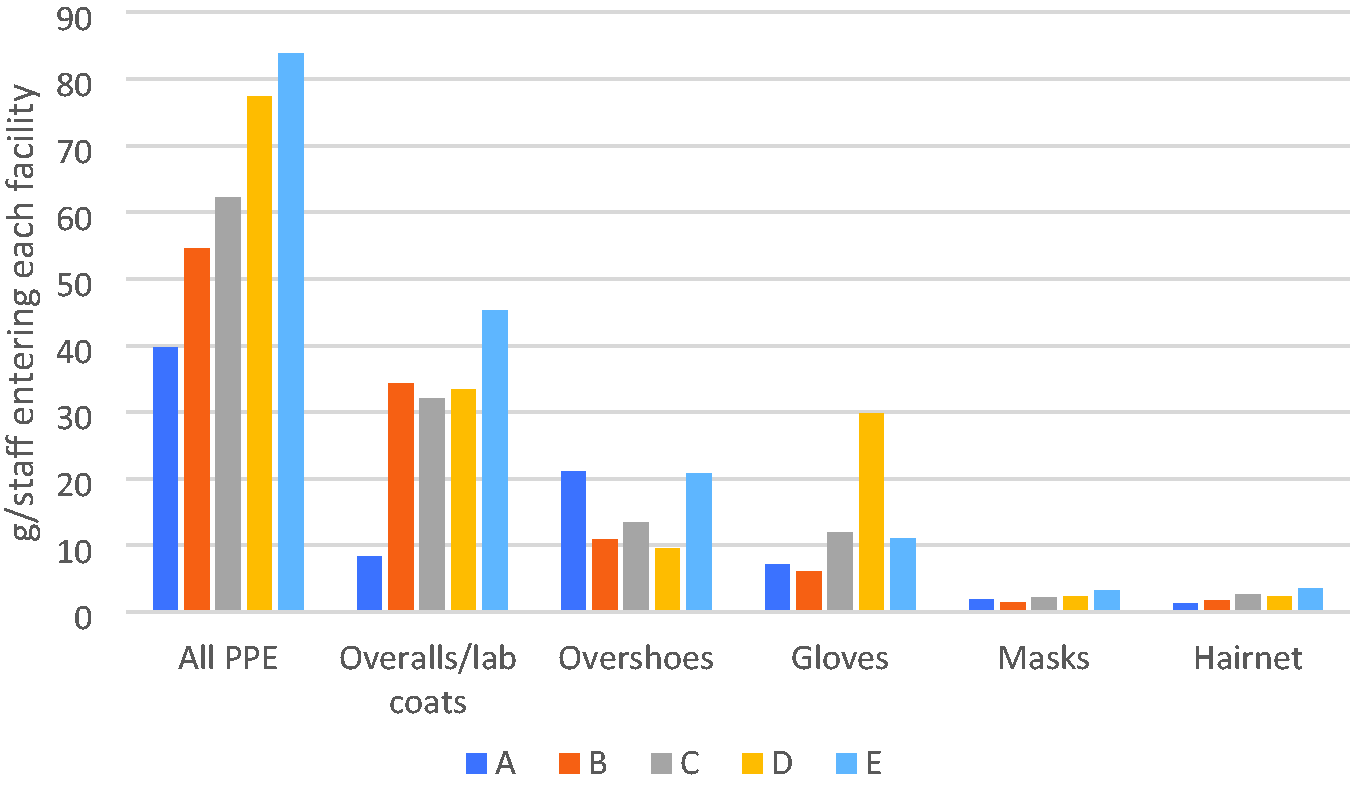
Personal protective equipment (PPE) waste over one week in five animal facilities. Data are in grams per staff entering each facility (A, B, C, D and E), for each type of PPE and for all PPE together.
Initiatives for more environment-friendly cage changes
On the husbandry front, a few facilities had already introduced the distribution of feed according to animals’ needs, and not to fill the pellet trough, and the reuse of pellets between rodent cages when suitable, such as from breeders to weaners or within the same colony and epidemiological unit. Similarly, the change of bedding is sometimes performed on a non-defined frequency, according to cage dirtiness, often linked to the cage population.25 –29 The transfer of nesting material with animals when cage changing is also a means to reduce nesting material consumption and preserve the smell of the animals’ familiar environment. Indeed, the frequency of cage changing is a connecting point for animal welfare and environmental impact. The discussion on local initiatives concluded with the need to constantly review processes and share best practices in view of reducing consumables.
Initiatives to reduce electricity consumption
To reduce resource consumption, a few cross-departmental topics are ‘work in progress’. For example, the animal facilities are testing light-emitting diode lighting and its potential impact on animal models. Some open topics are the hourly renewal of air within rooms or inside IVCs, and whether it could be reduced whilst complying with regulations and preserving acceptable air quality (e.g. ammonia concentration). Room ventilation is used to control temperature and humidity and often uses a high efficiency particulate air filter; hence the heating, ventilation and air conditioning system is considered as high-resource consumption. Bearing in mind that the environmental impact of electricity production (and therefore consumption) varies during the day, week and year (see below the section on carbon footprint and conversion factors), scheduling electricity use according to its production’s carbon footprint (e.g. reduced ventilation in corridors and experimental rooms at night) might allow a significant reduction of the institute’s environmental impact. This would require a close coordination between departments, and it might be limited by equipment and estate constraints.
Initiatives to reduce water consumption
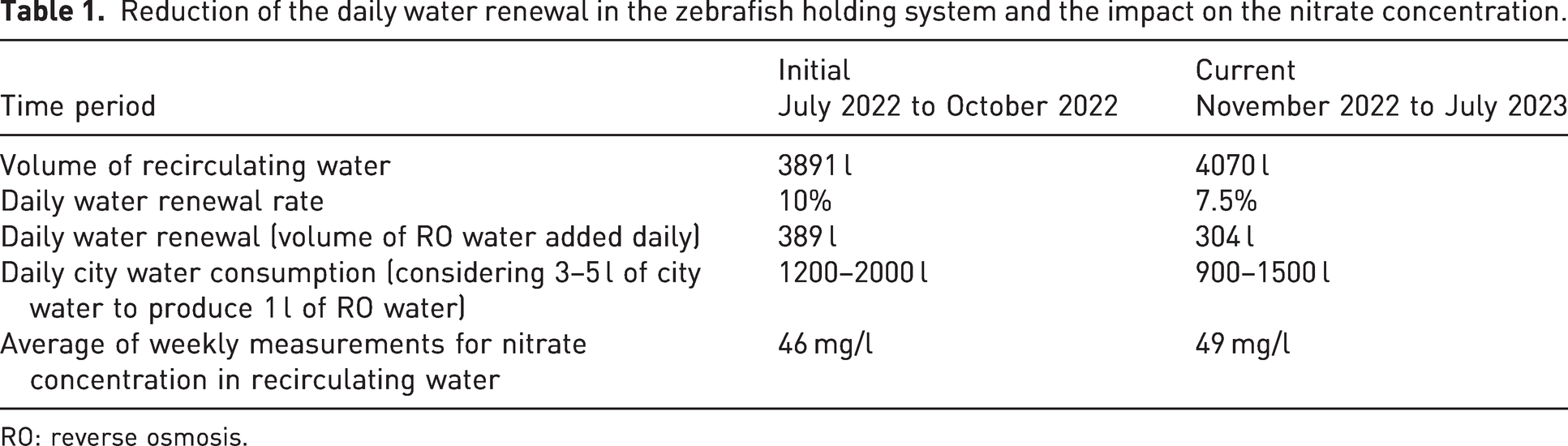
Water consumption is a topic that has seen various initiatives across the facilities. As detailed in Table 1, the zebrafish facility has started to reduce its daily water renewal while monitoring the nitrate concentration in the recirculating water. This aims at reducing the daily consumption of reverse osmosis water. The nitrate concentration of the water recirculating in the fish holding system has not been significantly affected by the daily water renewal drop from 10% to 7.5%.30 –32 About 3–5 l of city water is consumed to produce 1 l of reverse osmosis water. Therefore, the reduction of the daily water renewal has allowed a reduction of the annual city water consumption of about 110–180 m3 (i.e. 42.9–70.2 kg carbon dioxide equivalent (CO2e) as per conversion factors and carbon footprint calculation introduced below). On the rodent side, water bottles are changed only when at least half empty. This is a direct reduction of water consumption and a reduction of water usage through washing and autoclaving. The latter is a benefit of the initiative concerning the frequency of cage changing too. Washing equipment consume waters and electricity, and the institute’s autoclaves rely on a steam supply. Autoclaves are often cooled down with cold water which may or may not be reused depending on the set-up and equipment. Some tasks were set to investigate the topic further with the current equipment suppliers and to take energy efficiency and resource consumption into account when purchasing any new equipment. This can also be helpful to assess whether it is worth replacing old equipment with more environment-friendly options – considering the carbon footprints of the whole life-cycles: from raw material, manufacturing, delivery, use, maintenance and disposal including recycling. Calls for tender to acquire new washing equipment for animal facilities now include questions regarding these characteristics, which will be attributed a significant percentage of the score to rank the offers. To help the decision takers assess such efficiency, a part of the workshop was dedicated to calculating carbon footprints and comparing organisational options according to this environmental impact.
Reduction of the daily water renewal in the zebrafish holding system and the impact on the nitrate concentration.
RO: reverse osmosis.
Carbon footprint calculation
Although water consumption itself has an impact on the environment, the production of clean water and the treatment of dirty water at the national or regional level are energy-consuming processes with carbon footprints. The carbon footprint is only an estimated part of the whole environmental impact. It is measured in kilograms of carbon dioxide equivalent to the global warming potential of a unit of carbon dioxide.
Scopes of carbon emissions
To calculate the emissions of greenhouse gas equivalent (CO2e) to an energy consumption, the emissions are divided into three categories called scopes. Scope 1 refers to direct emissions from operations owned or controlled by the consumer. Scopes 2 and 3 correspond to indirect emissions resulting from the energy produced or consumed by an external party and not controlled by the consumer. Scope 2 refers to the energy sources being purchased (e.g. electricity, steam). Scope 3 includes other impacts such as travel, waste disposal, or raw materials and their transformation. For each individual activity that results in emissions, an emission factor is determined at the national or regional level. For instance, to calculate the carbon footprint in carbon dioxide equivalents of an activity, the electricity (in kilowatt-hours) and resource consumption (e.g. cubic metres of water) in the three scopes are multiplied by their respective conversion factors and added together.33 –35
Conversion factors
Equipment manufacturers should provide all information required to calculate the carbon footprint of the equipment use, such as the electricity (in kilowatt-hours, not kilowatts) consumed to start the machine and for each cycle. A simple multiplication with the conversion factor suffices to convert the consumed electricity in kilowatt-hours to carbon footprint in kilograms of carbon dioxide equivalent. Most importantly, the conversion factor depends on how the resource is produced. Typically, countries producing electricity mainly from nuclear energy have lesser conversion factors than those relying more on fossil fuels. Renewable energy is also of help since during daylight electricity produced from solar panels reduces the conversion factor by reducing the need to produce electricity from fossil fuel. 35 Thus, conversion factors are generally lower in summer than in winter, when houses are artificially warmed and lighted. Throughout the week, national electricity production demand is often reduced at weekends, when industrial use is reduced, and therefore conversion factors follow the same trend. The mean of electricity production impacts other resource consumption too. For example, municipal water is produced upstream from the animal facility and treated downstream, potentially in plants powered by energy with different conversion factors. Thus, each facility must investigate its local environment in order to assess its environmental impact and adjust its operations accordingly. In France, the average conversion factor is 0.057 kg CO2e/kWh for electricity, taking into account the building of power stations, the fuel supply to power stations, the fuel consumption in power stations and the losses along the distribution through the electricity network. For water, the conversion factors are 0.13 kg CO2e/m3 for supplied water and 0.26 kg CO2e/m3 for water treatment. For example, the consumption of 1 m3 of water has a carbon footprint of 0.13 + 0.26 = 0.39 kg CO2e.33,35
Carbon footprint scenario
During the workshop, participants worked on scenarios to calculate carbon footprints and use the calculation to decide on the design and management of a fictional animal facility. First, the need to use autoclaves for all sterilisation and disinfection processes rather than only sterilisation was discussed. The need to sterilise cages that are reused in the same epidemiological unit and not contaminated by another flora (e.g. not coming from outside the animal facility or quarantine and non-infectious models) was criticised, and it highlighted the benefits of hydrogen peroxide disinfection and thermal disinfection and how to monitor its efficacy. 36 Then, the participants calculated the carbon footprint for the daily set-up and a single cycle of a cage washer and an autoclave (see Figure 2). The scenario set a number of equipment uses for a routine week and carbon footprints of three options (A, B and C) were compared: A – all cages are washed and autoclaved; B – cages for immune-competent animals are washed and thermally disinfected, cages for immune-deficient animals are washed and autoclaved; C – all cages are washed, only cages for immune-deficient animals are autoclaved. By selecting option B or C, compared with option A, the carbon footprint would be reduced by more than 50%. Option C would allow the lowest carbon footprint (three-quarters of option B in this scenario).
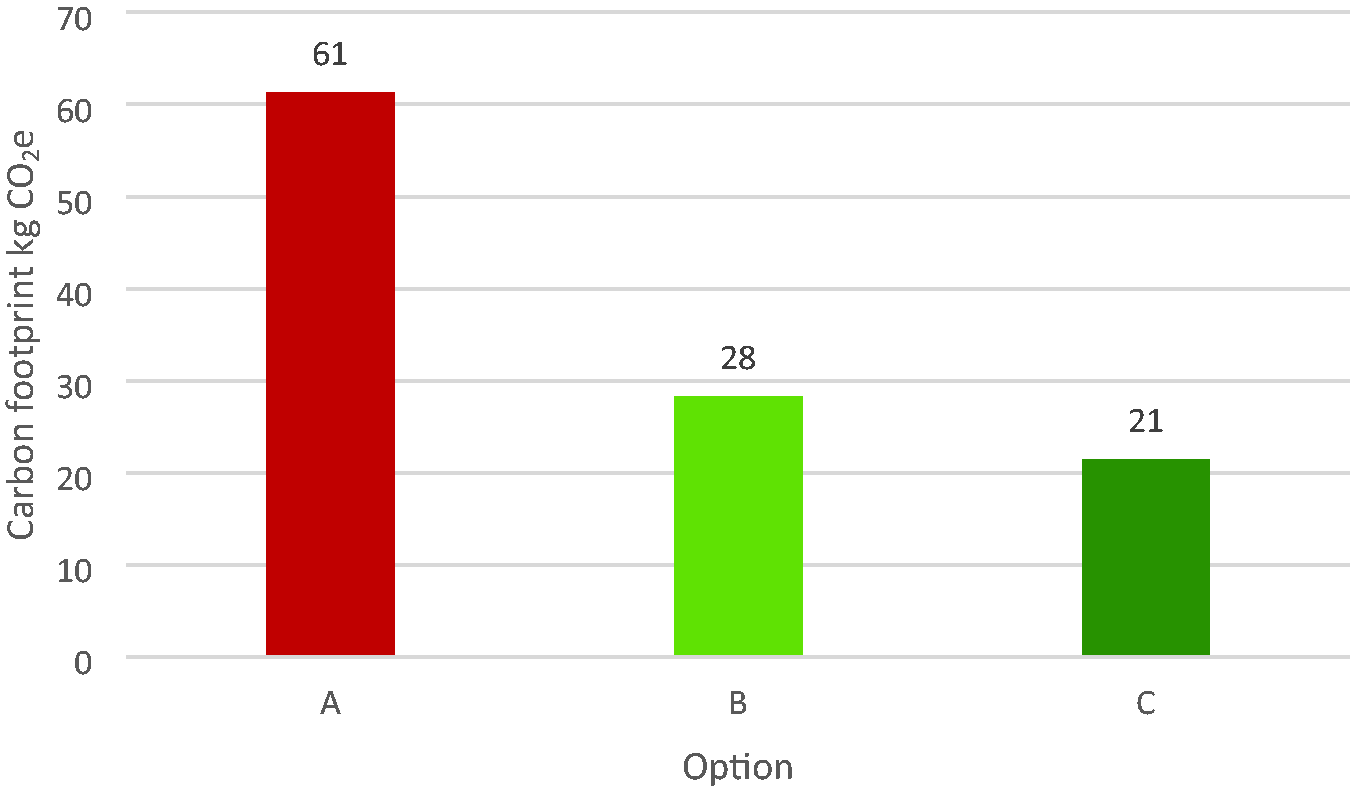
Comparison of carbon footprints for three options of the week pattern for cage washing and disinfection. A: all cages are washed and autoclaved. B: cages for immune-competent animals are washed and thermally disinfected, cages for immune-deficient animals are washed and autoclaved. C: all cages are washed, only cages for immune-deficient animals are autoclaved. Immune-deficient animals occupy 20% of the cages. The cage washer is emptied and set five days per week, during which it runs 10 cycles per day. The cage washer set-up has a carbon footprint of 0.50 kg carbon dioxide equivalent (CO2e), each wash cycle 0.18 kg CO2e, and a wash and thermal disinfection cycle 0.35 kg CO2e. The autoclave has the capacity to autoclave in a single cycle 10% of all cages with a carbon footprint of 4.98 kg CO2e.
Compare carbon footprints to organise cage cleaning and disinfection
Yet, the aim of the scenarios was to focus on the high carbon footprint of the autoclaves compared with the other washing and disinfection equipment in order to decide on the fictional facility design. The conclusion was that the carbon footprint comparison strongly suggested that having the washing of the cages inside the animal facility, rather than in an external space, and therefore not autoclaving all cages, was the environment-friendly option, and most likely the economical one too, at least in terms of running costs. The benefits of using carbon footprints for managerial decision making was illustrated further by more examples on choosing an autoclave capacity and a routine week pattern for cage cleaning according to the comparison of carbon footprints. Finally, we evoked other alternatives to autoclaving. For example, dry heat presents the advantage of a lesser impact on the building infrastructure. Single-use cages by-pass washing and disinfection requirements in the animal facility, nonetheless their carbon footprint depends on their delivery and collection for waste disposal (including recycling). Transport is currently a high carbon footprint activity, and single-use cages were not environment-friendly in the fictional scenarios.
Brakes and leverages
Leverages
During the discussions with the workshop participants, it became obvious that the reduction of the animal facilities’ environmental impact requires a close collaboration internally (i.e. between animal facility managers and between departments) and with external partners such as other research institutes, logistics company, suppliers, manufacturers and service providers, up and down the purchasing and waste management streams. Here, the leverage is the willingness to work together for a more environment-friendly science. This is facilitated by the institute’s strategical support, workforce, and means dedicated to the task. Higher manager and animal facilities’ personnel (e.g. animal caretakers, technicians, research staff) are increasingly aware of the challenge ahead and show the will to contribute to decreasing the impact of their activity on the environment, sometimes feeling peer pressure to act. Young recruits have been scholarly educated on environmental matters and constitute a vivid leverage for local initiatives. The reduction of repetitive tasks (e.g. less frequent cage and water bottle changes) is often perceived as a plus for occupational health and a good opportunity for staff to dedicate more time to observing the animals. The plurality of staff willing to dedicate their time to the environmental matter allows the division of the huge workload into smaller and more achievable tasks for which a staff member has a specific interest. The dismantling brick by brick of the environmental impact can then lead to sustainable science. Thinking outside of the institute, valuable initiatives can be shared through networks, accreditation schemes and collaboration with other facilities and their staff and managers. This speeds up implementation at local levels, and it creates a momentum between research establishments and can lead to lobbying against internal and external resistance and help to reach the collaboration of other stakeholders, such as suppliers.
Brakes
The resistance to change is a common brake to the implementation of new processes. The reduction of the environmental impact is no exception. Only good communication skills and the ability to listen and discuss can help understand the reluctance, adjust the change if necessary and convince all stakeholders. A significant reduction of the environmental impact will only be possible through collegial decisions and the buy-in of all stakeholders, eventually helped with some incentives. That will be even more convincing when based on objective evidence and measured reductions of the environmental impacts of the proposed changes. For new starters, the fear of change can be avoided by teaching the more environment-friendly processes from the initial training onwards. Still, there are brakes that cannot be easily mitigated. The task is not only to build new green buildings, it is about trying to do our best with the current infrastructures. Some walls cannot be pushed away, some ventilation systems cannot be re-designed, the challenge is sometimes about addressing 21st century concerns within constraints inherited from 20th century state-of-the-art design. If we want new buildings to be sustainable and therefore stand the test of time, how to adapt them to the 22nd century requirements? The historical challenge is not only architectural. The Institut Pasteur is in the heart of Paris. This location restricts options for the recycling of dirty bedding as local regulations prevent the use of an incinerator on site. Having equipped the workshop participants with the skills to calculate carbon footprint is a leverage. Yet, the lack of information regarding the carbon footprints of some materials and equipment is a frustrating limitation. Today, the efficiency of the purchasing initiatives is still limited, because regulators still do not request all suppliers to provide a common internationally recognised index precisely measuring their products’ carbon footprint and assessing their life-cycle. Only lobbying pressure (such as a network of animal facilities) would force the relevant stakeholders to work on their process and data. Nonetheless, there is currently no consensus on carbon footprint calculations.
Conclusion
Through the effort of the institute and the discussion with the facility managers, we hovered between the many paths towards reducing the environmental impact of animal facilities. Each path is worth exploring, and reporting on the outcome would help other facilities interested in engaging on the same route. This sharing is a valuable leverage for others struggling against specific brakes. The identification of common brakes across the Laboratory Animal Science community might itself trigger leverages. If the community’s interest for the environmental impact of animal facilities grows and ethics committees get involved, facility managers and researchers might have to reflect on the dilemma of the preservation of the animal’s health status for a sustainable and reproducible animal model versus the environmental impact of the preservation of this status.
Footnotes
Data availability
Data are available on request.
Declaration of conflicting interests
The authors have no conflicts of interest to declare.
Funding
The authors disclosed receipt of the following financial support for the research, authorship, and/or publication of this article: This work was supported by the Institut Pasteur and most kindly by the animal facilities and purchasing department’s personnel.
Research ethics statement
No animals were used for the purpose of this work.
