




Abstract
This study aimed to survey and analyze the profile of experimental dental research in animals, verifying its trends. We evaluated studies developed with the use of animals in vivo, published in 10 dental journals with high impact factors, from 2015 to 2020. From 1652 studies retrieved, 594 involved in vivo experimentation on animals and were analyzed further. Rats were the species most used and with the highest mean of animals per study. Ferrets, although presenting the lowest rate of publications, had the second highest mean of animals per study. Periodontics was the dental specialty with the highest number of publications, while oral rehabilitation had the lowest number. The data on the institution responsible for reviewing animal research protocols approval, sample size, anesthesia and analgesia were provided in 93.10%, 83%, 70.54% and 23.74% of studies, respectively. In 53% of studies, euthanasia was specified and anesthetic overdose was the method most used. Over the period analyzed, there was a reduction in animal studies in vivo, and periodontics was the specialty that most used this experimental model. Although most studies mentioned approval by an ethics committee, some publications neglected to mention sample size, anesthesia and euthanasia. The omission of essential information may raise scientific and ethical concerns.
Introduction
Animal models have been used in experimental research to increase human knowledge and help to find solutions for biological and biomedical questions. 1 Therefore, research involving animals has been discussed for ethical reasons, 2 presenting a constructive debate to provide greater awareness of the responsibility regarding the animals used in the studies. 3
Currently, there is a higher focus on ethical issues related to the use of animals in research and education due to a greater concern with the well-being of animals used and increasing awareness of the concept of animal rights. 1 Moreover, particularly now, people are becoming interested and concerned with the overall treatment of animals during scientific research. 4
Although there are some guidelines for using and caring for laboratory animals, there is limited legislation to verify the handling of laboratory animals. 5 However, it is known that research with experimental animal models should be based on bioethical principles to set limits on pain and suffering and inspect facilities and procedures. 3 Additionally, there is scientific evidence showing that several aspects of using and caring for animals that are beyond the legal requirements have a direct impact on research results. For example, the quality of animal care and use directly impacts the quality of preclinical data. 4
With regard to rules on the use of animals in research, some countries have implemented guidelines and even specific legislation on the subject.4,6–8 However, different countries have different levels of animal protection, although usually the legislation or guidelines are based on the ethical principles, mainly the Three Rs of Replacement, Reduction and Refinement:4,6,8 replacement of animals by non-animals, reduction in numbers of animals (with statistical precision), and refinement in animal use.4,7
In the United States, Animal Welfare Act and related Animal Welfare Regulations represent the only federal law on this topic. Legislation in the European Union is based on Directive 2010/63/EU. The United Kingdom, Canada, Australia, New Zealand, Israel, Brazil, Mexico, Uruguay, Qatar and Kenya, among other countries, also have legislation regulating animal experimentation. In most African and Middle Eastern countries there is no legislation regarding animal-based research.4,6,8
The experiments should be planned to prevent unnecessary stress, pain or suffering of animals. The choice for experimental designs should consider studies using the lowest number of animals possible to still provide statistically powerful and valid results, and involving the lowest level of neurophysiological sensitivity, that is, causing less pain, suffering, stress and lasting damages.4,9 Considering this context, institutions and organizations that perform research with animals must be transparent about their activities and regulatory processes. 2
Honest communication about the justification for using animals as experimental models is essential, as well as caring for these animals. 10 Therefore, in scientific publications, the authors should be more explicit when reporting the methodology used. Research with animals should include the number and specific characteristics of the animals used and the experimental, statistical and analytical methods, including details of the methodology.3,11 Attempting to improve the approach, some international journals require the inclusion of guidelines for animal handling and welfare rights in the instructions to authors so that ethical rules are implemented regardless of study location. 12
Before performing clinical tests in humans, a new material, technique or medication has to go through tests in animals to minimize the risks to human health, unless there are proper evidentiary data. 13 Therefore, studies with experimental animal models in vivo are used in dental research especially to test the efficacy and effects of dental materials, assess etiopathogenesis, clinical characteristics, and histological and immunological aspects of oral and maxillofacial diseases and test the success of new approaches to treatment and surgical techniques before their application in humans. 14
Thus, the present study aimed to determine the profile of experimental dental research in animals, analyzing the frequency and trends of animal use in dental journals published from 2015 to 2020.
Methods
To restrict the field of research and obtain an overall perspective of scientific dental research, only studies published in the main dental journals with high impact factors from January 2015 to December 2020 were included. The Brazilian Coordination for the Improvement of Higher Education Personnel establishes a classification of scientific journals. This ranking system is used by universities and research institutions and is called the Qualis system. It ranges from A1 (best rating) to C. Initially we selected all A1 rated dental journals and then, among these, we selected the 10 journals with the highest impact factor.
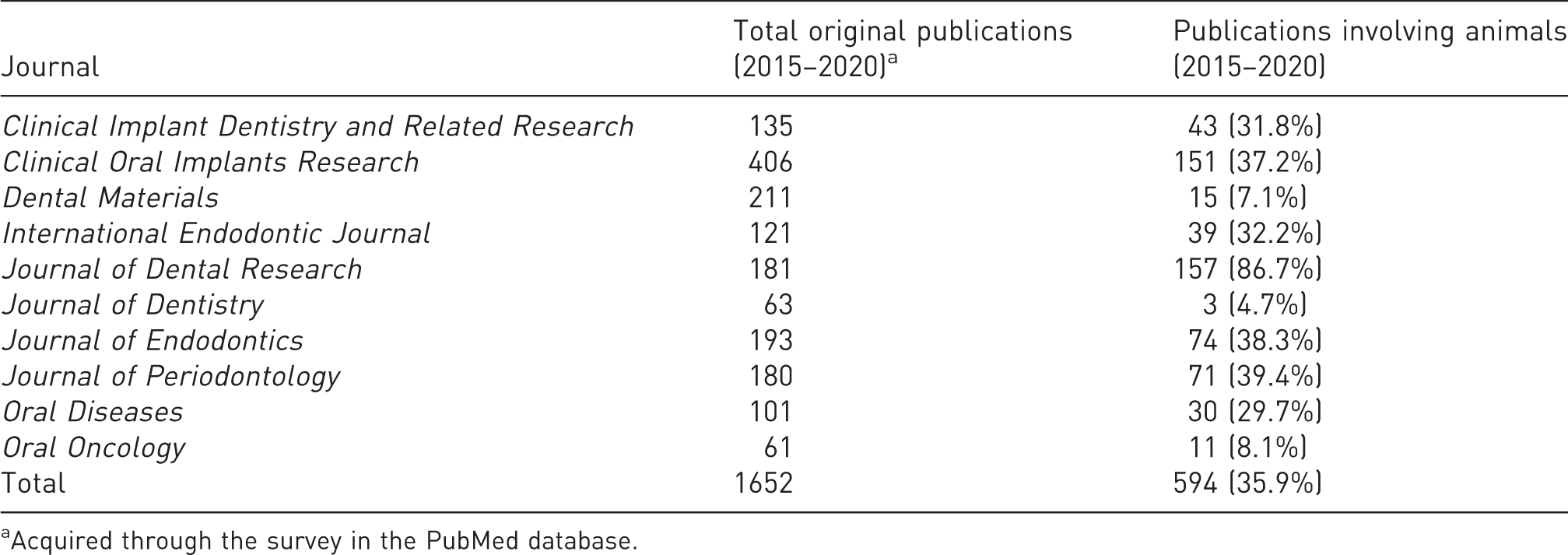
The articles were surveyed in the PubMed database; the names of the dental journals were used as keywords. Then, we selected the interval we intended to analyze: 2015–2020. The ‘Species’ filter was employed, where we selected the ‘Other Animals’ filter (we did not choose the ‘Humans’ filter), which allowed restricting the search to studies performed in animals. This resulted in 1652 studies (Table 1).
Distribution of the number of scientific articles using animals published in the analyzed journals.
aAcquired through the survey in the PubMed database.
Duplicates were removed and, subsequently, only studies that performed animal handling, meaning in vivo, were selected. Studies with only parts of animals, that is, ex vivo and in vitro studies, as well as systematic and other types of review on the topic, were excluded from this study. Only primary research was included. To evaluate whether papers should be included or excluded, a title/abstract screening was carried out. If there was no information in the title or in the abstract regarding the use of in vivo animals, the methodology section of the full text was read. The survey identified 594 publications that used experimental animal models in vivo from 2015 to 2020. Subsequently, each publication was analyzed in relation to the variables considered in this study.
Based on the methodology of the study by Mole and Heyns, 5 the data extracted from the articles were used to determine the frequency and trends of the use of animals in dental research according to journal, year of publication, and dental specialty. The animal species overall and correlated to dental specialty were analyzed. Information on Institutional Ethics Committee approval, sample size, methods of analgesia, anesthesia and euthanasia were also analyzed.
At the end of the collection, the data were processed in a Microsoft Excel spreadsheet, version 2016. The data obtained were organized in spreadsheets and divided into tables, according to the variables to be assessed. A descriptive statistical approach was used to analyze the results, with absolute and percentage distributions.
Results
Number of articles analyzed
The survey performed in the 10 selected dental journals identified 594 studies that used experimental animal models in vivo, published from 2015 to 2020. Table 1 shows the distribution of these studies according to the total of original publications in each journal. Overall, the studies including (living) laboratory animals represented 35.9% of the original research in the journals investigated. The majority of studies published in the Journal of Dental Research was carried out using animals.
There was a trend in the number of studies per year, with a decrease in the number of publications involving animal models in vivo (Figure 1(a)).
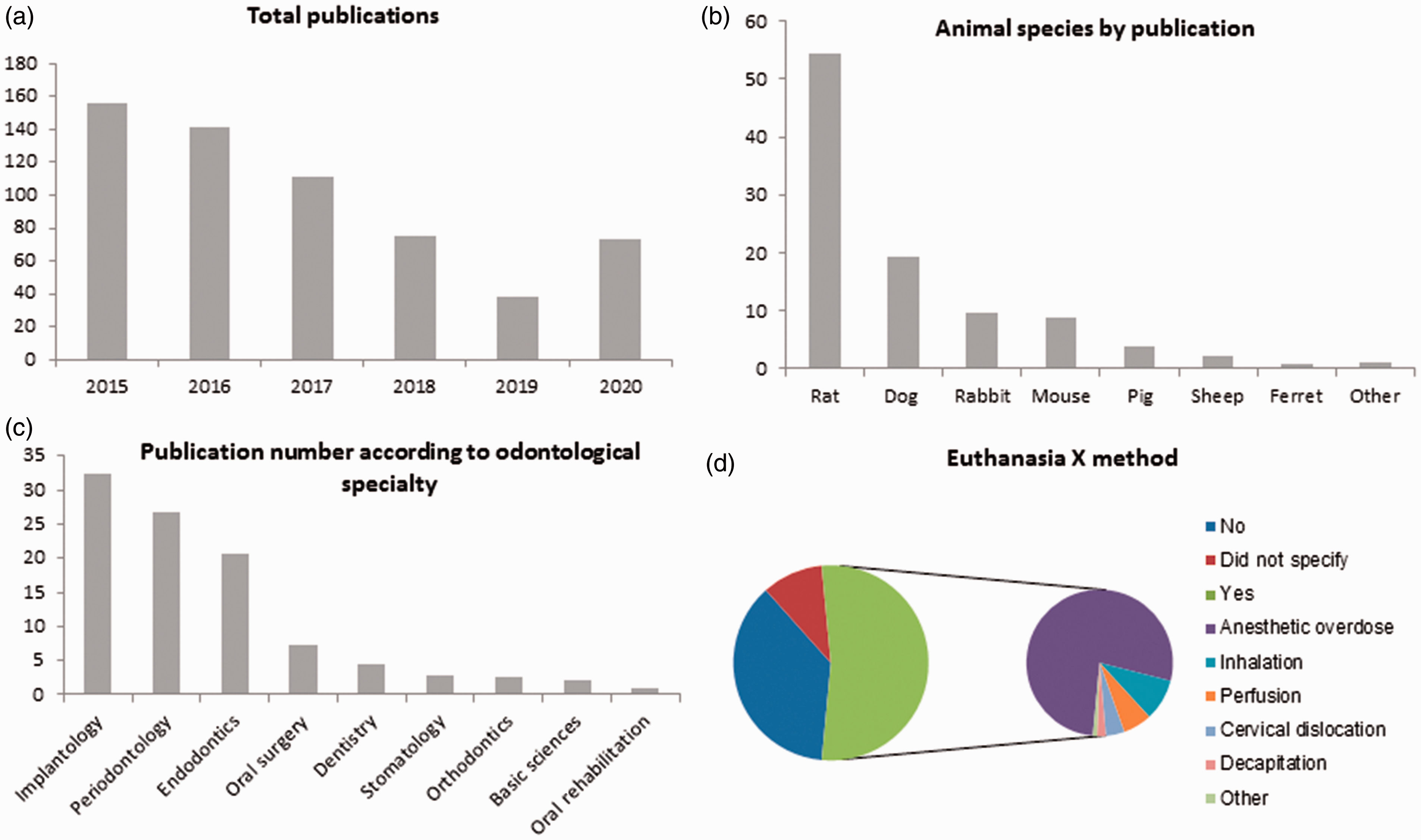
(a) Total number of publications involving animals, distributed in the years analyzed. (b) Total number of publications according to animal species used as experimental models. Others include monkeys, elephants and mice. (c) Distribution of publications involving animals according to dental specialty and (d) Total number of publications that mentioned euthanasia and methods used to perform euthanasia.
Animal species
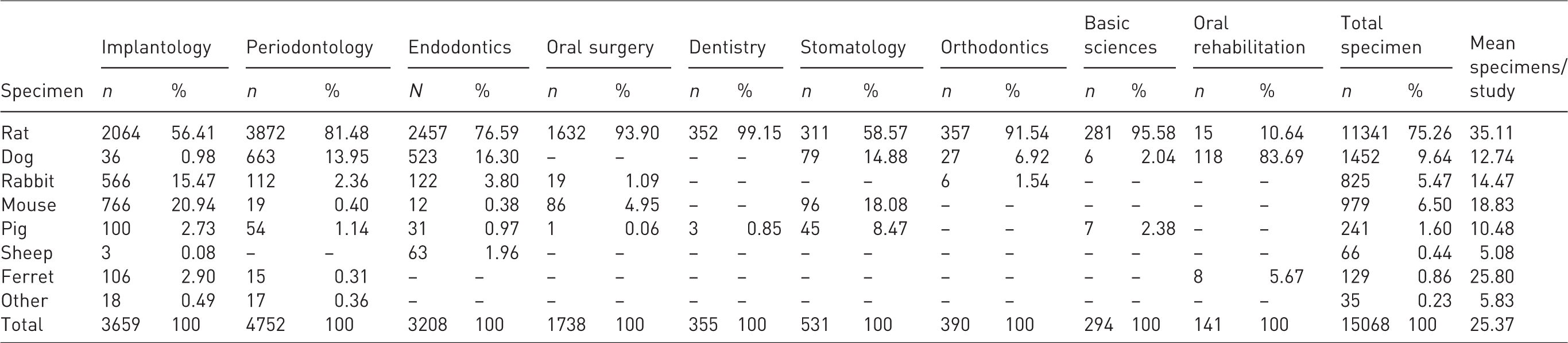
Considering all journals included in this study, 54.38% of the publications used rats and 19.19% used dogs. Rabbits and mice were employed in 9.6% and 8.75% of publications, respectively. Pigs, sheep and ferrets were used in less than 5% of publications. Six publications (1.01%) made use of other species less cited, including monkeys, elephants and mice (Figure 1(b)). Regarding the mean of animals per study, rats presented the highest value (35.11), followed by ferrets, which although used in 0.84% of publications presented a mean of 25.8 animals per study. Mice and rabbits showed means of 18.84 and 14.47 animals employed per study, respectively. Dogs, although representing the second animal species most used in the studies assessed, showed a mean of 12.74 animals per study (Table 2).
Species distribution according to the dental specialty.
Dental specialties
Regarding the nine dental specialties included in this study, periodontics was the dental field with the highest rate of publications involving animals (32.32%). Implantology and endodontics presented the subsequent highest values (26.77% and 20.71%). The other specialties represented less than 10% of the publications analyzed in this study (Figure 1(c)).
As described in Table 2, rats were the animals most used in the majority of specialties, except for oral rehabilitation, in which dogs were the experimental model most used. In periodontics and endodontics, dogs were the second animal species most used, followed by rabbits. In implantology, mice and rabbits were the most used. Rat species were almost exclusively used in esthetic dentistry and basic sciences studies.
Ethics approval, sample size, analgesia, anesthesia and euthanasia
Regarding the mention of approval by the due oversight body (local institution responsible for reviewing animal research protocols), 6.9% of publications did not show this information. Thus, most publications reported approval by the institution responsible for reviewing the protocols (93.10%) before performing the experiments. As for sample size, 17% of the studies that did not report the sample number mainly used rats and mice during the experiment (Table 3).
Percentage distribution of data, ethics committee statement approval, sample size, performing anesthesia, analgesia and euthanasia.

According to Table 3, most scientific articles used in this study, meaning 70.54%, mentioned that the animals were anesthetized before the experiments. However, the mention of performing analgesia was not so frequent, as only 23.74% referred to the use of analgesic agents after the interventions.
Regarding the analysis of animal euthanasia used in the scientific articles assessed in this study, 53% mentioned and specified the method used. Animal deaths by anesthetic overdose prevailed and a lower portion of the studies chose to sacrifice the animals by decapitation. A rate of 10% of the scientific articles mentioned performing euthanasia but did not mention the conducting and type of method used. The lack of information on animal euthanasia and its conducting was observed in 37% of publications (Figure 1(d)).
Discussion
Responsible science involves the transparency in scientific publications about the occurrences during studies performed with experimental animal models in vivo, ensuring the integrity and quality of research. 15
Animal experimentation models constitute an important tool in scientific research and the contribution of animals for studies in several fields is evident. 3 However, there is a current moral dilemma about using animals or humans to perform scientific research. 5 The use of animal models has been questioned by the scientific community. 16 Therefore, to ensure the well-being of animals during experiments, specific laws and well-designed research must be established. 3
Scientific studies should include relevant information on experimental objectives, characteristics of animals, methods used and results obtained.3,12 Thus, publication journals must require researchers to present such pieces of information in the methodology of their studies. This is a guarantee that, during the experiment, researchers will be concerned about animal well-being and ethical conduct, considering that these data cannot be neglected when publishing the study. The present study investigated the use of animals in dental research to describe the standard and methodology used in studies in this field.
The use of animal models in research has been based on supposed genetic, anatomical and physiological similarities of different species-models to humans. 17 Currently, laboratory animals such as rats are commonly used for animal experimentation, which corroborates the present study, considering that rats were the experimental models most used. This can be justified by the fact that this rodent represents satisfactorily the organism of a mammal 18 and that the breeding of rats is faster and cheaper than that of monkeys or dogs. 19 Dogs are the second most used animals in absolute numbers and, in some fields, match the reactions and evolution of human pathologies. 20
The use of animal models in dentistry is necessary, since many studies cannot be performed directly in humans without previous animal testing, especially studies on the development of new dental materials, new surgical techniques and new dental treatments, among others. In dentistry, experimental research using animal models is designed in such a way that the results, if positive, can be transferred to humans, or allow human trials to be carried out in a subsequent phase.
Implantology and periodontics were the specialties mostly published in the latest studies with animal experimentation. Animal models are commonly used to investigate the etiopathogenesis of periodontal diseases and analyze the efficacy of reconstructive and regenerative procedures. They are also useful to assess new therapeutic techniques, including laser and implant therapies, before their application in human beings. 21
Staubli et al. 19 analyzed animal-based research published in the Journal of Periodontology and Journal of Clinical Periodontology in 1982/1983 and in 2012/2013. In 2012/2013, most animals analyzed were rats: 85% in Journal of Periodontology and 54% in Journal of Clinical Periodontology. We also analyzed publications from Journal of Periodontology. In our study, we verified that, in periodontology, rats were the species most used (81.48%). Our results, concerning this specialty, were similar to the results obtained by the mentioned authors for the Journal of Periodontology.
According to the present survey, endodontics was the field in which the third most numerous scientific articles including experimental animal models were published. The regulated use of animals in endodontic research is often required to investigate the biological mechanisms of endodontic diseases and measure the pre-clinical efficacy, biocompatibility, toxicology, and safety of new treatments, biomaterials, sealants, medications, disinfectants, irrigants, devices and instruments. 22
Animals cannot consent, therefore, it is up to the due local institutions responsible for reviewing animal research protocols to decide whether a study in animals is justified or not. They are also responsible for ensuring that the use of animals in any research is conducted adequately and following ethical standards. 5 Most of the studies included in this survey mentioned approval by the responsible institution.
Notifying the number of animals is essential to assess the biological and statistical significance of the experimental results or reanalyze the data. It is also required for repeating the experimental methods. 5 In the present study, more than 80% of scientific articles mentioned the total of animals used. This is important because well-planned research along with an adequate statistical analysis can be a reference of sample number for other studies and can minimize the number of animals used. 11 It is essential that animals are not subjected to research unnecessarily and that the data obtained in the trials are not wasted or misrepresented. 16 For ethical reasons, studies should be designed to use the minimum number of animals and obtain conclusive results, preventing animal suffering. 5
Although dental research in animals usually needs surgical approaches, and analgesia and anesthesia are necessary, in this study, the data on the procedures of analgesia, anesthesia and euthanasia were not provided in 76.26%, 29.46% and 36.87% of articles, respectively. Animals have consciousness and memory and can suffer and feel pain, 5 therefore, experiments that may cause pain or distress should be developed under proper sedation, analgesia or anesthesia. The management of pain in laboratory animals is an ethical imperative. In tests in which animals are subjected to invasive procedures, the pain is another crucial aspect. The selection of anesthetic and analgesic agents is of utmost importance to control the pain related to the intervention without affecting the results measured. 23
The selection of a euthanasia method should be according to the animal species used, life stage, physiological conditions, forms of containment and technical ability of the researcher. Anesthetic overdose was the method most used, and it is recommended because, among other methods, it is fast and painless. 24
The authors of scientific publications have the responsibility to describe their methods and results comprehensively, accurately and transparently, and the reviewers and editors of journals share the responsibility of ensuring that the studies published meet these criteria. 11
The publications included in this study did not provide more details on the care and monitoring of the animals in addition to those presented here (such as anesthetic technique, analgesia after the procedures and the form of euthanasia). Nevertheless, details concerning monitoring and care of the animals should be explained in the research project, which must be submitted to the Institutional Ethics Committee. So, we believe it is essential that the research has been approved by the ethics committee that is responsible for reviewing animal research protocols, ensuring the ethical indicators involved in the use of animals in research.
Conclusion
Between 2015 and 2020, there was a reduction in the number of studies published on research developed with animals, in dentistry, in the analyzed journals. The studies were predominantly in the fields of periodontics and implantology and rats were the animals most commonly used, followed by dogs. Few studies did not mention institutional ethics committees, but some publications neglected to indicate the performance and method of analgesia, anesthesia and euthanasia. The omission of essential information may raise scientific and ethical concerns.
Footnotes
Declaration of conflicting interests
The author(s) declared no potential conflicts of interest with respect to the research, authorship, and/or publication of this article.
Data availability
The datasets generated and analyzed during the current study are available from the corresponding author on reasonable request.
Funding
The author(s) disclosed receipt of the following financial support for the research, authorship, and/or publication of this article: This work was supported by the Coordenação de Aperfeiçoamento de Pessoal de Nível Superior – Brasil (CAPES) – Finance Code 001.
