




Abstract
Severity assessment for experiments conducted with laboratory animals is still based mainly on subjective evaluations; evidence-based methods are scarce. Objective measures, amongst which determination of the concentrations of stress hormones, can be used to aid severity assessment. Short-term increases in glucocorticoid concentrations generally reflect healthy responses to stressors, but prolonged increases may indicate impaired welfare. As mice are the most commonly used laboratory animal species, we performed a systematic mapping review of corticosterone measurements in Mus musculus, to provide a full overview of specimen types (e.g. blood, urine, hair, saliva, and milk) and analysis techniques. In this publication, we share our protocol and search strategy, and our rationale for performing this systematic analysis to advance severity assessment. So far, we have screened 13,520 references, and included 5337 on primary studies with measurements of endogenous corticosterone in M. musculus. Data extraction is currently in progress. When finished, this mapping review will be a valuable resource for scientists interested in corticosterone measurements to aid severity assessment. We plan to present the data in a publication and a searchable database, which will allow for even easier retrieval of the relevant literature. These resources will aid implementation of objective measures into severity assessment.
Severity assessment is an integral part of all animal experiments performed within the European Union, as prescribed by article 15(1) from directive 2010/63/EU. The assessed severity can be categorised as “non-recovery”, “mild”, “moderate” or “severe”. While the directive and supplementary materials provide a basis to estimate severity, the actual assessment process is still based mainly on subjective evaluations by individual scientists; evidence-based methods to grade severity are scarce.1–4
Several objective measures can be considered to aid severity assessment. These measures comprise three main categories: behaviour (spontaneous behaviours such as vocalisations and locomotion, nesting and burrowing, but also choices in preference tests), 5 physiology (e.g. heart rate, respiration, body weight) and biochemistry (stress hormones).6–8 Biochemical measures do not seem to be the most popular for severity assessment, possibly because several can only be made post-mortem. However, hormones that fluctuate with experienced stress, e.g. glucocorticoids, can be measured in vivo to provide an indirect indication of the actual severity experienced by the animal, and these measurements are not necessarily invasive.
While the glucocorticoid stress response usually reflects a healthy reaction to stressors, the prolonged activation of the hypothalamic-pituitary-adrenal-axis generally is a reason for concern. 8 Therefore, measuring glucocorticoids can be used to evaluate animal welfare, and thereby severity.9–11 It is still common to sample corticosteroids from blood.12,13 For sampling blood, the number of repeated measurements from one animal is limited by the maximum volume of blood that can be withdrawn. Besides, most blood sampling procedures are invasive. Microdialysis allows for repeated measurements over several days, on a time scale of minutes to hours.14–16 However, it is technically challenging, and while the measurements themselves are not invasive, the animal needs to undergo surgery to implant a probe or guide canula. Particularly for welfare-related studies, refined methods for specimens that can be collected less invasively, such as urine, hair, saliva and milk are preferred.12,13,17–19
Corticosterone can be measured using several techniques, e.g. gas chromatography/mass spectrometry, high-performance liquid chromatography and several types of immunoassays. While the chromatography-based techniques are technically challenging, they are the most specific. Immunoassays are based on antibody-binding and are therefore generally less specific. However, they are easier to perform and can provide useful results depending on the species and specimen type under investigation.20,21
Mice are the main species used in laboratory animal sciences; in 2011, 61% of all animals used for scientific purposes within the European Union (EU) were mice. 22 In 2017, in Germany the percentage was 66% (www.bmel.de, “Tierschutz in der Forschung”, accessed 31 January 2019). Therefore, objective measures to aid severity assessment in mice are imperative. In mice, corticosterone is the main glucocorticoid.23,24
With the number of new scientific publications increasing daily, the need for objective literature reviews rises. Unfortunately, most reviews still do not implement an explicit methodology, resulting in potential bias of the presented results that cannot be estimated by the scientists reading the review. One type of review explicitly describing the review methods is the mapping review. 25 Mapping reviews comprise a comprehensive search of a wide field and present their results in a user-friendly format.26,27 The objective of a mapping review is wider and more descriptive than answering a specific research question, as is common in systematic reviews. Data extraction is thus limited, and assessment of the risk of bias in the included studies is optional. A mapping review will identify evidence clusters and evidence gaps. Systematic mapping of animal studies has started only recently. 28 While several important narrative reviews on corticosterone in mice have recently been published,29,30 no systematic overview of all available work on corticosterone in mice is available to date.
It is becoming more common to publish review protocols for animal studies (refer to Pires et al. 31 as an example). Protocols are published to benefit from peer review to optimise the review process, to make comprehensive search strings available to other reviewers and to share information on the ongoing effort with the scientific community before publication of the results. In line with this practice, we present the protocol of our systematic mapping review on corticosterone in mice in this publication. We have thus far completed the screening phase for inclusion of the relevant references and are in the midst of data extraction.
Protocol/methods
For transparent research practices, a non-narrative version of this protocol was posted online before we started screening the literature on the Open Science Framework (www.osf.io; 23 February 2018). To increase the chances of the protocol being found by those interested, it was furthermore posted on the Systematic Review Facility (http://syrf.org.uk/; 14 January 2019).
Research question
Because this is a mapping review it does not follow the standard PICO-format for the research question (Population, Intervention, Comparison, Outcome). We defined only the population (Mus musculus) and outcome (endogenous corticosterone concentration).
This mapping review thus gathers all literature on corticosterone measurements in mice indexed up to 7 February 2018. Besides, it will answer two main questions.
Which specimen types and methods of detection have been used for corticosterone measurement in mice?; and In which fields of research (animal welfare-, inflammation-, neuroscience-, pain-, and stress-research) have these measurements been performed?.
Search strategy
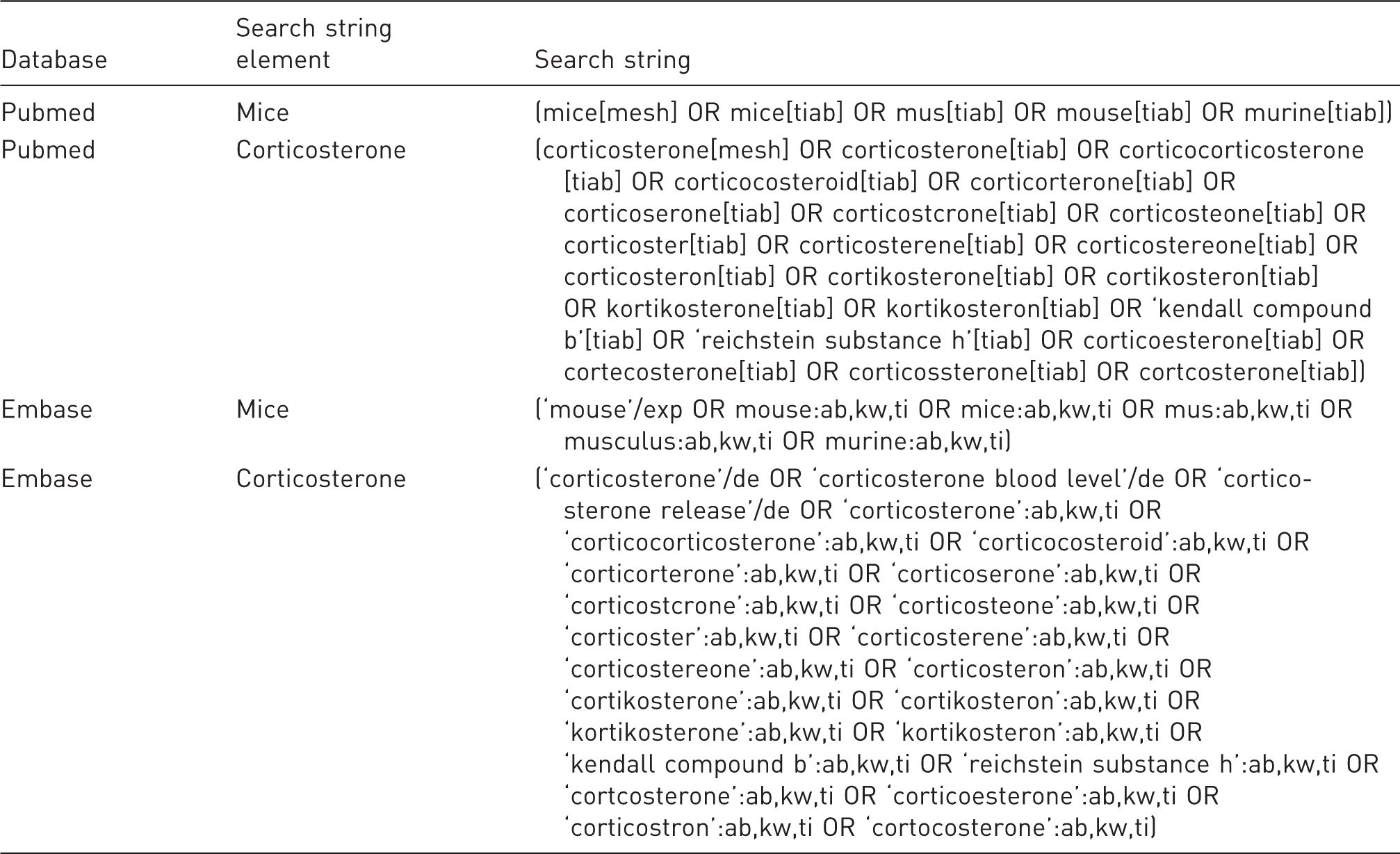
Two literature databases were searched on 7 February 2018: PubMed and Embase. Both are comprehensive databases that have indexed all included references using an internal thesaurus (MeSH for PubMed, Emtree for Embase). We used the MeSH and Emtree terms besides searching for author-defined keywords and title, and abstract text words to retrieve all relevant references.
Search strategies.
Study selection
To optimize the work flow, a non-standard approach for reference screening in a single phase was used. Inclusion or exclusion was based only on the title and abstract. If this information was not sufficient to determine if the inclusion criteria had been met, the full text was immediately consulted. If the full text could not be retrieved online, the reference received the label “To be determined on full text”. References in this latter category were ordered via the library of the Hannover Medical School for further analysis.
All references were screened independently by at least two reviewers. In case of discrepancies the reviewers reread and discussed the reference until consensus had been reached.
Inclusion and exclusion criteria
The following three inclusion criteria were used: first, the reference had to describe a primary study; second, the study had to be done in the house mouse (M. musculus), and third, the study had to measure endogenous corticosterone. Thus, non-primary studies, reviews without new data, studies that did not measure corticosterone, and studies that measured corticosterone only after exogenous administration were excluded. There were no restrictions on publication date or language of the references.
Data extraction
The data to be extracted were subdivided into three domains: bibliographic data, animal model characteristics, and outcome measures. We extract the following bibliographic data to identify references: authors, year of publication, title, journal, issue, page number, and language. The animal model characteristics we extract are: mouse strain, sex, and whether the mice were used as an animal model for a specific human disease.
The outcome measures to be analysed in the mapping are: specimen type (i.e. specimen wherein corticosterone was measured, e.g. serum), quantification technique (e.g. radio-immunoassay), and whether the study was related to animal welfare, inflammation, neuroscience, pain, or stress. It is possible for a study to relate to multiple or none of the research fields of interest (e.g. a study analysing the effect of repeated mild stress on neurogenesis in the hippocampus would qualify as related to neuroscience and stress).
For data extraction, the references are distributed amongst the reviewers. Data from each reference is extracted by a single reviewer. For quality control, at least 5% of all references are randomly selected and checked by a second reviewer for errors and inconsistencies.
All data are being extracted using a standardized sheet in Excel. To prevent variability between reviewers, pre-specified lists of answers are used where possible. For example, for sex the options are: M (male), F (female), B (both), or U (unknown or not given).
Data synthesis and risk of bias analysis
The extracted data will be tabulated and summarised in figures. These will show frequency of mouse strains used, sex, corticosterone quantification method, etc. For this mapping review, no quantitative outcome values (e.g. concentrations) will be extracted, thus no meta-analyses will be performed.
Due to the scope of this mapping review, a full risk of bias assessment is not viable. To provide a rough indication of the reporting quality of the included studies, reporting frequencies will be analysed for mouse strain, sex, specimen type and quantification technique.
Preliminary results
Our search in Pubmed retrieved 6046 references, that in Embase 7474. After duplicate removal, 8075 references were imported into EROS (Early Review Organising Software), a web-based application, for screening. For 3382 references, the full-text had to be consulted to decide on inclusion. We included 5337 references into our mapping review. The flow of references is provided in Figure 1.
Flow of references.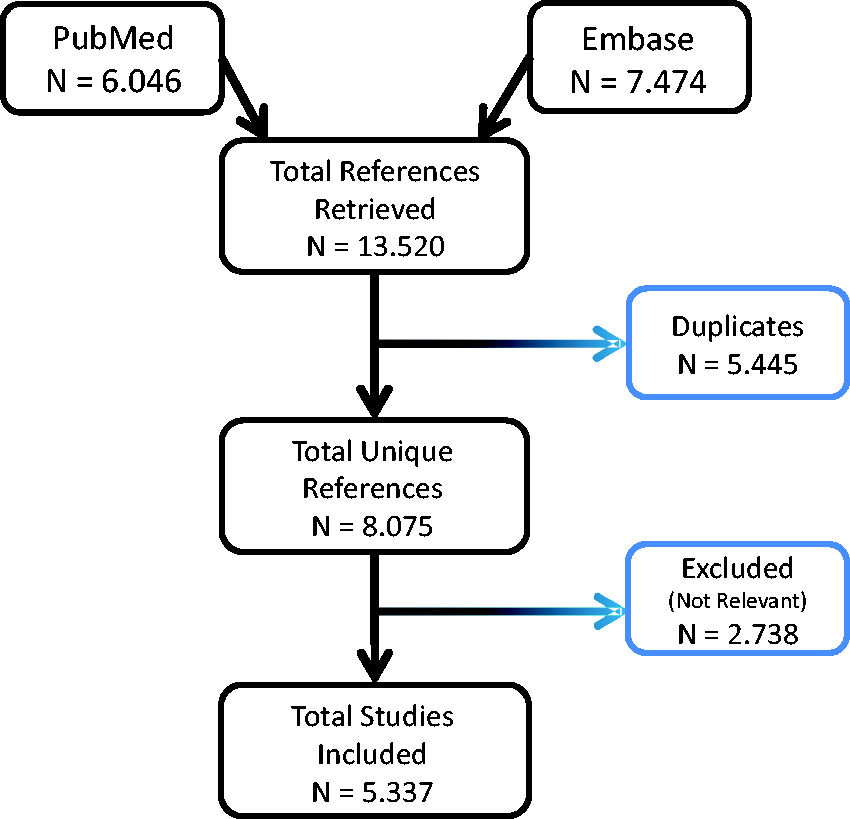
Data extraction from these 5337 references is currently in progress. We anticipate analysing the results mid-2019. Around halfway through the data extraction, 4.4% of the included references were on an animal welfare-related topics.
Besides crude numbers and percentages, we will analyse changes in research practices and research fields over time based on publication dates. For example, the methods used for corticosterone measurements are expected to change over time, with radio-immunoassays being replaced by other immunoassays and high-performance liquid chromatography. Furthermore, we plan to make the data from the 5337 included references available in a searchable database.
Discussion
This mapping review will be an accessible resource for scientists interested in corticosterone measurements in mice. The publication will show which techniques have been used to measure corticosterone in different specimen types over time. The database will allow scientists to easily retrieve the relevant literature as a background for their experiments. Both resources will aid implementation of objective measures into severity assessment in at least three manners. First, future study planning will benefit from improved estimation of the value and limitations of integrating corticosterone measurements. Second, the collated evidence will aid elucidating the biological meaning of corticosterone concentrations for severity assessment. Third, selection of the most appropriate animal model will benefit from knowing the relevance of corticosterone measurement.
A limitation of our database will be that our mapping review was restricted to corticosterone itself. We excluded the corticosterone metabolites from our mapping review, because preliminary searches for the metabolites indicated that the amount of literature retrieved would become unmanageable. As most relevant papers on measurements of corticosterone metabolites will mention the word “corticosterone” in the title, abstract or keywords, they will have been retrieved by our search. During the screening phase, we added labels to the papers stating that they measured corticosterone metabolites. We plan a separate review of these papers (protocol under development).
A general limitation of mapping reviews is that the amount of data extracted, and therefore the conclusions that can be drawn based on them, is limited.25–27 This is inevitable to keep the mapping review process manageable. Our mapping review is, however, an excellent starting point for further in-depth reviews, as all the relevant literature up to 7 February 2018 will already be gathered. As corticosterone is the most common stress hormone analysed in relation to severity assessment, our comprehensive analysis of the relevant literature, and its accessibility in a database, will benefit and support the implementation of more objective severity assessment strategies.
Footnotes
Acknowledgements
We would like to thank Alice Tillema for help in search development, and Rosalie Kempkens and Bobbie Smith for their ongoing help in extracting data.
Declaration of Conflicting Interests
The author(s) declared no potential conflicts of interest with respect to the research, authorship, and/or publication of this article.
Funding
The author(s) disclosed receipt of the following financial support for the research, authorship and/or publication of this article: This work is funded by the DFG (FOR2591, BL 953/11-1).