




Abstract
Research studies involving animal experimentation are regulated by the Institutional Animal Care and Use Committee (IACUC). To this end, the IACUC must integrate the information provided by the investigators of each preclinical study and the veterinarians from the animal facility in order to monitor and approve the process. Using a paper-based system to collect animal health and welfare data is a common, albeit time-consuming practice, prone to transcription and reading errors, not to mention inconvenient for veterinarians and investigators wishing to make timely and collaborative decisions when animal welfare is at risk. We created a web-based monitoring system focused on animal health with the potential to improve animal welfare. The data management system is based on REDCap software, which enables data integration in order to offer a solution for animal welfare assessment. The proposed scheme includes key indicators of general health status, such as environment, physical/nutritional information, and behavioral parameters during animal breeding and experimentation, as important components of animal welfare. In addition, the system facilitates communication of this information among researchers, animal facility staff, and the IACUC. REDCap is available to non-profit organizations, and may be adapted and replicated by institutions interested in and responsible for animal care, and used in research. REDCap is an excellent tool for promoting good practices that benefit experimental animal health.
Introduction
Animal ethics guidelines provide that institutions interested in using animals for research and teaching must appoint an Institutional Animal Care and Use Committee (IACUC) or equivalent oversight body to oversee laboratory animal welfare, according to the animal care and use program established by each institution. 1 The IACUC is responsible for the review, approval, and monitoring of projects that include animal experimentation, and for the periodic inspection of animal facilities, animal care programs, and concerns involving the care and use of animals in the institution.1,2 To this end, the IACUC must have current and efficient access to information related to animal welfare provided by veterinarians and staff of the animal facility and by the investigators responsible for the research.
The use of a paper-based system to collect data about laboratory animals in order to assess animal health and welfare is a common practice among veterinarians and researchers, but paper has several disadvantages. To analyze changes over time in paper-based data collection, the information must first be transferred to a digital spreadsheet for generating reports, thereby delaying decision-making in situations where animal welfare may be at risk. In addition, the separate storage of paper records prevents information from being easily cross-checked by the IACUC during inspections, or identification of missing information relevant to the IACUC mission. 2
Advances in information technology and the widespread use of the Internet have enabled the development of web-based systems to manage complex databases related to laboratory animals. 3 However, most of these systems focus on facilitating animal production processes, collecting and analyzing experimental data, and the commercial activity of animal facilities.16-19 Current systems do little to enable collaboration with regard to the research and welfare of experimental animals. A web-based system aimed at academic/non-profit institutions that links and facilitates joint work between animal facility staff, IACUC, and researchers for animal welfare assessment is not yet available.
In 2009, Harris and colleagues reported on the development of a novel workflow methodology and software solution, aimed at rapidly developing and organizing electronic data with capture tools to support clinical and translational research, called REDCap (Research Electronic Data Capture). 4 Currently, REDCap is a web-based system commonly used to manage data of clinical studies. 5 However, its use in preclinical research remains uncommon. REDCap users can collect data online through any mobile device with Internet access and a web-browser (e.g. smartphone, tablet, laptop), recording data efficiently and flexibly in a structured format. Moreover, REDCap has multi-site access that can be controlled through user profiles, ensuring the confidentially of information uploaded to the database. 6
To address this issue, we used REDCap to create a web-based system to collect and manage general health data during animal breeding and experimentation, as a key component to improve animal welfare, considering the interests of the three categories of users in animal research: researchers, veterinarians, and members of the IACUC.
Materials and methods
REDCap features
REDCap is a secure web application for building and managing online surveys and databases developed at Vanderbilt University, and is available without cost for REDCap Consortium Partners. However, it is not open-source software due to agreement restrictions. To obtain the software, a valid end-user license agreement between Vanderbilt University and the interested institution must be reached. 7 For further information on becoming a consortium partner, contact the Vanderbilt REDCap Team at the email: redcap@vanderbilt.edu
REDCap infrastructure requires a web server with PHP 5.3.0+, a database server with MySQL 5.0+ or MariaDB 5.1+ or Percona Server 5.1+, and an SMTP email server. REDCap can run on a variety of operating systems (Apache, Linux, Unix, etc.). It has no hard requirements for server processing speed, memory, or hard drive space because it requires very little initial space (less than 10MB for both the web server and database server combined). 8 For further information on REDCap installation and implementation, we recommend the report by Kiplin et al. 9
For login, users have their own account with access only to the assigned project/database through an authentication step with a username and password. User activities (data entry, viewing, or changes) in REDCap could be logged for further audit trail of the process. 10
In order to explore the program under discussion, users may see and use data from an experiment using Sprague Dawley rats at the Universidad de Desarrollo (Santiago, Chile) that has been recorded in the REDCap system. Users may go into the program, make changes, add to it, and play with it in order to determine how the system might benefit the user’s own animal research. The following is an introduction to the abovementioned animal (Sprague Dawley rats) experiment.
Example of animal health monitoring by REDCap: Growth of female Sprague Dawley rats
In order to show the properties and potentialities of the REDCap application, we described an example of animal health monitoring during the breeding process of female Sprague Dawley rats. The system has the possibility to collect data of general health and animal pain or distress indicators. However, we excluded animal pain assessment since it is unnecessary for the system description.
Female Sprague Dawley rats were kept under controlled lighting from 06:00 to 18:00 hours, at a constant temperature (20 to 24℃), and received food (5P00 Prolab RMH 3000, LabDiet, USA) and water ad libitum. In order to analyze animal growth, 4-week-old animals were weighed daily from Monday through Friday, every week for 7 weeks. Food and water consumption was measured daily. Body weight, water intake, and food consumption data were collected using the form entitled: “Study on the growth of female Sprague-Dawley rats at Universidad del Desarrollo”. Data were captured using a local Wi-Fi signal.
Results
Integrated database system design
In order to develop an appropriate database, the breeding process conducted by the animal facility was studied through staff interviews and analysis of the paper form used for data collection. In addition, paper forms used by scientists to assess animal health and/or welfare during animal experimentation at the Universidad del Desarrollo were examined. Finally, IACUC members discussed the minimal indicators needed to monitor animal welfare during any research protocol audit. Considering the activities of the animal facility and the key indicators used to assess animal welfare, such as animal health, a database was designed with a basic but flexible structure to allow changes in the selection of welfare indicators which vary depending on the research study. A demonstration model of the system demo is provided. See the REDCap User Guidelines in Supplementary materials.
In order to build the system’s “core,” the REDCap hosted at the Universidad del Desarrollo was developed with three databases (Breeders, Mating, and Litter&Allocation) to manage information related to animal breeding. These three databases were connected by SQL queries in order to track animals from birth to euthanasia or death. An isolated database entitled “Animal welfare” was created for use by the animal facility staff in order to capture data related with animal wellbeing such as environmental conditions and animal health, including physical and nutritional state, clinical signs, and behavior. 11 For each research project, a new database was generated. When required, animal data reported by the animal facility staff and researchers can be consulted and cross-referenced by IACUC during projects inspections (the structure of each database is fully customizable). Each database has a dashboard providing the status of records, which provides an overview of data collection during the entire activity or project.
This system is designed to be suitable for inbreeding and/or outbreeding animal colonies. The “Breeders” database is composed of a variable consisting of the animal’s Origin (inbreeding or purchased), Species and Strain, Sex, Birthday, and Date and Cause of euthanasia/death. It is possible to use the “Mating” database to select the breeders (male and female/s) to make up the different mating types. Every litter is associated with a specific mating (linked to the Mating database), which enables users to track the animal pedigree. The “Litter&Allocation” database characterizes the lactation process, starting with the birthday, then weaning, and finally, allocation. At that moment, each animal is identified with a hand-made ID for tracking purposes. In the “Allocation” form, the use assigned to each animal was registered under “Research,” “Breeder,” or “Euthanasia,” considering the ID associated with the “Litter&Allocation” database (Figure S1).
The “Animal welfare” module was designed for animal facility staff members, considering one room as a unit inside the Animal Laboratory Facility. This database, as mentioned before, is used to collect data on environmental conditions (Tmax, Tmin, and humidity), housing management such as woodchips, food, and water change, and indicators of animal health, such as body weight, physical appearance, and behavior. These indicators should be defined for each animal’s species and strain. If any animal manifests symptoms of pain or discomfort, the grimace scale (according to species) can be completed in the database. In addition, comments and photographs can automatically be sent to the investigator to communicate the health state of the animal and help the investigator make decision about pain management or humanitarian endpoint criteria for euthanasia (Figure 1(b)).
Section of animal welfare indicators in (a) Animal welfare database (related to research protocol) and (b) Vivarium-Animal welfare (shown partially).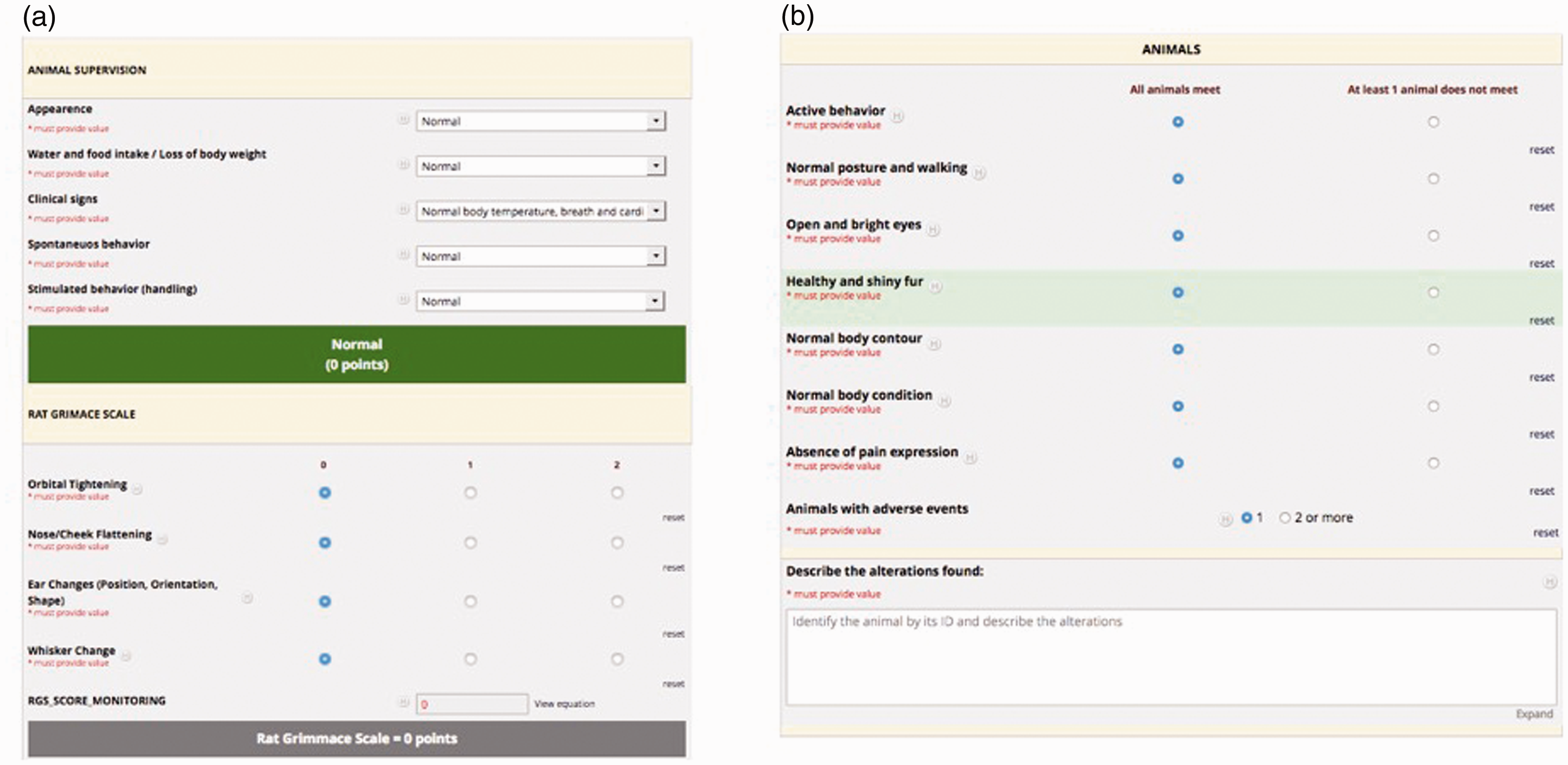
The “Animal welfare” form, for researchers, addresses each animal individually. This form considers physical and psychological indicators of animal health, such as body weight, water and food consumption, animal appearance, and behavior. Similar to the Animal Welfare database for animal facility staff, if any animal manifests signs of suffering, the grimace scale can be completed, which activates the same automatic communication mechanism with the veterinarian to assist in joint decision-making. In addition, a “text box” was created as a space for adding comments about abnormalities in environmental conditions. Users will find the glossary for clinical signs and scientific terminology created by the FELASA Working Group Report very helpful (Figure 1(a)) for creating an Institution’s monitoring protocol for experimental animals.
The system can generate table reports for each user type (researcher, animal facility staff, or IACUC member). For further analysis, data can be exported in the following formats: Microsoft Excel, SPSS, SAS, R, STATA, and CDISC ODM.
In addition, the system allows for the online submission of projects or protocols for IACUC approval. Reviewers assigned to the project can include their observations/suggestions on the same platform, and researchers can reply, revise, and submit a new version of the research project or protocol. Finally, the IACUC makes the final review and sends the research project approval (Figure 2).
Schema of data flow about animal health and welfare between veterinarians, researchers, and IACUC members during a preclinical study. The direction of the blue arrows indicates who sent and receives the data or information through the REDCap system.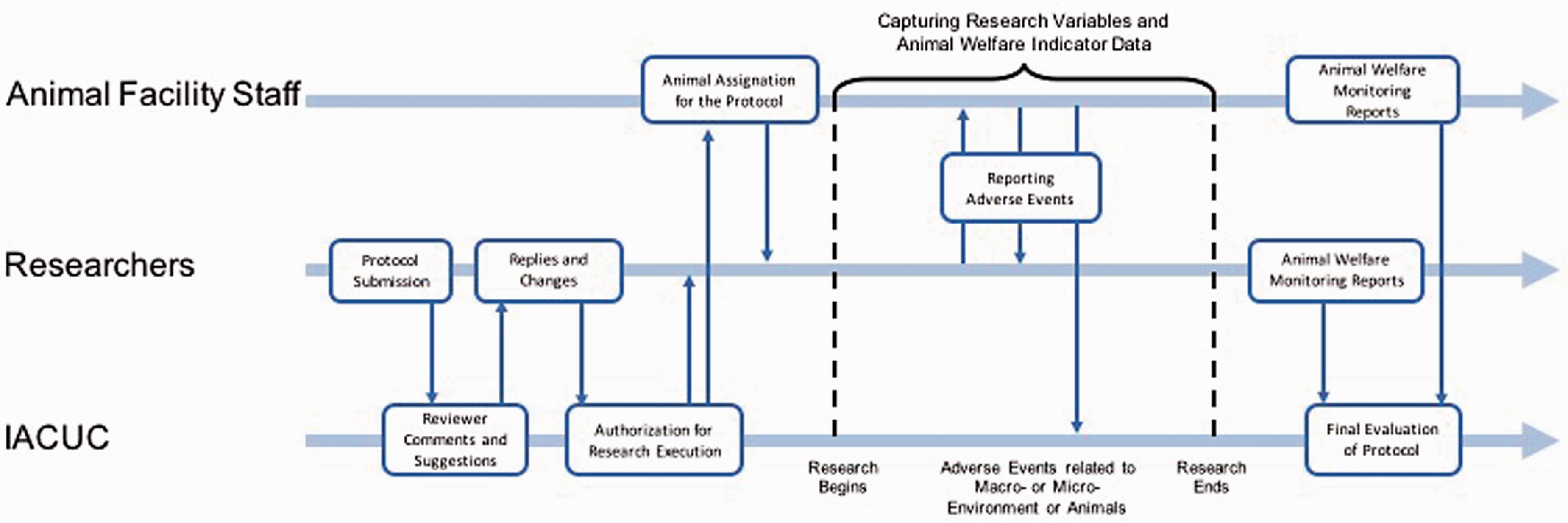
Study on the growth of female Sprague Dawley rats at the Universidad del Desarrollo
Data collected were exported to an Excel workbook, previously created with appropriate functions and pivot tables, to automatically obtain plots of body weight (%) and water and food consumption per animal (Supplementary Materials, Figure S2).
A typing error was detected in the data collection of body weight in animal N°2 (Supplementary Materials, Figure S2, A) and water intake in the beginning of the study (Supplementary Materials, Figure S2, B and C). In addition, a weekly periodicity in water consumption was observed and may be explained by water leakage in cage-handling procedures. Food intake was stable during the entire study. As expected, no anomalies were found in physical and psychological state indicators in the animals assessed by the numerical score sheet (data not shown). Data collection was placed under the Researcher category. Research and animal care staff monitored animal health using the abovementioned indicators.
Environmental conditions were measured during the study, and they were collected and recorded in Supplementary Materials (Figure S3). The animal care staff performed data captures. In addition, a research user recorded a reduction in the percentage of room humidity on 27 April (Figure 3).
Reports of Macro-environment data from (a) Animal facility Staff and (b) Research.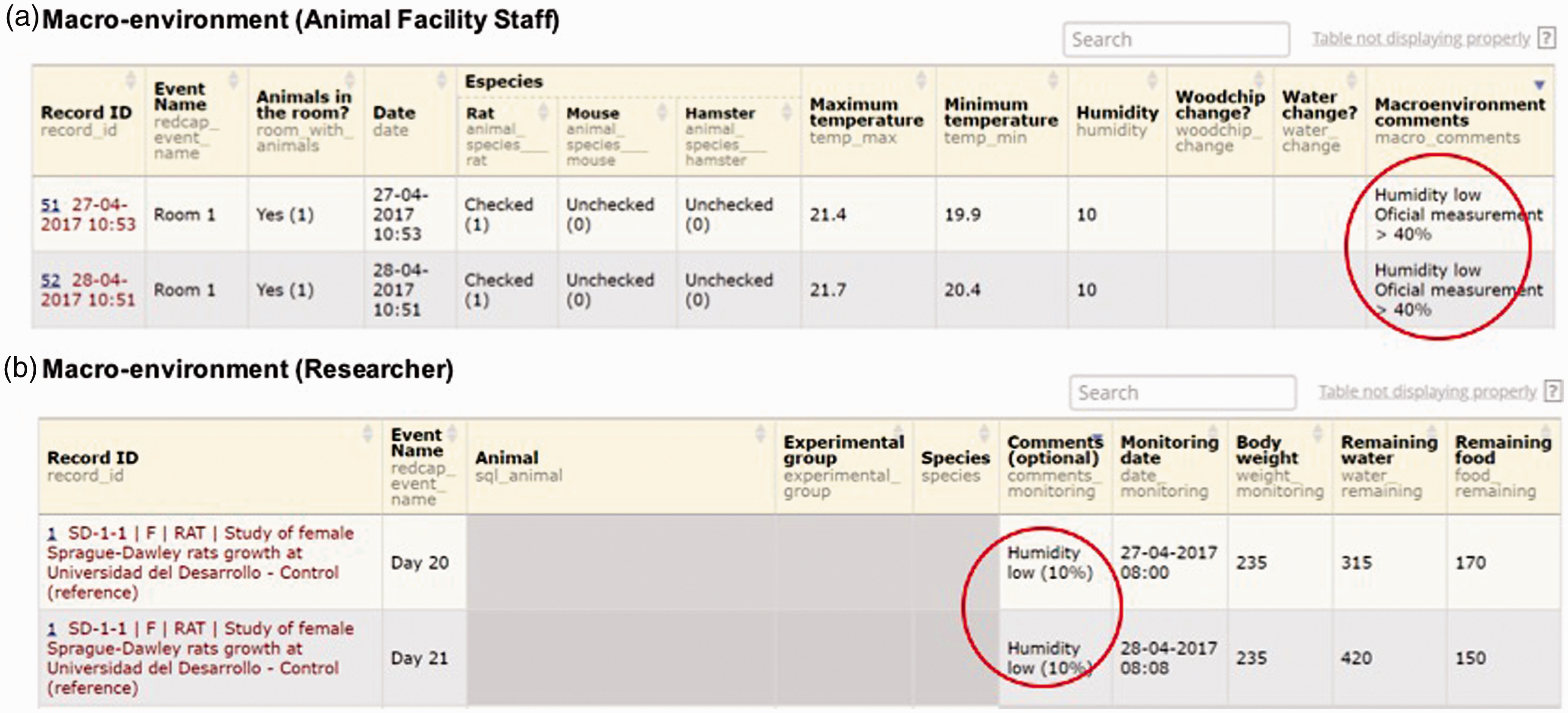
Discussion
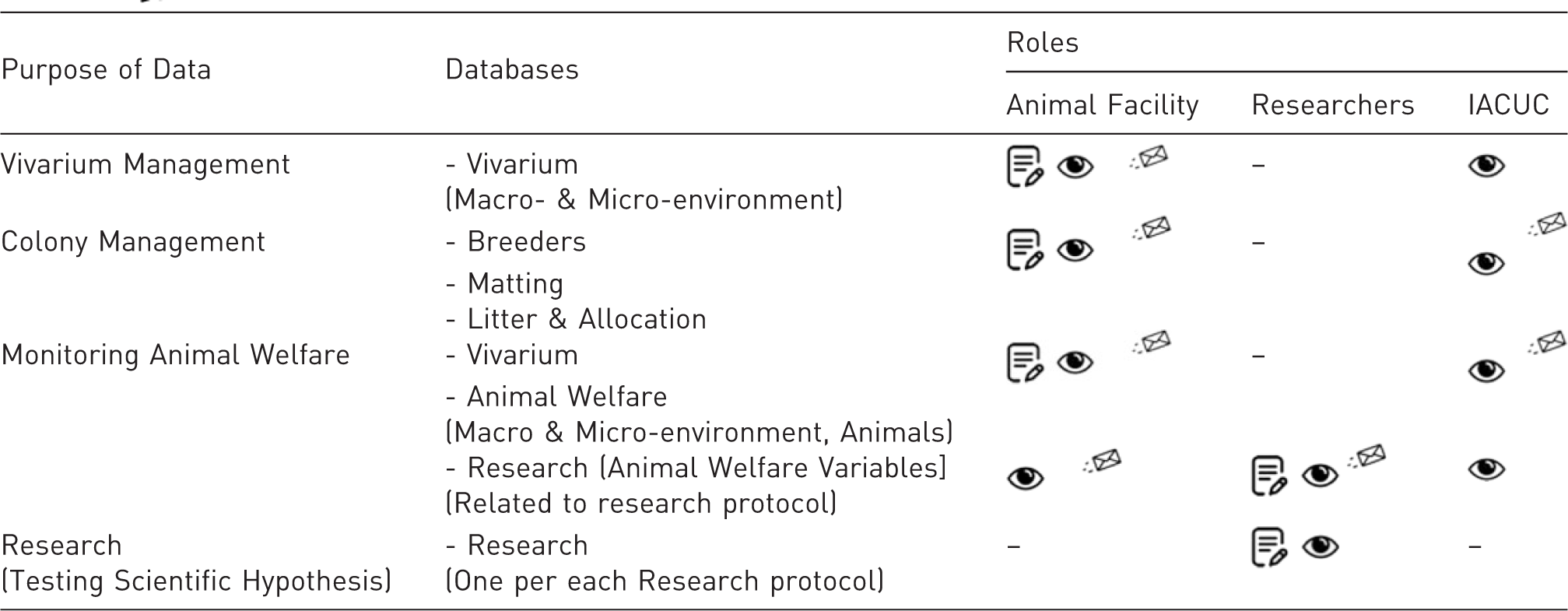
Data access permissions in database system are set per each role. Icons: Data visualization, Add/Edit Data and Automatic notification (by email).
Several colony management applications based on relational databases have been created in recent years. The best known free applications are MouSeek, 12 JCMS from The Jackson Laboratory, 13 and LAMA from Vancouver University. 14 They represent considerable progress in data collection, managing, and reporting systems for animal production processes, but function offline. Today, all commercial applications are web-based systems, such as–PyRAT Animal Facility software 15 and Tick@lab software, 16 both used for animal research projects.17,18 These software programs mainly focus on laboratory animal facilities and staff, and are used to record such data as stems from accountability issues, task and research project management, animal census, and external audits. In other words, these software programs have been designed to improve processes facilitating staff management and quality control, and are an excellent solution for the needs of industry. However, in an academic setting, the comprehensive, balanced, and coordinated work between the abovementioned categories of users (belonging to the same institution) mainly focuses on ensuring animal welfare during production or experimental processes and not on facilitating commercial aspects of the research.
Frenzel and colleagues developed a web-based database to manage data of small animal experiments and at the same time monitor animal health parameters such as animal weight and physical condition. The inclusion of a warning signal in their system alerts researchers and prevents procedural errors during experiments, such as treatment overdoses, or the identification of animals in critical conditions that require supportive therapies. This system is used primarily by researchers to facilitate the collection of experimental data and manage animal welfare, 19 excluding the participation of animal care staff and IACUC members.
Carbone and Austin reviewed the descriptions of pain management after survival surgery in research animals in 400 scientific articles. They concluded that the information provided about animal anesthetic and analgesic protocols is insufficient, alerting researchers to the fact that under-appreciation of animal pain could be a potential source of bias in experimental results, and emphasizing the necessity to treat pain. 20 This current system based on REDCap enables easy generation of databases to potentially improve animal welfare, including indicators of animal health status such as body weight, food and water consumption, animal appearance and behavior, and pain indicators, which vary depending on the study and the experimental species/strain. 11 This system additionally collects and favors logical storage of data that is increasingly relevant at the time of publishing.
The REDCap system allows the storage of warning messages and alerts regarding laboratory infrastructure failures, errors in animal proceedings, and unexpected animal pain or discomfort manifestations. Such information can be consulted for further consideration during review of animal care and use programs or during evaluation of the animal facility operation, its environment, and other institutional factors. In addition, the system was built in accordance with the Good Laboratory Practice for animal experimental protocols, the European Directive (2010/63/EU) on the protection of animals used for scientific purposes,21,22 and the current requirements of scientific journals for better description of health monitoring protocols of animals during experimentation.
As we mentioned before, REDCap allows user to generate data reports. In Figure 3, we show an example of the comparison of reports from Research data input and animal care staff about environment data. As demonstrated, IACUC members can compare data quickly and easily for future studies.
In summary, REDCap is a suitable tool for not-for-profit institutions interested in animal production for research purposes given that it is free, adaptable to animal laboratory facilities, and provides for the variety and hierarchy of research staff. Moreover, the system enables easy communication and information sharing between researchers, animal facility staff, and members of the IACUC, facilitating and potentially improving animal welfare assessment in the context of animal experimentation. Furthermore, the system’s replicability and flexibility can be adapted to meet the specific requirements of institutions and research projects, making it an appropriate tool for analyzing data not only to promote good animal wellbeing practices, but also to discuss and develop new recommendations at a global level for improving animal welfare programs and guidelines.
Supplemental Material
Supplemental material for A REDCap application that links researchers, animal facility staff and members of the IACUC in animal health monitoring
Supplemental Material for A REDCap application that links researchers, animal facility staff and members of the IACUC in animal health monitoring by Cristobal Carvajal, Catalina Vallejos, Dominique Lemaitre, Jorge Ruiz, Camila Guzmán, Valentina Aguilera, Diego Baño and Sebastián D. Calligaris in Laboratory Animals
Footnotes
Acknowledgements
We would like to thank Isabel Abarzúa for her kind and efficient support in the development of our data management system; Anne Bliss for her English-language assistance with the manuscript and her great points of view of our work; Benjamin Erranz for his scientific suggestions for the manuscript regarding animal breeding and welfare; and Christopher Gumera for his accurate revision and suggestions for the REDCap application design.
Declaration of Conflicting Interests
The author(s) declared no potential conflicts of interest with respect to the research, authorship, and/or publication of this article.
Funding
The author(s) received no financial support for the research, authorship, and/or publication of this article.
References
Supplementary Material
Please find the following supplemental material available below.
For Open Access articles published under a Creative Commons License, all supplemental material carries the same license as the article it is associated with.
For non-Open Access articles published, all supplemental material carries a non-exclusive license, and permission requests for re-use of supplemental material or any part of supplemental material shall be sent directly to the copyright owner as specified in the copyright notice associated with the article.
