




Abstract
Aggression in mice often results in injury leading to unplanned euthanasia or the initiation of protocols to isolate animals, thereby increasing research costs and straining resources. Here, we tested if adding a partial cage divider into existing mouse cages affected aggressive-like behavior in group-housed male mice (18 mice; 3 per cage). Mice were randomly assigned to one of two groups upon arrival to the vivarium: (1) standard cage; (2) cage with a partial cage divider. Behavioral observation over 12 hours were conducted at day one, two, and seven after receipt at the facility in order to assess aggression during the course of establishing dominance hierarchies. Observers blinded to study design and hypothesis scored each video for the number and type of aggressive behaviors, which were summed for each hour and analyzed. Results indicated a statistically significant decrease in aggressive behaviors of mice in cages with dividers compared to mice in standard cages. We conclude that cage dividers, which resemble burrows and provide access to common food/water, may promote rigorous research by reducing the number of animals used in a study and refining housing, thus, improving animal welfare.
Introduction
Mice have become essential to biomedical and biological research since they were first taken out of the wild and domesticated in the laboratory. In the wild, mice typically live in burrows during daylight hours and spend nighttime hours exploring their environment. Mice are a social species and choose to cohabit with other mice, thereby forming demes (territory maintained by a family group).1,2 Deme sizes depend upon available resources in the territory, and influence the number of females and subordinate males associated with a dominant male. The dominant male will chase unfamiliar males from the deme, while tolerating juvenile and subordinate males. The highest tolerance levels are found in densely populated areas with an abundance of food.3–7 Under laboratory conditions of controlled resources, investigators set the deme size and tolerance for unfamiliar males by the dominant male is limited. Aggressive interactions typically begin with a tail rattle. If this warning is not heeded, it is usually followed by a frontal attack wherein the dominant male chases the “intruder” until line of sight is broken or the intruder leaves the territory.8–10
In the laboratory, federal guidelines regulate cage size and density, where typical home cages are transparent, barren habitats, appropriately called “shoebox cages.” These commercial cages meet the recommendations of the “Guide for the Care and Use of Laboratory Animals” as to floor space and population densities, based upon minimal floor area per weight of each mouse. 11 Typical housing consists of either a standard cage or a breeder cage. Standard cages average 500 cm2 of floor space, and house demes of up to five mice per cage. Breeder cages average 1200 cm2 of floor space, and house a female dam with her litter, up to ten mice per cage.
This barren, confined space provides minimal, if any, stimulation or opportunity for natural behaviors such as exploration, burrowing, or hiding. Additionally, social dominance is an inherent behavior of mice and under laboratory conditions a dysfunctional dominance hierarchy, in which social cues and escape or submissive behaviors cannot be expressed, may be established.4,5,7,12–14 As a result, the mouse behavior likely drifts from natural expression of innate behavior towards the abnormal as the deme welfare becomes compromised.15,16 Mice housed in shoebox cages may be unable to respond in socially appropriate ways to each other, and subordinate mice are unable to flee from the dominant mouse.10,16 This inhibition of innate behavior can cause a state of suffering in the subordinate mouse, and an increase in aggression from the dominate mouse. 16 Increased aggressive behavior affects the psychological and physiological welfare of the subordinate mice, either by aggravating an appropriate behavioral response or through pain and distress resulting from injuries. 17
The typical treatments for a cage of aggressive animals are the addition of environmental enrichment devices to each cage,18–21 isolation of animals, or euthanasia. Isolation of animals can further alter physiological parameters, creating issues with variability in experimental results and scientific validity,10,22–25 not to mention additional costs to the investigator. Devices such as nesting materials and nest boxes are intended to provide complexity to the cage, allowing mice to express some natural behaviors and increase the psychological perception of space.19,26 Unfortunately, while some enrichments have shown a positive effect on animals,22–31 others have demonstrated an increase in aggressive behavior and indeterminate effects on both behavior and physiology.10,16,20,32–42
Few published studies focus on cage dividers or complex caging for mice.26,37–39 Mice reared in a complex cage system that emulates a burrow-like environment are healthier and less reactive compared to those in standard housing. 26 Complex cage systems include large cages, or caging systems with permanent modifications to establish 5–9 burrow-like dividers for breeding animals.26,37–39 These are different from the visible burrow system (VBS) that has been used to study stress in mice, 40 in that they are a “home cage” feature and not a test apparatus, and they allow for multiple “burrows.” Mice reared in these systems gained more body weight, had lower adrenal weights, and were more active than animals reared in an open cage. 26 In an open field behavior observation, mice from a complex cage system had increased ambulation and decreased defecation, indicating lower emotionality, or reactivity. 12 Emotionality and reactivity are synonymous, referring to a complex phenotype observed in prey animals in response to a variety of situations. The variance in reactivity between mice (cage mates or other) may explain the large group sizes needed to achieve statistical significance.
In the present study, we custom-designed cage divider inserts that create complex cage systems without permanent modification to existing caging units. These inserts divided half of the cage into thirds, with each emulating above ground burrows or nests and allowed for open access to a common area for food and water. The square inches of each burrow are approximately equal, where the burrow walls were either divider material or the home cage. The cage dividers added to cage complexity and increased wall space, which appeals to a rodent’s inherent thigmotactic (wall-seeking) behavior. 43 The objective of the study was to test if the addition of a partial cage divider upon arrival to the vivarium decreased aggressive behavior in mice. We hypothesized that the addition of a partial cage divider would significantly decrease aggressive behaviors compared to mice housed in a standard, non-divided cage. Overall, our results indicated a significant decrease in aggressive behavior and fighting in mice. These data support the addition of cage dividers to improve overall animal welfare.
Animals
Male Balb/c mice (8 weeks old) (Envigo, Inc., Indianapolis, IN) were used for all experiments (n = 18). This line was selected because they are commonly used, somewhat aggressive, and white in color (for easier tracking of individuals). Mice were housed in a 10 h light/14 h red light cycle at a constant temperature (23 ± 2℃) with food and water available ad libitum. Routine husbandry included daily evaluation and documentation of each animal’s condition. Cage changes occurred every other week (none during the course of evaluation). At the conclusion of this study, mice were transferred to another active IACUC (Institutional Animal Care and Use Committee) protocol for inclusion in additional studies.
Materials and methods
Study design
In a controlled laboratory experiment, this study tested the benefits of adding novel cage dividers into standard mouse caging without modification on aggressive behavior between group-housed mice (Figure 1). For this study, we used three animals per cage as the divider created a three-burrow partition. We selected three cages for each group (standard caging; divided caging), establishing a total n = 6 for statistical comparisons (see below). All animal studies were conducted at AAALAC International accredited facilities in accordance with the guidelines established by the internal IACUC at the University of Arizona (UA #15-075) and the NIH guidelines for the care and use of laboratory animals. Upon arrival to the animal facility from the commercial vendor, 18 animals were randomly assigned to cages until three animals were in each partially divided or undivided cage. These are the first data to evaluate cage dividers with respect to aggressive behavior, and so only a post-hoc power analysis could be conducted to confirm that the group sizes were sufficient for statistically robust detection of differences in aggressive behavior between groups (divided and standard). Data collection stopped at pre-determined final endpoints based on days in cage with or without dividers. Pre-determined exclusion criteria included removing any animal from the study that had visible wounds requiring veterinarian intervention. No animals or cages were excluded from the study. Data sets were screened using the extreme studentized deviate method for significant outliers. No significant outliers were excluded from the analyses.
Standard Innovive cage with divider, as seen from rear (a), side (b), and front (c). A schematic floorplan of a rectangular mouse cage with the cage divider showing half of the cage divided into thirds (burrows 1–3) and the remaining half cage as a great room with access to food and water. See text for dimensions.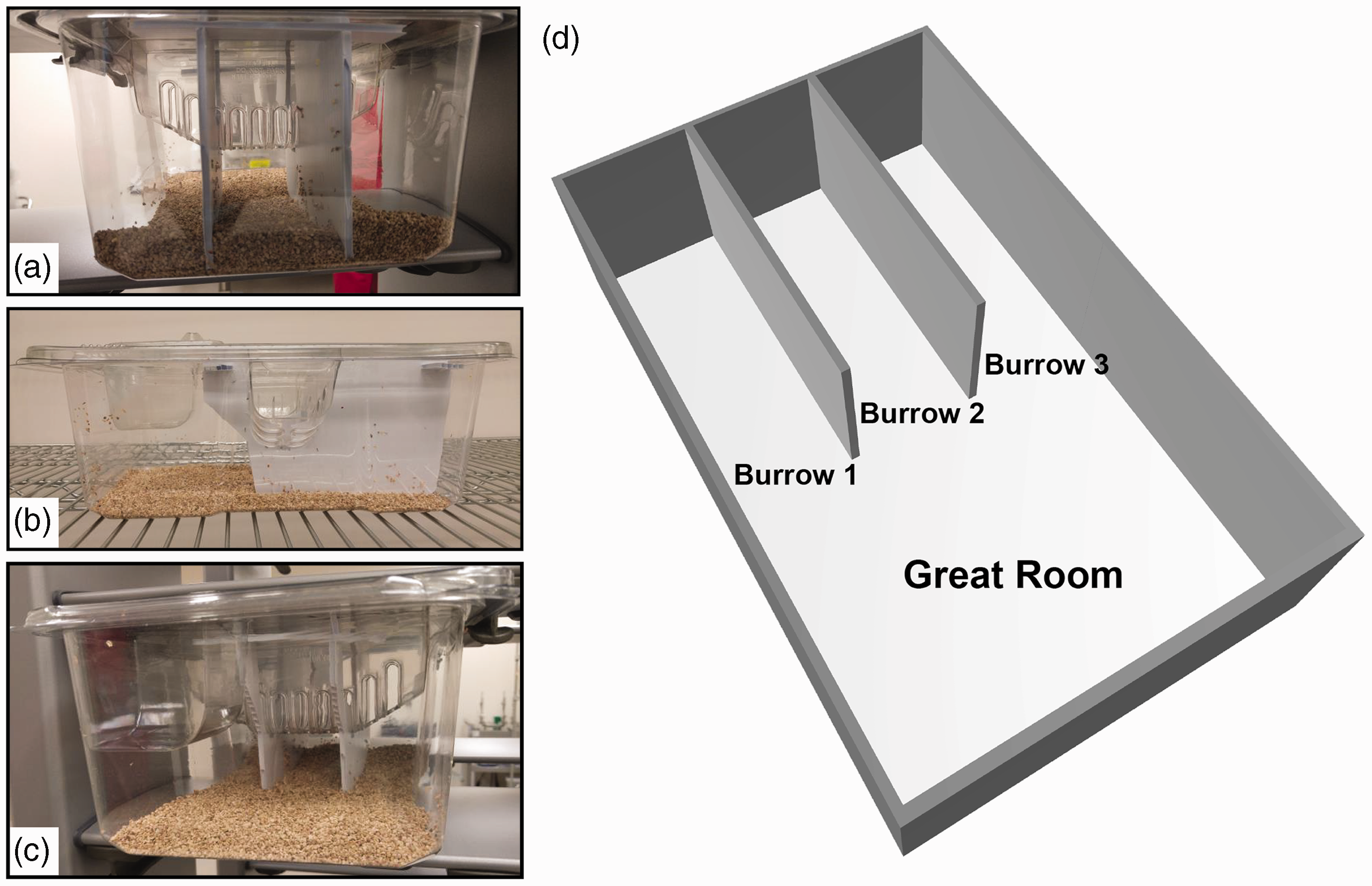
Cage dividers
Cage dividers were hand-fabricated from opaque, white, b-flute corrugated plastic. They were designed to fit inside existing cages (Innocage® Mouse Cage, Innovive, San Diego, CA; outside dimensions 14.7” L × 9.2” W) without modification to the enclosure or obstructing ventilation. Dividers were held in place by the feed hopper and cage lid, effectively dividing half of the cage into thirds (Figure 1), from cage floor to cage lid. All four compartments (common area and three burrows) were open to one another and accessible. The divider length was 7” and each burrow was approximately 3” wide. Total floor space (522.58 cm2) was unaffected by the addition of the cage divider. The walls of the cage divider ran parallel to the long axis of the cage, maintaining line-of-sight for daily observation and health checks by animal care personnel.
Housing
Upon receipt into the vivarium from the vendor, mice were randomly divided into two groups: group 1 was housed in standard caging without dividers (Figure 2(a)); group 2 was housed in standard caging with the addition of cage dividers (Figure 2(b)). All cages in both groups had a single water bottle, feed hopper, corn cob bedding, and a nestlet square, in accordance with standard procedures for the animal facility. A total of 3 cages per group, containing 3 mice per cage were included in the study.
Cage of three Balb/c mice with cage divider (a) and without cage divider (b). Note the minimal obtrusion of the cage divider in observing animal welfare.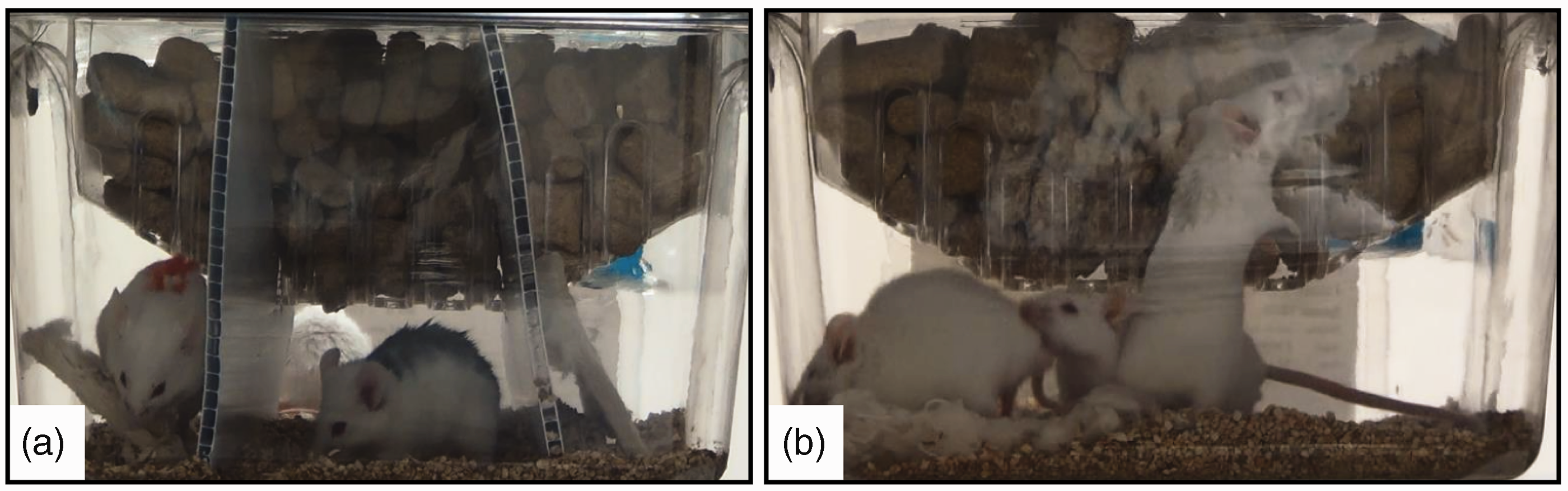
Video recordings and aggressive behavior scoring
A video camera (Sony Handycam HDR-CX190 HD low light) was positioned at the rear of each cage to continuously record behavior. Recordings (color, 1920 × 1080/60i quality, 24 Mbps) were made in 12 h sessions (maximum capacity of digital storage) starting upon receipt in the vivarium (day 1; acclimation period), 24 h later (day 2; establishment of the hierarchy), and one week after receipt (day 7; stable hierarchy). All recordings began with 6 h remaining in the light cycle and continued 6 h into the dark cycle. Recordings occurred between 12:00 and 24:00 on each day which is after the daily health check and any cage changes that occur in the housing room. The two initial recordings provided data during acclimation to the new environment, while the third recording captures the established hierarchy and status quo for the cage.
Offline, recordings were observed for aggressive behavior. Two independent observers tallied the number and type of aggressive behaviors for each hour in each cage (total 216 h). Aggressive behavior type was recorded on a 1–5 scale, where: 1 = posturing; 2 = scuffle/fight; 3 = unprovoked biting; 4 = blood (in cage or on animal); 5 = severe injury (wherein animal needs immediate attention). The number of aggressive behavior events were summed within each hour, over the three observation days, and collated within each group (standard cage, divided cage) and analyzed.
Statistical analysis
Data are shown as mean ± SEM and analyzed using SPSS, with statistical significance assigned when p < 0.05, unless otherwise indicated. Number of events were analyzed using a repeated measure two-way analysis of variance (ANOVA; group × time or type) followed by post-hoc tests, applying a Bonferroni correction to account for multiple comparisons. For all data, the assumption that data were normally distributed and held homogeneous variance were verified (Levene’s test for homogeneity or Mauchly’s test of sphericity) to ensure the validity of the statistical approaches used. Statistical values are included in the results.
Results
All cages and mice were included in the study of aggressive behavior between divided and standard cages. No unforeseen outcomes occurred. We recorded mouse behavior for 6 h during the light cycle followed by 6 h during the dark cycle on days 1, 2, and 7 after initial arrival to the vivarium. We tallied the number of aggressive behavior events within each group (standard cage, divided cage), by type (posturing to severe), over time. Data for time of day and aggression type were analyzed independently.
Cage dividers decreased aggressive behavior in light and dark cycles
Mice housed in divided cages had significantly fewer aggressive behavior events than mice housed in standard cages, in terms of daily combined number of events (F(1,4) = 280.189, p < 0.001), events in the light cycle (F(1,4) = 38.822, p < 0.01), and events in the dark cycle (F(1,4) = 289.053, p < 0.001) (Figure 3). There was an overall effect of day for aggressive behavior with significantly more daily combined events (F(2,8) = 19.840, p < 0.01), light cycle events (F(2,8) = 8.915, p < 0.01), and dark cycle events (F(2,8) = 31.255, p < 0.001), on day 2 compared to day 1 and day 7.
Cage dividers decreased aggressive behavior in light and dark cycles. Divided cages had significantly fewer aggressive behavior events than the standard cages, in terms of daily combined number of events, events in the light cycle, and events in the dark cycle. For daily combined events, light cycle events, and dark cycle events, the number of aggressive behavior events on day 2 were significantly greater than on day 1 and day 7 (post-hoc, †). *p < 0.05 as indicated.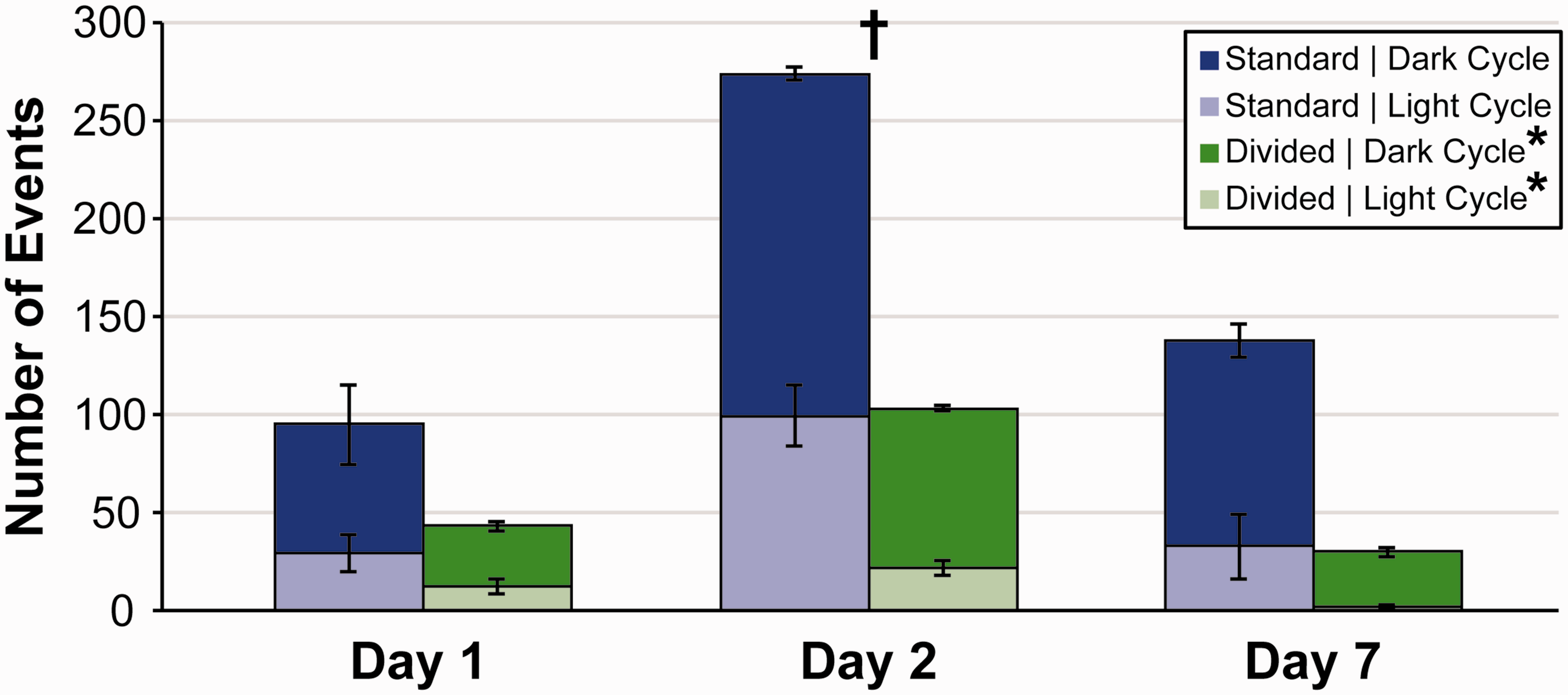
Cage dividers decreased aggressive behavior over days and time
The number of aggressive behavior events significantly differed over the time of day on day 1 (F(12,48) = 8.982, p < 0.001; Figure 4(a)), day 2 (F(12,48) = 96.437, p < 0.001; Figure 4(b)), and day 7 (F(12,48) = 7.017, p < 0.001; Figure 4(c)). Significant interactions between the daily combined number of events between divided and standard cages over hours were observed on day 1 (F(12,48) = 2.143, p < 0.05) and day 2 (F(12,48) = 12.429, p < 0.001). Given the largest effect sizes were observed on day 2, differences between divided and standard cages were explored. Significant reductions in aggressive behavior events occurred in divided compared to standard cages on day 2, with significance achieved for several hours during the light cycle and after dark onset (Figure 4(c)).
Cage dividers decreased aggressive behavior over days and time. Diurnal distribution of aggressive behavior following receipt of animals and introduction to new environment over 12 h of day 1 (a), following establishment of the cage hierarchy over 12 h of day 2 (b), and following full acclimation to the cage environment and establishment of a social hierarchy over 12 h of day 7 (c). The number of aggressive behavior events significantly differs over the time of day at day 1, day 2, and day 7. Divided cages significantly reduced aggressive behavior events on day 2, with significance at individual hours shown (post-hoc, †). Significant interactions regarding the daily combined number of events between divided and non-divided cages over hours were observed on day 1 and day 2. *p < 0.05 as indicated.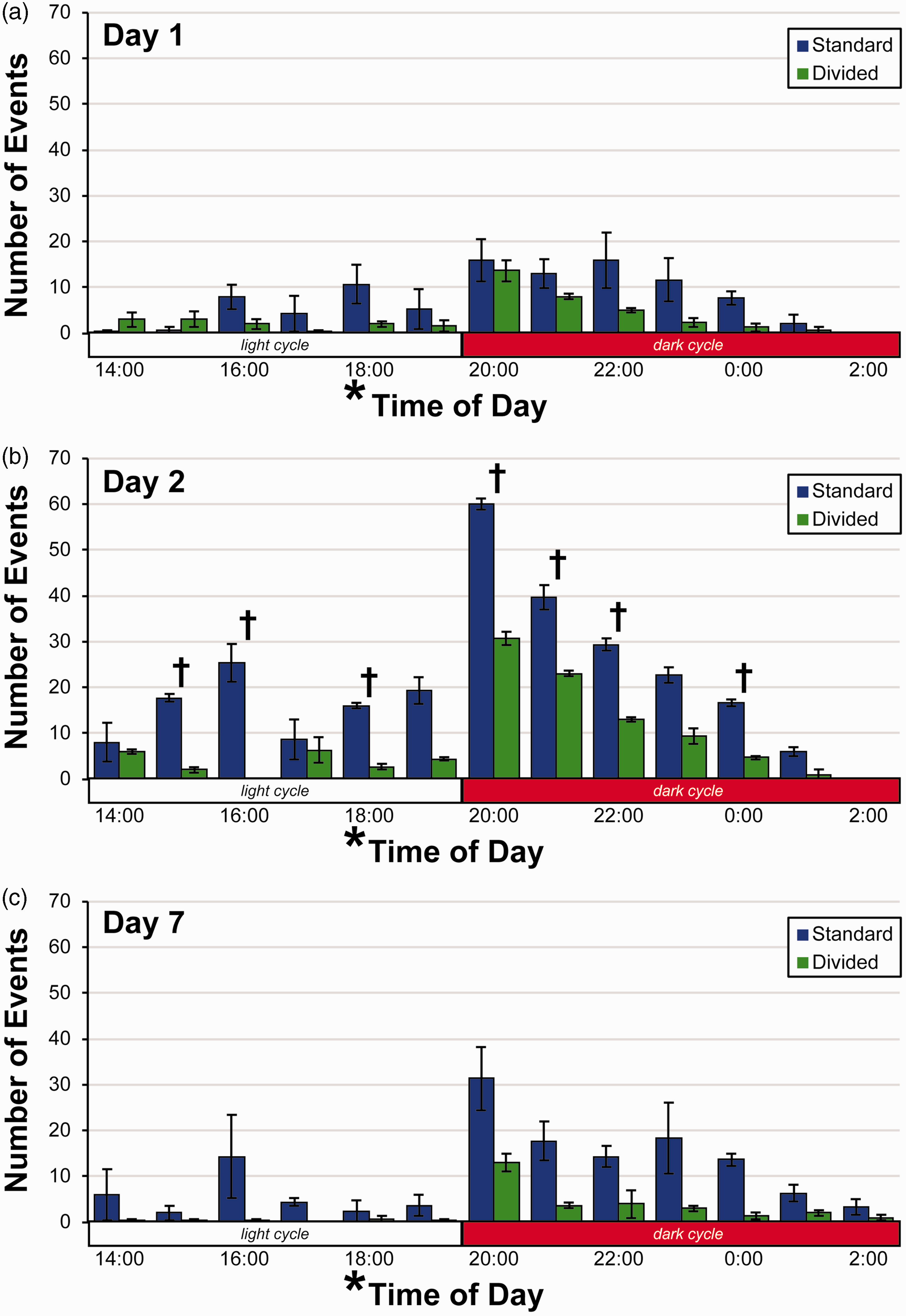
Cage dividers decreased the incidence of all aggressive behavior types recorded
Divided cages had significantly fewer aggressive behavior events than standard cages, in terms of posturing (F(1,4) = 44.330, p < 0.01), scuffling (F(1,4) = 20.360, p < 0.05), and unprovoked biting (F(1,4) = 23.710, p < 0.01) (Figure 5). For the 12 h observation period on day 2, more posturing was tallied compared to day 1 and day 7 (F(2,8) = 24.301, p < 0.001). No events of blood drawn were observed and no veterinarian intervention was necessary, and therefore these aggression types were excluded from analysis. Comparisons between types were not conducted. There were no interactions regarding the total number of posturing events between divided and standard cages over time (F(2,8) = 2.632, p = 0.132).
Cage dividers decreased the incidence of all aggressive behavior types recorded. Divided cages have significantly fewer aggressive behavior events than the standard cages, in terms of posturing, scuffling, and unprovoked biting. On day 2, significantly more posturing was tallied in comparison to day 1 and day 7 (†). Comparisons between types were not conducted. There were no interactions regarding the total number of posturing events between divided and standard cages over time. *p < 0.05 as indicated.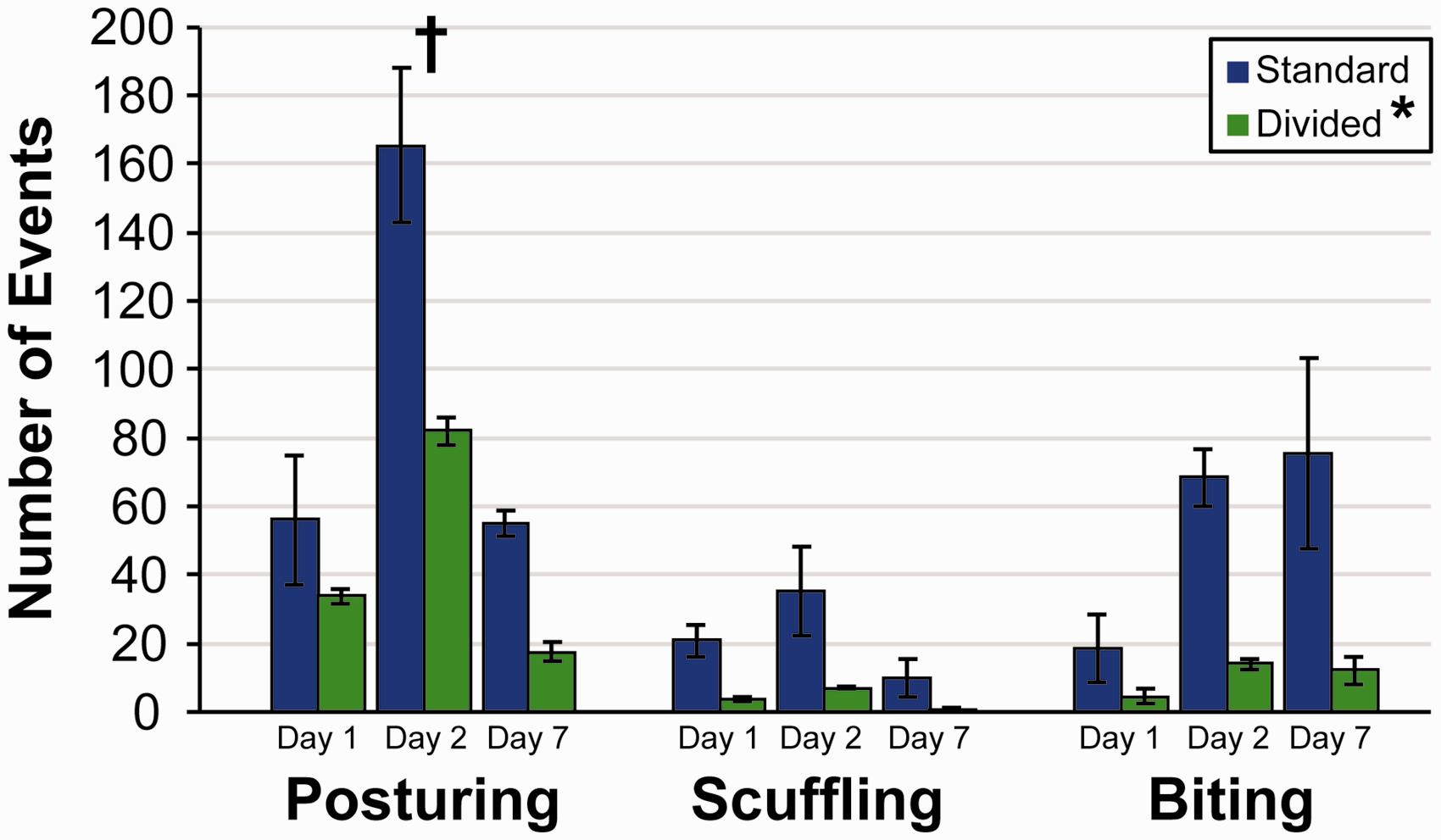
Anecdotal findings of divided cages
In divided cages, mice spent time in all three burrows and the common area, at times alone and together. Spontaneously, single animals would move into an empty burrow without provocation. The nestlet was brought into a single burrow and formed into a nest, where the mice would sleep together. In the standard cage, the dominant mouse showed activity by repeatedly returning to the nesting area, where the subordinate mice slept. Aggressive behaviors in the standard cage involved chasing around the circumference of the cage. In the divided cage, escape to or from a burrow stopped the aggressive behavior.
Discussion
The cage dividers presented here provide a possible solution to mitigate the aggression that can emerge from the artificial, open-space, laboratory mouse housing conditions, which prevent establishing a functional dominance hierarchy. Cage dividers were designed to emulate the natural environment of wild mice by partitioning off a common area and separated “burrows” without compromising cage area or permanently modifying existing caging.26,37 The addition of cage dividers to existing mouse cages significantly attenuated aggressive behavior in group-housed Balb/c male mice. These beneficial effects of cage dividers were observed across light cycles, within hours of a single day, over days of housing, and in terms of aggression type. The addition of cage dividers decreased aggressive posturing, scuffling, and biting behaviors, particularly on day 2 during establishment of the cage hierarchy. Results from this study indicate partial cage dividers may be a solution to a pervasive welfare issue for research animals, with potential downstream benefits on research quality.
In this initial, empirical investigation into feasibility and efficacy, we report mouse home-cage behavior over one week, in response to partially divided cages upon receipt at the animal facility. Day 1 observations represented receipt and housing of animals following transport and their introduction to the new environment. During this initial period, animals are stressed from shipping and handling, and explore the new housing conditions. Day 2 observations represented the establishment of the deme hierarchy as evidenced by the highest tallies of aggressive behavior. Day 7 was one week after acclimation to the environment with the establishment of a hierarchy, where aggressive events likely have reduced to those necessary to maintain the deme hierarchy.
Animal health is a key component of animal welfare, as is stress and stress management. Territorial or resource disputes initiate stress,3–5,12,15,16,19,39 which is evident in decreased exploration and ambulation.15,16,39 Stress then leads to aggressive behavior in mice,6,7,15–18,20,38,39 and subsequent atypical behaviors can be misinterpreted by other mice.3–6,12,38 The dominant animal’s aggressive behavior increases when hierarchal cues are not responded to appropriately.3,6,7,15,16,38,39 In a standard cage, subordinate males cannot avoid line-of-sight of the dominant male,7,38 thereby perpetuating a cycle of aggression and stress. Environmental enrichment partially addresses these issues, perhaps by providing a distraction, but causes other issues related to limited resources.16,18–21 Individual animals may be territorial over enrichment objects or perch on top for aggressive attacks. Complex cages permit species-typical behavior and provide routes for retreat.26,37 The cage dividers may provide a more natural environment, i.e. burrows,19,26,37,39 routes of retreat,26,37 separate animals to break eye contact, and lead to increased exploration and ambulation. 16 Furthermore, the cage dividers did not impede husbandry workflow or daily census and welfare checks. 16 The specific features of the divided cage that reduce aggression remains to be determined.
Aggressive behaviors can culminate in injury (evidence of blood or need for veterinarian intervention). Intervention typically results in separation and isolation of the animals. As mice are a social species, isolation may result in stress without resolution of atypical behavior.15–17 Continuous stress can affect mouse physiology in terms of stress hormone regulation and signaling from wound healing. Veterinary intervention can be costly, atypical behavior and physiological changes can affect scientific rigor,20,41 and individual housing increases per diem costs and cage space availability. Hence, the downstream impact on research is significant. A reduction in aggressive behavior is indicative of a healthy deme hierarchy and reduced stress; both improving research reproducibility and reducing technician and veterinarian time.
Limitations of the present study guide future research. Cage density was pre-selected by the number of burrows available, and not by industry standards. Cage densities of 4 and 5 mice of various strains would extend the effectiveness of the partial cage divider for widespread use.6,16,39 Here we report results over 1 week of housing, where the impact of cage dividers on long-term housing and/or breeding colonies remains to be determined. Further, the current design included solid barriers between burrows, creating a “dead-end” if a subordinate were chased. Chasing events where an escape hole may have benefited a subordinate were not observed. Cage dividers could be considered as an intervention instead of isolation for mice that show aggressive behavior. Ongoing studies are evaluating the impact of cage dividers on behavioral performance in standard neurological tasks. Future studies are necessary to investigate corticosterone levels to validate that the addition of cage dividers alleviate or minimize stress.
Continued evaluation of partial cage dividers has a primary benefit towards animal welfare. Results will lead to a better understanding of mice in their home cage environment, and suggest procedures involving cage additions that reduce aggressive behavior and improve overall welfare. The addition of cage dividers that create a natural burrow-like environment may provide more physical activity,19,26,37 improve animal welfare by reducing aggressive behavior, and enhance research reproducibility by constraining the influence of deme hierarchy and abnormal behavior.
Footnotes
Acknowledgements
The authors thank Daniel Griffiths for his assistance with recording equipment.
Declaration of Conflicting Interests
The author(s) declared the following potential conflicts of interest with respect to the research, authorship, and/or publication of this article: BRT and JL are inventors on a patent submission for vertebrate animal cage dividers, which is held by the University of Arizona. The University of Arizona has a licensing agreement for the manufacture and sales of cage dividers to Helm Technologies, LLC, in which BRT and JL hold equity positions.
Funding
The author(s) disclosed receipt of the following financial support for the research, authorship, and/or publication of this article: Studies were funded by Mission Support funds in the Department of Child Health, University of Arizona College of Medicine-Phoenix.
Note
These data were reported at the 67th Annual AALAS Meeting in Charlotte, North Carolina (Tallent BR and Lifshitz J. Reducing aggression in mice with addition of cage dividers. Abstracts of Scientific Presentations 2016 AALAS National Meeting Charlotte, North Carolina. JAALAS 2016; 55: 606–710).