




Abstract
Xenopus tropicalis is an increasingly important animal model in a variety of biological research fields. In many countries legislation exists to promote and increase welfare wherever possible, including the ability to view animals during daily husbandry with minimal stress to the animal. X. tropicalis (n = 16) refuge use was investigated; it was found that the animals significantly preferred black opaque overhead cover to open-ended pipes or closed-off ceramic plants pots in refuge choice experiments. This experiment was repeated by replacing the opaque black overhead cover with red filters. A significant preference for overhead cover was seen for the red translucent cover compared with other available refuges, suggesting that X. tropicalis may adopt translucent refuges due to their visual inabilities. The inability of frogs to see certain wavelengths of light may allow staff to view them whilst simultaneously providing the refuge of choice.
Xenopus laevis and Xenopus tropicalis are significant model organisms in biomedical research and related subject areas,1,2 but there are few scientific studies on captive amphibian enrichment.1,3 Major and Wassersug 4 found that 46% of Xenopus laboratories provided a refuge; 26% offered cover or shading; and 20% offered sinkable rocks, ceramic plant pots and other refuges capable of partly or entirely covering the animal. Hilken et al. 5 have reported that refuge/cover reduced activity and increased growth, and Brown and Nixon 6 showed that Xenopus prefer tanks with covers, with a trend towards a greater quantity and quality of eggs produced. Refuges and cover also reduce aggression and cannibalism. 7
X. laevis vision is believed to have a peak absorbance sensitivity between 519 nm
8
(see Figure 1 in Bridges et al.
9
) and 522 nm (Figure 1 in Crescitelli
10
), possessing only one visual pigment,
9
indicating they may not be able to perceive colour at longer wavelengths, for example reds and shorter wavelengths in the blue range. Close phylogenetic relatedness means it is plausible that X. tropicalis has similar visual inabilities. Translucent plastic hides with a red tint, called ‘mouse houses’, have been designed for laboratory mice; mice are thought to perceive translucent red as darkness.
11
In experiment 1 (a) a significant preference for using the opaque cover over the other refuges was found, but not compared with not using a refuge at all. (Friedman test, p = 0.001; post hoc tests found that there was a significant difference between the black opaque cover and plant pot, p = 0.023); not using any refuge and plant pot (p = 0.02); not using any refuge and pipe (p = 0.012); a strong tendency towards using the black cover more than the pipe (p = 0.055). Experiment 2 (b), ANOVA, p = 0.001. Post hoc testing (Tukey). Frogs spent significantly more time using the red translucent cover than the pipe (p = 0.033), than the plant pot (p = 0.005), but not compared with using no refuge at all (p = 0.995). There was also significantly more time spent using nothing at all than the plant pot (p = 0.01).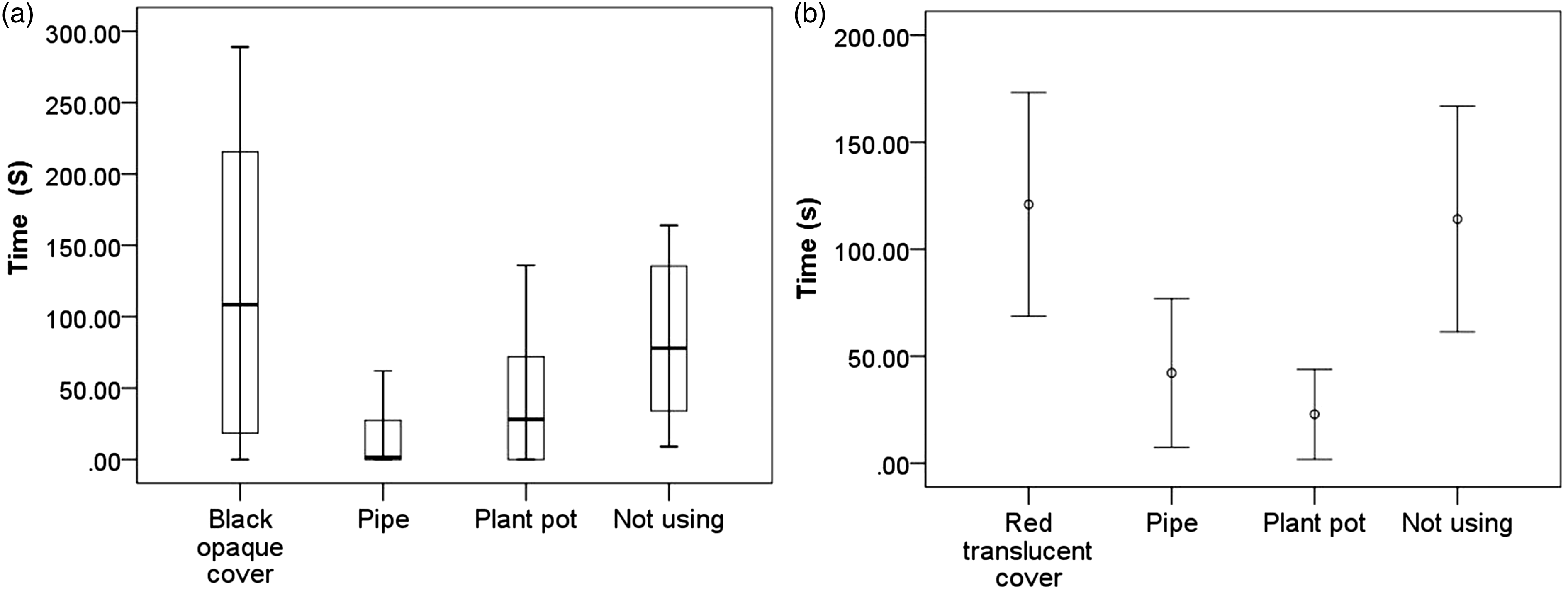
For this study, 16 laboratory-reared X. tropicalis were sexed (10 females, six males), weighed/measured (mean mass = 20.3 g ± 1.7; mean length = 107 mm ± 10.1) and isolated before the experiments began. They were approximately 3 years old, all from the same batch of eggs (strain unknown). They were kept according to standard EU/UK housing regulations (ASPA 1986) and fed a mixture of sinking pellets and blood worms throughout their lives.
The first experiment tested preference of refuges typically given to laboratory amphibians. 2 A grey opaque tank measuring (l × w × h) 86.5 cm × 40 cm × 55 cm was filled with water to 38 cm. Three types of typical refuge were tested (terracotta plant pot with 8 cm aperture, 5 cm base, and 8 cm length; a black open-ended PVC pipe measuring 7.5 cm diameter, 9.5 cm length; and a black overhead cover covering one-quarter of the surface area of the tank). One refuge was placed in one of the quadrants in the tank. The other two refuges were placed in two of the remaining three quadrants, and the fourth quadrant was left free as an open area. Each frog was added to the tank and allowed to acclimatise for 5 minutes. A ‘blind’ observer using a stop watch then timed how long the frog used each type of refuge. Time started when a frog stopped within a refuge but not if it simply passed through. Times were collected for each refuge use over 5 minutes, and these times were also compared with the time spent not using any refuge at all (300 seconds minus total time of all refuge use). The positions of the refuges in each quadrant were randomised daily.
The second experiment repeated the first experiment with the exception of replacing the black opaque cover with a laminated red filter (Lee Filters™ 106 ‘primary red’ http://www.leefilters.com/lighting/colour-details.html#106&filter=cf&sort=number).
All experiments were tested for equality of variances and normality, and statistical analyses were carried out in SPSS v 20. All experiments were conducted after an ethical review carried out by the institution’s Named Animal Care & Welfare Officer and conformed to ARRIVE guidelines.
Significant difference in the amount of time spent in different refuges or non-refuge use was found (Friedman test Chi Square = 10.563 df = 3, p = 0.001) in experiment 1. Post hoc testing (Wilcoxon matched pairs) found significant difference between the black opaque cover and plant pot use (p = 0.023); not using any refuge and plant pot (p = 0.02); not using any refuge and pipe (p = 0.012); and a strong tendency towards black cover use more than the pipe (p = 0.055).
Significant difference between the time used in the refuges (translucent red cover, pipe, plant pot) or non-refuge use was found (ANOVA, F6.2883,15, p = 0.001) in experiment 2. Post hoc testing (Tukey) revealed that there was significantly more time spent using the red translucent cover than the pipe (p = 0.033) and the plant pot (p = 0.005), but not compared with using no refuge (p = 0.995). There was also significantly more time spent using no refuge than the plant pot (p = 0.01). There were no significant differences between sexes in either experiment.
The results from the first experiment (Figure 1) suggest that overhead cover is preferred as a refuge for X. tropicalis. The surface area of cover offered by the overhead cover far exceeds that of the ceramic plant pot and PVC pipework. The cover gives more protected space for behaviours such as foraging.
X. tropicalis utilise translucent red covers in the same way that they utilise black, opaque covers. A non-opaque cover, such as that used in experiment 2, has many advantages; it allows staff to observe the frogs without disturbing them and causing stress, and to monitor waste, uneaten food or reproduction. Furthermore, it may allow experimentation or observation of natural behaviours without interference. Given our understanding of Xenopus vision,8–10 it is perhaps plausible that the frogs are unable to see the remaining light after it has passed through the red filter, which therefore provides adequate cover for the frogs.
The finding that ‘no cover’ did not differ significantly from using the preferred refuge is possibly due to exploration of the environment, looking for food perhaps; these times include movement between areas, which may have inflated the recorded time for ‘no cover’ use.
The use of laboratory animal colour vision to improve welfare has been investigated before in laboratory mice. 11 It is to be noted that not all common laboratory mice strains accepted the translucent red refuges, 11 and there are numerous laboratory Xenopus strains; some may not react in the same way as the animals studied here. Nevertheless, we believe this pilot study offers future directions for research regarding Xenopus spp. welfare, by taking advantage of an animal’s deficit in colour vision.
Footnotes
Declaration of Conflicting Interests
The author declared no potential conflicts of interest with respect to the research, authorship, and/or publication of this article.
Funding
The author received no financial support for the research, authorship, and/or publication of this article.