




Abstract
There is widespread concern about the quality, reproducibility and translatability of studies involving research animals. Although there are a number of reporting guidelines available, there is very little overarching guidance on how to plan animal experiments, despite the fact that this is the logical place to start ensuring quality. In this paper we present the PREPARE guidelines: Planning Research and Experimental Procedures on Animals: Recommendations for Excellence. PREPARE covers the three broad areas which determine the quality of the preparation for animal studies: formulation, dialogue between scientists and the animal facility, and quality control of the various components in the study. Some topics overlap and the PREPARE checklist should be adapted to suit specific needs, for example in field research. Advice on use of the checklist is available on the Norecopa website, with links to guidelines for animal research and testing, at https://norecopa.no/PREPARE.
Introduction
The quality of animal-based studies is under increasing scrutiny, for good scientific and ethical reasons. Studies of papers reporting animal experiments have revealed alarming deficiencies in the information provided,1,2 even after the production and journal endorsement of reporting guidelines. 3 There is also widespread concern about the lack of reproducibility and translatability of laboratory animal research.4–7 This can, for example, contribute towards the failure of drugs when they enter human trials. 8 These issues come in addition to other concerns, not unique to animal research, about publication bias, which tends to favour the reporting of positive results and can lead to the acceptance of claims as fact. 9 This has understandably sparked a demand for reduced waste when planning experiments involving animals.10–12 Reporting guidelines alone cannot solve the problem of wasteful experimentation, but thorough planning will increase the likelihood of success and is an important step in the implementation of the 3Rs of Russell & Burch (replacement, reduction, refinement). 13 The importance of attention to detail at all stages is, in our experience, often underestimated by scientists. Even small practical details can cause omissions or artefacts that can ruin experiments which in all other respects have been well-designed, and generate health risks for all involved. There is therefore, in our opinion, an urgent need for detailed but overarching guidelines for researchers on how to plan animal experiments which are safe and scientifically sound, address animal welfare and contain links to the best guidance available on more specific topics.
The purpose of this paper is to provide planning guidelines, fulfilling a comparable role to reporting guidelines such as ARRIVE 14 and others.15–19 We have called them PREPARE (Planning Research and Experimental Procedures on Animals: Recommendations for Excellence). They are designed to be applicable to all types of animal research and testing, including field studies, but they also contain topics concerning the management of animal facilities, since in-house experiments are dependent upon their quality. Some elements will be more relevant than others, but experimental bias and inappropriate statistical methodology are frequent causes of poor study design. PREPARE seeks to address the needs of all stakeholders: the animals, their caretakers and animal technologists, technical staff, scientists and designated responsible persons, including named veterinarians, training and competency officers and facility managers. PREPARE should also prove helpful for those evaluating proposals for animal studies, including funding bodies, ethical review boards, national committees and regulatory authorities. A more detailed discussion of these guidelines, with links to global resources is available at https://norecopa.no/PREPARE. A comparison between the ARRIVE and PREPARE checklists may also be found there.
The PREPARE guidelines short checklist.
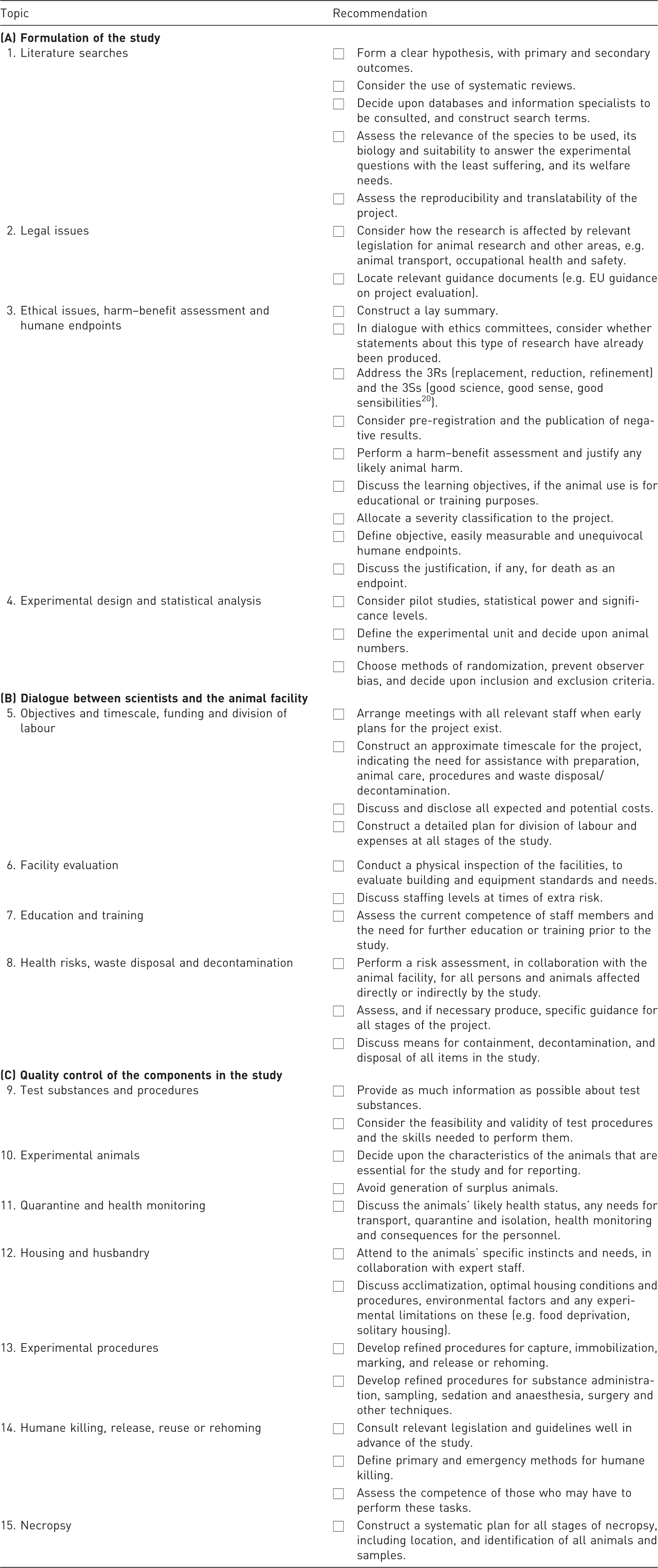
A more detailed discussion, with references and links, is available at https://norecopa.no/PREPARE, together with a downloadable pdf version of this checklist in several languages.
The guidance in this paper should be adapted to the individual research project, animal species and location. The topics in the checklist in Table 1 will not be relevant to all projects, some topics overlap, and they may have to be addressed in a different order to that in the table.
Division of labour, costs and responsibility
Some elements will be the responsibility of the animal facility itself, rather than the individual research group, since they determine the standard of the facility as a whole. However, a research project often raises questions which are not covered by the facility’s normal work routines. These include activities which have potential health and safety risks. Early and open dialogue between the facility and research group, to create a good atmosphere for collaboration, is therefore essential. For example, if a facility cannot safely conduct an experiment without structural changes or investment in new equipment, this should be discussed with the research group at an early stage, however tempting it may be to start collaboration on a prestigious project. Animal welfare and ethics committees can be a useful forum for some of this dialogue. 21 A set of general planning guidelines such as PREPARE can be used to help formulate a contract between the research group and the facility. This ensures prior agreement on two significant practical issues: the parameters to be recorded during the study, and the division of labour and costs between the facility and the research group. Failure to do this may result in lost data, making it impossible to publish the research findings, adding to the waste of resources and animal lives. An example of a contract based upon the PREPARE guidelines is given on the website.
The relationship between PREPARE and other guidelines
Over recent years, guidelines have been produced on many subjects related to the use of research animals including harm–benefit assessment, study design, capture, transport, breeding, housing, identification and marking, administration of substances, blood sampling, anaesthesia and analgesia, surgery, humane endpoints and humane killing.
The PREPARE guidelines build upon guidance that was developed at the Norwegian School of Veterinary Science over a 20-year period, 22 and they are intended to be an overarching set of recommendations to promote good practice. A comprehensive and curated global list of individual guidelines, databases, information centres and discussion forums can be found on Norecopa’s website in the 3R Guide database (https://norecopa.no/3r-guide-database), which is linked to the online version of PREPARE.
The European Union (EU) Directive 2010/63 refers to guidelines for education, training and competence, and for the housing, care and use of research animals. 23 Guidance documents from the European Commission, endorsed by the Member States, are a valuable source of information on these topics, 24 and may also prove to be useful to non-EU countries. For example, Appendix 1 of the Guidance on Project Evaluation and Retrospective Assessment contains preformulated questions for building a project application template, including harm–benefit assessment. 25 These topics have been embedded in PREPARE.
The relationship between PREPARE and ARRIVE
The speaker notes for ARRIVE 26 state that they ‘provide a logical checklist with all the things that need to be considered when designing an experiment’. There are, in our experience when planning animal research, a number of additional points which need to be addressed at the planning stage, but which are easily overlooked or dismissed as unimportant. This was our motivation for the construction of the PREPARE guidelines. Attention to detail not only helps promote excellent study quality and optimal animal welfare, but also the safety of humans and animals affected directly or indirectly by the work. Particular considerations highlighted in the PREPARE guidelines, which are not so prominent in the ARRIVE guidelines, include a harm–benefit assessment; health risks, waste disposal and decontamination; quarantine and health monitoring; the use of humane endpoints; the fate of the animals (humane killing, release, re-use or re-homing); and necropsy.
A Swiss study indicates that journal endorsement alone does not ensure guideline use: half of the researchers who had last published in a journal endorsing ARRIVE had never heard of the guidelines. 27 Emphasis on reporting guidelines in the EU Commission’s Guidance on a common education and training framework 28 and in recommendations produced by other authorities will hopefully improve this situation.
Concluding remarks
It is our hope that the PREPARE guidelines will draw scientists’ attention to the wide range of factors which require consideration at the planning stage. This should lead to an increase in scientific validity, reproducibility and animal welfare. Improving the quality of publications will also facilitate systematic reviews, thereby generating new knowledge through the synthesis of evidence, without the use of animals.29,30
Planning guidelines have greater potential than reporting guidelines for assisting funders, regulators and ethical review committees in the assessment of applications for new projects. We therefore propose that funders make adoption of the principles in PREPARE or similar guidelines a condition of funding.
As with the ARRIVE (reporting) guidelines, the PREPARE (planning) guidelines are neither meant to be mandatory, absolutely prescriptive, nor a standard formula. Biomedical subspecialities may find it useful to produce their own supplementary guidelines, such as Australian scientists have done for osteoarthritis research 31 and the STAIR conferences 32 for stroke models. The Strategic Planning Poster from FRAME (Fund for the Replacement of Animals in Medical Experiments) provides a flowchart with good general advice on planning animal research. 33 PREPARE is designed to provide a detailed, universally relevant checklist which reduces the risk of problems, artefacts or misunderstandings arising once studies have begun. Furthermore, it can serve as the basis for a contract for the distribution of labour between the animal facility and research group. This will also reduce the risk of the researchers being unable to respond to journals’ requests for more observations in an experiment, which can lead to manuscript rejection, wasting both animal lives and human resources.
‘It is perfectly true, as philosophers say, that life must be understood backwards. But they forget the other proposition, that it must be lived forwards.’ (Søren Kirkegaard 1813–1855)34
Footnotes
Acknowledgements
Early versions of these guidelines were inspired by the pioneering work of Öbrink and coworkers.35,36 An earlier version of the contract between researchers and the animal facility was published in compendia in Laboratory Animal Science produced by the Norwegian School of Veterinary Science. 22 We thank Anton Krag, Norwegian Animal Protection Alliance, Oslo; Dr Ute Weyer, Animal and Plant Health Agency, UK; Professor Malcolm Macleod, Centre for Clinical Brain Sciences, University of Edinburgh, and the referees for their valuable advice during the preparation and review of this paper.
Declaration of Conflicting Interests
The author(s) declared no potential conflicts of interest with respect to the research, authorship, and/or publication of this article.
Funding
The author(s) received no financial support for the research, authorship, and/or publication of this article.