




Abstract
Good communication is important for the dissemination of research results. Here, we summarize the advice that was given to authors at the LA seminar on scientific writing at the FELASA Congress 2016 in Brussels, Belgium on 13–16 June 2016, with the aim of improving the quality of submitted papers and of avoiding common mistakes in scientific reports. See www.felasa2016.eu.
Laboratory Animals (LA) is the official journal of the Federation of European Laboratory Animal Science Associations (FELASA) and publishes peer-reviewed original papers and reviews on all aspects of the use of animals in biomedical research six times per year. LA’s impact factor (IF) has progressively risen since 2008 and was 1.553 in 2015. Additionally, the journal is ranked 29 out of 138 journals in the veterinary sciences and 50 out of 160 journals in zoology. This IF and ranking make LA an attractive journal for publishing reports in laboratory animal science. LA can be selective in what articles it publishes because of the large number of submitted manuscripts and the limited page count per issue. Therefore, authors need to be diligent when preparing a manuscript for submission to LA because only one-third of all submitted manuscripts are published. Since good communication is important for the dissemination of research results, we summarize the advice that was given to authors at the LA seminar on scientific writing at the FELASA Congress 2016 in Brussels, Belgium, with the aim of improving the quality of submitted papers and of avoiding common mistakes in scientific reports.
Conducting studies in the laboratory animal sciences
As with other scientific research, common rules and recommendations regarding good scientific practice apply for studies in laboratory animal science. Nevertheless, researchers working and writing in the field of laboratory animal science may find themselves in a unique situation. This is because not all researchers who publish in laboratory animal science journals or journals in related fields are full-time scientists. Many are service providers who work in animal housing facilities or experimental units. As with medicine and other applied sciences, the involvement of practitioners (veterinarians, animal welfare officers, technicians, and carers) in research has some obvious advantages: awareness of the significant needs of the field and an ability to ask research questions which focus on the field’s science, as well as questions on animal housing and husbandry routines. In light of the requirements of Directive 2010/63/EU, studies which focus on the 3Rs (replacement, reduction and refinement) have gained in importance because the Directive’s emphasis is on the 3Rs. For example, the identification of parameters or indices for assessing the severity of experiments is needed. This emerging necessity can be best satisfied by experienced practitioners and highly qualified experts in the field of laboratory animal science who are involved in the daily routines of an animal facility and the conduct of animal-based investigations. Nevertheless, the involvement of practitioners has several drawbacks: they face barriers to successful writing, which impinge on the quality of manuscripts, such as inexperience in scientific writing, time constraints due to other duties, or insufficient financial resources.
Studies in the laboratory animal sciences and the 3Rs
Exemplatory list of 3R resources.
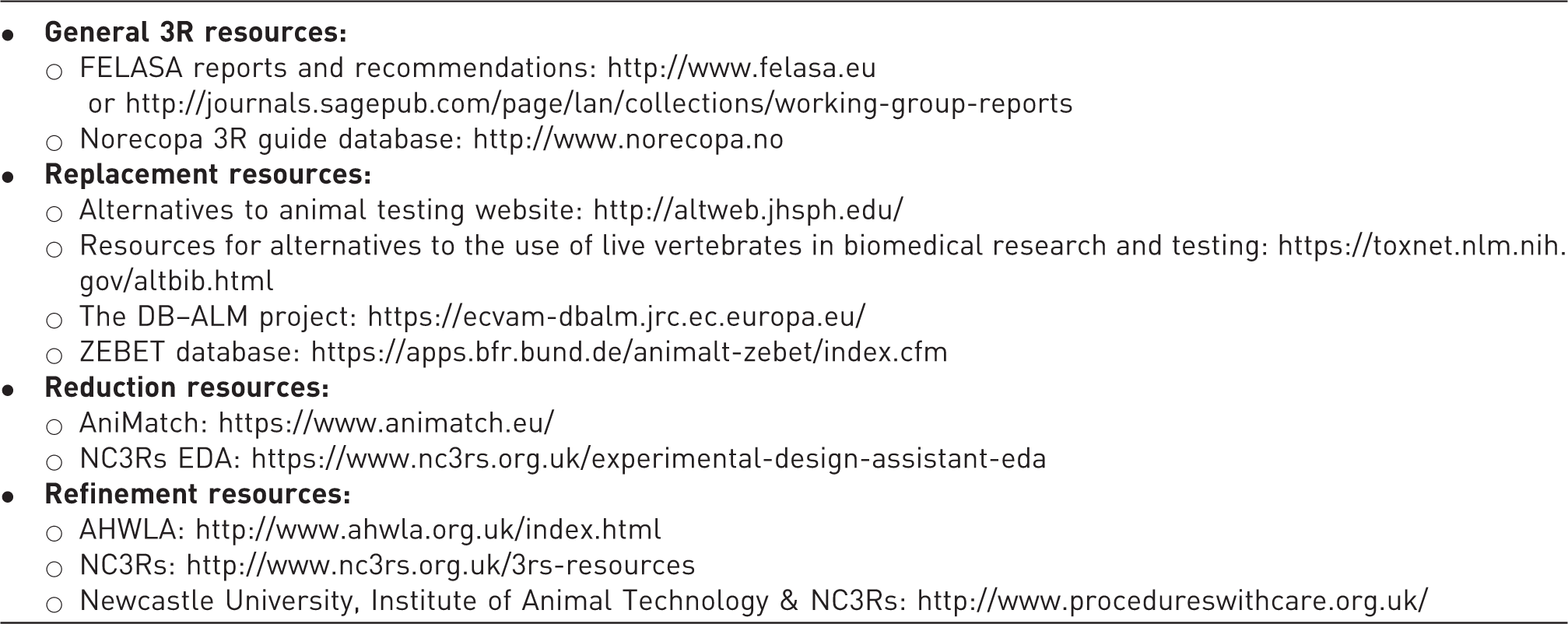
Reducing animal numbers can be accomplished not only with the proper choice of experimental designs and correct statistical analyses, but also by the sharing of research animals and animal tissues or organs. Web-based platforms to connect and enable researchers or housing facilities with unused animals or organs and tissues of killed animals to share are emerging; one example is the AniMatch online platform (Table 1).
While replacement of animal experiments or reduction of animal numbers might not be possible in all experimental studies, incorporation of refinement measures might be feasible in many experimental or housing routines in order to reduce possible stress, pain, or suffering of the experimental animals. Examples for methodological refinements are given in many publications, textbooks, and online resources such as the ‘Procedures With Care’ website that was developed by Newcastle University, the Institute of Animal Technology, and the National Centre for the 3Rs (NC3Rs) (Table 1).
The reporting of all experimental procedures, as well as housing conditions, animal handling and care routines, as described later in this manuscript, is important. Reporting should also include all refinement measures because their inclusion may facilitate a critical review of the data. Additionally, inclusion of these measures in a report also demonstrates adherence to animal welfare norms, and may guide other scientists regarding the use of such measures to ensure the application of the 3Rs. 4
Authors must also provide assurances that no experiments are unnecessarily duplicated, no alternative methods could have been used, and the most humane methods have been applied. Tools that help to design and check experimental systems and structures, such as the Experimental Design Assistant from the NC3R (Table 1), might be very valuable in identifying possible design errors before the start of a study. An important part of the experimental design is correct statistical planning before starting an animal-based investigation. This planning includes calculating the sample size and choosing the correct statistical analyses for the research study in question. Accordingly, involving a biostatistician who is experienced in the analyses of animal experiments is recommended.
The importance of instructions to authors and reporting guidelines
LA has instructions to authors for each different category of manuscript which it publishes, namely original articles, reviews, working party reports, short reports, and case reports (see https://uk.sagepub.com/en-gb/mst/journal/laboratory-animals#submission-guidelines). Authors should also be aware that a submitted manuscript must have the required content, and that manuscripts which do not contain the required content will be rejected by the editorial office, and will not enter the review process. Common reasons for a manuscript failing the editorial office’s technical screen are (a) non-compliance to the journal’s instructions to authors, (b) absence of key elements, such as authors’ affiliations and keywords, (c) incorrect formatting of the in-text citations and references, (d) exceeding the word count limit for each type of article, and (e) falling outside the journal’s aims and scope. Authors should also note that LA has adopted the ARRIVE reporting guidelines, 5 and recommends that the gold standard checklist be used when preparing a manuscript. 6 Hence, preparing a manuscript according to journal’s instructions and reporting guidelines increases the manuscript’s quality and facilitates the review process.
Required content and organization of information
Research reports are rigidly structured narratives of four main sections: Introduction, Materials and methods, Results, and Discussion (the IMRaD structure; Figure 1).
7
Before presenting the requirements of each section, some comments should be made on the manuscript’s title and abstract because these are usually written when the text of the manuscript is finalized and will be the first to be read. The manuscript’s title and abstract set the tone of the manuscript for the reader. The title should be precise and connect with its audience. A well-prepared abstract enables the reader to identify the basic content of a document quickly and accurately, to determine its relevance to their interests, and to decide whether or not to read the document in its entirety. An abstract is a condensed version of the manuscript, and succinctly describes its content and scope, and reviews its material in an abbreviated form. Specifically, an abstract should summarize the main points of the article, and should provide (a) the context or background for the investigation, (b) the investigation’s purpose, (c) the study design and methods, (d) the main findings, (e) the principal conclusions, and (f) the new and important aspects of the investigation.
The structure and required content of a scientific manuscript.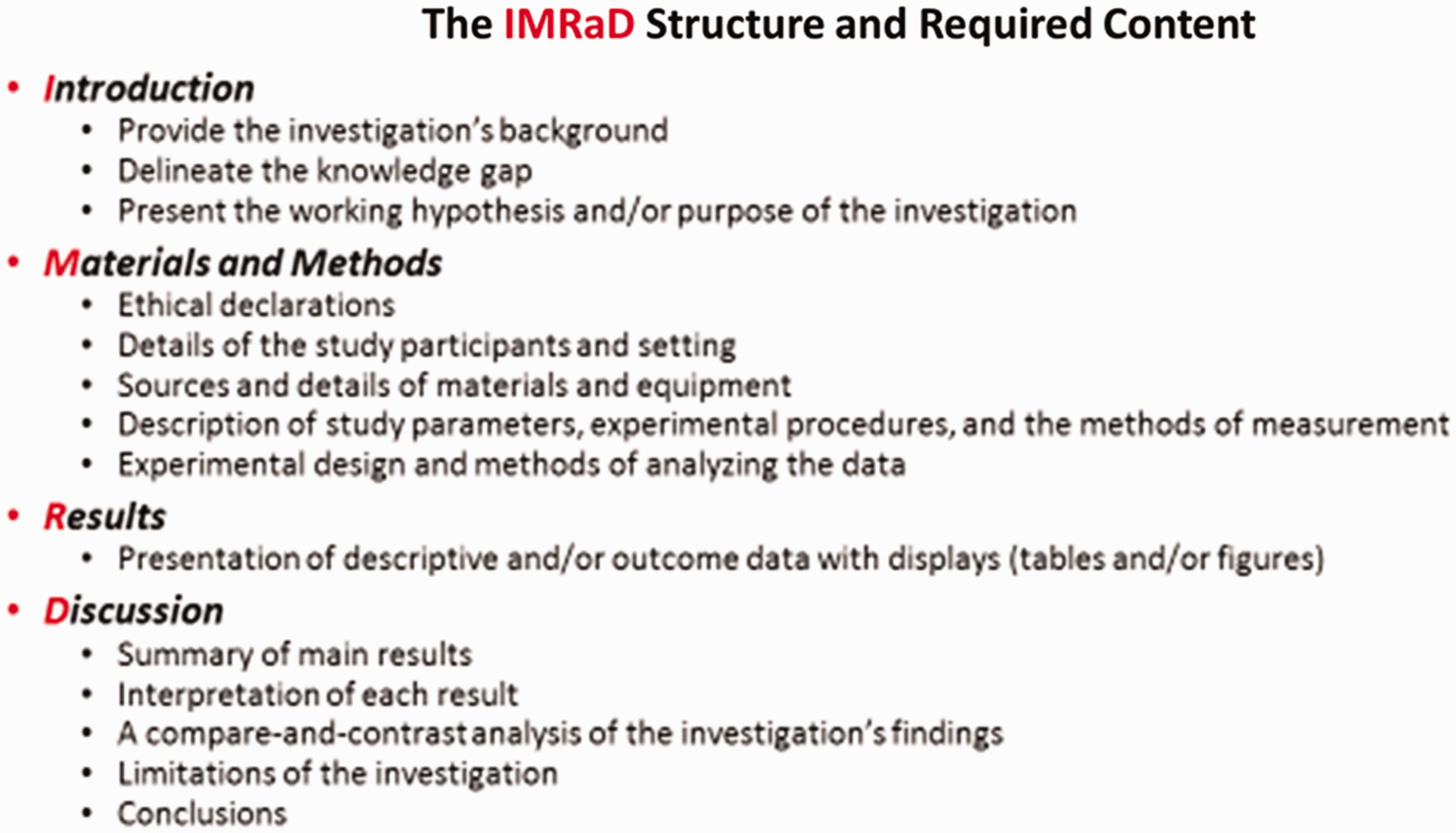
As for the organization of information and the IMRaD structure, the Introduction of a scientific paper should (a) provide the context or background of the investigation, i.e. the nature of the problem and its significance, (b) state the specific purpose or research objective of, or hypothesis tested by, the study or observation, and (c) describe why the study was conducted and why it is important. Authors often do not provide sufficient background and context in the Introduction of their manuscript. This insufficiency, together with an incomplete literature review, diminishes the credibility of the report and reflects badly on the diligence of the authors. The reporting of negative results is of major importance for the ethical use of animals in research. It is often thought that negative results are of little value and that they are simply the results of badly designed experiments. Hence, manuscripts that report statistically significant results are three times more likely to be published than those that report negative results. 8 This disparity is a major information loss for science, and a waste of financial resources. It also distorts meta-analyses and the outcomes of reviews, and may lead to the unnecessary repetition or duplication of animal-based experiments. Accordingly, prospective authors should ensure that the Introduction of their manuscript has a clearly formulated question, which is based on the evidence that was gleaned from all relevant studies.
The Materials and Methods section should include only information that was available at the time that the plan or protocol for the study was written. All information that was obtained during the conducting of the study should be confined to the Results section. The guiding principle for the Materials and Methods section should be a complete explanation on how and why a study was done in a particular way. To this end, this section must contain declarations which confirm that the investigation and all the experiments and/or procedures which comprised the investigation conformed to the relevant regulatory standards. Specifically, an animal-based investigation, which is reported in a submitted manuscript, must be approved by the animal ethics committee with oversight of the facility in which the studies were conducted. The journal has also adopted the ‘Consensus author guidelines on animal ethics and welfare for veterinary journals’ published by the International Association of Veterinary Editors. 9 Hence, papers will only be published if the experimental procedures conform with the accepted principles for the use of animals in biomedical science, namely those specified in the European Convention for the Protection of Vertebrate Animals used for Experimental and Other Scientific Purposes and its appendices, and/or the National Research Council Guide for the Care and Use of Laboratory Animals. If the experimental design or programme of work reported in the manuscript raises particular ethical or welfare concerns, the journal’s editorial board will consider the current UK legislation, namely the Animals (Scientific Procedures) Act 1986 and the amendment, which was published in 2014. 10
The ‘methods’ part of Materials and Methods section should also (a) identify the study’s participants and their health and/or genetic status, delineate the inclusion and exclusion criteria, and describe the source population, (b) describe the study parameters, the method for measuring each study parameter, the apparatus, and the procedures in sufficient detail to allow other workers to reproduce the results, and (c) describe the experimental design and the statistical methods for analysing the data with enough detail so that a reader and/or reviewer can verify the reported results. To this end, useful information on the design of animal experiments can be found in the second edition of ‘The design of animal experiments’, which was recently published by Laboratory Animals Ltd. 11 Since the relevance of variables, such as sex, is not always clear in the investigation’s aim, authors should explain their relevance when they are detailed in a study report. For example, authors should explain why the participants selected were of a certain sex or why animals of one sex were excluded from the study. 12
The purpose of the Results section is to present the key results of the research without interpreting their meaning, and should be specific and relevant to the research hypothesis. Any data presented in the tables should not be repeated in the text; however, important observations may be summarized or emphasized. When data are summarized in the Results section, numeric results should be given not only as derivatives (for example, percentages) but also as the absolute numbers from which the derivatives were calculated.
The purpose of the Discussion section is to interpret and put the results into a broad context. To these ends, the authors should conduct a compare-and-contrast analysis, explain the implications of the results, and make suggestions for future research. The Discussion section should also answer the questions that were posed in the Introduction, explaining how the results support the answer(s), and how the answer(s) fit(s) in with existing knowledge on the topic. The discussion should be a formal consideration and critical examination of the study: the research question should be addressed, the limitations of the investigation should be identified, and the results should be considered in the context of other studies. The discussion should also emphasize the new and important aspects of the study and the conclusions that follow from them. This section should end with a clear and concise conclusion that does not go beyond the evidence that was collected in the investigation. The conclusions should be linked with the investigation’s goals, and unqualified statements and conclusions that are not supported adequately by the data must be avoided.
For References, LA adheres to the SAGE Vancouver reference style, and details of this style for the manuscript’s references can be found at https://studysites.uk.sagepub.com/repository/binaries/pdf/SAGE_Vancouver_reference_style.pdf.
Hence, prospective authors should consult the journal’s submission guidelines before submitting a manuscript in order to ensure that it will not fail to pass the technical screen.
Reasons for rejecting or requesting a revision of a submitted manuscript
In addition to a manuscript failing the technical screen and not falling within the aims and scope of LA, a manuscript may be rejected or a revision is requested for several reasons. First, the investigation is incomplete because it is not a full study and the authors have ignored the results of other important investigations in the discussion. Second, the procedures and/or analysis of the data are defective. For example, the investigation lacked clear control groups and the statistical analysis of the data was not valid. Third, the data do not support the conclusions and the discussion lacks structure, and the flow of argument is illogical. Fourth, the report is incomplete because the authors have presented only some of their relevant data in order to make as many articles as possible into several publications (salami publishing). As a result, the findings are incremental and the report does not advance the field.
Since science has become an increasingly global enterprise, the language of almost all reports in peer-reviewed scientific journals is English. Since many of these reports are written by individuals whose first language is not English, many reports are badly written. A common feature of badly written reports is a substandard quality to the report’s language, which renders the report imprecise, inconsistent, verbose, and difficult to read and understand. A report is also often badly written because of incorrect diction, a superfluous style, and poor syntax, and the use of jargon, clichés, redundancies, typographical errors, and awkward phraseologies. Hence, submission of a badly written manuscript to LA will almost always result in a request to submit a revised version.
Preparation of a well-written manuscript can be achieved by applying a few simple writing tips, and the correct application of these tips should improve the manuscript’s readability and impact. A well-written manuscript should tell a complete story and should be written in good and plain English: it should not contain professional jargon and should be written with correct diction, syntax, spelling, and punctuation. The attributes of a well-written manuscript are:
Clarity: the reader can easily and quickly understand the manuscript’s message because the efficiency of information transfer from author to reader is high and the manuscript’s noise-to-signal ratio is low. The narrative should be free of ambiguities, which are unclarities by virtue of having more than one meaning and/or whose meaning cannot be determined from context. Ambiguities and unclarities often result from the writing of long sentences (a word count that is greater than 40). Precision: the fidelity of the manuscript’s message is enhanced by choosing the correct words. Choosing the incorrect words jeopardizes the message’s fidelity. Concision: the information density of the text is well-chosen and apt. The use of short sentences (average word count of between 12 and 20) eliminates the need for punctuation, and short sentences usually contain fewer grammatical and typographical errors. The presence of such errors indicates careless preparation of a manuscript. Coherence: the manuscript’s narrative is well-designed, and the manuscript’s argument is convincing and is presented logically without any ‘orphan’ sentences. Consistency: consistency in terminology throughout the manuscript’s text eliminates reader confusion. Originality: the text should be original, without repetition, and free of copied phrases and/or sentences and plagiarisms. Harmonization: the text of a manuscript that is written by several authors (collaborative writing) should be harmonized for style and standardization and removal of repetitions by the author with the most editorial experience.
Publication ethics
LA is a member of the Committee on Publication Ethics, COPE (http://publicationethics.org/), which is a forum for editors and publishers of peer-reviewed journals to discuss all aspects of publication ethics. It also advises editors on how to handle cases of research and publication misconduct. Protecting the integrity of a scientific report is one of the responsibilities of a journal and its publisher. Although plagiarism can be simply defined as copying, it is a serious offence for two reasons. First, it involves the theft of another investigator’s words and ideas without crediting the source. Second, it is also fraud or deception because it is the misrepresentation of an accomplishment. When plagiarism is suspected in a manuscript, the manuscript is checked during the review process.
Footnotes
Declaration of Conflicting Interests
The author(s) declared no potential conflicts of interest with respect to the research, authorship, and/or publication of this article.
Funding
The author(s) received no financial support for the research, authorship, and/or publication of this article.