




Abstract
Several cancer chemotherapies cause nausea and vomiting, which can be dose-limiting. Musk shrews are used as preclinical models for chemotherapy-induced emesis and for antiemetic effectiveness. Unlike rats and mice, shrews possess a vomiting reflex and demonstrate an emetic profile similar to humans, including acute and delayed phases. As with most animals, dosing of shrews is based on body weight, while translation of such doses to clinically equivalent exposure requires doses based on body surface area. In the current study body surface area in musk shrews was directly assessed to determine the Meeh constant (Km) conversion factor (female = 9.97, male = 9.10), allowing estimation of body surface area based on body weight. These parameters can be used to determine dosing strategies for shrew studies that model human drug exposures, particularly for investigating the emetic liability of cancer chemotherapeutic agents.
Despite the use of antiemetic drugs, notably the 5-HT3 (serotonin type 3) and NK1 (neurokinin type 1) receptor antagonists, classic cytotoxic and novel chemotherapy-induced nausea and vomiting remain significant concerns for patients.1,2 Although many studies of emesis use large animals, such as dogs and ferrets,
3
there has been a growing interest in the use of smaller animals, particularly musk shrews4,5 (Figure 1a). Rodents (rats and mice) lack an emetic reflex and, therefore, are not suitable as models for emetic testing.
6
Analysis of body surface area. (a) Musk shrew. (b) Skin was positioned flat for imaging; tissues were collected from a male (body weight = 74.6, age = 157 days). (c) Skin surface area was computed using software; areas for the ears and paws were doubled to compute both sides.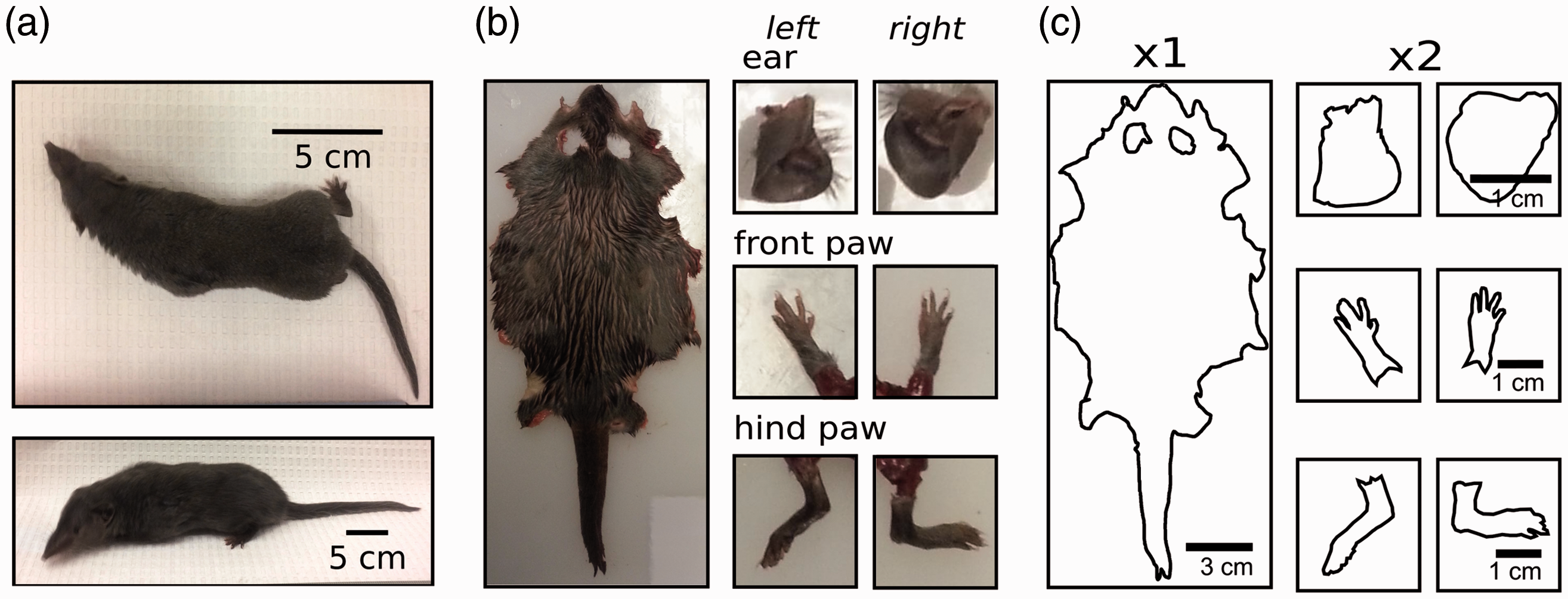
To allow translation between body weight (BW)-based doses in shrews and doses in humans on a body surface area (BSA) equivalent basis, BSA was directly assessed through image analysis of the skin area to determine the Meeh constant (Km) (a conversion factor between BSA and BW 7 ).
Sixty-one musk shrews (20 females, 52–213 days old and 41 males, 48–162 days old) were offspring from stock obtained from the Chinese University of Hong Kong (originating from Taiwan 8 ). They were housed individually in a 12:12 h light/dark cycle (lights on at 07:00 h), and fed a mixture of 75% Purina Cat Chow Complete Formula and 25% Complete Gro-Fur mink food (Milk Specialties Co, New Holstein, WI, USA), with free access to food and water. Experiments were approved by the University of Pittsburgh’s Institutional Animal Care and Use Committee, and the animal care and use program is approved by the Association for Assessment and Accreditation of Laboratory Animal Care (AAALAC).
Shrews were euthanized at the end of other, primary, studies using carbon dioxide (rising) or an intracardiac injection of Beuthanasia-D (0.2 mL = 78 mg sodium pentobarbital; Henry Schein, Melville, NY, USA), under general anesthesia (urethane 1 g/kg intraperitoneally). 5 Euthanization was confirmed by cervical dislocation. For dissection, a medial incision was made on the ventral plane from the tip of the lower jaw to the end of the tail. The skin was removed from the muscle, except for the area surrounding the paws, which was left in place. The ears were removed from the pelt and these tissues were laid flat, along with a metric ruler, for imaging with a digital camera (Figure 1b).
Using ImageJ software (National Institutes of Health, Bethesda, MD, USA), traces were made of the skin (Figure 1c). The total area was computed (converting the scale from pixels to centimeters) by subtracting the ear holes and adding the ears and paws, doubled to account for two surfaces (Figure 1c).
Data for male and female shrews were analyzed separately, and for each animal computed Km = BSA/(BW2/3). 9 The distribution of the Km values were examined with histograms, and determined to be normally distributed based on the Shapiro–Wilk’s test, so the mean was calculated and used as an estimate of Km, including a 95% confidence interval (CI). The prediction error, defined as the observed BSA minus the calculated BSA, was calculated for each animal and plotted against BW to determine if the prediction error had a trend related to BW. However, this trend was not observed for either sex, indicating that the data fitted the formula well. Also, the root mean square prediction error (RMSE) was calculated for each datum, along with its 95% CI. 10 Two-sided t-tests were used to compare males and females.
Females had a lower BW compared with males (mean = 40.47, SD = 3.62, median = 40.00, range = 36.60–50.90; compared with mean = 68.91, SD = 8.03, median = 68.3 g, and range = 50.90–88.20, P < 0.0001). Similarly, BSA was less in females (mean = 117.5, SD = 9.6, median = 118.7, range = 96.79–134.7; compared with mean = 152.8, SD = 14.3, median = 150.6, and range = 116.9–195.5 cm2, P < 0.0001). See scatterplots for BSA by BW (Figure 2a) and age (Figure 2b). Females had an average Km value of 9.97 (SD = 0.68, median = 10.12, 95% CI of 9.67 and 10.27; RMSE = 7.79 with 95% CI of 3.32 and 10.51) and males a value of 9.10 (SD = 0.66, median = 9.17, 95% CI of 8.81 and 9.39; RMSE = 11.21 with 95% CI of 8.05 and 13.66), respectively. The Km was significantly different between the sexes (P < 0.0001).
Summary of data. (a) Body surface area by body weight. (b) Body surface area by age. (c) Body surface area by body weight in female (f) and male (m) shrews compared with other mammals using logarithmic scales (monkey = cynomolgus, rhesus, and stumptail).
9
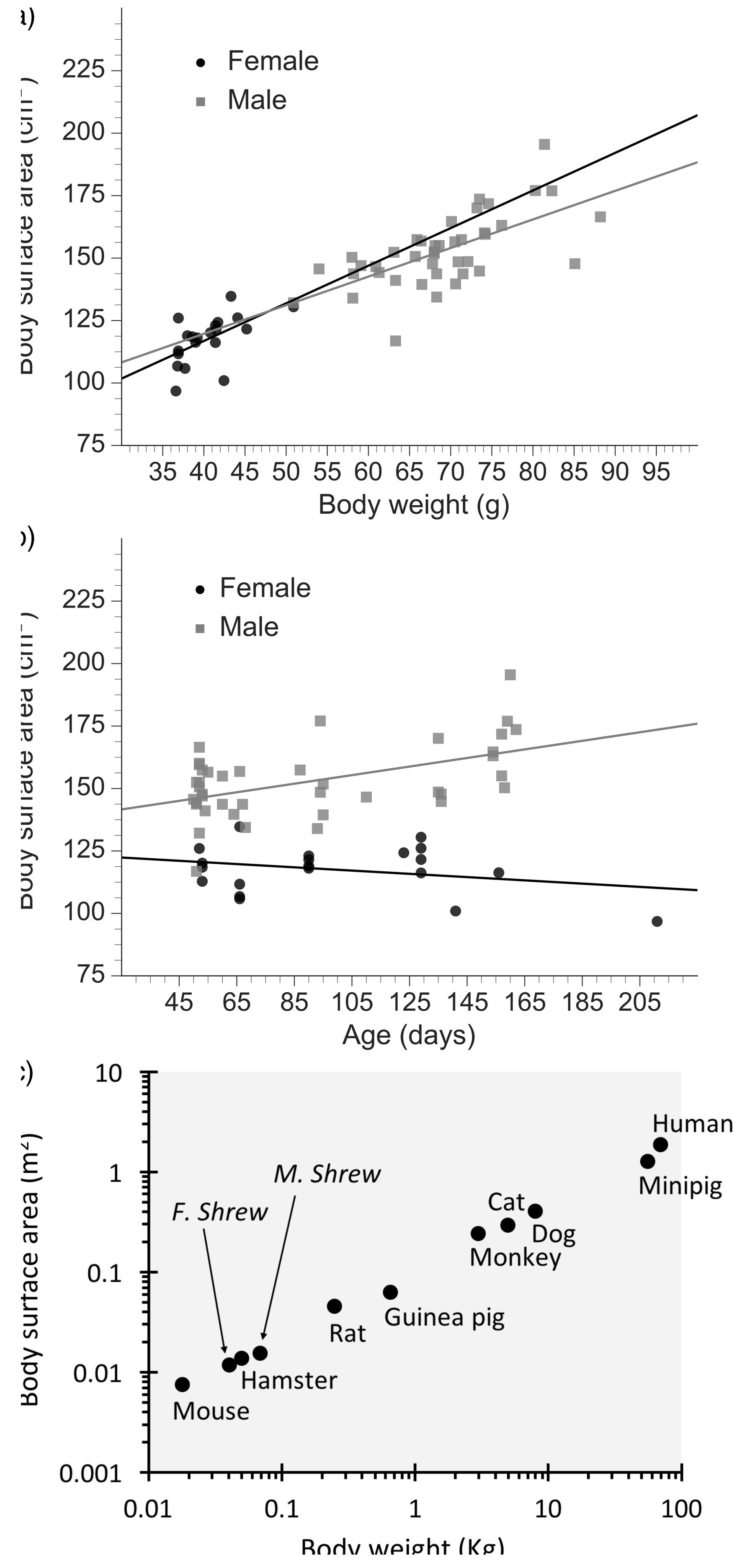
Our data indicate that Km can be used to estimate BSA. Shrew BW relative to BSA is in close agreement with measures from other mammals (Figure 2c). Using shrew Km values, chemotherapeutic drug dosages were estimated from prior studies. Typical doses of the chemotherapeutic agent cisplatin used in shrew studies of emesis were 10, 20, and 30 mg/kg BW,4,11–14 which convert to 100, 199, and 299 mg/m2 for females and 91, 182, and 273 for males (mg/kg value × Km). A cisplatin dosage of approximately >70 mg/m2 is highly emetogenic in humans, 15 but the equivalent dose in musk shrews (female, 7.0; male, 7.7 mg/kg) does not produce emesis. In our previous shrew pharmacokinetic study, ultrafilterable platinum clearance normalized to BSA utilizing Km is 341 mL/min/m2, which is similar to the value reported in humans of 397 mL/min/m2 (assuming a 70 kg, 1.73 m human),16,17 which suggests that there may be a susceptibility difference between humans and shrews.
Footnotes
Acknowledgements
We thank David Rosenberg, Nick Welko, Yolande Ramaroson, Audrey Lim, and Laura Farr for excellent technical assistance. We also thank the University of Pittsburgh, Division of Laboratory Animal Research, especially Megan Lambert and Dr. Joseph Newsome for excellent care of the shrew colony at the University of Pittsburgh Cancer Institute.
Declaration of Conflicting Interests
The author(s) declared no potential conflicts of interest with respect to the research, authorship, and/or publication of this article.
Funding
The author(s) disclosed receipt of the following financial support for the research, authorship, and/or publication of this article: Funding was supplied by the University of Pittsburgh Cancer Institute NIH grant P30 CA047904 (Cancer Center Support Grant), with core support to the Animal Facility and the Cancer Pharmacokinetics and Pharmacodynamics Facility, and grant U18EB021772 from the Stimulating Peripheral Activity to Relieve Conditions (SPARC) program at NIH.