




Abstract
Little attention has been paid to the effects of fish microbiotas on the reproducibility and comparability of fish studies so far. Extrinsic and intrinsic factors, such as water quality, environmental microbial populations, diet, host genetic profile, gender, age and stress status, affect fish microbiotas and create significant inter- and intra-species variations. Fish microbiotas play critical roles in many key aspects of host physiology, such as protection against pathogens, digestion and development of the digestive tract and the local immune system. Thus, greater effort should be invested in standardizing the microbiological profiles of research fish. In this context, issues requiring consideration include the establishment of isogenic and isobiotic fish lines, the standardization of rearing conditions and the development of appropriate tests to adequately describe microbial populations. There are many challenges involved in each of these issues, and the research community must decide which aspects should be standardized for each species and each type of research. For all studies in which microbiota is expected to exert an influence, thorough reporting is of paramount importance. Every step towards standardization increases study quality and simultaneously contributes to reducing the number of fish used in research, which is a legal and ethical obligation.
Keywords
In 2010, Kilkenny et al. 1 proposed the ARRIVE (Animals in Research: Reporting In Vivo Experiments) guidelines, which include 20 checklist points describing the minimum, yet essential, information that all publications utilizing animals must incorporate. One of these points requires a detailed description of the characteristics of the research animals prior to the study, including their microbiological status. Monitoring and recording the microbiological status of all research animals are also mandatory according to Directive 2010/63/EU because microbiological surveillance programs must be implemented for all research animals. However, until now, the vast majority of studies involving fish have not included any descriptions of their microbiological status, and testing for the absence of certain important fish pathogens has rarely been reported.
The aim of the present review is first to highlight why the normal microbiota of healthy fish is an important experimental variable that affects experimental validity and reproducibility; and second, to discuss the issues and challenges involved in the standardization of the normal microbiota of research fish.
The fish microbiota
Early studies have employed culture-based methods to identify and even to quantify the groups of microorganisms comprising fish microbiotas. However, due to the low culturability (often <2%) of many bacteria living in the water, on the skin and intestine of fish, various complementary molecular techniques have also been used to provide a more comprehensive picture of fish microbiotas.2–4 Based on the use of such techniques, many essential anaerobes that are difficult to culture represent a substantial portion of the fish gut microbiota in some fish species. 5
Immediately after fish larvae hatch, bacteria present on the egg chorion and in the water begin to colonize different areas of the body, and this colonization continues as the fish start to feed and grow.6–8
Microbes are normally found on the skin, gills and intestine of fish, but their presence has also been reported in other organs such as the liver and ovaries.9,10 However, because these other organs are considered to be sterile, the presence of any microbes generally indicates a breach in immune defense mechanisms and the presence of subclinical infections.
Microbiotas of the fish skin and gills
According to many studies, there are quantitative and qualitative differences between the microbiotas of the fish skin and gills and that of the water in the host environment. 6 There are also differences between the adherent bacterial and fungal communities of the gills and skin. 11
Due to the nutrient-rich environment of the skin and gill mucus, microorganism density on the fish skin and gills is significantly higher than that in the surrounding water, as determined by several studies employing culture-based methods to analyze fish reared either in tanks or in ponds.12,13 Based on previous studies, Austin 9 has reported bacterial populations ranging from 102 to 104 bacteria/cm on fish skin and 106 bacteria/g on their gills. Higher loads have been associated with heavily contaminated aquatic environments. However, due to the methods used (primarily culture-based methods and scanning electron microscopy), bacterial populations investigated in these studies may have been underestimated.
The vast majority of identified bacteria are Gram-negative and aerobic, and are members of the phyla Proteobacteria, Firmicutes, Cyanobacteria, Actinobacteria, and Bacteriodetes.8,9 The most common genera are the following: Aeromonas spp., Vibrio spp., Cytophaga spp., Flexibacter spp., Escherichia coli, Enterobacter spp., Pseudomonas spp., and Photobacterium spp. Many of these bacteria are opportunistic pathogens that are ubiquitous in the aquatic environment. They hold the potential to cause health problems under certain conditions, e.g. when the host immune system is compromised or when the water temperature is favorable.
Factors affecting the fish skin and gill microbiotas
Various external and host-related factors affect the density and composition of the fish skin and gill microbiotas (Figure 1).
Fish skin and gut microbiotas: influencing factors and effects. The blue boxes correspond to both the skin and gut microbiotas, red boxes correspond only to the gut microbiota, and the green box corresponds to the skin microbiota.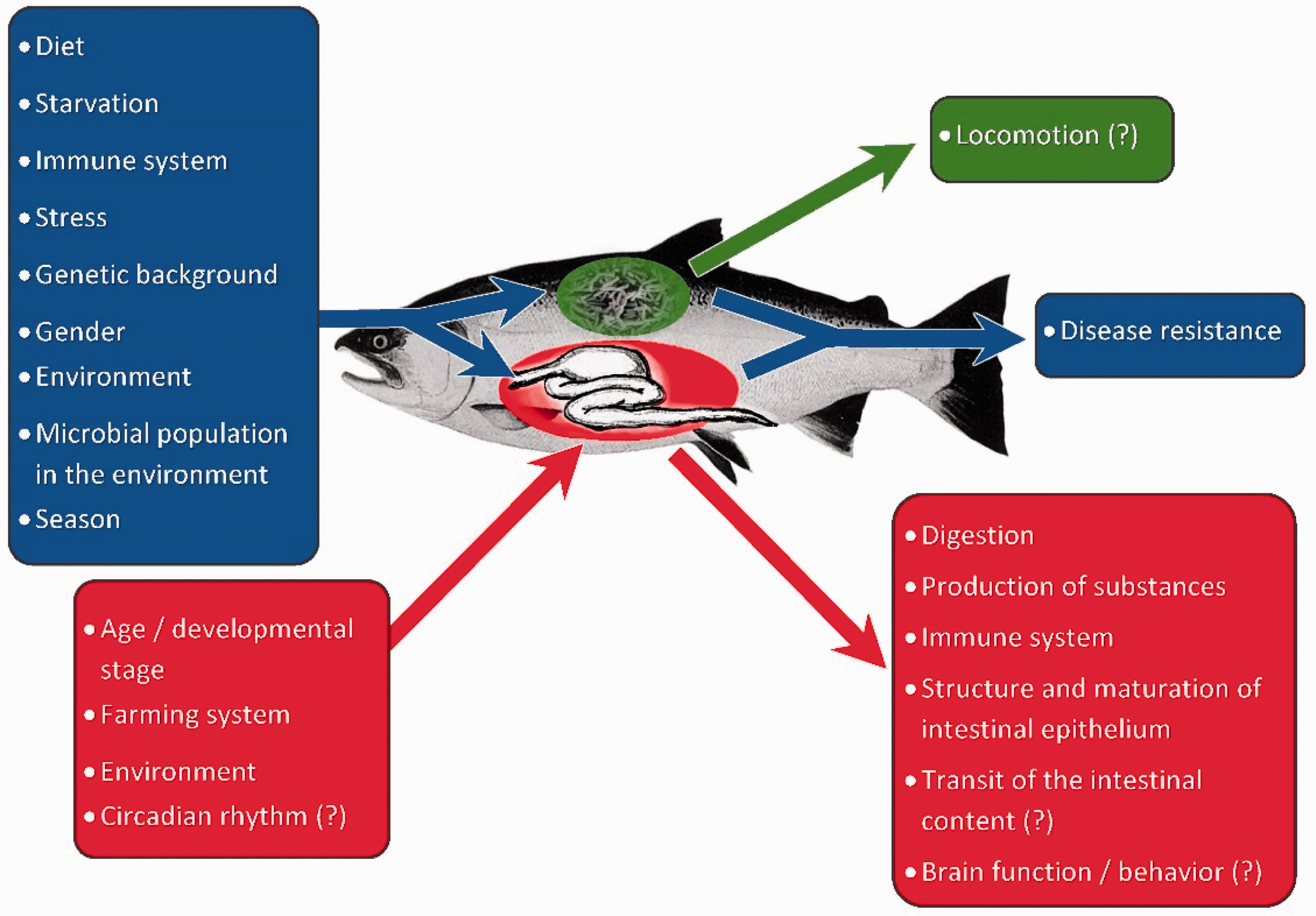
Although there is a clear host–species specificity, various factors, such as the environment, the season and various mucous components, affect the fish skin and gill microbiotas.14–16 Furthermore, host genotype and gender appear to exert strong influences, resulting in significant intra-species variations, although the presence of an autochthonous core population has been demonstrated in certain species such as the brook charr (Salvelinus fontinalis) and pangasius (Pangasius hypophthalmus).16,17
Different diets (e.g. pellets or natural diets) or starvation influence the fish skin and gill microbiotas through alterations in the composition of their skin and gill mucus. 12 Similarly, various stressful conditions, such as a high density population, hypoxia, or a 5 h transportation period, also influence the fish skin and gill microbiotas through alterations in mucous composition.18,19 Different fish species are able to differentially tolerate stress, and thus, the effects of various stressors on their skin and gill microbiotas may differ.
In mammals, the stimulation of one mucosal surface may result in an immune response at other mucosal surfaces. In fish, little is known about these common mucosal immune responses, and further research is required to elucidate such interactions and, in particular, to determine how they influence the microbiota.
Effects of fish skin and gill microbiotas on the host
In terrestrial mammals, normal skin microbiota plays an important defensive role by antagonizing many potential pathogens. A similar role has been demonstrated in fish (Figure 1).20,21 Beneficial bacteria act through competitive exclusion for nutrients and/or synthesizing antimicrobial compounds. The presence of such beneficial bacteria plays an important role in the initial stages of an infection, and may even help in the recovery of affected fish.20,22
According to Hansen and Olafsen, 6 some bacteria in the skin microbiota of fish may also assist in fish locomotion by secreting drag-reducing slime, thus enhancing the effects of skin mucus. This role has yet to be confirmed.
The fish gut microbiota
In fish, the gut microbial population has been extensively studied compared with the skin and gill microbiotas, and its effects on digestion, metabolism and various diseases have been confirmed.8,23,24
Microbes colonizing the fish gastrointestinal tract are either autochthonous or transient (or allochthonous), depending on their ability to survive the low pH of the stomach (depending on the fish species) and competition with other microbes.4,8,23 There are differences in the composition of the microbiota between different parts of the gastrointestinal tract, and these differences are associated with the feeding habits of the host species.23,25 The number of microbes tends to increase from the stomach towards the distal portion of the intestine.9,26
The groups of microbes colonizing the intestinal mucosa (primarily the autochthonous microbiota) are different from those found in the intestinal contents (primarily allochthonous microbiota) and in the water.27,28 These differences are likely attributable to specific properties of the microenvironment of the intestinal mucus, which provides certain resources for microbes to live and propagate.29,30
The major microbial groups are aerobic and facultative anaerobic bacteria, although many obligate anaerobes (e.g. Cetobacterium somerae) as well as various yeasts are also present.7,9,23,28,29,31,32 The predominant bacterial phyla are Proteobacteria, Bacteroidetes and Firmicutes. Viruses, including many bacteriophages, also live in the fish gut. 33
The cultivable bacterial populations in the intestinal content and mucus range between 106 and 109 colony forming units (CFUs)/g, with the mucous population generally exhibiting lower diversity,9,23,34,35 although the opposite has also been reported. 27 There are variations in the numbers of microbes colonizing the enterocytes; some enterocytes are colonized by virtually no bacteria at all. 36
Similar to the skin microbiota, the fish gut microbiota also comprises many pathogenic, primarily opportunistic, species such as Edwardsiella tarda, E. ictaluri, Aeromonas hydrophila and Vibrio alginolyticus.32,37
Factors affecting the fish gut microbiota
Generally, the same factors that affect the fish skin and gill microbiotas also affect the fish gut microbiota (Figure 1). In many cases, the exact underlying mechanism is not fully understood.
The fish species strongly determines the composition of the gut microbiota. 38 There are also differences in the predominant bacterial groups present in freshwater and marine fish species. For example, Aeromonas spp. and Pseudomonas spp. are the most common genera in many freshwater fish species, whereas Vibrio spp. appears to be the most common genus in many marine fish species.7,23
The effects of the host genetic background on the composition of the microbiota are not well-studied in fish. In humans and mice, certain host genes are able to alter gut immunological profiles and consequently influence the composition of the gut microbiota, including the predominant phyla Bacteroidetes and Firmicutes. 39 Smith et al. 40 observed that populations of threespine stickleback (Gasterosteus aculeatus) with greater genetic heterozygosity tended to exhibit lower inter-individual microbial variations. This tendency may be associated with increased immunogenetic diversity among individuals in these populations, which reduces microbial diversity. This conclusion, if confirmed, may have serious implications for the selection of fish genetic profiles for use in experiments.
Depending on the approach utilized, there have been different reports of the effects of gender on the fish gut microbiota. Employing primarily culture-based methods, Cantas et al. 41 did not observe significant differences in the gut microbiota between male and female zebrafish (Danio rerio). However, Bolnick et al. 42 observed significant differences in the gut microbiota between males and females in natural populations of stickleback (Gasterosteus aculeatus) and Eurasian perch (Perca fluviatilis) using 16S rRNA gene amplification. Additionally, different diets have prompted sex-dependent changes in the gut microbiota.
As fish progress through different developmental stages, their gut microbiota also changes, often due to changes in their diet.37,43,44 Moreover, the gut microbiota changes between juveniles and sexually mature fish, due potentially to increasing levels of hormones. 41
According to many studies, environmental factors, such as water quality, available nutrients, and potentially pollution, significantly influence the fish gut microbiota in both wild and farmed fish.25,45,46 Roeselers et al. 32 observed a constant, core gut microbiota in zebrafish maintained under diverse conditions in different laboratory facilities; these results are similar to those obtained for fish collected recently from their natural habitats.
Even the farming system affects the fish gut microbiota. Using molecular biological methods, Giatsis et al. 47 examined the effects of recirculation and active suspension tanks on the development of the gut microbiota in Nile tilapia (Oreochromis niloticus) larvae after the first feeding. Although there were no differences in larval growth, feed conversion and survival between the two systems, significant differences in the gut microbial populations were observed seven days after the first feeding. Differences in the water microbial populations were also observed, but it was not clear whether these differences were associated with the differences in the gut microbiota of the fish.
Diet appears to be the most significant factor directly affecting the gut microbiota. Different dietary ingredients, different types of feeds (e.g. live feeds or pelleted) and different feed additives (e.g. vitamins or probiotics) exert dramatic effects on the microbial community of the fish gastrointestinal tract. 4 These factors favor the growth of certain groups of microbes, which may in turn affect colonization by potential pathogens.
Significant changes in the gut microbiota occur within a few days or weeks following a change in diet, depending on the diet and potentially the age of the fish.27,48,49 Starvation also induces changes in fish gut microbial populations within days. 50 In the latter situation, bacterial groups that utilize more diverse energy sources, such as Bacteroidetes, tend to increase. In different fish species, different diets appear to differentially influence the autochthonous and allochthonous microbiotas,51–53 a phenomenon that should be examined in every fish species.
Stress may influence the fish gut microbiota, primarily due to resulting alterations in the intestinal mucus. In particular, after an acute stress such as netting, there is increased sloughing off of the mucus, resulting in excessive removal of the autochthonous bacteria, many of which play a significant protective role against potential pathogens. 54 These changes, combined with structural changes (e.g. increased transepithelial permeability) that occur in the intestine during stress, increase the risks of colonization and invasion by potential pathogens. 54
In mice, circadian rhythms, particularly when combined with a high-fat and high-sugar diet, affect the gut microbiota. 55 This phenomenon has not yet been studied in fish, but such effects cannot be excluded and may have important implications because varying photoperiods are used in different facilities and in different experiments.
Effects of the fish gut microbiota on the host
In fish, the significance of the gut microbiota for host digestion depends on the host trophic level. Herbivorous fish rely on the microbial digestion of certain plant materials, particularly cellulose, whereas carnivorous fish appear to be less dependent on gut microbial metabolism.56,57
The gut microbiota plays a protective role against many potential pathogens, primarily by inhibiting pathogen colonization and/or by producing antimicrobial substances.31,58 Many lactic acid bacteria, such as Carnobacterium divergens and Lactobacillus delbrueckii subsp. lactis, which are members of the indigenous gut microbiota of many fish, are known to have roles against pathogens such as Aeromonas salmonicida and Vibrio anguillarum. 59 Their populations, and thus their actions, may be affected by factors such as nutrition, stress and salinity. 58
Many fish intestinal bacteria synthesize important substances that are used by the host. For instance, Cetobacterium somerae, a member of the autochthonous gut microbiota of many fish species including carp and tilapia, produces vitamin B12. 60 Consequently these fish species have either low or no requirements for dietary supplementation of this vitamin. 61
Studies employing germ-free zebrafish have demonstrated the positive effects of the gut microbiota on the renewal and differentiation of the intestinal epithelium as well as the expression of fish genes involved in the immune and oxidative stress responses, thus increasing stress tolerance.62,63 In addition, studies investigating various probiotics have revealed the influence of the gut microbiota on the number of goblet cells, the height of the intestinal villi, the densities of T-cells and acidophilic granulocytes in the intestinal mucosa, serum lysozyme and complement levels, and bactericidal activity.64–67
In mice, the gut microbiota also influences intestinal motility, which likely occurs through stimulation of the enteric nervous system.68,69 Furthermore, communication between the gut microbiota and the host brain has also been demonstrated in mammals. 69 The microbiota affects host behavior through vagal afferents, whereas the host affects the content and function of the microbiota through neurotransmitters that bind to specific receptors on microbes. In fish, this research is still in its infancy, but recent studies have already suggested the influence of the gut microbiota on behavior and stress responses. 70
According to Mouchet et al., 71 functional diversity in the gut microbiota (assessed in terms of the carbon sources used) among individuals of the same population is not related to the genetic diversity of the gut microbiota but is instead affected by the fish species and diet. Thus, although various factors may affect the composition of the gut microbiota in individual fish, an entire fish population living in a specific aquatic environment sustains a certain degradation capacity, which stabilizes, to some extent, this specific environment.
Standardization of fish microbiotas: issues and challenges
There are four key issues to consider in the standardization of research in fish microbiotas (Figure 2): (a) the establishment of fish lines with a uniform genetic profile, (b) the establishment of isobiotic fish lines, (c) the establishment of standardized rearing conditions according to the preferences of each species, and (d) appropriate monitoring and adequate reporting of the microbiological status of research fish.
Standardization of the fish microbiota: issues and challenges.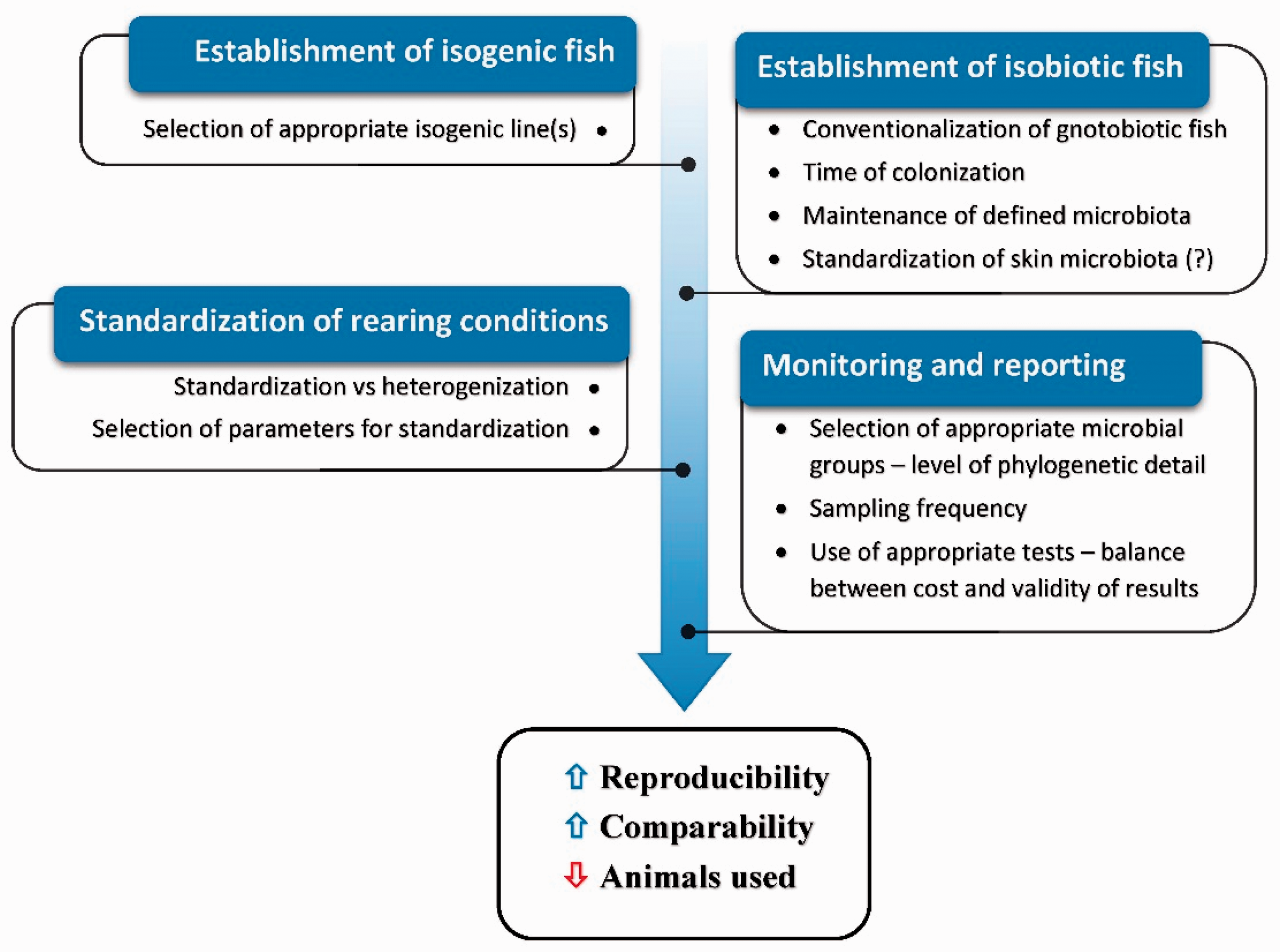
Establishment of a uniform genetic profile
In humans, monozygotic twins exhibit significant similarities in terms of their microbial populations. 72 Host genetics affect the microbiota through inherited characteristics such as different immune system components and mucous composition. 39 These types of interactions are also present in fish. For example, a study by Boutin et al. 17 have revealed three quantitative trait loci (QTL) in brook charr associated with Lysobacter, Rheinheimera and Methylobacterium counts on the skin. These bacteria may influence the numbers of certain opportunistic pathogens found on fish skin.
The extensive use of isogenic and isobiotic rodent strains for research has resulted in a rapid increase in our knowledge of many aspects of human and animal physiology. The use of such strains provides increased expertise, facilitates the characterization of more accurate dose–response relationships and results in fewer false–negative results compared with the use of outbred animals. 73 Regarding the gut microbiota, variations between inbred mice are significantly lower than those between outbred mice. 74
In fish, current experience indicates different isogenic lines exhibit significantly different characteristics and behaviors. 75 Thus, the selection of an appropriate line for study is of great importance and should be taken into account in any experimental design. According to Bongers et al., 76 if inbred fish are used in studies, the best approach is to utilize a number of inbred fish strains to extrapolate the experimental results to a larger outbred population. Further research is required to examine the interactions between defined microbiotas and host physiology in different fish lines, as well as the stability of the microbiota over time.
The production of isogenic lines involves many technical issues, and for some fish species of low commercial value, this may not be practical. However, their use will ultimately promote reproducibility and contribute to a reduction in the number of fish used in experiments, as emphasized by Grimholt et al. 77
Establishment of isobiotic fish lines
Ideally, fish used in any type of study should have a fully characterized or defined microbiota. Such animals are designated ‘gnotobiotic’, and the term also includes germ-free (or axenic) animals. These gnotobiotic animals are generally derived from germ-free animals, which are later colonized with a predefined microbiota. Animals that are colonized with microbiotas collected from conventionally-raised donors are also referred to as conventionalized animals. 78 Once produced, the isobiotic animals transfer their microbiotas to their offspring, as demonstrated by Becker et al. in rats. 79 The biggest advantage of using gnotobiotic animals is the increased control over many variables that affect the development of the microbiota and, in particular, autochthonous bacteria. However, the process has some disadvantages that are primarily related to the complexity of various procedures and the maintenance of the gnotobiotic status. 80
Gnotobiotic fish, such as zebrafish, have already been produced and utilized in several studies investigating gut microbiotas.78,80 The timing required for colonization is important and should be established for each fish species. Artificial colonization should occur simultaneously when natural colonization would occur so that the development of the gastrointestinal tract is not disturbed. For example, Pham et al. 78 have determined that the optimal time for zebrafish colonization is three days post-fertilization because this is the time when conventionally-reared fish hatch from their chorions and are colonized by their microbiota. However, thus far, no protocols to standardize or manipulate the fish skin microbiota have been developed; theoretically, the same approach is applicable.
The maintenance of defined microbiotas is an important issue and is strongly related to rearing conditions and fish diets. In addition, the microbiota may change over time due to mutations and/or the exchange of genetic information between microbes. Thus, recolonization through feed or water may be required, likely in combination with an antibiotic treatment.81,82 All of these issues must be examined in different fish species.
Treatment with various antimicrobial agents, such as formalin, is frequently proposed as a standard to reduce the risk of introducing pathogens or even to control the fish microbiota upon the arrival of new animals in a research facility. However, such approaches cause alterations in many fish tissues, induce stress and even increase mortality post-treatment, as demonstrated in challenge studies. 83 Thus, these methods should only be used when necessary and when their influence on both the welfare of the fish and the validity of the results has been assessed.
Standardized rearing conditions
Research facilities that maintain fish possess controlled environments with either flow-through or recirculating systems for their water supply. The majority of these facilities rear their own fish stocks, but they must also often use fish obtained from external sources, such as commercial farms or commercial breeders. In the latter case, the fish remain in quarantine for a certain period of time, during which they may be treated for common pathogens. Ultimately, due to different practices by different facilities, varying water quality parameters (although these are generally maintained within a predefined range for each species) and different diets, the microbiological status of research fish varies or is unknown.
The issue of environmental standardization between different research animal facilities is still controversial. Van der Staay et al. 84 discussed the use of standardized versus heterogeneous environmental conditions in animal experimentation and concluded that the latter fails to detect subtle differences, and thus, the former is preferred, particularly in principle studies. However, the generalizability of results must be confirmed in subsequent ‘extended replication’ studies, in which various known factors are examined. Using behavior measurements in a multi-laboratory study, Richter et al. 85 observed an increased rate of ‘false–positive’ results when employing standardized replication. Thus, environmental standardization should be replaced by systematic and controlled environmental heterogenization. Although the conclusions of Van der Staay et al. and Richter et al. differ, they emphasize the significance of a careful experimental design and the consideration and examination of all contributing factors before any solid conclusions are drawn. Nonetheless, certain rearing variables, such as a common diet for each fish species and the use of recirculated and treated water, may significantly minimize intra-species variations in the normal microbiota of fish.
Monitoring and reporting fish microbiota
The use of specific pathogen-free (SPF) animals and the maintenance of an SPF environment are the most important aspects of any fish health monitoring program implemented in a research facility. Additional factors, such as the selection of appropriate groups of target microbes, the test methods employed, the number of representative animals selected for testing and the cost, are also critical for the success of such a program. 86 Johansen et al. 87 provided an overview of the general principles of a health monitoring program for fish research facilities. However, there are additional considerations when monitoring and reporting the normal microbiota in fish to enhance the reproducibility of experiments, and necessary adjustments should also be made based on the fish species.
The importance of standardizing, monitoring and reporting the microbiota of research animals has previously been addressed by Eberl. 88 This author collected opinions from many specialists in this area to answer relevant questions. All specialists who recognize the role of the microbiota in the host physiology agreed on the importance of reporting the microbiota in all studies, particularly where there is strong evidence of its influence. Two of the initial questions addressed by Eberl were: (a) which microbes should be monitored, particularly in terms of the level of phylogenetic detail, and (b) how often should monitoring occur. In fish, the answers to both questions depend on the fish species (e.g. the trophic level), how isolated and constant the environment of the facility is, and the type of study. For instance, if the facility uses recirculation and water treatment (e.g. ultraviolet radiation or ozonation) and a standardized feed containing known microbial content, one assumes that the skin, gill and gut microbiotas will remain relatively constant if the genetic profile of the fish and overall management are also standardized. In particular, nutritional studies should, at a minimum, always include a description of the gut microbiota for all treatments (including both aerobic and anaerobic bacteria as well as fungi) at the beginning and at the end of the experimental period. Although a detailed description of the fish microbiota may not be practical in terms of cost, the list of target microbes should at least include all of the major groups of microbes that play important roles in digestion, depending on the fish species and the nature of the experiment. Similarly, experimental infections should include groups of microbes with known protective and/or immunostimulatory properties.
When long-term experiments are conducted, the effects of different developmental stages and fish ages on the microbiota should also be examined, and thus appropriate sampling points should be included. According to Giatsis et al., 47 there are no significant differences in the gut microbiotas of individual fish living in the same tank (particularly if the fish are of the same genetic background), nor are there differences between fish living in replicate tanks maintained under the same conditions. Although these observations should be confirmed under different conditions and a standardized sampling protocol should be developed, only a relatively small sample size appears to be required to determine the microbial status of a homogenous group of fish.
Another important issue is the methods employed to examine and standardize the microbiota of research animals. Every test has its limitations and therefore combination of tests should be used to give a more accurate picture of the microbial populations present.4,87,88 Recent advances in the use of culturomics to study the human gut microbiota indicate better results are obtained with a combination of culture-based and culture-independent methods, particularly in the case of low-abundance microorganisms that certain molecular methods fail to detect.89,90
The cost of adequately monitoring the microbiota of research fish may still be high for some facilities, particularly if regular sampling is required. However, this cost is affected by the level of standardization of the microbiota and may be balanced by the reduced numbers of animals required for experiments and the increased reproducibility.
Conclusions
Recently, there has been increased focus on the validity and reproducibility of published studies, particularly those involving animals. Apart from scientific and legal reasons, there is an ethical obligation to ensure that a minimum number of animals are used in various experiments to obtain reliable results.
One of the most fundamental factors affecting reproducibility, and consequently the validity of any experiment, is the standardization of experimental conditions. In fish experiments, fish microbiota is rarely included when describing the status of the animals used, although the ability of fish microbiota to noticeably affect the host, resulting in significant inter- and, more importantly, intra-species variations, is well known. As knowledge of the roles of skin, gill and gut microbiotas increases, the significance of standardization becomes more apparent.
This review highlights the most important issues and challenges associated with the standardization of normal fish microbiotas and their importance in fish experimentation. Fish constitute a highly diverse group of animals, and each species exhibits different tolerances and responses to various factors. The studies used as examples in this review included only certain species. Further investigation is therefore needed before the research community decides which factors affecting the microbiota of each species are important for standardization. Nevertheless, fish microbiota is an important experimental variable and should be monitored and reported in all studies in which it is likely to have an influence.
Footnotes
Declaration of Conflicting Interests
The author(s) declared no potential conflicts of interest with respect to the research, authorship, and/or publication of this article.
Funding
The author(s) received no financial support for the research, authorship, and/or publication of this article.