




Abstract
Non-human primates housed in zoos and laboratories often exhibit reduced activity and this poses welfare concerns. We examined the effects of enclosure types of differing size and environmental complexity on the activities of two species of callitrichids. We found that cotton-top tamarins housed in an enclosure of larger size and more environmental complexity showed higher activity levels, which was mainly contributed by more feeding/foraging activity. By contrast, Goeldi’s monkeys housed in an enclosure of larger size and more environmental complexity showed lower activity levels, which was mainly contributed by less locomotory activity. In both species, off-exhibit groups housed in smaller enclosures did not show significantly less locomotory activity which would have been expected, as larger availability spaces should allow more opportunities for locomotion. Furthermore, the feeding enrichment had significant effects on increased feeding/foraging activity for both cotton-top tamarins and Goeldi’s monkeys, irrespective of enclosure type. These results suggested that environmental complexity (or application of feeding enrichment) that provided more opportunities for natural foraging could have a larger effect on overall activity levels compared with larger enclosure sizes that should provide more locomotion opportunities. More importantly, it showed that even when enclosure space and complexity were limited, increased opportunities for foraging through the application of enrichment could increase species-typical behaviours. Such inexpensive, easy to implement enrichment methods should be applied to provide more complex environments for captive non-human primates, particularly in situations where there are logistical and/or cost constraints to the modification of physical exhibits.
Non-human primates in captivity are housed with much more limited space and environmental variability compared with their wild counterparts. Captive management also restricts their natural foraging opportunities. As a result, activity levels and naturalistic behaviours of captive non-human primates are often reduced. 1 The effects of captive environments have been shown, for example, in reduced locomotion of long-tailed and pig-tailed macaques housed in smaller cages 2 and in lower activity levels in common marmosets housed in smaller and less complex enclosures. 3
To mitigate these problems, captive animal managers implement various enrichment techniques to provide more challenging environments for captive animals and to promote natural behaviours. 4 Enrichment is particularly important for off-exhibit animals that are often housed in less optimal conditions compared with on-exhibit animals. Physical enrichment, for example, involves increasing the usable space and complexity of the animal’s enclosure or adding accessories to the enclosure such as objects, substrate, or permanent structures. 4 Physical enrichment has been shown to have positive effects such as increasing general activity, locomotory behaviour, and exploratory behaviour.5–7 Feeding enrichment has also been widely and effectively used as a means of promoting naturalistic explorative behaviours in animals.8–10
In this study, we examined the effects of enclosure type and feeding enrichment on the activity levels of two groups each of captive cotton-top tamarins (Saguinus oedipus) and Goeldi’s monkeys (Callimico goeldii) housed in on-exhibit and off-exhibit conditions that differed in physical space and environmental complexity. We applied a simple enrichment device with reduced visibility and accessibility of presented food that required increased foraging efforts to access. First, we hypothesized that activity levels would be higher for animals housed in larger and more complex enclosures in on-exhibit conditions, and the differences would be more marked where within-species enclosure conditions had wider variations. Secondly, we hypothesized that simple feeding enrichment could effectively compensate for lower activity levels in off-exhibit conditions by increasing active behaviours, and the effect would be more marked for off-exhibit animals in smaller and less complex enclosures. Lastly, we clarified how enclosure size, environmental complexity and feeding enrichment affected species-typical activities.
Materials and methods
Animals
Summary of study groups.

Family group consisting of father, mother and juvenile(s).
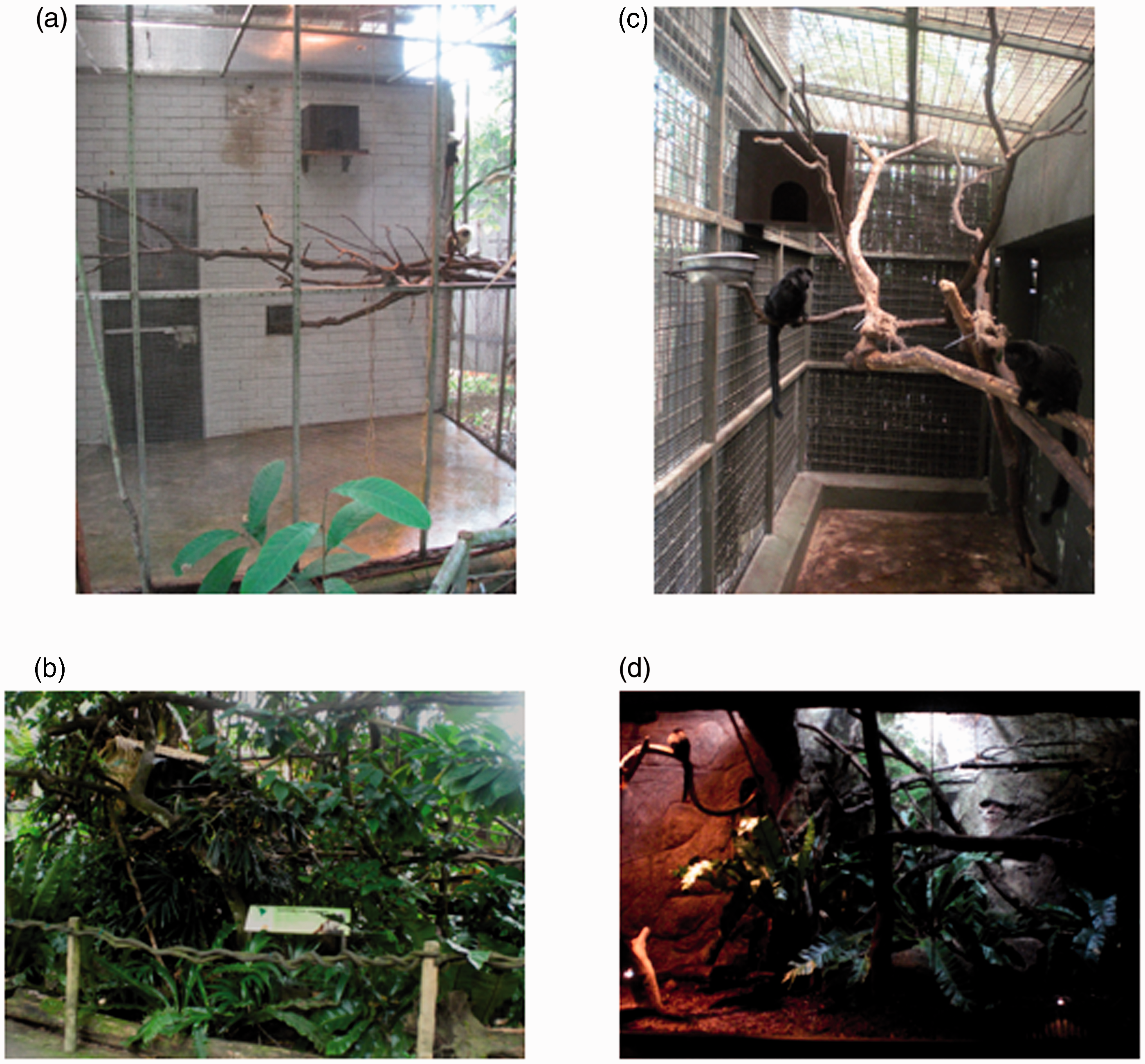
Housing for (a) cotton-top tamarins off exhibit; (b) cotton-top tamarins on exhibit; (c) Goeldi’s monkey off exhibit; (d) Goeldi’s monkey on exhibit.
Feeding and diet
Off-exhibit cotton-top tamarins and both off-exhibit and on-exhibit Goeldi’s monkeys were fed thrice daily, at 08:00 h, 11:00 h and 15:00 h. On-exhibit cotton-top tamarins were fed at 08:30 h, 11:45 h and 17:00 h, with additional token feeding at 10:30 h and 14:30 h in between their main meals. Token feedings consisted of small amounts of food to showcase feeding behaviour to visitors. Water was available at all times from a water dispenser near their nest box. The subjects were fed with staple diets which consisted of long beans, carrots and apples. In addition, special fruits such as grapes, bananas and oranges were included but only one type was given each day. Boiled meat or hard-boiled eggs (egg white only) were provided four times a week, as well as supplements of mealworms, ZuPreem® Marmoset Diet Canned (Allpets Asia Pte Ltd, Singapore) and Mazuri® High Fiber Callitrichid Diet (Migoto Aquaworld Pte Ltd, Singapore).
Enrichment
Hessian cloths were cut and stitched together to form pockets with flaps folded down (6 cm × 10 cm) (Figure 2). The pockets were secured onto branches using cable ties. The number of devices was determined by group size, such that one was available for each individual animal. This was to reduce the effect of intra-group competition that could influence individual subject use of the enrichment device. A half cup of cut leaves and one-quarter cup of mealworm mixture were used to fill the pockets, divided into equal portions according to the number of pockets placed. The positions of the enrichment devices were random, but an unhindered view of the devices was always ensured for the observer. Positional placement of the device was changed each time an enrichment treatment was replicated. This enrichment device was tested on the subjects prior to the study. This was to ensure that the device was not novel (as individual and species responses to novel objects could differ) and to confirm that the device could be suitably manipulated by the subjects. A preliminary study of one observation set for each of the four different exhibits was conducted.
(a) hessian cloths used for enrichment were secured using cable ties; (b) enrichment device being used by a Goeldi’s monkey.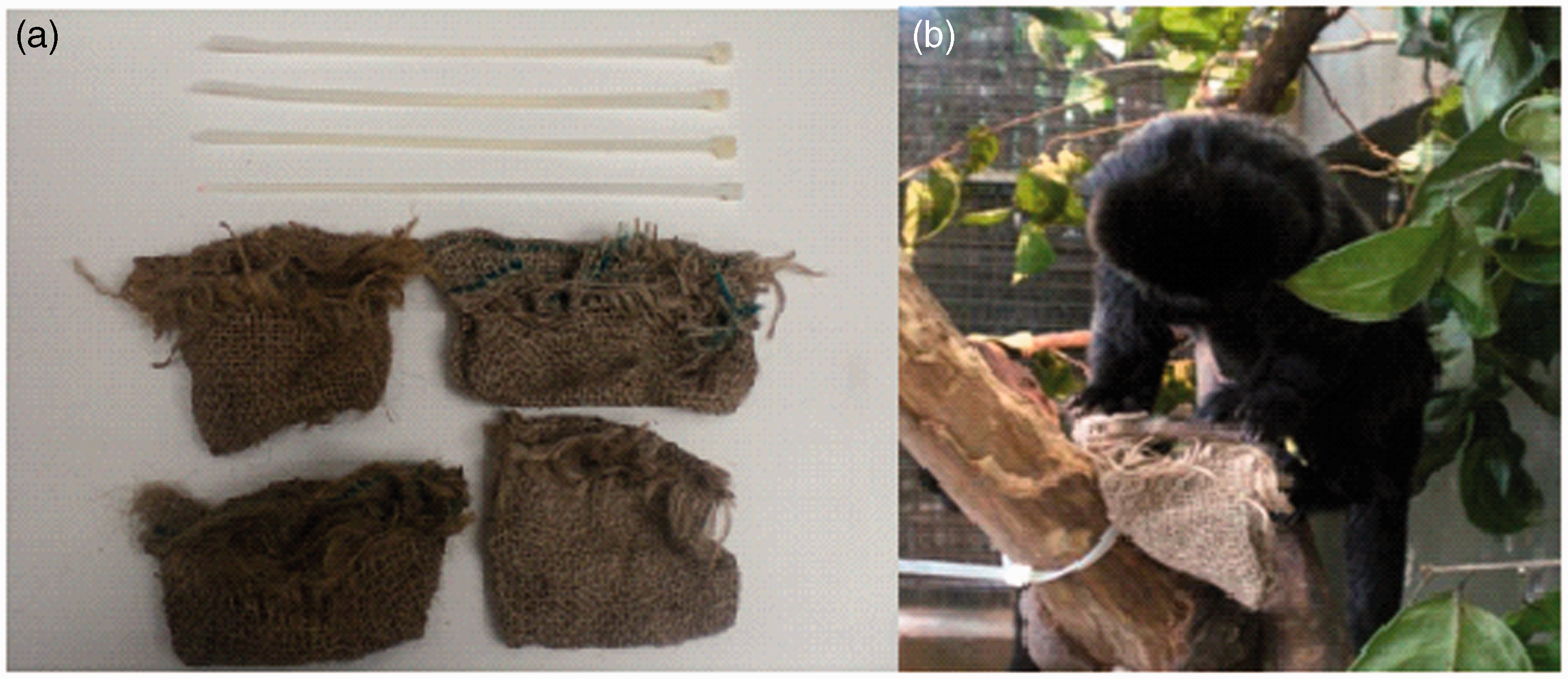
Data collection
Ethogram of behaviours recorded for the study subjects.

Statistical analysis
We used two-way analysis of variance (ANOVA) to test for effects of enclosure type and enrichment on the following activities observed in the study groups: (1) feeding/foraging, (2) locomotion and (3) resting. Due to differences in the size and composition of the study groups, the data was standardized by dividing the total number of scans for each activity category for all individuals over the total number of scans for all individuals in each observation set. These data thus represented average group activity. Percentages for each activity category for each group were calculated for each set and used for analysis. Enclosure type (off-exhibit/on-exhibit) and enrichment (baseline/enrichment) were assigned as independent factors and the activity categories were assigned as dependent factors separately in each analysis. All data were checked for normality using the Kolmogorov–Smirnov test, and were normally distributed. All analyses were conducted using the Statistical Package for the Social Sciences version 20.0 (SPSS Inc, Chicago, IL, USA). Statistical significance was set at P < 0.05.
Results
Effects of exhibit type and enrichment on the activity levels of cotton-top tamarins
The activities of the cotton-top tamarins in on-exhibit and off-exhibit conditions are shown in Figure 3. Overall activity level (feeding/foraging and locomotion) was higher and resting was lower for on-exhibit animals compared with off-exhibit animals (on-exhibit: 47.7%; off-exhibit: 25.6%; difference: 22.1%). The application of enrichment increased overall activity levels (feeding/foraging and locomotion) and decreased resting, with the percentage change higher for off-exhibit animals compared with on-exhibit animals (on-exhibit: 7.2%; off-exhibit: 19.0%).
Activity levels (percentage ± SEM) of on-exhibit and off-exhibit cotton-top tamarins during baseline and enrichment treatments. Asterisks denote significant differences between treatments.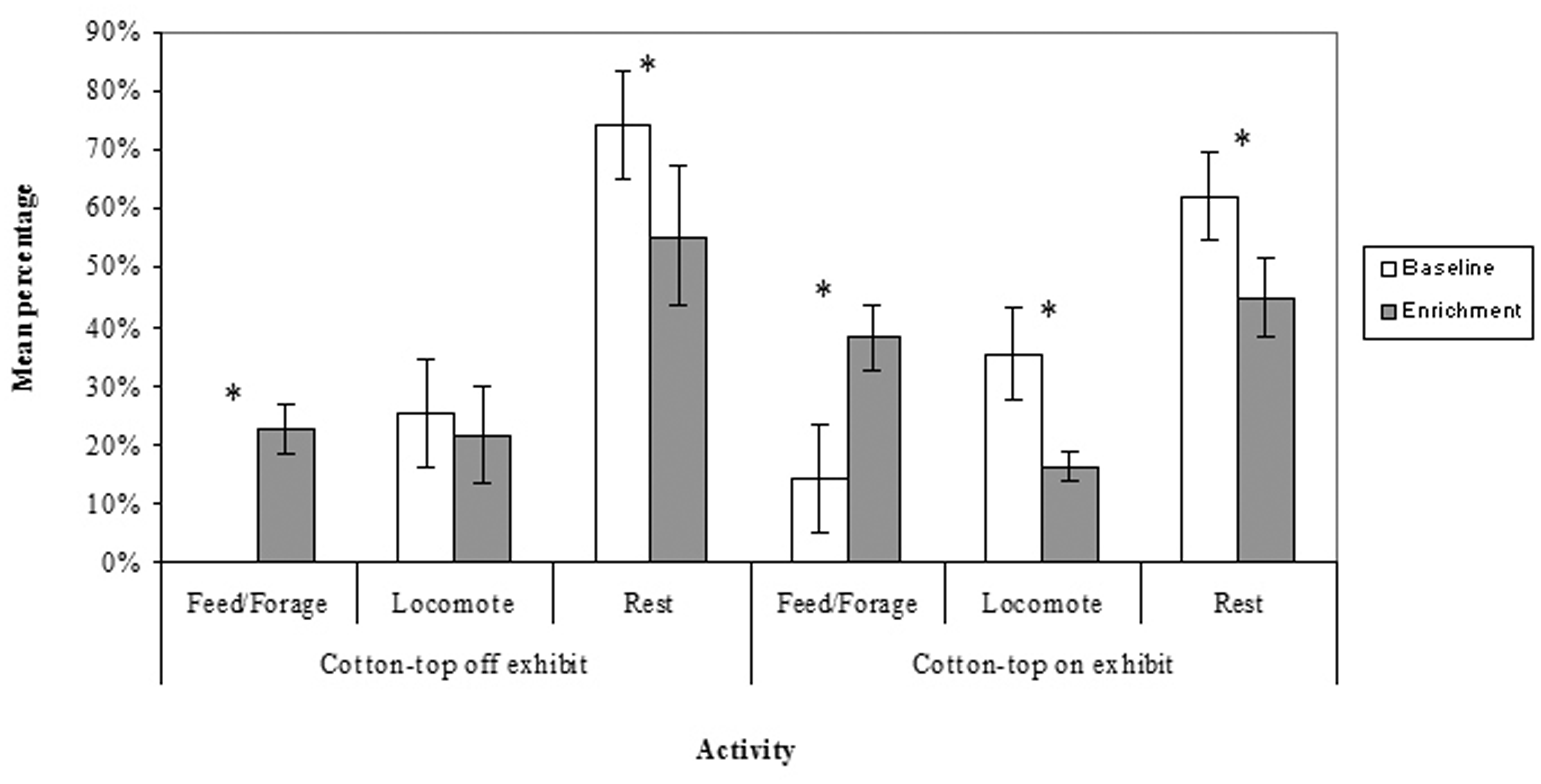
Feeding/foraging activity was higher for the cotton-top tamarins on exhibit than those off exhibit (on-exhibit: 14.3%; off-exhibit: 0%). Feeding/foraging activity was higher during enrichment treatment compared with the baseline for on-exhibit animals (enrichment: 38.4%; baseline: 14.3%) and off-exhibit animals (enrichment: 22.9%; baseline: 0%). There was a significant main effect of exhibit type on feeding/foraging activity (F1,18 = 30.396, P < 0.001); and a significant main effect of enrichment on feeding/foraging activity (F1,18 = 74.389, P < 0.001). There was a non-significant interaction between exhibit type and enrichment on feeding/foraging activity (F1,18 = 0.058, P = 0.813).
Locomotory activity was higher for the cotton-top tamarins on exhibit than those off exhibit (on-exhibit: 33.4%; off-exhibit: 25.6%). Locomotory activity was lower during enrichment treatment compared with baseline for on-exhibit animals (enrichment: 16.5%; baseline: 33.4%) and off-exhibit (enrichment: 21.7%; baseline: 25.6%). There was a non-significant main effect of exhibit type on locomotory activity of cotton-top tamarins (F1,18 = 1.098, P = 0.313); and a non-significant main effect of enrichment on locomotory activity (F1,18 = 2.270, P = 0.154). There was a non-significant interaction between exhibit type and enrichment on locomotory activity (F1,18 = 0.182, P = 0.677).
Resting activity was lower for the cotton-top tamarins on exhibit than those off exhibit (on-exhibit: 62.3%; off-exhibit: 74.4%). Resting activity was lower during enrichment treatment compared with baseline for on-exhibit animals (enrichment: 45.1%; baseline: 62.3%) and off-exhibit animals (enrichment: 55.5%; baseline: 74.4%). There was a significant main effect of exhibit type on resting activity (F1,18 = 7.012, P = 0.019); and a significant main effect of enrichment on resting activity (F1,18 = 18.098, P = 0.001). There was a non-significant interaction between exhibit type and enrichment on resting activity (F1,18 = 0.043, P = 0.839).
Effects of exhibit type and enrichment on the activity levels of Goeldi’s monkeys
The activities of the Goeldi’s monkeys in on-exhibit and off-exhibit conditions are shown in Figure 4. Overall activity level (feeding/foraging and locomotion) was lower and resting higher for on-exhibit animals compared with off-exhibit animals (on-exhibit: 13.6%; off-exhibit: 23.3%; difference: 9.7%). The application of enrichment increased overall activity levels (feeding/foraging and locomotion) and decreased resting, with the percentage change higher for off-exhibit animals compared with on-exhibit animals (on-exhibit: 15.4%; off-exhibit: 23.3%).
Activity levels (percentage ± SEM) of on-exhibit and off-exhibit Goeldi’s monkeys during baseline and enrichment treatments. Asterisks denote significant differences between treatments.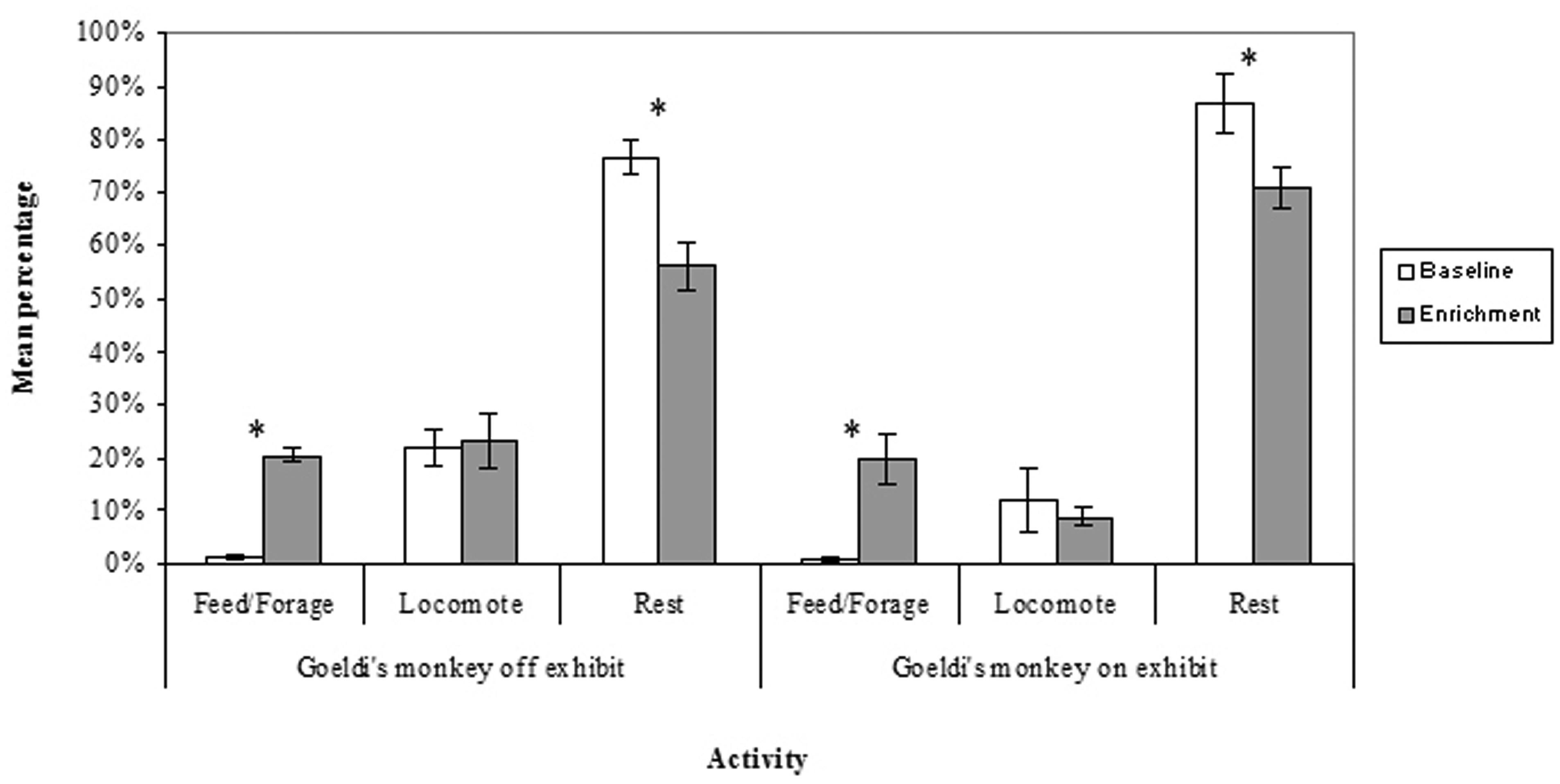
Feeding/foraging activity was higher for the Goeldi’s monkeys on exhibit than those off exhibit (on-exhibit: 0.98%; off-exhibit: 1.39%). Foraging activity was higher during enrichment treatment compared with baseline for on-exhibit animals (enrichment: 20.0%; baseline: 0.98%) and off-exhibit animals (enrichment: 20.6%; baseline: 1.39%). There was a non-significant main effect of exhibit type on feeding/foraging activity (F1,18 = 1.007, P = 0.686); and a significant main effect of enrichment on feeding/foraging activity (F1,18 = 274.830, P < 0.001). There was a non-significant interaction between exhibit type and enrichment on feeding/foraging activity (F1,18 = 0.003, P = 0.957).
Locomotory activity was lower for the Goeldi’s monkeys on exhibit than those off exhibit (on-exhibit: 12.6%; off-exhibit: 21.9%). Locomotory activity was lower during enrichment treatment compared with baseline for on-exhibit animals (enrichment: 9.0%; baseline: 12.6%) but higher for off-exhibit animals (enrichment: 23.3%; baseline: 21.9%). There was a significant main effect of exhibit type on locomotory activity of Goeldi’s monkeys (F1,18 = 31.975, P < 0.001); and a non-significant main effect of enrichment on locomotory activity (F1,18 = 0.194, P = 0.667). There was a non-significant interaction between exhibit type and enrichment on locomotory activity (F1,18 = 1.210, P = 0.290).
Resting activity was higher for the Goeldi’s monkeys on exhibit than those off exhibit (on exhibit: 86.8%; off-exhibit: 76.7%). Resting activity was lower during enrichment treatment compared with baseline for on-exhibit animals (enrichment: 71.0%; baseline: 86.8%) and off-exhibit (enrichment: 56.1%; baseline: 76.7%). There was a significant main effect of exhibit type on resting activity (F1,18 = 34.144, P < 0.001); and a significant main effect of enrichment on resting activity (F1,18 = 72.647, P < 0.001). However, there was a non-significant interaction between exhibit type and enrichment on resting activity (F1,18 = 1.262, P = 0.280).
Discussion
The higher activity levels (feeding/foraging and locomotion) and lower resting of cotton-top tamarins housed in a larger sized and more complex exhibit compared with subjects housed in smaller and less complex environments supported our hypothesis. The on-exhibit group showed much higher rates of feeding/foraging activity compared with the off-exhibit group, with the presence of a significant main effect of exhibit type on feeding/foraging activity. This was likely due to increased opportunities for natural foraging in a more complex and naturalistic environment with ample foliage for the animals on exhibit. Locomotory activity was also higher for on-exhibit animals than off-exhibit animals but there was no significant effect of exhibit type on locomotory activity. In addition, considering that higher locomotory activity of on-exhibit groups could also be influenced by social interactions in a larger group of on-exhibit animals, these results showed that opportunities for locomotion afforded by additional space for on-exhibit animals was likely not an important factor influencing differences in activity levels. Increased foraging opportunities in a more complex exhibit could be more important than absolute exhibit space differences used for locomotion, which supported similar results reported in another study. 14 However, the effects of exhibit space limitations on overall lower activity levels in non-human primates have been otherwise widely shown.15–17
For the Goeldi’s monkeys, subjects housed in a smaller sized and less complex off-exhibit enclosure showed higher activity levels (feeding/foraging and locomotion) and lower resting compared with subjects housed in a larger and more complex enclosure, which was contrary to our hypothesis. Higher activity for this group was contributed mainly by higher locomotory activity, since there was a significant effect of exhibit type on locomotory activity but a non-significant effect on feeding/foraging activity. This result was contrary to what was found in the cotton-top tamarin, but this could be explained by the differences in complexity and opportunities for natural foraging: the cotton-top tamarins on exhibit had much more complex environments in terms of floristic composition and space compared with the Goeldi’s monkeys on exhibit; and the differences were much larger between the cotton-top tamarins in on-exhibit and off-exhibit conditions, compared with the Goeldi’s monkeys in on-exhibit and off-exhibit conditions. However, more marked differences in activity levels between the cotton-top tamarin groups compared with between the Goeldi’s monkey groups supported our hypothesis that wider variations in within-species enclosure conditions had an effect on differences in activity levels. Height differences between the Goeldi’s monkey exhibits, whereby the off-exhibit enclosure was higher than the on-exhibit enclosure, could have contributed to the unexpected results for Goeldi’s monkeys, as vertical space has been suggested as an important factor for promoting naturalistic locomotory behaviours in marmosets and tamarin species. 18 Although the height difference between the Goeldi’s monkey exhibits was small (0.5 m) compared with between the cotton-top tamarin exhibits (3.5 m), the height difference for the cotton-top tamarin exhibits was influenced mainly by a few tall trees in the on-exhibit enclosure which had limited contribution to usable vertical space compared with the meshed cages under the off-exhibit condition which provided more vertical clinging space. In addition, the effects of additional vertical space may have a more marked effect only in small sized enclosures where differences in total space are less. Remarkably, the effect of exhibit type on locomotory activity was found only for Goeldi’s monkeys and not for cotton-top tamarins. The contribution of absolute versus vertical space in influencing locomotory activity should be further examined under more appropriately controlled conditions.
Overall, we could not conclude whether differences in exhibit space at baseline conditions had an effect on activity levels due to the conflicting results we found for the different species. This could be due to inherent species or individual group differences whereby baseline activity levels of the animals could differ irrespective of the enclosure type they were housed in, and could only be resolved by within-group comparisons under different exhibit conditions that were however not logistically possible in this study. The sample size in each condition was also small and due to limited availability of study subjects in sufficiently controlled conditions of enclosure size and complexity, we could not make direct comparisons of subjects under more similar housing conditions, which resulted in the Goeldi’s monkey exhibits being much more similar compared with the larger differences between the cotton-top tamarin exhibits.
Despite these limitations, our findings suggested that the effects of enclosure size could have a smaller effect on activity levels compared with environmental complexity. This was because for both species, the off-exhibit groups did not show significantly lower locomotory activity which would have been expected as larger enclosure spaces should allow more opportunities for locomotory activity (the off-exhibit Goeldi’s monkey group showed significantly higher locomotory activity instead). This finding could be supported by the consistent results we obtained for the effects of feeding enrichment, which had significant effects on increased activity for both species irrespective of enclosure type. Feeding enrichment functionally increases opportunities for feeding/foraging, which is similar to the effects of a more complex natural environment. There was no significant main effect of enrichment on locomotory activity, and differences in rates of locomotory activity was lower for on-exhibit animals in both species (particularly for the cotton-top tamarins) during enrichment treatment compared with baseline but rates were similar for off-exhibit animals under both conditions. This indicated that on-exhibit animals traded off locomotory activity for foraging activity during enrichment, and increased foraging during enrichment was the main contributing factor for higher overall activity levels in both species.
Overall, our results suggested that even when exhibit space and complexity are limited, increased opportunities for foraging through the application of enrichment could increase species-typical activities. This is particularly beneficial for off-exhibit animals where the percentage increase in overall activity levels during enrichment is higher than for on-exhibit animals. In fact, for the off-exhibit cotton-top tamarins, feeding/foraging activity during enrichment exceeded the baseline rates for on-exhibit animals, demonstrating that feeding enrichment could effectively compensate for lack of environmental complexity. The application of simple, inexpensive feeding enrichment methods has been advocated as a useful tool for captive non-human primate management,1,19 and should be more widely implemented, particularly in situations where there are logistical and/or cost constraints to the modification of physical exhibits, in order to provide for larger and more complex enclosures.
Footnotes
Acknowledgements
We would like to thank the animal keepers from Fragile Forest and Gibbon Island, especially Ms Sabrina Jabbar and Mr Rajan Thanapal for accommodating and facilitating data collection for this project amidst their busy schedules; and the management of Wildlife Reserves Singapore for their support.
Declaration of conflicting interests
The authors declared no potential conflicts of interest with respect to the research, authorship, and/or publication of this article.
Funding
This research received no specific grant from any funding agency in the public, commercial, or not-for-profit sectors.