




Abstract
In biomedical research the pig is widely used as an animal model for experimental surgery. Feasible monitoring tools during anaesthesia are pivotal for successful and reliable research outcome. Blood lactate values are a monitoring tool and prognostic indicator during surgery both in humans and animals. Lactate levels in pigs might be influenced by various parameters including stressful handling, breed and weight differences. To determine blood lactate levels present prior to experimental surgery, values of 124 female farm pigs were measured in venous blood samples. Pigs presented with blood lactate concentrations ranging from 0.5 to 5.5 mmol/L (median, 1.2 mmol/L; interquartile range [IQR] 1.2). Considering genetic background, Rheinhybrid/Pietrain pigs (n = 51; median, 1.4 mmol/L; IQR, 1) had significantly higher blood lactate levels compared with Landrace/Pietrain crossbred animals (n = 73; median, 1.1 mmol/L; IQR, 1; P < 0.05). Body weight had no significant effect on blood lactate levels within the evaluated range. This report can benefit research projects monitoring blood lactate values in farm pigs during experimental surgery.
Blood lactate is used as monitoring tool and prognostic indicator in critical care and surgery in animals 1 and humans.2–4 It is also monitored in medical research during experimental surgery in porcine models. This includes the use of farm pigs, which are hardly accustomed to handling when brought into an experimental facility. Since stressful handling and exercise induce an immediate rise in blood lactate values in pigs,5–8 reported baseline values of farm pigs acquired by field studies cover a wide range.5,9 This is mirrored in a reference range of 0–11 mmol/L (mean 5.2± 2.9) 10 stated for blood lactate values in farm pigs. Even though pigs are handled and conditioned to a certain degree while housed in the experimental facility, potentially stressful interventions carried out prior to experimental surgery might influence lactate baseline values. Here, we report blood lactate values determined in premedicated farm pigs prior to experimental surgery.
For this report, blood lactate was measured in venous blood samples derived from 124 clinically healthy female pigs (27.5–69 kg body weight) undergoing experimental surgery in different research projects. Experimental procedures were ethically approved by the governmental body responsible for animal welfare in the state of Nordrhein-Westfalen (Landesamt für Natur, Umwelt und Verbraucherschutz Nordrhein-Westfalen, Germany). Pigs were purchased from local breeding farms. Fifty-one animals were progeny of Rheinhybrid sows crossed with Pietrain boars (RHxPI), 73 pigs were offspring of Pietrain boars mated to German landrace sows (LxPI). Research project requirements on animal body weight lead to the presence of a ‘low weight’ (lw) and a ‘heavy weight’ (hw) group in each crossbreed (LxPI lw: n = 56, median body weight 31 kg, range 27.5–39.5 kg; LxPI hw: n = 17, median bodyweight 53 kg, range 46–63 kg; RHxPI lw: n = 7; median body weight 35 kg, range 32–44 kg; RHxPI hw: n = 44; median body weight 56.5 kg, range 47–69 kg). Animals were brought into the experimental facility 10–14 days prior to surgery in order to provide time for pigs to adapt to the new environment. Straw bedded pens (9.3 m2) were provided for group housing. According to body weight, groups consisted of two to five pigs. Animals had free access to drinking water and were fed a standard diet (Universal Mast, RWZ, Cologne, Germany). To satisfy exploring behaviour, balls were provided and hay was offered daily. Temperature in the ventilated housing facility was maintained at 19°C, rooms were kept on a 12/12 hour light/dark cycle. Prior to anaesthesia, pigs were separated from the group and fasted overnight. During separation period, visual contact to the remaining group of pigs was still possible. Before surgery, animals received intramuscular injections of Azaparon (2 mg/kg body weight; Stresnil, Janssen, Neuss, Germany), Ketamin (20 mg/kg body weight; Ketavet 100, Pfizer, Berlin, Germany) and Atropin (0.02 mg/kg body weight, Atropin, Braun, Melsungen, Germany) for premedication. Veterinarians familiar to the animals applied the injection. Once the effect of medication was established, oxygen was supplied via face mask and a 20 gauge catheter was placed in the lateral auricular vein. Blood samples were collected from the catheter in Li-Heparin microtubes (Sarstedt, Nümbrecht, Germany) and processed immediately using the ABLFlex800 (Radiometer, Willich, Germany). Pigs were subjected to the authority approved anaesthesia protocols of the respective research projects. Acquired data were evaluated in order to investigate potential effects on blood lactate levels due to genetic background or body weight.
Results are expressed as median, followed by interquartile range (IQR). Statistical analyses were performed using the Mann-Whitney U Test. Differences were considered significant with *P < 0.05.
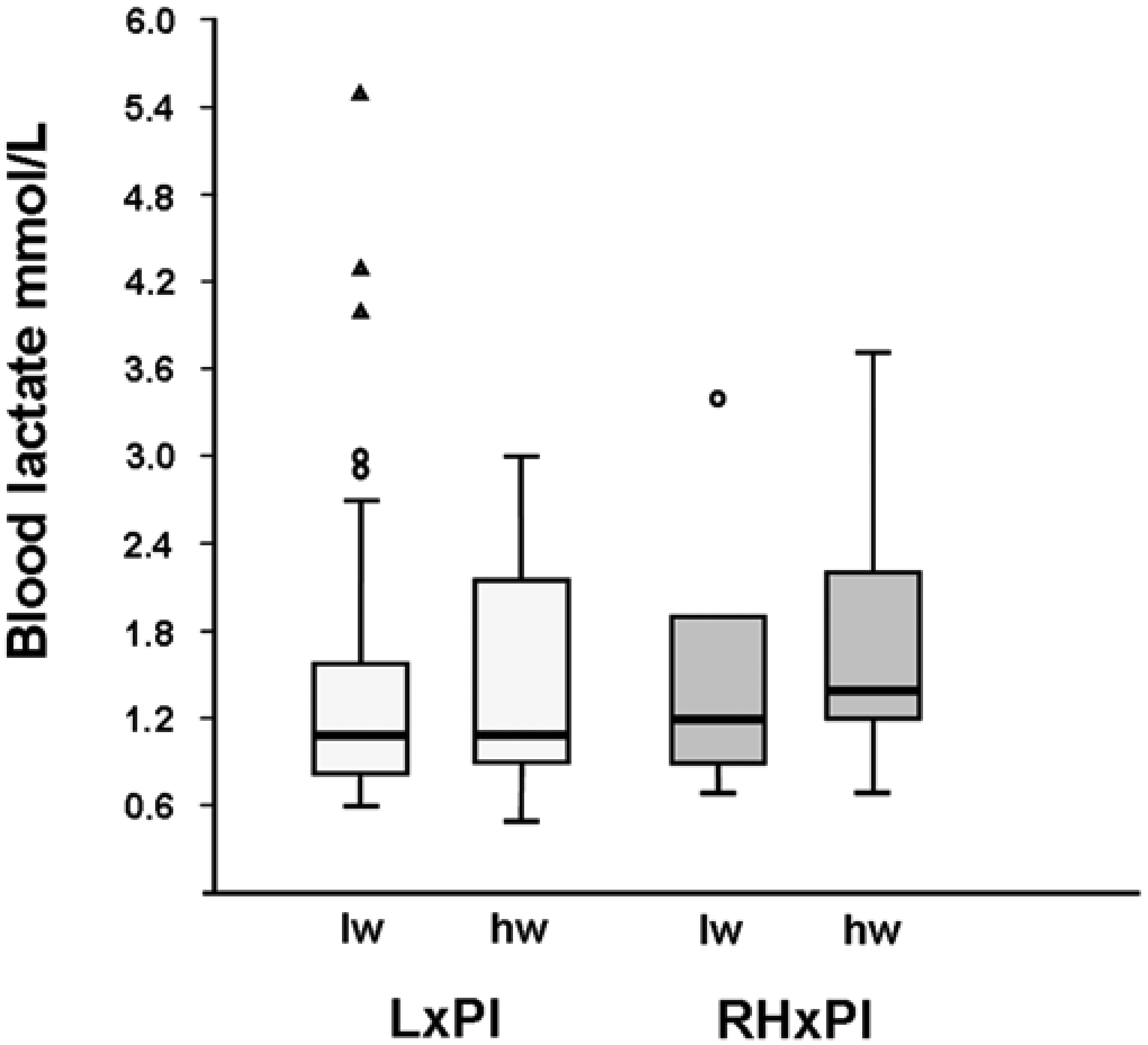
Blood lactate values in the examined cohort of 124 pigs ranged between 0.5 and 5.5 mmol/L, with a median blood lactate value of 1.2 mmol/L (IQR, 1.2). To further evaluate whether the acquired data were affected by a described influence of genetic background on blood lactate levels in pigs,11–13 the two crossbreed lineages were examined separately. RHxPI animals (n = 51) of our cohort presented with a median blood lactate value of 1.4 mmol/L (IQR, 1), whereas blood lactate values measured in LxPI pigs (n = 73) were significantly lower (Mann-Whitney-U test *P < 0.05), with a median of 1.1 mmol/L (IQR, 1) (Figure 1). Therefore a significant influence of genetic background on blood lactate values of pigs was evident in our study. However, no effect of pig body weight on blood lactate levels was detected within the evaluated range. Blood lactate levels in low weight LxPI pigs (median, 1.1 mmol/L; IQR, 0.75; n = 56) did not differ significantly from lactate values of the heavy weight LxPI group (median, 1.1 mmol/L; IQR, 1.25; n = 17) (Figure 2). No significant difference between the two weight groups of RHxPI background were observed (RHxPI lw: n = 7; median 1.2 mmol/L, IQR, 1; RHxPI hw: n = 44; median 1.4 mmol/L, IQR, 1) (Figure 2).
Significant influence of genetic background on blood lactate values in farm pigs prior to experimental surgery. Comparison of the two different genetic backgrounds: blood lactate values of LxPI animals (n = 73; median, 1.1; IQR, box plot on the left) were significantly lower when compared with RHxPI pigs (n = 51; median, 1.4; IQR, 1, box plot on the right). (Mann-Whitney U test * = P < 0.05) Body weight had no significant effect on blood lactate levels in farm pigs within the evaluated range. Comparison of blood lactate levels of light weight (lw) and heavy weight (hw) pigs of the same genetic background: blood lactate levels of lw LxPI pigs (n = 56; median, 1.1 mmol/L; IQR, 0.75) did not differ significantly from lactate values of hw LxPI animals (n = 17; median, 1.1 mmol/L; IQR, 1.25), box plots on the left. No significant difference in blood lactate values between lw and hw pigs with RHxPI background could be observed (lw RHxPI: n = 7; median, 1.2 mmol/L; IQR, 1; hw RHxPI: n = 44; median, 1.4 mmol/L; IQR, 1), box plots on the right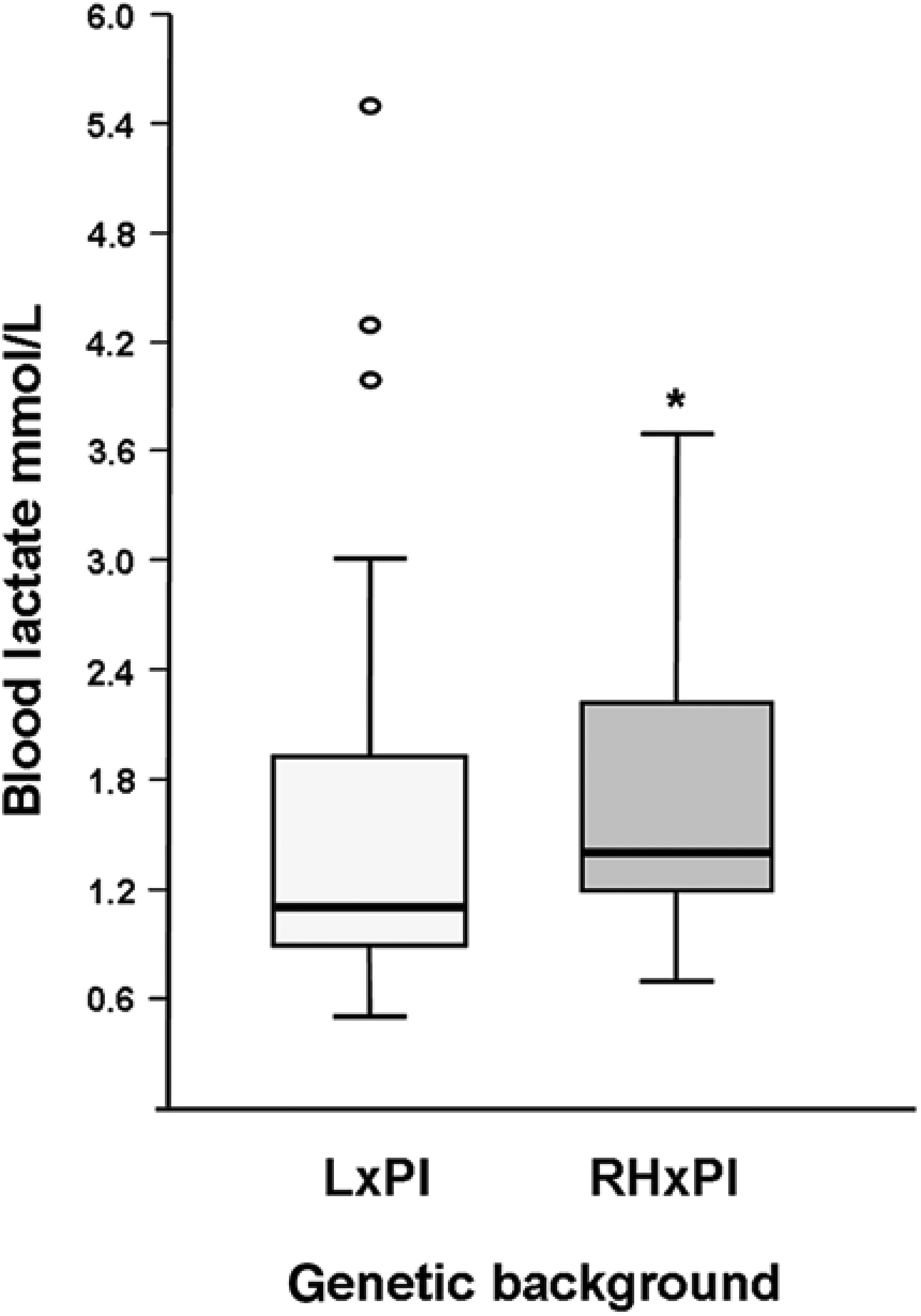
In contrast to our findings, studies reporting blood lactate values in farm pigs sampled under restraint, state a wider inter-individual range (1.8–13.4 mmol/L [mean, 4.1 mmol/L] for Fast 536/Duroc crossbred pigs; 9 range 1.2–11 mmol/L [mean, 3.9 mmol/L] for Fast 536/PIC 337 crossbred pigs; 9 and range 0.72–15.5 mmol/L [mean, 4.17 mmol/L] for Meishan/Pietrain crossbred pigs 11 ). Keeping in mind, that stressful handling, e.g. snaring, 7 is reported to induce an immediate rise in lactate values in pigs,5–8 different methods of blood sampling and restraint may account for the discrepancy of these results compared to our data. Pretreatment baseline blood lactate values in farm pigs acquired through non-stressful sampling methods were reported by Merlot et al. These authors observed mean pretreatment baseline blood lactate values of 0.89 mmol/L when blood samples were drawn from trained gilts equipped with implanted intravenous ports. 7 Interestingly, 23 pigs in our study did not exceed a blood lactate level of 0.89 mmol/L after intramuscular injection of Azaparon and Ketamin. Therefore these animals may not have experienced the intramuscular premedication as an overly stressful intervention. Additionally, reports on effects of sampling sites on lactate blood levels in dogs1,14 and humans 15 suggest that values obtained from peripheral venous blood may tend to overestimate the actual lactate level due to differences in regional lactate kinetics.1,14,15 This may also apply to our report, since we analysed samples from the auricular vein, while other authors used jugular or cava blood to determine blood lactate values.5,7,9,11 The observed significant difference in blood lactate levels of LxPI compared with RHxPI pigs in our animals is in accordance to authors reporting a genetic influence on lactate blood values in pigs. 11 Reiner et al. 11 described significant lower average lactate values in F2-Meishan/Pietrain crossbreed pigs compared with Pietrain founder animals.
Within the evaluated range of body weight in the present report, no significant influence on blood lactate was observed. However, there are controversial reports on the effect of body weight on blood lactate values in farm pigs.6,11 While there is no significant effect on baseline values stated by some authors, 6 others report a significant decrease in lactate values linked to increasing body weight and age of the animals sampled. 11 The interindividual discrepancy in lactate blood levels evident within pigs of the same genetic background in our report might be due to a variance in stress susceptibility of certain animals possibly combined with a less successful adaptation towards handling. To reduce stress associated with premedication in these animals, the procedure could be refined by allowing additional time for pigs to adapt to the experimental facility.
This study documents blood lactate values in premedicated farm pigs prior to experimental surgery. In summary, the lactate values observed were influenced by genetic background but not by body weight. The quality of adaptation of the individual animal to handling within the experimental setting may also be important. The latter underscores the need to implement a thorough adaptation phase in order to refine the procedure. Since interventions prior to experimental surgery may influence lactate values measured in the early phase of anaesthesia, this information can be beneficial for research projects monitoring blood lactate values in farm pigs during experimental surgery.
Footnotes
Acknowledgements
We would like to thank Hildegard Christ (Institut für Medizinische Statistik, Informatik und Epidemiologie; Universitätsklinikum Köln) for statistical support.