



Abstract
This study explores the history of the creation of, and disputes that surrounded, Pan Am's exclusive “Clipper Clubs”, which were designed to attract and retain high-value clients, as well as to consolidate networks of key policy makers and business leaders in the commercial aviation sector. Established in the 1940s, they were dismantled in the 1970s under pressure from actors who contended that they offered privileges to members chosen through an opaque selection process.
Introduction
Between the 1940s and early 1970s, Pan American World Airways’ (Pan Am) members-only Clipper Clubs were exclusive, heavily gendered, and contested spaces. Membership was governed by criteria that offered considerable discretion to senior Pan Am executives in final decisions. Eventually, regulators and consumer-rights groups pressed for change, and the architecture of membership selection was dismantled. These developments occurred within the context of a highly regulated sector in which passenger ground facilities became central to airline “brands” as they sought to inculcate loyalty in the most lucrative ends of the market. Pan Am was amongst several airlines that strongly resisted pressure to change their clubs. Drawing on records held in the University of Miami's Pan Am collection and in the Civil Aeronautics Board (CAB) collections at the National Archives, as well as reports in the trade and popular press, this study explores the rise of Clipper Clubs and interventions in their operation. It argues that airport facilities were critical to airlines’ marketing strategies after World War II and contends that access to their private clubs were entwined with wider debates over discrimination and consumer rights from the 1960s.
The clipper clubs as a marketing tool
In the two decades following World War II's end, as jet planes developed (before the era of the Boeing 747 jumbo jet) and air travel expanded, international and national civil aviation frameworks were defined by strict environments governed by the International Air Transport Association, and, in the United States of America, by the CAB, which the leading American airline journalist Robert Burkhardt noted in 1974 exercised oversight over domestic flag carriers, but not foreign flag carriers’ lounges; hence, he alleged, they were able to engage in harassment against domestic airlines even as such airlines as Air France, Alitalia, BEA, Iberia, KLM, Lufthansa, and Swissair operated their own counterparts. 1
Prices were tightly regulated. Competition focussed on attracting business travellers on higher-class fares. As domestic coach class and international tourist class travel grew (with charter service restricted to bona fide groups of affiliated travellers), carriers such as Pan Am, then the country's dominant global airline, offered preferential treatment to frequent flyers and to well-connected figures, seeing them as a potential customer base with influence over corporate travel books and aviation policy. The Clipper Club – Pan Am's exclusive passenger waiting lounge – was instrumentalised to this end.
Historically, Pan Am enjoyed a privileged and indeed symbiotic relationship with the state in the United States of America – serving not only as a projection of capitalism, glamour, and power from well before World War II (after which this process accelerated), 2 but also as a part of the material infrastructure of American capitalism and state power abroad. 3 The corporation, under the longtime leadership of Juan Trippe (whose corporate life has generated a hagiography 4 ) nurtured its iconic image as the epitome of luxury and comfort. From the organisation of labour within the company, 5 to the food it served, 6 Pan Am manifested the complex and dynamic relations of gender, class, and racial power in America and in the wider world. 7 It is within this context that it elaborated a distinctive corporate brand centred on the Clipper – a signature term and image which became synonymous with the company's efforts to project an image of glamour in an era when the most elite aeromobilities continued to be defined by private air travel. In flight, the assiduous cultivation of the business traveller (which by 1965 accounted for two-thirds of all commercial airlines traffic, compared to approximately half in 1959, according to Mitchell Gordon, writing in the Wall Street Journal 8 ), led carriers to offer amenities such as dictaphones. 9 Gordon noted that this “coddling” extended to United Airlines free gifts, offered on 5 pm “executive flights” between New York and Chicago (the CAB had to intervene and order United to open these dedicated business flights to female travellers). The exclusive spaces of the Clipper Club reproduced these strategies to offer value-added services in airports.
These exclusive spaces were carved out of the wider space of the airport. The airport has been conceived as part of an expansive infrastructure which produces unequal mobilities in the modern era. 10 It has been theorised by some as an exemplary non-place of modernity where, as Marc Augé argues, “people coexist or cohabit without living together”. 11 Other scholars emphasise dynamics of sociality realised in airports. They argue that treating airport spaces only as a node of traffic elides complex ways they are inhabited and imbued with value and meaning by varieties of people. 12 Airport spaces enable both mobility and sociality; they foster strong affective dispositions. 13 The spatial logic of the airport is elaborate and complex – and is part of a wider airspace characterised by distinctive levels and forms of functional differential and coextensive, differential mobilities. 14 Work on the airport hotel has underscored the critical functions it performs within the spatial logic of the airport – and as how it structures wider regional and transnational geographies of capitalism. 15 Other spaces of the airport – ticket counters, boarding gates, baggage handling facilities, retail facilities, staffrooms, customs queues and many more – hold potential for a variety of social engagements. Despite being seen as nodes of circulation, there is also considerable attention to spent time waiting in airports. To construe that time or those spaces as socially or even economically unproductive is to ignore a broad range of generative activities and identities built through them. As airport spaces dedicated to such time, airport concessions became central to supplying a retail environment for passengers to productively consume. Concessions were also rented by airports to airlines. Airlines used concessions to create clubs that were portrayed as designed to enhance business travellers' productivity – in this respect they closely resembled in their ethos many of the (highly gendered) spaces of urban businessmen's clubs that were designed to provide both comfort and places for work. But their purpose, and indeed the discourse that surrounded them, point to other incentives, too: networks of customers and decision-makers that could be of great value to the carrier were consolidated within elite and exclusive branded space.
When Pan Am established its first Clipper Clubs in the 1940s, American Airlines’ Admirals Clubs, established in 1938, supplied a template. The value of offering spaces to business travellers was evident in an era when airline terminal infrastructures were limited, and before airports developed more much complex spatial regimes. 16 Figure 1, a diagram of Dulles Airport in Washington, DC published in 1969, which identified the clubs as part of an elaborate network of resting spaces, shows the diversity of public and private spaces that were knitted together in the fabric of airports by the end of that decade. They were a far cry from the much more rudimentary buildings, with limited services, characteristic of the 1940s.
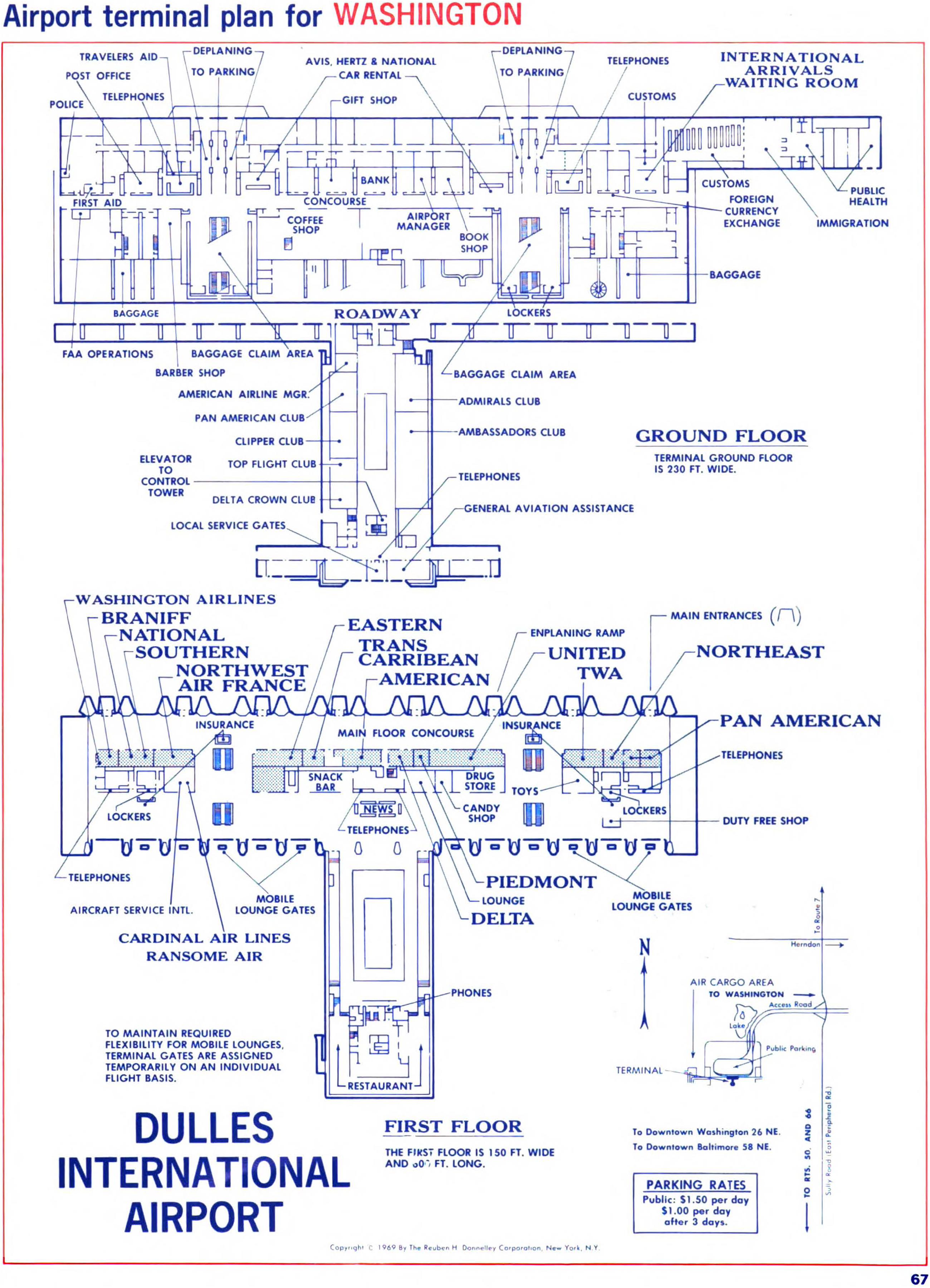
Dulles International Airport.
Within the functionally and aesthetically differentiated spaces of the airport, dedicated waiting rooms projected a brand and an ethos. Correspondence between Pan Am's Assistant to the Division Manager in Miami and the Assistant General Counsel in New York from 1947 contended that Pan Am clubs were fast becoming an “institution” so closely associated with the airline that the company would have to be vigilant about protecting the name as a trademark. 17
In terms of aligning the club with its brand, Pan Am meticulously cultivated a reputation for high service standards, a distinctive aesthetic, expressed through its airline interiors, and, most famously, its New York headquarters.
18
The certificate of incorporation of “Pan American Clipper Club, Inc”. identified that it existed: [t]o establish, maintain and operate a non-profit membership corporation for the encouragement, advancement and increased public use of air transportation; to establish, maintain and conduct a club and branches thereof for the accommodation of members and their guests; and to provide a club house or rooms and other conveniences, and generally to afford to members and their guests all the usual privileges, advantages, convenience and accommodation of a club; and to do everything necessary, proper, advisable or convenient for the accomplishment of any of the purposes hereinbefore set forth.
19
Access to these spaces, often secluded in hard-to-find parts of the airport, was restricted. Criteria for Clipper Club membership was opaque – deliberately so. It left considerable discretion to sales executives responsible for vetting nominees. A 1957 bulletin laid out membership criteria:
extensive travel (with a guideline of 50,000 miles); “standing in the community” (being regarded as “equally necessary”), with this criterion required “in order to maintain the highest calibre of membership and reputation for the Club as a whole”; “social qualification”, which would preclude the membership of any person likely to be the cause of “annoyance” to members (a broadly-defined category which underscored the discretion left to the selection of the Manager-Sales Promotion).
Questions of “dubious qualification” were to be addressed by the Vice-President of Traffic/Sales for a final decision. 20 Women were eligible for membership. But in a signal of the highly gendered nature of these spaces, wives of members had to be accompanied by their husbands or be in possession of guest cards. Travel and cargo agents were eligible, “subject to the stated requirements”. Exceptions to the requirement of extensive travel with Pan Am could be made if a nominee clearly qualified “in all other respects. Such possibilities would include high ranking civic or government officials, publishers of special importance to Pan Am”. As a writer in the Wall Street Journal opined in 1960, and as the opaqueness of some criteria attests, the clubs, in addition to focussing on selling more tickets, also helped the carriers “make friends and influence people”. 21
United Airlines was an outlier in standardising membership based on 100,000 miles flown with the carrier. United had no clubrooms, so it faced no comparable pressure on facilities or tension between extending membership and retaining access to the amenities it offered. 22 Admission to Clipper Clubs operated on a more discretionary basis.
The world of the airline club was opulent, and a far cry from the gates at which other passengers waited for their flights. A writer in the Wall Street Journal described airline clubs at major US airports as “furnished with expensive sofas and deep chairs and tables in oiled walnut. There's a well-stocked bar, soft music, card tables and dramatic lighting. A pretty girl serves coffee in a fine china cup”.
23
Another writer remarked that the clubs operated to “keep frequent users of air services happy, and thus sell more tickets, and to make the right impression on dignitaries, both industrial and governmental”.
24
A reporter for the Wall Street Journal quoted unnamed airline sources in 1960 as saying members included frequent business travellers, and others who have adopted policies favourable to the airlines, in addition to “some newspaper reporters who have reported sympathetically on air travel”.
25
In 1966 the New York Times described the airlines’ clubs as “plush and pleasant, with pretty receptionists, mostly former stewardesses, and such things as color television and phone service”. An article described how club members can nibble free hors d’oeuvres, sip free coffee, relax undisturbed in deep chair, in a quiet corner or in a separate conference room, watch television and buy drinks at normal bar prices, with some offering the services of a special attendant to assist with travel plans, take messages or cash cheques.
26
In a signal of how tightly the operation of these clubs was tied to Pan Am's sales division, nomination forms were obtained through Managers of Sales Promotion, who maintained the master list of members, and required the concurrence of the local District Traffic and Sales Manager. Training was seen as critical in the promotion of clubs: a 1959 Training Guide for Traffic and Sales Personnel underscored this point: members were meant to feel “
A (gendered) ethos of exclusivity
The (usually female) Skipper in American's Admirals clubs embodied their hospitality culture – which was constructed as an extension of the sedulous attention of first-class personnel. In 1944, a widely reprinted image of one such Skipper, Miriam Audette, appeared in Life magazine. Described as a “charming hostess” at La Guardia Field, Audette was the epitome of “war workers” in the US economy. Women remained strongly associated with the Skipper role after the war – in part because of the hostessing functions with which it was associated. The Skipper, and her counterparts in other clubs, exercised considerable authority over spaces of the club – most notably in authorising entry through an examination of a member's bona fides. 29 Skippers also performed more administrative tasks – contacting reservations, for instance, even after members purportedly no longer enjoyed such privileges and preferences. 30 Indeed, the Clipper Clubs’ labour were described as “stewardesses”. 31 If the typical member was a male businessman or influential figure in the public realm, behind the doors of the discreet members-only airline clubs, female staff predominated and reproduced the gendered character of in-flight service.
Airlines’ promotional material and the press underscored clubs’ comforts and amenities. To observers (and to critics), they very much reproduced the ethos of a private club. Members were also discursively tied to a community of travellers that implicitly promoted the tenets of global capitalism. A promotional Pan Am brochure from c. 1952 (listing at the time only 12 club locations, including Caracas, which did not feature on many future lists) laid out the club's amenities and described how members, regarded by Pan Am as “friends”, were helping to “knit global friendships” in an era when “commerce, travel (…) and yes, friendship (…) are carried on outside national boundaries”.
32
It also touted its Clipper Cargo service, “[f]or a Bigger business world”,
33
and underscored its gratitude for the ways in which members had helped Pan Am to realise its ideal of a “smaller world”.
34
This representation of the Clipper Club member as a partner in the airline's advancement, and in the broader goal of creating a “smaller world” through business and travel, signalled the intimacy into which the carrier sought to draw club members, identifying them both with the advancement of the company, of aviation, and of an enlightened global citizenry. A club pamphlet directed at members declared: Membership in the Clipper Club is limited to people like yourself who have made a distinct contribution to advancement of worldwide air transportation. Your membership singles you out for special attention on the part of Pan Am personnel all over the world. Your Clipper Club is unique. It has no constitution, no officers, no by-laws or dues. It is an honorary organization that exists only through the kinship of ideas held by its members in many lands.
35
This discourse was consonant with a wider strategy that positioned the airline as a global actor and “integrator of cultures”. 36 Décor that borrowed from local motifs underscored how the local and the global were articulated in these spaces, whose menus and furnishings recalled private clubs and prestigious public eateries. In 1959, the airline listed 22 lounges, with a variety of amenities, the smallest at airports such as Ankara seating six and larger ones at Havana and Miami seating 60. 37 The hierarchy of size reflected the Pan Am's strong presence in the Americas, to which Miami was a gateway (Table 1).
Clipper Club Locations, April 1959.
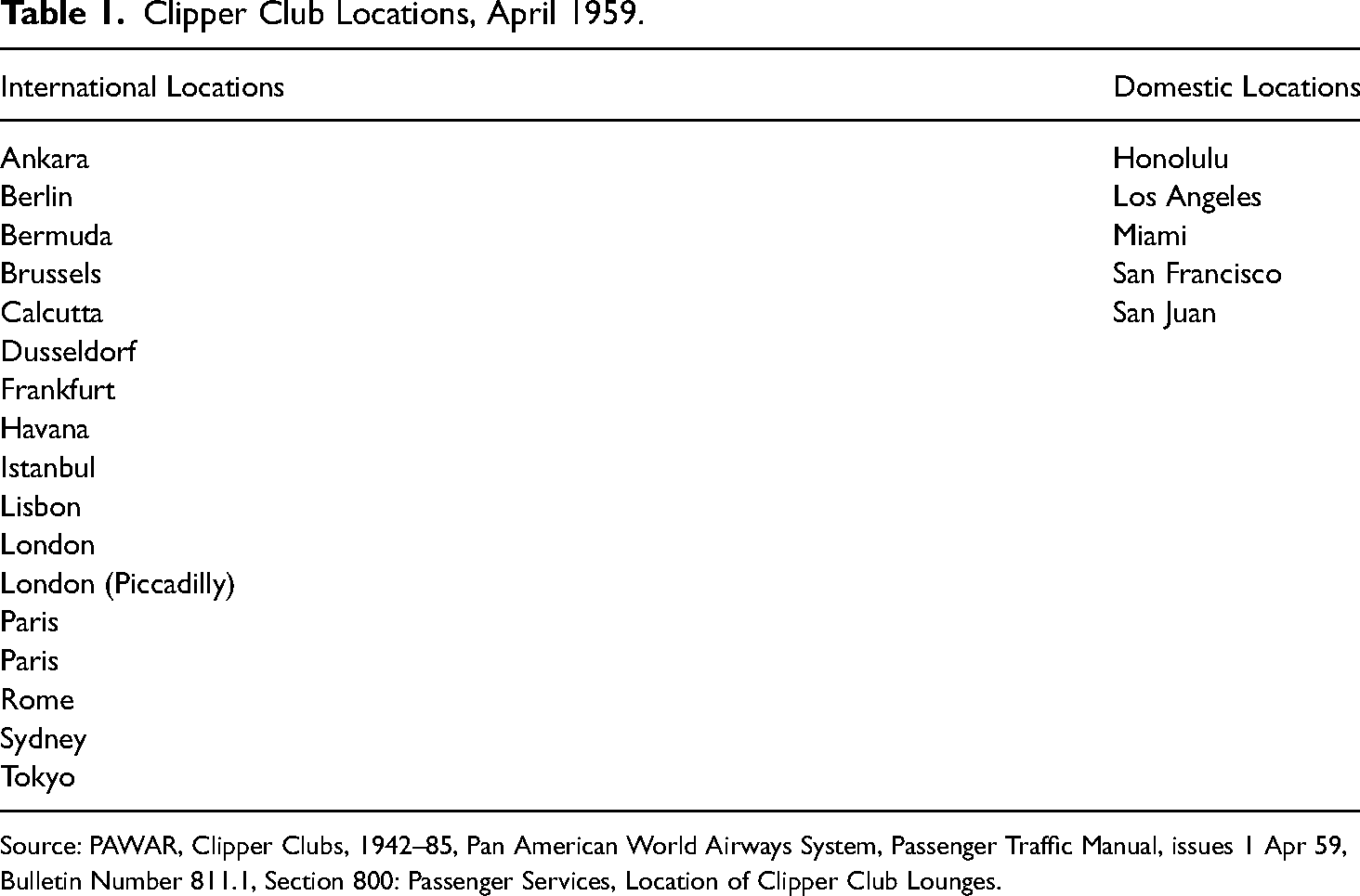
Source: PAWAR, Clipper Clubs, 1942–85, Pan American World Airways System, Passenger Traffic Manual, issues 1 Apr 59, Bulletin Number 811.1, Section 800: Passenger Services, Location of Clipper Club Lounges.
Other airlines also maintained dedicated spaces, usually located behind unmarked doors, in major airports. 38 They included Trans World Airlines (Ambassadors Clubs), Delta (Flying Colonels program), Continental (Presidents Clubs), United (100,000 Mile Clubs), Northwest (Top Flight Clubs), Braniff (International Council), National (Three Coast Clubs), and Trans Caribbean (Jet Clubs). They collectively lost an estimated $1 million annually on clubs in the mid-1960s. 39 But their value to airlines was principally understood by them in terms of rewarding and attracting valuable market segments – and they cultivated these groups sedulously.
The totemic signifier of membership in Pan Am's clubs was the Clipper Card that gained members access to clubs along national and global routes. 40 Members received their card along with a certificate that could be hung to conspicuously identify them as part of this exclusive community of travellers. They were accompanied by a personal letter of greeting from the Vice President of Traffic and Sales. 41 A club facilities folder, personalised luggage tags and an application for a guest card were also included with the notice of membership. 42 Perhaps most materially, the absence of fees (except in states that required the establishments of bottle clubs, in which case members obliged by storing liquor at the clubs and paid an annual due) underscored the exclusivity of membership.
Extant nomination records and related correspondence suggest that nomination and admission often relied heavily on personal connections, with retired Air Force General Laurence S. Kuter, a Pan Am Vice President, often serving as gatekeeper for applicants – many, like him, with military, aviation, and industrial connections. The blue nominating forms outlined details of each nominee, including section 3, “Description of Candidate's Importance to Pan Am”. John Asher, for instance, Assistant Director of USAID, applying in 1965, was “with the Foreign Service, U.S. Dept. of State and his position requires extensive travelling throughout the world. He is a frequent Pan Am traveller and travels approximately 50,000 miles per year”. 43 In chatty correspondence with one of several senior retired military figures, General John K. Gerhart, USAF, Kuter responded to Gerhart's request for membership by noting that he was already on the list of members. Kuter wrote that he had lost his own membership card in the early 1950s, “[a]ll of which goes to show not only that great military leaders can be forgetful but that these club cards are more than sales gimmicks that are tossed around like sample Post Toasties”. 44
The tightly interwoven upper echelons of industrial America, many of whom were retired military figures, expressed underlying links that were consolidated in Pan Am's clubs. Because of such exclusivity, airline clubs came under scrutiny, and eventually faced action from the CAB, in the 1960s.
Regulation and contest: The carriers, their clubs, and the CAB
In the early 1960s, the CAB was poised to push for changes in the clubs, following public complaints. 45 A survey by the CAB in 1960 found that a minority of 90 carriers it canvassed maintained clubs. 46 In 1961 several airline presidents were notified of the CAB Bureau of Enforcement's contention that they were in violation of the Federal Aviation Act's Section 404 (b) (which forbade discrimination in favour of, or against, “any particular person, port, locality, or description of traffic”), 47 and Section 411 (which empowered the Board to initiate actions against a carrier if it believed it engaged in unfair or deceptive activities that hindered competition), 48 by not offering services to all passengers on the same terms. It also alleged that they were potentially operating at an unfair advantage over airlines without such facilities. 49 Section 404 was widely cited in aviation law relation to an incident when singer Ella Fitzgerald sued Pan Am after she and her travelling party were denied boarding and their seats were reassigned in Hawai’i as they attempted to board a connecting flight to Sydney, Australia. Not only did an appeals court overturn a lower court's ruling in finding that there was a civil-rights cause of action in the case: it also determined that “separate but equal” facilities did not satisfy the Act's provisions. 50
The New York Times reported that the CAB's “anti-club drive” targeted four airlines that offered special passenger facilities – American, Trans Word, Pan Am and Continental – rather than others with more limited recognition programmes. 51 By 1961, American Airlines’ Admirals Club, dating to 1938, boasted 44,000 members, Trans World Airlines’ Ambassadors Club, established in 1952, some 52,000 members, Pan Am's Clipper Club 21,000, and Continental Airlines’ President's Club only 400. 52
In addition to considerable variation in membership and club amenities, there was evidence of a hierarchy of status amongst the various airline clubs, with Fred L. Zimmerman, writing in the Wall Street Journal in 1967, remarking that newer airlines’ clubs (such as Braniff's International Council) were easier to join than those of more established carriers. 53 Robert Burkhardt observed in an 1967 issue of Aeroplane that the Clipper Club was “probably the hardest to join”, as it required some frequency of travel, and members also enjoyed free drinks there, as opposed to other airline clubs. 54
In 1962 the CAB's Bureau of Enforcement requested an enquiry into the clubs. However, in a 3-2 vote in 1963, the CAB determined it would not be in the public interest.
55
The vote, in which the Republican appointees and the chair, a Democrat, voted against two Democrats, reflected recent partisan divisions in voting, and was accompanied by a short, strong dissenting opinion – and none for the majority.
56
This moratorium on official action ended in 1966, however, when Herbert A. Goldberger, a sales manager for Cable Electric Products, complained to the CAB after attempting to access the Admirals Clubs on his return from business to Rhode Island.
57
Elsewhere it was reported that Goldberger was denied entry only at JFK, en route from Saginaw to Rhode Island.
58
Recalling the episodes many years later, Goldberger reflecting on the indignity of a second rejection after having been turned away by a club at Detroit: On his flight to New York he stewed angrily about this [first] summary rejection, and at Kennedy he decided to try again. He searched out the Admirals Club, found it and went in. A pretty female “Skipper” took his coat, presented him with the guest book to sign, and asked to see his membership card. When he hesitated, the girl asked sweetly, “Did you forget it?” No, he hadn’t forgotten it, he didn’t have one, and he would very much like to get one. What would it take? An application? Dues? Neither one, he was told; American invited people to become Admirals, and if you didn’t get an invitation you couldn’t be an admiral [italics original].
59
Goldberger subsequently applied for membership and was placed on a waiting list. He then complained to the CAB that such membership processes constituted discrimination. If Goldberger's complaint was upheld, airlines contended, it risked overcrowding in the clubs and damaging the purpose for which they were established. 60 Moreover, the scale of membership necessitated restrictions such as waiting lists: by 1966 American's Admirals Clubs boasted 90,000 members, and TWA's Ambassadors Clubs some 100,000. 61 In 1967 the total of all airline club memberships was recorded at 567,880. 62 How could the ethos of the clubs be maintained under such strains?
The CAB charged that the airlines were offering special privileges to customers that were denied to others paying the same fare, 63 and that general revenues were being used to subsidise an exclusive amenity. 64 Journalist Robert Burkhardt alleged that there had been no groundswell of support in changing current practices, and claimed that of the “[s]everal hundred” letters received by the CAB in the course of its enforcement, more than 90 percent favoured maintaining the pre-1966 arrangements whereby the airlines operated the clubs. 65
CAB correspondence supports Burkhardt's claim: corporate executives, trade industry representatives, and others wrote scores of letters to the CAB and its congressional liaisons and their political representatives in Washington insisting that Goldberger's complaint had no merit and advocating for the continuance of the clubs. 66
Many, though not all, echoed the sentiments of Leonard G. Hill, Manager of Product Development for Hammermill Paper Company, who found the prospect of changes to the clubs “shocking and upsetting”, and contended that “[t]he fact that one particular customer was refused membership … is hardly justification for closing the clubs or throwing them open to any passenger or airport habitue who would happen to wander in”. 67
Many of the airlines robustly defended the clubs, too. American Airlines president Marion Sadler contended that offering facilities of a private club was in line with normal business practices of making “a special effort to please its regular large customers”.
68
Indeed, carriers charged that clubs fell outside the air transportation activity jurisdiction of the CAB altogether. As one unnamed executive opined in 1967: If you have a standard terminal facility for the regular passengers and special facilities for members of a club who support the facilities with dues, the fact that the latter are maintained doesn’t seem to be related to air transportation, does it? To say that it is a pretty far stretch of the chewing gum.
69
Writing in the Los Angeles Times’ “Travelines” column, Jerry Hulse also defended the clubs, dismissed Goldberger's complaint as “ridiculous”, and contended that the “businessmen” who predominated in clubs required the “preferential treatment” that came with their regular travel (here Hulse elided those members who qualified on other grounds). 70 Hulse ended with a blunt question for Goldberger: “Do you suppose your own private country club back in Rhode Island would admit me, a non-member, just because I knocked on the door and said, ‘Let me in’?” These defences were formulated around the premise that designating airport concessions for the exclusive use of certain passengers was essential for the conduct of modern business – by passengers using that space for such purposes, and by airlines enlisting it as a marketing tool.
In fact, airlines responded in strikingly different ways to the CAB's sabre-rattling. In response to the CAB's concerns, in December 1966 Northwest opened its clubs to all passengers travelling on a first-class fare, as well as other travellers meeting specified criteria, including, in “unusual circumstances”, infants, the disabled, elderly passengers, celebrities, and delayed and stranded travellers. 71
In their responses to the CAB, however, Continental and TWA challenged its jurisdiction over clubs, with TWA also arguing that the rules governing membership were reasonable. Continental argued that the clubs were a tool for sales. Pan Am, taking the position that the 1963 decision that an enquiry was not in the public interest, continued to stand, and contended that the CAB was allowing foreign airlines an unfair advantage in seeking to dismantle the domestic club system.
Pan Am found itself increasingly isolated, however, as one by one, carriers relented. National, Continental, Braniff, and, in 1968, Trans World Airlines opened their dedicated club spaces and offered the wider public membership based on a range of dues, including initiation and annual, or lifetime, memberships. 72 The clubs were to become self-sustaining in revenue terms, and open to any member of the public desiring – and paying for – membership.
American Airlines, in 1967 adopted another strategy, and announced plans to charge dues to its nearly 100,000 members. 73 In effect, American was not dismantling the membership system – it was only levying dues on members: on those grounds, in the eyes of the CAB, admission to Admirals Clubs remained discriminatory. 74
A CAB spokesmen likened American's proposed remedy to the operation of selective country clubs, since not every person who wished to avail themselves of the space would be able to.
75
It continued to press airlines to change their club operations so that membership should be available to:
all passengers, regardless of their class of fare; all passengers travelling on a specific class of fare; all members of the club whose membership was available to any applicant on the payment of dues.
76
By 1968, only Pan Am American, Trans Caribbean, and United had not settled with the CAB. Pan Am challenged efforts to expand membership to any paying member – and aimed to preserve pathways to accessing the clubs that it had constructed over several decades. 77 It argued that it was defending rights to develop an “enhanced” waiting room experience for premium passengers: the high-circulation environment of the airport was an appropriate place to reward passengers who would likely need to avail themselves of business services, too.
Correspondence shows that admission to the clubs continued to be carefully weighed in terms of the cachet and connections, as well as business status, of nominees. Larry Kuter, the Executive Vice President of Pan Am, attached a note in his own handwriting to correspondence from Dr Roland R. De Marco, President of Finch College, who had requested membership. De Marco also conveyed personal regards to Kuter and his wife Ethel. Kuter's cursory recommendation was: “Believe special attention justified (Pat Nixon et al. are Finch College)”. In reply directly to De Marco, Kuter lamented that “[y]ou and Lydia are the types of people we don’t see enough of in our clubs;” he noted that the CAB cast a jaundiced eye on the clubs, leaving to a Pan Am moratorium on admission: “I can give you no guarantee except my own sympathetic understanding and best wishes”. 78
Pan Am's actions reflected a growing awareness of its relative isolation. From July 1971, it began to levy an annual due on members, though its operating practices continued to attract the CAB's concern. In effect, dues became a way of demonstrating a willingness to make the clubs self-supporting, without opening their membership to the public. A letter to members from Pan Am's Senior Vice President, Marketing, James O. Leet, underscored how the fees were framed as a way of preserving access to privileged airport spaces, and the comforts that they provided amidst the bustle of airport terminals: If you’re like most Clipper Club members we’ve talked to recently, you’re probably in favor of retaining the existing nature of the Club. To preserve the Club for frequent international travelers like yourself, it is now financially necessary to charge an annual membership fee.
79
Members were promised that “privacy and comfort (…) separated from the busy terminals” would continue, alongside the Clubs’ signature free cocktails and beverages. New benefits included membership in Inter-Continental Hotels’ Six Continents Club, first-class counter check-ins, regardless of the member's ticket, and “newly designed clubs at Paris, Rome and New York's Kennedy Airport”. 80 Clubs continued to offer exclusive amenities in secluded spaces, and membership remained subject to internal vetting and to processes to which the CAB continued to object. In the context of the airport, Pan Am's Clipper Clubs were a refuge from the hurly-burly of intense airport circulation – a comfortable space to find repose or engage in work which contracted aesthetically and in terms of amenities with the airport waiting areas at gates, and a centre for the production and reproduction of a loyal customer base whose interests served that of the airline.
But clubs faced additional criticism in the 1970s, when their survival was seen as a barometer of regulatory inaction. The late 1960s and early 1970s, when the CAB intensified its efforts to have the holdout airlines operate clubs on new principles, were exceptionally challenging for the industry, with the first years of the decade marked by high inflation (impacting labour costs especially), overcapacity (with accompanying diminutions in profitability, which the carriers, having been accustomed to heady rates of growth through the 1960s and embracing new wide-body jets such as the Boeing 747, sought to address by reducing seats), and worsening conditions with the onset of the oil shock and recession in 1973. 81
Against this backdrop of increasing operating expenses and a sharp decline in the annual growth of passenger miles, Pan Am and American Airlines retrenched and sought to defend the structure of club membership – American Airlines most tenaciously. Perhaps in the face of mounting cost-cutting pressures, the restructured clubs that the airlines favoured, which retained a level of discretion in membership even as they moved to a fees-based structure, supplied a competitive advantage in a challenging market. But they faced increasingly strong headwinds and isolation as other carriers agreed terms with the CAB to change the operation of the clubs.
In addition to the objections of the CAB, the clubs attracted the ire of passenger advocacy groups such as the Aviation Consumer Action Project (ACAP), founded in 1971 to advance the interests of consumers “in a regulatory system dominated by trade association and industry lobbyists”. 82 These actions occurred against a backdrop of dramatically increasing air travel, including by supplemental (non-scheduled) airlines, and travel by affiliated groups on charter flights (package tours were introduced in the charter end in the late 1960s, and the principle of affiliation gave way in 1972 to advance ticket purchase alone as a criteria for charter travel).
In the context of wider participation in air travel, declining proportions of first-class travellers, and these structural changes in the charter sector affecting the wider industry, the persistence of the airline club struck amongst the main carrier critics as both anachronistic and an affront to other passengers on the same airline who were perceived to be footing the bill for them.
The ACAP's 1973–1974 action programmes specifically included “Equality of Service to All Air Passengers”, citing that their attorney had forced the CAB to finally act on Herbert Goldberger's eight-year-old complaint and force Admirals Club to change its practices, as well as advertise these changes. 83
David Sanford, a young consumer-rights advocate who would later be promoted to managing editor of the New Republic, took aim at airline clubs in “Come Right In ‘Colonel,’ ‘Admiral,’ or Whoever”, a chapter in the influential collection he also edited, Hot War on the Consumer. 84 Sanford traced the lineages of the clubs to days when the uninitiated were turned away by “the pretty ‘skipper’ at the door”. 85 Sanford offered a searing indictment of the clubs, noting that “[t]he airlines make a practice of offering memberships to public officials”, and identified several prominent US senators as examples. He pointedly remarked: “Passengers who pay the same fare as an ‘Admiral’ or a ‘Colonel’ [the membership designations of American and Delta airlines’ clubs respectively] may see no reason why they should subsidise a service which they are denied”. 86
Only in 1973, the same year that United opened its new Red Carpet Clubs to all, with an annual or lifetime membership category (replicating its former 100,000 club and satisfying the CAB), 87 did Pan Am restructure Clipper Club operations. It followed the Board's rejection of an earlier Pan Am proposal in February 1973 in which Pan Am sought to retain a discretion over membership by maintaining free honorary memberships “to high ranking American or foreign diplomats, or high ranking military figures or other officials;” permitting one-time access to a range of categories of travellers, including the elderly, the infirm and passengers holding international tickets – the CAB objecting to the last category; and reviewing and restricting new memberships twelve months after the proposed settlement due to limited club capacity, with priority for admission determined by date of application. 88 The Board had dismissed this proposed resolution.
Under the terms of the settlement in May 1973, Pan Am agreed to change the operation of its domestic clubs. The CAB Bureau of Enforcement identified clubs in the United States at Friendship Airport, Baltimore; Logan International Airport, Boston; Honolulu International Airport; O’Hare International Airport, Chicago; Detroit Metropolitan Airport; Los Angeles International Airport; John F. Kennedy International Airport, New York; San Francisco International Airport; San Juan International Airport; Dulles International Airport, Washington, D.C.; and Miami International Airport. Pan Am also maintained lounges at the East Side Terminal on First Avenue in New York and at the Pan Am Building Heliport in New York City. “Pan Am ticketed passengers, except those specially designated, are generally excluded in the United States from admission to the waiting room lounges except those at Miami, San Juan, and the Pan Am heliport ‘copter’ lounge. Pan Am also maintains lounges at 14 foreign locations which are maintained on a restrictive basis except at the La Aurora Airport, Guatemala City”. 89
The Board determined that the airline had “provided treatment not generally available from Pan American at such airports to others of its passengers holding tickets of the same class” which was “separate and different” from passengers generally. 90 Pam Am would continue to levy dues. It would cease to grant, renew, or extend honorary memberships (which had been exempt from dues). It retained rights to restrict membership eligibility of its employees and agents and those of other carriers, and it could grant non-dues-paying memberships to directors, officers and employees of Pan Am and other airlines. It could also establish “reasonable restrictions” on use of clubs to conform to relevant liquor requirements in various jurisdictions. It would advise its employees to alert passengers to the new arrangements, and, in line with Northwest's agreement with the CAB several years earlier, it could admit certain categories of groups, such as infants, the handicapped, elderly or ill people, eminent passengers, or delayed or stranded passengers, to the clubs. In response to a persistent complaint by the airlines, Pan Am could also restrict admission “on a nondiscriminatory basis” to prevent overcrowding. 91
These constituted the few grounds on which Pan Am could now determine access to the clubs or limits on membership; otherwise the clubs were open to application from the public. In a memorandum from the Executive Vice President to Managing Directors and Directors dated 18 June 1973, these “Rules Changes” were laid out, including the establishment of annual $30 and $300 lifetime membership dues, and the continuance of a policy limiting Pan Am members to employees at the level of Staff Vice President and above. 92 James O. Leet, Executive Vice President, Marketing also issued a letter to club members citing the same order and detailing the end of honorary memberships to the 666 such members (out of 25,214), and offering conversion on the fee basis. 93
In 1974 the CAB adopted a sweeping new policy which universally applied the criteria it developed with most carriers over the preceding eight years. It required clubs to be available to all travellers flying in designated classes, to anyone willing to pay a required fee or, alternatively, to all flyers. The CAB ordered the most persistent holdout, American Airlines, to open its eleven Admirals Club lounges to all people who met established criteria of eligibility attached to airline tickets. 94 That order affirmed the ruling of an administrative judge in 1973. 95 The Brief of the CAB's Bureau of Enforcement before that judge in 1973 revealed the extent to which it relied on case law rooted in the advocacy of equal civil rights which had aimed to redress segregated spaces in travel to argue in favour of its jurisdiction over clubs, from their status as facilities in interstate commerce to the argument that discrimination was prohibited in places that were integral to air transportation. 96 While American contended that the 1973 requirements extended beyond those negotiated with other carriers, the CAB report had determined that “[m]anifestly, the Admirals Club does not afford ‘equal treatment to all.’ Only certain persons can become members of the club”. 97 The airline club's membership criteria had changed, under regulatory pressure and then under order, and in the context of wider criticism from consumer-rights groups. But changes in membership criteria did not efface or in some respects disrupt many of the essential features and functions of the clubs in the wider spatial logic of the airport. They continued to be spaces of privileged access, largely secluded from public view, with aesthetics and amenities that marked them as distinct from the wider public waiting lounges and spaces of the terminal, and which were leveraged to promote airlines’ brands.
Conclusion
In March 1974, the New York Times featured a profile of 50-year-old, bespectacled Herbert Goldberger, under the headline “Thanks to One Stubborn Man, Everyone Can Be an Airport V.I.P.” An effort begun by him in the middle of the 1960s had finally resulted in the opening of all remaining airline clubs: long “the very soul of quiet privilege – quiet, cushy and smartly attended havens set off from the hurly-burly of the more plebian waiting areas of major airports” which restricted to “an arbitrarily created aristocracy of nabobs, moguls, tycoons and big cheeses” cultivated by the carriers. 98 In an article that depicted Goldberger as a modern-day folk-hero, Roy Bongartz contended that he had taken on a crusade against clubs that had been created as a “public relations gimmick” designed only for the “top echelons” of business and government (revealed by a sales representatives training guide for American Airlines to which Bongartz was privy). “Wise to what was going on”, some of the airlines “slyly” liberalised admissions, but still kept membership application details largely private.
The laudatory profile drew mixed responses in the newspaper's letters section. 99 But by 1974 Goldberger had triumphed, despite the notable lack of enthusiasm on the part of his family for his crusade, and a process which one observer was quoted as saying showed the CAB to be a servant of the airlines. 100 The dismantling of airline clubs’ opaque admissions process did not extinguish interest in membership or erase the footprint of the club in the regime of distinctive airport spaces. In fact, airlines reported continuing strong interest after the CAB's interventions, with one New York Times article in 1976 reporting that with the exception of the Clipper Clubs, most airlines reported “good gains” in membership in these “glorified waiting rooms”. 101 Still, as the Wall Street Journal reported in 1976, “[t]he demand for V.I.P. treatment continues strong”, with the paid membership clubs gaining members, with the exception of the Clipper Clubs. 102
Clipper Clubs continued to supply Pan Am with a brand and a tool for attracting and retaining new categories of members. In 1979, Jay Clarke, writing for the Knight News Wire and appearing in the Hartford Courant, contended that some of lounges, while not “VIP anymore”, were profitable to carriers (though his calculations were based on little more than a multiplication of members and annual dues), and highly popular, too: Eastern Airlines’ Ionosphere Club (operating 20 clubs, with another opening soon) was adding 3,000 members a month and its membership stood at 95,000, whereas four years earlier it boasted only 5,000 members and five clubs. 103 Clarke noted that United's Red Carpet Club, established as part of its agreement with the CAB, had 120,000 members and 18 lounges, with American's clubs also growing. Pan Am had opened new clubs in Houston and Caracas. Clarke reported that business travellers remained “overwhelmingly the best customers of the lounges”, since it made little sense for those who flew by air principally for vacation to pay their fees. In short, the refuge of the airline club, also increasingly referred to as lounges, remained attractive to many flyers.
In the 1980s Pan Am sought to monetise Clipper Clubs through a variety of initiatives, including proposals for city-based clubs operated by a licensee. 104 In a signal of how its operations had changed, though, clubs withdrew complimentary drinks privileges, resulting in extensive correspondence with, amongst others, attorney Hugh J. Morgan, who contended that the airline was in breach of its contract with his lifetime membership contract. 105 This withdrawal of an amenity that had long defined the club even in comparison to those of most other airlines’ signalled broader changes in the culture of the Clipper Club that were to accelerate through the 1980s. The airline also embraced other (primarily business) traveller incentives enabled by deregulation, not least the adoption of frequent flier programmes, which also produced a network of linkages between co-operating airlines where points could be redeemed, as well as hotels and other partners where they could be earned. 106
Airport lounges continued to be part of the wider brand projection and marketing strategies of major airlines, even as the expansion of membership resulted in allegations of “overcrowding” that diminished their prestige value. 107 Private jet travel, moreover, remained a gilded choice for high-flyers, and the introduction of scheduled supersonic transatlantic jet service on the Concorde in 1976 created a new, glamorous option for travellers. As for these “glorified waiting rooms”, while they had been conceived of, and operated, as socially exclusive and functionally and aesthetically distinctive in the context of a spatially complex airport that enabled complex and differentiated sociabilities, clubs were also central to brand development and projection in an era of tight regulation. Growing scrutiny in the 1960s and early 1970s by regulatory and consumer's groups presaged changes in access to their facilities, even if preserving the ethos of a unique space to build and reward a lucrative customer case continued.
Footnotes
Declaration of conflicting interests
The authors declared no potential conflicts of interest with respect to the research, authorship, and/or publication of this article.
Funding
The authors disclosed receipt of the following financial support for the research, authorship, and/or publication of this article: This research was generously supported by the Dave Abrams and Gene Banning Pan Am Research Grant, University of Miami Libraries’ Special Collections.
