




Abstract
The essay examines the history of interactions between academic thinkers and the application of their ideas to airline management and policy. Many studies of the history of transport focus on developments in engineering hardware and business models underlying its use, together with historical biographies of the key individuals involved. Here I deviate from this to look at how, over the past half-century or so, ideas emanating from the new behavioural economics have permeated the way air transport markets, and their regulation, have developed. I consider the outcomes on air carriers and their markets of efforts at combining psychology and economics into matters concerning airline management and policy formulation. It looks at the ways in which the traditional economic framework that dominated much of the thinking about commercial air transport from the 1920s has been challenged over the past 50 years and the implications of this for carriers and passengers.
Introduction
John Maynard Keynes famously proclaimed that Practical men who believe themselves to be quite exempt from any intellectual influence, are usually the slaves of some defunct economist. Madmen in authority, who hear voices in the air, are distilling their frenzy from some academic scribbler of a few years back.
1
Historically, many of these changes that have occurred in aviation have been on the supply side with the development of new aircraft types, the creation of sophisticated air navigation and control systems, and the emergence of new airline business models. Others have been due to shifts in demand as new destinations and products have appeared. Most air travel is also not wanted for its own sake but rather because it offers access to desired destinations for passengers and cargo. As Denys Munby put it over half a century ago, “…[o]nly the psychologically disturbed or inadequate want transport for its own sake.” 2 Growth in income, increases in populations, new configurations of supply chains, and enhanced communications networks are a few examples of existing and emerging factors affecting demands for passenger and freight air services.
In addition, some of Keynes’ scrawlers’ mentions have in their thinking moved away from traditional models of human behaviour, generating modified paradigms that underlay their policy messages. One change has been the greater incorporation of psychology in economic analysis. In particular, there have been endeavours to relax selected assumptions inherent in the notion of economic man (homo eonomicus), the core of neo-classical economics for over a century. Traditionally, this stereotypical person (or business) is always independently engaged in the marginal optimisation of their welfare, exhibiting rational behaviour in the context of stable and coherent preferences whilst making use of full information. 3 Recent years, however, have seen so-called “new behavioural economists” blending other disciplines into traditional economic analysis and relaxing some of the neo-classical assumptions.
While there have always been those who have nibbled away at the lack of realism represented in the economic man stereotype, the new ideas that have emerged not only cast doubts on the assumptions of neo-classicism but offer alternative ways of looking at economic decision-making. These new behavioural scribes have specifically integrated ideas from psychology into economic analysis. It is how these individuals, and their work, have influenced the way airlines are regulated and managed that I consider here.
Why study the history of airlines in this context? One reason is the rise in importance of the mode. Aviation is a relatively new form of transport, the first controlled flight was in 1901 and, although it took on an importance in the 1920s for mail services, airliners only began carrying a significant amount of traffic after World War II. 4 Aviation's growth accelerated in the 1960s with the widespread adoption of jet-engine technology. The mode now carries huge amounts of traffic; in 2019, prior to COVID-19, airlines carried 4,486 million passengers globally and 57.6 million tonnes of cargo which, the International Air Transport Association estimates, accounted for about 35 per cent of world trade by value. 5 Additionally, airlines use an almost self-contained infrastructure. There are obvious physical interactions with other modes at airports but airlines’ track – air corridors – and control systems seldom interact with sea- or land-based transport networks. The lack of a long-term legacy of hardware provision also means the history of air transport fits into a fairly clean time frame for analysis.
Importantly for this essay, there have been managerial and policy experiments involving the application of new behavioural thinking to airline markets that provide insights as to the former's usefulness. The drawback, however, is that there is no single, convenient historical path to follow. What we have are a number of distinct threads, albeit sometimes entwined, where Keynes’ scribblers have sought to add realism to some elements of our understanding of how airlines operate and how public policies are formulated. Madmen have duly followed by making use of some of these new ideas. What I offer here, therefore, is a set of historical vignettes, rather than a coherent single narrative, that trace some of these threads focusing mainly, but not exclusively on the experiences of the USA.
Before moving to the specifics of where, when, and why new behavioural economics (NBE) has been finding its way into airline management and policy-making, it is perhaps helpful as a segue to set out some of the key concepts of the new approach.
New behavioural economics
The backdrop
The concept of economic man of a century and a half or so ago had been pecked at from the outset by economists who questioned its realism, but there was a sea-change from the 1960s as the intensity of the reassessment grew. While the “old behavioural economists” had not been unwilling to make contributions to ongoing economic policy debates, including some concerning aviation matters, their main efforts had been directed at critiquing and tinkering with traditional policies governing such things as price and output controls.
The new behavioural economists represent a deeper challenge to the fundamentals of the neo-classical framework by bringing psychology more centrally to the debate, and notably the development of fresh ideas about how airlines and their customers behave, and in the ways regulatory policies should be better designed. 6 In particular, it focuses on refining economic assumptions regarding the objectives of key actors, the rationality of their actions, and the role of information in decision-making.
The growing recognition of the important role that NBE can play in both enhancing our understanding of economic forces and the actions of management and policy-makers is seen by the number the number of Prizes in Economic Sciences in Memory of Alfred Nobel awarded to some of those who work in the field including scribblers such as Herbert Simon, Daniel Kahneman, Robert Shiller, Oliver Hart, George Akerlof, Richard Thaler, Joseph Stiglitz, and Vernon Smith. Some of the list getting their accolade for ideas directly involving transport. 7
The official acceptance of new behaviour-based policy instruments was subsequently been witnessed in the UK in 2010 with the creation of the Behavioural Insights Team, and in the USA in 2015 by President Obama signing an executive order directing federal agencies to use behavioural insights when they “may yield substantial improvements in social welfare and programme outcomes.” 8 Other countries, including Germany, France, and Japan, as well as international bodies such as the World Bank, UN, and the European Commission, have also created behavioural economic units of various types.
Shoving, budging, nudging, and like things
The new behavioural scribes have, as is often the case with inventive people, introduced additional verbiage to economists’ lexicon in a bid to sharpen up their positions. Unfortunately, they are not quite at the point of unanimity on the appropriate jargon, but it is useful to briefly highlight some key concepts where a degree of concordance exists.
In terms of policy instruments that can have relevance for airlines, there remain traditional shoving and budging command-and-control measures. In aviation, they include legal oversight such as market entry, product quality (including safety), fares and cargo rates. In this context, the NBE fits in when psychology is used to design different ways of applying shoves and budges. For example, in the airline context, there are shoves in the design of onboard videos to ensure passenger compliance with safety rules. While this is a direct approach to affecting human behaviour, a budget is aimed at reducing one actor's negative activities on others. An example can be the legal requirements of a pilot to follow a take-off path that minimizes ground noise nuisance.
Nudging and boosting – sometimes collectively called steering – are ways of reducing failures in decision-making by establishing good choice architecture. An oft-cited definition is that “A nudge is an easy and often low-cost intervention … altering people's behaviour in a predictable way, while preserving the same range of choice options.” 9
Conceivably the best-known, although perhaps not the most important, nudge with aviation connotations is the incorporation of an image of a fly within the “sweet spot” of male urinal pans at Amsterdam Airport Schiphol. The idea is to encourage users to aim at the īnsectum. Accurate urinating was found to minimise splatter (“spillage” fell by 80 per cent), reducing cleaning costs and corrosion by 8 per cent. 10
Whereas nudging seeks to make use of myopia and loss aversion to change behaviour, boosting seeks to improve the skill sets of decision-makers or the situations in which nudges are employed allowing the latter to be used more effectively.
Although distinctions between shoving, nudging, and boosting are found in theoretical economic scrawling, there can be a blurring when it comes to policies. This is because there may be a number of dimensions to deviations from neo-classical behaviour to contend with, for instance, irrational decision making at the same time there is less than full information. Or it may be because a combination of using a hard shove and a soft nudge can have reinforcing effects.
I now turn to look at the history of applying the ideas of behavioural economic scribblings on both actors within the airline industry and those outside with responsibilities for its regulation.
Reforming traditional transport economics
That economic behaviour is more complex than assumed by traditional economists has only slowly permeated transport economics, let alone the airline industry. 11 Some elements of the theory of the firm, however, and ideas associated with industrial regulation economics, now often involve psychological considerations that range beyond the neo-classical, and notably so for markets that stray from the extremes of monopoly and perfect competition, air transport being an example.
Regulation of fares and market entry characterised most domestic and international airline markets from the 1930s until the late 1970s with the authorities in most countries using traditional shoving instruments to manage market entry and fares. The US Civil Aeronautics Board (CAB), for example, was by the late 1970s licensing individual interstate routes and setting fares on a rate-of-return basis with the aim of simulating the conditions of a static perfectly competitive world. 12 The approach was to focus on providing a limited range of services (e.g. “coach” and “first” class) with the average cost of a seat, plus a profit margin, determining the fare. 13 Most national airline markets were served by one or two carriers until the late 1970s. International routes had, since the 1944 Chicago Convention, been regulated through bilateral negotiations and agreements and were thus usually even more stringently controlled, with a state-owned-flag company enjoying a monopoly. Market stability and strategic reasons were often used in justification for all of this.
The US market had some idiosyncrasies, partly because of its size, the federal nature of the country, and because of its overall greater reliance on market forces. Airlines have traditionally been commercial, private companies. They were though, de jure regulated, by dint of the CAB's control over route licenses, fares, and mergers. Further, when a carrier met financial problems, the CAB's de facto policy was to foster mergers to ensure the integrity of the national network (see Table 1). But at the same time, this meant no new carriers were licensed and the market became increasingly concentrated. Innovation was not being encouraged, but this was seen as a lesser issue than instability potentially leading to markets not being adequately served.
USA airline mergers and acquisitions pre-1978.
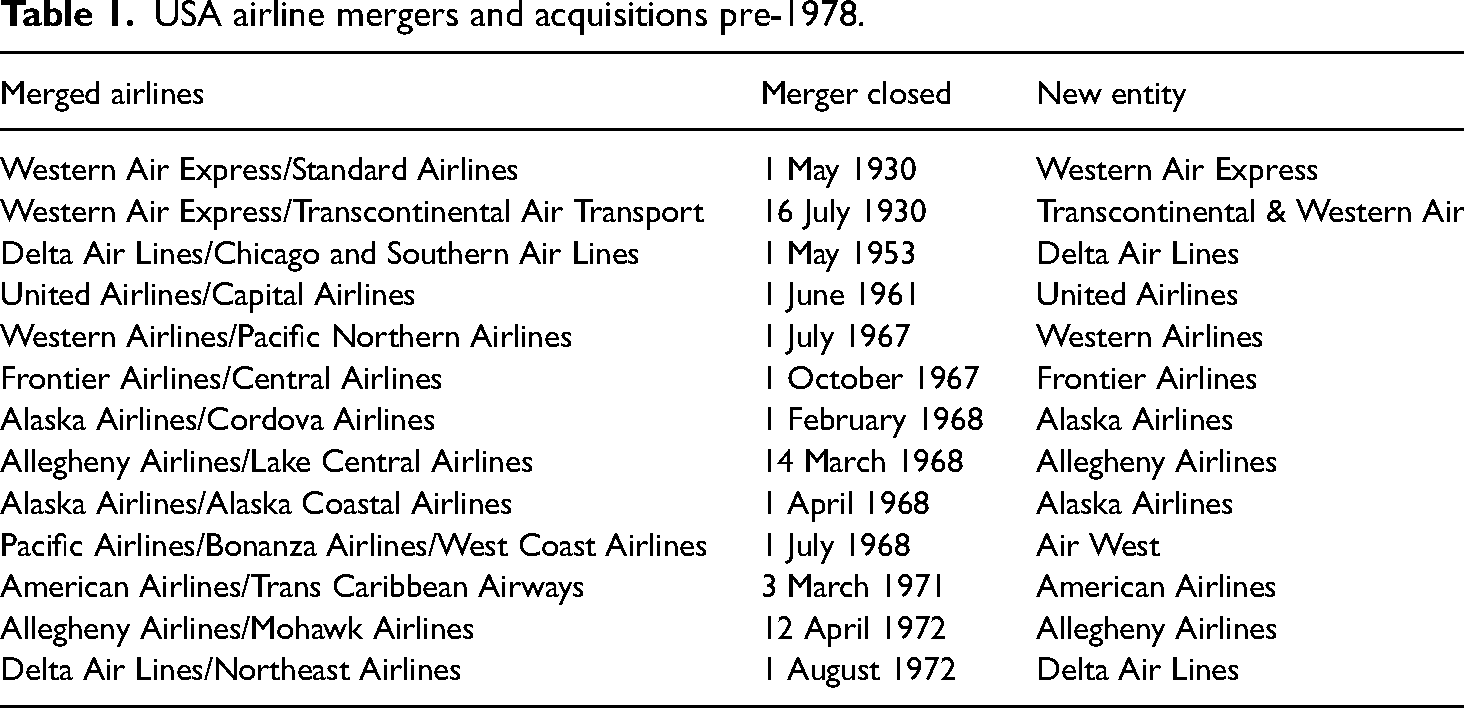
While there were critics of the US regime after World War II, it was later studies, comparing the high fares and poor service coverage in regulated interstate US markets with services in less regulated intrastate markets, that influenced policy. 14 There was additional evidence that actual fares in interstate markets when compared with those that would have emerged if airlines had minimised their costs were higher than need be. 15 From the supply side, the CAB was setting fares by averaging costs across services without allowing for differential local conditions thus increasing the financial burden on carriers, an issue exacerbated by administrative lags between cost changes and permitted fare adjustments.
At the macroeconomic level, the global stagflation of the mid-1970s, with its high unemployment combined with inflation, saw pressure grow in support of supply-side economics with its greater reliance on market forces and liberalization. 16 In the airline context, the issue was whether to leave the regulatory system as it was, extensively modify the extant regulations, or to deregulate the industry. Liberalization came in the US with the passing of the Air Cargo Deregulation Act in 1977 and the 1978 Airline Deregulation Act; much of the rest of the world followed over subsequent years.
The concept of potential competition
The idea of contestability
The 1978 Act removed most of the economic regulations covering interstate airlines and sunset the CAB. A concern of traditional economists was that the Act could lead to further concentration of an industry in which the number of suppliers had already declined under regulation. William Baumol and co-scribes, however, had been jotting away arguing that, under appropriate conditions, monopoly or oligopoly supply could result in optimal economic outcomes on a par with competition. 17 They felt that market liberalisation, by allowing for the threat of competition from existing carriers expanding into additional markets, together with new carriers emerging, would constrain incumbents from extracting monopoly rents. Under these “contestable conditions,” the potential of hit-and-run entry by new suppliers into routes, if not the overall market, would keep airline pricing honest.
It was appreciated that contestability only represented an imperfect “weak invisible hand” compared to actual competition when it came to ensuring economic efficiency, and there remained the issue of what exactly is meant by imperfect contestability. Nevertheless, advocates felt that on individual routes there were few sunk costs to impede new airlines from posing hit-and-run threats to incumbent monopoly carriers if the latter tried to exploit their market domination.
Contestability theory had emerged in a series of papers and reports produced by Baumol and others many of which preceded the enactment of the Airline Deregulation Act. Much of the formalisation came later. The notions underlying the theory were, however, well known to key members of the CAB, and most notably to Elizabeth Bailey, and its advisors such as Michael Levine, although not accepted as important by all. 18
The 1978 Act opened the market to new entrants that met conditions consistent with safety and the environmental regulations of the day, with only the capacity of the infrastructure and their own efficiency imposing economic barriers. Similarly, fares were deregulated. The event provided material for extensive study both within the US domestic market and between domestic and international markets such as the EU, where traditional regulatory regimes endured longer. 19
Although detailed calculations are sensitive to the period considered, the markets served, and the statistical methodologies deployed, average fares were generally found to have fallen, with most seats initially being sold at discounted fares, and later at the lower end of a spectrum of dynamically differentiated fares. Table 2 offers some illustrative data. The number of services increased as open entry led to hub-and-spoke route structures. Creating an array of coordinated, indirect as well as direct services as low-cost carriers, such as Southwest, began servicing secondary airports. Load factors rose from about 55 per cent to something over 60 per cent by the late 1990s, and to over 80 per cent by the 2000s, with many seats being filled by lower-income and leisure travellers. Initially, there was instability as carriers entered and left the market during the transition, and as mergers occurred. There were some thin route abandonments and higher fares on specific shorter routes or where demand was high.
Trends in the USA airline market from 1960 to 1995.
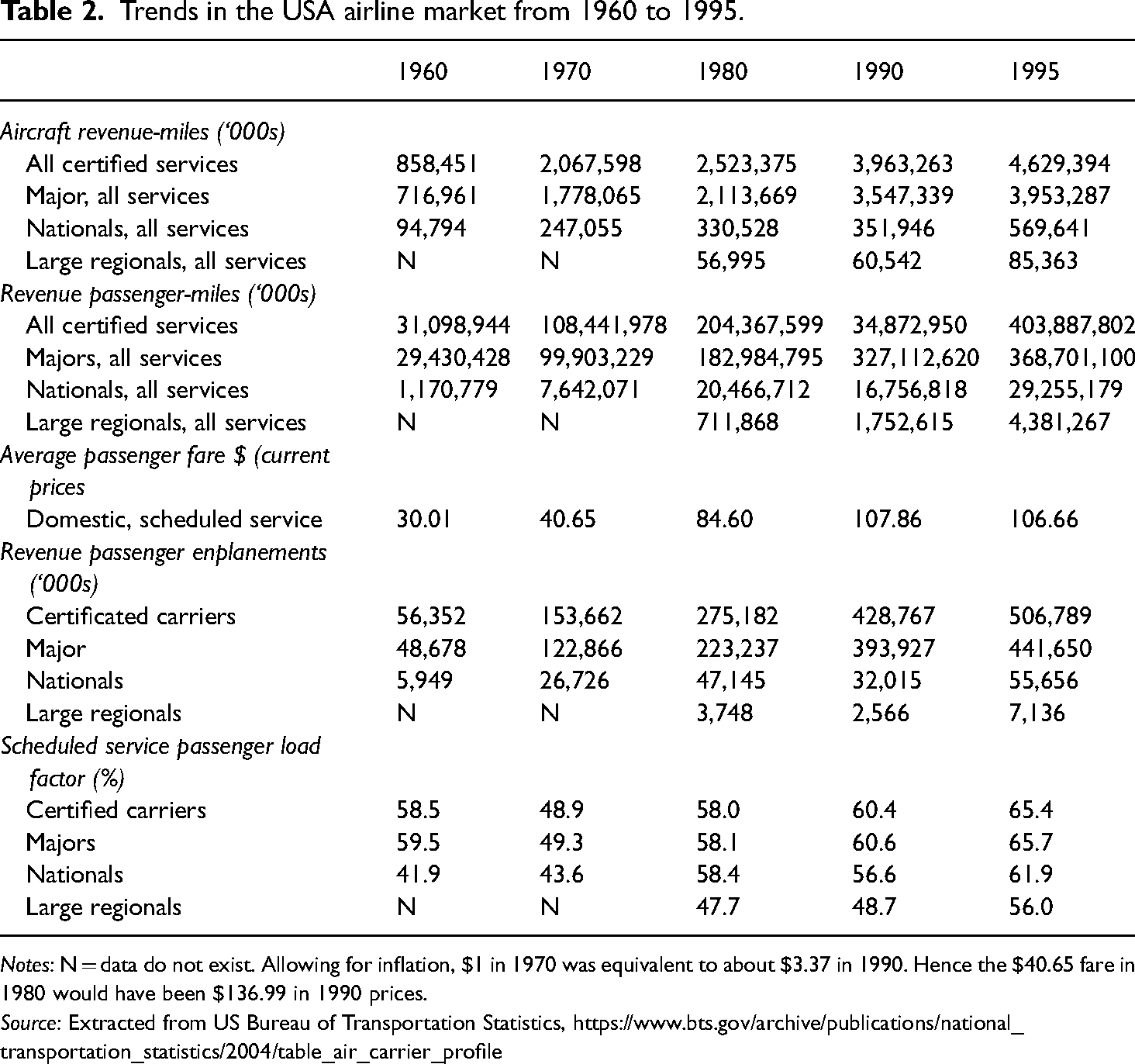
Notes: N = data do not exist. Allowing for inflation, $1 in 1970 was equivalent to about $3.37 in 1990. Hence the $40.65 fare in 1980 would have been $136.99 in 1990 prices.
Source: Extracted from US Bureau of Transportation Statistics, https://www.bts.gov/archive/publications/national_transportation_statistics/2004/table_air_carrier_profile
But from a new behavioural economic perspective, the interest lies not in the overall effects of the legislation, but rather in the extent to which these changes were due to contestability – the effects of potential entry – as opposed to the actual competition that accompanied deregulation. It took some time for the market to settle after the passing of the Act, partly because the changes were phased in with full-fare flexibility only coming in 1980 and because the infrastructure used by airlines, airports and air navigation services remained largely in local or federal ownership and isolated from market forces. 20 Added to this there was a portfolio of macro- and micro-economic measures introduced into the economy by the Carter, and then the Reagan administrations to combat Stagflation.
The outcomes
Initial empirical support for the role of potential competition came from findings that fare trends were consistent with the premise that medium- and long-haul routes were nearly perfectly contestable by the late 1970s and early 1980s. 21 Subsequent analysis, however, was less encouraging. Moore, looking across a range of US markets found that the addition of a single carrier in a medium- or short-haul market had reduced fares by 15 per cent in 1983 relative to those in 1976. Perfect contestability would have shown no such reduction, the threat of competition would have been sufficient to minimise fares. 22 Further, where actual competition expanded when low-cost carrier Southwest Airlines entered the market, aggregate fares fell by $12.9 billion in 1998, whereas potential and adjacent competition on other routes produced a saving of only $9.5 billion. 23 Overall, evidence produced by the Brookings Institute pointed to potential competition exerting minimal impact on incumbents unless there are three or more prospective entrants. 24
The longer-term view is summarised by early advocates of open markets, Baumol and Willig, who felt that the evidence showed that transport by truck, barges, and even buses could be more contestable than was the deregulated passenger air transport. This led to a substantive finding that the airline industry is not perfectly contestable but is imperfectly contestable. There was, in fact, a gradual acceptance after several years of deregulation that the contestability benchmark did not hold full sway. 25
Why were contestable effects not stronger? It may be because sunk costs were greater than assumed, with, for example, incumbents enjoying grandfather rights over prime runway slots, or having ground facilities, such as gates and lounges, available. Potential entrance also encounters non-recoverable costs of advertising services as well as loyalty payments to overcome the tendency of passengers towards inertia and to overcome hysteresis when picking carriers. 26 Additionally, there is the matter of the possible reactions of incumbent carriers – for example, predatory fare or capacity adjustments supported by cross-subsidies from other, including international markets. 27 But, despite the empirical findings, and the somewhat defensive reactions by many original advocates of contestability, there is evidence that potential competition does affect the behaviour of existing suppliers, but is much weaker than actual competition.
Asymmetric information and computer reservation systems
Before 1978 most ticketing was done through travel agents or directly at airline retail outlets with fare discrimination only allowed between the regulated coach fare and a 50 per cent higher business class fare. Early computer reservation systems (CRSs) were introduced in 1957 but only became important tools for handling airline bookings after the 1978 Act. By 1985 over 90 per cent of USA travel agents, however, were using them.
To begin with, airlines deployed CRSs in juggling the relative importance for customers of factors such as fares, the length of the flight, how close the actual departure time was to the desired time, and whether the flight had a connection. The Sabre Global Distribution System (SABRE), developed by American Airlines in 1960, was used in this way until 1976 when it became available to external travel agents. While initially intended to speed up neutral search and booking processes for the agents, in 1982 Americans found the latter selecting flight appearing on the initial line of data more than half the time, and 99 per cent of the time the selected flight was on the first screen. This provided an incentive for the airline to adjust its listing formula to favour its own flights. 28 It played upon behavioural observations linked to the notion of bounded rationality and, in particular, satisficing and inertia, in decision-making by consumers and agents. 29 Additional were halo effects with the award of financial and other incentives to agents favouring the CRS’ parent airline's services.
This manipulation of information, with the added asymmetry that airlines could make use of CRS data to develop their dynamic yield management tools – essentially charging what customers were willing to pay for a seat – led to US Justice Department investigations of airline-owned CRSs. 30 In 1984, this resulted in biased search results being made illegal – essentially boosting the information available to potential passengers. 31 The EU adopted similar measures, albeit slightly later. 32
In retrospect, whether shoving of this kind was needed can be debated, especially because US regulations were subsequently abandoned in 2004. 33 They did not seem as needed with the unanticipated appearance of independent countervailing markets in the form of global distribution systems (GDSs) – for example, Galileo and Amadeus in Europe in 1987 and Worldspan in 1990 in the USA – that removed much of the information bias. 34 These are computerised network systems that enable transactions between travel industry service providers; mainly airlines, hotels, car rental companies, and travel agencies. The systems use real-time inventory (e.g. flight and seats available) from the service providers. In other words, the shoving was done by new actors in the market.
Landing/take-off slot auctions
Airlines are dependent on a variety of surface infrastructures, runways being an obvious necessity. Several underlying issues of runway economics have attracted the attention of behaviouralists but a particular concern is with the allocation of take-off and landing slots. 35 In the USA, slots at most airports were traditionally allocated on a first-come, first-served basis. Fees for using slots were based mainly on aircraft weight, a reflection of the damage done to runways and aprons by the movement of the metal, but less reflective of the congestion that began to emerge as the industry grew but with airport capacity remaining roughly constant. 36
In 1968, the US federal authorities sought to administratively match supply with demand for airport capacity at acutely congested airports, and especially those with serious peak-load issues, by following the European practice of establishing scheduling committees. This saw the establishment of quotas for airlines by committees made up of incumbent carriers and CAB representatives. The committees met twice annually and most slots were grandfathered to incumbent airlines.
It was anticipated that any regulatory reform in the mid-1970s would likely put even more pressure on the runway capacity of major airports. The CAB put into motion, studies of alternative methods for slot allocation. A group at the California Institute of Technology initially looked into ways committees behave when it comes to allocation processes. To come to grips with the behaviour of the slot scheduling committees, experiments were then conducted. 37 These involved developing a unanimity voting game without side payments. The committees, composed of airlines each focusing on its own interests, saw carrier submitting claims for slots which inevitably exceeded the capacity available. Negotiations then proceed between the members and between the members and the chair. While most of their initial thinking involved committees in general, the CAB honed in on market-based slot allocation.
The outcome of the experiments provided a basis for proposing a more economically efficient slot allocation system. This involved separate primary markets for slots at each airport, the latter allocated through sealed-bid auctions at regular intervals. To handle the primary market's lack of provision for take-off/landing slot complementarities, an after-market computerised auction would follow with the revenues earmarked for airport expansion. 38
US slot markets were subsequently implemented in April 1986 under the high-density rule whereby slots could be bought, sold or leased for any consideration and time period. This generated opposition from potential new entrants who argued the markets did not facilitate their entry. As a consequence, the Federal Aviation Administration Authorization Act of 1994 empowered the US Department of Transportation to grant exemptions from the high-density rule in 1997. Subsequently, slot restrictions were entirely phased out at O’Hare in 2002 and at Kennedy and LaGuardia in 2007, and liberalised slot exemptions were introduced at the fourth. The result, as may be expected, was increased congestion and delays with the Federal Aviation Administration placing limitations on flight operations at several facilities. 39
Studies of the effects of the systems used at the high-density airports concluded that although the slot markets at the four involved may have had the potential to increase the degree of competitive entry and the efficient use of scarce resources, the markets did not function effectively. The number of slots sold to new entrants was too limited to allow them to increase their presence at excessively congested facilities. Indeed, slot sale transactions were usually conducted between financial institutions and carriers, or between related airlines with incumbent carriers’ manipulative or strategic behaviour impeding the functioning of markets. 40
Loyalty programmes
Economic man is continually updating information and reacting to new situations. Behavioural economics, however, has found that people place irrationally high values on objects they possess versus those they do not – the endowment effect. 41 In addition, updating information is not a cost-free activity. The collection and processing of information by potential customers have become more challenging with unbundling involving multiple cabin classes (e.g. United Airlines has economy, economy plus, premium economy plus, and Polaris cabins in its larger aircraft) and a potpourri of service add-ons that can be purchased prior or on a flight.
To be rational in situations where decisions extend beyond the price and convenience of the itinerary, economic man would need complete up-to-date information, be driven by cognition rather than emotion, and would have to be gifted with high computational ability. They would need to be consistent with regard to the axioms of choice. For example, when looking for a travel option from X to Y, a rational consumer observes and fully understands all alternatives, including ancillary services and bundles, and is able to rank them. In practice, individuals very seldom exhibit unbounded rationality and are also driven by emotions, previous experiences, social biases, and fringe benefits.
Airline loyalty programmes – frequent flyer programmes – seek to leverage this effect with regular passengers earning status based on formulae incorporating such as the annual mileage flown, the number of flights, and the money spent with the particular airline. The threat of loss of status or a desire to gain additional status can motivate some people to take additional trips, upgrade their tickets, or select inconvenient routes to retain their status. Individuals may deliberately schedule layovers to maximise mileage. There are benefits for airlines in retaining passengers as well as attracting new ones. If the traveller makes regular trips, for instance, this reduces fluctuations in cash flow for the carrier.
Boarding passes have status boldly printed on them as an immediate reminder throughout the boarding and flight process and passengers are seated in order of status, leaving others see to who boards first. They may receive inexpensive tchotchkes from the airline celebrating status, such as luggage tags, free on-board snacks and beverages, and membership cards. Added to this, passengers with loyalty status accrue points at a higher rate, creating a self-fulfilling cycle whereby the airline's desired outcome (more flights sold) feeds into the passenger's desired outcome (not losing status).
Forms of frequent flier programmes have been used since the 1970s to reinforce passenger inertia in airline selection. 42 They become less potent if they are devalued because airlines confront increasing accumulations of “miles,” and increased efficiency in seat management results in more fare seats being sold. As with any currency, inflation in the value of miles occurs when there is overprinting – technically frequent flier miles can be treated as redeemable platform currencies. 43 People's behaviour regarding holding miles is the same as with any money. If there are expectations that the supply of the currency exceeds the goods that are available then people will stop holding them – in this case, use miles up and then switch to another airline. Partly to counter the behaviour, carriers also regularly adjust the criteria for gaining miles.
Added to this is the principal–agent issue. Many business tickets are paid for by employers (who also normally keep the “miles”) but the decisions to fly, the airline to use, the class of travel and other attributes of the trip may be decided, at least in part, by the employee. The agency problem arises when there is a lack of alignment in the objectives of the two parties as assumed in neo-classical theory. Owners of firms often cannot observe directly and accurately the key day-to-day decisions of their employees (including managers). Business owners may seek the cheapest means of travel while the employee prioritises comfort and the acquisition of frequent flier miles. In this very naïve case, while the company owner (or shareholders) may be viewed as acting in a neo-classical way, the behaviour of the employee who makes the final decision is more complex. This leaves airlines with opportunities to exploit wedges between principals and agents, and in particular, the way frequent flier programmes are constructed.
Airline safety
Robert Shiller has made a number of contributions to behavioural analysis, the most recent involving the role of narratives in influencing behaviour. 44 Stories affect people's attitudes in many spheres, including decisions in aviation. Some of these are war stories told by previous travellers while others are more general impressions conveyed by the media, not just in terms of factual information, but in terms of the weights given to specific items and the way they are presented. Some of this is useful and a natural component of any market, but it may also be subjective, selective, and biased.
The most obvious example of where narratives play a role in people's air travel decisions involves the “fear of flying.” About 5 per cent of US citizens have aviophobia (or aviophobia) so severe that they cannot fly although the chances of being killed in an airline accident are about 11,000,000 to 1. Indeed, sometimes there is a greater chance of dying from not-flying. For example, the death toll from the 11 September 2001 attacks on New York and Arlington has been calculated as 2,300 higher than reported because of the people who switched out of air travel to the use of their cars. 45 Flying has also become progressively safer with advances in aircraft and aero-engine design, more sophisticated air navigation systems, and better training of personnel. But there remains the central paradox of aviophobia – dying in a plane crash is highly improbable while remaining vividly possible.
Research into the most effective ways to treat or manage fear of flying is notoriously difficult (as it is with other counselling or behavioural interventions) because of the inability to include a placebo or other control arm in such studies. 46 Studies do find, however, that media coverage, the stories reported, and their “slant” have an adverse effect on air travel. 47 Anxiety is serious enough for airlines to have a history of seeking to boost the confidence of potential passengers by offering “educational” courses and, more recently, online material. 48
In terms of accident prevention, nudges, and in particular checklists have also been used for some time in improving the safety record of airlines. The concept of a pre-flight checklist was first introduced by management at the Boeing Company following the 1935 crash of the prototype Boeing B-17 in Dayton, Ohio. The pilots, both of whom were killed, had made a mistake with one of the new controls leaving the elevator and rudder controls locked. After an enquiry, it was decided that the plane had been too complex for one man's memory and checklists were introduced. There was already considerable evidence from such diverse fields as surgery and mechanical servicing that the use of carefully structured checklists can enhance efficiency. 49 Airline crew and aircraft mechanics are confronted with a variety of checklists in their jobs, both pre-take-off and whilst in flight, but as Vats et al. find there is a need to bespoke the lists according to the groups involved. 50
The unbundling of airline services
In the mid-1960s, the Australian economist Kelvin Lancaster developed a model of demand similar to the neoclassical framework but differs from it. As he puts it, “The chief novelty lies in breaking away from the traditional approach that goods are the direct objectives of utility and, instead, supposing that it is the properties or characteristics of goods from which utility is derived.” 51 As implied earlier in the quote by Munby, few people travel for the enjoyment of it per se, but rather from the portfolio of services they reap from it – the economy, speed, convenience, safety, etc., of the transport being offered for reaching their desired destination.
The pre-1978 approach by regulators to airline pricing focused on carriers providing limited classes of services – “coach” and “first” class in the US domestic context – each embracing standard features such as assigned seats, checked baggage allowances, refreshment, amount of leg room, etc., with a measure of average cost being the basis of fare determination. But people are different and seek diverse things from air travel. Subsequently, after the enactment of the US 1978 Airline Deregulation Act, one of the less frequently predicted outcomes was the extensive unbundling of services by carriers, basically selling the individual characteristics separately. 52 The airlines appreciated that there is diversity in the behaviour of their potential customers.
Airlines began to set their fares according to the willingness of travellers to pay rather than cost. Immediately after 1978, airlines took advantage of the discounting the CAB allowed on the estimated standard fares to fill their remaining capacity. The situation now facilitated pricing under a demand curve that revealed itself as seats were filled. Subsequently, airlines not only improved their fare setting by gleaning more information on the prior behaviour of individuals and groups, but also adjusted the products they offered. 53 The advent of computerised ticketing allowed a variety of nudges and boosts to be deployed seeking to tempt customers to purchase a range of supplementary services. 54
The longer-term aim of most airlines has been to personalise offers made to consumers and price them according to the value enjoyed by each. This has resulted in a huge number of price/characteristic combinations being made available. More rapid capacity and fare adjustments require a better understanding of human behaviour relative to purchase decisions with fares being modified in real time to meet shifts in customers’ preferences. One can think of the use carriers make of customers’ characteristics to boost the latter's purchases of seats by presenting salient information to them, as well as nudging them by moulding services to their specific characteristics, for example, in terms of unbundling the services offered. 55 Airlines use big data as part of design-based control and big data-based analytic nudges have rapidly gained in potency because of their networked, continuously updated, dynamic, and pervasive nature – hence the term “hypernudge.” 56
As for measuring their effects on travel, it has been found that baggage fees do not affect the airline chosen by travellers departing airports in the Washington–Baltimore area and that passenger demand is more sensitive to increases in base airfares than baggage fees. 57 Additionally, choices of premium seats are impacted by the load factor, as customers are more likely to purchase them when window and aisle seats are all full. The proportion of ancillary revenues earned by the eight largest US airlines from unbundled supplementary products is an increasing share of operating revenues, especially for low-cost carriers. However, the elimination of ticket exchange fees, but more widespread use of baggage and seat reservation fees, has added complexity to passengers' decision-making. 58
The impact of COVID-19 on the airline business from 2019 further highlighted the need to create new ways of addressing consumers. Post-COVID-19 travellers are less prone to base decisions on historical data and are more in tune with recent observations of consumer choices and the competitive nature of available alternatives. One idea, following the International Air Transport Association's New Distribution Capability (NDC) initiative, to cope with this is to supplement the role of intermediary global distribution services such as Amadeus, Sabre, and Travelport, by having airlines dealing more directly with potential customers. 59 Carriers, including American Airlines, adopted NDC approaches during the recovery phase after COVID-19 when travel capacity fluctuated and an uncertain competitive landscape emerged.
Environmental measures
The deregulation of airline markets since the late 1970s has produced considerable improvements in airline efficiency, including the environmental costs per unit of output. This has largely been brought about by increased competition leading to the uptake of more fuel-efficient hardware – aircraft fuel efficiency has risen by over 1 per cent per annum since the 1990s – and the adoption of speeds, aircraft types, and routings that save fuel. 60 From a traditional economic perspective, it would seem that actors have been rational, have good information and the market has largely worked. But the problem is that whilst technology and new operating practices have led to less emission per passenger, the number of passengers has increased more than in proportion.
One difficulty in reducing airlines’ CO2 emissions is that there are no immediately available and commercially viable non-carbon fuels to replace kerosene. The initial official policy approaches often involved shoving the market using Coasian-styled cap-and-trade arrangements in accord with the idea underlying the 1997 Kyoto Protocol. For instance, airlines’ CO2 is embodied in the EU's Emissions Trading Scheme. 61 Because this involves international payments and policing, however, it was found politically unacceptable to many; airlines objected and it has been largely ignored outside of Europe.
Some airlines had been nudging passengers to pay off-set fees from the 1970s. The UN's International Civil Aviation Organization adopted the idea as official policy in 2016 and by 2018 more than 70 of its 191 members had joined. Carbon or greenhouse gas offsets are certified emissions reductions or sequestration that can be purchased to counterbalance emissions from flights. 62 Voluntary carbon offsetting (VCO), however, is not normally seen as a sufficient response to climate change but rather a supplement. Less than 10 per cent of passengers using airlines offering VCOs made purchases. This is partly due to the low perceived credibility of the schemes. For example, when 63,520 passengers of a European airline were questioned, the majority felt that existing carbon offsets had minor integrity 63
It has been found, however, that over time the effects of aviation offsets become stronger with global policy knowledge and perceived effectiveness of climate change policies playing a role. 64 Part of the problem seems to be that the public's knowledge about offsetting remains limited. A study at Gothenburg Airport, Sweden, for instance, found that in 2007, 76 per cent of the passengers were not informed about offsetting possibilities and only 2 per cent paid compensation. 65 It was concluded that air travellers put their own responsibility last when dealing with the environmental consequences of their air travel. Breaking down passengers by type shows international tourists to Australia between 2008 and 2010 were more likely to compensate than business travellers. Evidence from Australia and the UK also shows that while some consumers think carbon offsetting payments are a cheap and easy way to combat climate change, others use this as an excuse to carry on their negligent consumption pattern. 66
It seems participation rates in offsetting schemes can be boosted by appropriate targeting and providing better and more germane information – studying finding that fully explaining voluntary schemes increases the intentions of passengers to pay for offsets. 67 Relating VCOs to the local impacts of climate change also seems to have a positive effect on participation. But most importantly, “presumed consent” where the cost of mitigation is included in the price of flights, with opting-out possible, offers a more powerful nudge. 68
Responding to the failures using opting-in, the UN in 2022 initiated its Carbon Offsetting and Reduction Scheme for International Aviation (CORSIA), to be implemented in 2027. Seen as a second-best approach to the climate change issue this is a clear shove aimed at carbon-neutral growth goals based on verified carbon offsetting. 69 With CORSIA, fuel efficiency in flight operations has a more direct impact on airlines’ profitability than before and it is hoped will stimulate more fuel-efficient flying.
At a micro–micro level, evidence of the effectiveness of behavioural practices in influencing environmental behaviour is scarce. We do know that kerosine consumption is influenced by pilots’ actions when manoeuvring during flight and modified training and more precise information can affect route selection. 70 In a study measuring Virgin Atlantic airline captains’ productivity, four management nudging practices were compared: performance monitoring, performance feedback, target setting, and prosocial incentives. 71 These, but particularly monitoring and target setting, significantly increase captains’ tendency to reduce fuel burn with both positive spillovers on job satisfaction and CO2 emissions. The data from more than 42,000 flights revealed fuel savings of £3.3 million (in 2014) prices and CO2 emissions reductions of over 23,500 tonnes.
Conclusions
From the oft-repeated quotation opening this essay, it is clear that Keynes had considerable belief that it is ideas that are the essence of human activity. What is often not cited are his observations that follow, namely that the impact of ideas is, “Not indeed, immediately, but after a certain period, … soon or late, it is ideas, not vested interests, which are dangerous for good or evil.” 72 The aviation examples presented here offer some, although not solid, confirmation for this. It has taken time for many of the relevant behavioural features of NBE to be refined, applied, and evaluated. Keynes suggests that generally it can take 25 to 30 years and this has broadly what we have seen regarding airlines.
From a transport economics perspective, where pragmatism is often important, the rise of NBE is particularly challenging in the sense that no single, comprehensive theory integrating psychology and economics has emerged. The application of behavioural economics to matters pertaining to airlines is, therefore, patchy. On the other hand, the micro nature and distinctiveness of many air transport markets almost demand individualism in approach.
So, has the NBE helped us gain a better understanding of the history of airline markets? Have Keynes’ academic scribblers proved to have been influential in shaping the madmen of business and politics? In general, the emergence of new thinking adds to knowledge but not always in an expected or positive way. This has been the case with behavioural economics. In the context of contestability, for example, it has hardly been the “Uprising in the theory of industry structure” as William Baumol had prophesied, but the empirical evidence from the airline industry does support the idea that “madmen in authority” do take at least some account of potential competition. 73 Some of the nudges and boosts that have attracted attention have had marginal effects, and, where applied, have probably not always been cost-effective. But airline history is short, and perhaps the scribes of the NBE will have more impact in the longer term.
Footnotes
Acknowledgements
The paper extends and modifies an address given to the Aviation Management and Economics Conference, Heilbronn, 29 November 2022. The author would like to thank two referees for their valuable comments that have led to extensive redrafting of the original manuscript.
Declaration of conflicting interests
The author declared no potential conflicts of interest with respect to the research, authorship, and/or publication of this article.
Funding
The author received no financial support for the research, authorship, and/or publication of this article.
