



Abstract
This article analyses the construction and circulation of representations of Portuguese mainland railways by photography in the illustrated press in the late nineteenth and early twentieth centuries before World War I. The analysis uses a methodology combining semiotics with discourse analysis in journalism, which is applied to a sample of 406 photographs published in Portuguese magazines between 1872 and 1914. This study shows how these photographs created a new railway landscape, different from that fabricated previously by photographic albums (republished in the press as woodcuts), where human agents were more present, the utilisation of railways is underscored and dire aspects of the circulation of trains (namely train accidents) are more visible. This article contributes to the field of transport history with a perspective from visual culture and to the debate about the use of photography in historical research, as a reliable primary source, much more than a mere illustrative support.
Introduction
Construction of railways in mainland Portugal began in the 1850s, one decade after the first photographers opened their studios in the country. In the 1890s, when the main trunks of the network were in operation, extending throughout over 2,000 km, the illustrated press began using photography profusely. 1 In this article, I explore how the Portuguese illustrated press represented railways in the photographs it published between 1872 (when the first photograph was printed in the press) and the eve of World War I and how it disseminated those representations nationwide to create a new railway landscape. I analyse “perhaps the nineteenth century's two most insidious agents of social spatialization”, central tools of governance and nation-building. 2 I add to the field of railway and transport history with a perspective from visual culture and I contribute to the discussion about the role of photography to create landscapes and its use in transportation history. 3
The implementation of railways in mainland Portugal was a troubled process initiated in the 1850s, when political and financial conditions allowed for large investments in public works. The rhythm of construction was uneven, depending on the political context and the availability of capital to invest and it was influenced by different agendas of various historical actors (engineers, policymakers at governmental level, army officers, private investors). The outcomes of the investment fell short of the expectations touted by its promoters but improvements in transportation were noticeable, with consequences on the unification of the market, circulation of people, goods and ideas, industrialisation of the economy and the reinvention of Portugal as a modern nation. The years between 1890 and the eve of World War I, analysed in this article, were a period of crisis and recovery, marked by the consequences of the 1892 partial default of the Portuguese treasury and the political instability of the final years of the monarchy and its replacement by a republican regime in 1910. Regardless, until 1914, the network grew more than 1,000 km and the transportation of passengers and goods trebled. 4
During the same period, photography evolved from a novelty for the wealthiest to a work tool in different areas, such as cartography, geology, engineering, medicine, criminology, crime or anthropology. Different improvements made photography simpler, more portable and less expensive, accessible to the middle classes. 5
Railway photography became a favourite of professional and amateur photographers, motivated by the appeal of steaming locomotives as icons of technological and industrial prowess and by the usefulness of cameras to engineering projects. It pioneered the field of industrial photography and it became a central instrument to promote railway expansion, industrial development and tourism. Railway companies often hired photographers to create images to promote their tracks and present them as a modern and indispensable infrastructures. 6
In Portugal, railway photography was developed in the 1880s by the German photographer Karl Emil Biel, whose work has been analysed by different authors, underpinning different aspects of his portfolio: the innovative features of his photographs, his role in publicising an idea of progress advocated by the bourgeois elites in power, in endorsing the triumph of human ingenuity (especially Portuguese engineers) over nature and in promoting a technology-based nationalism and an idea of a modern Portugal. Many have focused on the landscape created by Biel's photographs: an anthropogenic and a technological landscape, centred in large technical infrastructures and objects, influenced by the technical sublime, yet able to reconcile industrial prowess with natural landforms. Biel's works were circulated in the press through the publication of woodcuts of his photographs. 7 Figure 1 illustrates Biel's works and the type of landscape his photographs created.
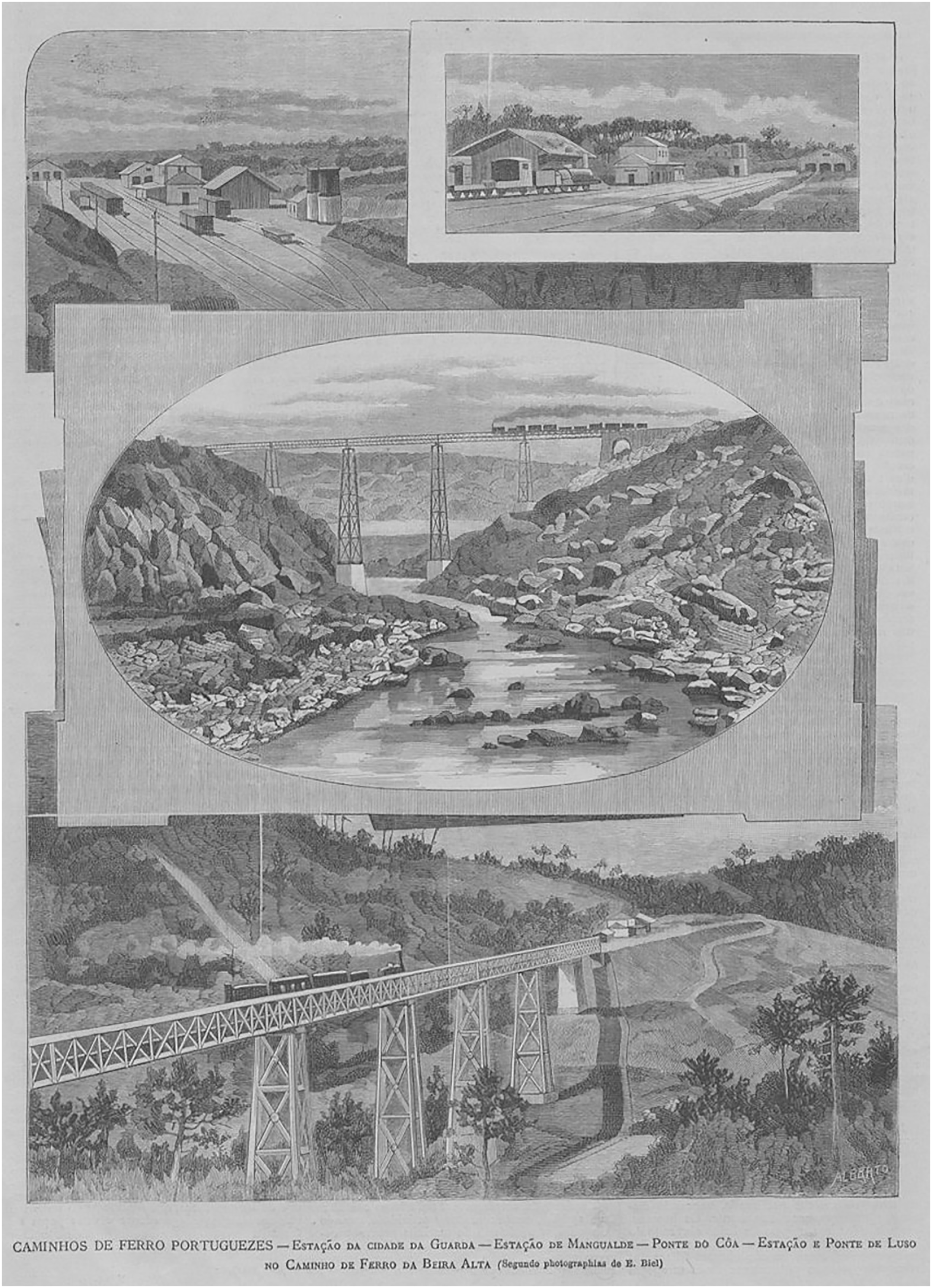
A page from Occidente with several woodcuts from photographs of Emil Biel of the Beira Alta railway in Portugal, 1882.
On a similar note, photographs of imperial railways in Portugal's colonies contributed to the creation of a landscape of progress, but also of the Europeanisation and domestication of the African territories and the civilisation of its inhabitants, although that vision was limited to the narrow regions of Africa traversed by railways. 8
By the end of the nineteenth century, with the invention of halftone, photography merged with journalism, paving the way for photojournalism. With halftone, photographs were photographed through a glass scored by a net of fine lines onto a zinc-coated plate, which was covered with acid that would eat away the ink in the lighter areas leaving the darker zones intact. Until then, newspapers seldom printed photographs, as this was technically difficult and expensive. For years, the press relied on woodcuts, an economical and easier process that, however, did not benefit entirely from the authenticity given to photographs. 9 Woodcuts failed to offer the assurance of “having been there”, as French philosopher Roland Barthes put it. 10 In Portugal, the press began using halftone to print photographs in the 1890s but it was in the following decade that the use of that technology became common and that photography became a common resource in magazines. 11
Two titles excelled in the Portuguese press for the use they made of imagery: O Occidente: Revista Illustrada de Portugal e do Estrangeiro (The West: Illustrated Journal of Portugal and Abroad, henceforth Occidente) and mostly Illustração Portugueza (Portuguese Illustration).
Occidente was first published in 1878. It was a generalist magazine that covered assorted contemporary subjects. There is no information about its circulation figures, but it had a network of distributors in Portugal and the overseas colonies. It was published twice a month until 1880 and thrice a month thereafter. It published woodcuts until 1897, when it used halftone print for the first time. 12 As for Illustração Portugueza, it was a weekly magazine founded in 1903. It published 25,000 copies per issue, each making an abundant use of photography (each number included dozens of photographs). 13
Both were expensive products, although affordable to many. A yearly subscription of Occidente had of price 3,800 réis (around £60 today), whereas that of Illustração Portugueza was 4,800 réis (roughly £100), accessible to both rural and industrial workers, whose daily wages ranged from 288 to 600 réis. 14 What is more, buyers of Occidente and Illustração Portugueza usually shared the issues and its contents with the rest of the community, overcoming the illiteracy of the Portuguese population (70 per cent by the end of the century). 15 The copious use of photography also bypassed that obstacle, as observing a photograph does not require any particular skills. 16
Occidente and especially Illustração Portugueza were the main providers of images to the turn-of-the-century Portuguese visual economy (Chart 1). Besides them, I examined other titles that did not have the same circulation span and that were directed to specific audiences. These include A Construcção Moderna (Modern Construction, published every three weeks, disseminated information about public works, construction and engineering), Annuario da Sociedade dos Architectos Portuguezes (Yearbook of the Portuguese Architects Society), Argus (another mundane publication), Panorama Photographico de Portugal (Photographic Panorama of Portugal, another generalist magazine), Revista de Obras Publicas e Minas (Journal of Public Works and Mines, edited monthly by the Portuguese Civil Engineers Association) and Gazeta dos Caminhos de Ferro de Portugal e Hespanha (Railway Gazette of Portugal and Spain, edited every fortnight, published articles on transport and tourism).
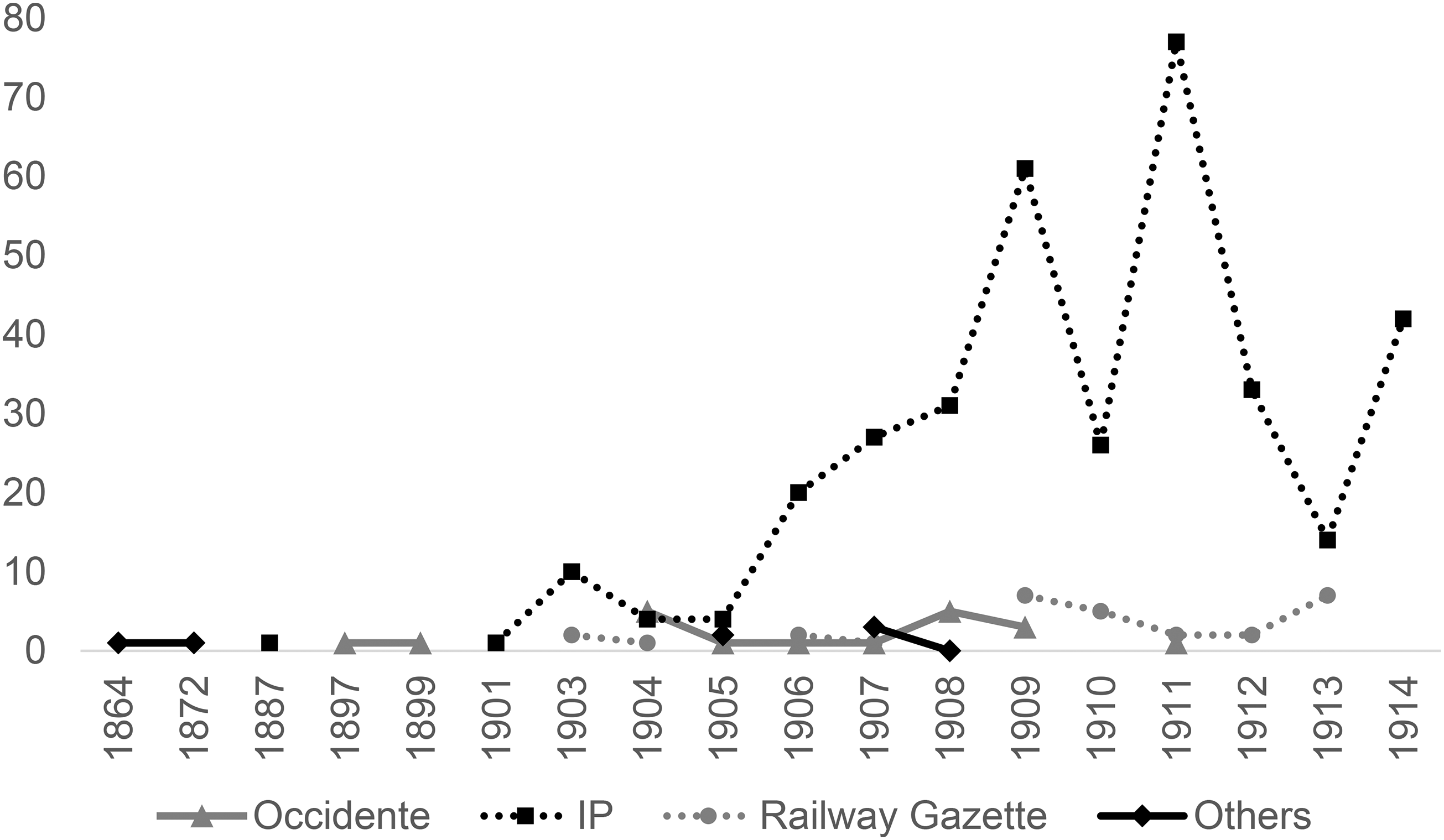
Photographs published in the Portuguese illustrated press per year and per periodical.
Examining these titles, I created a database of 406 photographs using the online tool STEMgram (www.stemgram.pt) that collects, classifies, labels and identifies people in photographs of science, technology, engineering and medicine in Portugal (Chart 1 and Figure 2). The database represents 9 per cent of all the photographs depicting activities, objects or structures related to technology and engineering found on STEMgram (industry, inventions, urban transportation, engineering works, automobility, etc.).
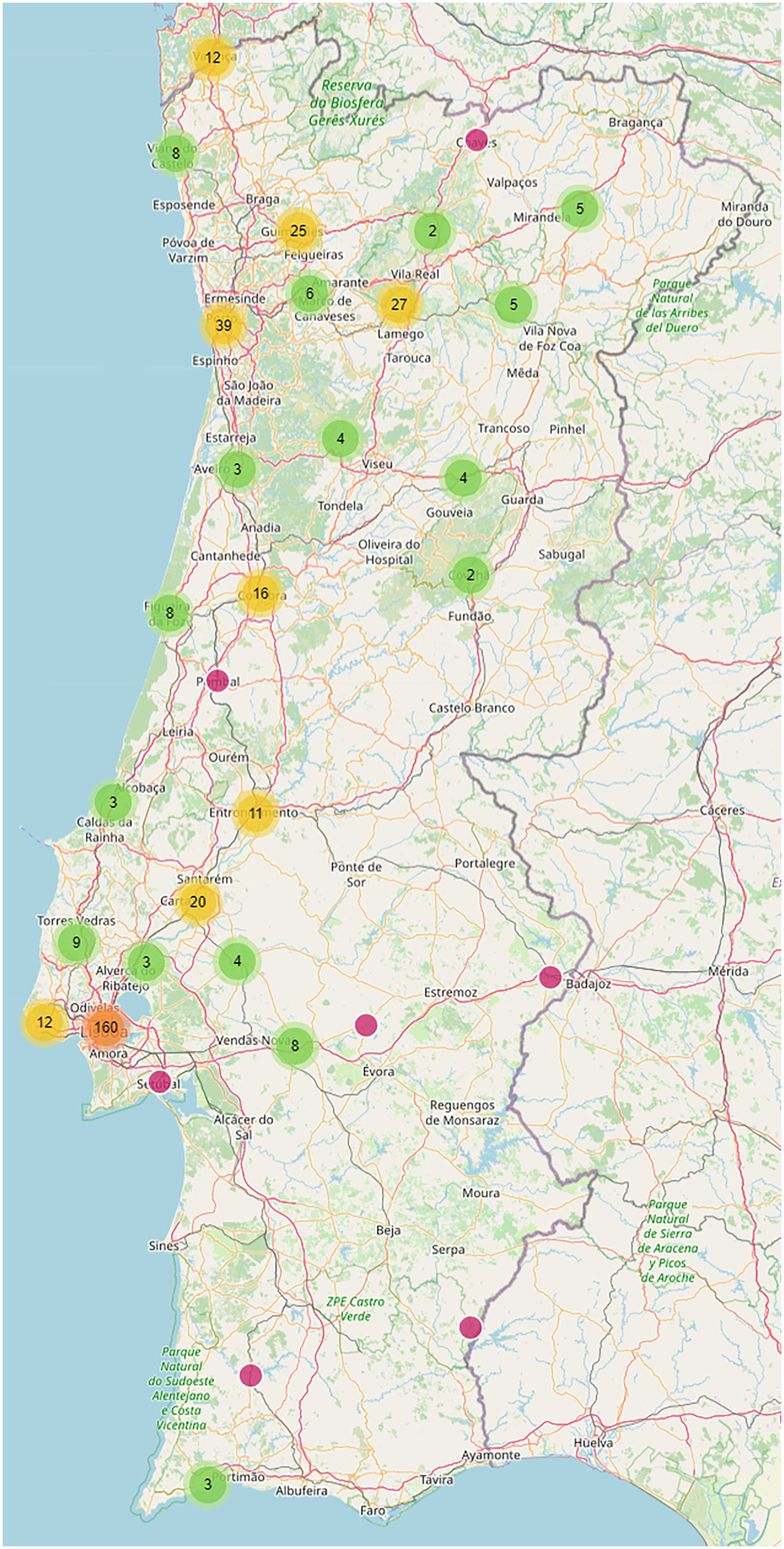
Geographical distribution of photographs published in the Portuguese illustrated press (woodcuts not included).
The collection includes record pictures and mostly promotional pictures. The former includes those photographs that attempted to capture the scene in a way as neutral as possible, neither accentuating nor cloaking any detail; their objectives are not to influence the response of the viewer but to make a strict record and matter-of-fact report for administrative or technical concerns, aimed at audiences of experts or investors, to jot down the process of construction, including architectural and restoration details and confirm the reliability of the investment. Promotional pictures, on the other hand, intend to promote rather than report, by offering a composed image bolstering the impact of railways and highlighting the expertise of engineers and their agency in transforming the territory, to manipulate or persuade the viewer. As it happened in other countries, record pictures of Portuguese railways became increasingly rarer and formal or neutral compositions gave way to growingly informal and composed pictures. 17
Figure 2 shows the geographical distribution of photographs published by these titles between 1872 and 1914 (woodcuts not included). Panorama Photographico de Portugal was the first publication to publish a railway photograph (in 1872, when the process of photographic printing was expensive). Most of the images were printed after 1900, following the implementation of halftone in the Portuguese press, mostly in Illustração Portugueza.
Methodology
This article draws from the assertion that throughout the nineteenth and early twentieth centuries, photography was accepted as an objective product that observed the immutable laws of Physics and Optics and therefore represented reality truthfully and objectively, unlike drawings or paintings that resulted from the subjective views of its authors. 18 However, photography is a subjective practice that includes personal choices (angle, objects and people portrayed, composition, etc.) and is influenced by the aims of the photographers and their patrons. 19 As a subjective practice accepted as a true depiction of reality, photography had the power to materialise abstract concepts and, therefore, to shape public opinion and create ideology, especially if it found its way to the press. 20
The illustrated press was the main disseminator of news before the electronic age. With halftone, the flow of photographs was hastened and readers were given the illusion of a direct contact with reality, of an untampered chain of translation back to the photographic referent. Photographs in the press offered an unprecedented degree of verisimilitude, authenticity, and credibility that drawings and woodcuts never had. The recurring printing of photographs led to the accumulation of small pieces of information that, put together, offered readers an interpretation of society that they could easily understand. By circulating nationwide, these publications contributed to the construction of a national interpretative community sharing common views, particularly in those societies that, like Portugal, had a limited number of periodicals in circulation in the visual economy, consumed by a vastly illiterate community. 21
The analysis of photography lacks a specific methodology, as photography is, as Barthes once wrote, a “message without a code”. 22 However, Barthes suggests some markers to interpret photographs, arguing that they have two distinct messages: the denoted message, an analogue of reality, which includes the signifier, the elements in the image; and the connoted message, how society interprets reality, including the signified, the representation that is conveyed. The accumulation of signified constructs the sign and the myths. 23
Bearing this distinction in mind, I use the methodology advanced by Brazilian communication specialist Márcia Benetti to examine the journalistic communication, adapted to the specific topic of research of this article (photographs of railways):
systematic inspection of the photographic discourses of the collection classification of photographs with related features iconographic analysis of the selected sample
24
Steps 1 and 2 were conducted using the online tool STEMgram. Focusing on the images’ signifiers and on the denoted messages, I looked for commonalities in the collection to classify the photographs in different categories, namely the object/structure depicted (infrastructure and rolling stock – Table 1) and the scene portrayed (Table 2).
Distribution of photographs according to the object/structure depicted.
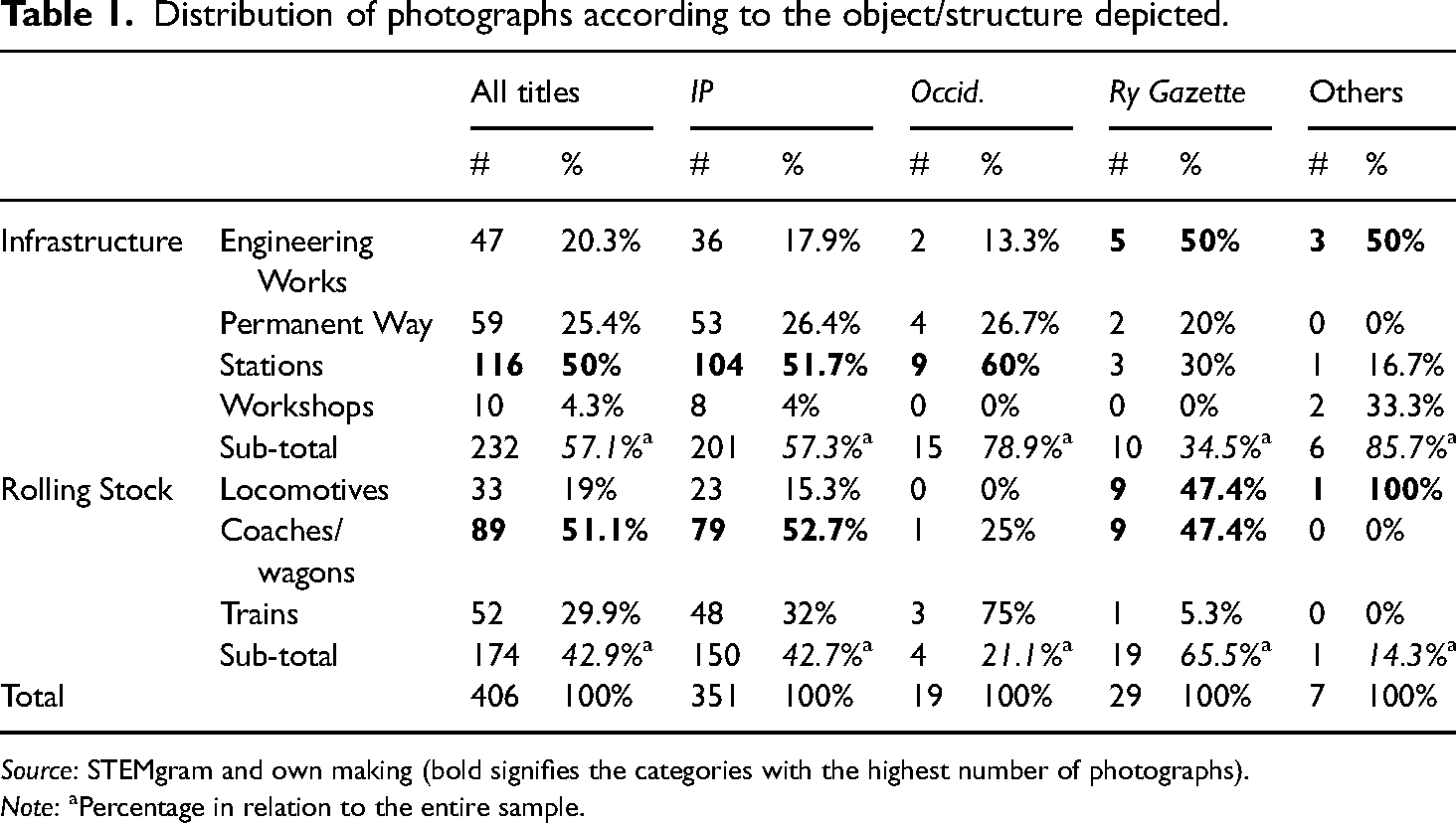
Source: STEMgram and own making (bold signifies the categories with the highest number of photographs).
Note: aPercentage in relation to the entire sample.
Distribution of photographs according to the scene depicted.
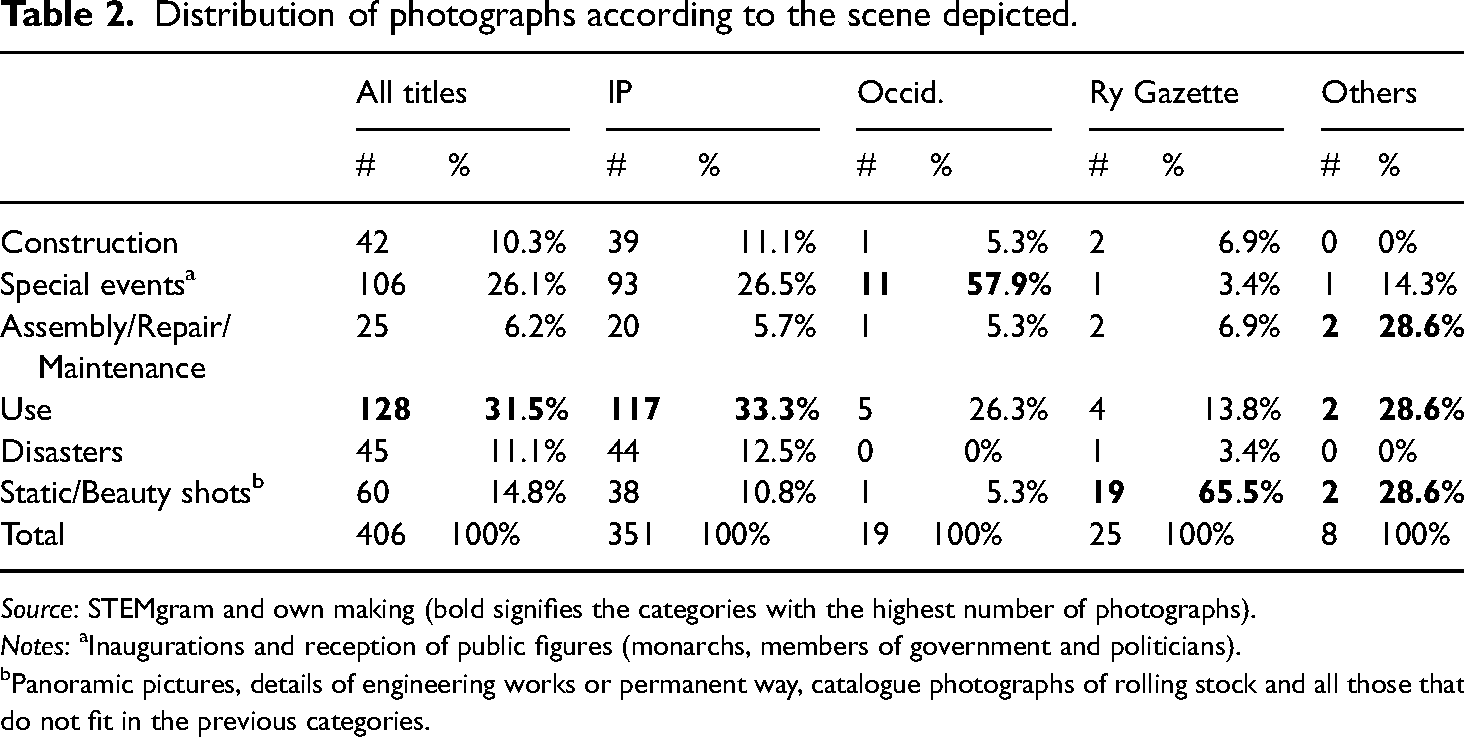
Source: STEMgram and own making (bold signifies the categories with the highest number of photographs).
Notes: aInaugurations and reception of public figures (monarchs, members of government and politicians).
bPanoramic pictures, details of engineering works or permanent way, catalogue photographs of rolling stock and all those that do not fit in the previous categories.
For step 3, I used the Barthesian connoted message described above. To correctly interpret it, it is necessary to ponder what Barthes calls the photographs’ studium, its sociocultural and historical background. Barthes underscores the “historicity of the connotation code”, that is, the interpretation of photography demands that viewers know its historical context. 25 In this vein, literature on the topic is crucial to know the photographs studium. In this article, the photographs are from a semi-peripheral European nation, with an underdeveloped transportation system that was facing financial and political challenges in the late nineteenth and early twentieth centuries.
Additionally, visual analysis of photography demands the analysis of written sources that come with or surround the images (e.g.: news pieces that accompany photographs in the press or parliamentary debates addressing the same topics as photographs). In this sense, the caption of the photographs is a central element in the analysis, considering that it underscores a detail, a reading or a concept in the image, influencing the interpretation by the observer. 26 Going back to Barthes’ approach, the caption underpins the punctum, that concrete or abstract detail that emerges from the image and pierces the mind of the observer. 27 In sum, including written sources in the analysis helps to restrict the influence of the researcher's preconceived representations and contributes to identify the signified that stands out the most in each photograph. 28
To conclude this section on methodology, I would like to emphasise the interconnections between photography and landscape, considering that I claim that photographs published in the press contributed to the creation of a new railway landscape. Like photography, landscape is a sociocultural construction too, intimately connected to the history of a territory, its appropriation and its inhabitants. 29 Authors like Jens Jäger or Robin Kelsey have underscored that “landscape as a social practice has ever since vested much of its fate in photographic reproduction”. 30 In previous works, I showed how photography is able to produce specific landscapes by emphasising and reiterating specific details in a group of images. This article focuses on railway landscapes, which are those created by the railway, including static views dominated by railway elements (engineering works, tunnels, cuttings, viaducts, bridges, workshops, warehouses, rolling stock) or those seen from a moving train, not as rich in railway icons but inducing the idea of movement in the mind of the observer. 31
Creating railway landscapes: Statistical approach
The creation of large databases of historical data permits statistical analysis, looking for regularities, repetitions, consistencies but also exceptions and irregularities that contribute to characterise historical processes. For the purposes of this article, I am interested in the geographical distribution of the sample, the people portrayed in the photographs and the type of scene and structures/objects depicted.
Figure 2 illustrates the distribution of photographs throughout the Portuguese territory. Table 3 and Figure 3 identify the railway lines that were photographed in the press.
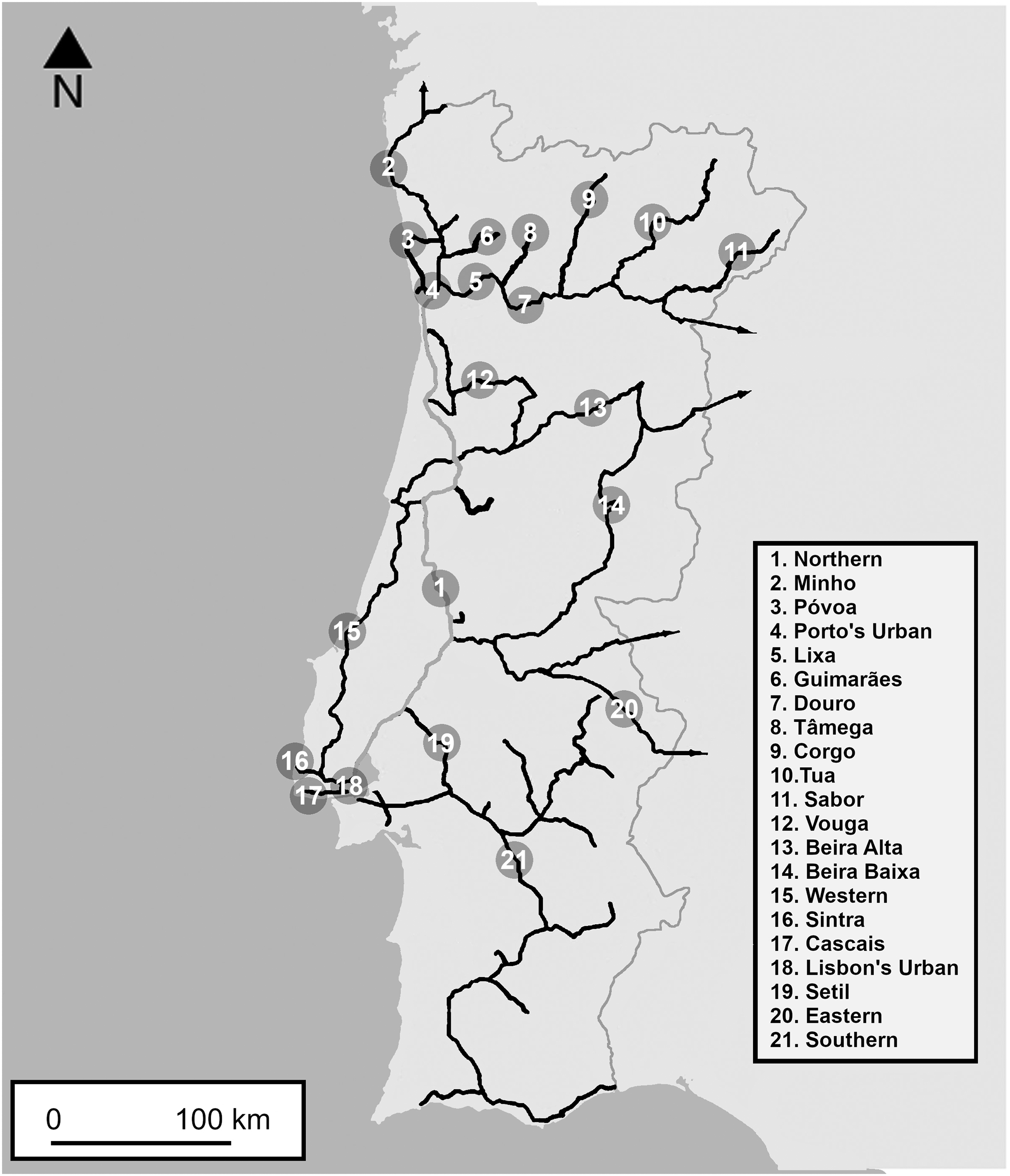
Portuguese railway network in the beginning of the twentieth century, with the indication of the lines photographed in the Portuguese illustrated press.
Distribution of photographs per railway line.
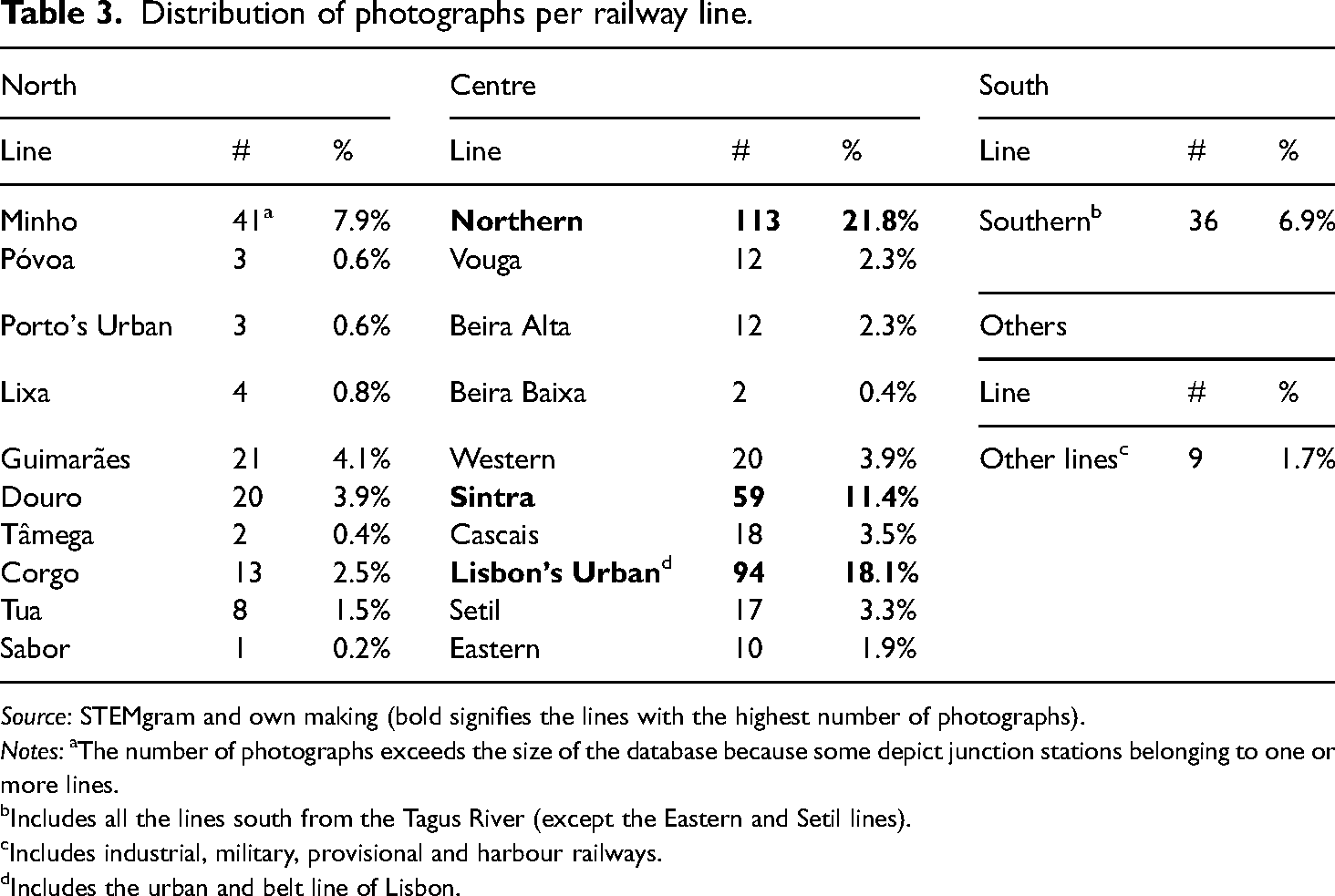
Source: STEMgram and own making (bold signifies the lines with the highest number of photographs).
Notes: aThe number of photographs exceeds the size of the database because some depict junction stations belonging to one or more lines.
Includes all the lines south from the Tagus River (except the Eastern and Setil lines).
Includes industrial, military, provisional and harbour railways.
Includes the urban and belt line of Lisbon.
Unsurprisingly, most of the photographs depict railway activity in Lisbon and in lines that had their main stations in Lisbon (Figure 4), which account for almost half the sample. Besides being the capital of Portugal, Lisbon had four central stations (Santa Apolónia, Rossio, Alcântara and Cais do Sodré) and five trunk lines (Northern, Western/Sintra, Cascais, urban and belt railways) and it was where the headquarters of the magazines analysed in this article were located.
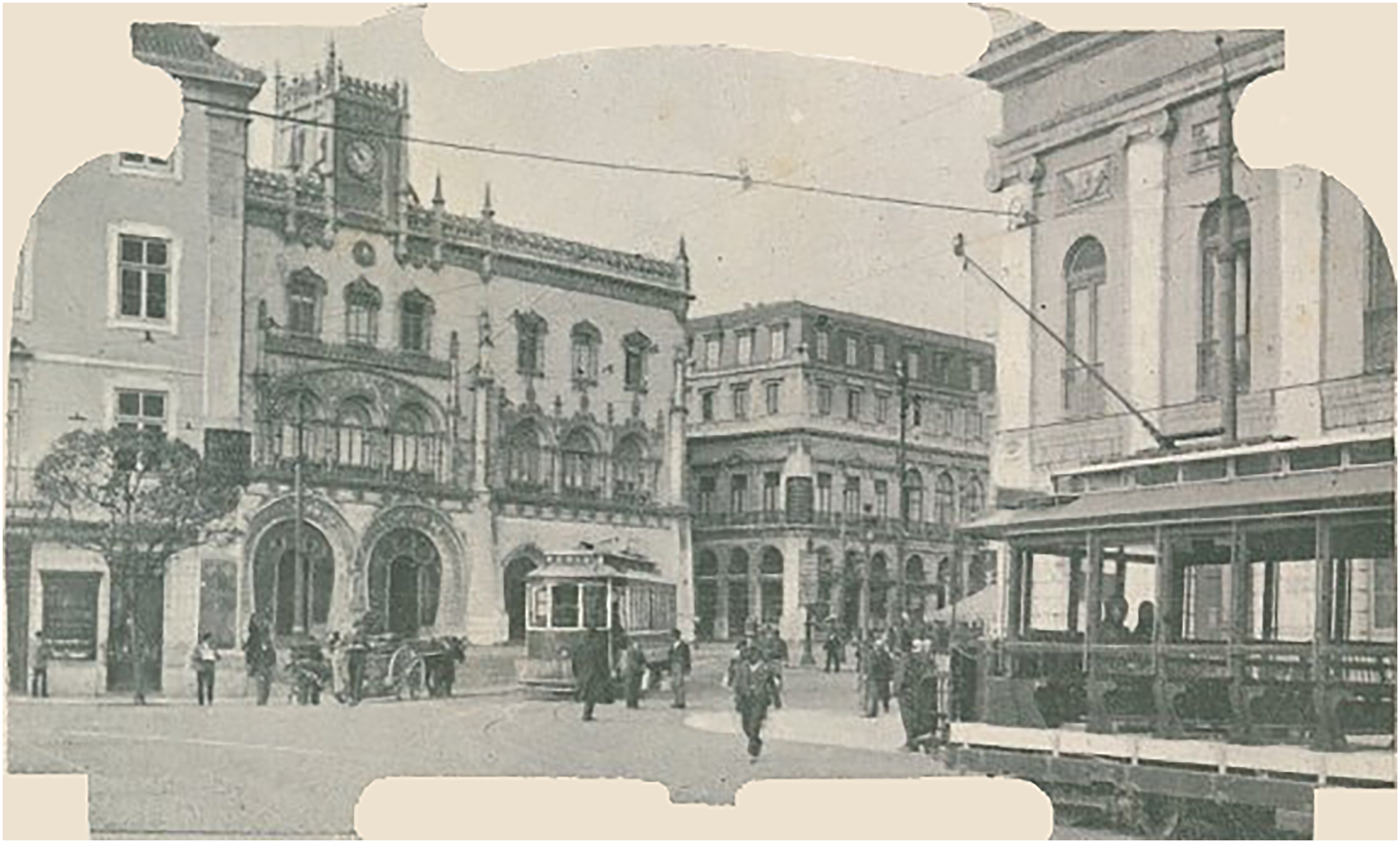
A view of D. João da Câmara Square, crossed by two trams, the Rossio station (centre left), the Avenida Palace hotel (centre right) and the D. Maria I theatre (right) visible. The station was much more than the terminus of urban railways; standing between the Rossio square and the Liberty Avenue (two central arteries of the capital), it became the centre of Lisbon, where trams flocked, taking the elites to the theatre, tourists to the high-class Avenida Palace Hotel and common people to multiple social and political events. Aptly enough, the original caption underpins the “seduction of Lisbon”.
The Northern line was the most photographed railway in the press. It was the most important of the entire network, with the highest volume of traffic of goods and passengers, connecting the two major Portuguese cities: Lisbon and Porto (where another important station – Campanhã – was located). In Lisbon, the attention devoted by photographers to the urban and the Sintra lines is due to their central station, Rossio, an imponent piece of engineering and architecture, with a Neo-Manueline façade that evokes the historical period of the Discoveries, that became a calling card for the emerging class of Portuguese architects, 32 and a pivotal point in the city for mobility and social events (strikes, demonstrations, reception of kings, presidents and rulers).
The other lines of the network represent around half of the sample, although if we look at them individually, they are underrepresented, especially when compared to the Northern, Sintra and Lisbon's urban railways. For the most part, those infrastructures only caught the eye of the photographers if something out of the ordinary happened (disasters, inaugurations, strikes, etc.). The almost complete absence of photographs of cross-border lines is noticeable. During the nineteenth century, stakeholders considered them central to the success of the investment in the railway sector but by the end of the century transnational traffic remained negligible, 33 which accounted for the low interest of photographers.
In Table 1, I divided the sample according to the object or structure depicted on each image. A slight preference for photographs of infrastructure is noted in comparison to a minor interest for pictures of rolling stock.
The train station is clearly the preferred item of railway infrastructure appearing in more than half of the total number of photographs (Figure 4). Travelling by railway and railway photography had placed the spotlight on the station. 34 Combining engineering and architectural skills, especially the details of glass and steel and the traditional Portuguese tiles, 35 train stations were the most symbolic icons of railway infrastructure, hotspots with a visual and cultural impact in the communities they served. 36 It was at stations that political dignitaries met the crowds. In 1910, shortly after the republican revolution, the arrival of the minister of Home Affairs and the new dean of the University of Coimbra to the city station was underscored in the caption of a photograph with the expression: “A revolution in the University.”
In the Portuguese context, stations were still considered the “temples of material progress”, 37 as Portuguese politician and writer Pinheiro Chagas once described them, gateways to the cities and for travel, mobility, tourism and circulation of goods, commuters, rulers, and heads of state, 38 and critical infrastructure of paramount importance during the conflicts that followed the implantation of the Republic in 1910 between partisans of the monarchy and the ruling republicans. 39
Permanent way and engineering works (completed or in construction), the stretches of track between stations, also caught the attention of photographers and the press. They were represented as hotlines in the territory, 40 and as civilising works that conquered geographical obstacles that for eons had encumbered circulation and mobility across the territory, thus contributing to its appropriation into a broader territorial unity. 41 An example is given by one bridge over the Tagus River, which besides being “grandiose and imposing,” united with “indissoluble ties” both margins of the Tagus and Lisbon, as journalists present at its inauguration described it. 42
At the same time, those photographs underpinned and promoted the skills of engineers. 43 Images of gravity-defying bridges and viaducts or railbeds and tunnel mouths on jagged ridges were completed by narratives that paid textual tribute to the expertise of engineers (Figure 5). 44 A good example is provided by the first railway bridge using Portland cement (in a branch line of the Southern network) or the bridge of the Sabor line over the Douro River, showcased by images and texts as innovations in construction and as proofs that the Portuguese engineers skills were up to date. 45
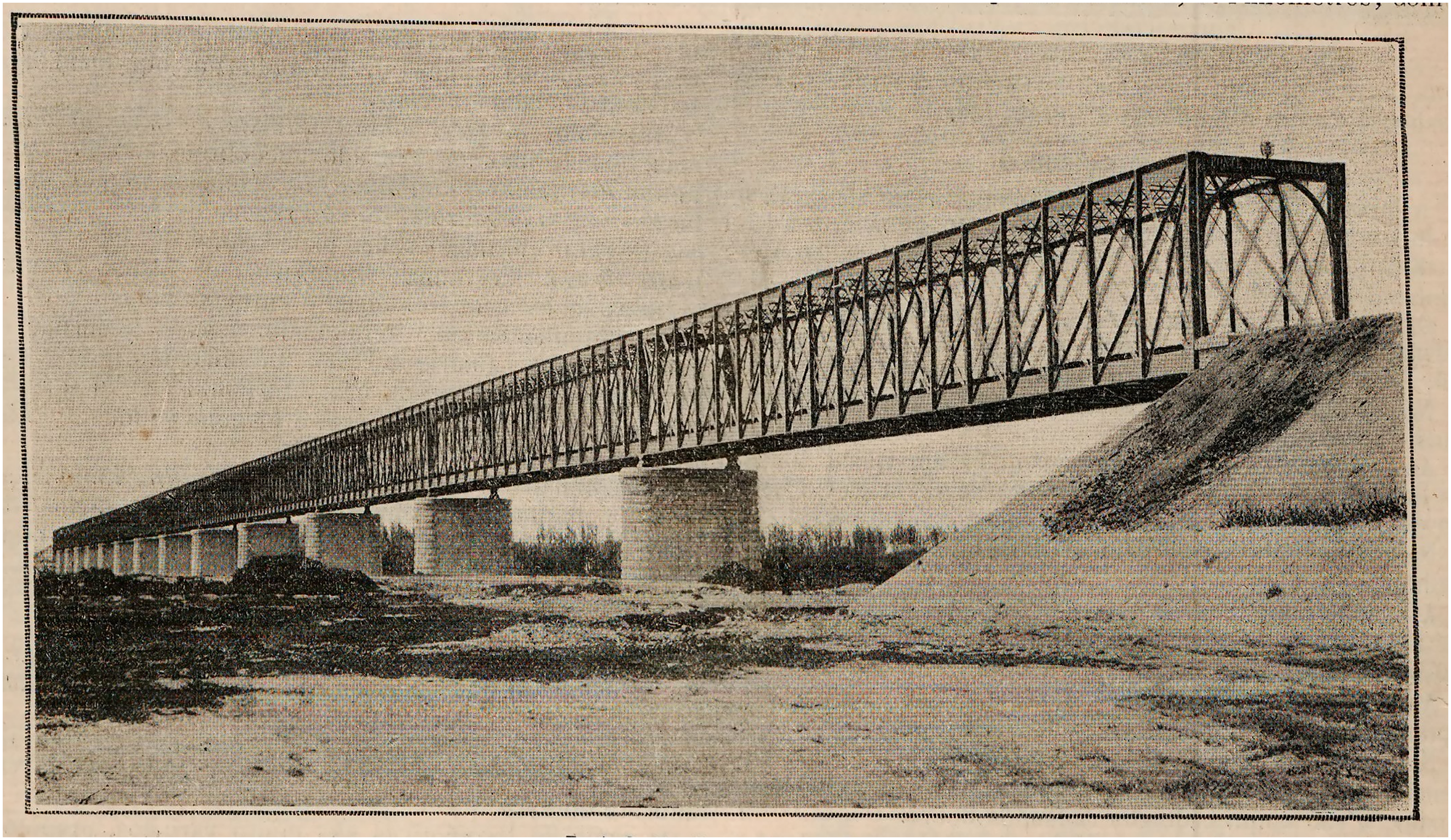
D. Amélia bridge, over the Tagus River, on the Setil line. This engineering work accomplished an objective sought by Portuguese policymakers since the mid-nineteenth century: the connection between the two banks of the Tagus that cut Portugal in half. At the time of its inauguration, it was the longest in the Iberian Peninsula. The length of the bridge is underscored by the angle chosen by the photographer: viewers can see its beginning, but they cannot see where it ends.
Contrariwise, workshops and activities of construction, repair and maintenance are underrepresented, evincing some lack of interest in this kind of work, despite its relevance for railway operation (Figure 6). Nonetheless, it was the first time that these workers were given visibility in the press and were seen by large groups of the population.
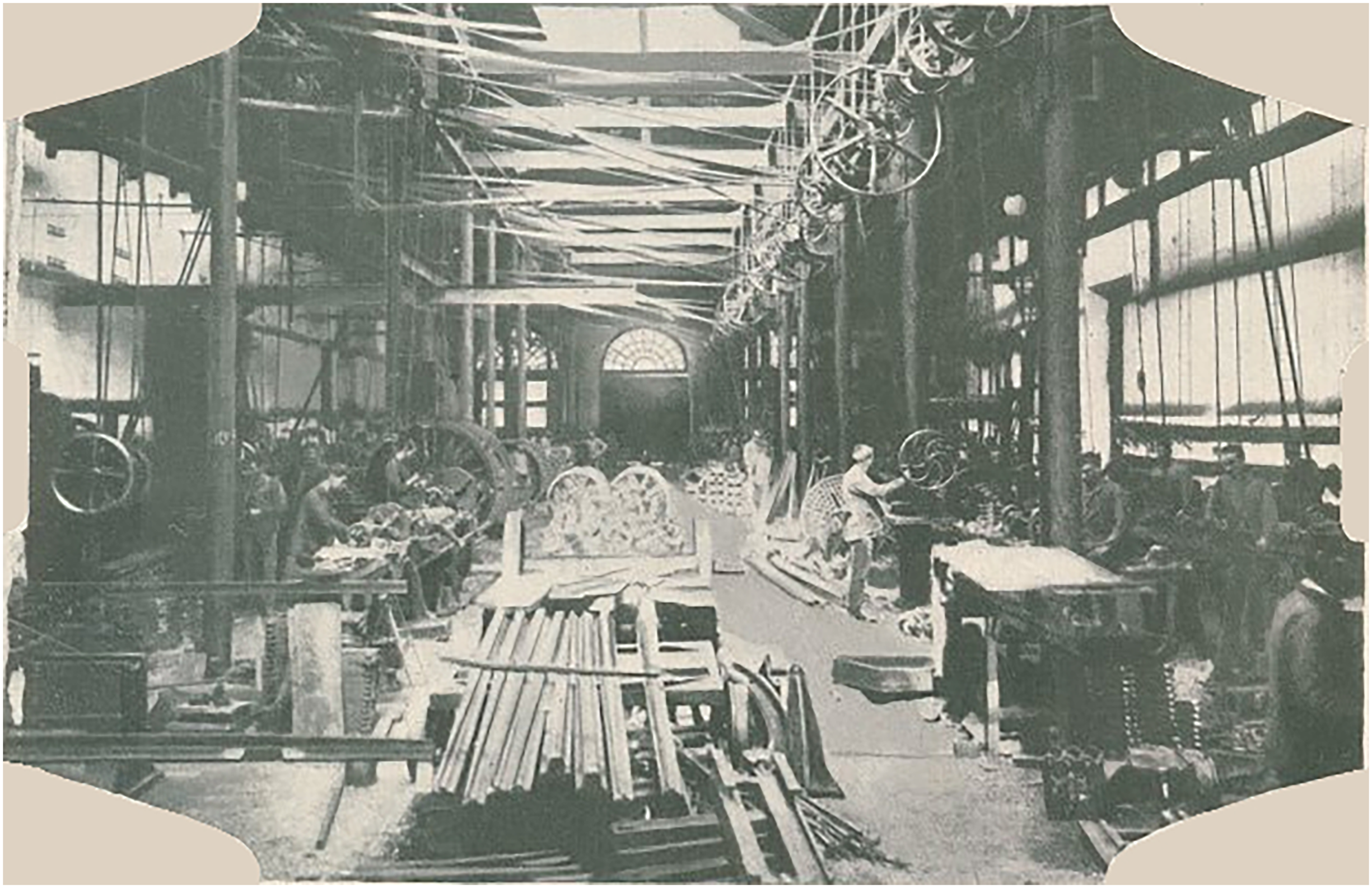
Workshops of the Southern railways, operated by the state. Despite their critical importance for railway operation, these and other workshops (and their workers), were barely visible in the visual economy of photography. People wanted to see trains circulating, not how or why did they circulate.
Previously, in the 1880s, a railway photographic album of the construction of the Beira Alta line showed multiple aspects of construction and its labourers; 46 however, this album was conceived as a gift to a local politician and to be distributed by small groups of stakeholders, therefore, it never knew a wide dissemination.
Regarding the imagery of rolling stock, photographs of coaches and wagons surpass those of locomotives and trains, which is surprising if we consider that the locomotive was the spearhead of technological progress and the vehicle of the technical sublime that conquered time and space and shrunk “the natural world by means of mechanical transportation”. 47
In the mid-nineteenth century, in Portugal and in other countries, locomotives took the spotlight, often being presented as living beings, animalised and anthropomorphised. 48 One of those images was published in 1904 by Revista de Obras Publicas e Minas but it was a reprinting of a photograph taken 40 years earlier, where eight engineers of the Royal Company of Portuguese Railways stand on a locomotive. 49 The steamer is shown as a steady and reliable machine that users could trust. 50
Decades later, in the turn of the century, locomotives appeared in less than half of the photographs published in the Portuguese press, which hints at a fading of the technical sublime and at a valorisation of the daily and common use of railways.
However, engineers like Fernando de Sousa, who wrote frequently in the press, 51 still placed locomotives under the spotlight, using images of steamers to promote the skills and expertise of Portuguese ingenuity in assembling or overhauling them. An article in Occidente stressed that this type of industrial work “occupied the first place in the industrial sector.” 52 Likewise, these photographs illustrated the modernity of the Portuguese railway sector, underscoring its technical capacities, often with unfathomable terms for the common people that added to their sublime. 53 What is more, some narratives underscored that the materials used in the construction had their origin in the Portuguese industry, 54 endorsing a technoindustrial nationalism, 55 especially in a time characterised by a policy of import substitution due to a financial crisis in the Portuguese economy. 56 Another dimension of this phenomenon included photographing industrial complexes connected to or using railway technology. 57 It was the case of the activities at the ports of Lisbon and Porto or the São Domingos mines in Southern Portugal, where locomotives and wagons were central instruments. 58
Table 2 shows the distribution of photographs according to the central happening taking place therein: construction, assembly/maintenance of rolling stock, utilisation, train accidents, inaugurations and other festivities and panoramic shots.
A preference for photographs of daily use is noticeable (Figures 7 and 8), in line with what American historian of technology David Nye has characterised as a growing preference of users for the immediate experience of the power of locomotives rather than for the social effects or the prosperity promised by railway promoters. 59 It follows the same trend found in the previous paragraphs and in the analysis of Table 1 (even though Occidente and the Railway Gazette preferred special events and beauty shots, respectively).
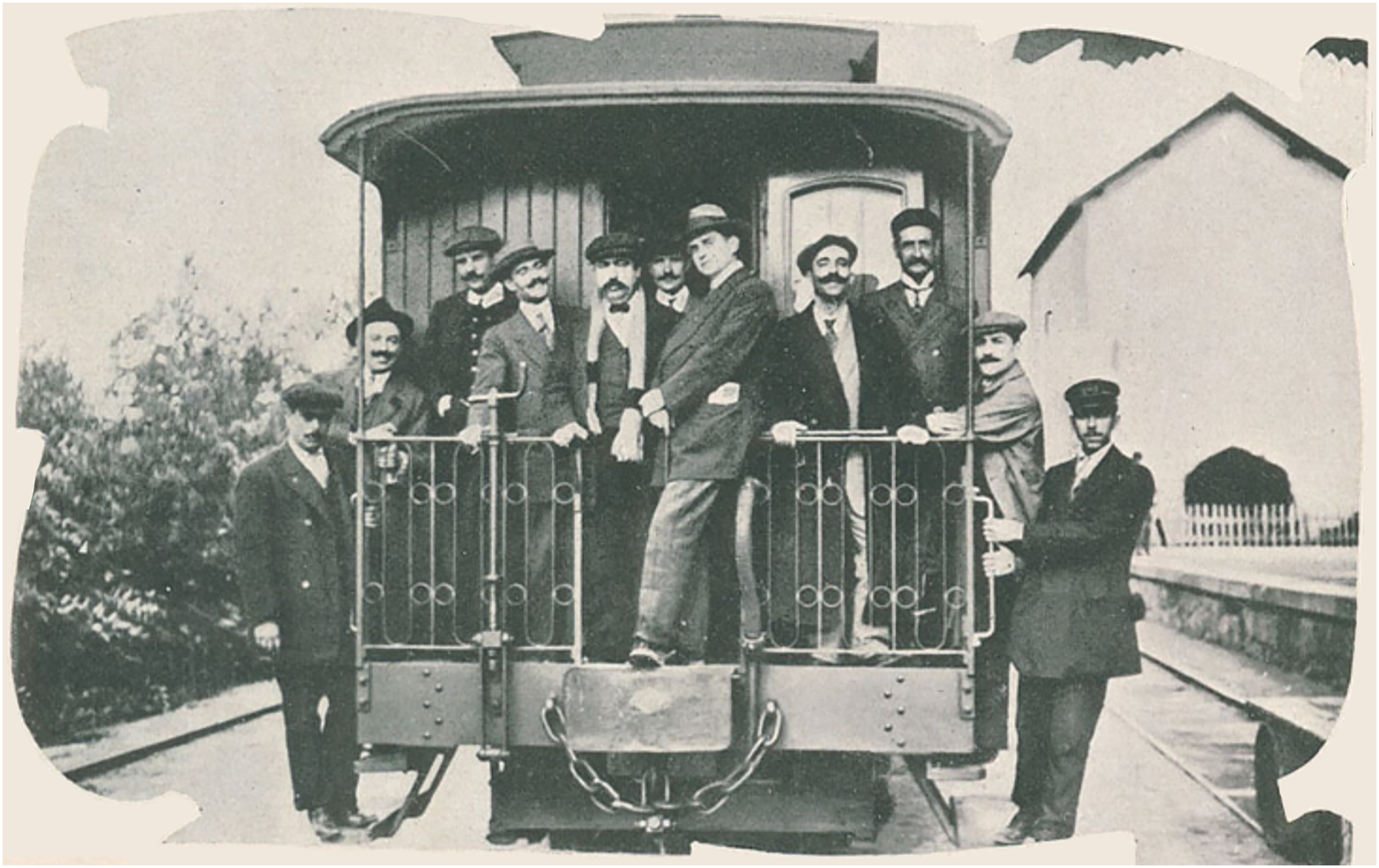
A group of journalist poses for the photograph on the balcony of a coach at the rear of a train. They were on the return journey to Lisbon, after covering the military manoeuvres of the republican army against the campaign of a battalion of monarchic partisans led by captain Paiva Couceiro. In the early twentieth century, news circulated by train, but those who created them were also travelled in railways.
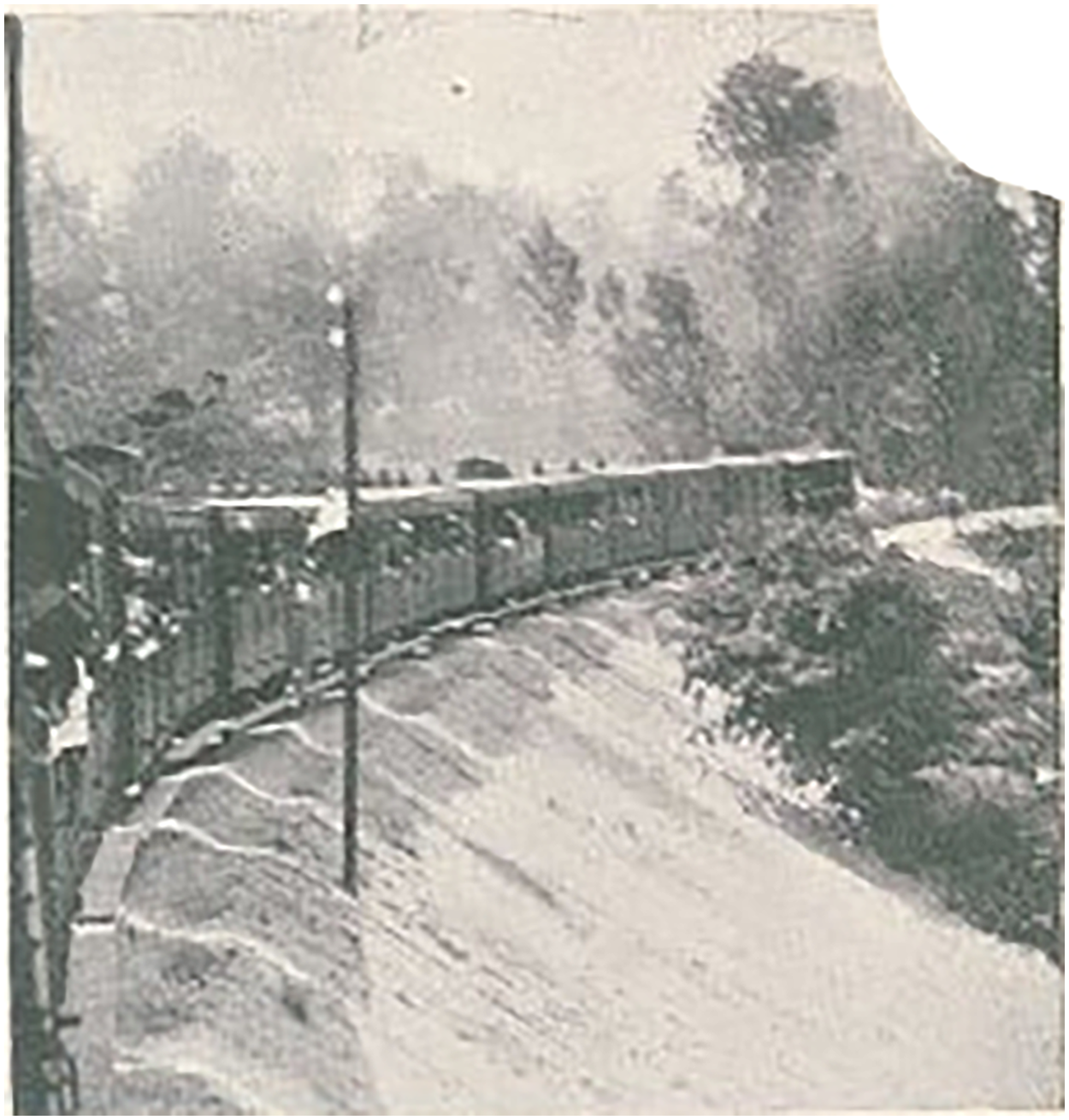
The maiden voyage in the Guimarães line, inaugurated in 1907. The angle of the photograph, the blurriness of the forms on the sides, the passing smoke stress the mobility of the train. For the first time, those who did not ride trains could see in the press what did it look like.
In the same sense, images of maintenance work (Figure 6) account for only 5.7 per cent of the sample, although these are accompanied by somewhat detailed accounts of that sort of labour (including descriptions of automated machinery, electric instrumentation, complex tasks, new technologies and improvements in the quality of the service). 60 This suggests a taking for granted of the railway service, overwhelming all the other background activities indispensable for the operation of the system.
A different perspective of use is provided by photographs of train wrecks, which are portrayed in 45 snapshots (11.1 per cent of the sample). Accidents were not uncommon in the railway sector of the late nineteenth and early twentieth centuries, which were illustrated by photography and the press. 61 Representations of horror contain within a specific beauty and motivate feelings of aesthetical pleasure, meaning that while repelling, they also attract – as a matter of fact, since the eighteenth century, accidents caught the attention of artists and landscape designers, who depicted them in their creations. Photography benefitted with the demand of shocking images of accidents that were sought by publishers to increase the sales of magazines and newspapers. 62 The Portuguese press was not very different and it included photographs of different disasters, either provoked by natural causes, like floods or by human action, including negligence (Figure 9) and sabotage by railway workers on strike (particularly after the end of the Monarchy). Some textual descriptions accompanying the photos of accidents are rather lurid: one text informs that “out of the 300 passengers, 60 were injured; the engine driver was hurled from the cabin when the locomotive stopped abruptly between the tracks and the coaches derailed and rolled away amidst the greatest panic.” 63 . However, for the most part they offer a factual version of the events, respecting the workers right to strike or commending their work in repairing the damages. 64 Moreover, the photographs did not amount to a significant number to challenge the perception that riding the train was more comfortable and safer than any other land transport. That fear was diluted in the daily utilisation of trains. 65
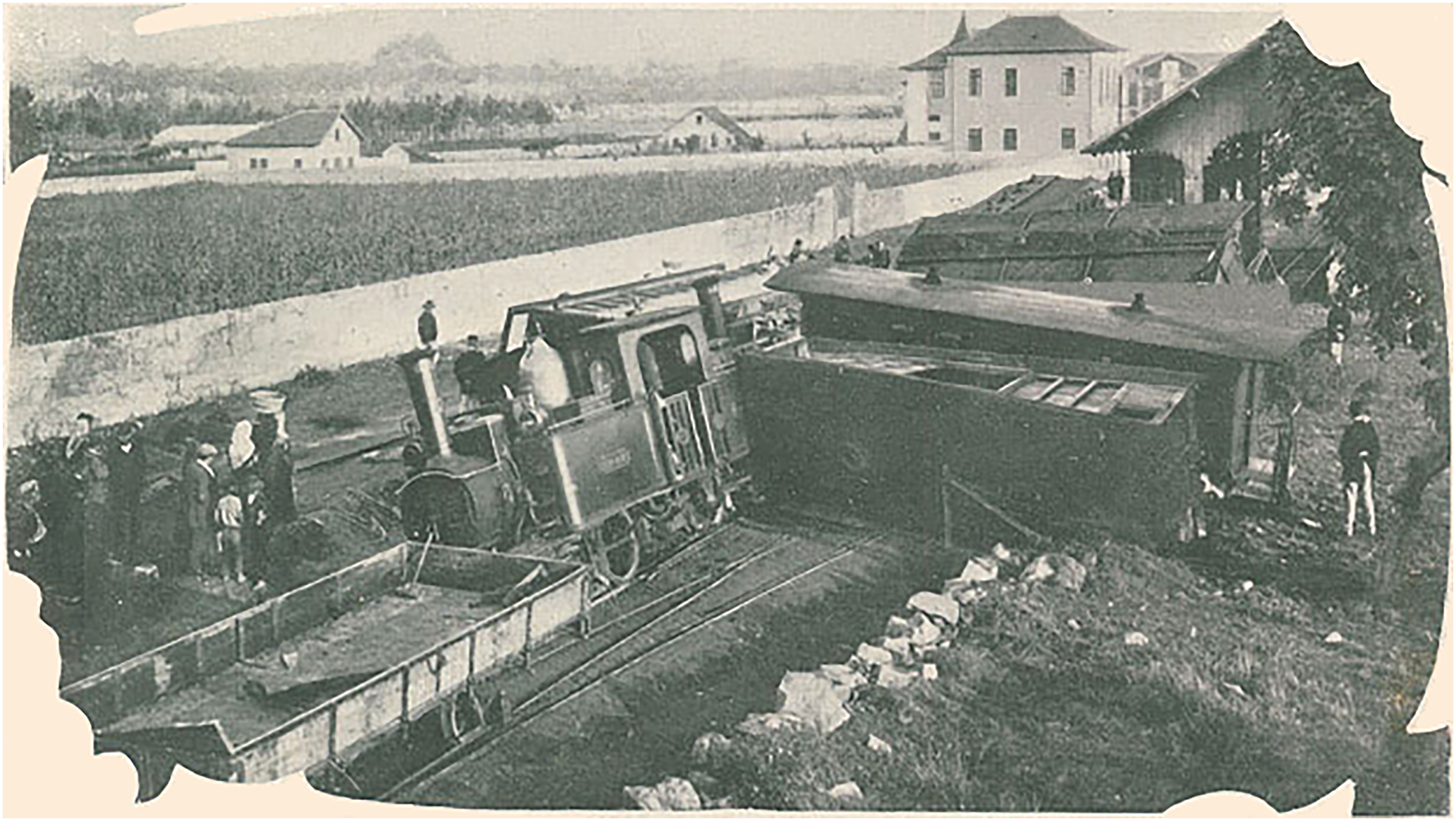
The aftermath of a derailment caused by speeding near Senhora da Hora station in the Porto to Póvoa de Varzim railway. The double-engine Fairlie locomotive is derailed and behind it three or four coaches are pilled in an unnatural position, transversally to the track. Surrounding the rolling stock, several men, women and children observe the wreckage, probably in shock but also in awe.
In beauty shots and in some photographs of the utilisation of railways there is an undeniable intent to promote tourism and leisure travelling. Railway photography illustrated how all kinds of people could reach secluded and picturesque locations by train, comfortably, safely, quickly and affordably, motivating passengers to travel to those destinations. 66 In Portugal, the Railway Gazette pioneered the use of railway photography to promote leisure and tourism. 67 It was followed by other titles soon after. Narratives in the press added a textual layer of compelling arguments about the beauty, attractiveness and main attractions of different regions of Portugal where one could travel to by train, namely the northern province of Minho, the Vouga and Douro Rivers valleys or the regions of Guimarães, Cascais and Sintra, traversed by homonymous railways and also the beaches of the north and the cities of Porto and Coimbra in the route of the Northern line or the spas of Vidago, Entre-os-Rios or Caldas da Rainha, where even King Charles would go to cure his own ailments. 68
To conclude this section, I would like to analyse the people included in the railway photographs of the Portuguese press. Data on Chart 2 apparently does not contribute to the pictorial valorisation of use, as only 3 per cent of the sample depicts passengers, whereas the presence of passersby (different people not using the trains) is evident. This may be explained by the fact that passengers are not always visible in passing trains and therefore they were not accounted for. Moreover, many of the other classes of people can be found in the images using station or trains. The depiction of railway workers is limited (mostly in contexts of construction or repair of lines or rolling stock), which goes in line with what I previously said about the underrepresentation of activities that support the operation of railways and counters the heroic representation of railway labourers that characterised railway photography in the mid-nineteenth century. 69
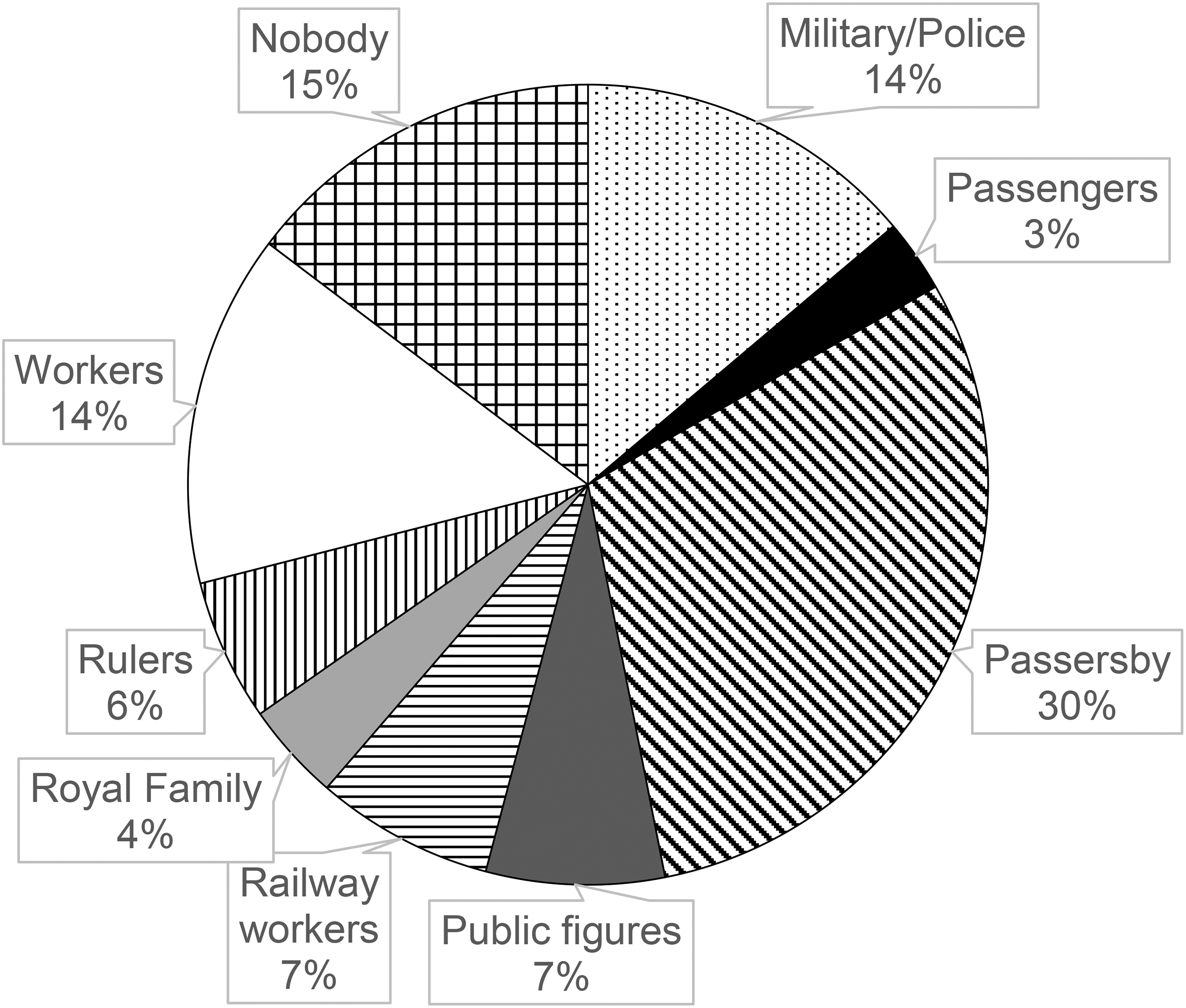
People depicted in railway photographs.
Creating railway landscapes: Production of meanings
The alliance between railways and photography contributed to the creation of a new landscape, which included a new interpretation of space and time (standardised with trains and timetables). 70 Considering the predominance of technical, human-made, imponent and imposing structures and objects, one can call it a technological landscape, or, more specifically, a railway landscape. 71 The new landscape was much more than just the permanent way, engineering works, stations and steaming trains added to the territory. It included many additional layers of sociocultural and sociotechnical symbolism that contributed to its resilience and naturalisation.
Different authors have emphasised the role of photography in promoting railways as a business venture and as an infrastructure that conquered distances, thus contributing to the unification of unconnected regions, to the creation of senses of community and cultural identities, to the definition of new political territories and to “projects of media governance and nation-building”. 72 The symbolical value of railway photography and its potential to create political propaganda has also been underscored. Overall, photography has given materiality and visuality to the abstract concepts of circulation, progress or modernity of societies and territories. 73 The photographs analysed in this article follow this trend. The press published images of locations in the outskirts of Lisbon (like Amadora or Estoril) assuring readers that they had developed greatly just after the arrival of trains. 74 It was a landscape of progress.
Engineering works like the Eiffel Bridge over the Lima River in the Minho line or the Audouard bridge over the Tagus River in the Setil line (Figure 5) were elevated to the rank of national monuments, “best constructions of the kind in Portugal”, worthy of the majesty of the rivers they traversed. 75 The images of the new Montemor branch line in the network of the South illustrated the conviction that the longest the railway grid, the largest the development and the progress of a country. The press added that with the new railway Montemor's “agriculture and commerce has entered a new stage and it can now expand and multiply its wealth.” 76 Furthermore, a comparison was made between the animal kingdom, where a well-developed arterial system carried nutrients to the cells, and the territory, where railways took wealth, civilisation and well-being to cities and towns. It was a landscape of circulation.
Other technical details, incomprehensible for the lay or highlighting the huge amounts of material employed during construction or the large dimensions of the works, added to the impact created by photography. For instance, while describing the railway workshops at Barreiro, journalist Mello de Matos mentioned their “voltmeters, amperemeters (…), motor Franco Tosi with 70 effective horsepower and the multipolar dynamo Siemens & Haske with 50 kilowatts of normal output,” and how a machine was operated “by a single man, who controls its 24 horse power, 220 volts, 91 amperes motor, which has an output of 740 rotations per minute.” 77 As mentioned earlier, the role of Portuguese industry in supplying these enterprises was commended as patriotic acts. 78 It was an industrial landscape.
Photography turned itself into a vehicle that transported the regions connected to the network to the readers of the press. In this vein, photographs promoted the territorial appropriation of those territories, by illustrating, in a way accepted as truthful and objective, the unchangeable route offered by the tracks and the continuous and constant utilisation of an area by a community that perceived it as its own. 79 While the railway, with its own territorial structure, transformed the territory, photography created a visual discourse of those transformations. 80 In this sense, a correlated, yet distinct, perspective is offered by photographs of the manoeuvres of the republican army by train to subdue the monarchic insurrections in the north of the country and appropriate those territories to the new republican unity. 81 It was a political landscape.
Another iteration of these political landscapes were inauguration ceremonies, important moments of territorial appropriation, with photography underscoring the continuous growth of the railway grid as a guarantee of prosperity, modernity and progress. They were dramatic stagings that announced future transformations and usually gathered the interest of large fringes of population that shared a common perception of railways as progress. 82 After the inauguration of the railway between Vila Real and Pedras Salgadas, Occidente recounted how “the festive demonstrations of the localities traversed by the line (…) are a proof of the great benefit that the railway brings to those populations.” 83
Other events counted with the presence of the head of state (king before 1910, president of the republic after 1910), members of government or victorious military leaders of colonial campaigns, who confirmed the importance of the railway for transport and mobility in Portugal and emphasised stations (especially in Lisbon and Porto but also in peripheral areas of the country) as social and political hotspots. 84 The caption of one of the photographs that documented the visit of King Manuel II to Braga highlighted how the train was received “with intense demonstrations of enthusiasm [accompanied by] hundreds of students of the city's schools and seminars.” 85
While photography opened windows and offered glimpses at these events and the new railways, news pieces completed the scenery, describing the soothing whistle of the locomotive, the immense crowds attending the ceremony, their enthusiasm, sundry technical details of the new infrastructure and cheerful anticipations of the success of the operation. 86
Photography contributed to the naturalisation of the railway infrastructure in the landscape and of the railway landscape, by associating it with something good, like progress, modernity, easiness of circulation, and, in the case of the inaugurations, enthusiasm and joy. What is more, trains, engineering works and stations were represented as if not disturbing the land, reconciled in harmony, balance and stability with nature and the territory, merging the technical sublime with the natural sublime, the natural wilderness with the strict regularity of the tracks and the lineal forms of the infrastructure. 87 When, in 1910, a bridge in the Northern line was replaced, the press and the photographs it published underscored how the gangs of workers formed an “admirable and picturesque scenery,” how “the new bridge, magnificent (…) was hoisted and set in the place of the older one,” or how after the operation was completed “the train to Vendas Novas appeared at the appointed hour, traversing the bridge under applauses.” No mention is made to the disruption this engineering work caused in the landscape. The photographs close up on the bridge and in the technicalities of the operation, veiling the natural details of its surroundings. 88
Following the recommendation of Romanian architect Cristina Purcar of looking into the details that photography does not show, 89 it is important to underscore that photography hid in plain sight the profoundly disruptive nature of railways in the territory, which included demolition of buildings, explosions to pave way for the track, astonishing volumes of debris and the piercing sound of moving trains.
This was accomplished in different, yet interconnected, dimensions. One of them was the inclusion of older structures next to the brand-new tracks, bridges or stations to identify the past and point to the future. As Kelsey recalls, “landscape has always been a way of moving into the future by reorienting oneself to the past.” 90 The same was accomplished by photographing railway infrastructure and vehicles next to natural landforms, juxtaposing the romanticism of nature with the modernity of technology, the disorderliness of the land (suggesting chaos) with the geometrical accuracy of the tracks and engineering works (hinting at order), the triumph of mechanical regularity over natural irregularity. 91 The geometrical forms of railways are intrinsically modern, they suggest infinity and issue what historian of photography Mary Warner Marien has called an “Edenic calm” 92 .
Another important feature of railway landscape is that photographs of lines and trains, although static, suggested motion and speed (Figure 8). 93 Velocity was one of the most spectacular characteristics of the locomotive, surpassing the capacities of ships or horses. 94 By 1900, photographing speed had become an obsession for photographers (resulting in improved shutter speeds). Those who could capture velocity would not only photograph progress; they would also be able to put in film that that was not perceptible to the human eyes – machines would overcome the limitations of the human body. 95 Earlier photographs of Portuguese railways were able to give the sensation of speed, but mostly they offered static views of railway activity (panoramic shots of lines and engineering works, parked locomotives, group photographs). 96 The press of late nineteenth century inaugurated a more accurate depiction of velocity, praising the “commercial average speeds of 72 km/h” achieved by new “powerful machines.” 97
Nevertheless, the most innovative perspective of the railway landscape was that seen from inside the train (Figure 8), as emphasised in the caption of a photograph of the visit of King Manuel II to the Minho Province in 1908, reading: “photograph taken from the inside of the moving royal train.” 98 . German cultural historian Wolfgang Schivelbusch underscores how train passengers no longer saw the landscape frontward but sideways and how landscape seen from that perspective seemed like a different world, distorted by velocity. 99 This perspective, however, was captured in some photographs analysed in this article, offering viewers the possibility of travelling across the territory as if they were riding the train themselves. As Italian art historian Nicoleta Leonardi argues, cameras, trains and observers were bound together in an exercise of virtual travelling with machines surrogating human bodies. 100
Conclusion
The introduction of halftone in the Portuguese press caused an exponential increase in the number of photographs circulating in media and in the visual economy. Unsurprisingly, technological developments (like automobiles, electric trams, industrial machinery) and engineering works (bridges, factories, school buildings) caught the attention of photographers and magazine editors, as assets that represented progress and modernity and that were in demand by the public. In this sense, railways were an important visual part of that array of visual resources.
Railway photography had developed in Portugal since the 1880s and it circulated in the press as woodcuts, contributing to the creation of an early railway landscape. However, not only woodcuts lacked the truth-value given to photography, but also the number of images in circulation was very limited. Consequently, the impact of halftone prints of railway photography in the public and in the railway landscape in the late nineteenth and early twentieth centuries was far greater.
What is more, the characteristics of that railway landscape were largely changed. Of course, there were some commonalities, like the advocation of railways as progress and order and a praise of the work of engineers; but whereas photographs (and woodcuts) of the 1880s offered a static view of railway activity, focused on the panoramic shots of infrastructure and on images of stationary vehicles, enhancing the sublime of technological structures and objects, where the human presence is almost invisible, halftone prints showed a much more active, dynamic and truthful view of railways.
Arguably the biggest difference is the presence of human figures, ranging from daily users to heads of state, rulers, military in campaign and railway workers (who despite being underrepresented were for the first time shown to the public). The preference for moments of use superseded that for panoramic photographs that sought to impress the viewers. Of course, the seduction of the technical sublime was still present in several photographs that underline the dimension of engineering works, the power of locomotives, and how both, representing human ingenuity, tamed landforms and nature and publicised picturesque locations that tourists could visit and enjoy. Nevertheless, different aspects of train travel are more frequent, including perspectives from inside the coaches, depicting landscape as if the observers were riding the train instead of merely reading the magazine in the comfort of their homes or within their communities. This was caused not only by an aesthetic change, but also by improvements in photographic technology. In the 1880s, cameras were cumbersome, with low shutter speeds, unable to photograph mobility. By the end of the nineteenth century, cameras were more portable and capable of capturing movement more efficiently.
Moreover, halftone photography also offered glimpses of two events that were present in the railway sector since the very beginning of the operation but that were largely invisible to most: inauguration ceremonies and disasters. The former had an immense political importance that thanks to photography and halftone trickled down over much more people than those who witnessed the events in person. The latter were not an uncommon feature of use. Train accidents, albeit infrequent, were not rare. Photographers saw in them sellable assets that at the same time met the need of the audience for shocking images that simultaneously repelled and attracted. Figures of circulation mentioned at the beginning of this article show that people used trains to travel in growing numbers, meaning that they were not alarmed with what they saw depicted in the press. Disaster photography was a distraction, not a concern.
The photographs analysed in this article show how railways were depicted and shown to the Portuguese population, either that who rode trains and that who were too far away from stations or stops to use them. Further studies using the same methodology could follow, analysing the representations about other means of transportation, from trams to automobiles and bicycles to understand how some were naturalised into society's mind and others were shunned away from the public mind.
Footnotes
Acknowledgements
The author wishes to acknowledge the financial support from the Foundation for Science and Technology (Portugal) through CIUHCT (UIDB/00286/2020) and institutional and academic support from CIUHCT – Interuniversity Centre for the History of Science and Technology (NOVA School of Science and Technology) and the University of York's Department of History.
Declaration of conflicting interests
The author declared no potential conflicts of interest with respect to the research, authorship, and/or publication of this article.
Funding
The author disclosed receipt of the following financial support for the research, authorship and/or publication of this article: This work was supported by the Fundação para a Ciência e a Tecnologia (grant number CEECIND/04157/2017/CP1462/CT0009).
