




Abstract
This paper examines the road corvée, a practice of using unpaid labour for road maintenance, in the nineteenth and twentieth century. I focus on the case of Estonia, where the road corvée, originating in the feudal economic system, persisted surprisingly long, being abolished only in 1959. Earlier studies on the road corvée have focused mainly on road construction and have therefore failed to recognise the use of the practice beyond absolutist Europe and colonial Africa. Focusing on maintenance reveals that the corvée was also widespread in twentieth-century Europe. I examine how the road corvée was organised and debated to reveal what inhibited and what accelerated its abolition. The study shows how maintenance practices can be deeply embedded in social and economic structures – like the agricultural system in this case – and ultimately be highly inert and resistant to change.
Introduction
The last race in the Russian Empire
On the morning of 24 July 1914, Grand Duke Kirill Vladimirovich and his wife, Grand Duchess Victoria Feodorovna, stepped off a train in Tartu. The Grand Duke, a cousin of Tzar Nikolai II, was the honorary president of the Baltic Automobile- and Aero-Club, and it was the first day of the Großfürstin-Viktoriafahrt, an annual automobile race named after the Grand Duchess. Roughly 30 cars were attending the race, all occupied by people of high rank and standing, including Nikolai Svegintsov, the Governor of Livonia, 1 where the race was to take place. The group first raced to Alatskivi, roughly 40 km northeast of Tartu, where baron Heinrich Reinhold von Nolcken treated the visitors to a breakfast and an excursion in his grandiose manor. They then raced back to Tartu, where they were received by the city's mayor with the local fire brigade orchestra, tea, champagne, and the theatre capella. The group then proceeded to the Raadi manor on the city's edge, where the owner Reinhold Karl von Liphart presented his extensive art collection, followed by a festive dinner, a ball, and fireworks. During the next six days, the automobilists drove more than a thousand kilometres through Livonia in a largely similar manner – a race to a manor where a friendly owner treats the visitors to a breakfast and a tour, followed by a race to the next location with a few stops along the way, concluded by a festive dinner with dancing and fireworks in the evening. 2
The joyride-like race had taken a long and careful preparation. Among other things, the roads along the race's route had to be in an automobile-friendly state. For this purpose, the Governor had ordered an extraordinary maintenance of the roads. 3 At the time, roads were maintained via a system of corvée – each peasant household, usually consisting of a family and a few farm hands, was obligated to maintain certain strips of roads without pay. Usually, the work was done in the spring and fall, but this time an order to fix the roads came in early summer, a time of intense farm work. Furthermore, the inspection was unusually harsh, and the peasants were ordered to redo the work multiple times in many places. 4 On the outskirts of the town of Viljandi, the situation even evolved into a widely reported conflict between the local peasants and baron Werner von Wolff, a local official tasked with inspecting the roads. Having demanded redoing a certain strip of road for the third time, the baron hired private contractors without having waited for the passing of the deadline given to the peasants. The contractors, likely local construction entrepreneurs who were happy to undertake expensive works, fulfilled the wishes of the baron to the letter and charged a huge sum of 2,670 roubles and 20 kopecks, 5 which the baron then demanded from the peasants. The peasants, along with Estonian journalists, were outraged – the legality of the actions of the baron was questionable at best. 6 However, an auditor from the regional capital Riga had little sympathy for the peasants and sided with the baron, forcing them to pay the ruinous sum. 7
On July 30, the very last day of the event, for which likely thousands of peasants had been drafted, the automobilists were enjoying a festive dinner when the news of mobilisation and the state of war reached them. The race was to remain the last one in the Russian Empire. 8 A few years later, the Empire, along with the world of large estates, dukes, duchesses and exploitative barons was gone and replaced, in the case of the Governance of Livonia, with democratic nation-states of Estonia and Latvia that stood, to a large extent, most of all for the interests of the peasant population. Yet the road maintenance system, based on feudal economic and social relations, survived almost intact. The road corvée was eventually abolished only in 1959, and even then, certain remnants of it continued until the 1990s. How could a system, long considered obsolete and anti-modern, survive for so long after the economic system which had called it into existence had collapsed?
Historiography and theory
The understudied topic of road corvée is usually treated in connection with absolutist states or colonial exploitation. Katherine McDonough argues that in pre-revolutionary France, the road corvée helped introduce the notion of public ownership and public administration for the provincial population. 9 Richard Tomczak studies the period from the late seventeenth to late eighteenth century, examining how labourers resisted the corvée imposed by colonial powers in Quebec. 10 Studies of the road corvée in the twentieth century appear limited to Africa. For example, Libbie Freed has shown how automobile-friendly roads were built in French Equatorial Africa and French Cameroon in the 1920s using forced labour to accomplish colonial goals. 11 Kwabena Opare Akurang-Parry has examined the use of forced labour for road construction in colonial Ghana between 1900 and 1940, focusing on how it was reformed and justified under pressure from international organisations. 12 James P. Daughton also dealt with the use of forced labour for colonial infrastructure construction in his book “In the Forest of No Joy”, which recounts the construction of the Congo-Océan Railroad. 13
All of the above, with the exception of McDonough, frame the corvée more or less explicitly as an essentially oppressive and unmodern practice, certainly an anachronistic and hypocritical phenomenon by the twentieth century, inherent only for the colonial periphery. For example, Freed points out that the colonial administrators “deliberately moved away from the quickly evolving cutting edge of road technologies” and instead chose “technically simple earthen roads built using hand tools and, especially, forced African labor”. 14 I believe this reflects a misjudgement of European road management practices caused by what David Edgerton calls the conflation between innovation and technology. 15 Freed is not wrong that there were cutting-edge technologies working on European roads in the 1920s, but they were not by any means omnipresent, and much of the work was still done with methods that were centuries old. Overemphasising innovation both by contemporaries and historians may have created an image of Europe that is far more modern than it actually was.
The authors also, admittedly to a varying degree, seem to neglect the aspect of maintaining roads, while the main interest lies with the construction of new ones. Forgetting and ignoring maintenance is not uncommon. Stephen Graham and Nigel Thrift explain it with the way infrastructure is perceived. Infrastructure tends to be invisible when unbroken, and any considerations of it breaking are generally preoccupied with catastrophic, large-scale failures that obstruct the view on minor, quotidian breakdowns that are continuously fixed. Infrastructure also tends to be perceived as homogeneous and coherent structures that are installed at one point in time and then eventually replaced in whole with a new and better one. Graham and Thrift assert that maintenance and repair are not incidental activities but instead “the engine room of modern economies and societies” that incrementally redesigns infrastructures by fending off the ever-present decay. 16 More recently, Andrew L. Russell and Lee Vinsel proposed the perspective of maintenance as a viable alternative to innovation-centric histories of technology and a necessary counterforce to “innovation-speak”. 17
With this case study, I intend to demonstrate that the maintenance perspective can highlight archaic practices that survive surprisingly long, even when they appear deeply at odds with the political context. The case of road corvée in Estonia further suggests that maintenance practices may be inherently slow to change. I will venture to explore both the accelerators and inhibitors of this process. According to Susan Leigh Star and Karen Ruhleder, one of the dimensions of infrastructure is its embedded nature – it is “‘sunk’ into, inside of, other structures, social arrangements and technologies”. 18 I propose that this also holds true with the maintenance of infrastructures and that it is largely why maintenance practices both change and remain inert.
Method, scope and structure
I will employ two approaches. First, I will describe the “material reality” of the corvée. Secondly, I will examine the discourse surrounding the road corvée. This helps reveal the underlying problems, contradictions and conflicts that either inhibit or accelerate change. I will use primary and secondary sources that provide information about the legal and practical aspects and the economic and social background of the road maintenance system. I rely heavily on different laws and degrees, parliamentary minutes and various Estonian newspapers. The level of press freedom has varied through these periods, but journalists appear to have been free to critically discuss the topic of road maintenance at least until the mid-1930s. Other primary sources comprise state budgets, statistical data, a 1906 study of the road corvée in the region, a 1940 road ministry report and a 1947 film clip. Most secondary literature provides relevant background information on economic and social processes. Additionally, I have used literature published by the Estonian Road Museum that deals with various aspects of the history of road maintenance and construction in Estonia.
My almost exclusive focus on the case of road corvée specifically in Estonia enables me to provide a high level of detail based on a wide selection of empirical materials. However, I would like to assert here that Estonia is not an extreme case. I am unaware of any studies that deal with the road corvée in twentieth-century Europe, and examining the practice beyond Estonia would go beyond the scope of this paper. However, the occasional Estonian materials that discuss the practice abroad provide limited proof that it was still relatively common, at least during the early decades of the century. In a 1914 Russian Duma debate, replacing the corvée with a monetary tax in some areas of Germany is mentioned. 19 In 1925 an official of the Estonian road ministry investigated the road maintenance systems in the Scandinavian states and reported corvée systems in place in Finland, Sweden and Norway. 20 According to McDonough, a form of road corvée known as prestation en nature was used in France for maintaining and improving local roads until 1904. 21 However, I have come across anecdotal evidence that the practice survived in some limited form until around 1955. 22
The article consists of three chapters, each roughly representing a historical period with their distinct challenges. The first chapter deals with the road corvée from the beginning of the nineteenth century until the First World War. The period presents a possibility to describe the corvée system of road maintenance and why and how it was challenged. The second chapter examines the interwar era and shows how the corvée persisted despite a political consensus that the practice should be abolished. The interwar period also presents an interesting shift in the way modernity was envisioned when constructing and maintaining roads. The third chapter considers the continuation and the eventual abolishment of the road corvée after the Second World War. The post-war years brought an intensification of the road corvée with no apparent intent to abolish it. Yet, it eventually faded out as the state and the agricultural system was able to obtain and sustain mechanised tools and specialised labour.
Chapter 1: The Imperial Era
The feudal system
Estonia was, from the early eighteenth century until the end of the First World War, a part of the Russian Empire. The empire itself was rather heterogeneous, with the Baltic governances of Estonia, Livonia and Courland differing heavily from the “inner” governances. At the beginning of the nineteenth century, the economic and political system of the Baltic provinces (as elsewhere in the Russian Empire) was essentially of feudal nature. Almost all the non-urban land was divided into large estates, most of it owned by landed nobility. The German-speaking nobility that owned the estates and was additionally matriculated as “native nobility” in the middle of the eighteenth century, further organised into knighthoods that formed the parliamentary bodies known as Landtags and their executive bodies that organised much of the local life within the governances. 23 The peasantry, bound as serfs to the estates on whose land they dwelled, was obliged to provide corvée labour and a certain amount of farm production for the estates. 24
Since the estates were the centres of rural economic activity, any taxes were directed at them. The earliest documented laws organising road maintenance in Estonia originate in the late seventeenth century – each estate was allocated a fair amount of roads for upkeep according to their economic strength. 25 Over time the specifications of standards and allocation rules were reformed and mended, but the system remained essentially the same until the beginning of the twentieth century. 26 In practice, the estate would use its serfs as workforce to fulfil this labour-intensive obligation and provide them with any necessary materials. The work itself meant that a few labourers would take a horse and a wagon along with any necessary hand tools and ride to the strip of the road allocated to the farm. This was often a day's or, in extreme cases, two-day ride away from the farm. They would bring gravel from pits, lay it on the road and level it by using hand tools and dragging old wagon wheels or logs along the road. They would additionally maintain the signs, milestones, culverts, bridges, and ditches on the sides of the roads. The timing of the works was defined by inspecting officials, who would declare the time of the inspection of roads once in the spring and once in the fall. The peasants would thus maintain the roads just before the inspection. 27
This system was likely functioning relatively well. It is to some extent testified by the fact that Emperor Paul I was impressed by the good quality of roads in the Livonian and Curonian governances when he visited them in 1797. 28 However, the nineteenth century, especially its second half, brought profound social and economic changes that would ultimately destabilise this arrangement. As elsewhere in Europe during the period of around 1750–1850, the agricultural system was being reformed, which generally entailed abolishing serfdom. 29 The peasant's laws of 1816 (in the governance of Estonia) and 1819 (in the governance of Livonia) released peasants from personal bondage to the estate and made their relationship with each other a matter of free contracts. 30 Initially, the peasants would continue to provide the estates with corvée labour as rent payment since the estates still owned the land. After further reforms in the middle of the century, the corvée rent was gradually replaced with monetary rent. Eventually, especially after 1860, an increasing number of peasants could purchase farms from the estates. 31 This meant that the peasant would have to start selling the farm's produce to pay for the farm, not simply engage in subsistence farming as before. The feudal economic system was receding and was being replaced with a capitalist system, where the farm was an active participant in the market.
The corvée becomes unjust
However, the changes did not reflect in how roads were being maintained. The 1816 and 1819 peasant laws had crystallised the previous allocation of obligations where the peasantry was solely responsible for providing the labour, with the newly created municipal peasant governments now responsible for organising the road works. 32 The peasant laws of 1849, 1856 and 1866, which did much to improve the economic well-being and independence of the peasants, also left the arrangement of road maintenance obligations untouched. 33 This made sense in the beginning of the century when land ownership patterns and agricultural economy still largely followed the feudal outlines, but it became increasingly problematic towards the last third of the century when there was less and less to distinguish an independent farm from an estate. It is reasonable to guess that the use of roads was intensifying along with the rural economy, making the maintenance of roads both more necessary and more difficult. The second half of the nineteenth century reportedly also brought rising labour costs, increasing the expense of road maintenance for the farms that commonly employed labourers. 34 This subsequently put increasing pressure on the corvée obligors and highlighted any injustices.
Eventually, the system came under criticism in Estonian-language newspapers, with the earliest example originating in 1878. The article argued that the road corvée was excessively burdensome for the farms by calculating the monetary expense of the practice. The proposed solution was to collect a monetary tax to hire the farms willing to do the job, which the author believed to be more cost-effective. 35 Similar narratives along with the same arguments and proposals were repeated in various newspapers in the following years. 36 Monetary expense had become a tool to calculate the effectiveness and rationality of a farm's activity – a testimonial of both an economic and mental shift from the feudal towards the capitalist system. The calculations further revealed that the obligations were unequally distributed between the peasants and the estates. Reportedly, the cost of providing the materials was negligible for the estates, while the labour cost was very high and rising. 37 This was confirmed by a 1914 Russian State Duma official investigation that found that in the Livonian governance, the peasants carried 96.3 per cent of the costs of road maintenance, while according to the 1911 land evaluation, the estate and the peasant lands were roughly equal in total profitability (52.9 and 47.1 per cent accordingly). 38
Over time, the discussion surrounding the corvée became increasingly strained. The earliest criticisms of the road corvée pointed at the unjustness of the system and proposed to change it. From around the turn of the century, the spokespersons of the peasantry would increasingly start claiming that the estate owners were intentionally trying to derail or postpone any change to evade taxes and obligations by placing them upon the peasantry. This conflict was enhanced by the Estonian national movement as well as by socialist ideas, both of which furthered a narrative of the exploitation of the Estonian peasantry by a powerful and unjust nobility.
Count Nikolai Kropotkin, a ministry official dealing with peasant affairs in Riga, claimed in a 1906 analysis of the road corvée and its legal history that it was causing widespread and dangerous discontent among the peasants. He pointed out that the peasantry had repeatedly and with increasing frequency petitioned the government to establish uniformity between the obligations of the estates and the peasantry. The repeated postponement of the satisfaction of these petitions had led to the situation where during the 1905 revolution, in almost every rural meeting, the matter of road corvée was at the forefront. Kropotkin concluded that it was one of the main reasons why the revolutionary movement reached rural households. 39 Kropotkin mentions the revolution in passing, but there are signs that it shook the elite into acknowledging the problem. His own analysis, published a year later, is likely a direct result of this acknowledgement. The governance of Estonia legally equalised the road maintenance duties of the peasantry and the estates in 1905, 40 undoubtedly an attempt to appease the peasants bent on looting and burning estates.
The corvée remains
And still, the situation remained unchanged and tense. In Estonian governance, maintaining roads was reportedly still much more burdening for the peasants because of outdated land evaluations favouring the estates. 41 In Livonia, the Landtag had admitted that the distribution of road maintenance obligations needed reform in 1888. After seven years, the governor raised the issue again and advised the Landtag to take action. The latter then found that this should follow the planned land evaluation. 42 The land evaluation was finished in 1911, but by the eve of the First World War in 1914, the road corvée had remained unchanged.
In early 1914 the Russian State Duma discussed the issue of road corvée in the Baltic Governances. The coverage of this discussion in Estonian newspapers illustrates the public's sentiment well. The representatives of Estonian and Latvian peasants presented the unjustness of the situation and claimed that the burden of the road corvée was ruinous for the peasantry while the contribution of the estates was minimal. This claim was repeated by the official investigation of the Duma already referred to above. It was also pointed out that the issue had been raised multiple times by different authorities without any progress. Some representatives even went as far as to hint that the estate owners were intentionally preserving and abusing the situation. However, the newspaper itself was much less diplomatic. When one Baron Wolff pointed out that the Livonian Landtag had been working on the question of redistributing the road corvée more justly since 1885, the journalist ironically commented that, unfortunately, the baron does not mention the power prohibiting the execution of this initiative. The Duma made a decision favouring the peasants: a law must be drafted that would force a change in the Baltic road corvée. Yet the journalist finished with a pessimistic note by stating that the estate owners would still have multiple possibilities to hinder the progress of the possible law and that the situation would likely continue for years to come. 43
The pessimism was not unjustified. The problem had been discussed for decades, but there had been almost no progress. There were three main obstacles hindering a meaningful change. First, political power no longer followed the economic realities – the governance Landtags that had the power to change the system consisted of feudal landowners keen to preserve their privileges. Any shift towards a more just allocation of road maintenance obligations would have been economically detrimental to the deciders. Therefore, it is reasonable to infer that a considerable amount of those in power were happy to postpone any change. The economic system in which the road maintenance system was embedded had been dissolving, but the power structures remained.
Secondly, there was no clear and appealing alternative. The proposals to switch to a monetary tax, which, judging by the Estonian journalism, may have had some support among the peasantry, found little support among the elite. According to Kropotkin, the tax would have been enormous, and he believed that the peasantry would likely have had occasional difficulties with paying it, while the ability to physically maintain the roads was more stable. It would have further been impossible to find enough paid labour force to keep the roads in a comparable condition. In other words, the capitalist economy was not strong enough to sustain the road maintenance system alone. Kropotkin proposed having the governance maintain the few roads of state-level importance and bridges on all roads. He considered it necessary to retain the corvée elsewhere but to ensure that the obligation would burden the estates and the peasantry equally. 44
Kropotkin passingly also mentioned that the highway network needed re-evaluation in light of the railway taking over a large amount of long-distance transport. This points to the third obstacle hindering change – the need to re-evaluate. New technologies, but also the changing economy, agricultural production, and land ownership patterns challenged the transportation network. Those intending to reform the road maintenance system would need to consider the rapidly changing road usage.
The future was unclear, the alternatives unappealing, the elite unwilling, and thus the road corvée outlived the Russian Empire.
Chapter 2: The Republican Era
The political consensus
The deadlock was broken by the rapid political changes following the First World War. Between 1918 and 1920, Estonians managed to establish a national state and wage a successful war against the Bolsheviks and also the Landeswehr representing the more conservative Baltic nobility. In 1919, the nascent republic pushed off a radical land reform, primarily inspired by widespread anti-German and anti-feudal sentiments, that expropriated the lands of the large estates and divided them into small farms. 45 Thus, the decades-long problem of the unjust division of road maintenance obligations was solved.
However, the corvée remained and was hardly any better than before the war. Due to intensified traffic and neglect during the war, the roads were in a very bad state. The situation further deteriorated with the spread of motor vehicles. In 1921 there were 201 motor vehicles, including cars, trucks and motorcycles, registered in Estonia. This number grew to 3,657 by 1931 and to 8,878 by 1939. 46 This is not a large amount – as a comparison, 218,669 horses and roughly 190,000 bicycles were registered in 1939. 47 It was, however, a growth from a rarely seen, exotic vehicle to one with a noticeable presence. Motor vehicles were significantly heavier than horse traction vehicles and caused more damage to the roads. To make matters worse, trucks were often equipped with simple iron wheels that were especially punishing to the road surface. 48 It was becoming increasingly difficult for the farmer to maintain the roads. That, combined with its history of political injustice, made the road corvée highly unpopular.
Additionally, the perceived importance of roads and their passability was shifting. During the early 1920s, some would still argue that a road has any significance only to those moving on them, and thus it is fair that the farmer is tasked with maintaining the road they need for selling the farm's produce. However, by the end of the 1920s, possibly due to the debate around the corvée, an economic perspective had prevailed – the good condition of roads was increasingly considered important to everybody, as it would, among other things, make farm production cheaper also for the city-dwellers who might never happen to move on the roads maintained by their taxes. 49
The issue was taken to the Estonian Parliament, where the discourse was mostly steered by the Farmers’ Assemblies, a party representing the large rural population. A first draft of the highway law reached the general assembly of the Parliament in 1925 but was rejected with the Farmers’ votes because it did not alleviate the corvée obligation in any substantial way.
50
A new draft, which was ultimately accepted, reached the general assembly in 1928. By then, there was clearly a general understanding that the corvée should be abolished. The first hearing in 1928 started with the report of the commission that had drafted the law, which can be considered the political consensus: The commission found that the corvée is wholly unjust for the farmer, it is a remnant of the times of slavery, and there is no hope that the roads can be put in order in this way since the traffic is intensifying with every day and the modes of transport have changed. The farmer is unable to fix the road with only a shovel when trucks carrying hundreds of poods
51
are driving on the same roads. It was thus decided that the corvée must be abolished on all roads.
52
We recently adopted several laws that we have based on the most modern ideas from the richer and more cultured Western European countries – now, however, we will jump back to the conditions of the times of slavery and want to graft a wild sprout on the stem of our new cultured state. I have seen cultured sprouts grafted on wild trees but not vice versa.
53
A partial solution
However, abolishing even a part of the corvée was highly expensive, which raised concerns that a rushed reform might cause the population to be overburdened with taxes. 54 After much political debate and intrigue, the Parliament passed the highway law. It defined three classes of public roads with corresponding standards and declared the maintenance of first class roads (defined as the most important roads with the most traffic) to be taken under state funding within four years and the maintenance of the second and third class roads to be taken under state funds when financially possible. The corvée was now legally undesirable and temporary. 55
By 1931, 5,694 km of roads had become the responsibility of the state, while corvée obligors still maintained 17,744 km of public roads. 56 An important aspect that enabled the state to maintain a considerable amount of roads was the proliferation of mechanical tools, most notably the road grader that became available in the mid-1920s. The earliest tests undertaken with the road grader in Estonia in 1926 showed that using it was five to ten times cheaper than doing the same work with human and horse labour. Further, using a motortruck for transporting gravel would allow for thicker and, thus, more resistant road surfaces. Most of the road graders in Estonia were domestically produced licenced copies of the Swedish Bitvargen (See Figure 1), and towards the end of the 1930s the state was ordering copies of American Caterpillar graders. 57 However, such large mechanical tools required a high initial investment. For example, purchasing 63 road graders in 1928 cost roughly a fifth of the year's road construction and maintenance budget. 58
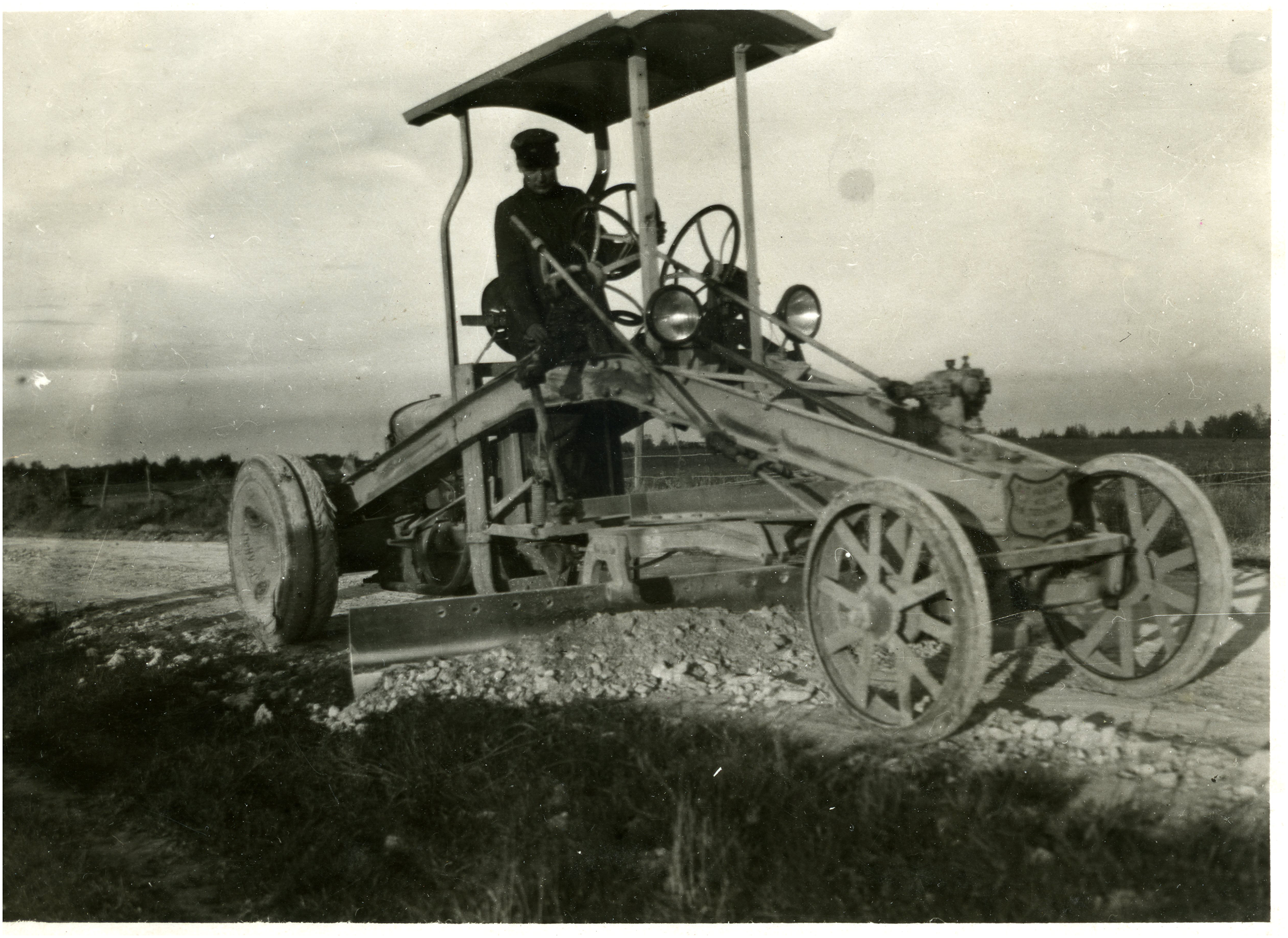
The Bitvargen road grader. Courtesy of Estonian Road Museum. EMM F 107:112.
By 1935, the situation regarding the corvée was largely the same – 6,088 kilometres of roads were under state funding. 59 The stagnation is not surprising for the economically difficult years of the first half of the 1930s, but the situation seems to have remained unchanged also in the more prosperous years that followed. A 1940 report by the road minister accompanying a 5-year financial plan for the road's ministry mentions 6,150 kilometres of roads under state funding. 60 The number of road graders, a good indicator for the states’ capability to maintain roads, had also barely changed – there were 100 of them in 1930, 120 in 1935 and 130 in 1940. 61 Therefore, despite the political consensus expressed in the 1920s that the road corvée should be abolished, it remained in practice on most roads.
Yet, between 1935 and 1939, the annual funding of roads tripled from around two to six million Estonian kroons, which was a jump from 2.7 to 5.3 per cent of the total state budget (see Figure 2). This hints that the priorities in using this funding were somewhere else. The 1940 report is revealing. It mentions the need to gradually abolish the corvée in favour of a more effective system of road maintenance and then continues to discuss in a considerably more detailed manner the need to adjust the roads to the needs of motorised transport – the roads need to be made dust-free, new bridges must be constructed, crooked roads need to be straightened. 62 Instead of abolishing the road corvée as soon as possible, the state was choosing to invest in the main highways to make them automobile-friendly. An example of this is the decision to invest heavily into reconstructing the Estonian part of the Riga-Tallinn highway in 1938 in anticipation of the 1940 Helsinki Olympics. Reportedly, all available machinery and large sums were directed into the highway since it was expected that a large number of western automobilists would be driving along this route, and the highway needed to represent the state well. 63 The shift in priorities speaks of a change in the way modernity was envisioned. In the 1920s, modernity was about escaping old injustices inherited from the despised feudal ages. By the late 1930s, possibly in connection with the 1934 shift to an authoritarian regime, modernity was primarily a matter of prestige – the state needed to facilitate cutting-edge technology, such as motor vehicles, to project an image of modernity.
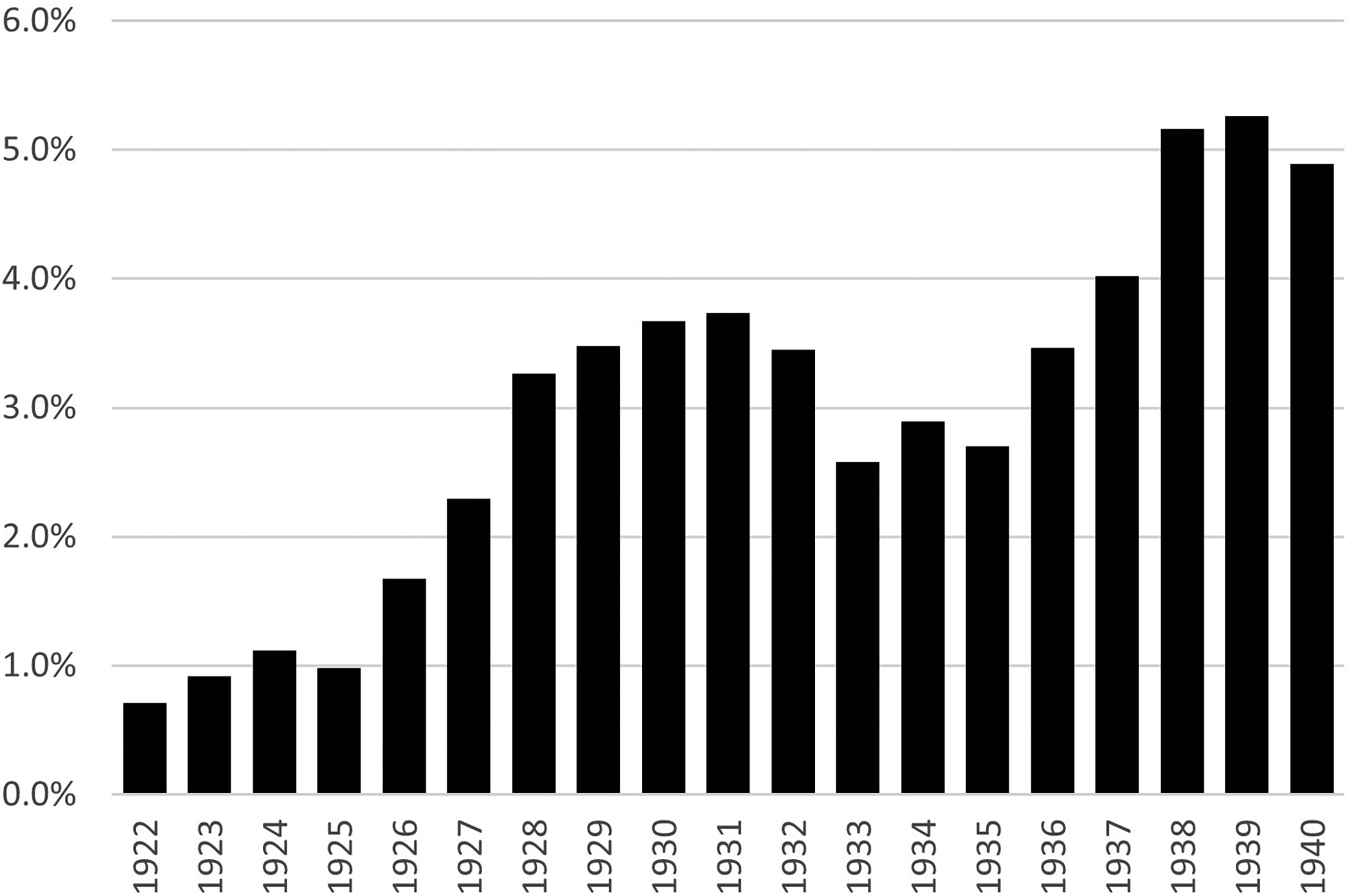
Percentage of total state spending on roads, bridges and ferries. Source: Riigi Teataja 1922–1940.
With the political shift after the First World War, the political obstacles to reforming the road maintenance system had been removed, and technological changes provided a viable alternative to the corvée system. Yet it persisted because building the alternative system required more resources than were at hand – it could only happen gradually.
Chapter 3: The Soviet Era and beyond
The tradition of the Soviet farmer
In the spring of 1945, when the Second World War had ended, the system of road maintenance in Estonia was altered with a decree that referred to the need to unify the system with what had been established in the Soviet Union in 1936. 64 In the Soviet system, instead of farms, the obligors were rural citizens between the age of 18 and 45 for men and 18 and 40 for women. The obligors were supposed to build or repair roads without pay for six days per year and to provide the road authorities with their draft animals and any tools for the duration of the obligation. Similarly, state farms, machine tractor stations and other rural enterprises were obliged to hand over their draft animals, tools and machines for the undertaking. 65 A slight change was introduced in 1950, which allowed collective farms to create specialised brigades that could do the work more effectively on behalf of fellow work obligors from the same farm. 66 Institutionally the work was still organised by the same administrative levels as always, but it was more centralised and flexible. The organisers of the road maintenance had the freedom to move the workforce (within 15 km of their place of residence) and draft animals (within 30 km of their owner's place of residence) where it was currently needed. In the meantime, there was no public discussion of the corvée, only campaigns to drive the workers to work faster. The objectionable remnant of a feudal age had become a “tradition of the farmers of Soviet Estonia”, as the narrator in a 1947 newsreel cheerfully remarked (see Figure 3). 67
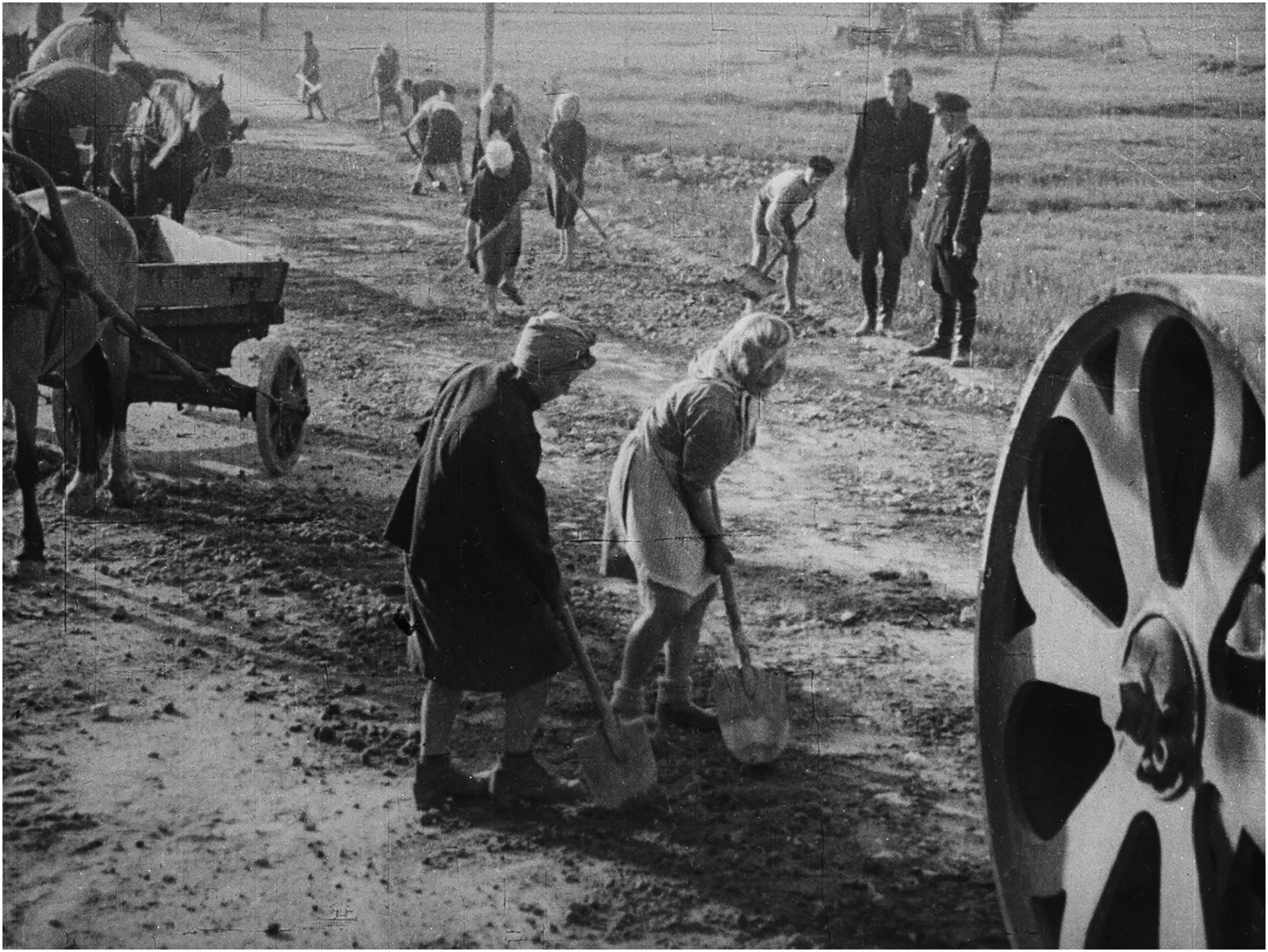
A still from the 1947 newsreel. Courtesy of Estonian Film Institute.
It seems that the new situation brought an intensification of the road corvée. An Estonian newspaper run by refugees in Sweden reported in 1947 that the roads formerly maintained by the state were now also maintained by corvée labour. 68 This is not surprising since the roads were in a bad condition, and there was a lack of machinery after the war. Although an unreliable indicator for the actual work done, the post-war laws and decrees also seem to imply that the road corvée was much more intense when compared to the pre-war situation. However, it is likely that the amount of actual work gradually decreased as the state restored its capability of mechanical road maintenance. By the end of the 1950s, the obligation may even have been only partly enforced.
Forgetting the corvée
In November 1958, the Presidium of the Supreme Soviet of the Soviet Union decreed that local roads should be constructed and maintained with the “participation of collective and state farms, industrial, transport and other enterprises, and economic organisations”, that the Supreme Soviets of the Union Republics should specify local “procedures, terms and forms”, and also declared void the 1936 decree that was the basis for the corvée system. 69 The Presidium of the Estonian Supreme Soviet approved the decree organising the local road maintenance in February 1959, effectively placing the burden of the maintenance of local roads on collective and state farms, and other rural enterprises via a tax. 70 The corvée was effectively abolished without gaining any notable public attention.
The shift was undertaken during a period of profound agricultural reforms. Among other things, the inefficient system of Machine-Tractor Stations was abolished in 1958, the same year saw the beginning of the transition to a monetary salary of collective farm workers and the taxation system was relaxed considerably. The collective and state farms were receiving investments, obtaining specialist workforce and mechanical tools, and generally faring better. 71 The agricultural system had developed to the level that it could sustain a road maintenance system based on machinery and specialists. By the mid-1950s the number of road graders in Estonia had surpassed the pre-war amount and was about to reach its peak, which means that the state was successfully expanding its capability to maintain and build roads. 72 The tax could be used to operate the machinery and enable the state to build and maintain more roads – an important goal of the recently adopted seven-year plan. 73
However, the reform also gave the rural farms and enterprises the ownership of some of the public roads – those used only by the farms or enterprises themselves – with the obligation to maintain them. Therefore, in a certain sense, some remnants of the road corvée continued even after 1959. This testifies that the goal of the reform was to make road construction and maintenance more effective but not to abolish the corvée. In the following years, the monetary tax for road maintenance was changed according to the need, but the obligation to maintain the roads under farm ownership continued. 74 Therefore, the last remnants of the road corvée were abolished only in the 1990s after the collapse of the Soviet Union, when collective and state farms were abolished by the agricultural reform and any municipally relevant infrastructure was taken back under state or local government ownership. 75 Ultimately the corvée was not abolished but rather forgotten and, with some exceptions, faded out.
There is, furthermore, a certain offshoot or analogue of the road corvée still in operation in Estonia today. Namely, the owner of real estate in a city is obliged to maintain the sidewalks bordering the property. This sidewalk corvée does not contain the paving of the sidewalk and is, most of all, in place to ensure the removal of snow and ice during the winter. In 1923–1924, the two delegates of the Parliament belonging to the Houseowners Union party made an attempt to abolish the system, but the proposed law was promptly rejected. 76 The possibility of having the municipalities maintain the sidewalks has been discussed in recent years, but there appears to be little progress, as the topic is forgotten once the snow melts.
Conclusions
The Estonian road corvée was deeply embedded in the agricultural system. This is demonstrated by the debates surrounding the corvée during the late nineteenth and early twentieth centuries, as the road maintenance system failed to follow the changes in the agricultural system. The highway reform of 1928 that partly abolished the corvée was a result of the changes in the agricultural system and land ownership patterns unfolding during the Imperial era and the early republican years that followed. Similarly, the 1959 reform that abolished the corvée almost completely, was preceded by intense developments in agricultural production.
The effect of political power on this process appears to have been disproportionate. Political will could, with relative ease, hinder any progress towards abolishing or reforming the road corvée. The passivity of the ruling elite was sufficient to postpone any change during the Imperial era. Facilitating a change, on the contrary, proved highly difficult. The political consensus of the 1920s that the corvée should be abolished would suffice only to provide a partial solution.
The advent of motorised transportation had an inconsistent effect on the road corvée. Initially, the consequently increasing difficulty in keeping the roads in good order provided a good argument in favour of abolishment. However, towards the second half of the 1930s, the state prioritised making the main highways automobile-friendly, thus draining road construction and maintenance funds that could be used to abolish the corvée also on the peripheral roads.
Favouring the reconstruction of the fewer main roads over the abolishing of the corvée also demonstrates the inconsistent effect of the drive to modernise. During the 1920s, the unmodern nature of the corvée was a strong argument in favour of abolishing it. During the late 1930s, the automobile-friendly main roads were expected to express modernity to tourists visiting the state.
The case of road corvée in Estonia demonstrates that the use of unpaid labour for infrastructure works in the twentieth century can be found beyond the colonial context. Further exploration of the history of the practice in Europe and elsewhere may offer various valuable insights. It would provide a counterbalance to innovation-centric histories of infrastructure development and highlight the persistence of pre-modern practices. It may further highlight various entanglements of the transportation system with other systems, such as its connection with the agricultural system in the case of Estonia. Further, the use of forced labour for colonial infrastructure construction, as described by Freed, Akurang-Parry and Daughton, likely had legal and practical roots in European countries. Thus, understanding the use of the corvée in Europe would also help understand analogous practices in colonial contexts.
Footnotes
Declaration of conflicting interests
The author declared no potential conflicts of interest with respect to the research, authorship, and/or publication of this article.
Funding
This work was supported by the Estonian Research Council grant PRG346 “Reshaping Estonian energy, mobility and telecommunications systems on the verge of the Second Deep Transition”.

Notes
Correction (November 2023):
The article has been updated to include the Funding statement.