



Abstract
The tramway of Turku was closed in 1972. The last tram rides were memorable public events where the tramcars got a floral tribute and people came to say farewell. This article concentrates on the urban cultural memory of the tram after the closure and is now an integral part of the city's urban culture and identity. The Museum Centre of Turku holds many tram-related materials and has published research on the history of the tram, but it does not have premises for a continuing exhibition, so keeping the memory alive has been up to private citizens, civic activity, and political activism. The tram was photographed by professional and private photographers, which has enabled a rich visual heritage that has been used in various ways. At the present, the memories affect the planning of a possible new tram, although how the old tram relates to future plans, remains complicated.
Introduction
The closure of the Turku tramway did not go unnoticed but attracted a lot of public and private attention. Trams and their surroundings were filmed and photographed by private and professional photographers, and discussed in the media not only at the time of the closure (1967–1972) but also in the following decades, up until today. Images of the Turku tram have circulated in various contexts from the city museum's publications to activist literature and social media, enabling a rich visual memory culture. In this article, I am exploring the visual memory of the Turku tram closure in the context of cultural memory and mobility studies.
The key moments and main developments of the Turku tramway from its beginning in 1890 to its closure in 1972 are well recorded and often repeated. The first tramway in Finland was the Turku horse tramway which operated from 1890 to 1892, when it was closed down because of high maintenance costs. An electrified tramway was opened in 1908 and operated until 1972. The tram service had its golden years after World War II: the number of passengers reached its height in 1946, and the network was at its largest in the late 1950s. The network covered the city centre, but when suburbanization hit the city in the 1960s, the network was not extended. At the same time the city started to favour buses. The tram network was the only municipally owned public transport service until 1950, when the city began to operate a bus network. The first political decision leading to the closure of the tram network was made already in 1965, but the process was gradual. Trams began being replaced by buses in 1967, and then the lines were closed one by one. 1 The last tram departure (line three) took place in 1 October 1972, after which the rails were quickly removed from the streets. In material terms, this was the end of the tram in Turku. The memory of the tram has, however, been persistent. Despite of its physical absence, and the fact that the tramway was closed more than 50 years ago, it continues to have a strong presence in local urban memory, identity and visual culture. This, in turn, affects urban politics and especially the planning of urban mobility, although in complex and contested ways.
The possibility of creating a new light rail system in Turku and the neighbouring cities has been discussed politically since the 1990s. The debate around the new tram has also intensified memories of the old tram. The political debate has been heated and elections have often changed the transport policy and hindered progress. Finally, in 2020, the City Council announced its support for a modern tramway system and the process has now advanced to the development of an implementation plan. The final investment decision is scheduled for 2025. 2 The strategical focus of the planning is on urban structure, attractiveness and sustainability with little emphasis on the past history of the Turku tram. 3 However, anyone consuming daily news or following local social media quickly discovers that the debate over the possible future Turku tramway has been strongly influenced by the past. 4 The tram has been an object of public debate in the news media particularly at the time of the closure and, again, when initiatives for a new tram started to appear. Since the launch of a Facebook group called Postikorttien Turku (‘Turku of Postcards’) in 2013, social media has been an important platform for the discussions around the history and future of the tram. The old tramway has been used to argue both for and against the reintroduction of the tram. The debates have extended from economy and sustainability issues to political and ideological arguments that pertain as much to urban memory and identity as to the technical qualities of the tram.
It is clear that there is a need to contextualise urban transport and mobility and to study them in relation to the cultural and political practices in which they are embedded. 5 A historical approach is also needed for a better awareness of the long trajectories of transport systems. Urban mobility systems have long lifespans, and it takes decades to build and unbuild such infrastructures. 6 On-rail infrastructures are even less flexible than automobile services. Cultural change is not fast either. Cultural representations affect policy decisions at many levels, so there is a need to look deeply into such representations to understand how they are constructed, used and circulated. Recently, it has been well recognised that, alongside official planning and decision making, contestations and alternative visions play an important role in how cities develop, and they should be taken into consideration when dealing with the challenges of sustainable urban mobility. In A U-Turn to the Future, for example, a book devoted to these alternative visions and contestations, Frank Schipper, Martin Emanuel and Ruth Oldenziel stress the importance of recognising and remembering their continued existence alongside those more dominant urban mobility paradigms which, often, favour the automobile. 7
The closure of the tramway in Turku coincided with similar events in many other European cities. After World War II, especially during the 1960s and 1970s, tramlines disappeared completely or partially from city streets in favour of motor buses and private cars. The demolition of tramways continued up until the 1980s, when a new trend started to emerge, and a new generation tramway was introduced in Nantes in 1985. This event reversed the trend of tramway closures, and marked the beginning of a new era, that has been called the tramway renaissance. As Mette Olsen has noted, this new wave of tramways has global characteristics, especially when it comes to spatial planning, yet each country and city has appropriated the idea in a distinctive way according to its local history, urban culture and politics. 8 Although the concept of the ‘tram renaissance’, as a figure of speech, has been mostly used in the context of the socio-technical dimensions of the tramways, the term renaissance as understood to refer to the development of humanism and the rebirth of classical culture in Europe also fits well for studying the cultural history of the tram in urban European culture. 9 The term ‘renaissance’ points poignantly to tramway culture's historical layers: the tram has a past, a period of absence or obsolescence, and a new birth.
In their heyday, there were around a thousand tramways in the world. By the 1980s, there were only three hundred left. 10 It is important to note, however, that the disappearance of the trams was never complete. In Finland, for example, the tram disappeared in Turku. Viipuri (Viborg) also had an electric tram from 1912 to 1952. 11 But, conversely, in the capital Helsinki the story is different. The 1970s was also a time of crisis for the Helsinki tramway, but it survived and is currently being extended to the surrounding municipalities of Espoo and Vantaa. It is also widely recognised as part the urban landscape. 12 Finally, it is worth mentioning here that Tampere has recently built a new tramline, which opened for traffic in 2021, but for that city it is not a case of a reintroduction, as the city never had a tramway before. Helsinki and especially Tampere have been important reference points in the discussion and development of the new Turku tramway. 13
As important it is to understand the history of the planning, in this article, the focus is not in the comparison of the decisions and circumstances that led to the closure of the tram network in Turku. Instead, I examine what might be called the afterlife of the tram, the urban cultural memory and its visual forms that have developed after the closure. 14 While the Turku tram is interesting in the context of politics and planning, it also offers an interesting case for studying tram culture from a cultural-historical perspective highlighting continuities, ruptures and layers of temporalities, and reflecting on the ways in which the past operates in the present and influences public life. 15
The cultural turn in mobility studies has often been associated with seeing mobilities ‘from below’, focusing on everyday practices. In this article, I extend the idea of ‘below’ by exploring the visual culture and memory making practices around the Turku tram, focusing on photographs and discussions in a Facebook group Postikorttien Turku (‘Turku in Postcards’). The group concentrates on local history through historical images, mostly postcards and photographs. The images come from various sources; from the collections and publications of the Turku Museum Centre, articles published in media, and private collections.
In analysing the texts and photographs in the Facebook group I apply a method that has been described as netnography. 16 I used the search function within the Facebook group to find tram-related posts, and made notes of the discussion themes, avoiding any personal identifiers. I am a member of the group, but have taken the position of an observer rather than a participant, and have not taken part in the discussions. 17 In analysing the images and discussions I was interested in how images are used and circulated, what their affective qualities are, and how they encourage the members to talk about the past.
As a historian, however, I am, also interested in the material context of the photographs. Scholars of photography, such as Susan Sontag, have reminded us that photographs are as much about presence as they are about absence. Photographers have, for example, captured neighbourhoods that have been torn down and disappeared, or rural places that have been disfigured. 18 However, photographs, even when posted on social media, are also material artefacts, and the context of social media is different from looking at the same images in a home album or as media illustrations. Material characteristics influence the way images are ‘read’, and different material forms lead to different expectations and engagements. 19
Postikorttien Turku is an important contemporary group for the memory culture of the Turku tram, but I want to emphasise that the memory culture preceded the emergence of social media, and in the case of the Turku tram, the history enthusiasts were active already in 1972. Urban scholars who have analysed memory practices in Facebook groups, such as Jenny Gregory and Robin Ekelund, have emphasised that photographs play an important role in dealing with urban memory practices. Gregory's article is particularly valuable in bringing up the importance of social media groups in facilitating the public expression of emotional responses to the past, and dealing with heritage loss. 20 Gregory writes about her hometown Perth, but similar heritage loss caused by modernisation has affected the urban dwellers around the world.
Cultural memory and mobility
In its current form, cultural memory studies have been a blooming, multidisciplinary field across the humanities and the social sciences since the 1980s. Scholars have often examined spaces and representations where individual, collective and cultural memories meet. Just as socio-cultural contexts shape individual memories, public memories represented in arts, media and heritage institutions have to be actualised and remembered by individuals and communities. Remembering, in cultural memory studies, is an active, performative way of engaging with the past. 21 Without active remembering, the monuments, rituals and representations do not have a meaningful impact. 22 Having said this, it is worth adding that cultural memory has proved to be a good approach for exploring the performative and aesthetic dimensions of silence and forgetting too. 23
Overall, cultural memory studies have been as much interested in how societies and communities remember as in what they remember. This means paying close attention to whose memories are narrated and represented, how they are mediated and why they are so effective. These questions are also relevant to urban mobility and its history, as transport memories are not equally remembered and cherished. One of the corner stones in cultural memory studies, and of relevance here, is what has been called the mediatisation of memory: the entanglement of modern media, media technology and social memory. 24 By focusing on the dynamic nature of memory, attention has been drawn not only to cultural artefacts but also to how artefacts circulate and interact with their audiences and environments. 25
The cultural memory approach has been applied in many fields, but most often in the context of grand narratives such as nationalism, communism and colonialism. This tendency has meant that quotidian urban memories have been somewhat neglected. Memory cultures of urban transport are, however, vibrant phenomenon in many cities. They would benefit from a nuanced understanding and the analytical tools developed in the field of cultural memory studies can help decipher mobilities’ role in urban memory, experience and imagination. The emphasis on representation and media in cultural memory studies has meant a shift from spaces and sites (lieux de mémoire as Pierre Nora termed it) to the mediated dynamics of memorial practices. 26 This has caused a move away from urban studies, but cultural memory studies and its critical approach to memory practices can still be useful in studying transport memories and their representations.
This article is based on my research on the Turku tram and European tram cultures in the context of urban cultural memory and mobility studies. In the new mobility studies, urban mobility has indeed been recognised as an energetic, yet also banal, buzz of everyday life that creates meaningful social practices. 27 It has been suggested that mobility can be understood as an entanglement of movement, representation, and practice. 28 These meaningful practices, movements and representations can have cultural power, but not without people who cherish and transmit memories. In Turku, there has been a particularly flourishing culture around the history and memory of the tram. There are many individuals and groups who consider the history of the tram to be worth preserving and sharing, but who also argue over it. This has kept the tram culture alive in the city for more than fifty years.
Remembering the closure of the Turku tramway
The closure of the tramway in Turku took place gradually, with lines being closed one by one and replaced with buses, following the political decisions in the 1960s. At first, the decision did not meet with public opposition, but in the years leading to the full closure criticism increased and when the last line was closed, many people, politicians included, started to regret. 29 There were other urban issues on the table too. The tram closure was connected to pro-automobile planning policies that had rapidly transformed the city in the 1960s. By the 1970s, problems related to modern urban planning and traffic, such as air pollution, road safety and pedestrians’ conditions started to be visible. Turku, the oldest city in Finland, became associated with the demolition of the wooden city. The demolition of old wooden buildings to make way for pre-fabricated houses and wider streets for cars changed the urban landscape and aroused a new kind of opposition. 30 In the case of the tram, the opposition started too late and was not well organised, so the closure could not be reversed. The final closure left behind a general sense of disappointment, but it also gave rise to a new kind of urban activism. Although the closure was carried out democratically by the City Council, there was a sense of injustice was associated with the closure and the way it was prepared. This disappointment can still be detected in memories of the tram. 31 However, only one formal complaint was ever made. Enemmistö ry (‘The Majority’), an association founded in 1967 for advocating environmental issues connected to public transport, demolition of old buildings, and the pedestrian rights, was the only group to organise a formal petition. 32
The last tram ride in Turku was widely reported in the local and national media on 1 October 1972. 33 After that, the trams became history overnight. Instead of politics, they were talked about in the past tense and their fate was discussed in the context of museums, memories and archives. In the news at the time, a certain fatalist melancholy prevailed: this was not only a tram closure, but the end of an era. ‘It is all over now’, reported the local newspaper Turun Sanomat. The tramcars were given a floral tribute and the sadness of the passengers and the conductors was reported. 34 A large number of photographs and 8-millimetre footage were shot by professional photographers and private individuals. 35 There was also an immediate interest in more institutionalised forms of remembrance, for example concerning practical questions about the tramcars. 36 Suomen Raitiotieseura (Finnish Rail Society), an association devoted to tramways and tramway history was founded in 1972. It publishes its own magazine (Raitio), and has a website with images and information about the history of rail transport. Some of the tramcars were preserved and when, in 1990, the Turku Museum Centre had an exhibition celebrating the centenary of municipal public transport, two of the surviving tramcars were renovated. Another of the old tramcars was later turned into an ice cream stall. It has become a landmark on the Turku market place during the summer and it still serves as a material reminder of the tram history in Turku. The old tram depots are also still in place and their preservation remains an important issue for the city's tram heritage. Turku hosts various specialised museums, but it does not have a museum devoted to its own, modern history. A new museum with the title ‘The Museum of History and Future’ is currently being planned. 37 But so far, the Museum Centre, the body responsible for cherishing the city's heritage, has not had the premises needed to display public transport vehicles on a permanent basis. The Museum Centre has, however, published research about public transport, based mostly on its own archives, including the archives of the Turku Municipal Transport Service. 38 The most important works published by the museum are Marita Söderström's illustrated book on the centenary of Turku's municipal public transport, and an exhibition catalogue with a detailed article on the tram cars. 39 These publications have provided an important basis for later discussions and debates.
The museum also has an extensive archive of photographs which, although not entirely open to public, is partially accessible to researchers and enthusiasts. The collection consists of both private collections donated to the museum, and images taken by the museum's own photographers. The research carried out by the museum has provided a basis for further research into the history of the tram and public transport as well as for the popular discussions found in the news media and on social media. The tramway is a popular topic among local activists and enthusiasts. While this is a local phenomenon, it is good to recognise that popular histories of transport are by no means solely characteristic of Turku. Enthusiasts and amateur historians play an important and acknowledged role in the histories of transport and mobility worldwide. 40
In 2009, Mikko Laaksonen published a book entitled Turun raitiotiet. Åbo spårvägar. Turku tramways that contain images and information about the history of the tram. While the museum's publications aim to be neutral in their attitude and solely describe the development of public transport, and not engage in the discussions of long-term consequences, 41 Laaksonen's book takes a different stance. His text is openly inspired by a wish to influence present planning and the building of a future tram network. Laaksonen, a local historian and activist, who has previously served as a city councillor for the Green Party, is not neutral about the future, nor is he neutral about the past: ‘The closure of the tramway was one of the biggest mistakes made in urban planning and transport in Turku after the war’. 42 The book is based on photographs, and the argument is convincing partly because of the quantity and the power of the photographs. Laaksonen was also involved in writing a report for a future tramway in the Turku region that has had significant influence on planning.
The Turku tram in photographs
The above-mentioned publications are rich in images, which is not surprising, given the parallel histories of trams and photographs. Both are products of late nineteenth century and first early twentieth-century cities and relate to modernity, movement and urban visual culture. Much of early photography, as well as cinematography, was shot in cities. Among modes of urban public transport, trams might be the most photographed, iconic vehicles of the modern urban landscape. Hugo S. Pereira has pointed out that transport photography creates, carries, and publicises representations and ideology in a particular way. 43 Similarly, historians of technology have emphasised photography's important role in how technologies have been appropriated. 44 Transport photography has thus influenced the creation of ideal modernity, but also its critique and contestation.
Modes of transport are not equally represented. Martin Higginson has remarked, in the context of popular culture that buses and trams are featured in art and popular culture less than trains and railways, and also in a less favourable light. 45 In Turku, this applies to the representations of buses, but not trams. The tram photography archive at the Museum Centre and the photographs published in Postikorttien Turku have much more photographs of trams than buses. Many of these photographs focus on trams in an everyday life context, for example by illustrating the extraordinary in the ordinary, as in the pictures of trams in a snowstorm (Figure 1), which is a typical photograph shared in the group. Snow is not unusual in Turku, but it affects everyday mobility and has been a constant theme in tram photography. Black and white photographs show the winter conditions well. Residents of northern cities are used to snow and ice, but the success of any mode of transport depends how well it is equipped to deal with such conditions.
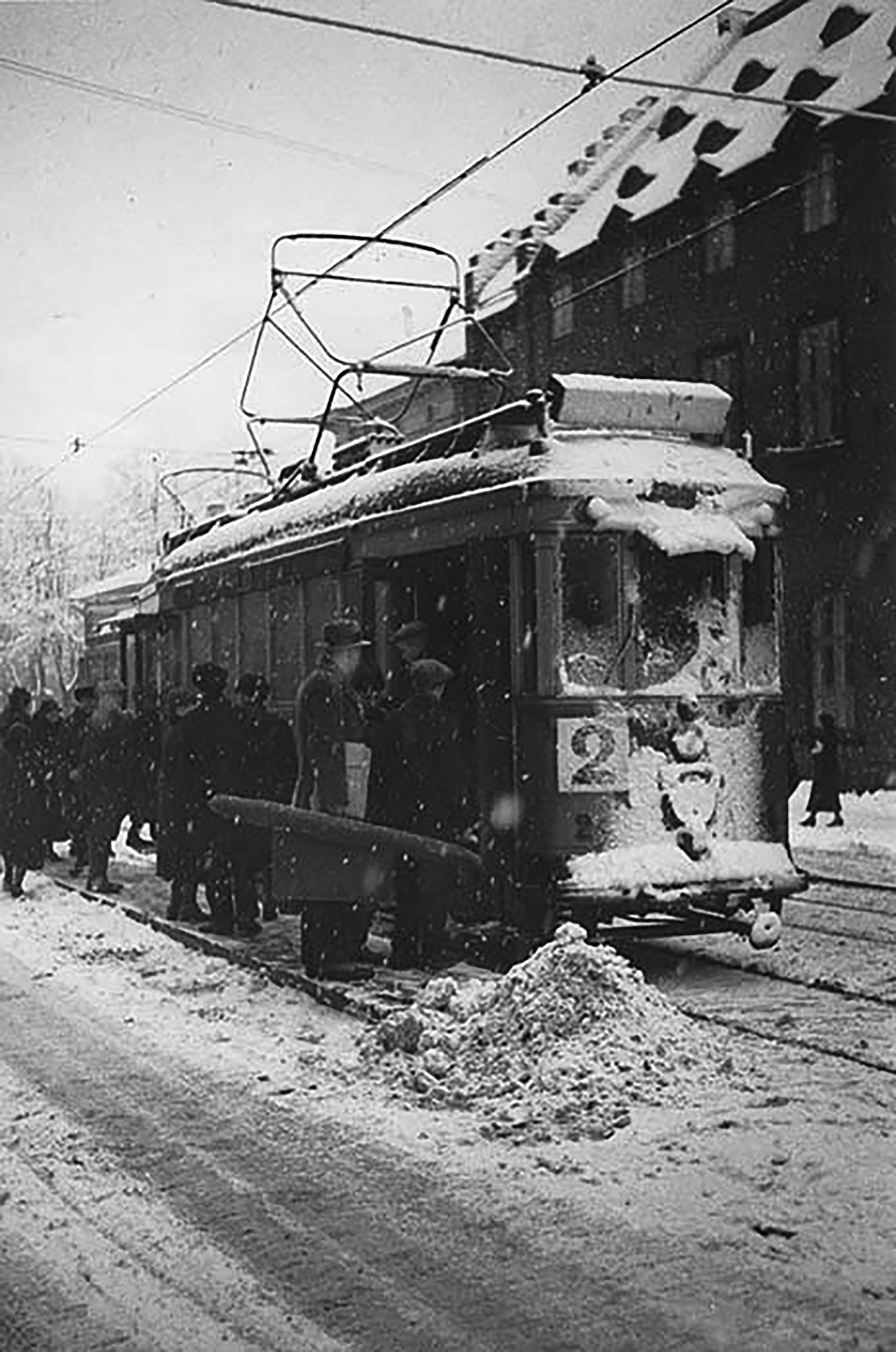
Birger Lundsten 1936/Turun Museokeskus.
Colour of the photographs is another topic that arouses lively debates. Colour photographs attracts many mentions in the Postikorttien Turku, and for example attempts to edit the colours get easily criticised as an attempt to manipulate the past. What goes often unnoticed is that black and white photography conceals an essential feature; the yellow colour of the Turku tram, which continues to exist in the colour of the buses. During the years, the attitude towards photography has gradually changed, and instead of just commenting the content, comments about the aesthetic quality get increasingly common.
Photographs can have a special value as historical evidence. In a methodological essay on photographs and transport, Pereira lists topics where photographs can be particularly useful: the study of behavioural mobility patterns; its consequences for the use of land; the technical evolution of vehicles and infrastructures; the role of users and the presence (or absence) of historically discriminated groups. 46 In addition to intentional content, photographs also contain casual, incidental evidence that can be revealing. Tiina Männistö-Funk, for example, has used photographs to fill a knowledge gap about pedestrians in Turku; a group that had been left out of the statistics but show up in diverse photographs. 47 Private photographs of trams often seem to reveal details of experiences of public transport that are difficult to trace. Moreover, photographs evoke personal memories of affective encounters and meaningful experiences.
The closure of the Turku tram was very visible in the news media at the time. Many of the news that covered the closure, such as the one from the leading national newspaper Helsingin Sanomat (Figure 2), show photographs with texts indicating that the assumed inflexibility, clumsiness, and crowdedness of the trams where the reasons behind the closure. Many of these images were shot at tram stops and can be used to analyse activities in public transport, such as waiting, queueing and entering. A tram was important for school children, especially high school students, and tram memories are often related to school journeys. When the media wanted to illustrate the political decisions they published photos with queues, but there are not many remaining photos of people inside the trams. This could be because photographing inside a moving tram was technically challenging but also because of the norms of around privacy. Most of the tram images in Postikorttien Turku are situated in urban landscape, underlining that trams are quintessentially urban and belong to the culture and memory of cities. The images show how trams occupy the urban space and how they mix (or do not mix) with other kinds of transport, but intimate experiences of tram travels are hard to find. This makes the images more suitable for discussions of urban space and, indeed, in media, they are often used as illustrations in debates on urban planning and the future of tram transport. By contrast, in the Facebook group, images of tram stops tend to lead to discussions about history and personal experiences. For example, images of trams on the market square, (as in Figures 3 and 4) often raise memories of the square as it used to be, but also speculation about the future. The market square has undergone many changes in relation to a new, much-criticised, underground car park, so discussions about it refer to the present situation, even when they do not do so explicitly.
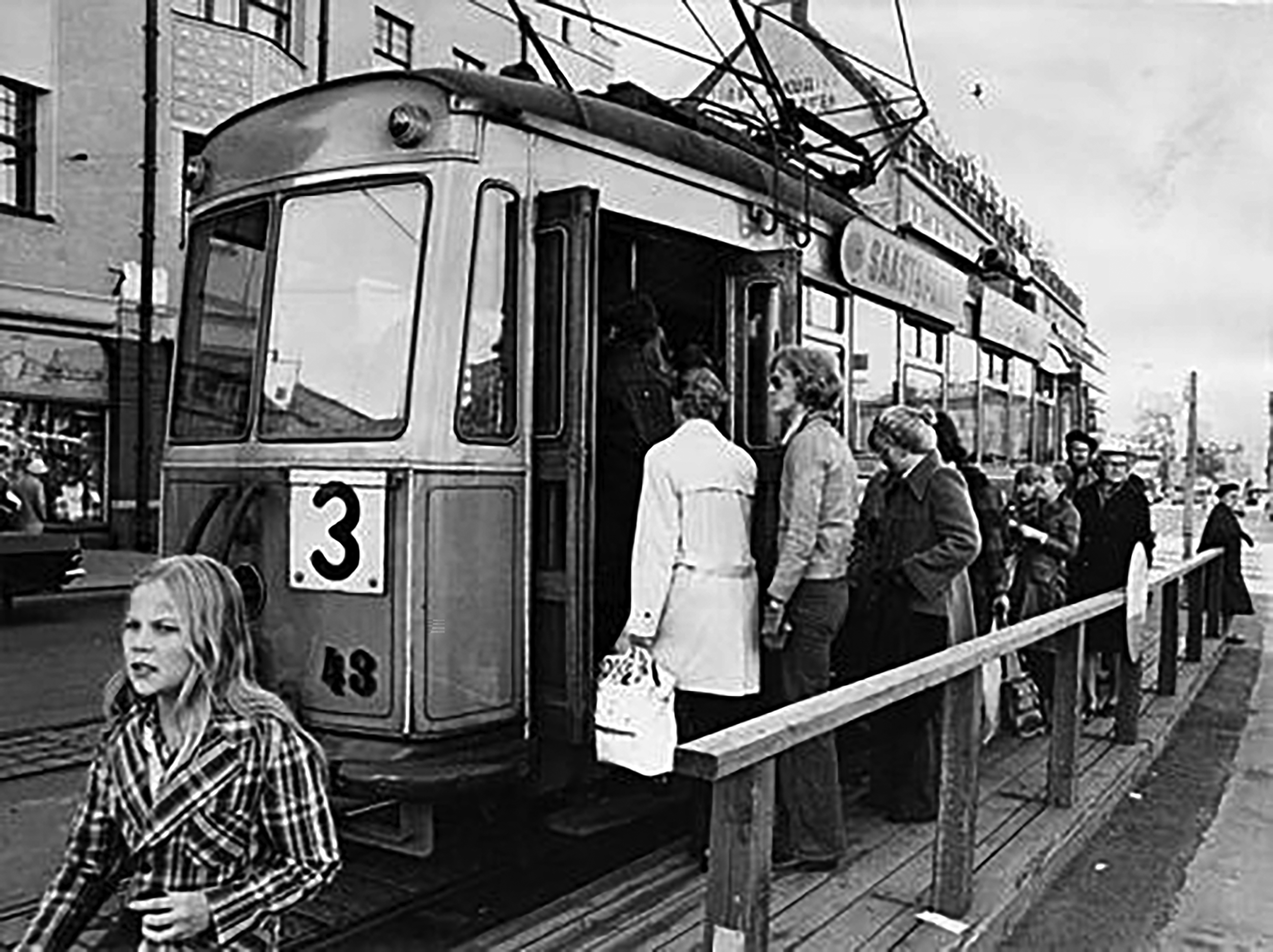
V.K. Hietanen/Helsingin Sanomat 1 October 1972.
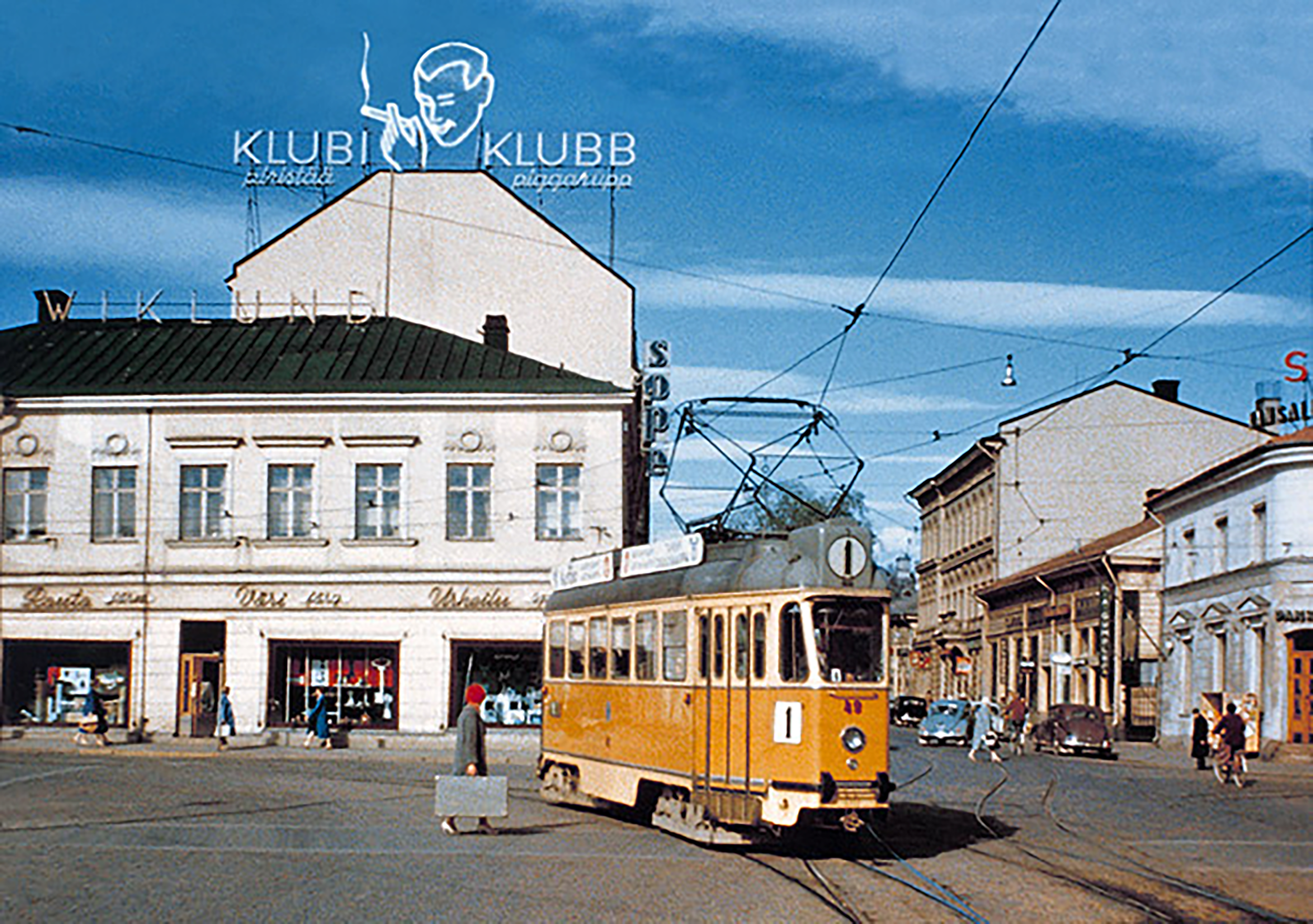
Market square 1959/unknown photographer.
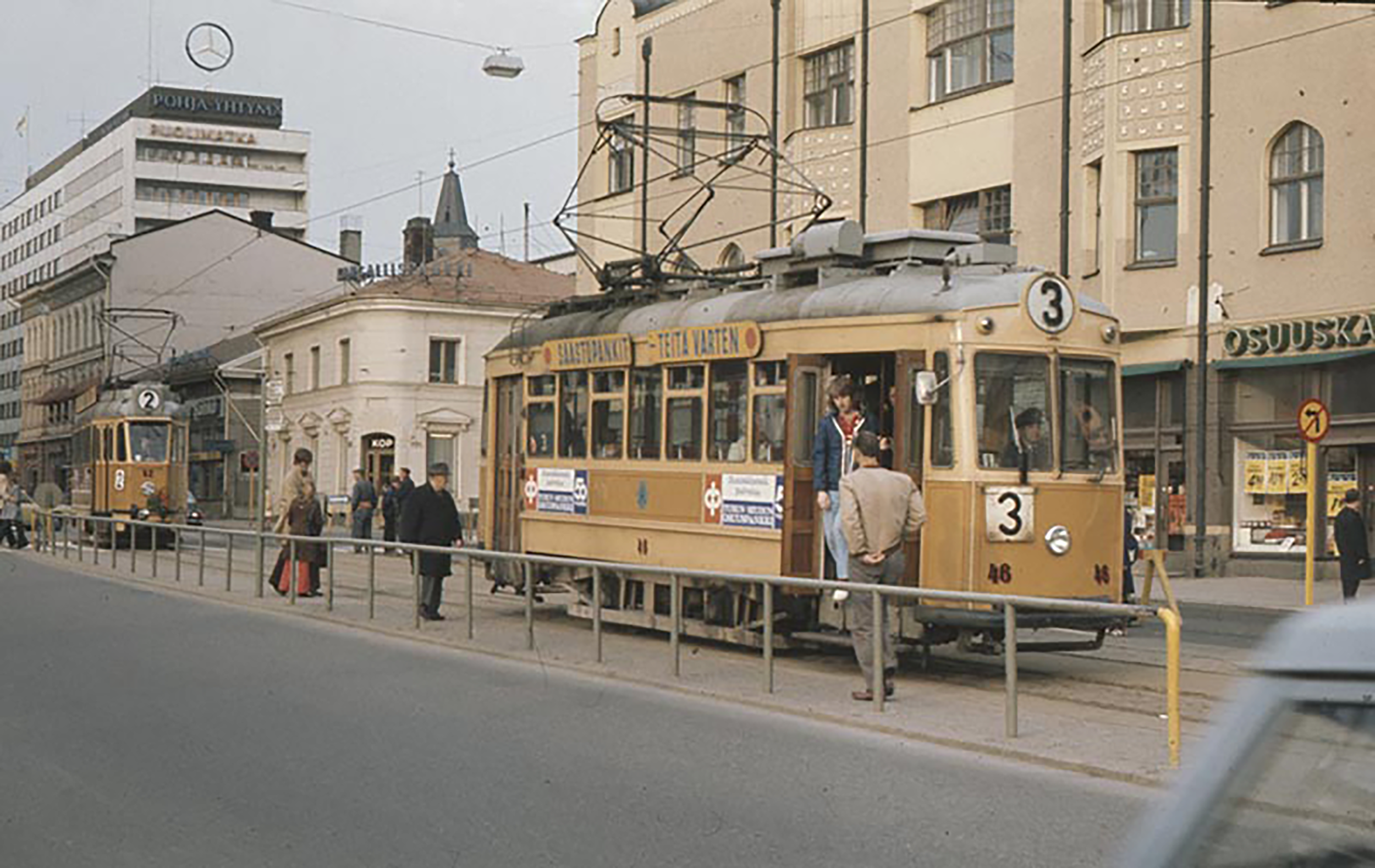
Market square 1972/Carl Jacob Gardberg/Turku Museum Center.
In addition to serving as historical evidence, photographs can have an important role in commemorative practices. In their seminal essay ‘The New Mobilities Paradigm’, Mimi Sheller and John Urry suggested that photographs can be used to activate the performances of memory. When studying photographs from the point of view of cultural memory and mobility studies, it is important to consider their content and their role in commemorative practices. In Turku, the heritage institutions have published research and hopefully, in the future, the museum will also be able to display its tram-related collections, although so far it is the local press and social media that have been the most active in remembering the old tram.
The closure of the Turku tram coincided with the demolition wave of the 1960s and 1970s that gave rise to the unflattering phrase ‘Turun tauti’ (Turku Disease). This process happened in many cities to a greater or lesser extent, but Turku became particularly famous for these demolitions and the alleged political corruption associated with them. 48 The photographs serve as reminders of how the city appeared before the demolitions and closures, but they have also sparked questions and debates about how and why they took place. The photographs of the Turku tram in the press and on social media have enabled people from diverse backgrounds to connect the history of infrastructure to their fragmented, personal memories and experiences of the city.
Commemorating the Turku tram on social media
The photographs and images of the old Turku tram can nowadays be found in many places. They are used in press and media, but can also be found in commercial products like souvenirs and postcards. Social media groups that concentrate on local history have become important platforms for the commemoration of the past mobilities. Postikorttien Turku is the largest and also the oldest group on Facebook. Created in 2013, with a purpose of sharing memories, images and stories from old Turku, it has grown to be an important and well-known platform that gathers people from diverse backgrounds and different age groups. 49 With around 23,000 members, it is an important platform for those interested in local history, from buildings and mobility to personal memories of family and childhood. The group aims to be inclusive and non-political, or at least non-partisan. It does not always succeed, but the effort to find a shared urban history is an important endeavour. When I joined the group, I was surprised how many photos of the old tram were posted and how much they engaged the members. Urban planning is politically charged, so there is a certain value in a local history that is not so much turned towards politics. In Turku, there are other Facebook groups that deal directly with planning. In these groups, history is not so much a source of community as it is material for political argumentation.
Social media has in many ways transformed public memory practices, and complicated the relationship between representation, mediality and understanding the past. 50 Many scholars have paid attention to how memories have become mobile and fluid, but also how memory communities themselves have been redefined. 51 Andrew Hoskins, for instance, has talked of a ‘connective turn’ or even a ‘new memory ecology’. 52 The emergence of social media has coincided with a memory boom, covered with nostalgia, that emphasises affective engagement with the past. The affective qualities of nostalgia have been critically approached in Svetlana Boym's seminal book Future of Nostalgia and in subsequent discussions. Boym sees nostalgia mainly as a disease-like mourning, ‘a temptation to relinquish critical thinking for emotional bonding’. 53 Nevertheless, she also makes a distinction between restorative and reflexive nostalgia. While restorative nostalgia is at the core of absolute truth and tradition, reflective nostalgia is curious and questioning, and can present ethical and creative challenges. 54
It is good to remember, that while nostalgia is characteristic of our time, it is not just a product of recent decades. Modern forms of nostalgia were brought on by the modernisation of society following the French Revolution, rapid technologization and mobility in societies. According to Antto Vihma, the quality of nostalgia has actually remained quite unchanged for the past two centuries, although the internet has been flooded by products that make consumption of nostalgia easier than ever, and no other epoque has had access to the same amount of nostalgic content, or to content that can used in nostalgic contexts. 55
While nostalgia has often been referred to in critical cultural studies, politics and sociology and in the context of social media, empirical explorations are still rare. 56 Studies of affects and emotions related to heritage sites and demolished houses, are scarce. 57 The commemoration of the Turku tram is a good example of how nostalgia has become entangled in the discourses of the tram. Nostalgia is a word often brought up by the group members themselves when they comment the old photographs. Often it does not lead, or is not meant to lead, to a discussion, but it is used more as a synonym for a nice thing. ‘How nostalgic!’ or ‘Those were the days’ are phrases that often accompany tram photos in Postikorttien Turku. Images of trams are among the most popular updates and sometimes they raise debates, but smileys, likes or brief recollections are the most common reactions, all typical for nostalgic discourse. 58 A common topic of discussion is what the tram was called. In Finland, all cities that have or have had trams have local nicknames for them. In Turku, traditionally, they were called ‘raitsikka’, of which the images serve as reminders. Many posts about trams end up with a discussion of the proper nickname. 59 The nickname connects the past and the present, and the future too, as it is already being used for the future tram, whose construction has not yet been decided.
Over the years, the tram-related posts have taken many turns from light, nostalgic chats to furious debates about the necessity of the new tram. In his often-cited book on the memory boom, Mark Crinson talks of memory with the pain taken out. 60 This attitude – to talk about the past while forgetting its complexities – can be found in the commemoration of the Turku tram as well. In some discussions, the tram serves as a symbol for visual urban pleasure without connections to politics, transport planning or the everyday working life, which was the most important reason for the existence of the tramway, many of which transported people to the shipyards to work. In this kind of nostalgic commemoration, the crowdedness, the noise and the slowness of the trams are often forgotten. A relevant concept related to tram culture in Turku, is the notion of prosthetic memory: a memory can be affective and individual through a representation; an ‘aesthetic’, imagined experience, without first-hand experience. 61 Postikorttien Turku has brought together different generations. This way younger generations with no personal experience of the old tram, has become acquainted with the images and stories, but have not been exposed to the material reality of it.
Writing about Facebook's local history groups and performed memory in Sweden, Robin Ekelund has noted that the groups tend to include a marked nostalgic longing, but also a ‘knowledge desire’ about specific dates and detailed information. 62 The same tendency can be detected in the posts on trams in Postikorttien Turku. The photographs often elicit questions about the model of the tramcar, the name of the street, the exact location of the stop, which, in turn, leads to discussions of their absence from the post-1972 city. Alongside nostalgic pleasure, there is a need to know and understand more. According to Ekelund, this kind of engaging with the past can be understood as a form of collective memory work. I agree with Ekelund that a lighter tone can indeed lead to a reflective approach, but the two can just as easily exist side by side. It is worth noting that nostalgic tones can have an unintentional downside beyond the emotional. Many of the tram history enthusiasts in Postikorttien Turku seem to be also advocates for the future tram. Representing the tram in a nostalgic mode can lead to the conclusion that the tram belongs to the past, not the future, and, indeed, this is a counterargument often found after a nostalgic post.
While there is no reason to downplay the role of social media, it is important to keep in mind that history-related tram communities have existed since 1972 when Suomen Raitiotieseura (‘The Finnish Tramway Society’) began its activities. The knowledge gathered by the Society, which can be found on its website, in printed magazines and other publications, is often referred to in Postikorttien Turku. Activists and enthusiasts are at the core of urban memory and living culture, but, despite their visibility, their investment has not received much scholarly attention. In social media studies, the participatory aspect has been overshadowed by interest in the media technology and digitality as folklorists Anne Heimo and Kirsi Hänninen have observed. 63
The administrators of Postikorttien Turku are not encouraging discussions about the future and current politics. Politics cannot always be avoided, but the group has proven to be a place where urban history can be discussed in a somewhat unpolitical or unpartisan context and where the search for common ground or shared urban history and memory, is an important goal. For the tram and other mobilities, this has meant that the group members have talked about trams in the context of urban memory and lived past. This has allowed for an imagination that sees the tram as technology that in embedded in urban culture and everyday life. Curiously, this is something that many participatory planning projects try to do, but without the activists and enthusiasts the results can be meagre. Social media groups can play an important role in contemporary urban culture if they are linked to other forms of civic engagement. They can facilitate the public expression of emotional responses to the past, as Jenny Greogry has observed in the context of heritage groups in Perth. 64 Nostalgic uses of history can cut both ways: they ‘can be both a social disease and a creative emotion, a poison and a cure’, as Svetlana Boym reminds us. 65 In the case of the Turku tram, they both ring true. Nostalgic pleasure and entertainment pertain to old trams, but nostalgia can also lead to engagement, a will to cherish the memory of the tram, and to see a new one coming in the future.
Conclusion
Modern European cities and their mobility structures are well connected. Professional and political networks and transnational governance strategies have evolved and connected European cities, often leading to similar developments elsewhere. 66 Regarding scholarship too, there is a tendency to internationalise local phenomena and to look for transnational connections. The challenge is to maintain the balance between similarities and differences, and to write in such a way that where the local and unique is not lost in generalising. It is necessary to keep one's eyes open for common features and differences. In Turku, a unique feature has been the affective popular culture that has supported and kept alive the memory of the tram at times when the institutional and political support for cherishing its memory (or pushing ahead with plans for a new one) has been weak, occasional or non-existent. It can be concluded that the memory of the tram has been so persistent in the urban cultural memory that Turku has never really ceased to be a tram city.
By emphasising the tram's past, activists have sometimes worked against their own goals by allowing opponents to label them as enthusiasts and the tram as nostalgic and old-fashioned. The cultural memory of the tram may not be as concrete as a plan or as material as tracks in the street; it may not be easy to define, but it is certain that Turku has a tram heritage with a strong community, a prerequisite for cultural memory. Heritage does not only mean a unanimous, positive attitude towards trams. It also consists of different opinions, including those who oppose the new tram, but still participate in remembering the old tram. Despite the differences, a social media group that focuses on the past rather than the present has enabled the sharing of memories and created a ground for the urban memory of the Turku tram to flourish.
In this article, I have tried to understand urban photography and its circulation in the context of mobility. The closure of the Turku tramway has had far-reaching consequences for urban transport and mobility in the city, but it has also created a unique memory culture where visuality has been a consistent feature. The reason for this may be the lack of a tram museum or another heritage institution that could cherish the memory in a more formal way. In this case, it is the enthusiasts, activists and ordinary people who have persistently shared their memories and photographs that have kept the idea of the tram alive. Taken by a variety of individuals and professionals, the images have travelled through time and different media, from 8-millimetre film and cameras to press photos, private and public archives, and social media groups. Together they form a visual memory of the old Turku tram that has provoked many responses, from nostalgia to political action and social engagement. The images have made it possible to share memories between generations; between those who remember what it was like to ride the trams and those who have come to know them through the images and the stories associated with them. This cross-generational remembering makes the cultural memory of the tram highly affective. Photographs and social media have also shaped public expressions of loss and negotiated responses to these events. Turku has a history of heritage loss; ‘Turun tauti’ (Turku Disease) is part of the city's cultural memory. Although the tram closure has often been considered separately from other urban issues, it is at the core of the urban memory of loss, along with the demolition of houses.
The planned new tram has been the subject of ongoing public debate and the planning documents are openly available. The technical plans for the new tram have been accompanied by various reports and presentations to justify the need for a new tram. 67 While the strategic documents are well versed with the vocabulary of sustainability, the connection to history remains superficial. For example, the city's latest public presentation material states: ‘History, culture, education and development make Turku the most European city in Finland. Rails and tramways are characteristic for modern European cities’. 68 Interestingly, this statement is placed in the introduction of a PowerPoint presentation, but it is missing from the concrete objectives which are built around the notions of competitiveness, sustainability, appealing public transport, the welfare of the passengers, and economy. To summarise: a new tramway can be argued for by referring to an alleged ‘European’ urban history, but the city's relation to its own past remains worryingly unclear. I think this shows how important it is (also for scholars) to look at mobility issues in a broader urban and historical framework. Trams are European, true, but so is local history, and this should not be discovered only through social media history groups, however influential they may be. Questions of urban memory and identity are messier and harder to define, measure and quantify than budgets and engineering plans, but they should still be taken into account in infrastructure developments.
The focus of this article has been on the creating a cultural memory around the Turku tram, but I think that it can also contribute to discussions about sustainability. How the possible future tram will relate to the old one, is a question yet to be explored. The Turku tram is not the only example where history is relevant and important for the future decisions. Transport historians have often pointed out how important an understanding of the past is for policy makers and planners, and it is the historian's duty to make this knowledge accessible. 69
The memory of the Turku tram is a good example of how cultural memory operates in the twenty-first century. It mixes public and private memories, politics and images. To some extent, it depends on media technology, but, in the end, it is the groups and individuals who buy the cameras, go out into the streets, take the photographs and then treasure them and share their stories that are at the heart of cultural memory. Old photographs can be shared, but it is only possible to share photos that have been taken in their time. This may sound trivial, but urban cultural memory relies much on this kind of activity, and it should not be belittled.
This can be seen as activism which may or may not be political in nature. The visual culture of the tram has sometimes tended to treat the past as entertainment and nostalgia has been an obstacle, albeit unintentional, to a new tram in making it seem old-fashioned and belonging to the past. More importantly, the images have been able to carry the memory of the tram and its closure, preventing the forgetting of urban concerns that were meaningful to many people, and pivotal for the city as a community.
Footnotes
Declaration of conflicting interests
The author declared no potential conflicts of interest with respect to the research, authorship and/or publication of this article.
Funding
The author disclosed receipt of the following financial support for the research, authorship and/or publication of this article: With support from the PUTSPACE project. PUTSPACE (‘Public transport as public space in European cities: Narrating, experiencing, contesting’) is financially supported by the HERA Joint Research Programme ( ) which is co-funded by AKA, BMBF via DLRPT, ETAg, and the European Commission through Horizon 2020.