



Abstract
This paper examines to what extent heritage considerations guided the closure of an operating tramline in Toruń's Old Town prior to its designation as a World Heritage City. The study is based on an analysis of local newspapers’ articles over a decade, encompassing the period before and after the tramline was closed. Additionally, it incorporates evaluations of historical public transport maps, content analysis of public consultation reports and expert interviews. The closure's narratives drew on factors including safety, operating costs, modernisation, and the promotion of tourism, all carefully tailored to confer legitimacy upon the decision. While heritage considerations and heritage experts’ opinions may have contributed indirectly to the formulation of policy, these elements were entirely absent from the narratives of justifications preceding the tramline's closure. The study traces, following the tramline's closure, a marked evolution in the narrative, which came progressively to emphasise the protection of Toruń's cultural heritage.
Introduction
Cities worldwide face numerous challenges that can significantly impact their historical landscapes. Among these challenges, transportation systems hold particular significance in shaping urban areas, and their role in preserving cultural heritage sites is of paramount importance. The establishment of the World Heritage List by UNESCO (the United Nations Educational, Scientific and Cultural Organization) has been a prominent instrument for recognising and safeguarding such sites globally. As of September 2023, the World Heritage List comprises 933 cultural, 227 natural, and 39 mixed sites recognised for their exceptional universal value. 1 Among these, 147 sites are specifically designated as “city” or “town”, while 55 bear the title of “historic centre”. However, certain modifications to urban transport networks within the centres of historical cities, particularly tramlines, have raised questions about their compatibility with designated World Cultural Heritage Cities. This article understands World Heritage Cities as ones in which the entire historic city centre is included in the World Heritage List instead of a single site (for example, a church or a castle). Such cities are recognised for their comprehensive historical and cultural significance rather than just one notable landmark.
Scholarly investigation into the relationship between World Heritage Cities and Public Transport (PT) has been limited, but the subject is gaining attention as an emerging field of examination. 2 In the domain of transport history, examining case studies on the influence of transportation on historical areas is of great significance as it illuminates the contradictions and complexities involved in the preservation of World Heritage Cities, providing insights into the evolution of urban landscapes and the preservation of cultural heritage. 3 Scholars have acknowledged the importance of such studies in comprehending the intricacies of urban development and the interplay between transportation systems and heritage sites. 4
At the same time, in transport history, multiple articles have been published examining changes in public transport modes, such as the closures of tram networks.5,6,7 After the Second World War the tram networks around the world were largely phased out, due to them being viewed as obsolete by the widely embraced ideas of urban development envisioned by Modern Movement. 8 The trend of the abandonment of tram networks continued until 1980s, when approximately 300 working tram networks were existing around the world, in contrast to over 1000 networks existing earlier. 9 This trend was also present in socialist planning, questioning the development of tram services “particularly in central areas, and especially those with a high density of narrow streets” and arguing that trams can only suitable for medium-sized cities. 10
In this study, we consider the city of Toruń. Situated in northern Poland, on the banks of the Vistula River, Toruń is renowned for its rich historical background, dating to its founding in the early medieval period. Toruń applied to be inscribed on the World Heritage List in the 1970s. Along with other surviving Hanseatic League towns, such as Wismar, Stralsund, and Visby, the “Medieval Town of Toruń” was awarded World Cultural Heritage status in 1997, 11 highlighting the collective historical and cultural value of its urban structures, beyond the significance of individual buildings. The city's urban layout, fortified structures, and edifices exemplify the distinctive characteristics of a medieval trading centre. Toruń's historical architecture showcases an impressive ensemble of Gothic and Renaissance styles, comprising churches, townhouses, merchant residences, and well-preserved defensive walls, all of which provide valuable insights into the city's historical development. 12 The UNESCO site covers an area of 48 hectare within the inscribed property and 300 hectare of the buffer zone, whilst the total area of the city is 11,575 hectare. 13 , 14
The medieval structure of the city has not prevented Toruń from successfully developing a Public Transport (PT) network. Before tram transport was introduced in Toruń, there were initiatives for organising omnibus transport. As early as 1863, the city authorities permitted a company to carry passengers in a 12-seat omnibus pulled by four horses along the route from the Old Market Square to the bridge across the Vistula River to what is now the Toruń Central Station. Trams appeared on the streets of Toruń in the early 1890s. In 1889, the city authorities negotiated with a Berlin engineering firm to construct a horse-drawn railway. The contract for laying the track and long-term operation of the horse-drawn railway was signed on 16 August 1890. The introduction of electric trams followed, and on 18 May 1891, the tram service was opened to great fanfare, including a parade of carriages in the Old Town Square. The tramline had a single track with passing loops, and it covered various parts of the city, extending from the city centre to the railway station.
The transition from horse-drawn to electric trams occurred on 1 February 1899, when the first electric tram started to operate in the city centre, connecting the depot to the railway station located next to the mediaeval city centre (nowadays called Toruń-Miasto). In 1901, the tram system transported a total of 1,122,411 passengers. 15 By 1903 two tramlines were operating in the city, the network now connecting the historic city centre with the city's two largest districts. This did not prevent ridership from decreasing that year to 1,041,494 passengers, the lowest recorded passenger count in the city's history, including all of the years of the two World Wars. 16
The historical aspects of PT in Toruń have received limited attention, with researchers primarily concentrating on the overall evolution of the transport network, the chronology of tram system changes, and the initial stages of tram movement.17,18,19 The academic literature does not extensively address the reasons behind the proposed changes in the tram network and closure of tramlines within Toruń's Old Town in 1970, an area subsequently designated as a World Heritage site. The influence of heritage experts in the decision-making processes is conspicuously absent from written records. The history of a systemic heritage protection in Toruń dates back to the beginning of the Second Polish Republic and early 1920s when the Monument Conservator Services in the city were established.
This research analyses the narratives of justifications for closing operating tramlines in Toruń's Old Town prior to its designation as a World Heritage Area. It seeks particularly to understand to what extent heritage considerations influenced this alteration in the urban transport system and how these changes might have contributed to the Old Town achieving its World Heritage status. The study explores the extent to which these considerations, including the opinions and recommendations of heritage experts, influenced the urban transport policy, leading to modifications in the tram network and the closure of tramlines within the World Heritage Area.
Considering the significance of heritage experts in decision-making processes and policy development within their respective areas of expertise, their role becomes particularly relevant in the management of World Cultural Heritage, which involves diverse actors participating in decision-making processes at various levels, spanning both global and local contexts, with each entity exerting a discernible degree of influence. 20 , 21 To examine the role heritage experts play in determining the closure of the tram network within the World Heritage Area, this study adopts a polycentric approach. In polycentric governance systems, policy venues are interconnected, facilitating networks of actors engaged in deliberation and collectively shaping decisions on interrelated policy issues. 22 The concept of polycentric governance does not rule out the possibility of a central authority making decisions about World Cultural Heritage. Instead, it goes beyond the confines of formal institutional arrangements wherein state authority presides over collective decision-making processes about World Heritage sites. 23
Materials and methods
The study is based on an analysis of historical PT maps and content analysis of public consultation reports within the framework of expanding the PT network in Toruń as a part of the European Union's (EU) regional development programme. This provides a thorough understanding of how heritage expertise has influenced the transportation system's development. The study also includes an analysis of local newspaper articles written between 1963, eight years before the tramlines were closed in 1970, and 1973, when the five hundredth anniversary of Copernicus's birth was celebrated in Toruń. The newspapers were chosen by the criterion of mentioning the PT in Toruń. The news articles were accessed in printed form in the National Archive in Toruń and were analysed by the authors without using digital tools, as they were not available in digital form.
The analysis of press articles brings certain limitations to the framing of the article. However, we argue that the Polish People’s Republic press cannot be classified as free. According to an article published on the topic of the freedom of the press at that time, “the press was treated as a political superstructure, which was an instrument of the ruling party's policy.” 24 We, therefore, analyse the press as somewhat an extension of the official position of the local government—that is, in a sense, that the press was a tool to explain and legitimise decisions, to present them as beneficial to society. We argue that analysis of press articles as a coherent narrative that furthered the agenda and reasoning of the governing structures is therefore possible. Various actors in the press, including the authorities, journalists, and readers, provided negative coverage of the trams. We posit that those press articles, authored by both journalists and readers, were pivotal in constructing the narratives presented to the public, while also being presented as constructed by the public itself. The analysis seeks to provide insight into the narratives provided by the authorities and the presented reasoning behind the closure.
Another source of information for this study was expert interviews conducted with key actors, including representatives from the transportation company, city administration, and decision-makers in the late 1960s and 1970s, when the decision to close the tramlines was made. Interviews also covered the current stage of the tram network development in Toruń. Individuals involved in the application process for World Heritage status in the 1980s and 1990s were also interviewed. Taking into account limitations of the use of interviews collected during a significant period after the tramline's closure, we recognize that the values of our interviewees may have changed over time. Due to the fallacy of human memory and oral history as a source, we do not treat the information as objective, but as a subjective contextualisation of our research. 25 However, they provide contemporary perspectives that are crucial as decisions regarding the network's expansion are being made today. The language of the press articles is Polish, and the language of the interviews was Polish and English. The materials were translated into English by the authors.
Through a comprehensive examination of the data, this research delves into the intricate dynamics that led the city to modify its PT system within the World Heritage Area, particularly the tram network. Georeferencing techniques were used to represent historical transport maps on OpenStreetMaps database maps, guaranteeing a precise and all-encompassing street-by-street juxtaposition at a consistent scale. This methodological approach facilitates a thorough analysis of the transformations that have occurred over time and an understanding of the evolution of the tram system within the designated area.
Heritage and expertise: Ignacy Tłoczek and Toruń trams
Ignacy Tłoczek served as the chief architect of Toruń (Główny Architekt Miejski) from 1930 to 1939 and was the foremost heritage expert to have substantially impacted the transformation of the city's tram network. During his tenure, substantial modifications were implemented to integrate the tram infrastructure with the city's rich historical and architectural milieu. He also proposed and designed a strategy for excluding trams from the historical city centre.
A number of experts interviewed for this study underscored the importance of Tłoczek's city development plans over the years. For example, an art historian from Toruń maintains that the plans “(…) are still being carried out. Partly, I am thinking about another bridge, for example. Tłoczek's plans show that there was planning, there was forward thinking. He planned in the late 1920s, early 1930s, and planned until the 1960s—that is, for three decades”.
The city of Toruń operates under the jurisdiction of the Municipality of Toruń. The governance system comprises the mayor, who heads the city administration, overseeing the local government's executive functions, and the city council, the legislative body at the local level. The chief architect of Toruń reports directly to the mayor, and the architect's functions and powers have changed over time. In Ignacy Tłoczek's day, this function combined urban design, public transport planning and architecture competencies in the hands of one person. Today, a complex system of multiple city departments is responsible for those areas. 26
Toruń's PT is currently operated by the Miejski Zakład Komunikacji company. It functions under private company law but is wholly owned by the Municipality of Toruń, its sole shareholder. All decisions and plans for the shape and investments into PT in Toruń are, therefore, formally made by the city executive and the Mayor of Toruń. Historically, a PT company owned by the city operated the PT system. While the city's governance structure was different under the communist system, the basic idea remains the same—city authorities make public transport related decisions, whilst the PT company executes the plans. This analysis delves deeper into the dynamics of power and collaboration between these different actors.
When Tłoczek took over under the leadership of Mayor Antoni Bolt, the city was already embroiled in a conflict over the Baroque apartment building located at the mediaeval city centre (37 Piekary Street). Constructed in the eighteenth century, this building was important but obstructed the route between the Old Town and the Bydgoskie Przedmieście neighbourhood. As a solution, in 1915, an arch for pedestrian access was thoughtfully integrated into the building's design, a project led by the esteemed German architect Karl Caesar. In recognition of Caesar's contribution, the entire building was later honoured with the name “Caesar's Arch” (Figure 1).
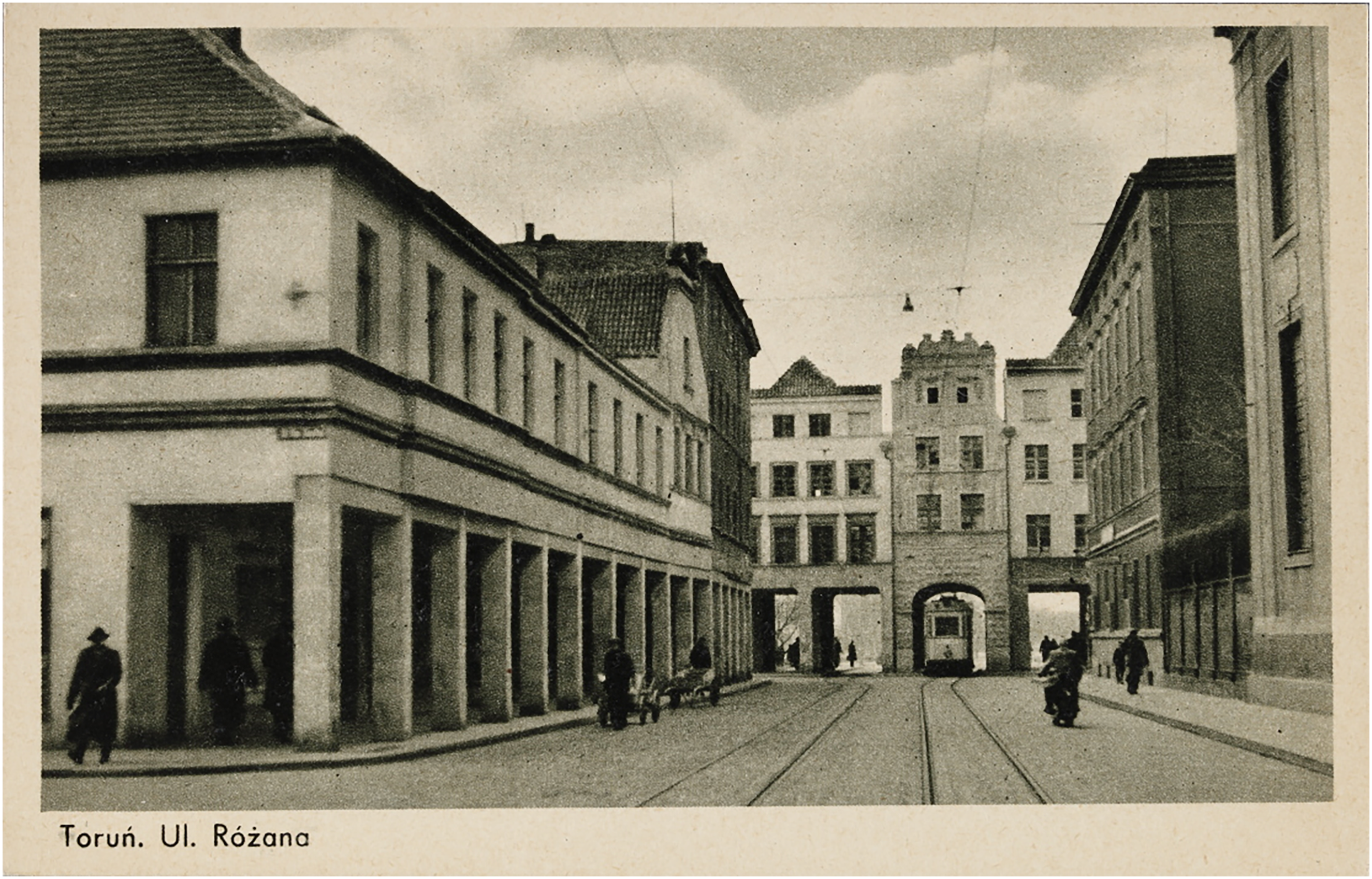
Różana Street after the creation of Caesar’s Arch and modification of the tram network. Source: Nicolaus Copernicus University in Toruń’s Library, Department of Graphic Collections.
During the latter years of the 1920s, the prospect of demolishing Caesar's Arch to make room for a tramline became a subject of debate, sparking contentious discussions. Prominent members of Toruń's business community fervently championed dismantling the historic edifice in favour of constructing a tramline. 27 However, the proposition faced strong opposition from citizens who recognised the building's significance as an emblem of architectural heritage and emphasised its importance within the mediaeval city's architectural framework.
Under the guidance of Ignacy Tłoczek by 1937, the culmination of these efforts led to the establishment of tram arches financed by the Municipality of Toruń, thereby enabling seamless passage for the trams. 28 Figure 1 illustrates that, concurrently, a portion of the left-side edifice underwent demolition to accommodate the construction of an arcade. This course of action was motivated by two primary objectives: ensuring pedestrian safety and providing additional room for the tram tracks.
For Tłoczek, this decision was perceived as temporary and was primarily aimed at preserving the historical heritage of the city. He noted that his arguments for preserving the historical structure were not well-received by the city council: “I demonstrated the project to the city council, underscoring the exceptional cultural value of the complex of the tenement houses. (…) I felt responsible for the compromised, suboptimal solution. I thought that the large-size piercing through the houses, disproportionate to their scale, is only temporary as the Old Town merchants will soon become bored by the tram in the Old Town, and we could reverse the changes”. 29 Consequently, Tłoczek found himself in a position where he had to justify the decision within the broader context of the tram network's development. Hoping for further change in the tram network, he said, “Anybody that is able to put things into perspective can see that it is only a matter of time before the existence of the tram will be seen as a nuisance in the narrow streets of the Old Town”. 30
The decision to construct a tramline through the House of Caesar's Arch played a crucial role in maintaining the historical city structure of Toruń’s Old Town and also preventing the demolition of this building complex and the construction of a high-rise building within the boundaries of the historic centre in the 1930s. This balancing act helped preserve the city's historical structure while providing a safe and convenient mode of transport for its inhabitants. The question of discontinuing the tram service within the city's historic centre, particularly in connection with Caesar's Arch, was addressed in the city's 1935 long-term development plan authored by Ignacy Tłoczek, which was to be binding until the 1960s. Integrating the tram network into the mediaeval city centre also helped maintain its appeal as a residential area, even if it offered less desirable living conditions than the city's newer neighbourhoods.
As shown above, Ignacy Tłoczek reconciled the tram network with heritage protection considerations before such protection became a more prominent issue. As readers will see from the analysis of the press from the time of the tram closure, the city's head of architecture was an unorthodox thinker about questions of heritage.
The influence of Tłoczek's decisions and plans on maintaining Toruń's heritage is recognised as having had a direct influence on the UNESCO inscription. For example, in his forward to the book “Węzeł Gordyjski w Toruniu”, Zefiryn Jędrzyński, former editor-in-chief of the largest local newspaper, writes about Tłoczek “[due to his measures], the Old Town complex of Toruń would find a home on UNESCO's World Heritage List”. 31 His importance and influence on heritage protection over the years make him one of the most central heritage expert figures in the history of urban planning and monument protection in Toruń.
Closure of tramlines in the World Heritage Area
Following the conclusion of the two World Wars, several World Heritage Cities, including Bamberg (Germany) and Český Krumlov (Czechia), chose to discontinue their tram networks. In contrast, Toruń took a different approach, actively seeking to expand its tram network and purchasing the carriages from other Polish towns that were closing down their networks (such as Inowrocław, Słupsk, Jelenia Góra, and Olsztyn). 32 The tram continued to be the only mode of PT in the historic city centre.
In 1946, when the city's population was approximately 81,400, the tram system served 11,370,519 passengers annually. The outline of the tram network up until the end of the Second World War was designed by Ignacy Tłoczek. His plans then guided the development until the 1960s. In a single year, passenger traffic increased by approximately 25.19 per cent, from 13,655,204 in 1950 to 17,093,194 in 1951. 33 During this period, the city's population also grew modestly, from 79,781 to 82,300 inhabitants. The tram network's popularity continued to surge, as evidenced by the official statistics for 1965, when 39,505,870 passengers rode the city's trams and buses, and the city was home to 114,500 inhabitants. 34 In 1964, the second most popular mode of transport, buses, carried approximately 33 per cent of passengers, while the tram network handled the rest. 35
Notwithstanding the notable growth in passenger ridership and trams as a primary mode of public transportation, a resolution was reached during the late 1960s to terminate the tramlines operating within the historic sector of the city. Subsequently, on 22 April 1970, the last tram ride occurred in the historic city centre. 36 In 1971, the rails were wholly removed from the historic part of the city except for a few elements. As a consequence of this decision, there was a discernible reduction in passenger traffic, with the numbers declining from 41,068,992 in 1970 to 37,621,857 in 1971. 37 The dismantling of the tram tracks within the city led to the absence of any form of PT within the designated World Heritage Area.
Urban transport policy—narratives and representations in the press articles at the time of the closure
This analysis does not seek the reason for the closure or the arguments deployed by the decision-makers of the time to close the tramlines. Rather, the aim is to provide insight into how this decision was presented and what narratives were constructed in the years leading to the closure to increase public support for the decision. We recognise that the narratives presented in the press may have guided the decision-makers, though we do not know to what extent. We also argue that the understanding of heritage and heritage expertise, initiated as a factor in thinking about public transport by Ignacy Tłoczek, plays a role.
Three main intersecting narratives in the press are identified: the narrative of safety in tram traffic, the narrative of the tram network's costs and maintenance, and the narrative of Toruń's modernisation. The press reports falling under the “safety” narrative increased in frequency as the closure neared. In our research, we identify three spatial levels of this narrative, as the accidents that the local press reported on took place in Toruń, Warsaw, or even internationally. The first analysed report on an accident involving a tram is from 1962. It reports on a fatal accident where a person attempted to run across the tracks and fell under the tram. 38
In 1964, another report on a tram accident emerged, this time on a “national” level, from the capital city of Warsaw, where a tram derailed, injuring three. 39 Toruń's Old Town makes its appearance in the reports with a story on an “Unfortunate accident” of a young lady being hospitalised after falling under the tram in the Old Town market square. 40 Here, another aspect is added to the narrative. The article “The Sensitivity Threshold” is a reader's letter describing a tram departing the stop too abruptly, leaving behind several students on a school trip who hadn’t yet boarded. This follows the narrative of the safety problems of the tram network, and “concerned citizens” begin reporting on it. 41 This trope continues in another piece, this time with the headline “Endangering an infant”, with the article ultimately chronicling the inattentiveness of tram drivers. The tram started departing from a stop before a mother could manage to get her trolley—and the infant inside—safely off the tram, resulting in the child falling to the ground. The article emotionally implies the dangers of using the tram as a mode of PT, ascribing blame for the incident to the automatisation of ticket sales in the trams and the related absence of conductors in every tramcar. 42
The next press report is one of a series, its trope that of reporting on inebriated people falling under trams. Leading with the headline, “It was not a good day”, it paraphrases a song whose lyrics in part read, “Every day is a good day to have a drink”. It reports on an accident a drunk individual had while trying to jump into a moving tram, falling under its wheels, and losing a foot as a result. 43 A year before the closure in 1970, the language used in such reporting became much more emotionally loaded. Reporting on a tram accident in Warsaw, an article leads with the headline “Again, a tragic tram pile-up”. It then uses emotionally charged language (“tragic”) and mentions the frequency of such accidents. 44 Shortly after, an article was published in a series of reports on tram accidents in various cities. The report covered a collision between two trams in Warsaw, sending four to the hospital with injuries. It highlights that the accident was caused by an inexperienced tram driver who made a mistake. It also emphasises the lack of sufficient supervision over inexperienced drivers and calls for “undertaking radical steps toward improving safety on roads regarding trams”. 45 Lastly, international cases were also presented in the press. At the end of the year, a photograph of a tram crash in Zurich was published. It portrayed a so-called “catastrophe” of an overfilled tram derailment that hit another tram, reporting on one person dead. 46
The prime objective of these publications was not tackling the safety concerns associated with tram transportation. Rather than proactively addressing the issue through means such as an educational campaign aimed at promoting safer behaviour among tram passengers, these pieces predominantly featured mere descriptions of hazards and the potential negative outcomes of unsafe actions. A solitary and concise public service announcement was disseminated, specifically focusing on individuals leaping onto or off moving trams. This announcement is the only such effort we have been able to identify. The content of the announcement reads as follows: “Never jump in or jump out of a moving tram”. 47 This instance further underscores the notion that such articles were mainly intended to garner public support for the closure of tramlines rather than to enhance the safety of public transportation.
The narratives of the tram network's costs and PT's modernity in Toruń are intertwined. Notably, in the 1960s, the trams were the most popular mode of PT in both Poland and Toruń. In Toruń, passenger numbers increased from the pre-war period sevenfold. 48 Hence, creating support for the closure of tramlines required creating a strong narrative of their obsolescence as a mode of PT and presenting a shift towards buses as the path to modernisation.
The first article from 1963 reports on an analysis conducted on the development of PT development in Toruń. It presents two alternatives—abolishing the tram and replacing it with buses or maintaining the current tram-bus model. Whilst written in the linguistic style of a “neutral report”, it does point out that “nowadays we would not build a tram network in a city the size of Toruń” and points out the high maintenance costs of the tram network. At the same time, this report did not mention the negative aspects of a bus-only solution. 49 The article raises doubts about the viability of constructing new tramlines due to their high costs. It highlights that road construction, though equally costly, addresses multiple transportation issues simultaneously and accommodates bus traffic. It also underscores the flexibility in bus routing, a feature lacking in tram systems. It suggests that trams are seen in a better light because the city's buses were in poor condition, and favours investment in new buses over the construction of new tramlines. According to the article, as a faster and more cost-effective track towards modernisation, buses offered better unit costs. 50
The incorporation of automatic door-closing mechanisms in tramcars became another motif of particular interest, one that resonated with the overarching themes of safety, modernisation, and financial considerations. The issue was encapsulated in a news article that meticulously delineated the advent of automatic doors in the trams in Bydgoszcz, a city near Toruń. The report noted that automatic doors would be gradually introduced into all tram networks, “improving the safety of travel” (thus implying that the current mechanical solutions were unsafe). 51
A sub-narrative of the unreliability of trams, thus implying the need for modernisation towards a bus system, can also be identified. Here, a newspaper article from 1969 reported on a five-hour delay in tram service in the city. An overhead line fell, breaking current collectors in two trams passing underneath at the time. The malfunction is presented with a strong narrative of having “paralysed” the tram network, taking most of the network out of service. In its stead, the article explained, buses took over most of the transport service. 52
Articles addressing the safety or reliability of buses also emerge, albeit with lower frequency. However, these discussions do not focus on the bus as a mode of transport itself, as is the case with trams. Instead, the narrative concentrates on the human aspect, specifically the operators of the buses. For instance, an article titled “Passengers Forced to Intervene Due to Inebriated Bus Driver” highlights this shift in focus. 53 The articles do not explore the inherent safety or reliability of the buses themselves.
The burgeoning phenomenon of tourism was a primary impetus underlying the decision to shut down the tram networks. The intersection of the narratives described above culminated in articles that explicitly addressed the discourse surrounding the discontinuation of tramlines. A notable example is an article that not only advocates, but also presents a proposal for, the temporary suspension of tram services within Toruń's historical precinct. The envisaged hiatus, as outlined in the article, would be of a transitory nature, restricted to weekends exclusively, with the intent to “transform the primary thoroughfare of the city into a pedestrian thoroughfare”. The article draws upon the precedent set by the city of Łódź, which had already adopted this approach. This course of action was advocated “so that the tourists can freely admire the beauty of our town”. 54 This implies not only that the tram network disrupted the prevailing ambience of Toruń but also that temporary suspensions of tramlines would not precipitate any disturbance. The narrative highlighting the dispensability of trams in the Old Town had now been introduced.
Another article about tram dispensibility bid farewell to tramline “1” within the World Heritage Area (preceding the comprehensive network closure by a year). Penned by the same individual who piloted the inaugural tram on its maiden route, the piece documented its final journey along the line. Notably, the article portrays the tram as a relic of the past, evoking a sense of nostalgia rather than functioning as a modern urban transport solution. 55 This was another narrative priming the citizens of Toruń for the impending closure of tramlines within the Old Town.
The analysis of news reports surrounding the closure of tramlines within the World Heritage Area of Toruń reveals the construction of three main intersecting narratives: safety, cost, and modernisation, with a sub-narrative on the city's development thanks to growing tourism. We submit that by publication of the articles those narratives were constructed by the authorities in local newspapers to justify their decision and garner public support for the closure. The safety narrative emphasised tram accidents and incidents, fostering concerns about the risks of tram transportation. The cost narrative highlighted the high maintenance expenses of the tram network and presented buses as a more financially viable and modern option. The modernisation narrative cast trams as outdated, and advocated for a shift towards a bus-only system as a progressive step for the city. The rationale underpinning the authorities’ decision to close the tramlines is tacitly rooted in their focus on forthcoming tourism development, which was to hold significant sway over the city's economy. This decision also reflects an intention to transform the principal thoroughfare of the Old Town into a pedestrian-oriented zone.
These narratives of justifications for closing tramlines within Toruń's Old Town did not focus on the technical aspects of the solutions proposed or the authority of any particular experts. The authorship of those articles was not usually ascribed to a particular person, but rather to the newspaper's editorial boards or letters to the editor section. The aim of the narratives was to foster public support for the proposed closures in alignment with the opinions of heritage experts. The “heritage preservation” rationale was not a direct narrative on its own, but rather a part of a theme within the narratives partly connected with the development of tourism.
Present-day narratives and Toruń's tram network today
Present-day perception of the closures put noise, obstruction of pedestrian traffic and heritage protection as the most commonly cited reasons for the line closures by interviewees nowadays, but there is no mention of it in the press of Ignacy Tłoczek's day. Despite the increasingly complex influence exerted by various actors in the polycentric governance system, a contrast to the more hierarchical system prevalent during the times of the Polish People's Republic, none of the decision-making entities is currently advocating for the reintroduction of tram services in the World Heritage area. Faced with the question of the need for PT in Toruń's Old Town, interviewees expressed surprise that the issue was raised and denied the existence of any debate regarding the return of trams to the historical city centre of Toruń.
Residents of Toruń at the time of the closures of tramlines within the Old Town area frequently cited noise as a primary motivator for the decision. For example, in an interview, former conservator of monuments Zbigniew Nawrocki said, “This tram was very disturbing and noisy. It was a big attraction, but it was disturbing. Everyone was happy [the] car route was built along the Vistula River, boulevards, and Sikorskiego Street (where the tram had been rerouted—ed.). So, the city has been separated from the transit traffic of all vehicles. And now it has gotten quiet”.
Today, a reason frequently cited for the tramline's closure is the alleged damage to the Old Town Hall of Toruń vibrations from trams were purportedly causing (tram traffic led to the formation of cracks in the structure). However, this assertion has not garnered substantial support from heritage experts responsible for heritage site restoration. In fact, in an interview for this study, one outright refuted the claim, calling it “a myth”. Additionally, the interviewee provided an alternative rationale for the closure, linking it to the modernisation efforts undertaken in preparation for the 1973 nationwide celebration of Nicolaus Copernicus's birthday. Born in Toruń, the renowned astronomer and mathematician is considered a central figure of the city's heritage. This also adds a layer of cultural and scientific significance to Toruń's World Heritage status.
This perspective suggests that the tramline closure was part of a broader initiative to upgrade the city's infrastructure for this important historical event. Notably, no mention is made of the urbanists and architects who made the decisions, nor of Ignacy Tłoczek, the heritage expert whose urban plans guided the direction of the changes. Generally, the reasons cited today do not usually align with the narratives constructed in the press at the time of the closure.
Eight years after the implementation, the tram company justified its decision to shutter tramlines by emphasising pedestrian safety and reduced noise in the city centre. 56 This is one of the few arguments that have been made about noise. However, it comes a long time after the closure and is a narrative presented by the city authorities.
The change in the shape of the network within the Old Town of Toruń guided by heritage considerations was first envisioned by Ignacy Tłoczek. Remarkably, Tłoczek's conceptual underpinnings, which continued to wield influence over the urban blueprints that guided the city's developmental trajectory, were conspicuously absent in the press. However, his ideas and name have been directly referenced by the tram company as an important expert in historical accounts of the changes from the 1970s: “This outline of the network was first envisaged by Tłoczek in his urban plan of 1936. His concept, therefore, became reality thirty-five years later”. 57 The inclusion of his concept into the authority's decision-making process underscores the significance of their decision and its alignment with historical urban planning principles. The plan conceived by Tłoczek, and guided by the intention to preserve the heritage of Toruń's Old Town, carried considerable weight and exerted a dominant influence upon the city's transport policy for an extended period beyond its planned timespan (through 1960). This strategic development plan laid the early groundwork for the City's Sustainable Urban Mobility Plan, which commenced development in 2022.
The advancement of the tram network in Toruń has not been impeded by the cessation of tramlines within the World Heritage Area. As evidenced in Figure 2, the tram encircles this specific portion of the city on a singular side. As the map shows, the tram service between the World Heritage Area and the central station on the other side of the river has completely stopped.
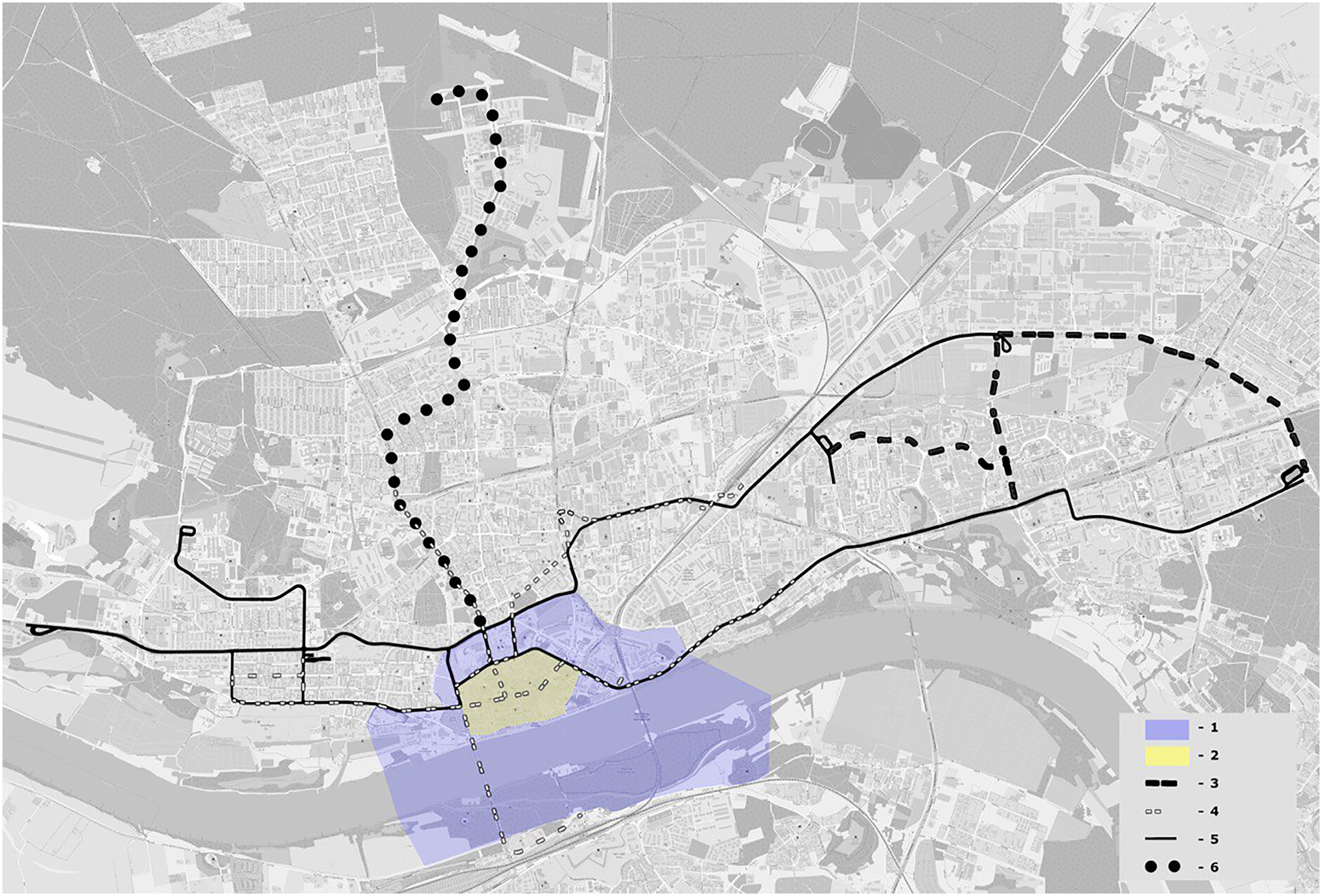
Scheme of the tram network changes in Toruń (as of August 2023). (1) buffer zone; (2) World Heritage Area; (3) BiT—City I project; (4) historic tramlines; (5) current tramlines; (6) BiT—City II project. Copyright: © OpenStreetMap contributors, adapted by the authors.
Toruń received substantial financial assistance from the EU Cohesion Fund to undertake a comprehensive overhaul of its tram network, encompassing modernisation efforts, establishing novel tramlines, and acquiring new tramcars. These efforts were realised through three major projects, each escalating in financial scope. The initial project, “Development of the Tram Network in Toruń”, was implemented from 2007 to 2013. 58 Two extension programs, “BiT—City I” 59 and “BiT—City II”, 60 followed. A critical goal of this series of projects was to develop three distinct strategies for improving the eastern transportation corridor.
In the course of executing these programmes, public hearings provided a platform for proposing development options for Toruń's tram infrastructure. The projects that received the most support and were ultimately implemented are illustrated in Figure 2. These initiatives led to a comprehensive revitalisation of the city's tram network, including the modernisation of existing infrastructure and the construction of new tramlines. The map clearly illustrates the tram network's expansion, highlighting the northbound line nearing completion and the potential for future extensions in the eastern sector, indicated by various dashed line configurations. Despite these developments, there are no plans or suggestions for reinstating tram services within the World Heritage Area in the documented initiatives.
Conclusions
The decision to close tramlines traversing Toruń's historical quarters during the late 1960s marked a significant turning point, despite a noticeable increase in passenger ridership. This decision, though contentious, resulted in the cessation of a once-thriving tram service within the World Heritage Area, leaving an undeniable void in the heart of the historic city. Public transport was completely withdrawn from this area with the closure of the tramline in Toruń's Old Town, unlike other cities where trams were replaced by buses. The historical city center is now partially accessible only to private transportation. However, due to the specific nature of the road surface, such as historic cobblestones, only certain streets are accessible to cyclists. This also poses accessibility challenges, for example, for families with strollers.
Our research has unearthed a complex array of narratives of justifications for closing operating tramlines within Toruń's Old Town prior to its designation as a World Heritage Area. With the change of societal values in times following the tram closure, the narrative surrounding the closure of tramlines in the city has undergone significant changes. Whilst concerns about vibration-related damage to historical monuments were occasionally cited, their validity remains uncertain. Factors including safety, operational costs, modernisation, and the promotion of tourism were all cited to rationalise the closure, with the aim to confer legitimacy upon the decision. The press played a pivotal role in disseminating narratives that contributed to shaping public perception and understanding of PT transformation. During this period, the protection of historical heritage was hardly mentioned as a key factor in official communications and publications.
Records left by Ignacy Tłoczek confirm that the argument for heritage protection did not gain sufficient support in the 1930s. Our analysis has shown that it was secondary to other considerations, such as safety and modernisation during the time of the closures. This is in stark contrast to the contemporary narrative about the closure of tramlines, which is primarily focused on the protection of historical heritage. Nowadays, heritage experts not directly involved in heritage restoration point to heritage preservation as the main reason for the closure of lines in the city's historical centre. However, this perspective is not corroborated by official representatives of the administration responsible for heritage protection and likely stems from a myth about cracks in the city hall building. Because heritage protection was not used as a justification for closing the tramlines in Toruń's Old Town, it clearly could not have been a direct strategy in facilitating the future World Heritage List application. However, heritage considerations were indirectly involved in the decision-making process, as Ignacy Tłoczek's ideas of heritage preservation and urban plans did influence the closure.
From a present-day perspective, noise pollution and pedestrian flow emerged as recurrent reasons for closing tramlines. These aspects received minimal coverage in press accounts of Tłoczek's time. Claims about structural damage to the historic Old Town Hall due to tram passage were also notably absent from historical records, though they persist in discussions today. Improving pedestrian traffic and network efficiency were cited as official reasons for the closure at some point long after it had come to pass. In present-day discourse, there was a consensus among our interviewees that there remains no need for public transportation to be brought back to Toruń's Old Town.
This study reflects on the perceived change in the importance of the opinions of heritage experts over time. In polycentric governance systems, the influence of heritage experts can be characterised as more direct, particularly in narratives that intersect with decision-making processes. In contrast, within non-polycentric systems, while these experts do play a role, it is typically indirect and often not represented as a central actor in the narratives. The press documentation makes no reference to urban planners and architects helping to shape the decisions that led to the closure of tramlines within the Old Town of Toruń. This oversight extends to the omission of Ignacy Tłoczek, hitherto recognised as a heritage expert whose urban design initiatives significantly steered the trajectory of these alterations. Notwithstanding this omission, it is noteworthy that Tłoczek's authoritative insights emerge as pivotal factors, featuring prominently within the discourse, as the transport company invokes them to substantiate the official rationale behind the closure of the tramlines.
The research emphasises the significant impact transportation systems, especially tramlines, have on the historical landscapes of World Heritage Cities. The case of Toruń illustrates this point well, showing how the development and modification of public transport networks can both preserve and potentially threaten the integrity of World Cultural Heritage Sites. This highlights the delicate balance that must be struck between modern urban development and heritage preservation.
Footnotes
Funding
The author(s) disclosed receipt of the following financial support for the research, authorship, and/or publication of this article: This research is part of the project No. 2021/43/P/HS5/02926 co-funded by the National Science Centre and the European Union Framework Programme for Research and Innovation Horizon 2020 under the Marie Skłodowska-Curie grant agreement no. 945339. For the purpose of Open Access, the author has applied a CC-BY public copyright licence to any Author Accepted Manuscript (AAM) version arising from this submission.
