



Abstract
Film representations of transport networks’ closure events are valuable materials in a critical, comparative urban studies. Here, 1953 and 1962 films commemorating the last nights of the London and Glasgow tramways exemplify such use. The present study examines them as part of work towards an understanding of public transport as a type of contested public space, since publics can have them removed. On the one hand, both films manufacture consent for the removal of on-street electric public transport on rails at a time when internal combustion engine vehicles, both private and public, were becoming more and more widespread in the UK. On the other, the film-makers provide affectionate views of urban transport modes which in the late twentieth century were largely considered obsolete, thus paving the way for heritage discourses of transport and even anticipating sustainability-led positions on the city that would only gain traction decades after these networks closed.
Introduction
This essay examines films commemorating tramway closures as evidence towards a critical comparative urbanism of twentieth-century cities. Drawing on mobility studies and film scholarship, the article casts light on imaginative dimensions of urban public-transport experience. Trams had very specific social connotations in twentieth-century Britain: they were closely linked to the urban working classes, and typically travelled through the portions of cities in which people belonging to this category lived and worked. There were variations between cities of course. In London, trams were largely excluded from wealthier residential districts and from the commercial and leisure-oriented central districts, the City and West End. London tramways were most characteristic of the city's northern, eastern and (the section surviving post-World-War 2) southern working-class sectors. In Glasgow, the other city examined here, trams ran through the city centre and extended far beyond it to east and west. A paradox relating to place is important in the historical study of tramways’ human dimensions: what made trams seem noisy, unsightly obstructions in the mid-twentieth century was also what would later, decades after the period covered in this essay, make them conducive to neourbanist planning, within which these on-street railways were grasped as key to endowing city centres given up to the motor car with a sense of place once more. 1
London and Glasgow were the two most populous British cities at the end of the Second World War. At their peak, around 1930, the tramway networks of the two cities were the largest ever to exist in the United Kingdom or Ireland. Both networks closed completely during the decades following the Second World War. London's last day of tram operation was 6 July 1952 and Glasgow's was a decade later, on 4 September 1962. 2 In Glasgow's case, the tramway was the most prestigious and outward-facing of the city's public transport networks. Charles A. Oakley's 1962 book entitled The Last Tram, an illustrated history aimed at the general public which was produced by Glasgow Corporation to commemorate the city's tramway closure, stated that “the foreigner” earlier in the century, “if asked what is Glasgow famous for? Was almost as likely, to reply for its trams as he was for its ships”. 3 Supporting Oakley's idea of a special connection between this city and its trams, Glasgow was the last major city in Britain to order new tramcars before the new era of light rail which began in the 1990s. London's hybrid public-private transport authority the London Passenger Transport Board (later known under the brand-name London Transport) took the decision to close the tramways as early as the mid-1930s, and in the capital of the United Kingdom, contrasting with the situation in Glasgow, trams were a somewhat marginal and stigmatised mode compared with buses and the system of urban off-street railways today known as the London Underground. In Glasgow, it was as late as 1957 that the General Manager of Glasgow Corporation Transport, Eric Fitzpayne, announced plans “for the complete elimination of tramcars over a period of twelve or fifteen years, and for their replacement by diesel buses” supported, perhaps, by trolleybuses. 4 In the event, closure took under six years from the time of this announcement.
Two films were made covering the closures in London and Glasgow. Both were 11- to 13-minute “shorts” designed to be shown in cinemas before the main feature, made by film-makers trying to establish themselves. They are The Elephant Will Never Forget (1953), directed by John Krish, and Kevin Brownlow's Nine, Dalmuir West (1962). 5 Each film marks the last days and hours of a city's tramway network, Krish's covering that of London and Brownlow's that of Glasgow. The films convey directorial intention on the part of their creators, but also contain, not necessarily intentionally, insights into the cities they depict. As in the Italian neorealist movement of the 1940s and 1950s associated with directors such as Roberto Rossellini and Vittorio De Sica, on-location shooting is central to the picture of the city that these films give, “an aesthetic plus, lending an aura of authenticity”, to quote Marilyn Fabe. 6 They illuminate mobilised social relations: when viewed through the lens of current research in mobility humanities, urban residents on the move gain new, shifting perspectives on one another and on the spaces they are moving through. 7 Close reading, a technique redeployed from formalist literary studies, is used here alongside Fabe's method of cinematic close-watching as a technique in interpreting the films. Oakley identified Glasgow as “the ‘Empire's Second City’”, suggesting how, in the imperial era of British history, Scotland's biggest city was both a beneficiary of empire and a subordinate node within it. 8 London, of course, was the metropolis of the British Empire, where a huge proportion of the wealth generated by extraction and renter capitalism was invested and spent. Recent research in comparative urbanism and urban cultural studies with an explicitly political stance, as well as work in critical urban theory by human geographers and literary scholars, underpins the comparative work of this essay in juxtaposing the primary city of the British Empire, London, with Glasgow as one among many secondary cities within it. 9 The events discussed in the essay reveal that in neither city did passengers control the future of what were commonly thought of and described as public transport services. They had no say in the disappearance from the streets of London's and Glasgow's trams.
In post-war Britain, as in many other countries around the same time, cheap on-rail public transport disappeared from city streets, with passengers directed onto motor buses that replaced the trams. City streets were redesigned around private cars rather than public transport. A year after the Glasgow closure, 1963's Buchanan Report, presented to UK Transport Minister Ernest Marples, proposed a framework for urban planning able to accommodate the “flood of cars” then engulfing British cities. 10 The films discussed in this article form part of the ideological work contributing to such a large-scale shift in people's mobilities. Yet they also contain images that could help viewers decades after the closure of these two networks think critically about the top-down direction of mobilities and decisions to remove systems at a time when large-scale road-building funded by public money originating in taxation was effectively being subsidised by the people in London and Glasgow who could no longer ride trams. As such, the article begins to establish a framework for the study of varied categories of cultural representation in transport history, adding to work such as that of Barbara Schmucki considering citizenry engagement with tramways. 11
The next section of the essay offers a theoretical framework situated in the mobility humanities. Here, categories of representations, including films alongside written narratives and still photography, are considered, as is the specific character of public transport representation in documentary film. Considering individual cities, such depictions remain as historical evidence but also form a representational landscape as particular to that city as is its topography. Next, in a section on “The two films and their contexts”, I explore the films and their specific contexts, including the careers of their directors. The section which follows, entitled “Close-reading and close-watching films as a method in transport history”, presents methods of reading and watching drawing on literary and film studies, with the aim of developing a closer, more self-aware relationship between transport history and filmic urban representations. The next sections then apply such a technique in interpretations of The Elephant Will Never Forget and Nine, Dalmuir West. Finally, a comparison between the two films argues that their similarities are more noteworthy than their differences. Both use the trams as a way of establishing their films’ present moment as one of postwar civic rebirth, although Krish deploys poignant nostalgia contrasting with Brownlow's apparently breezy celebration of now. In conclusion, interpreting the films via methods derived from both literary studies and film scholarship leads to scepticism about their role in building consent for the removal of the cities’ tramways.
The central area of interest here is the history of the two cities, understood within national and supranational frameworks, including industrial decline during the twilight decades of the British Empire. The demise of the tramways of London and Glasgow links the repetitive mobilities of individual citizens (such as commuters and shoppers but also tramway staff) of the cities, as well as visitors’ perceptions of those cities, with these larger-scale developments. The aim is to contribute to humanizing transport history.
Passengers versus decision-makers? transport representations and mobility humanities
Cultural representations of mobility are valuable materials in a critical urbanism since they bear witness simultaneously to the cities they document, and to their own conditions of production. These include their directors’ points of view and chosen styles, and the role in their contents of the bodies which commissioned and funded them. Integrating a reading of specific films with discussions of urban mobility is aided by an understanding of film as event, rather than film as text, as proposed by Thomas Elsaesser in work on non-fiction film and particularly “the Gebrauchsfilm or utility film”, a category including numerous sorts of film commissioned by profit-making and public organizations, including transport operators. 12 Documentary films are less orthodox materials in transport history than the “official publications, professional literature, and the urban and transport plans of the three case study cities” used by Elvira Khairullina and Luis Santos y Ganges in their study of on-street public transport in Magdeburg, Ostrava and Oryol during the 1950s and 1960s. 13 The new mobilities paradigm developed during the 2000s in the social sciences generated a humanities offshoot in the 2010s. In the later mobility humanities research, cultural materials (here, the two short documentary films) illuminate experiences of mobility understood in historical perspective. 14 Such work puts an emphasis on both the individually experienced quality of mobilities, and aspects of what Lynne Pearce calls “disembodiment” (including memory and detachment from place), in relation to the mobilities turn led by Mimi Sheller, John Urry and others, which has often focused on individuals’ immersion in bodily flows when they participate in varied mobilities that are embodied rather than consciously grasped. 15 One powerful concept from this theoretical work is that of “constellations of mobility”, proposed by the cultural geographer Tim Cresswell as a way of identifying “historically and geographically specific formations of movements, narratives about mobility and mobile practices” only graspable through “an historical perspective which mitigates against an overwhelming sense of newness in mobilities research”. 16
Paralleling thinking in the new mobilities paradigm, the scholars of transport Colin Divall and George Revill have proposed the idea “cultures of transport” as a means of opening transport history to developments in the “cultural turn” in historical studies. 17 During the 2000s, Divall and Revill called for a “historiography […] sensitive to the richness of social meaning generated through a diversity of media, from, for example, legal documents to visual representations”. 18 Still, examining “cultures of transport” for methodological reasons, in the hope of renovating the discipline of transport history, could serve what critical urban theorists call “instrumental reason”, a sort of thinking “designed to render existing institutional arrangements more efficient and effective, to manipulate and dominate the social and physical world, and thus to bolster current forms of power”. 19 Cultural evidence conveys people's qualitative experience of transport networks which can be hard to access through other sorts of material, including senses of access and belonging: what makes public transport feel public. Publicness remains an ideal in mass urban transport, 20 but the publicness of the London and Glasgow tram networks is called into question by the story of their closure.
Among categories of transport representation, films provide footage of the city in motion, particularly when they are based around documentary footage shot in real-world situations. Unless they deliberately break the fourth wall by highlighting their status as constructed representations, documentary filmmakers classically view cities as flies on the wall: we see streets, people and vehicles seemingly unaware of the eye of the camera upon them, in a manner comparable with street photography as a genre of still photography. 21 Bill Nichols's introduction to documentary is chiefly concerned with the period since the 1980s in which the genre has had greater prestige, but revisits earlier definitions, notably John Grierson's from the 1930s in which documentary is called the “creative treatment of actuality”. 22 Nichols begins from what he calls the “commonsense assumptions” that documentaries are about reality and real people and that they “tell stories about what really happened”. One could comment on this that according to this view documentaries are defined by non-fictionality, in a way that distinguishes them from what was typically thought central in earlier academic studies of prose writing, drama and film, namely fictional storytelling, including that of Italian neorealist cinema. According to Nichols documentaries tend to operate via an “informing logic” such as that of “problem-solving”. 23 He takes the example of Ralph Steiner and Willard van Dyke's 1939 documentary The City, which is driven by “a montage of scenes that include fast-motion clips of frenzied city living and shots of extreme poverty” together presenting “the proposal that urban existence has become a burden more than a joy” while, Nichols writes, ignoring the issue of “whether urban misery correlates with class”. 24
Documentary film representations of public transport experiences, vehicles and environments differ from, say, the official plans considered by Khairullina and Santos y Ganges or the legal transcripts and newspaper reports examined by Elizabeth Belanger in her research into challenges to enforcement of rules segregating streetcars by race in post-Civil-War St Louis, USA, in that they present or seem to present an individual perspective – that of the director. 25 In this, documentaries have more in common with literary texts such as poems or novels and retrospectives written by enthusiasts than with such source materials. 26 Films and imaginative writing may seem harder to connect with the material reality of a given city than plans or newspaper reports, but they may also be more resistant to instrumental reason. Their use, that is, may be particularly helpful if transport historians are to fully address questions of spatial justice as they have been taken on in explicitly critical urban research. 27
The films considered here are part of a representational landscape of the London and Glasgow tramways that is dominated by printed books and pamphlets. London has an extensive hobbyist literature on public transport with, at least since the 1960s, a lot more publications covering its buses and Underground than on its now-vanished trams. This indicates that (unlike, say, the World-War-II Blitz), London's trams have largely disappeared from civic memory. By contrast, nostalgic enthusiast publications about the Glasgow tramway continued to appear over the decades following the 1962 closure. These are often filled with photographs and snippets of local dialect they claim were used to talk about the Glasgow trams, and the experience of riding them, fitting into broader traditions of nostalgia about Scots culture. Abundant examples of such publications appeared between the 1970s and the 2010s. 28 To take one example, a generation after closure Cedric Greenwood (1986) published Glasgowtrammerung, subtitled The Twilight of the Glasgow Tram; (“caur”, “sparkie”, or “shooglie”) An aesthete's trambulation in the gloaming of the tramway age in dear auld Gleska toon.
The two films and their contexts
The entry of large-scale public transport systems into urban streets is a canonical example of industrial modernity's impact on city environments (along with factors like smoking chimneys and the noise generated by machines). As Schmucki shows, as on-street railways which placed complex, semi-permanent assemblages of metal on streets, trams were an intrusive infrastructure. 29 She calls them “The Machine in the City”. The construction of tramways was disruptive over long periods of time, in this perspective. It could take decades before tramways were assimilated or integrated into the cities they occupied, especially in older, denser cities. But what about when they left?
Even in his fond elegy for Glasgow's trams, linking them to the city's era of greatest prominence as the British Empire's manufacturing powerhouse, Oakley accepted the intrusiveness of trams in city environments, the quality which Schmucki claims is central to an understanding of their earlier days: By now Glasgow people are reconciled to their loss. Most accept it as unavoidable. They agree that the streets look better without the rails, the granite setts and the overhead wires. But some are still not quite convinced that the total change-over to the buses was really inevitable.
30
Individual tramway networks fit into much larger-scale urban contexts which can be looked at comparatively, taking in networks of cities with different levels of magnitude. Comparative urbanism “emphasises the importance of contributing to urban theory by drawing from diverse localities, especially those outside the global North”. 32 Glasgow, like London, is clearly part of the global North, but the comparison drawn between the two here happens within a perspective that sees European cities’ development as taking place in a worldwide context that includes the global North / global South relationship of imbalance. Critical urban studies, a parallel way of working alongside comparative urbanism, involves thinking about theoretical matters, being “reflexive and situationally specific”, opposes urban boosterism and thus instrumental reason, and aims at making real cities more just. 33 Looking at comparative urbanism within a region sharing aspects of governmentality, Khairullina and Ganges examine cities in postwar East Germany (the DDR), Czechoslovakia (the CSSR) and the Soviet Union that were all medium-sized, and all bombed during the Second World War. They show how “the continuity of inherited solutions” in the DDR and CSSR cities examined contrasts with the more radical adherence to the principles of modernism in planning, including in transport planning, which characterised the USSR, where there was additionally a lack of ability to replace destroyed tram systems via well-developed local industries. 34 Glasgow and London in the 1950s and 1960s were cities becoming postcolonial and postimperial. This status links them with other problematically postcolonial zones including Soviet peripheries and the post-socialist, post-Soviet environments of the late 1980s and since, considering matters of primacy and secondariness in literary urban studies. 35
Brownlow's film was inspired by Krish's earlier one and pays explicit homage to The Elephant Will Never Forget in its opening titles. But comparison of the two films highlights great differences between city regions. Glasgow's farewell to its trams was part of an extended urban crisis which in some respects (such as the decline of industrial and port-related employment in inner-city areas flourishing since the earlier nineteenth century) affected London too. The latter, however, avoided comprehensive decline thanks to its continued position as capital of the UK, home to the country's financial, legal and media sectors. It remained a magnet for the wealthy and powerful during decades in which cities such as Glasgow and Liverpool saw their status and population numbers deteriorate.
Finally on the context of the cities before, during and after the closures, their impact on the topographies of the cities concerned was a profoundly physical one. The disappearance of the tramways materially altered cities. The distinctive noise made by trams was no longer heard. And, as Oakley pointed out in Glasgow, cobbles underfoot were replaced by asphalt which was designed to be smooth for the wheels of cars, lorries and buses to pass over. Twenty-first-century investigators can perhaps understand such material changes best not by viewing pictures of London and Glasgow's vanished tramways in the archives but by visiting cities such as Milan and New Orleans in which tramways dating back to the beginning of the twentieth century and even earlier still operate in much the way they did then. Equally, the films of Krish and Brownlow contain astonishingly vivid documentary footage of London and Glasgow during the 20 years after World War Two.
In film theory, the auteur theory proposed in the 1960s by Peter Wollen views the director as someone “not simply in command of a performance of a pre-existing text” on the model of the theatre director or the classical musician, but as a creator in his or her own right. 36 In an interview filmed nearly 60 years after the making of The Elephant Will Never Forget, Krish claimed that “there's no truth in film”, continuing “I was trying to put over my perception of reality but it was always my perception […] where I put a camera is my decision, where somebody else puts a camera is their decision”. 37 Such a view recalls the auteur notion in making the director's eye paramount. It clashes somewhat with an alternative view, in which the two films would be treated as evidence of urban change arising from the nature of the city they depict at the time they were shot, rather than from conscious artistry on the part of Krish and Brownlow. Helpful in grasping such perspectives are scholarly techniques for analysing the visual qualities of filmic narrative, including what Fabe calls “shot-by-shot analysis” taking viewers through “close analysis of single film sequences”. 38
A key context for the films is how they were funded and made. Krish's film was funded by British Transport Films (BTF), the “in-house film production unit” of the British Transport Commission, which was founded in 1949 following the nationalisation of Britain's railways a year earlier. The unit was led for decades by Edgar Anstey, “a founding father of the British documentary movement”. 39 Krish was apparently told by Anstey not to make the film because BTF was supposed “to look to the future and celebrate new technology”, but he put it together anyway “under the disguise of doing other work”. 40 Brownlow, a decade later, worked in an environment more open to experimentation, since his film was funded by the British Film Institute, which gave him a free hand. Brownlow was a radical film-maker who later became respected as a historian and preserver of silent film heritage. 41 At the 83rd Academy Awards in 2011 he won an Honorary Oscar for this work, having been nominated by Martin Scorsese. 42
Seen as artistic creations, whether or not via auteur theory, the films are comparable. They have a good deal in common with British cinema influenced by Italian neorealism, including the Czech-born director Karel Reisz's 1956 short Momma Don’t Allow and his 1960 feature Saturday Night and Sunday Morning. Krish and Brownlow's films make use of music and depict industrial, urban modernity in ways resembling Reisz's work. The two tram-closure films both concentrate on a last day and last night of the tram as a moment expressive of more than just inevitable technological change making older forms of technology obsolete and so destined to disappear from the urban scene. Through music and a script read by an actor as a voiceover, both connect this moment in the first viewers’ present to various scales of past within modernity. During the twentieth century, in varying urban contexts, trams became freighted with meaning connecting them to either the latest stages of modernity or to obsolescence. In Kharkiv, today in Ukraine, the establishment of an electric tram network by city authorities at the beginning of the century undermined the monopoly control of a horse tramway given to a Belgian company by Kharkiv's imperial rulers in Moscow. Here, trams became “vehicles of modernity”, exporting “European ideas of progress”. 43 In London and Glasgow post-World-War II, conversely, they could seem spooky leftovers from abolished phases of modernity. Both Krish and Brownlow (like Reisz in Momma Don’t Allow, depicting a jazz performance at a pub in suburban London) combine documentary footage with popular music. In one case, the music evokes the era when electric trams began running in London via music-hall song of the sort popular in the first decades of the century; in the other, it alludes to the space-age modernity supposedly supplanting the trams of Glasgow in the 1960s.
Close-reading and close-watching films as a method in transport history
Drawing on both classical twentieth-century literary criticism and film studies research, this essay closely reads and watches Krish and Brownlow's films. 44 As mid-century practitioners like the American literary critic W.K. Wimsatt recognised, close reading may inevitably be “an abstraction”, 45 but it does enable deeper encounters with works of art produced in situations distant from those of audiences such as us. To read film effectively, a student requires strategies which overlap with, but are also distinct from, those needed in a successful reading of written texts. A close watcher can recall the literary scholar Franco Moretti's view that close readers’ high level of investment in “individual texts” conceals an assumption that “very few” representations “matter”. 46 But drawing on film scholars who investigate so-called “useful cinema”, including the category “utility films” offered by Elsaesser, there must be many other “non-canonized” documentaries containing location footage of London and Glasgow from these decades. The status of Krish of Brownlow as canonized auteurs is in any case less secure than that of, say Rossellini or De Sica. 47 Rather than insisting upon a narrow canon of great art, the close readings offered here serve an effort to create overlapping perspectives on transport experience in the modern city, alongside work on written genres of representation and explicitly literary texts. In the 2020s, close reading has been deployed outside literary studies, for example in the medical humanities. As Anna Ovaska and Kaisa Kortekallio write in that context, “[c]lose reading offers a valuable means of creating new ways of perceiving the self and its relationship to others and the world, particularly in settings which involve experiences of pain, vulnerability, and precarity”. 48 It may be surprising to see tram closure events as such a setting, but I propose that they should indeed be seen as such.
Close reading and close watching then, enables a look beyond directorial intention to ask what the films reveal about trams and the cities of London and Glasgow in a precise historical moment, those decades following World War 2 which in northern Europe were perhaps the heyday of automobility as an ideal or objective. Analysing the conjunction of the film-making, the network closures and the longer-term histories of the cities that the films depict reveals power relations and inequalities. Lessons about urban justice in the twenty-first century can be derived from these. Along with using the films to interpret long-term power relations within and between cities goes the question of how the actual days and nights of closure should be interpreted. Should these be seen as primarily festive events, or as events with a political meaning, even as acts of contestation? What, indeed, is the boundary between the festive and the political in looking at urban gatherings? There is a formal relationship between the two films: Brownlow's treatment of Glasgow self-consciously mirrors Krish's film about London and also draws direct attention to it, for instance in his on-screen tribute to the earlier film.
Analysing the films and the light they cast onto London and Glasgow leads to consideration of the boundaries and definition of politics. According to the Soviet literary theorist Mikhail Bakhtin, acts otherwise interpretable as mindless violence or loss of self in carnival and substance abuse can be seen as political expression. 49 Alternatively, politics can be defined much more narrowly as action by elected or unelected elites who have their hands on the levers of government. The political potential of popular-cultural responses to conditions in cities has been taken up in recent work on urban cultural studies and mobility humanities which the present study continues. 50 This is to ask whether, possibly, it was not an expression of popular, even imperialist, national sentiment to wave Union Jack flags as the last tram and a cavalcade of older vehicles went past, as happened in Glasgow in September 1962, but an act of bottom-up contestation. Or should this instead be seen as neither but instead an expression of urban solidarity on a big day for Glasgow, or merely as an excuse for a morning off work or school? These questions relate to those raised by tram closure events in pre-World-War-Two London, in which high spirits and wanton destructiveness by groups of young males – what could be defined as hooliganism – seem to be the key note. 51
The Elephant Will Never Forget: sentimentality and the passage from wartime
Krish's film of London's farewell to its tramways is more explicitly freighted with affect than Browning's later offering: it could be thought to romanticize its subject matter more. The London Transport Museum's current website catalogue entry for the film gives it the following synopsis: “London says farewell to its last trams in 1952 – vehicles whose peculiarly endearing qualities were only discovered at the threat of their disappearance”. 52 The artistic, representational choice to romanticize is visible and audible in the typography of Krish's film and his choice of music, the latter linked to its depiction of tram travellers. In particular, the second half of the film is devoted to images of an elderly couple riding on one of the last London trams, Edwardian period music in the background. The voiceover anthropomorphizes trams, describing them as if they were old workers facing retirement, their useful life at an end. In Krish's film, then, the moribund tram lurks in a post-war soft focus as it meets its demise. This very disappearance, this end of things, could be part of a transition away from “a post-war parenthesis”, to redeploy historian Tony Judt's phrase for the whole period 1945–89 in Eastern Europe. 53 The commentary in the Krish film links the disappearing to an idealised view of the London populace labelled as “the cockneys”, 54 together with a mass entertainment form that was dying in the age of the radio and cinema (the music hall), and the heroism of the Blitz (Figure 1).
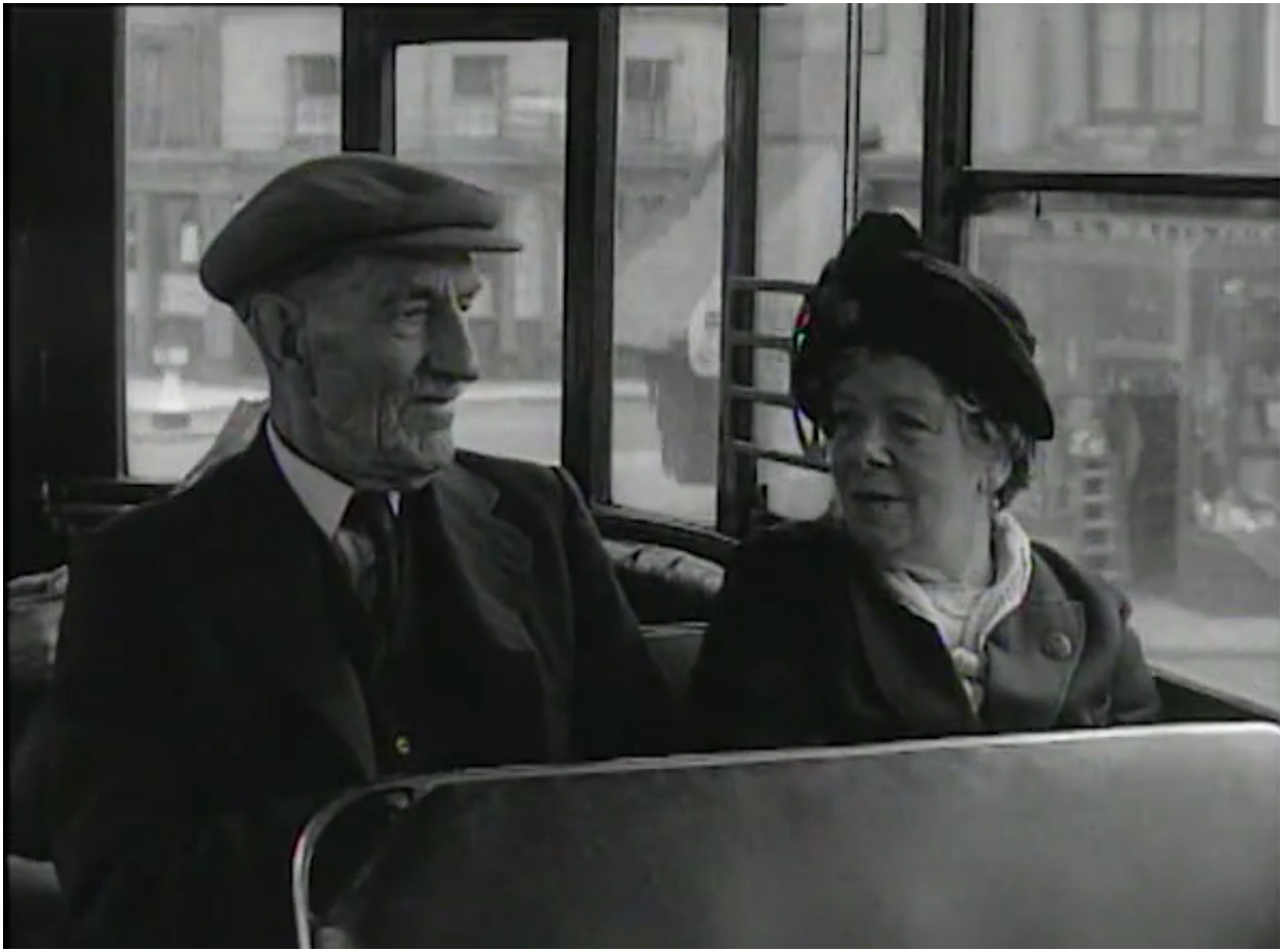
“The cockneys”, The Elephant Will Never Forget (02:46). ©TfL from the London Transport Museum collection.
Krish's narrative is structured over two days. The unknowing everyday of the trams’ penultimate day includes a journey into the past for the “cockneys” it depicts, with their presumed memories of the vehicles’ early days in London. The trams’ final day follows, containing commemoration, festivity and then immolation, in the mass burning of tramcars it depicts near the end, cut together with clips showing of tram drivers operating vehicles in their last days of service which were presumably shot earlier, and archive footage from the days of horse trams. 55 Portraying the consumption of the trams by flames feels like an allusion to the recently ended World War. Krish begins with melancholy music, showing us the busy Elephant and Castle junction in South London, emphasizing that this is “not Piccadilly Circus”, but rather “the hub of South London”. Already there is an effort to delimit a working-class zone within the city as the one in which the trams belonged. An iconic view is presented, across Westminster Bridge towards the Houses of Parliament with double-decker public transport vehicles approaching and receding, here trams rather than buses as have been used many times in images providing a visual shorthand for London. 56 Krish's authoritative but gentle-sounding male narrating voice announces that it is “hard to say goodbye” but that the time “had to come”. He calls the trams “friendly”, noting the “chatter” audible aboard, as they pass through “streets that will never be the same” after their departure. Again, these are the streets of working-class and industrial South London, the regions in which trams remained following 1938 closures. There are remarkable documentary shots of transport staff early on, for instance changing points in the street, 57 but the main emphasis is emotional and seems aimed at bringing a tear to the eye. We hear “how snug it was”, and statements like the “trams and the rain and the streets of South London” belong together. We pass corners that have not been built on following the bombings of a few years earlier (Figure 2).
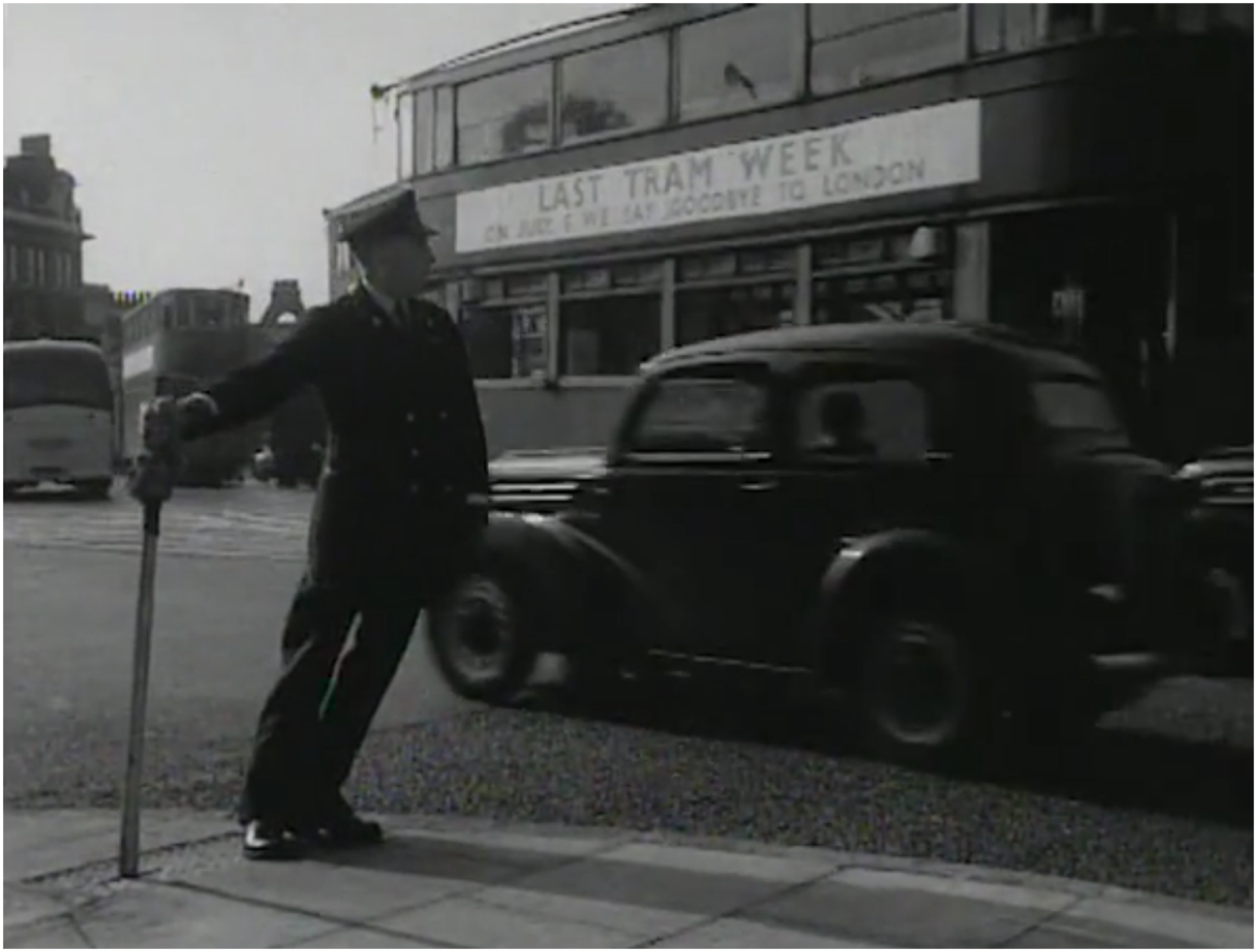
Changing points in the street, The Elephant Will Never Forget (01:50). ©TfL from the London Transport Museum collection.
Krish makes a claim about public space when he announces of “the cockneys”, the nickname for lifelong Londoners which in the twentieth-century became limited to the working classes, largely of East London and South London, that the “trams were theirs”. In the early nineteenth century, as the literary scholar Gregory Dart has shown, the term cockney had had broader, cross-class resonance, connoting those Londoners who seemed to be challenging the alliance between land ownership and stock market investment which controlled membership of the British elite, called “gentlemanly capitalism” by economic historians P.J. Cain and A.G. Hopkins. 58 Krish's “cockneys” may be viewed in his film with affection, but they did not have the right to call for the London trams’ continuation, only to appreciate the chance to ride on them one last time and say goodbye to them during festivities. The elderly couple on the tram depicted by Krish stand for the network's heyday before the First World War, as marked by the background music, a rendition of the music-hall song “Riding on Top of the Car”. 59 The song is heard in full and functions as a centrepiece of Krish's film. 60 The old couple wave and cross the River Thames at Westminster Bridge having passed along the Embankment, one of the few Central London sites where trams actually had prominence. The point of the song is about the covered top deck of the tramcar, at a time when omnibuses were legally required to have open upper decks, as a cosy place for young couples to court. In it, the conductor becomes “overgrown Cupid in clothes”, bringing them together. Krish may suggest that the old couple and the tram are alike obsolete hangovers from the period before the two World Wars, but his camera indicates a diversifying mid-century London, by, for example, letting us glimpse a non-white man in front of the elderly couple 61 (Figure 3).
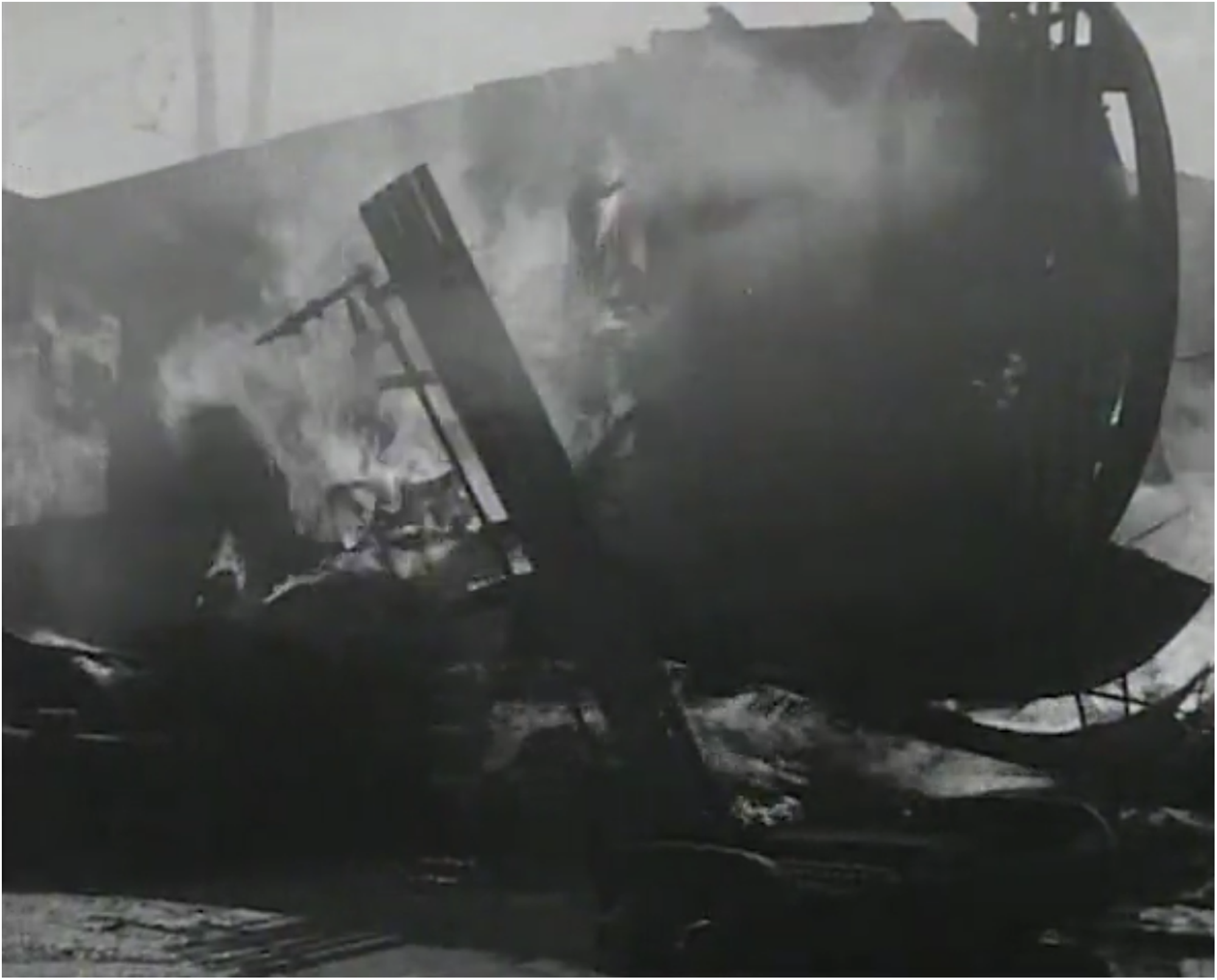
Burning tram, The Elephant Will Never Forget (07:21). ©TfL from the London Transport Museum collection.
The sky outside the tram becomes dark as Krish shows it moving through a very crowded portion of South London. This is Route 38, on the way to New Cross and Woolwich from the Embankment in central London, on the “last but one night – 24 h from now the tram would be dead”, as the voiceover puts it, accompanied by a minor-key adaptation for strings of “Riding on Top of the Car”. 62 Krish then takes us forward to the following morning, the last day of tram operation, presenting trams “blinking in the sun”, commenting “they weren’t to know” as if they were animals about to be slaughtered. 63 Not long afterwards, after referring to the “motorist who every day cursed” the trams, 64 and taking them “past the pawnbrokers and through the street markets” (in other words, through the grimiest sections of London), Krish asks what the driver was thinking, then switches to a shot of burning trams being melted down. 65 He alludes perhaps to the inferno caused by urban bombing raids during World War II, in Germany and Japan as much as in Britain, when he switches from reflections on the driver and imaginary “stories his father used to tell” of the horse tram days to commenting, over images of trams being melted down in the scrap yard, on “the way they burn them till there's nothing left but a charred skeleton”. Krish's last minutes are given to public commemoration which happens in the framework of official approval. From a shot of huge crowds waiting at the New Cross depot and a sign in the London Transport typeface proclaiming LONDON'S LAST TRAM, we see a dignitary on a platform making an announcement: “In the name of Londoners and London Transport I say ‘goodbye old tram’”. There is waving and cheering and then, Krish announces, 66 “the party was over” and 20,000 people went home. This is followed by a reprise of “Riding on Top of the Car” as the camera tracks through empty streets with streetlights on but no trams in them.
Nine, Dalmuir West: space-age modernity and stereotyping of the secondary citizen 67
Brownlow filmed Nine, Dalmuir West during the last weekend of the Glasgow tramway's operation, in September 1962. In the year before the September 1962 closure weekend, the city planned a large-scale procession of trams from different eras through the centre of the city, and thousands of people wrote in ordering tickets to ride on trams during the event. Glasgow's city archives today preserve huge folders of these letters – including those from people who wrote in too late and had their money refunded. 68 Many of the letters come from people living far outside Glasgow, either tram enthusiasts or former Glaswegians now living in England or further afield (or both). Next, as with The Elephant Will Never Forget, I offer a close reading, juxtaposing the words audiences hear in the film with the images and non-verbal sounds (including music) that accompany them.
Brownlow's positioning of his film as less explicitly nostalgic than Krish's begins with the appearance of a sans-serif font on the opening credits. And yet Browning positions his film as linked to Krish's, announcing in the opening credits that it is offered “with affectionate memories of John Krish's classic THE ELEPHANT WILL NEVER FORGET the film about the last London tram . . .”. 69 It would seem very odd today to make a film about Scottish urban matters with a voiceover narration, brisker and more reporter-like in style than Krish's, in what is clearly an English accent yet this is what happens here. Moreover, Browning's film does not even open in Glasgow, but in London, with an old Glasgow tram being transported across the centre of the old imperial capital on its way to the Science Museum. 70 Brownlow begins by reminding readers how ambitious Glasgow's tramway was. Later than other major UK cities, Glasgow identified itself with its tramway, which featured for instance in tourist guides to the cities and on postwar advertisements, and the length of the network was the biggest in Britain and Ireland outside London. He contrasts this with Glasgow in September 1962, identifying “an impending sense of loss, of desolation in the air” (01:10), and announcing that “the tramcar is dead” 71 (Figure 4).
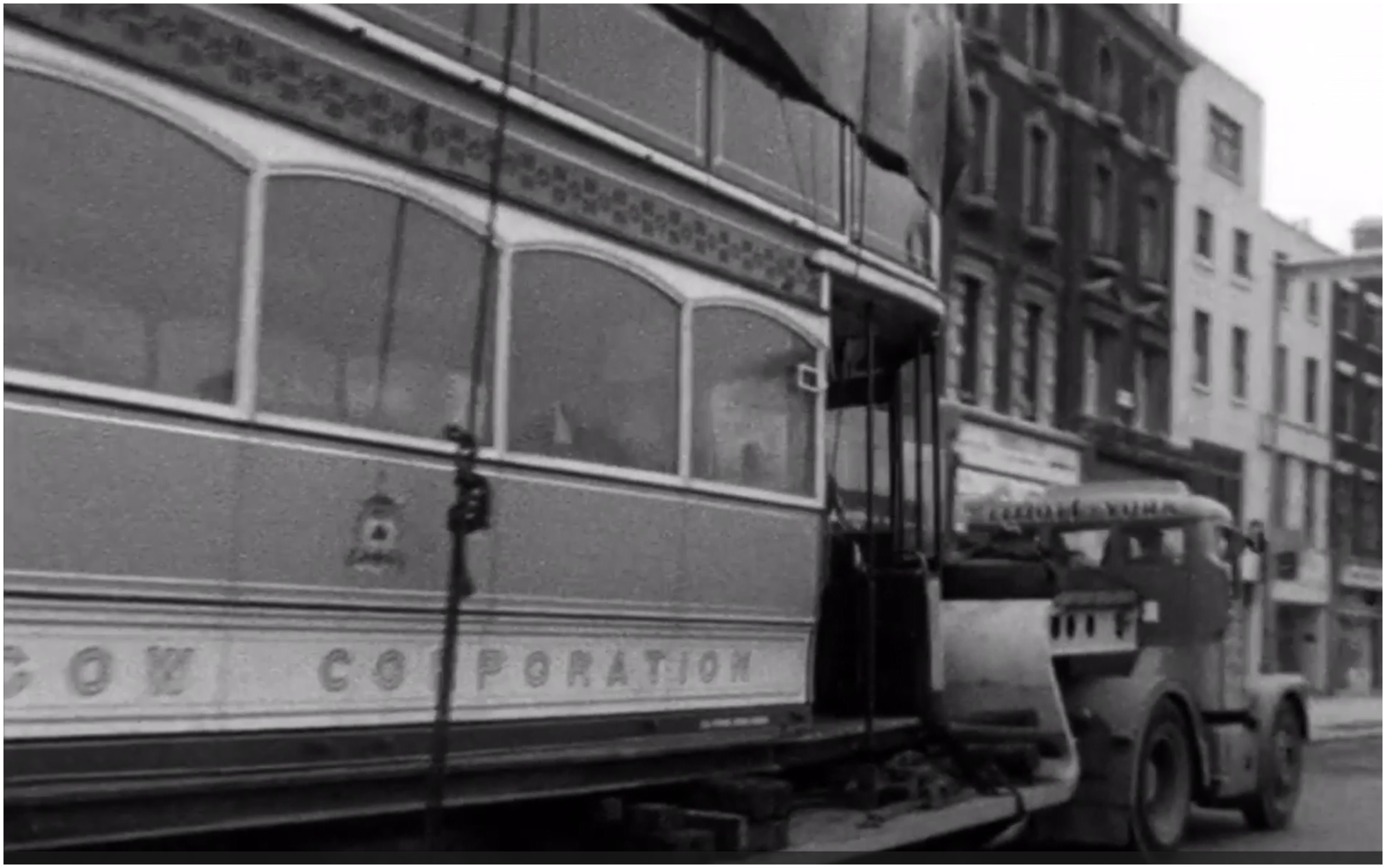
Glasgow Corporation tram being taken through London on a lorry, Nine, Dalmuir West (00:59). ©1962 BFI /Courtesy of the BFI National Archive.
Route 9 was the last main Glasgow route to close: it ran east west across the city for almost 20 kilometres. Brownlow's central claim is that “A number 9 demonstrates why trams would not survive”. After his introduction he moves, using a soundtrack of ambient noise, to shots of the deserted tram maintenance depot containing workers’ personal possessions. 72 Glasgow may be “losing a way of life” but trams are “a symbol of the hard years” when, he goes on, “new prosperity chokes the streets with private cars”. 73 Trams, Brownlow claims, were obsolescent because of the difficulty and danger for passengers of using them at a time when the roads of Glasgow contained more and more cars. Yet his Glasgow modernity includes images of the shipyard gates on the River Clyde closing for the weekend. 74 Only a few years after his film was made, there was first a crisis for shipbuilding businesses, then a massive nationalisation and closure phase from the mid-1970s to the mid-1980s (Figure 5).
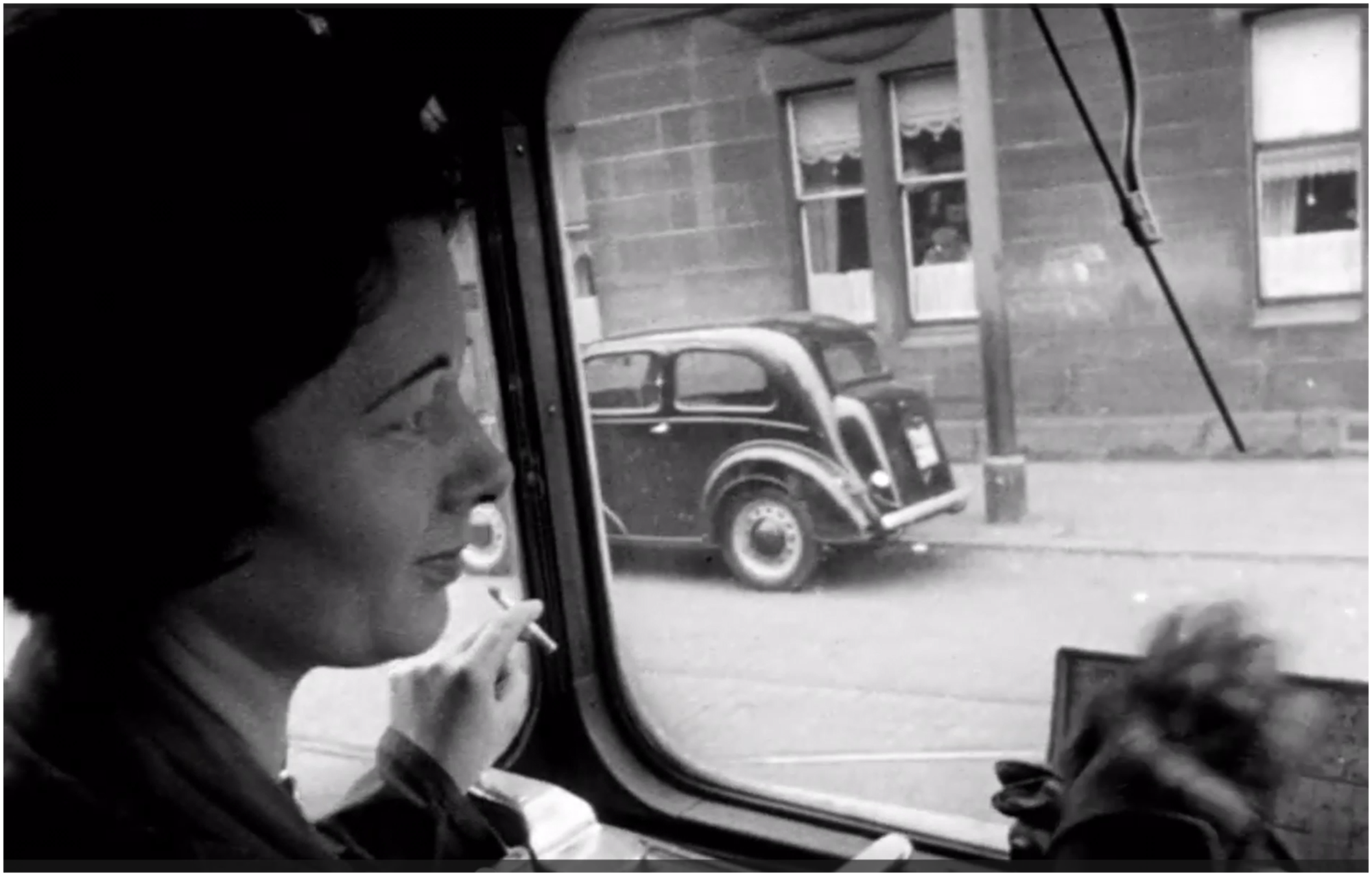
Woman tram driver on the last day of tram operation in Glasgow, Nine, Dalmuir West (04:45). ©1962 BFI /Courtesy of the BFI National Archive.
The structure of the film from here on resembles that used by Krish. The trams’ sense of “cosiness” at night as “passengers rattled home in a warm atmosphere” that itself contained a “feeling of home”, is contrasted with the then-current era of the space age, characterised by teenage consumption as part of mass prosperity, embodied in the instrumental guitar hit “Telstar”.
75
This contemporary music is juxtaposed with scenes of a young woman tram driver propelling it through busy, cobbled Glasgow streets, directly equivalent to the sonic backdrop of a music-hall song from 1905 used in the London film.
76
Brownlow, however, does not cut together present-day footage with archive material from the past as Krish does. His viewers see a scrapyard filled with the decommissioned vehicles in the process of being stripped before immolation and later, cut together with shots of the tram's last days of operation, flames consuming metal.
77
While these scenes of destruction play out, the voiceover repeats lines intoned earlier in the film: What was the attraction of the tramcar? A sense of cosiness, as the passengers rattled home in a warm atmosphere of steamed-up windows, of damp coats and mackintoshes. And this feeling of home was heightened by the friendliness of the crew.
78
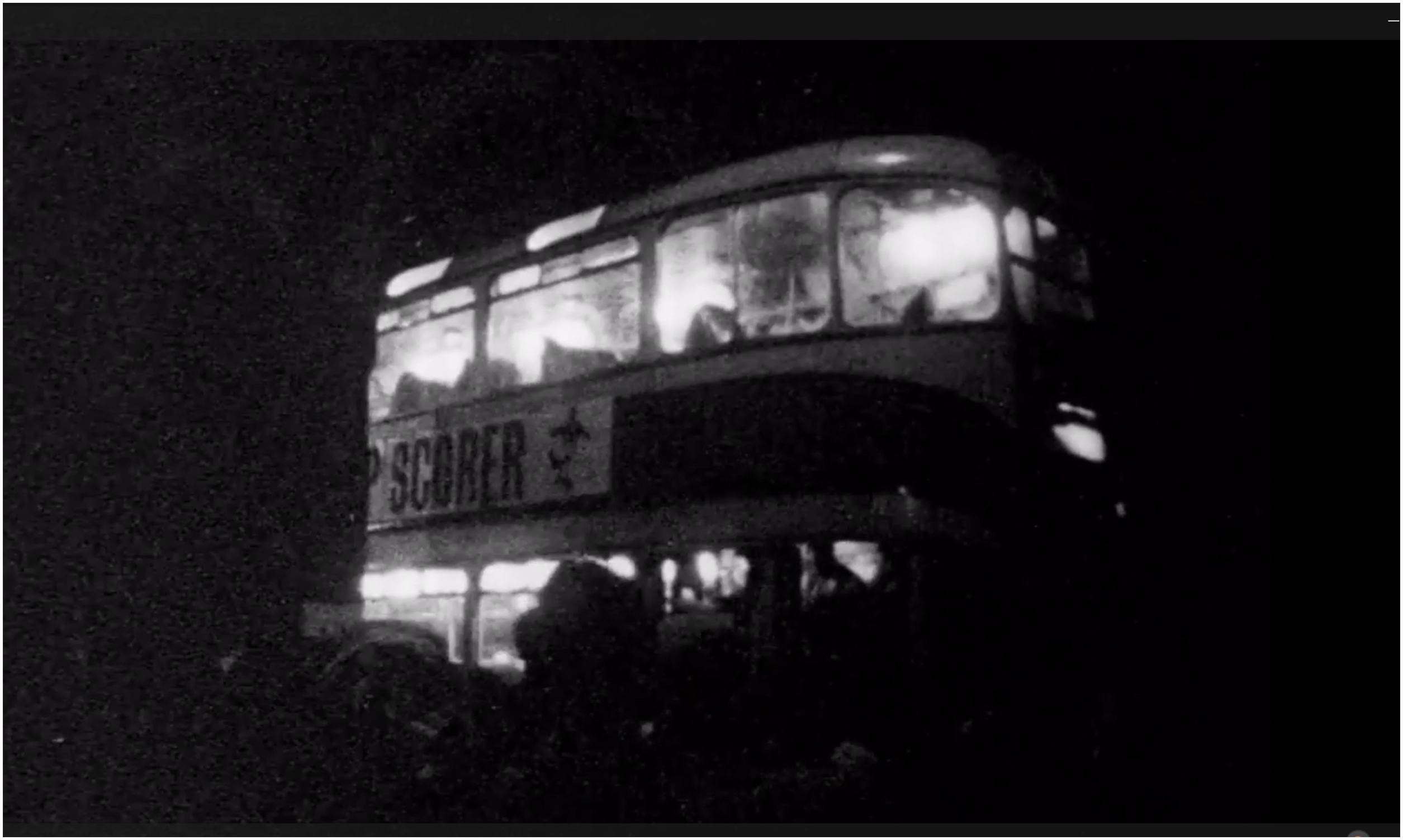
Tram entering tram shed at the end of its route on the last night of operation in Glasgow, Nine, Dalmuir West (11:56). ©1962 BFI / Courtesy of the BFI National Archive.
Brownlow's film makes no reference to what B. H. Davies of Royston, Hertfordshire, in a letter sent on 28 August 1962 requesting tickets to attend the event from Glasgow Corporation, called the city's “final procession of trams”. 84 Indeed, he seems to avoid official commemoration or anything like a celebratory tone. Glasgow in 1962 was in transition. It was still a great ship-building city, at a time when many of the former British colonies of the Americas and Africa were newly independent. Glasgow Corporation at the time was still a confident and large-scale local government body. 85 It seems to have envisaged the “final procession” not as a sad moment but as something to be proud of. Brownlow speaks of “prosperity” embodied by “supermarkets” and private car ownership as the key characteristic of contemporary Glasgow, contrasting this with “the hard years” before, from which the tram is “one of the few pleasant memories” Glaswegians “retain”. 86 As at Birmingham, 87 the English city which overtook it as the UK's second largest during the same decade, Glasgow's city centre became accessible or, alternatively, strangled, by motorways, high-speed multi-lane highways, in the course of the 1960s. How much the dismantling of the tram network of either Birmingham (where trams stopped running in July 1953) or Glasgow served this end in a hidden way is beyond the scope of this paper. 88
Despite the prominence of the tramway in mid-twentieth-century images of Glasgow, it is absent from recent academic accounts of the city's modern history. These are instead focused on industrial decline and the complex, often painful, relationship between its municipal government and national politics, partly determined in London but increasingly, during phases of Scottish devolution from the 1970s on, dominated by Glasgow's age-old rival Edinburgh. 89 Yet a viewer of Brownlow's film could readily see it as presaging the story, often retold in recent accounts, of contemporary Glasgow as a mistreated former metropolis. In such a narrative, Glasgow is the victim of heavy-handed and damaging policy decisions taken elsewhere, in London and Edinburgh, its “industrial decline […] actively embraced and accelerated by Scottish policy makers from the early 1960s, as part of a wider regional economic policy agenda seeking ‘development and growth’ in other parts of Scotland”. 90
Conclusion
Elsaesser's understanding of film as event is complemented by the fact that the particular films under consideration here themselves document events. As such, they are related to news-oriented genres of film, although these are both pieces which foreground their aesthetic qualities as cinematic art. Analysing them more fully would take in their use of techniques in film-making such as montage, shot-length and transitions, the choice of black and white over colour, graphic design, use of music and type of film stock. 91 All of these areas contribute to a final film we link to the name of an individual director. The present essay has used these films commemorating tram-closure events to show how transport history, urban history and mobility humanities could move into closer dialogue, and further close-watching of them using techniques such as those provided by Elsaesser, Fabe and Nichols would be valuable.
In Brownlow's words “recording the moments in which the mundane becomes the historic”, 92 both films present the disappearance of trams from the streets of the UK's largest cities as a stage in modern urban commemoration. Their similarities include the use of music to evoke the atmospheres of their cities in past and present twentieth-century phases, and their incorporation of vivid documentary footage of street life. As such, they create narratives of modern urban history, distinct from an idea of heritage also developing in the post-war era in the preservation of buildings from earlier centuries and the expansion of bodies devoted to conservation like the National Trust, via legal instruments such as the Town and County Planning Act of 1947 and the Historic Buildings and Ancient Monuments Act of 1953. 93 The films share a position at a time they present as one of post-war urban rebirth. The emergence of “the tram enthusiast”, “not known in the tram's heyday – he only attends its funeral”, is by Brownlow (but not by Krish) identified as a novel feature of the moment in which his film was made. 94
There are important differences in tone of voice, but these should not obscure the films’ commonalities. Krish romanticizes the London tramway via its connections with very recent and farther-off moments in urban modernity, namely the bombing of London during World War II (“That sound of the first morning tram used to be a comfort alright, then”, according to his voiceover narration) 95 and the Edwardian era when electric trams were new and up-to-date, and the “cockneys” of the film were young. An emphasis on post-war change in Brownlow's film from ten years later, meanwhile, does not include the immense public commemoration of the Glasgow tramway which happened in early September 1962 after lengthy work by Glasgow Corporation. Brownlow, that is, avoids nostalgia. But he does start the process of situating trams in a heritage context. With his footage of a Glasgow tram being moved by road to the Science Museum in London's South Kensington, he uses heritage discourse to announce, as Krish also does, the position of trams and tramways in a now outmoded phase of modernity.
Apparently ephemeral representations of events surrounding public transport thus point towards a new reading of power relations at national and transnational levels. In this, Brownlow's film demonstrates how Glasgow, “the ‘Empire's Second City’” as Oakley calls it, functioned as a semi-colony in the colonial and postcolonial eras, as a finite resource worth exploiting until it is no longer profitable and then is discarded. Glasgow's cultural capital is pillaged by the metropole, in a way marked both by Brownlow's key statement, among his extraordinary documentary shots of the central Glasgow streets, that the fact of the number 9 demonstrates why trams “could not survive”, juxtaposed with the earlier image of a decommissioned tram with “Glasgow Corporation Tramways” painted on its side, being taken through the streets of London to the Science Museum, like a defeated barbarian ruler being paraded through imperial Rome. 96 The departure of trams from both London and Glasgow added to rather than reducing spatial inequalities between residents: in both cases, it negatively affected urban spatial justice. This left a residue in Glasgow more than in London, in the Scottish city marked by the continued appearance in the twenty-first-century of books aimed at the general public with titles like Night Song of the Last Tram or making use of the word twilight as Greenwood had done in the 1980s. 97 The 1960s and 1970s, arguably, were twilight years for Glasgow as a city that had international importance. Working-class South East London, where the capital's trams ran last and no underground existed, was perhaps comparably affected.
Like Italian neorealist cinema, the films covered here depict the contemporary urban working classes, and like the films of Rossellini and De Sica, those of Krish and Brownlow follow “poor or common people to whom nothing extraordinary happens and whose fates are unresolved at the end”, notably the tramway staff whose jobs ceased to exist when the tramways stopped running. 98 Related to how their productions got funded, the British directors’ stance is, however, much more politically ambiguous than that of their Italian counterparts. To compare Krish and Brownlow's work with other representations of British trams in their last years, the films are unlike the depictions of tram closures found in enthusiast memoirs, in that they tend to depoliticise and domesticate closures and closure events. 99 They suggest that Cockneys or Glaswegians may only have been able to consider the trams “theirs”, in Krish's formulation, temporarily or with the permission of government and elites. The city authorities or national government could give and take away. Thinking of research into the publicness of public transport, 100 whose space was the space of public transport if some people high in an organisation could abolish it thanks to what a couple of meetings decided? The films chart the film-makers’ similar efforts to establish themselves through them as suitable directors for feature films. There are, however, important differences between the perspectives of Krish and Brownlow. Krish looks backwards while Brownlow looks forwards. Both directors, in these films, brought the people, cities and public transport environments they filmed to life in a way that was faithful to their subjects. But looked at critically, through the work they do “manufacturing consent”, these films served the cause of denying public space to people who, until 1952 in London and 1962 in Glasgow, relied on tramways. 101 From the perspective of the 2020s, the films meanwhile do something different: they anticipate changes in thinking. Krish and Brownlow look lovingly at urban transport modes which in the late twentieth century were largely considered outmoded. In doing so, the directors announce heritage discourses of transport and even hint at sustainability-led positions on the city that would remain marginal until decades later.
Footnotes
Acknowledgements
The article has been written with support from the PUTSPACE project. PUTSPACE (“Public transport as public space in European cities: Narrating, experiencing, contesting”) is financially supported by the HERA Joint Research Programme ( ) which is co-funded by AKA, BMBF via DLRPT, ETAg, and the European Commission through Horizon 2020. An earlier draft was presented at the closing conference of PUTSPACE in Brussels during April 2022. Staff at the London Transport Museum's library and the Mitchell Library in Glasgow provided invaluable assistance in pointing me towards obscure publications and unpublished materials.
Declaration of conflicting interests
The author declared no potential conflicts of interest with respect to the research, authorship, and/or publication of this article.
Funding
The author disclosed receipt of the following financial support for the research, authorship, and/or publication of this article: This work was supported by Humanities in the European Research Area (grant number 649307).