




Abstract
For much of the twentieth century, the tramway was the most important public transport system in Copenhagen, Denmark. It played a crucial role in the life of the city and features strongly in Danish art and literature produced during the network's lifespan as well as after it was finally closed in 1972. Despite this, the tramway has only received scarce scholarly attention. This article looks to address the situation. It does so by drawing attention to the fact that although the tramway was shut down, it lived on in art and literature. One example of this is “På Sporet af den Tabte Vogn” (1985) written by Klaus Rifbjerg. This short story has often been described as nostalgic. While this is not a misreading, it is an assessment that requires clarification. A close reading that draws on studies of nostalgia reveals that the short story does not boil down to a sentimental longing for a lost past. Rather, it thematises nostalgia for the Copenhagen tramway, questioning such remembrances’ status and relevance in contemporary society. This means that, ultimately, the short story can be seen as part of a broader tendency in writing about closures of electric public transport networks in Western Europe and North America: it works as a counternarrative to notions of progress, an antidote to predominant ideas of urban development in the mid-twentieth century.
Introduction
During the first half of the twentieth century, the tram was the main mode of public transport in Copenhagen, Denmark. At its height, the city's tramway covered most major thoroughfares and stretched well beyond the perimeters of the centre, carrying hundreds of millions of passengers every year. In the 1950s, the authorities initiated a process of what in Danish is referred to as “bussificering”, a term that equates well with the English portmanteau “bustitution”: for a variety of reasons, trams were deemed obsolete and gradually replaced with diesel buses. 1 The process reached its conclusion on 23 April 1972 when the last tram passed through the streets of the city. 2 Besides being a conspicuous part of Copenhagen's streetscape and the everyday lives of its citizens, the tramway features prominently in the literature, theatre, cinema and visual arts produced during the network's lifespan as well as afterwards. In spite of that, its size and socio-cultural significance, the tramway has only received scarce scholarly attention. Recent work has mainly been in the form of enthusiast histories, personal memoirs and autobiographies, although Mikkel Thelle's studies of the social and cultural effects of the network's electrification are notable exceptions. 3 This article is a further attempt to fill that gap. Contrary to Thelle, whose work focuses on the period of consolidation and expansion, this study looks beyond the time when the trams had stopped for good. It draws attention to the fact that although the trams have disappeared, they live on in the hearts and minds of the city's inhabitants and the memory of their existence continue to reverberate through Danish art and literature.
The closure of Copenhagen's tramway is not an isolated incident and, similarly, it is not the only place where writers and artists have contemplated the effects of a public transportation network's termination. Although a general survey of the partial and full closure of tram systems is still to be done, it is clearly a global phenomenon. Between the 1930s and the 1970s, in many cities across Western Europe and North America, the authorities decided to dismantle their tramways while similar developments are discernible in different parts of the world around the same time as well as later. 4 The causes and effects of such closures are a topic in need of further investigation. So far, scholarly analyses have mainly been done in the context of the tramway renaissance. Since many cities from the 1980s on decided to reintroduce tramways, several scholars have rightly thought it pertinent to examine the historical processes that led to this volte-face and, like Barbara Schmucki, found that, frequently, the decision-making processes (those that led to the initial closure as well as reintroduction) were not only steered by “objectifiable criteria such as ‘efficiency’ and ‘functionality’” but also by “fashions which are outside the functional hemisphere of technical argument, and […] set by cultural practices and assessments”. 5 Such studies highlight the importance of observing closely the connections between culture and technological developments by pointing to their relevance for policy-making. 6 Without denying the significance of such scholarship or suggesting that Copenhagen's tramway is in no need of a similar historical examination, this article follows a similar yet somewhat different path. 7
The focus is on the short story “På Sporet af den Tabte Vogn” (“On the Track of the Lost Tram”) written by Danish author Klaus Rifbjerg (1931–2015) and published in the collection Borte Tit (“Peekaboo”) (1985). 8 Set in Copenhagen, 12 years after the closure of the last tram line, it tells the story of an elderly enthusiast and watchman in a warehouse full of old, dilapidated trams who, in the last hours of his life, imagines taking a tram ride through the city. The short story is thus linked to the closure of the Copenhagen tramway, but it cannot be said to have any clearly discernible connections to the formation of public policy. This, however, does not make it irrelevant for transport historians. Susan Stalter and Barbara Eckstein have both demonstrated how the closure of a public transportation network can have a profound influence on art and literature, but also how, conversely, the work of artists and writers can enter the public imagination, subtly shaping perceptions of seemingly obsolete modes of transport. 9 I maintain that “På Sporet” should be understood in a similar way. The closure of the Copenhagen tramway is pivotal for the short story, but its impact is hard to determine precisely. That said, Rifbjerg was a cultural heavyweight and the influence he exerted through his writing was considerable. It is, therefore, reasonable to assume that his take on the closure of the Copenhagen tramway in “På Sporet” continues to reverberate through Danish society and culture, in its own way shaping the fabric of urban life.
The present study has further affinities with the work of Stalter and Eckstein. Examining a variety of different representations of the Third Avenue El in New York, primarily after its closure in 1955, Stalter argues that writers and artists “used the El to articulate negative or mixed feelings about what had until then been New York's steamroller style of modernization”. 10 Eckstein's reading of Tennessee Williams’ A Streetcar Named Desire (1947) reveals a similar association of ideas. In the play, she argues, the New Orleans streetcar is linked to the decline of the Old South, desuetude and lost causes, and, through its numerous productions and adaptations, it “destabilizes the context of obsolescence for the narrative of progress”. 11 In other words, both Stalter and Eckstein notice a tendency in American art and literature to use the closure of urban, electric public transportation networks as an antidote to predominant ideas of urban development during that period in history which historians and social scientists often refer to as “The Great Acceleration”, the time when “the machinic forces of progress truly gathered pace”. 12 I argue that “På Sporet” can be read as a comparable sort of counternarrative. To reach this conclusion requires some unpacking. First, it is necessary to briefly outline in more detail the history of the Copenhagen tramway. It will help readers unfamiliar with the network find their bearings and facilitate the analysis of the short story. This happens in the following section. The rest of the article revolves around a close reading of “På Sporet”. 13 The third section begins with an introduction to Rifbjerg, the man and his work, and continues with an analytical summary of the short story which focuses on the protagonist, the elderly watchman, his relationship with the tramway and the journey he imagines taking through Copenhagen. The fourth part focuses on how we are to understand “På Sporet”. It takes as its starting point previous readings of the short story, primarily reviews issued at the time of publication. 14 These have often described it as nostalgic. This description is not incorrect, but a close reading of the short story reveals that it requires qualifications that critics have not provided. By drawing on scholarly examinations of nostalgia and some basic narratological techniques, I show that rather than amounting to a sentimental longing for a lost past, “På Sporet” thematises nostalgic remembrances of the tram. Ultimately, I argue, the short story situates nostalgia in opposition to prevalent notions of progress and, thus, relates to broader discussions about the role of nostalgia in society at large during the past 50 years or so. 15
The Copenhagen tramway: A brief history
On 23 April 1972, the public body in charge of Copenhagen's trams, Københavns Sporveje (“Copenhagen's Tramway”), organised a parade: a large number of trams and buses drove through the city to commemorate the closure of the last tram line, number 5, the night before. The process of bustitution had started about 17 years earlier and whether you now witnessed its conclusion with dismay, indifference or delight, it was hard to deny that it was a landmark event. For a century, the tramway had been the city's main mode of public transport. It had played an important role in the lives of residents as well as visitors, and, as Thelle says, its infrastructure had shaped the urban space in ways that would be visible for many years to come. 16 Undoubtedly, the circumstances that led to the closure of the Copenhagen tramway are similar to those detectable in other Western European and North American cities around the same time. Nonetheless, it is a historical process in need of further study, as is indeed the entire history of the network. Due to the lack of scholarship, it seems pertinent to provide a brief outline of the history of the Copenhagen tramway and give a sense of the network's size and significance. This will also facilitate the subsequent discussion of “På Sporet”.
The first horse tram was introduced to Copenhagen in 1863, an event that, in a sense, marks the beginning of the city's public transport system. 17 Although the first years were characterised by fits and starts, the tramway gradually expanded and following electrification (1897–1903) it developed into a stable, recognisable, unified public transport system. The pinnacle years came during the 1930s and 1940s when the network had grown to cover most major thoroughfares in the centre and reached outlying suburban areas such as Søborg, Husum and Ordrup (Figure 1). 18 The overall capacity increased and the number of passengers per year rose steadily until culminating in 1946–47 at around 280 million. 19 But, at its height, the seeds of the tramway's demise were discernible. The introduction of the eight-hour working day, higher wages and pension plans, for example, increased expenses and Københavns Sporveje was unable to reap the benefits of the growing number of passengers and delivered regular deficits. The rise in passengers also had a detrimental effect. Due to a lack of supplies, during and after World War II, it was not possible to adjust the capacity. This resulted in overcrowding and a deterioration in the quality of the material that was difficult to rectify. Moreover, from the 1950s on, like elsewhere in Western Europe, there was a significant surge in the use of private cars and, by the early 1960s, this had caused the tramway's passenger numbers to drop to pre-war levels. Københavns Sporveje responded to these challenges with a long series of rationalisation measures and the gradual bustitution of the network. 20 The latter process started with tramline number 4 in 1955. It was followed by numbers 11, 18 and 20 in 1958 and from 1963 on, one or more of the remaining 13 lines were closed every year until, finally, the process concluded with that landmark parade in 1972.
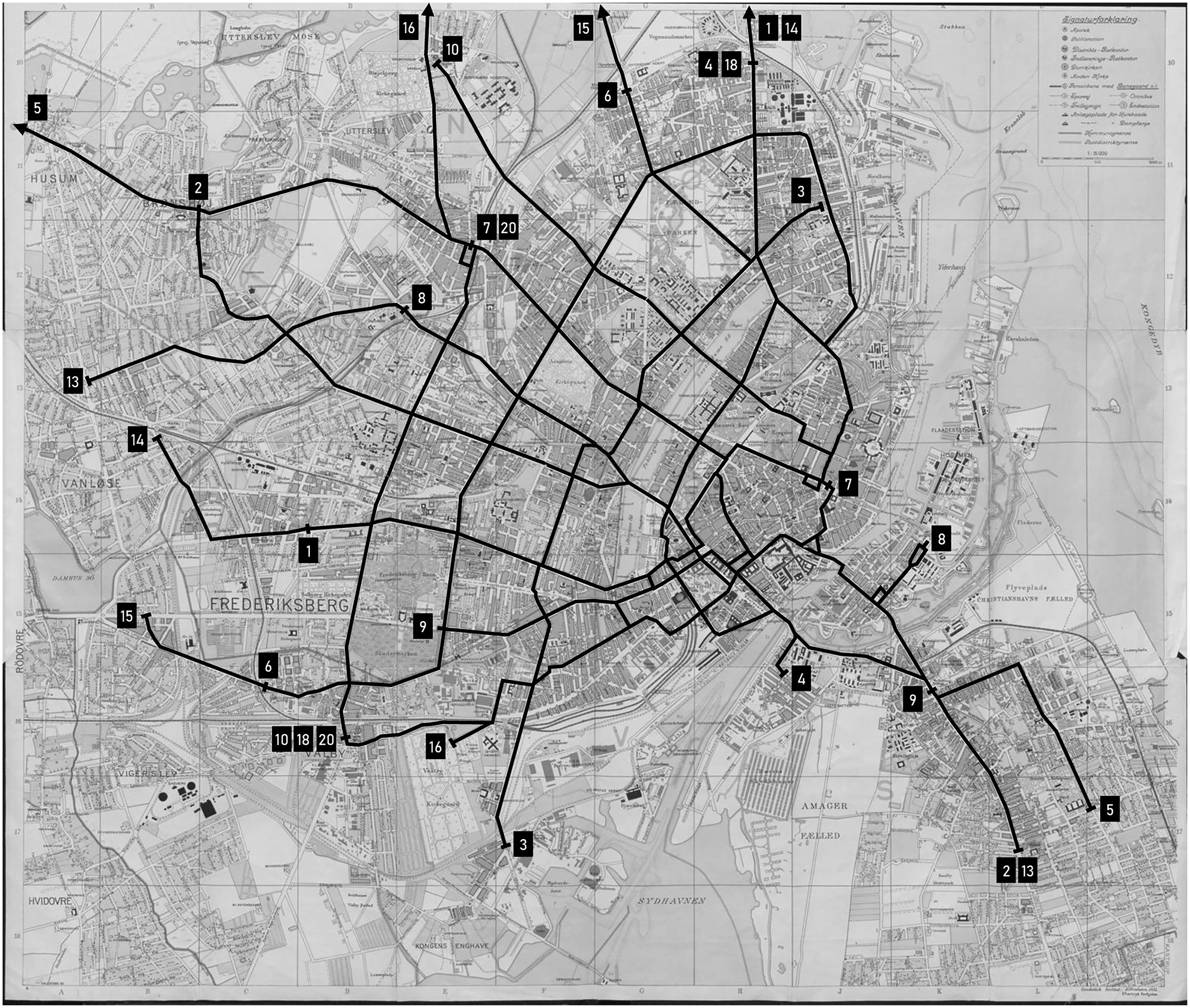
“Kort over København og Nordlige Omegn” (“Map of Copenhagen and Northern Area”), 1935. Information about the tram network has been partly highlighted by the author with line numbers placed at the termini. Note: Lines 1, 5, 14, 15 and 16 ended outside the map, respectively, in Hellerup, Husum, Hellerup, Ordrup and Søborg. Source: Københavns Stadsarkiv, 73957, https://kbhbilleder.dk/kbh-arkiv/105484 (accessed 2 September 2023).
During its existence, the Copenhagen tramway was an important part of the city. Between the end of World War I and the 1960s, apart from a few years, it never transported less than 140 million passengers per year. 21 In a city whose population size ranged between c.700,000 and c.900,000, such figures indicate that, for a long time, the tram was a stable feature in many peoples’ everyday life. 22 It also suggests that the tram did not only service the upper echelons of society and developments in ticket prices compared to average salaries point in the same direction. 23 In the most trying times, around 1930, the hourly wage of an industrial worker equalled six to seven tram journeys; at the best times, towards the end of World War II, he (or she) could travel almost 14 times on the tram. Further, Thelle says that the numbering of the tram lines in 1902 – as opposed to them just being named after the end station – solidified their presence in the urban space and granted them “a clear identity in everyday life”. 24 To this one might add that the colloquial nicknames given to all the lines point to the existence of an emotional attachment to the tramway, even if the sobriquets were not always entirely flattering. 25 They also suggest that the trams tickled the imagination and one need not search long to discover that the tramway inspired many writers and artists, during its lifespan as well as after termination. In fact, Copenhagen's tram features so strongly in Danish art and literature of the twentieth century that it is somewhat surprising to note how little scholarly attention the phenomenon has aroused. 26 This article looks to rectify the situation. It does so by zooming in on a famous writer in whose work the tram often features, Klaus Rifbjerg.
Rifbjerg and trams
Klaus Rifbjerg was born on Amager, the island immediately east of Copenhagen. His parents were teachers and, as one biographer puts it, the home a representative of the “Danish middleclass in its most beautiful, liberal-minded version, marked by comfort and security, but also openness to broader horizons”. 27 Rifbjerg's literary career would not be characterised by bourgeois comfort and security, however. He debuted in 1956 with the poetry collection Under Vejr med Mig Selv (“Under Weather with Myself”) which prompted the literary critic Torben Brostrøm to say that “the primate of materiality and sensuality here gets its bludgeon-swinging proponent”. 28 In other words, Rifbjerg's poetry initiated a much-needed renewal of Danish literature, one which challenged prevailing tendencies towards caution and restraint, provincialism and village idyll, by seeking inspiration from international modernism, and developed a poetry capable of dealing with life in a new post-war, modern, industrial society. Rifbjerg's role in the revitalisation of Danish literature became as pivotal as Brostrøm indicated, so much so that the decade or so following Under Vejr med Mig Selv is often referred to as the period of “konfrontationsmodernisme” (“confrontational modernism”) after Rifbjerg's poetry collection Konfrontation (1960) and like-minded writers as “Rifbjerg-generationen” (“the Rifbjerg-generation”). 29 Although it may be argued, as Lars Handesten does, that Rifbjerg's significance is mainly connected with his work from the 1950s and 1960s, he was far from finished afterwards. 30 Throughout his long and highly productive career, Rifbjerg continued to act the role of literary, cultural and social bludgeon-swinger: he was “a continuous provocation, first, in the eyes of a puritan bourgeoisie, later towards equally puritan leftist intellectuals” and later still “the political far-right”. 31
Rifbjerg's authorship has received a good deal of scholarly attention yet so far it is a largely unacknowledged fact that, throughout his very extensive literary production, the trams of his native Copenhagen appear time and again; they are a recurring material component in Rifbjerg's literary landscape. 32 Jason Finch has pointed out recently that, when considered collectively, the accumulation of such images of public transport can amount to “a kind of substrate in imaginative writing”. 33 This is, I think, the case with Rifbjerg and it is a characteristic of his writing that deserves closer attention. At the same time as this study looks to throw light on how the Copenhagen tramway has been represented in art and literature, it can also be seen as a first attempt at trying to identify some of the particulars of this specific substrate in Rifbjerg's oeuvre. The obvious place to start such enquiries is his most concerted engagement with the trams of his native city, “På Sporet”.
The collection Borte Tit is not among Rifbjerg's most famous publications, but it is held in reasonably high esteem. 34 Its front cover is dominated by Jesper Wetterslev's illustration of a Copenhagen tram (Figure 2), but trams are not a running theme in the collection. In the first short story, “Træd Ind, Barber” (“Step in, Barber”), set in the 1930s or 1940s, the tram features as a mundane part of the main character's day-to-day existence, but it is to “På Sporet”, the last short story in the collection, that the illustration points. 35 Wetterslev's drawing depicts a tram from the 1930s, one of those designed by Danish functionalist architect Ib Lunding. 36 It is neat, clean and in seemingly good order. This is slightly peculiar since most of the trams in “På Sporet” are anything but. The short story is set in 1984, mainly in a depot for old trams, presumably located somewhere in the vast area of rail tracks and good yards that used to stretch out behind Copenhagen Central Station, roughly between Ingerslevsgade, Kalvebod Brygge and the power plant, H. C. Ørsted Værket (Figure 3). 37 It is “filled to the brim with old trams”; some of the Lunding-type, some from other periods. 38 These are the trams that “it had not been possible to export or demolish” after the closure. 39 Stripped of “the bits and bobs that could be taken”, they “remained in the depot rusting while the seats rotted and the interim veneer plates […] came unstuck or cracked”. 40 They are the last of the last, obsolete and deprived of practical, functional purpose: “[t]he tracks that had been used to transport the trams into the depot had all been scrapped long ago. The trams were just left here as strange memories no one really cared about and only a municipal permission […] ensured that there was money for the necessary upkeep”. 41 But, most likely, the cover illustration is not intended to depict any of these trams, but, rather, an imagined tram.
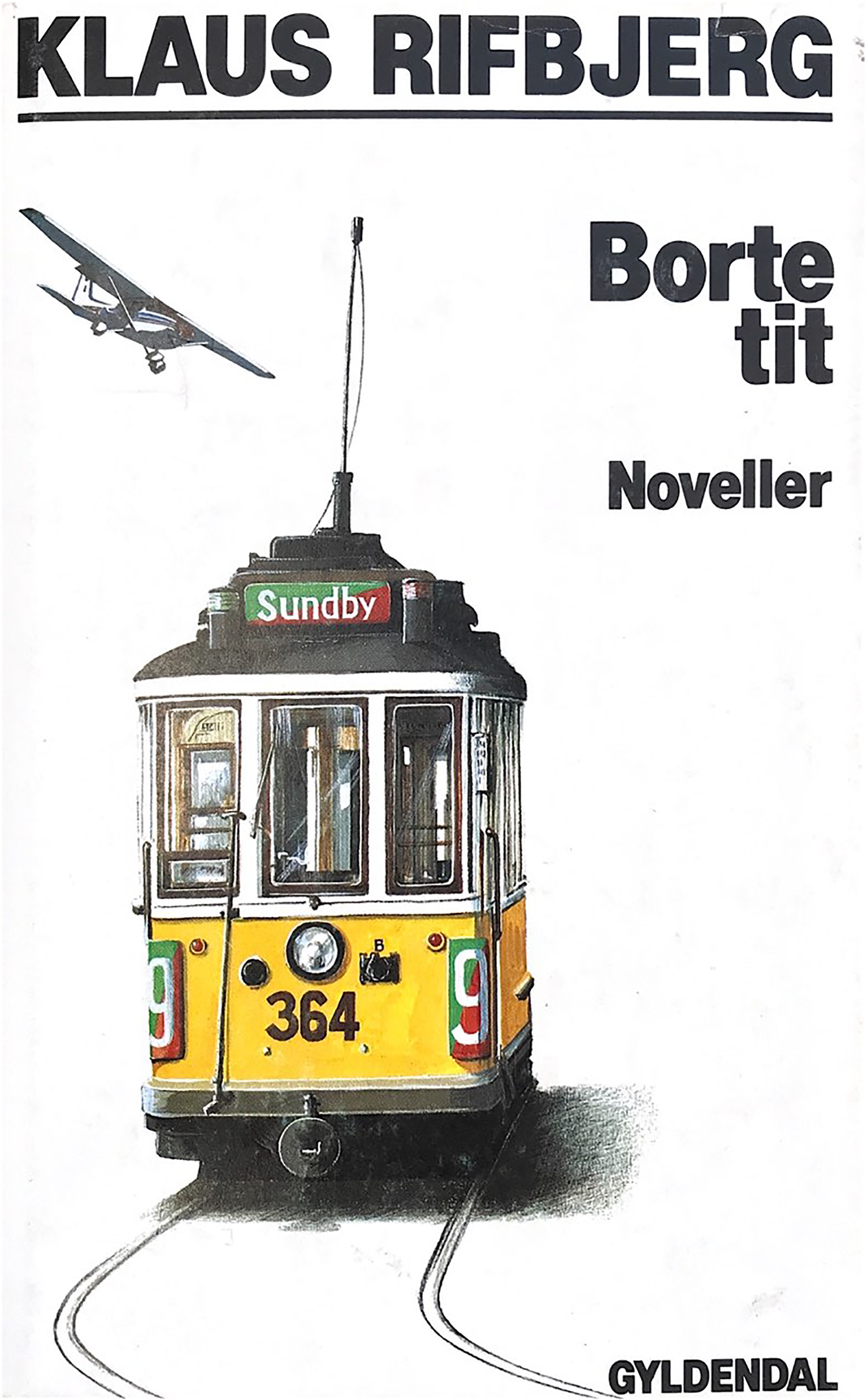
Front cover of Klaus Rifbjerg’s Borte Tit (1985).
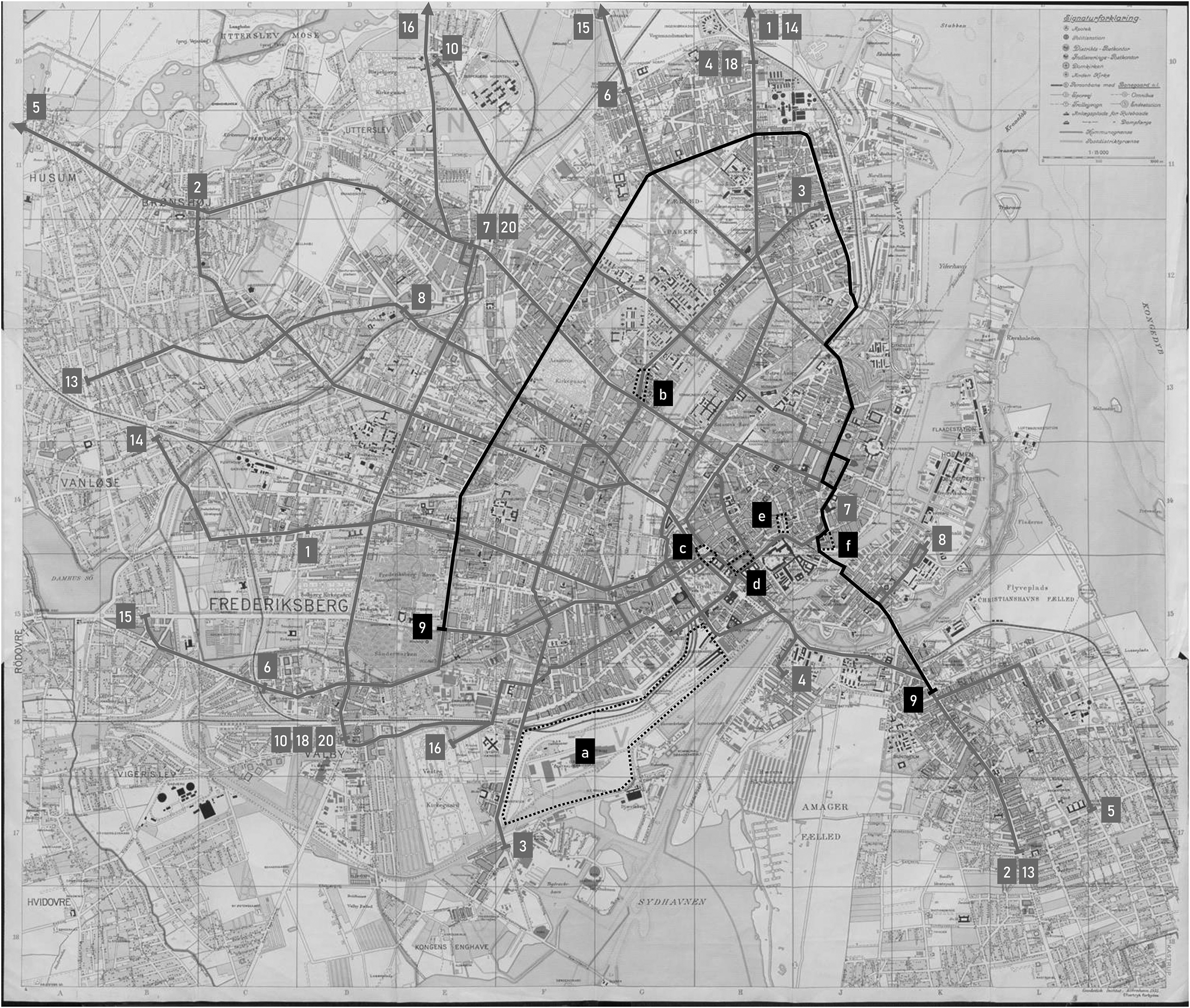
Same map as Figure 1. Tramlines not immediately relevant for “På Sporet” have been toned down while the most important, line 9, has been kept highlighted. Marked with dotted lines and letters are locations on Andersen's imagined tram journey: (a) the probable location of the depot; (b) Fælledvej; (c) Rådhuspladsen; (d) the National Museum; and (e) Højbro Plads. Also marked is (f) the National Bank. Although not mentioned in the short story, it is around there that Andersen's imagined journey intersects with line 9's actual route. All annotations are by the author.
The person to imagine this tram is the depot's elderly watchman, Andersen.
42
Apart from being a watchman, he is also something of a tram enthusiast. He likes his job and knows a lot about the trams, their design as well as how they operated and where, and shows himself keen to collect memorabilia.
43
On the day in question, a motorcar and a trailer disappear from the depot. Initially, this is puzzling. They stood surrounded by other trams on all sides; the gate was bolted shut; and, as noted, the tracks leading to the depot were all gone.
44
But, gradually, we learn that there has been no foul play. Instead, it is a fiction of Andersen's imagination. As he is uncomfortably aware, his mind tends to play tricks on him – Until that day all the trams had been very quiet, yes, so quiet indeed, that occasionally he felt unsettled and started hearing noises. They came as distant echoes, but he recognised them all: the appealing yet still strangely soft sound of the foot bell, the noise of the tram's acceleration […]. He shook his head. Sometimes he felt embarrassed, and he was glad that not many people came to the depot. They would probably find him odd if they saw him standing there with a distant look in his eyes, listening to sounds which didn’t exist and never would return.
45
Like in Wetterslev's illustration, Andersen's imagined tram is numbered 9. 47 From 1904 till it was bustituted in 1966, it ran from Amager through central Copenhagen north to Østerbro where it turned south into Nørrebro and Frederiksberg. Andersen's journey is unusual, not surprisingly. In addition to taking place 18 years after line 9 was closed, and entirely in his head, the route is different (Figure 3). Beginning outside the depot, behind Copenhagen Central Station, Andersen is taken to Fælledvej past Rådhuspladsen, the National Museum and Højbro Plads. It is not before he reaches the National Bank that the tram merges with line 9's traditional route. From there, it continues along its known path north to Østerbro and then south through Nørrebro to the terminus on Frederiksberg. 48 Although Andersen remains on the same tram, his journey seems jumbled, something like a hodgepodge of trips on several different lines blended into one. No explicit reason is given for these discrepancies. Implicitly, they are connected to the fact that Andersen's journey is an imagined experience, most likely a concoction of fragmented memories. Put differently, the nature of Andersen's journey is not immediately discernible from the literary form. Like the tram journey, the narrative glides along smoothly in a unified fashion, mimicking the progress of Andersen's memory, and it requires the reader to be attentive to historical and geographical details to notice the discrepancies between reality and imagination. 49
The temporal ingredients point in the same direction. There are several indications that Andersen's mind takes him back to some point in the 1930s. Most notably, the streetscape lacks cars and television antenna, and on Rådhuspladsen Martin Nyrop's clamshell is still to be seen. 50 But he neither relives a particular moment in time nor a particular journey. Beyond the fact that this happens to Andersen in the last moments of his life, there is nothing remarkable or extraordinary about his experiences, no dramatic incidents or memorable encounters. He relives the entirely mundane, everyday experience of travelling on Copenhagen's tram: the feel of its interior; looking out the window; getting up for a woman, secretly checking her hair, peaking at her see-through blouse; people entering and exiting; the conductor checking and selling tickets. 51
In its conclusion, the short story merges a decidedly unexciting, trivial experience with a highly dramatic one. Andersen's imagined tram ride ends with him falling asleep, but, as we learn, he is not just resting, he is dying. His life does not end in complete mental inertia, though. As Andersen is “taken away […] in a softly suspended ambulance”, he has a final epiphany: They struggled a little with him, and for a moment consciousness hit Depot Master Andersen like stroke of sunlight. It's not possible to say what he heard, but when they gave up on him, because there was nothing to do and because he was an old man, he experienced a sense of relief, because he was certain that somewhere, through some neighbourhood, a tram will always run.
52
A nostalgic trip?
When “På Sporet” was published, a recurring word in reviews was “nostalgic”. Here, for example, Brostrøm's assessment of the newspaper Information: A short story about […] the watchman Andersen who takes care of a depot filled with old trams. A nostalgic trip that screeches just right in the turn, like the green-yellow line 9 on that lovely cover. Here the depot master is guided into final unconsciousness […] but with the knowledge that, somewhere, in perpetuity, a tram will run.
53
To describe the short story as nostalgic is not as such a misreading, but it requires qualifications that critics have not provided. In Danish, like in English, the word is used in common parlance to describe “a sentimental or sad longing for a lost past” in which sense it corresponds roughly to what the sociologist Fred Davis once termed simple nostalgia: “that subjective state which harbors the largely unexamined belief that things were better […] then than now”. 54 But, as Davis and several other scholars have noted, nostalgia is a complex phenomenon that can encompass very different views on and attitudes towards the relationship between past, present and future. 55 Davis himself distinguishes simple nostalgia from reflexive and interpreted. In contrast to the first category, the latter two entail some sort of reflection upon the act of remembering. “In perhaps an inchoate though nevertheless psychologically active fashion”, reflexive nostalgia involves the casual bringing “to feeling and thought certain empirically oriented questions concerning the truth, accuracy, completeness, or representativeness of the nostalgic claim” while interpreted nostalgia goes further by targeting the nostalgic remembrance with “analytically oriented questions concerning its sources, typical character, significance, and psychological purposes”. 56 What Brostrøm and other reviewers meant when they described “På Sporet” as nostalgic is not entirely clear. Should they have thought it an expression of simple nostalgia, it is understandable. Parts of the short story point in that direction. I argue, however, that “På Sporet” does not boil down to a sentimental longing for a lost past. Rather, it approximates Davis’ notions of reflexive and interpreted nostalgia by thematising nostalgic remembrances, questioning their relevance and status in contemporary society.
There are parts of the short story that can make it seem like simple nostalgia, an invitation to reminisce about bygone days when trams moved through the streets of Copenhagen and how much better that time was. For example, Andersen's view that “few things compare to the joy human beings experience when they hit the footboard [of the tram] knowing they have made it” points to a qualitative difference between then and now based on the removal of pleasurable experiences.
57
The following impressions from his imagined tram ride can be described as simple nostalgia as well. One might also say that they come close to what Jefferson Cowie and Joseph Heathcott once called “smokestack nostalgia”.
58
That is to say, Andersen seems to romanticize the grim realities of public transport as well as the urban landscape of the past: He looked out at Strandboulevarden and there wasn’t really that much of a difference. And yet. […H]e sniffed and even there where he was sitting in the middle of the front car, it smelled better than he recalled. He touched the leather seat. It was old and worn, but because of that smooth and comfortable. Used. Good. Solid. Nice to touch. The houses out there were also worn and in need of paint and repair. But there was something about the colours that still appealed to him. They didn’t look so artificial. He didn’t quite know how to put it – they were more real, more natural.
59
Passages like these catch the eye, but they do not represent in condensed form the essence of the short story, its core meaning, as it were. Such sentiments are examined and evaluated by Andersen himself as well as the short story's narrator.
As mentioned, Andersen's mind plays tricks on him, occasionally bringing forth memories of the tram. He welcomes these occurrences, but they are also a cause for concern. He likes to remember the trams. Imagining the sound of “a current collector sliding against the overhead wire” brings “a smile” to his face and “a blissful look” to his eye. 60 And when, eventually, alerted by the sound of the bell, he goes looking for the missing trams, his excitement is palpable: “something pulled him and as he walked, […] his pace increased. His heart was beating, and he was breathing fast. He was definitely not used to running […]. But a tram!” 61 But, these remembrances or imaginings also worry him. Andersen fears that his inability to control their emergence points to an underlying, undiagnosed illness. 62 He also feels acutely that they are socially inappropriate. That smile caused by the imagined sound of the current collector, “he definitely doesn’t want others to see”. 63 He is “embarrassed” and worries that others might “find him odd”. 64 Although Andersen enjoys these memories and, eventually, gives in to them entirely, his awareness of how he might be perceived by others shows him capable of reflection. He can sense that, in society at large, his nostalgia looks slightly ridiculous, foolishly sentimental.
That Andersen is not wrong in his assessment is confirmed by the short story's narrator. As should be clear from the quotes presented so far, “På Sporet” is a third-person narrative, meaning someone else than Andersen tells the story. This someone could be said to be Rifbjerg, but, as a narratologists stress, one should be careful not to equate the actual author with the narrator, especially when it comes to literary texts. The author is a real person; the narrator is a textual construction, “the agent or, in less anthropomorphic terms, the agency or ‘instance’ that tells or transmits everything […] in a narrative”. 65 It is important to distinguish between Rifbjerg and his narrator, but, for the moment, it will suffice to say that we are here dealing with what in narratological terms can be described as an unembodied, overt narrator who has an external perspective on events told. The point of view is external because the story is clearly told by someone with “an outside […] view of the fictional world” rather than being “limited to the knowledge and the perceptions” of a character. 66 The narrator can be described as unembodied since we learn nothing about his (or her) physical characteristics or personal history and overt because she (or he) “can be clearly seen to be telling the story […] and be articulating her/his own views and making her/his presence felt stylistically”. 67 The narrator, then, is distinct from Andersen. They experience events differently and their opinions on what takes place are not the same, although, occasionally, they coincide.
The distinction between Andersen and the narrator becomes most tangible towards the end of the short story. When the imagined tram stops, Andersen is sleeping or, to be precise, dying. The narrator, on the other hand, remains very much alive and awake, and keen to reflect on what has happened: Perhaps it was all a dream. Most likely. It was also too uncontroversial, too easy, and the gist of it all quite unacceptable. Had it been better back then? Of course not. Just different. But these thoughts didn’t cross his [Andersen's] mind. He was sleeping. You couldn’t call it the sleep of the just, because he had quite obviously neglected his duty. He should have taken better care of his trams. Overall, you could say that he should have taken better care. He had been derailed, that was the truth about Andersen. He had reacted on an impulse and listened to sounds, voices, signals which didn’t exist except inside his head. It was a crime which under current circumstance warranted a severe punishment. You couldn’t go backward, only forward. In his waking moments, he knew it only too well.
68
Beyond illustrating the distinction between the narrator and the main character, the passage shows how Andersen's experiences and remembrances are called into question. Through the narrator, we get an outside perspective on Andersen's fate and sense the reasons for his discomfort about how his nostalgia might be perceived. In addition to the charge of occupational negligence, it is suggested that, by indulging in nostalgic remembrances, Andersen has done something “unacceptable”: “current circumstance” dictates that you cannot “go backward, only forward” and if you do, if you get “derailed”, the punishment will be “severe”. It is not a kind eulogy.
As said, I do not think it is a misreading to describe “På Sporet” as nostalgic, but to do so requires clarification. It contains passages that can be characterised as simple nostalgia, but, essentially, it comes closer to Davis’ notions of reflexive and interpreted nostalgia. Put differently, one could say that it thematises nostalgia: “På Sporet” asks its readers to reflect on the status and relevance of nostalgic remembrances in contemporary society, and it does so by juxtaposing Andersen with the narrator. Andersen, the elderly, somewhat pitiable watchman with an enthusiast's emotional attachment to the tramway, is cast in the light of a narrator who seems to speak for a broader socio-cultural economy that values that notion of progress which, as Martin Savransky and Craig Lundy point out, was so vibrant during the middle of the twentieth century; “that civilisation imagery of a boundless, linear and upwards trajectory towards a future that, guided by reason and technology, will be ‘better’ than the present”. 69 Ultimately, I argue next, Rifbjerg does not leave it up to the readers to make up their own mind, but nudges us to sympathise with Andersen and his plight. To illustrate this, it is, first, worthwhile to consider a couple of possible references in the short story's title and then, finally, to think more carefully about Andersen's epiphany.
The title of the short story, “På Sporet af den Tabte Vogn”, contains two possible references, each pointing in different interpretative directions. The one is a caricature by Danish cartoonist Bo Bojesen published in the newspaper Politiken in 1969, entitled “På Sporet af den Tabte Tid” (Figure 4). The other is French author Marcel Proust's canonical seven-volume novel À la Recherche du Temps Perdu (1913–27) whose title in Danish translations is rendered as På Sporet af den Tabte Tid. 70 Initially, it might seem as if Rifbjerg's short story has more in common with the caricature. Both deal with tram enthusiasts and the closure of the Copenhagen tramway. 71 The novel, on the other hand, has little to do with trams, even if, occasionally, they make an appearance. Nonetheless, it is Proust and not Bojesen who is Rifbjerg's intellectual bedfellow.
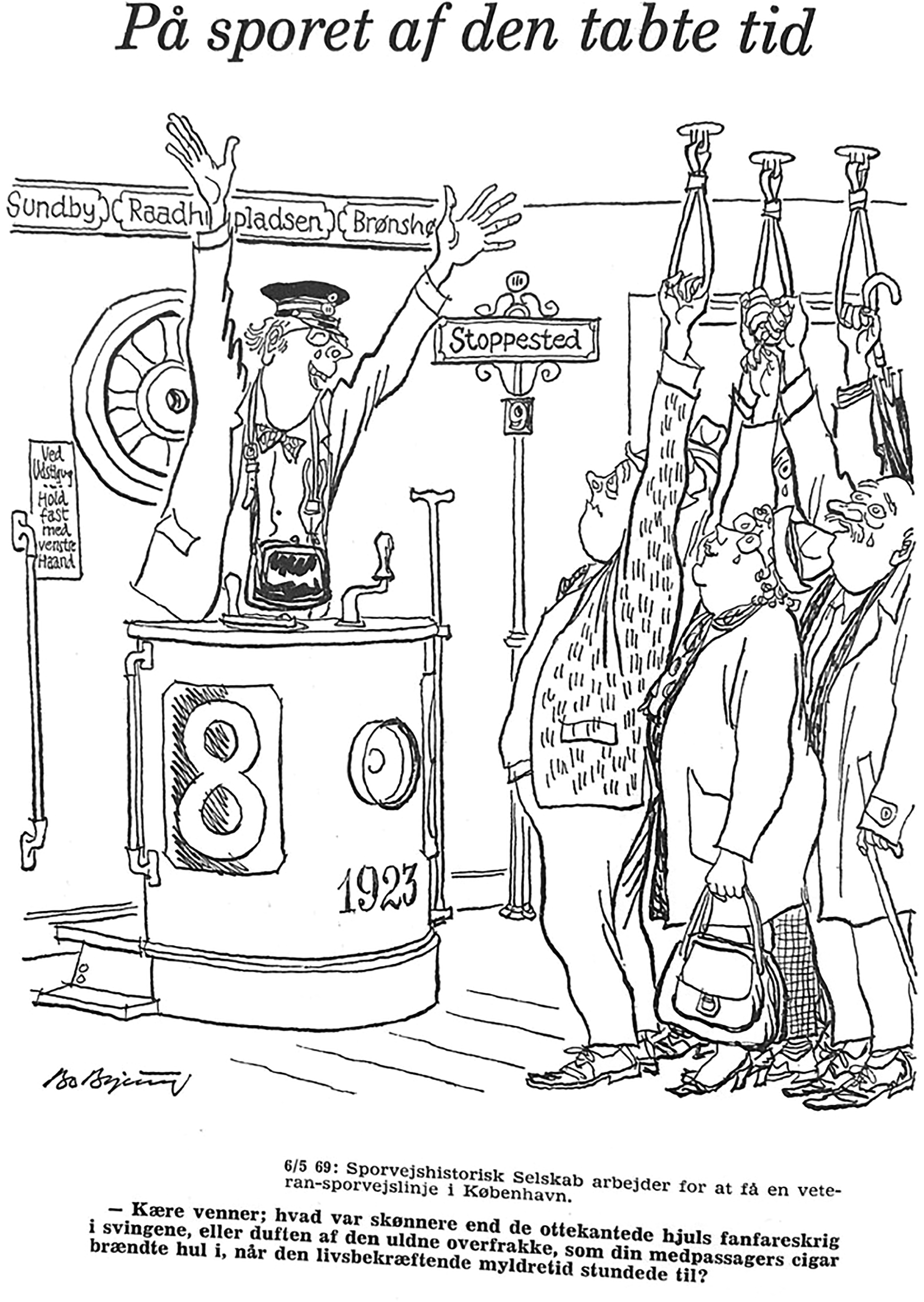
Caricature by Bo Bojesen from Politiken (6 May 1969). Title: “On the Track of the Lost Time”; or if one is to go by the common English translation of Marcel Proust's À la Recherche du Temps Perdu, to which the caricature refers, “In Search of Lost Time”. Text: “6/5 69: Sporvejshistorisk Selskab is working to get a heritage tramline in Copenhagen”; “– Dear friends, what was lovelier than the fanfare-screeching of the octagonal wheels in the bends, or the smell of that woolly coat that your fellow passenger's cigar burned a whole in when that life-affirming rush-hour kicked in?” Source: Bo Bojesen, Årets Tegninger fra Politiken (Copenhagen: Politikens Forlag, 1969).
Bojesen's caricature pokes gentle fun at tram enthusiasts. 72 It maintains that their particular version of nostalgia – seen as something like Cowie and Heathcott's smokestack nostalgia – represents a strange inversion of mainstream, common sense values: the closure of the tramway was to many a sign of progress, to them a mark of decline. The underlying message is that nostalgia for the Copenhagen tramway is a humorous oddity, one that is understandable and tolerable but, basically, foolishly sentimental. Although less cynical, the caricature's outlook is similar to that of the narrator in “På Sporet”, suggesting that the short story should be taken as something of a warning against nostalgia. In contemporary society, there is little to no room for remembering that which the top-down rationale of progress has deemed obsolete, for example, a tramway. Proust pulls in the opposite direction. It may well be considered out of place to align À la Recherche with the nostalgia of tram enthusiasts as the caricature does. In fact, many critics would take issue with the suggestion that the novel is nostalgic. 73 But, no doubt, Proust and tram enthusiasts are understood to share a preoccupation with the past, and this is certainly correct. Arguably one of the great achievements in European literature, À la Recherche places great emphasis on our memories – especially those that occur involuntarily – and presents the past as a pivotal source for the most intense self-examination. Contrary to the caricature, the allusion to Proust suggests that Andersen and his remembrances of the tramway should be taken seriously.
It is Proust that “På Sporet” is aligned with. One of the main strands in Rifbjerg's authorship is his preoccupation with memory and remembrances. 74 This interest in the past and our relationship with it, is what makes it difficult to conflate Rifbjerg with his narrator in “På Sporet”, and, indeed, to see the short story as on par with Bojesen's caricature. Fundamentally, they disagree about the importance of the past in the present. This is one reason why the short story reads as an attempt to carve out a place for nostalgia in contemporary society rather than an effort to ostracize such inclinations. Another reason is Andersen's epiphany. It will be recalled that, in his final moment, also the last lines of the short story, he is struck with the realisation “that somewhere, through some neighbourhood, a tram will always run”; it hits him “like a stroke of sunlight” and fills him with “a sense of relief”. 75 To become aware that trams will always run somewhere, is to recognise that the closure of the tramway in Copenhagen was not the inevitable, rational conclusion to a series of urban challenges. Under different and entirely plausible circumstances, the process of public calculation, deliberation and negotiation will reach another resolution, one where the tramway is not thought obsolete, burned or left to rot in some remote depot, but considered capable of fulfilling an important societal function. For a man like Andersen, this realisation is, naturally, a relief, and doubly so, because it also works to legitimise his own relationship with the tram. Its restoration from the scrapheap of history undermines the narrator, and the socio-cultural economy he represents, showing cracks and fissures in that assured worldview whose disapproval Andersen has felt so acutely. It opens up a distinct possibility for a society and a culture in which his nostalgia is not judged as an inappropriate sentimental longing for a lost past, but instead valued as an important link between past, present and future modes of urban public transport.
Conclusion
Susan Stalter says of the closure of the Third Avenue El in New York that it marks “the beginning of its afterlife as an object of aesthetic contemplation”. 76 The same might well be said of the Copenhagen tramway. Even after the process of bustitution had reached its climax in 1972, the tramway continued to intrigued artists and writers. This article can be seen as an attempt to understand the kind of artistic thoughts and works the ending generated. It has focused on Klaus Rifbjerg and his short story “På Sporet af den Tabte Vogn”, undeniably a significant publication for anyone interested in the network's history. I argue that it is not unreasonable to describe the short story as nostalgic, but that descriptive label must be used with more attention to detail than critics have done so far. A close reading reveals that this is not an invitation to reminisce about bygone days when it was possible to ride the tram through Copenhagen and how much better that time was. Rather, the short story thematises such nostalgic remembrances, asking its readers to consider their status and relevance in contemporary society. Although the argument is not delivered with the same bludgeon-swinging force that otherwise tended to characterise his career, Rifbjerg clearly looks to undermine prevailing notions of progress and legitimise nostalgic remembrances and other investigations into the past. In this respect, the story of the final moments in the life of Andersen, tram enthusiast and watchman, seems to have much in common with the tendencies Stalter has noticed in art depicting the Third Avenue El and, also, with Tennessee Williams’ A Streetcar Named Desire. 77 It joins a string of writers and artists in North America who saw in the closure of electric public transport networks an antidote to predominant ideas about progress and urban development in the mid-twentieth century. 78
Whether “På Sporet” is a solitary example of this tendency in Denmark or one out of many, is an open question. The Copenhagen tram clearly features strongly in Danish art and literature, before closure as well as after, but just as the history of the tramway has gathered little scholarly attention, its representations have also been left largely unexamined. I maintain that it is an aspect of Copenhagen's history worth closer attention. As Barbara Schmucki and several other scholars have shown, the political processes that led to the closure of many tramways across Western Europe and North America, as well as the later reintroduction of trams, were often not primarily directed by rational, objective criteria and argumentation but strongly influenced by cultural practices. 79 This illustrates that the study of the cultural aspects of public transport developments in the past can be of real consequence to policymaking in the present. However, the study of transport history should not be dictated by the needs of policymakers. That there are no clearly discernible links between a work of art and actual developments in a public transport network, does not mean that it has been uninfluential. Although the effects of a literary text such as Rifbjerg's “På Sporet” can be hard to determine, it does not mean that it is irrelevant to transport historians or, indeed, policymakers.
If we wish to get a better sense of the broader status and significance of a single work of art like “På Sporet”, a good place to continue our investigations will be to consider it in relation to other representations of the tramway. There are many examples to be found elsewhere in Rifbjerg's authorship. To name but a few, the tram features in the poetry collections Under Vejr Med Mig Selv, Konfrontation and Amagerdigte (“Amager Poems”), the novel Den Kronisk Uskyld (“Terminal Innocence”) and the long essay Tænkeboksen (“The Thought Box”). 80 As said, I think these instances are numerous enough to amount to distinct substrate in Rifbjerg's writing, but this is not to say that they all pull in the same direction. 81 Further studies are needed before we have a clearer sense of Rifbjerg's relationship with the Copenhagen tramway – the role it plays in his work and how, for example, it relates to his political standpoint more generally. Furthermore, it is necessary to understand Rifbjerg in relation to other artistic representations of the Copenhagen tramway, those produced during his career as well as those that precede it. They may not all be equally relevant to Rifbjerg, but they will all be part of that prominent yet largely unacknowledged substrate in Danish art and literature that is the Copenhagen tramway.
Footnotes
Declaration of conflicting interests
The author(s) declared no potential conflicts of interest with respect to the research, authorship, and/or publication of this article.
Funding
The author(s) disclosed receipt of the following financial support for the research, authorship, and/or publication of this article: The article has been written with support from the H. W. Donner Fund, Åbo Akademi Foundation and the PUTSPACE project. PUTSPACE (“Public Transport as Public Space in European Cities: Narrating, Experiencing, Contesting”) is financially supported by the HERA Joint Research Programme ( ) which is co-funded by AKA, BMBF via DLRPT, ETAg, and the European Commission through Horizon 2020.