




Abstract
This article presents a case study of pavement regulation and usage in nineteenth-century Stockholm, probing how urbanites’ interactions on and access to pavements were contested and negotiated, in the process shaping the publicness of streets. Utilising press coverage, it moves beyond a focus on infrastructure and political discourse, to capture urban dwellers’ perspectives, claims and interactions. The article shows that, in favouring circulation, Stockholm's pavement regulations expelled or made subsistence-driven activities illegitimate. Pavement circulation also secured undisturbed, anonymous walking and the ability to maintain a distanced attitude towards others – to be private while in public. Yet pavements featured as a prominent public space not only because it was ordered and controlled, but because urbanites of all sorts fought for access. Next to allegedly “modern” usages, city pavements remained home to age-old but marginalised street practices, as well as middle-class women who had begun to claim their equal right of use.
Introduction
Western cities in the second half of the nineteenth century faced similar challenges: the combination of industrialisation and rapid population growth strained urban environments and aggravated the problems of pollution, overcrowding, and sanitation. In response, urban elites everywhere initiated thorough modernisation processes. Urban embellishment projects, slum clearances, and new infrastructure systems came together to change cities’ physical layouts and the character of their streets. 1 Various “street improvements” made streets cleaner and more comfortable places to be. Combined with the large influx of people looking for job opportunities, nineteenth-century streets became places where people of all sorts gathered and intermingled. In cities governed by an unforgiving capitalist logic, crowded living conditions and low living standards made many men, women and children turned to the streets for leisure, daily chores, and pure subsistence. 2 Whereas some scholars have argued that this made streets and boulevards “democratic”, others have highlighted how monied and respectable people saw a risk of streets becoming, as Richard Dennis puts it, “too public”. Variously fearing the “anonymous and transient urban mass” or that the presence of the “wrong” kind of people would threaten their neighbourhood's reputation and property values, urban elites set out to purify streets by introducing new forms of regulations or informal rules that would change the public character of streets. 3
Streets were teeming with activity. According to Colin Pooley, pedestrians “dominated the streets” of nineteenth-century (British) cities. Notwithstanding differences in street presence depending on age, class, and gender, streets were “places where people from all backgrounds mixed (though did not necessarily interact)”. 4 Yet these interactions are the centre of attention in this article. Scholars have pointed to the urban promenade as a key site of bourgeois sociability and its production of gendered public space. David Scobey described it as a carefully orchestrated performance of gentility in hierarchical urban societies: it “mapped out an elite public-within-the-public, inscribing class and cultural hierarchy across the common landscape in New York”. 5 As later scholarship has shown, this did not prevent women, workers or people of colour from developing walking behaviours that ran counter to the bourgeois norm of the promenade, nor the development of conflicting ideals of walking among middle-class men. Peter K. Andersson suggests that the nineteenth-century promenade was “the culmination of an urban development that had turned walking from a mode of conveyance to a method of self-presentation”. 6 This conclusion is based on a limited subpractice of urban walking. In most places and at most times mundane, everyday and purposeful forms of walking dominated urban streets and pavements. As revealed in the work of Nicholas Blomley, Anastasia Loukaitou-Sideris and Renia Ehrenfeucht, and Phillip Gordon Mackintosh, amongst others, street usage was not only diverse but very often in conflict. A dominant trope is how pavements, like streets in general, were increasingly defined as places for circulation. In the name of order, speed and civility, liberal elites prioritised “efficient walking” over subsistence-driven uses of pavements among the urban poor and workers. 7
This article adds to this rich previous scholarship a case study of Stockholm. Considering pavement construction, regulation and usage in Stockholm in the second half of the nineteenth century, it seeks to probe how urbanites’ interactions on and access to pavements were contested and negotiated, in the process shaping the publicness of the streets. Next to the above-mentioned priority of pedestrian mobility, it highlights how pavement norms and rules facilitated undisturbed, anonymous walking, and gendered struggles as middle-class women increasingly appropriated pavements.
Theoretically, the article draws on literature on public space and the public realm. Public space is often defined variously in terms of ownership and control or access and use. Don Mitchell adds a constructivist understanding of public space, as he argues that spaces do not have a “preordained ‘publicness’” but are “made public when, so as to fulfil a pressing need, one group takes space and through its actions makes it public”. From this point of view, public space is always in the making, a product of contestations around regulatory frameworks of access and usage as well as practices on the ground. 8 Mona Domosh urges us to go beyond outright confrontations (demonstrations, riots) to consider the underestimated potential of small transgressions and “polite” deviations from male and middle-class norms – the “micropolitics” of the street – in shaping public space. 9 Meanwhile, Lyn H. Lofland introduced the alternative notion of public realms, referring to “social, not physical territories”. What makes a realm public, parochial or private, she argues, is fluid and dependent on “the proportion and densities of relationship types”. 10 A public space may thus, sociologically speaking, be either parochial or private, and importantly, “[w]here the boundaries are unclear or disputed or … at border points between them, ruptures in the moral order are not only possible but are, under some conditions, probable”. 11
This article aspires to trace such contestations, transgressions, and blurred boundaries among users of pavements in Stockholm. Alongside sources in municipal archives, which help in capturing issues of construction, repair, ownership and regulation of pavements, a detailed analysis of press coverage and letters to editors provides an opportunity to give voice to urban dwellers’ thoughts about, use of, claims to, and interaction on the city's pavements. 12 While it is necessary to remember that newspaper reports often focus on tension and conflict, and less on normal everyday business, they are valuable for mobility historians who wish to go beyond the common focus on infrastructure and political discourse and, as Simon Sleight puts it, “repopulate the streets” of the past. 13
Setting the (pavement) stage
Stockholm of the nineteenth century faced similar challenges to most other European cities. Following a long period of economic and demographic stagnation, industrialisation took off around 1850, turning Stockholm from a shipping and trading town into Sweden's unchallenged industrial centre, while the population roughly trebled in less than 50 years, reaching 300,000 at the turn of the century. 14 With already very high death rates, not least due to poor water quality and hygiene standards, Stockholm was ill-prepared for the expansion. As elsewhere, the urban elite – concerned about the rapid growth and its consequences, but also eager to capitalise on it – initiated a thorough modernisation of the city. 15 This involved the creation of new infrastructure systems, major changes to Stockholm's overall physical layout, and a new streetscape: levelled-out streets increasingly provided with pavements, gutters, and smoother surfaces for pedestrians and horse-drawn traffic. 16 Their realisation came at a high cost and required advanced administrative capacities, which pushed the gradual transfer of responsibility for these and other services from individuals or property owners to new and centralised administrative bodies, most of which were incorporated into the new municipal administration of 1863. 17
Following the international pattern, street paving and repair in Stockholm was successively brought under municipal control. This happened in a two-step process. Firstly, the task of paving and maintaining streets, previously in the hands of individual property owners, was centralised with the creation of the Street Paving Administration in 1845. Now, owners had to pay a fee in relation to the value of their property. Secondly, beginning in the 1860s, the burden of covering the costs of street paving was distributed among larger segments of the population: property owners were joined by income earners (although their contribution was smaller) before (in 1888) street paving was finally integrated in general taxation – indicative of the shift in perception that all inhabitants benefitted from street improvements. 18
Contrary to many foreign cities, however, Stockholm's proto-municipalisation of street paving regarded not only streets but pavements as well. In cities elsewhere, from France and Belgium to Australia and the USA, the responsibility (including the initiative and funding) for pavement construction remained with the property owners – although centralised public works or paving administrations increasingly regulated and oversaw their implementation. Property owners could variously hire contractors or request the local administration to carry out the work. Some cities, such as Paris, employed a bonus system to encourage pavement construction; in other cities, property owners had to take on the full cost themselves. In spite of ambitions to create homogenous pavement networks, the result was often, as in Brussels (where pavements were imposed only through building permits), a piecemeal extension, “house by house and not street by street”. 19 In Stockholm, where the initiative to establish pavements lay with a centralised administration – not individual property owners (or parish-level bodies) – the conditions for a coherent approach to pavement extension, with concerted efforts and uniform solutions, ought to have been better.
Loukaitou-Sideris and Ehrenfeucht argue that, as streets in US cities came under public control, they were increasingly seen as public spaces serving the city as a whole. Given the pavements’ proximity to and long-standing association with adjacent property owners, however, their publicness remained ambiguous. 20 Christophe Loir and Thomas Schlesser similarly argue that pavements in Brussels remained a “hybrid space, between the public and the private, financed and maintained by local residents but without any right of ownership or servitude”. 21 Stockholm's municipalisation of pavements might have resulted in an understanding of pavements as more public than in cities where they were initiated and paid for by the building owners, who could thus make, relatively speaking, more legitimate claims to them. Property owners in Stockholm could appeal for changes in the street paving administration's yearly plans – and they regularly did, with varying success – but they lacked the options of their peers in Toronto, for example, where property owners could veto street improvements if they managed to coalesce around an alternative solution. There, Philip Gordon Mackintosh contends, turn-of-the-century pavement construction was characterised by neighbourhood conflicts and corruption, resulting in not only substandard solutions but also social dissolution. 22 In Stockholm, with its centralised initiative and funding, local debates over pavement construction were not as infected, and the quality of pavements was not held back by disagreements among neighbours. This is not to say that everyone was pleased with the state of affairs regarding Stockholm's pavement priorities.
Stockholm was a latecomer, with few pavements established prior to the creation of the Street Paving Administration in 1845. The new administration made pavements a priority from the start – although it also guarded against spiralling costs. 23 Some of the first pavements were established outside popular theatres, where the visitors could step in or out of their own carriages, while remaining safe from others’, before and after a show. 24 The way pavements afforded respectable walking is apparent in how the city authorities, in preparing for the Stockholm Industry Exposition of 1866, granted the paving administration additional funds to furnish the streets around the exhibition area with new or widened pavements, including outside the exhibition hall, the National Museum and the Opera House. 25 A caricature mocked the imbalance of the city's paving efforts by pointing to how the shifting quality of the pavement along Regeringsgatan yielded different walking styles among visitors to the exhibition. On the most centrally located section, the sophisticated visitor could stroll ahead on the smooth paving stones; further south, however, sharp cobblestones turned him into a seemingly staggering old man (see Figure 1). 26
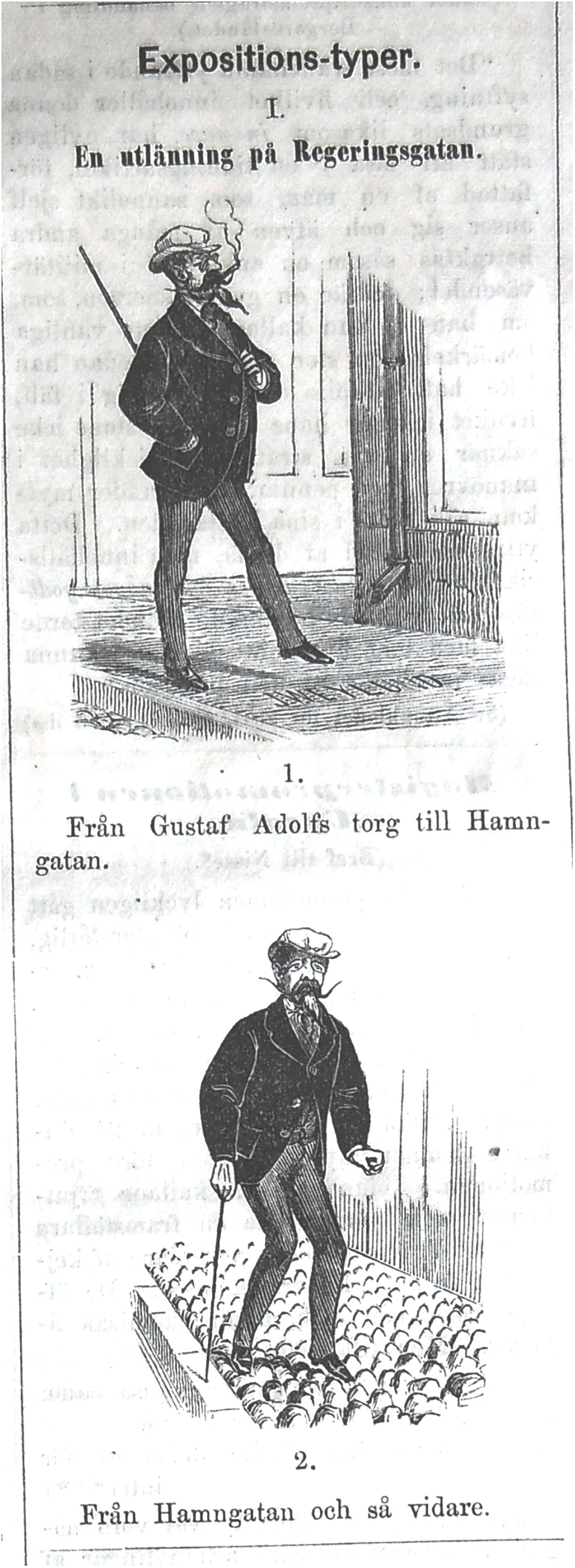
Illustration by Gustaf Wahlbom, published in Söndags-Nisse, 10 June 1866. Source: Stockholmskällan, https://stockholmskallan.stockholm.se/post/20178. Translation: “Exposition-types. I. A foreigner in Regeringsgatan. 1. From Gustav Adolfs torg to Hamngatan. 2. From Hamngatan and onwards.”
Besides the few centrally located streets, cobblestone pavements remained the norm. Like most modern cities that used cobbles, they were thoroughly criticised as a “torture” or “torment” on the feet. 27 The continued use of cobblestones was “unworthy” of a capital city, an annual review complained in 1865, before it reminded the administration about its first priority: to establish pavements of paving stones or asphalt and proper gutters for the comfort of pedestrians. 28 Things did change. By the turn of the century, cobblestone pavements were rarely used in the streets of Stockholm. Meanwhile, the administration considered and introduced other materials such as asphalt. 29 Yet pavement construction had a social geography. Pavements tended to be established in centrally located districts first, and only later in others. The residents of smaller streets on the outskirts had to wait longer, even as traffic volumes increased. Without pavements, one resident complained in 1867, they had to “wade in dirt” during the spring and autumn months. Liberal Dagens Nyheter identified the lack of decent pavements as a sign of the scant attention the city paid to the residents in the periphery. The narrow wooden pavements, “three (say 3) slender planks”, one reader lamented, forced a pedestrian to “step out and into the dirt” were he to meet another. 30
As these and many other examples show, the presence or absence of pavements was not just a matter of levels of traffic, although this also mattered. As elsewhere, pavements had smoother paving than the roadways. 31 They were a matter of pedestrian comfort and decency, seen as a measure of the level of sophistication of a district, and the social geography of pavement provision in Stockholm fuelled feelings of neglect among the residents of poorer districts who benefitted marginally and slowly from the municipalisation of street paving.
The walking public
While pavements were increasingly seen as public space, this did not necessarily mean that all people could feel equally at home there. Mackintosh usefully distinguishes between two competing pavement usages: “sidewalk subsistence” and “efficient walking”. 32 Under municipal control, engineers and administrators adopted what Blomley has termed a “traffic logic” of streets as well as pavements, prioritising movement and circulation as important for a well-functioning city. 33 The framing of pavements as circulatory space turned pedestrians into their most legitimate users. In this way, while excluding particular individuals or groups of people from using the pavement “as others use it” would have been too blunt a violation of equal access, activities were excluded on the grounds that they obstructed free flow and movement in streets and on pavements. 34 Several authors find that arguments of increased circulation in fact were rhetorical tricks to shut out activities (and by extension those who engaged in them) – begging, street vending, etc. – at odds with dominant perceptions of the modern city. 35 As we will see below, efficient walking appeared as a superordinate principle for pavement use in Stockholm's local ordinances at an early stage, although pedestrian priority remained contested throughout the century.
As pavements were established in Stockholm, it was essential to ensure that they were reserved for pedestrians and no other traffic. Already in 1846, the executive committee of Stockholm's street paving administration reported how vehicles occasionally ventured onto the pavements, causing “harm and mischief”, and they filed with the Governor's Office to introduce fines for such violations. 36 The new ordinance of 1852 declared that the city's pavements were established “exclusively for the pedestrians’ comfort” and banned horse riding and vehicular traffic on pavements, including horses or cattle, push carts, and the general conveyance of loads, which “due to their size or otherwise” would disturb “the public's” movements on the pavements. 37 In the coming years, pedestrians kept complaining about drivers of vehicles who preferred the smooth pavement surfaces to the roadways, or who rode so close to the kerb that they risked hitting pedestrians. Drivers were occasionally fined for riding or leading their horses on pavements and, as cycling increased in the 1890s, cyclists were also banned from using their smoother surfaces. 38 Meanwhile, occasionally, other road users wanted to confine pedestrians to pavements. As the local police ordinance was up for consideration in 1869, a comfortable majority in the city council agreed to the formulation that pedestrians “should” stick to the left-hand pavement. 39 As in other locations, however, walking was not heavily constrained; footage reveals that pedestrians could opt between using the street or the pavement (see Figure 2). 40
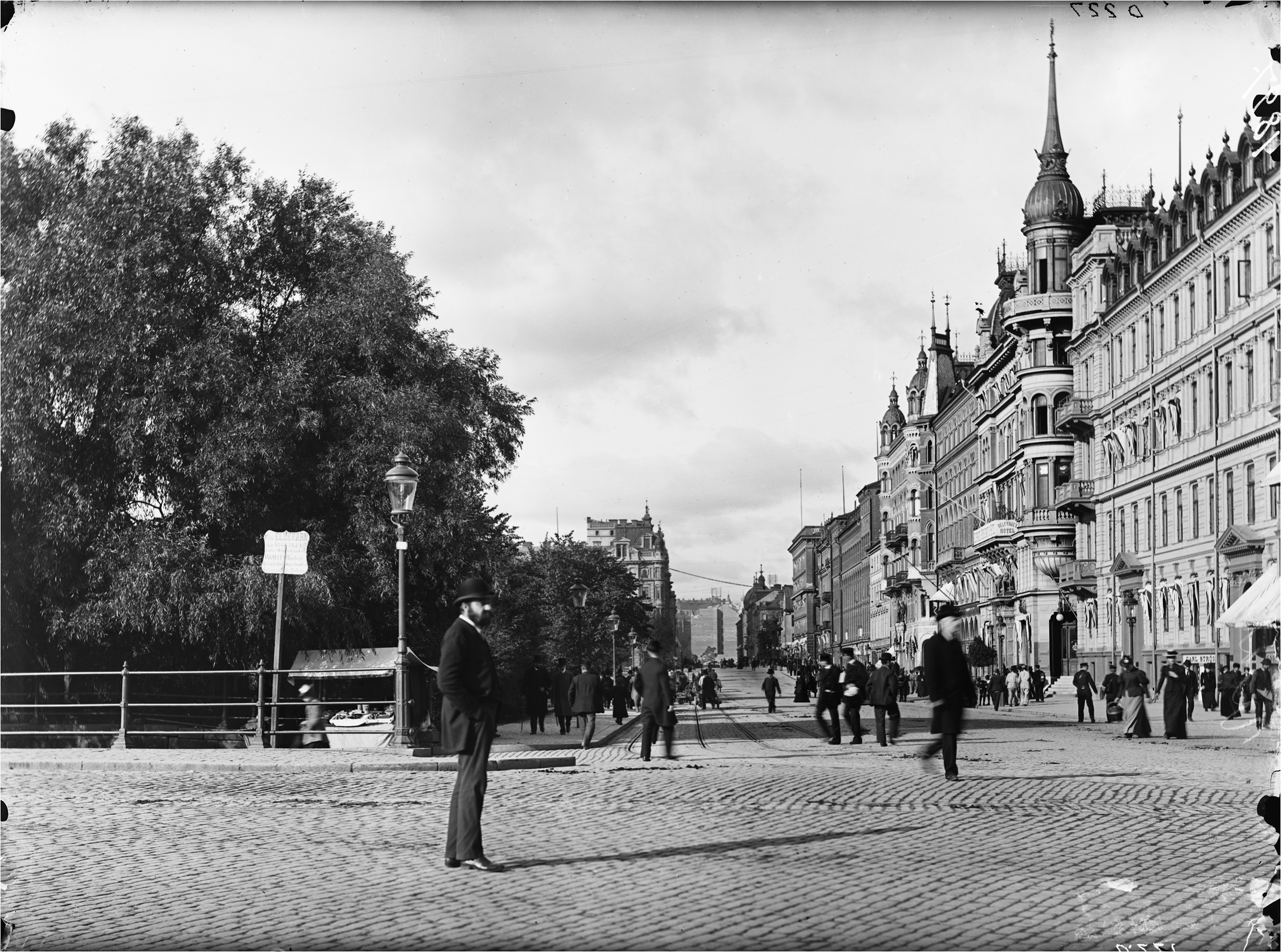
Photographs suggest that pedestrians could choose rather freely how and when to use the pavement or the roadway. Vasagatan, 1895–99. Unknown photographer. Stockholm City Museum, D 227.
Pedestrians’ main concern was not other traffic. In October 1851, the liberal newspaper Aftonbladet acknowledged the authorities’ and property owners’ efforts to establish pavements in the city and the long-term ambition to have them in all larger streets. Their usefulness was diminished, however, not only by their poor condition, but also by the many competing usages. Their ledges, slopes, and cavities, the author argued, made pavements dangerous to use during the dark hours of the day. Meanwhile, pavements were of little use when they turned into “stockpiles and market places”, forcing pedestrians to abandon them where they needed them the most: as a “refuge against the rampage of vehicles” in congested places. 41
The following decades saw protracted debates about the appropriate usage of pavements. For one, pedestrians filed complaints about how street hawkers and workers invaded the pavements, bringing disorder and untidiness, while also impeding their function as a space for walking. In August 1854, a reader of Aftonbladet claimed that “hawkers” regularly closed off pavements with their stands, causing “the public” – that is, those who walked – to “throng, jostle and knock each other over”. Objects hindering a smooth passage on pavements were another major concern for pedestrians. “[L]arge barrels, ploughs, grapnels, etc.” cluttered the pavements, obstructing pedestrians’ passage, and risked tearing their clothes. 42 On market days, another paper observed in 1861, “peasant” traders swelled out into surrounding streets and pavements. 43 Throughout the century, resident pedestrians kept feeling that workers – masons, brewers, bakers, farmhands, dairy traders, butcher boys, and painters – occupied the pavements with their trays, carts, baskets, buckets and containers. Against tradespeoples’ subsistence claims and workers who asserted their perceived right to the pavements, pedestrians interpreted such activities as a hindrance to their walking. On top of that, workers dared to mock them. “How on earth”, asked one pedestrian in 1890, “can this be allowed in a large city?” 44 Their arguments for displacing activities other than walking from the pavement had a clear social edge, which was sometimes disguised in aesthetic terms – street vending, for example, appeared “unpleasant”. In other cases, the criticism targeted alleged intruders’ lack of manners directly, as when a reader in 1895 characterised cigar-selling boys as “varmints” who failed to step aside for the (superior) pedestrians. 45
People carrying bulky goods on the pavements was another concern of pedestrians. 46 In 1852, a reader of Aftonbladet noted how pedestrians were often “forced into the gutter” by people balancing large baskets, boxes or painting materials on their heads, and pointed to the recently introduced ban. 47 However, the regulation of carrying goods, an obvious social marker, also received some criticism. One reader of conservative Nya Dagligt Allehanda found this part of the ordinance “barbaric”. In a so-called civilised nation, it was not worthy to make “a servant (who is also human)” carry heavy burdens in the mud of the roadbed, while “other, more fortunate” people could venture, free of such loads, in the clean, safe haven of the pavement. To this reader, pavements were established “for the pedestrians’ comfort, without consideration of rank and condition”, which made “a maid with her basket” as legitimate a user as her “mistress in crinoline”. 48 The ban on obstructing pedestrian access to pavements by carrying bulky goods was renewed in the 1868 national charter for Swedish cities, but it is difficult to assess the extent to which the police enforced the regulation. Readers kept filing complaints about the malpractice and, as in one instance in 1889, about police constables’ tendency to look the other way while “the public are bothered … have their clothes torn or stained by food baskets and such, which the servants carry without ever yielding to whoever they meet”. 49 That said, newspapers did occasionally report how maids were fined for “unauthorised” use of pavements while carrying baskets or other loads. 50
There are contradictions at work here. While the repetition of the ban to carry goods on pavements signals determination among the legislators, the interpretation of it as “barbaric” suggests some liberal intolerance to how it was differently effectuated depending on who the carrier was. On the other hand, the police occasionally overlooking the inconvenience of subsistence activities wrought on bourgeois pedestrians points to inconsistencies between the top-down policy making of the city council and the police leadership, and the decisions taken by individual police officers on the ground. While rules and regulations were grounded in the perceptions among the ruling elite, in practice, enforcement depended on the discretion of patrolling police officers.
The grievances about street vendors, servants, and various labour activities on pavements were aimed at people of low status. Property owners and shop owners had a different social standing, but they too lost out, relatively speaking, in their claims on pavements. Pedestrians complained about how house and shop owners threatened their priority on the pavements, as erroneously placed awnings, piles of hay, or construction materials forced them out into the streets where they risked being splashed or, worse, hit by traffic. 51 In 1864, a reader of Aftonbladet argued that property owners still – even though (since 1861) all tenants contributed to the cost of street paving – seemed to consider pavements as their private property, occupying them with steps, signboards, or using them as a dumping ground and for stockpiling. House owners should, this reader thought, pay a fee for their encroachments onto pavements, as they allegedly did in many foreign cities. 52 In 1868, these complaints were backed in the national charter for Swedish cities, which banned not only riding and vehicular traffic but also “other illegitimate use or obstruction of the pavements for those who are walking”. Even so, shop owners kept displaying their wares on the pavements to the hindrance of (pedestrian) “traffic”. If they refused the police officers’ “friendly requests” to remove them, one pedestrian noted in 1871, the owners were occasionally brought to court. 53
One kind of obstacle to pedestrian circulation was particularly targeted: steps that occupied a smaller or larger segment of a pavement. An age-old ordinance required property owners to remove steps that encroached on the streets when their buildings were subject to large-scale renovations, but frequent criticism suggests that the ordinance was not effectively monitored (see Figure 3). 54 Pavements reactivated the debate about how steps impinged on public space. In 1861, a reader of Aftonbladet found it unacceptable that steps took up half or more of their width. The author pleaded for a “high fee” for steps that occupied the pavements, which could be extended to “every such thing … which, for the benefit of private interests, infringes on the rentable part of the public sphere”. 55 In the following years, urban dwellers kept urging property owners to remove steps that constituted a “hindrance to traffic” when their street was up for refurbishment; if they refused, property owners were criticised as selfish and failing to acknowledge the needs of the walking public. 56 Steps occupying the street could perhaps be accepted in pre-pavements times, one critic wrote in 1870, but had now come into conflict with “the public's common claims” on the pavements. 57 Stockholm's new building ordinance issued later the same year required the “unconditional” removal within five years of stone steps that extended from building facades and encroached on pavements. 58 The newspaper Dagens Nyhter helped push the issue by including expressions of gratitude in the paper for every property owner who promptly acted on the ordinance. 59 Although some property owners successfully appealed for exemption from the rule, the problem with steps obstructing pavement circulation appears to have been “resolved” by 1880. 60
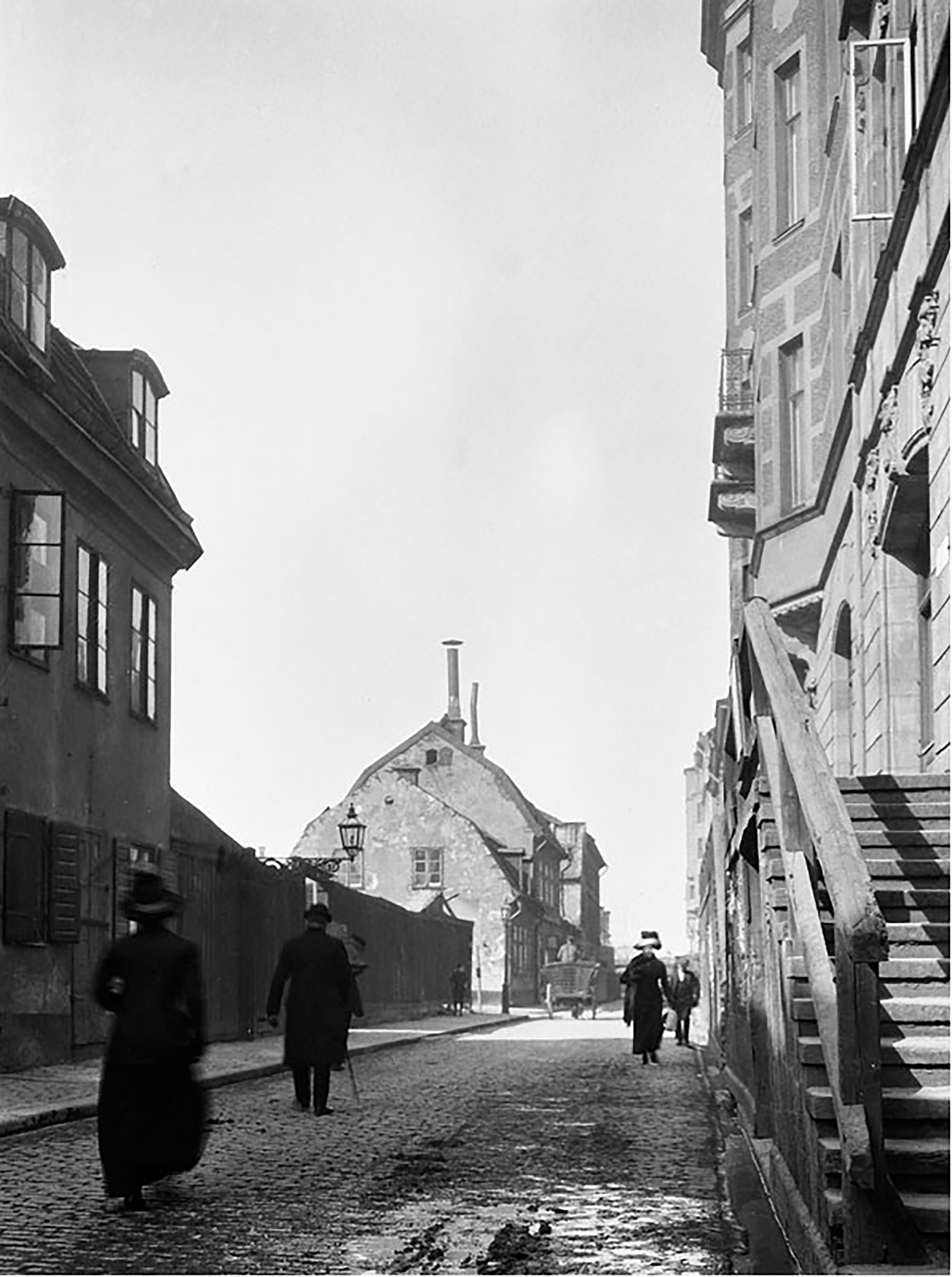
The pavement debate renewed an age-old debate about steps and property owners’ encroachment on public space. Stora Badstugatan, 1885–1919. Photograph: Kasper Salin. Stockholm City Museum, F 3086.
To summarise, municipal control of pavements in Stockholm shifted dominant views about legitimate use. As elsewhere, property owners had to subsume their own interests in favour of the public good as regulations banned steps and fixed objects. More so, it seems, in Stockholm than in Brussels, where similar regulations were full of exemptions to appease resistance from property owners. 61 Hence, pavements were clearly meant to serve public ends. Yet, the “the public” was not defined in universal terms, instead being restricted to those engaged in pedestrian traffic – the walking public – their clean, comfortable, and efficient passage being the primary objective. As elsewhere, public control of pavements came with a paradoxical combination of expanding and restricting their publicness. While the right of access was secured for the walking public, other uses – in particular those of the poor and working-class people – were constrained. 62 However, even as bourgeois proponents of “efficient walking” declared other uses as illegitimate – and had their claims backed by local ordinances and national charters – the steady flows of complaints about “misuse” speak to both the difficulty of enforcing these actions and the fact that work-related activities were never entirely expelled from pavements. Discursively and legislatively suppressed, people continued to engage in activities they needed to maintain their livelihoods or dignity. In fact, the regulation aimed at house and shop owners’ “encroachment” of pavements appears to have been more successful than that of working-class mobile uses, perhaps pointing to a greater ease in regulating and monitoring fixed people and objects than moving and fleeting ones.
Republic of privates
Much previous historical research stops at the observation that regulations grounded in class-based valuations gave priority to walking over working-class practices such as carrying heavy things or street vending. This section moves further in trying to understand everyday walking as a product of pavement norms and rules beyond those based on social standing. The difficulty of “being both part of the public and being an autonomous, private individual”, argues Miles Ogborn, was “[a]t the heart of the new urban experience”. Compared to promenading or flaneuring, he argues, mundane, everyday walking in eighteenth-century London involved “a less formalised engagement with public space, characterised by an intense sense of the individual experience of the city and a feeling of being in it, if not fully part of the crowd”. 63 Patrick Joyce calls this a “liberal” approach to walking, emphasising “a controllable private self”. 64 Stressing how Stockholm's pavements were places where boundaries between public and private realms became unclear and disputed, this section advances a similar argument to that made by Mackintosh, that proponents of “[e]fficient walking…encouraged not only freedom of mobility but also the freedom from distraction”. 65
In the 1860s, the concern in Stockholm about pavement circulation extended to people standing still, typically engaging in conversation (see Figure 4). In 1865, a reporter for Dagens Nyheter remarked on the common sight of loitering men – “a stationary, talking company (usually only men)” – occupying the pavement in all its width, thus forcing passers-by “down into the street or into the gutter”. 66 “Nothing is now more common”, a reader declared, than groups of people standing on street corners or outside shops and restaurants, leaving no room for others to pass. Others failed, upon meeting an acquaintance, to step aside for pedestrians, and instead behaved as “as if the pavements were their pedestal”. 67 Messengers were criticised for their tendency to group together in “stations”, where up to 10 or 15 messengers “completely blocked passage”, thus forcing women out into the street, and moreover ridiculing any attempt to correct their misconduct. 68 However, the disapproval of loitering was not limited to people of low age or social standing. When two messengers were fined, in 1869, for loitering on a pavement, Dagens Nyheter wanted such punishments extended to the “ladies and gentlemen who are not messengers, but hinder traffic” while engaged in their long conversations. 69 A reader joined in and wanted the Governor's Office to ban “loafers, ‘Eckenstehers’” as well as talkative men and women from occupying pavements. Having experienced the impolite responses “even of so-called better people” when asking to be allowed to pass by, this reader, and many more, wanted to empower police officers to remove wrongdoers and fine those who refused. 70 Years later, another reader similarly pointed out how groups of drunken men blocked the pavements outside bars, only to widen his concern: such misbehaviour could be found among “all social classes, even elegant ladies” who, upon meeting an acquaintance, would “use the pavement as a salon” for “cheerful conversation” as they hindered pedestrian traffic. 71 Hence, these sets of norms related to everyone, irrespective of social class.
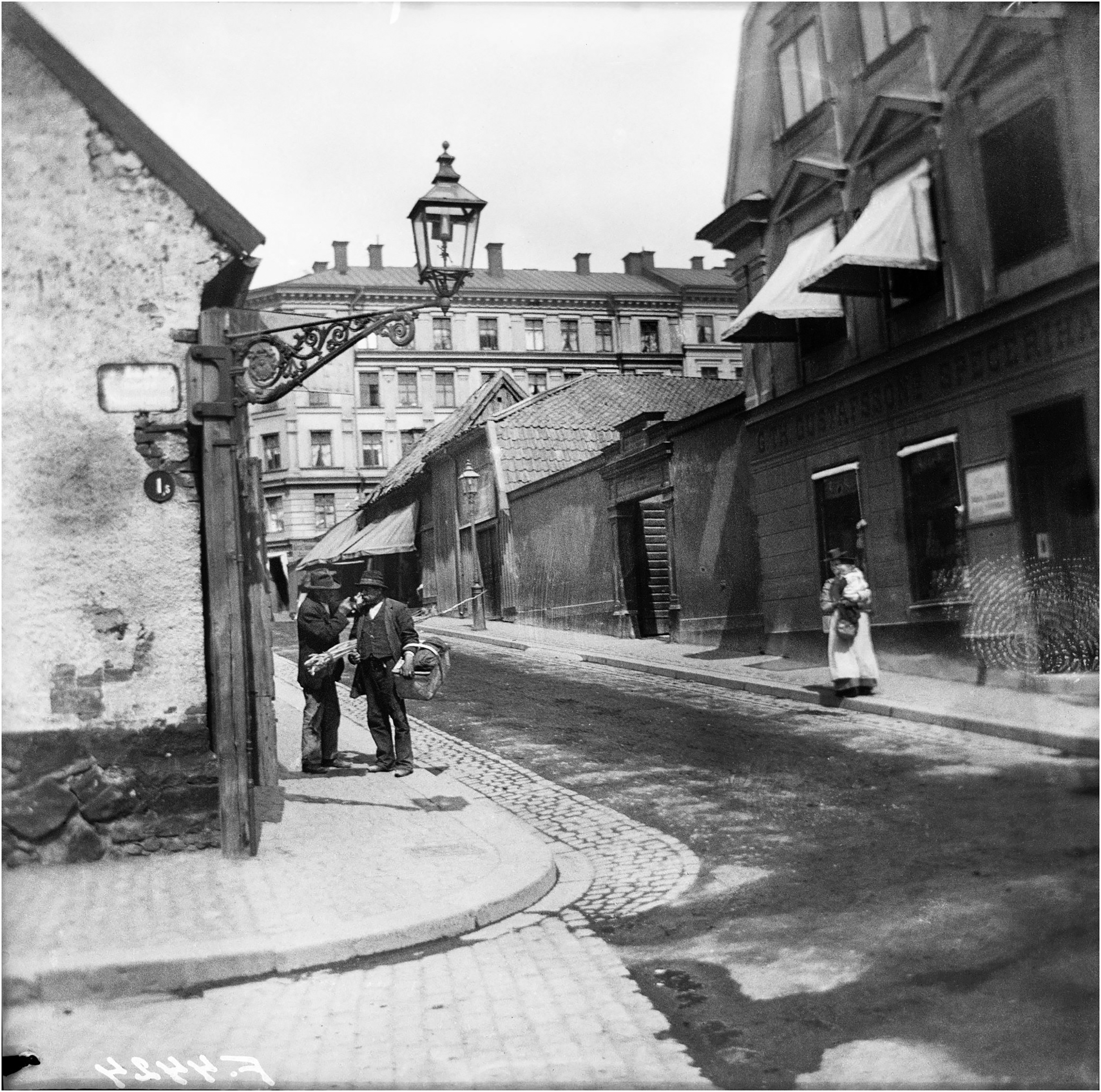
Men standing on the pavement, engaged in conversation. Whether it was considered a nuisance to moving pedestrians or not must have depended on the situation – in this case, it cannot reasonably have been seen as a problem. Nytorgsgatan, 1885–1914. Photograph: Mr. Bodin. Stockholm City Museum, F 4424.
In spite of the frequent calls for improvement and stricter enforcement, apparently little happened. “Boo, mister Stockholm!” one author exclaimed in 1883. “Leave the pavements for what they are intended to be, lanes for walkers! And stick to the property walls or step down into the street when you have something important to talk about with your acquaintances”. 72 Only working-class men, such as messengers and carriers, appear to have been fined for loitering. 73 Even so, editorials and letters to editors reveal that the concern regarded people of all sorts. How could standing still be so provocative? The circulatory logic noted in the previous section may suggest that it was due to a concern about friction-free mobility, a distinction between productive and unproductive walking, and a critique of “loitering” as a threat to the city leaders’ economic rationale. 74
However, there is more to this concern than pavement circulation. Cities were increasingly anonymous places and pavements were, sociologically speaking, a public realm; that is, most people inhabiting them were strangers to each other or were only known to one another by virtue of their job or status. As people formed groups outside shops or bars, as they stopped to chat with an acquaintance on the pavement, they formed – in Lofland's terminology – parochial or sometimes even private “bubbles” within a predominantly public realm. 75 This sudden change or vagueness of realm boundaries, I suggest, irritated bourgeois pedestrians who inhabited the pavements as if in a world of strangers. Seen in this way, the individualistic, anonymous behaviour of pedestrians – viewed as a pathological tendency in classical sociology – can instead be understood as a constructive effort to handle encounters with strangers, minimise frictions and cope with what Georg Simmel referred to as sensory overload. 76
If people standing still caused annoyance, it was nothing compared to the debates generated by people walking “incorrectly” (orätt). Alongside its ban of vehicular traffic and the carrying of large objects on pavements, the 1852 ordinance stipulated what was referred to as the “pavement priority” policy (trottoar-rätten). The “comfortable passage” of pavements would be facilitated, it stated, “if all pedestrians who are heading in the same direction use the same pavement”. The policy was formulated as a recommendation, not an obligation. The ordinance urged pedestrians to “voluntarily” use the left-hand pavement in relation to the direction in which they walked. 77 The implication was that people walking with the street on their right-hand side (hence, the pavement to the left) had the priority to use the often larger kerbstones at the pavement edge (Figures 5 and 6), while those walking in the other direction were expected to yield into the street or towards the house wall.
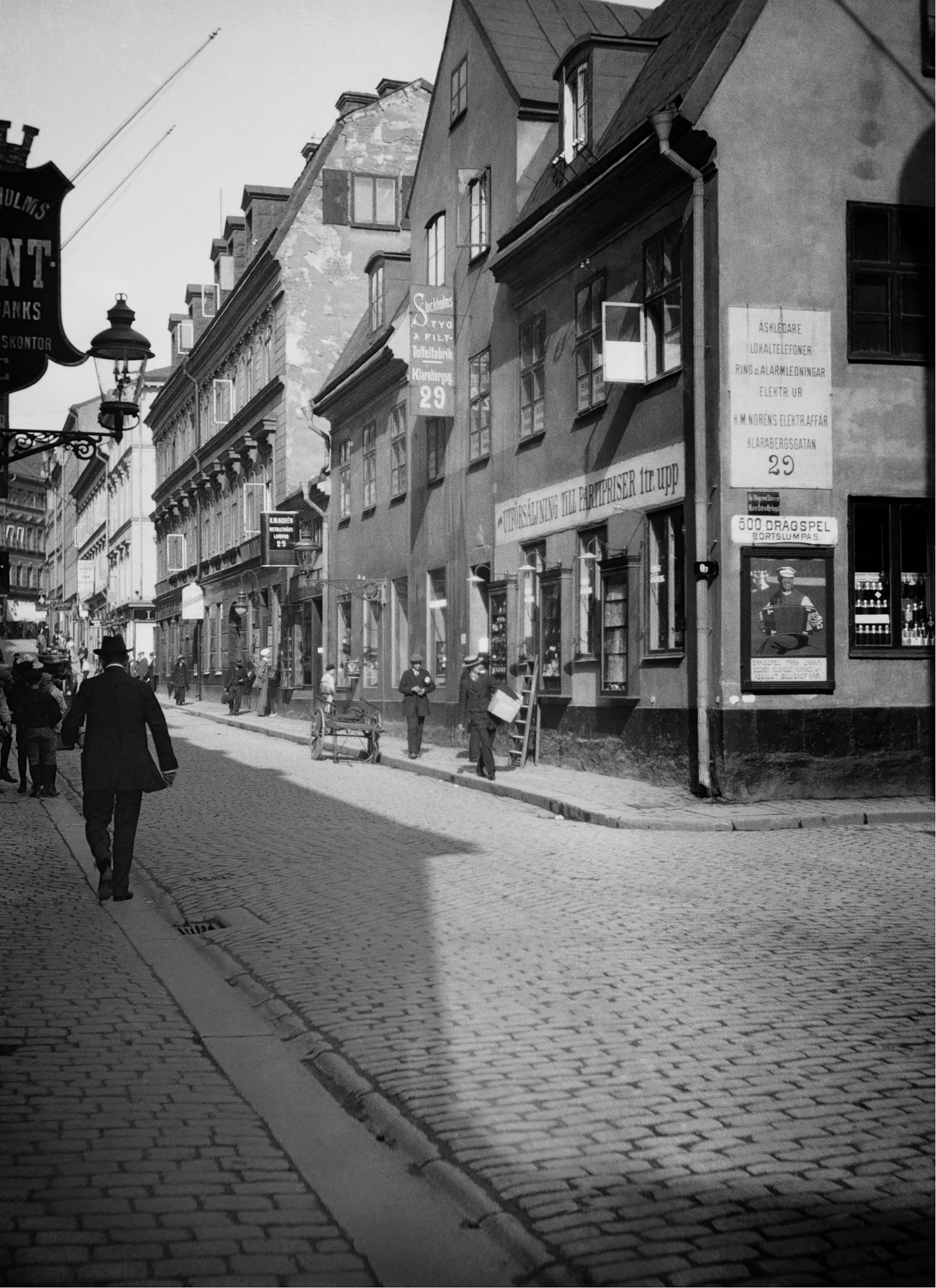
Stockholm's pavement priority policy implied that pedestrians with the street on their right-hand side had priority on the pavement and in particular its wider kerbstones, while others were supposed to yield either towards the wall or into the street. Note how pedestrians seemed to prefer the kerbstones and how – at least when it suited their purposes – they did actually choose the “correct” pavement. Klarabergsgatan, 1885–1900. Photograph: Kasper Salin. Stockholm City Museum, F 2712.
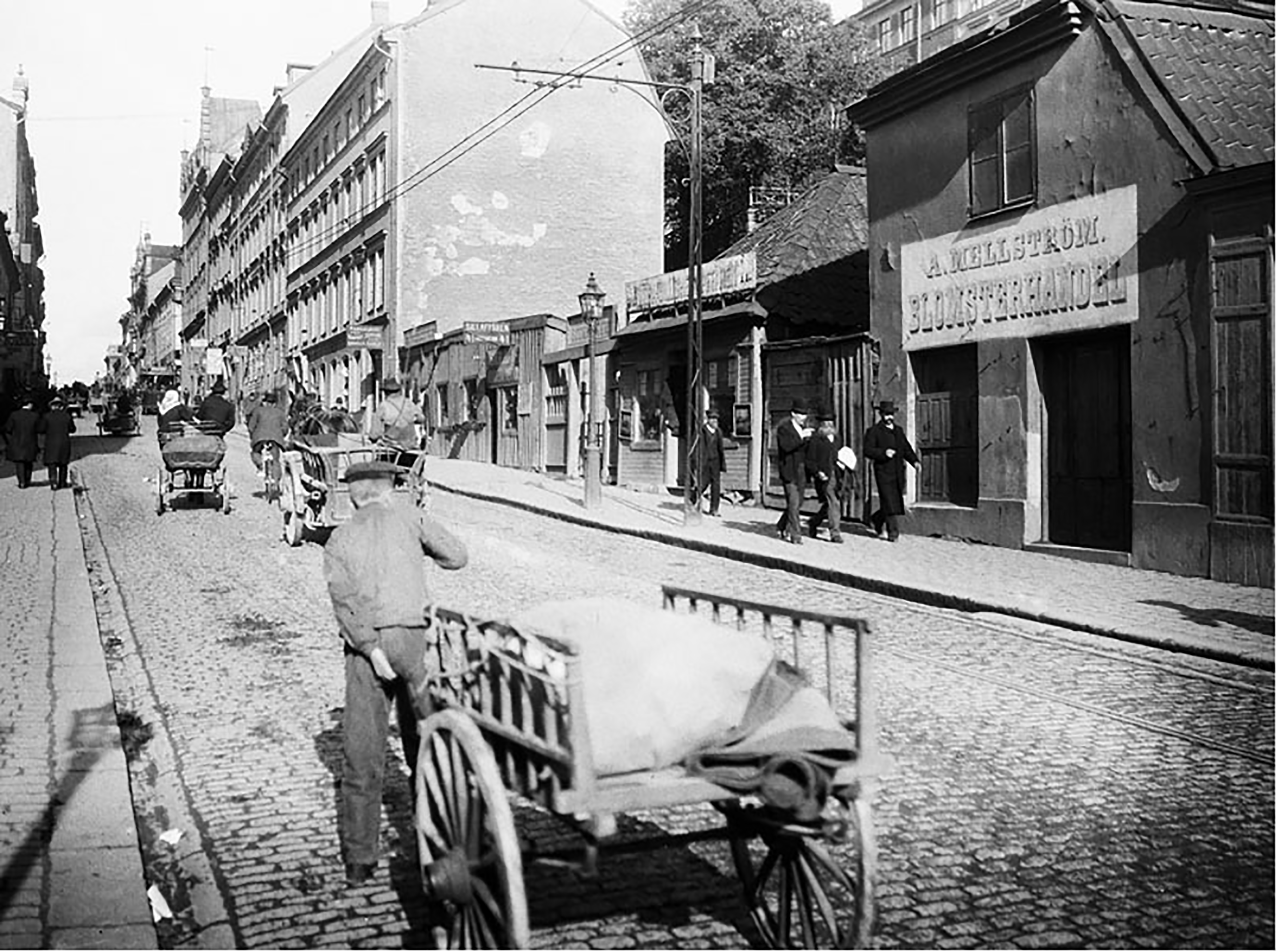
Another example where pedestrians used the “correct” sidewalk. Götgatan, 1892–1910. Photograph: Kasper Salin. Stockholm City Museum, F 4503.
Aftonbladet supported the pavement priority policy. In the present state, a correspondent wrote, many steered clear of pavements altogether in order to avoid “elbowing and bumping into persons, when you don’t know which way to yield”. The paper hoped for a quick adoption of the rule, as it would bring “order and comfort”. 78 Yet, judgements of the logic and efficacy of the policy varied. In 1859, one reader thought it had turned out to be “fully practical”. “[G]rounded in fairness and the common good”, the “hint” had turned into a “rule”. Now that “the streams of people always run in the same direction”, this reader argued, a pedestrian was rarely bothered by approaching traffic on the pavement. 79 Others had little belief in the policy as it had been designed, one persistently so. During the winter and spring of 1860, a writer with the signature “J.W.” strongly opposed the principle in three letters to the editor of the socialist bi-weekly Folkets röst (Aftonbladet refusing to publish them). He found it unnatural, impractical, and an assault on pedestrians’ right to use whichever pavement they liked to. While the policy served “those who are prone to promenading”, it was ill-suited to those whose time was precious, who were too ill to make detours, and those who for one reason or another preferred the sunnier or the shadier side of the street. 80
According to J.W., pedestrian freedom of choice should not be regulated seemingly arbitrarily. To “force the movement in unnatural ways” was futile, he argued, since pedestrians would choose whichever pavement suited them better. Stockholm's police apparently disagreed and had placards put up on pavements with a black warning finger that urged people to respect the pavement priority policy. J.W. ridiculed the initiative and kept maintaining that people in Stockholm would be better to follow the international pattern of yielding to the right on each pavement. 81 This principle, the free choice of pavement but always yielding to the right, was often called for in the coming years, as it strengthened the actual intention of the pavement priority policy, “to use the large, smoothly cut stones closest to the gutter”. 82
Although some photographic evidence suggests that, indeed, some pedestrians did use the “correct” pavement (see Figures 5 and 6), the overall impression was that many pedestrians continued to use whichever pavement suited them better. Hence, many urged stricter regulation and enforcement. Without fines and enforcement, wrote one columnist in Nya Dagligt Allehanda in 1865, ordinances and placards would fall short in changing pedestrians’ bad habits. 83 Readers agreed as they complained about “imbeciles” who failed to respect the pavement priority policy and the frequent “pushes and jabs” a pedestrian had to endure even when choosing the left-hand pavement. 84 Even ten years later, editors and readers alike found that the policy had still not become firmly established in Stockholm. 85 According to one reader in 1883, it appeared to have “as good as disappeared”, judging from the repeated awkward situations when two pedestrians “unintentionally bar each other's way”. 86
The pavement priority policy also became increasingly questioned by readers who found it legitimate for pedestrians to use the right-hand pavement in order to visit shops or arrive at their destination by the shortest route; to seek protection from the sun or rain and wind; or for watching people in the approaching stream of pedestrians. This was not a problem, one reader argued in 1883. As long as they kept close to the buildings and thus left the larger part of the pavement and its comfortable kerbstones to those approaching, people could freely choose a pavement but still avoid “blocking” each other. 87 Ten years later, a foreign observer pointed to Stockholm's policy as an oddity by international standards – elsewhere pavements allowed for two-way traffic. 88 Stockholm's pavement priority policy officially remained throughout the century. Although criticism persisted, at the same time, many observers seemed to dismiss punishing offenders. 89 Consider the irony then that, decades later, in the early 1920s, Stockholm's chief of police criticised the old-fashioned practice of always walking on the left-hand pavement. Pedestrians, he found, traversed the street only in order to go with the flow, but with negative consequences for both car mobility and pedestrian safety. At this point, the chief of police wanted to introduce clear yielding rules on pavements in order to avoid pedestrians crossing the road unnecessarily. 90 Apparently, the pavement priority policy had left its mark on the daily conduct of at least some of Stockholm's pedestrians.
The debates over where to walk and how to yield are somewhat technical, but hold clues about walking styles and pedestrians’ interactions (or lack thereof) in public spaces. Proponents of the pavement priority policy in nineteenth-century Stockholm conjured up images of how it helped to form “streams” of pedestrians, an efficient form of walking by channelling pedestrian movement, while random walking, the switching of sides, stopping and talking to acquaintances, or window shopping were, from this point of view, obstructions in a city of flows. Yet following Ogborn, Joyce, and Mackintosh, I suggest that the policy was at the same time a codified norm of (non-)interaction, and the unreflective respecting of it a means to remain detached and maintain privacy while being present in public space. Ideally, with a fully functioning pavement priority policy, there would be no need to negotiate, and thus no embarrassing situations from failing to negotiate an encounter with an approaching pedestrian. Put differently, there would be no disturbing transgressions of boundaries between realms. Pedestrians could mind their own business (see Figure 7).
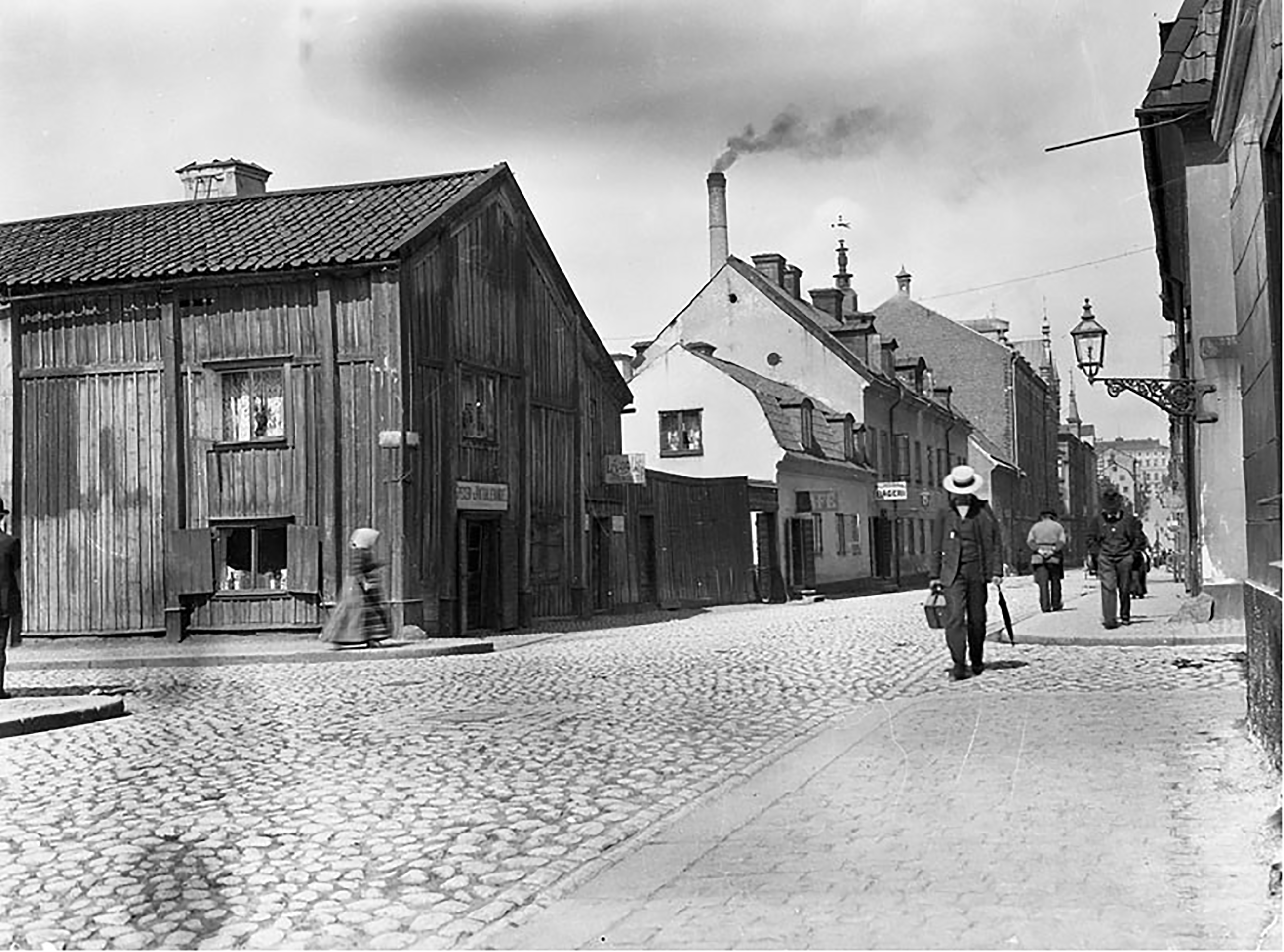
Östgötagatan, 1885–1919. Note how all the pedestrians have their heads down as if to avoid any pavement encounters. Photograph: Kasper Salin. Stockholm City Museum, F 4487.
Gendered pavements
During the period studied here, women became increasingly visible on the streets of Stockholm – as they were in many other places. While working-class women had a long-standing presence in city streets, previous scholarship points to the limited but increasing possibilities for upper- and middle-class women to enjoy urban public space in the late nineteenth century due to, for example, the development of “safe” spaces such as department stores, women's engagement in philanthropy and social work, and growing employment opportunities. However, conservative discomfort with middle-class women's appearance in public prevailed and continued to circumscribe their participation in public life. Respectable women were seen as particularly vulnerable and endangered by city vices, from beggars and drunkards to the male gaze and sexuality. Through dedicated places and practices such as urban parks, ballrooms, and the bourgeois promenade, they were accommodated, protected, and controlled. 91 According to Scobey, the promenade provided a relatively safe space for genteel women's participation in public life, including courting and flirting, which was nevertheless strictly monitored. 92 Yet, as Mona Domosh suggests, within the limits of what was deemed acceptable, women could also push back at men and use their presence in city streets to “renegotiate their identities”. 93
Memoirs point to how, in mid-nineteenth-century Stockholm, young women, in particular, should avoid walking the city streets alone if they cared about their reputation, and more so during the darker hours due to the risks of unwelcome suiters and sexual assault. 94 Yet beyond the confined nature of the promenade – which, after all, made up only a very tiny part of urban walking – middle-class women increasingly appropriated pavements. As they did, men's reactions varied from up-front complaints about women's behaviour to an uncertainty about how to behave properly in the presence of female pedestrians of equal standing. Men complained about how women's crinolines took up too much space and how women's umbrellas tore their clothes or knocked their hats off. Occasionally, men even physically abused women who used the wrong pavement. 95
Sparse evidence suggests that men of the younger generation felt more threatened by women's participation in public life than did older men. Writing in Ny Illustrerad Tidning in 1876, a supposedly older male author failed to understand the younger generation. Gazing at street events from his window, he observed first a young woman bumping into a “distinguished young gentleman”, dropping her basket of laundry in the dirt. Rather than helping or apologising to her – which the author had expected – the “gentleman” made her misery complete with a harsh reprimand about her use of the wrong pavement. On another occasion, the same author had observed a group of “young gentlemen” occupying the pavement, ignoring and blocking the passage of a woman and her two daughters. Embarrassed, the women “step[ped] down, with their fine footwear, into the filthy street”, the men “sniggering” at their humiliation. 96 As these examples suggest, men's harassment of women was not necessarily dependent on a woman's social status.
However, female pedestrians also stirred up uncertainty among men about previously learned behaviour. Historians have traced a late nineteenth-century “crisis” in middle-class masculinity, as distinguished men increasingly employed their body and posture rather than dress and character to differentiate themselves from women and less respectable men. 97 “By late in [that] century”, Brian Ladd argues, “the general relaxation of restrictions on middle-class women's public behavior created uncertainty not only about the limits of what was acceptable but also, crucially, about appropriate male conduct on the streets”. 98 This is confirmed by findings in Stockholm. Upon meeting another man, a male reporter noted in 1865, he could “show front, knowing one's right”, but with women, often coming in pairs and “sweeping everything out of the way with their crinolines” – signalling their social standing – he had to choose between the dangers of the street or violating “the courtesy one owes to these lovable sweeping angels”. The result was often, he claimed, one's “juste milieu, in the gutter”. 99 Another male reader of Dagens Nyheter argued in 1880 that “ladies” caused the most harm to Stockholm's traffic, particularly by not respecting the pavement priority policy. Worse, upon meeting a woman using the wrong pavement, it was hard to avoid a collision, since she “almost as a rule yields in the wrong direction, [why] a sort of dance arises, which usually does not end until we, Gentlemen, decide to take our position. It can hardly be denied that such street dances are both time-consuming and distasteful”. 100 Men like these set male rationality, discipline, and self-control in contrast to women's allegedly hesitant and irrational conduct on pavements.
Some men argued that women's failures in pavement conduct were socially determined. Only “the really honourable women” used the correct pavement, claimed the author cited above. This rhetorical trick – playing on women's supposed fear of being taken for a fallen woman – was repeated a few weeks later, when a visitor to Stockholm agreed that it was “predominantly ladies of questionable reputation who walk ahead on the wrong pavement”. 101 The connection between disrespect of the pavement priority policy and prostitution might seem far-fetched, but is probably explained by how walking on the “wrong” pavement meant unwelcome face-to-face encounters with “fallen women”. In fact, regulations displayed at Stockholm's inspection bureau for registered prostitutes prohibited them from loitering on the pavement at some prominent locations and from using the right-hand pavement – hence respecting the pavement priority policy. 102
The connection between “incorrect” walking and prostitution did not go unchallenged, but the idea was hard to erase; later that same year, another reader maintained how “it is only a certain class of women” that excelled in the practice of using the incorrect pavement. 103 In response, women and their male defenders pointed out how walking sticks were as dangerous as umbrellas; that men were as guilty as women of walking on the wrong pavement; and stressed that “honest women” ought to be able to walk home safely no matter the hour or choice of pavement. 104 Rather than conforming to social norms about women's behaviour in public, women asserted their right to use the pavements in the same manner as men.
Yet men continued to point to the difficulty of navigating pavements that were increasingly occupied by women. In 1883, a male reader of Nya Dagligt Allehanda argued that while men nowadays tended to use the correct pavement, most women walked as they pleased. “How often is it that, with urgent matters at hand, one chooses the left pavement in order to not be hindered, but must make the most ridiculous and difficult ‘side-jump’ in order to get past the … women, who in this case seem to have made it their cause to hinder traffic. Often, out of respect for the ladies, one yields, only to bump into another of Eve's daughters”. 105
The admittedly rather sparse evidence presented here suggests that middle-class women's struggle in this period to gain access to the public debate was paralleled by their claiming of the city's pavements. Their presence and practices, I suggest, amount to what Domosh refers to as polite politics, through which they stretched the boundaries of acceptability. Some men reacted by displacing women by force or browbeating. For others, genteel and middle-class women on pavements caused different notions of civility – courtesy to women and the distanced privacy in public – to conflict, putting them in awkward situations. Whereas social convention called on men to yield to women (as less knowledgeable or capable pavement users), acknowledging their social identity as women meant a breach of norms about minding one's own business while in public.
Pavement transformations
If we can consider streets as a microcosm of urban society, we should expect major urban and societal developments to be visible on them. Indeed, as cities grew and industrialised in the late nineteenth century, the character of streets changed, materially and culturally. Under the influence of new urban middle-class elites, who sought to achieve healthy, aesthetically pleasing, and efficient cities, streets were levelled, paved, and provided with pavements. Discomfited by urban crowds as well as middle-class women's increasing appearance in public, “city fathers” also sought to order public space through regulations as well as informal rules. Within this context, pavements were constructed and regulated to cater for safe, clean, comfortable, expedient, and undisturbed walking.
The findings of this case study of Stockholm in many ways confirm those of previous scholarship in other European as well as North American and Australian cities. As the city seized power over street construction, paving, and maintenance, streets, including pavements, came to serve public aims over those of private property owners. Regulations defined pavements as circulatory spaces, which effectively dispelled shop owners’ usage of pavements for the display of goods and forced property owners to remove steps that encroached on pavement space. While reserving pavements for the walking public, the same regulations rendered subsistence-driven and laborious activities on them illegitimate. As pointed out by Mackintosh, the contrasting pavement uses (efficient walking and sidewalk subsistence) reiterate Don Mitchell's view that rival circumstances expose “the contradiction that structures public space”. While liberal democratic ideals of public space allegedly necessitate order and rationality, argues Mitchell, democratic access is undermined by excluding supposedly disordered and irrational users. 106 Hence, pavements became more and less public at the same time: everybody could theoretically access them, but not all activities were allowed there. Pavements in Stockholm developed into hierarchical sites, where social standing facilitated the right of access. Although these efforts were only partially successful, the marginalisation of subsistence-driven activities on pavements, which would continue into the next century, had begun.
Pavement regulations and their interpretations among bourgeois pedestrians also targeted loitering and the use of the wrong pavement, forms of misconduct committed by people of all ranks. These concerns were at times questioned and ridiculed as unrealistic and unnatural in the liberal press, yet they reveal how norms about “efficient walking” secured not only circulation but also undisturbed walking. It helped urban dwellers to cope with sensory overload and maintain privacy and anonymity while in public. This feature, it seems, also continued into the new century, as suggested by notions of an “automated”, abstracted, and technologically mediated style of walking in increasingly car-oriented cities. 107
Middle-class women's increasing presence on city streets made them a target of gendered understandings of “incorrect” walking. The example of pavement encounters between middle-class men and women underscores how different norms of pavement interaction sometimes coalesced into contradictory situations, as men navigated expectations of courtesy without violating the norm of detachment, to stay private while in public. Yet women fought back and asserted their equal right to the streets. Women's everyday, “polite” transgression of gendered norms has not been exhaustively analysed here and deserves more attention in future studies.
To conclude, in the late nineteenth century, as the (male) urban middle-class balanced democratic ideals with the urge to establish themselves as the new urban elite, they called for respect for universal rules of interaction such as the official pavement priority policy, while expecting the less fortunate to step aside on city pavements. Yet pavements featured as a prominent public space not only or perhaps even primarily because it was controlled and ordered as such, but because urbanites of all sorts fought for access. City pavements were home to allegedly “modern” uses (rational, efficient walking), age-old street practices that did not fit well with liberal leader's understandings of the modern city, and middle-class women who had only just begun to claim their equal right of use. As such, pavements and the activities on them reflect a nineteenth-century urban culture in transformation.
Footnotes
Acknowledgements
The author would like to thank all participants of the (Un)Equal Footing workshop held at KTH Royal Institute of Technology in Stockholm in May 2021, as well as Rosa Danenberg, Andy Karvonen, and two anonymous reviewers for their very useful comments on previous versions of this article.
Declaration of conflicting interests
The author declared no potential conflicts of interest with respect to the research, authorship, and/or publication of this article.
Funding
This work was supported by the Swedish research council Formas within the national research programme for Sustainable living environments (Dnr. 2019-01941).
