




Abstract
This article probes the duality of marginalisation yet omnipresence of walking in cities. Using innovation in traffic light technology in Stockholm as a case study, it seeks to understand the attempts to regulate and safeguard pedestrians in the first decade after the Second World War. The article argues that traffic lights and other technologies were part of experts’ efforts to make urban mobility “systemic”, linking streets with vehicles and road users with the aim to optimize traffic. In doing so, their approach to pedestrian control was ambiguous. On the one hand, experts wanted to fit pedestrians into the emerging city traffic system: make them predictable, while also seeing to their safety. On the other hand, their designs and corresponding legislation often accepted pedestrian sovereignty, and walking was not systemised in Stockholm during the period studied here.
Introduction
Mass motorisation transformed cities around the globe during the twentieth century. Before, during, and especially after the Second World War, traffic experts and urban planners in Europe and elsewhere, anticipating rapid increases in car ownership and traffic, made up plans that would refurbish their cities to better accommodate cars with ring roads, thoroughfares, and ample of space for parking. 1 Alongside these long-term plans and visions, municipal engineers and the traffic police applied traffic control measures to make better use of existing road space and facilitate traffic flow while trying to maintain traffic safety. Focusing their efforts on the critical problem of finding a way to fit cars into cities and ensuring the flow of motorised traffic, experts marginalised other modes of mobility, including walking. However, as recent scholarship shows, despite the seemingly unstoppable rise of automobility in the last century, people continued to walk, and pedestrians remained an important—if neglected—part of urban mobility. 2
This article aspires to probe this duality of marginalisation yet omnipresence of walking in cities. Using innovation in traffic control technology in Stockholm as a case study, it seeks to understand attempts to regulate and safeguard pedestrians in the decade following the war and the impact of these on the practice of walking.
In 1950, Stockholm municipality had a population of about three quarters of a million, divided evenly across the inner city and the suburbs just outside of it. That same year, the city opened its first metro line through the city centre. During the following two decades, the metro system expanded rapidly to serve the new suburbs in Stockholm as well as neighbouring municipalities. At the same time, Sweden, including Stockholm, experienced a rapid adoption of cars among the populace. A ratio of car ownership of 55 per 1,000 inhabitants in 1952 placed Stockholm somewhere in the middle among European cities of a comparable size. 3 At that point, Stockholm’s planners envisioned an ownership ratio of 1:10 by 1970, a number that was reached as early as 1955. While the metro system remained the backbone of Stockholm’s post-war development, from the mid-1950s, the city increasingly adapted its plans to accommodate private automobility. 4
However, if Stockholm were about to embark on a pathway towards a modernist city based on cars and a metro, the first post-war decade stands out as a transitionary period when priorities about urban mobility were still undetermined. Towards the end of the Second World War, concerned urbanites and multiple stakeholders in Stockholm called for immediate action to counter a forthcoming “traffic chaos”, as cyclists and pedestrians would have to share the streets with motorists again. 5 By 1950, the level of car traffic had overtaken cycling in the streets of Stockholm; a rare pedestrian flow measurement reveals that pedestrians outnumbered motorists as well as cyclists. 6 With more traffic came more accidents: whereas the number of accidents reported by police in Stockholm remained relatively stable at around 4,000 per year throughout the 1940s, it increased to as much as 9,000 in 1958. In the five-year period following the war, a large share of road users who were killed or severely injured in traffic consisted of pedestrians (half and one third, respectively)—among these, children and the elderly were highly overrepresented. 7
In response, next to traffic education and police monitoring, traffic lights—a few of which had been installed in the interwar period—resurfaced as a popular measure for facilitating traffic and promoting safety in the short term. Moreover, innovation in traffic control technology allowed vehicles and pedestrians to activate traffic lights. New “thinking” lights, as they were referred to by the manufacturers and the press, detected approaching vehicles or allowed pedestrians to announce their presence by pushing a button, which could potentially influence the signal cycle. Aimed at different road user groups, the parallel introduction of vehicle and pedestrian actuation offers an opportunity to study the motivations and trade-offs taken by different stakeholders engaged in traffic control, as well as the impact the innovations had—intended or real, feared or hoped for—on mobility practices.
Historical studies of urban walking tend to focus on pedestrians crossing the street, as does the present article. Once pedestrians had been relegated to pavements, a key concern of experts and policymakers was how to direct pedestrians across streets in a safe manner without overly disrupting matters for drivers. Although scholars have focused on different stakeholders and ways to govern pedestrians (and motorists)—by means of traffic regulations, street markings, material interventions, or educational campaigns—they come to a similar overall conclusion: while policy makers and experts tried to balance and consolidate pedestrian safety and accessibility with car traffic flow, the latter ultimately had a higher priority. 8
Previous scholarship also acknowledges that the various attempts to govern pedestrians ultimately failed, or succeeded only partially. Thus, Joe Moran, in his study of “progressively more sophisticated” pedestrian crossings and traffic safety education, shows how pedestrians were resistant to adapt their practices when crossing the street. Muhammad Ishaque’s and Robert Noland’s evolutionary outline of innovation and re-innovation of pedestrian crossings, refuges and guardrails to guide pedestrians across the street suggests the same. Prohibitive costs and objections from drivers who feared delays often countervailed innovations. Meanwhile, pedestrians continued to protest any measure that hindered their movements, and when their protests were unsuccessful, they defied the intentions of the designers. 9
At the same time, argues Barbara Schmucki in her study of pedestrianism in post-war Britain, pedestrians “increasingly became part of the technical infrastructure of traffic flows”. 10 The introduction of traffic lights can be interpreted as an effort to make urban mobility “systemic” through technological means: to create a higher degree of central control, manage various subsystems, align system components, and improve traffic safety. 11 Following sociologist of technology Daniel Normark’s nested hierarchy of conceptualisations of the road (infrastructure—system—media), they represent a step in the transitionary process of urban traffic from an infrastructure-based domain to a system-based one. 12 On top of the basic infrastructure function of streets (to allow movement), engineers and others increasingly implemented artefacts and technologies that linked streets with the vehicles and drivers using them, making a system aiming to optimise mobility. Traffic lights were examples of a wider tendency, which Miriam Levin has identified as a post-war expansion of “decision-making machines” aimed at “regulating circulation in all mechanistic systems”. 13
How did this systemisation impact mobility practices? In the words of urban historian Clay McShane, traffic lights are part of a system that “attempts to impose a strong social control over the most fundamental of human behaviour, whether to move or to be still”. 14 Whereas this is certainly true, the implementation of mobility systems does not happen overnight: their creation was an incremental process, and the stabilisation of walking practices was gradual and incomplete. “[W]alking practices changed only very slowly”, Schmucki argues, “Time and again pedestrians appear to have preferred convenience over safety, and this remained a cultural practice up to the late 1950s.” 15 Based on photographic evidence from British city-centre streets, Lucy Faire and Denis McHugh point to a “gap between intention and result” regarding “micro-direction” by means of “small material interventions” in city streets. They invite a closer examination of user interaction with such interventions in order to understand “their ‘actual’ impact”. 16
An essay by cultural historian Richard Hornsey offers valuable interpretative support. Ambitions to adjust pedestrians’ corporeal habits to the emerging urban traffic system of interwar London, he argues, were constantly frustrated. Rather than turning into “unthinking automatons”, pedestrians retained a degree of sovereignty because they had to. According to Hornsey, “the contingencies of the metropolitan street demanded a more sophisticated form of predictable behaviour… an intelligent responsiveness that could readily adapt to all unforeseen circumstances”. The result was, at the close of the 1930s, “a newly cybernetic form of urban engagement, an ordered but ultimately less determined type of responsively programmed ‘road sense’”. 17 Hornsey writes of London at a time when Stockholm had only twelve traffic light installations, but his cybernetic thesis appears to rhyme well with Stockholm’s early post-war adoption of vehicle and pedestrian actuation with its detectors, signal processing, and human-machine interaction.
To capture impacts on historical walking practices is a challenge, and entails, I argue, a detailed, localised study of a specific city or even particular street crossings rather than the national approach of many previous studies. Elsewhere, I have suggested that we can understand what traffic lights do by returning to the local innovation process that first created them. In spite of early notions of traffic lights as “optical traffic police” and a “mechanisation of police supervision”, their introduction in the interwar period was no mere replacement of traffic police officers and their hand signals. As the authority to say who should drive and when was “delegated” —to use sociologist Bruno Latour’s term—from officer to technology, there were consequences; some intended, and others unintended. For example, the clear and non-negotiable red-green signals of the traffic lights introduced in Stockholm in the 1920s made motorists less hesitant in their driving practices than they had been under police officer guidance and control. It spawned an “on-off behaviour” among drivers and higher speeds through intersections, which had consequences for pedestrians: it became crucial for their own safety, many commentators argued, that they too adjusted their practice to the novelty. 18
According to anthropologist Madeleine Akrich, designers make assumptions about the preferences, competencies, motives and aspirations of potential users of a technology, and then “inscribe” these in the object. The “scripts” are the end product of an operationalisation of the designer’s perception of the appropriate relationship between technology and user, and is built into artefacts. Through scripts, experts “prescribe” appropriate forms of mobility. 19 To “de-scribe” something is the reverse process; it is to read the script from an artefact and its environment. However, users—in our case road users—do not always accept, or “subscribe” to, the experts’ imagined usages. 20 Sometimes, they adopt “antiprograms”, which may lead to subsequent “re-inscriptions” on the designers’ side. This conceptual toolbox is here employed to analyse the tensions between traffic control and walking practices, or in short, how governable pedestrians are.
Through a close reading of city archive sources, city council minutes, articles in professional journals and press coverage, below I probe stakeholder intentions and road user receptions of traffic control innovations in Stockholm in the early post-war period. 21 The choice of source materials warrants a word on delimitations. While it is necessary to focus the street-level innovation process in order to understand the co-production of traffic control technologies and mobility practices, which is at the centre of attention here, it comes at the cost of downplaying larger cultural and political struggles over the streets.
Vehicle actuation comes to town: Technology transfer and transition of expertise
Following the first appearance of traffic lights in the mid-1920s, Stockholm experienced a partial transformation of traffic control as the hand signals of traffic police officers were complemented by a dozen optical traffic lights before the Second World War. Most of them could be set to either work automatically according to a pre-set signal cycle or be manually operated by officers on location, and traffic experts debated the strengths and weaknesses of the two methods of operation. 22 The discussions persisted throughout the war and afterward. Manual control of the lights by police officers was more expensive, and traffic experts criticised their inability to properly judge the phases for optimal road user comfort and traffic flow. Automatic traffic lights, on the other hand, while efficient during peak hours, fell short during other parts of the day, as they made traffic stop even when an intersection was empty of traffic. 23
These shortcomings spurred further innovation in traffic signal technology. Vehicle (and pedestrian) actuated traffic lights was one avenue pursued; in fact, they were discussed seriously even before the war. Early proposals to trial vehicle actuation in Stockholm in the mid-1930s were, for various reasons, discarded or withdrawn. 24 Its introduction in Sweden instead took place in Gothenburg in 1937, spurring newspaper reports with cybernetic connotations such as the “robot that regulates traffic” and the “thinking signal”. 25 As Stockholm’s traffic department tabled a trial the following year, the police chamber supported it as a potentially more efficient way to regulate intersections where one road had heavy traffic but the other one much less. The traffic board agreed to have LM Ericsson conduct the trial. 26 Cited in the press, the head of traffic police in Stockholm, Erik Forsselius, was eager to try it. “In London, they are thrilled about the system”, he explained enthusiastically, praising their efficiency and ability to free up police officers for other duties. “In this way, every moment is utilised, and, moreover, the machine is, of course, in the long run, cheaper than human workforce. The police will have more time to guide the road users.” 27 The trials failed, however, and Stockholm did not have vehicle-actuated lights until after the Second World War. 28
Assigned to develop measures that would ease the transition to peace-time traffic, in February 1945, traffic expert Otto Wallenberg forwarded as his key proposition a coordinated, so-called progressive traffic light system that would allow drivers in the city centre to pass smoothly through several consecutive intersections without stopping at a red light—later called a “green wave”. 29 The investigation was received poorly by Stockholm’s traffic authorities. The newly formed Governor’s Traffic Committee preferred to have a thorough investigation carried out involving foreign experts regarding different traffic light systems and their suitability for Stockholm’s local conditions. The traffic department considered “the smoother system with vehicle-actuated lights more suitable for Stockholm’s heterogeneous street network”. Together with Forsselius, the department made plans to adopt vehicle actuation in 30 locations (Figure 1). Lacking in-house expertise, however, it invited two English firms—Siemens and General Electric Railway Signal Co, represented in Sweden by AGA, and Automatic Telephone and Electric Co, soon represented by the Swedish company Transfer—to assign one engineer each to assist further investigations (Figure 2). Both firms, the department stressed, had experience with the problems involved in traffic lights in combination with intense traffic and an irregular street network—as was the case in Stockholm. 30 Prior to their visit to Stockholm, the traffic department’s engineer Bo Hertzman-Ericson travelled to London on invitation from the English firms to study already implemented installations on location. Reporting on his experiences, Hertzman-Ericson concluded that vehicle-actuated traffic lights and the progressive system should not be juxtaposed but could rather be usefully combined. 31
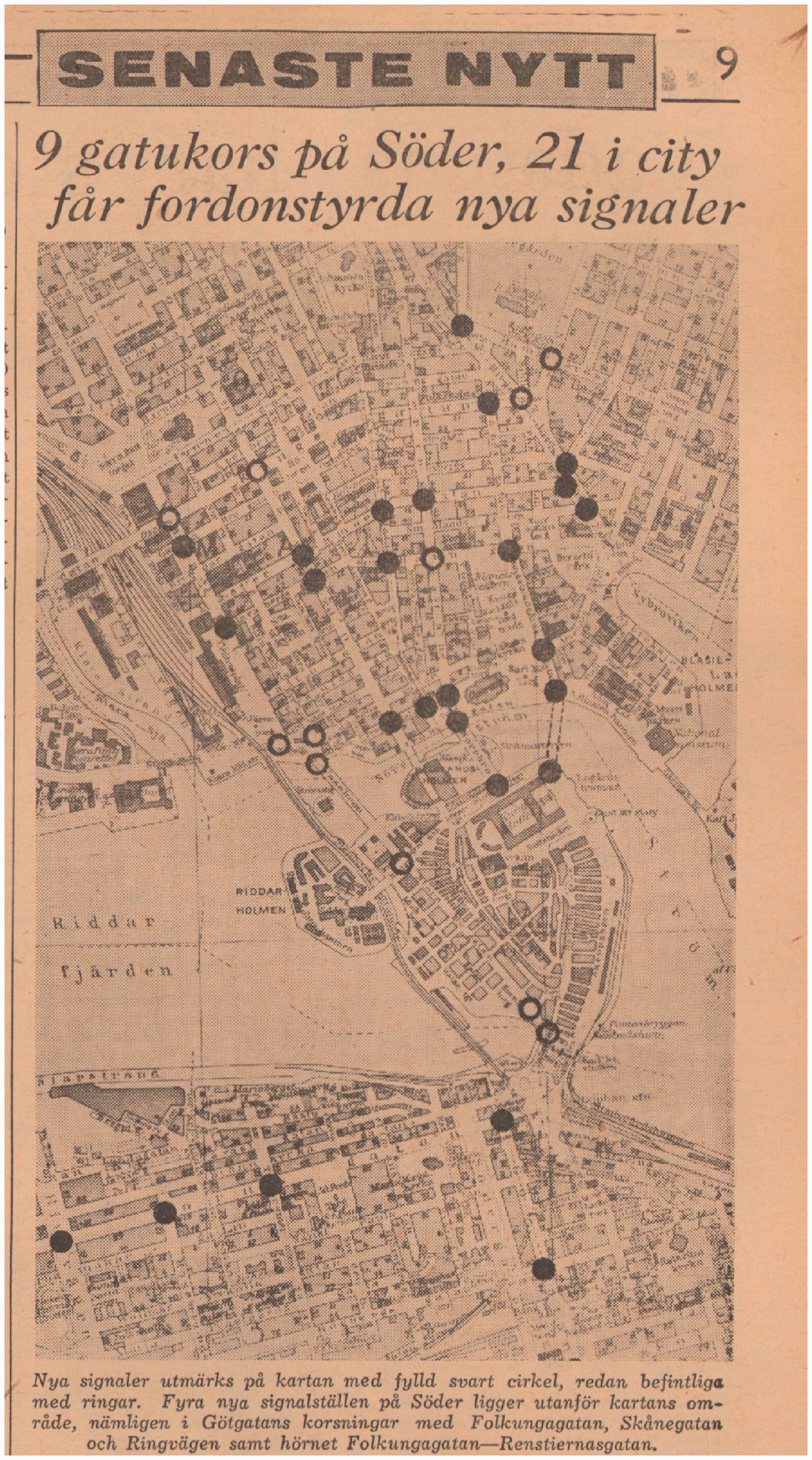
The map indicates the locations of existing traffic lights (empty circles) and those planned by the traffic department and the police authority (solid circles) in 1946. The plan included 21 new vehicle-actuated traffic lights in the city centre (north of the Old Town, the small island at the centre of the map). Nine installations were planned for Södermalm (the island, of which we see only a smaller part, located south of the Old Town) but only four are visible on the map. Source: “9 gatukors på Söder, 21 i city får fordonsstyrda nya signaler”, Expressen 27 April 1946.
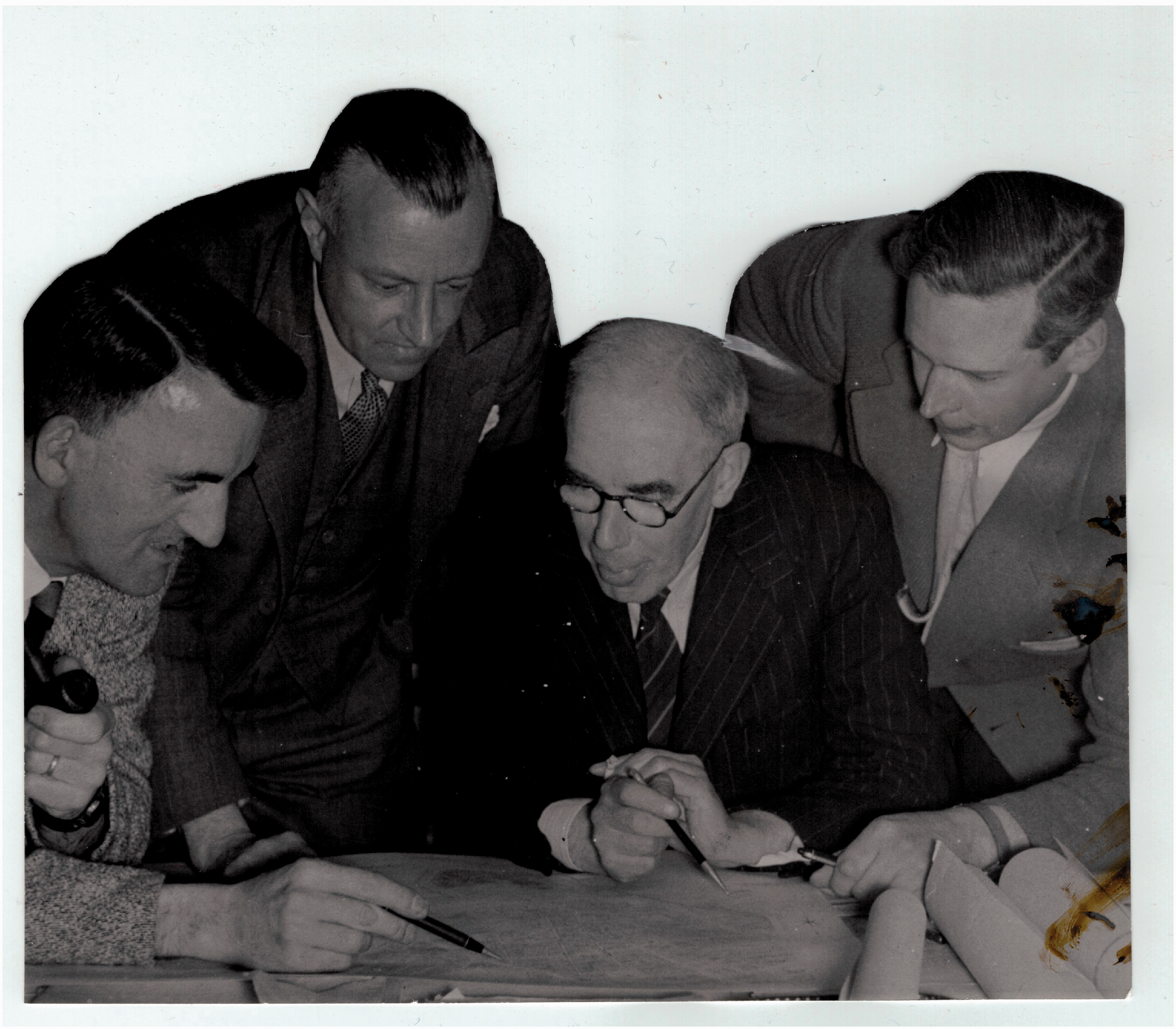
Stockholm Traffic Department’s engineer Bo Hertzman-Ericson (sitting in the centre) is here flanked by three English experts—T.P. Preist, Hjn. Riddle, and S.R. Smith—representing two different firms; Automatic Telephone & Electric Co. and The Siemens & General Electric Railway Signal Co. Ltd. In assiting with Stockholm’s traffic light trial, the firms presumably hoped to sell their equipment and expertise to Sweden. Photo: unknown photographer, author’s collection, originally published in Svenska Dagbladet 19 June 1946.
Stockholm thus chose the strategy of erecting vehicle-actuated installations while preparing for their future coordination into progressive systems to allow for green waves. Following Hertzman-Ericson’s study trip, the English experts arrived in Stockholm to contribute to the investigation and the trials in a centrally located intersection. 32 Based on their experiences, in June 1947, the department presented a revised plan for introducing vehicle-actuated traffic lights in Stockholm. Advised by the chair of the traffic board, the social democrat Helge Berglund, the department reduced its initial proposal of 18 intersections to 13, retaining mostly those that were already police-regulated; that is, where vehicle actuation could, in Berglund’s words, “fully or partially … free up a traffic policeman”. 33 The department of finance agreed to the investments, noting how the traffic lights seemed to reduce the need of fixed traffic posts and thus allowing for a more flexible and efficient use of traffic police officers. 34 Vehicle actuation was not only intended to improve traffic conditions; it was also a cost-saving strategy.
The traffic department now had a plan approved by the City Council at its disposal, but their work initially suffered from import restrictions on components for vehicle-actuated installations. 35 Frustrated, Forsselius urged the traffic department to push for a more rapid realisation of the programme in order to improve capacity and traffic safety, and because the police were not able to set aside any more personnel for directing traffic. 36 As the difficulties of gaining import permits eased, in February 1950, the chamber of police again inquired about swift implementation to improve “security and safety, not least for the pedestrians, but also a recognisable increase of traffic capacity”. No more tests were needed: it was time for a large-scale “uninterrupted” expansion of “vehicle-actuated (pedestrian-actuated)” installations, completing existing plans and drawing up new ones. 37 The traffic department agreed and produced a renewed plan for realising vehicle-actuated traffic lights at 31 intersections during 1951–52. 38
As the new decade approached, Stockholm had four intersections with vehicle-actuated traffic lights, but was on the verge of a more large-scale introduction. Compared to the time-set, automatic traffic lights, vehicle actuation relied on a more complicated set of technology: the sensors for detecting approaching vehicles (or, in the case of pedestrian actuation, push buttons), a switch receiving impulses from the detectors and regulating signal change, cables, and the traffic lights themselves. During high volumes of traffic in both directions, when detections were frequent, these installations worked exactly the same as automatic, time-set installations, but during low or irregular traffic, the so-called integrator allowed more green time for more intense traffic streams. 39 New installations followed a given procedure. While the traffic department was responsible for overall planning, they sent their proposals for approval by the so-called “Saturday Committee”, with representatives of the police chamber and the municipal tramway company. Following this, the contracted signal firm and the committee jointly designed the signal scheme; that is, allocated time to different traffic streams. 40
Three different firms competed for the contracts. Two of them were the English firms engaged in the early investigations and trials of vehicle actuation in Stockholm. These, together with their Swedish partners AGA and Transfer, had a significant advantage in having prior experience of working with vehicle actuation, as well as possessing greater knowledge in general about traffic control and signalling technology. 41 AGA stressed its “world-renown, long proven and tested system”. Transfer similarly pointed out that their English supplier ATE was “one of the oldest and largest producers of traffic signal equipment”. 42 A Swedish firm, LM Ericsson’s Signalbolaget (SIB), with prior experience of signalling in track-bound traffic systems, also vied in the competition. 43 Like their foreign competitors, SIB promoted their “‘thinking’ traffic lights” as a way to save time and manpower and to help move traffic more smoothly at the same time. 44 However, while the foreign firms highlighted their long experience with traffic control technology, SIB stressed the “practically unlimited” lifespan of their products. According to the company, their magnetic coils placed below the surface, responding to the metal of passing vehicles allegedly endured Sweden’s cold climate, winter conditions and related wear and tear better than their competitors’ contact pads. After some years’ experience with them, the city’s traffic department was inclined to agree. 45 Initially, however, the department was keen to rely on the English firms due to their greater experience with traffic signalling. Even when SIB’s bids were cheaper, the department wanted to keep the foreign companies in the game to secure deliveries and ensure competitive pricing, but also because of their “greater experience of traffic technology”. 46
The introduction of vehicle actuation helped change perceptions about what professional groups were most relevant in controlling traffic. During the initial years following the Second World War, Stockholm’s police chamber had successfully requested funding from the city to expand its workforce for traffic control, especially to come to terms with the problems created by the many cyclists and a widely spread perception that traffic manners had deteriorated during the war. From 1949 onwards, however, the city refused these petitions. One of several reasons for this was an anticipation that vehicle actuation would reduce the need of more traffic police officers. 47 Meanwhile, a shortage of staff made the police chamber dismantle its centralised traffic police department in 1951, which left the task of directing traffic to the less experienced and less well-trained police officers of the various districts. 48
Other traffic experts criticised traffic police officers for their inability to engage with the ever more complicated technologies of traffic control. In 1952, SIB highlighted how officers frequently disconnected vehicle actuation to control traffic lights manually. While they were able to monitor the intersections, SIB representatives argued, police officers often failed to estimate queue lengths, and as they tended to allocate too much signal time for each traffic stream, extensive queues built up in the opposite direction. SIB thus wanted to limit manual control “to a minimum”, relying instead on the ability of vehicle-actuated traffic lights to “‘feel’ the traffic situation” and guide traffic in “the most flexible and fair way”. 49 The city’s traffic department agreed, and, later the same year, the chamber of police issued a new order that instructed officers to operate vehicle-actuated traffic lights only when special circumstances arose. 50
As traffic lights continued to multiply, engineers increasingly took over the responsibility of regulating traffic from the traffic police. In fact, the chamber of police appears to have supported the transition. Due to the shortage of police officers, which allowed for nothing more than “scanty” traffic regulation, it pushed for an increased use of traffic lights. For the same reason, the police wanted to avoid the time-consuming task of carrying out the thorough field studies needed for achieving a good result with traffic light control. 51 Meanwhile, in the latter half of the 1950s, the traffic department as well as the electro-technical division of the city’s fire department—which took over the responsibility of maintaining traffic light installations from the delivering firms—expanded their workforce to plan, set up and maintain all the new signal technology. 52 Thus, while saving costs for the police, the increased use of traffic lights came at an added expense for the city’s technical departments.
To sum up, the early post-war period saw two shifts with respect to traffic control. As traffic lights had come to Sweden and Stockholm in the interwar period, the Swedish signalling firm AGA had played a crucial role in technology transfer from the United States. 53 As we have seen, AGA and other signal firms remained important agents of transfer in the post-war period, but now, Swedish experts looked to England rather than the United States for inspiration, technology and expertise—apparently because street networks and traffic in English cities seemed comparable to Stockholm. The first post-war decade also saw a shift in traffic control expertise, similar to what Clay McShane has found for the United States in the interwar period. There, the introduction of automatic traffic lights, and their later coordination into progressive systems, put engineers in command of traffic control during the first half of the twentieth century. Considering their car-oriented traffic light schemes, Clay McShane argues, U.S. traffic engineers rendered pedestrians as “second-class citizens”. 54 The transition from police-operated to engineer-driven traffic control—part of the piecemeal systemisation of urban traffic—came later to Stockholm, and, as was the case in U.S. cities, the police chamber and its head of traffic police pushed for traffic lights and vehicle actuation as a way to cut costs and free up officers for the overall monitoring of traffic. In the process, traffic police—the traditional guardians of pedestrian safety–lost out in relative influence over traffic control strategies. Whether this made pedestrians second-class citizens, however, is a matter that needs further investigation.
De-scribing traffic lights: Impact on road user practices
In a memo from 1947, the traffic department’s engineer Hertzman-Ericson summarised the benefits of vehicle-actuated traffic lights in a five-bullet point list. Such traffic lights, he argued, (1) yielded greater traffic capacity than normal ones, (2) were “popular” among road users who did not have to stop for red lights without reason, and (3) improved traffic safety. Vehicle-actuated traffic lights could also (4) “be active 24 hours a day”, and (5) they were more economical than the automatic traffic lights they usually replaced, since these lights needed manual control during parts of the day (at low traffic). 55
The labour-saving implications of vehicle actuation—freeing up police officers for other tasks—were, as we have seen, welcomed by the police chamber as well as the city’s politicians. In 1952, the traffic department argued that, since vehicle-actuated traffic lights could be active all-day round at dangerous intersections, they allowed police officers to focus on “measures to increase traffic capacity” close to the intersection during peak hours. 56 The contribution of vehicle actuation to traffic safety stemmed partly from them being active all day round, while automatic traffic lights had to be turned off during the night (or else they would severely hinder road users).
Additionally, vehicle actuation came to represent a “fair” distribution of signal time, supposedly improving motorists’ respect for traffic lights. Already when their introduction was discussed in the late 1930s, a reporter framed the new system of “optical police” as fair: it would “bring justice” by distributing signal time in relation to traffic flow in intersecting streets. The new system would thus result in less waiting time for drivers on main streets “when in practice there is nothing to wait for”. 57 It is important to note that “fairness” only applied to drivers—vehicle actuation did not ensure that pedestrians had their “fair” share. Related to fairness and avoiding unnecessary stops, Hertzman-Ericson repeatedly returned to the “psychological significance” of vehicle actuation. In locations controlled according to a pre-set schedule, he explained, a driver often had to stop for a red light even when there was no traffic on the intersecting street. “He will then make the reflection that the system is erroneous”, Hertzman-Ericson continued, “and if it happens to him time and again, it might lead to him no longer respecting the signal”. Vehicle actuation, on the other hand, “never stops nobody without a reason”, so the driver would eventually come to “value the signals”. 58
Through vehicle actuation, engineers re-inscribed motorists’ preferences and expectations into traffic light technology. This is why vehicle actuation was, as Hertzman-Ericson put it, “popular” among road users—that is, drivers. A sense of fairness and justice, coupled with the ability to prevent unnecessary stops, would make motorists respect the traffic lights. Writing in 1949, Nils von Matern of the Swedish National Road Administration argued that vehicle actuation had “earned the trust of road users, since it worked safely and not arbitrarily”. 59 The benefits for motorists were clear enough, but what about the effects of traffic light innovation on pedestrian practices? In order to facilitate the assessment, let us first revisit the heated debates about the tendency of pedestrians to walk through the red light.
Pedestrian lights: Scripting for safety and against jaywalking
In the hands of engineers, innovation in traffic signalling in the interwar period tended to favour vehicular traffic. Even the introduction of the third, amber colour (between red and green) in the 1930s, sometimes highlighted as a safety measure to the benefit of pedestrians, was primarily a motorist promoter; while pedestrians could use the opportunity to cross during the yellow light, it prepared motorists for a forthcoming start or stop and thus smoothed their progress. The short duration of the amber light—three seconds—and the risks of contending with turning cars when using the green light made many pedestrians still opt for walking through the red light. 60 Vehicle actuation showed little prospect for solving their problems. After all, registration depended on either heavy weights (pneumatic detectors) or a sufficient presence of metal (magnetic induction), and a smoother flow of cars was most probably hazardous to pedestrians. When AGA presented vehicle actuation back in 1939, the firm stressed how pedestrians, “even when they walk on green, must take care of and give notice to traffic. It is not possible to design the traffic signalling so that pedestrians are completely free from the risk of being run into by turning vehicles.” 61
Experts discussed various solutions to these problems—including an all-red period for vehicular traffic possibly combined with dedicated pedestrian lights—but little happened. 62 The criticism against the tendency of pedestrians to walk through the red light also persisted throughout the war and afterward, and the calls for stricter regulations were frequent. The national road charter asked that pedestrians “should observe” the signals, which, without being supplemented with any fines, was more of a recommendation (Figure 3). Why should it not be mandatory for pedestrians to respect traffic lights just like all other road users? The question was raised by Otto Wallenberg at a meeting held by the National Association for Traffic Safety in October 1941, and it had many follow-ups in the press over the subsequent years. Many journalists advocated the criminalisation of crossing when the light was red, one arguing in 1945 that it would curb pedestrians’ “sabotage” of traffic. 63 These widely spread calls were accommodated by C.H. von Hartmansdorff, cabinet secretary in the Ministry of Communication, in his 1944 proposal of a new road traffic charter. 64
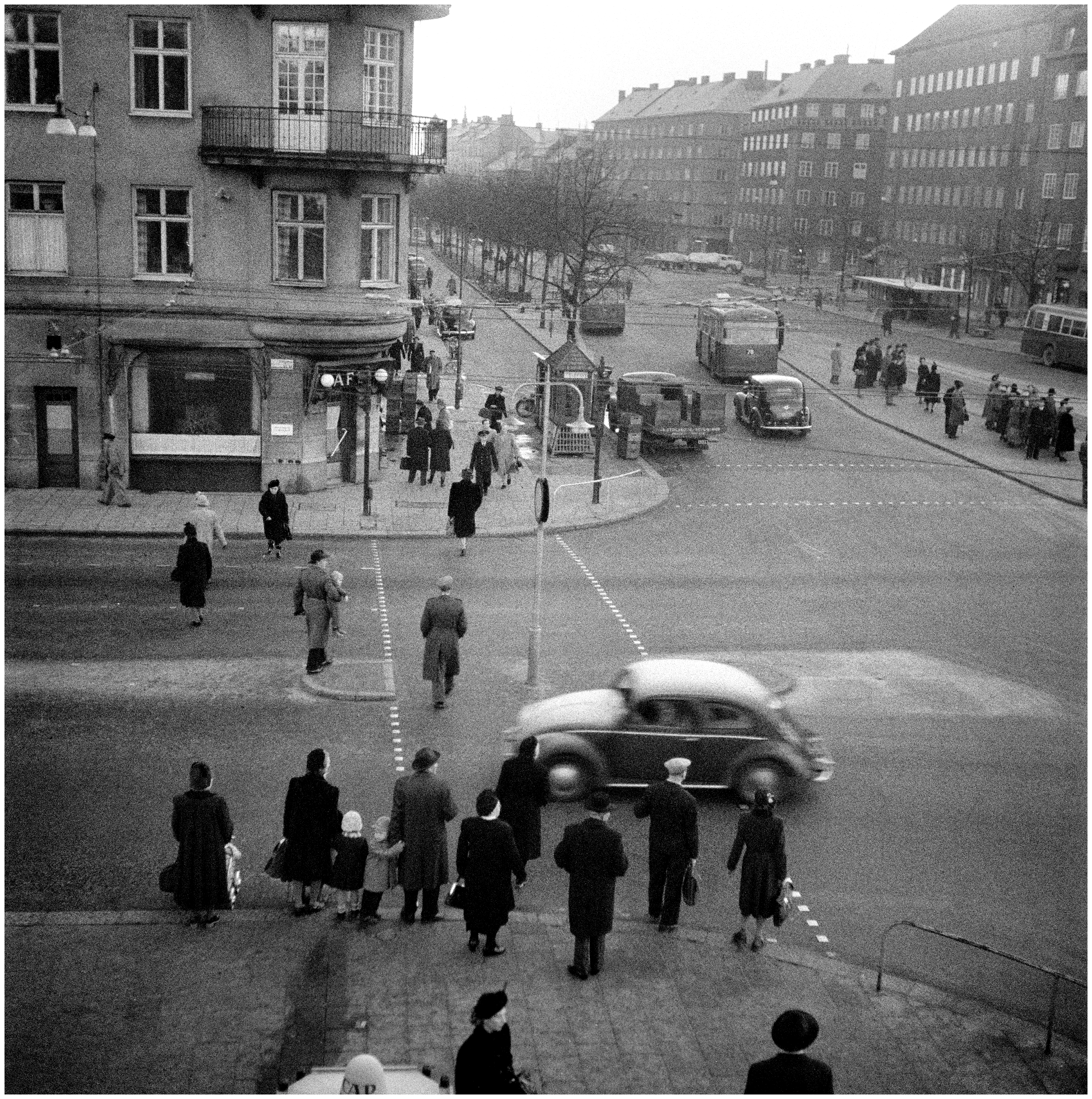
A pedestrian crossing at the Götgatan-Ringvägen intersection in Stockholm. At intersections like this, with no dedicated pedestrian lights, pedestrians “should” respect the red-amber-green traffic lights aimed primarily at vehicular traffic. Since they did not risk any fines, however, pedestrians used their own judgement to find gaps in the traffic stream and crossed at their own risk—to the detriment of representatives of the motoring interests. Photo: Lennart af Petersens, Stockholm City Museum (F 42,580).
Others disagreed. For one, the editor of Svenska Dagbladet found the reform unnecessary. In Stockholm’s intersections with intense traffic, pedestrians already respected the red light due to regard for their own life, and in places with less traffic it was, he argued, “rather natural if the pedestrians make use of the pauses in vehicular traffic to get across”. 65 As von Hartmansdorff’s proposal became public in May 1945, a representative of Stockholm’s traffic department argued that pedestrians should not be overly drilled: “is it not an unreasonable request”, he asked rhetorically, “that pedestrians should learn all the many regulations, which hamper their promenading?” 66 Interviewed in 1947, a traffic police officer pointed to the difficult balancing act his work entailed. Whereas he found fines to be the only feasible way to influence “walking jerks”, he admitted that it was “neither easy nor pleasant to ‘frame’ people for misdemeanours that they themselves see as trivial”. 67
Von Hartmansdorff’s proposal never materialised in a new road traffic charter, and the complaints about pedestrians walking through red lights prevailed. But in 1946, when Wallenberg returned with a call to change the road traffic charter’s wording into an explicit prohibition against walking through a red light, the traffic department argued that the benefits of a prohibition had to be balanced against the need of “a dedicated time period … for pedestrian traffic, during which all vehicular traffic has to stop”. Meanwhile, the Governor’s traffic committee considered it a national rather than a local concern, and in any case stressed that traffic lights, in most places, were “not yet implemented to also serve the pedestrians”. 68
As these examples show, despite frequent calls to punish pedestrians for walking through red lights, the majority of experts expressed their understanding. In a situation when traffic lights only frustrated the customary conduct of pedestrian, why should they have to respect them?
In fact, there is some evidence that suggests that vehicle actuation actually contributed to making it more legitimate to walk through a red light. Upon the successful trials using vehicle-actuated traffic lights in Stockholm in 1946, the traffic department wanted to have it operate 24/7. The traffic police supported the idea but thought it required a change of the local regulations in order to accommodate pedestrians. With the approval of the Governor’s Office, Forsselius made the necessary changes and issued a press release regarding the forthcoming night-time functioning of the traffic lights. Since signal change was activated by vehicles only, he wrote, during times of little traffic, the periods of red might be “unjustifiably long” in the eyes of pedestrians. “Pedestrians who in such a situation wishes to cross the intersection might, while carefully observing the traffic lights and with care and consideration, judge for themselves whether a passage can be made without hindering crossing traffic or risking an accident.” 69
Meanwhile, pedestrians continued to complain about how traffic lights failed to accommodate them properly. In 1949, one pedestrian described the amber light as “just flashing by”, which made it “completely meaningless”. Even when the lights were green, turning vehicles continued to pose a threat to pedestrians, so it was sometimes simply better to walk across when the light was red. 70 Alternative signalling methods to shield pedestrians from turning traffic were, however, implemented only to a limited degree, since engineers deemed them “more complicated” and since they meant more waiting time for motorists. 71
Another novelty was dedicated pedestrian lights, which instructed pedestrians to cross the street (“Walk now”, Swedish: “Gå nu”) in places where they had their own phase (Figure 4). As these were aimed directly at pedestrians, and since they risked delaying other traffic, the Governor’s traffic committee found it reasonable that pedestrians were obliged to comply with them.
72
However, the issue remained unresolved. Still in 1952, when Sweden had its new road traffic charter that was supposed to correspond to the rapid increase in traffic since 1936 (the year of the previous charter), actors made different interpretations with respect to the obligation of pedestrians to respect traffic lights. The charter and the preparatory work leading up to it clearly stated that all road users had to obey the signs and signals that concerned them; failure to do so could be punishable by fines.
73
The defining issue was thus: which signals concerned pedestrians, or all road users including pedestrians? Sten Agvald, secretary of The Royal Automobile Club, promoted a general obligation for all road user groups to follow the instructions of traffic lights as well as the hand signals of police officers.
74
Representatives of Stockholm’s police force understood things differently. One sergeant argued that it would be “foolish” of pedestrians not to walk through the red light of vehicle-actuated traffic lights during low traffic—it they didn’t, they could have to wait forever.
75
Stockholm’s head of traffic police, Erik Forsselius—who had himself been part of the state investigation preceding the new road traffic charter—argued that, as pedestrians did not risk causing any harm to anybody but themselves, the red light did not generally apply to them:
Stockholm’s Traffic Department installed dedicated pedestrian lights to inform pedestrians when and where they could safely cross the street. In the words of the reporter at Dagens Nyheter, the lights “command to ‘Walk now’ (Swedish: Gå nu) when it is clear to cross, so that pedestrians shall not lose any valuable seconds before they get started”. Photo: unknown photographer, TT News Agency, originally published in “Tegelbacksnytt”, Dagens Nyheter 7 January 1949. A driver who travels through a red light is guilty of a violation and is punished with fines—even if he happens to be the only driver in the whole district! A pedestrian who crosses through a red light, on the other hand, is found guilty only if he thereby makes himself guilty of careless walking, that is, if he in the particular case can cause danger or harm. The difference is that the driver must always be considered dangerous; the pedestrian not—he has a “slow speed” and can easily see to it that he does not hinder traffic or present any danger to other road users when he crosses the street. An unconditional obedience from pedestrians for the red-amber-green traffic lights would, in central Stockholm, for example, make a nocturnal stroll almost impossible. It would imply that nightly strollers would have to wait at the vehicle-induced traffic lights until a car appears.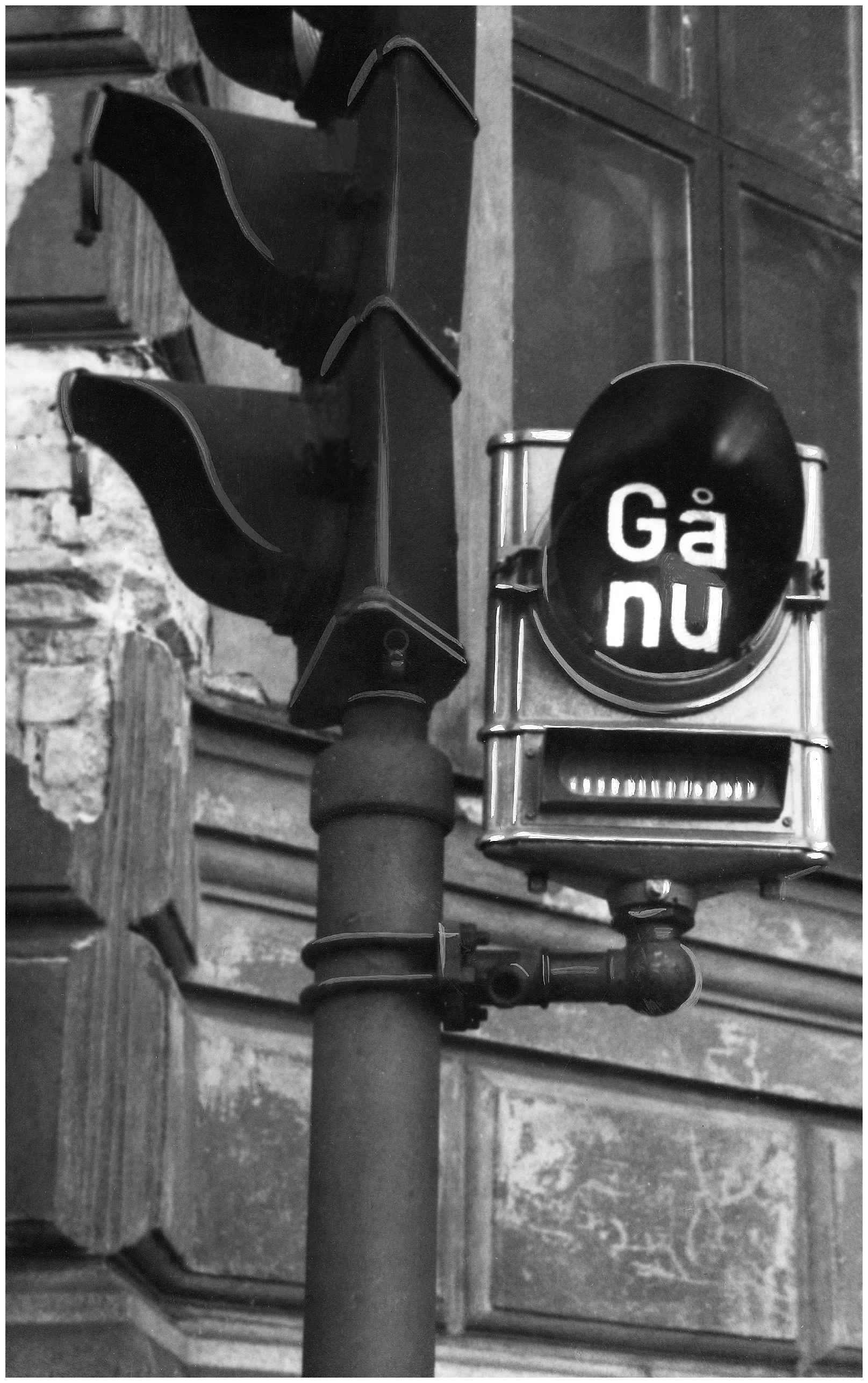
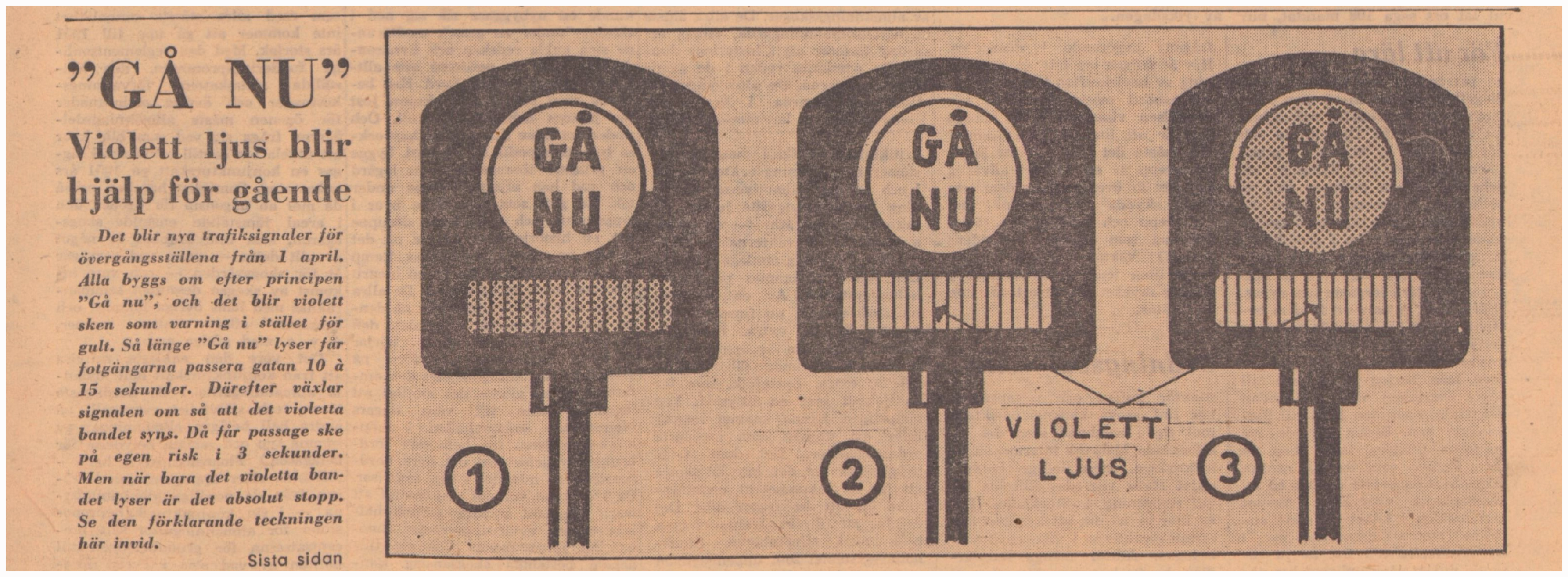
In 1952, the “Walk now” sign of some pedestrian lights was supplemented by a violet light underneath, which, when lit at the same time as the “Walk now” sign, informed pedestrians that they had another three seconds with which to cross the street safely. While the author of this Expressen article wrote that, when violet was lit alone, it meant “absolute stop” for pedestrians, the police chamber had specifically designed these installations so that pedestrian could continue, under the new Swedish Road traffic Charter, deciding for themselves whether they wished to follow the recommendation of the lights. Source: “‘GÅ NU’ Violett ljus”, Expressen 29.3.1952.
The issue of pedestrians walking through red lights was a hot topic in traffic circles and was never really settled during the period studied here. Most stakeholders admitted that traffic lights had never been introduced with the needs of pedestrians in mind, and sometimes had unreasonable consequences for them. Moreover, since their failure to respect the lights rarely caused any real danger—although it did cause annoyance—they expressed some understanding for pedestrian disregard. Still, in response, experts innovated in traffic signal technology in order to better accommodate and control, or systemise, pedestrians. One of their tools was dedicated pedestrian lights, which advised pedestrians about when to cross the street. For London, Hornsey finds that such signals were introduced only to a limited extent out of fear that pedestrian disregard for them would “jeopardise the authority of the entire assemblage” and give pedestrians a false sense of security. 79 This is not confirmed by my findings in Stockholm. There, while motorist organisations promoted an interpretation of the national road charter that implied that pedestrians should absolutely comply with these as well as ordinary traffic lights, the traffic police made sure that it remained a recommendation rather than a command. In short, although there were multiple inscriptions and re-inscriptions of assumed pedestrian interaction with traffic lights, the scripts remained weak and open-ended, and pedestrians could freely choose whether they cared to play along. Another novelty in pedestrian control, pedestrian actuation of traffic lights, granted pedestrians another degree of agency, which, as we will see, caused anxiety and irritation among motorists and their proponents.
Pedestrian actuation: Integrating pedestrians into the system
Pedestrian actuation of traffic lights built on the same technology as vehicle actuation, only instead of automatic detection of vehicles in the street, pedestrians had to push a button themselves to indicate their presence. The idea was not entirely new, even to Stockholm. In late 1938, the head of traffic police Forsselius, inspired by examples in England, proposed that pedestrian actuation should be trialled at a pedestrian crossing over one of the city’s access roads, where intense and fast-moving traffic made it “hardly possible for a pedestrian to, without great risks, get across the street”. 80 Although he understood its potential effect on motorists, Forsselius considered trying the innovation elsewhere as well. “The signals will obviously be a certain hinder for automobility”, he explained, “but it cannot be helped. People need to be able to get across the street.” 81
Pedestrian actuation was never realised in the 1930s, but the idea resurfaced after the war. In August 1948, Expressen reported favourably on the forthcoming novelty: A new traffic light system, which is managed by the pedestrians and gives them the opportunity to, after no more than 30 seconds of waiting, cross the roadway, will be built at Gustav Adolfs torg in Stockholm. It means that the pedestrians, who so far have come up short against motorists and cyclists in the struggle for the streets, can now, at least in one place, have their interests attended to.
The installation at Gustav Adolfs torg combined vehicle and pedestrian actuation, with four coordinated installations for vehicles and 13 pushbuttons to control the pedestrian lights at seven pedestrian crossings. The city’s department of finance reluctantly agreed to the installation. Not only did it come at a significant cost, the department was also hesitant regarding the pedestrian lights, a novelty that introduced “a new phase in the traffic regulation”. In the end, it relented to the traffic department’s desire to prepare the installations for pedestrian lights with actuation. 85
Like vehicle actuation, pedestrian actuation at Gustav Adolfs torg was postponed due to import restrictions. As it came up for consideration again in early 1950, the press was generally enthusiastic. Finally, one newspaper exclaimed, the city authorities had discovered the legitimate right of pedestrians. 86 Upon seeing the signal to walk, wrote one reporter, a pedestrian could cross, “secure and calm but of course without loitering”. Having in this way asked pedestrians not to misuse their new ability, the journalist was clear about the redistribution of power between road users. “The ‘confidence’ of the pedestrian” grew as he, “with one simple press of a button” gave the signal system a new impulse. No longer would he have to stand and wait “an eternity in order to discover a single gap in the compact flow of vehicles”—a gap that was often “quite life-threatening to utilise”. 87
The plausible shift in power worried motorists. Interviewed in Expressen, engineer Tunå at the traffic department tried to reassure them that the pedestrians’ agency was actually limited: I know that there are motorists who have been reserved upon hearing about that novelty, [but] to the contrary, the system will be of practical benefit to traffic. The intention is not to continually cut the traffic streams; the benefit is rather that traffic is not stopped by red light when there are no pedestrians. The pedestrians give an impulse, but otherwise do not regulate the time intervals between the signals.
88
Pedestrian actuation had been tested at one other location in Stockholm, but its implementation at Gustav Adolf torg was the “acid test” of the innovation. 93 (Figure 6) The trials showed several weaknesses; some technical, others related to pedestrian misunderstandings. According to one reporter, they appeared to think that the lights would respond immediately after they had pressed the button, when, in fact, it only “gives an impulse to a timing mechanism that inverts the lights according to the traffic intensity”. 94 A week after their introduction, the traffic lights continued to confuse motorists and pedestrians. While motorists were annoyed by delays—the press quickly nicknamed Gustav Adolfs torg “the red square”—many pedestrians apparently failed to understand the novelty and, as one journalist wrote, returned to their old practice: “to run across the street when the stream of cars reduces”. One police officer found the old method of police regulation to be smoother, but thought pedestrian actuation worked well from a traffic safety point of view: “The pedestrians walk—this is clear—considerably safer across the streets now, nota bene if they await the ‘Walk now’ signal.” Two interviewed women also found the buttons to be a great improvement, but most pedestrians, the reporter argued, “simply walk past the button and ignore the red light, or, if they do press, they don’t wait around for ‘Walk now’, which can take up to a minute during heavy traffic”. 95
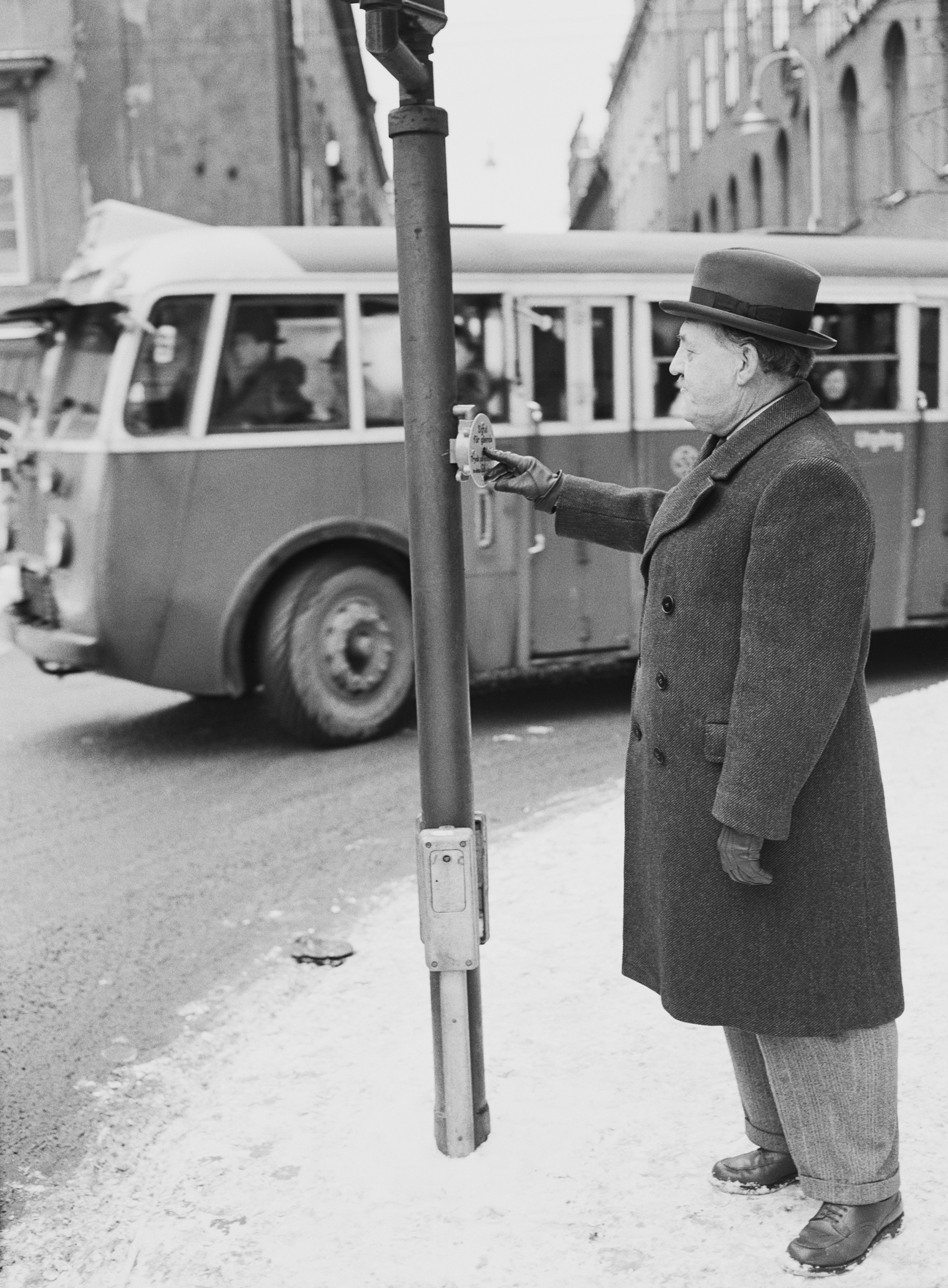
In this photo from 1951, Erik Lundeberg, head of division at the National Road Administration, trials pedestrian actuation in Gustav Adolfs Torg. The reporter at Expressen noted how pedestrians misunderstood the system and pressed the button “again and again”. Once they had learned to use it properly, however, he envisaged that the system would work equally well as in Piccadilly Circus, London. Photo: Hermann Ronninger, Stockholm City Museum (SvD 29285), originally published in “Torgskräck eller trafikhjälp?” Expressen 7 October 1950.
Because pedestrians failed to follow the intention of the designers, they put themselves in danger, but they also caused more red lights for motorists than necessary. The overuse of the buttons by pedestrians eventually forced the city authorities to revert to police regulation and replace the pedestrian lights with ordinary pedestrian crossings marked with yellow lines. 96 Later the same year, however, the lights were back on, including those for pedestrians—and the problems, and criticism, continued. One pedestrian complained that red lights for pedestrians were so long that “youths (and also many adults) don’t care to wait but instead beetle across the street as soon as they believe they have the slightest chance”. In fact, this pedestrian argued, it made the crossing “more dangerous than before, since the motorists, legitimately so, trust the signals”. 97 A reporter at Expressen similarly argued that the lights responded too slowly to pedestrians pushing the button. As pedestrians thus took the opportunity to cross when the stream of cars slowed down, there was no one to cross when the lights changed, causing an unnecessary stop for motorists and making them disrespect the traffic lights. Additionally, when pedestrians failed to respect the pedestrian lights, it actually resulted in poorer safety if motorists took their green light for what it meant: clear to go. 98
To sum up, pedestrian actuation was introduced as a way to give pedestrians the chance to cross the street in a safe manner. They were also, however, a way to confine pedestrian passage to specific times and rhythms—the clockwork was set to only allow activation of the pedestrian lights according to a pre-set schedule. To succeed, pedestrian actuation—an early example of cybernetic human-machine interaction—relied on pedestrians responding correctly and closing the feedback loop. But, similar to what Hornsey observes for London in the 1930s, since pedestrians could still choose whether they wanted to wait and use this safer opportunity or take the chance to cross when the car traffic stream slowed down, their confinement was only partial. 99 Worse in the eyes of motorists, pedestrians “misuse” of pedestrian actuation forced them to stop even when there was no longer anyone waiting to cross. As in the case of dedicated pedestrian lights, the script of pedestrian actuation proved too vague to enforce full compliance on the part of pedestrians, largely because the prescriptions of the technical apparatus were not aligned with traditional views about pedestrians’ rights and sovereignty. Ultimately, the attempts to integrate and coordinate pedestrian conduct with the emerging urban traffic system remained incomplete.
Conclusion
This article has analysed traffic light innovation in Stockholm in the decade following the Second World War, with special attention given to its impact on walking practices. Several of the novelties in traffic control, such as vehicle and pedestrian actuation, had been discussed or even trialled in the 1930s, but their real breakthrough was in the first post-war decade. Having proven their functionality, starting in the mid-1950s, the traffic department implemented vehicle-actuated traffic lights at a rapid pace in the centre and later extending beyond the inner city. By 1959, the number of such installations had reached 100. 100
Meanwhile, in the latter half of the 1950s, pedestrians continued to voice their concerns about motorists failing to respect pedestrian crossings, driving too fast, and the fact that many, children and the elderly in particular, had difficulty crossing roads during the brief pedestrian phase of the traffic lights. 101 Although the traffic department by that time had several options available to improve the situation—including dedicated pedestrian lights and pedestrian actuation—it rejected many suggestions of that sort. Although “well-motivated”, the department argued, “a certain contingent … considers too many signals a bad thing”, and, while needed by pedestrians, they were “a nuisance to traffic”. 102 Responding to calls for extended periods for allowing pedestrians to cross the street in 1957, the new head of traffic police promised to look into the possibility of allowing pedestrians some extra time, adding: “It is however a balancing act. Traffic cannot be stopped too much.” 103
Indeed, balancing the needs of pedestrians and drivers in designing traffic lights appears to have been a constant challenge to the authorities in Stockholm. Confirming the results of previous studies in Anglo-Saxon countries, the balance increasingly tipped over in favour of motorists. That said, the first post-war decade stands out as a period during which much was still unsettled. As we have seen, pedestrians did not easily submit to traffic control. In an attempt to understand the degree to which they were systemised, integrated with the emerging urban traffic system, this article has aimed to de-scribe traffic control innovations: to recapture the intentions of designers through a close reading of the innovation process and assessing the extent to which road users subscribed to the scripts.
Vehicle actuation ignored pedestrians, whose presence was not detected and whose problems with turning vehicles were not accounted for. Indirectly, however, in order to allow traffic lights to function during the night without resulting in unreasonable negative consequences for pedestrians, vehicle actuation appears to have increased acceptance among experts of walking through a red light. That said, its script attended primarily to the comfort of motorists and the smooth flow of cars. By avoiding “unnecessary” stops, vehicle actuation was supposed to ingrain in motorists a greater respect for traffic lights.
This is not to say that the experts did not care about pedestrians. They often expressed their concerns about the precarious situation faced by those travelling on foot as they took what they considered to be necessary measures to systemise drivers and improve traffic flow. They also had doubts about pedestrians’ readiness to submit to the new street order and traffic control measures geared towards automobility—and even whether it was realistic to expect so. Indeed, their take on pedestrian control was ambiguous, as seen in the weak scripts of pedestrian lights and pedestrian actuation. While these innovations urged pedestrians to use the opportunity to cross the street more safely, local traffic regulations and interpretations of national ones acknowledged their right to use their own judgement and not fully subordinate themselves to the needs and demands of motorists. Thus, within the heterogeneous group of pedestrians, some used the new opportunity available to them, others did not, depending on, for example, their ability, age, and in all likelihood also their individual willingness to submit to the system, the rhythm of traffic and situation-based time constraints.
As innovations based on communication with road users—either one-way or, as in the case of vehicle and pedestrian actuation, two-way communication—the scripts of traffic lights will always be weaker than material interventions such as speed bumps (an example made famous through an essay by Bruno Latour). 104 As we have seen, to be successful, their effectiveness relied on the parallel non-material prescriptions of traffic rules and regulations, the readiness of the traffic police to enforce them, and road users accepting them as legitimate and useful. When these aspects were not aligned, the scripts were only partially successful.
Pedestrians could thus retain their sovereignty and some of their pre-car habits, while developing, as Hornsey aptly puts it, a “less determined type of programmed ‘road sense’”. On the one hand, experts tried to fit pedestrians into the emerging city traffic system: render their movements predictable, control them, while also ensuring their safety. On the other hand, integrating pedestrians with this system was not an easy task, given age-old understandings about the right of pedestrians to walk where and how they desired. This divide—ambitions to fit them in, while accepting the impossibility of the task—seems to have been at the core of the issue of governing pedestrians in the period studied here.
Walking was never really systemised in Stockholm in the early post-war period. Pedestrians preferred, as Schmucki puts it, “convenience over safety”, and the extent to which this remained the case is a subject for further research. It should also be pointed out that this article, as one of very few looking into walking in European urban settings in the post-war period, has given priority to street-level interactions between road users, traffic control technology, and the actors immediately involved in designing them. The research task ahead includes, among many things, how walking figured in broader cultural and political struggles over our streets.
Footnotes
Declaration of conflicting interests
The author(s) declared no potential conflicts of interest with respect to the research, authorship, and/or publication of this article.
Funding
The author(s) disclosed receipt of the following financial support for the research, authorship, and/or publication of this article: This article has been produced within the research project “Techno-Politics of Walking: Continuity and Change of Streets as Public Space in Urban Europe” funded by the Swedish research council Formas within the national research program for Sustainable living environments (Dnr. 2019-01941).
1
Simon Gunn and Susan C. Townsend, Automobility and the City in Twentieth-Century Britain and Japan (London: Bloomsbury Academic, 2019); Per Lundin, “Mediators of Modernity: Planning Experts and the Making of the ‘Car-Friendly’ City in Europe”, in Mikael Hård and Thomas J. Misa (eds), Urban Machinery: Inside Modern European Cities (Cambridge MA: MIT Press, 2008), 257–79.
2
Colin Pooley et al., “Introduction: Historical Perspectives on Pedestrians and the City”, Urban History (2019), 1–7. Epub ahead of print 11 November 2019. DOI:10.1017/S0963926819000944; Martin Emanuel, Frank Schipper, and Ruth Oldenziel (eds), A U-turn to the Future: Sustainable Urban Mobility since 1850 (New York NY: Berghahn Books, 2020).
3
Arne Dufwa, “Planläggning—trafikundersökning”, in Nils Lidvall (ed.), Gatan: Praktisk handledning i gatubyggnad (Stockholm: Svenska kommunal-tekniska föreningen, 1953), 7–52, here 69.
4
Göran Sidenbladh, Planering för Stockholm 1923–1958 (Stockholm: LiberFörlag, 1981), 258; Generalplan för Stockholm 1952 (Stockholm: Stadsplanekontoret, 1952), 240.
5
Martin Emanuel, “Constructing the Cyclist: Ideology and Representations in Urban Traffic Planning in Stockholm, 1930–70”, Journal of Transport History 33:1 (2011), 67–91, here 73.
6
Statistisk årsbok för Stockholms stad (Stockholm: Stockholms stads statistiska kontor, various years).
7
Stockholms stadsfullmäktige (SF), Bihang (Attachment) 1959:18, “Gatunämndens verksamhetsberättelse 1958”, 26–27; SF Utlåtande (Statement) 1950:51, 37.
8
David Rooney, “Keeping Pedestrians in their Place: Technologies of Segregation in East London”, in Phillip Gordon Mackintosh, Richard Dennis and Deryck Holdsworth (eds), Architectures of Hurry—Mobilities, Cities and Modernity (Abingdon: Taylor & Francis, 2018), 120–36; Barbara Schmucki, “Against ‘the Eviction of the Pedestrian’. The Pedestrians’ Association and Walking Practices in Urban Britain after World War II”, Radical History Review 114 (2012), 113–37; Richard Hornsey, “‘He Who Thinks, in Modern Traffic, is Lost’: Automation and the Pedestrian Rhythms of Interwar London”, in Tim Edensor (ed.), Geographies of Rhythm: Nature, Place, Mobilities and Bodies (Farnham, Surrey: Ashgate, 2010), 99–112; Joe Moran, “Crossing the Road in Britain, 1931–1976”, The Historical Journal 49:2 (2006), 477–96; Muhammad Ishaque and Robert Noland, “Making Roads Safe for Pedestrians or Keeping Them out of the Way? An Historical Perspective on Pedestrian Policies in Britain”, Journal of Transport History 27:1 (2006), 115–37; Peter Norton, “Street Rivals: Jaywalking and the Invention of the Motor Age Street”, Technology and Culture 48:2 (2007), 331–59.
9
Ishaque and Noland, “Making Roads safe for Pedestrians”; Moran, “Crossing the Road in Britain”, 495; Norton, “Street Rivals”; “Persistent Pedestrianism: Urban Walking in Motor Age America, 1920s–1960s”, Urban History (2019), 1–24. Epub ahead of print 12 November 2019. DOI:10.1017/S0963926819000956; Schmucki, “Against ‘the Eviction of the Pedestrian’”.
10
Schmucki, “Against ‘the Eviction of the Pedestrian’”, 114.
11
Pär Blomkvist, Den goda vägens vänner: Väg- och billobbyn och framväxten av det svenska bilsamhället 1914–1959 (Eslöv: Symposion, 2001), 39–41.
12
Daniel Normark, Enacting Mobility: Studies into the Nature of Road-Related Social Interaction (Göteborg: Section for Science and Technology Studies, Sociology Department, Göteborg University, 2006).
13
Miriam R. Levin, Cultures of Control (Amsterdam: Harwood Academic, 2000), 27–8.
14
Clay McShane, “The Origins and Globalization of Traffic Control Signals”, Journal of Urban History 25:3 (1999), 379–404.
15
Schmucki, “Against ‘the Eviction of the Pedestrian’”, 120.
16
Lucy Faire and Denise McHugh, “The Everyday Usage of City-Centre Streets: Urban Behaviour in Provincial Britain ca. 1930–1970”, Urban History Review 42:2 (2014), 118–28, here 123–4.
17
Hornsey, “‘He Who Thinks, in Modern Traffic, is Lost’”, 111–112.
18
Martin Emanuel, “Designing Signals, Mediating Mobility: Traffic Management and Mobility Practices in Interwar Stockholm”, in Justin Spinney, Philip Pinch, and Suzanne Reimer (eds.), Mobilising Design (London & New York: Routledge, 2017), 103–16. On delegation, see e.g. Bruno Latour, “Where are the Missing Masses?”, in Wiebe E. Bijker and John Law (eds), Shaping Technology/Building Society: Studies in Sociotechnical Change (Cambridge, MA: MIT Press, 1992), 225–59. On the impact of early traffic lights on pedestrian safety, see Martin Emanuel, “Controlling Walking in Stockholm during the Inter-War Period”, Urban History (2019), 1–18. Epub ahead of print 11 December 2019. DOI:10.1017/S0963926819000968, here 13–16.
19
Madeleine Akrich, “The De-Scription of Technical Objects” and Madeleine Akrich and Bruno Latour, “A Summary of a Convenient Vocabulary for the Semiotics of Human and Nonhuman Assemblies”, both in Wiebe E. Bijker and John Law (eds), Shaping Technology/Building Society: Studies in Sociotechnical Change (Cambridge MA: MIT Press, 1992).
20
Nelly Oudshoorn and Trevor Pinch (eds), How Users Matter: The Co-Construction of Users and Technologies (Cambridge MA: MIT Press, 2003); Frank Trentmann, “Materiality in the Future of History: Things, Practices, and Politics”, Journal of British Studies 48:2 (2009), 283–307.
21
The archive material is mostly from the Traffic Department’s archive held at Stockholm City Archives. Most newspaper articles come from four large Swedish daily/evening papers (Aftonbladet, Dagens Nyheter, Expressen, and Svenska Dagbladet) and were accessed through the Swedish National Library’s digital service “Svenska dagstidningar”,  .
.
22
Emanuel, “Designing Signals, Mediating Mobility”.
23
Arne Dufwa, Stockholms tekniska historia: Trafik, broar, tunnelbanor, gator (Stockholm: Kommittén för Stockholmsforskning, 1985), 90–3. See also Stockholms stadsarkiv (SA), Gatukontorets arkiv (GA), Gatukontorets och gatunämndens expedition (GGE), EI (Inkomna skrivelser), Dnr. 1939:2456, “PM 1/3: Allmän beskrivning över fordonsreglerade trafiksignaler”, AGA, no date; Nils von Matern, “Trafiktekniska synpunkter på gatunät i stad”, in Gustaf Edlund (ed.), Handbok i samfärdselteknik (Stockholm: Natur och kultur, 1949), 247–88, here 233–4.
24
SA, GA, GGE, EI, Dnr 1935:1056, Gatukontoret (Traffic Department, GK) to Gatunämnden (Traffic Board, GN), ”Ang. optiska trafiksignaler i gatukorsen Hamngatan-Regeringsgatan och Humlegårdsgatan-Sturegatan”, 23 May 1935. See also several documents in Dnr. 1937:783 and 1937:2317.
25
“Robot ordnar körtrafiken”, Dagens Nyheter 10 February 1938; “Tänkande signal redan urmodig nyhet”, Svenska Dagbladet 12 January 1938.
26
See documents in SA, GA, GGE, EI, Dnr. 1938:101; AI 1938:1087, GN-minutes 7 September 1938.
27
“Spårvagnen måste snart avskaffas. Fordonsstyrda trafiksignaler rekommenderas”, Svenska Dagbladet 5 November 1938; “Fordonsstyrda trafiksignaler”, Dagens Nyheter 13 November 1938.
28
“Impuls-signalen i Vattugatan redan arbetslös”, Aftonbladet 14 July 1939; “Trafiksignalen på Brunkebergstorg”, Aftonbladet 15 July 1939; “PM 1/3.”
29
SA, GA, GGE, EI, Dnr. 1945:536, “1943 års trafikberedskapsutredning”, Otto Wallenberg, 7 February 1945, 20–22.
30
SA, GA, GGE, EI, Dnr. 1945:3690, David Anger to Yngve Larsson, 29 December 1945; Dnr. 1945:3978, Anger and Nils Lidvall to GN, 11 January 1946; “PM”, Yngve Larsson, 19 January 1946.
31
SA, GA, GGE, EI, Dnr. 1946:929, Anger to GK, “Studier av optiska signalanläggningar i England”, 1 April 1946; “9 gatukors på Söder, 21 i city får fordonsstyrda nya signaler”, Expressen 27 April 1946; Bo Hertzman-Ericson, “Moderna trafiksignalsystem”, Kommunalteknisk tidskrift 13:1 (1947), 7–12.
32
“Stockholm letar efter bästa möjliga trafiksignalerna”, Aftonbladet 19 January 1946; “‘Trampdyna’ vid gatukorsning underlättar Stockholmstrafik”, Dagens Nyheter 5 July 1946.
33
SA, GA, GGE, EI, Dnr. 1947:1973, Lidvall to GN, “Fordonsstyrda optiska trafiksignaler”, 27 June 1947; Helge Berglund to Anger, 1 July 1947; “Promemoria angående fordonsstyrda optiska trafikanter”, Berglund, no date.
34
SA, GA, GGE, EI, Dnr. 1947:1973, “Finansavdelningens tjänsteutlåtande”, Hjalmar Mehr, 27 October 1947; “Utdrag ur protokoll, hållet vid drätselnämndens sammanträde 28 October 1947”; SF Statement 1947:434; SF Protokoll (Minutes) 17 November 1947.
35
“Förberedelser för ‘gröna vågen’”, Expressen 26 February 1949.
36
SA, GA, GGE, EI, Dnr. 1948:791, Erik Forsselius to GK, 15 March 1948; SA, GA, GGE, EI, Dnr. 1948:2826, Forsselius to GK, 6 October 1948.
37
SA, GA, GGE, EI, Dnr. 1950:502, Forsselius to GN 11 February 1950. See also “Fordonsstyrda trafiksignaler i allt fler gatukorsningar”, Dagens Nyheter 16 February 1950.
38
SA, GA, GGE, EI, Dnr. 1950: 502, Anger, Ekwall & Lidvall to GN, “Fordonsstyrda signaler, nyanläggningar”, 9 March 1950.
39
Dufwa, Stockholms tekniska historia, 90–3.
40
SA, GA, GGE, EI, Dnr. 1950:972, “PM för fordonsstyrda signalanläggningars tillkomst och skötsel”, no date.
41
“PM”, Larsson, 19 January 1946.
42
See AGA’s and Transfer’s ads in Kommunalteknisk tidskrift 1950:2 and 1954:6.
43
Christian Jacobæus, LM Ericsson 100 år. Bd 3, Teletekniskt skapande: 1876–1976 (Stockholm: Telefon AB LM Ericsson, 1976), 321–3.
44
SA, GA, GGE, EI, Dnr. 1947:2566, H. Insulander (SIB) to GK, “Trafiksignaler”, 28 August 1947; “Förberedelser för ‘gröna vågen’; SIB’s ad in Kommunalteknisk tidskrift 1949:4.
45
SIB’s ads in Kommunalteknisk tidskrift 1950:4, 1953:2, 1954:1, 1954:4, 1955:2, 1955:5, and 1957:1; “Fordonsstyrda trafiksignaler”, Dagens Nyheter 13.11.1938; SA, GA, GGE, EI, Akt nr. 97:5, Fredrik Schütz & Nils Lidvall to Odense’s Police Commissioner, “Fordonsstyrda signaler”, 24 September 1954; Schütz & Lidvall to SIB, “Intyg”, 4 February 1955.
46
SA, GA, GGE, EI, Dnr. 1950:502, Lidvall to Anger, “Trafiksignaler, anbud”, 31 October 1950.
47
SF Statement 1949:125.
48
SF Statement 1956:105, 830.
49
SA, GA, GGE, EI, Akt nr 97:5 (Dnr 1952:302), H. Insulander (SIB) to GK, 26 January 1952.
50
SA, GA, GGE, EI, Akt nr 97:5 (Dnr 1952:302), Ekwall & Lidvall to Stockholm’s police chamber, “Fordonsstyrda signaler”, 22 September 1952; “A-order nr 18/1952”, 9 October 1952.
51
SA, GA, GGE, EI, Akt nr 97:5 (Dnr. 1955:1796/55), Nils Alm to Schütz, 24 February 1955; SF Statement 1957:212.
52
SA, GA, GGE, EI, Dnr. 1950:972, Anger, Lidvall & Ekvall to the Head of Fire Department, 10 February 1950; SF Statutlåtande (Budget statement) 1957:GN, 186; SF Budget statement 1958:GN (IV), 4.
53
Emanuel, “Designing Signals, Mediating Mobility”, 105–6.
54
Mcshane, “The Origins and Globalization of Traffic Control Signals”, 386.
55
SA, GA, GGE, EI, Dnr. 1947:1973, “P.M. angående fordonsstyrda signaler”, Bo Hertzman-Ericson, 21 October 1947.
56
Ekwall & Lidvall to Stockholm’s police chamber, “Fordonsstyrda signaler.”
57
“Ensam är stark i ny trafikreglering. Hur ‘optisk polis’ tänkts kunna skipa rättvisa”, Aftonbladet 21 December 1938.
58
Hertzman-Ericson, “Moderna trafiksignalsystem.” See also “‘Trampdyna’ vid gatukorsning underlättar Stockholmstrafik”, Dagens Nyheter 5 July 1946.
59
Von Matern, “Trafiktekniska synpunkter”, 242. See also Transfers’ ad in Kommunalteknisk tidskrift 1955:6.
60
Emanuel, “Controlling Walking in Stockholm”.
61
“PM 1/3”.
62
Lode Wistrand, SOU 1940:33. Principbetänkande i trafiksäkerhetsfrågan (Stockholm: Nordisk bokhandel, 1940), 65–75; Hugo Carlén, “Ljussignaler i teori och praktik”, Kommunalteknisk tidskrift 7:1 (1941), 4–8.
63
See e.g. “Straffskärpning för gå- och cykeldrullar”, Aftonbladet 23 October 1941; “Mysteriet trafiksignaler i teorin och praktiken”, Aftonbladet 11 April 1944; “Trafiksabotage”, Expressen 19 March 1945.
64
C. H. von Hartmansdorff, SOU 1944:18. Betänkande med förslag till vägtrafikstadga m. m (Stockholm, 1944), 35.
65
“Säkerheten på gatorna”, Svenska Dagbladet 27 October 1941.
66
“Strängare trafikbestämmelser för gående och cyklister”, Svenska Dagbladet 6 May 1944.
67
“Fotgängare m/ä kan ej läras gå”, Dagens Nyheter 22 May 1947.
68
SF Statement 1973:1946 (incl. attachment A); SF Minutes 20 May 1946.
69
SA, GA, GGE, EI, Dnr. 1946:553, AGA (Plass/Carlén) to GK’s policy department, “Betr. Prov med fordonsstyrda signaler, Kungsgatan-Drottninggatan”, 19 February 1946; “Utdrag av protokollet hållet hos poliskammaren i Stockholm 27 February 1947;” Forsselius to TT, 27 February 1947.
70
Sign. Daglig fotgängare på Odengatan, “Vartill tjänar det gula ljuset?” Expressen 20 November 1949.
71
SA, GA, GGE, EI, Akt nr 97:5 (Dnr. 1956:1189), “Pm angående ändring av den svenska signalväxlingen till det engelska systemet”, no date; von Matern, “Trafiktekniska synpunkter”, 235, 243; Bengt von Matern, “Trafiksignalers kapacitet och inställning”, Kommunalteknisk tidskrift 19:8 (1954), 337–41.
72
SF Statement 1946:173; SF Minutes 20 May 1946; SA, GA, GGE, EI, Dnr. 1947:441, Carlén to GK’s policy department, “Betr. Speciella signallytkor vid övergångsplatser för fotgängare”, 9 January 1947.
73
1945 års trafiksäkerhetskommitté, SOU 1948:20. Betänkande med förslag till åtgärder för höjande av trafiksäkerheten (Stockholm: Kihlström, 1948), 218, 261–2.
74
Sten Agvald, “Mot rött ljus?” Svenska Dagbladet 5 January 1952.
75
“Strömhopp över passagerna vid Expresskontroll”, Expressen 4 January 1952.
76
“Gå mot rött ljus straffbart endast vid ovarsamhet”, Svenska Dagbladet 6 January 1952.
77
“GÅ NU! Violett ljus…”, Expressen 29 March 1952.
78
“Inte förbjudet då mot violett”, Dagens Nyheter 1 April 1952; Sign. Peter, “Filkörning fara för cyklist. Violett betyder – ingenting”, Svenska Dagbladet 4 April 1952.
79
Hornsey, “‘He Who Thinks, in Modern Traffic, is Lost’”.
80
“Nya signaler planeras vid Thorildsplan”, Svenska Dagbladet 27 November 1938.
81
“Fotgängarsignal stoppar bilarna”, Dagens Nyheter 17 March 1939; “Fotgängarna får bilstoppsignal vid Torildsplan”, Aftonbladet 17 March 1939.
82
“Högst 30 sek:s väntan för fotgängare, får själva reglera trafiksignalerna”, Expressen 12 August 1948.
83
See e.g. SF Minutes 3 December 1945, 551–8.
84
Ibid. See also “Ljusning på Stockholms fotgängarfront”, Dagens Nyheter 13 August 1948; “Fotgängare får själv dirigera trafiksignaler”, Arbetaren 13 August 1948.
85
SA, GA, GGE, EI, Dnr. 1948:1440, Anger to GN, “Fordonsstyrda trafiksignaler”, 11 May 1948; Anger to GN, “Fordonsstyrda signaler på Gustav Adolfs Torg och Stureplan”, 27 May 1948; “Finansavd. Tjut”, Granat, 9 July 1948; “Utdrag ut protokoll från sammanträde 9 July 1948 med drätselnämnden utsedda särskilda delegerade för prövning av anslagsöverskridanden m.m., §17”.
86
“Nytt signalljus hjälp åt gående, ‘tryck-på-knapp’ debuterar snart”, Expressen 10 February 1950.
87
“Fotgängarnas nya melodi: Tryck på knappen!” Expressen 21 November 1950.
88
“Förberedelser för ‘gröna vågen’.”
89
“Nytt signalljus hjälp åt gående.”
90
“Knapp-premiär vid Karl XII:s torg”, Expressen 7 October 1950.
91
“Fotgängarnas nya melodi.”
92
Von Matern, “Trafiktekniska synpunkter”, 243.
93
“Fotgängarnas nya melodi”; “Nya trafiksignaler på Gustav Adolfs torg, riskabelt köra mot rött”, Dagens Nyheter 17 February 1951.
94
“Rött-grönt”, Expressen 18 February 1951. See also “Torgskräck eller trafikhjälp”, Expressen 18 February 1951.
95
“Gående inväntar ej ‘Gå nu’…”, Dagens Nyheter 24 February 1951. See also Sign. Stillman, “Ljusfesten på Gustav Adolfs torg”, Aftonbladet 7 March 1951; “‘Röda torgets’ nattliga ljusgåta”, Expressen 27 April 1951.
96
“‘Röda torget’ blir ‘Experimentalfältet’”, Expressen 11 May 1951; “Röda torget blev gult i natt!” Aftonbladet 19 May 1951.
97
SA, GA, GGE, EI, Akt nr. 97:5 (Dnr 1952:1861), Marte Swenborg to GK, 17 October 1953.
98
“Trafiksignalerna…”, Expressen 7 September 1952; Sign. Ingenjör, “‘Röda torgets’ trafiksignaler”, Aftonbladet 7 October 1953.
99
Hornsey, “‘He Who Thinks, in Modern Traffic, is Lost’”, 109.
100
SA, GA, GGE, EI, Akt nr. 97:5 (Dnr. 1956:1189), Schütz & Carl Ehrman to GN, “Beskrivning av de olika trafiksignaltyperna i Stockholm”, 28 August 1956; “Trafiksignaler börjar nu behövas även i Stockholms förortsområden”, Expressen 11 January 1955; “Nytt signalsystem för Stockholmstrafiken”, Expressen 24 October 1956; Dufwa, Stockholms tekniska historia, 92.
101
See e.g. Sign. Gåsen, “Polisen och de omöjliga bilisterna”, Aftonbladet 11 April 1956; Sign. Daglig trafikant, “Nu är det farligt på Vasagatan!” Aftonbladet 23 December 1959; “Gångtrafikanterna åter illa ute”, Expressen 29 August 1957.
102
SA, GA, GGE, EI, Akt nr. 97:5 (Dnr. 1956:1057), “Torsgatan-Rödabergsgatan och Alviksplan, trafikförhållanden”, Schütz & Ehrman, 20 April 1959.
103
“Gångtrafikanterna åter illa ute”, Expressen 29 August 1957.
104
Latour, “Where are the missing masses?”