




Abstract
Professional learning (PL) is universally lauded as essential to enhancing teaching quality and retention for aspiring teachers, yet it is a difficult balancing act for program and P12 school leaders trying to administer the many intricate components of a teacher residency program while implementing meaningful PL for residents. Grounded in complexity theory, this mixed methods case study examines PL experiences among residents (N = 36) across four cohorts within the Teacher Education Residency Consortium (TERC) program in the southwestern United States. Three themes related to balance emerged from the quantitative and qualitative findings: (a) an appropriate quantity of PL experiences, (b) an adequate measure of PL programmatic support, and (c) residents’ ability to hone time management skills to succeed in all their competing responsibilities during a yearlong residency. The implications are conceived as five coherent policy and practice conditions for residency implementers aiding the PL journey of aspiring teachers.
Keywords
Of the myriad components comprising teacher residencies—mentoring (Garza et al., 2019; Oh et al., 2024) with co-teaching (Chu, 2021), school–university partnerships (SUPs) (Hackett et al., 2021; Hill-Jackson, 2023; Hill-Jackson et al., 2020), licensure and exam requirements (Tichnor-Wagner et al., 2023; Van Cleef, 2022), coursework (Matsko et al., 2022; Smith & Griffith, 2024; Truwit et al., 2024), clinical training (Palmero & Lara, 2025), and compensation (Greathouse & Dobbins, 2023)—professional learning (PL) for aspiring teachers remains the least studied yet perhaps most consequential (Feiman-Nemser, 2012; Lieberman & Pointer Mace, 2008; Tang et al., 2017).
Recognized as specific activities, processes, or programs in teacher development (Fraser et al., 2007), PL encompasses formal and informal learning opportunities that deepen teachers’ competence, including knowledge, beliefs, motivation, and self-regulation (D. Richter et al., 2011). A focus on teaching quality, which improves retention (Ingersoll, 2025; Ronfeldt, 2021; Sutcher et al., 2016), identity development (Chu, 2021), and P12 student outcomes (Ekmekci & Serrano, 2022; Gore et al., 2021; Harris & Sass, 2011), has led to rising attentiveness in PL for beginning teachers (Darling-Hammond, 2021; Darling-Hammond et al., 2017; E. Richter et al., 2021; White, 2021). Despite this growing interest, novice teachers often report that PL is disconnected from their daily P12 teaching experiences (Darling-Hammond et al., 2017; Garcia & Weiss, 2019), delivered by professionals far removed from current classroom realities (Lieberman & Pointer Mace, 2008), competes for their professional and personal time (Beni et al., 2021), and occurs as sit-and-get workshops (Stein, 2024). Research on PL for beginning teachers remains “fairly limited” (Seeger & Boyles, 2021, p. 2). Worse still, the scholarship on PL for residents lags behind other pathways for aspiring teachers—primarily focusing on preservice teachers in traditional pathways (e.g., Admiraal et al., 2023; Chen et al., 2017; Fitzsimons et al., 2024; Kidd et al., 2015; Stewart & Jansky, 2022; Szelei et al., 2019)—revealing a notable literature gap.
The impetus for this present study comes from the authors’ observations when implementing PL experiences among residents (N = 36) across four cohorts within the Teacher Education Residency Consortium (TERC, a pseudonym) at two university-based postbaccalaureate programs in the southwestern United States. Although PL is universally lauded as essential for enhancing teaching quality and retention among aspiring teachers, administering elaborate teacher residency programs while implementing meaningful PL experiences presents a challenging balancing act for program and P12 school leaders. Organized in six parts, this study: (1) applied complexity theory as the theoretical framework; (2) reviewed literature to contextualize PL for residents; (3) utilized mixed methods case study methodology to examine PL satisfaction and engagement; (4) shared three themes related to balance that emerged from quantitative and qualitative findings: (a) appropriate quantity of PL experiences, (b) adequate measure of PL programmatic support, and (c) residents’ ability to develop time management skills to succeed amid competing responsibilities during yearlong residency; (5) offered study limitations and future research suggestions; and (6) unpacked the implications as five policy and practice conditions. The overarching mixed methods research question (RQ) guiding this study was: How do teacher residents’ experiences contextualize and explain participation in PL opportunities in the TERC program?
Theoretical Framework
Complexity theory was first introduced by Weaver (1948) and based on the belief that activity that occurs within multilayered structures or systems may produce overcomplicated phenomena in which the outcomes cannot be foreseen. An overarching goal of complexity theory is to demonstrate how such observations within complicated systems do not generate fixed outcomes. Importantly, however, “outcomes do emerge, are not random, but reveal patterns of outcomes” (Weaver, 1948, as cited in Opfer & Pedder, 2021, p. 379).
Systems thinking is a holistic approach to analysis that focuses on the way that a network’s constituent parts interrelate and how systems work over time and within the context of larger complex systems (Senge, 1990). Rather than breaking down multifaceted problems into sequestered parts, systems thinking recognizes that the behavior of a system cannot be understood solely by examining individual components in isolation. This approach emphasizes understanding the relationships, patterns, and dynamics that emerge from the interactions between elements within a system, as well as how these systems adapt and evolve over time (Meadows, 2008).
Complexity Theory and Teacher Education
Martin et al. (2019) explore how complexity theory provides a powerful lens for understanding teacher education as a dynamic, interconnected system rather than a linear process. They argue that embracing intricateness allows teacher educators and leaders to better account for uncertainty, adaptation, and emergent outcomes in both policy and practice. This perspective encourages flexible, responsive approaches that acknowledge the multifaceted realities teachers face in their PL and classroom environments. In connecting complexity theory to the field of teacher education, Ramiah (2014) argued, Educational systems and institutions are multi-level (students, teachers, and administrators) with several facets. While these roles might be constructed hierarchically, systems may be non-linear as the actions that arise from the interactions of these individuals are not always connected in a sequential manner; the system can make sudden jumps in state or possess sensitivity to initial conditions, there is a possibility of chaos or output which may not be the sum of all inputs. These human beings come together in several associations and endeavors because they are interconnected and almost always in a state of flux. They are far from equilibrium and unpredictable. Thus, educational institutions and their practices are knotty mesh works as they are made of human beings whom themselves are complex entities. (pp. 64–65)
The thinking around studying teacher education in general, or teacher residencies more specifically, through a byzantine lens maintains that one must “level-jump”—that is, simultaneously examine the phenomenon in its own right (for its particular coherence and its specific rules of behavior) and pay attention to the conditions of its emergence (e.g., the agents that come together, the contexts of their co-activity, etc.). (Davis & Sumara, 2014, p. xi)
Interestingly, as elements or components of a residency system intermix one component may inevitably dominate or concede to another in the co-nested subsystems (Walton, 2014) to preserve its own local boundaries (Byrne, 2013).
Since interacting components of a system occur in various activity settings (Ramiah, 2014; Wilson, 2006), a complexity theory perspective allows teacher residency leaders and P12 school district leaders to appreciate how PL as a feature or subsystem is impacted by, and impacts, residents’ experiences with the larger residency program or system. Proposing teacher residency programs as systems operating within larger school-university systems infers they include many elements and processes for which predictable outcomes cannot be predetermined.
Related Literature
Guided by complexity theory for educational organizations, this inquiry appraised three relevant lines of literature. First, the authors examined readings on SUPs exploring how these reciprocal, collaborative arrangements embed novice educators within authentic school contexts while encapsulating the multilayered teacher residency system. Teacher residency program literature was analyzed as the second focal area, investigating how these multicomponent preparation models act as large conglomerates providing guidance and support to residents. Finally, PL literature for aspiring teachers was reviewed to understand how continuous development opportunities, reflective practices, and community-based learning experiences contribute to effective educator formation within complex educational ecosystems.
School–University Partnerships
Teacher residency programs are carried out within SUPs through collaborative governance between university program directors and P12 school leaders. These partnerships are mutually beneficial, with co-designed clinical experiences and coursework to strengthen teacher preparation and improve schools (Goodlad, 1991; National Education Association [NEA], 2021). Residencies generally follow one of three approaches: ceremonial (university-centric), conventional (centering principles of partnership), or communal (equity-focused, attentive to culture as a mediator for robust residency; Hill-Jackson, 2023). Strong SUPs require mechanisms for shared governance, allowing both institutions to contribute expertise, maintain clear goals for teacher preparation, and support student learning outcomes. However, operationalizing teacher residencies within reciprocal SUP structures is convoluted, as various forces shape how schools and universities, each with unique cultures, come together to form new or hybrid spaces (Archer, 2013; Miller & Strachan, 2020; Soja, 1998; Westhorp, 2012). Success depends on the development of trust, aligning individual goals, and devising ways of working and communicating that bridge cultural divides. Creating such partnerships is difficult, especially when establishing a new organization that demands major changes in the parent organizations. The process for implementing SUPs is often “daunting and devoid of guidelines” (Darling-Hammond, 1994, as cited in Hill-Jackson, 2023, pp. 71–72).
Effective SUPs are grounded in shared visions of cultivating high-potential teachers dedicated to sustainable educational change. Implementing residency programs requires ongoing negotiation of roles, decision-making, and balancing academic with practical classroom needs. In this study, residency programs framed by reciprocal SUPs are conceptualized as complex systems with interconnected subsystems. Important system characteristics include interdependency and reciprocal influences among autonomous teacher residents, collectives (like learning communities), and subsystems like schools operating within districts in broader sociopolitical contexts (Opfer & Pedder, 2011).
For the purposes of this present study, we view teacher residency programs, bounded by reciprocal SUPs, as a larger system with interconnected subsystems (see Figure 1).
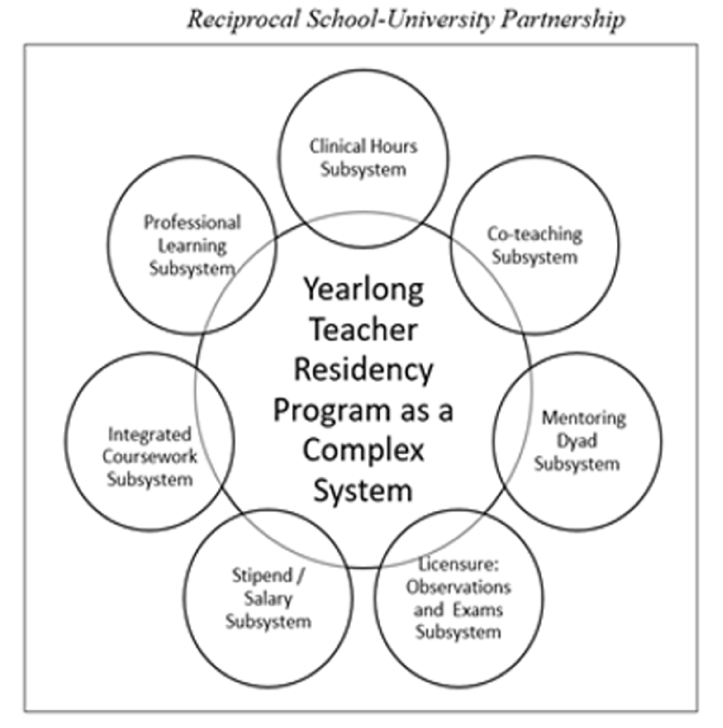
Yearlong Teacher Residency Program as a Complex System Bounded by a Reciprocal School–University Partnership.
Residency programs consist of numerous competing components (clinical hours, co-teaching, mentoring, stipends, graduate coursework, and PL), all targeted at holistic professional development throughout the clinical experience. An important characteristic of a teacher residency program as a complex system is that it is simultaneously interacting with autonomous entities (residents), collectives (SUPs, learning communities, and other stakeholders) and subsystems within the larger unit (components of the teacher residency). “These systems and subsystems associated with teacher learning are interdependent and reciprocally influential” (Opfer & Pedder, 2011, p. 379).
Teacher Residency Programs as Yearlong Clinical Experiences
Teacher residency programs are immersive, aiming to thoroughly prepare future educators for real classroom environments. Clinical experiences are key, providing contexts where residents learn to teach (e.g., Cohen et al., 2013; Hollins, 2015). For at least one academic year, residents spend several days each week in a P12 classroom “under the wing of an experienced and trained mentor teacher” (Guha et al., 2016, p. 7), incrementally assuming greater teaching responsibilities. Structured mentorship is a foundation: mentors offer feedback, guidance, and support, with regular observation and debriefing. Some programs provide stipends or tuition assistance (Greathouse & Dobbins, 2023). The extended, gradual increase in responsibility allows residents to move from co-planning and co-teaching to taking on full classroom duties. Besides instructional work, residents often participate in broader school activities such as parent–teacher conferences, meetings, extracurricular events, and district-mandated PL.
There is a growing body of research that highlights teacher residency programs as a transformative model for teacher preparation. Researchers like Spooner et al. (2008) examine the perceived benefits of extended clinical practice, whereas others, such as Mourlam et al. (2019), Papay et al. (2012) and Rose and Mishnick (2024), delve into the experiences and impact of yearlong residency programs on teacher candidates and P12 learners in the classroom. Furthermore, Guha et al. (2016, 2017) emphasize the power and potential of teacher residencies as an innovative and effective model for preparing high-quality teachers. Greathouse and Dobbins (2023) detail the transformative aspect of paid yearlong residencies, focusing on program design and implementation. Finally, Truwit et al. (2024) investigate how residences offer a distinctly different and potentially superior kind of teacher preparation, suggesting a shift in how future educators are trained and supported.
The Road to Teacher Licensure for University-Based Teacher Residents
The licensure process for residents—straddling university coursework and clinical practice—is often circuitous and difficult to navigate for residents. Licensure assures that educators who meet standards for effective teaching will complete their teacher preparation program with a full state license (NEA, 2025). The typical postbaccalaureate route for residents includes earning a master’s degree, completing a state-approved program, a residency year for classroom experience, regular field supervision, and passing state-mandated exams. Licensure exams are intended to ensure new teachers have critical knowledge and skills (Tichnor-Wagner et al., 2023).
Yet, such exams often function as gatekeepers, limiting access to the profession based on standardized test performance (Albers, 2002; Baker, 1995; Tichnor-Wagner et al., 2023; Van Cleef, 2022). Data consistently show that underserved populations—racial/ethnic minorities and first-generation college students—have lower pass rates than White candidates (Appleton, 2022; Nettles et al., 2011; Tichnor-Wagner et al., 2023), making licensure exam passage a key challenge for many SUP leaders and their residents.
PL for Aspiring Teachers
Research is limited on PL for aspiring teachers (Seeger & Boyles, 2021, p. 2); however, effective strategies include one-on-one mentoring (Garza et al., 2019), coaching (Hope et al., 2022), reflection (Blaik Hourani, 2013), learning communities (Chen et al., 2017), service learning (Hill-Jackson & Lewis, 2011; Jagla et al., 2013), workshops/webinars (Kyndt et al., 2016), and microteaching (Arslan, 2021). High-quality PL for initial teachers is often noncredit bearing (Tang et al., 2017; White, 2021) but content-focused, uses “active learning, supports collaboration, models effective practice, provides expert support, facilitates reflection, and is sustained over time” (Darling-Hammond et al., 2017, pp. v-vi). Meaningful PL should foster “deep learning” (NEA, 2020, p. 6), bridging theory from coursework to real-world classroom practice.
Evidence on PL’s impact on aspiring teachers is scant but growing. In a mixed methods study involving 282 preservice teachers, Tang and colleagues (2017) found that nonformal PL contributes to their professional competence. Papay et al. (2012) found that structured PL—especially when theoretical knowledge is paired with practice—leads to improved competencies and underscores the value of sequenced and scaffolded learning. Chen et al. (2017) found that PL communities increase commitment to teaching, while collaborative environments support idea exchange, reflection, and peer support—strengthening professional identity. Recognizing the significant learning that occurs during the final placements, Fitzsimons et al. (2024) report that preservice teachers show significant growth in professionalism, communication, classroom management, and inclusive practices.
Support and Barriers to PL for Aspiring Teachers
As residents struggle to bridge theory and practice (Admiraal et al., 2023; Kidd et al., 2015; Stewart & Jansky, 2022; Szelei et al., 2019), strong support from preparation programs is crucial. Allen and Wright (2014) found that practical, context-rich experiences are necessary for applying pedagogical knowledge. Nahal (2010) reported that new teachers face a disconnect between training and classroom demands, harming confidence and efficacy. Jarvis-Selinger et al. (2010) tracked teachers’ professional development, observing that reflection and guided experience support growth.
To maximize support and minimize barriers, it’s essential to understand enablers and obstacles. In a case study methodology, Nolan and Guo (2022) identified reflective dialogue as helpful and institutional inflexibility as a hindrance. Garcia and Weiss (2019) examine how early career supports, ongoing professional development, and strong learning communities can address the teacher shortage in the United States. The authors argue that inadequate support for teachers—particularly new ones—contributes significantly to high turnover and recruitment challenges. They highlight that mentoring, induction programs, and opportunities for collaboration are often lacking, leaving aspiring teachers feeling isolated and underprepared. Marynowski (2021) also employed a qualitative research approach—gathering and analyzing educators’ narratives—and found that collaborative networks and dedicated time facilitate PL, whereas insufficient resources constrain it. Eroglu and Donmus Kaya (2021), phenomenological study that examined professional development study, outlined barriers including negative attitudes toward training, poor scheduling, ineffective trainers, lack of relevant content, unsatisfactory evaluation, heavy workloads, and financial limits. Moreover, Mansfield and Gu (2019) explored the importance of mentorship in the early professional experiences of preservice teachers. The study emphasizes that preservice teachers experience frustration and stress when meaningful professional guidance and modeling are absent, thereby hindering the development of their teacher identity and professional skills.
Method
Mixed methods case study is a particularly valuable paradigm in educational research because it allows researchers to capture both the quantitative outcomes and the rich qualitative experiences of the participants (Creswell, 2022). Mixed methods case study for this current study provides a more comprehensive understanding of complex PL phenomena by triangulating quantitative and qualitative data, which strengthens the validity and reliability of findings. The mixed methods framework ensures that both measurable impacts and nuanced experiences of the residents are documented, while the multiple case studies across cohorts enable deep exploration of PL within the TERC program. In the section that follows, the RQs, context and participants, and design for this mixed methods case study are described.
Research Questions
This article is part of a larger project aimed at understanding the delivery of the TERC program while addressing continuous improvement. Previous work with the TERC program revealed unsettled rather than unified conceptualizations and practices for the program (i.e., Hutchins et al., 2022, 2024a, 2024b). Incorporating a mixed methods case study design, this present investigation explored the influence of PL on teacher residents by addressing the following three RQs that are quantitative (QUAN), qualitative (QUAL), and mixed-methods (MM) in their orientation:
Context and Participants
The TERC program operated within postbaccalaureate Master of Arts in Teaching (MAT) programs at two public universities in the southwestern United States, both within the same university system. University 1 enrolls nearly 80,000 students, offering MAT programs to about 60 students annually, whereas University 2 enrolls about 10,000 students with approximately 30 MAT students per year. Participation in TERC required a separate application. Both MAT programs span four semesters and 36 credit hours, with University 1 focusing on secondary certification areas, and University 2 emphasizing special education, early childhood, and physical education.
During the final two semesters, TERC candidates engage in a 1-year residency mentored by a trained host teacher, who receives a $2,000 stipend. The program partners with eight high-needs school districts within a 30-mile radius, encompassing rural, suburban, and urban areas, all dedicated to the residency model. With federal funding, residents receive PL, retirement credits, benefits, and a salary only $2,000 less than a first-year teacher, in return for a 3-year teaching commitment in their placement district with induction support. Residency implementation is overseen collaboratively by district liaisons and program leadership.
From 2020–2021 to 2023–2024, TERC served 36 residents across four cohorts (see Table 1). Cohort 1 (2020–2021) included seven residents (four females, three males); Cohort 2 (2021–2022) had 18 residents (11 females, seven males); Cohort 3 (2022–2023) included seven residents (four females, three males); Cohort 4 (2023–2024) comprised four residents (three females, one male).
TERC Resident Demographics by Cohort, Gender, and Ethnicity, 2020–2024 (N = 36).
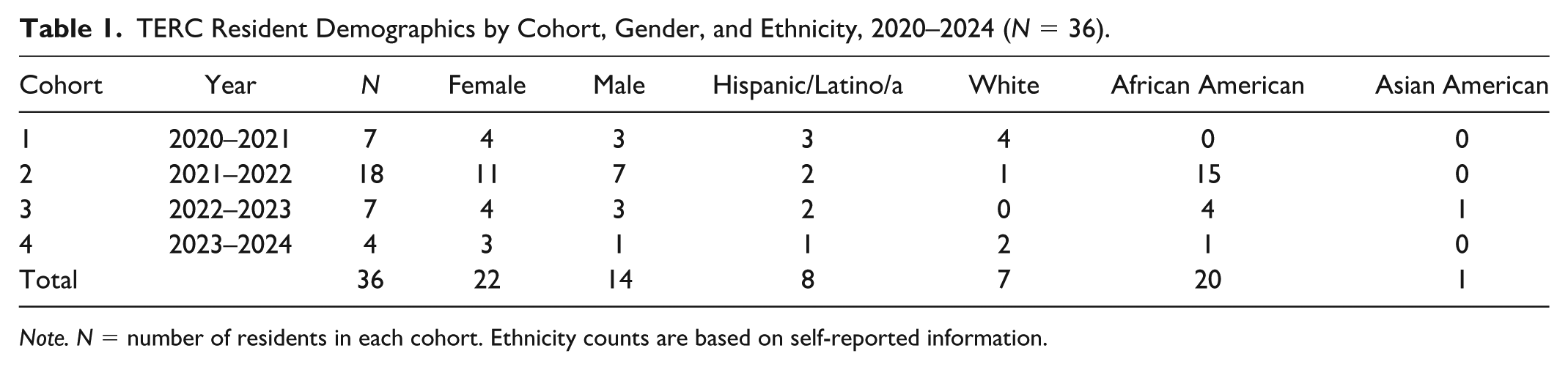
Note. N = number of residents in each cohort. Ethnicity counts are based on self-reported information.
Research Design
An explanatory sequential quantitative to qualitative (QUAN→qual) mixed methods case study design was formed by embedding a follow-up qualitative method within each case resulting in multiple units of analysis per case, that is, quantitative strand data on PL participation and qualitative strand data on participant experience (Creswell, 2022; Creswell & Plano Clark, 2018; Tashakkori et al., 2021). The case study followed an embedded multiple case study design with four cases. Each of the four TERC cohorts was treated as a bounded case (Creswell & Poth, 2025; Yin, 2018). The quantitative strand had priority given the focus on PL participation. There were two primary points of integration in the design. First, quantitative strand results informed development of the qualitative data collection (i.e., connected mixed-methods analysis). Second, qualitative strand results about experience with PL were used to explain the PL results from the initial quantitative strand, that is, integrated analysis and meta-inference (see Figure 2).
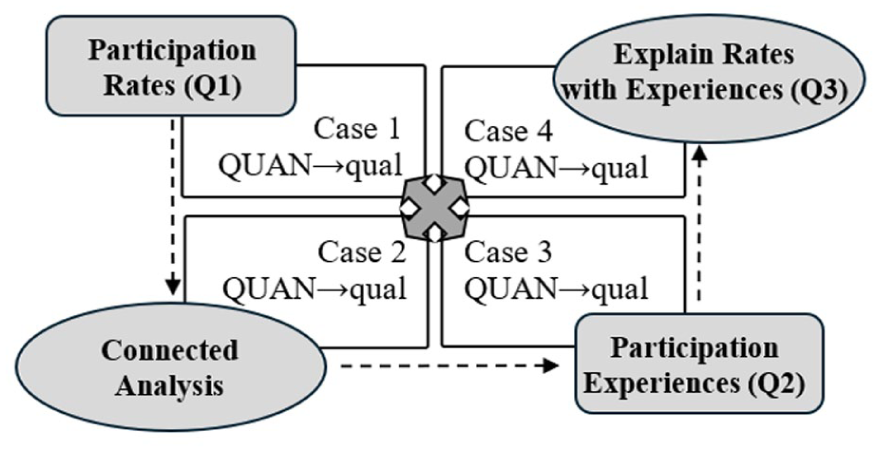
Visual Diagram of Mixed Methods Case Study Design.
Description of Cases
TERC was first implemented at University 1 with Cohort 1 (2021–2022) residents, all of whom had passed certification exams prior to starting residency. Most PL and support activities were introduced throughout the year. Cohort 1 had the fewest required pre-induction PL hours (66.25) of all cohorts. In Year 2 (2022–2023), TERC expanded to include both University 1 and University 2. Two residents from University 1 passed their exams before the residency, whereas 16 University 2 residents took their exams during residency; one was suspended for academic reasons. Cohort 2 required the most pre-induction PL hours (144). In 2023–2024 (Cohort 3), TERC continued across both universities. Two residents (one per university) had already passed exams, whereas five from University 2 worked on certification during the residency. This year offered increased certification support and a slight reduction in PL, totaling 131 hours—the second highest. In the final year (Cohort 4, 2024–2025), one University 1 resident passed certification before the residency; three University 2 residents worked on certification during residency. Implementation involved additional PL support and a significant reduction in total PL requirements. Cohort 4 completed 82 PL hours—the second lowest among the cohorts—reflecting TERC’s evolving focus on targeted PL and exam support over time.
Quantitative Data Collection and Analysis
The quantitative sample consisted of an exhaustive compilation of PL participation data for all residents. Data were gathered through document analysis of program records, including TERC’s online PL platform and annual summaries (Hutchins et al., 2023, 2024a, 2024b). Supplemental program records such as attendance sheets and artifacts were consulted to fill gaps. Programmatic records across cohorts were synthesized into data tables for analysis. Teacher residents engaged in various PL opportunities—ranging from formal workshops to informal gatherings. PL offerings varied yearly, but three consistent categories were established for reporting: TERC-Led core PL, TERC-Led special topics/other PL, and district-led PL (see Table 2).
TERC-Led Core PL
Activities included the Performance Management Portfolio (3-2-1 journal, mentoring, goal setting, reflections), a service-learning project, teacher observation rotations, and a demonstration lesson video.
TERC-Led Special Topics/Other PL
This included webinars, learning community events, TERC Friday presentations, and debriefings with program faculty.
District-Led PL
Activities varied by school district and included new teacher orientation, walkthroughs by principals or coaches, short-term substitute teaching, staff meetings, and professional development days.
For each cohort, the percentage of PL hours completed (resident hours divided by hours required) was calculated by PL type. Engagement data were also disaggregated by certification exam status at residency start. Cross-case analyses of PL percentages used Kruskal–Wallis nonparametric tests for statistical significance between cohorts and exam status. Post hoc Mann–Whitney tests compared cohorts.
Connected Data Analysis
Results from quantitative PL participation analysis identified key areas for further exploration (Creswell, 2022; Creswell & Plano Clark, 2018; Tashakkorri et al., 2021). Five overarching issues were found in program records from the four implementation years: the most valuable PL, the most time-consuming PL, balancing PL with other commitments, support for completion, and the overall amount of PL required. These issues informed the Follow-up TERC PL (FTPL) survey, which included a block of five items (four open-ended, one Likert-type) for each PL type, totaling 15 items. Emails with unique survey links were sent to all current and former residents (N = 36), with embedded fields for cohort and certification exam status. A key benefit of online surveys was real-time data monitoring and responsiveness (Stantcheva, 2023). The FTPL survey also included questions about barriers to PL engagement and potential program improvements, per the literature. Participation was incentivized with a chance to win one of six $25 Amazon gift cards.
Qualitative Data Collection and Analysis
The FTPL survey’s open-ended responses provided qualitative data on residents’ experiences. For qualitative analysis, responses underwent inductive analysis, starting with in vivo coding to capture residents’ key expressions. Descriptive coding was then used to group and characterize these codes. These were further organized into higher-order themes, which were iteratively checked for fit with the raw responses. Coding was refined until no further changes were needed, ensuring the stability of codes and themes. Hierarchy tree diagrams were generated to visually represent connections among thematic, descriptive, and in vivo codes (Creswell & Poth, 2025).
Integrated Cross-Case Methods
Quantitative and qualitative case analyses were integrated to address the mixed methods RQ. For each cohort, quantitative PL engagement data were systematically paired with qualitative themes and representative resident quotes to provide deeper context for observed differences in participation. This integration was supported by a joint display of results (Creswell, 2022; Creswell & Plano Clark, 2018; Tashakkorri et al., 2021) and was guided by the Pillar Integration Process (Johnson et al., 2017; see Figure 2). The Pillar Integration Process involves four key steps: (a) Listing—systematically organizing findings from both quantitative and qualitative strands; (b) Matching—aligning related quantitative results and qualitative themes; (c) Checking—critically assessing consistency and discrepancies between paired data; and (d) Pillar Building—synthesizing these integrated findings into clear meta-inferences. This approach allowed for nuanced interpretation and strengthened the credibility of the integrated results, providing a holistic answer to the RQs.
Results
The findings for the quantitative and qualitative data in this mixed methods case study were evaluated separately for each of the four cases, and then cross-case analyses across the four cohorts were performed. This section of the article organized the results by the quantitative, qualitative, and mixed methods RQs, respectively.
RQ1: How Did Residents’ Engagement in PL Compare Across Cohorts and by Certification Exam Completion?
Cohort 1 residents averaged 77% engagement in the required PL (see Table 2). They engaged the most with the TERC-Led Special Topics/Other PL (89.6% of required hours), followed by TERC-Led Core PL (70.1% of required hours), and engaged the least with District-Led PL (28.6% of required hours). Cohort 2 residents averaged 66.6% engagement in their required PL (see Table 1). They engaged the most with TERC-Led Core PL (87.4% of required hours), followed by the TERC-Led Special Topics/Other PL (45.5% of required hours), and engaged the least with District-Led PL (5.6% of required hours).
Engagement in Required PL by Cohort Year.
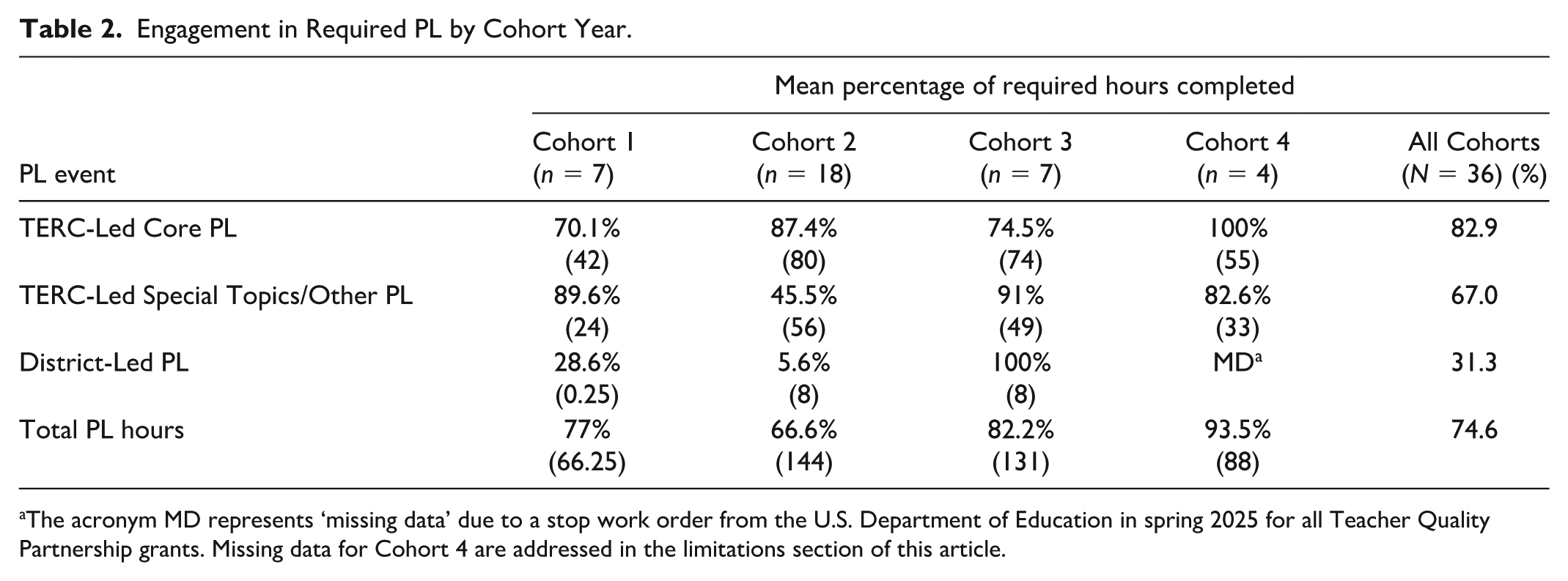
The acronym MD represents ‘missing data’ due to a stop work order from the U.S. Department of Education in spring 2025 for all Teacher Quality Partnership grants. Missing data for Cohort 4 are addressed in the limitations section of this article.
Cohort 3 residents averaged 82.2% engagement in their required PL (see Table 2). They engaged the most with District-Led PL (100% of required hours) and TERC-Led Special Topics/Other PL (91% of required hours). They engaged the least with the TERC-Led Core PL (74.5% of required hours). Cohort 4 residents averaged 93.5% engagement in their required PL (see Table 2) and engaged the most with the TERC-Led Core PL (100% of required hours) and the least with the TERC-Led Special Topics/Other PL (82.6% of required hours).
Across all cohorts, Cohort 4 had the greatest engagement with PL (93.5% of required hours) followed by Cohort 3 (82.2% of required hours). Although Cohort 1 was provided with the least PL, the percentage of engagement was the second lowest (77% of required hours). Cohort 2 was provided with the most PL and had the lowest overall percentage of engagement out of all four cohorts (66.6% of required hours), but Cohort 2 still averaged approximately 96 hours of engagement in PL, which was more hours than was required for Cohorts 1 and 4.
The Kruskal–Wallis test indicated at least one statistically significant difference in PL participation between cohorts in the TERC-Led core PL, H(3) = 8.03, p = .045; the TERC-Led special topics PL, H(3) = 18.07, p < .001; and the total PL, H(3) = 13.46, p = .004. Post hoc Mann–Whitney tests compared the six pairs of cohorts on PL participation. For the TERC-Led core PL, Cohort 4 differed from Cohort 1 (U = 2.0, p = .017) and Cohort 3 (U = 2.0, p = .017). No other pairwise differences were detected between cohorts in TERC-Led core PL participation. For the TERC-Led special topics PL, Cohort 2 differed from Cohort 1 (U = 9.5, p < .001), Cohort 3 (U = 7.5, p < .001), and Cohort 4 (U = 12, p = .034). No other pairwise differences were detected between cohorts in TERC-Led special topics PL participation. For the total PL, Cohort 2 differed from Cohort 1 (U = 30, p = .046), Cohort 3 (U = 7.5, p < .001), and Cohort 4 (U = 1, p = .003). No other pairwise differences were detected between cohorts in total PL participation.
Although Cohort 2 presented large differences in participation by certification status (13.7% more for residents who passed certification exams prior to starting the residency; see Table 3), the difference was not as pronounced across all cohorts (78.8% vs. 72.6%, passed certification exam before and worked on passing during, respectively). The Kruskal–Wallis test did not indicate any statistically significant differences in PL participation between certification groups in the TERC-Led core PL, H(1) = .239, p = .625; the TERC-Led special topics PL, H(1) = 1.66, p = .198; nor the total PL, H(3) = 3.17, p = .075.
Engagement in PL by Certification Status.
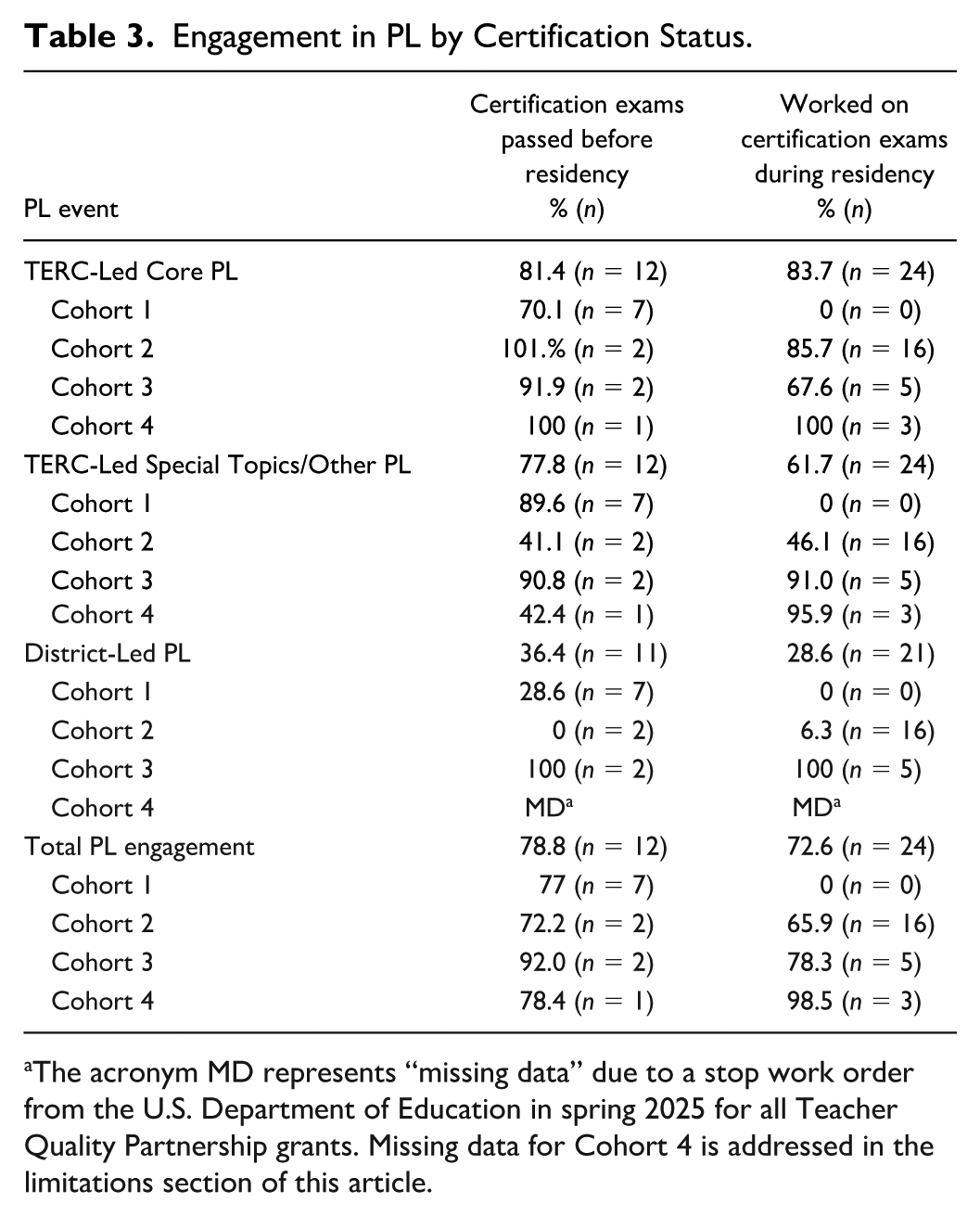
The acronym MD represents “missing data” due to a stop work order from the U.S. Department of Education in spring 2025 for all Teacher Quality Partnership grants. Missing data for Cohort 4 is addressed in the limitations section of this article.
Overall, residents in Cohorts 1, 2, 3, and 4, who had completed certification exams before the start of the residency, engaged in more PL experiences than residents who worked on passing their certification exams during the residency. When PL is poorly conceived for residents who need to pass licensure exams, the result is unintended consequences whereby the resident has the responsibility of completing district and residency PL experiences simultaneously completing obligations during the yearlong residency. According to Ramiah (2014), the variability in engagement observed across the cohorts reflects the inherently dynamic nature of PL, where individual and contextual factors interact in unpredictable ways to shape participation. Furthermore, as Van Cleef (2022) argues, the pressure to prepare for licensure tests can act as a significant barrier to licensure for aspiring teachers, diverting time and energy away from deeper engagement in PL activities.
RQ2: What Were the Experiences of the TERC Residents With Participation in PL During their Yearlong Placements?
Fifty-seven percent of the residents (n = 20) responded to the FTPL Survey which yielded qualitative data related to residents’ perceptions of the amount of PL offered during their residency placements. Most residents reported that the amount of TERC-Led Core PL, TERC-Led Special Topics/Other PL, and District-Led PL were about right (see Figure 3).
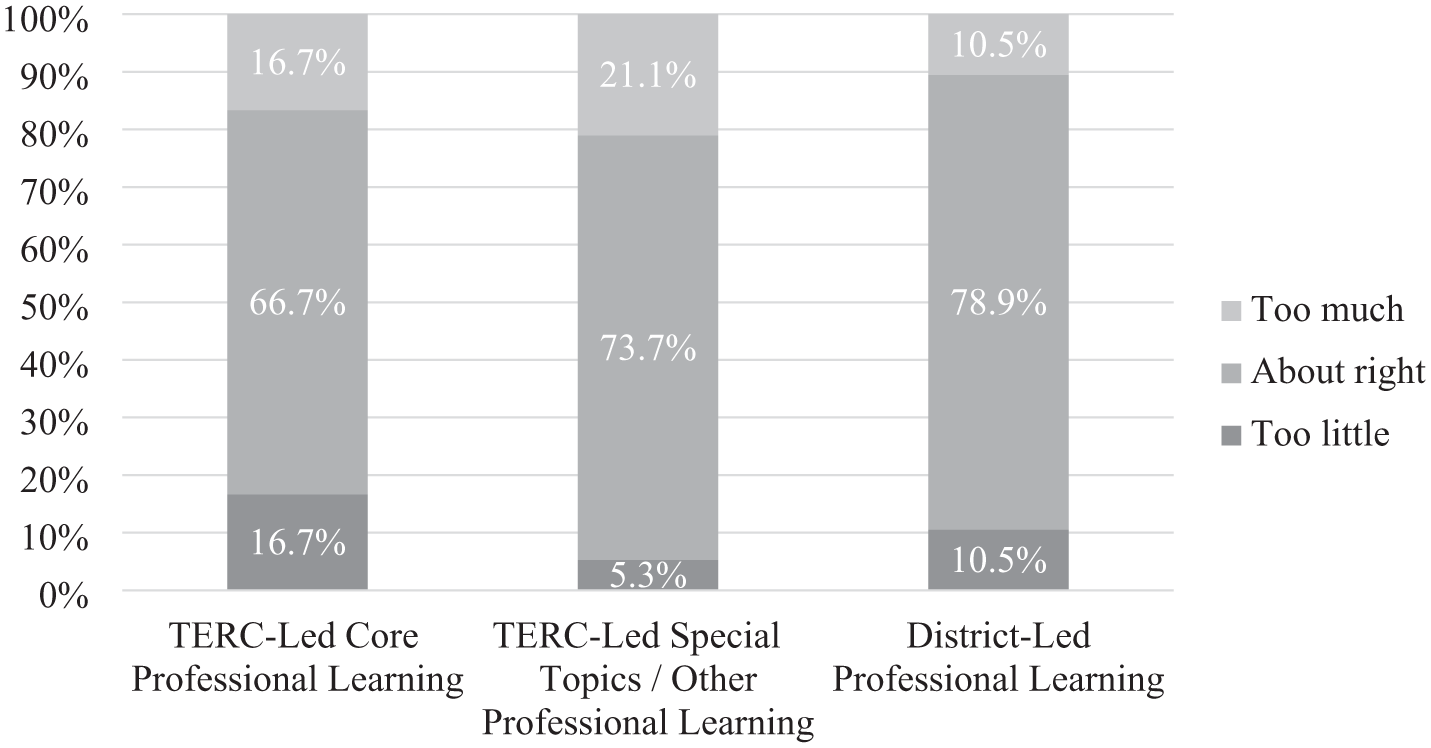
Residents’ Perceptions on the Amount of PL Offered During Their Yearlong Placements.
Of the seven Cohort 1 residents, n = 5 (71.4%) responded to the FTPL survey. Across all Cohort 1 responses, there was consensus on the use of outside work hours for TERC activities, which conflicted with personal lives. Only seven of the 18 cohort two residents responded to the FTPL survey (38.9%), and the overall subjects of their responses related to the value and time-consuming aspects of certification exam preparation, which often conflicted with time outside of work hours. Several Cohort 3 residents, n = 4 (57.1%), responded to the FTPL survey, and the general topics related to leveraging structured time, people resources, and time outside of work hours to complete tasks. All Cohort 4 residents, n = 4 (100%), responded to the FTPL survey, and three overall messages emerged that were related to effective time management, the well-structured program design, and consistent support from the mentor teacher and TERC staff.
From a complexity theory perspective, these varying patterns in response rates and experiences across cohorts highlight the adaptive nature of teacher education programs, where multiple factors dynamically interact (Davis & Sumara, 2014). As Martin and colleagues (2019) note, changes in program structure and support over time can generate new outcomes, with later cohorts (such as Cohort 4) experiencing greater coherence and support due to prior feedback and system adjustments. The emphasis on support and structure in later cohorts suggests the emergence of positive feedback loops, which enhance overall system resilience (Davis & Sumara, 2014). Furthermore, ongoing struggles with managing program demands and personal commitments point to the unpredicatable realities of teacher preparation and the need for adaptable program designs (Martin et al., 2019).
Cohort Perceptions of TERC-Led Core PL
Cohort 1 respondents were split 50%–50% (about right or too much) around the amount of TERC-Led Core PL. Mentoring with an experienced teacher and the service-learning project were the most valuable core PL. The 3-2-1 reflective journal and scheduled meetings were the most time-consuming PL activities. The residents struggled a bit to balance the time needed to participate in TERC-Led Core PL, often relying on time outside of work hours or conference periods. Residents found support for their TERC-Led Core PL from the mentor teacher and TERC staff.
Eighty-three percent (n = 5) of Cohort 2 respondents felt the amount of TERC-Led Core PL was about right (17% too little). The most valuable TERC-Led Core PL included certification exam preparation, activities related to classroom practices (i.e., co-teaching, rotations), and the service-learning project. The most time-consuming TERC-Led Core PL activities included certification exam preparation and the postconference activities with the mentor teacher. To balance time for participation in TERC-Led Core PL, residents used prioritization strategies, completed activities outside of work hours, and leveraged free periods during the workday. Residents found support for their TERC-Led Core PL from the motivational and encouraging messages from TERC staff.
Fifty percent (n = 2) of Cohort 3 respondents felt the amount of TERC-Led Core PL was about right (25% too little, 25% too much). The most valuable TERC-Led Core PL included activities related to hands-on classroom activities (i.e., observations, rotations, co-teaching) and PL related to classroom practices (lesson planning, classroom management). The most time-consuming TERC-Led Core PL included the 3-2-1 reflective journal, working on classroom management practices, and the community project. To balance time for participation in TERC-Led Core PL, residents used time blocking, planning calendars, and time outside of work hours. Residents found support for their TERC-Led Core PL from their mentor teacher, district points of contact, and TERC staff.
Seventy-five percent (n = 3) of Cohort 4 respondents felt the amount of TERC-Led Core PL was about right (25% too little). The most valuable TERC-Led Core PL included the service-learning project, hands-on classroom activities (i.e., teaching rotations, co-teaching with mentor teacher), and the PL conference. The most time-consuming TERC-Led Core PL included the service-learning project (one resident reported over 50 planning hours), 3-2-1 reflections, and required classroom hours (co-teaching and classroom practicum hours). To balance time for participation in TERC-Led Core PL, residents prioritized, scheduled, and used planning calendars. Residents found support for their TERC-Led Core PL from the mentor teacher, TERC staff (clear expectations, regular check-ins), TERC resources, and the structured program design.
Across cohorts, two forms of TERC-Led core PL emerged as the most valuable PL activities provided during the residency year: classroom-based training with master teachers as well as community-based experiences. Classroom-based experiences included mentoring sessions and co-teaching. Residents also valued rotations which were opportunities to observe master teacher in diverse classroom settings and real-time feedback and modeling from veteran teachers other than their mentor teacher. The service-learning projects were at the core of the community-based experiences, providing residents with a connection to the community they were teaching in, an understanding of the students’ needs at their schools, and the importance of community engagement and culturally responsive teaching. Garcia and Weiss (2019) emphasize the importance of these types of early career PL experiences within schools, where teachers can share best practices and support each other’s development.
Cohorts Perceptions of TERC-Led Special Topics/Other PL
Eighty percent of Cohort 1 respondents in the FTPL survey felt the amount of TERC-Led Special Topics/Other PL was about right (20% too much). The most valuable TERC-Led Special Topics/Other PL included skill-based webinars and events that allowed the residents to connect, build community, and hear others’ experiences. Activities that required documenting time or scheduled meetings were the most time-consuming. For participation in the TERC-Led Special Topics/Other PL, residents relied on calendars or other planning strategies and sometimes simply avoidance.
Fifty percent (n = 3) of Cohort 2 respondents felt the amount of TERC-Led Special Topics/Other PL was about right (17% too little, 33% too much). The most valuable TERC-Led Special Topics/Other PL included events with the cohort, certification exam preparation sessions, and time management. The most time-consuming TERC-Led Special Topics/Other PL included certification exam preparation, the 3-2-1 reflective journaling, and the 1-hr seminars during the week. Seventy-five percent (n = 3) of Cohort 3 respondents felt the amount of TERC-Led Special Topics/Other PL was about right (25% too much). The most valuable TERC-Led Special Topics/Other PL included webinars and structured reflection and self-assessment activities. The most time-consuming TERC-Led Special Topics/Other PL included modules and engaging in activities related to data-driven instruction. One hundred percent (n = 4) of Cohort 4 respondents felt the amount of TERC-Led Special Topics/Other PL was about right. The most valuable TERC-Led Special Topics/Other PL included hands-on learning (i.e., collaborative lesson planning sessions and instructional rounds) and events with the cohort. However, one resident commented that “the additional PL was supportive but not educational.” The most time-consuming TERC-Led Special Topics/Other PL included portfolio development and weekly 1-hr learning community meetings.
Across cohorts, two forms of TERC-Led special topics/Other PL emerged as the most valuable PL activities provided during the residency year: relationship-building experiences and skill-based learning experiences. To balance time for participation in TERC-Led Special Topics/Other PL, Cohort 1 relied on calendars or other planning strategies and sometimes simply avoidance; Cohort 2 used prioritization strategies, completed activities outside of work hours, and leveraged free periods during the workday; Cohort 3 set goals and completed activities outside of work hours; and Cohort 4 prioritized and planned ahead. The relationship building experiences included summer orientation, monthly TERC Friday events, and cohort-based events (e.g., lunches, conferences, trips). Furthermore, two forms of TERC-Led special topics/Other PL emerged as the most valuable PL activities provided during the residency year: relationship-building experiences and skill-based learning experiences. These relationship building experiences helped the residents develop a sense of community with their peers. The skill-based learning experiences included the 1-hr webinars and TERC-Led Friday events. Residents valued learning about instructional practices, classroom management, and lesson planning.
Cohort Perceptions of District-Led PL
Sixty percent of Cohort 1 respondents from the FTPL survey felt the amount of District-Led PL was about right (20% too little, 20% too much). Cohort 1 residents were a little mixed on their perceptions of District-Led PL. While two residents highlighted learning valuable classroom strategies, the remainder either could not recall or explicitly did not find much value in the District-Led PL. Onboarding and special education training were the most time-consuming District-Led PL activities. One hundred percent (n = 6) of Cohort 2 respondents felt the amount of District-Led PL was about right. The most valuable District-Led PL focused on lesson planning, special education, and the district curriculum. The most time-consuming District-Led PL were the required PL sessions at the beginning of the school year as well as those taking up an entire school day. When it came to balancing time for participation in District-Led PL, residents recognized that it was a job requirement but felt it competed with other priorities.
Fifty percent (n = 2) of Cohort 3 respondents of the FTPL survey felt the amount of District-Led PL was about right (25% too little, 25% too much). The most valuable District-Led PL included training the district curriculum and aligning lessons and assessments with district-specific standards and expectations. The most time-consuming District-Led PL included data-driven instruction, monthly staff PL meetings, disorganized meetings, and being used for duties outside of teaching. One hundred percent (n = 4) of Cohort 4 respondents of the FTPL survey conveyed that the amount of District-Led PL was “about right.” The most valuable District-Led PL included district PL days, summer PL, and new teacher orientation. The most time-consuming District-Led PL included online training, after school events, and school orientation.
Across cohorts, all residents found support for their District-Led PL from their mentor teachers, campus leadership, residency coordinators, and TERC staff. In addition, all District-led PL such as summer orientation, PL days, and other district-led PL sessions were generally found to be worthwhile by the residents. The district-sponsored PL experiences focused on skills related to special education, behavior management, the required district curriculum, and alignment of lessons and assessments. To balance time for participation in District-Led PL Cohort 1 residents either used conference periods or relied on time outside of work, Cohort 2 adjusted their perspective and recognized that the PL was a job requirement but felt it competed with other priorities, Cohort 3 residents collaborated with colleagues and leaned on their teacher mentor, and Cohort 4 residents proactively managed their schedules and often completed tasks outside of work hours. Coordination within SUPs is essential to ensure that both the program and district leadership work toward shared PL goals and outcomes. Effective PL coordination helps align resources, schedules, and curricula, maximizing the benefits for residents and other stakeholders, and facilitates clear communication, preventing misunderstandings and duplications of effort. Ultimately, strong PL coordination enhances the overall impact and sustainability of the teacher residency.
Cohort Perceptions of Barriers and Improvements
When asked about barriers to engagement in PL opportunities during the residency, Cohort 1 residents highlighted the amount of paperwork to document activities; their busy, time-constrained schedules; and the after-hour meetings and activities that conflicted with their outside lives. Cohort 2 residents highlighted the number of priorities and challenges balancing TERC responsibilities with school and personal responsibilities. Cohort 2 residents expressed that teaching strategies, time management, certification exam preparation, and setting aside specific PL time should be prioritized with future residents. Cohort 3 residents highlighted insufficient guidance or resources for working with students with special needs and challenges with their mentors. They also expressed expectations, processes, and goals that should be prioritized with future residents. Two of Cohort 4 residents highlighted juggling multiple responsibilities as a barrier to PL, whereas two commented that there were no barriers engaging in PL.
Across cohorts, respondents provided similar information when asked about barriers to engagement in PL and programmatic elements that should be prioritized for future residents. Consistent with the resident perceptions of time-consuming activities and how they worked to balance their time, residents identified competing priorities, time management issues, and time outside of work hours as the biggest barriers to their engagement with PL.
Juggling lesson planning, classroom management, coursework, and both TERC- and district-led trainings often felt overwhelming, especially during peak periods like assessment cycles or report card deadlines. There were times when the workload made it difficult to fully engage in professional learning sessions or reflect deeply on new strategies.
Residents from all cohorts articulated the importance of prioritizing classroom management in PL for future TERC residents. Cohort 1 recommended emphasizing classroom management PL, incorporating asynchronous supports, minimizing synchronous sessions to essential activities, fostering cohort collaborations, and providing real-time support during school hours. Cohort 2 echoed the need for classroom management and also suggested coaching and online PL opportunities. Cohort 3 proposed structured PL plans aligned with residency goals, balancing hands-on classroom experience with time for reflection and study, offering seminars on classroom management, task persistence, relationship building, and maintaining easy access to TERC support. Similarly, Cohort 4 advocated for hands-on learning experiences, focusing on classroom management, differentiated instruction, and culturally responsive teaching. Cohort 4 also emphasized the need for time management strategies, protected time for PL activities, and ongoing communication with the TERC team. Collectively, these suggestions aim to enhance support and effectiveness for future residents.
The PL that should be prioritized for future residents included classroom management skills and time management skills were the two most frequently cited areas. Other less frequently cited PL priorities included culturally responsive teaching and special education. A second resident proposed, Classroom management, differentiated instruction, and culturally responsive teaching. These areas are essential for creating inclusive, well-managed learning environments where all students can thrive. Additionally, prioritizing hands-on opportunities such as co-teaching, instructional planning, and data-driven decision-making will help residents build real-world skills that directly impact student achievement. Ongoing mentorship, support in navigating certification requirements, and training on building strong family and community partnerships should also be emphasized to ensure residents are fully prepared for the demands of the classroom.
The support that should be prioritized for future residents included keeping lines of communication open and continuing to offer opportunities for engagement and collaboration (e.g., coaching, peers, mentor teacher). For example, a third resident praised TERC for: . . . checking in on [residents] personally to make sure that they are getting lots of info from the school they are placed at, while also understanding all that is expected of them within their assignments; the text messages, emails, and meetings should continue to be prioritized for the residents because it is a great amount and type of support.
Eroglu and Donmus Kaya (2021) emphasize that without systemic supports to manage workload and facilitate effective time management, teachers (and by extension, residents) are less able to deeply engage in or reflect on new strategies introduced in PL. This research further validates residents’ recommendations to prioritize not only classroom management and differentiated instruction but also targeted training in time management and the protection of time for PL activities, as these will enhance residents’ ability to balance competing demands and ultimately improve their professional growth and effectiveness.
RQ3: How Do the Residents’ Experiences Contextualize and Explain Participation in PL Opportunities in the TERC Program?
The findings discussed in this article recognize the amount, support, and degree of engagement in PL impact teacher residents’ ability to manage their professional and personal time in the TERC program. Three themes related to balance emerged from the quantitative and qualitative findings: (a) an appropriate quantity of PL experiences, (b) an appropriate measure of PL programmatic support and (c) the ability of residents to hone time management skills to succeed in all their competing yearlong residency responsibilities—operating together to moderate the residents’ experience with the PL (see Figure 4).
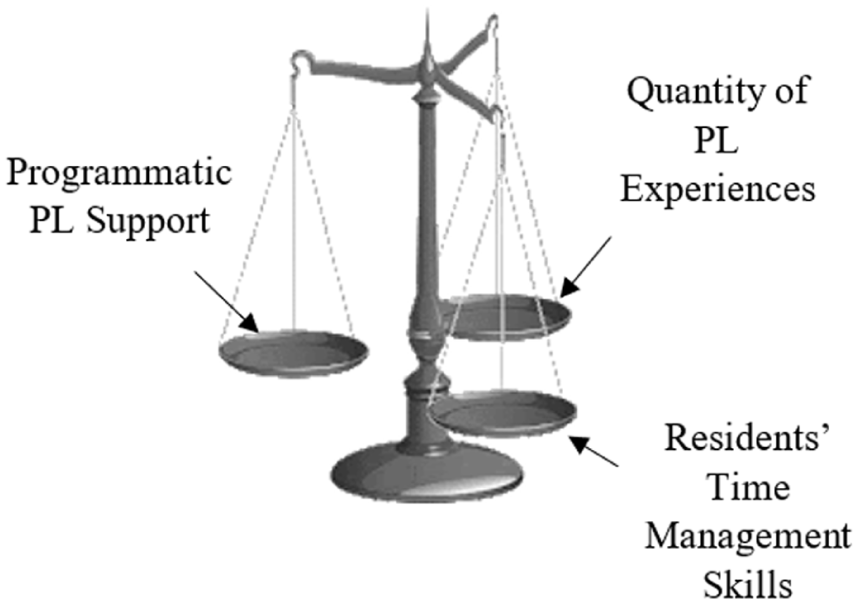
Three Themes for PL Among TERC Residents: Support, Quantity of PL Experiences, and Time Management Skills Represented in a Tripan Balance.
A Balance of Adequate PL Type With the Appropriate Quantity of PL Experiences
TERC leaders and P12 school district partners determined how much PL was required, the type of PL, and the level of programmatic support offered. The quantity and intentionality of PL improved from the first to the fourth cohort. A yearlong residency provides preservice teachers with diverse program PL experiences, including experiential, observation, mentorship, and collaborative learning opportunities, alongside traditional district PL. However, effective PL implementation requires more than a “kitchen sink” approach. PL experiences must be carefully synchronized between university and school district calendars so residents avoid being overwhelmed and can benefit from opportunities designed to improve their teaching effectiveness.
A Balance of Adequate PL Type With the Right Measure of Programmatic Support
PL type varied across years in response to continuous improvement data and shifting cohort composition. For example, from Cohorts 1 to 2, the expansion of the TERC program from University 1 to both Universities 1 and 2 resulted in the largest shift in certification status. Lower than desired PL participation characterized Cohort 1, dropped with Cohort 2, and then improved with Cohorts 3 and 4. Time spent on PL for certification exam preparation, rather than on residency-sponsored PL, introduced extra stress, resulting in the double duty phenomenon—the unintended consequence for residents managing both the many components of the residency and obligations for licensure PL requirements. Because PL is vital regardless of certification status, implementation (i.e., type, amount, and specific supports) should acknowledge residents’ unique stressors and be adjusted to minimize double duty. We recommend residency implementers incorporate less formulaic, and more process-oriented adjustments that protect both residents and the residency experience. The results of this study indicate that effective PL is determined not just by the frequency or timing of activities, but by how well these activities are tailored to residents’ immediate classroom contexts, professional goals, and real-world instructional challenges. In addition, support systems—including mentors, staff, and peers within the cohort—played a pivotal role in guiding residents through the complexities of PL and supporting their development as educators.
Residents’ Ability to Develop Time Management Skills to Balance Competing Yearlong Residency Responsibilities
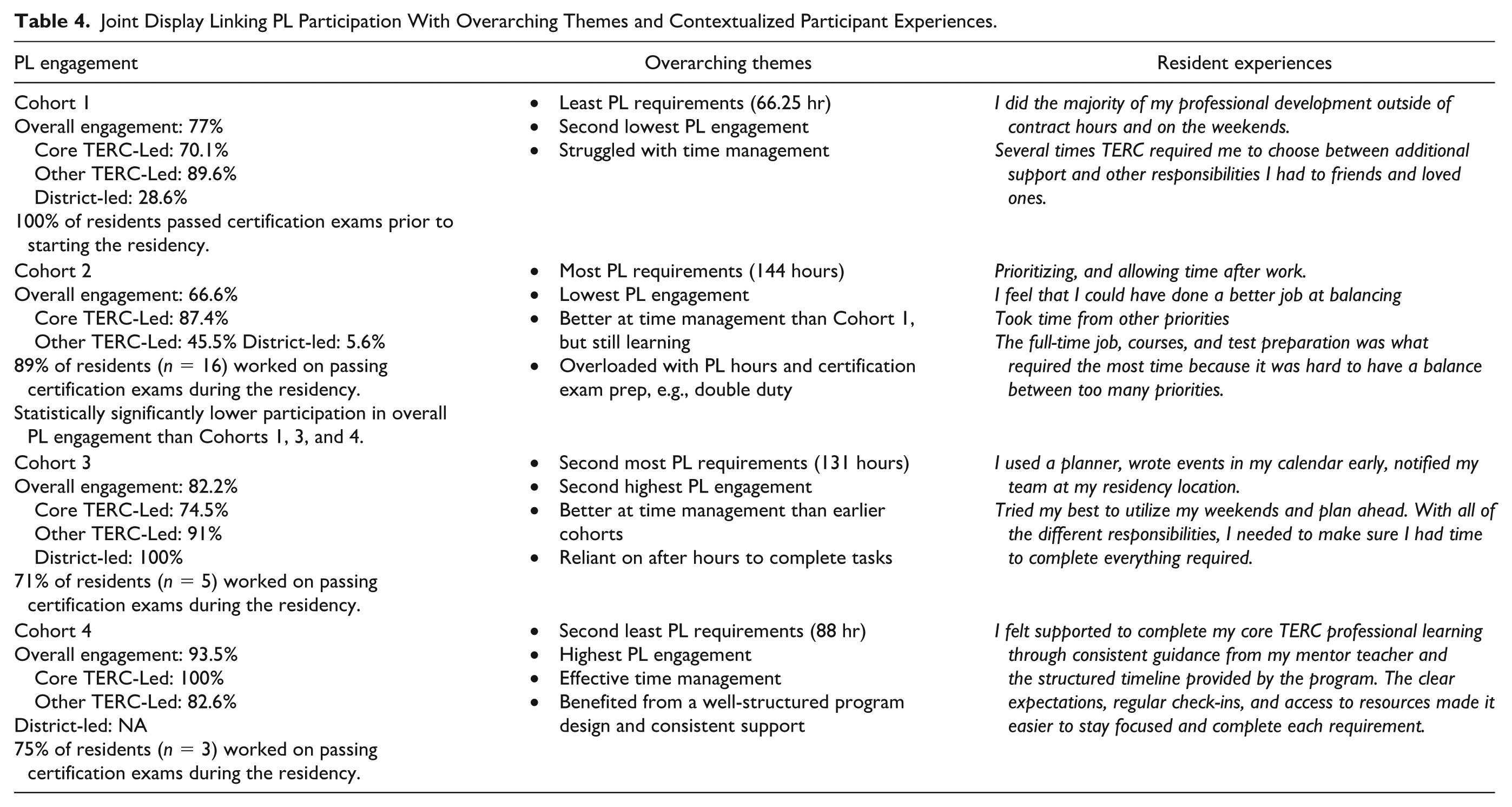
In the absence of selected PL provided by residency programs and school leaders, Cohort 1 struggled to balance and manage time. Cohort 2 included more residents who had not passed the licensure exam, yet TERC leaders delivered more PL hours, and engagement in required PL opportunities dropped. After PL became better planned and adjusted by program leaders, Cohorts 3 and 4 benefited from better-balanced expectations and support, helping them manage time and participate in more PL. Residents especially valued practical, hands-on experiences, mentorship, and collaborative opportunities, whereas activities viewed as administratively demanding and time-consuming were the most challenging to manage. Differences in responses across cohorts highlight that uniform PL strategies may not yield the best outcomes; instead, fostering flexibility and attentiveness to resident feedback creates a more nurturing and effective learning environment. Residents’ ability to manage time among competing priorities improved as residency leaders safeguarded the residency experience (see Table 4).
To the uninitiated, these themes around PL implementation may seem obvious or self-evident. However, it is only through implementation of PL during the residency, bounded by the SUP structure, that such evaluations of the system become visible. Davis and Sumara (2014) emphasize educational systems as malleable networks where learning emerges from dynamic interplay among diverse agents and contexts. Thus, attempts to oversimplify or standardize PL may overlook the nuanced relationships and feedback that shape resident engagement and development. Effective PL implementation requires leaders to respond thoughtfully to emergent patterns and adapt structures, accordingly, not just rely on predetermined best practices. By balancing PL quantity and support, as well as fostering residents’ time management skills, learning outcomes can be fully actualized.
Joint Display Linking PL Participation With Overarching Themes and Contextualized Participant Experiences.
Limitations and Future Studies
While this mixed methods case study on residents’ PL faces four key limitations that constrain its findings, the resulting four research recommendations offer promising directions for future investigation. These limitations provide a foundation for more robust studies ahead, generating considerable optimism for advancing our understanding of PL within teacher residencies.
Limitations
The findings of this mixed methods case study are impeded by four primary limitations. First, while nonparametric statistical analyses were used for PL participation data, the quantitative findings require cautious interpretation due to issues with normality, unequal variances, and unequal sample sizes. Second, the qualitative analysis lacked follow-up member checking and the use of multiple coders, which could affect validity. Nonetheless, constant comparison, theoretical saturation, and hierarchy tree diagrams were employed to strengthen the credibility, confirmability, and dependability of qualitative themes. Third, generalizability is limited because findings are based solely on participating TERC residents. The focus was on generating context-based causal explanations related to residents’ PL participation, but concerns regarding legitimation—including sample integration, sequential design, and multiple validities—remain and should be considered (Onwuegbuzie & Johnson, 2006).
Fourth, the study was limited by missing district-led PL data for Cohort 4, as indicated in Table 2. The absence of these quantitative measures was addressed by analyzing qualitative data from the FTPL Survey, which was completed by all Cohort 4 residents. These rich narratives provided insights into their PL experiences and suggested patterns relevant to the overall RQs, demonstrating a key strength of mixed methods research—using different data types to compensate for single-source gaps.
Recommendations for Future Studies
Building on this mixed methods study, four prospective directions for future research on residents’ PL are recommended. First, program leaders should examine regular data collection protocols through digital platforms where residents document student learning outcomes and reflect on pedagogical effectiveness, creating feedback loops that inform both individual growth and program-wide improvements. Second, practitioners and scholars could research processes for integrating certification exam preparation into authentic PL experiences by having residents create assessment materials and teaching strategies that simultaneously prepare them for licensure requirements while developing practical classroom skills. Third, teacher residency program scholars must continue foregrounding equity as a critical site of interrogation among residencies (Hill-Jackson et al., in press, 2023, 2024). For example, studies on PL communities could center equity whereby residents from diverse backgrounds engage in ongoing dialogue about dismantling educational inequities while receiving targeted support for overcoming systemic barriers to certification success. Fourth, examination of structured mentorship cycles is needed wherein residents collaborate with experienced teachers to develop lesson plans and curricula that connect to P12 students’ community experiences and cultural backgrounds.
PL as a Component of a Complex Teacher Residency: Implications for Program and P12 School Leaders
The implications of this current study on PL for teacher residents are intricate and layered. Complexity theory, when applied to teacher residency as a multilevel system, acknowledges that residents’ PL is shaped by numerous, interconnected factors, such as partnerships with schools and universities, licensure requirements, mentoring relationships, and coursework—that constantly interact in unpredictable ways. Rather than viewing resident development as a simple or linear process of gaining skills, complexity theory reveals that learning is nonlinear and adaptive, influenced by ongoing feedback within and across subsystems of the residency. This framing helps explain the challenging “balancing act” faced by program and P12 school leaders as they attempt to coordinate the many, often competing, components of teacher residency programs while also preparing residents for meaningful and sustainable PL experiences. The implications of this study are envisioned as five key policy and practice conditions for school-university leaders managing residency programs and seeking to optimize residents’ PL and development. These conditions include both the substance and strategies residency leaders can enact to improve residents’ capacity to reflect, learn, and develop as teachers.
Systems Thinking in Residency Leadership
Opportunities to improve stakeholders’ collective sensemaking and collaborative implementation to optimize the benefits and potentials of teacher residency partnerships must be prioritized (Chu, 2022). These programs exist in a “third space” where multiple subsystems interact dynamically. Effective residency leaders employ systems thinking to navigate these complexities, organizing supportive structures for residents while fostering meaningful collaboration. As Martin and Dismukes (2018) observe, these intertwined systems continuously influence each other as program activities unfold, requiring leaders who can manage dynamic, multilayered environments.
Key Strategies for Systems-Thinking Leaders
Map System Interdependencies: Create visual representations of how university coursework, school placements, mentor relationships, and district requirements interconnect, identifying potential friction points and leverage opportunities for systemic improvements.
Establish Cross-System Communication Protocols: Develop regular communication channels between university faculty, school administrators, mentor teachers, and district leaders to ensure alignment and rapid response to emerging challenges across subsystems.
Design Flexible Feedback Loops: Implement responsive mechanisms that allow for real-time adjustments when changes in one subsystem (such as new district policies or university requirements) create ripple effects throughout the residency program.
Intentionally Curated PL Experiences
PL in residency programs must be strategically designed and paced to respect residents’ time constraints while meeting their developmental needs. Rather than adding supplementary requirements, PL should be seamlessly integrated into teacher preparation programs as credited coursework that is job-embedded, relevant, and supportive of resident learning while maintaining work–life balance.
PL offerings must be deliberate and scaled to align with competing subsystem demands and district-specific needs. They should remain concise, well-aligned, and tailored to individual residents’ professional growth and classroom realities. Davis and Sumara (2014) note that sophisticated educational systems often produce unexpected results due to their unpredictable, interconnected nature. For instance, when new licensure exam challenges emerge, preparation should be thoughtfully woven into the existing PL portfolio rather than imposed as additional burden.
Key Strategies for Curated PL
Conduct Regular Needs Assessments: Use data from classroom observations, resident self-reflections, and mentor feedback to identify specific skill gaps and adjust PL offerings, accordingly, ensuring content remains directly applicable to residents’ immediate teaching contexts.
Create Modular, Stackable Learning Experiences: Design PL components that can be combined, modified, or replaced based on emerging needs without disrupting the overall program structure, allowing for responsive adaptation while maintaining curricular coherence.
Continuous Improvement Through Ongoing Feedback
Effective residency programs depend on continuous improvement cycles driven by ongoing feedback that identifies successes and improvement areas. Efficient data collection tools—brief surveys, group discussions, and individual check-ins—capture evolving resident needs in real time, simultaneously informing necessary PL topics and system adjustments.
Hutchins et al. (2023, 2024a, 2024b) and Walton (2014) emphasize that evaluation is iterative, not episodic. The TERC program exemplifies this approach, where assessment, reflection, and action cycles enabled implementers to balance PL quantity and quality. Cohort 4 demonstrated greater coherence and support due to feedback-driven system improvements from previous iterations.
Key Strategies for Continuous Improvement
Implement Rapid Cycle Feedback Systems: Establish weekly or bi-weekly micro-feedback loops using brief pulse surveys or structured reflection protocols that allow for immediate program adjustments rather than waiting for end-of-semester evaluations.
Create Cross-Cohort Learning Networks: Facilitate structured opportunities for current residents to learn from previous cohorts’ experiences while enabling alumni to contribute insights that inform ongoing program refinements and mentor development.
PL Within Mentor-Resident Dyads
The yearlong mentor–resident relationship creates unique opportunities for collaborative, inquiry-based PL aligned with P12 classroom realities. Aspiring teachers should observe and experience the pedagogical strategies they are expected to develop for their students. Mentors committed to modeling effective practices and lifelong learning serve as critical actors in powerful PL experiences. Through joint participation, mentors facilitate deeper, richer learning opportunities for residents.
Key Strategies for Mentor-Resident PL
Establish Co-Teaching and Co-Reflection Protocols: Structure regular opportunities for mentors and residents to plan lessons together, co-teach specific segments, and engage in immediate post-lesson debriefing that focuses on pedagogical decision-making and student impact.
Develop Inquiry-Based Learning Cycles: Guide mentor-resident pairs through systematic classroom inquiry projects where they jointly identify student learning challenges, research evidence-based strategies, implement interventions, and analyze results together.
Incentivizing Engagement and Application
Since most PL for aspiring teachers is typically non-credit bearing and under-accessed (Tang et al., 2017; White, 2021), meaningful incentives can significantly boost resident engagement. Strategies include providing critical feedback on PL activities, granting credit that increases hiring step placement, offering release time, micro-credentials, continuing education credits for license advancement, and classroom resources. These incentives provide residents with freedom and flexibility to explore, experiment, and integrate new instructional strategies developed through PL experiences, ultimately enhancing their preparation and effectiveness as beginning teachers.
Key Strategies for Incentivizing PL
Develop Portfolio-Based Advancement Systems: Create comprehensive documentation systems where residents showcase PL application through lesson artifacts, student work samples, and reflective analyses that directly contribute to hiring recommendations and salary placement decisions.
Partner with Districts for Resource Allocation: Negotiate agreements where districts provide classroom materials, technology, or curriculum resources to residents who complete specific PL modules, creating immediate classroom benefits that motivate engagement.
Establish Tiered Recognition Programs: Design progressive acknowledgment systems that offer increasingly valuable rewards (from digital badges to conference presentation opportunities to leadership roles) based on depth of PL participation and demonstrated classroom application.
The implications discussed in this section of the article propose a conceptualization which moves us beyond a focus on the effects of PL activity to consider the ways in which leadership and individual orientations may moderate PL for the resident. The critical point here is not that leaders of residencies identify PL content solutions (although substance of PL is a crucial point). Rather, the main issue here is that system thinking compel school-university leaders “to consider how they are implicated in the phenomena that they study and, more broadly, to acknowledge that their descriptions of the world exist in a complex (i.e., nested, co-implicated, ambiguously bounded, dynamic, etc.) relationship with the world” (Davis & Sumara, 2014, p. 15).
Conclusion
Program and P12 school leaders face a major challenge—a kind of balancing act—as they administer the multiple elements of a teacher residency program while simultaneously providing substantive PL opportunities for residents. Applying complexity theory, three themes surfaced from the quantitative and qualitative findings (N = 36): (a) an appropriate quantity of PL experiences must be balanced with (b) an adequate measure of PL programmatic support, and (c) residents’ ability to hone time management skills to succeed in all their competing responsibilities during a yearlong residency. Differing responses across four teacher residency cohorts in the TERC program suggest that a standardized approach to PL may not yield optimal outcomes for residents. This study’s four limitations including statistical analysis issues, lack of qualitative validation, limited generalizability, and missing data, led the authors to recommend four future research directions: digital documentation platforms, integrated certification preparation, equity-centered PL communities, and structured mentorship cycles.
Recognizing and actively managing the unpredictable interplay among subsystems in residency programs may lead to more responsive PL opportunities for aspiring teachers. The implications of this study are fashioned as five key policy and practice conditions for teacher residency program and P12 leaders: (a) systems thinking, (b) curated PL, (c) continuous improvement, (d) PL for resident-mentor dyads, and (e) appropriate incentives. How do teacher residents’ experiences contextualize and explain their participation in PL opportunities within the TERC program? The answer can be summarized in one word: balance.
Footnotes
Acknowledgements
We thank our student research worker, Paige Scott, for her assistance with this project. We are also deeply grateful to the teacher residents in this study who were willing to be so transparent with their professional learning experiences in support of current and future teacher residents.
Declaration of Conflicting Interests
The authors declared no potential conflicts of interest with respect to the research, authorship, and/or publication of this article.
Funding
The authors disclosed receipt of the following financial support for the research, authorship, and/or publication of this article: This project received funding support from the U.S. Department of Education, project number S336S200027.
