




Abstract
Mentoring is acknowledged as an essential prerequisite for successful teacher induction, but its effectiveness may vary depending on the mentor’s quality of support and the mentee’s initial professional beliefs. Focusing on novice teachers’ self-efficacy and emotional management, this longitudinal study investigates how constructivist- and transmission-oriented mentoring approaches support beginning teachers’ professional development, and how these approaches interact with the novices’ initial beliefs about teaching and learning. The data stem from a sample of 138 beginning teachers who participated in an online survey during their second and third trimesters of practical training in Germany. Moderated regression analyses indicate positive effects of constructivist mentoring on teacher self-efficacy 6 months later, and an enhancing moderation effect of mentees’ mismatching, transmissive beliefs. Results neither support distinct effects of constructivist mentoring on novices’ emotional management nor associations between transmissive mentoring and the outcomes. Implications for mentoring research and practice are discussed.
Keywords
Introduction
School-based mentoring is an integral part of teacher induction programs worldwide, intended to support beginning teachers’ skill acquisition and well-being (Howe, 2006; Ingersoll & Strong, 2011). The effectiveness of mentored learning to teach depends upon the learning approach a mentor bases his mentoring practice on (Feiman-Nemser, 2001; Richter et al., 2013; Wang & Odell, 2002). Although transmission-oriented mentoring practices, rooted in a behaviorist learning theory, seem largely ineffective in supporting beginning teachers, first studies highlight the benefits associated with a mentoring practice oriented toward constructivist principles of learning (Burger et al., 2021; Linninger, 2016; Richter et al., 2013). However, little is yet known about the capability of these mentoring approaches to promote self-regulatory and motivational competences, which are important prerequisites for a successful and healthy teaching career (Brouwers & Tomic, 2000; P. W. Richardson et al., 2013; Tynjälä & Heikkinen, 2011). To address this gap in the literature, the present, longitudinal study focuses on constructivist- and transmission-oriented mentoring and their influence on beginning teachers’ self-efficacy and surface acting as part of their emotional management. Teacher self-efficacy is viewed as essential for the conservation of resources during teaching-related tasks (Baumert & Kunter, 2006; Zee & Koomen, 2016). Surface acting, in contrast, is assumed to exploit teachers’ resources and undermine their well-being in the long term (e.g., Himbert & Imhof, 2022; Keller et al., 2014). Thus, both aspects of professional teacher competence are closely associated with the regulation of one’s personal resources at work.
Beside the learning approach underlying an experienced teacher’s mentoring practice, the prior beliefs about teaching and learning a novice bring into the induction program as an individual characteristic play an important role in mentored professional learning (cf. Kunter et al., 2013; Levin, 2015). Novice teachers’ initial constructivist and transmissive beliefs about teaching may be congruent with their mentors’ approach or not, which is assumed to influence how mentoring as a learning opportunity unfolds (Hobson et al., 2009). However, the nature of this interplay between professional beliefs held on both sides and its consequences for the mentees’ development remain largely undetermined. To contribute to our understanding of such mechanisms of mentoring, the present study includes the mentees’ prior beliefs about teaching and learning as moderators in an exploratory framework, determining how these beliefs interact with the distinct mentoring approaches under investigation.
Theoretical Background
Concepts of Mentoring
A mentor teacher is typically described as an experienced teacher assigned to a novice teacher (the mentee) with the aim “to observe and provide the new teacher with instructional support and feedback” (Pirkle, 2011, p. 43). In line with this, Gold (1996) described two general forms of support a mentor teacher can provide. Psychological support, that is, help in building confidence and preserving mentees’ self-esteem during negative learning experiences, is distinguished from instructional support, which entails direct assistance in the acquisition of various professional skills needed for the day-to-day tasks, such as classroom interactions and lesson planning. Although the provision of instructional support is among the core functions of formally assigned mentors, the quality of the supportive interactions between mentor and novice is crucial with regards to the mentee’s professional development (e.g., Howe, 2006; Wang & Odell, 2002). To consider distinct mentoring approaches, the present study draws on a conceptualization provided by Richter et al. (2013). The authors integrated two previous distinctions of mentoring approaches by Feiman-Nemser (2001) and Cochran-Smith and Paris (1995) into their modeling of constructivist and transmissive mentoring (Richter et al., 2013). Both approaches are rooted in a specific learning theory: Constructivist-oriented mentoring interactions are premised on a constructivist learning theory, which manifests itself in collaborative reflection, critical inquiry of practice, and mutual problem-solving. In contrast, during transmissive mentoring interactions, the expert teacher transmits knowledge to a rather passive novice via best practice, demonstrations, and direct provision, hence follows a behaviorist and unidirectional concept of teaching and learning. These approaches have differential consequences for the mentees’ development. The following sections outline the concepts of self-efficacy and emotional management and briefly review recent findings on their relation to mentoring.
Teacher Self-Efficacy and Mentoring Support
Self-efficacy is understood as an individual’s general expectancy to successfully cope with challenging situations in reliance on his or her own skills, and to succeed despite obstacles (Bandura, 1986). In accordance with the global concept rooted in Bandura’s (1986) social-cognitive theory, Tschannen-Moran et al. (1998) contributed an integrative teacher self-efficacy model, applying the global concept to different school-related contexts. Teacher self-efficacy implies, for example, expectancies to effectively manage classrooms and student engagement, as well as expectancies regarding relationship building and instructional practice (Schmitz & Schwarzer, 2000). The efficacy expectancies of teachers are associated with, inter alia, their teaching practices, well-being, and their students’ academic achievement (for an overview, see Zee & Koomen, 2016).
Teachers with less job experience reported lower levels of self-efficacy when compared with more experienced colleagues (Wolters & Daugherty, 2007). Moreover, efficacy expectancies have been found to show only small increases during early teacher preparation (Dicke et al., 2015; Fives et al., 2007). In face of high attrition rates in the early career (Ingersoll & Smith, 2003), it seems desirable to explore how novice teachers’ self-efficacy can effectively be enhanced during preparatory service. Bandura (1986) postulates four sources that can fuel these efficacy or competence expectancies: mastery experience, vicarious experience, verbal persuasion, and physiological arousal. Although mastery experiences are considered the most powerful booster of self-efficacy, beginning teachers lack personal experiences of job-related success upon entering their practical training. Hence, vicarious experiences from observations of a model teacher, and verbal persuasion via performance feedback from mentors may also emerge as strong sources of efficacy beliefs (George et al., 2018). Physiological arousal may further play a role in the initial teacher education context, for example, when inadequate interpretations of physiological states accompanying the novices’ first teaching experiences negatively affect their self-efficacy.
School-based mentoring can have an impact on efficacy expectations in multiple ways: Effective mentors can facilitate novices’ first mastery experiences via instructional support, they provide vicarious experience as a teacher model, and may verbally persuade their mentee within counseling and feedback sessions (Watson & Marschall, 2019). However, as not every type of interaction is beneficial for the mentee’s development, it is important to consider how different approaches to mentor beginning teachers promote self-efficacy. With respect to the distinction outlined earlier, transmissive mentoring holds only a limited potential in this regard. Although it seems likely that this mentoring approach offers vicarious experiences, the close guidance and direct transmission of knowledge undermines mentees’ internalization of mastery experiences in the classroom. Transmissive mentoring does not support the mentee’s need for autonomy (Burger et al., 2021), but the novices must be allowed to perceive themselves as the true initiators of their performance to be able to experience personal success in the classroom. In contrast, constructivist mentoring promotes autonomy and should facilitate professional mastery experiences for the novices. Furthermore, through shared reflection on practice and mutual inquiry (e.g., Feiman-Nemser, 2001), constructivist mentors serve as models and can effectively persuade beginning teachers. Previous findings are in accordance with these considerations. As such, Fives et al. (2007) found that student teachers’ self-efficacy for instructional practices increased when they were actively guided by their mentor teacher. Mentor teachers’ verbal persuasions have been found to play an important role in the development of self-efficacy during these university-based practicum experiences (Klassen & Durksen, 2014). With regards to the early teaching career, Kutsyuruba et al. (2019) reported evidence for the impact of mentoring that is based on a collaborative partnership in learning on beginning teachers’ well-being, self-efficacy, and classroom-related confidence. Meanwhile, a study by Devos et al. (2012) yielded mixed results regarding the effects of collaborative interactions with colleagues: These only enhanced the novices’ self-efficacy when their difficulties in teaching were low. Nevertheless, the perceived mentoring quality was found to foster their self-efficacy (Devos et al., 2012). In the same vein, Richter et al. (2013) demonstrated that a constructivist approach to mentoring enhances beginning teachers’ self-efficacy expectations, while transmissive mentoring yielded no effectiveness in this regard.
Emotional Management and Mentoring Support
The term “emotional labor” was coined by Hochschild (2012) and refers to the effort that is related to managing and expressing emotions considered adequate in a specific work-related context. Within the concept, the author distinguished the two strategies “surface acting” and “deep acting.” Surface acting refers to a display of emotions that are not genuinely felt as well as a masking of emotions that are considered inappropriate in a certain situation. In contrast, deep acting implies that current emotions are actively changed toward the desired valence, for example, by cognitive reappraisal. In the teaching context, emotional labor has been discussed as a highly relevant phenomenon (Schutz & Zembylas, 2009). In day-to-day classroom interactions, teachers are required to manage their emotions constantly to maximize their students’ learning (Sutton & Harper, 2009). During these interactions, teachers frequently suppress inner, emotional states that are deemed unfitting in the respective classroom situation (Keller et al., 2014). Analogously, teachers feel obliged to act out fake positive emotions on the surface to comply with their inner representation of informal display rules (Sutton, 2004). This surface acting has been found to be associated with negative affect and emotional exhaustion (Lee et al., 2016). In turn, emotionally authentic teachers foster positive affect in students (Keller & Becker, 2021). Still, emotions in the classroom and the skills required to manage them are not sufficiently covered by most formal teacher education curricula (Hargreaves, 2001; Meyer, 2009; Porsch, 2018). Hence, novices must acquire effective regulation strategies “en passant” their pre- and inservice training but may lack adequate role models on the part of their teacher educators.
Previous studies on teacher mentoring have tended toward avoiding the complex issue of emotions and emotional support (Hawkey, 2006). Nevertheless, school-based mentoring has the potential to foster adaptive emotional management despite the neglect of emotions within formal teacher education. To do so, the school-based teacher educators need to allow their personal feelings into the mentoring dialogue (Bullough & Draper, 2004). Acting as a model that introduces emotions into the interaction, mentors may then be able to identify the beginning teachers’ challenging situations and promote reflection on the strategies used to manage the corresponding emotions. In addition, mentors may aid beginning teachers to deconstruct emotional display rule beliefs (Chang, 2020). These considerations align with the core of constructivist mentoring, that is, reflection on practice, collaborative inquiry, and freedom of choice (Feiman-Nemser, 2001). Promoting reflection on emotional management and enabling autonomous learning, mentors encourage their mentees to express themselves and their emotions more freely around the classroom. In the directive and more hierarchical mentor–mentee relationships established in the transmissive approach, novices may feel a stronger need to comply to the ideal of teaching reflected in expert knowledge and best-practice examples. Mentors may introduce “ideal” pedagogical display rules that are in tension with authentic emotional communication of the mentees (Chang, 2020). Beginning teachers may feel obliged to conform to these rules and exclude seemingly unfitting emotions in their teaching practice. As their need for autonomy tends to be ignored within this type of interaction (Burger et al., 2021), mentees may be less inclined toward authentic expression of their progressing professional identity and, even more, manage their emotions superficially.
To conclude, the two mentoring approaches should have a distinct potential to reduce beginning teachers’ urge to surface act emotions. Although transmissive support may not allow for sufficient degrees of freedom in beginning teachers’ emotional teaching practice, constructivist interactions buffer against overusing superficial acting by encouraging autonomous learning and shared reflection on the emotional aspects of teaching. Though little is known regarding the influence of these specific approaches, some evidence indicates a considerable impact of school-based mentoring in general on novices’ emotional management. As such, Meyer (2009) explored how mentors influence the autonomous instructional practice and emotional management of their student teachers. In her qualitative case studies, reflection on their emotional management helped prospective teachers to optimize their lessons’ instructional quality. This reflection could be promoted or hindered depending on whether cooperating teachers responded to the emotional aspects of the teaching experiences shared by the student (Meyer, 2009). In line with this, Shapira-Lishchinsky and Levy-Gazenfrantz (2016) reported positive associations between authentic leadership qualities of school-based mentors and emotion regulation skills of the mentees in a qualitative study in Israel. Moreover, a supportive workplace environment was found to buffer against the negative effects of emotional labor on secondary school teachers’ well-being in the United Kingdom (Kinman et al., 2011). Meanwhile, a qualitative study by Yuan and Lee (2016) found mentors to elicit negative emotions that affected the identity development of prospective teachers when the relationship was more hierarchical.
Taken together, the empirical reviews underline the theoretical arguments for an impact of mentoring on beginning teacher self-efficacy and emotional management. However, while qualitative studies dominate (Hoffman et al., 2015), only few findings stem from quantitative and longitudinal designs. Even fewer focus on the postuniversity induction phase. Moreover, little is known concerning personal prerequisites of the beginning teachers and how they influence the mentoring relationship. The following section outlines the function of beliefs in mentored professional learning.
Beginning Teachers’ Beliefs About Teaching and Learning
To broaden our understanding of school-based mentoring and its influence on beginning teachers’ skill acquisition, it is important to consider the beliefs mentees bring into the program (Hobson et al., 2009). In this study, the term “beliefs” is used according to the definition provided by the COACTIV project team, that is, “psychologically held understandings and assumptions about phenomena or objects of the world that are felt to be true, have both implicit and explicit aspects, and influence people’s interactions with the world” (Voss et al., 2013, pp. 249–250). Teachers’ professional beliefs can be classified with respect to the topic they relate to, for example, students, the school environment, or the teaching approach. This study’s focus lies on beginning teachers’ beliefs about the ideal holistic approach to teaching that promotes students’ learning effectively. Professional beliefs situated within this domain have been distinguished in alignment with the two central learning theorems constructivism and transmission (e.g., Barkatsas & Malone, 2005; Hermans et al., 2008). Beginning teachers who hold constructivist beliefs view teaching as supporting the students in constructing knowledge by themselves. In their teaching, they encourage students to actively explore new learning content based on autonomous decision-making. In contrast, teachers with transmissive beliefs see teaching as the unidirectional transfer of knowledge to a rather passive student.
Beliefs about teaching and learning are assumed to develop and consolidate early, based on the teaching observed as a student in school. Consequently, prospective teachers already hold strong beliefs and theories about the right way of teaching and learning upon entering their programs (V. Richardson, 2003). Novice teachers’ professional beliefs function as filters within the perception and interpretation of new information received during professional learning experiences (Fives & Buehl, 2012; Yadav & Koehler, 2007). In this light, the beliefs about teaching and learning are individual characteristics of beginning teachers brought into the teacher education program and assumed to interact with learning opportunities offered by mentor teachers, potentially moderating to what extent these opportunities are utilized by the learners (cf. Kunter et al., 2013). As their prior beliefs affect the way the novices approach their formal education, it has been argued that mentors and other teacher educators need to take these beliefs into account and contrast them with their own (cf. He & Levin, 2008; Hollingsworth, 1989).
Regarding the pairing of mentors and mentees, it is yet to be determined whether congruent or diverging beliefs held on both sides generate more benefits for the beginners’ professional development (Hobson et al., 2009). As He and Levin (2008) argued, teacher educators who know about their students’ initial beliefs may “better facilitate teacher candidates’ development, especially if our [the educators’] beliefs were congruent and consistent with theirs” (pp. 39–40). In accordance, two of the rare studies that investigated this aspect suggest that similar beliefs between mentor and mentee lead to a more satisfying relationship in the mentees’ view, whereas divergent beliefs about teaching lead to tension (Bradbury & Koballa, 2008; Kitchel & Torres, 2007). However, while a match of beliefs about teaching may contribute to a more harmonious relationship, the implications of such a match versus mismatch for the development of mentees’ professional competence, specifically their adequate emotional management and self-efficacy (cf. Baumert & Kunter, 2006), remain to be determined. Therefore, at this early stage of research, the present study investigates how novice teachers’ beliefs interact with the beliefs held by their mentors in the framework of an exploratory analysis.
The Present Study
The present study’s research aims are two-fold: First, to determine whether constructivist- and transmission-oriented mentoring approaches have distinct, longitudinal effects on beginning teachers’ self-efficacy and emotional surface acting during teacher induction. Second, to explore how the novices’ prior constructivist- and transmission-oriented beliefs about teaching and learning interact with each of the two mentoring approaches, that is, whether an initial match or mismatch between a mentor’s approach and a mentee’s belief has an influence on the benefits arising from the mentoring relationship.
Against the background of the theoretical arguments and empirical evidence outlined above, the first research aim entails the following hypotheses:
Hypothesis 1 (H1): Constructivist-oriented mentoring enhances beginning teachers’ professional self-efficacy 6 months later.
Hypothesis 2 (H2): Constructivist-oriented mentoring lowers the frequency of surface acting as reported by beginning teachers 6 months later.
Hypothesis 3 (H3): Transmissive mentoring enhances beginning teachers’ professional self-efficacy 6 months later, to a lower extent than constructivist mentoring.
Hypothesis 4 (H4): Transmissive mentoring increases the frequency of surface acting as reported by beginning teachers 6 months later.
With respect to the second research aim, I abstain from including fixed a priori-hypotheses in line with the exploratory character of this part of the present investigation. The theoretical conceptualizations outlined above (Fives & Buehl, 2012; Kunter et al., 2013) provide a rationale for assuming that beginning teachers’ constructivist- and transmission-oriented beliefs moderate the effectiveness of mentoring. Thus, I will examine the interplay of beliefs held on both sides of the mentoring relationship in the framework of moderation analysis in the present study. Thereby, the following research question guiding this part of the investigation can be addressed:
What are the consequences of a match versus a mismatch between a mentor’s and a mentee’s beliefs about teaching and learning for the professional development of the mentee during teacher induction?
Method
Participants and Procedures
Data acquisition took place within a region-wide research project commissioned by the Ministry of Science, continuing education and culture in a federal state of Germany (“Bundesland”). By means of an online questionnaire addressed to beginning teachers undergoing induction, the survey aimed at evaluating the postreform practical training phase of German teacher education (Imhof et al., 2020). After graduation from their educational masters’ studies at university, prospective teachers complete a federal state-specific, 18-month-long inservice training before obtaining their final teaching license. Within this practical training phase, subject-related and general pedagogical content courses continue and are complemented by a wide range of classroom-related learning opportunities at an assigned supervising school. At this training school, a mentor teacher that usually shares one (or both) subjects is formally assigned to the beginning teacher.
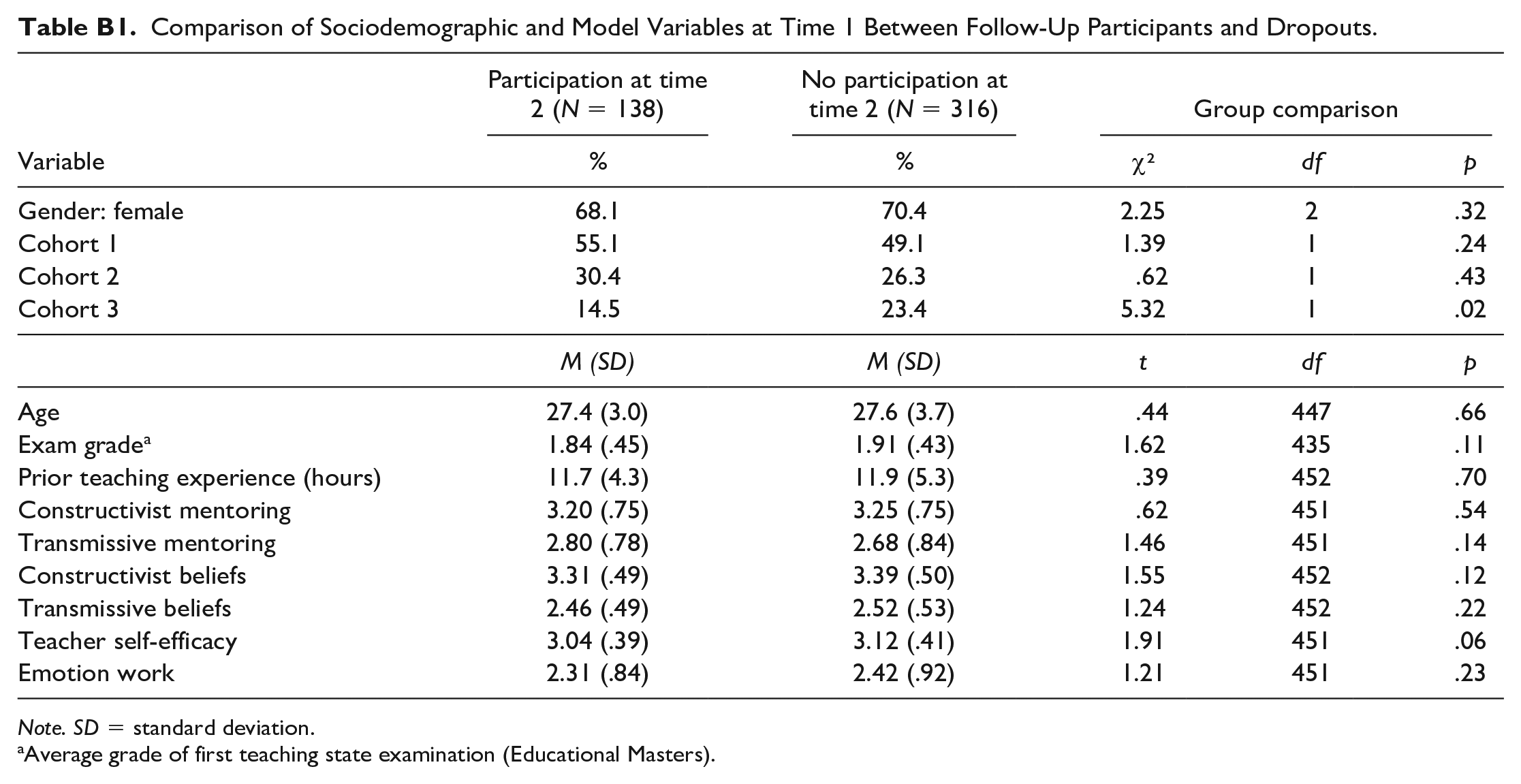
In this study, a subset of the original research project’s larger database is used, focusing on novice teachers that were assessed on entering their second trimester of practical training (i.e., in the 6th–8th month of 18 months in total; “time 1”) as well as approximately 6 months later, at the entrance of their third trimester (in the 12th–14th month; “time 2”). Participation was voluntary and without compensation, and data were pseudonymized to enable later matching of longitudinal data. Due to the repeated-measurement, multicohort design of the original project, the sample used in this study includes three cohorts that successively filled in the questionnaire in their respective second and third trimester of practical training. The initial sample at Time 1 consisted of 454 novices (N = 231 from Cohort 1, N = 128 from Cohort 2, and N = 95 from Cohort 3), from which 30.4% also participated at Time 2 (N = 138). To consider systematic differences between dropouts and later participants at Time 2, we compared both groups with respect to sociodemographic and psychological variables under investigation and obtained no substantial differences (see Table B1 in Appendix B). With regards to the longitudinal samples, Cohort 1 (N = 76, 76% female, Mage = 26.82, SDage = 2.49) participated in autumn 2017 (Time 1) and spring 2018 (Time 2), Cohort 2 (N = 42, 62% female, Mage = 28.02, SDage = 3.49) followed in spring 2018 (Time 1) and autumn 2018 (Time 2), and Cohort 3 (N = 20, 50% female, Mage = 28.50, SDage = 3.33) was assessed in autumn 2018 (Time 1) and spring 2019 (Time 2). None of these cohorts differed significantly from another with respect to sociodemographic background variables (gender, a-level and university masters grade, type of teaching license aspired, amount of teaching experience before induction), except for a small-sized difference in age. Hence, all data were integrated into one final sample consisting of 138 individuals with an average age of 27.4 years (SD = 3.0 years) and of whom 68% were female. 22% were preparing to teach at primary level, and 78% at secondary level.
Measures
Independent Variables: Mentoring Approaches
An adaptation of two scales for constructivist- and transmission-oriented mentoring developed by Richter et al. (2013) was used to measure the quality of mentoring interactions as perceived by the beginning teachers (these scales and the following self-report scales are available upon request; for author contact information, please refer to Appendix A). The scale assessing constructivist-oriented mentoring comprises four items (e.g., “My mentor helps me to improve independently.”), while the level of transmissive-oriented mentoring is captured by three items (e.g., “My mentor tells me what I need to improve.”). Every item was rated on a Likert-type scale ranging from 1 (strongly disagree) to 4 (strongly agree). Exploratory and confirmatory factor analysis conducted by the author group indicated a two-factor solution as best fit, and the scales have demonstrated good overlap with self-ratings of corresponding mentor teachers (Richter et al., 2013). In the present study, fit indices obtained in a confirmatory factor analysis at Time 1 indicated an acceptable fit as well, CFI = .96, RMSEA = .09 (90% CI = [.067, .108]), SRMR = .06; see Schermelleh–Engel et al., 2003. Both scales showed good to very good internal consistency at Time 1 (constructivist mentoring: ωT1 = .89; transmissive mentoring: ωT1 = .80) and Time 2 (constructivist mentoring: ωT2 = .92; transmissive mentoring: ωT2 = .86).
Dependent Variable: Self-Efficacy
To quantify levels of profession-related self-efficacy, an adaptation of the German Teacher Self-Efficacy Scale (Schmitz & Schwarzer, 2000) was applied. The 10-item scale was developed with the aim to create a content-valid and economical measure of teacher competence expectancies. Thus, it comprises statements referring to multiple competence domains, such as building relationships with students (e.g., “I am sure that I will be able to establish good contact with even problematic students.”) and coping with stress (e.g., “Even if I face classroom disturbances, I am sure that I will be able to maintain my composure.”), that are rated on a 4-point scale ranging from 1 (strongly disagree) to 4 (strongly agree). As expected with regards to construct validity, the authors were able to obtain high negative correlations with job strain and burnout (Schmitz & Schwarzer, 2000). It demonstrated good reliabilities in this study (ωT1 = .77; ωT2 = .77).
Dependent Variable: Surface Acting (Emotional Labor)
To assess the degree of surface acting that is carried out by the participants, the “emotional dissonance” subscale as part of the emotional labor scales (Zapf et al., 1999) was adopted. The four items measure the frequency of emotional dissonance experiences (e.g., “How often do you have to display feelings that do not correspond to what you actually feel towards others in school?”; “How often do you have to suppress feelings in order to appear neutral to others in school?”) and are rated on a 5-point scale from 1 (very rarely/never) to 5 (very often). The emotional dissonance measure has been shown to highly correlate with emotional exhaustion, depersonalization, and job dissatisfaction in various professions (overview in Zapf et al., 2001). It displayed adequate internal consistency for both measurement points (ωT1 = .84; ωT2 = .86).
Moderating Variables: Beliefs About Teaching and Learning
To capture the strength of two qualitatively distinct beliefs about teaching and learning, two scales developed by Kunter et al. (2017) were used. The scale tapping constructivist beliefs about learning and teaching consists of seven items (e.g., “Students learn best by discovering their own ways to solve tasks in class”) rated on a scale from 1 (strongly disagree) to 4 (strongly agree). Likewise, the second scale assessing transmissive beliefs about learning and teaching comprises seven items (e.g., “Students learn best by watching their teacher do example exercises”) with equal scale range. The original scales demonstrated a good two-factor solution fit (Voss et al., 2013), and the adaptation by Kunter et al. (2017) showed adequate internal consistencies over multiple times of measurement, as it did in the present study (constructivist beliefs: ωT1 = .83; ωT2 = .85; transmissive beliefs: ωT1 = .74; ωT2 = .79).
Statistical Analysis
The SPSS software package version 23 (IBM Corp., 2015) was used for all analyses. To test the proposed main effects and explore possible moderation effects, regression analyses were conducted, using the PROCESS macro for SPSS, version 3.5 (Hayes, 2017). The predefined “model 2” within PROCESS allows for the inclusion of one independent variable, two moderator variables, and one dependent variable simultaneously. Therefore, a series of four longitudinal regression analyses in total were conducted to test all main and interaction effects of interest. Per model analysis, one mentoring approach was defined as the independent variable (measured at Time 1), both belief variables were included as moderator variables (Time 1), and one competence-related outcome (self-efficacy or emotional management) was introduced as a dependent variable (measured at Time 2; see Figure 1 for an exemplary path model). Thus, each path model entailed two interaction terms, that is, a “match term” and a “no-match term” formed by the respective independent variable and the belief variables. All variables forming interaction terms were mean-centered prior to analysis (Irwin & McClelland, 2001). In each model, baseline values of the respective outcome at Time 1 as well as the gender variable were added as covariates. Regression weight estimates in the longitudinal models were based on 5,000 bootstrap samples. Hypotheses testing was based on a level of significance at p < .05.
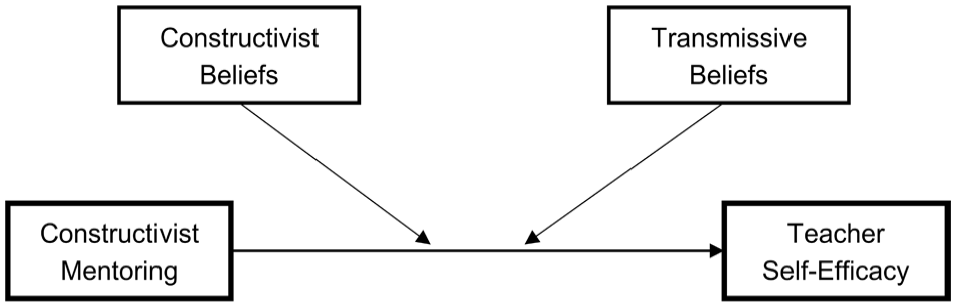
Generic Moderation Model Displaying Main and Interaction Effects.
Results
Descriptive and Preliminary Analyses
Descriptive and results for paired Welch tests between both measurement points for all variables are depicted in Table 1. With regards to descriptive values, constructivist mentoring interactions and constructivist beliefs displayed higher means than their transmissive counterparts. At the same time, means of the latter indicated a considerable presence of traditional views on learning and transmissive mentoring experiences in the sample as well. Significant mean augmentation from the second to the third trimester of the induction phase was observed for both teacher self-efficacy, t(137) = −3.89, p < .01, and surface acting, t(137) = −2.75, p < .01, indicating meaningful change in both dependent variables included in the study.
Means, Standard Deviations, and t-Tests for Both Measurement Points.
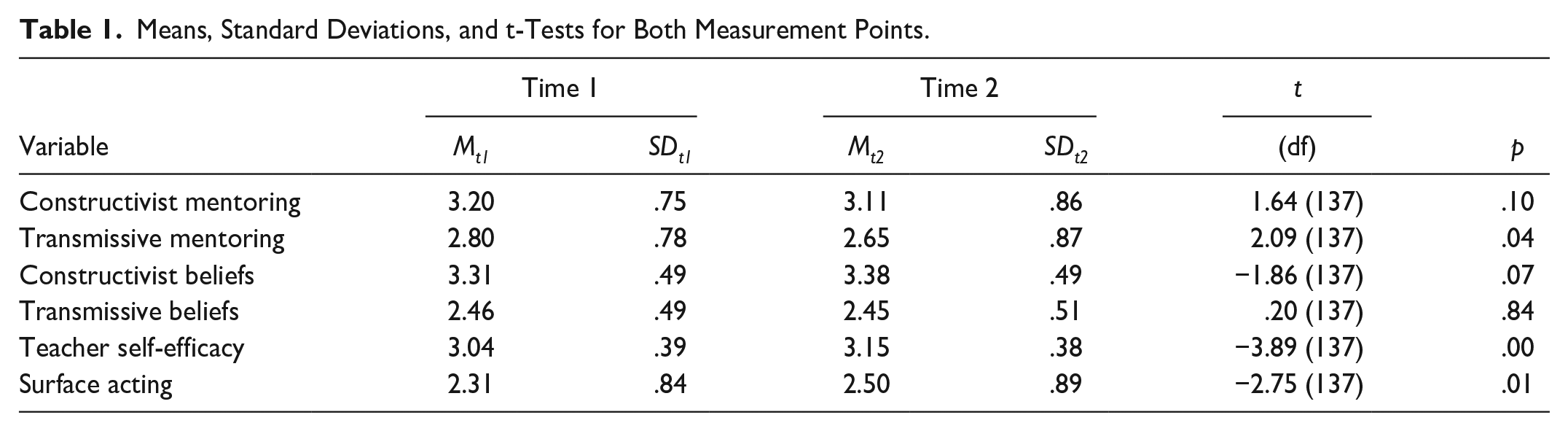
Table 2 displays the bivariate correlations of all model variables, assessed in the second trimester (Time 1) and third trimester (Time 2) of practical teacher training. Constructivist mentoring experiences at Time 1 and Time 2 were significantly associated with teacher self-efficacy at Time 2 (r = .22, p < .05, for constructivist mentoring at Time 1) and correlated negatively with surface acting at Time 1 and 2 (rt1 = -.35, pt1 < .05; rt2 = −.24, pt2 < .05, for constructivist mentoring at Time 1). In contrast, transmissive mentoring interactions did not display meaningful correlations with any outcome variable. With regards to beliefs and mentoring approaches, consistent, moderate associations could only be found for transmission-oriented mentoring and transmissive beliefs (significant r values ranging from .19 to .32). In addition, both teacher self-efficacy and surface acting showed strong stability over the time span examined (teacher self-efficacy: r = .59, p < .05; surface acting: r = .57, p < .05). To conclude, while these preliminary correlational results were in accordance with the hypothesized, beneficial effect of constructivist mentoring on self-efficacy (H1) and surface acting (H2), they did not support the assumed effects of transmissive mentoring on both outcomes (H3 and H4).
Bivariate Correlations of All Model Variables.
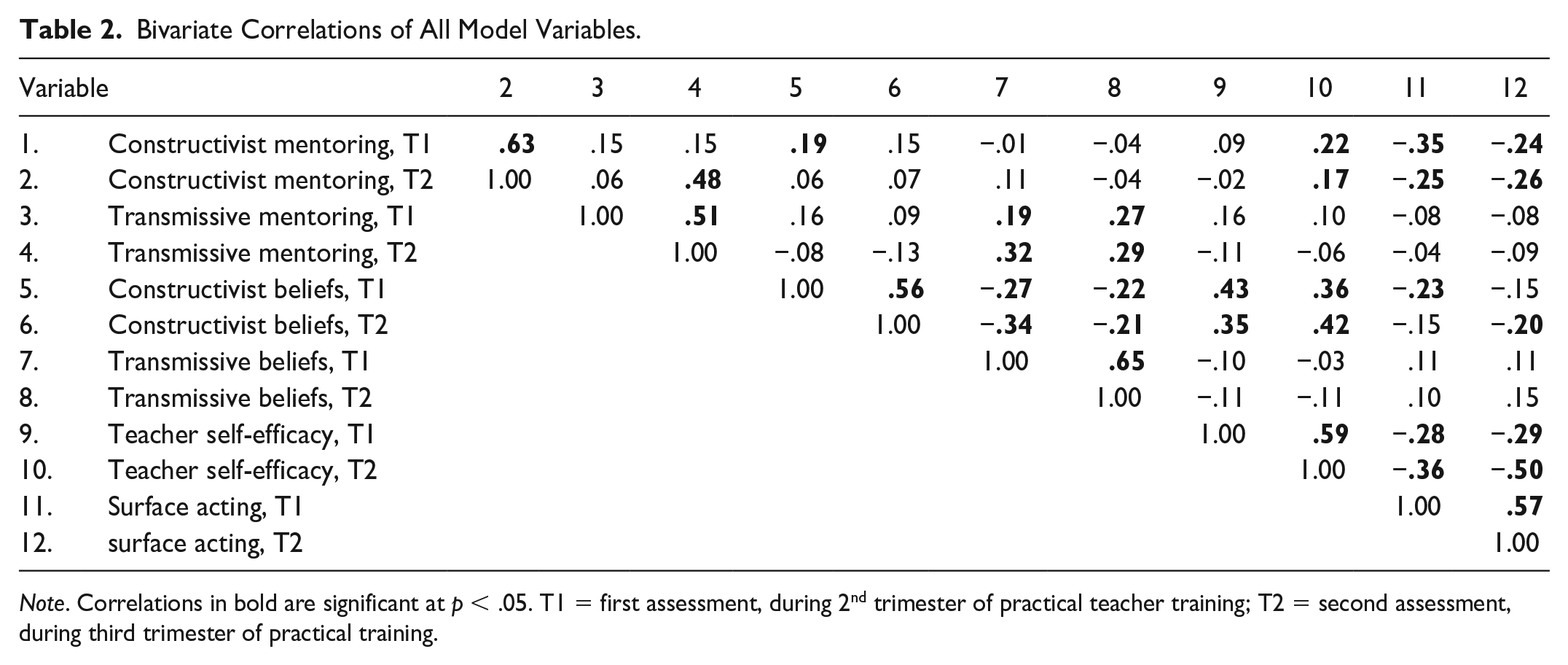
Note. Correlations in bold are significant at p < .05. T1 = first assessment, during 2nd trimester of practical teacher training; T2 = second assessment, during third trimester of practical training.
Path Models and Moderation
As outlined earlier, four sequential regression analyses were conducted to test the presumed main effects and explore possible interaction effects between mentoring approaches and mentees’ beliefs in a longitudinal framework.
Figure 2 visualizes the first path model specified for the regression analyses, displaying the results for constructivist mentoring and teacher self-efficacy. This first model reached overall significance, F (7, 130) = 18.16, p < .01, R² = .45. In support of H1, the mentoring quality exerted a meaningful first-order effect on the outcome at average moderator levels (b = .08, p < .05). In addition, a significant interaction with transmissive beliefs held by the mentee was obtained (b = .24, p < .01). Applying simple slope analysis (Jaccard et al., 1990) to further explore the effect pattern of this interaction, results indicated that constructivist mentoring was most beneficial for teacher self-efficacy when transmissive beliefs were high (e.g., b = .20, p < .01 for high transmissive and average constructivist beliefs), suggesting benefits arising from an initial mismatch between the mentor’s approach and the mentee’s beliefs. This moderation effect contributed significantly to the total amount of variance explained by the model, even if to a small extent (ΔR² = .05, p < .01). Aside, the baseline level strongly predicted teacher self-efficacy at time 2 (b = .47, p < .01).
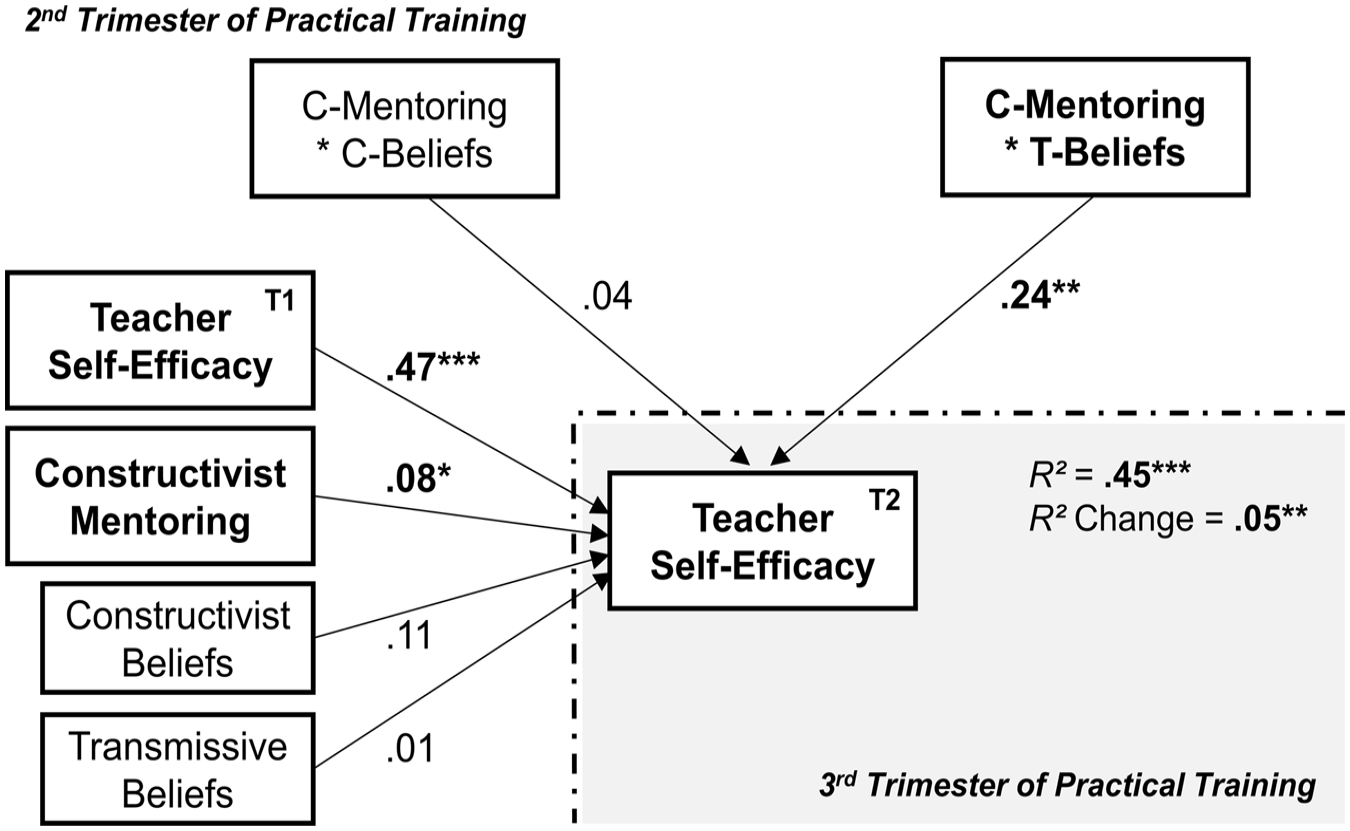
Longitudinal Path Model for Constructivist Mentoring and Self-Efficacy.
The second regression analysis covered transmissive mentoring interactions and novice teachers’ self-efficacy and reached overall significance, F (7, 130) = 13.88, p < .01, R² = .40. Contrary to H3, no first-order effect was found for transmission-oriented mentoring (Figure 3). Moreover, no interaction between the mentoring style and either of the belief variables was obtained. Solely the baseline measure of self-efficacy (b = .52, p < .01) emerged as a predictor of the outcome.
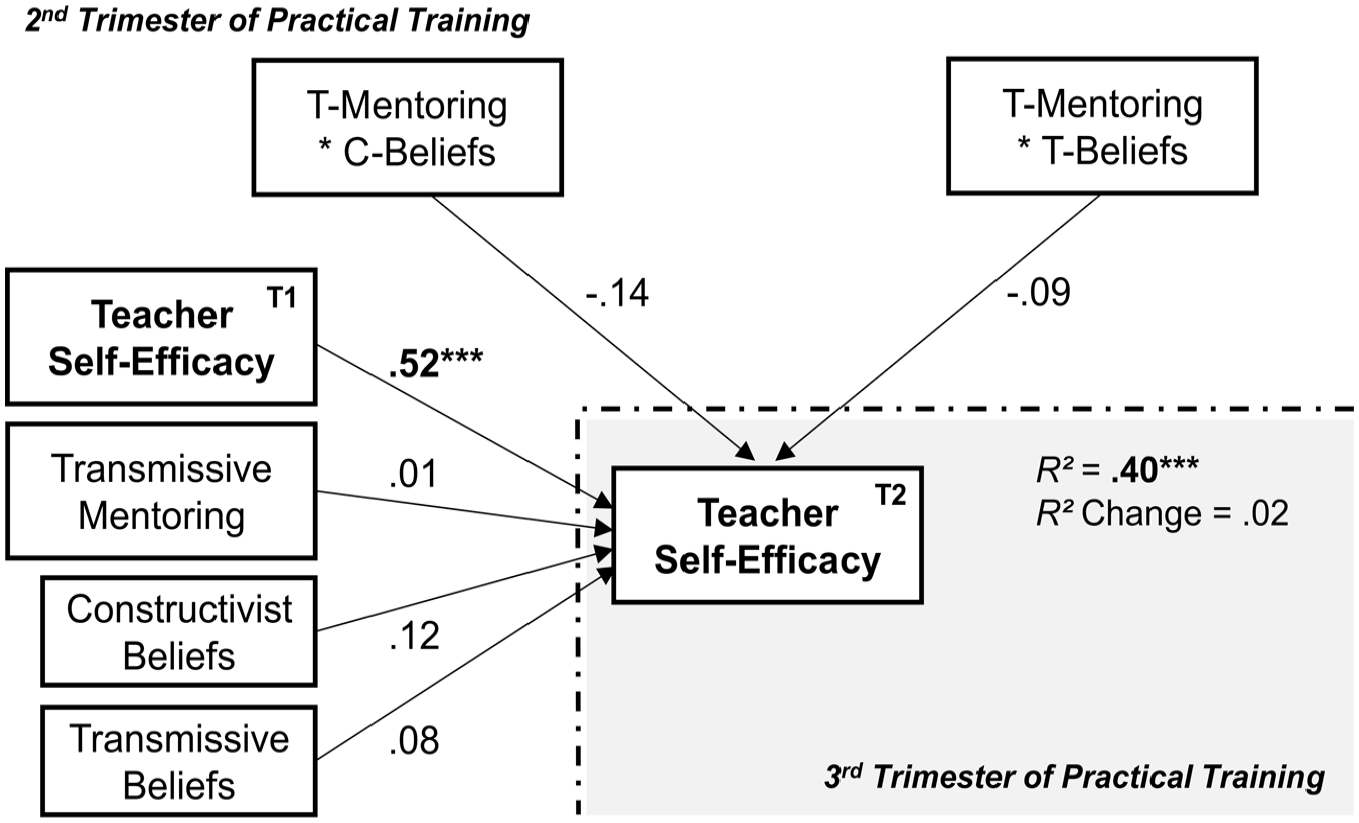
Longitudinal Path Model for Transmissive Mentoring and Self-Efficacy.
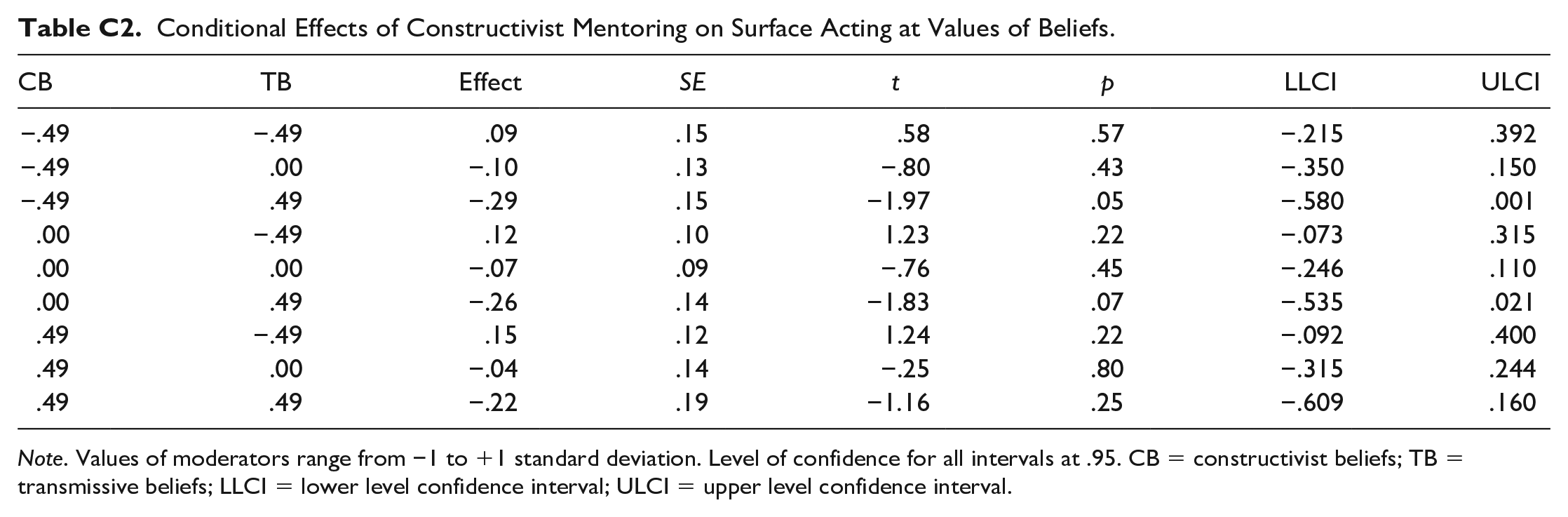
The third model addressed the relationship between constructivist mentoring interactions and emotional management and was significant (F (7, 130) = 13.98, p < .01, R² = .37). Although the baseline values at time 1 strongly predicted the amount of surface acting 6 months later (b = .57, p < .01), no first-order effect of constructivist mentoring at medium moderator levels was found, in contrast to the beneficial effect that had been hypothesized (b = −.07, p = .45). With regards to the exploratory part of the model, the interaction term formed by constructivist mentoring and transmissive beliefs significantly predicted the frequency of surface acting at time 2 (b = −.38, p < .05). Although the change in explained variance was small, this interaction contributed to the overall predictive value of the model (ΔR² = .02, p < .05). Results of simple slope analyses indicated that the predictive value of constructivist mentoring on surface acting was higher when mentees’ transmissive beliefs were high, and when their constructivist beliefs were low and medium, respectively. Although the global pattern of conditional effects aligned well with the interaction effect that had been obtained with regard to mentees’ self-efficacy, the simple slope analyses did not reveal a distinct effect of constructivist mentoring when the traditional threshold of significance was applied (e.g., b = −.29, p = .051, for high transmissive and low constructivist beliefs; for all conditional effects, see Tables C1 and C2 in Appendix C).
The last regression analysis covered transmissive mentoring interactions and surface acting. The corresponding, overall model reached significance, F (7, 130) = 13.49, p < .01, R² = .37. Contrary to the assumption of an adverse effect of this mentoring approach on mentees’ emotional management, transmissive mentoring did not increase the frequency of surface acting (b = −.10, p = .31). As to the exploratory moderation terms that were included again, no meaningful interactions with constructivist or transmissive beliefs were obtained. Parameters of the third and fourth regression models are displayed in Table 3.
Model Summary for Mentoring Approaches, Beliefs, and Surface Acting.
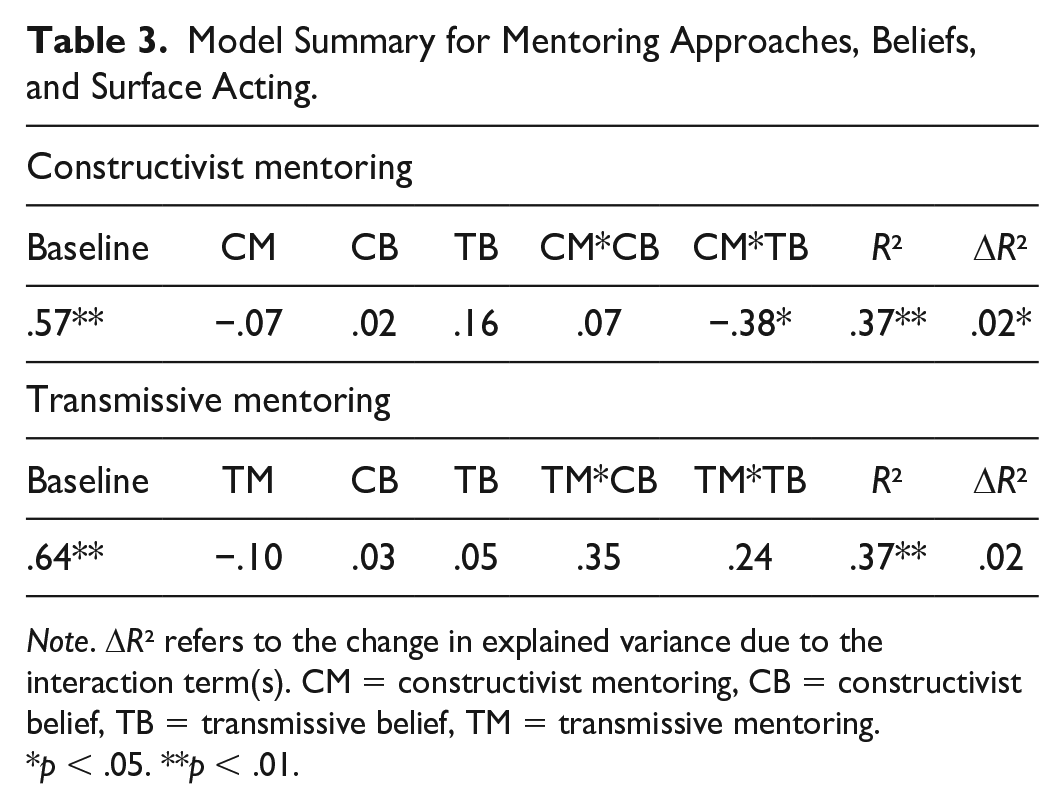
Note. ΔR² refers to the change in explained variance due to the interaction term(s). CM = constructivist mentoring, CB = constructivist belief, TB = transmissive belief, TM = transmissive mentoring.
p < .05. **p < .01.
Discussion
Findings of the Present Study
This longitudinal study focused on constructivist- and transmission-oriented mentoring approaches and their respective potential to influence beginning teachers’ self-efficacy and surface-acting frequency 6 months later. Within this investigation of mentoring effectiveness, it was further explored whether a (mis-)match between the mentor’s approach to mentoring and the mentee’s prior beliefs about teaching and learning has consequences for the beginning teachers’ professional development.
With regards to beginning teachers’ self-efficacy, the present results stand in line with earlier findings that have indicated a beneficial effect of mentoring approaches oriented toward collaboration, reflection on practice, and constructivist principles of learning (Fives et al., 2007; Kutsyuruba et al., 2019; Richter et al., 2013). Although the 6-month stability of self-efficacy in this study was high, constructivist mentoring still revealed a meaningful effect on the outcome, thus providing support for the corresponding hypothesis. In contrast, novices’ self-efficacy did not profit from mentoring interactions that followed traditional principles of learning within the time span considered. Thus, contrary to the assumption that a transmission-oriented mentoring approach may at least provide vicarious experiences for the mentees, transmissive mentoring apparently did not tackle any sources of self-efficacy. Although this aligns to previous evidence (Richter et al., 2013), a benefit of this directive approach in earlier phases of teacher education remains plausible, for example, at the entrance of practical training when novices may need closer guidance. To investigate whether an initial “match” or “no-match” (Hobson et al., 2009) between the quality of mentoring and the professional beliefs held by the mentee would be more beneficial for the development of novice teachers’ self-efficacy, the conditional effects of constructivist mentoring at different values of mentees’ constructivist versus transmissive beliefs were determined. This exploratory moderation analyses indicated that the influence of constructivist mentoring was stronger when beginning teachers’ beliefs contrasted the mentor’s approach to mentoring. Put differently, as mentees’ transmissive beliefs increase beyond the average in this study, the effect of constructivist mentoring on teacher self-efficacy becomes stronger.
With respect to the beginning teachers’ surface acting, transmissive mentoring interactions did not lead to an increase in frequency 6 months later, contrary to prior assumptions. Instead, transmission-oriented mentors did not affect their mentees’ surface acting in the classroom in this study, possibly because the emotional aspects of teaching are simply left out of the mentor-mentee dialogue in this approach. For constructivist mentoring, findings were ambiguous in this regard. Although the preliminary correlational analysis first suggested a beneficial effect, results from the subsequent, longitudinal regression analysis did not indicate that this mentoring approach reliably shields against maladaptive emotional labor within the time frame covered in this study. The exploratory analysis with regards to beginning teachers’ beliefs, in turn, revealed an interesting pattern of conditional effects that aligns well with the “no-match” effect observed for constructivist-oriented mentoring and teacher self-efficacy. However, in the light of these results, it would be premature to infer a distinct impact of constructivist mentoring on novice teachers’ surface acting. Although this appears to be in contrast with earlier findings on mentoring and mentees’ emotional management (e.g., Meyer, 2009; Shapira-Lishchinsky & Levy-Gazenfrantz, 2016), this study covered only a limited time frame within the induction phase and focused on instructional support provided by mentors. It cannot be ruled out that mentoring fosters beginners’ emotional management within longer time frames, or that, for example, psychological support (Gold, 1996) may have an influence on beginning teachers’ emotional labor. Mentoring and coaching support have already displayed beneficial effects on emotional labor in other workplace contexts (e.g., Chi & Wang, 2018), underlining their potential in this regard.
Although the “no-match” effect for the combination of constructivist mentoring and transmissive beliefs emerged only vaguely for surface acting in this study, it was observed quite consistently for teacher self-efficacy. In the light of this finding, it appears to be beneficial when a mentee experiences constructivist-oriented interactions with his or her mentor that, at the same time, clash with his or her prior, traditional views on teaching and learning. This may indicate that the initial irritation caused by the contradicting mentor’s approach and mentee’s belief can fuel the early learning processes stimulated by mentoring during induction. Noteworthy, an interaction with novices’ prior beliefs was only observed for constructivist mentoring in this study. Given its reflective, mutual, and inquiry-oriented nature, beliefs may be explicitly addressed, juxtaposed, and discussed within this approach (Wang & Odell, 2002), while a directive, educator-centered form of interaction may not leave enough room for such reflective discussion.
Practical Implications
As distinct qualities of mentoring have demonstrated distinct capability to support the professional development of beginning teachers, principals and school administrators should bear in mind the potential benefits of preparing future mentors for their challenging double role as teacher and mentor (Holloway et al., 2018). When untrained, cooperating teachers tend to rely on evaluative feedback, judgmental comments, criticism, and praise (Hoffman et al., 2015). They take up too much interaction time giving direct advice, and do not sufficiently practice, for example, active listening (Crasborn et al., 2008). Accordingly, transmissive mentoring interactions were a frequent experience for the present study’s participants but remained ineffective for their development. In contrast, constructivist mentoring interactions were beneficial for the novices’ self-efficacy, which represents an essential condition for a successful career start in teaching (Kim & Cho, 2014). Therefore, a structured, research-informed inservice training that prepares soon-to-be mentors for their new function and promotes reflective counseling techniques (e.g., Kaplan & Madjar, 2017) could harness the full potential of school-based mentoring. Benefits of such a mentor preparation program can further include the mentors’ increased capability to support the needs for competence and autonomy of their mentees, thereby promoting autonomous motivation in the beginning teachers (Kaplan, 2021). Moreover, by covering the role of emotions in teaching and the inherent emotional aspect of the mentoring relationship (Hawkey, 2006), this preparatory coursework may further encourage mentor teachers to reflect on the emotions encountered by the mentees, their management, and the respective consequences. Even if neither mentoring approach reliably buffered against a reaction-focused, maladaptive emotion regulation strategy in this study, an orientation toward mutual reflection and inquiry within the mentoring approach should still be considered as an essential prerequisite in this regard.
The present findings further underline the importance that has been attributed to beginning teachers’ prior professional beliefs in the context of teacher education (Fives & Buehl, 2012; He & Levin, 2008; Hollingsworth, 1989). At first glance, the observation that a mismatch of beliefs is beneficial for the mentees’ development contrasts some earlier findings. However, it is plausible that a match of beliefs leads to a more satisfying or harmonious relationship between mentor and mentee (Bradbury & Koballa, 2008; Kitchel & Torres, 2007), while a no-match may yield benefits for the beginners’ self-efficacy. In alignment, a certain degree of dissonance between a mentor and a beginning teacher has been discussed as a “mainspring” for learning (Hawkey, 1998). Professional beliefs are, in part, implicit and thus subconsciously affect the processing of professional learning experiences (Fives & Buehl, 2012). Mentors need to explicitly address these beliefs, deconstruct how they influence the beginner’s practice, and integrate them into the mentoring dialogue, which should be enabled during constructivist-oriented interactions. With regards to the pairing of mentors and mentees, a recommendation arising from the current findings is that principals and administrators consider the prior beliefs novices bring into their program. If these beliefs initially deviate from reform-minded teaching orientations, the beginning teachers should be paired with mentors whose approach to mentoring represents a counterpart to these beliefs. During a constructivist-oriented dialogue, strongly held traditional beliefs and the expectations espoused by the curriculum can be juxtaposed, verbally enacted by the mentee, and appreciated by the mentor (Levin, 2015). By enhancing meta-cognitive awareness of their beliefs, these may less result in resistance toward reform-minded practice (e.g., Bray, 2011). Moreover, in the light of the current findings, this mismatched pairing fosters the beginners’ self-efficacy.
Limitations and Future Directions
Several limitations of the present study require attention. First, the data used are based solely on self-report questionnaires, which may suffer from, for example, memory bias or consistency motives (e.g., Podsakoff et al., 2003). Moreover, for design reasons, the quality of mentoring was indirectly assessed via the mentees’ ratings and cannot be compared with the self-perception of their respective mentors. However, the novices’ assessment has been found to be a valid measure that satisfyingly overlaps with the mentors’ self-ratings (Richter et al., 2013). To capture the mentoring approach experienced by the novices, a broad measure was applied, which distinguishes between two approaches but cannot provide detailed information on the content of mentor-mentee gatherings. Thus, it cannot be inferred to what extent both parties exchanged views on teaching and learning during their meetings, and the present findings should be rather interpreted as a first clue of benefits associated with a “no-match.” Future qualitative or mixed-method studies could determine which communicative microinteractions are effective in juxtaposing different views on teaching and learning. With respect to teacher beliefs, this study’s focus is limited to beginning teachers’ beliefs about teaching and learning, which is only one of multiple belief domains relevant for professional teacher competence (Fives & Buehl, 2012). Furthermore, within the moderation analyses, it was implicitly assumed that the mentors’ approach to mentoring reflects their actual beliefs about teaching and their teaching practice so that a real “belief (no-)match” can be assessed. However, scenarios have been conceptualized in which this consistency is not necessarily the case (Wang & Odell, 2007). In this regard, the present findings need to be treated cautiously and future studies could address this challenge by applying more differentiating measures of beliefs around the mentor–novice relationship. Finally, the effect sizes obtained in this study are small and suggest that other learning opportunities will need to be considered in future research on the wide-ranged outcomes examined in the context of teacher education. Nevertheless, despite generally poor recognition of and compensation for their additional duties (Jones, 2000), mentors following constructivist principles were able to substantially contribute to their novices’ development of self-efficacy in this study.
Conclusion
This longitudinal study complements the research on school-based mentoring by investigating two qualities of mentor–mentee interactions and their consequences for novice teachers’ self-efficacy and surface acting during induction. The present core findings underline the potential that has been attributed to constructivist mentoring (Richter et al., 2013), do not indicate advantages of transmission-oriented mentoring approaches, and contribute to the search for effective means to foster self-efficacy in teacher education (Klassen et al., 2011). In a moderation analyses framework, the study further provides the first evidence for the benefits resulting from an initial mismatch between novices’ professional beliefs and mentors’ approaches to mentoring. Meanwhile, the results do not indicate a distinct buffering effect of either mentoring approach on novices’ surface acting. Mentor preparation programs and the consideration of mentees’ prior beliefs in the mentored learning process are worthy goals for mentoring practice.
Footnotes
Appendix A
The self-report scales applied in this study for data acquisition are available upon request. Please contact Mr. Julian Burger via e-mail:
Appendix B
Comparison of Sociodemographic and Model Variables at Time 1 Between Follow-Up Participants and Dropouts.
| Variable | Participation at time 2 (N = 138) | No participation at time 2 (N = 316) | Group comparison | ||
|---|---|---|---|---|---|
| % | % | χ² | df | p | |
| Gender: female | 68.1 | 70.4 | 2.25 | 2 | .32 |
| Cohort 1 | 55.1 | 49.1 | 1.39 | 1 | .24 |
| Cohort 2 | 30.4 | 26.3 | .62 | 1 | .43 |
| Cohort 3 | 14.5 | 23.4 | 5.32 | 1 | .02 |
| M (SD) | M (SD) | t | df | p | |
| Age | 27.4 (3.0) | 27.6 (3.7) | .44 | 447 | .66 |
| Exam grade a | 1.84 (.45) | 1.91 (.43) | 1.62 | 435 | .11 |
| Prior teaching experience (hours) | 11.7 (4.3) | 11.9 (5.3) | .39 | 452 | .70 |
| Constructivist mentoring | 3.20 (.75) | 3.25 (.75) | .62 | 451 | .54 |
| Transmissive mentoring | 2.80 (.78) | 2.68 (.84) | 1.46 | 451 | .14 |
| Constructivist beliefs | 3.31 (.49) | 3.39 (.50) | 1.55 | 452 | .12 |
| Transmissive beliefs | 2.46 (.49) | 2.52 (.53) | 1.24 | 452 | .22 |
| Teacher self-efficacy | 3.04 (.39) | 3.12 (.41) | 1.91 | 451 | .06 |
| Emotion work | 2.31 (.84) | 2.42 (.92) | 1.21 | 451 | .23 |
Note. SD = standard deviation.
Average grade of first teaching state examination (Educational Masters).
Appendix C
Conditional Effects of Constructivist Mentoring on Surface Acting at Values of Beliefs.
| CB | TB | Effect | SE | t | p | LLCI | ULCI |
|---|---|---|---|---|---|---|---|
| −.49 | −.49 | .09 | .15 | .58 | .57 | −.215 | .392 |
| −.49 | .00 | −.10 | .13 | −.80 | .43 | −.350 | .150 |
| −.49 | .49 | −.29 | .15 | −1.97 | .05 | −.580 | .001 |
| .00 | −.49 | .12 | .10 | 1.23 | .22 | −.073 | .315 |
| .00 | .00 | −.07 | .09 | −.76 | .45 | −.246 | .110 |
| .00 | .49 | −.26 | .14 | −1.83 | .07 | −.535 | .021 |
| .49 | −.49 | .15 | .12 | 1.24 | .22 | −.092 | .400 |
| .49 | .00 | −.04 | .14 | −.25 | .80 | −.315 | .244 |
| .49 | .49 | −.22 | .19 | −1.16 | .25 | −.609 | .160 |
Note. Values of moderators range from −1 to +1 standard deviation. Level of confidence for all intervals at .95. CB = constructivist beliefs; TB = transmissive beliefs; LLCI = lower level confidence interval; ULCI = upper level confidence interval.
Declaration of Conflicting Interests
The author(s) declared no potential conflicts of interest with respect to the research, authorship, and/or publication of this article.
Funding
The author(s) disclosed receipt of the following financial support for the research, authorship, and/or publication of this article: The evaluation project this study builds upon was commissioned and financially supported by the Federal Ministry of Science, Continuing Education, & Culture in Rhineland-Palatinate, Germany.
