




Abstract
Practices incorporating students’ cultures and communities are foundational to effective teaching. However, teacher candidates often do not effectively incorporate culturally based practices into their instruction. This article describes the perceptions of English education instructors as they reconceptualized their curriculum to cultivate culturally based practices. Findings show three major factors impacted the instructors’ reconceptualization of curriculum: (a) the instructors’ cultural roots; (b) the pervasiveness of whiteness—systems and processes that preference white identities, assumptions, and privileges that accompany the white experience; and (c) deep-seated tensions between culturally based practices and the practices of the university operating within the institution of English education. The authors assert that no individual who has matriculated through white-centric educational institutions and broader societal structures can be excluded from the call to unlearn whiteness. They urge teacher educators to dismantle oppressive, white-centric practices by reflecting on the interplay of biases and socio-political beliefs that they and their teacher candidates bring into educational spaces.
Keywords
Scholarship shows practices which incorporate students’ cultures and communities are foundational to effective teaching (Gay, 2010; Gay & Kirkland, 2003; Paris & Alim, 2017) and raise the academic and social achievement of all learners (Dee & Penner, 2016; Delpit, 2006; Gay, 2010; Milner, 2015; Pasternak et al., 2020). Culturally based practices (CBPs) empower teachers to honor their students’ cultural backgrounds by creating meaningful bridges between students’ home lives and school, encouraging multiple forms of expression, and transforming educational practices (Pasternak et al., 2020). Our definition of culturally based pedagogy, curriculum, and practice is rooted in the field of multicultural education (Banks & Banks, 1989; Nieto, 2017) and draws upon the work of Gay (2002), Lee (2009), and Powell et al. (2016).
Since 2012, the standards of the National Council of Teachers of English (NCTE), the leading professional organization of English teachers in the United States, have specified that English language arts (ELA) teacher candidates must demonstrate knowledge of how theories and research about social justice, diversity, equity, and student identities enhance students’ learning in ELA (George et al., 2021). This article discusses the tensions and rewards the instructional staff at one university-based English teacher education program encountered while moving toward a more culturally based curriculum to better support its teacher candidates (Bissonnette, 2016; Hayes & Juárez, 2011; Samuels, 2018).
A Need for English Teachers With an Understanding of Culturally Based Pedagogy
The present-day teacher workforce in the United States is predominantly middle class, 80% white, and 77% female (McFarland et al., 2019). This is at variance with present-day student populations, since Students of Color comprise 52% of enrollments in public elementary and secondary schools (National Center for Educational Statistics, 2020). This imparity between students and teachers is an aftereffect of fierce resistance to the desegregation that occurred in the decades following Brown v. Board of Education of Topeka, 347 U.S. 483 (Warren & Supreme Court of the United States, 1953). White unwillingness to integrate schools with Students and Educators of Color led to the systematic elimination of Black educators through massive layoffs and demotions (Dougherty, 2004; Haskins & Haskins, 1998). The forced displacement of Black teachers with white educators has left a legacy of culturally incongruent, white-centric policies and practices that persist over a half a century later (Dougherty, 2004; Milner & Howard, 2004).
Ladson-Billings (2005) calls attention to the continuing situation: Our teacher education programs are filled with white, middle-class monolingual female students who will have the responsibility of teaching in school communities serving students who are culturally, linguistically, ethnically, racially and economically different from them . . . However, much of the literature on diversity is silent on cultural homogeneity of the teacher education faculty. Teacher educators are overwhelmingly white [ . . . ] and their positions as college university-level faculty place them much further away from the realities of urban classrooms and communities serving students and families of color. (p. 230)
This reality holds true for Shoreline’s English education program, where predominantly white teacher candidates are taught by 17 part-time instructional staff—13 of whom are white. Thus, the staff of Shoreline’s English education program aligns with national trends to hire part-time instructors in lieu of filling more permanent, secure tenure lines– hindering the formulation of a “diverse faculty within a system of common professional values, standards, rights, and responsibilities” (American Association of University Professors, 2018). In Shoreline University’s case (pseudonym), having only part-time instructors in English teacher education complicates their time for mutual support, reflection, collaboration, and the redesign of a culturally based curriculum. This situation could cause instructors to fall back on white-centric, monolingual content perpetuating their past English education experiences (Lortie, 1975/2002).
Beyond national trends to staff teacher education programs with part-time faculty, the lack of diversity in the K-12 teacher workforce and the university faculty who teach them is magnified in English education by a traditional curriculum that focuses on white-centric texts and attitudes (Applebee, 1993; Lechtenberg et al., 2020; Pasternak et al., 2018). This monolithic approach to English education encumbers diverse students’ educational experience by deteriorating their sense of self-value, expression, and identity. Subsequently, there remains a scarcity of racially, ethnically, and linguistically diverse students in teacher education programs. With this, the importance of developing a teacher workforce skilled in culturally based pedagogy cannot be overstated (Haddix, 2016; Kumashiro, 2000).
To develop the critical consciousness of culturally based educators, teacher education programs must focus on content that interrogates overarching structures of institutional inequities (Gere et al., 2009; Sleeter, 2012). However, designing a coherent curriculum around equity and culture as it intersects English education content is challenging for teacher education programs that are predominantly run by white instructors who have been educated through white-washed English education practices in predominantly white institutions (Borsheim-Black & Sarigianides, 2019; Haddix, 2016; Ladson-Billings, 2005).
Reflections by teacher educators indicate that many grapple with their own whiteness when implementing CBP in their teaching (Martell, 2015; Tanner, 2022; Thandeka, 1999), leading to fragmentary discussions about inequitable power structures, institutional racism, implicit bias, and culturally based pedagogies. Many admit they have significant pedagogical and curricular improvements to make when developing projects that empower teacher candidates to critically examine CBP (Schmidt & Kenreich, 2015). Despite the barriers in operationalizing CBP in teacher education, their implementation can enhance the critical epistemological views of teacher candidates’ and increase their self-efficacy in implementing CBP (Gist, 2011). Therefore, it is crucial that teacher educators continue modeling culturally, linguistically, and ethnically based practices while engaging teacher candidates in discussions that shape their equity-based thinking (Gere et al., 2009).
White Teacher Identity
A critical part of reconceptualizing the way English is taught necessitates an understanding of how the construct of whiteness and white teacher identity impacts the work (English Language Arts Teacher Educators [ELATE], 2020; Feagin, 2020). While the authors acknowledge we must have a way to understand how the white teacher educators conceptualize and leverage their whiteness in their practice, we must reconcile this perspective with the experiences and theoretical sense-making of the Black teacher educator in our study. As such, we contend that the examination of whiteness and white teacher identity is only necessary because of the ways that whiteness is leveraged in teacher education to marginalize Black and Brown individuals and groups.
For the purpose of this research, it was crucial to understand how white teacher educators see themselves as racialized actors in teacher preparation, because teacher preparation has historically failed to attend to issues of whiteness and white supremacy in the preparation of educators (Jupp et al., 2016; Lensmire, 2022; Oyler, 2011; Thandeka, 1999). The importance of white teachers and teacher educators understanding themselves as racialized actors is highlighted with the understanding that white teachers often fail to see themselves as cultural beings or identify what white culture entails, and think culture is a concept brought into the United States from other countries (Sleeter, 2018; Thandeka, 1999; Zygmunt-Fillwalk & Clark, 2007). This leads to a reality in which teachers’ “own cultural backgrounds remain unexamined [. . .] they have no way to challenge their intrinsic assumptions” (Ladson-Billings, 1994, pp. 131–132).
White teacher educators enter the profession with years of understanding the world and their positionality through the lens of whiteness, recognized as a white racial frame (Feagin, 2020). We acknowledge that this white racial frame carries into their practice, which results in whiteness permeating their pedagogy, curricular decisions, broader understandings of students, and their roles as teacher educators (Jupp et al., 2016; Tanner, 2022). The practice of centralizing the concerns of white teachers who teach from a white, monolingual perspective while disregarding the needs of Teachers of Color has resulted in a white supremacist perspective in teacher education (ELATE, 2020). This creates a reality where restrictive, monolithic conceptions of English education uphold white values, norms, and ways of making meaning (Harris, 1993). This situation results in the entanglement of whiteness and what is deemed academic literacy and English education practices, which marginalize the ways of knowing and being of Black and Brown students (Baker-Bell et al., 2020; Turner, 2022). Thus, it is this broad and marginalizing permeation of whiteness across various facets of teacher education that make its prevalence and permanence so problematic.
In efforts to uncover and mitigate the influences of whiteness in teacher education, scholars have turned to the field of critical whiteness studies to make sense of how whiteness operates in teacher education (Barnes, 2017; Buchanan, 2016; Chandler & Branscombe, 2015; Crowley & Smith, 2015; Mazzei, 2008). Critical whiteness studies (Allen, 2001; Leonardo, 2009; Matias et al., 2014) focus on using interdisciplinary approaches to understand how individuals conceptualize ideas of whiteness (Matias et al., 2014). However, the authors of this article caution that focusing on whiteness in an overwhelmingly white field of study, like English education, is problematic because a focus on whiteness further detracts from the experiences and histories of racially marginalized and minoritized groups and individuals (hooks, 1994; Vickery & Duncan, 2020). To this end, scholars have encouraged research on whiteness that positions the examination of whiteness within the larger reality of structural racism and the marginalization of Black and Brown groups and individuals (hooks, 1994; Vickery & Duncan, 2020). Hence, while this study did not initially set out to examine the influences of whiteness in reconceptualizing culturally based curriculum because of emerging themes in the data analysis, this study examines whiteness within the larger realm of institutional and structural racism.
Study Background
Shoreline University’s English teacher education program is an urban program that focuses its curriculum in an urban emergent context (Milner, 2012) to address the racial, social, and psychological disconnects that overshadow what it means to “teach English.” To support this curriculum, the ELA instructors determined to become culturally based pedagogues and critically examine inequitable policies and practices in ELA —not merely searching for instructional strategies to extemporize the disconnect between developing a culturally based mind-set and incorporating isolated teaching strategies (Ladson-Billings, 2017). The instructors sought to integrate CBP and cultivate social-consciousness (Ladson-Billings, 1994) across the curriculum (Burns & Miller, 2017).
In designing the culturally based curriculum, the teacher educators had their students read texts that addressed issues of (in)equity and institutionalized racism, engage in workshops that modeled inclusive practices, and participate in teacher, administrator, and student panels that highlighted topics relevant to urban communities. However, this approach did not lead the teacher candidates to move past an awareness of institutionalized racism and (in)equity to actually implement CBP in their instruction (Pasternak et al., 2018).
Consequently, the instructors held a series of meetings that included the review and discussion of their syllabi and curriculum sequence. They critically reflected on their content and how they engaged with it themselves (Baker-Bell et al., 2017; Kinloch & Lensmire, 2019; Pasternak et al., 2020; Sealey-Ruiz, 2018), realizing a need to examine how their own biases affected their teaching, curriculum, and students (Kinloch & Lensmire, 2019; Sealey-Ruiz, 2018; Tanner, 2022). This program analysis began before the onset of the current study described in this article. With funds from an U.S. Department of Education Supporting Effective Educator Development (SEED) grant, the authors conducted a series of interviews and a focus group to document the instructors’ journey in reconceptualizing the curriculum.
This article is molded by years of discourse about our influences as individual scholars and connecting the understandings of ourselves and one another to the racial-historical context of our work. We found the complexities of interracial inquiry led to many discussions about the influence and implications of our varied positionalities throughout the data collection and analysis process. Each author in her varied role brought her personal history and racialized experiences to this critical work. Crystasany is a Black woman from a Black middle-class family. Rooted in Black feminist epistemologies, her work highlights the perspectives of Black women educators and their expertise in the care and education of Children of Color. Crystasany also examines teacher education through the lens of culturally responsive paradigms. This current work in the English education program aligns with this second line of inquiry in which she recognizes whiteness as a persistent barrier to developing culturally responsive pedagogues. Crystasany was the lead graduate researcher assigned to the English teacher education program. She designed the study to understand how the English education program staff conceptualized its curriculum around culturally based teaching and learning.
Donna is a white, middle-class woman raised in suburban New York City with deep ties to the Eastern European refugee community. Her parents and grandparents spoke multiple languages yet learned English to assimilate to the public schools, which would only educate children of English-only households. Donna’s parents became voracious readers who instilled a love of literature and a desire to share the stories they cherished. These marginalizing experiences affected what and how Donna taught English at the secondary and higher education levels. Her scholarship examines anti-racist/anti-bias literacy practices (George et al., 2021; Pasternak et al., 2018).
Kelly is a Black woman. Grounded in critical race theory and critical perspectives on race and whiteness, her work focuses on the influences of race and racism in hip-hop based education. Kelly is particularly interested in the ways teacher educators position themselves as critical, equity-oriented pedagogues in their work with teacher candidates. These interests are informed by her lived experiences as a high school social studies teacher in a mid-size urban school district (Milner, 2012) and being a Black woman raised in a predominantly white, politically conservative, rural area in the U.S. Midwest.
Leanne engages in this work as a white woman from a Midwestern working-class background. She entered the education field as a teacher of young children believing that all children have inherent rights to equity and excellence in their schooling. As a practitioner focused on the intersections of language acquisition and emergent literacy, she works to disrupt established practices of discrimination and marginalization of bilingual learners. As a critical scholar and teacher educator, she explores how teachers can become critically conscious educators of all learners. Leanne grounds her work in the belief that the sociocultural-historical, racial context of education is necessary to discourses that advance antiracism in PK-12, teacher education praxis, and research.
Kristine identifies as a white, middle-class, cis-gendered, female raised by first generation college students in a small Midwestern city. Educated as a secondary English teacher and reading specialist, she works to improve literacy and engagement with texts diverse in character and authorship that reflect those in the community. Her research examines literacy education, assessment, and the impact of student engagement with texts. The results of this study impacted her practice and the educators with whom she works.
Kristine and Donna taught in the English teacher education program before the implementation of this study. After the study’s completion, in collaboration with the program staff, they aligned the curriculum with the study’s findings. For this article, Donna and Kristine drafted the introduction and literature review. However, as Donna was the principal investigator of the SEED grant that underwrote this project and Kristine was the English teacher program chair, neither were involved in any participant recruitment, data collection, analysis, or findings determination. Kelly was the grant’s lead graduate research assistant, working across all aspects of the grant. She triangulated the findings and helped develop the implications of this study. While drafting this article, Crystasany and Kelly completed their doctoral studies in urban education. Leanne was the Co-Principal Investigator of the SEED grant who supervised the graduate research assistants and assisted with the analysis and articulation of findings. The authors’ demographics and roles are summed up in Table 1.
Author Demographics and Roles.
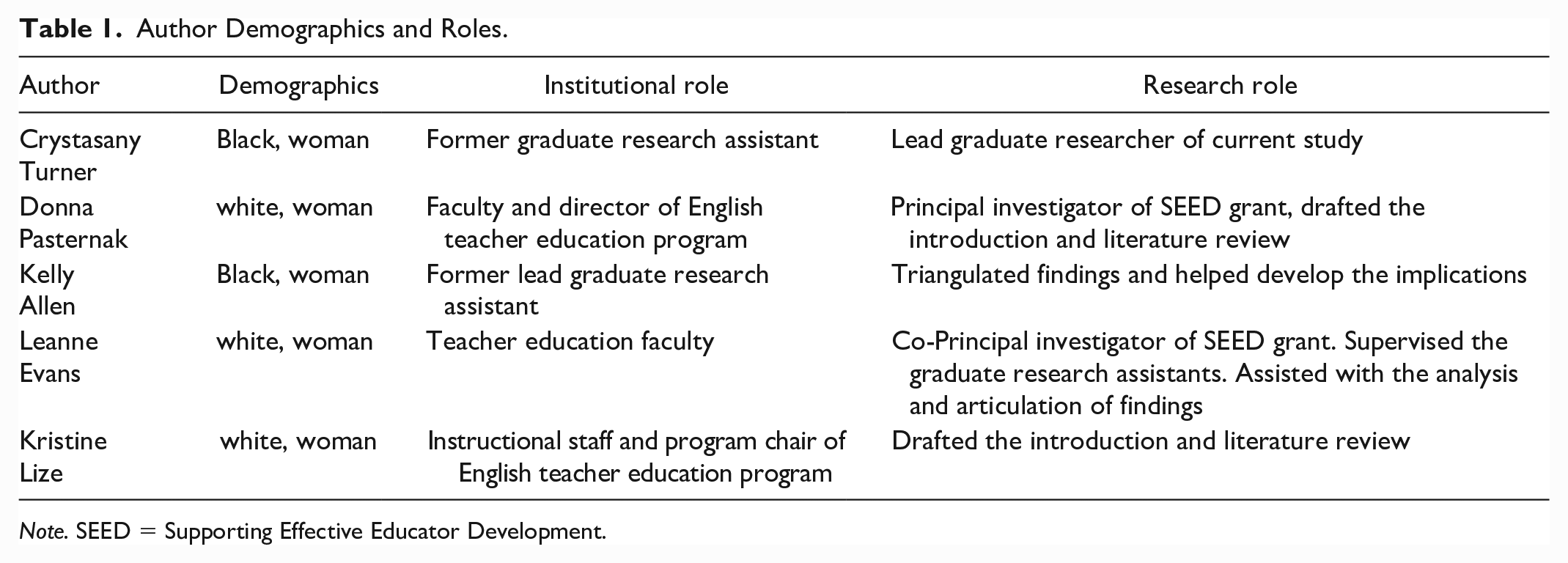
Note. SEED = Supporting Effective Educator Development.
Methods
Shoreline University is situated in a midwestern city of approximately 600,000 people. It is an open-access university with the goal of meeting the diverse needs of its state’s largest metropolitan area. The study setting is widely recognized as the most racially segregated urban center in the United States and has rich historical and socio-political characteristics (Nelsen, 2015; Smeeding & Thornton, 2018). The segregation of the city is the result of a history of housing and employment discrimination “due to a unique settlement pattern and an entrenched white power structure” (Nelsen, 2015, p. 9). The U.S. Census Bureau (2010) indicated that 90% of the city’s Black population reside in impoverished, racially segregated neighborhoods, which perpetuate the racial segregation of the public school district.
This context was integral to the work of reconceptualizing the curriculum of the English education program. Instructors allotted time during the program’s monthly meetings to discuss research articles on CBP. They shared how they grappled with, enacted, and aligned their understanding of institutionalized racism and social inequities within their course content. Through this critically reflective process, they questioned each other’s biases and discussed what it means to teach a concept or employ an approach explicitly through a culturally based lens—encouraging each other to consider how practices complicate the learning process and a teacher’s purpose. This work was situated within a larger study that partnered the local school district and the university through the U.S. Department of Education SEED grant.
The grant funded all education programs at the university to support staff in (a) identifying the program’s values and concepts of CPB, (b) determining if those values and concepts were being taught across the program, (c) analyzing syllabi to understand where and to what degree the concepts were being scaffolded, and (d) revising curriculum to be explicit in teaching these concepts.
Participants
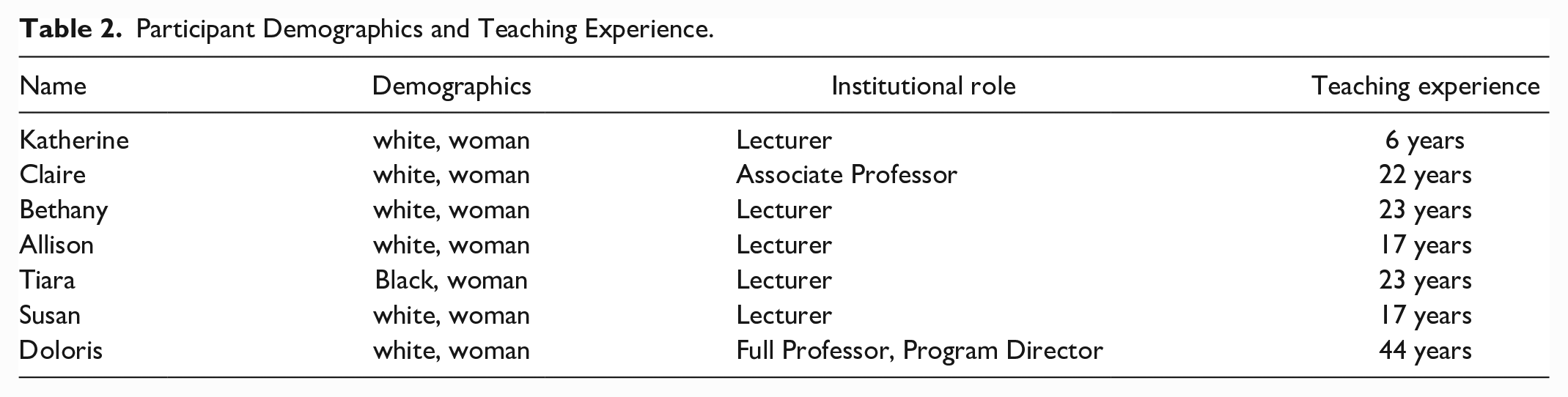
The participants of this study were instructors in the university English education program. At the time of the study, the university’s English education program was comprised of 17 instructors: one tenured, full-time, program faculty member (however, she was bought out of her teaching obligations in the program at the time of the study), one tenure-track faculty member (dedicated to another program) who worked part-time in the English education program, one part-time lecturer who served as program chair, and 14 part-time lecturers and graduate assistants. This staff consisted of 3 Black women, 1 white male, 1 Hispanic male, and 12 white women. Of the 17 staff, 5 hold doctorates in English, American literature, or literacy education.
All 17 instructors were invited to participate in this study; 7 participated: 6 white women and 1 Black woman. Six of the participants worked part-time in the program. Despite not teaching in the program, the tenured faculty member participated in its administrative decision-making processes and attended all meetings. All 7 participants completed an individual interview with the researcher; but only the five part-time instructors participated in a focus group discussion. The tenured faculty member and program director were not invited to participate in the focus groups to avoid any power differentials (see Table 2).
Participant Demographics and Teaching Experience.
Data Collection
Data was collected through a series of semi-structured interviews and a focus group session, conducted via Zoom video conferencing between May and June of 2020. The interviews explored each instructors’ experiences and their conceptualization and implementation of CBP. The interview protocols for the individual interviews and focus groups can be found in the Appendix. Although the part-time lecturers held semester-to-semester contracts with no guarantee of rehire, researchers also asked about their goals as leaders in the work of reconceptualizing CBP in the program.
Crystasany, Kelly, and Leanne conducted a two-phase inductive to deductive analysis (Saldaña, 2018) of the transcripts. During the first phase of analysis, we completed a general reading and blinded-coding of the transcripts. We then discussed the emerging themes identified within the data and collectively constructed codes from the individual coding patterns. From our conversations, the following codes were constructed: observations or enactment of CBP, barriers to CBP, curriculum redesign, personal/professional roles or experiences, and school needs. The discussions that occurred were formative to our collective understanding of the teacher educators’ perspectives and the findings. As researchers, “our ideological and epistemological stances are heavily shaped by what we hear, do not hear, and understand about our and others’ thinking” as we make sense of experiences and analyze data (Paris & Winn, 2014, p. 288). As we entered this work with varying racial, linguistic, and socioeconomic backgrounds, the generative conversations about the data allowed us to grapple with the emerging themes. Through this dynamic analysis we developed, defined, and grouped codes to describe the instructors’ reflections of their knowledge, meaning-making, and implementation of CBP.
During the second phase, the transcripts were analyzed deductively using the collectively created codes. Each code was analyzed to allow the emergence of themes related to the instructors’ experiences with CBP, the challenges they recognized within the program, and their vision for moving the program forward in the work of developing culturally-based pedagogues (Kuckartz, 2014). We continued to engage in coding consensus conversations and worked to acknowledge and reflect upon our personal perceptions and biases to interrogate any influences on data analysis. As a result of these conversations, the following sub themes emerged during the second phase of coding: approaching students, barriers to culturally responsive pedagogy, culturally responsive practice, definition of cultural responsiveness, English education community, equity, higher ed, perceptions, school needs, university-school link, and white/whiteness. We then analyzed the documents with these new subthemes in mind.
Through our continued conversations, we realized the emerging themes needed an additional layer of analysis. Therefore, we layered our coding with critical discourse analysis (CDA) (Fairclough & Wodak, 1997; van Dijk, 1993). Wodak and Meyer (2009) explain that CDA is not necessarily concerned with studying a linguistic unit, but rather the social contexts in which texts are created and understood. Foundational to CDA is the understanding that all discourse is situated within historical contexts. Therefore, an approach to discourse analysis that considers this positioning is needed as language is influenced by the context it is situated within (Fairclough, 2012; van Dijk, 1993; Wodak & Meyer, 2009).
CDA was an essential extension to our coding because it allowed us to make sense of individuals’ stories and perspectives and how their lived realities were influenced by and intersected with various levels of sociohistorical contexts (Fairclough, 2012; van Dijk, 1993; Wodak & Meyer, 2009). Through the use of CDA, issues of power and privilege –both contemporarily and historically– are acknowledged throughout the analysis of narratives and discourse (Fairclough, 2012; van Dijk, 1993; Wodak & Meyer, 2009). This focus on socio-historical contexts, power, and privilege allows us to make sense of and illuminate the entanglements of individuals’ perspectives and experiences that would not be possible without the use of CDA. Following the institutional review board (IRB) approved protocol, the rigor of this study was maintained through a systematic analysis based on the researchers’ integrity, collaboration, triangulation, and literary competence.
Findings
Analysis of the data revealed three interrelated themes regarding the instructors’ reconceptualization of their curriculum centered on CBP. The first overarching theme illustrates how the educators’ cultural roots—their cultural backgrounds, heritages, and experiences—had a significant impact on how they engaged in the work. This reflection led to the second finding, which shows how the pervasiveness of whiteness was a significant factor in the participants’ reconceptualization of the curriculum. To aid us in conceptualizing the second finding, we describe “whiteness” as an historical and social construct based on and maintained by oppression and inequitable power structures. As such, whiteness is not simply a category of identity, but a position of power that esteems the assumptions, privileges, and norms that accompany the white experience (Nichols, 2010). Through the continued reflection of their cultural roots, many of the instructors named constructs of whiteness including white fragility, privilege, and bias as challenges they confronted in their work. The final theme illustrates the deep-seated tensions between CBP and the practices propagated by the university operating within the institution of English education. As such, the English educators struggled to overcome various systemic barriers as they strived to teach, model, and reconceptualize their curriculum around CBP.
The Impact of Cultural Roots on (Re)conceptualizing Culturally Based Practice
Scholarship shows that teachers bring their experiences and cultural understandings with them into the classroom. These experiences inform the lens through which they develop curriculum and their subsequent teaching practices (Gilpin, 2005; Hasberry, 2019; Sparks, 2018). Our first finding affirms this research on teachers’ cultural influences on practices and curriculum (Black et al., 2019; Pereira et al., 2015). Our finding also demonstrates that teachers’ cultural roots have an impact on their point of entry into the conversation about culturally-based work. This is illustrated in the way Tiara’s lived experiences shaped her understanding of CBP.
Tiara shared her account of being raised by Black educators whose educational experiences occurred prior to the Brown v. Board of Education decision. She stated, “It [CBP] is nothing new to me.” Tiara provided the example of her scholarly focus on African American English in her studies. She explained her choice for this focus was because “It was just a part of my history growing up, so I was not unfamiliar.” Tiara’s entrance into the conversation was rooted in her parents’ modeling and conversations with her sister (a professor of writing and rhetoric).
It was evident Tiara’s experiential roots had a formative impact on her teaching. She believes, There’s not a single way to communicate . . . I wanted the kids to communicate. However they did that was fine. [ . . . ] I feel like it was easier for me ‘cause that was a part of who I was—just how I was brought up. You could just be who you were.
Tiara mentioned the need of teaching a “standardized” English; however, she did not want students to “feel bound by [it].” She added, “Just come and be who you are. Let’s talk about it. Bringing hip hop culture into the room is really important for kids . . . bringing social justice and things going on in their communities and in their lives.” Tiara’s commitment to ground her instruction within the lens of her students’ cultures was based on her own cultural upbringing and experiences as an individual from marginalized cultural group. Consequently, she had a firsthand investment in ensuring the student-centered cultural foundations of her instruction.
Not all the participants had the same groundings in CBP as Tiara. For some of the educators, their entrance into the conversations and work regarding culturally based pedagogy emerged through their university education and choices they made as young adults. In explaining her foundational understanding of CBP, Bethany stated, “I graduated from college in 1997; and so cultural responsiveness [was] the next step in the evolution of the same kinds of issues I’ve been concerned about and talking about since I was in college.” She explained, “I finally feel it [CBP] is getting the kind of serious treatment it deserves. We have a long way to go, but I’ve seen it come a long way [since I started college].” Bethany’s understanding of CBP was founded on her understanding of what English education should aim to do in “sharing everybody’s story.”
Bethany described her graduate study focus in critical multicultural pedagogy and her commitment to these kinds of studies continues. After reading the text Stamped from the Beginning (Kendi, 2016), she reflected, “This is nothing like what I was teaching my kids. Even now I’m like, dammit. I got it all wrong still. I feel like I’m trying so hard to do the right things. There’s still so much to learn, and there’s so much to do, and I feel like that’s part of cultural responsiveness.” Beginning with her professional and academic experiences, Bethany came to understand that if she wants teacher candidates to understand various perspectives, she must embody this in her own practice. She said, “It’s never feeling like you know it all, you know the way, you know what’s supposed to be done and you do it the right way. It’s always about continually learning, continually adapting, continually developing your practice.”
Like Bethany, Katherine’s entrance into the work of CBP started through her teacher education experience. Katherine initially sought a career in education because school was an enjoyable experience for her. Through her teacher education program, she learned how educational inequities affect certain student groups. She explained, “As a white female entering a lot of spaces with Black and Brown students, it’s interesting to think about my own history in education. I liked school. School worked for me. I saw myself in the curriculum. I saw myself in the classroom.” Katherine understands her cultural and racial roots as a white woman required self-examination. She reflected, “[I am] doing a lot of inquiry work in thinking about how classroom communities look and are built, what respect looks like in the classroom and checking my ideas and the ideas of white culture and how I can make the classroom a more responsive place in terms of classroom community, my pedagogy, the text that we use, discussion strategies.” Katherine’s entrance into equity and culturally based work has led her to seek out specific frameworks. She described the use of cooperative learning structures and scholarship on brain-based research (Hammond, 2014). She said, “As a white person, culture continues to be a concept that I am unpacking just because white people live within white culture. I think that [culture] is harder to identify, even though it’s not. It’s just all around me.”
The educators in this study approached culturally based practices through their cultural and racial roots which determined when they entered the work of culturally based pedagogy. Tiara’s work was “part of who [she] was . . . and how [she] was brought up.” Her commitment was rooted in her upbringing and then fortified through her experiences as a Black educator navigating her own cultural-linguistic marginalization within predominantly white institutions. In contrast, Bethany and Katherine experienced their upbringing as white women within the familiarity of their white culture (Lensmire, 2022). Thus, their understanding of CBP emerged later through their teacher education and professional development. This finding demonstrates the impact that teachers’ cultural and racial roots have on their entrance into culturally based work.
The Pervasiveness of Whiteness
We found that the instructors engaged in the examination of culturally based work through a white racial framework (Feagin, 2020). This perspective impacted their approach to examining and reconceptualizing the English education curricula. Tiara recognized her white colleagues grappled with whiteness as she explained, “Seventy percent of our teaching staff is white. Having them try to open their minds to something different, something new, to be exposed to other cultures and understand the relevance can be challenging.” She recognized her colleagues were still developing their efficacy around interrogating racial inequities. Bethany reiterated this observation stating, Because the majority of English teachers are white women, what that means is stepping out of a white identity and examining how other factors of status and class and race intersect in the interactions that you have with your students, the community that you bring, how you come to understand community, and then the strategies and curriculum texts that you’re offering your students.
Both these instructors recognized that whiteness was a persistent tension to CBP.
In considering how whiteness appears in their work on an institutional level, some participants discussed what it meant to be a white woman teaching mostly white teacher candidates within a predominantly white institution. The instructors described how the pervasiveness of whiteness first took them inward to critically examine themselves. Susan explained how she interrogates her privilege and white identity to understand how it plays out in the classroom. She knew that developing culturally based educators within a canon that has been “institutionalized for 100 million years” requires first “examining whiteness, examining privilege, and understanding how that’s already playing out in your classroom in ways you may not intend.” Moreover, Katherine acknowledged that “in a lot of ways, every day, [her] job is to address white fragility and to name white privilege, because that’s where [she’s] meeting a lot of [her] students.”
For some of the instructors, modeling CBP for their teacher candidates could only happen after reflection on how whiteness influences them personally. This reflective process was described by one instructor as an uncomfortable exercise of “stumbling forward.” Doloris identified her white privilege and identity as something she continually grapples with in the evaluation of her behavior, actions, and words. She said, “I have privilege that other people don’t. Sometimes you say the wrong thing, or what came out came out wrong.” Doloris clarified: I think that when that wrong happens, it stops people. What’s really important is to examine what that was and figure out how to not let that wrong happen again and then stumble forward. I think there’s a lot of stumbling in this kind of work.
Doloris concluded by saying “We [white educators] always have to reevaluate what we did and how we did it, or what did we say, or [ask] ‘Did I make a mistake? or How can I rectify that?’ ‘I think that’s partly some of the fear of being a culturally responsive pedagogue is that I’m white.”
The instructors’ critical interrogation of their identity and privilege as white women was a crucial first step in the work of reconceptualizing their curriculum. As Claire noted, the process requires “deep moments of opportunity for reflection on our own practice, our own beliefs, our own biases, our own individual relationships, even with students.” Further analysis of the instructors’ experiences showed that modeling CBP for teacher candidates while they critiqued their own white identities added another dimension to the work. Susan recognized, I want to be able to be more conversant about white fragility. I understand the concept of it, but I haven’t read enough to have a language to use right in the moment where I’m seeing something like that, or even where I see it within myself.
The instructors were challenged to reflect and cultivate their own critical skills, centered on CBP and dismantling whiteness, while simultaneously fostering the same skills within their teacher candidates.
Our finding demonstrates that the instructors approached their understanding of CBP with an awareness of the pervasiveness of whiteness, and each grounded their examination of culture in their own racial identity. Seeing themselves as racialized actors (Feagin, 2020), they were able to identify concepts of whiteness in the exploration of their role as teacher educators. It is worth noting that even as they recognized and pushed against whiteness, the white participants communicated little to no mention of other racial perspectives in their work. Throughout their narratives, there was no mention of the experiences and histories of racially marginalized groups or individuals. This finding aligns with the observation of how centralizing white teachers’ experiences and perspectives, while simultaneously disregarding the experience and histories of Teachers of Color perpetuates a white supremacist perspective in teacher education (Tanner, 2022).
Tensions Between CBP and the Systemic Whiteness of English Education
Our analysis revealed that closely related to the pervasiveness of white ideologies within the instructors’ work was the underlying tension between the instructors’ intent to implement CBP and the systemic nature of whiteness in English education. All the participants were traditionally educated within predominantly white institutions of higher education; and they recognized English, as a subject, is often taught from a dominant, white perspective. Susan described her experience as “always overcoming your history of how you were taught and the systems you have been embedded in forever.” Similarly, Doloris discussed the dichotomy of teaching English education methods classes from a culturally based perspective while historically following a white-centric/teacher-centric curriculum in her literature classes. When confronted with an institutionalized, white-washed English education curriculum, she realized her teacher candidates could not learn to be culturally based pedagogues through her teaching from such a narrow stance. Once she became a teacher educator, she said, I was doing all this stuff in teacher education that supported the diversity of learners, but when I started teaching in my lit studies class, I was teaching the way I was taught at my [undergraduate] university [in its white-centric literature studies program].
In her literature and writing classes, she taught practices that focused on traditional models of instruction emphasizing “grammar in isolation, [and great books] by dead white men.” Thus, Doloris reverted to the same traditional methods that had been modeled to her in her undergraduate program, despite being invested in CBP in her English education methods courses.
In addition, Doloris shared her sentiment about being a marginalized learner in her own schooling experience. Because of her non-Christian upbringing, she rarely saw people from her own cultural background represented multidimensionally. Even with firsthand knowledge of the effects of “culturally irrelevant” teaching, Doloris recognized the incongruence between her practice as an English educator and what she knew to be culturally inclusive to her students. She acquiesced to non-critical institutionalized practices and unintentionally perpetuated them through her own teaching.
This dichotomy was also discussed among the focus group participants, expressing frustration with the system in which they operated. Katherine explained that the educators were “trying to be culturally responsive within a framework that is not culturally responsive.” The educators recognized that as instructors committed to teaching CBP, they were working against an institutional legacy founded and sustained by white, middle-class values.
Susan discussed how assessment tools can often “derail” efforts of implementing CBP. She explained that she was able to design her grammar class according to her own standards of CBP, “We can have this curriculum that’s doing [CBP], but then all of a sudden, we have to make sure that our teaching also is helping [teacher candidates] to pass something like this really high-stake assessment [ . . . ].” Susan felt the university’s English curriculum and assessments challenged her autonomy in creating a culturally based curriculum and modeling these practices for her students. She explained, “I feel stuck in some ways” as she described having to use inequitable rubrics that did not reflect CBP.
While the instructors agreed they wanted to be culturally-based in their curriculum choices, they found it challenging to prepare teacher candidates to pass high-stakes standardized tests. Bethany acknowledged the irony that these tests are “highly evaluated on writing and academic writing skills [ . . . ] even though this does not go along with what we’ve been doing all year long.” The participants felt institutionalized assessment tools were antithetical to their efforts of using other curriculum choices designed to align with students’ experiences and CBP. Thus, the question of how to frame evaluations and assessments within CBP remained a significant consideration in the reconceptualization of curriculum.
Important to this finding is how the instructors navigated their discomfort and tension with disrupting conventional practices. Katherine stated, “I’m talking to people who are above my boss. I still need to push for equity, even though it’s uncomfortable.” Bethany added, “It’s a scary proposition, especially when those people have control over your job, over your livelihood. It’s a tough line to walk.” Correspondingly, Tiara recounted how initially she could not frame culturally based work with the term “culturally responsive practices.” She explained, “I didn’t always call it that in the beginning, because the minute you started there, it was this defensiveness that was put up . . . In the beginning, I didn’t frame [CBP] in that way.”
Claire detailed how she navigated the tension by decentering academic writing. She stated, “[The students] submit two academic writing pieces, however, much of their work is published on a blog . . . I tell them that their voice can be between informal and academic.” Claire’s approach moves students to challenge their sense of expression to bring about “a more critical lens on social issues when [we] step outside of these academic discourses.” Thus, the instructors were keenly aware of the dissonance between the work of CBP and the conventions of English education that uphold systems of whiteness.
Discussion
Our work contributes to existing scholarship that identifies tensions between institutionalized English education and the need to decenter whiteness— moving toward more liberatory culturally based practices (Borsheim-Black & Sarigianides, 2019; Haddix, 2016; Kim, 2021; Kinloch & Lensmire, 2019; Lensmire, 2022). The findings indicate that the instructors’ cultural and racial roots and pervasive constructs of whiteness impacted their curriculum and instruction, despite efforts to be culturally based educators.
As research continues to expose disparate behavior control (Morris, 2015; O’Brien-Richardson, 2019; Wun, 2018), over policing (Homer & Fisher, 2020; Weisburst, 2019), disciplinary action (Annamma et al., 2019; Kozol, 2006; Loveall, 2018) and expulsion rates of Black and Brown students (Cheng, 2019; Heilbrun et al., 2018), it is crucial that teacher educators prepare teacher candidates to disrupt inequitable, exclusionary policies and practices that maintain oppressive educational experiences. Yet, teacher educators’ development of their own critical consciousness through the interrogation of their whiteness is requisite to their efficacy in guiding teacher candidates in CBP.
With a commitment to liberatory, culturally based English education that centers students’ cultural knowledge and ways of being, the authors acknowledge the insidious nature of centering whiteness in educators’ experiences, norms, and values. Consequently, their work in culturally based pedagogy becomes obscured by whiteness, rather than focused on identifying and interrupting oppressive practices that marginalize the perspectives and experiences of culturally, linguistically, ethnically, racially, and economically diverse students (Feagin, 2020). Our research aligns with existing discourse on the perils of centering whiteness in English education (Baker-Bell et al., 2017; Borsheim-Black & Sarigianides, 2019) and condemns the white-ification (Kinloch & Lensmire, 2019) of English education methodologies and subject matter. Instead, we call for educators to unlearn whiteness toward the development of liberatory CBP.
In empowering educators to emancipate their thinking from the constructs of whiteness, we acknowledge that teacher educators enter the work with various understandings of systemic racism and social oppressions. Our findings suggest an inherent difference in the disposition toward CBP based on the cultural standpoint of the Black instructor and the white instructors—cultural roots matter. However, we emphasize that the Black instructor’s consciousness—although influenced by racialized experiences—is not solely a result of her Blackness. Rather, it is because she grew up practicing the interrogation of whiteness that was modeled to her through critical conversations with her family and other community members.
Although we do not generalize our findings, we assert that regardless of racial-ethnic heritage or cultural background, no individual who has matriculated through white-centric educational institutions and broader societal structures can be excluded from the call to unlearn whiteness (Kohli, 2014; McCormack, 2020). This call to unlearn is conceptualized by Woodson (1999), as he explains that the primary aim of American schooling was to assimilate Black people into white ways of knowing and being so they would teach other Black people, primarily Black students, how to assimilate into whiteness. Therefore, there must be a concerted effort by all individuals to unlearn whiteness as a part of advancing liberatory educational pedagogy and praxis.
With this understanding, we imagine how the emancipatory process of unlearning differs for people of diverse backgrounds. Some of the white instructors in our study expressed their need for spaces for “talking with other practitioners [and] teachers that are doing this in their classroom” to support their reflection and development of more culturally based materials. While these spaces may meet the needs of white instructors grappling with constructs of whiteness, they could have negative or even traumatic effects for People of Color. Many Faculty of Color bear the onus of educating their white counterparts about the deleterious effects of racism and whiteness in education policy and practice (Gibson, 2019; Laura, 2019). For Faculty of Color, the burden of unveiling institutional racism and white patriarchy can lead to racial battle fatigue and is often undervalued and uncompensated by tenure review boards and white colleagues (Bridget & Winkle-Wagner, 2017; Croom, 2017; Garrison-Wade et al., 2012; Gibson et al., 2017; Haynes et al., 2020; Levin et al., 2015; Tanner, 2019). Racial battle fatigue pushes many Faculty of Color out of the profession, further perpetuating their underrepresentation in academia (Chancellor, 2019; Rollock, 2021). To counter this, there must be a deliberate centering of the voices and perspectives of ethnically and linguistically diverse people in the creation of policies and practices that influence faculty and students.
A Culturally Based English Education Program
We understand that the construct of culture, and therefore CBP, is dynamic and must be enacted through a localized, community-based lens (Pasternak et al., 2020). Hence, CBP is understood in a variety of ways that can affect individual classrooms, educators and student(s), schools, and districts. With this understanding, as English Education programs continue moving toward more culturally based curricula, instructors should seek out more diverse literary studies content (Borsheim-Black & Sarigianides, 2019). The aesthetic power of literature, particularly, multicultural literature, can enable explorative discussions that foster a shift of perspectives on race, culture, and power (Florio-Ruane, 2001; Smith et al., 2001). For example, Gere et al. (2009) suggests that incorporating multicultural literary texts, continual interrogation of attitudes toward race and racism, and explicit engagement with race consciousness foster learning about how educators take up CBP. Further, Sleeter (2012) suggests a political approach grounded in critical theories to engage in the pedagogical work needed for “stumbling forward” toward more CBP. Baker-Bell et al. (2020) demand that teachers engage in linguistic justice which entails discontinuing practices that posit socially constructed academic language and “standard” English promoted in schools as the accepted communicative norm. These scholars (Baker-Bell et al., 2020) instead encourage teaching the interconnection between language, race, and identity.
For Shoreline’s English education instructional staff, collaborative opportunities to engage in CBP came about through collective reflection within monthly meetings in which instructors analyzed their syllabi and instructional approaches. Furthermore, they read and discussed scholarly articles; co-taught methods courses by pairing instructors, researchers, and graduate students; collaboratively designed new courses, revised existing courses, and expanded course content to emphasize the diversity of language and literature taught in ELA classrooms.
A Call to Stumble Forward
In acknowledging Doloris’ sentiments, we emphasize the significance of “stumbling forward” as requisite for culturally based pedagogical work. In the act of stumbling, one may lose their footing, and maybe even fall; but there is also the presumption that they get up and try again. The process of becoming a culturally based pedagogue is dynamic and filled with missteps and discomfort; yet, the work of incorporating CBP in teacher education must continue. Teacher educators must work to dismantle oppressive, white-centric practices by reflecting on the interplay of biases with the socio-political, economic, and racial beliefs that they and their teacher candidates bring into educational spaces.
We conclude by recalling the words of ELATE (2020), which remind us that teachers “either maintain the status quo of racism or work actively to dismantle it.” No English education classroom, university setting, or community is a neutral space (Bissonnette, 2016; ELATE, 2020; Horton & Freire, 1990). In the realm of culturally based work, to claim neutrality is acceptance of the status quo. Horton and Freire (1990) assert that, There can be no such thing as neutrality. It’s a code word for the existing system. It has nothing to do with anything but agreeing to what is and will always be—that’s what neutrality is. Neutrality is just being what the system asks us to be. Neutrality, in other words, [is] an immoral act. (p. 102)
In working to integrate CBP into every aspect of the curriculum, Shoreline’s English education program continues to stumble forward as it shifts from a position of neutrality toward cultivating culturally based, socially conscious educators.
Footnotes
Appendix
Declaration of Conflicting Interests
The author(s) declared no potential conflicts of interest with respect to the research, authorship, and/or publication of this article.
Funding
The author(s) disclosed receipt of the following financial support for the research, authorship, and/or publication of this article: The research leading to these findings has received funding from a U.S. Department of Education Supporting Effective Educator Development (SEED) grant titled “Asset-based Cultural Competence Ensuring Student Success (ACCESS)” under the Grant agreement number (U423A170029).
