



Abstract
There is a need to better understand the complex landscape of adolescent literacy intervention as a shared responsibility across all educational stakeholders. To address this need, we examined the self-reported literacy beliefs and practices about secondary readers and literacy intervention among a group of educators (including administrators, teachers, and specialists) who participated in a year-long professional learning series focused on providing adolescents with rich and responsive literacy learning opportunities. We found that educators’ beliefs and practices shifted as they developed shared understandings of asset-based mindsets and ways of supporting students’ situated literacy learning and comprehension within disciplinary contexts. We offer suggestions for how to create shared learning opportunities for educators across roles and discuss implications for future research.
Keywords
Reading and writing are critical to success in secondary school and beyond. Therefore, secondary educators must contend with how to support students’ literacy learning across the school day, and many schools rely on literacy intervention to address this challenge. In educational contexts, intervention typically refers to a continuum of instructional supports intended to develop and scaffold students’ learning. We conceptualize literacy intervention at the secondary level broadly to encompass any process by which educators support adolescents’ reading and writing within, across, and beyond the core disciplines of English language arts (ELA), history, math, and science. Our broad definition recognizes that intervention is conceptualized differently across fields (e.g., special education and coaching) and encompasses various approaches geared toward ensuring adolescents’ access to and engagement in disciplinary content and related literacy practices. This includes supporting adolescents’ foundational literacy skills (e.g., word recognition) alongside their higher-order literacy processes (e.g., comprehension and writing) while also acknowledging their sociocultural identities as readers and writers who excel at a broad array of literacy practices. Within this broad definition, literacy intervention has been understood disparately by various educators, for example, as identification of individual student difficulties or as a reworking of curriculum and instruction to better support students’ literacy learning (Johnston, 2011).
Recent research exploring varied approaches to literacy intervention indicate that interventions intended to improve adolescents’ reading and writing in secondary schools differ dramatically in both process and outcome. For example, quantitative syntheses of adolescent literacy intervention research indicate that most stand-alone reading intervention classes do not significantly improve adolescents’ reading comprehension on standardized measures (Baye et al., 2019). And, a recent qualitative synthesis of research on adolescents’ experiences and perceptions of reading intervention classes highlighted negative consequences of these classes for students’ literacy learning opportunities and identities as readers (Frankel et al., 2021). This previous work raises important questions about how educators can support adolescents to develop their literacy practices in ways that acknowledge and extend their existing identities and capacities as learners. As we will demonstrate in this study, the answers to these questions are complicated by secondary educators’ various instructional roles and beliefs about literacy intervention. They are further complicated by evidence that professional learning (PL) opportunities often fall short of equipping secondary teachers with tools to understand and support adolescents’ developing literacy capacities (Wilson et al., 2009).
In light of a lack of consensus in the literature about what constitutes secondary literacy intervention, there is an earnest need to better understand the landscape of adolescent literacy intervention and the complexity of current approaches, including how shared PL opportunities can support secondary teachers in developing a shared vision for supporting adolescents’ literacy learning within their schools. This requires a “big picture” understanding of how intervention is conceptualized and enacted in secondary settings across multiple perspectives and stakeholders. Therefore, in this study, our goal was to bring together individuals and perspectives from historically disparate fields—within both our author team and our group of participants—to support a more holistic understanding of intervention. We did this by exploring a group of 17 secondary educators’ various literacy intervention beliefs and practices as they communicated them in the context of a year-long PL opportunity, and how those beliefs and reported practices shifted over the year-long PL sequence. The PL experience focused on supporting educators to provide their students with rich and responsive literacy learning opportunities, while bringing together administrators, specialists, and teachers to work collaboratively to re-envision adolescent literacy intervention at their respective schools. Three research questions informed this study:
What are secondary educators’ beliefs about readers who may need intervention and how did those change over time?
What are secondary educators’ reported practices about literacy intervention for these readers and how did those change over time?
How are beliefs and reported practices similar or different based on educator role and within schools?
Conceptual Framework for Secondary Literacy Intervention
This study sits at the intersection of several bodies of work that extend across multiple fields and specialties, including reading, special education, coaching, disciplinary literacy, professional development, and policy. In the following sections, we define and discuss secondary literacy intervention as it is conceptualized in different ways across the literature to show how and why PL about literacy can and should draw from varying perspectives and engage multiple stakeholders. Figure 1 provides a visual representation of our conceptual framework for literacy intervention, which begins with our definitions of literacy and literacy intervention.
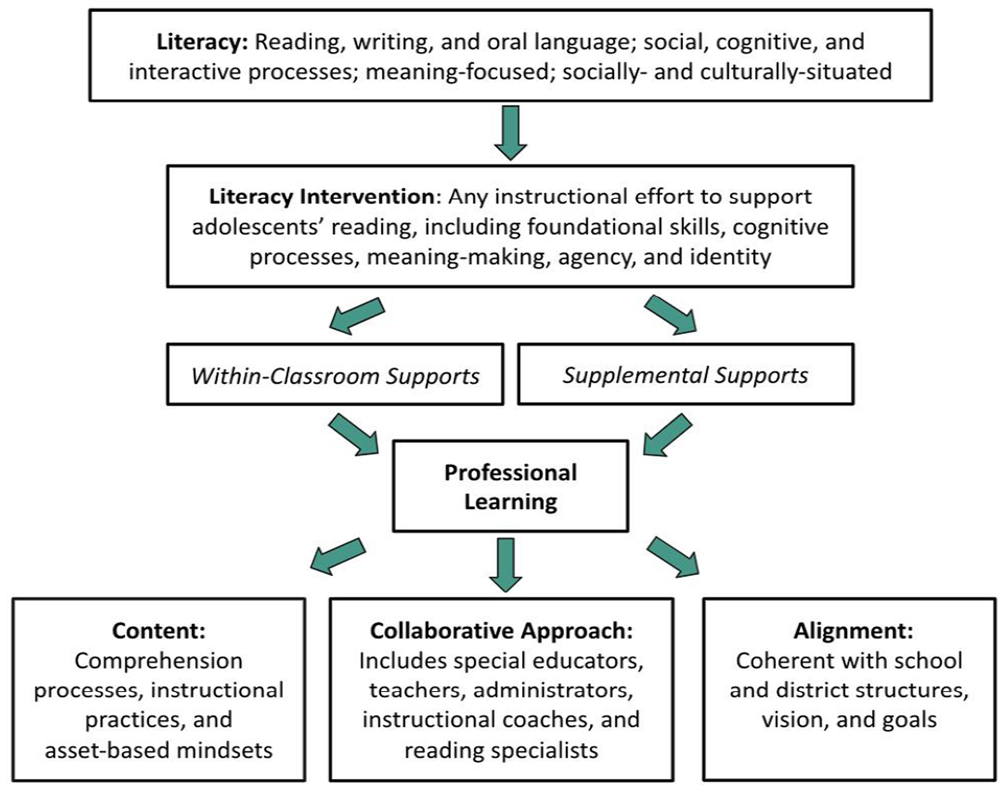
Conceptual Framework For Literacy Intervention.
Literacy
We define literacy as a “process of using reading, writing, and oral language to extract, construct, integrate, and critique meaning through interaction and involvement with multimodal texts in the context of socially situated practices” (Frankel et al., 2016, p. 7). Reflecting an interactionist perspective (Lipson & Wixson, 1986), we further conceptualize literacy (dis)ability as constructed, dynamic, and dependent on the specific contexts in which readers learn. While there are numerous factors involved in any literacy-based practice, we assert that comprehension of texts, including multimodal texts that contain combinations of modes (e.g., words, pictures, video) is central to the processes occurring within literacy practices.
The RAND Model (RAND Reading Study Group, 2002) posits that reading comprehension is a dynamic process consisting of interactions between readers, texts, and activities within particular sociocultural contexts. In secondary contexts, texts are typically discipline-specific and can present various challenges to readers. In turn, readers bring their knowledge, skills, and strategies to their interactions with texts, including those related to word recognition (ability to decode words on a page), fluency (ability to read with accuracy, speed, expression, and intonation), vocabulary, comprehension, and writing. They also bring their interests, histories, and identities as readers. These interactions between readers and texts occur through a wide range of activities or tasks, such as independently summarizing a text, analyzing a text through peer-led discussion, or taking a multiple-choice test. Furthermore, interactions between readers, texts, and activities are contextualized within, and shaped by, broader belief systems and social, cultural, and historical practices. For example, teachers’ beliefs about reading, students’ identities and prior experiences as literacy learners, and schools’ and districts’ intervention policies and practices all contribute to readers’ comprehension processes.
To theorize these sociocultural contexts that shape (and are shaped by) interactions between readers and texts, we further conceptualize literacy as situated, meaning it occurs within, and is enacted through, social practices. These social practices are ideological, purposeful, and imbued with power (Street, 1984). This conceptualization of situated literacy is in contrast to autonomous perspectives that view literacy as a neutral skill that can be isolated from the contexts in which individuals engage in literacy practices. From a sociocultural perspective, how readers and their literacies are positioned by institutions, by teachers and other students, and by texts all contribute to their experiences with literacy (Frankel, 2017).
Literacy Intervention
Following this definition of literacy, we conceptualize literacy intervention broadly to encompass all efforts to support adolescents’ reading, including approaches that focus on foundational literacy skills (e.g., word recognition and fluency), attend to higher-order discipline-based literacy processes (e.g., knowledge of how to interpret a graph in mathematics or engage with a primary source document in social studies), and engage readers’ agency and identities (e.g., perceptions of reading ability). Defining literacy intervention broadly reveals the diversity of ways that it is understood and taken up by educators and researchers across fields, which are informed by the aforementioned distinction between literacy as an autonomous skill and literacy as ideological practice. As these diverse understandings of literacy are applied instructionally, one way of interpreting intervention is a skills-focused approach that focuses on identifying individual student difficulties. Another way of interpreting intervention is a practice-focused approach that identifies opportunities within curriculum and instruction to better support specific, individual students’ situated reading and writing needs (Johnston, 2011).
This distinction in how the concept of intervention has been understood and operationalized in disparate ways is consequential to our definition of literacy intervention. We use the term intervention strategically in this article to speak back to historical and ongoing deficit-focused perspectives about adolescents and their literacies that have been perpetuated over time by autonomous, skills-focused approaches to intervention as remediation (Frankel, 2022). Such deficit-focused perspectives are tied to broader historical trends in reading research and policy, particularly as they relate to special education legislation for students with learning disabilities, which contribute to ongoing racial inequities by systematically foregrounding White, middle-class, and English-dominant norms for literacy that are rooted in White supremacist ideologies (Willis, 2019). Therefore, following the aforementioned distinction between skills-focused and practice-focused approaches to intervention, we argue for the necessity of a broad, practice-focused definition of intervention that establishes a shared commitment across educators and the corresponding, multiple contexts in which adolescents, teachers, and specialists engage together in literacy learning. In so doing, we aim to shift the field’s collective focus from remediating individual readers (an autonomous, skills-focused perspective) to, instead, rethinking and reshaping the practices and contexts in and through which literacy learning occurs as a shared responsibility across all educational stakeholders (an ideological, practice-focused perspective).
Therefore, our broad definition of intervention necessarily also encompasses the various frameworks (e.g., institutional structures and personnel support) that constitute literacy intervention. These frameworks vary widely among schools, greatly depending on how the concepts of literacy and literacy intervention are understood and implemented in a particular context. For example, many special educators have adopted the framework Response to Intervention (RtI), a tiered approach to identifying and supporting students’ literacy learning needs, as one way to implement literacy intervention (Ciullo et al., 2016). This multifaceted approach to supporting adolescents’ learning, which, notably, was a focus of Willis’s (2019) critique described above, involves providing literacy support at multiple tiers, with tier 1 typically including literacy instruction within content-area classes and tiers 2 and 3 focused on more targeted and intensive literacy support. In recent years, the term Multitiered Systems of Support (MTSS) has begun to replace the term RtI.
Supporting Literacy in Content-Area Classrooms
Among reading educators as well as general education teachers, there is a growing body of research that focuses on literacy support within content-area classrooms (tier 1 within the RtI framework). In this work, literacy is conceptualized as situated within the disciplines of ELA, history, math, and science (Hinchman & O’Brien, 2019), and intervention focuses on supporting students’ literacy learning, often with an emphasis on disciplinary reading and writing.
Some of this research situates literacy holistically as part of disciplinary practices. For example, Project READI—a collaboration between researchers, professional development designers, and practitioners to develop and research discipline-specific interventions for adolescents within their content-area classrooms—has positively improved students’ comprehension of science content (Goldman et al., 2019). Other research on the integration of literacy within social studies classrooms also indicates positive outcomes (Capin & Vaughn, 2017). And, still other research has explored how special education co-teachers can support disciplinary teaching and learning alongside content-area teachers as part of a broader instructional approach (Wexler et al., 2021). Following our conceptual framework, in this type of support, the distinction between intervention and instruction is blurred because adjustments to content-area instruction are part of literacy intervention.
Supporting Literacy Beyond Content-Area Classrooms
In addition to supporting disciplinary literacy through classroom-based interventions, other research, both from special education and reading perspectives, describes how to support adolescents through supplementary interventions.
Focus on Foundational Skills
Although we conceptualize literacy broadly and with a focus on meaning-making from texts in the context of socially situated practices, much of the literature on supplemental intervention focuses on improving adolescents’ foundational skills, particularly word recognition and fluency. For example, coming from a special education perspective, Wexler et al. (2008) found that providing a model, cueing students, and repeated readings improved students’ reading speed and accuracy. Similarly, Bhattacharya and Ehri (2004) found that syllable segmentation instruction improved middle school readers’ word reading accuracy of science texts, and O’Connor and colleagues (2015) used social studies texts to improve middle schoolers’ word recognition and fluency skills.
Emphasis on Making Meaning
However, interventions focused solely on word recognition and fluency without also supporting adolescents’ comprehension do not positively impact readers’ text understanding (e.g., Bhattacharya & Ehri, 2004). On the contrary, interventions focused on comprehension, whether alone or alongside foundational literacy skills (e.g., Kim et al., 2017; O’Connor et al., 2015) did result in positive comprehension outcomes. These findings suggest that any supplementary intervention should emphasize comprehension alongside foundational skills. Furthermore, numerous studies indicate that a collaborative approach (i.e., peers supporting each other’s reading) yields positive results (Baye et al., 2019), which highlights the importance of conceptualizing literacy as an interactive social practice in intervention settings.
Reader Agency and Identity Concerns
Emerging research, particularly research rooted in sociocultural perspectives, indicates that being placed in a supplemental reading intervention class interacts in complex ways with students’ identities as readers. For example, Frankel (2016, 2017) found that students navigated their placement in reading intervention classes in different ways, such as resisting the placement or viewing the placement as reinforcing their positioning as a poor reader. Similarly, some adolescents labeled as struggling and placed into reading intervention classes experienced those classroom contexts as limiting their agency (Learned et al., 2019). Overall, scholars note that literacy intervention at the secondary level often fails to consider adolescents’ agency and identity as key to their experiences (Frankel et al., 2021).
Variability in What Counts as Evidence of Effectiveness
Finally, within education, the nature and purpose of supplemental intervention vary widely. For instance, Ivey and Fisher (2007) argued that the ability to progress-monitor growth is one key aspect of intervention, creating a focus on assessment both in determining who needs support and if those supports are effective. However, assessment data used to place students into interventions and to monitor progress varies widely. For example, often, summative data (e.g., state-level assessments) or categorical data (e.g., existence of an IEP), as opposed to diagnostic data, are used for placement. Furthermore, the content of the intervention is a critical component that often is not sufficiently addressed at the secondary level. Ciullo and colleagues (2016) found that much of the instructional time during supplemental intervention is spent on noninstructional matters rather than explicit reading instruction. In addition, reflecting a skills-focused approach, many existing interventions within the RtI or MTSS frameworks focus on supporting students to “master” particular literacy skills, despite limited research in support of this approach (Pearson et al., 2014).
Professional Learning for Teachers
Professional Learning (PL) focused on adolescent literacy presents an opportunity to bring together educators from various backgrounds (e.g., special education and general education) to develop a practice-focused and collaborative vision for supporting learners in their schools. Following Bean and Swan Dagen (2014), PL opportunities should include ongoing, collaborative, shared leadership experiences that support educators to address challenges that impede student learning. We intentionally use the term PL, which focuses on on-going opportunities designed to meet teachers’ needs, rather than professional development, which is associated with something that is “done to” teachers.
Consistent with our framework (see Figure 1), a wide body of literature supports key elements of PL that focus on developing teachers’ content and pedagogical knowledge (Amendum & Fitzgerald, 2013) using a collaborative approach to learning (Ingvarson et al., 2005) that is situated in the culture and vision of the school, district, and community (Wenger, 2012). For literacy-focused PL, secondary teachers need to understand comprehension processes, instructional routines that support readers, and how different cultural or linguistic backgrounds interact with meaning-making (Lupo et al., 2023). Furthermore, as Hayes-Jacobs & Johnson, (2009) note, the content of the PL should center the curriculum teachers are using and provide opportunities for interdisciplinary learning.
With the goal of bringing together educators from various backgrounds and perspectives, PL opportunities also should provide extended opportunities for active learning with other colleagues at the same school and/or district to support shifts in teachers’ beliefs and practices (Ingvarson et al., 2005). Ideally, administrators should attend PL opportunities to learn alongside teachers and support sustainability (Brock et al., 2021; Robertson et al., 2020). Moreover, the process of learning is just as critical as the content; therefore, successful PL experiences require educators to reflect and receive feedback on their ideas over time (McKenna & Walpole, 2008).
Finally, secondary school systems and resources are important considerations when developing PL opportunities (Opfer & Pedder, 2011). For example, PL is more effective when school-wide goals and values are reflected in the experience, which includes developing teacher agency through the co-construction of knowledge between those delivering PL and participants and by adapting PL experiences throughout the year in response to participants’ needs (Brock et al., 2021; Robertson et al., 2020). These factors are critical to overcoming challenges such as negotiating participants’ varied understandings about literacy teaching (Parsons et al., 2016).
The Present Study
As depicted in our framework (see Figure 1) and described in our literature review, there is a lack of consensus around what constitutes literacy intervention in secondary schools. Moreover, existing scholarship typically does not consider the various underlying beliefs and related practices that contribute to how educators understand the concept of intervention in the first place, or how those beliefs and practices might shift and, perhaps, come into alignment through shared PL opportunities. Therefore, in this study, we focus on centering educators’ perspectives as a first step toward establishing consensus around what constitutes literacy intervention. Thus, we seek to explore how educators across diverse roles and different schools in one school district conceptualized intervention and how their conceptualizations and reported practices changed over time as they participated with their colleagues in a year-long PL opportunity focused on adolescent literacy intervention grounded in a practice-focused perspective.
Methods
Context and Participants
This study took place in an urban school system in a large Mid-Atlantic city. The students served in this district are 64% African American, 20% Latinx, 12% White, 2% Asian, and 3% two or more races, and the demographics of the teacher participants in the study were reflective of these trends. The enrollment in this district by special populations includes 17% students who receive special education services, 12% who receive English learner services, and 47% who are district-identified as at-risk. This school system is home to many traditional public and charter schools, and the PL opportunity was open to educators across all schools. Each school was instructed to send a team to the PL consisting of at least one teacher and one leader, which included a principal or assistant principal, instructional coaches (who focus on supporting teachers’ pedagogical knowledge), reading specialists (who focus on supporting students’ literacy needs), ELA teachers, special educators, librarians, and TESOL teachers. In total, there were 21 participants included in the PL sequence. Seventeen participants across nine public middle and high schools (five charter, four traditional) consented to being included in the study. See Table 1 for an overview of participants by school, including information about their role and participation.
Description of Participants.
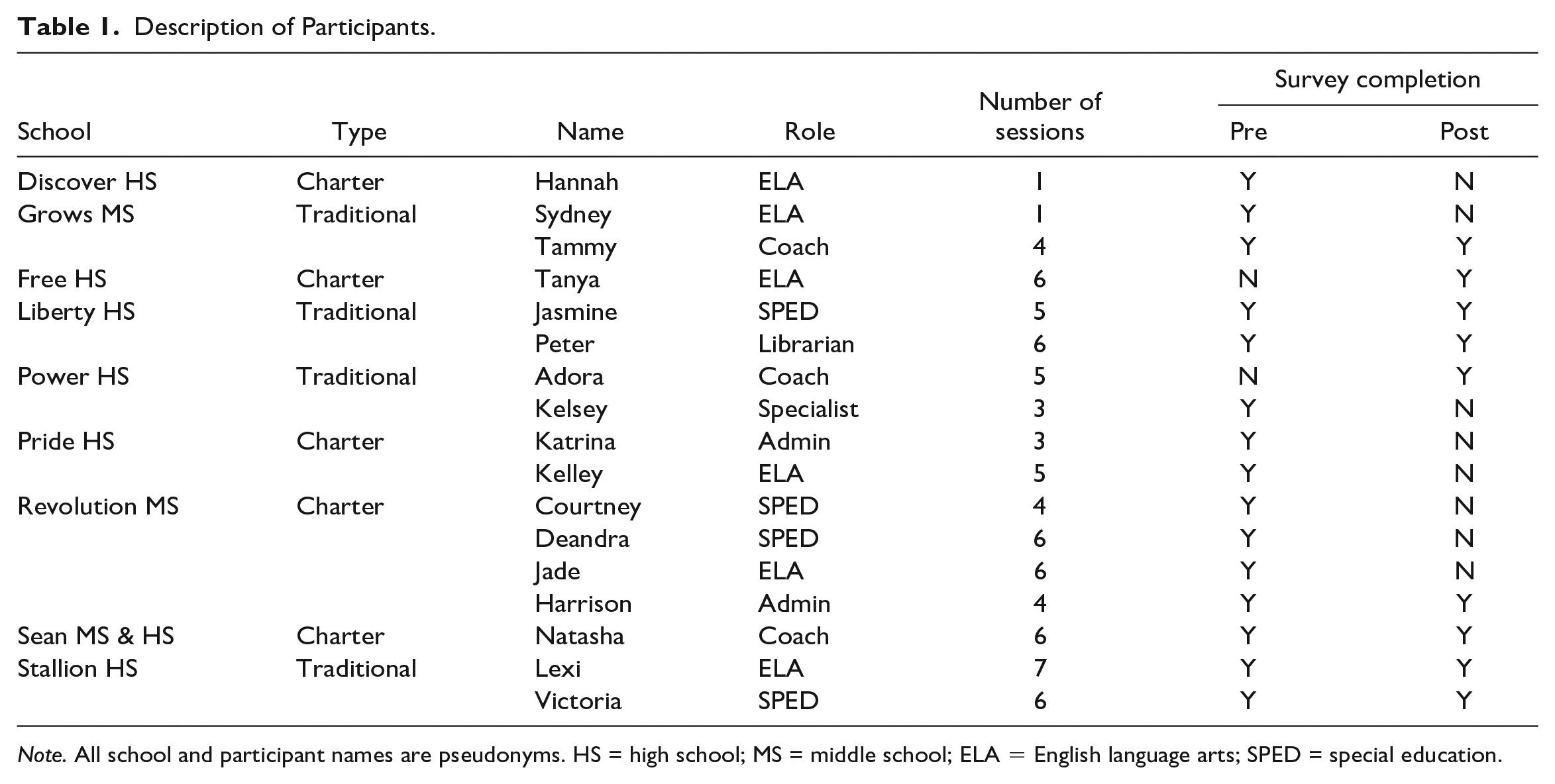
Note. All school and participant names are pseudonyms. HS = high school; MS = middle school; ELA = English language arts; SPED = special education.
The school teams participated in one full-day PL session in November 2019 followed by seven monthly half-day sessions (December 2019–June 2020) for a total of eight sessions. Owing to the COVID-19 pandemic, the first five sessions were held in-person, and the final three were presented remotely. Informed by PL scholarship and in collaboration with an outside PL organization, Sarah and Ali designed and facilitated the PL, drawing upon research across perspectives, including special education, reading, ELA, and other disciplines. They created content to intentionally build conceptual understanding of intervention as a “continuum of supports.” This included how to scaffold literacy instruction in content-area classrooms and develop adolescents’ literacy learning through situated literacy experiences as part of both disciplinary and supplemental instruction that leverages the social, cultural, and linguistic assets of students (see Supplemental File 1 for a detailed description of the PL experience). The first day of the sequence included research about the importance of asset-based mindsets; introduced a broader definition of literacy to include literacy practices beyond the academic realm; and supported educators in developing a robust understanding of literacy processes to support development of foundational knowledge. Sessions 2 to 5 supported participants to identify scaffolds for fluency, comprehension, writing, and vocabulary that could be embedded within classroom practices, focusing on developing strong content and pedagogical knowledge. Sessions 6 and 7 introduced diagnostic assessment tools used to identify students’ literacy strengths and needs, and in session 8, participants summarized their learning and identified action steps. Every session included modeling of new strategies or approaches by the facilitators, opportunities to practice and apply strategies to their own curriculum, opportunities for feedback from peers and facilitators, and active learning activities to help educators situate their practices within various sociocultural contexts.
Data Sources
To understand participants’ beliefs and current practices around literacy intervention, as well as identify how they changed over time, multiple data points were collected across the year. The main data sources were presurveys and postsurveys to learn about participants’ beliefs and reported practices (see Supplemental File 2). Participants completed a presurvey at the beginning of the first session that included open-ended questions about how participants viewed literacy, intervention, and their adolescent readers, which informed instruction for future sessions. The presurvey also helped us to see how participants’ beliefs were situated in and shaped by their own backgrounds and school contexts. At the end of the last session, participants completed a postsurvey, which contained similar questions about their beliefs and practices regarding their students. Fewer participants completed the postsurvey due to complications related to the COVID-19 pandemic.
Secondary data sources included an in-depth reflection that participants completed after session 1 (see Supplemental File 3). In addition, at the end of every session, participants completed an anonymous response form (see Supplemental File 4) to provide feedback to the facilitators about the session and inform next steps based on their areas of interest and need.
Data Analysis
Pre/postsurvey data were analyzed using an open-coding procedure (Teddlie & Tashakkori, 2009), comparing beliefs and practices by role and within schools. We supplemented our analyses of survey data with secondary data sources to establish and confirm patterns.
To answer the first two research questions, three authors coded the survey data independently using a collaboratively created code book (see Supplemental File 5), using our conceptual framework for literacy intervention (see Figure 1) to guide code selection. We initially examined themes from the pre/postsurveys holistically. Then, as we began to note individual and collective shifts in participants’ responses, we engaged in another round of analysis to compare responses and identify shifts in participants’ beliefs and reported practices over time. As part of this process, we created case-level summaries for each participant. For instances of disagreement, we met to discuss and establish consensus, ultimately reaching an inter-rater reliability of .83 for the coded data.
To answer the third research question, we looked across participants by role. Our subsequent analytic memos included cross-case overviews of participants across roles, including attention to similarities and differences in participants’ responses within roles, which in some cases provided insights into their particular backgrounds and school experiences. We also conducted cross-case analyses and wrote corresponding memos to identify similarities and differences in participants’ responses by school. Specifically, we attended to how participants within schools described beliefs about students and how to support them, literacy intervention and instructional practices, and alignment between their beliefs and practices and their school’s approach. In our final phase of analysis, we created a cross-case descriptive matrix (Miles et al., 2020) to systematically look across participants’ responses by role and by school.
Researchers’ Positionality
Like our study participants, as an author team, we bring a diversity of professional experiences and perspectives to this collaboration. Sarah is a researcher and teacher educator who also has experience as a reading specialist and literacy coach at the secondary level, working with teachers across the disciplines and as an English as a second language (ESL) and ELA teacher. Ali is a special educator with experience implementing literacy interventions. Kate and Mark are both former secondary literacy teachers and current literacy researchers and teacher educators. Thus, across our research team, we embody varying perspectives on literacy and intervention that informed the design of this study.
Furthermore, identifying as three White, cisgender females and one White, cisgender male seeking to understand the perspectives of a group of mostly teachers of color, we recognize both the privileges our identities afford us, as well as ways others might view our roles as scholars and educators. As such, we intentionally promote critical conversations on diversity, equity, and inclusion in our university courses and professional development seminars. We also pursue scholarship that aims to identify and disrupt systems of oppression that affect students and teachers in U.S. schools. Furthermore, we use our roles as teachers, teacher educators, and researchers to advocate for youth and teachers who have endured such systems of oppression, and through this work, we aim to contribute to a more equitable society.
This study occurred during a critical time in our country and globally, beginning in fall 2019 and extending through spring 2020. After a brief break from mid-March to early May as teachers adjusted to virtual instruction as a result of the COVID-19 pandemic, the sequence restarted through synchronous Zoom sessions in May and June. As such, Sarah and Ali often began PL sessions by acknowledging and creating space for participants to discuss or reflect on the present moment, while also explicitly recognizing their positionality as White women. At the beginning of session 7, which occurred the day after George Floyd was murdered, Sarah and Ali began by naming the ongoing oppression of people of color, and most recently, the death of Floyd. They acknowledged that participants were likely coming to the session with many different emotions and offered various opportunities for participants to share with one another through optional self-selected breakout rooms, whole group reflection, or video-off solo processing time. They further acknowledged their own limitations, as White women, to truly understand what many of the educators of color in the room were feeling and offered the session as a space to share, or not, as needed.
As a key part of data analysis, Sarah and Ali shared their reflections about these and other experiences as co-facilitators of the PL with the other two members of the research team. The team also discussed on an ongoing basis the ways in which participants’ survey responses were situated in, and in some cases reflective of, broader systems-level considerations in U.S. public education, such as the aforementioned racial inequities rooted in historical and ongoing systems of oppression within educational policy, research, and practice (Willis, 2019). We accounted for these broader considerations by explicitly naming and including them as part of our interpretation processes.
Results
Organized by our research questions, we first explore educators’ beliefs about readers, their reported literacy intervention practices, and how those beliefs and practices changed over time. Next we examine how their beliefs and reported practices varied by role and school.
Secondary Educators’ Beliefs About Readers
Analysis of our data indicated three themes and related shifts in participants’ beliefs about adolescent readers: (de)emphasis on text levels, recognition of learners’ literacy strengths, and use of disciplinary texts as a tool for learning.
(De)Emphasis on “Levels”
On the presurvey, participants often described readers (and texts) from a skills-focused perspective with an emphasis on “levels.” Many participants labeled readers who needed intervention as “below grade level” and indicated that they were unable to engage in reading “grade-level” texts. For example, Kelsey noted that many of her students scored “below grade level” on their reading assessments. Participants further described instruction in terms of levels. For example, Sydney indicated that “instruction varies by level. Students at the lower level are finding the main idea and working on complete sentences, others are finding voice in writing.” Similarly, Natasha stated that students work on the same skill (i.e., finding the main idea) with different levels of texts. Thus, in the presurvey, reading level was a main focus both in labeling students and describing approaches to instruction.
As the PL progressed, participants de-emphasized levels and began to describe changes to their instructional practices, particularly the benefits of providing a range of disciplinary texts for their students with varying amounts of scaffolding. For example, Peter noted the importance of providing opportunities for students to interact with a variety of texts, both more and less challenging, for different purposes. Similarly, Adora noted the importance of exposing children to the rich vocabulary found in disciplinary texts. On the postsurvey, the majority of participants shared the importance of engaging with “complex” texts for readers who need intervention.
This shift occurred slowly across the PL sequence. For example, after session 2, one participant wrote in their feedback form that, “The whole idea of [not using] reading levels just doesn’t make sense.” However, over time, participants began to ask more questions about alternative approaches. After session 5, one participant stated that they wanted to know “more information about why ‘leveling’ older readers isn’t as cut and dry as it is for younger students.” And by the sixth session, participants showed a more nuanced understanding of what it means to support students’ meaning-making, identifying that comprehension and fluency are dynamic depending on text, activity, and context, and that support needs to be adjusted to ensure that all students can “grapple with complex text.”
Increase in Recognition of Students’ Literacy Strengths
Initially, many participants noted the variation across their students in terms of static and generalized observations about their literacy abilities. For example, Tammy explained that some students cannot spell or sound out words while others “speak eloquently” and write “college-level essays.” Furthermore, on the presurvey, participants indicated that many of their students “struggle” with reading and writing and further indicated that this issue spanned across grades. On the presurvey, several participants highlighted that limited proficiency in English perpetuated reading difficulties. Often teachers described students’ struggles in vague, skills-oriented terms. For example, Kelsey indicated that students are “unable to keep up with higher level skills.”
Several participants also noted strengths for readers who needed intervention, but often these strengths were not related to literacy. For example, Harrison noted that students’ strengths included developing “coping mechanisms to help them access the curriculum and participate.” Similarly, Natasha shared their “high willingness to learn and grow.” Others noted low-level, skill-specific strengths, such as their ability to recall or recite information (Hannah) or foundational literacy skills (Kelsey).
Over time, more participants began to identify and articulate literacy strengths for their students. For example, after the first session, which focused on mind-set shifts and viewing all learners as capable, Victoria wrote in her reflection, “I approach students at my school with an academic mind-set, rather than a deficit one like my colleagues.” Then, on the post-survey, she shared the conditions under which her students experience success. Specifically, she observed that when texts are supplemented with verbal information or with visuals students perform well, indicating that her students are capable of engaging in high-level literacy tasks with the appropriate scaffolds. In addition, Lexi and Natasha both indicated on the postsurvey that students’ “funds of knowledge” were a strength, indicating that they believed their students bring relevant knowledge from their homes and communities to their reading experiences, which supports their literacy learning. Furthermore, participants indicated that they needed to focus on what students were able to do rather than just focus on students’ needs, which demonstrated a shift in thinking for many participants. For example, on the postsurvey, Natasha shared that “I come from a place of possibility and equity. Let’s look at what students can do—and start from there.” By considering students’ literacy abilities and the specific contexts in which they require more or less support, participants demonstrated an increasing orientation to literacy as situated practice.
Shifts in Beliefs About Supporting Readers With Disciplinary Texts
On the presurvey, many participants indicated that low levels of background knowledge or weak vocabulary caused issues with students’ reading and writing. Furthermore, many participants also indicated that their students could not engage with disciplinary texts because, as Tammy described, they lacked “real world experience to understand challenging texts.”
However, responses to the postsurvey and session feedback forms demonstrated a shift in thinking about providing access to disciplinary content through attention to particular texts, activities, and contexts. Participants indicated that students were not just capable but, in fact, needed to read disciplinary texts to support their literacy growth. For example, after session 6 one participant shared that they would like to “rethink texts and tasks on our current mid advisory and end of advisory assessments” to create more thoughtful and situated comprehension experiences for readers. In addition, on the postsurvey Lexi shared, “I think they should always have the opportunity to grapple with complex, grade-level texts! Otherwise they will remain at the same level and not progress.” Lexi’s response is an example of how participants seemed to be grappling with the complexities of literacy at the intersection of skills- and practice-focused perspectives.
Changes in Secondary Educators Reported Practices Around Intervention
Data analysis for our second research question revealed an increased emphasis on situated reading and a more nuanced understanding of foundational skills and scaffolding.
Shift from Focus on Standards to Supporting Situated Meaning-Making
On the presurvey, when asked about how to teach literacy, many participants focused on increasing students’ abilities using standards-based and skills-focused language such as “finding the main idea” or “making inferences.” For example, Victoria noted that “students in high school continue to struggle with identifying main idea and making and answering inferential questions about the text.” Responses like this one reflect an autonomous and skills-focused orientation to literacy instruction.
On the postsurvey, there was a shift in focus from teaching standards to also making meaning from the text. Natasha shared that “each student comes to a text with varying levels of access and need for support to get to meaning making.” Lexi noted the need to support students in developing “self-monitoring skills, like pausing to check for understanding.” After session 6, which was focused on literacy assessments, another participant shared that they wanted to “pull focus away from district standards-based assessments,” indicating that they needed assessment data that allowed them to learn more about their readers than standards-based assessments allowed them to do. Specifically, participants shifted their focus to narrative assessments that allowed them to look at students’ abilities across texts, tasks, and contexts, and to consider the ways that students could bring their vast funds of knowledge to those reading experiences.
More Nuanced Understanding of Foundational Skills
Initially, most participants identified needs for their students related to phonics, fluency, or phonemic awareness. Yet, participants did not share any information about how those needs were operationalized in classroom settings, nor did they designate which students needed support with particular foundational skills or the specific conditions under which additional support was necessary.
In the postsurvey, several participants noted fluency, comprehension, or decoding specifically as areas of need or strength for particular students. Furthermore, participants provided clear examples of what students could or could not do in the context of specific texts and activities. Some participants indicated that the needs “varied by child” and assessments were needed to determine which foundational skills, if any, to address during intervention. In addition, participants’ understanding of foundational skills was stronger and more nuanced on the postsurvey, as they were better able to demonstrate an understanding of fluency and how it relates to comprehension, describing how all of the pieces of literacy fit together. For instance, Lexi shared that “fluency can demonstrate a student’s reading comprehension and is a window into their processing of a text, but it can reveal comprehension only up to a point.” Others highlighted the need to figure out if decoding or fluency were specific needs for students before providing intervention around foundational skills, indicating a shift from a one-size-fits-all approach to one that takes into account the specific conditions under which students may experience difficulty.
Shift in What Intervention Means
Prior to the PL, participants discussed three structural aspects of intervention to describe their conceptualization of the concept: grouping structures, personnel, and programs. For example, teachers indicated that readers identified as below grade level benefited from “pull out” instruction provided by another educator, small group instruction in or out of the content classroom, or one-on-one instruction, without explaining what types of instruction would happen across different settings. One teacher shared in her session 1 reflection that, “I encourage teachers to provide small group instruction as a way to really get to know their students’ reading ability and behaviors.” In this response, the focus was on the structure (i.e., small groups) rather than the content of the intervention.
Relatedly, many participants conceptualized intervention as instruction that was delivered by a specialist, such as a reading specialist or special educator, who was better equipped to assist students. In addition, some participants revealed that intervention included providing tracked ELA classes (often using a reading program focused on skills for lower tracks) with a collaborative teacher (often a special educator) to support students who were identified as “below grade level.” In some cases, participants noted that it was not an ELA teacher’s responsibility to provide intervention. In addition, when asked specifically about intervention instructional practices, most participants cited programs, specifically naming Wilson, I-Ready, Fundations, Lexia, Reading A-Z, DI, Read 180, ABC mouse, phonics programs, STARI, LLI, and System 44.
Postsession feedback indicated that teachers were grappling with how to use assessments to better understand their students’ literacy needs. For example, after session 4, which focused on vocabulary instruction, one participant shared that, “I would like to learn more about comprehensive literacy assessments . . . Is there something more comprehensive or effective than SRI and Read 180 for high school students?” Similarly, how some participants described intervention changed between the presurvey and postsurvey. Although on the postsurvey, some participants still mentioned the use of pull-out instruction or specific programs such as Read 180, others more clearly described what students needed and how using formative assessments (such as classroom work) could provide insights into which supports were working and under what conditions. Adora, a literacy coach, indicated the importance of PL to help support ELA teachers, describing the effectiveness of “working in the classroom alongside ELA teachers” to teach them “how to provide comprehension support.” Adora’s reflection on the PL reveals her attention to supporting students’ literacy learning within the contexts of their classrooms as an alternative to stand-alone intervention programs that are disconnected from students’ disciplinary learning.
Deepened Understanding of Scaffolding
When initially asked about how to support students during ELA, most participants provided vague responses such as differentiation, scaffolds, leveling, or reading aloud rather than specific techniques grounded in the texts and content of the discipline. However, a few participants described more specific scaffolds. For example, scaffolding practices mentioned included preteaching vocabulary, providing preannotated texts or annotation guides, asking students to practice reading complex texts more often, modeling fluent reading or higher-level analysis, reading high-interest books, and practicing reading challenging words before reading.
As participants broadened their understanding of scaffolds, they began viewing disciplinary texts themselves as ways to support readers’ comprehension, rather than seeing the text as an obstacle. For example, a common support identified by participants was the use of quad text sets, an approach that uses a challenging disciplinary text alongside another, more accessible informational text to build background knowledge, a visual text, and a “hook” text to engage students (Lupo et al., 2018). On the postsurvey, Tammy noted, “Ultimately, building vocabulary, context, and using text sets can benefit children at any level.” Tammy stated that she would “provide another text on a similar topic to help build the student’s knowledge base to be able to better comprehend and analyze the text.” This response demonstrates a shift from skills-focused thinking toward knowledge building and meaning-making as key components of literacy intervention.
Furthermore, on the postsurvey, participants provided more specific and situated information about how to scaffold reading and demonstrated more knowledge about what challenges readers face when engaging with disciplinary texts. For example, Lexi highlighted the importance of addressing vocabulary, stating that she “activated prior knowledge activities with images, video, other types of multimedia, graphic organizers and charts, determining what types of vocab to work with before creating activities, specifically scaffolded analysis questions.” Others mentioned how and when to use various scaffolds such as graphic organizers, annotation guides or fill-in-the-blank guided notes, close-reading questions, visuals, anchor charts, probable passages, multiple opportunities to re-read a text, think alouds, text-dependent questions, and modeling fluency. While the extent to which these named scaffolds were tied explicitly to meaning-making and disciplinary learning varied, they suggest a more precise and situated consideration of the kinds of scaffolds that support students’ literacy learning across ELA contexts.
Nuances in Beliefs and Practices Based on Educator Role and School Context
Analysis of data around our third research question revealed variance in how participants across different roles and schools defined and engaged adolescents in literacy instruction.
ELA Teachers
ELA teachers’ beliefs and reported practices varied, with some teachers viewing supporting students’ reading as part of their job and others seeing it as not their responsibility. For example, Lexi thought about intervention as something that she could address in her own classroom. She wrote in her presurvey, “Scaffolding works! Develop a year-long, long-term plan to [support] them and slowly remove scaffolds.” In her postsurvey, she continued to stress the importance of this approach. Other participants like Jade thought about intervention in terms of what she could provide in her classroom through differentiation and scaffolding within the larger context of her school’s approach to intervention. She explained in her presurvey, “besides the students who receive pull-out support, most students can be sufficiently supported by scaffolded work provided in the classroom.”
In contrast, Hannah thought about intervention at her school from a special education perspective. In her presurvey, she explained that for “the high level of students with learning disabilities at my school . . . [intervention] is necessary to meet them with the proper accommodations.” Finally, in her presurvey, Kelley did not see intervention as something that was part of her duties as an ELA teacher. She noted that she had a co-teacher “who leads the levels of supports for students” and therefore “knows more about [intervention approaches].”
Coaches and Specialists
Coaches and specialists’ beliefs and reported practices also varied. In her postsurvey, Adora (coach) thought about intervention as something that happens effectively in pull-out and small-group settings, as well as in classrooms with ELA teachers (e.g., around comprehension). In her pre/postsurveys, Natasha (coach) focused on intervention as it occurs through differentiation within classrooms, including but also beyond ELA, with a focus on “supporting students in accessing complex/grade level texts.” In contrast, Kelsey (specialist) thought about intervention as something that should be provided by a resource educator rather than a classroom teacher. Finally, Peter, a librarian, thought about intervention in terms of how he can support students through collaboration with other educators at his school.
Special Education Teachers
There was more consistency in special education teachers’ beliefs and reported practices about literacy, with a particular focus on foundational skills. Yet, for the two special educators who completed pre/postsurveys, there was a shift to a more comprehensive understanding of readers. Victoria’s postsurvey included a clear description of why students struggle, stating the range of reasons extending well beyond phonics and including motivational factors and semantic knowledge. Similarly, Jasmine’s postsurvey included more specifics about the particular approaches and ways of scaffolding to support readers, such as building background knowledge and interest, supporting vocabulary, and using different annotation techniques and scaffolds.
Administrators
Similar to special educators, there was more consistency between the two administrators’ beliefs and reported practices about literacy intervention, with a particular focus on when and how to schedule interventions and the curriculum (or lack thereof) used in intervention settings. The two administrators had more vague notions of what literacy support actually looks like at the system level. In her presurvey, Katrina noted that her school is not strategic or proactive in supporting students. For example, she indicated that many students have IEPs related to literacy, but they do not have any systems in place to support these students once they enter nineth grade. In his pre/postsurveys, Harrison noted that there are a range of different reasons that students struggle, with an emphasis on comprehension and that they should receive individualized supports both within supplementary spaces and in the regular classroom. However, outside of the new district-adopted curriculum for general ELA instruction, what these supports might entail was unclear.
Within-School Trends About the Meaning of Intervention
Differences in perspectives on intervention and readers also varied significantly within schools. 1 For example, Pride participants—an administrator, Katrina, and an ELA teacher, Kelley—shared different perspectives about literacy intervention. Katrina did not think her school does a good enough job, and Kelley did not see intervention as part of her ELA responsibilities. At Revolution, differing perspectives followed the variation in beliefs by role described earlier. Despite these differences, we noted two trends.
Increased Commitment to Embrace a Collaborative Approach
These within-school differences became less pronounced over time. The PL appeared to spark collaboration across colleagues within schools. For example, in postsession feedback forms, nearly half of the respondents advocated for a designated time to meet with special education and ESL colleagues to ensure students receiving services are getting what they need in a consistent way. Similarly, another participant shared that “I will begin a dedicated, 30-minute weekly co-planning meeting with my co-teacher, ESL support teacher, and myself.” Other participants shared in their postsession feedback forms that they advocated for co-teaching models to allow for more collaboration across roles within their schools. Similarly, Harrison, an administrator, noted in his post-survey that “the opportunity to work alongside my humanities teacher helped our working relationship and our ability to serve our students well.”
More Consistency in What Literacy Intervention Entails
Furthermore, within schools, there was evidence of more consistency in approaching intervention in a more situated way through the use of disciplinary texts with strong scaffolding. For example, as mentioned previously, on the postsurvey, Lexi articulated a need for students to have opportunities to engage with “challenging” texts so that they can progress. Similarly, Lexi’s colleague, Victoria, also shared that “I believe those readers who have been identified as reading below grade level can still access the rigorous task or read those grade level texts with the right supports.” Lexi noted that this shared vision went beyond the participants in the PL, stating that: My beliefs align with my school’s practices because we provide all our ELL students chances to work with challenging texts. . .with supports in place. The ESL team is also involved in planning with all other ELA teachers, so we share practices and are in no way expected to teach less rigorous texts.
At Free, both Jasmine and Peter shared a similar view. Peter noted on his postsurvey that “helping to bring [students] up to grade level is so imperative to their growth and the growth of the community.” Jasmine similarly noted in her statement, “We believe all students can read and will learn to read with the proper supports and interventions.” As these examples illustrate, participants within some schools appeared to show more consistency in their interpretation of literacy intervention. While the extent to which this consistency in views moved beyond a skills-focused perspective to a more situated understanding varied, participants increasingly seemed to share a commitment to supporting students’ disciplinary learning through responsive literacy instruction and indicated movement toward a shared vision of literacy intervention in their schools.
Discussion and Implications
Educators’ definitions of and approaches to intervention, as well as their beliefs about adolescent readers’ abilities and approaches to supporting these readers, varied widely. And yet, a more inclusive, situated, and coherent understanding of literacy was evident across participants over time. Below, we summarize the main findings and discuss implications for future PL opportunities.
Shifting Beliefs About Readers and Literacy
Participants shifted their beliefs from categorizing readers in terms of specific and relatively static labels related to reading level (reflective of an autonomous, skills-focused perspective on literacy) to identifying students’ areas of academic strength alongside areas where they may need additional support (reflective of a more situated perspective). This shift appeared to contribute to more nuanced, practice-focused understandings about the readers in their classrooms, the conditions under which they experienced more or less difficulties with reading, and the ways that instructional scaffolds could support them to engage with disciplinary texts. These findings are compelling in light of prior research that has focused on the importance of developing situated understandings of readers and reading (Lipson & Wixson, 1986) and more agentive notions of students’ own learning (Brock et al., 2021). While readers’ multiple literacies and identities and the broader belief systems and social, cultural, and historical practices that shape and are shaped by them also matter to literacy learning (Frankel et al., 2021), we found that attention to these key aspects of literacy was less prevalent in participants’ responses.
Thus, a foundational step for future PL is to support secondary educators to understand literacy as situated within social practices and interconnected with readers’ identities. This more contextualized and socially situated understanding of literacy provides a lens through which educators can work with their students to consider the specific conditions under which readers experience success across contexts with a focus on making meaning from texts. The PL described here began with a focus on understanding and, where necessary, shifting educators’ mindsets about the capabilities of adolescents. The first session’s reflections suggested that some teachers experienced an immediate shift in how they viewed and spoke about their students. Over the course of the study, as participants’ knowledge of comprehension grew, their responses suggested a related shift in their beliefs and practices related to literacy intervention. Therefore, a key implication for future PL with secondary educators is to provide them with a framework that conceptualizes literacy as embedded within social practices and interconnected with students’ multiple literacies and identities.
Shifting Orientations to Instruction and Intervention
Our findings indicate that participants shifted their focus from general standards-aligned skills to making meaning of texts as the primary purpose of literacy instruction. They also indicated an increased awareness of the specific areas of reading and instructional scaffolds necessary to support individual students, a stark contrast to the pre-survey responses which focused on intervention structures. These findings suggest that the concept of literacy intervention is often generally and vaguely understood in seemingly contradictory ways. This diversity in understanding and lack of specificity mirrors similar trends in the broader research literature, where intervention is used in various, even dichotomous, ways (Johnston, 2011). And yet, participants in this study seemed willing to apply what they learned to make adjustments to their own understandings and curriculum (Hayes-Jacobs & Johnson, 2009).
One consequence of vague or generic language, reflecting an autonomous view of literacy, is that it leads to deficit positioning for adolescent readers by focusing on static states and prescribed instructional responses rather than on literacy learning as a dynamic process situated within ideological and purposeful social practices. Therefore, as an extension of the practice-focused perspective grounded in a sociocultural orientation to literacy described above, an important additional focus for PL is to work with educators to develop more precise, shared language across educators’ roles that is adequately responsive to a diversity of readers and their range of experiences with literacy in varying contexts. For example, questions educators might ask include: What are the specific contexts and conditions under which readers experience challenges? What specific combinations of texts and activities require increased scaffolding and support? By precisely identifying the potential disciplinary literacy-based challenges that students might face, educators can view these challenges as rich opportunities for literacy learning and access to disciplinary texts for all students in their classrooms. Moreover, when educators have opportunities to describe students’ assets and identify contexts in which their students may face challenges, they are able to strategically consider scaffolds for particular texts and activities.
Reconciling Varied Beliefs and Reported Practices Based on Educator Role
Across participants, we found that ELA teachers, coaches, and specialists had quite varied understandings about supporting students’ reading, ranging from not viewing literacy intervention as part of their job to a focus on foundational skills, assessment, or tracking. This lack of a shared definition for what it means to support adolescents’ reading in school is likely tied to broader structures (e.g., teacher preparation programs, school organizational structures) and historical trends (e.g., differing perspectives on intervention as skills- versus practice-focused) that may contribute to educational silos (e.g., separate literacy and special education departments, limited communication with disciplinary teachers). These structures and trends have implications for how scholars and educators theorize, research, and implement literacy interventions. And yet, in the context of PL designed to bring diverse scholars and educators together to expand their collective understandings of literacy, our findings suggest that differences within schools may become less pronounced over time as participants collaborate to develop consistency in vocabulary and what intervention entails. These findings are consistent with previous research (Amendum & Fitzgerald, 2013; Brock et al., 2021).
Therefore, another focus for PL is to help educators conceptualize intervention more broadly as a collaborative effort consisting of a continuum of situated supports in which all stakeholders (e.g., administrators; educators across the disciplines of ELA, history, math, and science; and students themselves) participate in identifying and providing coherent scaffolds to support students’ literacy learning. Drawing on the experience and expertise of all stakeholders provides pathways for students to be appropriately supported within disciplinary classrooms, and to contextualize any opportunities for supplementary instruction as part of a broader understanding of supporting students’ literacy learning. It also allows for the use of contextualized data (e.g., formative assessment, narrative profiles) to identify additional areas of need beyond assessment score or disability category.
A collaborative approach to intervention is different from perspectives that separate regular content-area instruction from intervention outside the mainstream classroom. It marks a shift from approaches described in the literature and in policy discussions about literacy intervention, where particular programs or methods are framed as “silver bullets” consisting of isolated and decontextualized instruction outside of students’ disciplinary classrooms. False narratives such as these “medical models” are rooted in a long history of orienting to intervention as remediation (Frankel, 2022). Moreover, this remedial orientation reflects an autonomous, skills-focused view of literacy informed by White, middle-class, and English-dominant norms for literacy (Willis, 2019). It positions students, particularly minoritized students, as “lacking” necessary skills, with the expectation that a program or instructional approach, delivered by a special educator or interventionist, will “fix” the problem.
In contrast, by viewing intervention as a continuum of situated instructional supports that are the responsibility of all stakeholders, educators can challenge historical and ongoing deficit-focused perspectives about adolescents and their literacies and be responsive to different profiles of adolescent readers, including the affective and academic factors that contribute to their literacy experiences as part of social practices within and beyond school. In this way, all stakeholders are working toward a common, inclusive, and collaborative goal focused on establishing rich and meaningful literacy experiences across the school day. We have a collective, shared responsibility to rethink intervention, including defining it more broadly, both to challenge historical and ongoing deficit perspectives that perpetuate racial inequities and to attend to literacy learning within and beyond content-area classrooms.
Limitations and Future Research
This study represents a first step toward better understanding the range of educator beliefs and practices about supporting adolescents through literacy intervention, and how these beliefs and practices may change in the context of PL. Since we focused on a select group of educators from one school system, this study does not claim generalizability. Rather, our purpose is to call attention to the various ways that educators make sense of literacy intervention, and the conditions that have the potential to facilitate perspective shifts across roles and contexts.
Our findings point to important future directions for adolescent literacy intervention research. First, future research should seek to understand how educators’ beliefs are enacted in practice and over time within and across schools, as well as how their beliefs relate to students’ experiences, literacy outcomes, and perspectives related to the contexts in which they engage in literacy learning. Understanding students’ perspectives is essential given prior research indicating that literacy intervention at the secondary level often fails to consider adolescents’ agency and identity as key to their experiences (Frankel et al., 2021). This trend was evident in our findings as well, suggesting that future PL would benefit from increased attention to the importance of students’ histories and identities to literacy learning.
Second, future research should consider the conditions under which PL can support educators to develop a shared language and vision for literacy intervention that values and extends adolescents’ strengths and identities and, in so doing, speaks back to deeply rooted deficit perspectives about adolescents and their literacies. This point is important in light of the practical challenges we encountered in creating the survey, where we were careful to use terms that educators would understand while also attempting to avoid common deficit language to describe readers (e.g., “below-level” or “struggling”). And yet, our own wording in the survey as well as participants’ descriptions of readers in their responses both call attention to confusion around terms and a persistent deficit orientation in the language used to describe adolescent readers. Taken together, these trends point to a need to develop situated and dynamic ways of describing readers and their needs that build from readers’ strengths, reflect an interactionist perspective (Lipson & Wixson, 1986), and do not position readers as deficient.
Third, future research can provide empirical support for theorizations and definitions of intervention that are grounded in robust conceptualizations of literacy and that encompass a continuum of situated supports in both disciplinary and intervention contexts. Future research also must interrogate the assumptions that continue to underlie conceptualizations of literacy and intervention and that contribute to ongoing inequities in literacy learning opportunities for minoritized students (Willis, 2019).
Redefining Literacy Intervention: A Vision for the Future
A key implication of our study was the importance of looking across multiple educator roles to better understand their (shifting) beliefs about adolescent readers and intervention. We suggest that the sustained opportunities for shared learning across teachers and school leaders that focused on deepening their understandings of literacy processes, supporting asset-based ways of viewing adolescents, and providing specific strategies to support literacy in disciplinary contexts may have made a difference in how individuals and whole schools conceptualized and enacted intervention in their contexts. By developing a shared language and vision for literacy intervention, these educators were able to focus on a variety of ways to support learners across school contexts. For example, some ELA teachers shifted their views about literacy and intervention as something outside of their purview to viewing literacy support as key to teaching within their discipline. Some special educators began to approach intervention as a more collaborative endeavor to support both supplemental instruction and disciplinary learning. With a better understanding of the scope of intervention approaches, administrators were better able to collaborate with teachers in support of students. Thus, a shared understanding and vision of literacy and intervention seems essential.
Developing a shared vision requires that educators have time and space to engage in collaborative discussion and action to challenge both preexisting conceptualizations of literacy focused on decontextualized and autonomous skills and related, historically rooted and ongoing deficit-focused perspectives on intervention as remediation. This might look different across contexts. For example, at one school, ELA, history, math, and science teachers, coaches, specialists, and special educators might come together in ongoing weekly PL communities to develop shared understandings of literacy as part of social practices that include close attention to their students’ multiple literacies and identities across disciplines and beyond school. They might then use these understandings to collaboratively identify ways of engaging, scaffolding, and extending their students’ literacy learning as part of disciplinary practices within, across, and beyond classrooms. Another school might implement monthly “unit unpacking” collaborative sessions in which disciplinary teachers and specialists work to identify opportunities for curricular support that build from what they know about their students as readers and as people. No matter the structure across individual schools, frequent opportunities for thoughtful and critical partnership appear to be pivotal to ensure all educators are communicating to support students.
A complementary approach might involve PL that extends beyond one school. For example, the PL series in this study presented a unique opportunity to bring together teachers and administrators across grade levels, roles, and schools. As such, it provided insights into the differing perspectives that educators had regarding intervention. This PL also allowed educators to engage in conversation across roles to develop a shared language and vision for supporting adolescents’ literacy learning in their individual school contexts. Research has shown that these types of PL sequences can provide rich opportunities for secondary educators to deepen their understandings of adolescent literacy and what it means to support learners (Robertson et al., 2020; Wilson et al., 2009). Thus, as we redefine literacy intervention, collaborative approaches hold particular promise, especially ones that bring together educators in different roles to reject deficit perspectives; explore asset-based mindsets; and develop a shared vision of literacy and intervention, including the systems, structures, and resources necessary to support all students.
Footnotes
Declaration of Conflicting Interests
The author(s) declared no potential conflicts of interest with respect to the research, authorship, and/or publication of this article.
Funding
The author(s) received no financial support for the research, authorship, and/or publication of this article.

Supplemental Material
Supplemental material for this article is available online.
Notes
Author Biographies
References
Supplementary Material
Please find the following supplemental material available below.
For Open Access articles published under a Creative Commons License, all supplemental material carries the same license as the article it is associated with.
For non-Open Access articles published, all supplemental material carries a non-exclusive license, and permission requests for re-use of supplemental material or any part of supplemental material shall be sent directly to the copyright owner as specified in the copyright notice associated with the article.
