




Abstract
This study investigated how taking different perspectives in teacher training courses influences the learning of professional vision, multiperspectivity, and strategic knowledge of classroom management. A total of 134 student teachers analyzed classroom management from one of three different perspectives: 36, from an observer perspective by viewing videos of unknown teachers (TG-V); 46, from only a protagonist perspective by remembering own teaching (TG-T); and 52, from both a protagonist and an observer perspective through videos of their own, their peers, and unknown teaching (TG-VT). An untreated control group (CG) received no classroom management training. Learning gains were investigated in a quasi-experimental pre–post–follow-up design using a mixed-methods approach. Results showed that all interventions fostered strategic knowledge of classroom management. Analyzing videos from own and unknown teachers (TG-VT) had the strongest positive effect on professional vision, but analyzing own teaching from memory also had higher effects on professional vision and multiperspectivity than analyzing stock videos.
Classroom management is an important skill for the academic, social-emotional, and motivational development of students and for the health of teachers (Evertson & Weinstein, 2006; Hattie, 2009). The challenge of classroom management is to monitor disruptive students and manage transitions (Kounin, 1970) as well as to maintain the group focus on a class without neglecting the individual focus on single students (Kounin, 1970; Thiel et al., 2012; van den Bogert et al., 2014). However, student teachers in particular, but also inservice teachers, report that they struggle with classroom management (Giallo & Little, 2003). Especially novices have difficulties in focusing their attention on a disruptive student while simultaneously observing the rest of the class (Hogan et al., 2003; Sabers et al., 1991; van den Bogert et al., 2014). In contrast, expert teachers have a professional vision of their classrooms, meaning they are able to notice and interpret critical events in the classroom competently (Sherin et al., 2008) due to having mental schemata and scripts at their disposal that lead to a fast perception, recognition, and interpretation of relevant situational cues (Berliner, 2001; Bromme, 2014). Therefore, a professional vision of classroom management (PVCM) is a prerequisite of a teacher’s classroom management. However, student teachers report struggling with classroom management (Giallo & Little, 2003; Meister & Melnick, 2003; Romano, 2007), but receiving insufficient preparation in classroom management during their teacher training (Giallo & Little, 2003; O’Neill & Stephenson, 2012).
To acquire such a PVCM, student teachers need to build elaborated and situated knowledge structures about classroom management that will enable them to notice and interpret those meaningful events in the flow of teaching that are relevant for classroom management. Consequently, promoting knowledge on and professional vision of classroom management may help student teachers to deal with the complexity of a classroom.
This raises the question how PVCM can be promoted most efficiently. This study compared the effects of three learning environments, each providing a different analytic perspective on teaching and classroom management in particular: (a) from a video-supported observer perspective analyzing videos of other teachers’ teaching, (b) from a non-supported protagonist perspective by analyzing own teaching without having a video at hand, and (c) from both a video-supported observer and protagonist perspective but having a video at hand for analyzing other teachers’ and own teaching. We hypothesized that the latter would be most efficient learning environment.
We conducted a quasi-experimental pre–post–follow-up training study to investigate the effect of the combination of several perspectives (c) compared to the other training groups (a; b) and the effects of all three learning environments compared to the performance of an untreated control group (CG). Findings about the effectiveness of such seminars can provide information on whether the effort to create and analyze videos from own teaching is worthwhile for improving teacher education programs, taking into account technical requirements and data protection issues. In terms of the implementation effort, such video-based courses could be easily implemented in practical phases of teacher training. In the following sections, we first review the relevant literature on PVCM before presenting our intervention approach.
Professional Vision of Classroom Management
Professional vision means the ability of a teacher to notice and interpret relevant classroom interactions (Sherin et al., 2008). It encompasses two interrelated and dynamic processes: Noticing includes drawing attention to noteworthy events that influence learning while ignoring those that do not. Knowledge-based reasoning means to figure out the implications of these events based on one’s professional knowledge. Thus, professional vision is a perception (noticing) and interpretation (knowledge-based reasoning) of classroom events premised on the flexible application of professional knowledge (Seidel & Stürmer, 2014).
Noticing
Teachers’ noticing in a complex situation is guided by highly connected and flexible schemata and scripts enabling them to integrate new information without any great mental effort and to pay selective attention to meaningful classroom events (Bromme, 2014; Sherin et al., 2008). Because this study focuses on teachers’ PVCM, we shall specify facets of classroom management that teachers have to notice.
Classroom management is defined as “the actions teachers take to create an environment that supports and facilitates both academic and social–emotional learning” (Evertson & Weinstein, 2006, p. 4). Classroom management should, accordingly, aim at student discipline but particularly at establishing a positive learning climate and positive student–teacher relationships by engaging in primarily preventive actions (Evertson & Weinstein, 2006). Preventive and reactive classroom management strategies can be subsumed under three facets (for a detailed description, see Gold & Holodynski, 2017):
Monitoring. Being aware of the interactions in a classroom, demonstrating this “withitness” to the students, and intervening to prevent disruptions as needed (Emmer et al., 1980; Kounin, 1970).
Managing momentum. Instructing in line with students’ attention and understanding, activating and motivating students to participate, and creating smooth transitions between classroom activities (Emmer et al., 1980; Kounin, 1970).
Establishing rules and routines. Defining, communicating, and establishing a transparent framework through a set of rules and routines for daily classroom life together with the students (Emmer et al., 1980; McGinnis et al., 1995).
Noticing these three facets of classroom management in an adequate way is important for further interpretations, decisions, and actions in class. This is confirmed by research showing that experts are better at focusing their attention on critical classroom management events (van den Bogert et al., 2014; Wolff et al., 2017). Consequently, noticing events that are covered by the aforementioned facets represents one component of PVCM.
Knowledge-Based Reasoning
Knowledge-based reasoning about noticed classroom management events is a rather automatic process (for experienced or expert teachers) of describing, explaining, and evaluating these events as well as predicting consequences and making decisions (Sabers et al., 1991; Seidel & Stürmer, 2014; Sherin & van Es, 2009). Compared to novices, expert teachers are better at paying attention, processing information, and making decisions while teaching their own class or even watching a classroom video. Novices tend to describe what is happening in the classroom superficially, whereas experts integrate situation cues into their knowledge structures and make inferences for their decisions (Berliner, 2001; Sabers et al., 1991; Seidel & Stürmer, 2014; Sherin & van Es, 2009; Wolff et al., 2015). Gold and Holodynski (2017) investigated knowledge-based reasoning specifically with respect to the aforementioned facets of classroom management. They found that inservice teachers’ ratings of classroom management in videos were significantly more in line with those of experts (researchers and teacher trainers) than those of student teachers.
Multiperspectivity
Beyond noticing and knowledge-based reasoning, teachers need to recognize and integrate the perspectives of all those involved in the classroom to understand their needs and to adequately involve them (Goeze et al., 2014; Könings et al., 2014). Expert teachers have elaborated knowledge structures to integrate single aspects of a situation into a big picture. This is supported by studies comparing novice and expert teachers in their information processing while observing classroom videos. Experts were more competent in (a) integrating different perspectives (e.g., the students’ and the teacher’s view) and (b) connecting together several events or relevant aspects of a situation (Hogan et al., 2003; Sabers et al., 1991; Wolff et al., 2015, 2017). In summary, PVCM comprises noticing relevant events with respect to the three facets of classroom management and engaging in knowledge-based reasoning from multiple perspectives.
Some empirical findings have shown that higher professional vision is related to higher teaching quality (Roth et al., 2011; Santagata & Yeh, 2014; Sherin & van Es, 2009; Sun & van Es, 2015) and to student learning (Kersting et al., 2012; Roth et al., 2011). These results emphasize the relevance of promoting professional vision for successful teaching and therefore classroom management.
Theoretical Framework for Promoting Professional Vision in Classroom Management
One promising approach to support student teachers in dealing with the complex task of managing a class is, first, to promote their PVCM. Cognitive flexibility theory (Spiro et al., 2007; Zottmann et al., 2012) offers a theoretical framework for developing effective learning environments that foster PVCM. This learning theory for acquiring knowledge in ill-structured contexts assumes that cognitively integrating, contrasting, and comparing different perspectives and different aspects of a given context helps learners to transfer theoretical knowledge into integrated and applicable knowledge.
Analyzing classroom videos might notably improve such knowledge transfer (Goeze et al., 2014) and hence help develop PVCM, because videos provide opportunities for repeated observation of the same teaching events. This enables student teachers to analyze different facets of classroom management as well as multiple perspectives on the same event, for example, the perspective of the teacher as a protagonist, or the perspective of an observer. Furthermore, videos document the complexity, simultaneity, immediacy, and unpredictability of real classrooms (Goldman et al., 2007) which helps to take the students’ perspectives rather than only the teacher’s perspective (Goeze et al., 2014; Rosaen et al., 2008).
We adopted this framework to fit the promotion of PVCM and developed a learning environment in which student teachers analyzed teaching by combining the protagonist perspective and the observer perspective. The protagonist perspective was related to memories of own teaching, while the observer perspective was related to a video of the same taught lesson and to videos from other teachers’ teaching. We contrasted this combined multi-perspective intervention with two other interventions, each providing only one perspective while analyzing teaching: a video-supported observer perspective provided by videos from other teachers’ teaching and a protagonist perspective provided by own teaching without a video. We shall elaborate these perspectives in the following sections.
Learning From Videos of Own Teaching Versus Others’ Teaching
Analyzing videos of their own teaching allows student teachers to take at least two perspectives. The first is the internal perspective as the protagonist of teaching, which comes from memories of the lesson they have taught. The second perspective is the video-supported external perspective of observing their own teaching via video that allows a comparison between the protagonist and observer perspective. In contrast, analyzing videos of other teachers offers only the observer perspective.
Sherin (e.g., Sherin & van Es, 2009) has long been investigating the use of videos of own teaching in so-called video clubs, in which small groups of teachers jointly reflected on their videotaped teaching. However, these non-experimental studies referred to inservice teachers. Hardly any experimental intervention studies have compared the effect of analyzing videos of own teaching to analyzing videos from other teachers that provide only an observer perspective. One quasi-experimental training study with student teachers (Hellermann et al., 2015) found that the own-video condition was significantly superior in promoting the PVCM compared to the stock-video condition. Seemingly, the opportunity to compare and integrate both the protagonist and the observer perspective led to a more flexible application of knowledge and, thus, to a more elaborated professional vision in student teachers.
Some further experimental nonintervention studies with inservice teachers have revealed advantages as well as challenges of working with own videos in teacher education. Seidel et al. (2011) showed that a video analysis of own teaching elicits a more elaborated reflection on teaching and learning, but less critical analysis in the sense of reflecting on negative aspects of teaching.
Further studies also found a leniency bias indicating that teachers tend to avoid a deep critical analysis of their own and peer videos (Beisiegel et al., 2017; Kleinknecht & Schneider, 2013; Seidel et al., 2011; Zhang et al., 2011). One source of leniency bias is self-protection in response to an emotional arousal or even distress people perceive when confronted with themselves on a video (Fuller & Manning, 1973; Leblanc, 2018; Seidel et al., 2011). Such a positive bias might also stem from the attempt to resolve cognitive dissonance when remembered and observed teaching (also via video) are perceived differently (Baecher & Kung, 2011; Fuller & Manning, 1973; Leblanc, 2018; Rosaen et al., 2008).
For promoting professional vision, such a positive bias of analyzing only own teaching should be reduced or ruled out. A suitable solution is to begin an intervention first with analyzing videos from other teachers before analyzing videos from own teaching. This order has two advantages: First, it can “create a climate of trust” (Leblanc, 2018, p. 130) in which student teachers feel esteemed (Gaudin & Chaliès, 2015). Second, starting with a structured observation of other teachers’ videos can practice a more objective way of focusing on professional facets rather than self-related aspects such as voice or body when analyzing own teaching (Baecher et al., 2013; Tripp & Rich, 2012).
Taken together, an effective way of promoting professional vision seems to be a combination of analyzing videotaped lessons from other teachers by means of a theory-based scheme of observation and analyzing videotaped lessons from own teaching with the already familiarized theory-based scheme afterwards. Such a video-based analysis of own and others’ teaching combines the advantages of both procedures and perspectives, the observer and protagonist perspective. Compared to this, a video-based analysis of others’ teaching only provides an analysis from an observer perspective and might be less effective for promoting professional vision.
Learning From Own Teaching Videos Versus Memorized Teaching
The advantages of analyzing videotaped teaching are obvious when comparing it to the opportunities student teachers usually have for improving their professional vision. During their internships, they can normally analyze and reflect on their own and other teachers’ teaching only through participatory observation and fleeting memories of their observations. We call this access to experienced teaching based solely on participatory observation or memory memorized teaching and narrow the term to memorizing own teaching from a protagonist perspective.
Analyzing memorized teaching of own lessons provides only one perspective on teaching: the protagonist perspective as retrieved from memory. In contrast to watching someone else’s teaching, this perspective has the advantage of providing access to the hidden thoughts, intentions, and emotions of the protagonist, to his or her behavior in class, and to additional contextual information (e.g., about the students, the classroom) as far as he or she can remember (Yinger, 1986). However, due to the limited capacity of working memory, he or she can only remember a limited number of events for a subsequent reflection. In contrast, videos of own teaching provide both perspectives: the memorized protagonist perspective and the video-supported observer perspective. Furthermore, a video can also be stopped and repeatedly watched, overcoming the limits of memory and enabling repeated in-depth analysis of multiple facets of experienced teaching events without pressure to act (Borko et al., 2008; Gaudin & Chaliès, 2015).
Shepherd and Hannafin (2008) as well as Snoeyink (2010) interviewed preservice teachers who had analyzed videos of their own teaching and concluded that the videos helped them to view their teaching from multiple perspectives, to discover aspects they had previously overlooked thanks to video evidence, and to revise their initial opinion about their teaching. Similarly, Rosaen et al. (2008, p. 358) refer to the “slowing down” effect. It means that videos of own teaching enable student teachers to reflect on classroom events they had not noticed while teaching in class due to time pressure and the immediate need to act (Borko et al., 2008; Rosaen et al., 2008; Zhang et al., 2011).
To sum up, analyzing videos of own teaching combine advantages of video-based classroom observations (e.g., repeated analysis of own teaching form a distanced observer perspective) and analyzing own teaching from memories (e.g., access to own intentions, thoughts, and emotions during the taught lesson from a protagonist perspective).
Aim of the Study
The main research question of the present quasi-experimental intervention study was as follows: Does analyzing own and other teachers’ videotaped teaching (
We assumed that providing student teachers a video of their own teaching (TG-VT) would facilitate comparing and integrating at least two perspectives (the protagonist and the observer perspective). Therefore, according to cognitive flexibility theory (Spiro et al., 2007), this intervention should lead to more integrated knowledge and, thus, improved professional vision skills. In contrast, either a stock video (TG-V) or memorized teaching (TG-T) offer only one perspective: a video-supported observer perspective in the first case and a non-supported protagonist perspective in the second.
Furthermore, we recruited a CG participating in another course of educational psychology that did not deal with classroom management or own teaching to control for repeated measurement effects of the instruments. We expected that they would not increase their PVCM and multiperspectivity (as shown in reflections on teaching from multiple and integrated perspectives). Apart from the aforementioned skills and as a discriminant dependent variable, we assumed that strategic knowledge on classroom management should also significantly increase in all intervention groups due to coursework on classroom management topics.
Hypothesis 1
Student teachers participating in one of three types of courses designed as learning environments for promoting PVCM will outperform student teachers in an untreated CG in terms of their PVCM, multiperspectivity, and their strategic knowledge about classroom management.
Hypothesis 2
The treatment group analyzing videos of own and other teachers’ teaching (TG-VT) will show a significantly higher increase in PVCM and multiperspectivity compared to the other two treatment groups (TG-T: analysis of memorized teaching enabling only a protagonist perspective, TG-V: analysis of videos showing only other teachers’ teaching enabling only an observer perspective). However, all training groups will show a comparable increase in their strategic knowledge on classroom management due to the same content on classroom management being taught in all three courses.
We investigated the difference between the TG-T and TG-V with only one perspective (TG-T: memorized protagonist perspective; TG-V: video-supported observer perspective) in explorative analyses.
Although the group analyzing own videos should gain an observer perspective only on their own teaching, we decided to additionally use videos of other teachers’ teaching as recommended for reducing the positive bias when analyzing own videos (Baecher et al., 2013; Tripp & Rich, 2012). Student teachers should learn (a) to use theory-based observation categories to reduce superficial and positively biased analyses of their own teaching (Baecher et al., 2013) and (b) to deal with videos of other teachers in a respectful manner (Gaudin & Chaliès, 2015) to create a safe environment for analyzing their own behavior. Accordingly, lecturers of the training courses guaranteed that students would not have to show them their own videos and that their videotaped teaching was not a part of their course grading (Snoeyink, 2010).
Method
Sample
The total sample comprised 179 student teachers (see Table 1). From this sample, 52 students took a course in which they analyzed videos of their own and of other teachers’ teaching with respect to classroom management (TG-VT), 46 students analyzed their own teaching from their memories (TG-T), 36 students analyzed videos of others teachers’ teaching in a third course (TG-V), and 45 students served as a control group (CG). The four groups did not differ significantly in their length of study, F(3, 175) = 0.71, p = .546, age, F(3, 172) = 1.43, p = .237, or gender distribution, χ2(3) = 3.50, p = .320.
Sample Description: Number of Participants per Group, Percentage of Female Participants, Mean Age, Mean Semesters of Study.
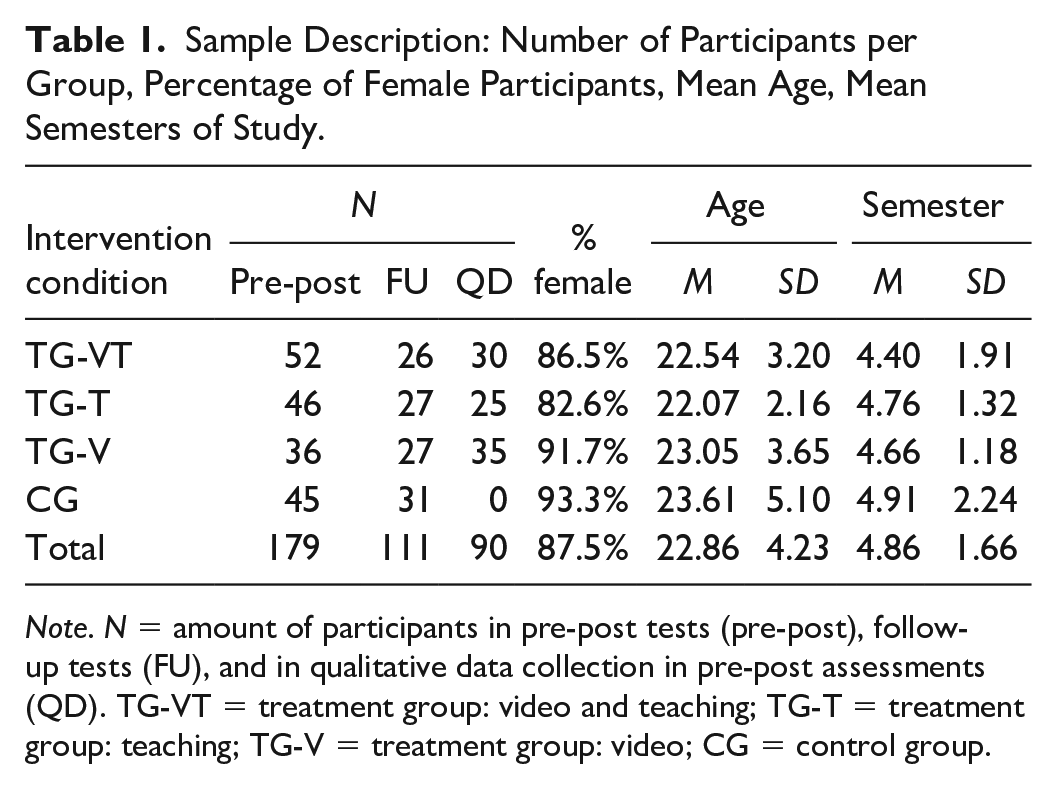
Note. N = amount of participants in pre-post tests (pre-post), follow-up tests (FU), and in qualitative data collection in pre-post assessments (QD). TG-VT = treatment group: video and teaching; TG-T = treatment group: teaching; TG-V = treatment group: video; CG = control group.
Only 111 of the 179 students participated in the voluntary follow-up test including standardized tests, but the proportion of participation varied slightly between groups, χ2(3) = 6.88, p = .076. Students in TG-V who participated in the follow-up showed a significantly lower increase in their PVCM from pre- to posttest than students of the TG-V who did not participate, F(1, 34) = 4.65, p = .038, leading us to the assumption of systematic dropout (Schafer & Graham, 2002). Because systematic dropout might result in biased parameter estimates, we decided to estimate the missing data of the follow-up test for the missing cases using expectation maximization (Cox et al., 2014). This means that the results of the change from pre- to posttest were based on complete data sets. The results concerning the change from pre- respectively posttest to follow-up-test were based on some estimated cases in the follow-up test.
In addition to these standardized tests in the pre-, post-, and follow-up-tests, we assessed PVCM through an open-response format in a session at the beginning and the end of the three training courses. Out of 134 student teachers taking one of the three courses, only 90 were present at both dates and voluntarily participated in the assessment (see Table 1). Because this assessment took place during time in class, we did not have such qualitative data from the CG. The proportion of participating and non-participating students varied significantly between groups, χ2(2) = 20.29, p < .001. However, there were no significant differences between participating and non-participating student teachers in any of the standardized tests (also not within the three training groups).
The three training courses were part of the curriculum for elementary school teacher studies leading to a “Bachelor of Education.” They were offered as one of several elective seminars in psychology for teacher education as part of the Bachelor program. At the time of course subscription, we did not inform students about differences between the three courses to minimize any self-selecting bias. Participants in the CG were recruited in other courses for educational psychology in teacher education that rarely overlapped with the contents of the training courses (e.g., “Development of mathematical skills”). They also did not teach own lessons in these courses.
Intervention Conditions
To examine the effect of different perspectives on teaching described above, we recruited three treatment groups (TG) and one CG:
TG-VT (
TG-V (
TG-T (own memorized
CG: No analysis of teaching at all.
All three different learning environments were conducted in separate courses taught by the same two lecturers, and CG was taught by different lecturers. Each consisted of 14 weekly meetings amounting to a total of 28 hr of intervention time plus homework during a 3-month period. They were phased into two course blocks (see Figure 1).
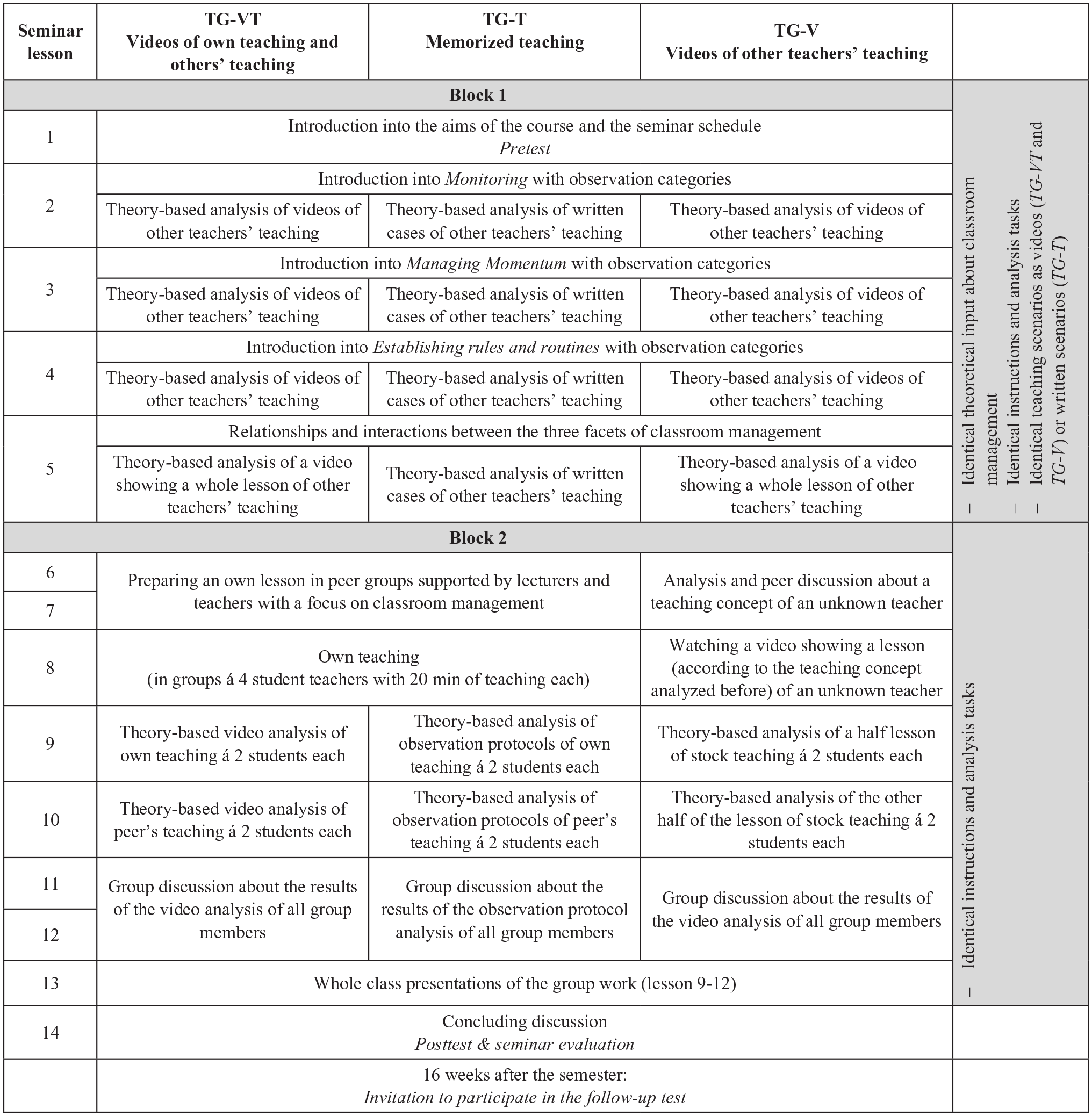
Seminar schedule and lesson contents of the three intervention groups.
Block 1
This block aimed at building conceptual knowledge about classroom management and introducing observation categories for describing and interpreting classroom management. It included five course lessons (10 hr) plus homework. After an introduction to the aims of the course and its schedule, the further four lessons included (a) a theory-based introduction to the three aforementioned facets of classroom management and their interplay using a set of defined observation categories, (b) selected episodes from elementary teaching as exemplary cases for the practical application of the three facets of classroom management to real lessons, and (c) a guided theory-based analysis of these episodes, in which student teachers had to notice and interpret classroom-management-related events from an observer perspective.
Student teachers of the TG-VT and TG-V group received video clips they could watch from an observer perspective repeatedly. Student teachers of the TG-T group used the same episodes as written texts describing the classroom setting and the teacher’s and students’ verbal and nonverbal behavior. These written vignettes cannot illustrate the complexity, immediacy, and particularly the simultaneity of real teaching situations (Doyle, 2006; Spiro et al., 2007). Consequently, student teachers of the TG-T received neither an observer perspective (because they did not observe any real lessons) nor a protagonist perspective in this block. All materials, PowerPoint presentations, analysis tasks, and texts were identical across the three training courses.
Block 2
This block consisted of nine course lessons (18 hr) plus homework. The treatment conditions for the three courses were different in this block (see Figure 1).
Preparing and conducting a lesson in TG-VT and TG-T
These courses were divided into teams of four who developed a lesson plan for a 90-min lesson. In the taught lesson, each member instructed for a 20-min part of the whole lesson, while the other three students observed their fellow student’s teaching. Teaching took place in classes at several elementary partner schools of our university. Student teachers had to visit the classes in advance to become acquainted with the elementary school students’ names and the established rules and routines of the class. Whereas TG-VT’s lessons were videotaped, in TG-T, two of the observing students took notes on a simple observation protocol to facilitate subsequent discussions.
Analyzing the lessons in TG-VT and TG-T
Each team was divided into two dyads that first analyzed their own teaching (2 × 20 min per student = 40 min) based on the observation categories learned in Block 1. In a next step, each dyad analyzed the teaching of the other two student teachers (2 × 20 min per student = 40 min). The team then compared and discussed their analyses in terms of an observer agreement to avoid observer biases due to subjective perceptions, interpretations, and memories (Praetorius et al., 2012). Afterward, the whole group prepared an oral presentation addressing two successful and one improvable classroom management event together with insights gained from the analyses and the peer discussions.
In TG-VT, analyzing the videos of others and particularly own teaching made it possible to focus on the same events from both perspectives, the video-supported observer and protagonist perspective on own teaching. In contrast, the TG-T analyzed their own teaching only based on own and their peers’ memories.
For TG-V, the second block was arranged in a comparable way concerning partner and group work: The course was also divided into four-member teams. Because students in this course did not teach an own lesson, each team spent one session discussing the classroom-management-related challenges found in a planning sheet of a lesson (90 min) from another teacher’s teaching. Then, each team analyzed the corresponding video using the same analytic strategy as the teams in the other two intervention courses.
Consequently, in Block 2, all courses analyzed a 90-min lesson of teaching with identical instructions (TG-VT: video of own and peer teaching, TG-T: observation protocols of own and peer teaching, TG-V: video of only another teacher’s teaching). Furthermore, both videos from student teachers’ teaching and from another teacher’s teaching were videotaped with one camera using a long shot camera view across the class with identical video resolution, and both types of videos had two sources of sound (a teacher microphone and a class microphone).
To control for experimenter bias, the same lecturers taught all three training courses. To counter for expectancy bias of the lecturers, we prepared highly structured seminar plans with precise time planning, which the course lecturers had to adhere to and to reflect on after each seminar.
Instruments
The study took a multimethod approach to assess learning effects in PVCM. First, we used a standardized video-based test with rating items to measure knowledge-based reasoning over the description and interpretation of critical classroom management events in elementary school classrooms. Second, we used a video analysis with an open-response format to measure student teachers’ noticing and multiperspectivity, because noticing cannot be assessed with rating items that would already direct attention toward specific events in the classroom (Seidel & Stürmer, 2014). Third, strategic knowledge on classroom management was assessed using a situational judgment approach.
Quantitative assessment of PVCM
The standardized and validated video-based test consisted of four video clips (2- to 4-min long) with scenes from real-life elementary school lessons showing events that inservice teachers and educational researchers had rated as authentic and relevant for classroom management (Gold & Holodynski, 2017). Participants were asked to rate these clips on 47 items describing and interpreting the presented classroom management events on 4-point scales ranging from 1 (I disagree) to 4 (I agree) (see Figure 2). Answers were compared to a master rating based on the judgments of 16 experts and calculated as the percentage of correctly rated items. The internal consistency was acceptable for the pre-, post-, and follow-up tests (α = .70, .77, and .80 respectively).
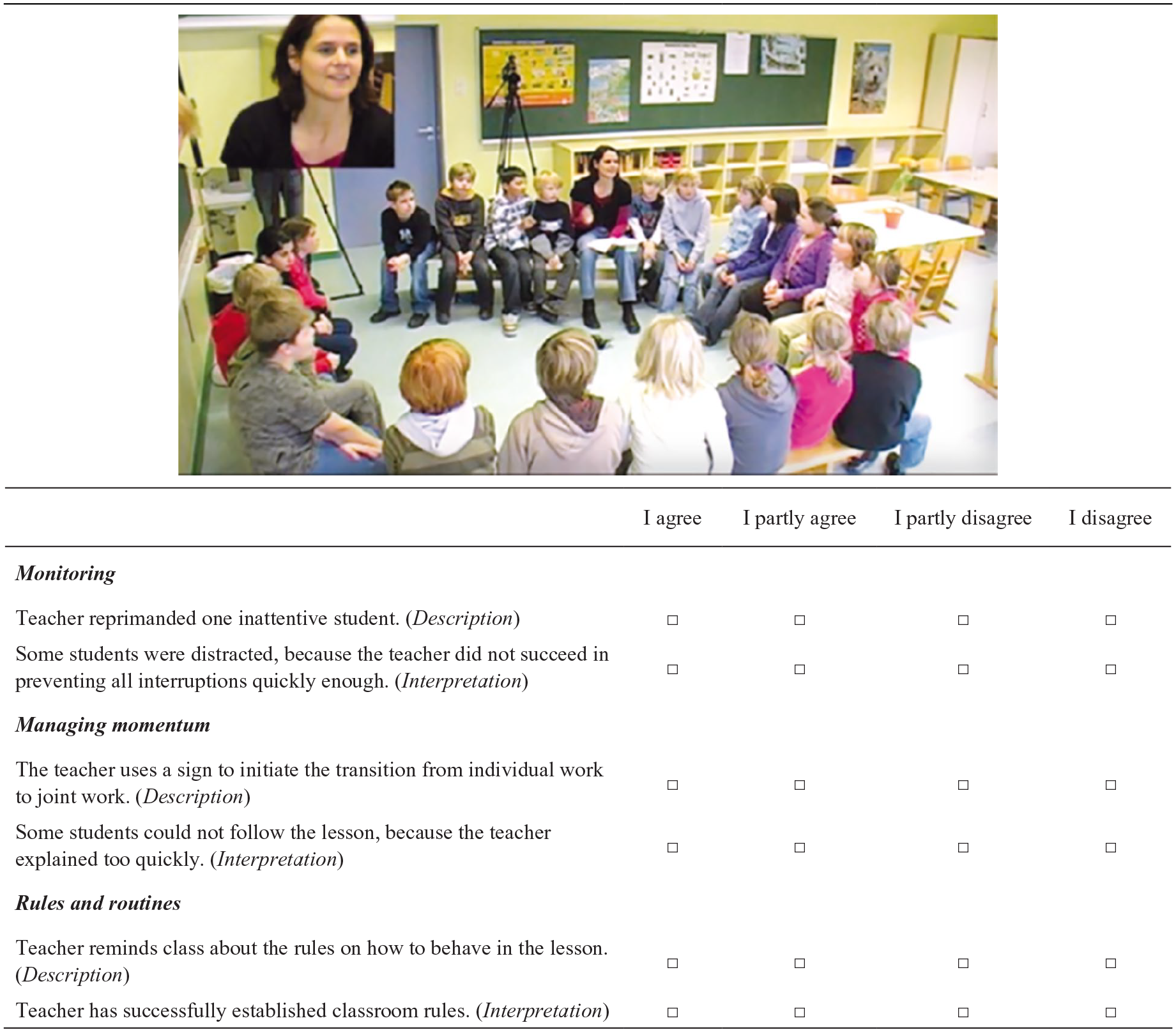
Example of the video-based test measuring professional vision of classroom management (PVCM) with sample items for its three facets (Gold & Holodynski, 2017).
Qualitative assessment of noticing classroom management and multiperspectivity
Two more video clips (Video A: 4 min 10a s, Video B: 3 min 17 s) from elementary school science lessons (both showing group work and whole group discussions) were used as the stimuli for a parallel test. As the CG did not work on this task, we used two different video clips for the pre- and the posttest to control for repeated measurement effects. In a pilot study, seven teachers with at least 12 years teaching experience (M = 19.14, SD = 4.10) judged the difficulty in analyzing classroom management in both video clips. Results showed no difference between the video clips on noticing and interpreting in relation to monitoring and managing momentum (see supplemental material). However, analyzing the facet of establishing rules and routines was reported to be slightly more difficult in Video A. Nonetheless, the assignment to Video A or Video B in the pre- or posttest did not influence students’ noticing in either the pretest, F(1, 88) = 0.86, p = .356, or the posttest, F(1, 88) = 0.54, p = .464.
Additional t tests indicated that experienced teachers judged both videos to be similarly productive, authentic, and interesting (see supplemental material). The chronological order of watching the two videos (in pre- or posttest) was counterbalanced within all three intervention groups to control for differences in difficulty in analyzing the facet of establishing rules and routines. At first, participants read a short introductory text containing context information about grade level, class composition, and the content of the lesson. After watching the video clip, they read the following questions: Which classroom management strategies used by the teacher did you notice in this video clip? Please, describe and justify. Then, they watched the video clip a second time and had 30 min to answer the question in an open-response format. Participants’ analyses were evaluated with two different coding schemes addressing (a) their noticing of classroom events and (b) the multiperspectivity of their analyses.
Noticing classroom management events
Two independent raters counted how many events each participant had described in her or his written analysis that the team of experts had also mentioned as being relevant. One event involved approximately one to three sentences referring to one classroom management event in the video. Interrater reliability was good (Cohen’s κ = .71).
Multiperspectivity
Categories of this coding scheme were adopted from Wolff et al. (2015). We treated each participant’s written analysis as an entire unit regarding the following two facets: (a) multiplicity of perspectives: either the text included only a single perspective (= 0 points) or multiple perspectives (= 1 point; the text included at least two perspectives, for example, the teacher’s and the students’ perspectives); and (b) integration of perspectives: either integrated perspective (= 1 point; text contained an interrelated perception of events) or isolated perspective (= 0 points; text focused only on a single aspect, or—if multiple events are mentioned—they are not connected) (see Figure 3). Hence, each student was awarded one or zero points for each of the two categories. The values in the results represent the proportion of students in the respective group taking up a multiple or integrated perspective in the written analysis. Interrater reliability was again substantial (multiplicity of perspectives: κ = .96, integration of perspectives: κ = .66).
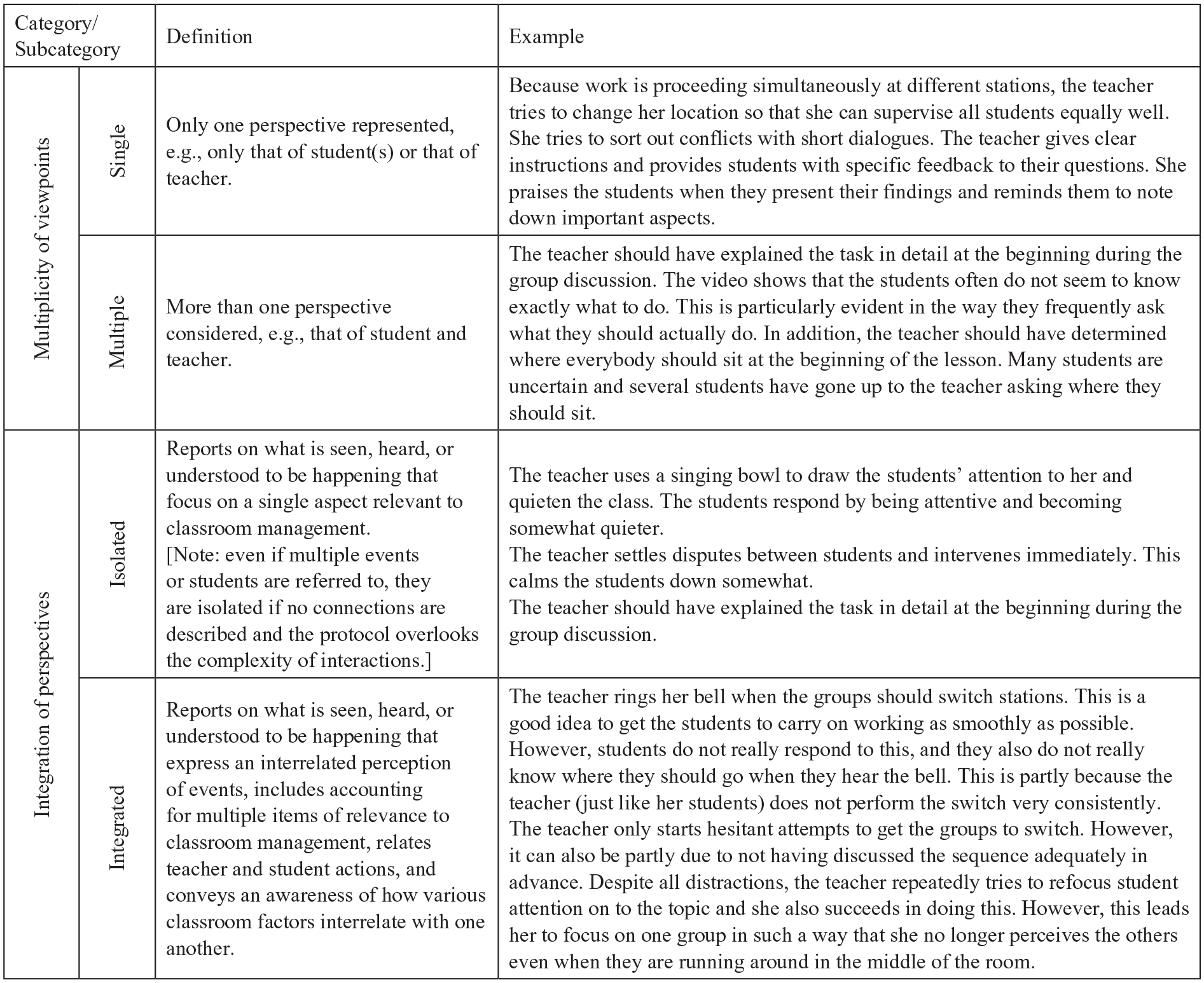
Coding definitions and coding examples of multiperspectivity based on Wolff et al. (2015).
Assessment of strategic knowledge of classroom management
The situational judgment test validated in previous studies (Gold & Holodynski, 2015) consisted of 10 short descriptions of challenging classroom management situations. Five to seven more or less effective courses of action were proposed as ways of dealing with these situations (see Figure 4). The efficacy of each alternative had to be rated on a 6-point scale ranging from A (excellent) to F (failure). In a further analysis, we compared participants’ pair comparisons between two respective courses of action to those of 17 experts who had agreed on a relative ranking of these courses of action. This resulted in a percentage of agreement with this master rating. The test showed acceptable and partly questionable internal consistencies (pretest: α = .66, posttest: α = .62, follow-up: α = .75) which can be interpreted as good consistencies for situational judgment tests (Catano et al., 2012).
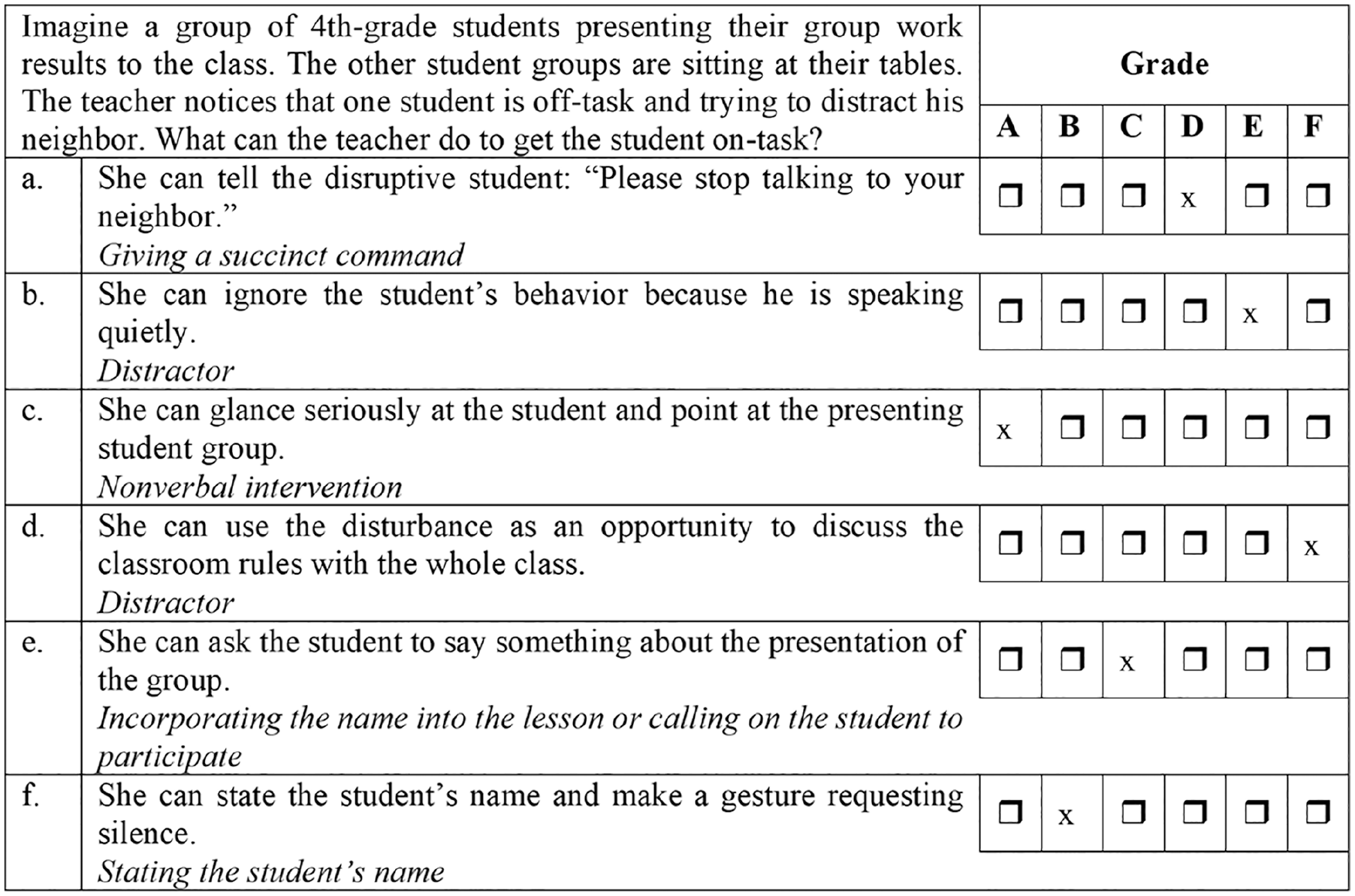
Sample scenario of the test measuring strategic knowledge on classroom management (KCM; Gold & Holodynski, 2015).
Procedure
The quantitative assessments (PVCM and knowledge of classroom management [KCM]) were conducted online and took an average of 75 min. The time to watch the test videos was restricted across all participants. The time for responding to items was not restricted, because this was not a speed test. Members of the intervention groups participated in the pre- and posttest for credit points and were paid 25 euros for participating in the follow-up measurement. Members of the CG participated voluntarily and received 75 euros in gift vouchers for attending all three measurement points.
Data Analysis
We first examined whether the statistical preconditions were met for calculating analyses of variance (ANOVAs). For the standardized tests measuring PVCM and KCM, six of 24 distributions (2 variables × 4 groups × 3 measurement time points) were not normally distributed. However, because the histograms did not indicate serious violations of the normal distribution, we decided to calculate (a) repeated-measures ANOVAs with planned contrasts and Cohen’s d effect size for the change in each group and (b) analyses of covariance (ANCOVAs) with the respective pretest as covariate, treatment group as between-subject variable, and the respective posttest or the follow-up test as dependent variable, because we found significant differences in the KCM-pretest measure between TG-VT and the CG (p = .017). 1
Homogeneity of variances was assessed with Levene’s test. This indicated equal variances for PVCM (posttest: p = .222; follow up: p = .587) as well as KCM (posttest: p = .285; follow up: p = .168). Planned simple contrasts were calculated with the CG as reference group to investigate whether each TG showed a significantly higher increase in the dependent variables than the CG (Hypothesis 1). Then, we conducted Helmert contrasts to compare (a) the mean of the posttest of the CG with the mean of the three TGs (with the pretest as covariate) and (b) the mean of TG-VT with the mean of TG-T and TG-V to determine whether the video analysis of own teaching (TG-VT) had an additional value in comparison to the analysis of memorized teaching (TG-T) or unknown teachers’ videos (TG-V) (Hypothesis 2). Finally, we compared (c) the mean of TG-T with that of TG-V without directed assumptions.
The two noticing variables (pre- and posttest) of the qualitative assessment were normally distributed, except in the TG-VT. However, once again, the histograms did not indicate a strong violation of the normal distribution. Levene’s test indicated equal variances (p = .127). Although the groups did not differ from each other in the pretest, we calculated an ANCOVA to keep the analysis procedure constant.
For the two facets of multiperspectivity, namely, multiplicity of perspectives and integration of perspectives, we transcoded the two measurement time points into one new nominal variable by summarizing whether each participant’s analysis had improved from 0 to 1 (= 1), deteriorated from 1 to 0 (= -1), or not changed (= 0) from pre- to posttest. We then compared the distribution of the three categories of change in the intervention groups with a chi-square test. Differences between groups were indicated by standardized residuals (SRs) larger than the cut-off value of ±2. Alpha was set at p ≤ .05 for all tests.
Results
Quantitative Measures of PVCM and KCM (Pre–Post–Follow-Up)
PVCM
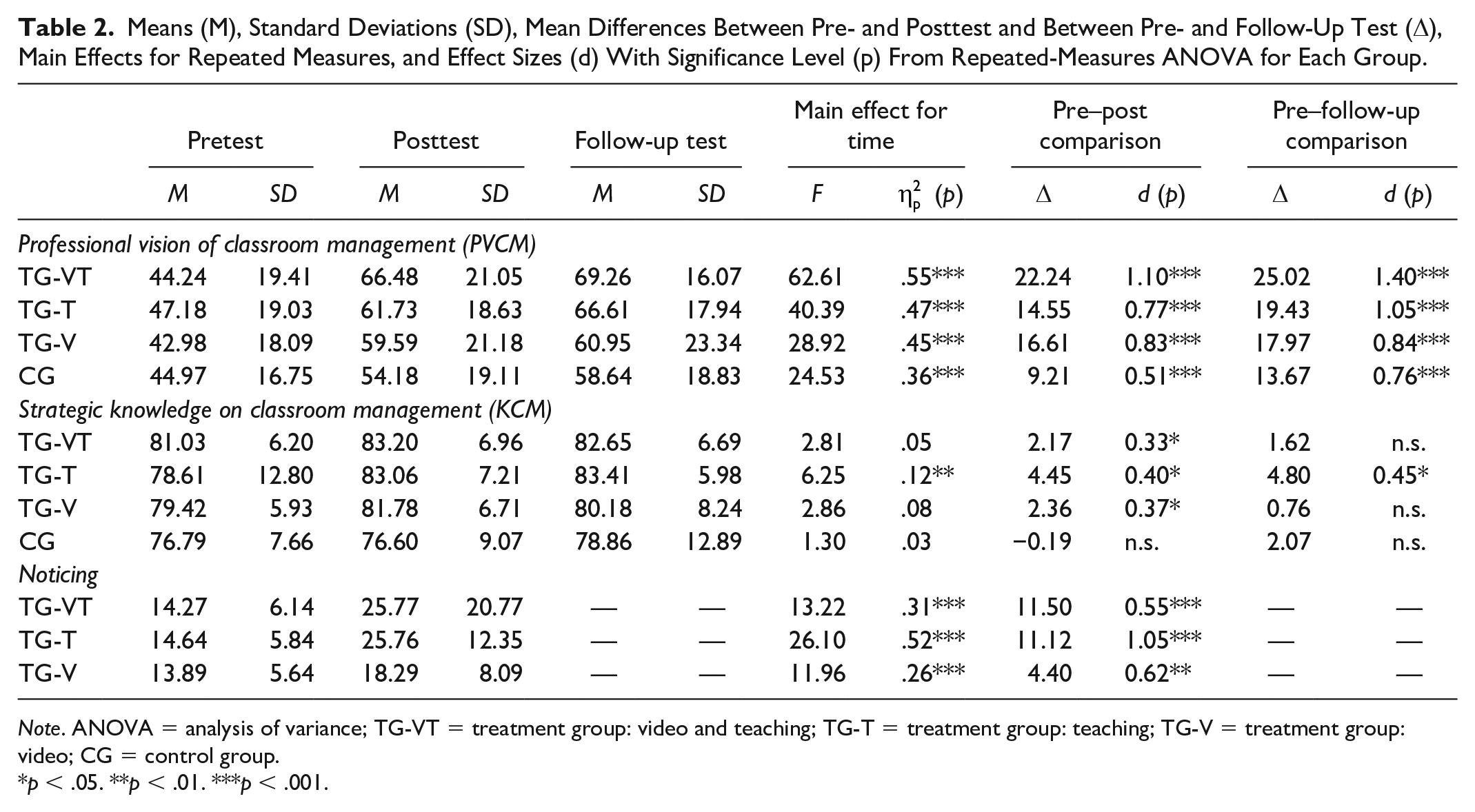
Descriptive results and paired repeated-measures ANOVAs indicated a significant increase from pre- to posttest in all groups (see Table 2). From post- to follow-up test, only TG-T (ΔPVCM = 4.88, d = 0.27, p = .002) and the CG (ΔPVCM = 4.46, d = 0.23, p < .001) further increased their PVCM, whereas TG-VT (ΔPVCM = 2.78) and TG-V (ΔPVCM = 1.36) did not change. Considering learning gains across the three measurement time points, TG-VT had the highest learning gains followed by TG-T, TG-V, and CG (see Table 2).
Means (M), Standard Deviations (SD), Mean Differences Between Pre- and Posttest and Between Pre- and Follow-Up Test (Δ), Main Effects for Repeated Measures, and Effect Sizes (d) With Significance Level (p) From Repeated-Measures ANOVA for Each Group.
Note. ANOVA = analysis of variance; TG-VT = treatment group: video and teaching; TG-T = treatment group: teaching; TG-V = treatment group: video; CG = control group.
p < .05. **p < .01. ***p < .001.
The ANCOVA with PVCM posttest data indicated a significant main effect of pretest, F(1, 174) = 110.49, p < .001,
Regarding the long-term effects of the intervention, an ANCOVA with the follow-up test as dependent variable and pretest as covariate revealed similar results. Alongside the highly significant main effect for the pretest, F(1, 174) = 71.77, p < .001,
KCM
All TGs showed a significant increase in KCM from pre- to posttest, whereas the CG did not (see Table 2). None of the groups showed a significant change from post- to follow-up test.
An ANCOVA with posttest data indicated a significant main effect for pretest, F(1, 174) = 69.73, p < .001,
An ANCOVA with follow-up data 4 months after the intervention still revealed a significant main effect for pretest, F(1, 174) = 24.59, p < .001,
Qualitative Measures of Noticing and Multiperspectivity (Pre–Post)
Noticing classroom management events
All TGs noticed significantly more relevant classroom management events after attending the seminars. An ANCOVA on posttest data revealed a significant main effect for pretest, F(1, 86) = 30.77, p < .001,
Multiperspectivity
Results on the multiplicity of perspectives revealed a clear ceiling effect: almost all participants of the three trainings groups had already written their analysis from multiple viewpoints in the pretest (see Figure 5). This was also reflected in a nonsignificant chi-square test, χ2(4) = 2.55, p = .637. Regarding the integration of perspectives, TG-VT and TG-T showed a strong increase in the number of integrated analyses, whereas TG-V showed a deterioration from pre- to posttest. Groups differed significantly in the distribution of the change categories (no change, improvement, deterioration), χ2(6) = 13.99, p = .007. SRs showed that TG-V improved their integrations of perspectives less than the other two groups (SR = −2.2).
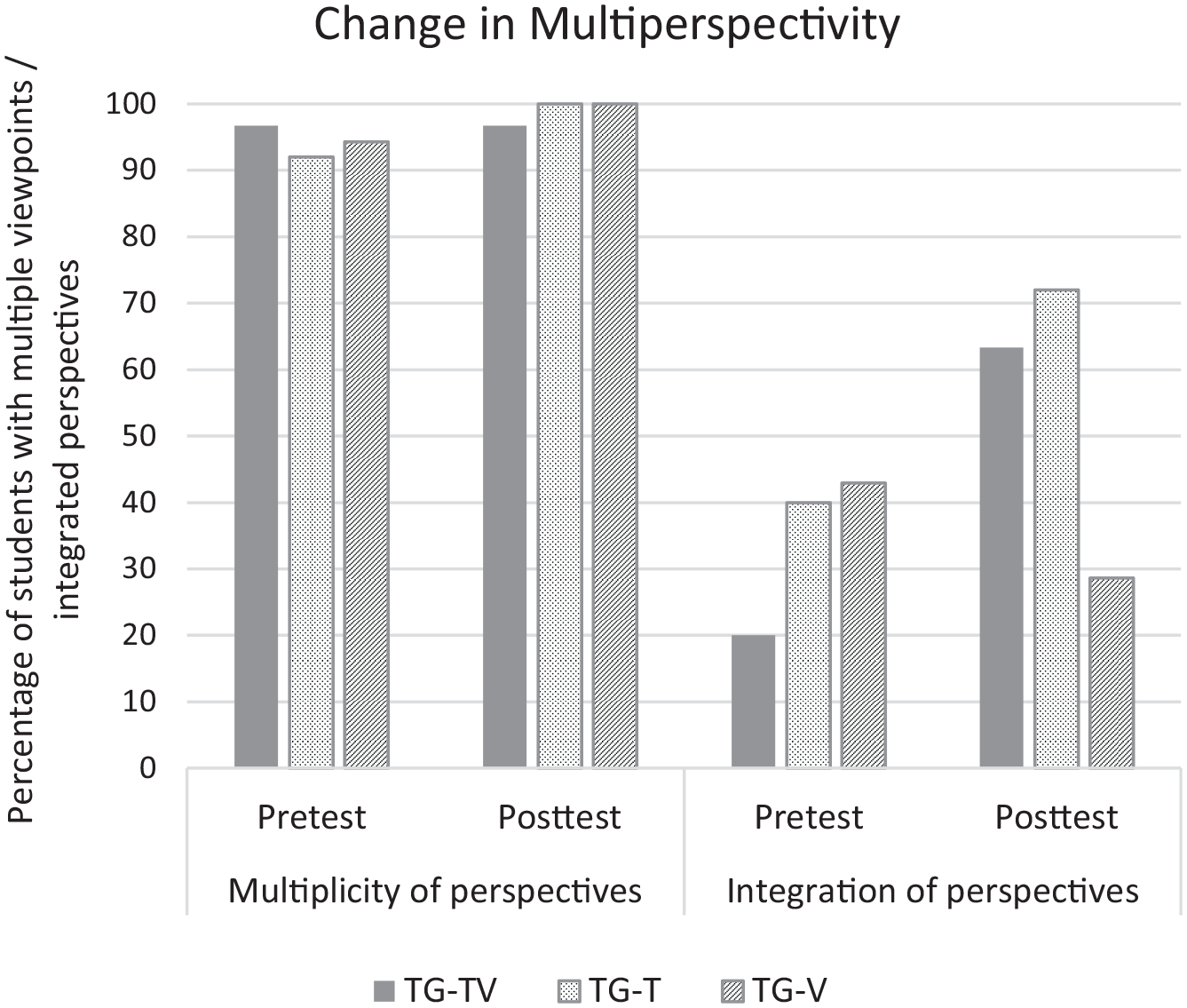
Distribution of multiple perspectives and integrated perspectives in pre- and posttest for all treatment groups.
Discussion
The aim of the present quasi-experimental intervention study with a pre–post–follow-up design was to evaluate three different trainings in teacher education designed to promote student teachers’ professional vision of classroom management (PVCM), multiperspectivity, and strategic knowledge on classroom management (KCM). All interventions supported theory-based analysis on real teaching with a focus on classroom management. They differed with respect to the provided perspective and video support: in TG-V, student teachers relied on videos of other teachers’ teaching providing only a video-supported observer perspective. In TG-T, student teachers relied on own memorized teaching without videos at hand providing only a protagonist perspective. In TG-VT, student teachers relied on videos of own and others’ teaching providing an integration of a video-supported observer perspective with a protagonist perspective on own teaching. Based on cognitive flexibility theory, we hypothesized that the opportunity to assess multiple perspectives in TG-VT would be superior to solely one perspective in TG-T (memorized protagonist perspective) and TG-V (video-supported observer perspective) (Hypothesis 2) and that all intervention groups would have higher learning gains than an untreated CG (Hypothesis 1).
Summary and Interpretation of Findings
We found that TG-VT had significantly higher values in PVCM in the standardized assessment than the CG and than the other two treatment groups directly after the interventions. In addition, TG-VT noticed more critical classroom events in the open-response format than the other two training groups. These results met our assumption that combining a protagonist perspective from memorized teaching with an observer perspective from a video on the same classroom events would be more successful than having only one perspective at hand. In the follow-up test 4 months later, TG-VT and also TG-T had significantly higher PVCM than the CG, indicating that analyzing own teaching with the help of a video combined with videos of other teachers’ teaching as well as analyzing own teaching from memory supported by observation protocols helped student teachers to increase their PVCM.
TG-VT had the advantage of connecting the protagonist with the observer perspective of their own teaching, but also viewed videos of other teachers’ teaching providing the possibility to contrast own teaching with teaching of experienced teachers. Although analyzing videos of own teaching and of unknown teachers’ teaching is confounded in the condition of TG-VT, we decided that TG-VT should also analyze videos of other teachers’ teaching, because this allowed us to implement a respectful culture of conversation among the student teachers before they started analyzing their own video (Gaudin & Chaliès, 2015). We gave this aspect a higher priority.
One surprising result was that participants of TG-V analyzing only stock videos did not differ significantly from the CG. They also noticed significantly less classroom management events and showed significantly less integrated perspectives in their written analyses of a video after the intervention in comparison to TG-VT and TG-T. However, many previous studies with student teachers have used videos of other teachers’ teaching to successfully promote professional vision (Gold et al., 2013; Santagata & Angelici, 2010). Below, we discuss the differences between TG-V and the other intervention groups that might explain these results.
First, we cannot rule out the possibility that TG-VT and TG-T were better able to apply theory on classroom situations due to their experiences from own teaching, observing their peers, and discussing own teaching with them. They held their lesson in an unknown classroom and had to ask the class teacher for existing classroom rules and routines. This might have helped them to realize that some classroom-management-related facets are hardly visible (on videos) but essential for daily teaching (Kounin, 1970)—for example, when elementary school students sit in a circle by themselves because this is a previously established routine. As a consequence, they might be more sensitive and aware of such classroom management facets in the posttests than student teachers in TG-V who observed videos of rather effective classroom managers all the time.
Second, beyond own teaching, the possibility to analyze peer teaching of TG-VT and TG-T might be another reason for lower posttest scores in TG-V. Analyzing peer teaching has the additional advantage that the observed persons are similar to one’s own person and education level (Gaudin & Chaliès, 2015; Tripp & Rich, 2012; Zhang et al., 2011). This might result in more realistic implications when it comes to connecting theory with teaching situations and thus result in higher situated knowledge and PVCM. Although TG-T analyzed their teaching based only on memories and observation protocols created by themselves as novices, they also had the opportunity to discuss their own teaching behavior and classroom management in depth and to compare their own behavior with that of peers (Harford et al., 2010). In contrast, TG-V observed and analyzed authentic teaching of experienced teachers. Even though these teachers might function as role models (Bandura, 1997), they might be too distant from student teachers’ beliefs or actual classroom experiences (Gaudin & Chaliès, 2015; Zhang et al., 2011), and this may have impeded the integration of theory, authentic teaching examples, and previous experience.
Third, TG-V was the only training group that did not analyze “live” teaching. This may have had motivational and cognitive consequences, in that real teaching might emphasize time pressure and simultaneity of teaching more impressively and might consequently demonstrate the relevance of classroom management more than classroom management in videos. In addition, videos from unknown classes lack contextual information. Thus, it should further be investigated, for what learning goals and under what circumstances stock videos are conducive to professionalization.
Apart from that, another interesting point is that members of the CG also increased their scores in the standardized measure of PVCM. The reasons for this might be twofold: On one hand, participants in the CG had also been receiving teacher education and would have made learning gains during the usual course of the term. On the other hand, small effect sizes might be due to practice effects through taking the same test a second time.
Regarding our results for KCM, we found support for our assumption that participants who were enrolled in one of the classroom management interventions would have higher values in KCM after the training and 4 months later, but would not differ from each other due to same learning opportunities with respect to theoretical concepts of classroom management.
To sum up our findings, promoting PVCM is most effective when student teachers have the opportunity to compare, contrast, and reflect on their memories of a taught lesson in combination with a video of this lesson. Our conclusion is that competences do not simply evolve through teaching experience and its unsystematic reflection. Rather, a data-based description and analysis of own teaching behavior based on evidence-based criteria of effective classroom management is central to initiate change (Gage & McDaniel, 2012). For example, to develop classroom management competencies, Simonsen et al. (2014) suggest that teachers should observe each other using evidence-based observation checklists, to identify areas for improvement based on these checklists, continuously practicing these areas as well as monitoring their progress through continuous systematic observations. Videos of own teaching might have the potential to support such professional development programs through a more knowledge-based discussion of such observation criteria (Weber et al., 2018). Beyond that, the role of video-based feedback might be crucial and needs to be investigated further (Brouwer et al., 2017; Harford et al., 2010; Weber et al., 2018).
Limitations and Implications for Future Research
We cannot rule out some limitations of our study. First, there was a systematic dropout from posttest to follow-up test. Although we considered this problem by estimating missing data, motivational problems of some student teachers might have affected their test results.
Second, data on student teachers’ noticing and multiperspectivity were available only from the treatment groups from pre- to posttest. The qualitative assessment was performed during coursework at the beginning and the end of the term because we had assumed a strong motivational decline during the test taking due to a long testing time. Data from a CG would have offered information on whether the treatment courses were effective in fostering noticing and multiperspectivity compared to an untreated course.
Third and most importantly, seminars in teacher education cannot reach the standards of laboratory studies (Kember, 2003). Besides the variation of perspectives and the availability of videos, all intervention groups contained further measures that could additionally be responsible for the improvement of professional vision in all intervention groups. All participants used evidence-based observation categories to analyze their classroom management (Fukkink et al., 2011) and received peer feedback on their analyses in peer group discussions (even if we have kept these conditions the same in all groups). Beyond the assumed effect of multiple perspectives, participants of the TG-VT might perhaps be more motivated or immersed in analyzing their own teaching on a video than participants from the TG-V (Borko et al., 2008; Kleinknecht & Schneider, 2013; Krammer et al., 2015; Seidel et al., 2011) or the TG-T without video. Consequently, future research should try to differentiate the effects of these mechanisms by applying innovative multimethod designs to study video-based learning (Kember, 2003).
Besides these disadvantages, our study provides higher ecological validity than laboratory studies (Kember, 2003), because the courses were part of the regular teacher education program. However, our most complex and presupposing condition tended to be the most effective one leading to the question of whether it might be difficult to implement it in regular teacher training programs. It is indeed particularly suitable for internships for preservice teachers or professional development programs for beginning teachers. Therefore, future studies should investigate the effectiveness and practicability of analyzing own videos in different stages of teachers’ career and with respect to other dimensions of teaching quality.
Supplemental Material
PVCM_Supplemental_material – Supplemental material for Promoting Professional Vision of Classroom Management Through Different Analytic Perspectives in Video-Based Learning Environments
Supplemental material, PVCM_Supplemental_material for Promoting Professional Vision of Classroom Management Through Different Analytic Perspectives in Video-Based Learning Environments by Bernadette Gold, Christina Pfirrmann and Manfred Holodynski in Journal of Teacher Education
Footnotes
Acknowledgements
Many thanks go to Jonathan Harrow for language editing.
Declaration of Conflicting Interests
The author(s) declared no potential conflicts of interest with respect to the research, authorship, and/or publication of this article.
Funding
The author(s) disclosed receipt of the following financial support for the research, authorship, and/or publication of this article: This study was funded by the German Federal Ministry of Education and Research (BMBF; 01JH0916). The BMBF had no involvement in the study design; the collection, analysis, and interpretation of data; the writing of the report; and the decision to submit the article for publication.

Supplemental Material
Supplemental material for this article is available online.