




Abstract
Students with disabilities or mathematics difficulties often experience challenges with fractions. As fraction competence predicts algebra readiness and later success, targeted support is critical. The present systematic review examined 39 fraction intervention studies designed to support middle-school (i.e., Grades 6–8) students with a disability or mathematics difficulty (MD/D). Results indicated that explicit instruction and multiple representations were the most consistently embedded practices, often paired with verbalization to strengthen understanding. Promising instructional components included digital platforms, including virtual manipulatives, and gesturing as forms of representation. Most interventions targeted foundational fraction skills (e.g., magnitude, comparison, equivalence), and fewer addressed grade-level content (i.e., division) or word problems, underscoring the need for research in these areas with middle-school students with MD/D.
Fraction knowledge is predictive of algebra readiness and overall mathematics achievement, underscoring its importance in mathematics instruction (Booth & Newton, 2012; National Mathematics Advisory Panel [NMAP], 2008). However, fractions can be one of the most challenging mathematics areas for students with and without disabilities (NMAP, 2008). Students entering middle school (i.e., Grades 6 through 8) with persistent difficulties with fractions often continue to struggle in mathematics, as middle-school mathematics curricula build on rational number sense (e.g., fractions) and operations, and algebraic reasoning (Namkung et al., 2018; National Governors Association Center for Best Practices & Council of Chief State School Officers [NGAC & CCSSO], 2010). We synthesized fraction interventions for middle-school students with a disability or mathematics difficulty (MD/D) to examine key instructional components and inform classroom practice.
Fraction content is heavily emphasized in mathematics standards in Grades 3 through 8 (NGAC & CCSSO, 2010). By the end of Grade 3, students are expected to develop an understanding of magnitude, such as parts relative to a whole (e.g.,
Although foundational fraction concepts are initially addressed in Grades 3 through 5, many students enter middle school with persistent misconceptions (e.g., whole-number bias), difficulties comparing and ordering fractions, and weak part-whole understanding (Mazzocco et al., 2013; Siegler et al., 2012). Unfortunately, research indicates the fraction knowledge gap widens between students with and without MD/D throughout Grades 6 and 8 (Siegler & Pyke, 2013). Without intervention, foundational misconceptions can persist and interfere with more complex rational number reasoning introduced in Grades 6 through 8 (e.g., ratios and proportions, integers; NGAC & CCSSO, 2010; NMAP, 2008). Misconceptions about fractions can also negatively impact algebra readiness, which is a key focus of middle-school mathematics (Booth & Newton, 2012; Ketterlin-Geller & Chard, 2011).
Given the unique and substantive connections between fraction competence and proficiency in middle-school mathematics, examining the design, implementation, and effects of fraction interventions specifically for middle-school students is crucial. Although many fraction interventions have focused on elementary grades (see Roesslein & Codding, 2019), a synthesis centered on middle school can reveal how fraction interventions are adapted to meet the unique instructional and contextual needs of this population. Interventions at this level may cover grade-level fraction concepts (e.g., dividing fractions by fractions), previously taught skills (e.g., adding fractions with unlike denominators), or a combination (NGAC & CCSSO, 2010). Understanding the scope of intervention approaches and their efficacy at the middle-school level provides unique insight into supporting algebra readiness and overall mathematics proficiency. The present review examines fraction interventions for middle-school students with MD/D to inform instructional practices beneficial for this pivotal period in mathematics education.
Fractions for Students With a Disability or Mathematics Difficulty
In this synthesis, we focused on students with a specific learning disability (SLD) in mathematics (i.e., dyscalculia) or those who demonstrate persistently low mathematics performance (e.g., performing below the 25th percentile; Nelson & Powell, 2018). These students typically exhibit challenges related to number sense, fact retrieval, cognitive functioning (e.g., working memory and attention), and word-problem solving. Likewise, students with moderate to severe disabilities such as autism spectrum disorder (ASD) and intellectual and developmental disability (IDD) present persistent difficulty with mathematics (Spooner et al., 2018). In this article, we use MD for students with mathematics difficulty only and MD/D to encompass students with ASD, IDD, or SLD who have mathematics difficulty.
When learning fractions, students with MD/D often demonstrate a lack of conceptual fraction knowledge (Hecht & Vagi, 2010; Siegler et al., 2012). Specifically, they frequently misapply whole-number properties to fractions (i.e., whole-number bias), make errors when partitioning whole numbers, make errors when ordering fractions (e.g., from least to greatest), inability to find equivalent fractions, and make errors translating visual representations of fractions to symbolic representations (Mazzocco et al., 2013). Of concern is that the fraction knowledge gap widens between students with and without MD/D throughout Grades 6 and 8 (Siegler & Pyke, 2013). Siegler and Pyke’s (2013) study revealed that with instruction, students with MD/D made little to no growth in fractions, as opposed to their peers without MD/D, who typically see growth. Therefore, interventions targeting fractions are necessary for middle-school students with MD/D.
Past Reviews
With fraction knowledge being one of the most crucial building blocks for future mathematics competence (NMAP, 2008), researchers have sought to explore and implement evidence-based instructional practices to improve students’ fraction proficiency. In the last decade, researchers conducted several reviews to determine ways to support students with MD/D with fraction learning (Ennis & Losinski, 2019; Hwang et al., 2018; Roesslein & Codding, 2019; Shin & Bryant, 2015). In this section, we provide an overview of these efforts.
Shin and Bryant (2015) reviewed 17 studies published between 1975 and 2014, with Grades 3–12 students with MD/D. From their results, the authors noted that interventions with positive effects tended to include concrete and visual representations, explicit instruction, and a clear scope and sequence (i.e., lessons strategically and logically ordered). Limitations of this synthesis included a small sample size for the time span (i.e., n = 805 over 39 years) and a limited focus on fraction conceptual understanding. The authors recommended that future research studies incorporate fraction concepts other than fraction addition and subtraction.
Hwang et al. (2018) conducted a synthesis that evaluated and compared the overall efficacy of fraction interventions against standard instruction (i.e., instruction that took place in the control group) for students with MD. The researchers reviewed 22 group-design studies, published between 1990 and 2015, with a total of 8,313 participants from Grades 1–12. With positive effect sizes (ES) ranging from 0.60 to 2.27, Hwang et al. determined that explicit instruction, anchored instruction via videos, and the Concrete-Representational-Abstract (CRA) framework significantly improved students’ fraction learning. The researchers determined fraction instruction to be especially effective for students identified with MD/D.
Ennis and Losinski (2019) published a meta-analysis that reviewed and evaluated 21 fraction intervention studies with a focus on quality indicator standards. Participants included students with MD/D in Grades 3–10. After reviewing the studies against the quality indicators for special education studies (Cook et al., 2015), the researchers determined the quality of evidence supporting positive effects for each of the following fraction instructional practices: video modeling (VM), strategy instruction, scope and sequence, explicit instruction, and anchored instruction. Of the five instructional components, only explicit instruction demonstrated a robust effect and was considered an evidence-based practice.
With a unique focus on the elementary level, Roesslein and Codding (2019) examined fraction interventions for students with MD in Grades K–6. Consistent with recommendations emphasizing conceptual learning of fractions, the researchers identified that most included studies focused primarily on conceptual fraction learning (e.g., magnitude, equivalence, and word problems). Overall, the researchers determined six instructional components important for fraction intervention: concrete and visual representations (e.g., number lines), explicit instruction, scope and sequence, strategy instruction, contextual problems (e.g., word problems), and student verbalization. Like Shin and Bryant’s (2015) recommendation, Roesslein and Codding suggested the use of multicomponent fraction interventions. However, as this study only focused on participants in elementary grades, the implication of its findings should only apply to students reflective of their included participants.
Across these reviews, there is consistent evidence for instructional components observed among fraction interventions for students with MD/D across K–12, and researchers highlighted a few implications. First, they supported the use of multicomponent fraction interventions for students with MD/D, particularly the use of explicit instruction and multiple representations (e.g., CRA and the number line). Second, most authors emphasized the critical role of fraction magnitude knowledge in students’ overall fraction performance. Finally, authors underscored the continued need for rigorous (i.e., high-quality) studies that explore the balance between procedural fluency and conceptual understanding with fractions for students with MD/D.
Purpose and Research Questions
Although past reviews (e.g., Hwang et al., 2018; Shin & Bryant, 2015) have included studies that span across Grades 1–11, the current review provides a targeted synthesis of fraction interventions specifically for middle-school students with MD/D. This focus is warranted for multiple reasons. First, middle school is a pivotal point in the development of mathematics proficiency, in which mathematics content includes increasingly abstract conceptual and procedural understanding of rational numbers that underpins algebra readiness (Booth & Newton, 2012). The gap in fraction knowledge between students with and without MD/D, which is already pronounced at Grade 6, widens substantially by Grade 8 without intervention (Siegler & Pyke, 2013), alerting the need for targeted support. A synthesis of intervention efforts within this grade band can provide insight into efficacious supports for building fraction knowledge.
Second, middle school presents distinct instructional and organizational contexts compared to elementary school (e.g., Backes et al., 2024; Bedard & Do, 2005). By focusing on middle-school students with MD/D, the present study fills a research gap examining these unique contextual factors. For instance, middle schools are typically departmentalized, meaning teachers specialize in subjects and serve different groups of students. In this structure, teachers work with multiple classes of students throughout the day, often with wide variation in mathematical skillsets, which differs markedly from elementary settings where teachers typically work with one class. This organizational structure can shape how instruction is planned, delivered, and individualized (Bedard & Do, 2005). Past reviews have aggregated data across broad grade bands, thereby overlooking the unique developmental, structural, and instructional characteristics of middle-school settings. Focusing the review on middle-school fraction interventions ensures that developmental, contextual, and instructional differences are accounted for, allowing for more tailored implications for middle-school practitioners. The purpose of this systematic review was to examine fraction interventions implemented with middle-school students with MD/D. We aimed to comprehensively examine instructional components designed to improve fraction learning for this student population. We asked the following research questions: 1. What are the effects of fraction interventions for middle-school students with MD/D? 2. What are the quality ratings of these studies (Cook et al., 2015)? 3. What instructional component(s) did the interventions embed, and which of these components showed promise of efficacy for middle-school students with MD/D?
Method
Search Procedures
We followed the Preferred Reporting Items for Systematic reviews and Meta-Analyses (PRISMA) 2020 guidelines to conduct and report this synthesis (Page et al., 2021). Figure 1 shows a flow chart of the systematic search. First, we conducted an electronic database search in APA PsycINFO, Education Source, and ERIC in August 2025. Past reviews guided relevant key terms; we provide the full Boolean string in the online Supplemental Material B. Next, we screened reports by title and abstract, then by full text. We then performed forward and backward searches of the studies that met the inclusion criteria, and hand searches of 13 relevant journals from the last 10 years.
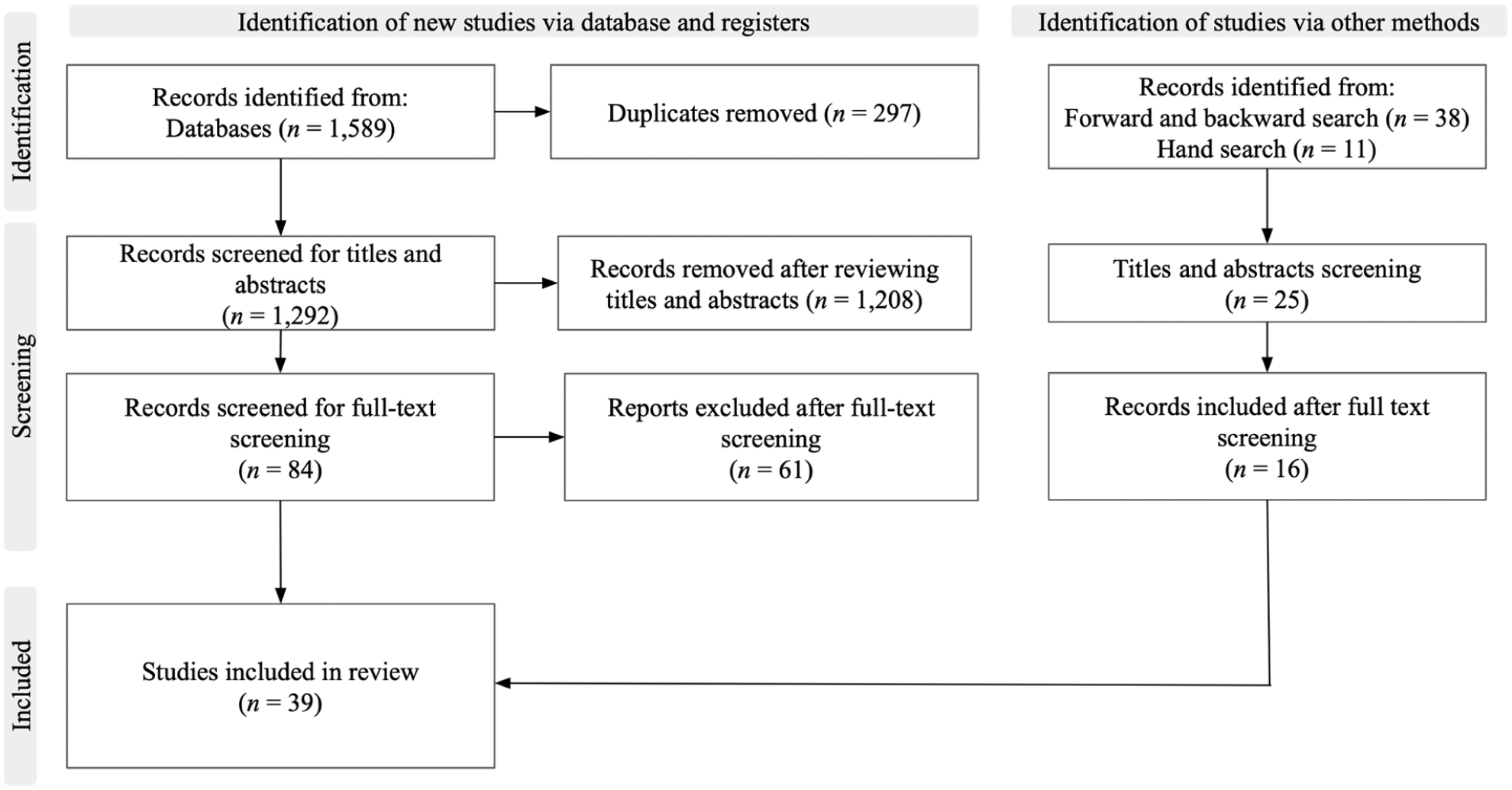
Systematic Search Flow Chart.
Inclusion Criteria
We included studies that met the following criteria: (a) The study was an experimental study, which entailed either a group design (i.e., randomized controlled trial [RCT] or quasi-experimental design) or a single-case design. (b) The study included at least one fraction measure. (c) Participants were identified as having MD/D. (d) Participants were in Grades 6, 7, or 8. (e) The study was published in English as a peer-reviewed journal article or a doctoral dissertation. (f) The study was published in or after 2000, the year that the National Council of Teachers of Mathematics (NCTM) published its standards. We excluded studies that included participants with deaf-blindness, deaf or hard of hearing, visual impairment, traumatic brain injury, or orthopedic impairment.
Coding Procedures
We developed a codebook to record the following information about included studies: intervention content, instructional components (e.g., explicit instruction; Roesslein & Codding, 2019), study quality (Cook et al., 2015; see descriptions of quality indicators in online Supplemental Material C), measures, and effect data. Online Supplemental Material A provides operational definitions for multiple representations (e.g., CRA, virtual-representational-abstract [VRA]), and Supplemental C provides a detailed coding framework.
Effect Sizes
We calculated effect sizes to answer Research Question 1 and to provide context for the instructional recommendations and implications included in the Discussion. Because this article is a descriptive synthesis, we used descriptive analysis to report and interpret intervention effects (William & Bizup, 2014). We categorized studies as having positive, mixed, or negative effects based on the following criteria. For group-design studies, we determined a study as having positive effects if we calculated a significant positive Hedges’ g for more than 66% (e.g., two out of three studies) of fraction outcomes. Mixed effects entailed significant positive effects on fewer than 65% of at least one fraction outcome. Null or negative effects entailed calculated outcomes yielding no significant effects or negative effects. For single-case design studies, we determined a study as having a large effect if the calculated Tau-U was greater than 0.90, moderate if the Tau-U was between 0.6 and 0.89, and small if the Tau-U was less than 0.59. Although we calculated the effect sizes for group and single-case design studies, given that this is a descriptive synthesis, we did not aggregate effect sizes. Rather, we present effect sizes to illustrate the relative magnitude of effects reported in each study to identify patterns across outcomes.
For group-design studies, we calculated the bias-corrected Hedges’ g, adjusted for small sample sizes, for the effect size of each measure (What Works Clearinghouse, 2022). Using the reported pre- and posttest means and standard deviations (SD) from the treatment and BAU groups, we calculated the standardized effect of treatment as the difference between pre-post means divided by the pooled SD. When pretest equivalence was not reported or adjusted for, we used available information (e.g., t- or f- statistics and n) from the treatment and BAU groups to calculate Hedges’ g. For single-case studies, we extracted raw data using a graphical data extraction software program, DigitizeItTM, as using a plot digitizer is a reliable method when raw data is inaccessible (Wooderson et al., 2024). Then, we use a web-based Tau-U calculator to calculate the weighted average Tau-U for each study (https://singlecaseresearch.org/calculators/tau-u/; Vannest et al., 2016). We selected Tau-U over the percentage of non-overlapping data (PND) as it addresses limitations inherent in PND (Parker et al., 2011). Specifically, as PND has been criticized for its ceiling effect, lack of sensitivity to baseline trend, and poor statistical properties, Tau-U provides a more accurate and conservative estimate of treatment effects. In addition, Tau-U has been shown to yield stronger reliability, higher sensitivity to intervention effects, and improved interpretability (Wooderson et al., 2024).
Inter-rater Agreement
The first author trained the third author to independently code 20% (n = 8) of the 39 studies. The authors compared codes to calculate the inter-rater agreement (IRA): agreements divided by the sum of agreements and disagreements, multiplied by 100. Initial IRA was 95.2%. The authors met to resolve discrepancies, reaching 100% agreement.
Results
Across the 39 included studies, we identified 16 group-design studies and 23 single-case studies; three were doctoral theses (Misquitta, 2011; Serianni, 2014; Simsek, 2016). We cross-referenced the studies included with those included in past reviews. Importantly, 24 studies in the present study were not included in any of the past reviews, representing newly published or previously unreviewed middle-school fraction interventions.
Study Participants and Settings
A total of 1,661 students with MD/D were included in this review, out of which 1,077 received an intervention treatment. Thirty studies reported whether students received special education services, and all 39 studies reported the identification of students with MD/D. Most research teams (n = 38) disaggregated the grade levels in their reporting; 967 students were in Grade 6 at the time of the study, 279 students in Grade 7, and 248 students in Grade 8; seven high school students were included in one study (Bottge et al., 2021). Three studies (Butler et al., 2003; Krutnak et al., 2022) did not report the breakdown of their participants’ grade levels, resulting in 167 students in this study being unidentifiable by grade level. However, the authors indicated these students were in Grades 6, 7, or 8, or middle school. Of the 39 studies, 24 included students with MD, 11 included students with MD/D, two included only students with ASD, and two included only students with IDD. Among group-design studies, the majority (n = 10) were delivered by classroom teachers, whereas most (n = 20) of the single-case design studies were delivered by researchers. Most group-design interventions were provided in small-group (e.g., 3–5 students per group; n = 7) or whole-class formats (n = 8), and most single-case design interventions were one-on-one (n = 20).
Intervention Effects and Measures
To answer our first research question, we examined the effects of fraction interventions for middle-school students with MD/D across group and single-case design studies. Online Supplemental Materials C and D summarize group and single-case design studies, respectively, with our calculated bias-corrected ES. Among the 16 group-design studies, 11 studies showed positive effects, two had mixed effects, one had negative effects, and two showed null effects. Among the 23 single-case design studies, 20 showed large effects, and two showed moderate effects; one study showed large effects on probes administered to all participants and moderate effects on probes administered to only one of its participants (Yakubova et al., 2024).
Among group-design studies, about half of the studies used a combination of researcher-developed and standardized measures (n = 9), six studies used only researcher-developed measures, and one study used a curriculum-based measure. The number of measures in a study ranged from one to eight, with six studies using only one measure and seven studies using four or more measures. All 23 single-case studies employed researcher-developed probes, with three studies using between two and three measures. Of the 39 included studies, 11 used at least one measure on fraction magnitude (e.g., estimation, comparison), 26 used at least one measure on fraction arithmetic or computation, 7 used at least one measure on word-problem solving, and 4 used at least one measure outside of fractions (e.g., algebra, measurement, decimals).
Study Quality
Online Supplemental Material C includes quality scores for each group-design and single-case design study, respectively (Cook et al., 2015). Across the 39 studies, four group studies met all 24 quality indicators, and nine single-case studies met all 22 quality indicators. Most studies showed high quality, with six group studies meeting 19 to 23 (83%–96%) quality indicators and 12 single-case studies meeting 18 to 21 (82%–95%) quality indicators. All applicable studies met the following indicators: context and setting (1.1), intervention agent role (3.1), intervention procedures (4.1), demonstrating effects (6.5), baseline phase (6.6), low attrition (6.8), low differential attrition (6.9), socially important outcomes (7.1), dependent variable measurements (7.2), showing experimental effects (6.5), establishing baseline (6.6), and providing graphs (8.2).
Fraction Topics and Instructional Components
Fraction topics and the instructional components used for each study are detailed in Online Supplemental Material F. For intervention content, most studies (n = 28) addressed fraction topics that had initially been taught in earlier grade levels (NGAC & CCSSO, 2010), with nine studies that included both foundational topics (i.e., magnitude, equivalence) and operations, including multiplication or division, and one study focusing only on multiplication. The topics most frequently addressed were addition (n = 29), subtraction (n = 19), and equivalence (n = 17). Of the 31 studies that covered addition or subtraction, 22 mentioned the use of like or unlike denominators. Specifically, 14 studies reported using both like and unlike denominators when targeting fraction addition or subtraction, 5 used only unlike denominators, and 3 used only like denominators. Overall, 11 studies addressed only one fraction topic; they focused on magnitude, equivalence, addition, and multiplication. Two studies addressed estimation and ordering fractions. Although these fraction topics are typically introduced in upper-elementary grades, they also serve as the foundation for proportional reasoning and algebraic problem-solving, which are central learning objectives of middle-school mathematics (NGAC & CCSSO, 2010).
The most used instructional practice was explicit instruction (n = 38), followed by multiple representations (n = 30) and verbalization (n = 21). Several variations of multiple representations were reported, such as the concrete-representational-abstract framework (n = 8), number lines (n = 10), the representational-abstract framework (n = 9), and the virtual-abstract framework (n = 9). Apart from multiple representations, common instructional components included scope and sequence (n = 18) and technology (n = 18). Less frequently, authors reported focusing on word-problem solving (n = 13) and strategy instruction (n = 12).
Discussion
Fraction knowledge is a critical component of mathematics that predicts algebra readiness and overall mathematics achievement (Booth & Newton, 2012). To address the fraction knowledge gap between students with and without MD/D, researchers have reviewed the effects of fraction interventions (e.g., Roesslein & Codding, 2019). However, no reviews have evaluated fraction interventions solely for middle-school students with MD/D, despite an achievement gap that widens between these students and their peers throughout the middle-school grades (Siegler & Pyke, 2013). In the present study, we examined fraction interventions designed for middle-school students with MD/D to identify instructional components that showed significant positive effects in students’ fraction outcomes.
Intervention Effects
Group-design studies generally showed mixed or positive efficacy. Some RCTs yielded large, positive effects on certain fraction outcomes (e.g., number line estimation, computation, comparison, e.g., Barbieri et al., 2020; Bottge et al., 2014) but also null or even negative effects for other outcomes (e.g., Bottge et al., 2021; Hughes, 2019). In contrast, single-case design studies almost uniformly showed large effects (e.g., Everett et al., 2014; Grünke et al., 2024). However, single-case design studies are conducted with small samples, limiting generalizability and potentially inflating the favorability of the intervention (Ennis & Losinski, 2019). Caution is warranted when interpreting effects from both designs. On researcher-developed proximal measures, both group and single-case design studies yielded many significant positive effects. These measures included fraction computation, comparison, and estimation tasks, and probes for single-case design studies designed to capture target fraction outcomes. Because these measures align with instructional foci, they often indicate short-term learning gains, explaining the overall, consistently strong results. Standardized measures, in contrast, were much fewer and had varied outcomes (e.g., Bottge et al., 2021; Clarke et al., 2022). Although fraction interventions are effective for improving targeted skills, evidence of distal transfer is less consistent.
Study Quality
The quality ratings of the studies, importantly, added a layer of dimension to our discussion of intervention effects and instructional components. The studies with the highest methodological rigor (i.e., meeting 100% of the quality indicators) were often multicomponent interventions. Studies such as Barbieri et al. (2020), Bouck et al. (2019), Grünke et al. (2024), and Watt et al. (2025) demonstrated that well-designed group and single-case design studies can yield large effects. In contrast, the variability in results among lower-quality studies highlights the importance of methodological rigor for drawing reliable conclusions. Several studies with lower-quality ratings (see online Supplemental Materials C and D) had inconsistent and extremely large effect sizes, warranting caution when interpreting results.
Instructional Components
Consistent with past research (e.g., Roesslein & Codding, 2019), explicit instruction was the most used instructional practice. Combined with the positive effects and high study quality, these results provide evidence for the utility of explicit instruction for improving fraction knowledge in middle-school students with MD/D. When describing explicit instruction, authors reported embedding modeling (e.g., Barbieri et al., 2020), feedback (e.g., Everett et al., 2014), and practice opportunities (e.g., Scarlato & Burr, 2002). Studies pairing explicit instruction with multiple representations (e.g., number lines, CRA) also saw significant effects, suggesting these instructional components are foundational for supporting middle-school students with MD/D across fraction topics. Researchers also noted the feasibility of delivering instruction via technology (i.e., VRA, VA, and VM) and its reinforcing effect on fraction understanding preceding students’ independent practice (e.g., Bouck, Maher, et al., 2020).
Moreover, this review pointed to the utility of verbalizations to strengthen fraction understanding and reduce misconceptions (Fisher & Dennis, 2023; Roesslein & Codding, 2019). Verbalization (i.e., think-aloud) was an instructional component often used in interventions; some researchers led verbalization (e.g., Test & Ellis, 2005) during instruction while others prompted students to verbalize their thought process (e.g., Everett et al., 2014). When teaching multi-step skills (e.g., finding equivalent fractions), many interventionists verbalized the steps to provide clear explanations while using representations (e.g., Bouck et al., 2019).
Less frequently embedded but promising components included virtual manipulatives, gesturing, and self-regulation supports. Studies incorporating VRA/VA consistently reported large effects (e.g., Shin & Park, 2024; Yakubova et al., 2024). This reflects a trend toward leveraging digital and virtual environments to provide scaffolding to middle-school students with MD/D. In addition, as Barbieri et al. (2020), for example, demonstrated that pairing gestures with verbal explanations and visual representations helped facilitate students’ organization of multiple pieces of information when solving fraction problems, gesturing may provide a multimodal scaffold that reinforces conceptual understanding. Furthermore, virtual manipulatives were deemed socially desirable by students with MD/D, specifically reducing the stigma of using manipulatives in the middle-school grades (e.g., Bouck, Park, et al., 2020).
Instructional Components and Content
For fraction magnitude, comparison, and estimation, interventions using number lines produced positive results, highlighting their utility for strengthening students’ conceptual understanding of fractions (e.g., Dyson et al., 2020; Jordan et al., 2024). Fraction computation performance, likewise, benefited from the use of multiple representations and strategy supports (e.g., Grünke & Barwasser, 2024). Word-problem outcomes were measured less frequently and showed mixed results; anchored instruction showed promise, but effect sizes were often smaller than for fraction computation, reflecting the added linguistic and cognitive demands of applied problems. Across studies, topics such as magnitude, comparison, and equivalence were more commonly targeted (see online Supplemental Material F) than grade-level topics (i.e., division; NGAC & CCSSO, 2010) or word problems. In addition, many interventions targeted addition and subtraction with like and unlike denominators; only a few targeted addition and subtraction with like denominators. Because mastery of fraction addition and subtraction with unlike denominators is expected by the end of elementary (i.e., Grade 5; NGAC & CCSSO, 2010), it is reasonable that middle-school fraction interventions would target and reteach this skill to remediate persistent misconceptions to prepare students for proportional reasoning, which is heavily emphasized in Grades 6 and 7. Overall, these patterns suggest that middle-school fraction interventions often prioritize Grade 3 to 5 fraction topics for students with MD/D. Word problems, on the contrary, require a different set of instructional approaches (e.g., metacognitive strategies, schema instruction, vocabulary instruction) that address both fraction and literacy skills.
Instructional Components by Disabilities
Although not part of our research question, a closer look at instructional components by disabilities reveals distinctions. For students with ASD and IDD, interventions frequently included technology-mediated instruction, video modeling, and structured prompting systems (e.g., Morris et al., 2022). These features align with the learning needs of students who benefit from predictable, visual, and systematic supports. For students with SLD or identified with MD, interventions predominantly paired explicit instruction with multiple representations and verbalization to address foundational fraction concepts. Notably, group-design studies primarily included students with MD and implemented the intervention in whole-class or small-group formats, whereas single-case design studies included more students with ASD or IDD in one-on-one settings. That group-design interventions were mostly delivered by classroom mathematics teachers in these formats reflects an intentional effort to make implementation feasible within the structure and demands of middle-school classrooms. In contrast, the fact that most single-case studies were delivered by researchers in one-on-one settings reflects the early-stage, efficacy-focused nature of this research, which prioritizes experimental control over ecological validity. These studies offer critical instructional implications under ideal conditions, but generalizing such approaches to classroom settings, even self-contained classrooms typically serving students with ASD or IDD, still requires further research for feasibility.
Limitations
There are several limitations to consider when interpreting the results of this review. First, despite every effort made to include all primary studies with a fraction intervention for middle-school students with MD/D, it is possible that our search procedures did not capture all studies that met our inclusion criteria (e.g., inaccessible journals through inter-library loans). Second, we calculated the effect sizes from various research designs, some of which did not report sufficient detail to allow consistent adjustment for pretest differences or sampling variance. Therefore, comparisons across studies should be interpreted cautiously. We addressed this limitation by reporting and discussing intervention effects using descriptive analysis.
Some limitations pertained to the corpus of intervention studies on this topic. First, a considerable portion of the included studies were conducted by the same research teams (i.e., Bottge and colleagues; Bouck and colleagues), which indicates that fraction interventions may need to be studied by a broader range of researchers in mathematics education and special education. Second, half of the studies (n = 15) used only one outcome measure, and five studies used only one researcher-developed measure. This may suggest biased interpretations of the results and caution when interpreting the findings. The final limitation was the variability in how MD/D was defined and identified among researchers. There is still limited research on the specific challenges that students with some disability identifications (e.g., ASD, IDD) face.
Implications for Research and Practice
Several research directions should be considered based on the results of this review. First, future research should specify the difficulties students with disabilities have that are distinct from students with MD who do not have a disability identification. Second, because most interventions addressed elementary-level fraction content, additional research is warranted on fraction interventions focused on concepts introduced in middle school (e.g., fraction division, negative fractions). Third, future research should examine the effects that gesturing has on fraction learning. Although gesturing was not heavily incorporated into fraction interventions, it showed initial promise as a form of representation (Barbieri et al., 2020; see also Fuchs et al., 2021). Traditionally, multiple representations encompass concrete, pictorial, or virtual means to guide students’ mathematical reasoning, but gesturing may be a physical form of representation that requires a research repertoire to establish its instructional evidence. Finally, research should continue to explore the effects of verbalization in fraction intervention, especially when used alongside the number line (Fisher & Dennis, 2023) to reinforce fraction learning.
Findings from this review inform implications for teachers of middle-school students with MD/D. First, teachers should continue to provide fraction intervention using explicit instruction and multiple representations (Doabler & Fien, 2013; Fuchs et al., 2021). Prior to implementing a fraction intervention, teachers should consider and evaluate the intervention’s quality, format, and feasibility. As many interventionists in this review were researchers, middle-school teachers should implement fraction interventions, anticipating potential variabilities such as time constraints and group size, which can be structurally distinct from those of elementary settings. Furthermore, this review highlights the utility and growing role of technology and virtual representations in middle-school interventions, an area less emphasized in past syntheses.
Conclusion
The present review examined intervention effects, study quality, and instructional components among fraction intervention studies for middle-school students with MD/D. Overall, studies demonstrated improved student outcomes and rigorous methodology. Explicit instruction, multiple representations, and gesturing were associated with improved outcomes. Before implementing fraction interventions for this student population, researchers and practitioners should evaluate and identify students’ fraction misconceptions to address their specific needs. Providing research-based fraction intervention in middle school is a promising avenue to prepare students with MD/D for algebra and other advanced mathematics in the secondary grades.
Supplemental Material
sj-docx-1-sed-10.1177_00224669251405854 – Supplemental material for A Research Synthesis of Fraction Interventions for Middle-School Students With a Disability or Mathematics Difficulty
Supplemental material, sj-docx-1-sed-10.1177_00224669251405854 for A Research Synthesis of Fraction Interventions for Middle-School Students With a Disability or Mathematics Difficulty by Jessica Mao, Sarah R. Powell, Danielle O. Lariviere and Katie B. MacLean in The Journal of Special Education
Footnotes
Funding
The authors received no financial support for the research, authorship, and/or publication of this article.
Declaration of Conflicting Interests
The authors declared no potential conflicts of interest with respect to the research, authorship, and/or publication of this article.

References
Supplementary Material
Please find the following supplemental material available below.
For Open Access articles published under a Creative Commons License, all supplemental material carries the same license as the article it is associated with.
For non-Open Access articles published, all supplemental material carries a non-exclusive license, and permission requests for re-use of supplemental material or any part of supplemental material shall be sent directly to the copyright owner as specified in the copyright notice associated with the article.
