




Abstract
In this study, we examined the extent to which educators believe students with complex support needs (CSN) participate in and benefit from practices associated with school-wide positive behavioral interventions and supports (SWPBIS). We conducted a survey of 622 teachers in the United States and analyzed responses according to the implementation or absence of SWPBIS at the respondent’s school. Our findings show (a) teachers working in SWPBIS schools have more knowledge of how to handle challenging behavior among students with CSN, (b) students with CSN who are taught in SWPBIS schools are more involved in SWPBIS-associated practices and the general education classroom, and (c) teachers believe students with CSN should be involved in SWPBIS-associated practices. Implications for practice and research are discussed.
Keywords
The reauthorized Individuals with Disabilities Education Improvement Act (IDEA, 2004) emphasized that teams should consider positive behavioral interventions and supports (PBIS) for students receiving special education services whose behavior impacts their own learning or that of others. Providing individualized supports for all students, including those with severe but infrequent challenging behaviors, is unfeasible, thus paving the way for more system-wide, universal approaches to address challenging behavior (Crimmins & Farrell, 2006). School-wide PBIS (SWPBIS) emerged as a multi-tiered continuum of supports to reflect the support and delivery of positive and preventative services to all students, including the implementation of universal screening, progress monitoring, and problem-solving (Freeman et al., 2016). This multi-tiered continuum generally consists of universal, Tier 1 supports, or instruction and preventative strategies for all staff and all students across all settings; targeted, Tier 2 supports for some students who are at risk for engaging in challenging behavior and require more intensive support (e.g., social skills groups and self-management) in addition to that offered at Tier 1; and intensive Tier 3 supports for the few students who require individualized function-based and/or wraparound supports in addition to supports offered at Tiers 1 and 2 (Sugai et al., 2014). These tiers of support are meant to be iterative and cumulative for all students, adding to, rather than replacing, existing supports (Sugai et al., 2014). SWPBIS is a prevention-based framework for supporting student behavior that incorporates applied behavior analysis, contextual validity, systems change, inclusive ethics, and stakeholder collaboration (Andreou et al., 2014).
Students with complex support needs (CSN), or the 1% of students with significant cognitive disability who are eligible for their state’s alternate assessment and have support needs across academic and functional domains, were the beneficiaries of individualized PBIS within schools before the school-wide implementation of PBIS (Bambara & Lohrmann, 2006). However, SWPBIS assumes all students need support to learn prosocial behaviors with support varying by level and intensity (Hawken & O’Neill, 2006). Because students with CSN engage in challenging behavior more frequently than students without disabilities (Emerson et al., 2014) and more than other students with disabilities (Chadwick et al., 2008), a framework like SWPBIS is likely to be especially useful for this population of students.
SWPBIS and Students With CSN
Although SWPBIS is a framework intended to benefit all students (Sugai & Horner, 2010; Zagona et al., 2021), and students with CSN have particular and compelling needs that align with SWPBIS, students with CSN are at risk of not participating in all tiers of SWPBIS because they are usually excluded from general education activities and settings. Students with CSN have been overwhelmingly absent from general education settings for decades (e.g., Morningstar et al., 2017), with approximately 93% of students with CSN taught outside of the general education setting for most of the school day (Kleinert et al., 2015). Therefore, this group of students is likely to be excluded from Tier 1 instruction and screening procedures (Hawken & O’Neill, 2006). Experts in SWPBIS have asserted students with CSN should be involved in, and would benefit from, all three tiers of SWPBIS (Zagona et al., 2021). Nevertheless, other recent research confirms students with CSN are routinely excluded from SWPBIS Tier 1 instruction, activities, and/or data collection practices.
For example, in a survey of 179 school personnel familiar with SWPBIS in 18 states, Walker and colleagues (2018) found that, in many cases, students with CSN did not participate in SWPBIS Tier 1 activities, although participation increased when students were taught in the general education setting. In a state-wide survey of 849 special education teachers, Shuster and colleagues (2017) found special educators were rarely involved in SWPBIS teams and that students with CSN rarely participated in SWPBIS activities, with most involvement occurring in school-wide acknowledgment systems. Although involvement was reported to benefit students, special educators of students with CSN viewed their involvement as less beneficial than special educators of students with other disabilities. Surveys of SWPBIS coaches corroborate these findings: in a state-wide survey of 305 SWPBIS coaches, Kurth and Zagona (2018) reported students with CSN rarely were involved in Tier 1 activities. However, in a study of 15 administrators and teachers, most participants reported students with CSN were indeed included in Tier 1 instruction and acknowledgment systems; however, participation in SWPBIS seemed to align with inclusion in general education settings, further raising the question about access to SWPBIS for the many students with CSN who are placed in self-contained special education classrooms (Walker et al., 2022). Additionally, the participants in Walker et al.’s study reported the infrequent participation of students with CSN in SWPBIS data collection efforts and no participation in SWPBIS fidelity assessments. Together, findings from these studies offer some consensus that SWPBIS is intended to include students with CSN, that students do benefit from their involvement, but that students with CSN may not participate in Tier 1 instruction, activities and/or data collection practices. However, the extent to which students are involved in, and perceived by educators to benefit from practices is likely to vary based on educational placement, school implementation of SWPBIS, and associated teacher skill and knowledge.
The successful implementation of a preventative and tiered framework, like SWPBIS, relies on the work of teachers (Fox et al., 2022). Yet, in general, teachers feel unprepared to engage in effective behavior support (Myers et al., 2020), although their knowledge improves when they receive training and coaching (Feuerborn et al., 2018; Massar et al., 2022). Furthermore, being able to implement SWPBIS with fidelity may improve student outcomes (Bastable et al., 2020) and improve overall school climate (Ellis et al., 2022). When teachers improve confidence in their ability to use a framework like SWPBIS, there is an enhancement in teacher ability to manage or support student behavior in a sustained manner (Chitiyo et al., 2019; Fox et al., 2022), and, when teachers perceive their school as having a positive climate, they are more likely to report a framework like SWPBIS to be feasible (Corbin et al., 2022). In fact, studies have found teachers perceive the SWPBIS framework to be beneficial to their schools (Chitiyo & May, 2018; McDaniel et al., 2021), that its implementation improves school climate (Charlton et al., 2021; Mitchell et al., 2018), and reduces teacher burnout (Ross et al., 2012). In addition, SWPBIS has a positive effect on school organizational health, which may mediate the relationship between implementation of SWPBIS with fidelity and student outcomes (Bradshaw et al., 2008). These findings, taken together with other research results documenting the positive impact of SWPBIS on a range of student outcomes (Freeman et al., 2016; Kim et al., 2018; Lee & Gage, 2020; Simonsen et al., 2012), suggest the potential for SWPBIS implementation to change teacher practices and improve both the knowledge and skills of teachers.
To date, approximately 27.4% of U.S. schools implement one or more tiers of SWPBIS, impacting millions of teachers and students (pbis.org;nces.ed.gov). The remaining 73% of U.S. schools, representing millions of teachers and students, are not participating in SWPBIS frameworks but may implement key practices associated with SWPBIS (e.g., defining and teaching school-wide expectations, increasing instruction and practice with self-regulation and social skills for students requiring additional support, developing individualized PBIS plans for students with significant behavioral needs). Given the broad benefits to student outcomes, school climate, and teacher confidence associated with SWPBIS, there is reason to believe that students with CSN, and their teachers, might also benefit from being taught in schools implementing practices associated with SWPBIS. However, there is a lack of studies investigating the benefits of SWPBIS for students with CSN and their teachers. This includes the extent to which teachers believe practices associated with SWPBIS are useful for students with CSN, if teachers have the knowledge to support the involvement of students with CSN in preventative behavior frameworks, and practices schools use to involve students with CSN in SWPBIS practices.
Purpose and Research Questions
The purpose of this project was to explore the differences in practices and beliefs among educators working in schools implementing SWPBIS and those not implementing SWPBIS. The following research question is addressed: To what extent do educators believe (a) students with CSN should participate in Tier 1 SWPBIS-associated practices, (b) they have the knowledge to support the involvement of students with CSN in Tier 1 SWPBIS-associated practices, and (c) they engage in practices that support the involvement of students with CSN in Tier 1 SWPBIS? We hypothesized teachers working in schools implementing SWPBIS would be more supportive of student participation in SWPBIS-associated practices, would believe they were more knowledgeable of such practices, and would be more likely to engage in practices that support the involvement of students with CSN in SWPBIS-associated activities.
Method
Participant Demographics
As seen in Supplemental Table 1, responses were collected from all 50 U.S. states and the District of Columbia, with one respondent working at a Department of Defense school overseas. The average age of respondents was 39.7 years with an average teaching experience of 12.9 years. Most respondents reported their gender identity as female (81.7%) and their race as White (76.5%). Respondents held roles as preschool teachers (0.96%), special education teachers (24.5%), and general education teachers (71.5%). Of the special education teachers, 5.5% reported teaching students with CSN. Approximately 75% of participants reported working in public neighborhood schools, with most (53.5%) in suburban or town areas. Finally, participants taught in grades preschool through 12, with most in elementary schools (30.2%).
Teacher Beliefs About the Involvement of Students With CSN in SWPBIS.
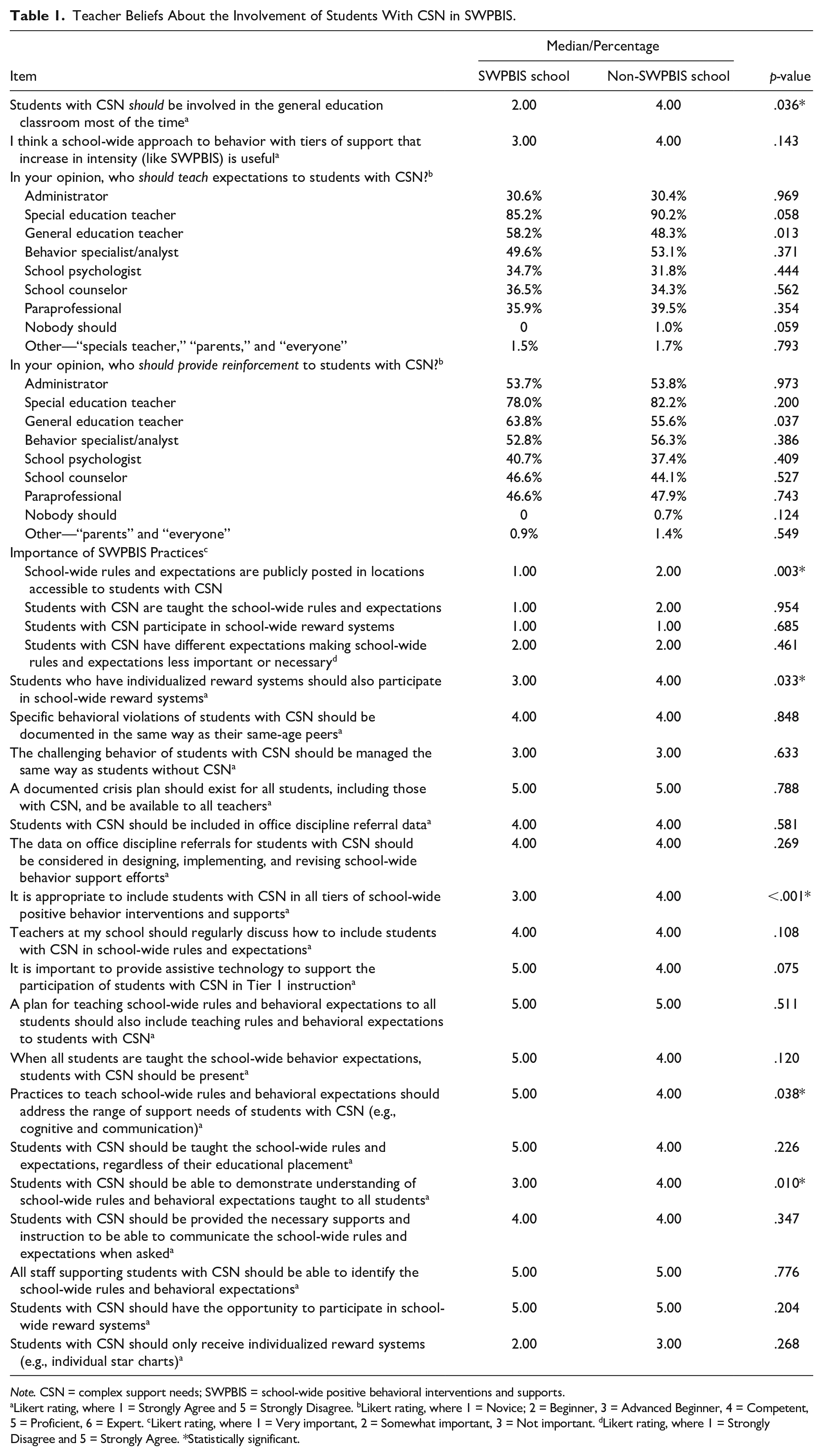
Note. CSN = complex support needs; SWPBIS = school-wide positive behavioral interventions and supports.
Likert rating, where 1 = Strongly Agree and 5 = Strongly Disagree. bLikert rating, where 1 = Novice; 2 = Beginner, 3 = Advanced Beginner, 4 = Competent, 5 = Proficient, 6 = Expert. cLikert rating, where 1 = Very important, 2 = Somewhat important, 3 = Not important. dLikert rating, where 1 = Strongly Disagree and 5 = Strongly Agree. *Statistically significant.
Procedures
Survey Content and Development
A survey was developed based on a review of the extant literature, including items from previous surveys as well as items generated for this project. The primary focus of this study was to understand educators’ knowledge and perspectives on practices associated with Tier 1 SWPBIS (e.g., teaching school-wide rules and expectations, acknowledging student behavior). The purpose of this was to ensure teachers would respond through a lens of reporting general behavioral practices, given some respondents may not be familiar with the jargon associated with SWPBIS. In doing so, we were able to determine the general practices teachers report implementing without requiring them to have detailed knowledge of SWPBIS itself.
The survey was reviewed for clarity and face validity by four experts in SWPBIS and experts in students with CSN (all have been published more than two peer-reviewed papers on SWPBIS, have 10 or more years of professional experience, and were not authors of this study). In addition, two teachers who were not part of the participant pool piloted the survey and participated in cognitive interviews. All external reviewers were identified through our professional networks. Using feedback from these pilot responses, we developed a survey consisting of 53 questions. This survey was then “soft launched” to a Qualtrics panel of 50 participants to ensure the survey was readable to participants; upon completion of 50 responses, survey collection was paused, and we analyzed preliminary results. These 50 responses were then excluded from further analysis, which resulted in two items being re-worded for clarity; specifically, we added a “not applicable, there are no students with CSN at my school” as an option, and two questions were combined into one (a question asking about the classes students with CSN attend, and a question about the presence of students with CSN on their school campus), resulting in a final survey with 52 items. The survey was then re-launched, resulting in 644 new responses, of which 622 responses were retained for data analysis purposes.
The final survey consisted of multiple-choice questions, including Likert-type rating items. The first set of 18 questions collected participant demographic information, including gender identity, race and ethnicity, degrees and years of teaching experience, location of their school, and the presence and instruction of students with CSN on their campus. In the next section (n = 15 items), respondents were queried about their beliefs around the inclusion of students with CSN in general education, SWPBIS practices at their school, and involvement of students with CSN in SWPBIS Tier 1 at their school. The term “severe disabilities” was used throughout the survey, and a brief definition was provided. However, we use the more contemporary language of “complex support needs” here. The final 19 questions consisted of Likert-type rating items in which respondents noted their degree of agreement with statements derived from an adapted School-wide Evaluation Tool (Zagona et al., 2021) that revealed participant perceptions about the value of practices associated with SWPBIS for students with CSN. See Tables 1–3 for a complete summary of responses for the survey. Reliability of the survey was established by calculating Cronbach’s alpha for subscales: knowledge (
Teacher Knowledge of Tier 1 School-Wide Rules and Expectations for Students With CSN.
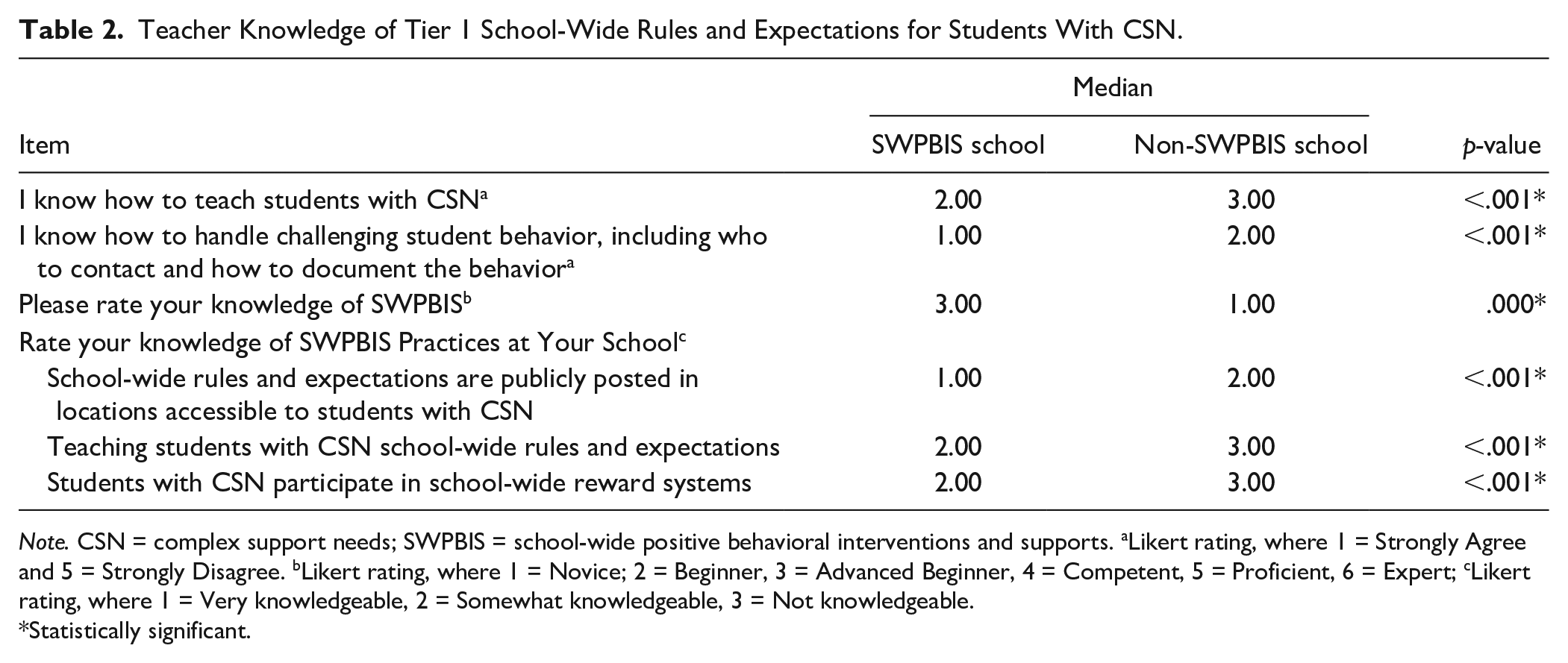
Note. CSN = complex support needs; SWPBIS = school-wide positive behavioral interventions and supports. aLikert rating, where 1 = Strongly Agree and 5 = Strongly Disagree. bLikert rating, where 1 = Novice; 2 = Beginner, 3 = Advanced Beginner, 4 = Competent, 5 = Proficient, 6 = Expert; cLikert rating, where 1 = Very knowledgeable, 2 = Somewhat knowledgeable, 3 = Not knowledgeable. *Statistically significant.
Teacher Self-Reported Use of School-Wide Rules and Expectations Practices.
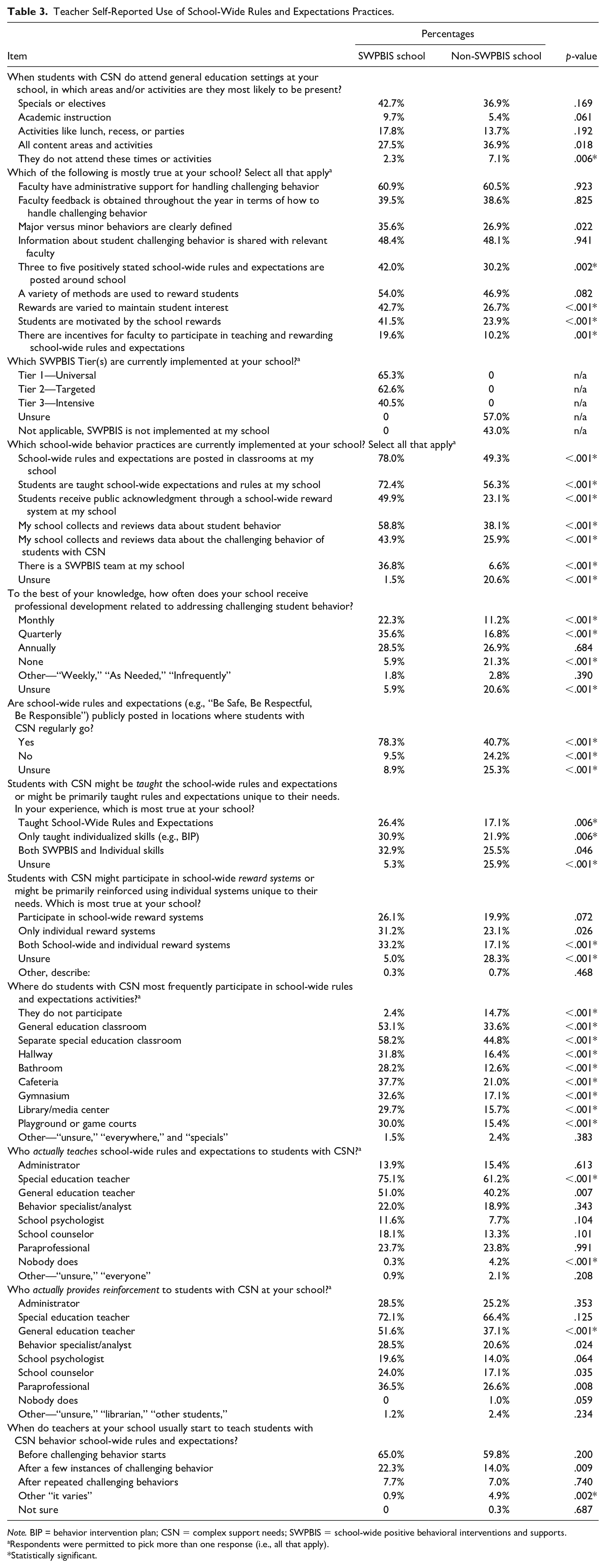
Note. BIP = behavior intervention plan; CSN = complex support needs; SWPBIS = school-wide positive behavioral interventions and supports.
Respondents were permitted to pick more than one response (i.e., all that apply).
Statistically significant.
Participant Recruitment
The data presented here are part of a series of studies related to practices associated with Tier 1 SWPBIS and students with CSN. To achieve a large sample size, a Qualtrics panel of 644 teachers in the U.S. was purchased. All recruitment occurred through panels of respondents managed by Qualtrics and were drawn from a pre-recruited set of respondents, in this case, PreK–12 educators teaching in U.S. schools. Qualtrics distributed the survey and data were collected between July 21 and August 1, 2022. Each participant first reviewed an explanation of the research study and agreed to use their data for research purposes prior to proceeding with the survey. Twenty-two respondents were excluded from the analysis because they taught in homeschools, daycares, colleges/universities, and post-secondary transition programs, resulting in a total sample size of 622 participants. No follow-up reminders were sent.
Data Analysis
Given our interest in understanding the practices and beliefs of teachers who work in schools implementing SWPBIS and those who do not, one survey question was used as a grouping variable in which respondents could indicate which tier(s) of SWPBIS were implemented at their school. Those respondents who reported implementation of one or more tiers of SWPBIS were grouped in the “SWPBIS school” category (n = 337). Schools implementing one or more tiers were considered SWPBIS schools given the typical delayed installation of higher-level tiers (Kittelman et al., 2022). Respondents were permitted to report the implementation of more than one tier, as such, totals exceed 337: Tier 1 (n = 220), Tier 2 (n = 211), and Tier 3 (n =136). Two hundred and eighty-five respondents reported they did not know if their school was implementing a SWPBIS tier (n = 162) or that their school was not implementing SWPBIS (n = 123). These respondents were grouped together as participants from “non-SWPBIS schools” (n = 285).
All data analysis was conducted using IBM SPSS version 28. Because of the survey distribution practices with a purchased sample from Qualtrics, there were no missing data. We completed descriptive analyses of teachers’ responses to each survey question using non-parametric methods given that response options were Likert-type ratings. Responses to Likert-type ratings are reported using medians and analyzed using Kruskal–Wallis one-way analysis of variance to compare responses to ratings for participants who teach in SWPBIS versus non-SWPBIS schools. Distributions of ratings for both groups were similar, as assessed by visual inspection of box plots. Pairwise comparisons were performed using Dunn’s (1964) procedure with a Bonferroni correction for multiple comparisons; as such, adjusted p-values are listed in the results section. Post hoc analysis was further completed to determine statistically significant differences as appropriate.
Chi-square goodness-of-fit tests were completed to compare the observed frequencies of survey responses to determine whether an equal number of participants from SWPBIS and non-SWPBIS schools reported similar responses. As previously described, pairwise comparisons were performed using Dunn’s (1964) procedure with a Bonferroni correction for multiple comparisons; as such, adjusted p-values are presented. Post hoc analysis was further completed to determine statistically significant differences as appropriate.
Results
Educator Beliefs on the Involvement of Students With CSN in SWPBIS Tier 1 Practices
A Kruskal–Wallis test was conducted to identify any differences in perceptions about the usefulness of school-wide behavior supports and practices scores between teachers in SWPBIS and non-SWPBIS schools using Dunn’s procedure (1964). As seen in Table 1, teachers in SWPBIS schools more often reported students with CSN should be involved in general education most of the time compared with non-SWPBIS schools, χ2(1) = 4.394, p = .036. Teachers in SWPBIS schools more frequently agreed school-wide rules and expectations should be posted in locations accessible to students with CSN, χ2(1) = 9.001, p = .003. They also more often agreed that students with CSN should be involved in several school-wide rules and expectations practices compared with teachers in non-SWPBIS schools. Specifically, teachers from SWPBIS schools more often agreed that students who have individualized acknowledgment systems should also participate in school-wide acknowledgment systems, χ2(1) = 4.564, p = .033, it is appropriate to include students with CSN in all tiers of SWPBIS, χ2(1) = 21.407, p ≤ .001, practices used to teach school-wide rules and expectations should address the range of support needs of students with CSN, χ2(1) = 4.314, p = .038, and students with CSN should be able to demonstrate understanding of school-wide rules and expectations taught to all students, χ2(1) = 6.685, p = .010.
When asked who should teach school-wide rules and expectations to students with CSN, as well as who should provide reinforcement to students with CSN, there were no statistically significant differences between the SWPBIS and non-SWPBIS schools when analyzed using a chi-square test of homogeneity with an adjusted p-value, although most respondents in both groups agreed that school personnel broadly should teach behavioral expectations and provide reinforcement to students with CSN.
Educator Knowledge to Support Students With CSN in Tier 1 SWPBIS
To determine if there were differences in teacher knowledge between teachers working in SWPBIS versus non-SWPBIS schools, we analyzed responses from four questions, which were rated on a Likert-type scale where 1 = Strongly Agree and 5 = Strongly Disagree, 1 = Novice and 5 = Expert, and 1 = Very Knowledgeable and 5 = Not Knowledgeable. A Kruskal–Wallis test was conducted to determine if there were differences in knowledge of behavior supports and practices scores between groups that differed in their implementation of SWPBIS: the “SWPBIS schools” (n = 337) and “non-SWPBIS schools” (n = 285). Distributions of knowledge scores were similar for both groups, as assessed by visual inspection of a boxplot.
Median knowledge scores were significantly different between the groups (SWPBIS and non-SWPBIS), χ2(1) = 24.468, p = .001 (see Table 2). Follow-up pairwise comparisons, with adjusted p-values for multiple comparisons, revealed statistically significant differences in median knowledge scores between the groups related to knowledge of how to handle challenging behavior, χ2(1) = 26.893, p ≤ .001, knowledge of where school-wide rules and expectations are publicly posted, χ2(1) = 55.675, p ≤ .001, and of SWPBIS in general χ2(1) = 210.367, p = .000. Teachers in SWPBIS schools reported having more knowledge of how to teach students with CSN, χ2(1) = 43.882, p ≤ .001, how to teach school-wide rules and expectations to students with CSN, χ2(1) = 61.583, p ≤ .001, and how to involve students with CSN in school-wide acknowledgment systems, χ2(1) = 51.583, p ≤ .001.
Educator Practices to Involve Students With CSN in Tier 1 SWPBIS
A total of 13 questions queried respondents about school practices and how activities are organized to support student learning of school-wide rules and expectations. A chi-square test of homogeneity was used to analyze questions related to practices. The two multinomial probability distributions were equal in the population. Observed frequencies and percentages of school-wide behavior practices for all results are in Table 3; we report statistically significant results next. In all cases, p-values were adjusted for multiple comparisons.
To understand the involvement of students with CSN in general education, respondents indicated if students with CSN participated in electives or specials; academic instruction; activities like lunch, recess, or parties; all content areas and activities; or none of these. More respondents from SWPBIS schools reported they involve students in general education instruction or activities, χ2(1) = 7.440, p = .006, post three to five positively stated rules and expectations around school, χ2(1) = 9.240, p = .002, vary reinforcement to maintain student interest, χ2(1) = 17.430, p ≤ .001, believe that students are motivated by school rewards, χ2(1) = 21.694, p ≤ .001, and report there are incentives in place to encourage faculty to participate in SWPBIS-associated activities, χ2(1) = 10.564, p = .001.
Respondents from SWPBIS schools more often reported posting school-wide rules and expectations, χ2(1) = 56.522, p ≤ .001, teaching rules and expectations, χ2(1) = 18.837, p ≤ .001, publicly acknowledging students, χ2(1) = 47.290, p ≤ .001, collecting and reviewing data about student behavior in general, χ2(1) = 27.154, p ≤ .001, collecting and reviewing data about behavior among students with CSN, χ2(1) = 21.958, p ≤ .001, and the presence of a SWPBIS team, χ2(1) = 79.531, p ≤ .001. Respondents from non-SWPBIS schools reported more often not knowing about behavior practices at their school, χ2(1) = 61.523, p ≤.001.
Respondents also reported the frequency of professional development related to addressing challenging behavior. Those teachers working in SWPBIS schools more often reported professional development occurring monthly, χ2(1) = 13.183, p ≤ .001, or quarterly, χ2(1) = 27.584, p ≤ .001, whereas teachers working in non-SWPBIS schools reported more often there was no such professional development, χ2(1) = 36.621, p ≤ .001, or they were unsure about behavior-related professional development, χ2(1) = 30.369, p ≤ .001.
The survey then prompted respondents to consider the involvement of students with CSN in school-wide behavior support practices. Across the sample, 39 respondents (6.3%) reported no students with CSN were taught at their school, including 11 (3.3%) in SWPBIS schools and 28 (9.8%) in non-SWPBIS schools. Respondents stated whether or not rules and expectations were posted in locations where students with CSN regularly attend, with more respondents teaching in SWPBIS schools doing so, χ2(1) = 92.021, p ≤ .001.
Respondents in SWPBIS schools also more frequently reported teaching school-wide rules and expectations to students with CSN, χ2(1) = 7.598, p = .006, whereas teachers in non-SWPBIS schools more frequently taught students with CSN skills associated only with their unique behavioral needs, χ2(1) = 7.651, p = .006, or were unsure of how students with CSN are taught rules and expectations, χ2(1) = 52.111, p ≤ .001. In terms of participation in acknowledgment systems, SWPBIS schools more often used both school-wide and individual rewards, χ2(1) = 20.712, p ≤ .001, whereas teachers working in non-SWPBIS schools were unsure about rewards for students with CSN, χ2(1) = 63.572, p ≤ .001.
Respondents were queried regarding where students with CSN participated in activities related to school-wide rules and expectations. Respondents teaching in SWPBIS schools more often reported students with CSN participated in all contexts, including general education classrooms, χ2(1) = 23.979, p ≤ .001, separate special education classrooms, χ2(1) = 11.138, p ≤ .001, hallways, χ2(1) = 19.505, p ≤ .001, bathrooms, χ2(1) = 22.680, p ≤ .001, cafeteria, χ2(1) = 20.555, p ≤ .001, gymnasiums, χ2(1) = 19.574, p ≤ .001, libraries, χ2(1) = 16.833, p ≤ .001, and playgrounds, χ2(1) = 19.097, p ≤ .001. Conversely, respondents from non-SWPBIS schools more frequently reported students with CSN did not participate in any context, χ2(1) = 63.572, p ≤ .001.
Respondents reported who actually teaches school-wide rules and expectations and provides reinforcement to students with CSN. Teachers in SWPBIS schools more often reported special education teachers actually teach rules and expectations to students with CSN, χ2(1) = 13.871, p ≤ .001, whereas teachers in non-SWPBIS schools more often reported nobody teaches this to students with CSN, χ2(1) = 11.512, p ≤ .001. When asked who provides reinforcement, more respondents in SWPBIS schools reported general education teachers provide reinforcement to students with CSN, χ2(1) = 13.271, p ≤ .001. Finally, respondents reported when teachers usually start to teach students with CSN school-wide rules and expectations. There were few statistically significant differences. Teachers in non-SWPBIS schools more often reported initiating instruction on school-wide rules and expectations for students with CSN after a few instances of challenging behavior and after repeated challenging behavior, rather than before challenging behavior starts, χ2(1) = 9.396, p = .002.
Discussion
This study sought to understand the extent to which teachers believe students with CSN should participate in practices associated with SWPBIS, whether educators perceive themselves as having the knowledge to support the involvement of students with CSN in SWPBIS, and what practices schools engage in that support the involvement of students with CSN and if responses varied based on school implementation of SWPBIS. The main results suggest (a) teachers believe students with CSN should be involved in SWPBIS, (b) teachers working in SWPBIS schools perceive themselves as having more knowledge of how to handle challenging behavior among students with CSN, and (c) teachers in SWPBIS schools engage in more practices that support the involvement of students with CSN in Tier 1 activities and instruction.
For our national survey, we queried respondents on their beliefs about the involvement and benefits of SWPBIS for students with CSN. For many items, there was no statistically significant difference in perceptions between teachers in SWPBIS and non-SWPBIS schools. However, more respondents in the SWPBIS schools reported students with CSN should be involved in general education classrooms most of the time, compared with respondents in non-SWPBIS schools. This is compelling, given they also reported more students with CSN were actually taught in general education settings, suggesting the teachers found the practice of inclusion in general education to be aligned with their beliefs. These findings further emphasize the potential relationship between educational placement and involvement of students with CSN in SWPBIS (Walker et al., 2018) and ways in which the SWPBIS framework may promote a more inclusive school culture (Sailor et al., 2006). Furthermore, those teachers implementing SWPBIS more often believed students with CSN should be involved in school-wide acknowledgment systems, should participate in all tiers of SWPBIS, should demonstrate an understanding of school-wide rules and expectations, and that educators should use differentiated instructional practices to teach school-wide rules and expectations to students with CSN. Together, these findings suggest teachers believe SWPBIS benefits students with CSN. In terms of overall participation in practices associated with SWPBIS (e.g., teaching expectations and providing reinforcement), there was wide agreement among educators in both SWPBIS and non-SWPBIS schools that students with CSN should participate in these activities, consistent with perceptions reported by experts in SWPBIS (Zagona et al., 2021).
A key aspect of SWPBIS is that “all students, staff, and settings” in a school participate (Sugai & Horner, 2010, p. 67). To accomplish this, all educators must have knowledge of SWPBIS practices and activities and of students with CSN. Our findings reflect that schools implementing SWPBIS are more likely to consist of educators who believe they are more knowledgeable about meeting the behavioral needs of students with CSN than educators in schools not implementing SWPBIS (Chitiyo et al., 2019; Fox et al., 2022). Given that SWPBIS is implemented in all settings, yet students with CSN are routinely physically and programmatically separated from general education, our finding that students have more access to SWPBIS practices when taught in SWPBIS schools is encouraging. We hypothesize that having more students with CSN present along with additional training on SWPBIS practices supported respondents from SWPBIS schools to believe that they were more knowledgeable of how to teach students with CSN; how to make school-wide rules and expectations accessible to students with CSN; and how to teach and support the involvement of students with CSN in school-wide rules and expectations and acknowledgment systems. Together, responses to the knowledge section of the survey suggest SWPBIS implementation supports educators to believe they have knowledge of behavior in general, but also as it relates to students with CSN, suggesting a benefit to being taught in schools implementing SWPBIS for students with CSN.
Finally, we investigated the extent that educators teaching in schools implementing SWPBIS (compared with those that were not) implemented practices associated with SWPBIS. These practices included professional development for teachers related to positive behavior support, teaching students school-wide rules and expectations, and reinforcing student behavior. Once again, we found an advantage for students with CSN who were taught in SWPBIS schools in terms of their involvement in these practices. Specifically, students with CSN taught in SWPBIS schools were perceived to be involved in general education instruction and activities, which has been associated in a growing body of research with improved student outcomes (e.g., Kleinert et al., 2015). We also found students with CSN from SWPBIS schools were reported to be present when school-wide rules and expectations were taught, received instruction on school-wide rules and expectations, received varied reinforcement to maintain student interest, participated in both school-wide and individualized acknowledgment systems, and felt motivated by those systems. Personnel in SWPBIS schools also reported reviewing and making decisions about the challenging behavior of students with CSN and to have school-wide rules and expectations posted in locations where students with CSN participate regularly. These practices are important for maintaining high levels of fidelity and alignment with the purpose of SWPBIS: to benefit all students (Zagona et al., 2021).
Limitations
There are limitations to our survey and analysis that we must acknowledge. We asked respondents to indicate the practices associated with SWPBIS that are implemented at their schools, but we do not definitively know if a school was or was not implementing SWPBIS. This is due to the potential for teachers to not be familiar with the language used to describe SWPBIS. We attempted to mitigate this by providing a clear definition of SWPBIS within the survey, and we permitted teachers to report the implementation of any of the three tiers of SWPBIS at their school. Nevertheless, it is possible a respondent was placed in the SWPBIS or non-SWPBIS school group incorrectly. A further limitation is that, like the teacher workforce (National Center for Education Statistics, 2022), our respondents were primarily White women; therefore, additional demographic variation would be useful. In addition, it is possible that respondents from schools implementing SWPBIS for more time will report different practices, knowledge, and perceptions than others; therefore, future research should recruit participants from schools with varying lengths of implementation. Although these limitations exist, we recognize several strengths of our sample. First, we obtained a large national sample representing all states. Second, various types of teachers (general, special), school types (public, charter), grade levels, and locations (urban, rural) are represented in the survey, lending credibility to our findings.
Implications and Future Directions
Our finding that more teachers in SWPBIS schools believed they involved students with CSN in general education and more teachers believed students with CSN should be involved in SWPBIS aligns with earlier research findings that SWPBIS has a positive impact on school organizational health (Bradshaw et al., 2008). It is possible that teachers in SWPBIS schools involve students with CSN or believe they should be involved because they know how to support these students, and there is a supportive network in the school to do so, including from a SWPBIS team. Future research should investigate the relationship between these factors (teacher knowledge of supportive practices for students with CSN, implementation of SWPBIS with fidelity, and organizational health) to understand educator knowledge of supporting students with CSN and the factors that contribute to knowledge.
This finding also suggests the implementation of SWPBIS may be a catalyst for improving inclusive practices for students with CSN, which in turn is likely to result in better behavioral outcomes. For example, Sailor and colleagues (2006) describe how the application of the SWPBIS framework had a significant positive impact on academic achievement for students with disabilities. These SWPBIS-associated practices also were found to promote involvement in general education and positive student academic outcomes (Choi et al., 2020). Our findings corroborate these studies. We hypothesize the SWPBIS framework contributes important knowledge, skills, and beliefs for teachers to draw upon when teaching diverse students, including those with CSN, although further research is needed.
Responses to the knowledge section of the survey demonstrate that teachers in schools implementing practices associated with SWPBIS are more knowledgeable about supporting student behavior in general, and the behavior of students with CSN in particular. This suggests an important benefit for students with CSN who are taught in SWPBIS schools. Future research should investigate the ways teachers have gained knowledge about supporting student behavior, including methods that have been most effective. This research should draw upon best practices in professional development (e.g., Darling-Hammond et al., 2017) and strategies for scaling up professional knowledge related to teaching students with CSN (e.g., Horner et al., 2017).
In addition to learning how teachers have gained knowledge in effective behavior supports for students with CSN, it also would be important to examine the impact of their knowledge on student outcomes. Researchers have documented how SWPBIS has resulted in positive student outcomes (Freeman et al., 2016; Kim et al., 2018; Lee & Gage, 2020; Simonsen et al., 2012), and there is a need to learn about the academic, communication, social, and behavioral benefits for students with CSN attending SWPBIS schools.
The results of this study revealed that, in schools implementing SWPBIS, students with CSN were present when school-wide rules and expectations are taught. Future research should investigate the extent to which instruction on school-wide rules and expectations is accessible for students with CSN given the potential for students with CSN to have complex communication, cognitive, or sensory support needs. Future research also must investigate strategies for ensuring instruction on school-wide rules and expectations are indeed accessible for students with CSN, including strategies for professional development and systematic procedures for adapting lesson plans and enhancing instructional supports (e.g., Loman et al., 2018).
Finally, research is needed to investigate the specific components of SWPBIS that benefit students with CSN. Both groups of respondents reported reliance on special education teachers to teach and provide reinforcement to students with CSN, although there was a general consensus that more faculty (e.g., administrators and paraprofessionals) should also be involved. Future research is needed to understand how to best involve all school staff, including methods of developing and communicating needed adaptations for students with CSN across school personnel. Relatedly, investigating the extent to which special education teacher involvement on SWPBIS teams contributes to the overall success of SWPBIS in supporting students with CSN is needed. It is possible their involvement may provide important content and pedagogical knowledge for students with CSN, and this may in turn benefit the team as a whole, and ultimately benefit a large set of students with diverse support needs who would benefit from flexible and adaptable instruction.
Conclusion
Extant research suggests students with CSN have been excluded from Tier 1 SWPBIS activities and instruction. However, the extent to which this exclusion harms or benefits students with CSN has been unknown. As such, we completed a survey of practicing teachers to gain their understanding of whether and how SWPBIS benefits students with CSN. We found that teachers believe students with CSN benefit from learning in schools implementing SWPBIS, that teachers in schools implementing SWPBIS have more self-reported knowledge of supports for students with CSN, and reporting engaging in more practices that support the involvement of students with CSN in Tier 1 SWPBIS. Our findings thus reinforce the importance of including students with CSN in SWPBIS-associated activities and instruction.
Supplemental Material
sj-docx-1-sed-10.1177_00224669231164396 – Supplemental material for Teachers’ Perspectives and Knowledge of Students With Complex Support Needs and Practices Associated With SWPBIS
Supplemental material, sj-docx-1-sed-10.1177_00224669231164396 for Teachers’ Perspectives and Knowledge of Students With Complex Support Needs and Practices Associated With SWPBIS by Jennifer A. Kurth, Alison L. Zagona, Virginia L. Walker and Sheldon L. Loman in The Journal of Special Education
Footnotes
Declaration of Conflicting Interests
The author(s) declared no potential conflicts of interest with respect to the research, authorship, and/or publication of this article.
Funding
The research reported here was supported by the University of Kansas General Research Fund.

References
Supplementary Material
Please find the following supplemental material available below.
For Open Access articles published under a Creative Commons License, all supplemental material carries the same license as the article it is associated with.
For non-Open Access articles published, all supplemental material carries a non-exclusive license, and permission requests for re-use of supplemental material or any part of supplemental material shall be sent directly to the copyright owner as specified in the copyright notice associated with the article.
