




Abstract
We examined differences between expert and nonexpert musicians’ assessments of recorded episodes of music practice. High school (n = 28) and professional (n = 26) string players listened to brief recordings of four anonymous violinists’ practice sessions (two artist-level experts and two competent high school students). As they listened, they pressed a computer key when they perceived a discrepancy between what they heard on the recording and what they would have intended (their own goals) if they had been the practicing musician. Professional musicians marked discrepancies nearly 3 times as often as did students regardless of whether they were listening to recordings of high school or expert violinists, p = .001. When participants estimated the experience levels of the performers on the recordings, professional participants were more likely than students to correctly identify expert practicers as experts, although both student participants’ and professional participants’ key-press rates were not significantly related to their estimates of the practicers’ experience levels. Our results are in keeping with the notion that professionals formulate more precise goals for practicing than do developing musicians and that student musicians may misperceive the extent of mistake making in the practice of experts.
The development of music performance skills involves the refinement of complex movement sequences in a process of iterative goal-setting and self-evaluation (Chaffin et al., 2003; Duke et al., 2009; McPherson et al., 2017; Miksza, 2007, 2012), one that requires the integration of auditory and kinesthetic perception, decision-making, motor control, and ongoing monitoring to gradually align performance with intention. Identification of discrepancies between momentary goals and attempts to accomplish those goals is an essential component of instantiating and updating procedural memories across all levels of experience and expertise (Chen et al., 2013; Hamilton & Duke, 2020; Katahira et al., 2008; Maidhof, 2013; Maidhof et al., 2013; Ruiz et al., 2009; Shadmehr et al., 2010; Wolpert & Ghahramani, 2000).
This idea aligns with foundational models of music practice, now well established in the literature, that are characterized by well-defined tasks, repetition, self-assessment, and error correction (Ericsson et al., 1993; Hallam, 1997). Effective learners formulate well-defined goals, recognize discrepancies between their goals and momentary performance outcomes, and then modify their behavior to minimize or eliminate those discrepancies in subsequent performance trials (Herzfeld & Shadmehr, 2014; Maidhof, 2013; Seidler et al., 2013; Wu et al., 2014). This process echoes Zimmerman’s (2000) model of self-regulated learning, which conceptualizes expert learning as a dynamic, cyclical process involving forethought (e.g., goal setting and strategic planning), performance (e.g., self-monitoring and behavioral adaptation), and self-reflection (e.g., performance appraisal and causal attribution). Musicians’ abilities to regulate their behaviors through each of these phases, particularly when coupled with high-quality feedback, directly affect their capacity to make meaningful progress (McPherson & Zimmerman, 2011).
The conceptualization of errors as discrepancies between intentions and outcomes has important implications for skill learning in music because the clarity of performers’ intentions necessarily influences self-perceptions of accuracy. The precision of intentions, whether related to technical mastery or expressive nuance, can directly affect how discrepancies are perceived and addressed, thus shaping the trajectory of skill refinement. Musicians sometimes identify discrepancies in terms of discrete outcomes (e.g., a wrong note or missed entrances), but this narrow conception of error making does not fully acknowledge the sensory-motor feedback loop that guides the adjustment of complex movement sequences in response to ongoing streams of auditory, proprioceptive, tactile, and visual feedback. Indeed, moment-to-moment monitoring allows musicians to make within-trial corrections, contributing to the fluidity and adaptability that characterize expert performance.
Skillful cellists, for example, can perceive that an ongoing shift of their left-hand position will likely undershoot the intended pitch and then increase the speed of their movements midshift to overcome the impending discrepancy (Chen et al., 2006, 2008). Similarly, skilled pianists who sense that they are about to play an incorrect note tend to reduce the velocity of their finger movements to minimize the impact of the error (Maidhof et al., 2013). Such anticipatory adjustments illustrate the interplay between feedforward control (based on internal models) and feedback mechanisms (based on real-time sensory input), underscoring the sophistication of expert motor planning. Real-time movement corrections in motor learning rely on accurate sensory feedback and comparison to internal reference signals (Adams, 1971; Schmidt, 1975, 2003; Wolpert & Ghahramani, 2000). As expertise develops, learners rely increasingly on intrinsic feedback (e.g., proprioception, auditory input) rather than external feedback, reinforcing the need for educators to scaffold students’ internal feedback mechanisms over time (Schmidt & Lee, 2011).
In previous research, we investigated the extent to which discrepancies between intentions and outcomes appear in the practice of musicians at varied levels of skill. We audio-recorded 60 musicians representing four levels of skill development (high school musicians, undergraduate music majors, graduate music majors, and artist-level experts) as they practiced familiar repertoire in 5-minute practice sessions (Hamilton & Duke, 2020). Immediately after their practice sessions, the musicians listened to their own recordings and pressed a computer key to mark discrepancies between what they had intended while practicing and what they had actually played. There were large differences in the quality of playing among skill levels, but the number of marked discrepancies did not differ systematically among groups. The discrepancies identified by the more skillful performers were more subtle than were those identified by the less skillful performers, but all participants noted discrepancies between their intentions and their performances. These findings suggest that the perception of error is a sensitive indicator of expertise, reflecting increasingly refined evaluative frameworks.
In a follow-up experiment 2 years later, 13 of the high school participants and 11 of the expert participants from the original study returned and listened to their original recordings, now pressing a computer key to mark moments of discrepancy between what they believed would be their current intentions and what they heard on the 2-year-old recording (Hamilton & Duke, 2020). Expert participants’ key-press rates were approximately the same as they had been in Experiment 1, but high school participants’ key-press rates were significantly higher after 2 years had elapsed. As these younger, developing musicians gained experience, they developed increasing levels of auditory discrimination and clearer goals for their playing. Taken together, these data suggest that the progression from novice to expert is characterized not primarily by a diminution in the rate of error making but rather by an apparent increase in the elaboration and refinement of intentions and expectations. These revised intentions guide practice behavior and lead to increasing levels of motor refinement and improved performance skill over time. This developmental arc implies that musical expertise is not merely a product of error reduction but also of perceptual and conceptual expansion—musicians learn to hear more, expect more, and therefore improve more.
This developmental trajectory parallels findings in the literature indicating that self-evaluation is a fundamental aspect of music learning and can evolve with experience (Bergee, 1993; Kostka, 1997). Although less experienced musicians may struggle to evaluate their own performance in ways that align with expert judgments, their ability to self-evaluate can be nurtured over time in an effort to positively influence their musical development (Davis, 1981; Sparks, 1990). When learners engage in self-evaluation while also listening to high-quality models, they tend to show greater improvement in areas such as tone, rhythmic accuracy, interpretation, and overall performance—suggesting that the act of comparing internal goals to external reference points strengthens both perception and execution (Hewitt, 2001). In contrast, modeling without self-evaluation yields far less impact, reinforcing the idea that active engagement in the evaluative process is crucial for meaningful progress (Hewitt, 2001).
Informal discussions with young musicians about their conceptions of expert practice reveal the widespread misperception that expert practice involves very few errors or mistakes or that there are few discrepancies between what experts intend and what they accomplish, even during practice. This misconception stands in contrast to the more elaborate models of practice that emphasize the ongoing process of monitoring, evaluating, and refining one’s performance through repeated trials (Ericsson et al., 1993; Hallam, 1997). We posit that as musicians mature, their improved ability to compare internal goals to external auditory feedback supports the development of autonomous musicianship. This autonomy, marked by independent evaluative thinking, refined auditory imagery, and intentional error correction, is a hallmark of expert performance and an aspiration of musical training.
Our purpose in the present investigation was twofold. First, we sought to determine whether professional musicians perceive errors in the practicing of other musicians (two high-school-level violinists and two artist-level expert violinists) more frequently than do less experienced musicians. Other research (e.g., Brand & Burnsed, 1981; Byo, 1993; Sheldon, 1998; Stambaugh & Nichols, 2019) has examined musicians’ abilities to hear pitch and rhythm errors (i.e., a wrong note compared to what is printed in the score), but we were interested in obtaining a measure of participants’ perceptions of errors relative to their own goals as musicians. We also asked whether the frequency of perceived errors was related to listeners’ estimates of practicers’ levels of expertise.
Method
Auditory Stimuli
We created four brief auditory excerpts (each approximately 2 minutes in duration) of different violinists practicing—two competent, high-school-age violinists and two highly esteemed, expert violinists. These excerpts were extracted from audio recordings obtained from our previous research (Hamilton & Duke, 2020). The excerpts included no information that might identify the violinists. The recordings were used with permission of the four performers.
Student Violinists 1 and 2 were both proficient musicians who had demonstrated success in their respective schools’ orchestra programs and private teachers’ studios. Expert Violinists 1 and 2 were highly regarded musicians with distinguished performing, recording, and teaching careers. Each 2-minute excerpt was trimmed from the original 5-minute practice session and included one successful rehearsal frame (Duke, 1994), an interval of practice time during which the violinist made a series of attempts to accomplish a tangible musical goal and subsequently accomplished the goal. The performers and practice sessions are described in the following.
Student Violinist 1 (SV1) had played violin for 13 years and held leadership positions in her school orchestra, youth symphony, and music festival ensembles. On the recording, she was practicing the second movement (Adagio) of Violin Concerto No. 1, Op. 26 by Max Bruch (Bruch, 1951). She had been working on the piece for 6 weeks before recording the practice session. In the 1-minute 55-second excerpt, she was practicing a shift from first to fourth position within a lyrical, arpeggiated passage involving string crossings and intonation challenges.
Student Violinist 2 (SV2) had played for 6 years and had taken private lessons for 3 years. On the recording, he was practicing the first movement (Allegro non troppo) of Symphonie Espagnole, Op. 21 by Édouard Lalo (Lalo, 1908). He had been working on the piece for 4 weeks before recording the practice session. In the 2-minute 10-second excerpt, he was working on the shifting patterns within a fast (16th note) ascending arpeggiated passage. He worked through the passage with a metronome, slowly increasing the speed throughout the practice session and at times, choosing to play the passage at half speed.
Expert Violinist 1 (EV1) had played for 36 years, was frequently engaged as a soloist and chamber musician, and was a tenured professor of violin at a well-respected university. On the recording, she was practicing the first movement (Allegretto ben moderato) of Sonata for Piano and Violin in A Major by César Franck (Franck, 1886/2016). She reported that she had performed the piece approximately 20 years earlier and that she was polishing it for an upcoming recital. Her recent review of the piece included just one practice session prior to the one that was recorded for this experiment. In the 2-minute excerpt, she was working to establish a fingering in an expressive, lyrical passage, experimenting with three different sets of fingerings and two different patterns of inflection.
Expert Violinist 2 (EV2) had played for 38 years, was frequently engaged as a soloist and chamber musician, and was a tenured professor of violin at a well-respected university. On the recording, he was practicing the second movement (Scherzo: Allegro) of Violin Concerto No. 1, Op. 77 by Dmitri Shostakovich (Shostakovich, 1957). EV2 reported that he had just begun playing the piece for the first time 15 minutes prior to the practice session recorded for this experiment. In the 1-minute 58-second excerpt, he was practicing an arpeggiated lyrical passage requiring a complex fingering pattern.
Examples of the errors contained on the recordings included intonation and bowing problems on a lyrical, descending-octave, shifting pattern (SV1); erroneous notes and rhythms within a fast 16th-note passage (SV2); unwanted intonation, phrasing, and vibrato variability within a lyrical passage (EV1); and intonation and cross-body, hand coordination within a fast technical passage (EV2). Each excerpt contained technical or expressive challenges commonly encountered by string players. We also created a fifth short practice excerpt that contained salient intonation and rhythmic errors so participants could practice the experimental task prior to listening to the four experimental excerpts.
Participants
We recruited 54 string musicians (violin, viola, cello, or bass) to serve as participants; 28 were musicians in high school who had played their instrument for at least 3 years (experience: M = 9.4 years; age: M = 16.8 years; gender: ns = 16 female, 12 male, and 0 nonbinary), and 26 were professional musicians who were employed full-time in salaried orchestras or as applied instrumental faculty at universities (experience: M = 33.6 years; age: M = 41.7 years; gender: ns = 15 female, 11 male, 0 nonbinary). The experimental procedures were approved by the Institutional Review Board of the University of Texas at Austin. All participants volunteered to participate and gave informed consent. They received no compensation for their participation.
Procedure
We tested participants individually in a quiet room without distractions at a time of their convenience. Participants listened to the instructions and the excerpts through Bose QuietComfort 2 Acoustic Noise Cancelling Headphones attached to a MacBook laptop computer. 1 Individual participants adjusted the volume level of the recording. After listening to the instructions and the practice excerpt, participants were given the opportunity to ask questions about the procedure. Participants listened to each of the four auditory stimuli (SV1, SV2, EV1, EV2) once without viewing printed notation. The excerpts were presented in one of four orders, counterbalanced across participants using a Latin square design to control for order effects.
As participants listened to the excerpts, they pressed a designated computer key each time they heard a discrepancy between what they heard on the recording and what they would have intended had this been a recording of their own practicing. That is, participants were asked to adopt a first-person perspective, imagine the recording as their own performance, and mark any moment that sounded different from what they would have aimed to produce in that context. These discrepancies could reflect perceived technical errors, interpretive differences, or characteristics of practice behavior. This framing was intended to elicit a broad range of responses related to participants’ individual standards and expectations for their own playing and practicing. The concept of “discrepancy,” as applied here, is grounded in motor learning literature, where a mismatch between intention and outcome, a sensorimotor prediction error, is considered a core mechanism of skill acquisition and refinement. Such discrepancies drive adaptive changes through error-based learning and are central to models of expert motor control and performance (Krakauer et al., 2019; Shadmehr et al., 2010; Wolpert et al., 2011).
After listening to each excerpt, participants were asked (a) whether they felt they had completed the key-press task accurately, (b) the nature of the discrepancies they identified, (c) their familiarity with the repertoire on the recording, (d) their perceptions of the repertoire’s suitability for the performer’s ability, and (e) their estimations of the performer’s experience level. The primary author of the study served as the test proctor and took written notes of participants’ spoken responses during the question period.
Results
Accuracy of Key-Press Task
We used Scribe 4 behavior analysis software (Duke & Stammen, 2010) to record participants’ key presses. We asked each participant immediately after they had listened to each recording whether they felt their key presses accurately reflected the discrepancies they perceived. Fifty-two of the 54 participants indicated that their key presses were an accurate reflection of what they had perceived. Two of the 26 professional participants reported that their key presses did not accurately represent discrepancies between what they would have intended and what they heard on EV2’s recording. 2 After examining their mean rates of key presses, we found that these two participants’ responses were at or near the middle of the distribution of scores of other participants in their group listening to the same excerpt. We decided to keep these participants’ key-press rates in the data set; we also analyzed the data with and without their responses and found that their inclusion did not affect the outcomes of any of the statistical analyses.
Mean Rates of Key Presses
We calculated the rate of key presses for each participant, which served as the primary dependent measure of the study, by dividing the total number of key presses by the total duration of each recording. We compared the mean rates of key presses by student participants and professional participants in all four excerpts using a two-way (participant level by excerpt) analysis of variance with repeated measures. 3 Mauchley’s test indicated that the assumption of sphericity had been violated, χ2(5) = 21.30, p < .001, and we calculated corrected degrees of freedom using the Greenhouse-Geisser procedure.
There was no significant interaction between participant level and excerpt, F(2.4, 115.1) = 0.68, p = .53. We found that key-press rates were not significantly different among excerpts, F(2.4, 115.1) = 2.30, p = .09, but professional participants (key presses per minute: M = 15.08, SD = 16.83) marked significantly more discrepancies than did student participants (key presses per minute: M = 4.02, SD = 3.47), F(1, 48) = 11.13, p = .002, η p 2 = .18. There was a great deal of variability within both groups. Data for this comparison are presented in Table 1 and Figure 1.
Mean Rates of Key Presses Per Minute in Four Practice Recordings.
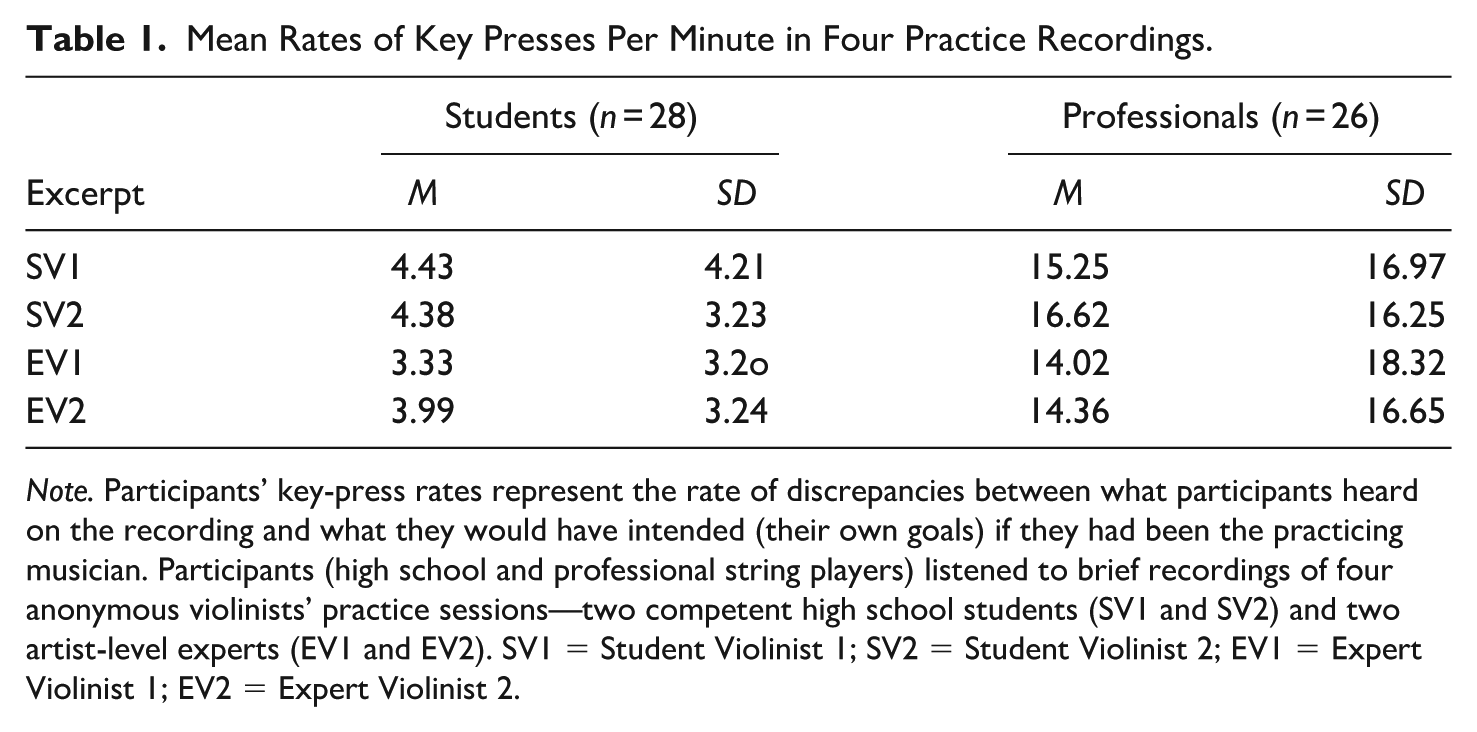
Note. Participants’ key-press rates represent the rate of discrepancies between what participants heard on the recording and what they would have intended (their own goals) if they had been the practicing musician. Participants (high school and professional string players) listened to brief recordings of four anonymous violinists’ practice sessions—two competent high school students (SV1 and SV2) and two artist-level experts (EV1 and EV2). SV1 = Student Violinist 1; SV2 = Student Violinist 2; EV1 = Expert Violinist 1; EV2 = Expert Violinist 2.
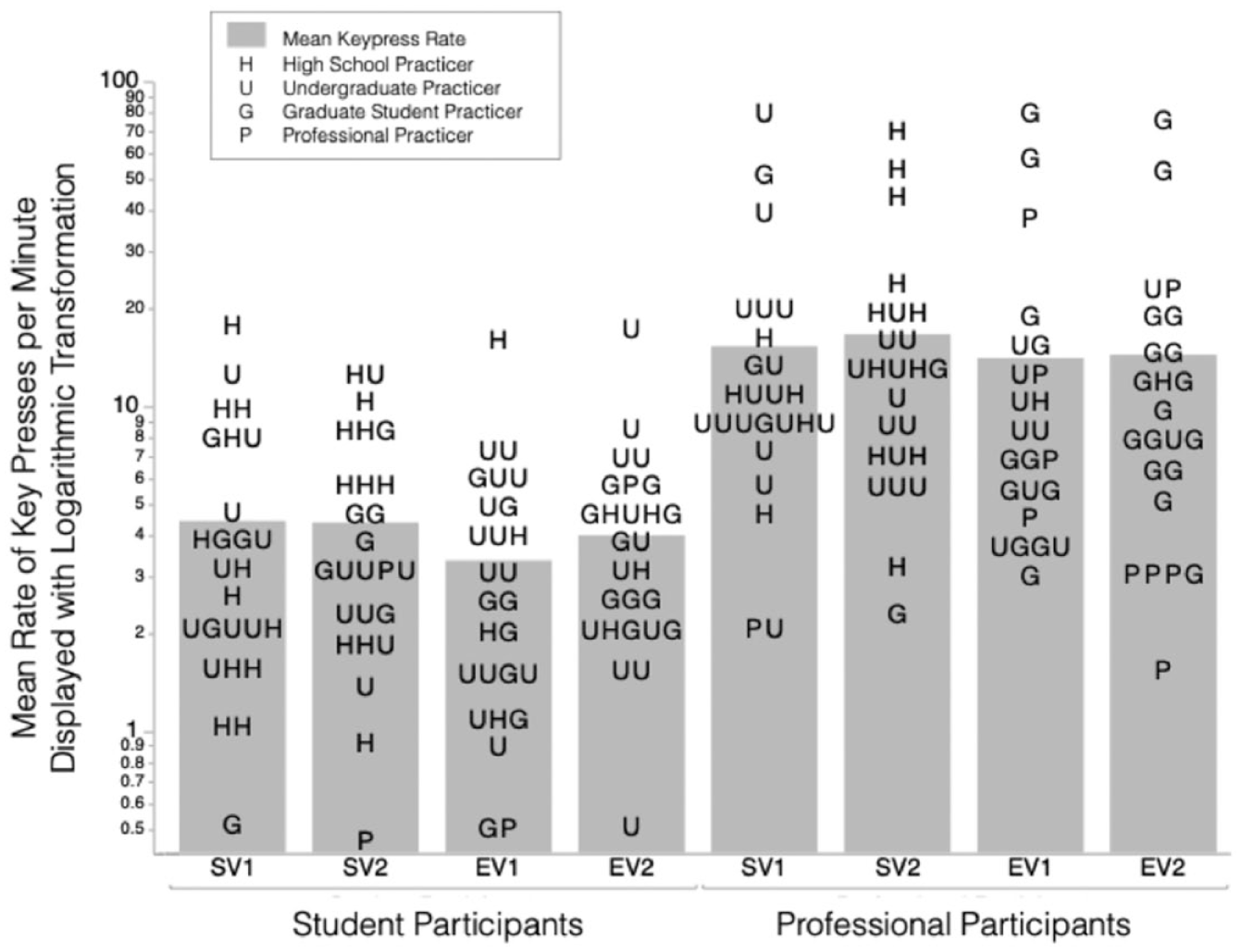
Participants’ mean key-press rates and estimations of each performer’s level in four practice recordings. Student and professional participants’ mean rates of key presses while listening to four anonymous violinists’ practice sessions and participants’ estimations of the violinists’ experience level are presented. Columns along the x-axis are divided into participant groups (student and professional participants) listening to recordings of two competent high school students (SV1 and SV2) and two artist-level experts (EV1 and EV2). The y-axis represents participants’ mean key-press rates per minute while listening to each excerpt, displayed with a logarithmic transformation. Gray bars represent the group means for each recording, and the letter represents each participant’s estimation of each performer’s level of experience (high school, undergraduate, graduate, and professional). One participant declined to estimate the levels of the four performers; this participant’s key-press data have been included in all statistical analyses but are not presented in the figure. SV1 = Student Violinist 1; SV2 = Student Violinist 2; EV1 = Expert Violinist 1; EV2 = Expert Violinist 2.
Participant Familiarity With the Task
Thirteen of the 28 student participants and 11 of the 26 professional participants had participated in a similar experiment in which they marked discrepancies in recordings of their own practice (Hamilton & Duke, 2020). To ensure this prior experience with the task did not affect participants’ key-press rates in the current study, we compared their key-press rates to participants who had not participated in the earlier study. We calculated a mean key-press rate for each participant across all four excerpts and compared these rates using an independent samples t test. We found no significant difference in mean rates of key presses between participants who had participated in the previous study (M = 9.88, SD = 14.95) and participants who had not (M = 8.92, SD = 10.95), t(52) = 0.27, p = .79.
Listeners’ Estimations of Performers’ Levels of Experience
After participants completed the key-press task, we asked them to indicate whether they thought the violinist in each of the four recordings was a high school student, an undergraduate music major, a graduate music major, or a professional performer. Participants’ estimates of the four violinists’ skill levels are presented in Table 2. We compared the participants’ estimated levels of the performers in the recordings using a chi-square test of independence. Specifically, we compared the numbers of student and expert participants who indicated that the practicers in each of the four recordings were high school students, undergraduate music majors, graduate music majors, or professional performers (see Table 2). We found a significant relationship between participants’ skill level and their estimation of the practicers’ level when listening to the two recordings of the high school violinists, χ2(2, N = 53) = 8.17, p = .02, Cramer’s V = .28, and expert violinists, χ2(2, N = 53) = 14.99, p < .001, Cramer’s V = 0.38. 4
Percentages of Participants Who Indicated That the Practicers in the Recordings Were High School Students, Undergraduate Students, Graduate Students, or Professional Violinists.
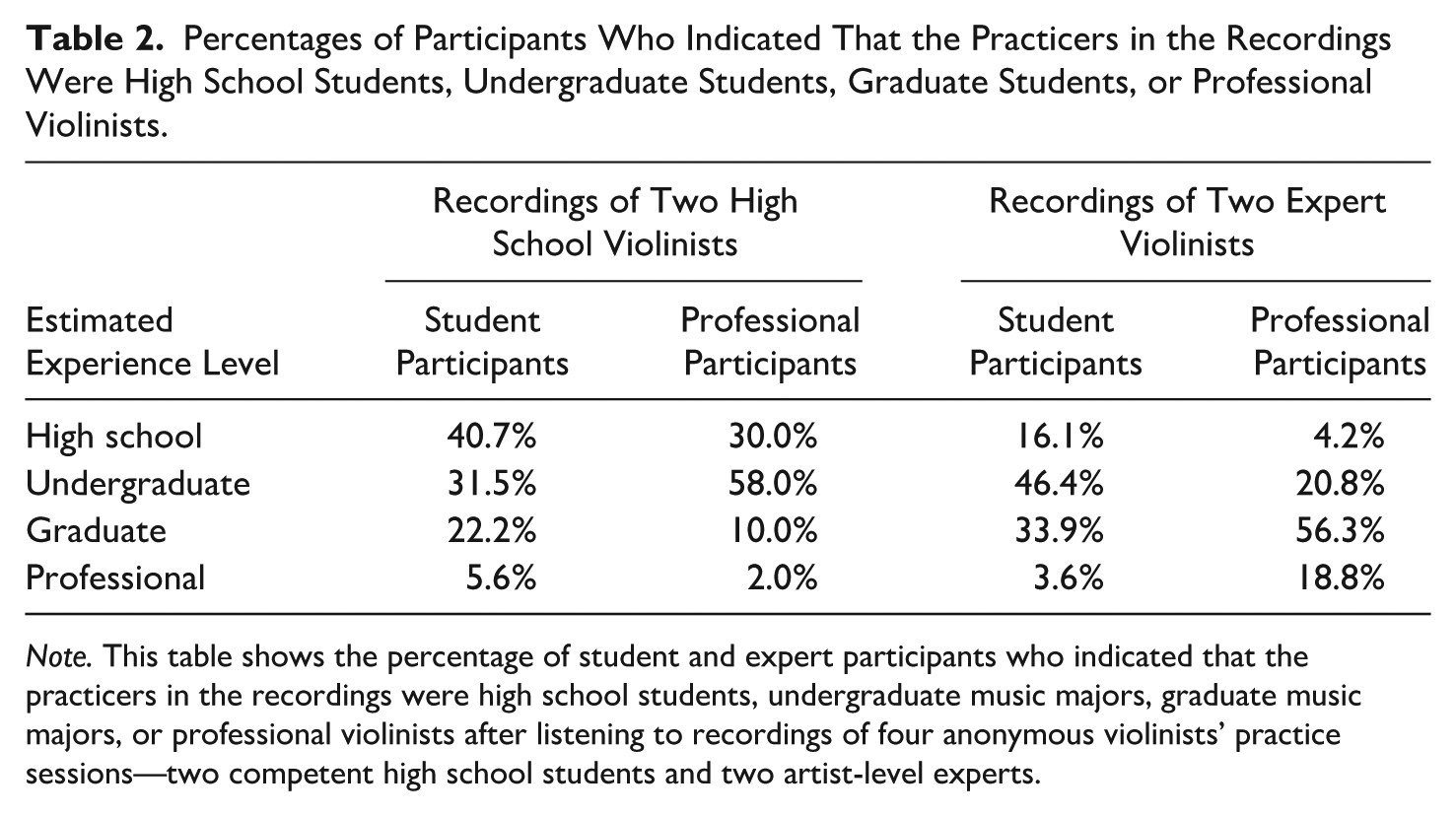
Note. This table shows the percentage of student and expert participants who indicated that the practicers in the recordings were high school students, undergraduate music majors, graduate music majors, or professional violinists after listening to recordings of four anonymous violinists’ practice sessions—two competent high school students and two artist-level experts.
Very few participants (n = 13) indicated that any of the recordings they had listened to were of a professional violinist; those who did included five high school participants (two of whom were correct) and eight professional participants (seven of whom were correct). To test whether there was a relationship between participants’ key-press rates and their perceptions of the performers’ skill levels on each of the four recordings, we computed a Spearman correlation between estimated experience level (high school, undergraduate music major, graduate music major, professional) and key-press rate. We found no significant correlation between participants’ key-press rates and their estimations of the performer’s level among student participants, rs(110) = −.16, p = .09, or among professional participants, rs(98) = −.19, p = .07. Participants’ key-press rates and corresponding rankings of each excerpt are presented in Figure 1.
Participant Familiarity With Repertoire
The repertoire on recordings SV1, SV2, and EV1 are commonly studied and performed—Violin Concerto No. 1, Op. 26 by Max Bruch (Bruch, 1951); Symphonie Espagnole, Op. 21 by Édouard Lalo (Lalo, 1908); and Sonata for Piano and Violin in A Major by César Franck (Franck, 1886/2016). The repertoire in recording EV2—Violin Concerto No. 1, Op. 77 by Dmitri Shostakovich (Shostakovich, 1957)—is less common. We asked participants to indicate their familiarity with each piece using a 5-point, Likert-type scale, with 1 representing never heard it and 5 representing performed it in public.
We calculated each participants’ average familiarity across all four excerpts and compared student and professional participants’ mean familiarity rates using an independent samples t test. We found a significant difference between high school (M = 1.3, SD = 0.5) and professional (M = 3.3, SD = 1.3) participants’ familiarity with the repertoire in the excerpts, t(30) = 7.05, p < .001. Perhaps unsurprisingly, expert participants reported more familiarity with the repertoire than did high school participants.
We were curious about whether participants who were more familiar with the repertoire recorded higher key-press rates than did participants who were less familiar with the pieces within each group (students and professionals). We did not ask participants to identify discrepancies between the written score and what they heard on the recording but instead to identify discrepancies between the performance on the recording and what they would have intended if they had been the person practicing. It seemed possible that individuals who had more experience listening to or performing the repertoire may have had clearer goals and intentions while listening to the performance on the recording and therefore might have perceived more discrepancies.
We examined the relationship between student and professional participants’ familiarity with the repertoire and their key-press rates using a Pearson correlation. For the professional participants, we found no significant relationship between key-press rates and their familiarity with the repertoire, r(100) = .18, p = .07. For the student participants, however, we found a significant, weak, positive correlation between their key-press rates and their familiarity with the repertoire, r(108) = .27, p = .004. Students who reported greater familiarity with the repertoire tended to have higher key-press rates than did students who were less familiar with the repertoire.
Participants’ Perceptions of the Repertoire’s Suitability for the Performer
After participants listened to each excerpt, we asked them to indicate how suitable they felt the repertoire was for the performer in the excerpt using a 5-point Likert-type scale, with 1 representing not well suited at all and 5 representing very well suited. Most participants indicated the repertoire was well suited for the individuals on the recordings (rating ≥ 3), with just one high school participant and one professional reporting that they felt the repertoire on recording EV2 was not well suited for the performer in the recording (rating ≤ 2).
Nature of Perceived Discrepancies
After participants listened to each recording and marked moments of discrepancy between what they heard and what they would have intended for themselves, participants described the types of discrepancies they perceived by responding to the question, “When there were discrepancies, what were the nature of those differences?” Participants provided global responses about the entire excerpt immediately after listening to each recording. We coded participants’ responses about the nature of the discrepancies they perceived using the following definitions: intonation (statements pertaining to precise finger or hand placement, playing in tune, or shifting in tune), tone (statements about quality of sound, bow control, or articulation), practice (statements about the quality or type of practice), expression (statements about phrasing, inflection, vibrato, and dynamics), timing (statements about tempo, fitting rhythms to a tempo, and coordinating left and right hands), and notes (statements about playing the correct notes, memorizing the correct notes, or creating playable fingerings); most participants made comments in two or more categories. The numbers of discrepancies of each type in each experience category are presented in Table 3.
Number of Participants Commenting About Each Type of Discrepancy in Four Practice Recordings.
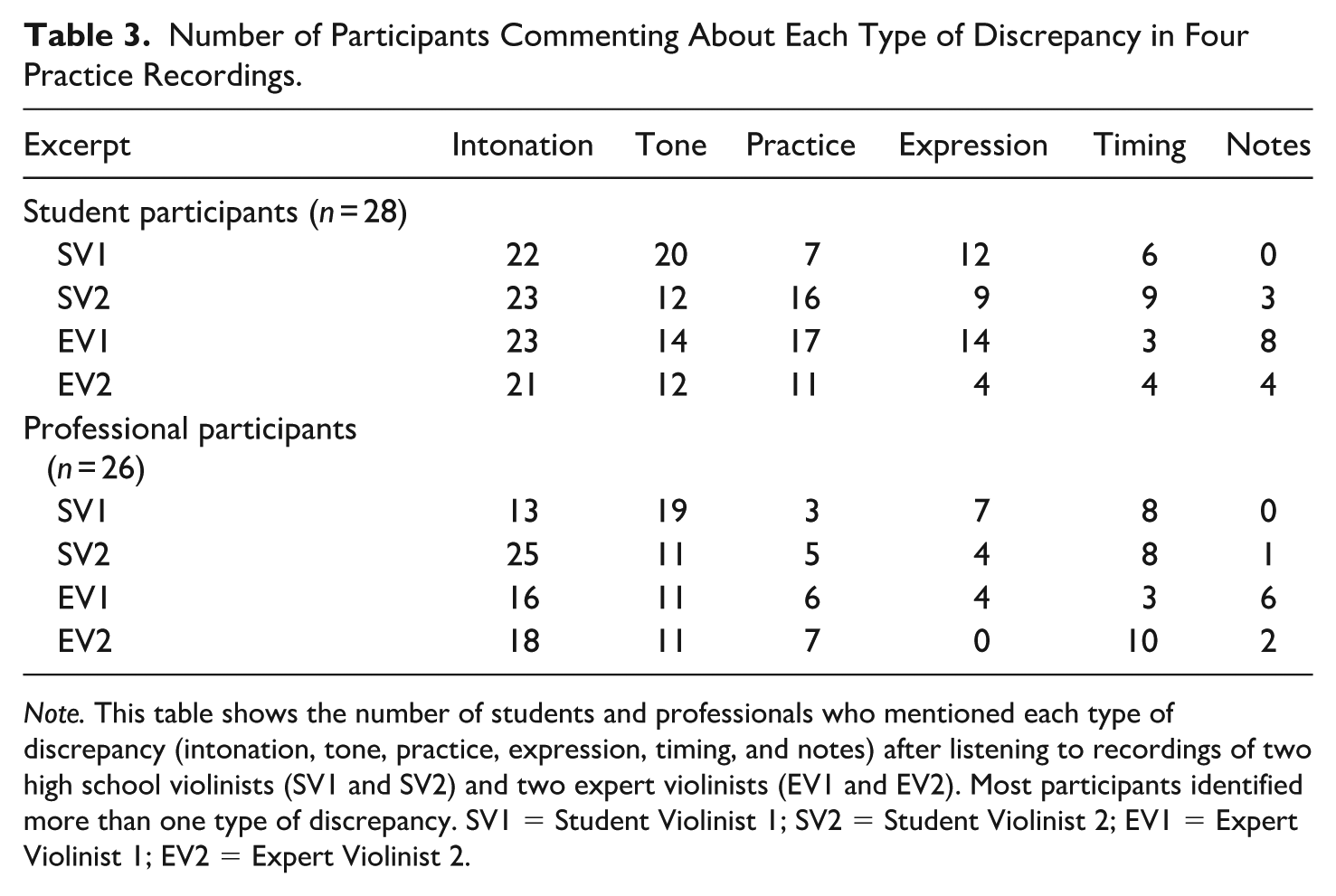
Note. This table shows the number of students and professionals who mentioned each type of discrepancy (intonation, tone, practice, expression, timing, and notes) after listening to recordings of two high school violinists (SV1 and SV2) and two expert violinists (EV1 and EV2). Most participants identified more than one type of discrepancy. SV1 = Student Violinist 1; SV2 = Student Violinist 2; EV1 = Expert Violinist 1; EV2 = Expert Violinist 2.
A trained reliability observer read verbatim transcripts of 20% of the interviews (n = 44) and coded participants’ responses using the same category system. Reliability between the primary author’s codes and the observer’s codes of the verbatim transcripts was 89% for intonation, 93% for tone, 95% for expression, 89% for notes, 95% for timing, and 91% for practice. The same reliability observer again coded participants’ comments, this time from the primary author’s written notes for all (N = 216) of the participants’ statements. Reliability between the primary author’s codes and the observer’s codes was 94% for intonation, 91% for tone, 92% for expression, 91% for notes, 92% for timing, and 91% for practice. Overall reliability between the primary author’s codes and the observer’s codes of the author’s written notes was 92%. Overall reliability between the primary author’s codes and the observer’s codes of the verbatim transcripts was 92%.
Discussion
We invited professional and high school string musicians to listen to brief practice recordings made by four violinists, two students and two experts, and to identify discrepancies between what they heard on the recordings and what they would have intended if they had been the musician who was practicing. The professional participants identified significantly more discrepancies than did the student participants, and this was true in all four practice recordings (two of student violinists and two of expert violinists). Students’ familiarity with the repertoire was weakly positively correlated with their key-press rates, perhaps a result of students having clearer performance goals regarding repertoire that they had heard or played in the past. Among professional participants, nearly all of whom indicated that they were familiar with the repertoire in all four recordings, the mean numbers of discrepancies marked in the four recordings were similar regardless of whether they were listening to an expert practice or a student practice.
Across the four recordings, the student participants’ mean key-press rates ranged from 3.33 to 4.43 key presses per minute, whereas professional participants’ mean key-press rates ranged from 14.02 to 16.97 key presses per minute, an important and statistically significant difference. This contrast highlights how the development of expertise involves increasing levels of perceptual sensitivity. As suggested in feedback-based models of motor learning (Adams, 1971; Palmer & Drake, 1997; Schmidt, 1975, 2003; Wolpert et al., 2011; Wolpert & Ghahramani, 2000), experienced performers develop detailed internal models that guide their moment-to-moment assessments of accuracy and expression. In fact, highly skilled expert musicians also make anticipatory adjustments to avoid errors during performance, reflecting the dynamic interplay between feedforward and feedback control (Ericsson et al., 1993; Maidhof et al., 2013; Wolpert et al., 2011). In contrast, the thinking of student participants, who are still in the early stages of developing these predictive frameworks, may lack the vividness and precision with which one can anticipate and internally represent desired outcomes.
Perhaps the progression from novice to expert is not best characterized as a reduction in error making but rather as an increase in the elaboration and precision of tangible goals and perceptual discrimination. This notion is consistent with our current understanding of motor skill learning; effective learners focus on the goals and outcomes of complex movement sequences and refine outcomes through a motor-sensory feedback loop (Duke et al., 2009; Wolpert & Ghahramani, 2000; Wulf et al., 2001). Novice learners, for example, might be satisfied with notes that initially land out of tune if they are quickly adjusted before moving to the next note, whereas more experienced players come to expect every note to begin and end precisely in tune (Hamilton & Duke, 2020) and expect their fingers to follow such a precise trajectory that even small discrepancies in a finger’s path, corrected en route to produce an accurate note, are still perceived as errors (Chen et al., 2006, 2008; Maidhof et al., 2013).
This progression of thinking is evident in participants’ remarks during postlistening interviews. For example, when speaking about a violinist’s intonation, one student participant commented, “There were out of tune notes which they fixed quickly, so I couldn’t count most of those.” Another student stated, “[There was] a lot of really minor intonation stuff, so I really didn’t press the key for it. You just expect that to happen sometimes.” This is in contrast to a professional participant who also commented about the same violinists’ intonation, saying, “They’d get it right by sliding up to the pitch, of course, but then they moved on rather than really finalizing it so [their finger] would land in tune.” Because the professional had a higher expectation regarding what is “in tune,” they marked a discrepancy between their intentions and the recording. The professional noted that the violinist was engaged in practice for adjusting their fingers when they landed in the wrong place rather than practice for dropping their fingers in the correct place to get the beginning of the note in tune. These different interpretations would shape practice behaviors differently, and they demonstrate a difference in the thinking of student and professional participants.
Many developing musicians may find it somewhat surprising that expert participants indicated discrepancies between their own intentions and the practice of other experts given what seems to be a perception among many aspiring musicians that as skill increases, the rates of errors decrease even during practice. Indeed, there was no significant relationship between either the students’ or professional participants’ key-press rates and their ranking of the performer in the recordings. The key-press rates were indicative of differences between the participants’ own intentions and what they heard on the recording, and student participants were especially inaccurate at estimating the experience level of the expert violinists.
When one high school student was asked about the level of one of the experts, he laughed saying, “There’s no way that’s a professional! They were trying to figure out the best fingerings and there were even a few intonation errors.” This reveals a fundamental misconception among students about the nature of expert practice. Our study offers empirical evidence to refute such misconceptions, supporting the idea that experts continue to explore, refine, and resolve discrepancies throughout the learning process—often in more detailed and sophisticated ways than novices do. Although there are anecdotal reports that student musicians incorrectly assume that highly skilled musicians execute near-flawless practice, our research clearly demonstrates that error making, when defined as discrepancies between intentions and outcomes, is an essential feature of skill development in every domain of human experience (Maidhof, 2013; Shadmehr et al., 2010).
In contrast to the students, professional participants were more likely to rank the expert violinists as experts despite perceiving discrepancies between what they would have intended and what the performers were doing. One highly skilled professional participant perceived frequent discrepancies in “tone production, character, intonation, coordination of left and right hand, shifting sounds, finger placement, and a portato [pulsating] sound.” However, they also estimated the expert they were listening to was highly skilled with a “very mature sound.” This participant noted frequent discrepancies between their own intentions and the practice they heard on the recording, but this was not viewed as indicative, to them, of an inexperienced musician’s practice.
Another professional participant compared expert violinists and student violinists, saying they were both working on “all the same stuff.” The participant remarked that they could distinguish between the playing of the high school student and expert due to the magnitude of errors, saying,
This player had less physical control from finger to finger in their left hand and also how they moved from string to string with their bow. All the same issues exist as the previous excerpt, but . . . the intonation errors were bigger, there was more margin of error. The bow changes were sloppier. While there were bow speed issues in the first clip, they were exaggerated in this one.
Additional evidence of the contrast between the thinking of students and professionals comes from participants’ remarks about the suitability of the repertoire. After listening to experts practice, three high school participants remarked that the violinists were working on repertoire that was too easy for them and that their teacher should assign more difficult repertoire. In another poignant example, a student participant, listening to an expert practice, remarked “They were going back over things over and over again when the player doesn’t really need to.” Such comments underscore a limited understanding among developing musicians of how experts structure practice to notice and resolve discrepancies, even in technically “easy” material—a process central to the refinement of musical skill.
Our study of classical musicians opens avenues for future research that explores how these perceptual processes unfold in other musical traditions. For example, in improvisational practices, where adaptability and flexibility are paramount, musicians may develop distinct strategies for error detection and correction. Investigating such differences could provide deeper insight into the broader spectrum of expertise across diverse musical domains.
Results from the current study bolster the notion that musical expertise includes acute perceptual abilities and the ability to formulate precise, tangible performance goals. As musicians become more skilled, their goals become more vivid, and their perceptions of discrepancies between their intentions and outcomes inform their decisions regarding music practice. Taken together, these results challenge the simplistic notion that expert practice is characterized by the absence of error. Instead, our findings support a reconceptualization of expertise as the ability to identify and act on increasingly subtle discrepancies between intention and execution. This view aligns with motor learning research suggesting that skill acquisition is driven not by error elimination but by enhanced error detection and correction processes (Shadmehr et al., 2010; Wolpert & Ghahramani, 2000). It may be that these aspects of goal setting and perception are underemphasized in novices’ lessons, in which goals are often defined by the teacher and there are few opportunities for learners to formulate realistic proximal goals moment to moment and assess the extent to which those goals are accomplished.
Footnotes
Authors’ Note
The work presented in this article was conducted while affiliated with the University of Missouri–Kansas City.
Declaration of Conflicting Interests
The authors declared no potential conflicts of interest with respect to the research, authorship, and/or publication of this article.
Funding
The authors received no financial support for the research, authorship, and/or publication of this article.
