




Abstract
This study explored how professional conductors understand the role of individual (purposeful) practice and how they describe the contents of such practice. Twelve professional conductors were interviewed and content analysis was used to analyze the data. The results show that the participants understood conducting as a lifelong learning process. Through intensive individual practice, they had built up a significant repertoire of musical works. Being well prepared allowed them to impart knowledge, which helped them to achieve an authoritative and communicative relationship with musicians. While technical aspects such as baton technique had been important during early career stages, these were mostly no longer practiced. Studying the score was perceived as the most central practice activity aiming at performance improvement. It required disciplined, persistent, and goal-oriented learning, and thus carried the marks of purposeful practice. Individual activities during score study were mainly carried out mentally and in particular situations supported with external tools (e.g., piano, audio recordings). The findings shed light on differences in opinion and implicit tensions, especially regarding memorization and the use of tools.
Professional conductors are a source of fascination and how they become experts is an intriguing question in the domain of music (Palmer et al., 2020; Schmidt et al., 2021). An expert is defined as a person who performs to an outstandingly high level and can deliver superior performance over a long period of time (Ericsson et al., 2007). Over the last quarter of a century, much evidence has been gathered to highlight the importance of practice—especially deliberate practice—for the acquisition of expertise in music (see Platz et al., 2014). Whether and how professional conductors engage in systematic practice was the basic question motivating the present study. Through expert interviews, we wanted to explore conductors’ views and preferences regarding their individual practice to gain insights into the working methods of an elite group of performers.
The role of purposeful practice in the domain of music
As a theoretical starting point, we chose the expert-performance approach, which stresses the role of practice in particular (Ericsson, 2018; Ericsson et al., 1993). Accordingly, serious commitment and extended engagement in domain-relevant activities are necessary to attain expert performance. Gradual and steady progress can be achieved with deliberate practice, which is described as a focused effort on performance improvement through a defined set of structured activities that can be time-intensive and are not required to be inherently enjoyable (Ericsson, 2021). Deliberate practice, in contrast to work or play, requires the formation of specific goals for improvement and the monitoring of various aspects of performance (Lehmann, 1997). For instance, Ginsborg and Chaffin (2011) revealed that musicians who had established explicit goals were more efficient in their practice. Moreover, it has been found that accumulated deliberate practice predicts the development of expertise in classical music to a considerable degree (Hyllegard & Bories, 2009; Lehmann & Jørgensen, 2012; Platz et al., 2014).
More recently, Ericsson and Harwell (2019) report that the concept of deliberate practice has received a lot of attention, but the operationalization of specific practice activities varies quite tremendously among studies. The authors observe a deviation from the original definition that was described in 1993 by Ericsson and colleagues as individualized solitary practice in classical music directed by a qualified teacher. In this definition, the teacher plays an important role in designing goal-directed practice activities to eliminate weaknesses in performance. Thus, it is not mere practice that matters, but that specific conditions need to be met. Over time, studies differed in whether deliberate practice was designed by a teacher and/or by the performer, causing some confusion. To differentiate more clearly between different kinds of practice activities, Ericsson and Harwell (2019) distinguish deliberate practice from structured practice, naïve practice, and purposeful practice. While structured practice is less individualized and refers to group activities guided by a teacher, naïve practice is not motivated by the explicit goal of improving performance. Purposeful practice, however, is closely related to deliberate practice as it is solitary practice with a focus on performance improvement. Yet, in contrast to deliberate practice, purposeful practice is not guided by a coach or teacher and therefore this concept seems more appropriate for the context of professional conducting as investigated in the present study. Understanding the underlying mechanisms of purposeful and deliberate practice is still on the research agenda (Ericsson, 2018; Regier et al., 2022; Schmidt et al., 2021).
As professional conductors are highly experienced musicians, it is worthwhile to look into studies on musical expertise that have addressed various instrumentalists to shed light on professional practice methods. Sloboda et al. (1996) found that formal effortful practice (task-oriented practice and practice on the main instrument) was a strong predictor for musical achievement within the classical instrumental performance domain. Differences in practicing habits were apparent at a young age. Young musicians who were classified as high achievers tended to concentrate on practice in the morning and they indicated more day-to-day stability in practicing habits compared with low achievers (Sloboda et al., 1996). In an interview study, Hallam (1995) investigated differences in the practicing activities of freelance professional musicians and revealed that their approaches to practice were very diverse regarding regularity, extent and perceived need for practice, its content, motivation, and emphasis on technique and musicianship. Research has also explored changes that occur in the practice activities of young musicians as expertise develops. A survey study showed that learners at higher levels of expertise reported increased amounts of practice, more effective practicing strategies and fewer ineffective ones, as well as a better awareness of errors. In addition, practice activities become more specific (such as the use of a metronome or recordings) (Hallam et al., 2012). In a recent study, Hallam et al. (2020) found that the amount of practice increased as learners developed more expertise. However, they also revealed wide individual differences showing that persons playing keyboard instruments practiced more than string, brass, and woodwind players.
Notably, a musician’s practice activities may also include methods that are relatively independent of the physical instrument, such as marking their score as an aide-mémoire for later practice sessions or concerts (Chaffin & Imreh, 2001; Ginsborg & Chaffin, 2011). To improve performance, musicians may also apply mental practice activities in which they engage with musical scores without physically playing an instrument (Bernardi et al., 2009). However, musicians may differ widely in their approaches to mental practice (Loimusalo et al., 2019), and young musicians especially might not always know how to implement mental practice (Davidson-Kelly et al., 2012). It seems reasonable to assume that similar score-centered and mental orientations toward practice would be even more central in the individual practice of professional conductors. For instance, Schmidt et al. (2021) found in their sample of conducting students that studying the score was the only practice activity that increased over time. Interpreting an orchestral score is a complex task. It involves the control of a large number of instrumental voices and the simultaneous grasp of complex details. Large holistic processes take place within various musical parameters, including harmony, melody, rhythm, phrasing, dynamics, tempo, and timbre (Farberman, 2003; Jansson et al., 2019). Before presenting our empirical study, we provide a window into the roles assumed by professional conductors and the previous empirical research on practice-relevant aspects of conducting.
The multifaceted task of conducting
According to Jansson et al. (2019), conductors assume several roles, including manager, mentor, artist, and craftsperson, each of these roles representing an array of skills, behaviors, and responsibilities. In the role of manager, for instance, tasks include the structured preparation of the concert program, rehearsals with the orchestra, choosing adequate repertoire, estimating necessary time, and defining the instrumental resources for each rehearsal and concert (Barber, 2003; Biasutti, 2013; Jansson et al., 2019). It seems that conductors’ strategies for rehearsing with an orchestra vary widely (Barber, 2003). In a qualitative study of rehearsal strategies (Biasutti, 2013), conductors mentioned strategies such as gaining an overview, analyzing technical aspects, successive refinement, and rehearsal planning. In the role of mentor, the conductor guides and supports the orchestra or singers to develop them further (Jansson et al., 2019). Even more centrally, the conductor carries the main responsibility for the musical interpretation in the role of artist (e.g., establishing an idea of the sound in music) and craftsperson (e.g., correcting errors) (Jansson et al., 2019). In Biasutti’s (2013) study, the participating conductors emphasized the importance of listening abilities to detect performance mistakes, knowledge of harmony and counterpoint, the ability to provide feedback, and a good memory as particularly relevant for their rehearsal practice. In addition, conductors should provide a coherent rehearsal schedule, collective learning opportunities, good non-verbal communication, short- and long-term planning, and consider individual aims to ensure a high-quality performance (Biasutti, 2013). Taken together, the work of conductors is multifaceted and various practice activities may lead to professional performance in conducting. Yet, there is still a lack of systematic research about how conductors practice individually.
Much of the prior empirical research in the domain of conducting has been focused on the expressivity of the conductor, conducting gestures, and baton technique, as well as leadership and authority. Here are just a few examples in brief. Wöllner (2008) studied which parts of a conductor’s body convey the most expressive information. Luck et al. (2010) examined the relationship between the kinematics of conducting gestures and the expressiveness perceived by the audience. Nápoles and Silvey (2017) investigated the effects of baton use on band and choral musicians’ perceptions of a conductor’s expressivity and clarity. De Reizabala and Benito (2018) examined gestural learning in orchestral conducting. A study by Bergee (2005) revealed differences between levels of expertise and the internalization of baton techniques showing that professional conductors were able to verbalize fluently while conducting, whereas novices and semi-experts had to pay more attention to their movements. Bodnar (2017) investigated the effect of intentional, pre-planned movements on novice conductors’ gestures and found no significant differences between participants who had received guided score study with planning and practicing of gestures, compared with those who had received guided score study only. Boerner et al. (2004) revealed that directive-charismatic leadership in the orchestra affected the quality of ensemble playing positively. Developing effective leadership skills is also seen as relevant for conducting pedagogy (Lanaro et al., 2023).
Although the above-mentioned studies have revealed valuable aspects about conducting, their focus mainly lies in the conducting activity itself as well as in rehearsing with an orchestra, without taking the fundamental individual practice activities ahead of performance into account. Evidence on how conductors achieve high levels of performance through practice seems mostly anecdotal or based on individual experts’ views. For instance, in his extensive account of the conductor’s art, Schuller (1997) identifies a wide variety of skills—including psychological and philosophical ones—that are relevant for a conductor but then goes on to postulate score analysis as the main obligation to ensure good conducting. Yet even score analysis might involve a variety of approaches. In a recent interview and eye-tracking study with four choral conductors, Timoshenko-Nilsson et al. (2024) found that despite some common strategies, the conductors’ ways of silently approaching scores were also influenced by their individual cognitive interests that varied from practical aspects of conducting through analysis of harmony or compositional structure to musical aesthetics. The concert audience’s perspective as observers does little to reveal how conductors think and what they actually do “behind the scenes” to prepare themselves for their work in front of the orchestra.
To our knowledge, no empirical study has yet thoroughly investigated how professional conductors individually prepare themselves offstage. Hence, in the present study, we addressed the following two research questions:
How do professional conductors understand the role of individual (purposeful) practice in their work?
How do they describe the contents of such practice?
Method
Participants
Twelve professional male conductors aged between 29 and 86 years (M = 51.75 years; SD = 16.30 years) agreed to participate. All participants had an academic degree in the domain of music and were the main conductor of an orchestra. Their reported average conducting experience was 27.42 years (SD = 18.05 years), with a minimum of 6 years and a maximum of 65 years (see Table 1). Conducting is a very international field. The conductors participating in this study represented five different nationalities (Chile, Germany, Japan, the United Kingdom, the United States). At the time of the interview, they had all been working in Germany for several years. The conductors will be referred to using the abbreviations C1–C12.
Overview of Some Practice Activities in Relation to Reported Years of Experience.
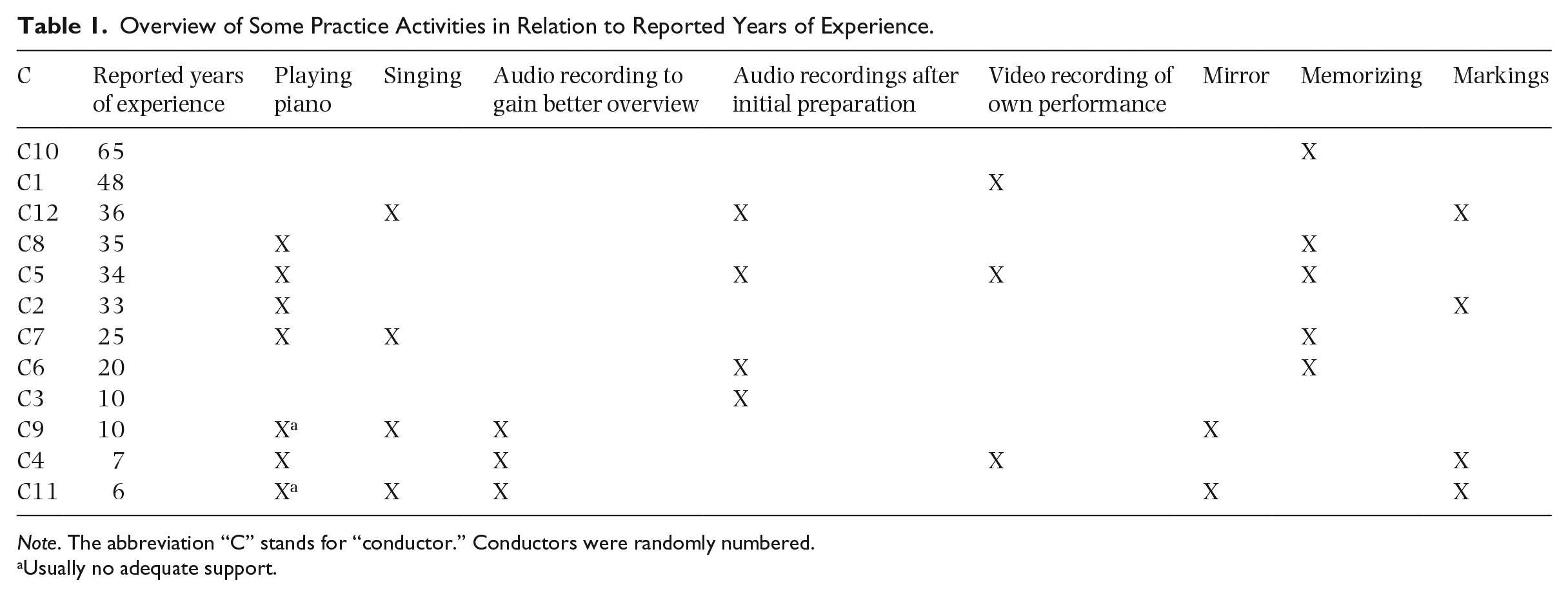
Note. The abbreviation “C” stands for “conductor.” Conductors were randomly numbered.
Usually no adequate support.
Procedure
Professional conductors working with orchestras in large cities in Germany were contacted by email or telephone, or approached directly to set up face-to-face interview appointments. The aim of conducting expert interviews was to focus on the conductors’ subjective perspectives and their experiential knowledge (see Bogner et al., 2014). The first part of the interview focused on the professionals’ work and their practice activities, including their approaches to working with scores and new pieces of music. The second part of the interview was designed to gain background information on the professional development of the participants.
At the beginning of each interview, the participant was guaranteed anonymity and was encouraged to give candid answers, which would be used for research purposes only. Each conductor gave his written consent to participate in the study and the APA Ethical Principles of Psychologists and Code of Conduct were followed. The interviews were conducted in German by the third author of this study and were digitally recorded. The durations ranged from 39 to 137 min (M = 70.74 min; SD = 26.50 min).
Analysis
The 12 interviews were transcribed verbatim. Content analysis was used as the basic procedural method of systematic textual understanding and interpretation (Mayring, 2014). The transcribed interviews were read and reread to ensure complete familiarization. Under the guidance of the research questions, the core contents of each interview transcript were extracted by focusing on conductors’ understanding of practice (e.g., goals, development) and their reported practice activities. Together with the first author of this study, two research assistants iteratively created a coding scheme with smaller analytical categories (e.g., lifelong learning, building up a repertoire of important musical works, gaining context knowledge, aural imagery, use of external tools). Individual and collaborative coding were alternated so that agreement between the coders was reached for the whole data set. A tally sheet was used to note down how often and by how many conductors particular categories were mentioned. Table 1 presents a part of the sheet for a more fine-grained overview of some of the categorized practice activities.
Finally, the first two authors created four themes by bringing together the previously identified categories: (1) The role of purposeful practice in conductors’ work, (2) Studying musical scores, (3) External tools in purposeful practice, and (4) The role of memorization. The first theme relates to the first research question regarding conductors’ understanding of practice, while themes 2–4 provide an account of the main aspects reported about purposeful practice activities. In the following, the results are presented according to these four themes.
Results
The role of purposeful practice in conductors’ work
All conductors perceived musical expertise as a prerequisite for professional conducting and emphasized that hours of intensive training formed the basis of their proficiency. Four conductors explicitly stressed that professional conducting is a lifelong learning process, as illustrated by conductor C6: “You have to keep on studying until you die. That’s clear!” Instead of talking about “practicing,” the majority of the conductors used terms like “learning,” “studying,” or “reading”—expressions which were mostly related to working on a (new) score. What becomes clear, in any case, is the conductors’ high level of commitment to practice: “Practice is of course the be-all and end-all if you want to do it professionally” (C1).
All but one of the interviewees mentioned that they had become more efficient with increasing experience, meaning that they achieved more in less time by being more goal-directed. Their experience ensured a better understanding of what might be difficult or what might be important to practice to be well prepared. For instance, conductor C5 noted that his way of working had become “much more reasonable than before. So before I used more time, wasted it, so to speak. And now, I think I work much more purposefully, precisely.” Similarly, conductor C2 mentioned to “leave out everything unnecessary. The whole endeavour is to recognize what is necessary, and where is the core of the matter.”
While discussing the process of preparing for the task of conducting, all conductors distinguished between individual preparation and rehearsing with the orchestra. Intense individual practice aiming at performance improvement was regarded as a prerequisite for leading orchestral rehearsals. Thus, individual practice and rehearsing with the orchestra were described as intertwined. Ten conductors understood their goal as achieving an authoritative and communicative relationship with musicians. Conductor C1, for example, described the role of a conductor as “primus inter pares” and stressed that “the orchestra needs to accept you and your interpretation of the musical work.” Knowing what is possible, convincing the orchestra, and determining the direction were viewed as critical. Being well prepared makes it possible to impart knowledge (as mentioned by 11 conductors) and to identify constraints and mistakes (as mentioned by seven), which were said to be activities that radiate power and authority (mentioned by six). According to the least experienced conductor (C11), the more advanced an orchestra, the more time a conductor needs to spend in individual preparation. Others similarly emphasized that the work for leading experienced musicians required an authoritative position, illustrated by the following quotation:
You have musicians who have already done Sacre du Printemps ten times, so you need to be prepared in order to give a reasonable response to each question. And you have to say: “I want it that way because . . .” And you have to be convincing. You can only transmit what is inside you. You cannot make a big fuss if you lack knowledge yourself. (C2)
It is important to note that some of the conductors’ purposeful practice activities might also have social aspects. Seven conductors (C1, C4, C7, C8, C9, C10, C11) emphasized that attending different musical performances (“I saw all musical works in Bayreuth by various conductors,” C10) and observing provided useful approaches to skill development (“I learned a lot from him just by attending his rehearsals,” C9). “[Copying] someone by watching” (C11) was regarded as a great learning opportunity for young as well as experienced conductors. In addition, “by being part of the orchestra and by watching rehearsals of experienced conductors live or on television” (C7). Two conductors (C3 and C7) also found discussions with a peer group valuable to reflect on one’s own performance during career development.
Two of the interviewees (C1 and C2) stressed that learning from errors and feedback was crucial for understanding one’s own weaknesses and for further developing one’s skills. More often than mentioning their teachers’ feedback, however, conductors emphasized the importance of learning by doing and adopting individual responsibility for orchestra leadership. For instance, the most experienced conductor (C10) discussed being “in front of the orchestra: that is where you learned conducting,” and six other interviewees expressed similar views (C3, C4, C6, C8, C10, C11).
In the following three sections, we will nevertheless focus on the individual forms of purposeful practice. We will look more closely into three aspects of such practice emerging in our analysis: studying musical scores, external tools in purposeful practice, and the role of memorization.
Studying musical scores
For all participants, working on a score was at the core of their individual practice activities. The estimated daily duration spent on score study was reported to range from 1 to 12 hr, depending on the conductor’s schedule. However, various preparatory activities may also overlap, making it hard to assess the exact amount of time invested in particular activities. For instance, C3 reported investing “10, 11 hours a day just studying.”
Indeed, all conductors emphasized understanding a musical work by analyzing the score. Here, various aspects were mentioned such as harmony (e.g., C11: “I analyze chords from bottom to top, which notes together make what”), rhythm, melody, and phrasing. Studying a score was described as a silent mental activity by all 12 conductors (e.g., C3: “99% of the work of studying a score is carried out mentally, only in your mind”). While the conductors agreed on the importance of being able to “hear” the music directly by working with the score, the approaches to this work varied. C8 described the internalization of the basic metrical feel of the piece, coupling this with more analytical observations:
In analyzing a score, you go as far as you can with your brain. You count the bars, you count how often a G# occurs. [. . .] What about modulation? When is it? What is it like? (C8)
Instead of focusing on larger pitch structures, another conductor suggested that score study centrally involves imagining the specific timbral aspects related to instrumentation and instrumental technique:
A prerequisite is that the conductor can hear what he sees. [. . .] When it [i.e. the interval] is a fourth, he can also hear a fourth, and if the clarinet sounds a fourth with the French horn, he can imagine the corresponding sound. Therefore, he must know in which registral range the instrument plays. Is it a low or an extremely high register? How is the balance between the two instruments? What is forte like on a French horn? What is forte like on the clarinet? I need to study that bar by bar. For a normal movement of a normal symphony, which I study for the first time, which takes about 12 minutes, I definitely need 12 hours. [. . .] Moreover, if the violinists have five notes in one down bow, it will be rather quiet. If it were one note per bow, it would be surely louder and therefore change the sound. I will create an image of how I want it to be. (C11)
This last remark highlights the element of artistic interpretation involved in a conductor’s silent score reading: conductors not only aspire to imagine the musical details “as they are” in some objective sense, but rather also make decisions about how they want them to sound. Indeed, such freedom of choice might be encouraged by the very act of imagining the music without auditory support: “When you imagine it, you have much more freedom in timbre and dynamics and fusions and all these things that make music interesting” (C4). However, as conductor C1 explained, obtaining a true understanding of a score is a “long-term endeavor” which involves learning both analytical and synthetic aspects: “You have so many different voices, which you must combine with your inner ear to an overall sound. First, you must dissect the overall sound to find out what the details are and how these connect” (C1).
Analyzing the score may also involve seeing the musical work as the intentional, personal expression of the composer, as illustrated by the following quotation:
First comes AB and then ABC has to come, but then suddenly he [Beethoven] does ACB, and you say: “Why did he do that?” Then you understand that he must be emphasizing a certain idea. [. . .] So it’s very important to get inside and understand the whole composition, not just how it sounds. (C3)
In addition to gaining an understanding and an overview of the structure of a particular musical work, five conductors (C1, C5, C6, C7, C11) indicated that they find it important to gather background knowledge about the composer, the epoch, the history, or the musical style in question. A central reason for this seemed to be the desire to understand what the composer had tried to express with the work:
Of course, it is important to know something about the composer. Knowing in which phase of life he has written it, what kept him busy during that time, and what his concerns were. Music as such does not make precise statements. It appears far more precise if it is combined with text. That is for sure. Therefore, I must try to understand what kind of attitude towards life he wanted to express with the musical work. (C1)
External tools in purposeful practice
The silent learning of the score is later enhanced by auditory feedback in orchestral rehearsals. According to C12, when he is “standing in front of the orchestra, receiving direct feedback from notes” played by the orchestra, learning proceeds “5 to 10 times quicker than when I am sitting at my desk trying to imagine it.” For similar reasons, C9 needs to complement his silent reading of the score with support from the piano:
I am an auditory type. Thus, I can very quickly develop an idea of sound. For instance, if you sing a melody right now, I will have immediately stored it and can re-enact and harmonize it at the piano. However, working on a score is very difficult for me, because I need to try to make the notes audible. [. . .] I sit down with my score and try to imagine, inside my head, how the voices sound. To imagine the flute part, to imagine single voices. [. . .] I need the piano when I, for instance, come to a point with somehow complicated chords. That is very difficult to imagine. However, melodic parts, or the like, where something is moving—these are aspects that happen mostly silently in my head. (C9)
In addition to the mental activity of creating an aural image of the score, external tools for individual practice were frequently mentioned. Eight conductors indicated that they play the piano (C2, C4, C5, C7, C8, C9, C11) or sing (C7, C9, C11, C12) to become acquainted with the musical work (e.g., C7: “If I do not know the musical work, the preparation with the piano is important for me. Then I sit down and play”). Five participants confirmed only reverting to the piano either for difficult passages of the musical work (e.g., C5: “In the past, I often used to play the piano, nowadays only sometimes for difficult parts”) or in cases of the musical work being “completely unknown” (C7). Two conductors (C9 and C11) thought playing the piano hardly provided adequate support: “In studying the score, I rather tend to leave out the piano, because it is a totally different instrument. Thus, I cannot imitate the phrasing of a violin, or the articulation. Then I would rather sing it” (C11).
According to some conductors, listening to audio recordings produces unwanted distractions during the preparation process (C2, C7, C8). For instance, conductor C7 said that for “fear of being influenced by a particular interpretation,” he never listens to CDs of the works he is currently working on. However, other conductors found pre-existing audio recordings helpful. Three of the least experienced ones (C4, C9, and C11; see Table 1) mentioned that they use pre-existing recordings to gain a better overview of the musical work:
I am someone who buys and listens to many recordings. I have 10 rather different recordings of a Schumann symphony. If I have little knowledge about a composer and I am performing him for the very first time, I adopt many things that I like in recordings. (C11)
Four conductors (C3, C5, C6, C12) indicated that they find audio recordings helpful for preparation as soon as they have studied the score themselves. However, as C5 suggested, beginning the process by listening to other conductors’ interpretations could compromise one’s critical attitude:
I would rather do that afterwards [i.e., listen to a recording]. As soon as I have analyzed the musical work and developed a certain feeling for it, then I say: “Okay, let’s see how others did it.” [. . .] [By contrast,] when I do not know the musical work and do not plan to study it, then I might [listen to the recording and] say: “Great, he has done that nicely.” Thus, I am far less critical than had I studied it myself. (C5)
Recordings were also used as a means of monitoring one’s performance. Three conductors (C1, C4, C5) explicitly mentioned that they record their own performances on video to reflect and to learn from errors. This could even involve the physical movements and appearance of the conductor:
You have to see what kind of awkward facial expressions you make. You must see that yourself. [. . .] Reflecting is most important. That is the reason why we [i.e. conductors] use relatively plenty of time [to reflect upon our work] after each rehearsal. (C1)
At the beginning of their conducting careers, there had often been a greater focus on technical aspects, with seven participants referring to baton technique in this context. As aspiring conductors, the participants had spent more time practicing movements (e.g., C3: “learning to separate the three points, elbow, shoulders and wrist”) or exploring the relationships of physical gesture to musical dynamics (C7: “how does it look when the beat is softer and when it is hit harder”). The interviewees stated that these types of practice activities were no longer necessary. Only one of the conductors indicated that he also practices his baton technique daily (C2: “It’s like in any sport, you have to stay in training”), but some of them commented on the use of the mirror as a tool for practicing one’s movements. While some conductors might find practicing in front of the mirror “nonsensical” (C7), two of our least experienced interviewees (C9 and C11; see Table 1) explicitly mentioned that they practice in front of a mirror to fine-tune their performance. One of them reported positioning himself in front of the mirror, thinking about “which movements do the musicians need, and which ones do I have to give them so that they understand the music the way it should sound” (C11). Another conductor implied that some of the colleagues might not want to admit that they use the mirror in this way:
Maybe it sounds a bit ridiculous, but I use a mirror. When practicing, I try to work on a score, to imagine how it would feel to be a string player or a wind player or whatever. [. . .] My god! You stand there and you simply try out different movements and you think about it. [. . .] I think that most conductors do that whether they admit it or not. It belongs to the job that you work on your movements. Some even have special movement training. For instance, I know conductors, who practice Qigong so that they smooth out their motion sequence. (C9)
The role of memorization
Learning the score also involves “really trying to learn it; memorizing it” (C7) in a stepwise manner—“piece by piece” (C5) or “bit by bit” (C6). Interestingly, none of the four conductors in our study with less than 20 years of experience reported memorizing whole scores, whereas five of the more exprerienced informants asserted that they had learned scores by heart (C5, C6, C7, C8, and C10; see Table 1). For the most experienced conductor (C10; see Table 1), for instance, the criterion for appropriate learning seemed to be that one can play the score by heart on the piano. These conductors saw the advantage of memorizing in being able to better capture the complexity of a musical work, and in being recognized as well prepared during rehearsals. Other conductors were more reserved toward learning by heart, though. For instance, C12 alluded to the argument that conducting from memory might restrict one’s cognitive resources, thus limiting freedom: “It is not tremendously important that conductors conduct by heart. However, it is important that you are free.” Another argument presented against the difficult task of memorizing the entire score was the inevitable oversight of the finer details:
What does memorizing mean? I have never learned an entire piece of music by heart in a way that I could write down each note. And regarding people who conduct by heart, I would really like to see whether they could exactly write down what the orchestra needs. Because I think, it is very, very risky and very arrogant to conduct by heart if you cannot write down each note, and if you do not know precisely what the composer has written down. Learning it by heart is useless from my perspective. (C4)
Instead of learning by heart, some of the conductors would also externalize some of their memory processes by marking their scores in various ways. Six of the conductors reported preparing the score for rehearsal with their markings (C2, C4, C5, C7, C11, C12), while only the most experienced conductor (C10) explicitly claimed not to make any markings in the score. Such markings might serve either as memory cues for “important accentuations” (C7) or other chosen interpretative points of focus, or they might simply help commit the musical structure to memory:
I have my color system. Well, of course, the score has to remain as clear as possible. When I organize it, it becomes readable to me. I highlight particular aspects and in that way, it stays better in my brain. Everything I have marked is anchored better [in my memory]. (C11)
Score markings can also be made in later individual practice sessions in response to orchestral rehearsals to reflect on the performance. C3 reported enhancing his memory by using “little stickers” to mark “what did not go well during the rehearsal,” and C5 had a similar strategy: “I have these slips of paper, which I stick in my score as soon as I know how it went. Then I know which points I definitely have to pay special attention to.”
Discussion
This interview study aimed to discover how professional conductors understand the role of individual (purposeful) practice and how they describe the contents of such practice. Our findings add to prior research that has focused on rehearsal practices and strategies in the domain of conducting (e.g., Biasutti, 2013). The qualitative approach allowed for a detailed description of conductors’ perspectives and gave an understanding of how they prepare themselves to step in front of an orchestra. Although the focus of our study was on the individual practice and preparation of conductors, it is necessary to acknowledge that most of that individual work is undertaken with the group of musicians to be conducted in mind. Conductors’ individual practice precedes rehearsals with an orchestra, but may also take place after rehearsals to further enhance public performances.
The findings relating to our first research question, “How do professional conductors understand the role of individual (purposeful) practice in their work?” show that the interviewees understood conducting as a lifelong learning process, requiring continuous engagement with music, predominantly through intensive individual practice. It was difficult for the participating conductors to estimate their time spent on different practice activities. A diary study or shadowing conductors, if they allow it, might be a more suitable approach to gain such data. According to our participants, the better prepared and the more knowledgeable conductors are, the more convincing their radiation of power and authority as leaders (cf. Boerner et al., 2004). Building a repertoire of significant musical works, learning by observing, doing, and modeling, as well as by carrying true responsibility for an orchestra, were perceived crucial for learning and were therefore recommended for professional development.
The second research question addressed how professional conductors describe the contents of their individual (purposeful) practice. In general, individual practice mainly centered on studying specific scores rather than on more general types of exercises or activities. As described by the conductors, score study carried the marks of purposeful practice with its focus on performance improvement, requiring disciplined, persistent, and goal-oriented study (see Ericsson et al., 2007). Score study was seen as a systematic process of individual preparation with the overarching purpose of internalizing the musical work and understanding its details. Unlike instrumentalists (e.g., Davidson-Kelly et al., 2012), much of the conductors’ individual practice had the character of mental practice. Structural and interpretive analyses were mostly carried out silently at a desk. To understand the musical work as a whole, conductors emphasized that contextual knowledge is helpful to understand the background of a musical work.
All conductors in our study described the learning process as a mental activity, in which they create an aural image without the actual presence of sound. Nevertheless, for some of the conductors, auditory support from a piano was needed for complex musical passages or works. Likewise, the auditory feedback from an orchestra was essential for some conductors to fine-tune the aural image that had been created during individual mental practice. Therefore, monitoring and reflecting on one’s work both during and after rehearsals were considered important for identifying points of concern. To this end, the interviewees also used tools such as video or audio recordings as well as personal notes. In contrast to instrumental musicians’ practice strategies (e.g., Hallam et al., 2012), other tools such as metronomes seemed less relevant for the conductors.
Much literature and prior research in the domain of conducting has focused particularly on baton technique and gestures (Bergee, 2005; Luck et al., 2010; Wöllner, 2008). The results of this study gain a sharper profile by assuming, like Konttinen (2008), that the process of conducting involves several gestural phases. According to Hatten’s (2004) theory of musical gestures, there is a differentiation between musical gestures written by the composer, and chosen and analyzed by the conductor, a conductor’s technical gestures that make musical gestures visual and give them a sounding form, and expressive gestures with individual expressive content. Applying this terminology, it would seem that our interviewees’ individual practice activities were largely dominated by a focus on musical gestures: aurally imagining the music, studying and memorizing musical structures, marking points of interest within the score, grasping difficult passages with help of the piano, and so on. As demonstrated by the study, the focus on technical gestures was rare, and the conductors also did not extensively discuss their individual practice in expressive terms. In the interviews, individual expressivity was presented as an emerging individual understanding of the music—for instance, when one conductor, having “developed a certain feeling” for the work, also wanted to hear how other conductors had performed it. One might conclude that for experienced, professional conductors, technical gestures are not of great concern as such, and expressive gestures only fully occupy the conductor once in front of the orchestra. For that moment to be successful, the individual practice of the conductors mostly consists of internalizing the musical gestures inherent in a musical work.
The interview data shed light on some differences in opinion and implicit tensions regarding memorization and tool use. Some conductors, especially those with 20 or more years of experience, would memorize and learn the score by heart (see Table 1). Others felt it was important to remain as free as possible, having a clear aural impression of the work without allocating cognitive resources to conducting by heart. It should be noted that conducting by heart is an example of a kind of feat that can easily—even by conductors themselves (e.g., Wigglesworth, 2018, p. 99)—be connected to increased expressivity, and that may thus be subject to myth-building in the public arena. One should remember that conductors’ statements concerning their own skill and achievement cannot just be read factually. The same may be true about claims concerning tool use, as aptly implied by one interviewee, who suggested that “most conductors” practice in front of the mirror “whether they admit it or not.” Interestingly, only two of the least experienced conductors explicitly “admitted” using the mirror (see Table 1). The implication seems to be that there might be something embarrassing in the use of a mirror, and similar issues might indeed arise with other tools as well. One must consider, for instance, how statements regarding the conductor’s use of the piano might suggest either a highly valued skill (capacity to realize a large orchestral score on an instrument) or the lack of another skill that is widely regarded as essential to the profession (ability to imagine orchestral sound without instrumental support).
In closing, it should be pointed out how qualitative research on conductors’ expertise can hardly avoid addressing the rich, but heavily value-laden social discourses around the profession. In the case of professionals whose public image centrally supports the whole field of classical music, questions regarding skill are arguably not just neutral questions of fact. They are also inextricably intertwined in the myth-making around conductors. Our results might fortify the stereotype of the professional conductor as a (male) dictator, solitary genius, and musical autocrat. It is certainly a limitation that our sample consists of male conductors only. However, finding female conductors turned out to be difficult as there were practically no female conductors in the closer vicinity. Although the number of female conductors is increasing in Germany, there are still only very few (Hasselbeck, 2019; Steinbeck, 2021). Moreover, our study was conducted in one particular context, Germany, which might also relate to certain notions expressed by the conductors (e.g., the role of authority), and it would be interesting to investigate similarities and differences between nations. These aspects seem especially important given the push for democratic, culturally responsive learning environments in music education.
The raising of these critical points should not serve to question the interviewees’ sincerity, but rather to suggest that there is more to do for researchers in this area to penetrate the nature of a conductor’s skills and practices from the perspective of what they say—both informed and undeceived by the discourses of exceptionality that have taught us to admire the public personae tied to this profession.
Footnotes
Declaration of conflicting interests
The author(s) declared no potential conflicts of interest with respect to the research, authorship, and/or publication of this article.
Funding
The author(s) received no financial support for the research, authorship, and/or publication of this article.
