




Abstract
Previous studies have examined the influence of on-screen teacher depictions on future educator demographics, normative pedagogies, and public perceptions of the profession. However, research specifically on music teachers in film remains limited, focusing narrowly on a few films. In this article, we introduce a database analyzing 46 films portraying 53 music educators in 49 different schools released from 1940 to 2025. Within the database, we analyze data related to the age, race, and gender of depicted teachers; the types of schools depicted; and the musical styles and classroom practices of music teachers. In identifying, coding, and analyzing the contents of these films, we hope to encourage other scholars to explore how common themes and practices depicted in film may consciously and unconsciously influence the field of music education in future research.
Keywords
Popular culture—particularly film and television—not only mirrors society but also significantly influences perceptions and behaviors within it, “creating a reality” (Burbach & Figgins, 1993; Farhi, 1999; Ryan & Kellner, 1988). Screen productions convey potent cultural and political narratives that people learn from (Baran & Davis, 2000; Brown, 2015; Trier, 2001). Studies within the fields of media and education have found that the portrayal of teachers in film and television is particularly significant to the public’s impression of teachers and thus to cohorts of the public who consider becoming teachers (Dalton, 2004; Glanz, 1997; Joseph & Burnaford, 1994; Kirby, 2016; Pfau et al., 1995; Resnick, 2018; Snyder, 1995). When noting significant teacher shortages across the English-speaking world, a consideration of the ways in which media depictions of teachers may consciously and unconsciously influence public perceptions of the profession and an individual’s likelihood of considering training to become a teacher is necessary (Ahn & Leggo, 2019; Brehony, 1998; Brown, 2015; Cohen, 1999; Giroux, 2001; Trier, 2001).
Filmic representations of teachers also form part of a “public pedagogy” (Brown, 2015) that influences wider societal perceptions of the teaching profession. Symbolic convergence theory (Burbach & Figgins, 1993; Thompsen, 1993) posits that the collective power of teacher tropes and myths in mass media can become part of a symbolic reality that can be more powerful than actual reality. Without firsthand knowledge or training in teaching, people can form their attitudes toward teachers and their profession based on an acceptance of fictional media representations (Brand & Dolloff, 2002; Elam & Gallup, 1990; Pyett, 2014). Developing views toward teachers and the teaching profession based on film representations is problematic because images of teachers are often distorted and stereotyped (Lasley, 1998; Swetnam, 1992) and are becoming less positive over time (Beyerbach, 2005; Burbach & Figgins, 1993; Ewing et al., 2021).
Because film and television depictions of teachers influence prospective teachers’ views of teaching and wider societal perceptions of education, various authors have made calls for the examination of teacher portrayals in popular culture, especially in teacher education programs (Beyerbach, 2005; Brunner, 1991; Cortez, 2000; Giroux, 1994; McLaren, 1995; Rushkoff, 1994; Thompsen, 1993). However, such examination would require a comprehensive database of media depictions of teachers generally and teachers of specific learning areas, including music. The purpose of this article is to provide the field of music education with a database noting the descriptive and demographic characteristics of music teachers depicted within films from 1940 to 2025 (released in English or using English subtitles). In doing so, we encourage scholars to further investigate the implications such media representations may have on an individual’s willingness to pursue a career as a music educator and on perceptions of the pedagogical or classroom norms that such figures may hold before entering teacher education programs. The study was guided by the following research questions: (1) What are the demographic characteristics of fictional music teachers represented on screen? (2) Which demographic characteristics are underrepresented within these films? and (3) What music classes and music pedagogies are represented within filmic representations of teachers?
Existing Research Exploring Depictions of Music Teachers in Film
We are certainly not the first scholars to explore depictions of music educators within film. In this section, we summarize salient past research on cinematic representations of music teachers. However, it is notable that most of this literature conducts a close analysis of a few particularly popular films, specifically, Mr. Holland’s Opus (1995), Music of the Heart (1999), and/or School of Rock (2003).
Although Brand (2001) identified 17 films featuring music educators, much of the discussion focuses on only two films: Mr. Holland’s Opus (1995) and Music of the Heart (1999). This study provided rich examples of common tropes within films about teachers, such as the immoral and incompetent archetypes, the teacher as friend/pseudoparent and counselor, the spinster teacher archetype, the beloved teacher and savior archetypes, and the myth that anyone can teach after failing in another profession. Specific to music teaching, Brand noted the phenomenon of “low process–high product” in which a band or choir experiences miraculous improvement after a short period of time or experience with an innovative or special mode of musical instruction. Another trope of interest was the “school music vs. popular music” tension, in which a depicted teacher’s choice to explore popular musics often pushed against the values or beliefs of school stakeholders (e.g., principals, parents, or the local community).
de Vries (2004) studied only Mr. Holland’s Opus (1995) but used the novel method of recording a school music teacher’s response to the film to compare movie music teaching with real practice. Some inaccuracies noted by this educator included a lack of administration duties depicted, the absence of students who are not motivated to learn in the film, and a conductor’s deep knowledge of multiple individual instruments. de Vries also supported Brand’s (2001) “miraculous improvement” trope. Accurate portrayals of the music teaching profession identified by de Vries’s participant while watching Mr. Holland’s Opus (1995) included funding cuts, a lack of support from school leadership, the navigation of musician–music teacher identity tensions, and difficulty finding the time to be a musician while concurrently being a schoolteacher.
Webb (2007) analyzed the fictional School of Rock (2003) and the documentary Rock School (2005). Major findings included the depiction of music teachers as unconventional individuals who do not use traditional teaching methods. Characters Dewey Finn (School of Rock, 2003) and Paul Green (Rock School, 2005) both inspire and challenge their students to express themselves creatively. Like de Vries (2004), Webb found that in both fiction and real life, a narrative was established where one atypical teacher challenges other teachers or administrators and in doing so, portrays other educators as incompetent/negligent (Thompsen, 1993). Perhaps just as problematic as inept/adversarial archetypes (Beyerbach, 2005), the lone, heroic “super teacher” trope (Farber & Holm, 1994; Farhi, 1999; Maeroff, 1998; Wells & Serman, 1998) risks setting up generations of in-service teachers as professional martyrs who burn out and/or serve as maverick solo practitioners who do not adhere to existing policies (Burbach & Figgins, 1993; Kertz-Welzel, 2009).
Pyett’s (2014) study of three films reinforced the findings of previous studies, identifying music teachers as inspirational, eccentric people who change their students’ lives, although often in ways deemed unrealistic. Despite being the most recent analysis of music teachers in film in the literature, only the same three major films as those studied by previous researchers (Mr. Holland’s Opus, 1995; Music of the Heart, 1999; School of Rock, 2003) are examined. This study is now 10 years old itself, with our database noting that at least 22 films depicting a music educator have been released since 2003’s School of Rock, the most recent film analyzed.
Although the aforementioned studies have lent insight into the ways some music educators are depicted in film, their focus on a small number of films released more than 20 years ago is limiting. This article provides a database noting the depictions and demographic characteristics of music educators in films released in English (or with English subtitles) from 1940 to 2025. In creating this database, we aim to encourage future researchers to more deeply consider how depictions of music educators in film may influence the cohorts of individuals considering becoming music teachers and their prior expectations of the teaching profession prior to entering preservice education programs and how these films might influence wider societal perceptions of the teaching profession.
Method
In this descriptive study, we employed basic content analysis (Drisko & Maschi, 2015) as a methodology to analyze the representations of music educators in films released in English or with English subtitles. Because this observational research design used preexisting and publicly available data, no human research ethics approval was required. In the following sections, we note how the provided database of 46 films featuring 53 individual music teachers in 49 different schools was curated.
Searching for Relevant Films
To seek films that specifically featured a music educator as a minor character, a major character, or a protagonist, we employed purposive sampling methods. Between January 2024 and January of 2025, we used existing literature exploring depictions of music teachers in films (e.g., Brand, 2001; de Vries, 2004; Pyett, 2014) alongside online databases to search for relevant titles. A preexisting database identifying teachers on screen across all subject specializations (Gundlach, 2024) provided significant support in generating a list of eligible titles, as did other research exploring teachers on screen and films set in schools (see Ahn & Leggo, 2019; Beyerbach, 2005; Brown, 2015; Brunner, 1991; Crume, 1988; Epstein, 1991; Mungur & Wylie, 2021; Trier, 2001). The search feature of the Internet Movie Database (IMDb) served as the dominant method for finding other relevant films, alongside Google searches and suggestions from colleagues. The use of online search functions was practical because some websites and databases made recommendations for other films focusing on teachers, choirs, music, and schools. This mimics the social research snowball sampling method in which the identification of one film led to the algorithmic suggestion of other relevant films (Creswell, 2014; Ewing et al., 2021; McCullick et al., 2003).
Inclusion and Exclusion Criteria
All films that named a music teacher within final credits (either by character name or by role, e.g., “marching band leader”) were considered for inclusion. Because we were most interested in the ways fictional narrative representations of music educators may differ from reality and/or may influence perceptions of the music profession, nonfictional or documentary films were excluded from the data set. We were interested in the implications of filmic music teacher representations on the practices of compulsory school educators, so films with solely adult students and/or where instruction took place outside of formal school settings were also excluded from the data. Thus, texts that depicted nonschool community music-making practices (Sister Act, 1992; Brassed Off, 1996; Paradise Road, 1997; Unfinished Song, 2012; Military Wives, 2019), noncompulsory schooling contexts (Beethoven, 1992; Shine, 1996; The 5,000 Fingers of Dr. T., 1953; The Sound of Music, 1965; Madame Sousatzka, 1988), and tertiary music education contexts (Pitch Perfect, 2012; Whiplash, 2014; Pitch Perfect 2, 2015; Tár, 2022) were excluded from the data. Representations of music educators within television programs were not analyzed as a part of this project; however, a database exploring representations of music teachers in television programs is currently being curated (see Gundlach et al., 2024).
As native English speakers, films that we could not view in English or with English subtitles were excluded from analysis. The non-English language films that were included in the database were Les Choristes (The Chorus; 2004), La Famille Bélier (The Bélier Family; 2014), and La Mélodie (Orchestra Class; 2017), which had releases in English-speaking countries and were sourced with English subtitles on DVD.
Films released up until the end of the search time frame (January 31, 2025) were included in the database if their content satisfied the other inclusion criteria. Both independent and studio released films were considered for inclusion in the database. The final database included films released from 1940 to 2023.
Content Analysis and Coding
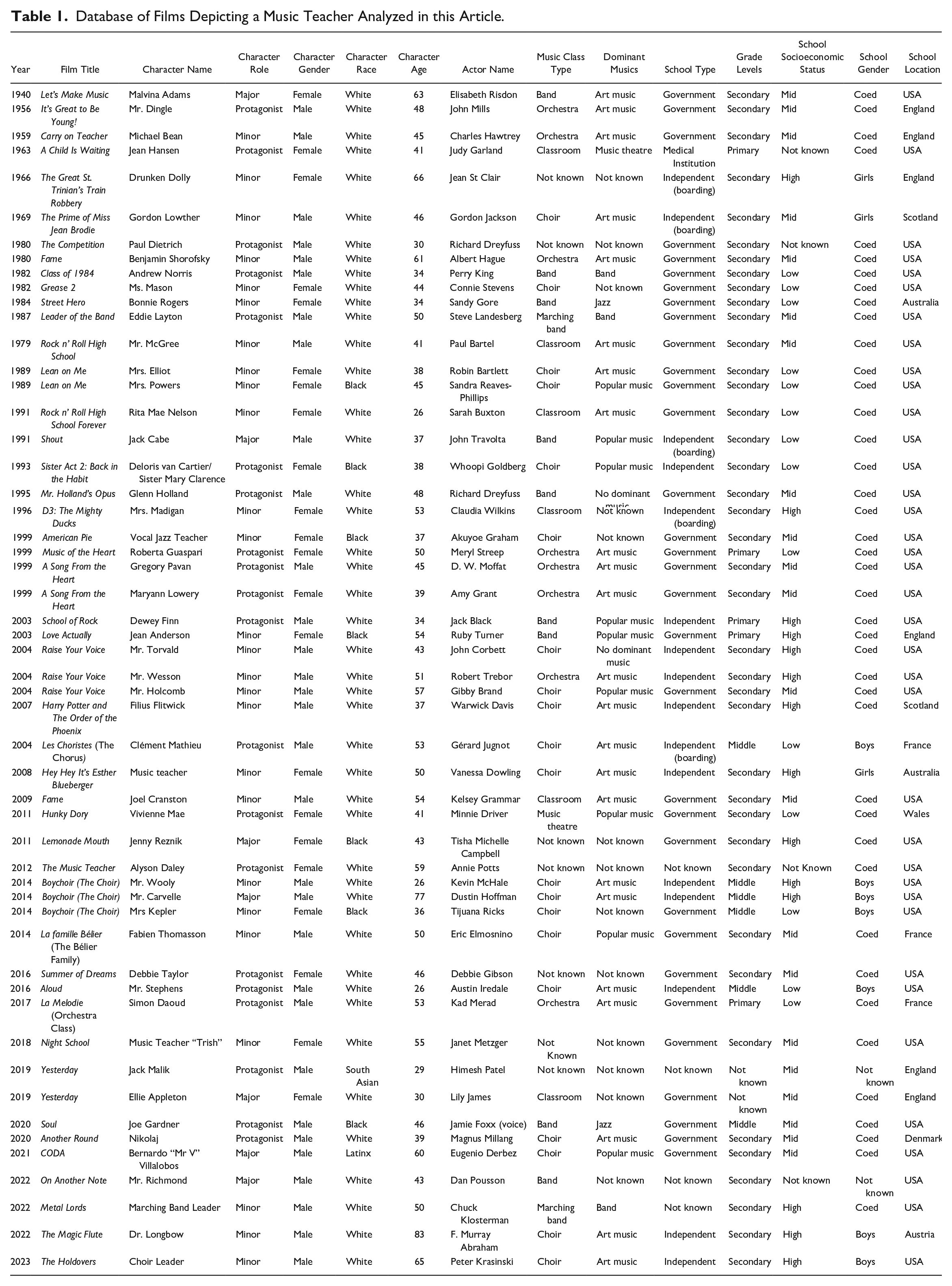
Deductive codes used by the first author to curate an existing database of teacher representation within media (Gundlach, 2024) were used to manually code each film. These descriptive codes included year of release, title, character name, character role (protagonist, major, minor), character gender, character race, character age, the actor portraying the teacher, school type (government, independent, boarding), grade levels of focus (primary [K–6], middle [Grades 5–8], and secondary [Grades 7–12]), perceived school socioeconomic status (SES; high, medium, low), whether the school was a single-sex or coeducational school, and the location (country) of the depicted school.
The second and third authors of the article, both trained music educators, then developed additional coding categories relevant to music education specifically. These deductive codes included the dominant music class type depicted (band, marching band, orchestra, choir, and classroom classes) and the dominant music styles explored in these classes (art music, band repertoire, 1 musical theatre repertoire, jazz, popular musics). The films were also open-coded and tagged for any depictions of themes related to pedagogy or teaching practices. Each film was coded by at least two coders, with any inconsistencies in coding discussed and a final categorization agreed on by the authors.
All films were watched in full except Let’s Make Music (1940), where only short clips, encyclopedia entries, and IMDb information were available. If specific codes were unable to be ascertained after watching the film, the code “not known” was employed. In cases where demographic data were not explicitly addressed within the film, the public demographic profiles of the actors playing these characters informed discussions of how films would be coded (including character age and character race).
The final list of films and codes is reported in Table 1. A list that is updated with new films as authors are made aware of them can be found at the live Figshare link created by the authors (see Gundlach et al., 2024). Statistical analyses were carried out using Microsoft Excel. Percentages of each of the coded categories were analyzed using frequency counts as a portion of the whole sample or as a portion of the sample with data available. Live updated frequency counts can be found on the second sheet of the Figshare database created by the authors (Gundlach et al., 2024).
Database of Films Depicting a Music Teacher Analyzed in this Article.
Findings and Discussion
In the following section, we use the data represented in the database to discuss themes associated with depiction of music teachers in film. These data stem from the 46 films, 53 music teachers, and 49 schools represented in the database (Table 1). A live link to the database can also be found within the references of this article (Gundlach et al., 2024), allowing readers to engage with a more accessible version of the table that includes color coding and larger text.
Demographic Representation of Music Teachers in Film
In presenting the demographic characteristics of music teachers as portrayed in film, this study includes corresponding demographic data from real-life music teacher populations where available. These statistics are not intended for direct comparative analysis, nor do they serve as a benchmark against which fictional portrayals should be evaluated. Rather, they are provided as contextual reference points to assist in interpreting the patterns observed in screen portrayals. This approach allows for a grounded reading of the data while maintaining the study’s core focus on representation within fictional media.
Of the 53 music teacher characters in the data set, 31 were depicted as male (58.5%) and 22 as female (41.5%). This proportion of female characters is similar to Shaw and Auletto’s (2022) estimate for the state of Michigan (45.5%) and closely aligns with Miller’s (2023) figure for Maryland (42.0%). However, national-level data suggest that women make up a larger share of the profession overall. Matthews and Koner (2017) reported that 61.3% of music teachers are women. As Miller noted, demographic patterns vary not only by state and school level but also by content area. For example, women comprise only 37% of band teachers (Miller, 2023) but 64% of orchestra teachers (Smith et al., 2018). The gender balance in film thus mirrors state-level figures more than national ones and may also reflect the overrepresentation of band settings in screen narratives, where male teachers are more prevalent. This suggests that screen portrayals may reproduce—not challenge—the gendered divisions within music education itself.
No teachers were positioned as openly gender-queer or nonbinary. With McInroy and Craig (2017) noting that depictions of queerness in media may encourage queer people to pursue specific careers or more openly discuss gender/sexual identity with other young people, the lack of queer music teachers in film is concerning. Female characters were more likely to be assigned minor roles or supporting roles (54.5% of the 22 female teachers held minor/supporting roles) in comparison to their male counterparts (where 45.1% of the 31 male teachers held minor/supporting roles), a phenomenon that reflects wider gendered trends in film (Lauzen, 2015).
Across the database, 44 of the music teacher characters were depicted as White (83.0%), 7 as Black (13.2%), 1 as South Asian (1.9%) and 1 as Latinx (1.9%). Matthews and Koner (2017) found proportions of 90.9% White, 2.2% Black, 0.9% Asian, and 1.2% Latinx in their national American study’s sample of National Association for Music Education (NAfME) members who completed their survey. Although people of color remain significantly underrepresented as music teachers (Elpus, 2015; Gardner, 2010), they appear relatively more frequently in on-screen portrayals.
The first depiction of a non-White classroom music teacher in the coded films was portrayed by Whoopi Goldberg (Sister Act 2: Back in the Habit, 1993). As was noted by Rakovski (2023), depictions of racially and ethnically marginalized populations in media inform the types of careers racially marginalized individuals consider undertaking. Wright (2017) and Koza (2010) explicitly problematized the overrepresentation of whiteness within preservice and in-service music teacher cohorts, a problem that is reflected in and potentially exacerbated by depictions of music teachers in film. However, trends toward more diverse representations of music educators were noted in the data set with films released in the last five years. Of the nine music teachers depicted in films since 2019, 66.6% were White, with the representation of South Asian, Black, and Latinx music teachers also found within this period.
The average age of music teachers depicted in film was 46.4 years, with the majority ages between 45 and 54 (35.9%). A further 18.9% were over 55, 28.3% were ages 35 to 44, and 17.0% were ages 25 to 34. The age bands used in our study (e.g., 30–34, 35–39) are designed to avoid overlap at boundary values. Direct comparison with Matthews and Koner (2017) is difficult because they used different age groupings and have overlapping boundary values (e.g., 30–40, 40–50). Using a weighted average, however, we estimate their average age music teacher is 40.8 years.
Of all films, music teachers were positioned as the protagonist of the narrative 20 times (37.7%), a major character seven times (13.2%), and a minor character 26 times (49.0%).
Depictions of Schools Within Films Featuring a Music Teacher
A total of 49 unique fictional schools were represented in the database. Acknowledging Hollywood’s significant influence on film and the exclusion of foreign-language films that were not released in English-speaking markets, 33 (67.4%) of the schools were set in the United States. Six schools were depicted as being located in England (12.2%), three in France (6.1%), two in Scotland (where we elected to count Hogwarts of the Harry Potter series; 4.1%), two in Australia (4.1%), and one each in Denmark (2.0%) and Austria (2.0%).
The majority of portrayed music teachers worked within government (public) school settings (66.7% of the films where the school type could be determined). Just under a third (31.1%) of teachers worked within independent (private) schools (11.1% in boarding schools and 20.0% in nonboarding schools). For estimated American national data, 89.4% of music teachers worked in public schools and 8.1% in private schools (Matthews & Koner, 2017).
The film A Child Is Waiting was set within a medical institution where students who were deemed intellectually disabled were sent to live and learn. The majority of schools represented were coeducational (80.9% of films where school gender could be determined), with six depicting “single-sex boys” schools (12.8%) and three depicting “single-sex girls” schools (6.4%), of the films where the schools were depicted. Three-quarters (75.4%) of music teachers in film teach secondary year levels, similar to 71.9% in American national estimates (Matthews & Koner, 2017). Primary (9.4%) and middle school (11.3%) level depictions are underrepresented in film compared to real life (43.7% elementary; Matthews & Koner, 2017).
Although determining school SES is a difficult prospect within fictional schools and being aware that SES can vary within a school, we assessed average school SES based on the school’s depicted facilities, resources, and condition; depicted wealth of students and parents; and any character quotations referring to class and wealth. Within these criteria, it was determined that 24.5% of schools were depicted as serving student populations of high SES, 26.5% were depicted as serving students of low SES, and 40.8% served students of neither particularly high nor low SES.
Music Classes and Musical Styles Depicted in the Films
When considering Montemayor et al.’s (2018) discussion of the dominance of the “triumvirate” of band/orchestra and choir within music education (specifically in the United States, where the vast majority of schools were depicted to be located in the data), it is unsurprising that large ensemble-based instructional methods were dominant within the data. Of the 44 films where teacher pedagogy and instruction were explicitly shown on screen, 39 of the teachers were teaching in a large ensemble context (86.7%). Of those, 20 (44.4%) were leading a choir; 9 (20.0%) were instructing a nonmarching band, such as a concert or wind band; 8 (17.8%) were shown conducting an orchestra, and 2 (4.4%) were instructing a marching band. Six music teachers were positioned as classroom (general) music teachers (13.3%), and one taught music solely in the context of developing a music theatre production (2.2%). The best available estimates for real-life American music teachers’ allocated areas are choir (30.2%), nonmarching band (46.4%), orchestra (13.9%), marching band (5.5%), and (general) music (35.7%; Matthews & Koner, 2017).
Despite critique positioning Western art music and band repertoire as likely to be culturally irrelevant for the majority of students (see Green, 2001; Kruse, 2016; Wright, 2017, 2019), 65.0% of music teachers depicted in film predominantly explored these musics in class (with 7.5% exploring band musics and 57.5% exploring other art musics in films where dominant musics could be identified). Nine of the music teachers were shown giving a music lesson that utilized popular musics (22.5%), often in contrast to the previous dominance of Western art musics within depicted schools (e.g., in Shout, 1991; Sister Act 2: Back in the Habit, 1993; and School of Rock, 2003). Jazz was the dominant music in both Street Hero (1984) and Soul (2020), and multiple musical styles were explored in depth within Mr. Holland’s Opus (1995) and Raise Your Voice (2004). Although musical genres represented in our data may reflect the reality in many ensemble-based Western music classrooms (Montemayor et al., 2018), recent research supports a growing change in this trend with calls for student exposure to more diverse repertoire and musical cultures (Westerlund & Karlsen, 2015) and the implementation of alternative pedagogies, such as Musical Futures (Hallam et al., 2016; Jeanneret, 2010).
Pedagogies, Teaching Practices, and Tensions Depicted
Interestingly, all films where the music teacher featured as the protagonist or major character depicted teachers employing teacher-centered, formal music pedagogies where the instructor was positioned as the musical leader of a student group (Green, 2008). These teachers either conducted the large ensemble they were instructing and/or performed in an ensemble with the students. Such discourses reflect the “dictatorial” (Cremata, 2017, p. 65), “controlling” (Narita, 2017, p. 38), and “authoritarian pedagogical models” that Schmidt (2005, p. 4) noted have come to be “expected” within music classrooms. Even in movies where popular musics and student voice were positioned as valuable, the pedagogical models utilized reflected Narita’s (2017) assertion that “teachers (possibly unintentionally) blend their controlling actions with musical demonstrations and give learners (and teachers themselves) the illusion of freedom of choice” (p. 38). In films like School of Rock (2003) and Shout (1991), the musics were almost always chosen by the teachers, the arrangements created by the teachers, and the performances led by the teachers even if student voice was positioned as particularly valuable by educators. For movies in which informal or nonformal music learning strategies were depicted, the teacher was not in the room during such activities (Lemonade Mouth, 2011; Metal Lords, 2022).
The presentation of teaching as the secondary passion of music teachers, or the “fall back” career one accepts if they have not “made it” as a professional musician was also common. Both Jack Malik (Yesterday, 2019) and Joe Gardner (Soul, 2020) are quick to leave the teaching profession for the opportunity to work as professional musicians, and the bitter Fabien Thomasson of The Bélier Family (2014) is rude and dismissive with his choir, desperate to escape the school context. For others, a failed career as a professional musician led them to consider careers as music educators. Jean Hansen in A Child Is Waiting (1963) states that she chose to pursue work as a music teacher after being unable to secure a career as a concert pianist, Eddie Layton of Leader of the Band (1987) lost his regular gig as a pianist in a bar before he decided to become an educator, Dewey Finn of School of Rock (2003) is kicked out of his semisuccessful rock band and needs to find work, Debbie Reynolds of Summer of Dreams (2016) becomes a teacher after her previous career as a pop star is no longer successful, and similarly, Simon Doud of La Melodie/Orchestra Class (2017) accepts a teaching position when unable to find work as a concert pianist. Interestingly, none of these characters possess a teaching degree before moving into these teaching positions. Indeed, 13.0% of films on this list explicitly highlight that a music teacher of focus does not possess a teaching qualification, including A Child Is Waiting (1963), Leader of the Band (1987), Sister Act Two: Back in the Habit (1993), School of Rock (2003), Summer of Dreams (2016), and La Melodie (2017). This presentation of music teaching as something that someone with little to no educational qualifications can do (and often are able to do in a way that is positioned as more “successful” than qualified music educators) may have implications on public perceptions of the field of music education and the broader deprofessionalization of the teaching profession (Dulfer et al., 2023; Flores, 2020; Menter & Flores, 2021).
Acknowledging that for the purposes of film narratives it can be helpful to focus on a relationship between a teacher and one “special” student, there is still a strong trope of music teachers on film giving extra encouragement, instruction, and support that other students do not receive, which helps a major character achieve their musical ambition. Many films from the 1990s onward feature an inciting moment where the teacher identifies a particular student as “talented,” with the teacher embarking on a mission to ensure they become a “serious” musician. In Street Hero (1984), it is Vinnie; in Sister Act 2 (1993), it is Rita Louise Wilson; in Mr. Holland’s Opus (1995), it is both Gertrude Lang and Louis Russ; in School of Rock (2003), it is Zach Mooneyham; in Les Choristes (2004), it is Pierre Morhange; in Raise Your Voice (2004), it is Terri Fletcher; in La Famille Bélier (2014)/CODA (2021), it is Paula Bélier/Ruby Rossi; and in Aloud (2016), it is Arden. Such depictions reinforce critiques from Wright (2017) and Gaztambide-Fernández (2010), who noted that music educators may justify teaching in manners that disadvantage the majority of students if it may be of benefit to “the few who do” consider becoming professional musicians.
Finally, a consistent theme depicted in these films was the presentation of the school’s music program as under threat due to budgetary cuts (Mr. Holland’s Opus, 1995; A Song from the Heart, 1999; Music of the Heart, 1999; Lemonade Mouth, 2011; The Music Teacher, 2012; Night School, 2018). The need to advocate on behalf of the music program in the face of funding cuts mirrors discussions from Woodford (2005, 2019), Zavitz et al., (2024), and Schmidt (2020), who highlighted that arts programs are often more likely to be considered “at risk” of reductions to funding in neoliberal contexts.
This film and character database examines popular media representations of school music teachers, exploring their demographics, portrayal, professional practices, and core values. By analyzing these depictions, this research aims to reconcile differences between actual music educators, students’ perceptions, and broader societal views.
Acknowledging Limitations and Calling for Participation
In publishing this database, we hope it will serve as a tool that scholars can utilize to easily find and analyze films depicting music teachers in formal schooling contexts. However, limitations to the curation of this database must be acknowledged.
Films that were not released in English or with English subtitles were excluded from the database. This and the dominance of U.S.-based production companies associated with films released in English have led to the exclusive depiction of Western educational systems and the dominant positioning of music teachers as White. Benedict (2006) warned the field that “the commonness of Whiteness in our society spawns a culture in which the experiences of the White teacher become the normative yardstick by which to measure all experience” (p. 6). We do not intend to reinforce the positioning of Western and White musical ideals, stylings, and teachers as most worthy of on-screen depiction. Thus, we encourage readers aware of non-English-language films featuring music teachers to contact us so that such films can be collaboratively coded and added to the live-updated database (Gundlach et al., 2024). This use of collaborative live documents aligns with discussions from Simpson (2023) calling for the embedding of nonstagnant media into published scholarship to ensure data remain relevant and inclusive of multiple perspectives.
The selection criteria led to the coding of films depicting music teachers practicing within a compulsory school context. Thus, films depicting music teaching in nonformal contexts, including camps (e.g., the Camp Rock franchise), community contexts (I Used to Be Famous, 2022), or tertiary institutions (Whiplash, 2014), were not included. A live-updated database of music teachers depicted outside of compulsory schooling contexts is currently being created. Similarly, the database of focus in this article excludes depictions of music educators within television series and is the focus of a separate ongoing database creation project (Gundlach et al., 2024). We encourage any scholars interested in contributing to the creation of these databases to contact the corresponding author.
Conclusion
Studies within the fields of media and education have found that the portrayal of teachers in film informs us of the ways in which both educators and noneducators perceive the profession. Despite this, studies exploring depictions of music teachers in film specifically are rare and have tended to focus on a close analysis of just a few films. The purpose of this article is to provide the field of music education with a comprehensive database noting the descriptive and demographic characteristics of music teachers within films from 1940 to January 2025 (released in English or using English subtitles). An analysis of this database reveals a concerning lack of diversity in the cinematic portrayals of music teachers, who are predominantly depicted as White males employing teacher-centered pedagogies. Such representations have implications for the kinds of individuals who consider undertaking a career as a music educator and on their expectations of the role. We also note the ways in which representations of music educators may influence wider societal perception of music education. We specifically highlight the ways in which filmic depictions of music teachers may contribute to the deprofessionalization of music teachers, specifically when noting the number of music educators depicted as having no formal music teaching qualification. Given research showing that fictionalized media representations of teaching can significantly shape public opinions of the value of educators, it is crucial to critically examine the ways these common depictions may influence public perceptions of the field (Dalton, 2004; Glanz, 1997; Resnick, 2018).
By making this database publicly available and calling for contributions to expand its scope beyond Western/Anglophone contexts, the authors aim to encourage further scholarly inquiry into this important issue. We also hope that the publication of these data may encourage filmmakers to develop more authentic, equitable representations of music teachers in film, with such representations having the power to inspire broader societal changes in how the profession is perceived and valued.
Footnotes

Declaration of Conflicting Interests
The authors declared no potential conflicts of interest with respect to the research, authorship, and/or publication of this article.
Funding
The authors received no financial support for the research, authorship, and/or publication of this article.