




Abstract
Previous research has variably indicated the role of working memory in error detection by which working memory played a role in rhythmic error detection but not melodic error detection. Here, we devised a longer melodic error detection task for college musicians in an auditory, rather than visual, condition using classical excerpts, which we compared to briefer visual and auditory control conditions. These tests were compared to performance on a test of verbal working memory (forward digit span test) and an experimenter-created tonal working memory test. The tonal working memory test was positively related to the forward digit span test, the melodic error detection, and the visual control but not to the auditory control. Performance on the error detection test was not significantly related to year in school, level of aural skills class, years of private piano, or level of group piano class. Our participants performed similarly on the aurally presented melodic error detection of classical excerpts and the briefer visual control but not on the briefer aural control. Among other variables, years of experience on a second instrument was a significant predictor of error detection skill. High familiarity ratings with a classical excerpt did not yield a relationship to error detection performance.
Teachers and conductors have an important stake in error detection because they have competing interests for their attention when leading instruction (Nichols & Stambaugh, 2022; Waggoner, 2011; Williams, 2022). For example, playing the piano along with a choir ensemble decreases the conductor’s ability to detect errors (Nápoles et al., 2017), and even the act of conducting music while listening decreases the ability to detect and report errors (Montemayor et al., 2023). For these and other reasons, undergraduate music students report being least confident in error detection and correction among requisite conductor skills (Silvey, 2011), possibly because within the task of error detection, there are sometimes multiple parts to monitor. In research about error detection, the typical presentation of stimuli is a visual score accompanied by an aural track that introduces errors in rhythm, pitch, or expression (visual-aural mode). Musicians routinely work in the aural-aural mode, however, in which they recall musical sequences from short- or long-term memory without referencing the score, although previous research has focused on the visual-aural presentation based on score study but using sometimes only very brief excerpts.
Error detection is an aural skill in which a live or recorded musical excerpt is compared by the musician to an aural image of the music as suggested by a notated score or as previously learned or memorized material (e.g., Nichols & Stambaugh, 2022; Schlegel, 2010). The expected music comes from the individual’s reading of the score, or their memory, to create this image. To test error detection in musicians, a visual score is usually shown before or during the playing of the audio with errors implemented in the audio stimulus for the participant to detect; to be successful, musicians must focus their attention and have acute perceptual skills. For example, the ability to detect pitch errors may be predicted by the ability to identify musical intervals (Stambaugh & Nichols, 2020). That is, a musician must be able to identify intervals to perceive when one is produced incorrectly. Next, the ability to perform melodic dictations is also correlated to interval identification: One must be able to identify intervals in order to categorize and document a sequence of pitches (Nichols & Springer, 2021).
Types and location of errors have been shown to be salient factors in error detection performance. For example, instrumentalists have been shown to detect more rhythm errors, whereas vocalists detected more pitch errors (Stambaugh, 2016). Regarding single line versus multipart textures, rhythm errors may be more easily identified in a single part, whereas pitch errors may be more easily identified in multipart music, possibly due to the nature of pitch errors in a harmonic context (Waggoner, 2011). For this reason, researchers have explored musicians’ focus of attention in multipart scores. College musicians may be better at detecting errors when focusing their attention on a single line of music compared to parts on the periphery in three-part music, and participants may be better at detecting errors overall when their attention is not directed to one part (Williams, 2022). Furthermore, those musicians were better at detecting errors when they focused their attention on the middle parts rather than the bass line. Other work suggests the context of homophonic versus polyphonic texture complicates the findings on focus of attention for pitch and for rhythm error detection (Schlegel, 2010). A desire to incorporate contextual factors in realistic settings (ecological validity) while also controlling for confounding variables in research settings (internal validity) has forced researchers to make careful decisions about the inclusion of pitch versus rhythm errors and the number of parts (one vs. several) in error detection research (per Sorenson, 2021).
Studying a part beforehand, whether through score study techniques or hearing an accurate model prior to the task, may help error detection performance but so too can multiple listenings during the error detection task. College musicians have been found to detect additional errors in multipart music in a second or third listening, although fewer than in the first attempt (Sheldon, 2004). Performance on other musical tasks such as singing accuracy seems to indicate some individuals improve after the first attempt (Nichols & Wang, 2016) but for error detection, an important finding from Sheldon (2004) was that sometimes errors were indicated incorrectly (false positive), which increased with additional listenings.
Although timbre itself may be unimportant to error detection performance (Stambaugh & Nichols, 2020), the inclusion of single line, choral texture, or instrumental parts and the inclusion of pitch versus rhythm errors have all been employed in the previous literature. Furthermore, listening itself has served as a condition in error detection performance. For example, adolescents in school bands participated in two conditions: listening only and listening while playing (Thornton, 2008). In both conditions, participants viewed a score of familiar songs with and without errors. We contrast this to a potential condition in our current study in which participants hear an accurate model without seeing the score (“listening only”) and then are played the stimuli again but with the introduction of errors—pitch or rhythm or otherwise.
The Role of Working Memory
Working memory was first described as a finite memory system holding information for a limited amount of time until it would either be used, stored, or discarded (Cowan, 1999, 2013; Köster & Gruber, 2022). The definition was further refined to include three distinct mechanisms, the phonological loop, the visuospatial sketchpad, and the central executive. This model has been updated and is now known as the “multicomponent working memory” model, which includes the addition of the episodic buffer as a link between short- and long-term memory (Baddeley, 2000). Although each of these may be relied on by musicians, our interest to musicians as it relates to monitoring, identifying, and detecting musical errors is the phonological loop.
The phonological loop was originally considered to be analogous to a tape player; recording new information that can either be saved or written over with new auditory information. Stimuli can be stored in the phonological loop from either an auditory or visual input if they are aural in nature. This information is temporarily stored through rehearsal within Broca’s area (Andrade & Henson, 2006). Although it has been found that the capacity of the phonological loop is finite, the amount of data stored within is dependent on the size and complexity of the data. For example, five syllable words were found to be significantly more difficult to remember than single syllable words (Baddeley et al., 1975). The brain compartmentalizes the processing of auditory and visual stimuli into separate cortical areas. Auditory stimuli are predominantly processed in the auditory cortex, located in the temporal lobe. Visual stimuli are processed in the visual cortex, located in the occipital lobe; however, if the stimuli are auditory but written down (e.g., sheet music or written words), it moves from the visual cortex to the auditory cortex to be encoded as if it were originally heard (Baddeley, 2000). Additionally, when a person is presented with a visual representation of the auditory stimuli, their recall ability increases (Heikkilä et al., 2017). Recall ability for these two stimuli forms also differs, with the visual memory stream being found to be significantly stronger than auditory (Gloede & Gregg, 2019). Cognitive load theory suggests that there is a finite amount of working memory space and that recall ability varies widely depending on modality (Sepp et al., 2019).
Working Memory and Music
Working memory has been found to correlate with certain musical abilities. When listening to polyrhythms, musicians were significantly better at isolating the individual rhythms than nonmusicians (Jones et al., 1995). Also, sight-reading musicians relied heavily on inhibitory factors to focus on their task. The level of cognitive flexibility also largely correlated to a participant’s fluency while sight-reading (Herrero & Carriedo, 2020). These findings directly relate to our questions on the relationship of working memory and error detection through the relationship of cognitive flexibility as a subcategory of working memory and overall auditory ability.
Music researchers have had a long-standing interest in working memory, partly because musical training has been historically associated with improved scores in other academic areas, although controversially discussed (Bain, 1978; Bergee & Weingarten, 2020; Miksza, 2010). Working memory ability may contribute to the advantages in cognitive flexibility found among musicians, which could underlie academic achievement. In addition, the impact of working memory may explain additional variance above and beyond that explained by socioeconomic status when comparing musicians and nonmusicians on academic achievement. The Trail Making Test, a test in which a participant connects circles in ascending order (Partington & Leiter, 1949), has been used to measure the attentional flexibility of participants with musical training. One experiment showed those with musical training performed better on the test as well as another speed/flexibility test, the Paced Auditory Serial Addition Task (Bugos & Mostafa, 2011). The Paced Auditory Serial Addition Task consists of participants hearing single digit numbers every 2 or 3 seconds and then adding each new number to the immediately previous number (Gronwall, 1977). In addition, conductors were found to have increased working memory and attentional flexibility capacity over pianists, possibly due to their increased requirement for divided attention in music (Wöllner & Halpern, 2015; supported by Pallesen et al., 2010). Tonal working memory may differ from standard verbal working memory, as in one case in which tonal working memory was dependent on the number of stimuli, not the duration, unlike verbal working memory (Ding et al., 2018). Interestingly, musical training has been found to improve performance on both visual and auditory working memory tasks equally (Degé et al., 2011). A defining factor in memory recall for musicians is musical contour (Talamini et al., 2021). Experienced musicians performed better in the contour condition of both the visual and auditory stimuli, with the use of contour as a memory aid, compared to nonmusicians.
There is evidence that familiarity with the excerpts presented to musicians can increase the identification of melodic errors. Participants have demonstrated greater difficulty recognizing errors in unfamiliar melodies (Koreimann et al., 2014; Talbert, 2021). This suggests that the more time or experience or knowledge of a piece of music, the easier it may be to locate and define errors in playing. Similarly, when participants were conducting, their error detection scores were lower, especially when not given the chance for score study and a model of a correct aural example (Montemayor et al., 2023). Furthermore, Williams (2022) suggested researchers have not often employed an aural-aural mode of comparison in error detection, suggesting that “familiarity with a score to the point of primarily relying on one’s aural image would reduce perceptual load to allow for increased attentional processing, thus providing additional empirical evidence to support the common recommendation of studying the score” (p. 483). Koreimann et al. (2014) used an aural-aural modality of error detection for a more diverse pool of participants given that nonmusicians would not be expected to read sheet music. It is unclear how student musicians respond to aurally presented stimuli followed by the aural playing with errors as sometimes occurs in rehearsal (i.e., hear it right and then hear it wrong) and to what degree this skill is related to verbal numeric or tonal working memory. The purpose of the present study was to explore more ecologically valid error detection excerpts including classical music melodies in comparison to briefer researcher-composed control excerpts from previous research. A secondary purpose was to explore aural versus visual presentations of the model. We chose the following research questions: (1) What is the relationship between measures of memory and melodic error detection performance? Given the decrease in error detection when other tasks like singing or conducting are introduced and given that musical training has been associated with increased working memory capacity, we hypothesized that the association between memory and error detection will be positive. (2) What is the relationship between performance on visually versus aurally presented melodic error detection? Given that musical training has been associated with both visual and auditory working memory, we hypothesized that there exists a positive association performance on visual versus aurally presented melodic error detection. And (3) What is the effect of excerpt familiarity on error detection? Based on previous research in adult amateur musicians and also in nonmusician samples, our hypothesis is that higher familiarity with a musical excerpt will be associated with higher error detection on that item.
Method
Participants
We tested music majors (N = 61) at two U.S.-based tertiary schools of music ranging from first- through fourth-year students (n’s = 18, 15, 19, 9, respectively). Music majors were recruited from music classes due to their exposure to conducting, music reading, ear training, and other musicianship skills. The average age of participants was 19.92 years (SD = 1.37). Participants consisted of 30 males, 27 females, and four nonbinary persons. Most participants were music education majors (n = 49), with other music majors comprising the remainder (unspecified BA/BMA music majors: n = 4; music therapy: n = 3; performance: n = 2; unspecified BM music majors: n = 2; and jazz: n = 1). The participants included 20 vocalists and 41 instrumentalists, the latter comprising wodwinds (n = 18), brass (n = 16), piano (n = 4), strings (n = 2), and percussion (n = 1). Participants varied in years on their primary instrument (M = 5.89, SD = 3.21). Of those who played a secondary instrument (n = 35), the majority played brass instruments (n = 11), followed by piano (n = 10), strings (n = 5), woodwinds (n = 5), and voice (n = 4). Some participants had taken private piano lessons, whether documented as a secondary instrument or not (n = 30, M = 5.47, SD = 4.45). Participation in drumline also varied, with only 17 participants having this experience (M = 2.71, SD = 2.44). The amount of completed semesters for both aural skills and music theory were the same, with 25 participants having completed everything, 14 participants in their fourth semester, two participants in their third semester, 18 in their second semester, and two in their first semester. Group piano class completion was similarly distributed, with 24 participants being finished with all classes, 19 participants in their fourth semester, two participants in the third semester, 13 participants in the second semester, and three in the first semester. We documented mean years of private lessons in classical music (M = 5.95, SD = 3.27) versus jazz music (M = 0.52, SD = 1.19) and ensembles experience in classical (M = 7.93, SD = 2.99) versus jazz ensembles (M = 1.97, SD = 2.16).
Test Stimuli
At the beginning of the individual test sessions, we began with a background questionnaire for demographic and musical history information followed by a test of absolute pitch ability. This test used prerecorded sine wave tones ranging F#3 to E5. Between each of the 10 items was a brief silence and distraction sounds made of pitch clusters across the piano range using a piano timbre (cf. Schlemmer et al., 2005). We used a threshold of 80% accuracy to account for guessing and to suggest the presence of absolute pitch ability (per Nichols et al., 2018). The stimuli were randomized within the test, following the practice question. This test did not serve as a screening, and we continued the session regardless of the outcome.
Following the test for absolute pitch, each participant was given a verbal working memory test for forward digit span capacity (Talamini et al., 2016). This was the only test given verbally as opposed to being a part of a Qualtrics survey created by the experimenters. The participants were read numbers by a research assistant at a rate of one number per second and then asked to repeat them. The test length began at a length of four numbers and rose every set of six items. Participants advanced to spans of five numbers, and if successful, they went on to spans of six numbers and so on. The test stopped when a participant failed more than one set. The participants’ digit span score was the longest span at which they were successful (i.e., if participants failed a second set on the span of six numbers, they did not advance and were given a score of 5).
We gave participants an aurally presented melodic error detection test consisting of eight musical excerpts, taken from the classical music canon. These excerpts consisted of monophonic melodies from classical music, which were all prerecorded using a piano timbre and ranged in length from eight to 18 notes, including potentially familiar excerpts such as Appalachian Spring and Carmen (see Table S2 in the supplemental document included with the online version of this article). Participants would hear the melody correctly and then incorrectly, with a single melodic error added. The correct and incorrect melodies were separated by 2 seconds of silence. The total time for each excerpt ranged from 8 seconds to 39 seconds with an average time of 19.13 seconds (SD = 8.95). Participants were asked to (a) select the location of the error and (b) indicate familiarity with the melody on a Likert scale from 1 to 5.
To counterbalance this condition, participants also listened to a visual control test and an auditory control test. The visual control condition consisted of eight musical stimuli from previous research (Nichols & Stambaugh, 2022). Each stimulus was eight notes long and consisted only of quarter notes lasting 5.5 seconds. During this test, participants would view a one-line score while listening to it played using a piano timbre. The auditory control condition consisted of the same eight stimuli as the visual control condition; however, they were presented in the same aural-aural format as the primary melodic error detection test.
All stimuli were created using the grand piano timbre from Apple’s Logic software. The melodies for both the visual control and auditory control were created for this experiment and modeled after previous literature (Stambaugh & Nichols, 2020). Error detection has been found to be easier when the error does not fit within the tonal context of the melody (Groulx, 2013), so we included minimal leaps and nonchord tones and ended the stimuli on either the tonic or dominant pitch to give a sense of tonality. Additionally, all stimuli were set to a tempo of 88 bpm to minimize the effect of temporal changes on participant performance. The errors were ranked using four levels created from the tonal hierarchy (per Krumhansl & Kessler, 1982; see Table S2 in the supplemental document included with the online version of this article). The stimuli were randomized within the conditions and the conditions were also randomized, meaning a participant could begin with any of the three conditions but would finish that condition before moving to the next.
Following the melodic error detection tests, participants were presented with pitch sequences representing a tonal working memory test. These sequences were written in 2/4 time at 75 beats per minute (bpm) ranging from three to six beats. Each sequence was made of eighth notes. The sequences were repeated after 1 second of silence, in which the second sequence was either the same or different. The notes used were D4, E4, F4, G4, A4, B4, and C5. The only notes changed were either E4, F4, B4, and C5, and only one note was changed per sequence (cf. Ding et al., 2018). The music was composed in a style consistent with Western classical music. Large leaps and nonchord tones were minimized. There were 40 sequences divided evenly between the same and different repeats and number of beats (10 each). The average duration of this test was 12 minutes. The participants began at the three-beat level (six eighth notes), followed by four beats (eight eighth notes), five beats (10 eighth notes), and six beats (12 eighth notes). The stimuli were randomized within levels. There were no disqualification scores for this task, like the previous digit span test, so all participants completed all four levels.
Scoring
For error detection tasks, participants were given a point for each correct response and initially given no points for close or distant responses. We also explored an additional score for participants by counting as accurate the identification of a pitch plus or minus one note in the sequence, counting as accurate on either side of the actual error (per Thornton, 2008). The second scoring strategy yielded participant scores that were moderately correlated (r = .581, p < .001) to the first, and the subsequent analyses used the first scoring method only. Prior to analyses, six participants who scored at least eight out of 10 items on the test of absolute pitch were compared to all the participants. None of these participants were the highest scoring on the tests of error detection, tonal working memory, or digit span; thus, we proceeded with the following analyses by including them in the sample.
For the tonal working memory test, we calculated d-prime scores, a transformation that created unbiased data from same/different (dichotomous) item types by including false alarm rates in the calculation. Before creating participants’ overall score on this test, principal component analysis was performed to test for weaker stimuli. No stimuli levels (three beat durations vs. four beat durations, etc.) were found to be different from the others during this test; all communalities were above 0.55. The raw total score was significantly correlated to the d-prime score at each test level (three beats: r = .507; four beats: r = .720; five beats: r = .536; six beats: r = .616; all p values < .001), and the subsequent analyses used the raw total score for this reason.
Results
To investigate the relationship between working memory and error detection performance, we calculated the correlations between the tonal working memory test, the digit span test, the absolute pitch test, and the three error detection tests. The tonal working memory test was significantly related to the forward digit span working memory test (r = .463, p < .001), the aurally presented classical error detection test (r = .381, p = .002), and the visual control (r = .287, p = .025) but not to the aural control (p = .115). Performance on the error detection test was not significantly related to year in school, level of aural skills class, years of private piano, or level group piano class (p > .05).
We conducted a two-step hierarchical regression analysis to describe the associations between working memory capacity, error detection, and instrument experience (Table 1). Given that the working memory tests for forward digit span and tonal memory were moderately and significantly correlated to each other and to error detection performance, we chose to use the forward digit span as the measure of working memory in the following analyses. Before conducting the analyses, we tested the assumptions of multiple regression (Tabachnick & Fidell, 2007), including visual inspections of scatterplots suggesting linear relationships and normality plots that we interpreted to support homoscedasticity. The Durbin-Watson test indicated a value of 1.707, signifying no concerns of autocorrelation. Tolerance statistics and variance inflation factors were also within recommended ranges (>0.5 and <10.0, respectively), suggesting the absence of multicollinearity (correlations among all variables are shown in Table S1 in the supplemental document included with the online version of this article).
Hierarchical Regression of Error Detection Scores.
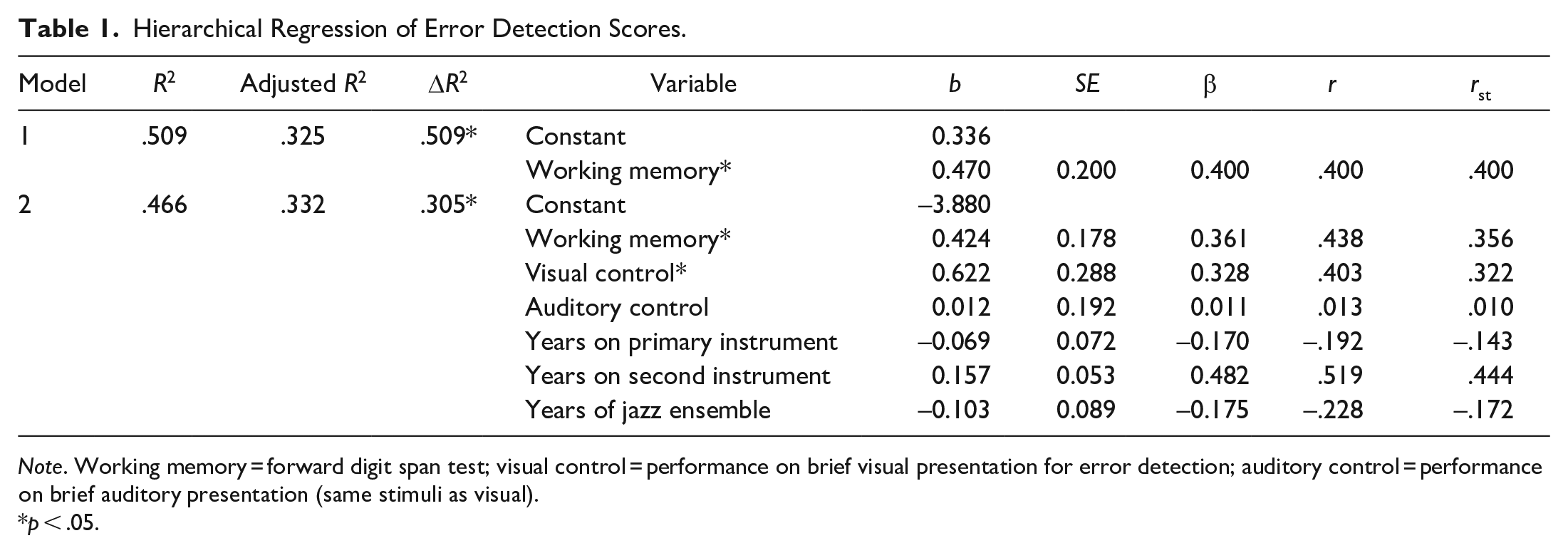
Note. Working memory = forward digit span test; visual control = performance on brief visual presentation for error detection; auditory control = performance on brief auditory presentation (same stimuli as visual).
p < .05.
Next, we chose to enter the forward digit span test in the first model as a covariate. The result was a significant model for error detection performance, accounting for 16% of the variance in error detection scores, F(1, 29) = 5.539, p = .026, R2 = .160, adjusted R2 = .131. Then, we entered musical history in terms of years playing a primary instrument, years playing a secondary instrument, and years playing in a jazz ensemble plus the two control measures: the brief visual and auditory error detection control tests. The purpose was to isolate the effect of experience and the effect of visual and auditory controls to the error detection task, controlling for working memory. This second model explained significantly more variance (ΔR2 = .305, p = .043), explaining 46.6% of the variance in error detection scores, F(6, 24) = 3.487, p = .013, R2 = .466, adjusted R2 = .332. In this model, only working memory (p = .025), years of lessons on a secondary instrument (p = .007), and the visual control test (p = .041) were significant predictors.
To explore performance by year in school, we divided the group between underclassmen (Years 1 and 2, n = 33), representing students who were still completing theory/aural skills coursework and had not begun conducting coursework, and upperclassmen (Years 3 and 4, n = 28), who had completed aural skills coursework and had begun the conducting coursework sequence. We performed a series of one-way analyses of variance with class grouping as a factor. The upper group did not perform significantly differently on the error detection, F(1, 59) = .120, p = 0.730; the visual control, F(1, 59) = 3.721, p = .059; or the auditory control tests, F(1, 59) = 1.619, p = .208.
The following analyses are in support of Research Question 2 regarding the relationship between performance on visually versus aurally presented error detection. Performance on the eight-note visual control (M = 7.10) was significantly higher than on the comparable eight-note aural control (M = 6.15), t(60) = 4.653, p < .001. Some participants did perform higher on the aural control test than the visual control test (n = 10), and some participants performed the same (n = 16). Thirty-five participants scored higher on the visual control by 1 point (n = 13), 2 points (n = 13), 3 points (n = 6), 4 points (n = 2), or 6 points (n = 1). Participants who scored the same or better on the aural control test (n = 26) than the visual control test (n = 35) did not demonstrate significantly different performance on the classical error detection test (M = 3.00 and M = 3.00, respectively), F(1, 59) = .000, p = 1.00. Performance on the visual control was significantly correlated to the main classical error detection test (r = .266, p = .038), whereas performance on the aural control was not (p = .307). Furthermore, performance on the visual control and the aural control was not significantly correlated (p = .399).
We divided the participants into groupings based on their performance during the classical condition to explore Research Question 3 on the effect of familiarity on the performance of the main error detection test. Participants who rated the stimuli 1 to 3 were considered to indicate low familiarity for each excerpt, and ratings of 4 to 5 were considered high familiarity for each excerpt. This also allowed us to create a cumulative familiarity rating for the entire condition. Two of the stimuli did not indicate any participants with high familiarity, although others did: Stimulus 2 (n = 2), Stimulus 3 (n = 17), Stimulus 5 (n = 7), Stimulus 7 (n = 1), and Stimulus 8 (n = 1). The familiarity scores for each excerpt were not significantly correlated to the respective error detection scores (p > .05 for each excerpt). Thus, the familiarity groupings were not found to have a significant association to individuals’ performance on the test items or the overall error detection test score.
Discussion
A primary purpose of this study was to explore the relationship between working memory and melodic error detection, including tasks with stimuli presented in comparable visual and aural control conditions. The first aim was to explore the relationship of working memory capacity to the performance of error detection in classical melodies presented aurally, not visually. Our intent was to explore how college-aged musicians monitor and diagnose long melodies in the aural format without the aid of a visual score, and our prediction was that working memory capacity would be positively correlated to error detection performance. A test of tonal working memory incorporated pitch durations of three to six beats and was moderately correlated to a common measure of working memory capacity, the forward digit span test (Talamini et al., 2021). Furthermore, our test of tonal working memory was moderately correlated to the melodic error detection task, and it indicated a small to medium correlation to the visual control, which was shorter in duration and presented from written notation. There was no relationship indicated, however, between tonal working memory and the aural control, which matched the visual control exactly but was presented by playing the stimulus correctly first rather than using written notation. Thus, participants who performed well on tasks with short melodic fragments in previous studies (e.g., Nichols & Stambaugh, 2022) may have also been likely to perform well on tasks with relatively longer melodic fragments.
The data indicated the lack of a relationship between performance on the visual and aural controls, which is not explained by the previous literature. We expected college musicians to capably track an error with a melodic fragment consisting of eight quarter notes, whether displayed visually or played once correctly and then played with one error. Overall, they did so, but the participants did not perform similarly on the two control conditions, which used identical stimuli. The former—a presentation of notation followed by a hearing including an incorrect note—represents the standard stimulus for error detection in practice and in research. The auditory control condition, however, in which the stimulus was played accurately once and then played with an error, represents a same-different task that could be described as easier than a common error detection task except participants were asked to identify the location of the error. This experience somewhat illustrates the perspective of listening to pitch sequences in the tonal working memory test, which was a same-different task. Yet performance on that test was not related to the error detection auditory control.
Regarding our third hypothesis‚ we believe there is evidence that familiarity with excerpts offers no to little advantage in error detection for students who are learning to apply musicianship skills to classroom teaching settings. We suggest that matters of attention, experience like that on additional instruments, and tonicization should be explored as factors in the classroom and for research. It is possible that our participants were not very familiar with the excerpts overall, thus there is limited influence of their familiarity of the excerpts to the error detection test. Alternatively, it is possible that among practicing (student) musicians, there is a limited degree to which familiarity with an excerpt can improve their error detection performance in a detectable way as it did with adult amateur musicians (Talbert, 2021) or nonmusicians (Koreimann et al., 2014).
The main finding is that beyond working memory capacity, experience playing a secondary instrument and the visual control measure could be used to indicate performance on classical melodic error detection stimuli. Given that working memory capacity is not generally malleable or generally assessed or reinforced in music curricula, our aim was not to generate a predictive model. Instead, our aim was to explore the relationship to working memory incorporating longer stimuli and musical experience. In this study, years playing the primary instrument was not significantly related to error detection performance; however, experience on a second instrument was. Previous research indicated no relationship between instrument or instrument type or stimulus timbre and error detection ability (Stambaugh & Nichols, 2020), although the experience of playing a second instrument may be useful for developing error detection skills for listening to others’ performances. Or the effect of playing an additional instrument could be additive in at least a small way: Different instruments and singing all involve different physical and other performance properties, and of course, some instruments play melody while others often are assigned harmony parts. Playing an instrument for 10 years may offer a different experience related to error detection performance than playing an instrument for 5 years and another instrument for 5 additional years. Finally, an additive effect of studying two instruments at once may occur, and playing experience itself is highly variable even within similar number of years on an instrument. The benefits of playing for 10 years, practicing every day, or listening to certain kinds of music, or attending concerts may differ from those someone accrues should they also play for 10 years but have less access to a practice space, their own instrument, or the availability of other curricular or extracurricular musical opportunities.
The lack of association between year in school and error detection performance can be explained in relation to the music theory and aural skills that are typically completed in the first 2 years of coursework. Underclassmen might have an advantage of being in regular practice for aural skills exercises in classes and homework, whereas the upperclassmen are “out of practice” in this regard. That is, some time has passed since they were doing daily/weekly exercises for aural skills training. The upperclassmen, however, have likely taken one to two semesters of conducting coursework, which could potentially enhance musicians’ skills in error detection. For example, some instructors may use error detection textbooks in conducting or methods courses. This level of curriculum detail was not documented in the present study, but the possibility remains that experiences and training specific to conducting class and field experience in other ensemble settings could provide opportunties for practicing skills relevant to melodic error detection.
In addition, the cognitive load of the short excerpts used as stimuli in this study may not have taxed the working memory capacity of the musicians, or the nature of grouping rhythms and grouping pitches (chunking), together and separately, may have offset the cognitive load of the stimuli—suggesting implications for future study. In the case of melodic error detection, musicians can “chunk” pitch sequences in a way that places only a small load on their working memory capacity (Baddeley, 2000). Chunking strategies for longer pitch sequences or aurally rather than visually presented error detection stimuli, such as in our main error detection task, may not be possible in the two control conditions. Chunking may be less essential in visual presentation modes compared to aurally presented excerpts. In contrast, chunking strategies may become more essential in longer excerpts or in actual melodies from repertoire.
Rhythms may present a different challenge to pitch, with many more notes and note combinations present in the stimuli than in the melodic condition of the same duration, which employed eight quarter notes. Or, due to the monophonic nature of excerpts, it is possible that the participants’ attention was not divided among multiple streams of music whereby participants attended to, encoded, and recalled a single error from a single line as in previous studies. For example, in studies by Schlegel (2010) and Williams (2022), a wide range of abilities in error detection was found among participants, which could suggest variability in their working memory capacity. In addition, those studies used visually-presented musical scores typical in error detection tasks against which a performance including errors is played. In that method, participants can view the musical notation before/during and after the musical recording is played, and as soon as an error is detected (or immediately after), it can be recorded by the participant. Pitches versus rhythms may tax individuals’ working memory differently when they can notate it immediately from written notation in comparison to waiting until an aural recording ends, as in the present study.
Future Research
In this study, we have established a link between a visually presented melodic error detection task and the performance of error detection in longer, classical melodies using auditory rather than visual presentation. We use this finding to suggest that some of the cognitive processes used when evaluating briefer and longer excerpts and for visual versus auditory presentations may be similar. Nonetheless, the scores of the brief visual control and the comparable auditory control tasks were not significantly related, which suggests a difference in how musicians process even brief stimuli dependent on presentation mode. These findings may be contextualized in future research exploring the cognitive processes and pedagogical implications of same-different tasks versus error detection in melodic or both melodic and rhythmic stimuli. Whether we perceive something as different or as an error depends on whether something is required to be played a certain way. The use of written notation certainly suggests an excerpt must be played a certain way, but brief auditory stimuli (eight notes in error detection) or slightly longer auditory stimuli (six to 12 notes in tonal working memory) may present less compelling or less different “mistake” responses.
Years playing in jazz ensembles was not significantly related to performance in our auditory classical error detection test, nor was experience on a primary instrument, although experience playing jazz music has been associated with superior working memory capacity in musicians (Nichols et al., 2018). Future efforts to explore how experience and training influence abilities such as melodic error detection may benefit from different or more precise measures of experience and training. Just as one’s year in school may not always indicate the corresponding level of current music theory course (students vary in their progress), not all first-year students enter college with similar backgrounds. There may be an effect of jazz experience in working memory capacity, but this effect has not yet been significantly related to error detection skill. Finally, attentional flexibility and working memory as a whole have been shown to be a conduit of other mental abilities and processes, such as musical ability and long-term memory (Sandry et al., 2020), and the role of attentional flexibility may serve a similar or more important role than working memory capacity in successful error detection.
Limitations
Although there is evidence that the ability to identify intervals is predictive of melodic error detection skill (Stambaugh & Nichols, 2020), it remains possible that error detection is a skill that requires dedicated practice or dedicated practice in the presence of other cognitive demands, such as monitoring of varying textures (Waggoner, 2011), conducting (Montemayor et al., 2023), or playing the piano (Nápoles et al., 2017), which were not tested in the present design. In particular, the focus on a specific part in multipart settings where more than one part exists seems to be an important factor of error detection success (Schlegel, 2010; Williams, 2022), with implications for attentional flexibility related to conducting experience beyond the experience of student musicians in the present study (Wöllner & Halpern, 2015).
Implications for Music Education
Aural skills are used by popular and classical musicians at any age level who must develop practices to support the improvement of singing and playing instruments. The ability of teachers and conductors to detect errors in others’ playing or musicians in their own playing (cf. Thornton, 2008) is a requisite skill for successful music-making. The detection of errors is the first step in this, which would lead to the accurate identification and correction of those errors, either in one’s or another’s playing. The results of this study can be used to suggest a discrepancy in performance between aural-aural modes of discerning what is heard and what is intended based on the lack of association between the auditory melodic error detection test and the briefer auditory control. The results can also be used to suggest a limited parallel in performance between aural-aural error detection and visual-aural error detection based on the lack of association between the auditory melodic error detection test and the briefer visual control. The latter of these offers implications for visually impaired students: That students can similarly hear errors how other students see errors offers an important intersection for disability studies.
K–12 students in ensembles or theory class may practice melodic dictation—which, like error detection skill, is also predicted by interval identification (Nichols & Springer, 2021)—and may also benefit from specific error detection practice from books and manuals published for that purpose. The performance of college-aged music education students in the present study did not vary by year in school on the specific types of tasks. For those who will rely on this skill for teaching and conducting in student teaching, however, the ability to detect and identify errors will be a useful skill.
Previous research did not reveal a significant relationship between short melodic error detection excerpts and working memory (Stambaugh & Nichols, 2020). The data in the present study, however, yielded significant positive correlations between longer auditory presentations of error detection stimuli and working memory. Combined, we suggest a limited role for working memory capacity in musicians’ ability to detect and correct errors in playing. Specifically, we take these and the previous results to suggest most music students who have a typical working memory capacity and are developing the requisite skills in interval identification will likely be able to perform the necessary exercises for conducting and playing music. In line with previous recommendations (Montemayor et al., 2023; Nápoles et al., 2017), we use these results to suggest that error detection is a skill that should be studied and practiced along with other typical musician demands, such as monitoring multiple players and parts while conducting or accompanying, such as on piano.
Implications for Working Memory in Music Teaching
Baddeley (2012) described working memory as dependent on an elusive “acoustic code.” This code would explain why some letters and tones that appear similar would be easier to remember together than others that were perceived to be different. Cowan (1988) described working memory as an activated form of short-term memory with a specific focus of attention in which the information was manipulated. Our study shows that like Baddeley, musicians’ working memory is reliant on auditory information. Due to the relationship we found between working memory and the visual control task but not the auditory control task, however, the Cowan model of focus of attention must also be considered along with the potential impact of experimenter-created stimuli as opposed to music that is composed by musicians. Although the experimenter-created stimuli may not have been familiar to the participants, it likely manifested in their memory due to being consistent with the idioms of the Western musical tradition and a common musical zeitgeist. Additionally, the fact that the tonal working memory test correlated with the forward digit span test but not the auditory control test suggests a large jump in difficulty or a different cognitive mechanism involved in the act of recognizing the existence of an error versus knowing where it is.
Conclusion
Participants who perform well on typical, visually presented stimuli isolated to features of melody (no rhythm) may be expected to perform more accurately without a score and even in long durations of playing. That is, performance on short monophonic melodic excerpts was related to the identification of pitch errors in considerably longer excerpts that introduced rhythms. We propose that previous brief, pitch-only presentations in error detection research do have an ecological validity to more typical musical settings with or without a score. It remains unclear why aural presentations of the control test did not relate significantly to the error detection task but visual presentations did and why the aural control was not related to the tonal working memory test. Beyond working memory capacity, error detection skill may be related to formal experience playing a second instrument. Because error detection skill did not vary by year in school, we use these findings to recommend that error detection is a unique skill that may require specific training, not a composite of other more basic musical skills.
Supplemental Material
sj-docx-1-jrm-10.1177_00224294231225408 – Supplemental material for The Effect of Memory and Presentation Mode in Melodic Error Detection
Supplemental material, sj-docx-1-jrm-10.1177_00224294231225408 for The Effect of Memory and Presentation Mode in Melodic Error Detection by Bryan E. Nichols and Logan Barrett in Journal of Research in Music Education
Footnotes
Authors’ Note
The Tonal Working Memory Test was written and piloted by Logan Barrett.
Declaration of Conflicting Interests
The authors declared no potential conflicts of interest with respect to the research, authorship, and/or publication of this article.
Funding
The authors received no financial support for the research, authorship, and/or publication of this article.

Author Biographies
References
Supplementary Material
Please find the following supplemental material available below.
For Open Access articles published under a Creative Commons License, all supplemental material carries the same license as the article it is associated with.
For non-Open Access articles published, all supplemental material carries a non-exclusive license, and permission requests for re-use of supplemental material or any part of supplemental material shall be sent directly to the copyright owner as specified in the copyright notice associated with the article.
