




Abstract
The purpose of this study was to describe music teacher professional development (PD) in the United States and to chart potential differences between the experiences of music teachers, other arts teachers (visual art, theater, dance), and teachers in low-stakes (natural and social sciences) and high-stakes (math, English language arts) academic disciplines. Using data from the 2017–2018 National Teacher and Principal Survey, I evaluated PD practices, perceptions, and policies against six consensus criteria for effective PD: content specificity, social interaction, sustained duration, relevance, agency, and policy support. Findings showed music teacher participation in content-specific and socially interactive PD was robust and that the vast majority of music teachers described their PD as relevant. Cross-comparisons revealed discipline associations as to some criteria (social interaction, relevance, agency) but not others (content specificity, sustained duration, policy support). Although music teachers achieved parity or were advantaged in some areas (e.g., access to content-specific PD), they consistently reported less access to socially interactive PD, spent less overall time in PD, and were considerably less likely to exercise agency in support of their PD endeavors. Music teachers—along with their art, theater, and dance colleagues—generally, although not overwhelmingly, operated on less favorable PD terrain in 2017–2018.
Teacher professional development (PD) has long been an instrument for change in education. Recent surveys show that between 90% and 99% of teachers participate in PD each year (Organisation for Economic Cooperation and Development, 2019; Taie & Goldring, 2020). In the United States, Jacob and McGovern (2015) estimated PD expenditures at approximately $18,000 per teacher per year in the 50 largest school districts, finding that teachers spent the equivalent of 19 school days, or roughly 10% of a typical academic year, involved in PD. These data indicate PD is a routine activity for most teachers and a major policy priority for most schools and districts, but they do not convey the full story. Although many state and local policies are applied irrespective of teachers’ discipline—for instance, PD hours required for licensure renewal (Jaquith et al., 2011; Loeb et al., 2009) or funding for district PD programs (Jacob & McGovern, 2015)—prior studies have nevertheless revealed differences in PD access as a function of discipline (Desimone et al., 2007; Gallo, 2018; Phillips et al., 2011). Even if PD investments are robust in the aggregate, every teacher may not equally benefit. This is especially true for music teachers, whose PD experiences, while improved since the 1990s, still lack in critical respects (e.g., school and district policy support, opportunities for mentorship and collaboration; West, 2021).
It is thus essential to continue documenting and scrutinizing music teacher PD, particularly in relation to the experiences of teachers in other disciplines. Using results from the 2017–2018 National Teacher and Principal Survey (NTPS), the most recent data available, I provide a comprehensive assessment of U.S. music and non-music teacher PD, including the first population-level comparisons of PD practice and policy within arts education (i.e., music vs. art, theater, and dance teachers) and an initial account of music teacher PD after the 2015 passage of the Every Student Succeeds Act (ESSA), which enumerated music as a discrete academic subject in federal education law for the first time.
Related Literature
PD—the workshops, conferences, coaching programs, professional learning communities, and more in which teachers engage to grow their practice—has been a key lever in school and teacher quality improvement efforts over the years (Darling-Hammond et al., 2016; West & Bautista, 2022). Teacher learning is supported by substantial school and district financial investments in PD (Jacob & McGovern, 2015; Miles et al., 2004), requirements in every state of some PD for teaching licensure renewal (Jaquith et al., 2011; Loeb et al., 2009), and several citations in federal law of teacher PD as a main mechanism for meeting the nation’s education goals (ESSA, 2015; No Child Left Behind Act [NCLB], 2002). Although it is reasonable to assume music teachers would benefit from PD’s political and legal position in the education system, extant evidence suggests otherwise. West (2021) examined PD practices among nationally representative samples of music teachers between 1993 and 2012, a period marked by the standards-and-accountability movement in the United States and before and after the 2002 passage of NCLB. He concluded that although access to music-specific PD had markedly improved over that 20-year period, music teachers reported a lack of consistent participation in collaborative PD experiences, such as mentoring and coaching; low levels of sustained PD; middling perceptions of PD’s utility to practice; little influence over PD content; and limited provision of PD funding and release time.
Researchers have persistently found that music teachers face challenges in the PD space (e.g., Barrett, 2006; Bauer, 2007; Bautista et al., 2017). PD initiatives designed for and by music teachers can sometimes be rare, perhaps due to music teachers’ minority status in most schools and misunderstandings of music teachers’ distinctive PD needs. Schools and districts often provide PD for music teachers, but these efforts are too often “unsystematic, sporadic, and capricious in both purpose and content” (Schmidt & Robbins, 2011, p. 95). The National Association for Music Education (NAFME; 2015) framed the situation thusly:
Music teachers often receive nonmusical professional development that does not help [them] strengthen curriculum, improve music assessment, or learn ways to better support students’ music learning.
In response, music education researchers have sought to delineate music-specific principles of high-quality PD, drawing on PD effectiveness frameworks in general education (e.g., Darling-Hammond et al., 2017; Desimone, 2009). Scholars have held that PD ought to be musical, grounded in teachers’ school contexts, involve teachers in social exchange with their peers, be supported by and aligned with school and district policy, and take place over extended periods of time (e.g., Barrett, 2006; Bautista et al., 2017; NAFME, 2015; Stanley et al., 2014; West, 2021; West & Bautista, 2022). Qualitative and quantitative evidence suggests that music teachers are likelier to engage in PD that meets these effectiveness standards (Wesolowski et al., 2022; West, 2020). Accounts of such PD are ample in the literature. Researchers have highlighted, for example, the power of collaboration (e.g., Sindberg, 2016; Stanley et al., 2014) and music-making as PD (e.g., Pellegrino, 2011), the need for PD to be responsive to teachers’ levels of experience (e.g., Draves, 2012; Eros, 2013) and classroom contexts (e.g., Stark, 2021; West, 2020), and the enduring popularity of off-site conferences and workshops as music-specific alternatives to nonrelevant local PD (e.g., Schneckenburger, 2014; Shaw, 2017).
Despite theoretical consensus on what makes PD effective, practical applications have not always been straightforward. In a recent case study, West et al. (2021) showed how a 7-month reciprocal peer coaching initiative for urban music teachers—designed to reflect effectiveness principles of collaboration, self-direction, and extended duration—was nonetheless met with attrition and demotivation. Data indicated most participants had neither the psychological bandwidth nor administrative support to fully immerse in the coaching experience. The authors attributed these outcomes to teachers’ belief that an intensive coaching program was “fundamentally incompatible with the demands of their work as urban music educators” (West et al., 2021, p. 18). The theory-practice gap is echoed in larger scale quantitative findings, too. Notwithstanding long-standing skepticism of “episodic” PD (e.g., Barrett, 2006, p. 25), in surveys, music teachers plainly prefer shorter term experiences such as workshops and conferences (Gallo, 2018; Parsad & Spiegelman, 2012; West, 2019a, 2021), believing these efforts can support positive changes to their work (Schneckenburger, 2014).
As the music teacher PD enterprise has become better defined, little attention has been given to how music teachers’ PD experiences relate to those of their colleagues. To date, Gallo (2018) is the only scholar to have examined the PD experiences of music and non-music teachers, although unlike the present study, she did not include art, theater, and dance teachers in her analysis. Gallo found that in 2011–2012, music teachers engaged in more content-specific PD than their colleagues in math, science, and social studies and, somewhat surprisingly, reported similar levels of PD policy supports such as release time and funding as non-music teachers, leading her to “refut[e] the commonly held belief that music educators are disadvantaged in the amount of school-provided financial and temporal support for PD” (p. 182). That music teachers in 2011–2012 were not uniformly disfavored is an auspicious sign, but this finding ought to be tested using the most recent comparative data available.
Purpose of the Study and Research Questions
The purpose of this study was to describe U.S. music teacher PD and to chart potential differences between the experiences of music teachers, other arts teachers (visual art, theater, dance), and teachers in low-stakes (natural and social sciences) and high-stakes (math, English language arts) academic disciplines. Using data from the 2017–2018 NTPS, I assessed PD practices, perceptions, and policies against six research-based criteria for effective PD 1 :
Content specificity: teachers’ participation in PD related to their primary subject areas;
Sustained duration: teachers’ indications of time spent on selected PD topics;
Social interaction: teachers’ participation in PD likely to involve collaboration;
Relevance: teachers’ views and behavior related to PD’s practical utility;
Agency: teachers’ perceptions of their influence over PD content and quality;
Policy support: the extent teachers’ PD efforts were facilitated by school officials.
This inquiry is a follow-up to my recent study evaluating music teacher PD effectiveness between 1993 and 2012 using the same criteria (West, 2021). I expand on that work in at least two respects. First, the current study marks the initial assessment of U.S. music teacher PD since the passage of ESSA in 2015. ESSA was a watershed event because music was for the first time distinguished from “the arts” in federal education law (Kos, 2018). The last substantial increase in content-specific PD participation for music teachers was coincident with the enactment of NCLB, ESSA’s predecessor legislation, going from around 40% in the 1990s to about 80% between 2003 and 2012 (West, 2021). Wei et al. (2010) documented a similar uptick for teachers overall, from 59% in 2000 to 88% in 2008. NCLB had tied federal funding to students’ performance on subject-specific tests and emphasized content knowledge as a factor in determining whether teachers were “highly qualified.” With this study, I offer a preliminary evaluation of music teacher PD in ESSA’s wake.
Second, this is the first in-depth, comparative study of music teachers’ PD experiences against those of other arts teachers. Population-level reports on visual art, theater, and dance teachers’ PD are few and outdated. Sabol’s (2006) examination of visual art teacher PD in the 2003–2004 school year revealed wanting conditions. Parsad and Spiegelman (2012), using data from 2009–2010, explored all arts disciplines, including music, but their focus was on understanding arts instruction availability rather than providing detailed insights into arts teacher PD. Neither Parsad and Spiegelman nor Sabol included non-arts teachers in their analyses or situated their work within concepts of effective PD. And as previously mentioned, Gallo’s (2018) study, despite its evidence on music versus non-music teacher PD, did not include data on other (non-music) arts teachers.
The following questions guided my inquiry: (1) What practices, perceptions, and policies described U.S. music teacher PD in 2017–2018, and how do they comport with criteria for effective PD? and (2) Were there material differences in 2017–2018 between the PD experiences of music teachers; art, theater, and dance teachers; and teachers of traditionally low-stakes (natural and social sciences) and high-stakes (math, English language arts) subjects?
Methods
Data Source
NTPS is one of the most comprehensive, regularly updated data sources on the characteristics of teachers, administrators, schools, and school systems in the United States. Teacher respondents are asked about, among other topics, their credentials, teaching experience, working conditions, and, pertinent to this study, their involvements in PD. NTPS is administered every 2 to 3 years by the U.S. Census Bureau on behalf of the National Center for Education Statistics (NCES), a unit within the federal Department of Education. NTPS is the successor program to the Schools and Staffing Survey (SASS), which was conducted between 1987 and 2012. Although there are some differences between SASS and NTPS, core methods, structure, and content were retained, allowing for reliable cross-year comparisons. Most relevant to this study, the 2017–2018 NTPS contained a substantial expansion to the section on teacher PD. In addition to basic information on the practices and policies that comprise the PD system, NTPS provides new data on teachers’ implementation of PD-related change to their practice and teachers’ perceptions of whether PD conditions in their school are conducive to their learning. I was granted an NCES restricted-use data license to conduct this research.
Sampling
NTPS used a multistage complex sampling procedure. Schools were first selected randomly from the 2014–2015 NCES Common Core of Data Nonfiscal School Universe data file. Next, teachers within these selected schools were sampled. Because of this multistage process, a given teacher’s likelihood of inclusion is a function of whether their school was chosen first rather than being by chance alone. To compensate, NCES provides a weight for each respondent equal to the inverse probability of their selection into the sample. The application of these weights renders all NTPS estimates representative at the national level. 2 To build analytic samples for this study, I merged respondents to the public and private school NTPS teacher questionnaires and identified teachers with full-time, part-time, or itinerant appointments. Other instructional staff were omitted (e.g., student teachers, paraprofessionals, substitute teachers).
Using teachers’ identification in NTPS of their main teaching assignment, I further divided respondents into four discipline-specific groups. To address Research Question 1, I separately analyzed music teachers (n = 1,830). For cross-comparisons, and to address Research Question 2, I analyzed three groups of non-music teachers, each with a different level of perceived “stakes” attached to their work. I sampled art, theater, and dance (ATD) teachers (n = 1,670), whose subjects are not typically part of standardized test-based accountability systems in the United States; natural and social science (NSS) teachers (n = 7,510), whose subjects are typically considered low-stakes in accountability systems; and math and English language arts (MELA) teachers (n = 10,680), whose subjects are typically considered high-stakes in accountability systems. These designations, I should add, are descriptive, not normative, given that the assignment and definition of stakes in education are vigorously debated (Nierman, 2019). That said, my approach aligns with stakes-related distinctions in prior PD scholarship 3 and with how academic subjects have been categorized, expressly and tacitly, in federal and state education policy. 4
Together, sampled teachers represent a pooled and weighted national estimate of 1,587,489 teachers in 2017–2018. Of the respondents, 87% and 13% taught in public and private schools, respectively. Eighty-two percent of teachers identified as non-Hispanic White; for music teachers, this figure was higher, at 87%. Overall, 67% of teachers were female and 33% male; in music, the split was 60% and 40%, respectively. Forty-five percent of students in sampled schools qualified for free or reduced-priced lunch. For music teachers, this figure was also 45%. Overall response rates were 67% for public school teachers and 53.9% for private school teachers (Cox et al., 2022). See Table S1 in the appendix of the supplemental document included with the online version of this article for school and teacher summary statistics.
Measures
I used the Teacher Professional Development section of NTPS, 5 which contained a comprehensive battery of items on PD practices, perceptions, and policies.
PD Practices
Respondents were asked about the content and duration of their PD experiences—for instance, whether in the last year they participated in PD on selected topics (e.g., “directly relat[ed] to your teaching assignment,” “classroom and behavior management,” “using technology to support instruction”) and how many cumulative annual hours they spent (“did not participate,” “8 hours or less,” “9–16 hours,” “17–32 hours,” and “33 hours or more”). I analyzed overall participation (any amount) and sustained participation (33 or more annual hours). Respondents also noted their past-year participation in selected PD formats, which I further classified as collaborative or individual. Collaborative PD experiences were those for which interpersonal exchange and inquiry were likely to be core elements (e.g., consultation with other teachers, coaching and mentoring). Individual PD experiences were those in which teachers would participate primarily on their own (e.g., conferences, workshops, web-based PD). Response options for formats included “did not participate,” “once or a few times a year,” “once or a few times a month,” and “once or a few times a week.” I analyzed overall collaboration (any amount) and weekly collaboration (once or a few times a week).
PD Perceptions
Numerous NTPS items provided insight into teachers’ perceptions of PD quality. Respondents expressed their agreement or disagreement with statements such as, “The types of [PD] available to me are consistent with my own professional goals,” “I have sufficient PD resources,” and “I have the opportunity to provide feedback to school leaders about my [PD] experience to determine its value and impact.” Teachers’ views on these statements provided a sense of the extent they shaped their PD experiences and whether they had resources to carry into their teaching what they learned in PD. Response options were strongly disagree, somewhat disagree, somewhat agree, and strongly agree, which I collapsed into two categories (agree, disagree). Although this streamlining reduces some detail, it was sufficient for the general sentiments I sought to capture and the nonparametric tests I ran in this inquiry. Respondents were also asked about PD’s utility to practice, namely, whether they found PD relevant to their teaching assignment (not relevant at all, somewhat relevant, very relevant), whether they incorporated PD-related changes into their teaching (never, rarely, often, always), and whether they received feedback on their PD implementation efforts (yes, no).
PD Policies
I used eight yes–no items on the availability of selected policy supports for teacher learning: instructional release time (time for individual or team-based PD during regular contract hours); funding for conferences, travel, or college tuition; and recertification credits for PD participation.
Empirical Strategy
Data analysis proceeded in two stages. First, I estimated discipline-specific weighted percentages for teachers’ responses to NTPS items on PD practices, perceptions, and policy. Following West (2021), to maximize multiyear comparability and to simplify interpretation, I retained data in their original categorical form. Second, I ran a series of nonparametric Rao-Scott chi-square analyses (Rao & Scott, 1984), initially to detect possible discipline-based associations in teachers’ responses and to further identify between which disciplines those differences lay (Huck, 2012; Siegel & Castellan, 1988). The Rao-Scott chi-square is akin to the traditional Pearson chi-square in that it can test associations in categorical data. However, the Rao-Scott permutation generates an F statistic (two-tailed) and includes a design correction for the complex procedures commonly found in survey research (e.g., weighting, multistage sampling). Absent this correction, Type I error would be elevated. I set alpha conservatively at .001 because of the number of associations I tested. All estimates reflect NCES-provided sampling weights (TFNSW). Reported degrees of freedom are rounded to comply with restricted-use data license rules. I cleaned and analyzed all data using the program Stata. Omnibus chi-square results are in the following; post hoc results (cross-discipline comparisons) are in the appendix in the supplemental document included with the online version of this article, Tables S2 to S4.
Results
PD Practices
PD participation was virtually universal in 2017–2018, with 98% of music teachers and 99% of teachers in the pooled sample engaging in some form of PD. Participation by topic and format is reported in Table 1.
Teachers’ Professional Development Practices by Topic and Format.
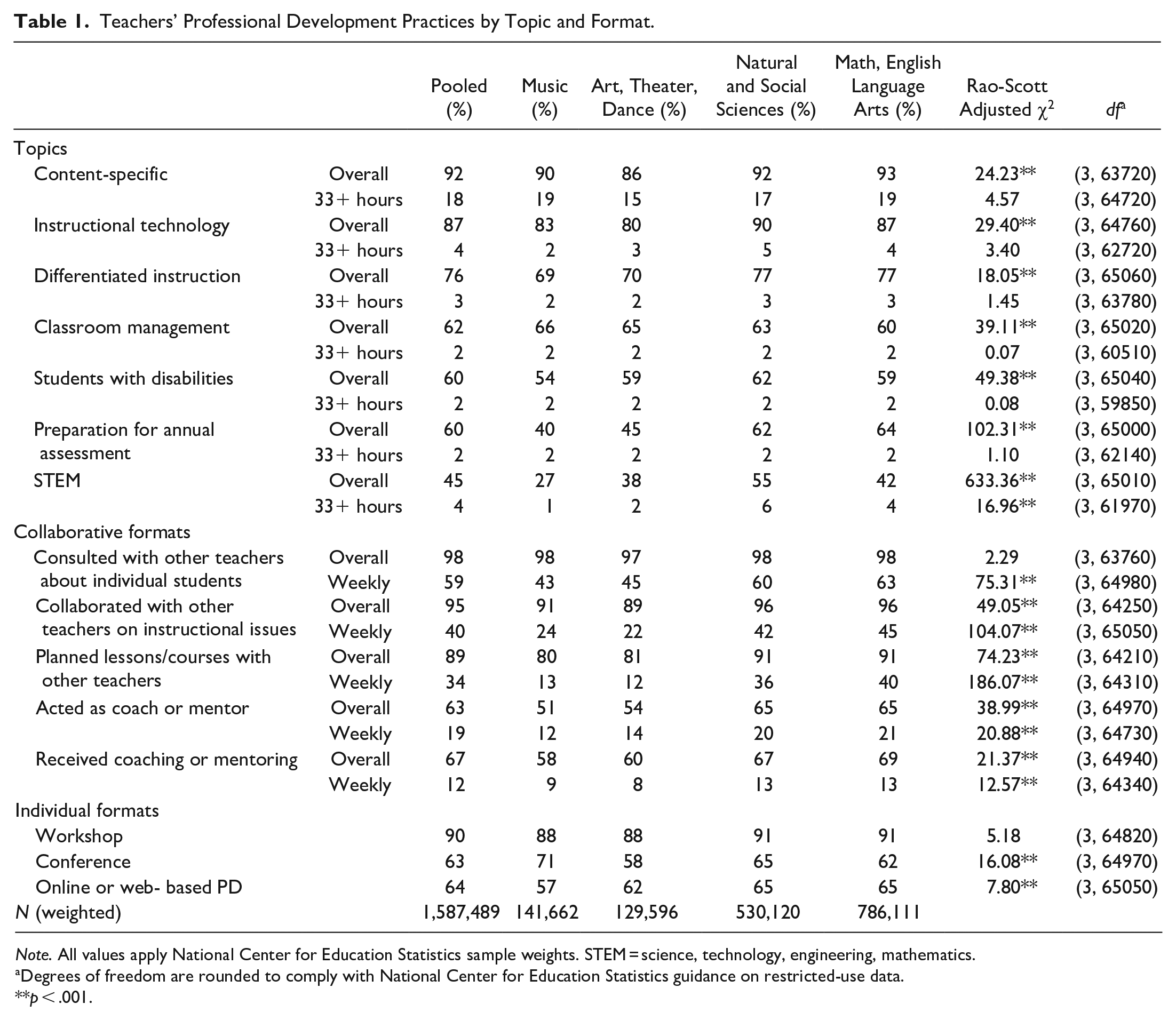
Note. All values apply National Center for Education Statistics sample weights. STEM = science, technology, engineering, mathematics.
Degrees of freedom are rounded to comply with National Center for Education Statistics guidance on restricted-use data.
p < .001.
Topics
Music teachers
Content-specific PD (90%) and instructional technology PD (83%) were the most popular topics, followed by PD on differentiated instruction (69%), classroom management (66%), and students with disabilities (54%). Fewer than half of music teachers partook in STEM (science, technology, engineering, mathematics) PD (27%) or PD on preparation for annual assessment (40%).
Cross-discipline comparisons
Chi-square analyses showed a significant discipline-based association for each of the seven topics surveyed, although the magnitude and directionality of the differences varied. In some instances, differences were absent or minor. For example, although music teachers participated in content-specific PD at a statistically significantly different rate (90%) than MELA teachers (93%), this disparity may not be practically meaningful. Likewise, the nominal difference between music teachers (90%) and ATD teachers (86%) in content-specific PD participation was not statistically significant. Findings also revealed music teachers’ sustained participation (33 or more annual hours) was concentrated in content-specific PD (19%), a rate statistically indistinguishable from ATD, NSS, and MELA teachers. These data suggest music teachers’ content-specific PD access was largely in line with their higher stakes peers in MELA and NSS, and if anything, ATD teachers emerged at a minor disadvantage.
For noncontent PD topics, the between-discipline differences were slightly bigger, although not in ways that always disfavored music and ATD teachers. For instance, music teachers were significantly less likely to participate in PD on differentiated instruction (69%) compared to MELA and NSS teachers (both at 77%), but they were significantly more likely to participate in classroom management PD (66%) than MELA teachers (60%). For PD on teaching students with disabilities, music teachers (54%) were significantly below NSS teachers (62%) but statistically indistinguishable from MELA and ATD teachers (both at 59%). For some topics, discipline-driven associations were more pronounced. Compared to MELA and NSS teachers, music teachers were between 15 and 28 points less likely to engage in STEM PD and more than 20 points less likely to take PD on preparation for annual assessment. Within the arts, music and ATD teachers had similar participation rates except for STEM PD (music = 27%, ATD = 38%). Notably, ATD teachers’ STEM PD uptake was statistically indistinguishable from MELA teachers’ (42%). The frequency of teachers reporting 33 annual hours or more was at or below 6% for all but one surveyed topic (content-specific PD). The only topic in which sustained participation was significantly associated with discipline was STEM PD, where NSS (6%) and MELA teachers (4%) outperformed music (1%) and ATD teachers (2%).
Formats
Music teachers
Music teachers almost universally reported consulting with colleagues about individual students (98%) and were nearly as likely to collaborate with other teachers on issues of instruction (91%). Four in five music teachers reported collaborative planning of lessons/courses. Smaller majorities indicated receiving coaching or mentoring (58%) and acting as a coach or mentor (51%). As for individual PD, an estimated 88% of music teachers participated in a workshop, and about 71% attended a conference. At 57%, online or web-based PD was less popular. Music teachers were most likely to engage weekly in consultation with other teachers about individual students (43%) and collaboration with other teachers on instructional issues (24%). Weekly participation in collaborative planning (13%) and in giving (12%) or receiving (9%) coaching or mentoring were all much lower.
Cross-discipline comparisons
Music and ATD teachers were significantly less likely to partake in nearly every format of collaborative PD relative to MELA and NSS teachers. The differences ranged from about 7 points (collaboration with other teachers on instructional issues) to 14 points (acted as a coach or mentor). The only exception was consultation with other teachers about individual students, where I found no significant discipline association. When considering weekly collaboration, the differences were starker. Of the NSS and MELA teachers, 36% and 40%, respectively, said they planned lessons or courses with other teachers once or a few times a week. Corresponding rates for music and ATD teachers were 13% and 12%, respectively. A similar pattern held for collaboration on instructional issues, where music and ATD teachers were almost 20 percentage points less likely to report weekly participation. Comparative analyses of individual PD participation showed music teachers’ conference attendance rate (71%) significantly outpaced ATD (58%), NSS (65%), and MELA teachers’ (62%). Conversely, music teachers were significantly less likely to report participation in online or web-based PD (57%) relative to ATD (62%), NSS (65%), and MELA teachers (65%). I found no discipline-driven association in workshop participation (pooled rate = 90%).
PD Perceptions
Teachers’ perceptions of PD quality and utility are reported in Table 2.
Teachers’ Perceptions of Professional Development Quality and Utility.
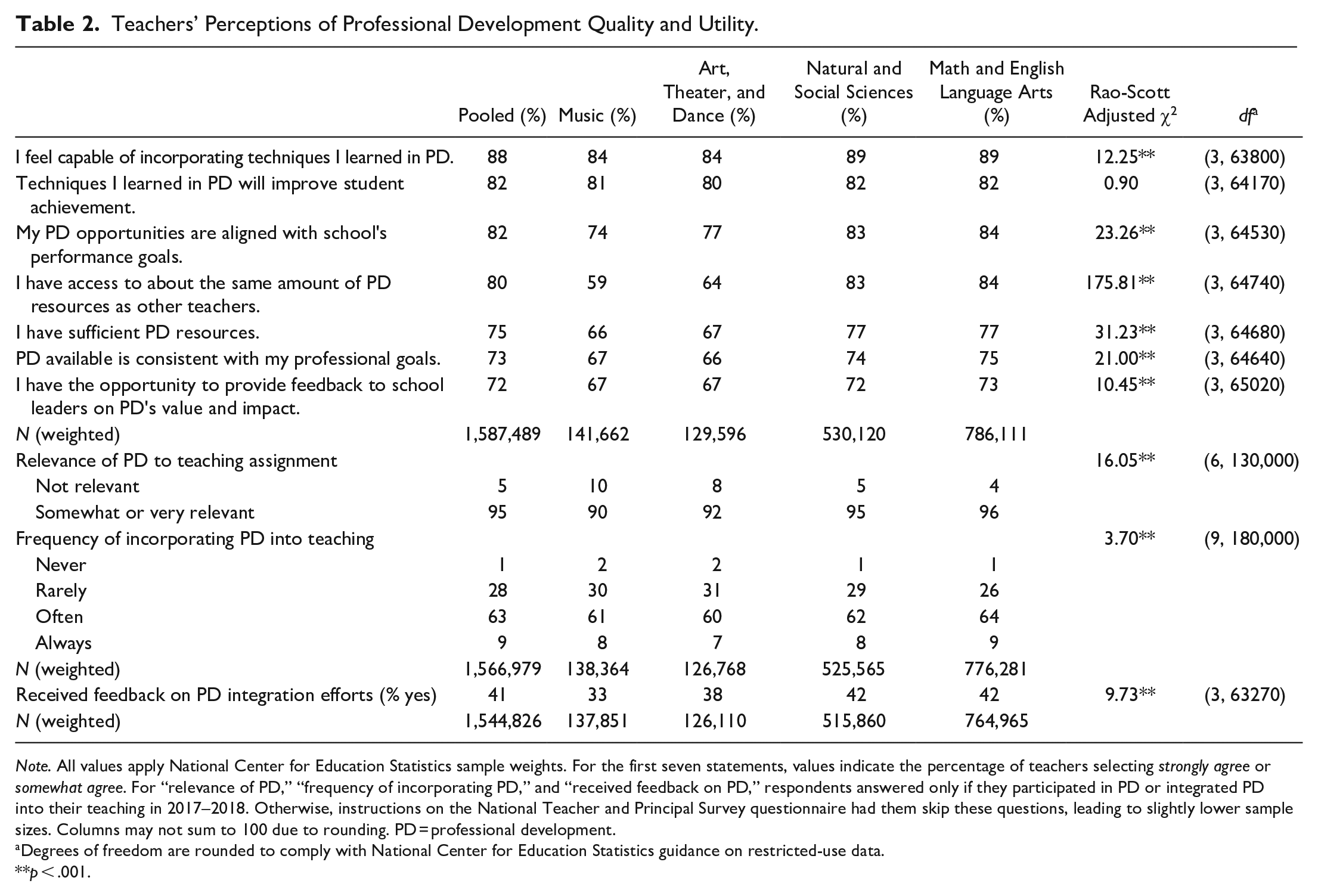
Note. All values apply National Center for Education Statistics sample weights. For the first seven statements, values indicate the percentage of teachers selecting strongly agree or somewhat agree. For “relevance of PD,” “frequency of incorporating PD,” and “received feedback on PD,” respondents answered only if they participated in PD or integrated PD into their teaching in 2017–2018. Otherwise, instructions on the National Teacher and Principal Survey questionnaire had them skip these questions, leading to slightly lower sample sizes. Columns may not sum to 100 due to rounding. PD = professional development.
Degrees of freedom are rounded to comply with National Center for Education Statistics guidance on restricted-use data.
p < .001.
School PD Conditions
Music teachers
Although majorities of music teachers agreed with each statement, levels of agreement ranged widely. For instance, 84% of music teachers felt capable of incorporating PD-derived techniques into their teaching, but only 67% believed that the PD available was consistent with their professional goals.
Cross-discipline comparisons
On every given statement save for one (the belief that PD techniques will improve student achievement), music and ATD teachers’ sentiments were less favorable than NSS and MELA teachers’, with the largest difference on the statement, “I have access to the same amount of resources for PD as other teachers.” Of the music and ATD teachers, 59% and 64% agreed, respectively, while rates for NSS and MELA teachers were at least 20 percentage points higher. The smallest difference, although still statistically significant, was in response to the statement, “I have the opportunity to provide feedback to school leaders on PD’s value and impact.” Sixty-seven percent of music and ATD teachers agreed, a few points off from NSS (72%) and MELA teachers (73%).
PD Utility
Music teachers
Music teachers overwhelmingly described their PD as somewhat or very relevant to their teaching (90%). Most music teachers said they often or always incorporated PD into their teaching (combined 69%). Although only 2% of music teachers said they never incorporated PD, a reasonably high 30% said they rarely did so. Only 33% of music teachers reported receiving feedback on their PD integration efforts.
Cross-discipline comparisons
Music teachers’ relevance ratings were comparable to ATD teachers (92%) but significantly different from NSS (95%) and MELA (96%) teachers. Music teachers and ATD teachers were about twice as likely as MELA and NSS teachers to describe their PD as not relevant. Rates of incorporation were also significantly associated with discipline, driven by the difference between ATD teachers and MELA teachers. PD incorporation rates among music teachers were not significantly different from ATD, NSS, or MELA teachers. Music teachers (33%) were significantly less likely than NSS and MELA teachers (both at 42%) to report receiving feedback on their PD integration efforts. I found no significant differences between ATD teachers (38%) and other teachers on receipt of feedback.
PD Policies
Rates of teachers reporting various PD policy supports are presented in Table 3.
Teachers Reporting Selected Professional Development Policy Supports.
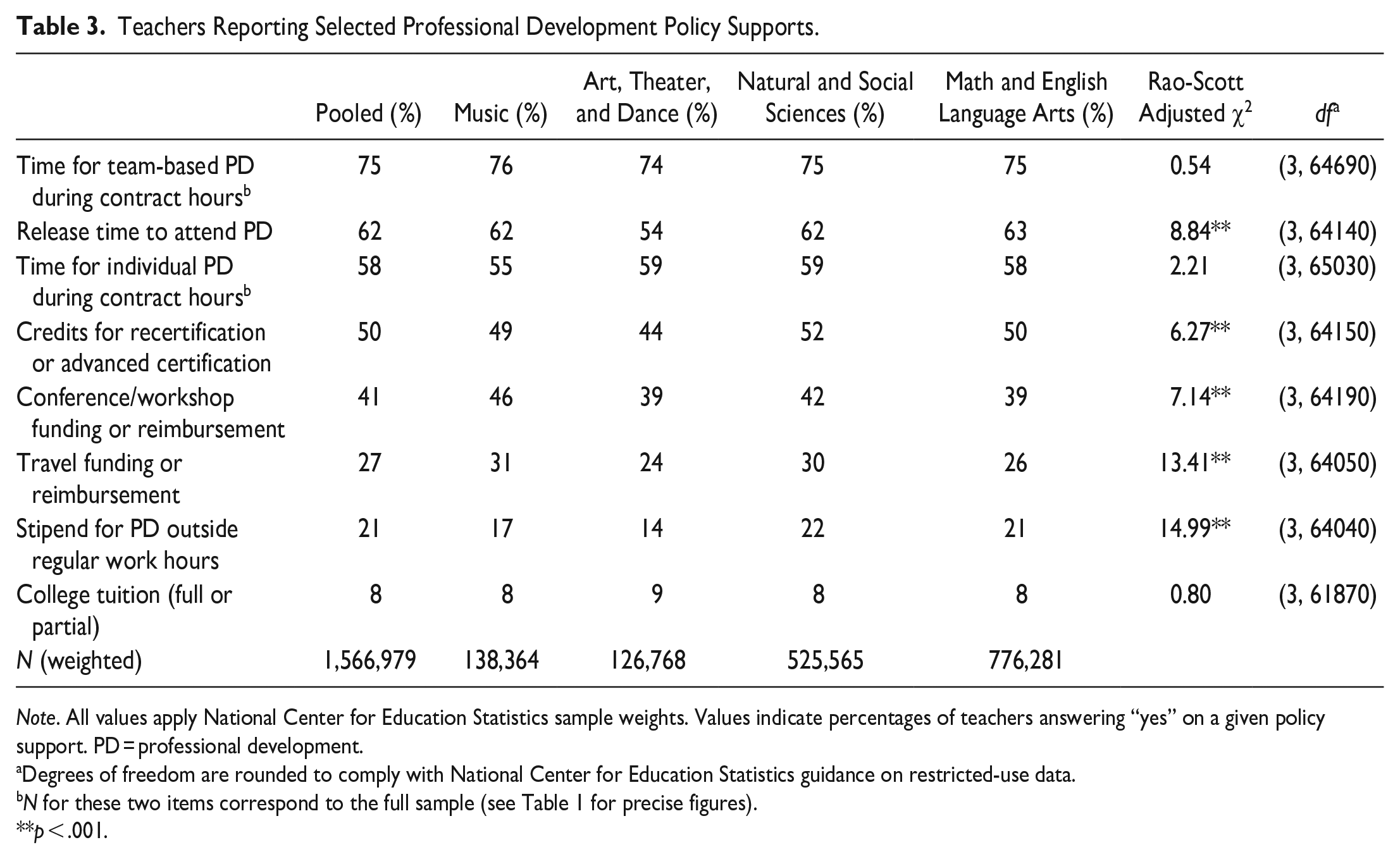
Note. All values apply National Center for Education Statistics sample weights. Values indicate percentages of teachers answering “yes” on a given policy support. PD = professional development.
Degrees of freedom are rounded to comply with National Center for Education Statistics guidance on restricted-use data.
N for these two items correspond to the full sample (see Table 1 for precise figures).
p < .001.
Music Teachers
Time provisions were the most prevalent, with majorities of music teachers indicating time during contract hours for team-based (76%) or individual PD (55%) and instructional release time to attend PD (62%). Other policy supports were less common. Less than half of music teachers received credits for recertification/advanced certification (49%) or funding for conference and workshop attendance (46%). Travel funding (31%), stipends for PD outside regular work hours (17%), and college tuition subsidies (8%) were the least likely to be reported by music teachers.
Cross-Discipline Comparisons
Although significant discipline-based associations were revealed for five of the eight policies surveyed, music teachers were not consistently disfavored. On funding for conferences or workshops, music teachers (46%) were more likely to receive support relative to ATD (39%) and MELA teachers (39%). Music teachers (31%) enjoyed travel funding or reimbursement at a rate like NSS teachers (30%) and significantly higher than ATD (24%) and MELA teachers (26%). Music teachers also matched NSS and MELA teachers on release time to attend PD (about 62%), with the significant association being driven by lower levels of release among ATD teachers (54%).
Application and Discussion of PD Effectiveness Criteria
I now consider music-specific and comparative results alongside the six PD effectiveness criteria outlined earlier (content specificity, social interaction, sustained duration, relevance, agency, policy support). I take each criterion in turn, contextualizing present findings with prior data on music teacher PD from 1993 to 2012 (West, 2021) and then submitting recommendations for future research and policy.
Content Specificity
At 90%, content-specific PD participation in 2017–2018 was at the most robust level yet documented for music teachers, exceeding the previous high-water mark of 80% (West, 2021). In an apparent departure from Gallo (2018), who found music teachers participated in less content-specific PD than English language arts teachers and more than math, science, and social studies teachers, music teachers in this study enjoyed similar levels of content-specific PD as their peers in high-stakes and low-stakes subjects. Scholars should scrutinize the factors driving such strong content-specific PD participation. For one, it appears that the rise in content-specific PD participation corresponded to increased participation across other topics, too. Music teachers in 2017–2018 reported more PD related to instructional technology (83%), classroom management (66%), and serving students with disabilities (54%) than parallel data from 2011–2012: 58%, 43%, and 25%, respectively (West, 2021). Music teachers are clearly engaging in more PD overall and not just PD related to their content areas, but additional study is needed to understand why. Researchers ought to also examine PD nonparticipation. About 10% of music teachers reported a lack of content-specific PD, and about 2% reported no PD engagement at all. Detailed profiles of these teachers would shed light on this finding. Perhaps they are more likely to work in traditionally underserved areas (e.g., rural schools) or in sectors of the education system where state and federal PD inducements have little or null influence (e.g., charter and private schools). Maybe PD experiences were available, but the teachers opted against participation for lack of time or insufficient administrative support (West et al., 2021) Whatever the cause, it is important for scholars and policymakers to grasp—and remove—obstacles between music teachers and meaningful, content-rich PD.
Social Interaction
Music teachers’ access to socially interactive PD was healthy in 2017–2018, led by a full 98% consulting with colleagues about individual students. Even the least reported collaborative PD experiences, giving or receiving mentoring/coaching, reached a majority of music teachers. This represents a sharp rise in socially interactive PD access since West (2021) established that “only one third to two thirds of [music] teachers participated in observation, collaboration, or mentoring/coaching” (p. 335) between 1999 and 2012. Although this course is not certain to continue, it is nevertheless significant given the well-documented potential of collaborative PD to ease music teacher isolation (Sindberg, 2016), build social capital (West, 2019b), or simply provide informal contexts for professional exchange (Stanley et al., 2014). That said, to the extent music-specific findings were promising, cross-discipline comparisons were decidedly less so. Except for one category (consultation with other teachers about individual students), music and ATD teachers were much less likely to collaborate than NSS and MELA teachers. Such discrepancies are not altogether surprising given arts teachers’ minority status in most schools. However, they still need scrutiny, especially in the policy domain. Core-subject teachers typically have on-campus access to many colleagues with whom they could collaborate. Music teachers and ATD teachers often lack such a critical mass and thus require logistical and scheduling accommodations to create one (e.g., instructional release for travel to another campus). Access to these policy supports is not sufficient overall, as I address elsewhere in this article, but they could have outsize effects on teachers’ ability to collaborate. The field would benefit from new scholarship and policy aimed at increasing teacher collaboration in the arts.
Sustained Duration
Music teachers engaged in minimal sustained PD in 2017–2018. Participation in at least 33 annual hours was at or below 2% for six of seven surveyed topics, the lone exception being content-specific PD (19%). Although these results align with what I found previously (West, 2021), notable in the current study was the lack of differential access to sustained PD as a function of discipline. Strikingly few teachers, irrespective of subject area, participated in more than 33 annual hours of PD on any topic. Teachers clearly did not partake in PD at recommended levels (e.g., 100–120 annual hours; Banilower et al., 2007; Blank et al., 2008; Ramey et al., 2011). Although this outcome is inconsistent with prevailing theory—sustained duration remains a core tenet in PD effectiveness frameworks (Barrett, 2006; Darling-Hammond et al., 2017; NAFME, 2015; West, 2021)—it ought not automatically raise concerns for PD efficacy. Recent scholarship in general education has called into question the presumption that longer PD is always more effective. More salient may be PD’s responsiveness to teachers’ needs, regardless of its duration (Foster et al., 2013; Ramey et al., 2011). Basma and Savage (2018), in a meta-analysis of 17 studies on literacy-focused PD programs, found that shorter PD may be more impactful because it focuses on “simpler, more encapsulated and specific elements, strategies, and resources” (p. 468). This suggests the sustained duration principle may benefit from updates in recognition that routine pedagogical or professional challenges can be addressed via short-term PD, while difficult or deeply rooted problems may be more amenable to long-term PD (Desimone & Garet, 2015).
As I again show in this study, music teachers’ tendency toward shorter term PD experiences has been firmly established (Gallo, 2018; Parsad & Spiegelman, 2012; West, 2021). Bauer (2007) noted in a review of literature: “While a number of studies seem to indicate that extended experiences are more beneficial than short-term in-services, further examination of this question is needed” (p. 16). Unfortunately, no such agenda has since materialized. In fact, Bauer et al.’s (2003) investigation of a technology-focused summer PD workshop remains one of the only empirical considerations of time in relation to PD effectiveness for music teachers. Their conclusion that the PD’s effects progressively diminished as time accrued after the workshop reinforces the sustained duration principle, but it needs revisiting. Considering recent findings showing time as a more nuanced and perhaps less linear contributor to PD outcomes in general education, this is an opportune moment to determine whether the same may hold for music educators.
Relevance
Relevance sentiments were mixed in 2017–2018. On the one hand, music teachers overwhelmingly believed their PD experiences were somewhat or very relevant to their practice (90%), an apparent uptick from West (2021), when perceptions of relevance peaked at about 80% for teachers who had participated in content-specific PD. 6 On the other hand, comparative analyses showed that music and ATD teachers were twice as likely as MELA and NSS teachers to describe their PD as not relevant, signifying that arts teachers faced higher hurdles in their pursuit of germane PD. Moreover, despite 90% relevance ratings, an estimated one in three music teachers reported never or rarely incorporating PD into their teaching, revealing a nontrivial group of music teachers for whom relevance did not beget implementation. PD’s value is diminished when teachers do not apply what they learn, yet implementation behavior remains undertheorized in the music teacher PD literature. Scholars have generated numerous accounts of what music teachers think about PD, yet we still lack robust data on what music teachers do with PD.
Two recent studies offer pathways for much-needed inquiry into PD implementation, one empirical and the other theoretical. On the empirical side, Osman and Warner (2020) validated a new measure of teachers’ motivation for PD implementation. They situated their work in expectancy-value theory: expectancy for success (e.g., “I believe I can be successful applying this training”), task value (e.g., “Participating in this training will help me in my job”), and perceived cost (e.g., “Applying this professional development will require too much effort”). It follows that some teachers may find a PD intervention relevant to their work but nevertheless have reservations about how valuable or disruptive it is to their practice. Measuring implementation motivation would be instructive, especially to PD designers. On the theoretical side, West (2020) posited a model showing that implementation was driven by music teachers’ “animating belief that their conference PD experiences meet with, or converge on, their classroom teaching experiences to the greatest extent possible” (p. 77). These judgments of convergence turned on three factors: relevance (germaneness to practice), impact (probability of positive change), and practicability (feasibility of application). The more convergent music teachers deemed a PD intervention, the more probable was implementation. West’s theory could help explain why music teachers in the current study were much more likely to categorize PD as relevant than they were to report incorporating PD into their classroom practice. Perhaps implementation behavior is indeed affected by factors beyond relevance alone. I did not in this study make such discriminations, but they pose critical questions for future research.
Agency
In the PD context, agency has been defined as teachers’ “capacity to self-determine needs, choose relevant over nonrelevant PD, and obtain deference and practical support for favored changes” (West, 2021, p. 334). Findings revealed that music and ATD teachers, especially in contrast to NSS and MELA teachers, struggled in 2017–2018 to meaningfully shape their PD experiences. In fact, of the six effectiveness criteria I applied in this study, the agency results were the only to consistently show music and ATD teachers at a stark disadvantage. Relative to NSS and MELA teachers, music and ATD teachers were substantially less likely to report that the PD available was consistent with their professional goals, that they had opportunities to provide feedback to school leaders on PD’s value and impact, and that they felt capable of incorporating PD techniques into their teaching. Interestingly, even as prominent PD theories in general education have typically lacked overt invocations of agency (Boylan et al., 2018), voluntariness and autonomy are pivotal themes in many music-specific models (e.g., Barrett, 2006; NAFME, 2015, Stanley et al., 2014; West, 2021), not least because, of those likely involved, music teachers themselves are best positioned to understand and act on their PD needs (Spruce et al., 2021). To this end, further exploration of the disappointing agency findings in this study are warranted. An obvious place to begin is to examine discipline-associated discrepancies in access to PD resources and in conveying PD-related feedback to school administrators. This is particularly troubling given the demonstrated importance of local supports and teacher-administrator relations to music program health (Abril & Bannerman, 2015). When lines of communication are constricted or basic PD resources unavailable, agentic action is effectively impossible. To the extent this describes the PD system for one in three music teachers, as I show here, researchers and policymakers ought to make explicating and reversing it a priority.
Policy Support
Music teacher PD was supported more by time than money in 2017–2018. Substantial majorities of music teachers reported favorably on all three time-focused policies surveyed (i.e., contract time for team-based or individual PD, release time to attend PD); funding supports had an appreciably more limited reach, with only 31% and 46% of music teachers reporting travel and conference/workshop funding or reimbursement, respectively. Perhaps counterintuitively, in cross-discipline comparisons, music teachers’ reported policy supports equaled or exceeded those of their high-stakes and low-stakes colleagues in some instances. Music teachers were more likely to have travel funding or reimbursement relative to MELA teachers, more likely to have conference/workshop activities funded by their schools relative to NSS teachers, and just as likely to be granted PD release time relative to both NSS and MELA teachers. Moreover, between 2011–2012 (West, 2021) and the current study on 2017–2018, music teachers were 20 percentage points more likely to report PD release time, 10 points more likely to report travel funding, and about 6 points more likely to report credits toward certification; other surveyed policies appeared unchanged (i.e., travel funding, contract-time PD, stipends for PD outside contract hours, college tuition reimbursement). That there has been no obvious degradation and some material improvements in PD policy in recent years confirms what Gallo (2018) concluded: “The common assumption that music educators are generally less supported within their schools does not hold true” (p. 168).
Evidence showing music teachers did not face systematic policy disadvantages is a promising development, but there is more to do. There is not yet clear data that PD policy properly accounts for discipline-based asymmetries in teachers’ PD involvements. I argued in prior work that PD policy ought to vary by discipline because barriers to PD access often vary by discipline (West, 2021). Discipline-neutral rules may appear fair but could nonetheless have disparate effects. Consider a district policy providing all teachers $150 toward the cost of attendance at one professional conference against a policy providing teachers who work as sole specialists $500 for the same. Although the former would be neutral, the latter is equitable because it channels finite funds to teachers who disproportionately rely on off-site PD for subject-specific content and exchange.
Equity-minded school officials would find it appropriate, even necessary, for policy to account for the discipline-based substantive and administrative differences in how teachers engage in PD. Music education researchers have widely covered substantive distinctions—for instance, promoting PD policy that recognizes music teachers’ identities as artists and musicians (NAFME, 2015, Pellegrino, 2011)—but they have not been as attentive to administrative components such as how music teachers might typically pay for PD and to what extent (and under what conditions) music teachers’ requests for off-site PD are approved by school officials. General education scholars have examined PD-related fiscal and operational issues, including aggregate estimates of PD expenditures (Jacob & McGovern, 2015; Killeen et al., 2002) and the development and application of frameworks for measuring PD’s costs and benefits (Foster et al., 2013; Miles et al., 2004; Odden et al., 2002). A similar agenda would be useful in music education. Indeed, it matters little if the field understands the attributes of effective PD if it cannot reliably and equitably ensure access to it.
Conclusions and Limitations
In this study, I sought to describe music teacher PD in 2017–2018 and to determine whether there were material differences in the PD experiences of music teachers, other arts teachers, and teachers in high-stakes and low-stakes disciplines. Applying the six PD effectiveness criteria with respect to the first research question, results indicated robust (content specificity, social interaction), mixed (relevance, policy support), and deficient (sustained duration, agency) conditions for music teachers in 2017–2018. These outcomes show stability and, in some respects, clear improvement since the prior national assessment of the music teacher PD system (West, 2021) and the passage of ESSA in 2015. With respect to the second research question, cross-discipline comparisons showed that PD access and quality were associated with stakes in some domains (social interaction, relevance, agency) while being largely immaterial in others (content specificity, sustained duration, policy support). Although the differences were not as stark or as systematic as one may have surmised at the outset, my analyses indicate that in 2017–2018, music and ATD teachers generally, if not overwhelmingly, operated on less favorable PD terrain than NSS and MELA teachers.
My application of the six effectiveness criteria revealed myriad areas worthy of continued consideration. Yet I close by drawing attention to where the PD system most consistently and pronouncedly fell short: agency. That this was the case for music and ATD teachers, and not merely music teachers, highlights the potential for ameliorative, intra-arts coalitional work. Coalitions in arts education are commonplace, but they are usually aimed at boosting funding and program supports generally and not on arts teacher learning and PD particularly. Given the results of this study, there is an excellent opportunity for this dynamic to shift. PD access and quality concerns for arts teachers are often owed to their numeric disadvantage in most schools. While it may be tough for any single arts teacher to revamp a deficient PD system within a campus or district, arts teachers working in tandem would presumably wield more influence. Moreover, a PD system in which arts teachers have voice in PD design and implementation is likely a system in which teachers use their influence to advocate for more relevant PD and better PD policy. Thus, increasing arts teacher agency in the PD space—individually or via coalitions—would likely have immediate and comprehensive consequences.
Readers should interpret findings considering four important limitations. First, in this study, I did not seek to establish how various factors statistically contributed to PD behavior or policy. My conclusions and conjectures in that regard were based on the application of effective PD theory. Future scholars may wish to go further, for instance, by estimating the influence of policy conditions (e.g., release time, funding) or teacher sentiment (e.g., perceived relevance of PD) on the types or amount of PD teachers take. Second, the NTPS was meant to capture perspectives from a cross-section of teachers and other school personnel. Although in my view NTPS’s national scope and capacity for cross-discipline comparisons compensates for its generic nature, this inquiry was nevertheless bound by the items included and excluded on the survey. Third, the non-music teacher groups I sampled (i.e., ATD, NSS, MELA) were chosen to represent three different positions in the test-based accountability system in the United States. Although I did not consider PD practice or policy relating to the individual disciplines within these groups (e.g., art vs. theater), there may be interesting insights and discriminations gleaned from such an inquiry. Fourth, and finally, the data in this study, from 2017–2018, predate the COVID-19 pandemic and its impacts on teaching and learning in the United States. In the years ahead, with postpandemic data, it will be necessary to revisit many of the questions and trends I addressed here.
Supplemental Material
sj-docx-1-jrm-10.1177_00224294231180084 – Supplemental material for Professional Development Among U.S. Music and Non-Music Teachers: Comparative Evidence From the 2017–2018 National Teacher and Principal Survey
Supplemental material, sj-docx-1-jrm-10.1177_00224294231180084 for Professional Development Among U.S. Music and Non-Music Teachers: Comparative Evidence From the 2017–2018 National Teacher and Principal Survey by Justin J. West in Journal of Research in Music Education
Footnotes
Declaration of Conflicting Interests
The author declared no potential conflicts of interest with respect to the research, authorship, and/or publication of this article.
Funding
The author received no financial support for the research, authorship, and/or publication of this article.

Notes
Author Biography
References
Supplementary Material
Please find the following supplemental material available below.
For Open Access articles published under a Creative Commons License, all supplemental material carries the same license as the article it is associated with.
For non-Open Access articles published, all supplemental material carries a non-exclusive license, and permission requests for re-use of supplemental material or any part of supplemental material shall be sent directly to the copyright owner as specified in the copyright notice associated with the article.
