




Abstract
The 2020 Norwegian national curriculum for primary, lower secondary, and upper secondary education includes a “competence aim” after Year 7 that expects pupils to be able to “investigate how gender, gender roles, and sexuality are presented in music and dance in the public sphere and create expressions that challenge stereotypes.” This article reviews four focus group interviews in which music teachers discussed the relevance and application of the new competence aim and their own experiences with gender roles and gender-expansive expressions among their pupils in their music practices. Using analytical tools from the field of discourse psychology, we trace and identify the discursive resources or “repertoires” that music teachers draw on when approaching questions of gender roles, gender identities, and sexuality. While the repertoires in question imply that the teachers hold progressive views about gender identities and expressions, the notion of “ideological dilemmas” enables us to ask whether the progressive attitudes may in fact also work to confirm perceptions of normative, binary gender conformity, hence also delimiting the diversity and freedom of gender expression that the repertoires seem to celebrate. We suggest that a queer pedagogical thinking can offer music teachers tools to address topics related to gender roles, sexuality, and queerness in their music educational practices.
Similar to countries across the world, Norway currently finds itself in the middle of a charged and growing debate concerning questions of gender identities and sexual diversity. Spurred on by the Minister of Culture and Equality’s pledge to commission a report on the possibility of introducing a third legal gender option in Norway (Bakke, 2021; Ministry of Culture and Equality, 2022), the debate spans social media platforms, national newspapers, academic journals, and broadcast media and draws voices from a variety of academic fields, political interest groups, and religious communities. 1 The discursive urgency with which gender issues are treated also extends to the Norwegian national curriculum for Years 1 through 10, which, in its 2020 revision, introduced new “competence aims” in music, religion, and social science to increase pupils’ understanding of and deepen their reflection on gender expressions and identities. Hence, in the music subject, pupils in Year 7 are expected to be able to “investigate how gender, gender roles, and sexuality are presented in music and dance in the public sphere and create expressions that challenge stereotypes” (Norwegian Directorate for Education and Training, 2020).
In this article we analyzed four focus group (FG) interviews in which music teachers discussed the relevance and application of the new competence aim and their own experiences with gender-expansive 2 expressions among pupils in their music practices. Our overall purpose was to inquire into the discursive repertoires (Edley, 2001) available to and operationalized by teachers in experiencing, reflecting on, and debating gender identities and expressions. This, we maintain, is important for at least two reasons. First, music teachers work with and through materials and activities that hold considerable significance in young people’s lives. The discursive repertoires enacted to articulate music in the context of gender may, by association, acquire similar significance for pupils’ understanding of themselves and others as (non)gendered subjects. Second, researchers have shown that music education is a thoroughly gendered field of practice (Green, 2002; Onsrud, 2015; Roulston & Misawa, 2011). However, as has been argued by popular music researchers, in music as a field of practice, gender relations and hierarchies are under significant scrutiny, deconstruction, and renegotiation (Green, 2002; Hansen, 2022a; McClary, 2002). Hence, music teachers are in a privileged position to understand and even contribute to the debate with their pupils, colleagues, stakeholders, and the public in general (Garrett & Palkki, 2021; Onsrud, 2021). The potential of music education to investigate and challenge such issues is supported by research across the globe. Previous researchers have demonstrated that music education plays an important role in students’ social and cultural (gender) development process (Abramo, 2011; Edley, 2001; Eerola & Eerola, 2014; Iverson, 2011; Lam, 2018; Onsrud, 2015; Roulston & Misawa, 2011) and in the collective effort to challenge (or maintain) gendered social hierarchies (Karvelis, 2018; McBride & Palkki, 2020; Onsrud, 2012; Silveira & Goff, 2016).
However, little is known about the language in use when teachers approach topics on gender-expansiveness and sexuality in their classrooms with their pupils. In exploring Norwegian music teachers’ thoughts and statements about the new Norwegian curricular aims to address gender roles and challenge stereotypes in the music subject, the present study serves as a case in this regard. By using analytical tools from the field of discourse psychology, we trace and identify the discursive resources or “repertoires” (Edley, 2001) that music teachers draw on when approaching questions of gender, gender identities, and sexuality. Equally, we are interested in what the repertoires imply about the broader ideological situation and dilemmas they emerge from and contribute to uphold or challenge. Thus, our objective is to identify how the teachers’ repertoires on gender roles, gender-expansiveness, and sexuality are enacted and made possible through discourse. We ask the following questions: (1) Which interpretative repertoires are drawn on by a sample of music teachers when discussing gender, gender expressions, and sexuality in light of the Norwegian music subject curriculum? and (2) Which ideological dilemmas emerge from these repertoires?
The repertoires will be presented as separate headlines under the findings and discussion section, immediately followed by a discussion of the broader “ideological dilemmas” (Edley, 2001) emergent within and across the repertoires that constitute important sites of meaning making over which different repertoires struggle to achieve dominance.
Interpretative Repertoires
An “interpretative repertoire” can be understood as “basically a lexicon or register of terms and metaphors drawn upon to characterize and evaluate actions and events” (Wetherell & Potter, 1987, p. 138). Different interpretative repertoires provide different (even contrary) registers of terms, narratives, and rationales for objects and events. Together, they are “part and parcel of every community’s common sense” (Edley, 2001, p. 198). In our application, interpretative repertoires denote the distinguishable patterns of narration, explanation, and reflection regarding gender non/normativity 3 that we found in four FG interviews with Norwegian music teachers.
Discourse analytical studies often focus on the patterning of the positions taken up by users (Davies & Harré, 1990; Edley, 2001). In our study, the users were the teachers. However, rather than tracing individual positionings, we analyzed the interpretative repertoires of gender non/normativity themselves, the assumptions on which they seem to be based, and on the narratives and possibilities of identification they seem to offer. We recognize that the FG interview setting represents a discursive practice. Nevertheless, we take the strength and consistency of the discursive repertoires identified to indicate that these repertoires are also available to the teachers when teaching. Put otherwise, we speculate that they are enacted in music educational practice. Hence, they will come to constitute actual discursive possibilities of participation for pupils by ascribing to them places and positions in discourse from where the repertoires make sense.
Our analytical approach also includes the concept of “ideological dilemmas” (Edley, 2001). In the field of discourse psychology, ideology has come to acquire a meaning more similar to lived culture than to compelling belief, as in sociological traditions (Edley, 2001, p. 202). Furthermore, and following the logic of competing interpretative repertoires, the ideology of a society will not only be characterized by inconsistency and contradiction but will be driven by these (Edley, 2001, p. 203). In being sensitive to the dilemmas that animate conversations (i.e., the places of indeterminacy and tension), we examine the active dynamics of contemporary ideology and hence how discursive relations of meaning are continually being negotiated.
Queer Repertoires and Pedagogies
Judging from the current Norwegian and international debates on gender, gender identities, and sexuality, the interpretative repertoires enacted to understand and talk about with and to each other as non/gendered sexual beings are excessively concerned with repertoires: words, abbreviations, linguistic distinctions, and divisions. Gender pronouns and sexuality labels are of significant strategic importance in political struggles for recognition, and the repertoires they constitute are thus continuously subjected to social strife and resignification (Cayari et al. 2021; Garrett & Palkki, 2021).
Queerness has, however, come to take on meaning that goes beyond simple signification of attractional orientation and/or gender identity and could offer a theoretical lens to approaching the aforementioned competence aim, understood as a way of thinking beyond binaries. This discursive impact of queerness as an expanded concept is evident in Henderson’s (2019) entry-level introduction to queer/LGBTQ+ studies, where he writes that the term “queer” “predicates on the concept of nonnormativity as a natural and legitimate variation in human existence and relates to how one views, understands and acts in the world” (Henderson, 2019, p. 5). In the field of education, the queer pedagogy 4 similarly commits to a broader, critical perspective on normativity. Neto (2018) suggests a queer pedagogical approach in which one resists the hegemonic heteronormativity of a society by exploring the role of identities in the classroom, the nature of disciplines and the curriculum, and finally, the connection between the classroom and the broader community (Neto, 2018, p. 591). He further advocates that focusing on language use among the participants in the pedagogical context is crucial for a queer pedagogy that aims to recognize and include a variety of gender expressions (p. 601). Sympathizing with this stance, we investigate in this article the language-in-use when Norwegian teachers reflect on gender expressions and classroom practices, display the repertoires they draw on in doing so, and explore the dilemmas that produce and are produced by these repertoires. We have no ambition of identifying and deciding on the most proper, productive, or pedagogically sound repertoires. Rather, our overall purpose is to support further queer-pedagogical efforts by mapping out the gender repertoires that teachers and researchers in the field of music education are habitually and undoubtedly subconsciously putting into play and thus also confronting them regarding such repertoires.
Onsrud (2021) recently offered perspectives on queer pedagogy as a tool for music teachers. She argued that “popular culture could be a relevant entrance into such [queer] issues, due to the queer turn in popular music as well as other areas, such as [the] film and television industry” (p. 135). Through an audiovisual analysis of the song “Girls” by the Norwegian singer-songwriter Girl in Red, Onsrud shows how the lyrics, music, and music video all promote a specter of (sometimes contradictory) layers of meaning. Still, Onsrud reminded the reader of the ambiguity of queerness in popular culture as something dynamic, as opposed to something fixed: Young people in Scandinavia today are surrounded by friends who are in transition. Some may call themselves pansexual, [while] others actively emphasize that they are still in a process when it comes to sexual orientation identity. “Girls”: does not cover the multiple possibilities of queerness at all. (p. 152)
Exploring queer music, music videos, queer personae, and other queer expressions from popular culture and social media platforms can be a useful tool for thinking queer pedagogy in the context of music education. There are always pitfalls to consider, such as avoiding othering of pupils, misrepresentation of queer expressions, and contributing to the reinforcement and maintenance of certain stereotypes. Moreover, no matter the carefulness with which one treads, even a queer music pedagogy can fail to be exclusively inclusive. Yet using cultural texts such as music videos is an available resource for teachers who are approaching the aforementioned competence aim. Following Edley’s (2001) arguments, as a discursive practice, music education thrives and develops through interpretative disagreements and dilemmas, social-border drawing and exclusion, and collective and individual distinctions. Dyndahl and Ellefsen (2009) argued for an approach to music education and music education research that takes as its starting point the discursiveness of music education, its complete cultural immersion, and the ever-ongoing negotiations of power and knowledge: No matter what didactic identity it claims for itself or is interpreted as conveying, the educational subject music is unavoidably obliged to constitute an aesthetic-functional field of constructing, performing and negotiating meaning and power, most notably relating to certain nodal points of subjectivity and identity. However, different didactic identities are significant with respect to which meanings and whose power are becoming dominant or marginal respectively. Thus, as part of its didactic - and didactologic - reflexivity, music education should be aware of what kind of cultural meaning and power it is dealing with in different situations and contexts. (p. 24, italic in Original)
While refraining from closing in on gender and sexuality, Dyndahl and Ellefsen’s (2009) approach is in line with queer pedagogical criticism and investigation of discursively constructed normativity. From their “culture-oriented didactic (research) approach,” we take that while music educational practices are always already happening within discourse, participants’ active identification with and subjectivation through the repertoires they use will necessarily also change discourse (including music educational practice).
The discursive performance of gender will never be a straightforward affair. We see this as an underlying premise for the analyses in this article. Nevertheless, the empirical materials on which the analyses are based do not provide grounds for analyzing pupils’ gendered subjectivation. What they do offer is insight into the conditions of possibility for pupils’ gendered subjectivation that the teachers’ interpretative repertoires constitute.
Methods, Research Participants, and Data Analysis
The data collection took place in 2021 through four FG interviews with 14 music teachers. 5 We utilized semistructured interviews so that we could extract and make use of “the knowledge-producing potentials of [the] dialogues” (Brinkmann, 2018, p. 579) in addition to promoting a freer conversation between the interviewer and the teachers and among the teachers themselves. We used purposive sampling (Schreier, 2018, p. 88) to collect rich information that could help answer the research questions. The teachers were sampled from all over Norway, from both rural and urban areas, to promote geographical diversity. We picked random schools from different locations. After receiving ethics approval for our study from the Norwegian Centre for Research Data, we contacted teachers directly by phone, after which we sent each of them an email with a registration form attachment. Twelve male and seven female teachers initially agreed to participate in the study, but five teachers withdrew from the study at a later date. Thus, a total of 14 teachers (11 male, 3 female) participated in the interviews. The interviews took place digitally, via Zoom (except for FG 1 6 ), and lasted for 60 to 90 minutes. Each focus group interview was conducted using a three-part interview guide. The first part (the initial stage of each interview) consisted of general questions (e.g., “What can you tell us about the pupils in your classes?” and “How are the class dynamics?”) to create an atmosphere in which the teachers could talk freely about their everyday practices. The second part evolved around the specific competence aim for Year 7. In FG 2 and FG 3 (in which the teacher participants knew each other), the conversation flowed freely without much prompting by the interviewer. In the third part (the final stage of each interview), the interviewer encouraged the teachers to share anecdotes and stories regarding their pupils, their experiences in relation to the competence aim, and stories about pupils who “stood out from the crowd.” 7
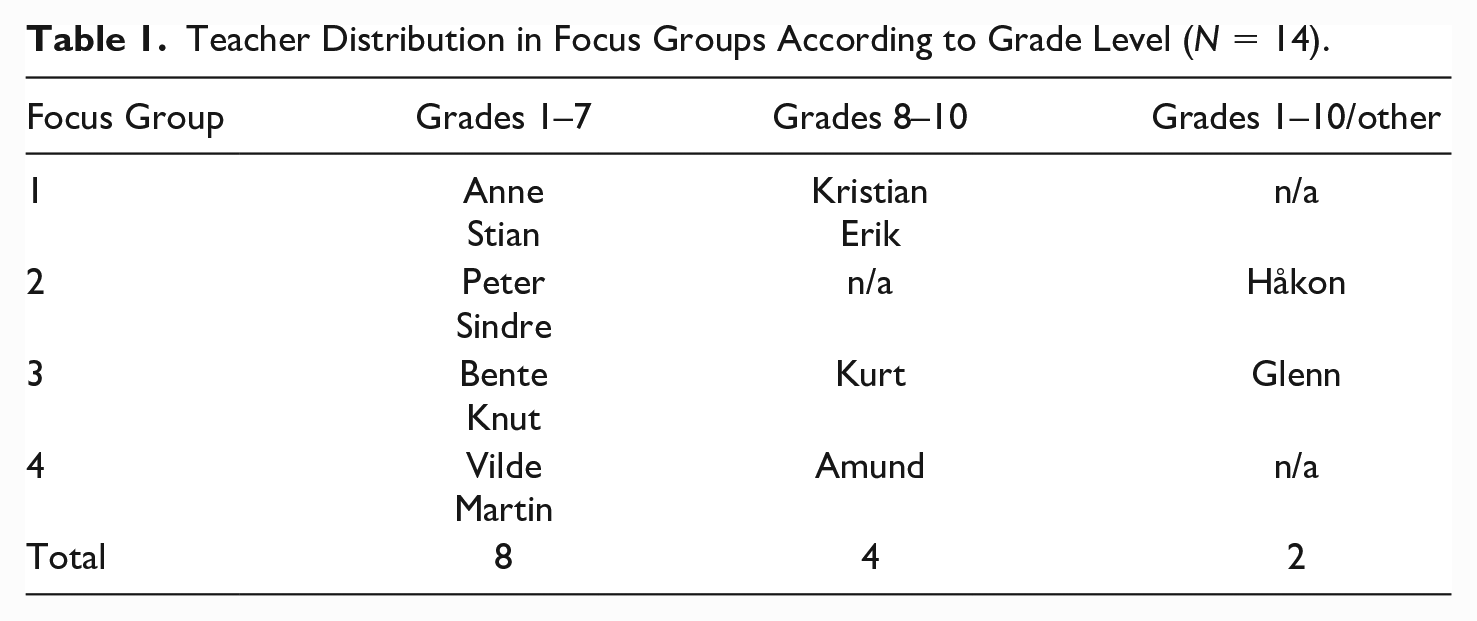
After transcribing and analyzing the four FG interviews, we decided that the data would provide sufficient findings for this study as we started to discover emerging patterns and a few similar experiences among the participants. We took this into consideration when we decided not to recruit more participants (cf. Schwandt, 2001, p. 111). However, we acknowledge that the skewed distribution of the participants in relation to gender may have influenced the data. Music subject didactics were integrated into all the teachers’ degrees because this was one of the criteria for participation in the study. Table 1 shows the distribution of the teachers in the FGs by level taught at their respective institutions (all the names are pseudonyms).
Teacher Distribution in Focus Groups According to Grade Level (N = 14).
The data were analyzed using the analysis program NVivo. In the initial analysis, utterances were placed under categories such as “masculine,” “feminine,” “boy behavior,” “girly,” “hip-hop,” “clothes and hair,” and “social media.” We then reread the data and replaced the utterances and stories in different cases (a sorting function in NVivo), which ultimately informed our recognized interpretative repertoires, as presented in the following section.
Findings and Discussion
In this section, we present and discuss the four interpretative repertoires and two main ideological dilemmas (cf. Edley, 2001) emerging from the analyses as described in the methods section. The repertoires “binaries” and “sexualized femininity” connect to and are followed by the dilemma “im/maturity and in/capacity,” while the repertoires “divergent masculinity” and “natural transitions” are followed by the dilemma “de/stabilizing gender norms.”
Repertoire: Binaries
Naturalized to the point of being invisible as an interpretative repertoire, the male/female gender binary permeated the teachers’ talk regardless of the topic in question. Indeed, when the teachers described the pupils they had met in their respective music classes, the binary served to evoke cultural archetypes, such as “football guys,” “babes,” “rowdy boys,” and “quiet girls,” as in the following interview excerpts: FG 1, Anne: I apologize for categorizing them like this (.), but, for example, the football guys, they are loud and boastful. They set the tone in class and have the (.) ‘babes’ (.) come along. FG 3, Glenn: Where I used to work, a group of rowdy boys who were seen as troublemakers showed a very different attitude and enthusiasm when I arranged for them to learn the guitar. They even performed for their parents, who practically hadn’t seen them achieve anything before.
Notwithstanding the teachers’ aversion to stereotyping, gendered archetypes were cast across the interview data, featuring the cool or tough boys, the choir girls, the outsiders, mature girls who exhibit alternative tastes in music, and the girls already absorbed in planning their russetid, a several-week-long party that accompanies upper secondary graduation in Norway. These constructs also assist in reiterating well-known narratives about boys’ lack of motivation and empowerment through practical learning, about girls’ preoccupation with boys and partying, about the puberty-related tension between the noisy boys and the grown-up girls, and about the classed superiority of the popular kids, as exemplified through Vilde’s statement: FG 4, Vilde: The boys (.) and girls (.) at the top [of the social hierarchy] have Gant sweaters (.). . . . And in the same groups, you have the quiet, conscientious girls who don’t have Gant sweaters and who thank me at the end of class. . . . I have a few dance girls sitting in between these quiet and conscientious girls, and (.), well, a lot of stereotypes from me here (.).
It comes as no surprise that the binary repertoire regulated the formation of other repertoires in the four FG interviews. Hence, pupils’ musicianship and musical interests, their leisure activities, their development toward puberty, and their sexuality are always already binary gendered. It is thus predictable that teachers challenge stereotypical gender roles and expressions for educational purposes, but their educational efforts at subverting and/or broadening stereotypical gender behaviors and preferences tend to enforce binary thinking.
Repertoire: Sexualized Femininity
All the four FG conversations in our study quickly turned to a repertoire concerned with sexualization and degrading representation of women when the teachers discussed how to deal with the new competence aim of investigating “how gender, gender roles, and sexuality are presented in music and dance in the public sphere and create expressions that challenge stereotypes” (Norwegian Directorate for Education and Training, 2020): FG 1, Kristian: Taking hip-hop culture as an example, [there are] often very explicit lyrics with gangsters, hoes, and bitches (.), generally a degrading view of women, especially in music videos. There’s a great deal of twerking and sexualization. It’s important to talk about it and reflect on how these women are being portrayed.
Hip-hop culture constituted a self-evident case of demeaning sexualization of the female body in the conversations. The sexualization of male bodies (demeaning or not) was not included in the teachers’ repertoire, nor was the gender-subversive potential of hip-hop, as discussed in contemporary literature (Djupvik, 2014, 2017; Karvelis, 2018; Kruse, 2016). In comparison, the sexualization of women constituted the main repertoire for considering female gender roles. The teachers’ discussions of the Norwegian phenomenon of “russ” music similarly showed the sexualization repertoire in use: FG 2 Håkon: The lyrics are not at all suitable for 8-year-olds, for example. Sindre: They’re not suitable for anyone, I think, in the public sphere, because much of it is really sex discrimination. Interviewer: In what way? Sindre: Well, it paints a picture of how russ girls are supposed to be, like, for example, “Tonight it is allowed to be a whore” and the explicit lyrics we’ve heard in media.
8
Russ music (russelåter) is a type of house/techno-inspired Norwegian party music produced on request by groups of upper secondary graduate students (russ) to go with their graduation party concepts; it also includes group logos, clothes, and party buses, with speakers playing russ music at full volume (Hanssen, 2023). Russ music has also become popular with younger children, a fact that the teachers find problematic because the lyrics involve partying, drugs, sex, and drinking. Kurt (FG 3) even warned that russ music lyrics might mirror the rape culture (see Johnson & Johnson, 2021) Norwegian media has claimed to find on the party buses (Berglund, 2014). Peter (FG 2) referred to a situation he had read about where school pupils were selling sex and drew a parallel to the sexualized lyrics of pupils’ music, the normalization of sexualized language, and the accessibility of pornography in society. He said, “That’s why kids need to be educated, in school, and (.) yes, in science class and other school subjects (.), but [especially] in music, because of the sexualization there and the gender roles we see in certain musical genres.” In line with Peter’s advice, all the teachers in our study held that raising pupils’ awareness about sexualization and misogyny in music is a main educational task: FG 3, Bente: When their idols say that “tonight it is allowed to be a whore” and call all women to become whores, it’s easier (.). I know there’s been a recent media debate about this (.). More and more children call each other whores, use similar insults. . . . The competence aim demands that we teach them that “this is not the case” [laughs], that “you are not a whore.”
Kurt and Sindre offered educational suggestions, including the following: FG 3, Kurt: For example, if something is very demeaning to women, you can try to turn the lyrics around (.) write a song lyric like these coarse gangster rap lyrics, but do it the other way around. Girl lyrics, but with a boy. FG 2, Sindre: [Norwegian pop artist] Sigrid is a good example to use. . . . She is wholly dedicated to giving a good performance, to singing well (.), ehh (.), rather than showing off her body. She chose a white T-shirt and a pair of jeans to turn the focus away from [her body] and over to herself and her music. I think that’s a good way of doing it. Perhaps you don’t have to use your body to (.) . . . well . . . achieve something.
Similar deconstructive strategies to the one suggested by Kurt are often advised by feminists to get at naturalized gender repertoires (Björck, 2011; Gould, 2004, 2009; Lam, 2018). The conversation in FG 2, however, led Sindre to evoke an argument that feminists have been fighting to put down: that because women, contrary to men, use their bodies to attain success, they are, by inference, responsible for the demeaning sexualization of their gender. Although hardly dominant in the FG interviews, the “achieving success by sex” narrative nonetheless serves the sexualization repertoire Sindre drew on when putting forth Sigrid as an alternative role model as opposed to music with inappropriate lyrics.
Ideological Dilemma: Im/Maturity and In/Capacity
When drawing on the “binary” and “sexualized femininity” repertoires, the teachers in our study alternated between seeing their pupils as mature and capable and problematizing their pupils’ lack of the same alleged virtues. In all four FGs, the conversations turned to young people’s (particularly boys’) use of profanities, such as “fag,” “homo,” “bitch,” and “whore” (for further reading on this subject, see e.g., Pascoe, 2011). Anne (FG 1) stated that pupils were spreading these slurs around without fully realizing what they entail. Stian (FG 1) observed that “fag” is primarily used by boys about other boys, whereas the girl “equivalent” is “bitch.” Amund (FG 4) pointed out that: “[The pupils] call everything and everyone a ‘homo
9
’ without really understanding what ‘homo’ means. They hardly know the differences between homo, lesbian, trans, and other terms. They don’t know the concepts (.). They don’t know anything about the matter.” In approaching questions of challenging (gendered) stereotypes for educational purposes, the teachers considered the receptiveness of the pupils themselves: FG 1, Anne: My first thought [about the competence aim] was “Oh, God, but they’re so young, and this is so huge and difficult.” I panicked a little. . . . It’s an aim that’s really demanding for seventh graders. Also, to be investigating gender and gender roles and sexuality in music when you’re 12–13 years old (.) . . . well, it does make sense because you’re in a situation where you really have to figure yourself out. FG 4, Vilde: [The pupils] are moving into a grown-up world they’re unfamiliar with, which we can actually discuss in music and in Norwegian class. It’s important that they familiarize themselves with this [world], but they need a maturity level that my eighth graders still lack . . . to have a serious discussion [about sexuality in music]. Now, they’re just testing us teachers regarding the vocabularies we know and what they can get away with.
The repertoire governing the FG conversations in the aforementioned considerations tends to position the pupils as ignorant of the (supposedly) adult issues behind the competence aim formulations: They are too young and too immature. The assumption that pupils’ capacity to critically reflect on gender issues and sexualized language increases as they go through puberty is implicitly expressed and fits well with the preceding repertoires (see also Karvelis, 2018; Kruse, 2016).
A running theme supporting the positioning of pupils as innocent and immature is the influence of popular music, television, and social media. As Amund (FG 4) reasoned elsewhere, considering what pupils hear and see on the internet and in reality television, it is hardly their fault. The innocence repertoire thus demands that teachers straighten out the misunderstandings conveyed by their idols (“You are not a whore”). The teachers in FG 1, FG 2, and FG 4 all stated that social media and reality TV are significant influencers of young people. This could be a starting point for exploring gender roles and sexuality, as referred to in the competence aim, but as Anne noted: FG 1, Anne: Now, we [the teachers] can hardly show music videos without getting reactions from the parents (.), especially if we show the pupils things that are not age appropriate. For instance, I was asked by a concerned parent who had watched a film together with the sixth-grade pupils if I was allowed to show the pupils that film, especially as a naked butt was shown in it [laughs]. For reasons like that, I’ve decided to be careful with this competence aim until I’ve figured out how to address it in the classroom.
In FG 2, a short dialogue on children’s and youth’s gender activism emerged. According to Håkon, his pupils are concerned with being “politically correct,” such as in their use of personal pronouns. On the other hand, he said that they had gone beyond defining sexualities with prefixes like “homo,” “bi,” “pan,” and “hetero.” It is a more “open room,” he mused. Responding to Håkon, Sindre agreed that “children today are more accepting, in a way, of who you are. . . . Not that they are activists, but they do participate in our conversations and have . . . real acceptance.”
One could certainly argue that an alternative repertoire to the innocence narrative was in play in FG 2, which credited the pupils with an active, informed voice. Looking back to Vilde’s (FG 4) statement in which she said that the pupils are just testing the teachers regarding words and vocabularies to see what they can get away with, we also sense a recognition of the pupils as mature teenagers (who are testing their teacher’s limits by using profanities and fowl words) as opposed to the innocent child who knows nothing of the adult (sexual) world. The dilemma becomes evident in this dichotomous representation of an eighth grader and could very well represent the complexity of defining maturity itself; mature compared to the innocent child or immature compared to the adult subject position? The pupils’ capacity for participation as im/mature agents thus seems in many cases to be regulated by their discursive positioning enacted by the teachers themselves (cf. Davies & Harré, 1990).
Repertoire: Divergent Masculinity
Rather than dwelling on the topic of sexualization, as with the repertoire for female stereotypes, the teachers discussed masculinity by sharing examples that they believed would expand the scope of masculine gender expressions. By doing so, we suggest, the teachers implied that there is a normative masculinity behavior to expand or diverge from: FG 2 Håkon: [School kids today] listening to acting-tough music learn how boys are supposed to behave: They must be tough and strong but cool. Interviewer: What do you mean by acting-tough music? Håkon: Well, rap and hip-hop. Russ music also belongs to that category.
Judging from the general discussion of rap/hip-hop and russ music in the FG interviews, the main male stereotype to be put under educational scrutiny is the tough man, the gangster (see e.g., Djupvik, 2017). Ordinary, everyday maleness, however, such as the average “dad,” constitutes an even more important archetype for the masculinity repertoire in use, as exemplified by the following quote. Anne, remembering finding David Bowie “disgusting” as a child, has introduced his music to her 12-year-old pupils: FG 1, Anne: It’s about him being all painted up and that he . . . well . . . he isn’t a man, in a way [laughs]. It challenges the “man” stereotype, I think. Showing that boys can wear make-up, you can do so and so, [artists like] Freddy Mercury, Prince (.). So, that’s what I did, with Year 7. Seeing him [Bowie] and taking in the fact that he’s different from all the dads they see around [the city], that was weird for them at first, like, “Oh, gross,” “What? That’s weird!,” and such. But then we talked about it: that there are people who have something inside themselves that’s unusual compared to most people. [It’s about] being different.
While presenting the case of Bowie not being a man, the way he looked, Anne tacitly conveyed that, of course, Bowie was a man, but a different man with something unusual inside him. Narrating how she problematized her pupils’ initial disgust, Anne simultaneously seemed to lend their disgust a legitimate place in the masculinity repertoire as something to be overcome. Kristian followed up on Anne’s story: FG 1, Kristian: Harry Styles is another good example. He’s witty and entertaining, really cool. He can dress in absolutely anything and get away with it. That’s pretty brave, I think, going with such an alternative, modern style.
What Kristian’s statement can be said to add to the repertoire is an enhanced emphasis on success and authority as features of masculinity that spin all potential threats to manliness into evidence of the same: Styles does whatever he wants and gets away with it, including dressing flamboyantly. This repertoire is in line with representations of a so-called new masculinity, a topic currently under scrutiny within musicology (Hansen, 2022a). Witty carelessness and cool arrogance are macho characteristics that are as good as any.
Turning now to a longer story told by Vilde about a pupil in her school, we can see that the same repertoire played out somewhat differently
10
: FG 4, Vilde: There’s a pupil in the 10th grade (.) . . . Yes, it’s a boy (.). Well, on the first day of school, he shows up with a purse, nail polish, an orange belly top, and a skateboard. I’m thinking, “Wow, you’re so cool!” There has been talk in the staffroom that this pupil is struggling a lot mentally, but to have the courage (.), I think that’s awesome. But being away from school for a longer period last year made this pupil miss out on a lot of things that the class did. I suppose this explains his “Now I’m back, look at me!” attitude. I see him as a role model for the rest of the school, especially because “homo” is used as an insult among eighth graders like mine. He copes with these issues every day, although one day he was wearing ordinary jeans and a gray hoodie that covered his head. He seemed to have taken a break from showing off.
Similar to Kristian, the repertoire that Vilde used to recount her experience with the boy who diverged from the male-gendered clothing codex at school constructed his coolness and courage. Indeed, in Vilde’s interpretation, the pupil’s coolness and courage were all the more awesome due to his mental and social struggles. She implicitly added health/sickness to the divergent masculinity repertoire, an ambivalent dichotomy that has a history of application to nonnormative expressions of gender for reasons of modification, medication, control, and even empowerment and that continues to constitute a principle nodal point of meaning making in contemporary gender discourse (see Garrett & Palkki, 2021; McBride & Palkki, 2020). Furthermore, the repertoire of divergence again serves to confirm binary gender repertoires: The act of “taking a break” also suggests that the pupil’s more flamboyant expression is understood as a performance; to take a break from expressing gender in a certain way indicates that there exists a natural state to fall back on, perhaps a state that this pupil was socialized into while growing up. Following up on Vilde’s story, Amund (FG4) reflected: “There are pupils who (.) well, when we [the teachers] talk among ourselves we might say that [laughs] ‘Well this one has to be gay’ without making any fuss about it. We might be wrong, but oftentimes [it’s] accurate.” When the interviewer asked a follow-up question on how the teachers assume pupils’ attractional orientation, Amund mentioned “feminine behavior” as a signifier but emphasized that he and his colleagues rarely dwelled further on it.
Repertoire: Natural Transitions
When asked about their experiences with gender-expansive pupils, the teachers told stories of pupils “changing gender.”
11
The casualness with which the stories were told was striking, particularly considering how contemporary discourse, political and academic alike, seems to find transgender issues thoroughly complex and problematic (Cayari et al., 2021; Garrett & Palkki, 2021; Silveira & Goff, 2016). Consider the following three interview excerpts: FG 1, Anne: One of my pupils (.), a girl (.), had long, beautiful hair for years. One day, she came to school with short hair (.). She always befriended boys. She wanted to play with the boys (.), and she had changed her name. In lower secondary school, she started as a boy. I think she was so brave to have made that choice at such a young age. It happened smoothly, gradually. Towards the spring of seventh grade, it started to feel like “Yes, this is the way it should be.” (.) and there was really no one who commented on or reacted to it. . . . It’s been so natural. She was like a boy; that’s how it was. FG 2, Håkon: At my school, we had a pupil who changed her gender from girl to boy, and of course, she also changed her name. It did not take long for this to be accepted by both the teachers and the pupils. My impression is that the process was painless for the boy. FG 4, Amund: I actually used to have a student who decided to change her gender (.) between ninth and tenth grades. She quit our school for other reasons, but she changed her gender all by herself, and it was unproblematic (.), without trouble. It’s like it happened overnight, and everyone was okay with it maybe because everyone had understood it already.
In recounting pupils’ gender transitions, Anne, Håkon, and Amund acknowledged that, to use Anne’s words, “This is the way it should be” (i.e., “she was like a boy,” “everyone had understood it already,” and “it settled so naturally”). The natural transition repertoire in use did not challenge the boy/girl gender binary. Quite the contrary, by emphasizing naturalness, the repertoire seemed to encourage binary thinking. Facts were conveyed as empirical evidence for a trans personality: If a girl dresses in boys’ clothes and behaves like a boy (e.g., playing with boys, wearing her hair short), referring to herself as a boy and using a boy name is the “natural” gendered behavior. The pupil’s gender expression is in accordance with what is considered gender normative. The natural transition repertoire, then, might be less challenging for stereotypical gender interpretation than what might first seem to be the case.
Another feature of the natural transition repertoire was the smooth change. Happening gradually or overnight, the transition provoked no reaction; it was acceptable to everyone. Juxtaposed to the concept of health/sickness from when discussing divergent masculinity, it was surprising that the teachers rehearsed a narrative of painless, smooth gender transition. Considering that the same teachers reported widespread use of sexualized insults among their pupils (see the dilemma on im/maturity and in/capacity), we are even more curious about the social and cultural function of this narrative. In an educational context, an answer might be that the teachers consciously and/or unconsciously aimed to empower their students. Moreover, paired with the concept of naturalness, the narrative of smooth transition works to reconstitute potentially incomprehensible gender subjects within that which can be comprehended (and hence also dealt with painlessly) within the already existing educational discourse.
Ideological Dilemma: De/Stabilizing Gender Norms
The interpretative repertoires of “divergent masculinity” and “natural transitions” allowed the teachers to eagerly express their support and relaxed attitude toward gender-expansive expressions in general and pupils in transition in particular. Transitions were described as “natural,” suggesting that the pupils in question transferred to a fixed position with ease. The “naturality” of it was informed by descriptions of the pupils’ hair, clothes, and (expected) gendered behaviors. However, these are all signifiers that potentially also maintain the teachers’ (implicit) rehearsal of stereotyped gender characteristics. We can see this ideological dilemma working in the following excerpt, where the teachers in FG 3 talked about a pupil who has transitioned. The natural transition repertoire is also effective here, but the dialogue took a different turn than in the other groups, as introduced by Glenn’s statement that “he plays the guitar”: FG 3: Glenn: Well, there’s a student in eighth grade who used to be a girl. He plays the guitar. Bente: Really talented! Glenn: Yes, he’s really good at playing the guitar. He’s really into music (.), and he also has a high “standing” socially among the pupils. Interviewer: Why do you think he does have a high “standing” among the pupils? Glenn: Well, he has a great personality and is generally a nice person. I don’t think it has anything to do with his gender transition. He’s smart and kind, and he’s not afraid to speak his mind, but without being stupid about it. He balances it just fine. Kurt: Twinkle in his eyes! Glenn: Yes, twinkle in his eyes, for sure! A lot of people look up to him. He engages a lot in musical activities. He’s very focused on his guitar.
The dialogue between the teachers in FG3 is not primarily a story of transition. Indeed, Glenn rejects the idea that the gender transition bears any prominence on the pupils’ current social situation. What the excerpt illustrates, however, is how repertoires of musicianship and gender strengthen each other to position a transgendered boy favorably in society. The dialogue is specked with statements that testify to the boy’s masculine musicianship, starting with his prowess at the guitar, “in many ways the musical signifier sine qua non of swaggering, heterosexual masculinity,” as Warwick (2015, p. 334) put it. The emphasis on the pupil’s focused dedication to music implicitly activates the idea of single-minded male absorption (or nerdiness). Similar to the descriptions of Harry Styles given by Kristian in the previous quote on divergent masculinity, the “twinkle in his eyes” serves to seal a charming boyishness to his musical and social performances. Framing his kindness within statements of intelligence and integrity (“speaking his mind”) assigns even this potential feminine trait a masculine value, which is in line with the dilemma on gender norms. In this case, our analysis indicates how the gender binary effects of the natural transition repertoire are supported by the mutual constitution of maleness and male musicianship: The boy’s masculinity is constituted by his musicianship, and his musicianship is constituted by his masculinity (see also Hansen, 2022b).
Interestingly, the various transition stories all depicted the stories of “boyish” or short-haired girls transitioning to boys. The ideological dilemma emerged when the teachers told stories of boys who did not fit into the stereotypical “boy” category, as seen in the statements from Amund and Vilde (FG 4). The teachers’ discursive rehearsal of gender nonconformity contributes to the stability of ideas of conformity. In resorting to stereotyped characteristics to reinterpret a person’s gender, we suggest, the teachers maintain rigid and mutually excluding notions of what signals the being of a “boy” and what signals the being of a “girl.” There was nothing nonconforming about it; it was just a reinterpretation. Hence, the teachers’ challenging of stereotypical gender roles and expressions for educational purposes and their educational efforts at subverting and/or broadening stereotypical gender behaviors and preferences tended to enforce, rather than to challenge, binary thinking.
Concluding Remarks: Challenging Stereotypes?
Through this analysis, we have aimed to describe the interpretative repertoires available to the teachers in our study when discussing questions regarding gender expressions and sexuality in relation to their pupils and popular culture in general, prompted by the core curriculum and the aforementioned competence aim. Some of the expressions in question were well-established notions of a sexualized, sometimes even misogynist, portrayal of women in certain musical genres, while others specifically represented our time and age, in which many people refuse to adhere to a traditional gender binarity. Through our analyses of the teachers’ conversations, we recognize a dichotomous representation of a Year 7 pupil: On one hand, the child was seen as mature, sexualized (ready to perform gender transition), and ready to partake in a discussion about gender roles and representation, while on the other hand, the child was seen as immature, naïve, and not ready to fully understand what this discussion entails. Simultaneously, we glimpsed from the repertoires and the ideological dilemmas the teachers’ wish to do what is right while simultaneously expressing an underlying feeling of impotence. Put simply, challenging stereotypes can be quite challenging.
Music and popular culture can offer expressions that defy notions of normativity while also limiting young people’s freedom in expressing their gender by reinforcing stereotypical notions of gender roles. Onsrud (2021) recognized this as a challenge for music teachers, specifically in how they can “support pupils in how to deal with controversial issues and contradictory values in popular culture and popular music, which they meet every day and everywhere through social media” (p. 150). The inclusion of diverse cultural texts within music education can provide a more nuanced picture of gender expressions in media and thus make music classes safe spaces for all the participants, pupils, and teachers alike. The objective of our study was certainly not to reprimand teachers for their views on gender-expansiveness and (stereotypical) gender expressions. Rather, we hoped to underline the importance of creating an increased focus on gender diversity and gender-expansive identities in teacher education, much in line with a queer-pedagogical thinking. We believe that (music) teachers should be provided with tools and resources to prepare them to deal with an increasingly complex landscape of gender-expansive pupils and (queer) identities, who are very much present in a postmodern classroom. We see queer pedagogy as a possible starting point for challenging stereotypes and thinking beyond binaries, but we also acknowledge that the complexity of the matter (as shown through the ideological dilemmas) might discourage teachers in addressing certain topics in the classroom. One approach could be to rethink the term “diversity” in the Norwegian context (which is often connected to cultural background and ethnicity) to be expanded to include gender-expansiveness and queer identities. Furthermore, an increased focus on interdisciplinary topics within teacher practices can encourage teachers to explore questions of gender, gender roles, and sexuality across all school subjects and thus challenge not only the stereotypes in popular culture but also the way teachers relate to gender-expansiveness among their pupils in general.
We acknowledge that the findings from a study of 14 teachers cannot be generalized, and more studies are needed to understand the long-term implications of the new Norwegian curriculum from the perspectives of both the teachers and the pupils. Future studies could also address the wording in the curriculum to further investigate what is meant by terms as “sexuality” and “gender” to promote a language that is more in line with contemporary feminist and queer discourse. While we do understand that many teachers may find the aforementioned topics challenging, we also recognize that music teachers are in a privileged position to approach them in the classroom. Having pupils use music to reflect on societal issues such as racism, xenophobia, homophobia, and sexism is a good starting point for challenging stereotypes and making music classes safe spaces for reflection and discussion.
Footnotes
Declaration of Conflicting Interests
The authors declared no potential conflicts of interest with respect to the research, authorship, and/or publication of this article.
Funding
The authors received no financial support for the research, authorship, and/or publication of this article.
