




Abstract
This study explored the perceptions of music professors as to their experiences navigating both the academy and motherhood. We utilized a multiple critical case study approach to understand the experiences of six participants, two of each representing early-career (assistant professors), midcareer (associate professors), and late-career (full professors) female-identifying music faculty with children. Analysis of the data revealed three themes. The first, living within two worlds, represented participants’ lived experiences of parenthood and their careers as faculty within the music academy, highlighting participants’ use of “drastic measures to make it all work.” The second theme, motherhood and gender equity, represented the participants’ experiences of motherhood as a gendered phenomenon, including navigating microaggressions and discrimination in the workplace. The final theme, navigating the academic world: structures and people, represented participants’ experiences related to tenure and promotion, the lack of support they frequently perceived from academic colleagues, and the financial ramifications of their dual positionality. Recommendations for further research and suggestions for practice are discussed.
Within the academy, there has been slow progress regarding gender equity for women faculty. Despite efforts to increase the numbers of women in academia, women make up only 44% of tenure-track faculty and 36% of full professors within the academy and are overrepresented within less prestigious and less secure positions such as in community college and adjunct or lecturer positions (American Association of University Professors, 2018; Cardel et al., 2020; Casad et al., 2021; Kamerlin & Wittung-Stafshede, 2020; Lee & Won, 2014; Mason et al., 2013; Wolf-Wendel & Ward, 2006). Salary inequity is an additional issue faced by women in the academy, with full-time women professors earning less at all ranks than their male counterparts (American Association of University Professors, 2018; Cañas et al., 2019). Women of color are especially underrepresented within university faculties (American Association of University Professors, 2018; Guy & Boards, 2019; McChesney, 2018; Settles et al., 2019).
The lack of gender equity within the academy cannot be separated from women’s experiences as mothers. Family formation adversely and disproportionally affects women’s academic careers, with women with young children less likely than men or other women to achieve tenure and more likely to experience discrimination on the basis of their family status (Mason & Goulden, 2002, 2004; Mason et al., 2006). Women with children also report higher levels of occupational stress because gendered expectations leave women to experience heavier workloads within an often nonsupportive organizational climate (Domingo et al., 2022; Kossek et al., 2012; Michailidis, 2008).
While parenthood across the gender spectrum is important to discuss, there are gendered assumptions that make motherhood for women in academia especially important to examine. Although all working parents surely struggle with attempts to balance parenting and work responsibilities, “Researchers agree that married women who work outside of the home experience far greater conflicts between work and family roles than their male counterparts” (Brown, 2010, p. 472). Schein (1993) found that the burden of home and parenting responsibilities typically falls on female-identifying parents “regardless of the extent of their career or family earnings” (p. 22), a finding echoed by Sallee et al. (2016). Different perceptions of the capabilities of male and female parents are substantiated by Correll et al. (2007), who reported that reviews of application files for a corporate marketing position differed according to gender and parenting status. In this experimental study, where the only difference between resumes was parenting status, women with children were judged as being less competent and committed than women without children and were offered starting salaries 7.4% less than other women. In contrast, men with children were rated as significantly more committed to their job than nonfathers. Other studies substantiate this finding, suggesting that male parental status has been seen by employers as an indicator of responsibility, while female parents with the same qualifications are perceived as less competent and were recommended for lower starting salaries (Brown, 2010; Heilman & Okimoto, 2008). These differences in societal expectations for parents according to gender have been associated with documented salary inequities between female and male parents, termed the “motherhood wage penalty” and “fatherhood wage premium” (England et al., 2016; Glauber, 2018; Killewald & Bearak, 2014).
The world of the professoriate seems to be especially hostile to mothers, as women in the academy are more likely to remain single and childless for the purpose of advancing in their career than women in other professional fields (Drago & Colbeck, 2003; Mason et al., 2013). Similarly, while 70% of tenured men in academia report having children, only 44% of tenured women report the same; women in academia report fewer children than women in all other fields, including women doctors (Mason, 2013). Research reveals a pattern of systemic inequity with regard to the academy, as a woman with at least one child under the age of six is 22% less likely to obtain a tenure-track position than her childless counterparts. Additionally, the age of children is also a key factor, as women with older children and women without children do not experience this same penalty (Wolfinger et al., 2008).
Once within a tenure-track job, women with children are less likely to achieve tenure. Research findings from the Do Babies Matter Studies (Mason & Goulden, 2002, 2004; Mason et al., 2006), which utilized results of the Survey of Doctorate Recipients, indicate that women who have children within 5 years of earning their PhD are less likely to earn tenure than both male parents and female nonparents. Complicating matters, academic parenthood also appears to be an intersectional experience, as issues of marginalized race and ethnicity experienced alongside motherhood can intensify the marginalization that women experience within the academy (Adel, 2013). Mason (2013) describes the culture that leads to such disparities for mothers in academia: What makes academia so difficult for mothers? In large part it’s because academia is a rigid lockstep career track that does not allow for time out and puts the greatest pressure on its aspirants in the critical early years. Most PhDs are achieved, postdoctoral fellowships completed and tenure granted between the ages 30 and 40; the “make or break decade” as I call it. It is also the decade in which women have children, if they have them at all. Low fertility is not a coincidence among tenured women, who believe they must have tenure (usually around 40) before beginning a family.
The coalescence of motherhood and academia is a timely consideration due to the disproportionate impact of the pandemic on women parents. There is a growing body of scholarly literature examining the impact of the COVID-19 pandemic on gender equity within academic spaces, particularly for mothers who engage with research. The reduced availability of childcare and the closure of schools during initial phases of the pandemic forced parents to work while simultaneously remote schooling and providing childcare for children in their home. Due to previously documented disparities in the amount of home responsibilities borne by working parents according to gender (Wolfinger et al., 2008), researchers expected that the COVID-19 pandemic would exacerbate existing inequities. Emerging literature suggests that not only did research submissions to leading journals by women trend downward during the initial phases of the pandemic (Andersen et al., 2020; Inno et al., 2020; Myers et al., 2020; Viglione, 2020), but during the same time, submissions by male authors actually increased (Inno et al., 2020; Myers et al., 2020). Researchers documented increased and disproportionate responsibilities for women mothers during the pandemic both in the home (Docka-Filipek & Stone, 2021; Sevilla & Smith, 2020; Yildirim, 2021) and within the academy (Docka-Filipek & Stone, 2021) when compared with others.
Authors and scholars in music education have engaged deeply with issues of gender, acknowledging junctures between gender, identity, and systemic inequity within the field (Armstrong, 2016; Garrett & Palkki, 2021; Gould, 2004, 2011; Green, 1997, 2017; Hallam et al., 2008; Lamb et al., 2002; Tobias, 2014; Trollinger, 2021; Wright, 2001); connections between gender and motherhood are largely absent from this literature base (Fitzpatrick, 2013). There are no existing studies of music faculty experiences with academic motherhood in higher education, although we hypothesize that such equity issues may be even more profound, given the often gendered and well-documented stereotypes and expectations associated with particular fields, levels, and specializations of music teaching (Eisenmann, 2004; Fitzpatrick, 2013; Gould, 2001, 2005; Grant, 2000; Sheldon & Hartley, 2010; Shouldice, 2022). Therefore, the purpose of this study was to explore the perceptions of music professors as to their experiences navigating both the academy and motherhood. We began with the guiding question: How do participants describe their experiences with motherhood in the music academy?
Conceptual Framework
Motherhood studies (Brush, 1996; DiQuinzio, 2006; Glenn et al., 1994; Kawash, 2011; O’Reilly, 2006, 2007, 2008, 2010) is a branch of feminist scholarship that emphasizes diverse and individualized understandings and experiences of motherhood located within various societal contexts, especially as these understandings and experiences relate to power. Kawash (2011) states that “feminism cannot possibly hope to remain relevant without acknowledging motherhood in all its contradictions and complexities” (p. 997). Yet motherhood and mothering experiences have often been relegated to the margins of feminist scholarship, as scholars have “struggled against the most oppressive aspects of biological reductivism while at the same time working to incorporate the perspectives and needs of women as mothers” (Kawash, 2011, p. 970). Within this study, we embrace Kawash’s conceptualization of an approach to motherhood studies termed “Mothers’ voices.” Work situated within this framework attempts to depict motherhood as a complex, individualized, and nonidealized phenomenon that is nevertheless situated within broader social and gendered structures that deserve consideration and critique. This lens guided not only our conceptualization of motherhood within this study but also our approach to data collection in terms of asking questions designed to elicit mothers’ stories that were individualized and nonidealized. We did not utilize preexisting codes aligned with this framework during data analysis but, rather, worked during data analysis to ensure that we were considering not only participants' experiences with motherhood but also the intersections of these experiences with broader academic and societal structures.
Method
Researcher Lens
We find it important to provide context regarding our individual experiences with motherhood and the music academy so that readers may better understand our positionality within this specific topic of study (Saldańa & Omasta, 2018). Kate Fitzpatrick is associate professor of music and associate dean for undergraduate academic affairs at the University of Michigan. She is a mother to two children, both of whom were born during her path to tenure, and she was awarded tenure when her children were ages 3 and 1. Kate did not request a parenting-related change to the tenure clock. Bridget Sweet is associate professor of music education at the University of Illinois Urbana-Champaign. She is a mother to two children also born on the tenure track; Bridget also lost a baby in the second trimester of pregnancy during this time. Bridget’s path included two tenure clock rollbacks due to the birth of her children; she was awarded tenure when her children were ages 6 and 4. Our dual positions as mothers and researchers provided us with unique insight into the same phenomenon that our participants experienced. The conversations we had throughout the project, as both mothers and researchers, only deepened our convictions that mothers’ perspectives are distinctive and need to be recognized in the music academy.
Study Design
To illuminate the complex issue of motherhood in the academy, we utilized a multiple critical case study approach (Harvey, 1990), which focuses on exploration of wider social structures within the cases. The case is not the end itself, but “rather it is an empirical resource for the exploration of wider questions about the nature of oppressive social structures” (Harvey, 1990, p. 153). The focus on engaging with broader social structures is complementary to the lens of motherhood studies in that both emphasize how a particular phenomenon (motherhood) provokes questions related to broader social structures and power dynamics.
Qualitative research is concerned with “in-depth understanding, usually working with small samples . . . to look at a process or the meanings individuals attribute to their given social situation” (Hesse-Biber, 2017, p. 54). We utilized purposeful sampling (Patton, 2002) to select six participants, two of each representing early-career (assistant professors), midcareer (associate professors), and late-career (full professors) female-identifying music faculty. Participants represented a diversity of racial/ethnic identities, university sizes and fields of specialization, and field of music study (ensemble teachers, studio professors, and those within academic music fields). It was very difficult to locate mothers at the various stages of career in the music academy; several academic mothers declined our request to participate because they did not have time to take part. We did not ask participants to disclose their gendered or sexual identity, but all of our participants identified themselves by using the term “women” and discussed coparenting with male-identifying partners. For this study we specifically chose to examine women’s experiences within tenure track or tenured positions in the music academy as the most traditional path in the academy. In future explorations of motherhood and the music academy, we anticipate themes will vary based on the lived experiences of our participants.
Within critical case study, researchers can select from a variety of different data collection techniques that allow for exploration of social structures. To better understand the experience of academic mothers and manifestations of these experiences within broader gendered societal structures of the academy, we chose to collect data through interviews. Each participant completed two individual, in-depth structured interviews (except for Mary, who was unavailable for a second interview) and a full-group focus group interview. Individual interviews ranged in length from 30 to 68 minutes; the focus group interview was 63 minutes. We invited participants to contribute to a private participant-only-access blog, should they wish to jot thoughts, experiences, photos, reflections, or stories during the course of the study. No one submitted items, and many participants apologized for not contributing, citing that they were too busy to follow through.
Participants: Assistant Professors
Mary has a teenage daughter. She began teaching in higher education in 2019 and currently teaches secondary methods, music appreciation, and music theory and conducts all instrumental ensembles at a small, private, liberal arts college. She self-identifies as African American. Jill has two young sons. She began work as an adjunct professor in 2009 and started teaching oboe and music theory in 2015 at a middle-sized public university. Jill identifies as White.
Participants: Associate Professors
Nancy’s daughter is 8 years old, and her son is 5 years old. She began teaching college in 2009 and works at a large metropolitan university teaching conducting, instrumental rehearsal techniques, and marching and symphonic band. She self-identifies as Caucasian/White. At the time of our study, Nancy was preparing her promotion dossier to be considered for full professor. Eleanor has three children, all of whom are teenagers. She is a music theory professor at a large, public, conservatory-esque university. Eleanor began teaching college in 1994 after immigrating from Serbia in 1990. She identifies as White.
Participants: Full Professors
Laura has a teenage daughter. She teaches instrumental music courses at a large, Research 1 institution. Laura began teaching college in 1998. She self-identifies as White. Michelle has four grown children (and a son-in-law) and three grandchildren. She still works at the large, Research 1 institution where she began teaching college in 1981. Michelle teaches voice and African American singing and choral traditions. She identifies as African American.
Data Analysis
We began data analysis by conducting within-case examinations, with each researcher initially coding interviews that the other had conducted (Saldańa, 2021); both of us analyzed the focus group conversation. Collaborative work on secondary and tertiary rounds of thematic coding (Bernard et al., 2017) led to our establishment of initial themes, and cross-case synthesis was conducted by “aggregating findings across a series of individual studies” (Yin, 2014, p. 165). Initial coding and theming was shared with external reviewers well versed in qualitative music education research to determine the need for revision, clarification, or elucidation.
According to Saldańa and Omasta (2018), trustworthiness is established through credibility (p. 272), first by ensuring that the research design was thoughtfully conceived and executed; second, by ensuring that data collection and research questions “harmonized” (p. 272) with each other; and third, thorough disclosure of analysis methods in the final report. As a research team, we met weekly over many months prior to and during data design and collection, constantly scrutinizing our methods to ensure a “strong qualitative work ethic” (p. 272). Using online coding software and word processing programs, we could continually see each other’s work and build on it (both individually and in real time) throughout the various stages of analysis. We also utilized triangulation of individual interview and focus group data and developed rich, thick descriptions (Merriam, 2009) of the participants, experiences, and contexts to allow the reader to consider to what extent the information is transferable. Finally, we attended to “analytic generalizability” (Hesse-Biber, 2017) by soliciting feedback on our initial findings from a group of mothers in the music academy who were not involved in the study.
Findings
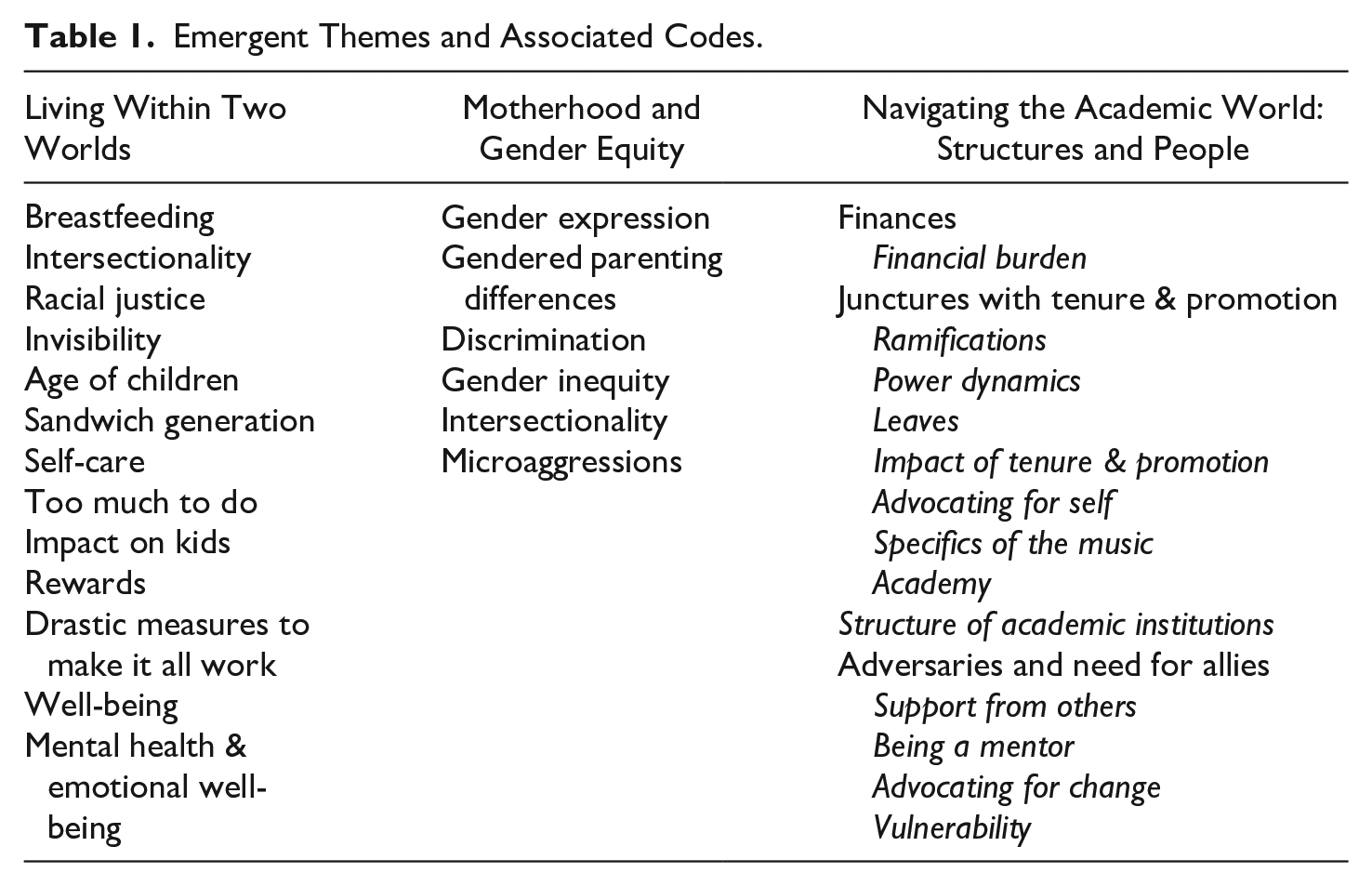
Cross-case data analysis revealed three themes: living within two worlds, motherhood and gender equity, and navigating the academic world: structures and people. The codes associated with each of these themes are presented in Table 1.
Emergent Themes and Associated Codes.
Living Within Two Worlds
Participants described academia and motherhood as two distinct worlds that each brought their own set of expectations, mental load, timelines, demands, and challenges. These worlds greatly influenced one another, and participants lived at the intersection: For me this semester, I’m cramming as much of my day into as small of a space as I can so that I’m not away from my baby for 12 hours every single day. So there’s really not space in the day for that spontaneity of, “Let’s have coffee. How are you doing?” If I say yes to going out to lunch then I'm home an hour later which means I'm missing bedtime. I don’t have the space in my schedule. (Jill, Interview 1)
The lived experience of being an academic mother involved what participants described as “drastic measures to make things work,” including finding creative ways to continue breastfeeding while at work, arranging and rearranging childcare schedules, and navigating the impact of the COVID-19 pandemic, which placed inordinate demands on them to parent and work simultaneously without childcare or in-person schooling options. Jill described an experience she had during the pandemic: “I remember clearly breastfeeding my son, Abe, while wearing headphones and monitoring edits of my CD, while simultaneously teaching my son, Bill, his kindergarten work. It was a ridiculous moment” (Jill, Interview 2). Participants’ descriptions of efforts to creatively solve problems revealed their abilities to multitask and strategically plan: “I think that being a mother has made me much more efficient and focused. When I do have time to be dedicated to my work, I don’t get distracted. I’m laser beam focused so that I can get it done” (Jill, focus group). Michelle agreed: “I deliver. I delivered. My work was not hampered because I was a parent, it was enhanced. I delivered” (Michelle, Interview 2).
Finding solutions to “make things work” required tremendous adaptability, flexibility, and resourcefulness, especially within an academic environment that participants found mostly unsupportive to mothers. Participants discussed how scheduling issues, in particular, revealed tensions between the two worlds of academia and motherhood, as home and work schedules often collided: “With 8 am classes, or going to see your student teacher, you have to leave at 6:30 am in the morning in order to get there for the band rehearsal . . . that was probably one of my biggest challenges in terms of figuring out who was going to get the kid on the bus” (Laura, Interview 1).
Participants discussed the complexity of deciding how much to disclose about their roles and responsibilities as mothers while at work, fearing discrimination while also advocating for their (and their family’s) needs. The notion of silent parenting (vs. visible parenting) was a common point of conversation among participants, with many concealing their role as a mother out of concern for the ways they might be perceived, discriminated against, or judged by coworkers. Laura received the following advice from a trusted colleague on this subject: She recommended not telling your students if you’re missing something or rearranging your schedule because of your child. She would say [to her student], “Can I move this lesson because my kid’s got a school play that I wanted to go to?” or something like that. And then the student would be really nice and “That’s so great, yeah, sure, no problem.” And then you get your instructor ratings back and it’s like, “She's constantly having to rearrange because of her children.” (Laura, Interview 1)
Michelle, however, encouraged acts of visible parenting within the academy: What I would say to our colleagues who are secret parenting is they’re robbing themselves and they’re robbing the Academy because they are living with a divided loyalty. And you cannot do your best in either situation because the children will feel neglected when there are times that the job pulls them away and the children don’t understand. (Michelle, Interview 1)
Although participants “made things work” in their two worlds for the betterment of families, students, and colleagues, they described the enormous toll that this took on their personal well-being. As Eleanor described, “So we’ve managed, but I think I’ve grown gray” (Interview 2). Participants described their lived experiences as challenging, feeling that there was often too much to do and that their constant efforts went unnoticed by those around them: What I’m saying is there’s just so much stuff [to do] that’s invisible. It’s invisible to children. It’s invisible to students. It’s invisible to many men. It's even invisible to many women, especially the ones that don’t have any children and cannot fathom what that brings into the mix. (Eleanor, Interview 2)
This “invisibility” left participants feeling as though they could not speak up or advocate for themselves. Nancy discussed a time when her plans for pumping breast milk at work did not go as hoped: I remember forgetting a pumping session in auditions once, and all of a sudden I’m just exploding. Milk is running out of my whole shirt. And I’m sitting here in a puddle of wet, in pain. And in that situation—because these were blind auditions and we were halfway through—I sat through it, and I didn’t speak up . . . and that’s the stuff people don’t know, I guess that’s the silent part that I look back saying, oh, my gosh! I wish I could’ve told myself this is a medical issue. Just tell them, “Sorry, I have to excuse myself, and I will come back and not be an official judge but give feedback in about 30 more minutes.” But at the time, it felt so embarrassing and I felt paralyzed . . . and so those were the true hard times. (Nancy, Interview 1)
Although aware that self-care was important, participants found it difficult to fit such actions into their already busy lives. For some participants, self-care included learning to say no to professional responsibilities and also saying yes to asking for help from others, especially from their partners. Complicating matters, Eleanor discussed the intensity presented by the nature of academic jobs, where women commonly must move away from family and other support systems who, in generations past, would have helped with childcare and home responsibilities in addition to providing a community. This realization led her to consider the unreasonableness of expectations for academic moms: “And we’re asking, how can we do this better? I don’t think we can do this better. We need to do less” (Interview 2). Several participants noted that they did a better job of taking care of others, both at school and at home, than they did taking care of themselves: “I tell my students, ‘You need margin in your life. You can’t just walk to the edge and fall off’ . . . and then I say to myself, ‘Take it. Take your own advice’” (Michelle, Interview 2).
Motherhood and Gender Equity
Participants discussed connections between their experiences as an academic parent and their identity as a woman. This theme was rooted in fear of discrimination in academia and a perceived gender imbalance in expectations from the two worlds of home and work.
Fear of discrimination was founded on participants’ deeply negative experiences, and even instances of gender-based harassment, as mothers within the academy. Mary described a devastating conversation with an administrator that led to her delaying having (and eventually being unable to have) more children: In my interview, once I was hired and signed my contract . . . my chancellor asked me, “You’re not planning on having any more children, are you? If so, you may want to wait a few years. We need you to build this band program.” It didn’t strike me then—I guess I was in a fog and I was so happy I just signed my contract . . . the conversation happened so fast that I didn’t have time to process what he said. Needless to say, I didn’t have any more children. And I wanted more. But I think some of the stresses of the profession, and the stresses of my daughter being born premature, and I guess waiting—I missed my chance to have more children. (Mary, Interview 1)
Traditional and often gendered roles embedded within the band profession were highlighted within both Mary and Nancy’s experiences. Nancy discussed her work as a collegiate marching band director: The optics of being pregnant and saying, I want to be the marching band director—all of our liberal, open-minded academics, oh, they weren’t open-minded at all. A lot of biases came out during that time. . . . There’s also the idea of a female running a marching band. We do have female marching band directors but not that many, and then you put the motherhood piece on it. And I think what people struggled with is, people know it’s a time-intensive job and so there was expectation that, well, I’m just not a good person if I’m going to be taking on extra work and being a mother. . . . And so I just tried to show love and grace and take it with a grain of salt because I was like, no one gets to say what I do with my life. (Nancy, Interview 2)
Mary similarly highlighted gender-based discrimination that she perceived from male colleagues based on her parenting responsibilities: A couple of men in the department say, “Well, we didn’t consider you for this because we know you have a daughter . . . ” and, like, you didn’t ask me first! I think some of the assumptions [about my work] are off when it comes to women faculty who are parents. I think that they [male colleagues] make decisions for us a lot of the time. (Mary, Interview 2)
Participants often referred to the “heavy load” or “intense load” that they carried as a way to describe feeling largely responsible for gender-specific aspects of parenting, specifically pregnancy, breastfeeding, unplanned pregnancy, and loss. While working with their home partners to distribute certain home responsibilities, these women found themselves solely responsible for certain experiences (i.e., breastfeeding) that they, alone, could fulfill. Eleanor talked about the complexity involved with figuring out how to feed her daughter: She wouldn’t take bottles. So then I had to drive between the classes to breastfeed her, to go back teaching. At that time, the chair was a newly hired woman who did have a child in her college years, so she was a little bit more accommodating in terms of allowing me gap time between classes so I could go and breastfeed the child. (Interview 2)
Jill similarly talked about the complexity involved with breastfeeding as a performer, where she often has to work to find spaces such as bathrooms to pump breast milk during events and performances: When I’m at work I’m not really just at work. I’m like, “Oh, okay. Now I have to pump and now I have to figure out something so I can continue to be productive while I’m pumping” . . . and there’s that element of like, yeah. I’m doing it, right? I’m doing it. But it’s also like, it’s a false story that we tell ourselves I think . . . is this really having it all? Is this me eating in a bathroom in my concert clothes sitting on the floor—this is really having it all? I don’t think so. (Jill, Interview 1)
Two of our participants discussed the devastating experience of losing a child to either miscarriage or loss, and several others experienced years of infertility on the path to having a child. Although many of these experiences were medical in nature, participants discussed returning to work or to their duties without acknowledgment from colleagues or consideration of the trauma they had just experienced.
All participants discussed the increased mental or emotional load that they felt expected to carry in their homes. For example, Jill told us that there is an “extra mental load put on the woman. Not just ‘done with work’ . . . done with work and then setting up the party, ordering the groceries, making sure all things are set up for school for the week” (Jill, Interview 2). Nancy noted the difference between her initial expectations for equity of parenting responsibilities and the way that this actually developed between her and her husband: My husband is very hands-on and I was shocked when I had a child that, even though he was very willing to be just as involved in the development of the kids as I was, there was a part of the children who actually needed me more than their dad. . . . We would joke that when I was at school, I was constantly thinking about the kids and wondering about their day and constantly going through my checklist. I asked my husband, “When you go to work, are you thinking about those things?” And he’d say, “No, not at all.” He was very compartmentalized. And that made me think, oh my gosh, there are built-in differences. (Nancy, focus group)
Issues of gender equity were experienced intersectionally for Michelle and Mary, who identify as African American/Black. During the time of this study, the United States was navigating an intense time of protest following the murder of George Floyd. Michelle discussed her own identity as a Black woman and how she views her own presence and success in academia as a powerful form of resistance. For Michelle, her experiences as a mother and grandmother are deeply intertwined with her efforts to craft a legacy and make change within the academy: My femaleness, my cultural identity, all of that informs my scholarship, it informs my day to day existence. I recognize that I don’t necessarily need to go out on the street and march, because my living is resistance. . . . I’m the great, great-granddaughter of enslaved persons. . . . That heritage is very important to me, and I carry that along because those are the strong shoulders that have scaffolded my life. There’s a line in Maya Angelou’s poem that says “I am the hope and the dream of a slave.” I live that out every day. So for me to do the work that I do at such a level that I do is in tribute and honor to my heritage, because trust me, we’re dealing with situations now but it's unimaginable what they dealt with. . . . I’m the mother of five adult children, the grandmother of three children. I have to leave something to my children and to my children’s children. So I stay at the table, because honoring my legacy, my heritage is so important, I owe it to them. (Michelle, Interview 2)
Overall, participants described their experiences as parents in the academy as highly gendered and perceived that their own experiences of parenthood differed from those of their partners and their male-identifying colleagues in important ways.
Navigating the Academic World: Structures and People
Although participants worked hard to navigate academic structures as mothers and build positive relationships with colleagues, they found experiences to be fraught with challenge. Within this broader theme of navigating the academic world, we organized our findings within three subthemes: tenure, finances, and adversaries and need for allies.
Tenure
The ways that participants’ experiences of motherhood intersected with the structure of the academy were more intense because of how the timeline for having a child aligns with the tenure process. Eleanor discussed this timeline: By the time you get a PhD, you are in your early 30s. If you get on a job market and you’re not in a tenure track position, you’re immediately in pressure for the third-year review. Then add another 6 or 7 years to that and you’re in your late 30s. And I think if I was having those children just when starting on tenure track, it would never have happened. That’s why nobody has them. You know, they have them either during a visiting position or a lecturer or some other kind of position where you can build up some research to then refine and put forth. Otherwise, you have to wait until you’ve submitted your tenure file and hopefully you’re still young enough and it works for family and relationships to have kids. (Eleanor, Interview 1)
Three of our participants described struggles with infertility that they associated with waiting too long to have additional children as a result of pressures from academia to first focus on building a strong tenure portfolio.
Several participants discussed the lack of clarity about the path to tenure and suggested that institutions work harder to make tenure expectations more clear. Nancy explained the impact of getting tenure on her journey: I didn’t really start changing my behaviors until I got tenure. I said yes to everything. I felt like I was in the blender, and I think everybody does, because academia is so messed up in terms of fuzziness of expectation. (Nancy, Interview 2)
Jill discussed the resistance of her faculty colleagues to her requests for clarification: Instead of making the process better for us, senior faculty members have this attitude of, “If we have more specific guidelines, then that’s just what people would do—they would just do the minimum.” As a junior faculty member, you sit there and you’re like, “Okay, I will just continue to give myself a mental disorder with how stressful this is. . . .” The process is so vague and the culture involves so much fear that I feel like if I produce creative activity 24 hours a day, 7 days a week all year long, they make it feel like that may not be enough. (Jill, focus group)
Participants had differing perceptions of university policies intended to promote equity for parents (e.g., optional tenure clock extensions), but all agreed that the helpfulness of these policies depended on the culture and climate of their academic units and the support (or lack thereof) of colleagues and administrators. For Laura, having her tenure clock start over at a new institution felt reassuring in that she had more time to achieve tenure expectations while also caring for a new child. For Nancy, an extension on the path to tenure felt problematic and unhelpful: I could have requested to delay tenure by 1 year, and I just didn’t do it, I did not want to have that pressure hanging over myself. I was already in schlepping, crazy, impossible mode. Honestly, I felt it would have been a sign of weakness. And I don’t know why I felt that, but I do know that when I expressed to people that I would stay on track, I was actually given kudos for that. Something in my gut sensed that, and then it was, of course, reaffirmed once people said, “Yes, you would not be seen as being as productive” or “It would’ve been seen maybe as some kind of an allowance, an extra.” (Nancy, Interview 1)
Many unwritten or unspoken demands and expectations for tenure, specific to the field of music, included assumptions for extensive practicing, attendance at student recitals, and attendance at concerts and colleagues’ events. Participants noted that these events and responsibilities took up significant amounts of their time during nonworking hours even though they generally did not count for purposes of promotion or tenure: In your tenure track you’re expected to be invested and show up at everything or show up at enough of everything that it looks like you are a good team player. So it’s all of the evening things and all the weekend things and then rearranging your schedule so you can be at [events like] lunches for the search committee. (Jill, Interview 2)
Finances
Participants discussed financial implications associated with their experiences as academic mothers, perceived as most challenging during the intensive path to tenure, when, ironically, participants were most likely to be low on the salary scale at their institutions. Eleanor described the impact that institutional scheduling practices had on her finances due to the need to pay for additional childcare outside of working hours: There are things that administrators, colleagues, or the actual structure of the academy can influence, like scheduling meetings at 6:00 pm or 5:30 pm to 7:30 pm. There’s absolutely no cognizance of parenthood and after school hours. I mean, for me, I had to pay to go to faculty meetings. (Eleanor, Interview 1)
Several participants mentioned travel to conferences and other events as being especially challenging while parenting, requiring creative planning and the use of extra funds to make things work: My children have always gone with me. Literally, I took one of my best friends with me. I paid her way. She stayed in the hotel with [my youngest child] when he was just 6 months old or so. No one even knew I had him with me at the conference. (Nancy, Interview 2)
Childcare costs were described as exorbitant, and the situation was exacerbated by the fact that most participants lived away from extended family structures due to the nature of their academic positions: “When I first came here, my entire salary after taxes and health insurance went to pay for the preschool for my kids that were 2 and 4 years old” (Eleanor, Interview 1). Eleanor went on to describe the difficulty associated with finding affordable childcare, especially on some college campuses: [My last institution] had childcare on-site in the graduate center where everybody comes in and can drop off their kids and it’s not expensive. But at [my current institution], you’re like, who is this for? For the provost’s children? I mean, who can pay for this, right? It is absolutely disproportionate and this is a systemic issue. (Interview 2)
Similarly, participants found existing financial structures embedded within university policies to be inconsistent and lacking in consideration of the experiences of parents. Laura was perplexed by inconsistencies in her university’s travel reimbursement policies: When you get reimbursed for things for travel, there’s a list of things that you can be reimbursed for. One of them was sending a houseplant to the person who you stayed with as a thank you gift. So, I could spend $40 for this house plant to send to my friends who I stayed with for the conference and I could get reimbursed for that $40. However, I could not be reimbursed for any money that I spent revolving around childcare while I was gone. [Laura, focus group]
Adversaries and Need for Allies
Support from colleagues, or lack thereof, played a large role in participants’ experiences as mothers in the academy. Some participants mentioned overt support and friendship from key colleagues as especially appreciated and meaningful. Nancy and Laura described at least one colleague to whom they could turn for advice and support as an academic mother. However, all of our participants felt disappointed that other women, at times, chose to be adversaries along their journey. Jill attributed the lack of support from her female colleagues to their own challenges as women in the academy: I think they still have fear and baggage of what they went through in order to get tenure—I feel that they speak in a way that passes on that fear. That actually comes more from other women in the department and not from any men necessarily. (Jill, Interview 1)
All participants perceived varying degrees of support, or lack thereof, from their colleagues and institutions, in some cases experiencing microaggressions or outright discrimination from colleagues. For many, it was made clear that their parental leave was viewed similarly to a work sabbatical despite the fact that most of our participants described recovery from birth, feeding, and caring for a new baby as exceedingly intense times in their lives. Jill described how she felt when she returned from her parental leave following the birth of her son, waiting in dread for her colleagues to ask her, “How was your baby vacation?”
The early phases of the COVID-19 pandemic created nearly impossible situations for our participants, who juggled full-time jobs with full-time parenting and, often, homeschooling responsibilities. One positive outcome of the pandemic was increased visibility of parenting while working, as childcare/school was unavailable and children frequently appeared on participants’ Zoom screens. As a tenured faculty member, Eleanor used her role as an academic mother as an opportunity to increase awareness with colleagues: I was in a big editorial board meeting for this journal that I’m on, and there’s no mothers on this board at all. And I just told my kids—come on, they need to see that there are mothers. I need to change this, and they’re not going to kick me off the board. So they came and sat with me, and I thought, this is good. We need to do it—so those of us with tenure can do that, right? (Eleanor, Interview 2)
In contrast, some participants mentioned that the visibility of their children while working fostered fear in terms of fearing discrimination or being seen as less devoted to their jobs.
Informed by their own experiences, the women with whom we spoke expressed a desire to advocate for change with regard to mothers’ experiences within the academy and to provide mentorship and support for other women. They perceived themselves as necessary allies for other academic mothers. Laura now encourages others to speak up when experiencing or observing microaggressions and hostility related to mothering in the academy: As I look back, I wish there were times that I said something just to educate people—just to raise awareness—to really make people have to respond to a comment that they’ve made or a situation that they created or something like that. Not even to be confrontational about it. I know I did it sometimes and I look back and I’m glad when I did it. And I’d say 80 percent of the time it had a positive result. But that 20 percent kept me from doing it more often. (Laura, Interview 2)
Laura also mentors her students, particularly her graduate students, as they plan for or navigate parenthood within the academy: “They generally just want me to share the story, share my timeline, and then advantages, disadvantages, would I recommend going that way, and what should they be thinking about” (Laura, Interview 1). Mary, too, works hard to advocate for her students and their parenthood: It’s almost like paying it forward. I had professors and people who were accommodating for me, so if I have a student who is trying to decide between going to class and taking care of their child, I’m like bring your child to class, you need to be here. . . . And a couple of my students, I'm actually the godparent for their children, because I wanted to make sure they knew that having a child is not an excuse for you to drop out of school. So I have four godchildren as a result of that. (Mary, Interview 1)
Despite all of the challenges that they described within our interviews, our participants described an overall sense that their institutions benefited from the perspectives, skills, and experiences they gained from being a mother: Being a mother—that’s the benefit that my colleagues derive from our relationship. They may not ever admit it, but they really enjoy my presence on a committee. They enjoy my presence in a meeting because I'm going to always bring that perspective. We're going to get to this problem, but while we get to this problem, we have to honor and value the individuals in the process. (Michelle, Interview 2)
Laura agreed, saying: “I don’t know if other people feel this way, but I do feel that motherhood has affected how I think about my students. And as [my daughter] has gotten closer to [my students’] age, I feel even more sort of motherly” (Laura, Interview 2).
Discussion and Conclusions
Our findings indicated that the experience of motherhood within the academy was complex for our participants, who navigated often hostile and challenging climates within their faculty roles. It is notable that none of our participants described their roles as academic mothers as being “balanced,” nor did any describe their academic unit(s) as being supportive of the multiple roles they filled. All participants identified ways in which their parenting and academic journeys intersected with gender-based assumptions, stereotypes, and microaggressions, highlighting concerns about gender inequity for mothers in the music academy.
Our participants represented multiple faculty ranks yet focused much of their discussion on the challenges associated with navigating the path to tenure alongside motherhood. As the structure of higher education relies heavily on the tenure and promotion system, this system should be scrutinized with regard to gender equity for parents. For example, although initiatives such as “stop the clock” exist, their implementation is complicated, leading to documented and persistent disparities in pay (Manchester et al., 2010) and to the kinds of resentment and discrimination discussed by some of our participants. The rigid structure of the tenure system also does not account for the disproportionate role that women play in our society with regard to family responsibilities: “The concept of ‘fairness’ and a belief in the meritocratic academy fails to acknowledge the gendered nature of family life, thereby privileging male academics that may not be shouldering caring responsibilities” (Aiston & Fo, 2021, p. 138).
This family load does not exist in a vacuum for women academics—it is combined with often heavier university-based service and workload allocations (Aiston & Fo, 2021; Domingo et al., 2022) that do not correlate with promotable activities or recognition and reward, frequently relegating women to what Fitzgerald (2012) calls the “ivory basement.” In our study, not all participants discussed an experience of carrying heavier service loads than their peers, but Eleanor felt this intensely, often describing how she utilized her research time in service of her department. She used a scholarly leave intended to provide space to write her book to instead support a departmental conference when her colleagues backed out: Nobody wanted to volunteer—nobody ever wants to. And so I did. And it was good for me to be introduced to the system but it also meant that I was working on this during the time that I should have been writing. So this meant that I was eight months pregnant during [this conference] running up and down with people failing and not showing up and not doing their parts of the job and all that. So that was my nurturing leave. (Eleanor, Interview 1)
The ways in which our participants were perceived negatively, or felt that they were perceived negatively, for being mothers are not inconsequential. Our findings emphasize the enormous labor that our participants experienced in trying to navigate often antagonistic environments. Participants also experienced financial burden beyond that of their colleagues in order to sustain their professional responsibilities, generally due to a lack of consideration in the scheduling of meetings and other events outside of working hours. In particular, our participants highlighted the phenomenon of silent parenting, where many of them felt the need to conceal aspects of their parenting responsibilities within the academy due to fear of bias and discrimination. Previous research acknowledges silent parenting as a gendered phenomenon, as men and women are viewed differently within the academy with regard to the parenting responsibilities they reveal to colleagues (Brown, 2010; Correll et al., 2007; Heilman & Okimoto, 2008; Schein, 1993). Women in our study adopted practices of silent parenting in order to counter these gendered expectations and to more easily “fit into” traditional expectations of the academic persona despite this extra labor affecting their health and well-being in significant ways.
Feminist scholars raise questions regarding the ways that women who have caretaking roles, including motherhood, are viewed within the academy. When caretaking roles intersect with the woman’s role in the academy (e.g., not being able to attend a faculty meeting scheduled outside of working hours due to childcare concerns), it creates a disruption in how she is viewed. According to Amsler and Motta (2019): Such disruptions place the mother–academic in the position of insider–outsider and “other.” She becomes subject to informal and formal mechanisms of judgment in which she is misnamed through “mothering discourse” (Griffith & Smith, 2005) as inconsiderate, expecting special treatment, unprofessional and behaving in inappropriate ways. The internalization of classed, raced and gendered norms of professionalism and the politics of academic space result in practices of judging and being judged, logics of competition between female subjects, and hierarchies of separation (McRobbie, 2015). (pp. 90–91)
All of this is detrimental to the success of the mother within the academic space, and all of it deserves critique and reconsideration.
Viewed through the lens of Motherhood Studies, and its emphasis on broader societal structures, important questions arise as to the ways that gendered expectations in the academy continue to ask women to “fit” into the mold of the traditionally patriarchal work-life structure, which is based on a historical expectation of the male professor who is devoted only to their academic and scholarly pursuits while relying on the unpaid labor of their female partners who took on full-time childcare and home responsibilities. As institutions face growing pressure to address the gender imbalance of their faculty at all ranks (American Association of University Professors, 2018; Mason et al., 2013; Wolf-Wendel & Ward, 2006), achieving the goal of promoting gender equity in the academy may be inseparable from better supporting mothers in the academy.
The question remains what to do to improve this situation, and we offer several recommendations from the literature. First, we reject the notion that women without power, currently navigating the often hostile structure of the pretenure system, should be asked to speak out or self-advocate while navigating this system. Aiston and Fo (2021) argue that women are effectively silenced by institutional expectations that stereotype and devalue them when they speak up within hostile departmental and university contexts—leading to some of the lack of self-advocacy demonstrated by our participants before the relative security of tenure was achieved. Ahmed (2009) particularly highlights the challenges that women of color experience when speaking up within the academy: “To speak out of anger as a Black woman is then to confirm your position as the cause of tension” (p. 49). Rather than these women speaking out and facing potential consequences during the tenure process, what is needed is the explicit support of allies and the structural support of institutional policies that protect them.
Participants acknowledged few allies at their music institutions and varying degrees of hostility for being academic mothers. Greater support is welcome across the music education profession. Men (both with and without children) and other colleagues without children are encouraged to speak up in support of parent-friendly policies and counter microaggressions they witness (for a helpful list of ways in which colleagues and allies might interrupt gender-based microaggressions within the workplace, see Shouldice, 2022). Structural and institutional reforms are also needed to promote change, and we find it important to emphasize here the unique impact of limited U.S.-based family and childcare policies that lag far beyond international counterparts (Son & Böger, 2021). Mason (2014) suggests that four structural reforms be implemented within higher education related to academic motherhood: (a) better and more childcare options (including emergency backup care); (b) effective dual-career policies that account for the fact that women’s careers often trail those of their male spouses; (c) better childbirth accommodations, including paid leave for both male and female parents; and (d) better compliance with and enforcement of Title IX’s prohibition on pregnancy discrimination.
Additionally, we suggest that administrators consider making visible their support for faculty members' lives outside of work, including overtly articulated support for academic mothers—and all academic parents—rather than keeping silent on these important issues. Women, and academic mothers in particular, would greatly benefit from increased, open dialogue about motherhood within the academy (Seher & Iverson, 2015), including mentorship for graduate students and others navigating family formation. Returning to the concept of the “ivory basement,” while data support the need for academic mother mentors, this role is likely to fall on other academic mothers. However beneficial for both parties, the situation reveals another instance of unrecognized labor that reduces the available time to pursue scholarly and creative activity. We recommend that mentoring of academic mothers be a formal and documented aspect of university service.
Within their institutions, our participants discussed the need for designated and clean spaces to breastfeed or pump milk for their infants, time to physically heal after childbirth or following instances of miscarriage and loss, maternity leaves that actually protect their time and allow them to step away from service and professional responsibilities to care for their children, and better support in terms of childcare accommodations for travel to conferences and other required events. Although it is important to consider ways to improve the conditions and structures for academic mothers within the academy, Amsler and Motta (2019) raise the possibility that in the face of such a hostile climate, some academic mothers might actually be better off by simply leaving the institution altogether and seeking a better life for themselves and their families. This is disappointing; however, given the challenges and obstacles our participants experienced and described, it is understandable.
Recommendations for future research include examinations of motherhood and the music academy with different populations of mothers and of academics. Professional options include nontenure track or clinical music faculty, music administrators, and academics who work in institutions outside of the United States. Variations of motherhood could include mothers who have adopted and/or fostered children, mothers who identify beyond cisgender and/or heterosexual women, single mothers, and mothers who have lost children both during and following pregnancy.
Our participants’ stories provide insight into the ways that academic mothers navigate the music academy. We find it important to note that we, the researchers, found that all of our participants were incredibly hardworking, devoted, productive, and caring members of their departments and units. Their work, as evidenced through their teaching, research, creative work, and service in the academy, indicated to us that they have significantly, and positively, impacted the lives of their students and the larger profession. It is worth considering that academic mothers like our participants may be exactly the kind of faculty that universities should prioritize in terms of hiring, support, and retention. However, doing so effectively requires that motherhood be acknowledged, supported, and accounted for within the music academy. Additionally, as music faculty prepare future teachers and music majors to work with others in professional capacities, university students largely reproduce what they learn from their professors. If motherhood is perceived as devalued in education by college students, there are implications for those who may, themselves, become parents; those who teach children in pre–K12 settings; and/or those who may continue to uphold structures limiting parental support. As Michelle (Interview 3) shared bluntly, “Right now we’re in a watershed moment. Will we really live up to what we say or will we continue to just speak? My patience has grown very thin with just the talking.”
Footnotes
Declaration of Conflicting Interests
The authors declared no potential conflicts of interest with respect to the research, authorship, and/or publication of this article.
Funding
The authors disclosed receipt of the following financial support for the research, authorship, and/or publication of this article: The authors wish to acknowledge the support of the University of Michigan School of Music, Theatre, and Dance Faculty Research Grant Program.
