




Abstract
Objectives: Individual- and school-level factors associated with youth being stopped, searched, or arrested in school are identified. Correlates of community-based contact are also examined. Methods: Longitudinal student surveys and corresponding school-level data come from 21 middle and high schools in 6 districts in St. Louis County, Missouri. Multilevel multinomial logistic regression was used to assess factors related to a three-category dependent variable, distinguishing youth with: (1) no police contact, (2) in-school contact, and (3) out-of-school contact. Independent variables capture student-level demographics, behavior, experiences, and perceptions and school-level characteristics and practices. Results: Factors associated with in-school contact include substance use, peer associations, prior contact, and prior school sanctions. Odds of school-based contact also increase when youth are less aware of school rules and perceive greater disorder. Among school-level characteristics, only officers responding to school problems is significantly associated with in-school contact. Conclusions: There is some consistency in individual-level factors associated with police contact across locations, particularly related to prior sanctions, but findings highlight potential mechanisms that vary across contexts. This study also provides evidence that some schoolwide responses may contribute to youth's likelihood of having police contact in school, but solutions should consider the fluidity of contact in schools and communities.
In recent decades, scholars have increasingly considered how schools facilitate justice system involvement among youth. The school-to-prison pipeline, or systematic funneling of students out of schools and into the justice system, is believed to work in two ways. First, overreliance on exclusionary discipline, such as suspensions and expulsions, increases students’ likelihood of dropping out, which may indirectly lead to justice system involvement (Monahan et al. 2014; Mowen and Brent 2016; Wolf and Kupchik 2017). Another pipeline is through direct contact with the justice system and its representatives. Some zero-tolerance policies require that certain behaviors, including violence or threats of violence, be met with justice system referrals (American Psychological Association 2008). Moreover, when officers are stationed in schools, they are quickly positioned to intervene when even minor misbehavior is suspected. With 46 percent of public schools (National Center for Education Statistics 2019) and almost 60 percent of secondary schools (Musu-Gillette et al. 2018) reporting the presence of a sworn law enforcement officer, a substantial number of today's youth have a direct line to the justice system.
Research at the individual-level indicates that police contact in schools is a relatively frequent occurrence. For example, Geller’s (2017) research shows that up to 51 percent of police stops reported by youth between the ages of 9 and 15 occurred at school. 1 The nature of encounters in schools, however, can vary considerably. In some cases, officers stationed in the community respond to calls at schools on an as-needed basis or intercept youth on school grounds during non-school hours. Many schools have officers stationed inside on a full- or part-time basis. Through the course of daily routines or on-campus events (e.g., athletic, social), these school-based officers have more opportunities for surveillance and interactions with youth, filling roles beyond what is typical for community-based officers. Along with traditional law enforcement activities, school-based officers are often tasked with mentoring and educational responsibilities (Coon and Travis 2012; Finn and McDevitt 2005; McKenna and White 2018). These nontraditional roles provide a foundation for informal relationships between officers, school personnel, and students, which can impact the nature of policing in schools. For example, officers may be influenced by the needs and desires of school personnel (Curran et al. 2019; McKenna, Martinez-Prather, and Bowman 2016) or use personal knowledge of students to determine how and when to intervene (Kupchik et al. 2020; Rhodes and Clinkinbeard 2020). If barriers between officers and students are broken down, school-based officers can leverage personal and background information that community-based patrol officers do not have at their disposal. Used judiciously, these relationships and information can encourage informal handling of misbehavior and successfully divert youth from the justice system. However, the ability to leverage informal relationships and students’ personal information might negatively affect some students if officers differentially engage in law enforcement practices as a result.
Although police-initiated encounters that occur in school versus the community may differ in important ways, little attention has been paid to distinguishing the correlates of these encounters. Some efforts to identify who is at higher risk for police contact in schools rely on administrative data to link school characteristics to rates of school-based arrests and justice system referrals. These data point to disparate impacts by school socioeconomic and racial composition, with impoverished schools and those serving a greater percentage of Black students reporting higher rates of justice system contact (Homer and Fisher 2020; Irwin, Davidson, and Hall-Sanchez 2013; Miner et al. 2018). Linking school characteristics to rates of school-based arrests and referrals is necessary for identifying the scope of the problem, but it is not clear which individual-level factors affect youth's encounters with police at school. Given that officers remain stationed in schools across the country, shedding light on the correlates of police encounters by location can help to identify ways to reduce the likelihood that certain youth will have police contact as well as target school practices that might contribute to the school-to-prison pipeline.
Relying on longitudinal data gathered in St. Louis County, Missouri, we examine individual- and school-level factors that predict students’ self-reports of police-initiated contact (stops, searches, and arrests). In addition to student-level demographic, attitudinal, behavioral, and perceptual factors, we consider characteristics of schools—including demographic composition, rule enforcement, and reliance on target-hardening strategies. We distinguish youth with no contact from those who had school-based contact as well as from those who had contact outside of school only. Differentiating correlates by encounter location allows us to identify the unique individual- and school-level mechanisms through which school-based contact occurs. This endeavor allows us to explore whether there is something unique about the school environment that sustains the school-to-prison-pipeline or whether this phenomenon is just an extension of the same forces at work writ-large. Although we cannot link these correlates directly to information that officers have at their disposal or police decision-making, our study suggests that there is overlap in the individual factors associated with in-school and out-of-school contact as well as some variability, particularly in the role of peers, that may reflect the unique nature of policing in schools. Our results also indicate that one criminalizing school practice—use of officers to respond to school misbehavior—is associated with students’ odds of being stopped, searched, or arrested in schools.
Background
As the number of school-based officers has increased over the years, so too have the roles they are expected to fill. According to the Police Foundation (2016), School Resource Officers (SROs) are sworn officers assigned to schools on a long-term basis. Others, such as School Police Officers (SPOs), are sworn authorities that work for a police department but are assigned to a specific school district; these officers may regularly spend time in certain schools or respond to schools on an as-needed basis (Police Foundation 2016). Although there are some distinctions between SPOs and SROs, including level of training and amount of time spent in schools, we use the term “school-based officer” to refer to both because we are interested in the location of the police contact, rather than the officer's designation. 2 The primary distinction we highlight in this section is between school- and community-based officers, as this has implications for the information officers have at their disposal and their relationships with youth, and thus, the factors associated with police contact.
Generally, school-based officers fill roles beyond those typical of traditional community patrol officers. Both SROs and SPOs consistently adopt the triad model, which encompasses law enforcement, education, and counseling roles (Police Foundation 2016). Surveys from nearly 1,000 schools and law enforcement agencies across the United States indicate that over 90 percent of school-based officers performed law enforcement activities, 73 percent advised or mentored students, around 50 percent filled educational roles, and over 70 percent attended school-related events (e.g., athletic, social) (Coon and Travis 2012). 3 Two additional roles that focus on students’ well-being have been observed: surrogate parent and social worker (Martinez-Prather, McKenna, and Bowman 2016; McKenna and White 2018). These departures from traditional law enforcement roles can impact police contact in several ways. First, officers stationed in schools can get to know youth and school personnel in ways that those in the community do not. One implication is that school-based police contact may be informed by youth's personal and background information obtained as a result of these relationships. Second, school-level characteristics and processes likely affect when and how officers intervene with students in schools. Community-based officers, on the other hand, largely operate independently of schools and typically have less informal knowledge about youth. In this section, we first detail how these mechanisms might shape student-level predictors of contact in schools versus the community. Then, we describe how school-level factors may affect police contact occurring in schools.
Individual-Level Mechanisms of Police Contact & Encounter Locations
Typical law enforcement and order maintenance activities—including responding to calls and conducting searches—often require officers to make quick decisions about how and when to intervene using limited information. That is, officers responding to issues in the community generally have limited time and opportunity to get to know citizens as more than “frequent fliers” (Rhodes and Clinkinbeard 2020, 261). One of the first studies to document the characteristics associated with officers’ decisions to engage with youth was Piliavin and Briar’s (1964) systematic observations of officers in a single police department. They noted that the decision to approach or arrest youth was largely based on appearance (e.g., race, clothing) or demeanor. More recently, researchers have used youth self-report data to examine predictors of arrest as well as less serious forms of contact like being stopped and questioned. Using data from the National Youth Survey Family Study, Pollock, Willard, and Menard (2012) found that being male, prior substance use, and having delinquent peers were linked to the likelihood that youth were stopped or arrested. Similarly, Crutchfield et al. (2009, 2012) longitudinally analyzed eighth grade students in the Seattle school district indicated that being male and having deviant siblings, peers, or adult networks significantly predicted police contact. While Black youth were not more likely to have police contact once a full set of variables was entered into the model, the authors argued that race may operate indirectly via two factors that were significantly associated with police contact: school discipline and justice system involvement (Crutchfield et al. 2009). Although these studies did not consider encounter locations, they point to ways in which the mechanisms that explain police contact could differ across settings. Namely, visible characteristics like gender or race might factor into decisions about stopping or arresting youth when no other information is available. While other factors like delinquent behavior, deviant associations, and prior sanctions should increase the likelihood of police contact by making youth more visible or known to the police, as Piliavin and Briar (1964) noted, officers in the field do not immediately have access to this type of background information.
In schools, on the other hand, officers often get to know youth in comparatively stable and safe environments through daily routines and informal interactions with school administrators, teachers, and students. In fact, school-based officers often consider fostering informal relationships an integral part of their job. Based on 20 interviews with SROs in the Midwest, Rhodes and Clinkinbeard (2020) found that officers veered away from their street cop personas and instead used rapport-building techniques such as showing personal interest and humor. These interactions may increase officer support of students and promote positive perceptions of the police among youth, but information that officers glean might also factor into decisions to intervene. In interviews with 47 SROs in two school districts, Kupchik et al. (2020) found that a primary goal of officers was to develop informal relationships, largely to teach youth that cops are the “good guys” (p. 404). Despite positive intentions, officers informally checked up on students assumed to be at risk of future delinquency (e.g., low-income students, youth of color, those with known family history), which could lead to disparities in the detection and punishment of misbehavior (Kupchik et al. 2020). Similarly, Bracy (2010) argued that when students develop trusting, informal relationships with school-based officers, they may be more willing to share information, which can then be used against them later. In schools, then, there is greater opportunity for informal information about students’ socioeconomic and family background, peer associations, and even attitudes about and performance in school to circulate, which could account for students’ police encounters.
These informal relationships can also improve officers’ perceptions of youth, which may in turn influence factors associated with police contact. In their interviews with SROs, Rhodes and Clinkinbeard (2020) found that officers who transitioned from the community to the school previously held unfavorable views and broadly applied negative labels like “bad kid” to youth. After transitioning to SRO roles, however, these officers generally viewed youth in a positive light. As a result of these positive overall perceptions, officers labeled only a small percentage of students as “problem” kids, but once known to officers and school officials, these youth were regularly approached and subsequently disciplined (Rhodes and Clinkinbeard 2020). Even officers who respond to calls from school personnel on an as-needed basis likely have indirect knowledge shared by teachers and administrators. Higher levels of surveillance and visibility within schools also means that school-based officers may have more opportunities to witness student misbehavior firsthand. Thus, in the school setting, factors like prior misbehavior and sanctions should be more consistent predictors of police contact. In the community setting, on the other hand, these priors are less likely to be known to officers and might even be redundant with the notion that most youth are up to no good.
To summarize, the unique nature of policing in schools enhances visibility and encourages informal relationships between officers, students, and school personnel, potentially increasing the likelihood that certain student characteristics play a role in whether youth experience police contact in school. Specifically, information such as peer associations, delinquent behavior, and prior school sanctions may be key in determining whether youth are questioned, searched, or arrested in schools. In the community, officers have fewer opportunities to get to know youth. Instead of background and informal information, then, visible characteristics like race or sex as well as where youth spend their time (e.g., in public places) should be better predictors of community-based contact. In addition to these individual-level characteristics, school-level practices—which are largely irrelevant in the community context—should also impact school-based police contact. We outline school-level mechanisms expected to be associated with police contact in schools in the next section.
School-Level Mechanisms of Police Encounters in Schools
Within the school setting, officers are influenced by the educational context in ways that would not affect officers on the street. For example, school-based officers are subjected to educational goals and values, student needs, and perceptions of the school environment, which likely impact how they respond to students. Even officers responding to issues on school property may be influenced by preferences of school personnel. Expectations for school-based officers are sometimes communicated formally, through memorandums of understanding (MOUs), zero-tolerance policies, or implementation of target-hardening strategies as well as informally through regular interactions between officers and school personnel. 4 Despite formal policies that shape police intervention, officers typically have some discretion. For example, Curran et al. (2019) interviewed 47 SROs in two school districts that formally stipulated their roles as law enforcement and not school disciplinarian. The officers indicated that they administered warnings, conducted searches, and reported behavior to school authorities, justifying these types of discipline based on requests by school personnel (Curran et al. 2019). Similarly, interviews with 26 school-based officers in Texas revealed that collaboration with administrators determined roles, with one officer stating, “officers will work with campus principals on a daily basis to determine what needs to be done” (McKenna, Martinez-Prather, and Bowman 2016, 436). Thus, while the likelihood of experiencing school-based police encounters should be greater in schools that adhere to punitive policies and practices, it may also be shaped by expectations that teachers and administrators have for school-based officers.
Even if roles and expectations are not directly communicated to school-based officers, school climate should give officers an indication about when and how to intervene. Curran et al. (2019) noted that SROs were increasingly likely to intervene when they perceived schools as being more disordered. Additionally, officers perceived more serious problem behavior and made more arrests in high schools, compared with elementary and middle schools. Research also suggests that perceptions of disorder are tied to the school's demographic composition. Building off the Curran et al. (2019) database, Fisher et al. (2020) collected additional data, for a total of 73 SRO interviews. Qualitative analyses showed that officers in urban, racially diverse schools typically characterized students as threats to safety (e.g., bullying, student fights, aggressiveness toward staff) whereas those assigned to suburban, majority-White schools believed external factors like intruders were greater threats. Absent perceptions of disorder and threats, research shows a persistent link between school demographic characteristics and justice system intervention. Arrests and police referrals tend to be highest in urban schools, those with greater percentages of Black and Latinx students, and schools serving communities with high rates of poverty (Homer and Fisher 2020; Irwin, Davidson, and Hall-Sanchez 2013; Miner et al. 2018; Payne and Welch 2010). Given that perceptions of disorder and school demographic characteristics impact school disciplinary practices, students in these schools may have greater odds of experiencing police contact.
The research reviewed here maps out the ways in which school-level policies and characteristics—including formal disciplinary procedures, expectations of officers, levels of disorder, and school demographic characteristics—might impact a student's likelihood of experiencing police contact in school. In schools, officers are uniquely positioned to be influenced by school personnel and the school context more generally. Police-initiated encounters occurring in the community, on the other hand, should not be affected by these school-level directives and expectations. The qualitative research reviewed here shows the impact that school context has on school-based officers’ roles in school discipline, and analyses of aggregated data indicate that school-level factors impact justice system referral and arrest rates. However, it is not understood what impact similar school-level factors have on individual students’ experiences of school-based police contact.
Current Study
In the aggregate, research suggests that placing officers in schools contributes to the school-to-prison pipeline, and in some locations, youth are more likely to experience police-initiated contact in their school than in the community. Despite research that examines individual-level factors that predict police contact, as well as school-level characteristics and practices that contribute to high rates of school discipline and school-based arrests, little is known about the mechanisms that influence a youth's likelihood of school-based police contact. The study of the school-to-prison pipeline as a distinct phenomenon assumes that school-specific practices facilitate youth's justice system involvement. However, researchers have not examined whether the mechanisms that account for school-based police contact are distinct from those predicting police contact outside of schools. One potential difference may be that school-based officers are uniquely situated to have more visibility over students and develop positive, informal relationships—potentially allowing greater access to students’ background and personal information that might influence the likelihood a youth experiences police contact in school.
In comparing youth with no contact to those with school-based contact and those with contact outside of school only, we examine whether the factors that predict police contact vary depending on the location of the encounter. If factors differ depending on location of the police encounter, solutions to reduce the impact of police contact in schools may be geared towards eliminating criminalizing school practices or using student information judiciously to address misbehavior and support students who are punished. Further, if youth experience school or community contact based primarily on visible characteristics like race rather than behavior, attention should be paid to policing practices that might contribute to overrepresentation of youth of color.
Data & Methods
The data used to examine differences in the correlates of police contact come from a longitudinal study on the correlates and consequences of victimization and offending in schools in St. Louis County, Missouri. School districts were strategically contacted with the goal of including schools that were diverse in terms of size, racial composition, and percent of students eligible for free and reduced-cost lunch. Of particular importance to this study, our sample consists entirely of schools that have officers assigned to them, based on school personnel reports. 5 Students in six districts were surveyed about their opinions on a range of topics including school climate, behavior and attitudes, and experiences with law enforcement both in and outside of school. Students were in 7th or 8th grade for the initial survey and were followed in each of the following two years, with surveys conducted in the spring semester of each year (end of January through early April). All students enrolled in the 7th and 8th grades in the 12 participating middle schools were eligible to participate in the study; 77 percent (3,663 students) received parental consent and were surveyed in the first wave. During Wave 2 data collection, researchers made more than 100 visits to schools to attain a response rate of 86.4% (N = 3,165). During the third and final year of the project, all students had transitioned into high school, and 75% of the sample (n = 2,753) completed surveys.
For the current study, we utilized all three waves of data but restructured the dataset to address discontinuity in the school environment that arises from the natural transition from middle to high school. For students in 7th grade at the start of the study, Time 1 (T1) and Time 2 (T2) correspond to the first two survey waves. For youth who were in 8th grade at the start of the study, T1 and T2 variables correspond to the second and third survey waves (9th and 10th grades). Thus, the restructured dataset represents students in 7th or 9th grades at T1, and 8th or 10th grades at T2. These students are nested within 12 middle schools and 9 high schools, for a total of 21 schools. We excluded youth who transferred to a different school between the observed time points (n = 195). We also excluded youth who were not surveyed at one or both waves (n = 695). Exclusion of students who did not change schools but were missing on one or more variables included in our analyses (n = 252) leaves an analytic sample of 2,521 youth. 6
School-level data come from two sources: school personnel surveys collected as part of the original study and school administrative data from the National Center for Education Statistics (NCES). Personnel surveys were administered concurrent with the first and third waves of the student surveys, providing personnel data across middle and high school. At each school, teachers, administrative personnel, and staff who interacted with students were asked to complete the survey, with a total of 763 respondents. Within each school, survey responses were averaged to create measures capturing the school environment. The NCES data are school-reported administrative data that correspond to the years the personnel surveys were conducted (2016–2017 for middle schools and 2018–2019 for high schools). 7
Dependent Variable
Our three-category dependent variable accounts for whether youth had no contact, in-school contact, or community-based contact at T2. Youth were coded as having in-school police contact using several survey items. First, youth were asked to indicate whether they had, in the past six months, been stopped for questioning and been arrested. Students who responded in the affirmative to either of these questions were asked whether they were at school during the most recent encounter. In another section of the survey, students were asked about two types of school-specific police contact in the past six months: if they had (1) been searched, or had their locker or bag searched by a police officer or security guard, and (2) been arrested at school. 8 Youth were coded as having in-school contact if they reported any of the following happened at school: stopped for questioning, searched, or arrested. Youth were categorized as having out-of-school police contact if they were stopped for questioning or arrested in the past six months and the most recent experience did not occur at school. 9 Youth were coded as having no contact (“0”) if they reported having no in-school or out-of-school contact experiences in the past six months.
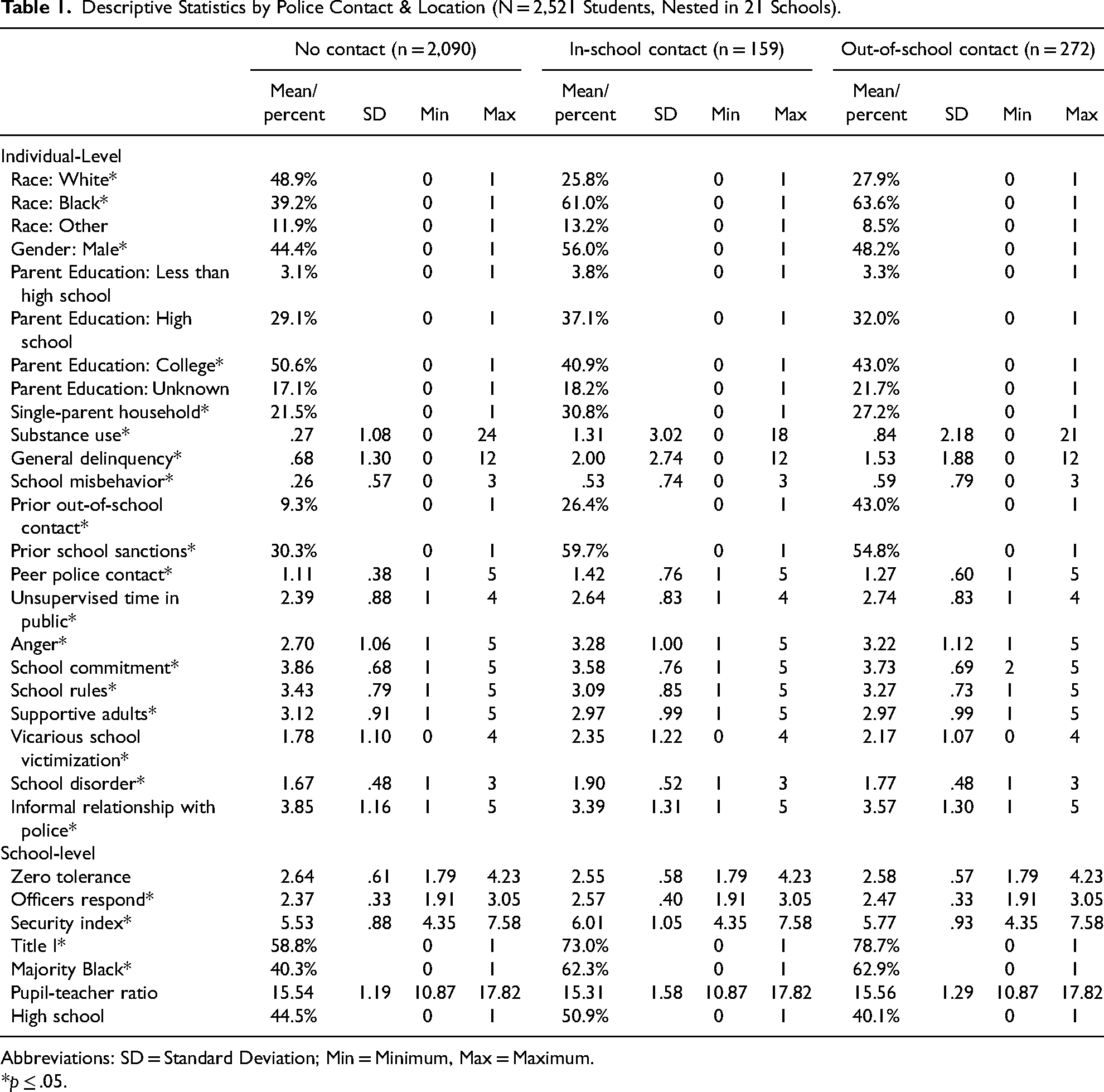
Most youth experienced no police contact (83%), while 6 percent experienced contact in school and 11 percent had out-of-school contact only. Those who experienced police contact in either location are more similar on personal characteristics than those with no police-initiated contact (see Table 1). Using survey data to capture police-related experiences raises concerns of whether youth accurately report their encounters with the police. Police records may be better suited for capturing arrests, which might be undercounted in our school-based sample, but self-report data allow researchers to capture less serious forms of police contact, such as stops and searches. Moreover, a high concordance of self-report and official statistics has been reported in prior research (for review, see Piquero, Schubert, and Brame 2014).
Descriptive Statistics by Police Contact & Location (N = 2,521 Students, Nested in 21 Schools).
Abbreviations: SD = Standard Deviation; Min = Minimum, Max = Maximum.
*p ≤ .05.
Independent Variables
Our individual-level independent variables capture factors expected to be associated with police contact, which are taken from self-report student survey data measured at T1. School-level independent variables are from school personnel surveys and the NCES, measured at T1 for those in middle school and at T2 for high school. For all independent variables, scales were created by calculating the response averages, and unless otherwise noted, response categories are based on a Likert scale ranging from “1. Strongly disagree” to “5. Strongly agree”. Indices are based on summative scores. A complete list of scale and index items, including factor loadings and scale reliabilities when applicable, can be found in the Appendix.
Individual-level factors
We include a set of variables to account for whether police contact is influenced by demographic and socioeconomic factors. Youth in our sample primarily indicated that they were White/Anglo or Black/African American, so we created a three-category measure of race (White, Black, and Other), with White as the reference group. 10 Gender is coded “0. Female” and “1. Male”. To control for socioeconomic status, we include three indicators of highest level of parent education completed by either parent: no high school, completed high school, and don't know, with youth whose parents completed college as the reference category. We also include a measure of single-parent household, coded “1” for youth who reported living with only their mother or father.
Substance use, delinquency and misbehavior may bring youth to the attention of the police; therefore, we include a number of indices that capture youth's prior behaviors. Youth were asked how frequently over the past six months they used non-prescribed prescription medications, tobacco, alcohol, marijuana, heroin, and other illegal drugs with response categories ranging from “0. Never” to “4. Every day”. A measure of prior substance use was created by summing responses to these six items, creating a variable that ranged from 0 to 24. General delinquency (12 items) captures the number of different delinquent and problem behaviors the student reported engaging in the past six months. For a narrow range of school-specific problem behaviors, school misbehavior (3 items) provides a count of the types of school-related misbehavior youth engaged in over the past six months.
Two measures of prior sanctions account for the possibility that youth known to the police are at increased risk of surveillance and punishment. Prior out-of-school contact captures whether youth were stopped or arrested in the community, and prior school sanctions encompasses being sent to the principal's office/receiving detention, being suspended, being searched/frisked, or being arrested at school. 11 Both prior out-of-school contact and school sanctions are dichotomous, coded “1” if the youth had the experience in the past six months and “0” if not.
Two measures are included to account for the robust relationship between delinquent peers and behavior. First, peer police contact is a 2-item scale that captures the proportion of the youth's friends who have been searched/frisked or arrested. The five response categories range from “1. None of them” to “5. All of them”. Second, unsupervised time in public is the average of two items asking youth how often they spend time with friends outdoors or at malls/shopping centers. Response categories range from “0. Never” to “4. Often”. A 3-item anger scale accounts for demeanor and behavior that might influence police contact.
A final set of individual-level variables capture institutional bonds and perceptions of the school environment. A 5-item scale captures school commitment and supportive adults at school is a 3-item scale that measures youth's informal relationships with school personnel. Awareness and enforcement of school rules, a 4-item scale, may impact whether students experience police contact at school if they are unfamiliar with school rules or if rules are unfairly enforced. Because police contact might be more likely at disordered schools, we include two measures of youth's experiences and perceptions. School vicarious victimization is a 4-item measure that captures a variety of forms of victimization youth have seen or heard about at school. School disorder is a 6-item scale that includes perceptions of minor as well as more serious forms of disorder. The item, “there is at least one police officer in my school or neighborhood I could turn to for help” captures informal relationships with police.
School-level factors
Drawing on responses to the school personnel surveys, we created two aggregated measures that capture school policies and practices that may be linked to police contact in schools. Zero tolerance and strict rule enforcement is a 3-item Likert response scale that captures consistent enforcement of school rules, zero tolerance policies, and adherence to disciplinary practices. The variable, officers respond is a 2-item Likert response scale that asks the extent to which the respondent agrees with whether officers often respond to (1) delinquency problems, and (2) gang-related violence. Security index is a 9-item variety score that captures the number of security and target-hardening measures the school implements, including, for example, security guards, police officers assigned to the school, metal detectors, and locker checks.
Three school-level demographic variables come from the NCES. These include Title I eligibility, with schools eligible for the school-wide program coded as “1”. All schools in our sample had fewer than 20 percent or more than 70 percent Black students, so we recoded the percentage of Black students from its original metric into a dichotomous variable, Majority Black (with those over 70% Black coded “1”). 12 School racial composition is also highly correlated with geographic location, and in turn, policing. Schools composed of predominantly Black students are located in North St. Louis County, an area where policing for profit has been documented (Department of Justice 2015; Ferguson Commission 2015; Police Executive Research Forum 2015). We comment on the extent to which this may affect our findings in our discussion. Pupil-teacher ratio is the total number of students divided by the number of full-time equivalent teachers. Finally, a dichotomous indicator for High school is included to distinguish middle schools (coded “0”) from high schools (coded “1”).
Analysis
We rely on multilevel multinomial logistic regression because our police contact outcome is a categorical variable with no inherent ordering. Students are nested within schools, so random intercept models with clustered standard errors are estimated. 13 While general consensus is that “more is better” when estimating multilevel effects, less than 20 groups may constitute “too few” (Cameron and Miller 2015, 341). Some recommend around ten groups for every two level-two variables in a random-intercepts model whereas others suggest that at least a dozen groups are needed to satisfy modeling assumptions (see Johnson 2010). 14 With only 21 schools in our sample, our ability to detect significant school-level effects may be somewhat impaired; however, sensitivity checks with pared-down models are consistent with our general findings (see footnote 16). Because one of the primary contributions of this study is to examine whether school-level factors uniquely predict in-school police contact, all level one and level two variables are centered around the grand mean. Grand mean centering allows us to examine the impact of level-two variables, controlling for the effect of level-one covariates (Enders and Tofighi 2007). 15 All analyses were done in Stata/SE 17.0 (StataCorp 2021).
To explore the significance of individual- and school-level measures, we enter variables in a stepwise fashion. Block 1 includes demographic characteristics. In block 2, common correlates of police contact—including individual-level attitudes, behaviors, perceptions, and experiences—are added to the model. School-level factors are added in block 3.
Results
In Table 1, we present descriptive statistics for all variables in their original metric separately for our dependent variable categories. Analysis of Variance (ANOVA) for continuous variables and chi-square tests of independence for categorical variables were used to assess whether characteristics of students significantly differed depending on their police contact. Black youth and males are significantly more likely to report having either in-school or out-of-school contact compared to their White and female peers, respectively. With a few exceptions, youth with police contact score higher on those individual-level variables expected to be associated with police contact (e.g., delinquency, substance use, prior police contact and school sanctions, school disorder and vicarious victimization). Youth with police contact also disproportionately attend schools that rely on the police to respond and other security measures, receive Title I funds, and have a majority Black student body.
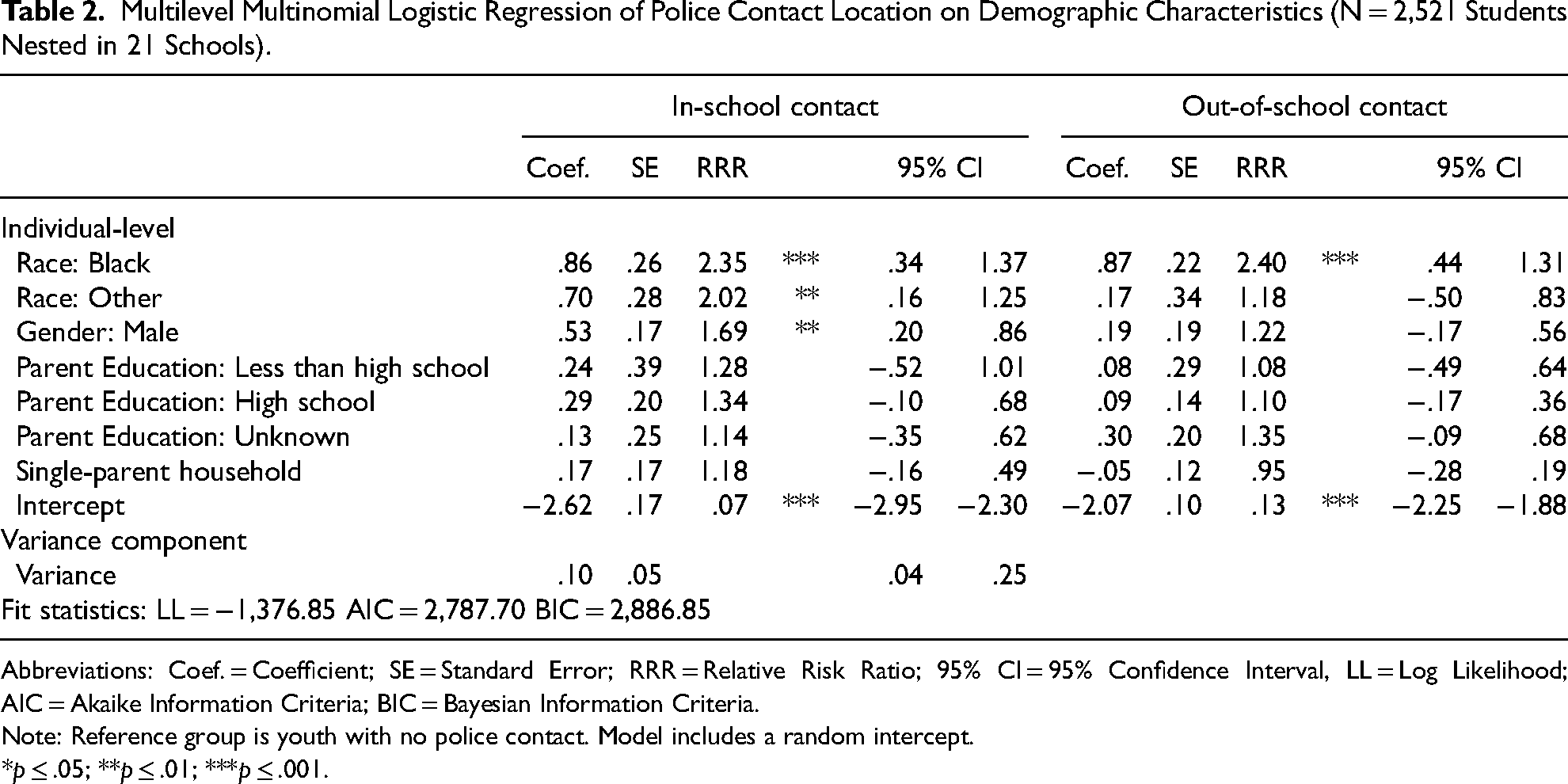
Results presented in Table 2 indicate that compared with their White peers, Black youth and those who identify as neither White nor Black have greater odds of experiencing in-school police contact, as do males. By exponentiating the coefficients, we interpret the results as relative risk ratios. For Black youth, relative to whites, the risk of having in-school contact versus no contact is 2.4 times higher (b = .86). For youth of another race, relative to whites, the risk of in-school contact is 2 times higher (b = .70). Black youth also have a 2.4 times greater risk of having out-of-school contact relative to White youth (b = .87), but no gender differences emerge for out-of-school contact.
Multilevel Multinomial Logistic Regression of Police Contact Location on Demographic Characteristics (N = 2,521 Students Nested in 21 Schools).
Abbreviations: Coef. = Coefficient; SE = Standard Error; RRR = Relative Risk Ratio; 95% CI = 95% Confidence Interval, LL = Log Likelihood; AIC = Akaike Information Criteria; BIC = Bayesian Information Criteria.
Note: Reference group is youth with no police contact. Model includes a random intercept.
*p ≤ .05; **p ≤ .01; ***p ≤ .001.
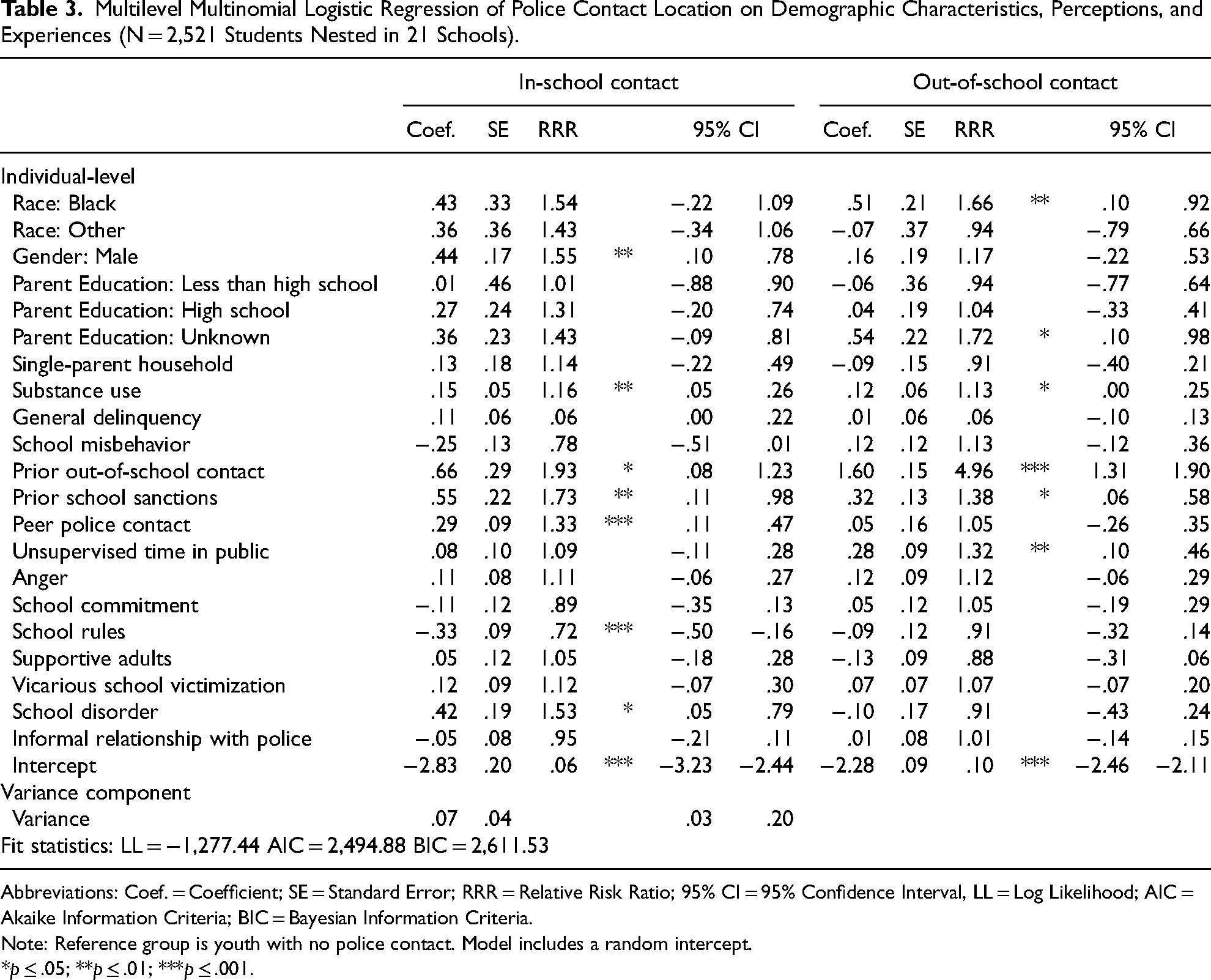
The models presented in Table 3 add attitudinal, behavioral, and perceptual measures. Gender remains a significant correlate of in-school police contact, but race does not. Being male is associated with 1.6 times greater risk of in-school contact relative to having no contact (b = .44). Substance use is positively associated with in-school contact. General delinquency and school misbehavior are just above the cut-off for statistical significance, with both p-values at .056. Prior sanctions predict student-police encounters on school grounds: relative to having no contact, a previous community-based contact increases the risk of having later in-school contact by 1.9 times (b = .66), and prior school punishment is associated with a 1.7 times greater likelihood of school-based contact (b = .55). Youth are also more likely to have school-based police encounters when they have friends who had police contact (b = .29). Among our perceptual measures, a one-unit increase in awareness of school rules decreases the odds of experiencing in-school contact by a factor of.72 (b = −.33), while perceiving the school as more disordered increases the odds of school-based encounters.
Multilevel Multinomial Logistic Regression of Police Contact Location on Demographic Characteristics, Perceptions, and Experiences (N = 2,521 Students Nested in 21 Schools).
Abbreviations: Coef. = Coefficient; SE = Standard Error; RRR = Relative Risk Ratio; 95% CI = 95% Confidence Interval, LL = Log Likelihood; AIC = Akaike Information Criteria; BIC = Bayesian Information Criteria.
Note: Reference group is youth with no police contact. Model includes a random intercept.
*p ≤ .05; **p ≤ .01; ***p ≤ .001.
When comparing youth with out-of-school police contact to those with no contact, we find that all else equal, Black students are more likely to be stopped or arrested in the community than White youth. The odds of experiencing community-based contact are higher for youth who use drugs and alcohol with greater frequency, but other forms of delinquency are unrelated to police encounters. Both prior police-initiated contact and school punishment are significant. For youth with prior police contact outside of school, the odds of having community-based contact increases by nearly 5 times (b = 1.60), and prior school punishment is associated with a 1.4 times increase in community-based contact (b = .32). Spending more unsupervised time with peers in public is also significantly associated with police contact in the community (b = .28).
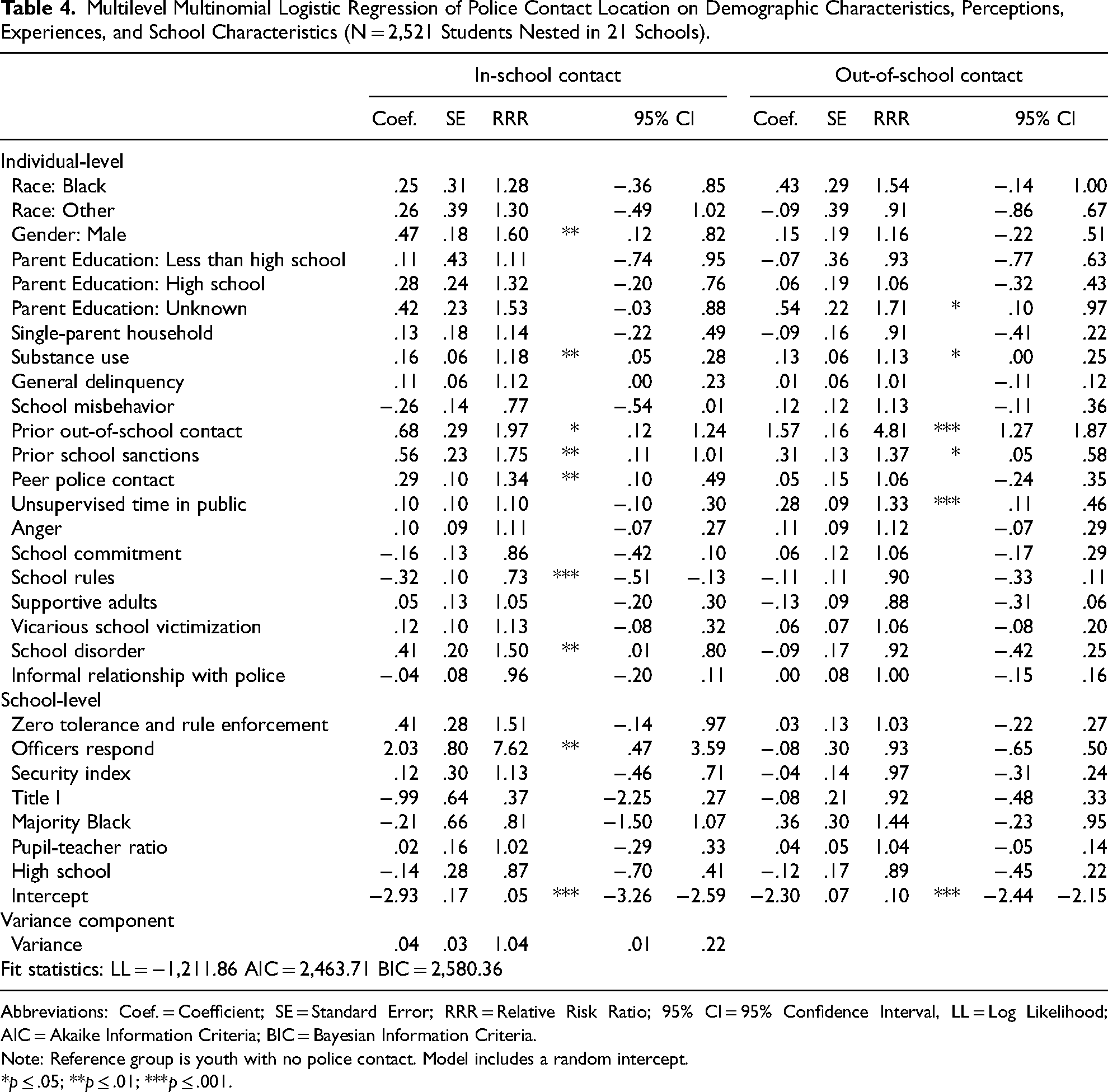
Table 4 displays the full model results, with the addition of school-level variables and school-level intercepts. Individual-level effects generally remain unchanged, but there are no longer differences in out-of-school contact by race. Among school-level variables, when officers respond to schools for delinquency and gang problems, the odds of experiencing police contact in school significantly increase. 16 A one-unit increase in agreement with this scale is associated with a 7.6 times increase in youth's odds of experiencing police contact in school (b = 2.03).
Multilevel Multinomial Logistic Regression of Police Contact Location on Demographic Characteristics, Perceptions, Experiences, and School Characteristics (N = 2,521 Students Nested in 21 Schools).
Abbreviations: Coef. = Coefficient; SE = Standard Error; RRR = Relative Risk Ratio; 95% CI = 95% Confidence Interval, LL = Log Likelihood; AIC = Akaike Information Criteria; BIC = Bayesian Information Criteria.
Note: Reference group is youth with no police contact. Model includes a random intercept.
*p ≤ .05; **p ≤ .01; ***p ≤ .001.
To summarize, our results indicate that the variables consistently associated with both in-school and community-based contact are related to misbehavior and prior punishment, with only substance use, prior community-based encounters, and school sanctions increasing the odds of later police contact across both locations. 17 Differences regarding peer associations and time spent with peers emerge, suggesting potential distinctions in the role of peer networks and behavior that account for police contact location. School-related perceptions, such as those related to disorder and rules, significantly predict police contact in, but not outside of, schools. Among our school-level variables, only officers responding to delinquency and gang problems significantly influences the odds of having school-based police contact.
Discussion
The school-to-prison pipeline has been the topic of decades of research, with scholars focusing primarily on the harms of school punishment and how it can lead to later justice system involvement (Monahan et al. 2014; Mowen and Brent 2016; Wolf and Kupchik 2017). Another direct link to the justice system is via youth's school-based encounters with police. While research indicates that school-based officers have access to student information which may shape their perceptions of and types of interactions with students (Kupchik et al. 2020; Rhodes and Clinkinbeard 2020), little is known about the individual-level factors that predict school-based encounters and whether they differ from factors associated with police contact in the community. Given the nature of policing in schools, it is possible that students’ personal and background information is linked to in-school police contact in ways not seen in community-based contact. Here, we discuss our findings in the context of mechanisms associated with police contact generally, as well as the more specific individual- and school-level factors that uniquely impact youth's experiences with the police in schools versus the community. These findings point to avenues for decreasing students’ contacts with the police by targeting both individual-level factors as well as school-wide policies and practices.
We find some key student characteristics to be indicators of police contact, regardless of the location. Prior police contact outside of school, as well as prior school-based sanctions and police contact, predict both in- and out-of-school contact. This finding may well relate to the fact that these youth are involved in problem behavior. However, given the fact that delinquency is not a strong predictor of police contact, it might reflect that prior experiences with sanctioning officials leads to heightened surveillance, increasing the risk of additional sanctioning. For example, Rios (2011) describes a “youth control complex” composed of schools, police, family, and probation in which criminalizing labels stick with youth as they move across institutions of control. While we cannot disentangle whether the relationship between prior punishment and later police contact is due to differences in behavior, secondary sanctioning, or labeling processes, prior research suggests all are plausible and may be at work (Liberman, Kirk, and Kim 2014; McGlynn-Wright et al. 2020; Wiley, Slocum, and Esbensen 2013). For example, prior suspension may push youth out of school, thereby increasing their likelihood of community-based police contact, while simultaneously making them known to school personnel and increasing later odds of in-school contact. Additional research is needed to explore these mechanisms. It is equally important to disentangle these results by types of punishment and police contact—something we are unable to accurately do in our sample for both our independent variables capturing prior sanctions as well as our dependent variable. Arrest likely has different predictors and consequences than less serious forms of police contact (e.g., being stopped and questioned). For example, if a youth experienced in-school arrest, their risk of later arrest may be heightened more so than for a youth who was only routinely searched previously. Other more common types of punishment, like detention, may be less consequential for later police contact. By disentangling the type of punishment, future research can illuminate our understanding of the interrelationships between surveillance, school sanctions, and justice system involvement.
Youth's self-reported deviant behavior is less consistently associated with police contact; substance use significantly predicts both in- and out-of-school contact, but neither general delinquency nor school misbehavior do. Substance use may come to the attention of school authorities if it occurs on school grounds or affects youth's performance or attendance. Moreover, for youth who need to hide substance use from parents, drugs are often used in public spaces, putting youth at increased risk for police contact. Other forms of delinquency (lied about age, avoiding paying for things, theft less than $50), on the other hand, might never come to the attention of the police because they are less likely to be detected, reported, or investigated. While one would expect school misbehavior to predict in-school contact, our measure is limited in the types of behaviors it includes, such as bullying and truancy. Future work should consider a broader range of school-based behavior that may come to the attention of authorities.
Peer group characteristics are also related to police contact, but in different ways depending on the location. Youth who spend more unsupervised time with friends in public places have greater odds of being stopped or arrested outside of school. Meanwhile, having friends with prior police contact significantly predicts in-school, but not out-of-school contact. These findings highlight the different ways that surveillance and peer associations play out across locations. While visible group activity appears to drive police-initiated encounters outside of school, school-based contact may be shaped by whether peers are known to the police—information that could be gleaned by adults who know students on an informal basis. That peers matter above and beyond one's own behavior aligns with Rios' (2011) ethnographic work on young Black and Latino males. Drawing on Goffman’s (1967) notion of a courtesy stigma, Rios described how even boys who followed school rules and attempted to avoid trouble were criminalized by authority figures for associating with delinquent peers.
Other research suggests that Black boys are often singled out for their behavior in schools and are more likely to experience school-based sanctions as a result (Ferguson 2000; Shedd 2015). We find that males make up 56 percent of school-based contacts (vs. 48% of community encounters) and their odds of experiencing later in-school contact are greater than for females even after controlling for other individual-level characteristics. At the bivariate level, Black youth in our sample are overrepresented in police contacts both in and outside of school and are more likely to receive school punishment, but we no longer find significant differences by race after controlling for other individual- and school-level factors. Although we expected to see race differences in police contact based on theory and prior research (e.g., Ferguson 2000; Fisher, Wiley, and McGlynn-Wright 2021; McGlynn-Wright et al. 2020; Rios 2011; Shedd 2015), our results parallel studies that find race is no longer significant once other correlates of police contact are accounted for, particularly prior school punishment (Crutchfield et al. 2009, 2012). Black youth in our sample were more likely to have prior school punishment, police contact, and friends who have been in trouble with the police, so we cannot cleanly separate race from secondary sanctioning or peer associations that might affect later experiences with the police.
The racial and geographic clustering of our data may also hinder our ability to disentangle race effects. Our sample is split nearly evenly along geographic lines; North St. Louis County has a high concentration of Black residents and is battling decades of public disinvestment (Gordon 2019). It also has higher rates of crime than the rest of the county as well as a history of aggressive policing for minor offenses (Department of Justice 2015; Ferguson Commission 2015). In the community, where individual officers are less likely to have personal knowledge of youth, police may use race and place as a marker of criminality (Rios 2011, 2017; Shedd 2015). To some degree, then, both school- and community-based contacts are influenced by students’ location of residence. At the bivariate level, youth with either school- or community-based police contact attended schools with higher percentages of Black students, receipt of Title I funds, and greater use of school security measures. While these factors are not significantly associated with police contact in our final regression models, it is noteworthy that Black youth have greater odds of community contact prior to adding school-level factors to our model. To the extent that schools mirror the communities they are in, this finding may highlight heightened surveillance and policing practices in communities of color. Given the overpoliced nature of Black schools and communities in North St. Louis County, it is difficult to disentangle demographic characteristics from experiential and attitudinal correlates of police contact (e.g., delinquency, prior sanctions). While our findings are likely relevant for other highly segregated inner-ring suburbs, future research is needed to understand how these mechanisms play out in places where space, race and concentrated policing are less intertwined.
Relatedly, while there is variability across our sample of 21 schools, each school is relatively racially and socioeconomically homogenous, making it difficult to parse out the effects of context from individual-level characteristics. Moreover, schools have uniformly increased their reliance on criminalizing practices since the early 2000s (Kang-Brown et al. 2013) and all schools in our sample had an assigned officer. As such, our findings should be replicated using data with a larger sample of schools that capture a wider range of locales, school and neighborhood characteristics, and policies to adequately assess the relationship between contextual factors and youth's likelihood of police contact in schools and in the community.
After accounting for school composition, only one school-level measure is significantly associated with being stopped, searched, or arrested in school. When officers respond to school-based delinquency and gang problems, the odds of experiencing school-based contact increase. Meanwhile, more universal policies like zero tolerance or general target-hardening strategies are not drivers of school-based police contact in our sample. 18 While we cannot say whether officers’ responses to problem behavior is rooted in formal policies or informal expectations, prior research supports the idea that officers largely determine their disciplinary responses based on the school's day-to-day needs and their relationships with personnel, even if their response does not completely align with school or district policies (Curran et al. 2019; McKenna, Martinez-Prather, and Bowman 2016). Our measures also do not directly capture role expectations that school personnel or officers have, but a growing body of research shows that these roles (e.g., law enforcement, mentor, educator) shape how school-based officers interact with students (Devlin and Gottfredson 2018; Fisher et al. 2020). Determining the role of the intervening officer is important not only for understanding their expected involvement in school discipline, but also because being questioned by a known SRO during school hours likely looks much different than being questioned by community-based patrol officers on school property outside of school hours (Shedd 2015). If the information available to school-based officers is dependent on their role in the school or types of relationships with students, then the individual-level factors that predict school-based contact should shift as a result.
In addition to school-level characteristics, we captured youth's perceptions of school personnel, rules, and climate. That the students enrolled in these schools have characteristics, experiences, and perceptions that increase their likelihood of police contact may be indicative of a subtle, indirect process in which the school environment contributes to the very student characteristics that elevate the prevalence of these encounters. When students perceive that their school is characterized by higher levels of disorder, ranging from behaviors like bullying and teasing to more serious problems like gang presence and racial/ethnic group animosity, it increases their likelihood of in-school police contact, above and beyond their own behavior. It is possible that disordered schools rely on officers as a source of guidance or have few options aside from law enforcement to help control student behavior, especially if they lack other services, like counseling (Kozol 1991; Kupchik 2010; Simon 2007). If officers more frequently respond in disorderly environments, for example to break up fights or remove disruptive students from classrooms, then the likelihood that students in these schools will experience police contact should increase. While calling on officers might be a quick solution, such criminalizing practices can erode students’ perceptions of legitimacy (for a review, see Hirschfield and Celinska 2011) and increase views of disorder (Curran et al. 2021; Mayer and Leone 1999), thereby contributing to the problem.
Arbitrary enforcement of school rules has similarly been found to harm the legitimacy of school authority (e.g., Shedd 2015). In our sample, when youth disagreed that rules were fair, clear, and consistent, they were more likely to experience police contact. While this may reflect the school's inability to maintain fair punishment, it is also possible that youth who consistently get into trouble rate rules as unfair simply because they are personally impacted by them. The quantitative nature of our data precludes a nuanced understanding of the complex ways in which behavior, interactions with authority figures, perceptions, and the school environment interact to shape experiences with the police. For example, there is evidence that when students view school rules as unevenly enforced or feel they have been unfairly treated by the police, this erodes the legitimacy of authority and promotes defiance, particularly among youth of color (Rios 2011; Shedd 2015). We are unable to disentangle these reinforcing, reciprocal processes or the potential ways that they generate and maintain race differences in experiences with authority. A strength of our approach is the documentation of broader patterns of school-based police contact, but qualitative research is better suited to explore how the factors we have identified unfold in the eyes of students, school personnel, and officers.
Conclusion
Protests surrounding issues of policing and systemic racism have prompted the reconsideration of placing officers in schools. By keeping officers in schools, some have argued that it sends a message that school districts are complicit in perpetuating systemic racism and violence at the hands of police. While our findings do not conclusively support the idea that Black students are singled out in schools for searches, stops, or arrests, they point to complexities in disentangling individual- and school-level factors that predict police contact. If criminalizing practices are concentrated in schools and communities of color in our data, even police contact that appears to be driven by behaviors such as substance use or prior sanctions may be disproportionately detected among Black youth, serving to exacerbate unequal experiences with school punishment and justice system contact across all settings. Additional research is needed to explore this possibility.
Regardless of these complexities, our data from one county point to the need to consider how discretionary responses to students can perpetuate harms. For example, prior contact with the police—whether in or out of school—does not serve as a deterrent and instead further entrenches youth in the justice system. Given that early justice system involvement may set youth on a path out of school and into the justice system, other responses to these youth must be considered. Police contact is associated with deleterious educational outcomes, such as academic achievement, school commitment, and subsequent school sanctions (Arcia 2006; Fisher, Wiley, and McGlynn-Wright 2021; Wiley et al. 2020). Police contact that occurs in school might amplify these consequences if the student-officer encounter is known to school personnel and other students, triggering processes of exclusion and ostracism and discouraging the youth from maintaining connections in school.
Our findings point to the importance of school-level responses to student behavior in that relying on officers to intervene is a correlate of school-based contact. Alternatives to law enforcement should be considered when responding to student misbehavior, particularly if the behavior that draws youth into the net of the justice system includes substance use or other less serious forms of delinquency. Schools should also consider whether the signals they send to students related to student safety and the fairness of school rules and their enforcement trigger student misbehavior and subsequent criminalizing practices, and if so, imagine new strategies for interacting with youth (Rios 2017).
While our findings suggest that limiting the extent to which schools rely on police officers to respond to problem behavior may be one way to limit youth's negative contacts with the police, the solution is likely more complicated than this. Not only are the individual- and school-level factors that predict police contact in school complex and overlapping, but punitive police contact in the community seems to follow youth into the school, while in-school encounters follow youth into the community. That is, youth who have in-school and out-of-school police encounters share similar experiences and the factors that enhance their exposure to police follow them from the “halls to the malls”. This finding challenges researchers to move away from studying the school-to-prison pipeline as a distinct phenomenon and instead examine how what happens in one locale (i.e., the community) shapes what occurs in the other. More broadly, it suggests the need for a more comprehensive harm reduction strategy that spans the school and the community.
Supplemental Material
sj-docx-1-jrc-10.1177_00224278221096985 - Supplemental material for From School Halls to Shopping Malls: Multilevel Predictors of Police Contact In and Out of School
Supplemental material, sj-docx-1-jrc-10.1177_00224278221096985 for From School Halls to Shopping Malls: Multilevel Predictors of Police Contact In and Out of School by Stephanie A. Wiley, Lee Ann Slocum and Finn-Aage Esbensen in Journal of Research in Crime and Delinquency
Footnotes
Acknowledgments
We would like to thank Chris Sullivan and three anonymous reviewers for their insightful comments and Michael Brandes for title ideas. Code available upon request.
Declaration of Conflicting Interests
The author(s) declared no potential conflicts of interest with respect to the research, authorship, and/or publication of this article.
Funding
The author(s) disclosed receipt of the following financial support for the research, authorship, and/or publication of this article: This work was supported by the National Institute of Justice, Office of Justice Programs, U.S. Department of Justice (grant number 2015-CK-BX-0021).

Supplemental Material
Supplemental material for this article is available online.
Notes
Author Biographies
References
Supplementary Material
Please find the following supplemental material available below.
For Open Access articles published under a Creative Commons License, all supplemental material carries the same license as the article it is associated with.
For non-Open Access articles published, all supplemental material carries a non-exclusive license, and permission requests for re-use of supplemental material or any part of supplemental material shall be sent directly to the copyright owner as specified in the copyright notice associated with the article.
