



Abstract
Objectives:
To assess the impact of positive credentials on perceptions of individuals with criminal records and whether the effects of credentials differ by the type of conviction or the criminal record holder’s race.
Methods:
We present fictional job applicant details to a nationwide survey of American adults (n = 5,822) using a factorial design. We manipulate whether the job applicant is Black or White and has a criminal record or not. Among those randomly assigned to have a criminal record, we also vary the type of felony (violent or drug), whether they report a positive credential, and the type of credential (if applicable).
Results:
Among those with criminal records, respondents viewed applicants with positive credentials more favorably than those without credentials. In fact, a supportive reference letter from a former employer mitigates most of the stigma from a criminal record. The results are consistent by applicant race as well as criminal record type, and our employer respondents react similarly to experimental conditions as compared to the overall sample.
Conclusions:
Our results suggest that the inclusion of positive credentials can help reduce criminal record stigma and aid in the normification process.
Introduction
A criminal record is a “deeply discrediting” mark that is socially created and reinforced (Goffman 1963:3). A prevalent perception is that a criminal record conveys that a person is dangerous, risky, and untrustworthy (Hirschfield and Piquero 2010; Holzer, Raphael, and Stoll 2007). In response, the public and policymakers impose social inclusion restrictions, many of which are formalized by legal proscription (Council of State Governments 2017). Formal consequences of a criminal record include restrictions on civic rights, ineligibility for certain public assistance programs and employment or occupational licensing exclusions (Ewald 2012; Travis 2005; Uggen and Manza 2002).
One of the most pervasive barriers involves employment. A recent comprehensive review of collateral consequences identified over 33,000 state and federal laws restricting access to a job (United States Commission on Civil Rights [USCCR] 2019). In addition to formalized laws, employer concerns include safe work environments and legal liability if a crime is committed on the job (Lageson, Vuolo, and Uggen 2015; Society for Human Resources Management 2012). Such employment barriers can impede the desistance process, while employment opportunities can reduce recidivism (Denver, Siwach, and Bushway 2017; Uggen 2000). A key concern is that rather than carefully linking restrictions to particular situations or types of criminal conduct, policymakers have started “piling on” collateral consequences (Uggen and Stewart 2014:1872). As a national commission recently concluded, unnecessary barriers “negatively [affect] public safety” and professional license restrictions “hinder the chances for and likelihood of rehabilitation for the formerly incarcerated person” (USCCR 2019:133).
As a means of providing relief from the consequences of a criminal record, policymakers and researchers have moved in two main directions. The first involves concealing criminal records. Concealment strategies include prohibiting certain decisionmakers from observing criminal records (sealing) or destroying the existence of the record (expungement). Goffman (1963) refers to these types of actions as normalization: Actors are treating people as if they did not have the stigmatizing attribute. However, such policies are predicated upon unilateral control of criminal record information by a centralized bureaucracy. Although criminal justice agencies are formally responsible for the creation of criminal records, their dissemination is largely unregulated and open to the public. The proliferation of the Internet, accompanied by private companies that collect and distribute criminal records (Bushway et al. 2007; Lageson and Maruna 2018), has caused some legal scholars to argue that criminal record concealment “ignores the technological realities of the information age” (Love 2003:1726).
The second direction, criminal record contextualization, takes a different approach. Rather than remove evidence of the existence of a criminal past, individuals with criminal records are encouraged to obtain and report additional positive information about themselves or their criminal history. This is consistent with another prominent stigma remediation tactic identified by Goffman (1963): normification. Normification entails the stigmatized individual presenting himself “as an ordinary person” while “not necessarily making a secret of his failing” (p. 31). Modern criminal record contextualization strategies can take manifold forms but typically fall under some form of individualized assessment.
One method of using individualized assessments in practice is to enable job applicants to provide both criminal records and positive credentials upfront. At the core of a positive credential strategy is an acknowledgment that stigma remediation must take into account the interests of both individuals with criminal records and those making important decisions about them. By contextualizing the criminal record as just one piece of information about the person, decisionmakers can more accurately assess the “whole person” in their review (Lundquist, Pager, and Strader 2018:5). For stigmatized populations, Goffman referred to positive pieces of information as “disidentifiers.” The purpose of a disidentifier is not to firmly establish a new identity for the stigmatized individual but to create ambiguity as to the veracity of the label (i.e., “criminal”) cast upon him (Goffman 1963:44). Little is known regarding the impact of disidentifiers in practice. In particular, there is a research gap regarding whether some positive credentials are prioritized and viewed more favorably than others and how they interact with applicant characteristics to impact opportunities for individuals with criminal records.
Using a nationwide sample (n = 5,822) of American adults, the current study focuses on how people react to competing types of information about individuals with criminal records, using the employment context as our study setting, to better understand the potential disidentifying effects of positive credentials. We are only aware of one project that examines the impact of a positive credential on employment outcomes among individuals with criminal records. Leasure and Andersen (2016, 2019) sent fictitious resumes to employers in Ohio to test the effect of the state’s Certificate of Qualification for Employment (CQE). Among resumes reporting a one-year-old drug felony, applicants with the CQE received a more favorable response than those without the CQE—and almost as favorable as applicants without a criminal record (Leasure and Andersen 2016). While there were null race effects overall, White applicants received a more favorable response than Black applicants when both presented a CQE (Leasure and Andersen 2019). Key policy questions include whether a positive credential effect can be replicated in other contexts with other types of criminal records (most notably, violent felony convictions) and other types of positive credentials. In addition, the role race plays in attenuating or magnifying the impact of positive credentials is unclear, as current research yields inconsistent findings (Blair and Chung 2017; Gaddis 2014; Kleykamp 2009).
This study has two key contributions. First, we use an experimental factorial survey design that enables us to consider numerous forms of competing information simultaneously. We consider variations in the type of felony conviction (violent or drug) to determine whether a disidentification strategy has similar effects for those with violent felony convictions during a reform era that tends to neglect that population (Gottschalk 2015). We also examine the influence of four distinct positive credentials that are theoretically and policy relevant: the completion of an involuntary or voluntary job-training program (Bushway and Apel 2012), an occupational license (Blair and Chung 2017), and a positive reference from a prior employer who knew of the applicant’s felony conviction (Maruna et al. 2004).
Second, we analyze whether the race of the criminal record holder conditions the influence of positive credentials. Given prior research findings that Black applicants need to obtain a degree from an elite university to be as successful on the job market as White applicants with less prestigious degrees (Gaddis 2014), it is possible that Black applicants with criminal records may need to obtain stronger signals than their White counterparts to achieve the same level of labor market success. By contrast, research has shown that other positive credentials—for example, administrative military service (Kleykamp 2009) or occupational licenses (Blair and Chung 2017)—are especially effective for Black applicants. Determining whether credentials exhibit multiplicative effects by race or felony type can inform reentry and criminal record policy discussions and guide future research efforts on disparate effects.
The Theoretical Role of Positive Credentials
The notion of a criminal record as a negative credential was adapted from the sociology of education literature over a decade ago (Pager 2003), but theoretical discussions of positive credentials in the criminal record context are still scarce. In the current study, there are several proposed elements of a credential that we use as a guide. First, we adopt Pager’s (2007:37) definition of credentials as a “proof of ability or trustworthiness.” Credentials can serve as powerful labels and can influence a person’s “formal and enduring” social status (Pager 2007).
Second, credentials involve legitimacy, and often, performance (Maruna 2012; Pager 2007). Maruna (2012:78) gives the examples of pairing graduation ceremonies with diplomas and court trials with convictions, with “the credential legitimizing the ritual and the ritual legitimizing the credential.” Previous discussions in the literature often point to occupational licenses and state-issued certificates of rehabilitation/employability as examples of credentials (Doleac 2016; Leasure and Andersen 2016). Some credentials, however, may not involve formal rituals but still invoke a legitimizing process. For example, Maruna and colleagues (2004) described how having “legitimate” sources as personal references, especially if the sources are outside a job applicant’s immediate inner circle, can speak to a person’s character and qualities. Character reference letters from previous employers who are aware of the person’s criminal record can serve as an important source of trustworthiness in information-limited decision contexts (Denver and Ewald 2018).
Third, positive credentials can reduce labor market inequalities by providing additional information to employers and minimizing information asymmetry (Blair and Chung 2017), but not all credentials are equally valuable. From a human capital perspective, obtaining a credential improves an individual’s abilities, thereby increasing their employment opportunities if these skills are more valued in the labor market (Becker 1964). Alternatively, from a “credentialism” perspective, the credential may simply provide information to others about underlying, unobservable characteristics about the person (Collins 1979). This latter notion of credentialism is similar to the theoretical notion of signaling (Spence 1973): Engaging in a reentry program should impose differential opportunity costs 1 for participants, and program completion can signal information about an underlying trait or characteristic to potential employers (Bushway and Apel 2012). In a credentialism or signaling framework, voluntary program participation should reveal more information than nonvoluntary participation; the more “costly” the credential, the more informative it is.
Similarly, the same credential may not be viewed as equally valuable depending on perceived baseline risk. Employers tend to report heightened concern with violent felonies compared to nonviolent felonies (Hunt et al. 2018; Pager 2007). Similarly, policy reforms disproportionately alleviate punishment severity for those with nonviolent, nonserious, and nonsexual offenses (Gottschalk 2015). Applicants with violent felony convictions may need to report stronger credentials than their otherwise identical counterparts with a prior drug felony conviction to reduce the stigmatizing effects of the criminal record.
Fourth, even the same positive credential may have effects which differ by applicant race. In the broader credential literature, Gaddis (2014) found that bachelor degrees from an elite university are equally as effective for Black job applicants as less prestigious bachelor degree institutions for White applicants. Further, positive responses to applications from Black applicants were significantly more likely to involve lower tier positions with lower wages, as compared to responses to similarly-educated White applicants who were more often requested to interview for higher tier jobs with higher starting salaries. Gaddis (2014) interprets these results as suggesting that Black applicants are at a double disadvantage in the labor market—not only must they graduate from more elite universities to receive callbacks at the same rate as Whites with degrees from less prestigious universities, but even when they do their positive responses from employers involve less desirable, lower paying jobs.
By contrast, Kleykamp (2009:272) reasons that another plausible signal of an applicant’s productivity—military service—could especially benefit minority applicants because the experience could imbue minority applicants with characteristics that employers perceive them to be lacking as compared to typical White applicants—namely, soft skills and personal discipline. Her results suggest some support for this statement, as military service with administrative experience as clerks tends to improve callback likelihoods for Black applicants but not White applicants. In a study comparing credentials, Blair and Chung (2017) examine whether occupational licenses can mitigate wage gaps. Using nationally representative data from the Survey of Income and Program Participation, they demonstrate that the wage premium from an occupational license experienced by Black males completely mitigates the wage gap between licensed White and Black male employees. Further, Blair and Chung (2017:4) find that the wage increase effect for Black men is strongest in states with felony conviction restrictions, suggesting that employers perceive the license as a “positive indicator for non-felony status.”
Current Study
While there is no formalized framework for understanding how positive credentials interact with the negative credential of a criminal record, we constructed three key hypotheses based on prior literature. The first is based on the expectation that positive credentials vary in strength and perceived value. Most notably, credentials that involve some type of voluntary and formally recognized, legitimizing process should have the potential to mitigate criminal record stigma more effectively than mandated credentials (Bushway and Apel 2012). Therefore, while we anticipate that all of the positive credentials will have a beneficial effect on respondents’ perceptions of job applicants because they provide information about the applicant’s human capital, we expect that involuntary job skills training program completion will be the least effective (H1). We make no further a priori assumptions about the ordering of positive credentials in their effectiveness.
We also expect two important interactions. We hypothesize that positive credentials will be less effective for applicants with violent felony convictions, as the stigma associated with this type of criminal record is typically stronger than that attached to a drug felony (H2). We also expect race to interact with positive credential type, producing more or less effective disidentifying effects for Black male applicants (H3). We remain agnostic as to the direction of the race effect across our tested credentials due to the scarcity and inconsistency of prior research findings.
Data and Methods
We administered a survey in April and May 2018 to a nationwide nonprobability sample of adults in the United States (age 18 or older) through Amazon’s Mechanical Turk (MTurk). The MTurk platform connects “workers” (or respondents) to “requesters” to voluntarily complete Human Intelligence Tasks (or “HITs”) for compensation. Convenience samples are increasingly common in the social sciences more broadly, particularly for experimental survey research that seeks to develop and test theory (Daniels and Munsch 2018; Pogarsky, Roche, and Pickett 2017; Silver 2017). While probability samples are preferred when feasible, researchers have found nonprobability online samples to have similar experimental findings compared to probability samples (Coppock 2018; Mullinix et al. 2015; Simmons and Bobo 2015) while reducing the financial constraints involved in nationally representative data collection efforts. Researchers have also found MTurk samples to have better “data quality,” typically defined as higher levels of survey comprehension, attentiveness, and survey completion, compared to a leading population-based sample (GfK; Weinberg, Freese, and McElhattan 2014), and online surveys generate less social desirability bias relative to phone and in-person surveys (Chang and Krosnick 2009; Kreuter, Presser, and Tourangeau 2008).
We restricted survey participation in two ways. MTurk workers needed to have at least 50 HITs to take the survey (the lowest experience restriction available). In addition, workers needed to have an approval rating of 95 percent or higher on prior tasks. Under these conditions, workers with low levels of experience could still participate in the survey, reducing nonnaivete (Chandler, Mueller, and Paolacci 2014), while also maintaining reliable response quality (Peer, Vosgerau, and Acquisti 2014). We did not include attention check questions in the current study. Peer et al. (2014) demonstrate that restricting MTurk survey participation to workers with a “high reputation” (at least a 95 percent approval rate on prior tasks) may be sufficient, as high reputation workers produce reliable data regardless of whether attention check questions are presented or not. Furthermore, attention check questions may interfere with survey flow and cause undesirable respondent reactions to attention checks, which has led some to caution against using this strategy for reputable MTurk workers (Paolacci, Chandler, and Ipeirotis 2010; Peer et al. 2014).
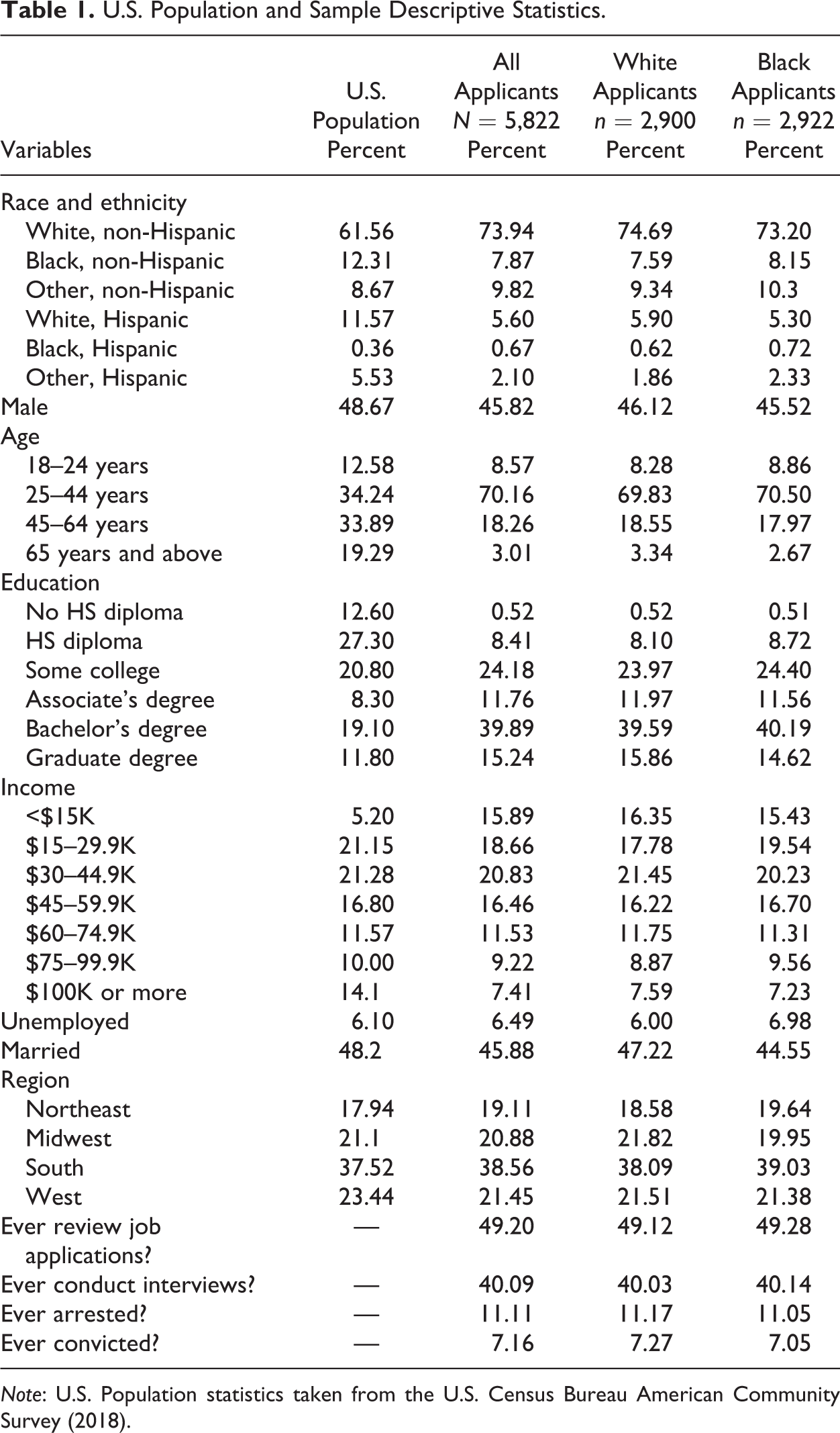
We estimated that the survey would take approximately 6 minutes to complete; on average, MTurk respondents took 6.5 minutes to complete the survey (median = 5.4 minutes). 2 We paid workers 30 cents to take the survey, which is higher than typical respondent pay scales (Weinberg et al. 2014). The survey ran for 35 days, and MTurk workers could only take the survey once. Table 1 provides summary statistics for our final sample of 5,822 respondents. 3
U.S. Population and Sample Descriptive Statistics.
Note: U.S. Population statistics taken from the U.S. Census Bureau American Community Survey (2018).
MTurk survey samples typically overrepresent White, young, well-educated, and lower income individuals relative to the general public (Levay, Freese, and Druckman 2016; Shank 2016; Weinberg et al. 2014). Similarly, compared to the most recent U.S. Census Bureau American Community Survey (2018) estimates, our sample overrepresents non-Hispanic Whites (73.94 percent to 61.56 percent), is more likely to be between 25 and 44 years old (70.16 percent to 34.24 percent), is considerably more likely to have a Bachelor’s degree (39.89 percent to 19.10 percent), and generally reports lower income than the average U.S. resident. In addition, there is a slight regional over- and underrepresentation for the Northeast and West, respectively.
Factorial Survey Methodology
Factorial experiments enable researchers to test and examine interactions across key factors of theoretical interest (Cox and Reid 2000), which is critical for the research questions proposed in this study. We employed a 2 × 2 × 5 factorial design. We also included two “no criminal record” control conditions for Black and White applicants, for a total of 22 possible conditions (see Figure 1 for a summary and Online Appendix B for details). We randomly assigned MTurk workers to (1) one of two possible applicant race conditions (White/Black), (2) one of two criminal record conditions (drug felony/violent felony) or a no-record condition, and conditional on being assigned a criminal record, (3) one of five credential conditions (described below).
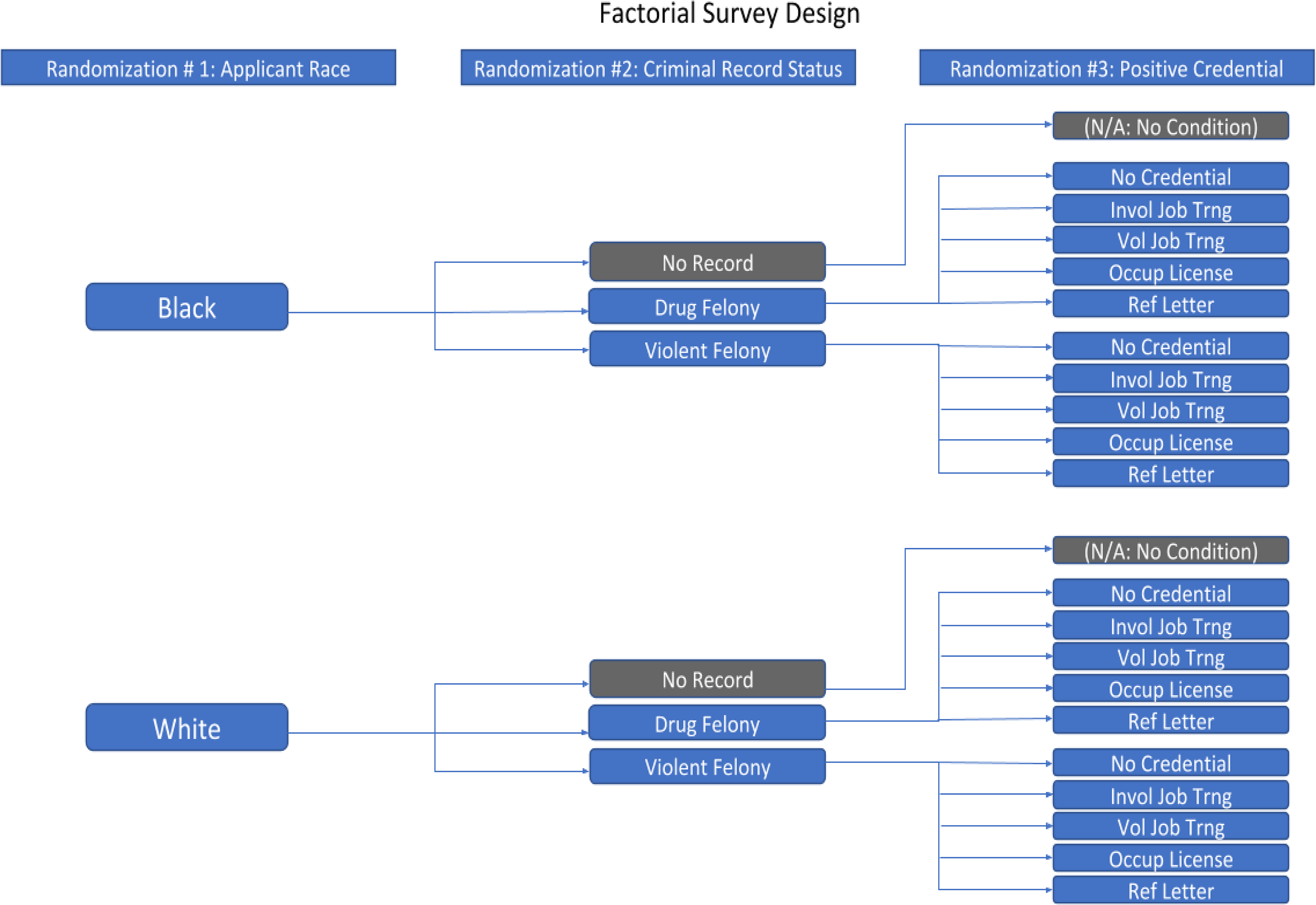
Flowchart of factorial survey.
For the race condition, we assigned to each fictional applicant one of ten race-suggestive names originally employed and validated by Bertrand and Mullainathan (2004). 4 Although there is some controversy surrounding the use of names to signal race (Gaddis 2017), potential alternatives to this strategy—using common White/Black names localized to respondent social contexts or photos of fictional applicants presented with resume details—were either not possible (since we do not know in advance where respondents reside) or, in the case of photos, could bias results in potentially unpredictable ways (King and Johnson 2016). Names were presented twice to reinforce the race prime. The name initially appeared at the top of the job application and was referenced again when asking the respondent to indicate their willingness to call the applicant back for an interview (see Online Appendix B for exact presentation).
The second stage of randomization assigned either no criminal record (control condition) or one of two felony conviction conditions: (1) a single felony conviction for cocaine possession with intent to distribute or (2) a single felony conviction for aggravated assault. We chose these felony conditions for two reasons. First, both of the convictions referenced an 18-month prison sentence, and the two crime types tend to yield roughly similar median prison sentences (BJS 2013). Second, prior research indicates respondents have more negative reactions to violent convictions relative to other conviction types (Denver, Pickett, and Bushway 2017; Holzer et al. 2007; Hunt et al. 2018; Pager 2007), which could result in meaningful differences when evaluating positive credentials.
The third and final randomization stage assigned respondents to one of five possible credential conditions. In addition to a no-credential control condition, where the MTurk worker did not receive any additional information, positive credentials included: (1) involuntary completion of a job skills training program; (2) voluntary completion of a job skills training program; (3) an occupational license to be a barber, which is formally awarded by a state agency; and (4) a reference letter from a previous employer, which verified a positive work history and stated that the employer would be willing to rehire the applicant if given the opportunity. We informed respondents that each credential was obtained after the applicant was convicted, since the temporal ordering of events can alter the perceived value of positive credentials (Denver and Ewald 2018). For the reference letter condition, we note that the employer knew about the applicant’s conviction when he or she wrote the letter.
The first two credential conditions were chosen because they represent a potential solution to a key prisoner reentry problem—many former prisoners lack basic human capital expected by employers, even in entry-level employment markets (Holzer 1996; Petersilia 2003). Therefore, our respondents may evaluate applicants with criminal records negatively because they associate a criminal conviction with personal attributes associated with low worker productivity (e.g., a low level of education, employment inconsistency, or the lack of other important hard and soft skills). If concerns about job applicants with criminal records are due to doubts about their human capital (i.e., “hard skills”), we expect that job skills training will increase respondent willingness to call these applicants back for an interview. We differentiate between involuntary and voluntary participation and completion to ascertain whether survey respondents assign a premium to the applicant for their initiative.
The third credential condition, an occupational license to be a barber, was selected as a form of official state endorsement of the job applicant’s rehabilitation and good conduct. Employers are attentive to licenses and other state-supported credentials (Blair and Chung 2017; Leasure and Andersen 2016). Barber licenses are ubiquitous across states, with high licensure approval rates across the United States for individuals with criminal records, including felony convictions (Ewald 2019). In addition, a barber skill set is offered in multiple state prison job training programs (Clear, Reisig, and Cole 2018), providing a potentially accessible license type both pre- and post-release. We also wanted to select a license for a position that was not directly related to the job in question to differentiate the credential from work history in the same occupation.
The fourth and final credential condition, a positive reference letter from a prior employer, was chosen because it may provide a legitimate source of trustworthiness about the job applicant to decision makers (Denver and Ewald 2018). Individuals who are perceived to be prosocial, “moral” citizens—particularly if they are knowledgeable about a person but are not part of their inner circle of family or friends—can vouch for that person’s prosocial identity (Maruna et al. 2004) while also verifying the quality of the person’s abilities and skills. In information-limited decision contexts, respondents may view a job applicant with a supportive letter of recommendation as not only capable of successfully performing the required tasks of a job but also as a person who can be trusted. In the current context, the letter writer knew the applicant for a year and a half, explained that the person was a “good worker, showed up on time, and did not violate any company policies or workplace rules,” and indicated that although he has a felony conviction, the employer would rehire him if they had the opportunity to do so.
Consistent with the prior literature, the hypothetical job opening was a full-time entry-level position (cashier at a supermarket) which required a high school diploma or equivalent and no prior work experience. We attempted to control for as much contextual information in the vignette as feasible by standardizing several pieces of information. All applicants were male and the same age (23 years old). Additionally, each applicant had a high school diploma, 2.5 years of experience as a cashier and 1 year working in a barbershop. To account for the 18-month employment gap among applicants with a criminal record we altered the high school diploma year for applicants without records to indicate they had graduated a year and a half later than is typical, similar to the tactic employed by Pager (2007) to address this issue. As a result, none of the applicants had employment history gaps after they graduated from high school, with the exception of the 18 months applicants with criminal records spent in prison. While applicants assigned to the positive reference letter credential had a heightened level of support from an external reference, all applicants had two references that verified the applicant’s self-reported work history was accurate.
Applicants were designed to be overqualified for the job opening, consistent with typical audit designs (Leasure and Andersen 2016; Pager 2003, 2007; Pager, Bonikowski, and Western 2009). A consequence of this approach is that our fictional applicants are representative of just a small proportion of individuals with criminal records who have consistent work histories and a high school diploma. Given that the average educational and employment history of a young adult male with a criminal record is considerably less developed, our study arguably underscores the impact of a criminal record and credentials on the likelihood of a callback for an interview. At the same time, it is possible that examining fictitious applicants—both with and without criminal records—with lower levels of education and work experience could produce different estimates based on overall less positive appraisals, an important area for future studies. 5
After summary applicant characteristics were presented and defined, respondents were asked to gauge their willingness to call back a job applicant for an interview (1 “very unlikely,” 2 “slightly unlikely,” 3 “neither likely nor unlikely,” 4 “slightly likely,” 5 “very likely”). We chose to ask respondents to indicate willingness to interview, rather than willingness to hire, because the former represents the first significant barrier for individuals with criminal records to overcome in the employment process. Further, it would also not require that the applicant is offered the job—merely that they be invited to interview for it. This ensures that our respondents are not forced to decide whether these fictional job applicants are the best choice for the position, but whether they meet the minimum criteria to be considered for it.
Analytical Models
We analyze responses on the callback willingness scale by first estimating an ANOVA. We then conduct post hoc mean comparison tests (t-tests) using Bonferroni multiple comparison corrections across each combination of experimental conditions. However, given that our outcomes are ordinal scales the assumptions of a traditional t-test may not be appropriate. We assessed the extent to which our findings were sensitive to violations of these assumptions by estimating Dunn tests (Dunn 1964), a generalized form of the Kruskal–Wallis test (Kruskal and Wallis 1952), which allows for Bonferroni multiple-comparison corrections. The results of these analyses were very similar to our t-test results, so we only present the latter here. 6 After presenting the main results, we provide two salient robustness checks, which demonstrate the consistency of our estimates across alternative model specifications.
One potential concern that arises with the inclusion of 22 experimental conditions is statistical power. A power analysis suggests that the probability we would identify a true significant effect (two-tailed α = .05) between the conditions does not drop below a standard level of .80 and is generally closer to .90. We conducted t-tests assuming effect sizes ranging from .30 to .60, as identified through existing literature on the impact of race (Quillian et al. 2017), offense type (Agan and Starr 2018; Pager 2007), and positive credentials in the employment context (Leasure and Andersen 2016, 2019). Increasing the alpha level to .10 results in statistical power of .90 or greater for all comparisons in our main analysis.
Results
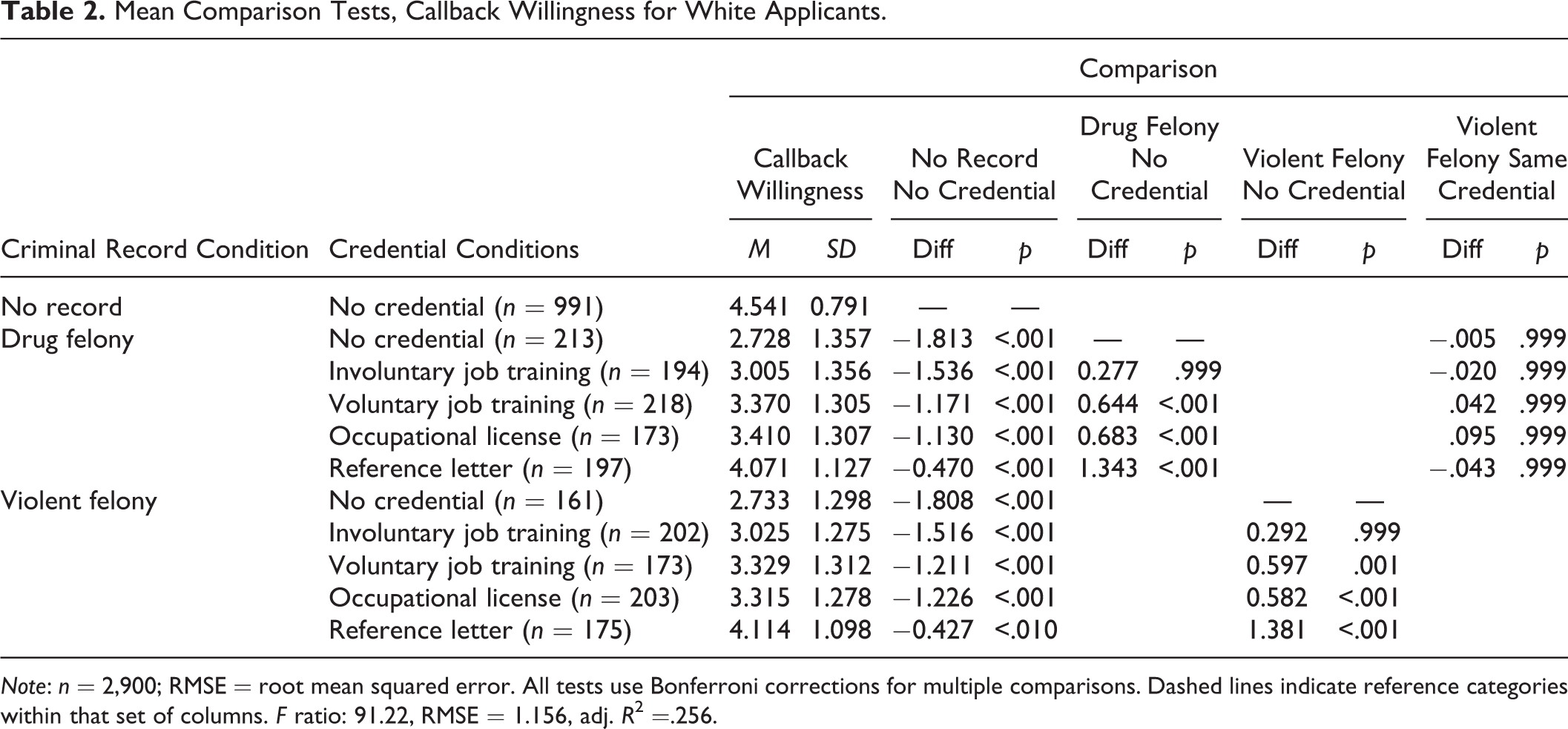
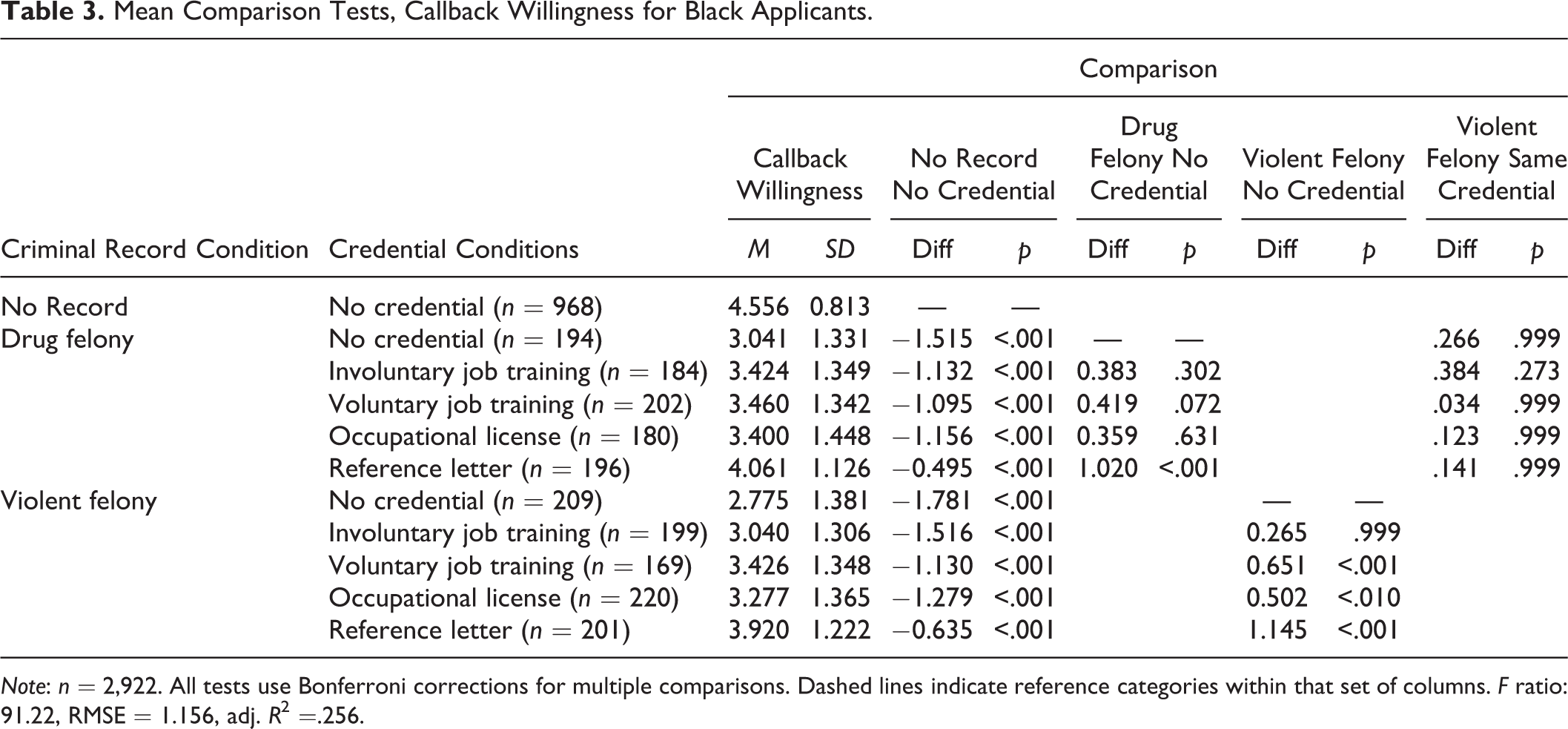
Tables 2 and 3 provide the results from Bonferroni-corrected post hoc mean comparisons for White (n = 2,900) and Black (n = 2,922) applicants separately. We rotate the comparison group across four relevant baseline conditions: (1) comparing all conditions to the “no record, no credential” category, (2) comparing applicants with drug felonies and a positive credential to applicants in the “drug felony, no credential” category, (3) comparing applicants with violent felonies and a positive credential to applicants in the “violent felony, no credential” category, and (4) comparing applicants with a drug felony and a specific credential to an applicant with the same credential but who instead has a violent felony.
Mean Comparison Tests, Callback Willingness for White Applicants.
Note: n = 2,900; RMSE = root mean squared error. All tests use Bonferroni corrections for multiple comparisons. Dashed lines indicate reference categories within that set of columns. F ratio: 91.22, RMSE = 1.156, adj. R 2 =.256.
Mean Comparison Tests, Callback Willingness for Black Applicants.
Note: n = 2,922. All tests use Bonferroni corrections for multiple comparisons. Dashed lines indicate reference categories within that set of columns. F ratio: 91.22, RMSE = 1.156, adj. R 2 =.256.
Consistent with prior research, Table 2 indicates that White applicants who report a criminal record are viewed significantly more negatively than their “no record” category counterparts. For example, an applicant that reports a drug (
The following two columns compare categories within felony conviction type, reinforcing the results from the first set of comparisons. With the notable exception of involuntary job training completion (drug diff = 0.277, p = .999; violent diff = 0.292, p = .999)—a null effect that aligns with our first hypothesis—every positive credential in this study improves perceptions of job applicants with criminal records. Relative to an applicant with a drug felony but no positive credential, for example, an applicant with a drug felony reporting a reference letter from a prior employer experiences a 1.343 increase in callback likelihood ( p < .001). Qualitatively, this type of increase shifts the public’s reaction from a response between “slightly unlikely” and neutral (2.728) to “slightly likely” (4.071). The same general pattern holds for fictitious applicants with violent felonies; compared to applicants without positive credentials, a reference letter increases callback likelihood by 1.381 ( p < .001).
The final column provides comparisons across felony conviction type conditioning on the applicant also having an identical credential status (e.g., an applicant with a drug felony and occupational license is compared to an applicant with a violent felony and an occupational license). Contrary to hypothesis #2 but in line with the patterns previously observed in the results, we find that no significant differences emerge in any of the felony type comparisons. This suggests that our respondents view applicants with aggravated assault convictions approximately the same as they perceive applicants with a drug possession with intent to distribute felony conviction. We suspect this finding may have to do with the specific nature of the violent felony conviction we employ in our analysis, and we return to this issue in our discussion. Taken together, Table 2 indicates that positive credentials are largely (but not equally) effective in improving perceptions of White job applicants, and the effects are not conditioned by the types of felony convictions considered here.
Table 3 provides this same series of comparisons, but for respondents who were randomly selected to evaluate Black applicants (n = 2,922). With respect to comparisons to the “no record” condition, our overall results are no different than for White applicants: Every experimental category is associated with a lower average callback rating and the positive credentials examined here alleviate the stigma of a criminal record, but do not completely mitigate it. By contrast, results for the drug felony comparison exhibit clear differences from the same set of results in Table 2. Namely, only one positive credential—the reference letter from a prior employer—is able to significantly improve respondent perceptions of Black applicants with drug felony convictions (diff = 1.020, p < .001). Findings for Black applicants with violent felony convictions align with those in Table 2, with the slight exception that an occupational license for Black applicants appears to be slightly less effective in mitigating the stigma of a violent felony conviction (diff = 0.502, p < .010). Lastly, comparisons across felony and credential conditions (i.e., varying felony conviction type and holding credential type constant within each pair) also comport with the results for White applicants. Respondents do not indicate lower callback rates for Black applicants with violent convictions compared to otherwise identical Black applicants with drug felony convictions, regardless of which credential is being used for comparison.
Figures 2 and 3 expand upon the comparisons in Tables 2 and 3, depicting race comparisons for each felony and credential condition. The height of each bar represents average callback willingness across respondents in that survey condition while the error bars provide 95 percent confidence intervals around each of the point estimates.
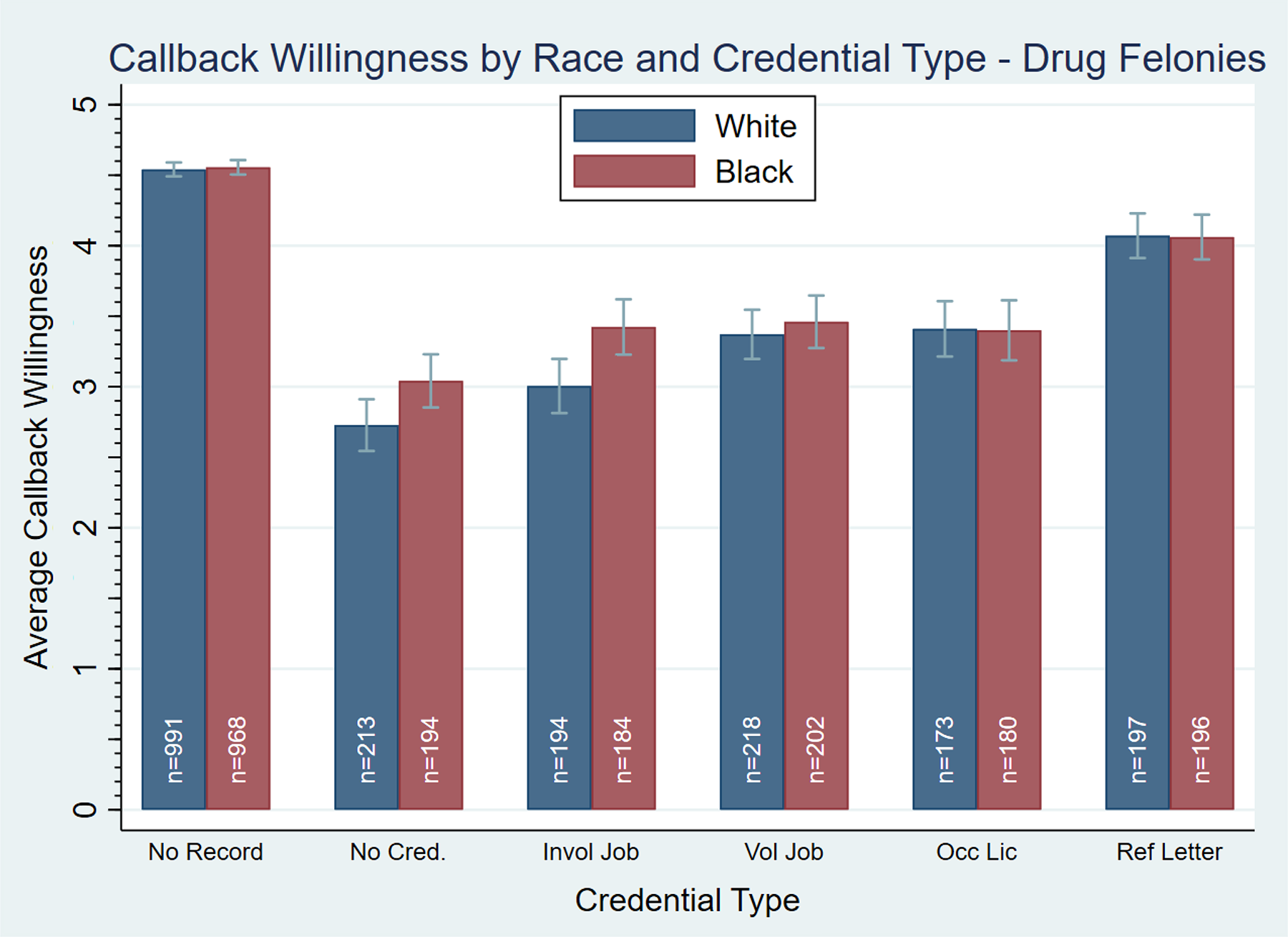
Callback willingness by race and type of credential—drug felonies.
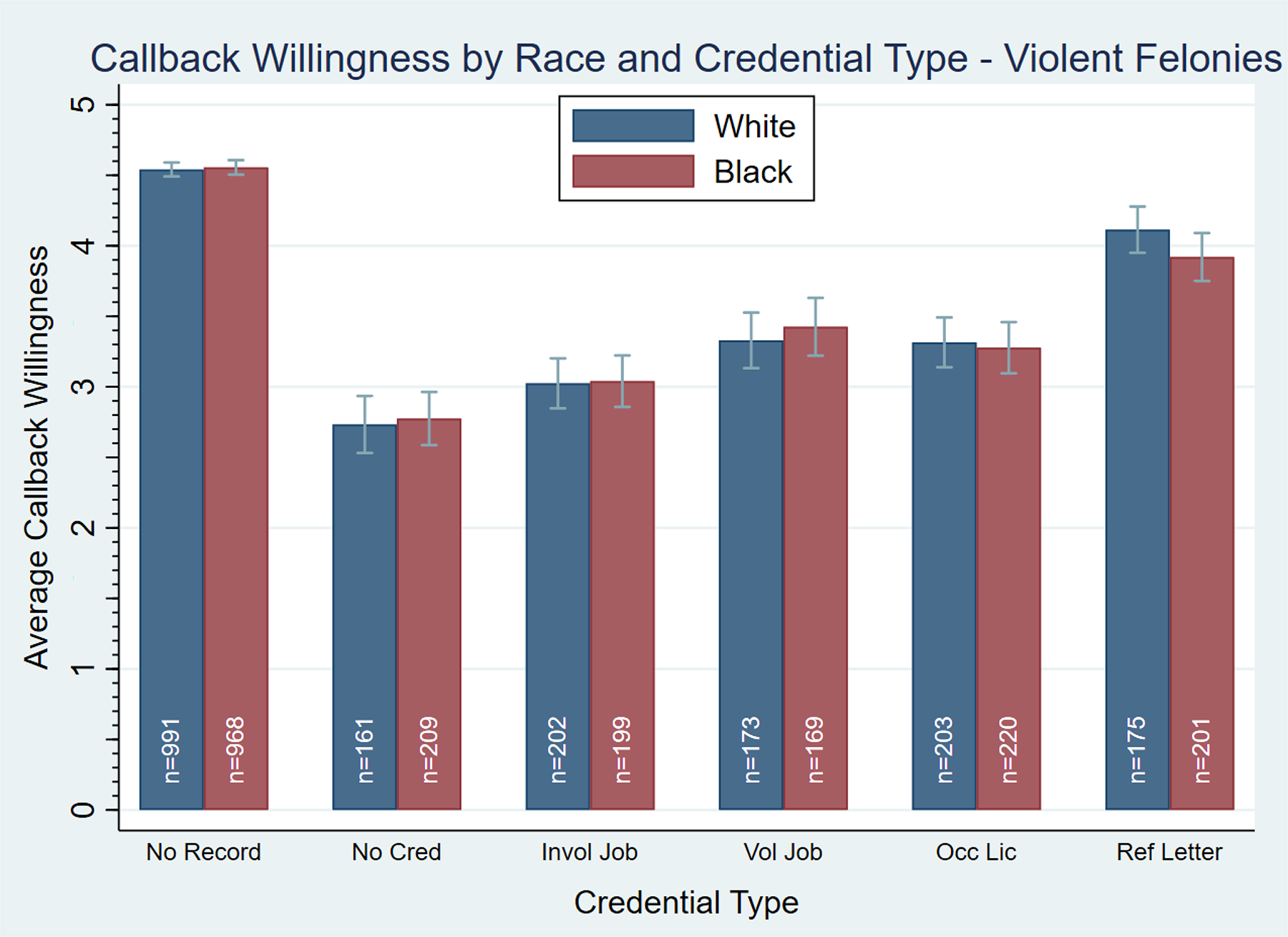
Callback willingness by race and type of credential—violent felonies.
Figure 2 displays respondents’ perceptions of Black and White applicants side by side for the baseline “no credential” condition and all “drug felony” and credential pairings. Of particular note is the clear visual difference in the “involuntary job training” credential comparison—the confidence intervals do not overlap and the results indicate that Black applicants fare better than White applicants when both have involuntary job training completion credentials. However, Bonferroni-corrected t-tests (see Online Appendix C for these results) indicate that no comparison is statistically significant, suggesting that Black and White applicants with drug felonies are perceived similarly within each credential pair. Figure 2 also demonstrates similarity across the effects of the credentials. Involuntary job training, voluntary job training, and occupational licenses exert statistically similar effects across credential type and for Black and White applicants. 7 The sole exception is the effect of the reference letter, which is significantly larger than any other credential effect.
These same patterns are largely repeated in Figure 3, which instead visualizes race comparisons across credential conditions for respondents who viewed applicants with a violent felony conviction. As compared to average callback willingness for applicants with drug felonies, fictitious applicants with violent felonies are viewed slightly more negatively, though no cross-felony comparison in this analysis is significant (see Tables 2 and 3, final column). Further, average callback willingness is strikingly similar across race—no cross-race comparison within any category approaches statistical significance. As in Figure 2, the only credential that is statistically different compared to other credentials when considering a violent felony record is a reference letter from a prior employer. We suspect that this finding is driven by the dual message the reference letter provides—that the applicant has a positive postconviction employment history and the former employer vouches for the applicant’s character.
Sensitivity Analyses
The findings are somewhat surprising, as results from prior studies suggest that Black males with criminal records fare worse than their White counterparts in the labor market (Pager 2007; Pager et al. 2009) and that violent convictions are particularly stigmatizing compared to property or drug felonies (Holzer et al. 2007). One potential explanation is that these findings may be attributable to our sample of MTurk workers, who tend to be considerably more racially, politically, and socioeconomically homogeneous as compared to the wider U.S. population (Levay et al. 2016). To test this possibility, we create sampling weights using population information from the American Community Survey (U.S. Census Bureau 2018) and replicate the analyses. Accounting for sampling weights does little to change our results, as average callback willingness remains similar across experimental conditions and our focal results do not change (see Online Appendix D).
An additional concern about the generalizability of our findings is that we are primarily interested in how people react to both stigmatizing and mitigating circumstances rather than querying employers specifically in response to real job applications. While prior research comparing public and employer preferences for employment opportunities for people with criminal records finds strong similarities, employers may emphasize certain applicant or criminal record traits more than the public (Denver et al. 2017). Therefore, we also separately consider only respondents who had reviewed job applications and made employment decisions in the past. Approximately 40 percent of our sample (n = 2,334) indicated they have been in a position which required them to review job applications and conduct interviews. Using this subsample, we ran an additional set of robustness checks to ascertain whether current or former employers in our sample respond differently to experimental conditions.
Tables 4 and 5 provide a series of Bonferroni-corrected t-tests across all experimental conditions for White and Black applicants, respectively. In contrast to the findings reported in Table 2 (all respondents, White applicants), in Table 4 we find that employer respondents report statistically similar callback willingness to applicants with felonies and reference letters as they do for applicants without a criminal record. Occupational licenses no longer mitigate the stigma of a drug felony (0.546, p = .972) and only a reference letter has a meaningful effect for an applicant with a violent felony record (1.217, p < .001). However, these findings are primarily driven by larger standard errors resulting from the smaller size of this subsample—a simple comparison of average callback willingness across the tables for these categories (e.g., no record, no credential condition in Table 2 vs. Table 4) reveals that these tend to differ by fewer than .10 points on the willingness scale.
Mean Comparison Tests, Employer Subsample—Callback Willingness for White Applicants.
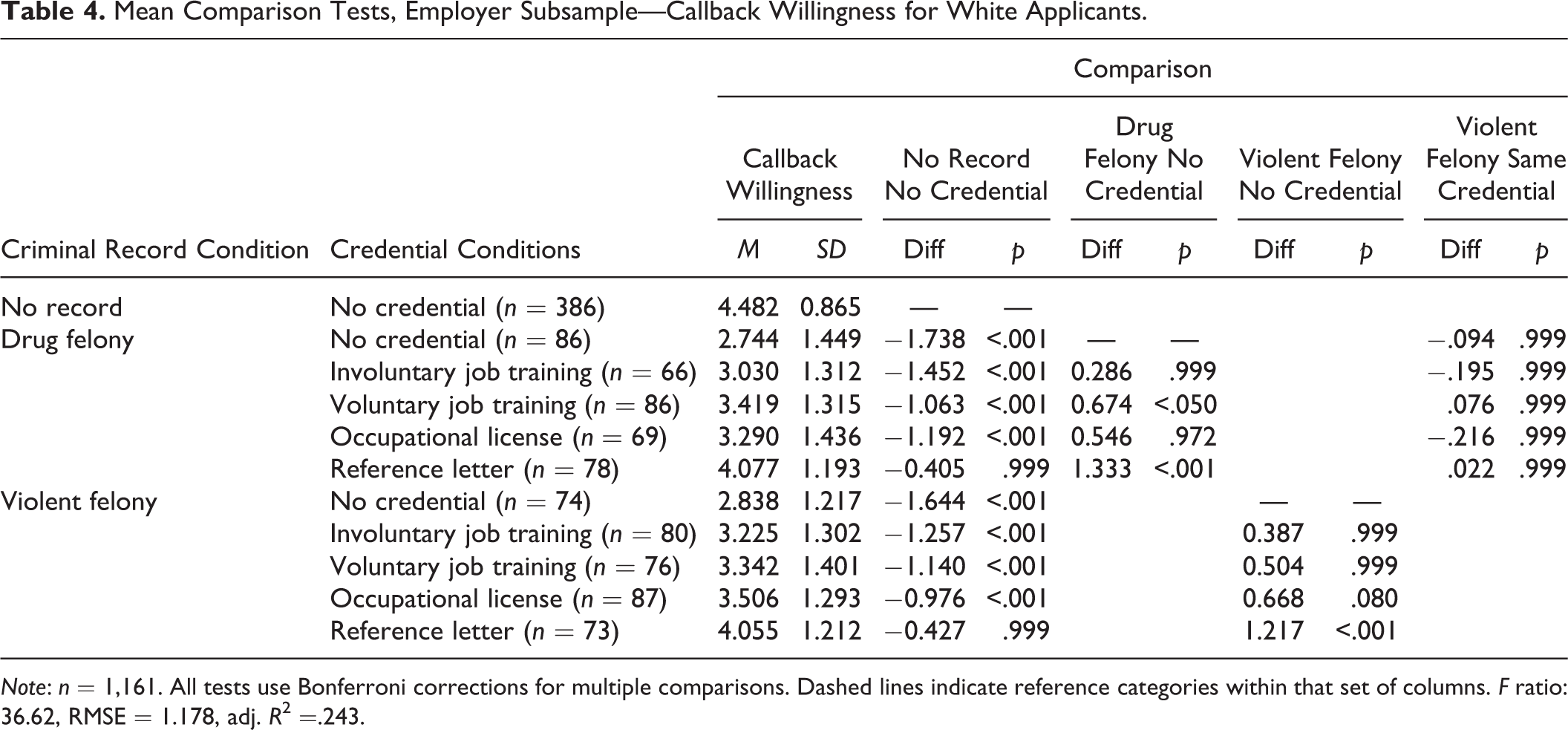
Note: n = 1,161. All tests use Bonferroni corrections for multiple comparisons. Dashed lines indicate reference categories within that set of columns. F ratio: 36.62, RMSE = 1.178, adj. R 2 =.243.
Mean Comparison Tests, Employer Subsample—Callback Willingness for Black Applicants.
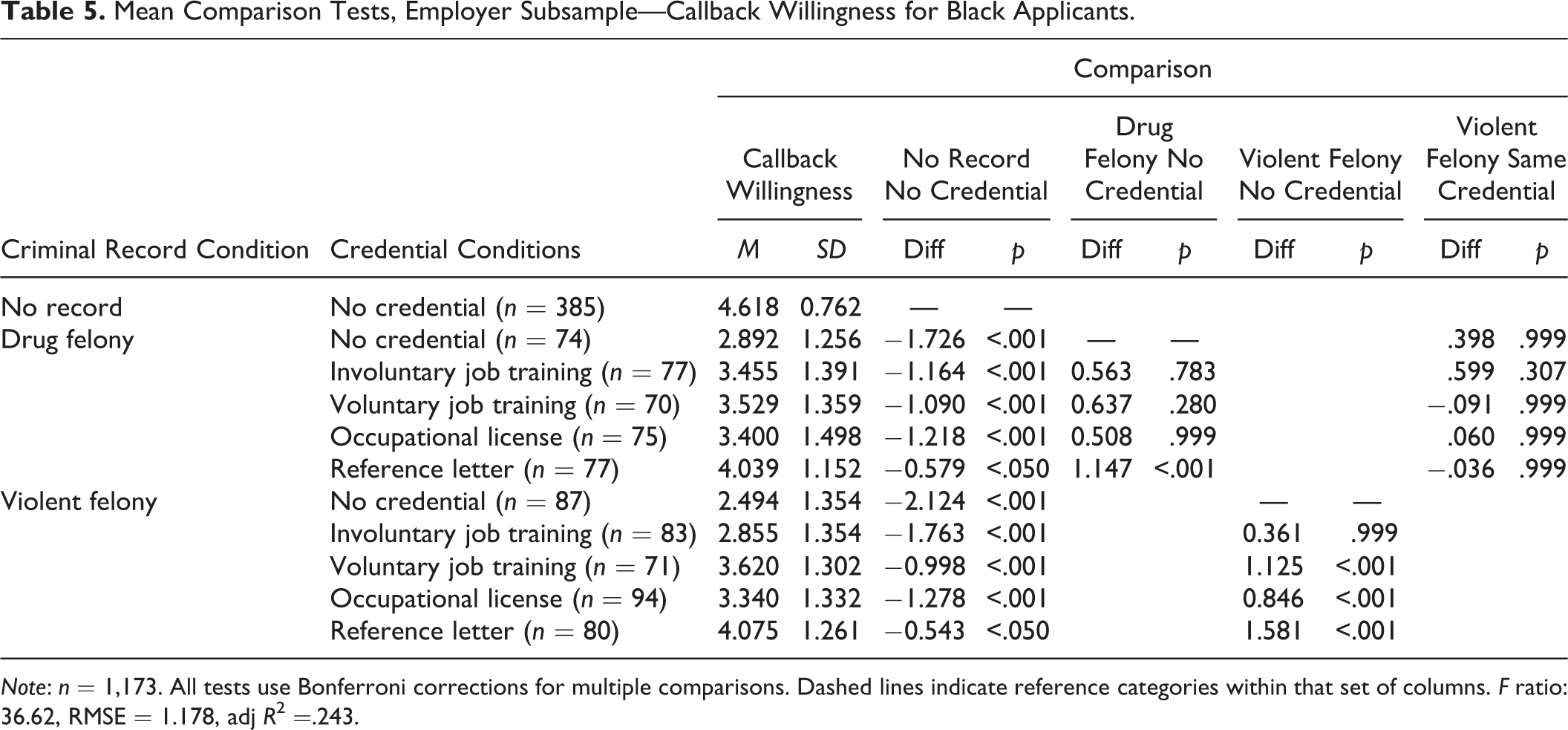
Note: n = 1,173. All tests use Bonferroni corrections for multiple comparisons. Dashed lines indicate reference categories within that set of columns. F ratio: 36.62, RMSE = 1.178, adj R 2 =.243.
When considering Black applicants (Table 5), callback willingness for applicants with reference letters remains significantly lower for drug (−0.579, p < .05) and violent (−0.543, p < .05) felonies relative to applicants without criminal records. However, when compared to applicants with the same criminal records, reference letters still improve perceptions of applicants with a drug felony (1.147, p < .001) and both voluntary job training (1.125, p < .001) and occupational licenses (0.846, p < .001) mitigate the impact of a violent felony record (column 4).
Taken together, the employer subanalysis results indicate that employer respondents react slightly differently to White and Black applicants, although tests of the same experimental conditions across race (not shown) within the employer subsample do not yield significant findings. Therefore, it is unclear if the disparities across Tables 3 and 5 are due to systematically different perceptions of Black applicants between general and employer respondents or if these differences emerged due to our smaller employer subsample. Given the lack of systematic differences across race conditions in both this and our main analysis, we suspect the latter explanation is better supported by our results.
Discussion
Erasing criminal records—one of the most powerful and stigmatizing labels—is extremely difficult in the digital age (Lageson 2017; Lageson and Maruna 2018). As a result, access to such information is often inevitable. Yet, through the “normification” process, individuals with criminal records can present multifaceted narratives to reduce reliance on the criminal record label, increase perceptions of being “ordinary,” and improve access to social inclusion opportunities (Goffman 1963). The employment context, which necessitates a balance between public safety interests and opportunities for individuals with criminal records, provides an excellent setting to test positive credentials as a normification strategy. Policymakers have adopted various strategies centered on when, how, and under which conditions employers can observe criminal records and whether positive narratives can be introduced. In the current article, we contribute to a rapidly evolving policy discussion surrounding perceptions of a felony label and which factors might mitigate criminal record stigma. Using a nationwide sample of American adults, we implement a factorial survey design to examine the impact of criminal record type, positive credential type, and applicant race on the likelihood of calling a hypothetical job applicant for an interview.
In the first set of analyses, we confirm and contrast several main effects found in prior research. Similar to previous research, we find that our survey respondents are apprehensive about applicants with a felony conviction (Holzer et al. 2007; Pager 2003, 2007), and positive credentials can mitigate the impact of a criminal record (Leasure and Andersen 2016). Most notably, we find that a reference letter from a prior employer mitigates most of the impact of a felony criminal record. However, we do not find meaningful variation by criminal record type or by race. The effects from a positive credential are not conditioned by the apparent race of the job applicant or whether the criminal record was a drug felony or violent felony.
The null effect for criminal record type is surprising given prior research that points to violent felony records as particularly stigmatizing. However, our comparisons were similar in severity (felonies with 18-month sentences) and we explicitly specified the violent crime type in the current study (aggravated assault), whereas in prior research the term “violent” is often presented as a general category (e.g., Cerda, Stenstrom, and Curtis 2015; Holzer et al. 2007). Although we are not aware of research comparing broad categories and specific offenses when considering employment preferences, public opinion research suggests perceptions may vary when respondents are asked to consider a specific case with situational context compared to a general inquiry (Applegate et al. 1996). Since recent policy advances prioritize individualized assessments and context (e.g., Equal Employment Opportunity Commission 2012), we used specific conviction types. Further comparisons within and across crime type categories could help to uncover the mechanisms underlying stigma.
While the null race effect may be a result of our survey methodology (see, e.g., Pager and Quillian 2005), recent research has also failed to replicate race effects (Agan and Starr 2018; Decker et al. 2015; Leasure and Andersen 2019). One potential explanation is that when people encounter multiple social categories, certain combinations can dominate or counteract prevailing stereotypes (Pedulla 2014). For example, Rattan, Steele, and Ambady (2019) examined multiple social statuses for a hypothetical job applicant by reminding respondents who were evaluating the candidate of either the applicant’s race (Asian) or gender identity (female). When the candidate’s race (rather than gender) was primed, men rated her as more hirable and skilled in traditionally male-dominated industries. Similarly, rather than suppressing criminal record information in the early stages of hiring decisions, providing additional positive information might reduce reliance on a person’s race, dominant “virtual identity” (Goffman 1963:44) or master status (Becker 1963) as a “criminal.”
There are several limitations in the current study. We selected an employment context to test the role of positive credentials in the normification process, but there are other social, economic, and political outcomes of interest that might be influenced by such information and which could be examined in future research. Within our hypothetical employment environment, we purposely designed the vignette to describe all job applicants as (equally) overqualified, with three and a half years of total prior work experience. This approach mirrors prior work (e.g., Pager 2003, 2007; Pager et al. 2009) but does not represent the labor market reality many individuals with criminal records face. However, past surveys of employers indicate that they respond more negatively to criminal records than they do to unstable work histories (Holzer and Stoll 2001; Pager and Quillian 2005). Nevertheless, future research could explore whether positive credentials are differentially effective for applicants with weaker or stronger employment and educational histories. We also did not include manipulation checks on treatment effectiveness. Such checks can alter the respondent’s subsequent answers and the survey flow (Hauser, Ellsworth, and Gonzalez 2018) or give respondents insight into the study hypotheses (Parrot and Hertel 1999). However, careful manipulation checks can also strengthen the study (Hauser et al. 2018). Future replications that include treatment manipulation checks could be beneficial. Further, although our primary results are sufficiently powered to detect significant effects, our employer sensitivity analysis fell below conventional levels of statistical power (80 percent) in several comparisons. Though the results from that sensitivity analysis indicate that employers in our sample responded quite similarly to our experimental conditions, it is possible that this analysis was underpowered to detect smaller differences across our focal comparisons.
In this study, we focused on a nationwide sample of American adults rather than employers specifically because we are interested in understanding more broadly what influences how people react to criminal record stigma. Social reactions are a critical component of understanding stigma remediation strategies across a range of legal and policy barriers to successful reintegration, and the public’s perceptions and attitudes toward individuals with criminal records plays a role in prisoner reentry success and policy choices (Hirschfield and Piquero 2010). 8 However, a sensitivity analysis using only the employer subsample yielded highly comparable results, suggesting that employers in our survey respond similarly to our experimental mechanisms as do non-employer respondents. While we cannot speak to how employers more broadly, different employers across industries or job positions, or other types of decision makers (such as landlords) might react to such credentials, future research could use the key positive credentials identified in the current study to test employer reactions in more localized environments.
Although our results point to a supportive reference letter being considerably powerful, it is unclear how realistic it would be to expect individuals with criminal histories to have this credential upon leaving prison or shortly afterward. Researchers at RAND (Hunt et al. 2018) found similar results in their survey of employers—namely, a post-conviction certificate that verifies work performance history can increase hiring willingness by 37 percent to 53 percent. This seems to place an individual with a criminal record in a “catch-22” scenario (Maruna 2009); if an employer is less likely to hire an applicant without informal (reference letter) or formal (post-conviction certificate) documentation supporting their post-incarceration work history, how can applicants obtain the credential in the first place? At the same time, recognizing which credentials the general public and decision makers view as meaningful is important for individuals with criminal records. If certain state-issued credentials are not as valuable as other forms of information, dedicating extensive time to collect this document may not be advisable.
Future research should continue to explore the perceived stigma remediation value of different credentials and the role advocacy organizations might play in the process for those lacking certain forms of social capital. Close attention must be paid, however, to the intended versus actual message conveyed by the credential. For example, although a supportive letter from a probation or parole officer or reporting a strong work history while incarcerated may appear helpful, it is unclear whether the negative connotation of prior contact with the criminal justice system might outweigh the positive information provided by the credential. Particularly in cases where criminal justice system contact may not otherwise be readily apparent to decision makers, it may be the case that credentials explicitly tied to the criminal justice system reinforce, rather than mitigate, the stigma from a criminal record.
More generally, we would caution against a strong reliance on onerous credentialing programs that place a heavy burden on an individual returning from prison. Reentry periods are fraught with pitfalls including difficulty procuring housing (Simes 2018), adhering to parole requirements (Petersilia 2003) and rebuilding damaged social support networks (Harding et al. 2014). Considering this, and in light of our results, policies aiming to support the procurement of positive credentials should focus efforts on the time period leading up to reentry. Such policies could be made considerably stronger if they place individuals with a criminal record on a trajectory leading toward opportunities to obtain documentation supporting positive post-conviction work performance.
As Shannon et al. (2017:1815) summarize, “Regardless of whether one has been incarcerated, a felony conviction clearly affects life chances.” Increasing employment opportunities for individuals with criminal records who are seeking to enter the labor market is a significant policy challenge that will maintain its importance as the effects of mass incarceration continue to reverberate into the near future. Numerous promising policy avenues which attempt to mitigate the stigma of a criminal record, including transitional jobs programs and “Ban the Box” initiatives, have faced challenges and concerns (Agan and Starr 2018; Bushway and Apel 2012; Doleac and Hansen 2017). Individuals with criminal records might be better served by policies and programming which aid them in obtaining additional positive credentials that they can then report alongside their criminal record to best allay its burden. Our results, consistent with prior theory and recent empirical evidence, suggest that this approach could substantially remediate the negative stigma from a criminal record, thereby potentially improving employment prospects for individuals with criminal records.
Supplemental Material
Supplemental Material, Appendix_A_-_Time_Spent_on_Survey_Robustness_Check - Criminal Records, Positive Employment Credentials, and Race
Supplemental Material, Appendix_A_-_Time_Spent_on_Survey_Robustness_Check for Criminal Records, Positive Employment Credentials, and Race by Samuel E. DeWitt and Megan Denver in Journal of Research in Crime and Delinquency
Supplemental Material
Supplemental Material, Appendix_B_-_Survey_Instrument - Criminal Records, Positive Employment Credentials, and Race
Supplemental Material, Appendix_B_-_Survey_Instrument for Criminal Records, Positive Employment Credentials, and Race by Samuel E. DeWitt and Megan Denver in Journal of Research in Crime and Delinquency
Supplemental Material
Supplemental Material, Appendix_C_-_Between_Race_Comparisons - Criminal Records, Positive Employment Credentials, and Race
Supplemental Material, Appendix_C_-_Between_Race_Comparisons for Criminal Records, Positive Employment Credentials, and Race by Samuel E. DeWitt and Megan Denver in Journal of Research in Crime and Delinquency
Supplemental Material
Supplemental Material, Appendix_D_-_Weighting_Methodology_and_Results - Criminal Records, Positive Employment Credentials, and Race
Supplemental Material, Appendix_D_-_Weighting_Methodology_and_Results for Criminal Records, Positive Employment Credentials, and Race by Samuel E. DeWitt and Megan Denver in Journal of Research in Crime and Delinquency
Footnotes
Acknowledgments
The authors would like to thank Robert Apel, Shawn D. Bushway, Rose B Bellandi, and Audrey Hickert for their valuable advice on earlier versions of the survey design and manuscript. They also extend their gratitude to Dr. Chris Sullivan and three anonymous referees for their helpful suggestions throughout the review process.
Declaration of Conflicting Interests
The author(s) declared no potential conflicts of interest with respect to the research, authorship, and/or publication of this article.
Funding
The author(s) disclosed receipt of the following financial support for the research, authorship, and/or publication of this article: This work was supported, in part, by funds provided by the University of North Carolina at Charlotte.

Supplemental Material
The supplemental material is available in the online version of the article.
Notes
References
Supplementary Material
Please find the following supplemental material available below.
For Open Access articles published under a Creative Commons License, all supplemental material carries the same license as the article it is associated with.
For non-Open Access articles published, all supplemental material carries a non-exclusive license, and permission requests for re-use of supplemental material or any part of supplemental material shall be sent directly to the copyright owner as specified in the copyright notice associated with the article.
