



Abstract
The impact of extreme weather events on electoral processes is not well understood, yet as the climate changes, such events are predicted to become more common. This highlights the need for scholars to investigate how natural hazards affect election campaigns and electoral administration. Drawing on data from the Electoral Contention and Violence dataset, this article uses a difference-in-differences approach to assess the effect of tropical storms on electoral contention over seven elections held in the Philippines between 1992 and 2010. It finds that storms that occur in the year leading up to an election increase, and that this effect is likely accounted for by both economic grievances consequent upon the negative impact of storms on agricultural output and grievances generated by storm-induced disruptions to the electoral process. These findings suggest that as climate change intensifies, – and the violence that contention often entails – could become more common in a number of contexts. This has implications for electoral administration, and it implies the need for cooperation across electoral and meteorological agencies in places where weather extremes are likely to occur in the runup to electoral events.
Introduction
Extreme weather events have severe impacts on a wide variety of social and political phenomena, not least elections. The intensification and increased frequency of weather extremes is known to exacerbate political contention and violence under some circumstances (e.g. Busby, 2022; Ide et al., 2020, 2021; Shaver and Bolfrass, 2023; Von Uexkull and Buhaug, 2021). There has, however, been very little academic attention devoted to the impact of extreme weather events on the way that elections are conducted, and those studies that have been carried out are largely conceptual (Mohan and Roberts, 2021; Morley, 2018). Electoral contention, understood as acts of political contention connected with elections, is an aspect of electoral conduct that is of particular concern, as it can be politically destabilizing and it often involves violence (Daxecker et al., 2019; Frank, 2021; Norris et al., 2015). Electoral violence is found in virtually all parts of the contemporary world, and it represents a major obstacle to democratic elections. Even less violent forms of electoral contention, such as boycotts or protests, can call the legitimacy of the democratic process into doubt (Norris at al., 2015). The effect of extreme weather events on contentious electoral practices has not been systematically assessed, however. This article seeks to fill that gap by investigating the impact of tropical storms on electoral contention.
The empirical focus of the analysis is the Philippines, a country that frequently experiences disruptive tropical storms, and also a political context in which most elections in recent decades have been highly contentious. It is also a country with relatively weak state institutions, which have been linked to vulnerability to both electoral violence and the adverse effects of extreme weather events (Birch, 2020; Deinla et al., 2023; Malji et al., 2022). The analysis presented here draws on event data from the Electoral Contention and Violence (ECAV) dataset (Daxecker et al., 2019), which covers the 1990–2012 period. These data are analysed together with storm data from the period preceding each election. The main finding of the article is that storms increase electoral contention. In as much as climate change is predicted to increase the intensity of tropical cyclones in many parts of the world (Intergovernmental Panel on Climate Change, 2021: 16), this finding could well have relevance for other parts of the world on known tropical storm trajectories.
This analysis makes contributions to two main literatures. First, it extends our understanding of the factors that combine to generate electoral contention. In this sense, the article represents a bridge between the burgeoning literatures on climate change and conflict on the one hand, and contentious politics on the other. Second, the findings of the article add to our understanding of the political effects of climate change, a body of knowledge that is rapidly growing as evidence emerges of the social impact of extreme weather events.
Extreme weather events and electoral contention
Work to date on how environmental disasters affect the conduct of elections has mostly been carried out by practitioners. The International Institute for Democracy and Electoral Assistance’s Risk Management Tool contains a section on mitigating environmental risks associated with elections, largely focused on mapping risk and resilience capacity (International Institute for Democracy and Electoral Assistance, 2016). A small number of other studies assess the legal aspects of electoral processes affected by environmental risk (Mohan and Roberts, 2021; Morley, 2018). Academic work on elections and extreme weather has mostly addressed the impact of natural disasters on the behaviour of voters and elected representatives (e.g. Baccini and Leeman, 2021; Bechtel and Mannino, 2023; Birch, 2023), not electoral processes – electoral administration and the conduct of election campaigns. There has thus been a lack of empirical investigation of the effect of extreme weather events on electoral security and related phenomena such as protests, boycotts, intimidation and attacks.
In order to theorize this relationship, I draw on the literatures on extreme weather, contentious politics, political violence and electoral violence. Like most forms of contentious politics, electoral contention is ambiguous from a democratic point of view. Freedom of association and freedom of expression are core values of democracy, and a healthy democratic polity is one that is home to ‘critical citizens’ (Norris, 1999) who hold their leaders to account and contest abuses of power. Electoral contention is one such form of contestation, and successful contentious activities such as boycotts and protests have led to electoral reforms and regime changes in contexts as diverse as Mexico, Serbia and Malawi; at the same time, electoral contention risks becoming violent or provoking conflict (Daxecker et al., 2019; Frank, 2021). A wave of recent scholarly interest in the topic has served to delineate the specific features of electoral violence and to demonstrate that it is a phenomenon discrete from other forms of political violence (Birch et al., 2020). Electoral violence is known to be caused by both short-term trigger events such as the competitive dynamics of elections, allegations of electoral misconduct and concurrent non-electoral conflicts (Hafner-Burton et al., 2014; Höglund, 2009; Goldring and Wahman, 2018), as well as long-term structural factors such as poverty, corruption, political exclusion and ethnic divisions (Birch, 2020; Brosché et al., 2020; Fjelde and Höglund, 2016; Toha, 2022).
The extensive literature on the impact of extreme weather events on other types of political violence has generated conflicting results. Some studies have failed to find any convincing causal link between meteorological/climatic factors and the incidence of violence (e.g. Salehyan, 2008; Thiesen et al., 2011). Other studies, however, have found that under certain conditions, floods, droughts and other extreme weather events can raise the risk of violence and shape the trajectory it takes (e.g. Haer and RezaeeDaryakenari, 2022; Malji et al., 2022; Perliger and Liu, 2022; Shaver and Bolfrass, 2023). A third strand in the literature finds that extreme weather events lead to increased contentious politics activity (Aidt and Leon, 2016; Almer et al., 2017; Koubi et al., 2021).
Bringing together these two literatures, I can surmise that on its own, an isolated extreme weather event is unlikely to lead directly to electoral contention or electoral violence. Rather, disruptive weather events are best understood as short-term factors that have the potential to trigger electoral contention in contexts of vulnerability. Where there is already potential for contention, an extreme weather event could plausibly exacerbate grievances, as conjectured (but not demonstrated) by Malji et al. (2022: 945). Moreover, heightened political tensions could also cast innocent mistakes in a suspicious light.
Let us unpack these conjectures. Contentious politics often results from a grievance that is imposed suddenly (McAdam et al., 2001: 301), and the social and economic shock of an extreme weather event could well be a trigger of this type. Contentious politics is also enabled by competitive elections, which create an institutional framework in which certain repertoires of contentious activity can develop (McAdam and Tarrow, 2010). This is especially likely to be the case when electoral practices are disputed. We know from previous research that the procedural disruption of elections is often accorded nefarious intent, even when it is a matter of ‘mispractice’ rather than ‘malpractice’ – in other words, unintentional mistakes and flaws in electoral administration that have no political motive (Schaffer, 2008). Elections are complex logistical exercises that are vulnerable to disruption from a variety of sources; this is especially likely to be the case in the context of under-developed states with low state capacity. Tropical storm disruption might generate damage to buildings that electoral authorities typically rely on as polling places. If these facilities are not repaired soon after the storm, alternative arrangements may need to be made, and these may not always be communicated effectively to voters. Also, storms that displace voters will cause challenges for electoral rolls, as voters may well not be located where they are registered to vote. Unless temporary measures are in place to allow them to vote elsewhere, and unless these measures are communicated to the voters in question, they may find it difficult to cast their ballots on election day.
Such disruption may be politicized via two means: voters and others may spontaneously attribute partisan intent to disruption; and parties (and other political actors) may disseminate allegations of intentional manipulation in the aim of fostering a sense of partisan grievance and discrediting the results. Examples of these phenomena are detailed in Section A1 of the Online Appendix.
In some cases, procedural disruption occasioned by extreme weather might in fact lead to malpractice rather than (or in addition to) mispractice, if electoral actors take advantage of procedural problems to increase their chances at the polls. For example, disaster-induced need has in a number of contexts been found to spur clientelism (e.g. Birch and Martínez i Coma, 2023; Cooperman, 2022; Gallego, 2018), which might make those not in receipt of disaster relief aggrieved. Resulting concerns that the electoral process was not conducted fairly could potentially trigger contention and violence, particularly after the election (Brancati, 2016). Another channel is logistical advantages gained by the incumbent party amid disaster-related disruption (see examples detailed in Section A1 of the Online Appendix).
It is therefore clear that there are a number of ways in which the aftermath of natural disasters, including storms, could disrupt electoral processes in ways that would lead citizens to perceive there to have been electoral misconduct.
A second possibility is that grievance caused by loss could spark contentious activity. Economic disruption following tropical storms may generate anger and desperation that could well fuel electoral contention, if some aspect of the electoral process – and perceived lack of government concern – provides a trigger for popular mobilization. We know from previous studies of protests against electoral misconduct that contention of this type is more common in the context of economic grievance (Brancati, 2016; Rød, 2019). We also know that electoral violence is more likely to occur in contexts of economic under-development (Norris et al., 2015; Von Borzyskowski, 2019). Less developed societies typically include needy groups who are highly vulnerable to any economic shock, and potentially willing to support contentious means of addressing their grievances. And we know that extreme weather is more likely to trigger or increase the likelihood of civil unrest when weather events are associated with economic shocks (Bagozzi et al., 2017; Ide et al., 2020, 2021; Perliger and Lui, 2022). Relatedly, it may be that the mobilization of violence perpetrators is facilitated by economic deprivation and dislocation caused by storm damage. It is well known that state-perpetrators and non-state perpetrators of electoral violence typically hire economically-insecure young men to carry out violent acts on their behalf (Höglund, 2009; Rauschenbach and Paula, 2019; Söderberg Kovacs, 2018). In as much as they lead to temporary displacement and loss of livelihood (Eadie et al., 2020; Malji et al., 2022), extreme weather events may increase the supply of those willing to engage in violent electoral contention. Drawing together these findings, it is logical to posit that in societies that are economically dependent on predictable weather patterns, unusually strong tropical storms prior to elections should increase the likelihood of election-related contention.
These considerations suggest the following principal hypothesis together with hypothesized causal channels:
Hypothesis 1: Elections that take place in the wake of an extreme weather event are more vulnerable to electoral contention than those that do not.
Hypothesis 1a: extreme weather events spark contentious electoral activity associated with popular concern about electoral conduct.
Hypothesis 1b: extreme weather events spark contentious electoral activity associated with increased economic grievance.
It is worth noting that the contexts with the greatest potential for electoral contention are also those that are most likely to be vulnerable to calamity should a natural disaster strike, as electoral conflict and disaster effects are both more likely where state institutions are affected by corruption and politicization, leading to political exclusion and the inability of states to serve citizen needs (Birch, 2020; Höglund, 2009; Ide et al., 2021; Malji et al., 2022). This renders weak state institutions an important scope condition for the argument advanced here.
These expectations will be tested on data from the Philippines, a country that is vulnerable both to tropical storms and to electoral contention. South-East Asia is the area of the world most severely affected by tropical storms, and within South-East Asia, the Philippines is one of the countries that is most often hit by strong cyclones. The Philippines has also held a number of unruly elections since democratization in 1986, many of which have been affected by episodes of rioting, protest, violence and other forms of electoral contention (Brownlee, 2007; Deinla et al., 2022; Hicken et al., 2019; Patino and Velasco, 2004). Popular protest was instrumental in bringing about the ‘People Power’ revolution of 1986 that toppled dictator Ferdinand Marcos (Timberman, 1991), and since that time elections in the Philippines have been widely seen as opportunities to voice grievances and to make demands on leaders. Weak state capacity, weak political parties, vibrant civil society and patronage-based politics dominated by political ‘dynasties’ are factors commonly invoked to account for high rates of electoral disruption in the Philippines (Anibales and Amoroso, 2017; Deinla et al., 2022, 2023; Hicken et al., 2019; Smith and Reyes, 2021).
This confluence of vulnerabilities, shown in Figure 1, makes the Philippines a good context in which to examine the link between severe storms and electoral contention. This ‘most likely case’ (Eckstein, 1975) offers an opportunity to test evidence for a phenomenon that may only just be emerging now, but which could become more widespread in the future with further changes to the global climate. Significant electoral contention is relatively rare in most settings, as are hurricane-strength storms at the current time; this means that any associations between the two phenomena would be difficult to study in most geographical contexts. Selecting a case with known vulnerability to both phenomena provides sufficient variation across time and space to make such an analysis possible. From the point of view of the theoretical framework outlined above, a further advantage of the Philippines as a case is that approximately a third of the population is dependent on agriculture, such that weather-related shocks exert substantial impacts on local economies and citizen livelihoods. Indeed, a study by Eastin has found that tropical storm activity increases terrorist attacks in the Philippines (Eastin, 2018). Though most electoral contention events are not linked to terrorism, and most terrorism is unrelated to elections, this finding offers prima facia evidence of a connection between extreme weather and political contention in the Philippine context.
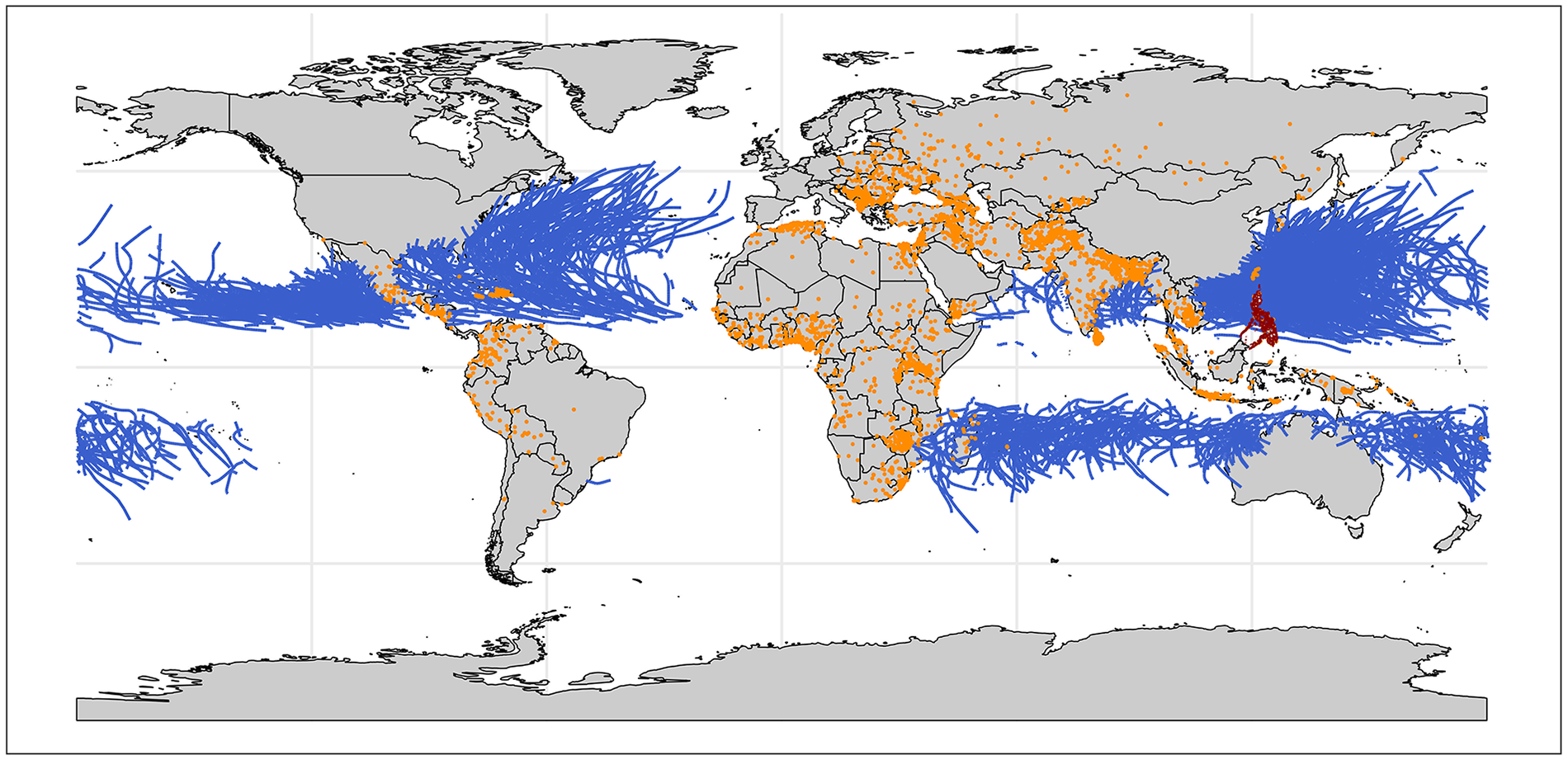
Tropical storms and electoral contention around the world, 1990–2012.
Figure 2 shows the distribution of storms and electoral contention events in the Philippines; as can be seen from this map, a relatively large number of events occur in the southern part of the country that is not regularly affected by strong storms but is the base for several insurgent groups.
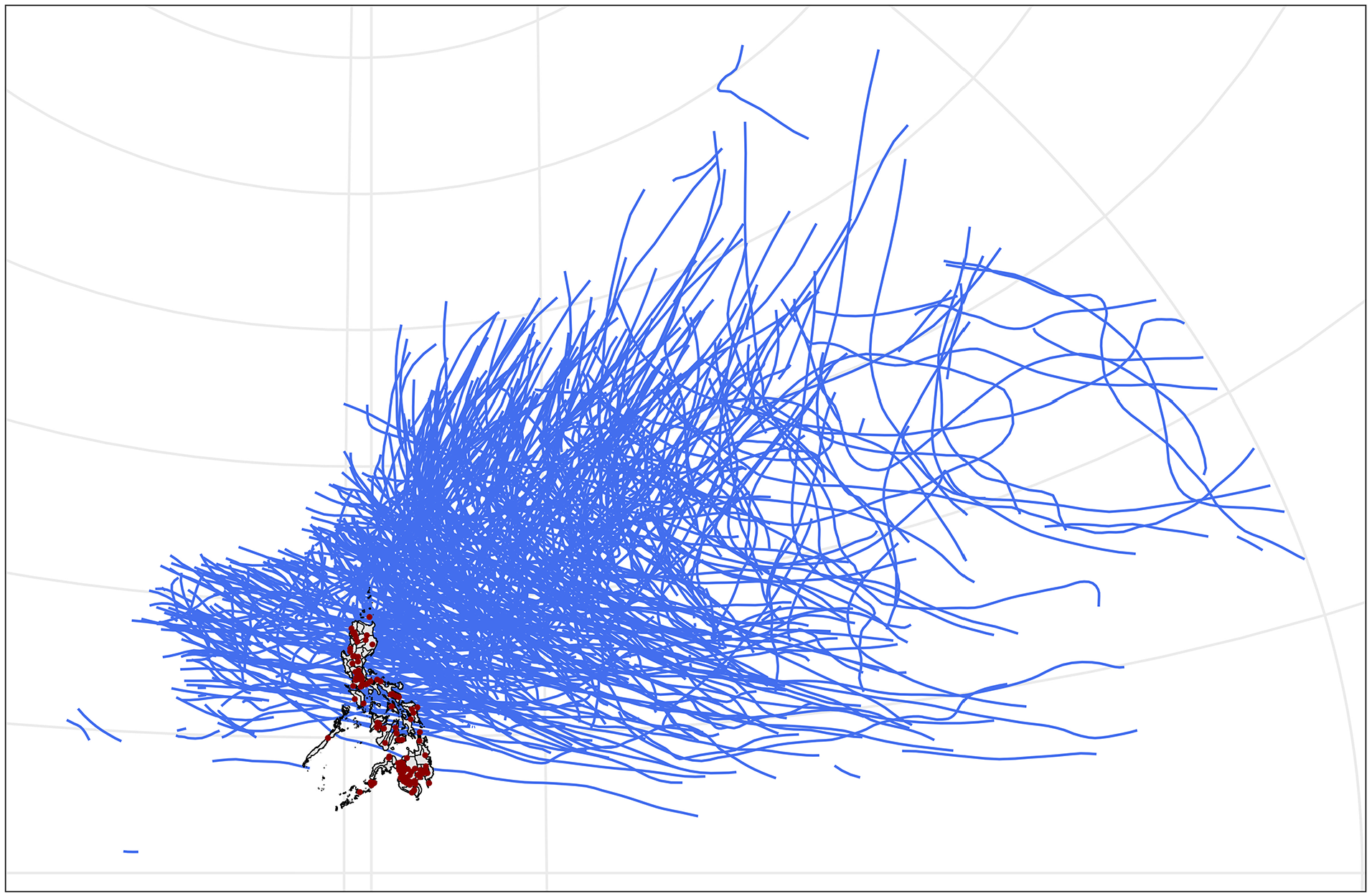
Tropical storms and electoral contention in the Philippines.
In other parts of the country, the impact of tropical storms on electoral processes has been documented in previous qualitative analysis of Philippine electoral politics. Franco notes that storm destruction in the province of Sorsogon in the 1980s resulted in peasant leaders being integrated into programmatic political groups (Franco, 2001: 254). Mangada recounts how the loss of property following storm Haiyan in 2013 prompted residents in the region of Leyte to engage in political activism for the first time (Mangada, 2019: 213). Severe economic grievance in the wake of a major storm, combined with the perception that the distribution of disaster relief has been politicized, might also spark anger, as appears to have been the case among some opposition supporters in Leyte in the wake of Typhoon Haiyan (Tumundao, 2019: 227–228). These examples accord with the conjecture that storms should increase electoral contention.
Data and estimation strategy
Data to test the hypotheses set out above were drawn from several sources. Tropical storms data were taken from the International Best Track Archive for Climate Stewardship dataset (Knapp et al., 2010). 1 This database includes global tropical stormtrack shapefiles since 1980 together with other data on each storm. Data are lacking on the radius of maximum winds (RMW) of storms in the Philippines; this is the distance between the centre of a storm and the band of strongest winds, it is where rainfall tends to be greatest, and it a conventional (if imprecise) measure of the area affected by the storm. In the absence of data on each storm, the tropical storm RMW mean of 47 kilometers is used to estimate the area most severely affected by each storm (Hsu and Yan, 1998). This admittedly provides only an approximate indication of the extent to which an area was adversely affected by a storm, as this depends on the size and speed of the storm as well as topological features of the landmass over which it passes. However, it is highly unlikely that random variations within a given area in these physical factors from storm to storm and election to election should be systematically correlated with patterns of electoral contention in the same way that direct measures of disaster affectedness could. 2 This measure may be noisy and therefore less likely to reveal associations between variables, but it is unlikely to result in Type I error. As noted above, hurricane-strength storms almost never affect the southern part of the Philippines. The analysis carried out here is therefore restricted to those provinces that are at risk of strong storms, in the sense that they were affected by at least one hurricane-strength tropical storm in the 1986–2020 period. 3 I report models where storm-affectedness is entered as a dummy variable, and also models where the treatment is an intensity measure: 1 plus the natural logarithm of the number of storms affected in a given province in the calendar year preceding the election in question.
Electoral contention was measured using Daxecker et al.’s (2019) ECAV dataset, a data source that is ideally suited to the purposes of his analysis, as it includes geolocated event data and it is conceptually closely aligned to the understanding of electoral contention considered here. Daxecker et al. define electoral contention as ‘public acts of mobilization, contestation, or coercion by state or nonstate actors that are used to affect the electoral process or that arise in the context of electoral competition’ (Daxecker et al., 2019: 716), a definition that accords with my understanding of this term. The dataset includes electoral contention events from around the globe in national elections held during the period 1990–2012. The period for which data were collected runs from six months before to three months after each election, and the data take an event–day–location format (Daxecker et al., 2018, 2019). 4
To give a flavour of the forms taken by electoral contention in the Philippines, I reproduce here descriptive accounts (taken from media reports) of the first, 50th, 100th, 150th and 200th Philippines events listed in the ECAV dataset: ‘The wife of opposition Congressman Pablo Ocampo was wounded in an ambush in central Manila early Sunday, police said.’ ‘Armed suspects snatched boxes containing 3000 official ballots while being transported to the precincts.’ ‘Grenade blasts also disrupted the vote count in Isabela town.’ ‘A candidate for congress in the Philippines was shot dead early Saturday in what police said was likely a politically-motivated slaying.’ ‘Riot police clashed Tuesday with about one thousand stone-throwing supporters of defeated Philippines presidential candidate Fernando Poe. Police fired tear gas and water cannon at Poe partisans who tried to mount an unauthorized march on the presidential palace in Manila, an AFP [Agence France-Presse] photographer on the scene said.’
As can be seen from this list, the events are all clearly linked to aspects of the electoral process. They include; a protest; the use of force to disrupt ballot-handling; and violence against electoral actors and their close associates.
For each election, all storms measuring at least 1 on the Saffir–Simpson scale (hurricane strength) in the year preceding election day were identified, and a 47-kilometer buffer area was estimated around each storm. This made it possible to map the total area affected by storms in this period. The ECAV data were then intersected with the storm data to identify datapoints within the storm-affected area and those not in this area. At the aggregate level, I also calculated the number of storm events in each province. In the 1990–2012 period covered by the ECAV dataset, national-level elections were held in 1992, 1995, 1998, 2001, 2004, 2007 and 2010. Figure A1 in the Online Appendix displays the distribution of storm events across provinces and elections, showing that storms preceded all but the 1995 election.
The period under analysis starts with the first post-founding elections after democratization (following the toppling of the Marcos regime in 1986). Each of these electoral events included bicameral national legislative elections as well as executive and legislative elections at provincial (Sangguniang Panlalawigan) and municipal (Sangguniang Panlungsod/Sangguniang Bayan) level. Presidential elections were held concurrently in 1992, 1998, 2004 and 2010. The focus of the empirical analysis is on the country’s 81 provinces. Provincial politics is the building-block of Philippine electoral competition (Franco, 2001: 5–25; Hicken et al., 2019: 3, 29–31). This is the level at which the country’s many local party machines tend to have their core operations, machines which have long relied on a combination of carrot and stick to achieve their ends (Dulay and Go, 2022; Franco, 2001; Hicken et al., 2019). National parties in the Philippines are weak; presidential campaigns typically have very limited grassroots presence and they appeal to political machines based in provinces and municipalities for support; municipal political elites, for their part, also often rely on provincial party machines for resources (Anibales and Amoroso, 2017; Hicken et al., 2019: 26–31). It therefore stands to reason that contention which occurs in the context of national-level electoral events (as captured by the ECAV dataset) should be structured and played out at the provincial level.
I employ aggregate-level models with province as the unit of analysis to assess the overall impact of tropical storms on electoral contention, together with event-level models to explore causal mechanisms. 5 The main analyses are carried out in a difference-in-differences framework implemented in the first instance via two-way fixed effects (Angrist and Pischke, 2009; Imbens and Wooldridge, 2009), with fixed effects for province and election year that control for unobserved time and province-specific factors. These models are designed to estimate the average treatment effect on the treated (ATT), and they take the general form:

where Yit is an indicator of electoral contention in region i at time t, τ is the parameter of interest (the ATT), Fit is an indicator of the number of storms that affected region i in the twelve-month period in the run-up to the election that took place at time t, γ i is a unit (region) fixed effect, δ t is an election year fixed effect, and Xitβ is a vector of covariates. 6 A Poisson estimator is used due to the fact that the dependent variable is a count indicator, though negative binomial models are also run for robustness. As an additional robustness check, I also used the de Chaisemartin and D’Haultfœuille’s (2020) DIDm approach to difference-in-differences analyses with panel data. These authors develop an approach that addresses the possibility that the weighted sums of the average treatment effects estimated via standard two-way fixed effects could have negative weights in the presence of heterogeneous treatment effects (Callaway and Sant’Anna, 2020; Imai and Kim, 2021; Sun and Abraham, 2021). DIDm is relevant for panel data setups with non-discrete treatments and where cases are assumed to switch in and out of the treated state. 7
Results
The ECAV dataset records a total of 239 electoral contention events in the Philippines over the seven elections included in this analysis. As shown in Figure 3, contention increased over the 1992–2010 period, with a peak in the early years of the new millennium. Over the period, about 80% of all events involved violence. A total of 158 of the 239 events took place in at-risk provinces, of which 112 (70.1%) were violent; it is these 158 events, shown in Figure 3, that are the focus of the empirical investigation conducted here.
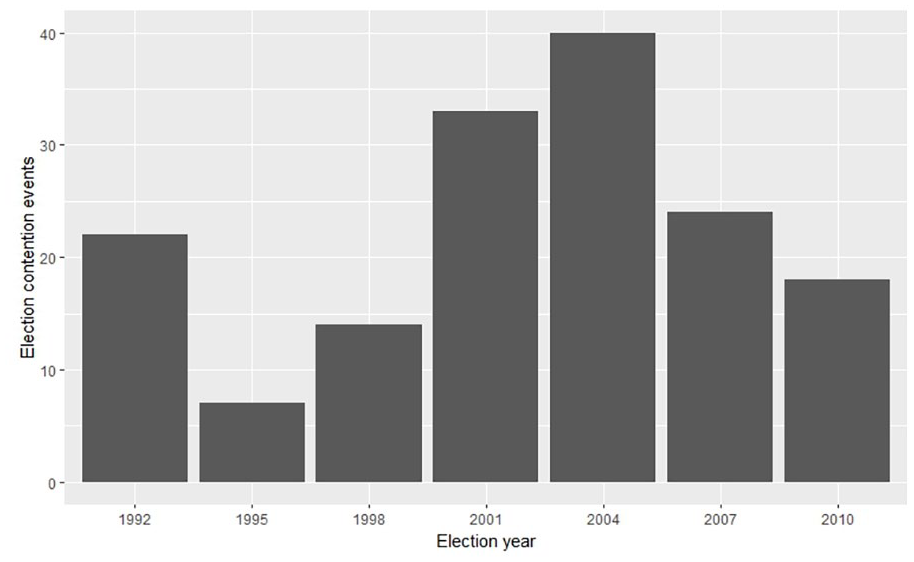
Electoral contention events by election year.
Aggregate-level Poisson models are presented in Table 1 and Figure 4. 8 In Models 1 and 2, the storm-affectedness of a province is the sole independent variable, together with unit (province) and time (election) fixed effects. Model 1 shows that hurricane-strength storms are positively associated with greater election contention; in other words, if a province is affected by a storm in the year leading up to the election, is it more likely to experience electoral contention than non-affected provinces, controlling for temporal and geographical unobservables. In Model 2, the treatment is the number of storms (logged) that affected a province in this period, and it is clear that electoral contention is also sensitive to treatment intensity.
Two-way fixed effects models of the effect of storms on electoral contention.

These are Poisson models with standard errors clustered by province and election year. Cell entries are coefficients (standard errors). The number of observations in these models is less than the total number under analysis, as provinces with identical outcomes in all elections are perfectly predicted by province fixed effects and are therefore dropped from the models.
p > 0.05, **p > 0.01, ***p > 0.001.
Hundred thousand metric tonnes.
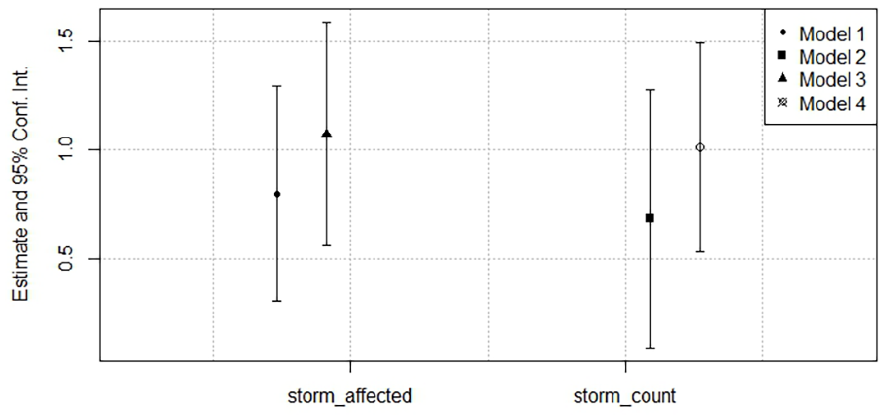
Predicted electoral contention events.
The fixed effects should do a good job of controlling for many of the structural and election-specific factors known to be associated with electoral contention and violence. However, it is desirable also to control for local economic and political perturbations between elections that might affect electoral contention. As an economic control, I would ideally have included direct measures of economic loss resulting from each storm, but such data are only available for a handful of the most recent storms in the dataset used here. As a proxy for economic loss, I have therefore included in Models 3 and 4 annual rice and corn production in the region in question. 9 These indicators capture local variations in economic conditions that might be expected to affect in particular the poorest and most weather-dependent sectors of Philippine society – subsistence farmers and agricultural workers – who may also be most vulnerable to being involved in electoral violence, either as victims or as hired perpetrators (Birch, 2020; Goldring and Wahman, 2018).
In addition, controls are included to tap the competitive dynamics of the contest: a variable indicating that the election brought about a change of party; and an indicator of the number of terms the incumbent had been in office at the time of the election. A change in party signals a shift in partisan dynamics that may be linked to underlying changes in political affiliations on the part of voters and/or elites. The number of terms in office is a proxy for political control; governors who had been in power for shorter periods are expected to have amassed less local political influence and therefore be more vulnerable to competitors. 10 As Models 3 and 4 show, the results are robust to the inclusion of these controls.
In substantive terms, the estimated treatment effect from these models suggests that the presence of tropical cyclones in the runup to an election leads to an increase in electoral contention of between 0.593 (Model 1) and 0.641 (Model 3) events. This may not seem like a great increase, but the highly detrimental impact of disruptive contention on elections justifies the claim that this is a substantively important effect. Even one additional riot or attack can have very serious implications for the welfare of those involved, it can have a chilling effect on citizen engagement in campaign activity and it can spark civil unrest (Brancati and Snyder, 2012; Flores and Nooruddin, 2012, 2016; Hafner-Burton et al., 2018).
Several robustness checks were undertaken on these models. First, Table A2 and Figure A2 in the Online Appendix display a version of Model 4 (which included the most complete information) estimated by means of de Chaisemartin and D’Haultfœuille’s (2020) DIDm approach; the results are robust to this alternative estimation strategy. Second, the estimation strategy employed here relies on the assumption of parallel trends; in other words, it assumes that provinces that experienced storms in period t were, prior to this period, on the same trajectory of electoral contention development as those that did not experience storms then. The parallel trends assumption is often assessed via visual inspection of graphs, however the small number of electoral contention events at each election in this dataset makes this an unsuitable approach. Instead, I have carried out formal tests of the parallel trends assumption by regressing province-level storm-affectedness in period t on electoral contention prior to period t, controlling for fixed effects. If indeed affected and unaffected areas are on similar contention trajectories prior to storms, the storm coefficient should not be significant. And this is exactly what I find, as shown in Table A3 in the Online Appendix; this indicates that the parallel trends assumption holds. In addition, Table A4 of the Online Appendix displays models based on the entire country, not just regions at risk of cyclones. As can be seen from these models, the phenomenon under analysis generates statistically-significant coefficients even in these models, albeit with reduced significance levels, as might be expected. Finally, negative binomial models are displayed in Table A5 of the Online Appendix; as will be seen, these are almost identical to the Poisson models.
Together, these findings provide support for H1. In other words, it appears that strong tropical storms increase the likelihood of electoral contention. These are substantively important results which indicate that hurricane-strength tropical storms appear to make elections more contentious. These models shed little light on causal mechanisms, however. In order to understand the channels through which storms affect electoral contention, I turn to event analysis.
Causal channels
The theoretical discussion above suggested two causal channels whereby tropical storms might affect contentious electoral politics; one possible channel operates via the disruptive impact that storms could have on electoral processes, and the lower degree of confidence in the conduct of elections that this might generate (H1a). Another possible channel is the impact of increases in objective levels of need on the part of storm-affected voters who are then more likely to engage in grievance-driven protest or to be mobilized by elites into the use of violence (H1b).
Event-based analysis provides a means of exploring these causal mechanisms. The ECAV dataset codes electoral contention events according to perpetrator, target, type of event, event timing and a short narrative description of the event. In many cases, there are too few cases in relevant categories for multivariate statistical analyses to be viable. In addition, there is considerable missing data for some variables, especially the perpetrator categories, given the inherent difficulty in identifying those responsible for many types of electoral contention. Ideally, it would be possible to code event descriptions according to whether they were motivated by discontent with election quality, but unfortunately many events in the ECAV dataset have descriptors that are insufficiently specific as to the motives of those involved (e.g. events involving polling places, or protests with no information on the object of contention). This is undoubtedly due to lack of information in the original source material, a common problem with reports on violent contention.
The H1a will therefore be explored through analysis of event timing. If disruptions to the electoral process are calling into question the integrity of elections, one would expect to see a surge of post-EC, as questionable election quality is a common trigger of post-election protest and violence (Birch, 2020; Brancati, 2016; Hafner-Burton et al., 2018). The evidence partially bears this out. Events in provinces that had not been affected by recent storms were equally divided between the pre-electoral and post-electoral periods, with 58 events each. Of the 44 events in provinces recently affected by storms, 37 took place before the election and only seven after. However, multivariate analysis suggests that this is accounted for by other factors associated with the provinces and elections in question. In conditional logit Models 1 and 2 in Table 2, the unit of analysis is the event, and the same province-level controls are included as in the aggregate-level models reported above, save that instead of a dummy designating a change of party, I include instead an indicator of whether or not the incumbent governor was a member of the presidential party, as this can be expected to increase local protest against the conduct of national-level elections (both variables cannot be included simultaneously for reasons of multicollinearity). 11 Model 1 indicates that controlling for other factors, the occurrence of an event in a province that had been affected by a storm in the previous year was not significantly associated with whether a contention event occurred before or after the election. In Model 2, the independent variable of interest is the number of storms in the province in question (logged) – storm intensity – which is associated with a lower likelihood that an event occurred before an election. Predicted probabilities from this model indicate that as the number of storms preceding an event rises from 0 to 3, the probability of that event taking place before the election falls from 0.97 to 0.63. Thus, although most electoral contention takes place in the pre-election period even in the context of elections preceded by multiple storms, the number of storms that occur is associated with a rise in the chances of post-electoral contention, which we know from previous research is more likely to revolve around electoral integrity. These findings offer some support for H1a, suggesting that electoral contention in the wake of storms is more likely to be triggered by concerns about the conduct of elections.
Event models.

These are conditional logit models with standard errors clustered by province.
This is an ordinary least squares model with standard errors clustered by province. Cell entries are coefficients (standard errors). The number of observations in these models is less than the total number under analysis, as provinces with identical outcomes in all elections are perfectly predicted by province fixed effects and are therefore dropped from the models.
p > 0.05, **p > 0.01, ***p > 0.001.
Hundred thousand metric tonnes.
Analysis of electoral contention target categories in the ECAV dataset is useful in assessing H1b. If contention is grievance-driven, we would anticipate that state actors would be a common target, as voters could be expected to call on the state for post-storm assistance, and if their demands are unmet, this may make state officials vulnerable to protests and acts of electoral violence.
The subset of the ECAV dataset considered here includes targets that fall into five ECAV target categories, as shown in Table 3. State actors are the most common targets of electoral contention in the provinces included here, followed by party actors, citizens and armed groups. State and party actors are slightly more likely to be targets in the wake of storms, and citizens less so.
Breakdown of electoral contention events by target.

Given the small number of cases in most categories, statistical analysis is confined to the distinction between state and non-state actors, which is theoretically most salient. However, the logic behind the grievance hypothesis (H1b) is one of an indirect effect moderated by other economic processes.
For reasons of data availability, my chosen proxy for the economic effects of storms is change in crop production, yet this variable is only directly relevant in areas that grow crops. Nearly half the electoral contention events in this dataset took place in the highly urbanized region of Metro Manila, the Philippine capital, where crops are not grown for commercial use. For the purposes of this analysis, I therefore omit Manila from this last set of models. This reduces the available data points considerably, and I therefore leave out the political control variables in the models I estimate on the basis of this smaller dataset in order to conserve degrees of freedom and to minimize the effects of missing data. I first ascertain that storms do indeed impact on crop production; based on a calendar-year dataset for election years, Model 3 in Table 2 indicates that especially strong storms decrease the yield of rice and corn.
Having established a link between storms and crop production, I then proceed to assess the hypothesized moderating effect of agricultural output on the impact of storms on electoral contention directed at state actors. Models 4 and 5 in Table 2 include terms that interact the number of storms with rice and corn production in the province in question. Only one of the interaction effects in these models is significant – the interaction in Model 4 between number of storms and rice production. Visual examination of this effect, displayed in Figure 5, shows that as the number of storms preceding an election increases, the likelihood that the target of an electoral contention event will be a state actor rises in provinces that are major rice producers, but falls elsewhere. This evidence is again not conclusive, but it suggests that in areas most vulnerable to the economic impacts of storms, citizens choose the electoral period as a time to air their grievances at lack of state support, and that one way of doing so is electoral contention.

Interaction plot.
In sum, the evidence suggests that the post-storm rise in electoral contention documented in the previous section may well be a product of both grievances related to storm-induced disruptions to the electoral process and economic grievances. This evidence provides qualified support for both H1a and H1b, but it must be admitted that these findings are at best tentative, and they could usefully be explored via other research designs that do not suffer from the limitations of the approach used here, in which relatively little is known about the factors that contribute to each event. The main contribution of this analysis is to establish the link between tropical storms and electoral contention, and to suggest possible causal channels.
Conclusion
Electoral contention is a product of a number of converging factors on which scholarship has recently shed considerable light, but the findings presented here provide intriguing and substantively important evidence of an effect not yet identified in the literature: the propensity of extreme weather events to condition electoral contention. The data suggest that if tropical storm intensity increases with climate change, electoral contention and violence could well increase in the Philippines, and potentially in other contexts also. The analysis also offers some evidence in support of political and economic causal channels that may account for this result; both election timing (an indicator of mobilization against electoral administration) and the interaction between rice production and state actors as targets of contention suggest mobilization mechanisms into electoral contention. These findings are of considerable substantive relevance to elections and disaster planning. Yet they are also preliminary results based on evidence from the Philippines alone; they would therefore benefit from further exploration in future research.
There are a number of other countries with fragile electoral processes that are located on known tropical storm paths and are therefore also vulnerable to storm-inducted electoral contention, including Taiwan, Cambodia, Bangladesh, the eastern coast of India, Madagascar, Mozambique, Haiti, Jamaica, Honduras, Nicaragua, Guatemala, Mexico and the United States. As tropical storm intensity increases in the years and decades to come, it is likely that meteorological processes will interact with local political dynamics to spark and magnify electoral contention in many of these contexts.
These findings also raise an obvious question: what can be done to channel electoral contention prompted by extreme weather events into democratic forms? Given the increase in frequency and severity of extreme weather events that climate change is causing and will cause in the future, there is an urgent need for scholars and practitioners to develop electoral management strategies that will protect electoral processes from the risk of extreme weather events. Early warning systems are available for both tropical storms and electoral violence, and relevant strategies might include contingency planning to ensure that procedural disruption from such an event is minimized. It is also important to put in place working relationships between electoral management bodies and those branches of the government and the international community that take charge of disaster relief, so as to minimize the extent to which elections are vulnerable to the effects of loss and damage.
Footnotes
Acknowledgements
I have benefitted from helpful comments from the Journal of Peace Research’s anonymous referees and Editor. I also thank the participants at the Elections and Violence conference at the University of Amsterdam in October 2021, the American Political Science Association General Meeting panel on Conceptual and Methodological Issues in the Study of Electoral Violence in September 2022 and the Department of Political Economy Environmental and Public Policy seminar at King’s College London in November 2022 for feedback and advice. I am in particular grateful to Julian Limberg, Megan Turnbull and Andres Uribe for useful suggestions. All errors of fact and interpretation are my own. Furthermore, I am grateful to King’s College London for allowing me the time to undertake research for this article.
Replication data

Funding
The author received no financial support for the research, authorship, and/or publication of this article.
Notes
SARAH BIRCH, PhD in Politics (University of Essex, 1998); Professor of Political Economy, Department of Political Science, King’s College London (2016–present). Current research interest: the impact of extreme weather events on political processes. Most recent book: Electoral Violence, Corruption, and Political Order (Princeton University Press, 2020).