



Abstract
The reconnaissance strike complex is synonymous with modern military power, and prominent realist theories would have predicted rapid proliferation after its successful debut in the Gulf War. Instead, the complex has proliferated slowly. To explain this puzzle, we theorize that interstate security threats significantly impact proliferation, but not in the way traditionally presumed. Although the literature on weapons proliferation has largely assumed a monotonically increasing relationship should hold between the capabilities of a state’s adversaries and a state’s own capability, we draw from the economics literature and game theoretic insights from political science to argue that the relationship should resemble an inverted-U. When states have rivals with moderate reconnaissance strike capabilities, they have security incentives to compete with them. However, when states face highly advanced adversaries, it becomes more difficult to escape or match their competition, making symmetrical acquisition less appealing. While most prior research focuses on narrower aspects of the reconnaissance strike complex like missiles or smart bombs, we test our theory on a novel dataset tracking country-level acquisition of eight aspects of the complex from 1980 to 2017: Ballistic missiles; bombers; cruise missiles; fighter aircraft; intelligence, surveillance, and reconnaissance assets; precision-guided munitions; satellites; and submarines. We find strong support for our inverted-U argument. States that have rivals with moderate reconnaissance strike capabilities have over double the reconnaissance strike capabilities themselves than states that have rivals with very low or very high capabilities. Our findings hold for broader measures of the complex that closely proxy a state’s general military capabilities, narrower measures of the complex, and alternative measures of general military sophistication, indicating our theory has broad applicability. This article explains why some states invest heavily in conventional capabilities despite an already-large lead over their adversaries, and why other states instead opt to invest in alternatives rather than balancing symmetrically.
Keywords
Introduction
The reconnaissance strike complex is synonymous with modern military power. While the ability of the United States to combine guided munitions, delivery platforms, and surveillance assets to quickly and precisely strike targets around the globe is well known, how have these capabilities proliferated? Countries want reconnaissance strike capabilities because of their military effectiveness. For example, although just 8% of the bombs used in Gulf War were precision-guided, they were responsible for about 75% of the serious damage suffered by Iraqi targets (Gillespie, 2006: 138). So, why haven’t these capabilities spread more widely? Given that how military power spreads has significant consequences for the balance of power and international conflict, this is a critical question to address (Horowitz, 2010; Sechser and Saunders, 2010; Taylor, 2016).
After the highly publicized and successful use of reconnaissance strike weapons and platforms by the United States in the 1991 Gulf War, prominent realist theories of the spread of military power would have predicted that reconnaissance strike capabilities would spread quickly due to competitive mimicry (Resende-Santos, 2007). As Waltz (1979: 127) argued, ‘Contending states imitate the military innovations contrived by the country of greatest capability and interest. And so the weapons of major contenders [. . .] begin to look much the same all over the world.’ Gilpin (1981: 176) similarly stated that, even for ‘states on the periphery’, ‘there is a historical tendency for the military and economic techniques of the dominant state or empire to be diffused to other states in the system.’ Globalization and the dual use nature of many military technologies was expected to further amplify the tendency towards convergence in realist theory (Bitzinger, 1994; Nye, 2011: 36). Many policy analysts also predicted that reconnaissance strike weapons like cruise missiles, platforms like submarines, and enablers like satellites would spread rapidly (Watts, 2013). However, the United States’ lead in reconnaissance strike capabilities – and, indeed, military power more generally – persisted for decades and the complex has generally spread relatively slowly.
To help explain the puzzle of why the reconnaissance strike complex has spread less rapidly than prominent realist theories would expect, we theorize that demand-side dynamics work differently than commonly conceived. The literature on weapons proliferation has largely assumed a monotonically increasing relationship between security threats and proliferation (Jo and Gartzke, 2007; Sechser and Saunders, 2010; Singh and Way, 2004). However, drawing on the economics literature regarding the relationship between product competition and innovation (Aghion et al., 2005; Arrow, 1962; Schumpeter, 1943), we theorize that an inverted-U relationship should exist between security threats and proliferation. When states have rivals with moderate reconnaissance strike capabilities, they have incentives to compete with them in order to enhance their security by pursuing reconnaissance strike capabilities themselves. On the contrary, when states face highly advanced adversaries, it becomes more difficult to escape their competition or even match their enemies’ capabilities, and thus states have incentives to shift resources to other defense strategies. Our theory also builds on game theoretic and qualitative research in political science that argues states have incentives to retreat from symmetric competition when faced with highly capable adversaries (Gowa and Ramsay, 2017; Wohlforth, 1999) and instead invest in irregular/asymmetric capabilities (Biddle, 2021; Coe, 2018) rather than the kinds of conventional capabilities assumed by most prior work.
We test our theory with a novel dataset tracking country-level acquisition of eight aspects of the reconnaissance strike complex from 1980 to 2017 ranging from cruise missiles and intelligence, surveillance, and reconnaissance (ISR) assets to precision-guided munitions (PGMs) and submarines. These factors represent key aspects of modern military capabilities, including enablers like surveillance aircraft and satellites, platforms like submarines and bombers, and munitions like PGMs.
We find strong support for our core hypothesis. Per our inverted-U theory, states that have rivals with moderate reconnaissance strike capabilities have over double the reconnaissance strike capabilities themselves than states that have rivals with very low or very high capabilities. This result holds in a regression context where we control for factors like a state’s GDP per capita, military spending, and CINC score, suggesting the inverted-U result is not driven by state capacity. We also provide evidence that this finding is not driven exclusively by the US or Russia, which is a significant empirical result since much of the prior political science literature we draw on to develop our inverted-U theory is focused on unipolar politics (Gowa and Ramsay, 2017; Wohlforth, 1999). Lastly, we demonstrate that our findings hold for both broader and narrower measures of the reconnaissance strike complex, as well as alternative measures of general military sophistication. Although the reconnaissance strike complex serves as a kind of ‘model organism’ with which to study how states respond to threats given its prominence in security discourse and close conceptual connection with modern military power, this finding indicates that our inverted-U theory has broader applicability to the proliferation of conventional weapons systems.
This article makes several important contributions. First, although the literature on weapons proliferation has largely assumed a monotonically increasing relationship between security threats and proliferation, we show a non-monotonic relationship may exist for important conventional capabilities. This complicates some realist theories of balancing and helps explain both (a) why some states continue to invest heavily in conventional capabilities despite an already-large lead over their adversaries (Gowa and Ramsay, 2017; Wohlforth, 1999); and (b) why other states instead opt to invest heavily in alternative capabilities rather than balancing symmetrically (Biddle, 2021; Coe, 2018). Second, while we draw on prior game theoretic and qualitative research in political science to develop our inverted-U theory, this article is the first we are aware of to test it empirically in a wide-ranging quantitative analysis. Third, unlike most prior research, which focuses on narrower aspects of the reconnaissance strike complex like ballistic missiles (Barkley, 2008; Mettler and Reiter, 2013) or smart bombs (Kahn and Horowitz, 2023), we measure and explain the proliferation of reconnaissance strike capabilities – and, by extension, general military sophistication – more broadly. Finally, our novel dataset can assist future researchers in analyzing additional questions, such as force posture decisions, battlefield outcomes, and deterrence and compellence efficacy.
What is the reconnaissance strike complex?
While the US first developed the technological groundwork for the modern complex, Soviet military theorists first imagined the potential of these capabilities (Adamsky, 2010). The deep historical roots of the reconnaissance strike complex go back at least as far as World War II, when advances by Germany in missile, submarine, and other technology made it easier to deliver munitions accurately, quickly, and at long range. However, the modern reconnaissance strike complex originated primarily in the late 1970s and 1980s with the United States’ ‘second offset’ strategy. The goal of the second offset was to counter the Soviet Union’s numerical superiority in Europe with a qualitative edge in military technology. Operationally, this meant an ability to accurately and swiftly attack Soviet forces deep behind Soviet lines before they could bring their own forces to bear against the US or its European allies.
The Soviets recognized the potentially game-changing nature of the technology undergirding this strategy and termed this new military concept the ‘reconnaissance strike complex,’ from the Russian pекогносцировочно-yдарный комплекс (Watts, 2013: 5).
1
What, exactly, was the Soviet conception of the reconnaissance strike complex? According to Adamsky (2008: 272), who analyzed declassified Soviet materials, The quintessence of [reconnaissance strike] was a ‘system of systems’ which was to consist of an integrated triad of (1) ground, air, and space reconnaissance, surveillance, and target acquisition assets; (2) direct fire elements and deep-strike weaponry; and (3) advanced command-and-control that ensured the delivery of strikes close to real time [. . .] This combination of sensors and weapons was designed to permit conduct of the war over much greater distances and with greater precision, coordination and pace than ever before.
Similarly, our primary definition of the reconnaissance strike complex is the integration of surveillance assets, strike platforms, and munitions to strike targets (in any domain of warfare) quickly, from a distance, and with greater precision, with a lower probability of being detected or destroyed first. 2 Note three key elements of this definition.
First, the reconnaissance strike complex is made up of several key technologies rather than a single technology. Surveillance platforms that locate and track potential targets (e.g. reconnaissance aircraft and satellites), strike platforms that deliver munitions against targets (e.g. bombers, fighters, and submarines), and munitions that can actually destroy the target (e.g. missiles and precision-guided munitions) are all required to have a sophisticated reconnaissance strike capability. Although collecting data on every possible component of the complex is not possible, we measure a large number of key capabilities from these three categories of surveillance platforms, strike platforms, and munitions. 3
Second, an advanced reconnaissance strike capability requires states to operate with speed, stealth, range, and precision. All else equal, states that can operate with precision but not at long range have a less sophisticated reconnaissance strike capability than states that can do both.
Third, this is a broad definition. We believe this is appropriate given that the reconnaissance strike complex has been conceptualized broadly by policymakers and scholars. Nevertheless, given the scope of military technologies that this definition covers, an advanced reconnaissance strike capability has increasingly, over time, become closely related with having a sophisticated modern military. In other words, our primary definition of reconnaissance strike has become, over time, a plausible definition for general military sophistication.
Of course, there are narrower ways to define the complex that help distinguish it from general military sophistication. For example, perhaps the core technology associated with reconnaissance strike is munitions. Missiles, such as the German V-1 and V-2 rockets used in World War II, have been cited as the historical origins of the complex. Similarly, in the Persian Gulf War, the watershed moment illustrating the complex’s effectiveness, the role of PGMs received significant attention. Given the different ways to conceptualize reconnaissance strike capabilities, we will operationalize it with both broader and narrower empirical proxies.
After the United States’ successful use of reconnaissance strike capabilities in the Gulf War brought the underlying capabilities into international political consciousness, what happened next was a puzzle according to some scholars and members of the policy community. As Watts (2013: 2) writes, ‘Not widely foreseen in the mid-1990’s was that nearly two decades later long-range [reconnaissance] strike would still be a virtual monopoly of the US military.’ While many states have individual elements of the complex, such as missiles and aircraft, the proliferation of reconnaissance strike when conceptualized as a system of systems has been slower than expected. In the next section, we propose a theory to explain this puzzle that also helps illustrate a key factor that drives the spread of military power more broadly.
Reconnaissance strike proliferation and disincentives from symmetric competition
According to prominent realists, the primary reason states acquire military technology is to increase their combat power, thereby enhancing their security. When states are faced with a threatening military innovation, they should act to try and match, and ideally eclipse, their adversary’s capability (Resende-Santos, 2007; Waltz, 1979). States facing the most capable adversaries should have the greatest security incentives to emulate their competitors and acquire similar capabilities. This is a demand-side explanation for proliferation because it relates to whether and when states have the desire to acquire a particular military technology. Note that we define ‘acquire’ as a state either building a military capability itself or purchasing the capability from another actor and integrating it into its military. Broadly in accordance with this view, previous literature (not all of it realist in nature or from realist scholars) shows that security factors have significant explanatory power when it comes to the spread of nuclear weapons (Jo and Gartzke, 2007; Singh and Way, 2004), drones (Fuhrmann and Horowitz, 2017; Horowitz et al., 2020), ballistic missiles (Barkley, 2008; Mettler and Reiter, 2013), and mechanized systems (Sechser and Saunders, 2010).
The argument for why a positive, monotonic relationship should hold between the capabilities of a state’s adversaries and a state’s own capability in that technology is intuitive. When states face adversaries with relatively low capabilities in a particular military technology, the security threat that country faces (all else equal) is relatively low. Consequently, investing in that military technology may not be worth the opportunity costs and states should be less likely to do so. However, as adversaries become more capable in military technology and security competition begins to rise, the benefits of investing in that military technology for protection also starts to rise, and thus states should have greater incentives to do so. This logic is what drives prominent realist theorists to predict that security competition will lead to emulation and isomorphism with respect to the proliferation of military technology (Gilpin, 1981; Waltz, 1979). Resende-Santos (2007), for example, found many South American countries emulated German and French militaries in the 1800s and argued imitation is not restricted just to the great powers.
Although the literature on weapons proliferation has largely assumed a monotonically increasing relationship between the capabilities of a state’s adversaries and a state’s own capability in that technology, 4 we draw on Aghion et al.’s (2005) seminal study from economics to argue that the relationship is more likely to resemble an inverted-U when it comes to the proliferation of reconnaissance strike technology. Of course, given that there are differences between domestic economic markets and international politics (such as enforceable property rights in the former and the frequent transfer of cutting-edge technology in the latter), the economic literature we draw from provides inspiration for our theory rather than a one-to-one match.
There is a classic tension in economics about the relationship between product competition and innovation. Specifically, following the work of Arrow (1962), some economists believed a positive, monotonic relationship held between product competition and innovation. The logic underlying this argument was that when product competition is low, firms have very little incentive to bear the financial costs of innovating since they have few, if any, competitors to try and beat out. But as product competition begins to rise, the benefits of investing in innovation also rise because firms will lose market share if they cannot effectively compete with their rivals. This has been termed the ‘escape-competition effect’ (Aghion et al., 2015: 561). Likewise, as a state’s adversaries become more capable in a military technology – a kind of ‘product’ – and security competition begins to rise, states may have incentives to acquire that military technology (by building it, buying it, or innovating new technologies) in order to protect themselves by ‘escaping,’ or at least matching, their competition.
On the other hand, following the foundational work of Schumpeter (1943), a different group of economists believed a negative, monotonic relationship held between product competition and innovation. The rationale being that as product competition increases, profits are reduced and the probability of overtaking your competitors goes down, which lowers the benefits of investing in innovation. This has been called the ‘Schumpeterian effect’ or the ‘rent-dissipation effect’ (Aghion et al., 2015: 561). In the realm of international relations, this might suggest that as adversaries become more capable in a military technology, there should be a decrease in the likelihood that states will demand that particular military technology. The reason being that it becomes relatively harder to overtake your adversaries and investments in military technology are less likely to pay off with enhanced security or other benefits akin to profits.
Which economic view is more accurate? Both provide important insights. Seminal research by Aghion et al. (2005) demonstrates that the relationship between product competition and innovation resembles an inverted-U. As illustrated in Figure 1, at low to moderate levels of product competition, the escape-competition effect dominates, leading to a positive relationship between competition and innovation. At moderate to high levels of competition, the rent-dissipation effect dominates, producing a negative relationship between competition and innovation.
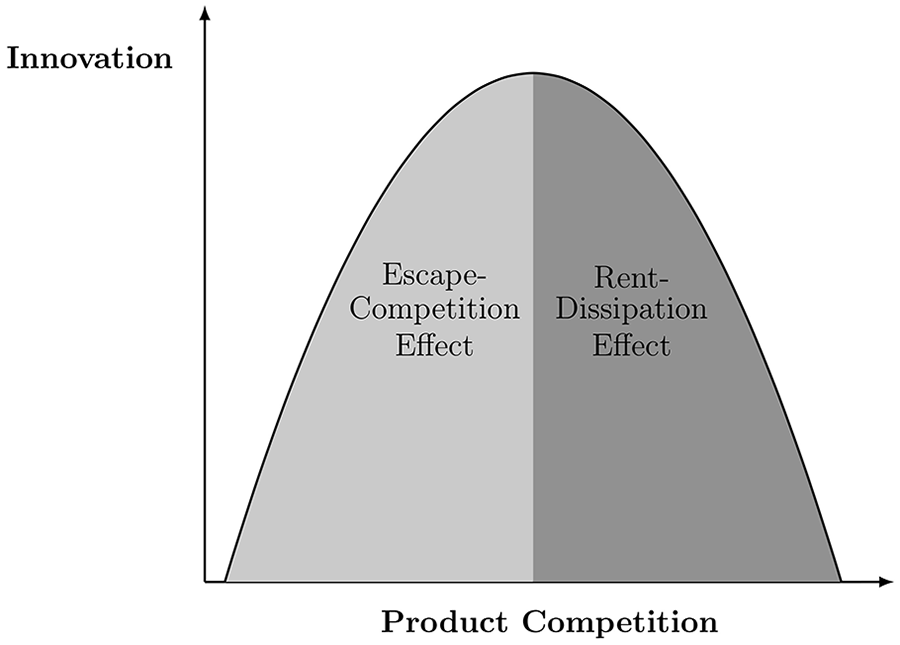
Inverted-U relationship between competition and innovation.
Building off of this logic, we expect that the relationship between the reconnaissance strike capabilities of a state’s adversaries and their own reconnaissance strike capabilities should resemble an inverted-U. When foes have relatively low reconnaissance strike capabilities, the need to pursue reconnaissance strike technology for your own protection is relatively low, and so investing in it may not be worth the costs. 5 In accordance with traditional expectations, as the reconnaissance strike capabilities of adversaries begins to rise, states have incentives to demand reconnaissance strike technology in order to better protect themselves from threats and try and ‘escape the competition’ or, at least, match it.
However, in contrast to the conventional wisdom, but in accordance with the general logic of the rent-dissipation effect in economics, when adversaries’ reconnaissance strike capabilities pass some threshold states should be less likely to demand reconnaissance strike technology themselves. 6 We expect this relationship to hold because it becomes harder to escape or match the competition and investments in reconnaissance strike are less likely to pay off with enhanced security or other benefits that resemble profits. Alternatively, if the conventional wisdom is correct, then there should be no inverted-U relationship. Instead, as the reconnaissance strike capabilities of a country’s rivals increases, states should attempt to emulate their adversaries or out-innovate them in order to match or eclipse their capabilities (Resende-Santos, 2007; Waltz, 1979).
Insights from political science also provide theoretical inspiration for the existence of an inverted-U relationship. For example, in his analysis of unipolarity’s durability, Wohlforth (1999) argues that because the US is so powerful, adversaries have little hope of directly competing. In other words, states that face highly capable adversaries have a reduced chance of escaping their competition and profiting from direct competition, which means they are less likely to attempt to do so. Related is game theoretic work by Gowa and Ramsay (2017), which shows that large stocks of military capability by a leading state can discourage competition because catching up does not seem plausible; the marginal benefit of directly competing exceeds the cost. In the literature on rebellion, studies find that rebel groups confronted with an especially powerful state adversary are more likely to utilize irregular tactics rather than the typical conventional tactics employed by state actors (Kalyvas and Balcells, 2010). Similarly, state actors likely have incentives to adopt more irregular strategies when faced with highly capable adversaries (Biddle, 2021; Coe, 2018). There is also evidence for an inverted-U relationship between repression and political violence (Zhukov et al., 2019). At low levels of repression, there is little desire among citizens to engage in political violence. As repression becomes more prevalent, the demand for political violence becomes greater. However, at high levels of repression, the costs of participating in political violence may outweigh the benefits.
An inverted-U relationship is likely to hold for the proliferation of some weapons systems but not others. When it comes to the spread of advanced conventional capabilities, such as reconnaissance strike, Schumpeterian rent-dissipation dynamics are likely to activate at some point in time for two key reasons. First, having middling reconnaissance strike capabilities provides relatively low security benefits if your adversary has a comparatively advanced capability. For example, having a few low to medium capability aircraft and surveillance assets is unlikely to make much difference against a state with a sophisticated conventional or reconnaissance strike capability who can strike you quickly, in the rear, and with precision. This creates disincentives to symmetrically competing with a capable adversary. Second, developing an advanced capability is especially difficult because doing so necessitates acquiring a complex of systems (guided munitions, strike platforms, surveillance assets, and communications capabilities) rather than a single technology. Moreover, integrating those different technologies into existing or novel organizational structures and employing them in combined arms warfare on the battlefield is extremely challenging (Horowitz, 2010). In other words, it is hard to acquire and integrate the diverse array of technologies required to have advanced reconnaissance strike capabilities compared to specializing in a smaller subset of technologies. Note that while we focus our discussion on the reconnaissance strike complex given its prominence in security discourse, which makes it an ideal ‘model organism’ to study proliferation dynamics, the two reasons outlined above should also hold for the spread of advanced conventional capabilities more broadly. Indeed, as previously discussed, there is a close conceptual connection between the reconnaissance strike complex and modern military power.
By contrast, we would not predict a similar inverted-U relationship to hold for nuclear proliferation because the first reason outlined above does not operate in the nuclear realm. Given their immense destructive power, possessing even a relatively unsophisticated nuclear capability provides significant benefits to states irrespective of if their opponents have highly sophisticated nuclear capabilities. Pursuing nuclear weapons is thus still a logical strategy for states that face highly capable nuclear adversaries since a few weapons and a minimal deterrence posture may be sufficient to achieve strategic objectives, such as regime survival and independence.
If we are correct that states face disincentives to symmetric competition when their adversaries have advanced reconnaissance strike or conventional capabilities, then what other measures can states take to advance their security? There are at least three possible ways states can re-direct their security efforts to other, more profitable defense strategies (Coe, 2018). First, they could pursue nuclear weapons. Doing so may be the most effective way to guarantee their sovereignty, but it also comes with significant risks in terms of economic sanctions and pre-emptive military attacks to destroy a state’s nuclear infrastructure before a bomb can be constructed. For some states, such as North Korea, these risks may be worth it due to the severity of the threat, but for others it may not.
Second, states can engage in external balancing by cultivating allies and, potentially, free-riding on their defense efforts. Economically, this may be the cheapest option and make sense for states that perceive threats as relatively low, such as countries in Western and Central Europe. Nonetheless, the principal risk of pursuing this strategy is abandonment (Parent and Rosato, 2015), and some states may also face difficulty attracting allies.
Finally, states may invest in irregular/asymmetric capabilities (Biddle, 2021; Coe, 2018). Even actors at a significant military-technological disadvantage relative to their opponents, such as the Viet Cong and Taliban, can potentially achieve victory by adopting this approach (Arreguín-Toft, 2001). This strategy may be particularly suited to actors that face serious security threats and are unwilling to outsource their security to a third-party, but do not have the financial or technological capabilities (or the risk tolerance) to pursue nuclear weapons. Of course, states may also pursue a combination of these different strategies.
Recent and historical evidence suggests states believe in the possibility of rent-dissipation-like effects and act accordingly. For example, as discussed by Krepinevich (2006), one element of the United States’ defense strategy has been to try and dissuade potential competitors by maintaining sufficiently high military capabilities such that rivals do not believe they can realistically escape the competition. The 2001 US Quadrennial Defense Review outlined this strategy, as one of the four main defense policy goals entailed ‘dissuading future military competition’ by ‘maintaining or enhancing advantages in key areas of military capability’ (Department of Defense, 2001: 11–12). Stephen Cambone, the then principal deputy undersecretary of defense for policy and a close advisor to Donald Rumsfeld, articulated the futility of escape-competition logic even more clearly: [I]t’s important that potential adversaries understand [. . .] there are things that you may wish to do, there are efforts you may wish to undertake, but you need to understand from the beginning, before you even start, that these are not going to be winning efforts. So don’t bother going down that course. Stay out of that area because you cannot succeed there. (Krepinevich, 2006: 4)
Another example comes from France’s response to British naval superiority in the mid-to-late 19th century. Despite France challenging Britain by building the first ocean-going ironclad in 1858, they were unable to escape their competition because Britain had a strong second-mover advantage and was able to outproduce France when it came to constructing ironclads (Krepinevich, 2006: 10–11). Per the logic of rent-dissipation-like effects, in response to facing a highly capable rival, France eventually experimented with a more asymmetric strategy to counter Britain. Most prominently, the Jeune École, or ‘Young School,’ advocated targeting the enemy’s seaborne commerce rather than battleships and substituting smaller vessels for the more traditional capital ships historically employed by the French navy (Røksund, 2007).
Similarly, having witnessed US power firsthand during the Tanker War in the 1980s and Israeli capabilities for decades, Iran recognizes that it cannot compete with them conventionally and has not tried to (Cordesman, 2010; Defense Intelligence Agency, 2019). Instead, it has adopted an asymmetric strategy focused on imposing high costs on the US and Israel (as well as its other adversaries like Saudi Arabia) in order to bleed their resolve (Defense Intelligence Agency, 2019). This strategy was explained candidly by Major General Mohammad Ali Jafari, commander-in-chief of the Iranian Revolutionary Guard Corps (IRGC) from 2007 to 2019: Given the enemy’s numerical or technological superiority, the IRGC would use asymmetrical warfare capabilities, such as those used by Hezbollah in its 2006 war with Israel in Lebanon. (Chubin, 2004: 72–73) Asymmetrical warfare [. . .] is [our] strategy for dealing with the considerable capabilities of the enemy [. . .] Since the enemy has considerable technological abilities, and since we are still at a disadvantage in comparison, despite the progress we have made in the area of equipment, [our only] way to confront [the enemy] successfully is to adopt the strategy [of asymmetric warfare] and to employ various methods of this kind. (Cordesman, 2010: 16)
These statements are striking in that they nearly mirror our inverted-U logic. First, Jafari’s words clearly indicate that he recognizes Iran cannot compete with its adversaries symmetrically. Just like how firms facing intense product competition may be less likely to invest in innovation because it is unlikely to allow them to beat out their competition, Iran recognizes a similar constraint. Second, in response to Iran’s disadvantage, Jafari reveals that they are investing resources in asymmetric capabilities – resources which could be dedicated instead to developing advanced reconnaissance strike/conventional capabilities. Iran’s actions have mirrored their words, as they have invested significant resources into supporting and developing relationships with a large number of proxy groups like Hezbollah, pursued nuclear weapons, and failed to build a ‘modern’ air force (Defense Intelligence Agency, 2019: 30).
Our theory focuses on the average reconnaissance strike capabilities of a country’s adversaries rather than the abilities of a country’s most capable rival. If a state has one highly capable rival it cannot compete with, but several other rivals it can compete with, then investing in reconnaissance strike capabilities (by either building or buying the relevant technology) may still make sense from a security perspective. On the other hand, if a state cannot effectively compete with its average rival, then that provides a strong case against investing in reconnaissance strike. For example, because Iran has several capable adversaries (the US, Israel, and Saudi Arabia) our theory would expect them to be relatively less likely to invest in reconnaissance strike capabilities than if the US was its only rival with strong capabilities.
Overall, this discussion suggests the following hypothesis: The relationship between the reconnaissance strike capabilities of a state’s average adversary and their own reconnaissance strike capabilities should resemble an inverted-U.
There are, of course, other factors that enable or constrain the spread of reconnaissance strike capabilities. For example, supply-side factors, such as technological capacity and defense relationships, impact whether states have the capability to build or buy reconnaissance strike technologies. We discuss these additional factors in the Online Appendix, but focus here on our inverted-U argument given its novelty.
Research design
Dependent variable: Measuring reconnaissance strike capabilities
To measure the sophistication of states’ reconnaissance strike capabilities, we draw on an original time-series cross-sectional dataset that includes a broad subset of the universe of reconnaissance strike munitions, launch platforms, and enablers. It is the three in combination that generate the reconnaissance strike complex and thus we measure elements of all three. Even though some older-generation military systems (e.g. second generation aircraft) may have little reconnaissance strike value, we include them because they still bring states closer to being able to strike targets quickly, from a distance, and with greater precision, with a lower probability of being detected or destroyed first. In other words, reconnaissance strike sophistication is a spectrum, and even out-of-date military technology brings states farther along the spectrum.
The unit of analysis is the state-year and the data cover 1960 to 2017, but we focus on the 1980 to 2017 period because that is when much reconnaissance strike technology began to be deployed following the Carter administration’s investments. In the Online Appendix, we also show our results remain robust to examining the full 1960 to 2017 time period, and 1988 to 2017.
Unlike most prior research, which focuses on narrow aspects of the reconnaissance strike complex like ballistic missiles (Barkley, 2008; Mettler and Reiter, 2013), our dataset covers eight different elements of reconnaissance strike: (1) ballistic missiles; (2) bombers; (3) cruise missiles; (4) fighter aircraft; (5) ISR; (6) PGMs; (7) satellites; and (8) submarines. 7
We chose these elements for the following reasons. First, they represent each of the elements of the reconnaissance strike complex – munitions, platforms, and reconnaissance. Second, each is publicly recognized as an important military technology and discussed in the context of reconnaissance strike. Third, they contain a mix of capabilities that have evolved over time, and which we can measure over time, meaning we can capture overall variation in reconnaissance strike complex capabilities. The results are robust to the exclusion of particular elements of the index and to a variety of different index construction measures, as we detail below. This is important because these specific elements only represent part of the reconnaissance strike complex. But given their prominence, they represent a reasonable set of proxies as a first attempt at measuring reconnaissance strike capabilities and, by extension, modern military power more broadly. Future research could unpack these further and add additional components, such as surface warships or vehicle-mounted surface-to-air missiles.
To create our dependent variable – a measure of each state’s reconnaissance strike capabilities – we take two steps. First, we measure each individual country’s capabilities in each of the eight components of reconnaissance strike: ballistic missiles, bombers, and so on. Second, we capture each individual country’s overall reconnaissance strike capabilities in a single measure. For the first step, we utilize the component variables outlined in Table 1. The Online Appendix contains a detailed description of these variables and why they were chosen. For example, we include stealth capabilities because, per our definition of reconnaissance strike, this lowers the ‘probability of being detected or destroyed first.’ We include speed because this enables states to ‘strike targets [more] quickly’ and can also reduce the chances of being destroyed by enemy forces in some circumstances. Detailed bibliographies for each individual weapons system are also available on request and rely on sources like the Military Balance and the Center for Strategic and International Studies Missile Defence Project. We do not include accuracy as one of the component variables because open-source data on accuracy is often not available or reliable. Yet, we are still able to capture the accuracy element of the reconnaissance strike complex to some extent by measuring PGM acquisition.
Components of the reconnaissance strike index.
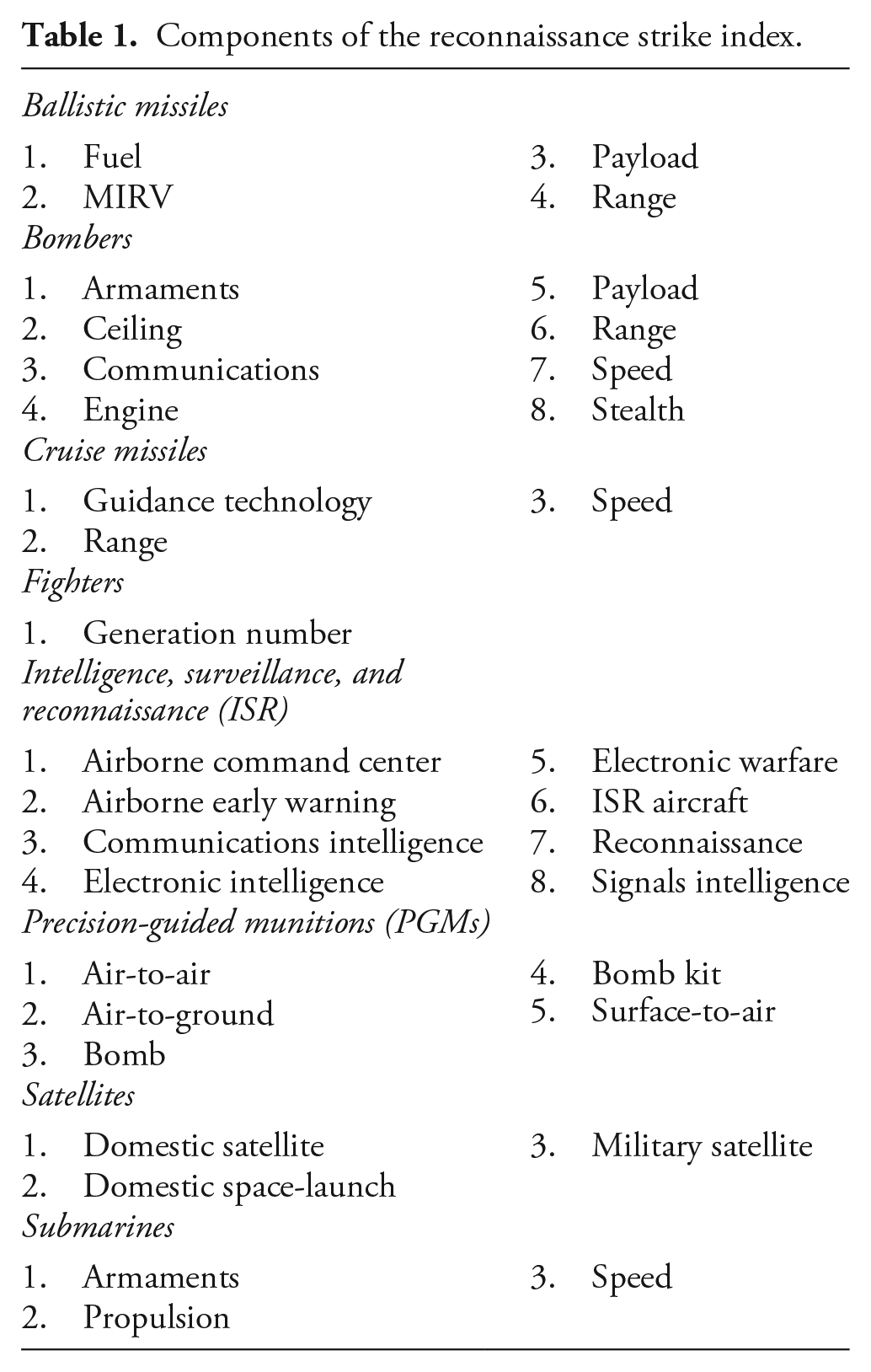
For ballistic and cruise missiles, bombers, and submarines, we use inverse covariance weighting (ICW) to generate an index score for each country in each of these capabilities. ICW, which is a now frequently utilized method in political science research (e.g. Gilligan et al., 2014), creates a weighted average of different variables. It does so by giving more weight to variables (like stealth capabilities) that differentiate high and low capability states and less weight to variables (like whether bombers have a jet engine) that do not do much to differentiate states’ capabilities. More formally, variables that are not highly correlated with other variables in the index are given more weight because they provide ‘new’ information. There are several key advantages associated with ICW (Anderson, 2008). First, it can accommodate variables that are measured using different scales. Second, the procedure enhances statistical efficiency via its weighting procedure. A more detailed discussion of how ICW works is included in the Online Appendix.
For fighters, which have a pre-existing accepted ranking system (the aircraft generation), we measure a country’s sophistication ordinally, by year, based on its highest generation aircraft. Finally, for PGMs, ISR, and satellites, we create a count variable based on whether they have the capabilities outlined in Table 1 or not. 8
For step two, we capture each individual country’s overall reconnaissance strike capability in a single measure using two separate methods. We opt to create a single measure of a state’s reconnaissance strike capabilities because doing so can cause the random measurement errors associated with individual variables in the index to cancel each other out, thereby reducing noise in the data (Anderson, 2008). Additionally, as the number of dependent variable measures increases, the probability of a false negative incorrectly rejecting one of the article’s hypotheses or a false positive incorrectly finding support for one of the article’s hypotheses increases mechanically. By creating a single measure of a state’s reconnaissance strike capability, we can avoid this risk. Our main measure of a state’s overall reconnaissance strike capabilities weights each of the systems equally using Z-scores (Beath et al., 2013; Braconnier et al., 2017). In other words, this aggregation strategy does not assume that possessing certain systems (e.g. advanced bombers) provides more information about a state’s reconnaissance strike capabilities than possessing other systems (e.g. advanced submarines). Our alternative measure utilizes ICW, meaning it upweights or downweights certain systems based on the amount of unique information it provides. We run ICW despite using ICW already on some subcomponents because running it on the eight components reveals the relative differentiation of overall capabilities. For example, if not many states have advanced bombers, then ICW will give extra ‘credit’ to states that do and thus stand out from the pack. Both measures range from 0 to 1, with higher values indicating a more advanced capability.
For robustness, we also generate three additional measures. First, we create a simpler measure of reconnaissance strike capabilities that ranges from 0 to 8 and indicates how many of the eight components of the reconnaissance strike complex each state has, irrespective of their sophistication. For example, if a state has ballistic and cruise missiles, but no other components of the reconnaissance strike complex, then it would receive a score of 2. This measure does not rely on ICW at all. Second, given that our definition and primary operationalization of reconnaissance strike capabilities are relatively broad, we generate a narrower reconnaissance strike index that uses fewer of the components listed in Table 1. For this narrower index, we focus on components that are most directly associated with the reconnaissance strike complex. For example, for submarines we only include armaments since that is the component most directly related to a state’s ability to ‘strike,’ and we only utilize military satellites in this narrower index and exclude domestic satellite capabilities. 9
Finally, we create an even narrower measure of reconnaissance strike capabilities: a munitions-only index that just includes ballistic missiles, cruise missiles, and PGMs. 10 These narrower measures of reconnaissance strike may help distinguish what we are measuring from general military sophistication, although even these alternative variables are correlated with general military capabilities because of the way that reconnaissance strike capabilities are increasingly core to advanced conventional military power. The results are consistent across all of these different measures of reconnaissance strike capabilities, which builds confidence that our findings are not being driven by arbitrary operationalization choices or the breadth of our primary definition.
Figure 2 plots the average of our primary, reconnaissance strike index over time for countries like the US, Russia, and China; other major powers; 11 and all remaining countries with populations above half a million. In total, 173 different countries are included. The primary reason some countries’ scores decrease is because they have systems go out of service. This figure illustrates two main dynamics. First, while some realist theories suggest (Gilpin, 1981; Resende-Santos, 2007; Waltz, 1979) and many experts in the 1990s assumed (Watts, 2013: 1–2, 11–12) that reconnaissance strike technology would spread rapidly and the United States’ lead would quickly evaporate, in reality, the US has maintained an advantage since the 1980s. Interestingly, the US and Russia continue to score better than China in our measure of reconnaissance strike, though China still has the third highest score in the world in 2017 according to our measure and has closed the gap with Russia.
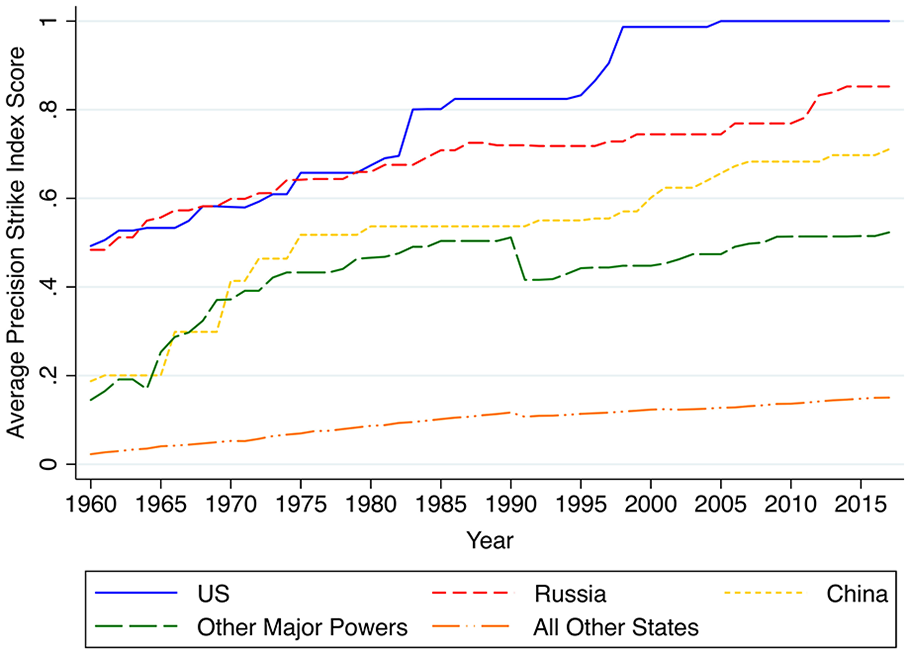
Average reconnaissance strike index over time.
A second important dynamic illustrated by Figure 2 is that most countries have not acquired advanced reconnaissance strike capabilities, even though the underlying technologies are now over a generation old, if not older. For example, the average reconnaissance strike score for non-major powers is just 0.10. This demonstrates that the puzzle outlined at the outset of the article is, indeed, real.
As a whole, Figure 2 demonstrates that a data-driven approach generates aggregate reconnaissance strike ‘scores’ comparable to a 30,000-foot understanding of the capabilities of many countries. If, for example, the United States, Russia, and China were not at the top of the list, then that would be concerning. This provides face validity for our measure of reconnaissance strike proliferation. Our measure also passes a convergent validity check, as it is correlated (ρ ≈ 0.53–0.63) with three other proxies of general military sophistication: the Composite Index of National Capability (CINC), military spending, and Souva’s (2023) Material Military Power (MMP) measure. 12 The moderate correlation between our measure of reconnaissance strike and other measures of general military sophistication is reassuring because a negative or weak correlation would be concerning from a validity perspective. It also indicates that our reconnaissance strike is indeed proxying general military sophistication to some extent. 13 On the other hand, that the correlations are not overly strong indicates that our variable is not simply reproducing existing measures.
Note that our goal is to measure the sophistication of national military capabilities – a proxy for the adoption of the reconnaissance strike complex – rather than the quantity of capabilities. Although collecting accurate data on quantity is not currently possible, this is a potential task for future research given that quantity, of course, has a significant impact on battlefield outcomes. 14
Explanatory variable: Measuring the reconnaissance strike capabilities of a state’s adversaries
Our main measure of this concept is the average reconnaissance strike index score of a country’s rivals, utilizing updated rivalry data from Goertz et al. (2016). We also include a squared term to test for an inverted-U relationship, and robustness tests show our findings hold when controlling for the total number of rivals states have. As discussed previously, we believe this is the optimal measure to test our theory because if a state cannot effectively compete with its average rival, then that provides a strong case against investing in precision strike. On the other hand, if a state has one highly capable rival it cannot compete with, but several other rivals it can compete with, then investing in reconnaissance strike capabilities may still make sense from a security perspective. The measure we utilize is also similar to the approach taken by Sechser and Saunders (2010), who measured interstate threats based on the mechanization score of a state’s adversaries.
As a robustness check, we utilize a variable that incorporates geography by measuring the average reconnaissance strike index score of a state’s neighbors. Prior research demonstrates that neighboring states are much more likely to go to war with each other (Bremer, 1992), and scholars have used a variable similar to this one to measure interstate threats (Barkley, 2008; Sechser and Saunders, 2010).
Another potential operationalization could be the relative difference between a state’s reconnaissance strike capabilities and that of their rivals or neighbors. When this gap is small, states might have incentives to try and escape their competition by investing in reconnaissance strike capabilities. When it is large, rent-dissipation-like effects would be more likely to kick in. However, using a relative capabilities variable would force us to include a measure of a state’s reconnaissance strike capabilities on the left and right-hand side of our regression equation. This is problematic because as the relative advantage of a state’s adversaries grows in the realm of reconnaissance strike, the dependent variable would mechanically be inclined to decrease. Furthermore, using an absolute measure of the capabilities of a state’s rivals is appropriate for our theory since, on average, states with more capable rivals should also be more likely to face rent-dissipation-like pressures. In fact, using an absolute rather than relative measure should constitute a harder test of our inverted-U theory. Some states with highly capable adversaries may be quite capable themselves, making rent-dissipation-like effects – and thus an inverted-U relationship – less likely.
Control variables
In accordance with previous studies on proliferation, we control for key supply-side factors, such as technological capacity and defense relationships, which may impact whether a state is able to build or buy a technology. To proxy a state’s technological capability, we use the log of its gross domestic product (GDP) per capita (World Bank, 2019), which is commonly used in the proliferation literature (Fuhrmann and Horowitz, 2017). Our primary measure of defense relationships is whether countries have a Defense Cooperation Agreement (DCA) with the United States or Russia, which are key reconnaissance strike exporters (Kinne, 2020). Utilizing a measure of DCAs rather than formal defense pacts has several advantages we outline in the Online Appendix, but our results are robust to controlling for defense agreements instead.
Per prior studies, we also control for a country’s regime type (Jo and Gartzke, 2007; Kahn and Horowitz, 2023; Sechser and Saunders, 2010). Since democracies and autocracies tend to differ in terms of their values, institutional constraints, and expected security challenges, their incentives to seek reconnaissance strike technology may also differ, making it an important factor to control for. In our main models, we measure regime type using data from the Polity IV project (higher values indicate a country is more democratic), and in the Online Appendix we utilize the V-Dem electoral democracy index to probe robustness.
We also control for prestige or status-seeking since prior research finds that status-seeking influences the spread of military capabilities (e.g. Horowitz et al., 2020). Operationalizing whether a state is seeking prestige is difficult, but we do so using two methods validated by prior research. First, in our main models, we employ a measure based on whether states over-perform at the Olympics relative to a model of likely performance (Early, 2014). Second, in the Online Appendix, we use a measure of status from Renshon (2017), which identifies whether states face a status deficit globally or compared to their relevant status community. In the Online Appendix, we also include a longer discussion of how regime type might impact the proliferation of reconnaissance strike capabilities and why Olympic over-performance proxies status-seeking.
Results
Table 2 contains the results from seven different models with robust standard errors clustered by country. Model 1 is our primary specification where the dependent variable is the equally-weighted reconnaissance strike index, independent variables are lagged one year to reduce concerns about potential endogeneity, and we use ordinary least squares. Model 2 substitutes the ICW-weighted index for the equally-weighted index and also uses this alternative index to measure the average index score of rivals. Recall that the ICW index relaxes the assumption that certain systems (e.g. bombers) do not provide more unique information about a state’s reconnaissance strike capabilities than other systems (e.g. submarines). Model 3 uses a count variable measuring how many of the eight components of the reconnaissance strike complex each state has, along with an ordered probit specification. Model 4 employs a narrower index, which focuses on the components of systems that are most directly associated with the reconnaissance strike complex. 15 Model 5 utilizes the munitions-only index. Model 6 replaces the average reconnaissance strike index score of a country’s rivals with the score of its neighbors. Model 7 controls for other measures of general military sophistication (CINC and MMP). Model 8 analyzes whether there is also an inverted-U relationship for MMP (Souva, 2023).
Analysis of the proliferation of reconnaissance strike (1980–2017).
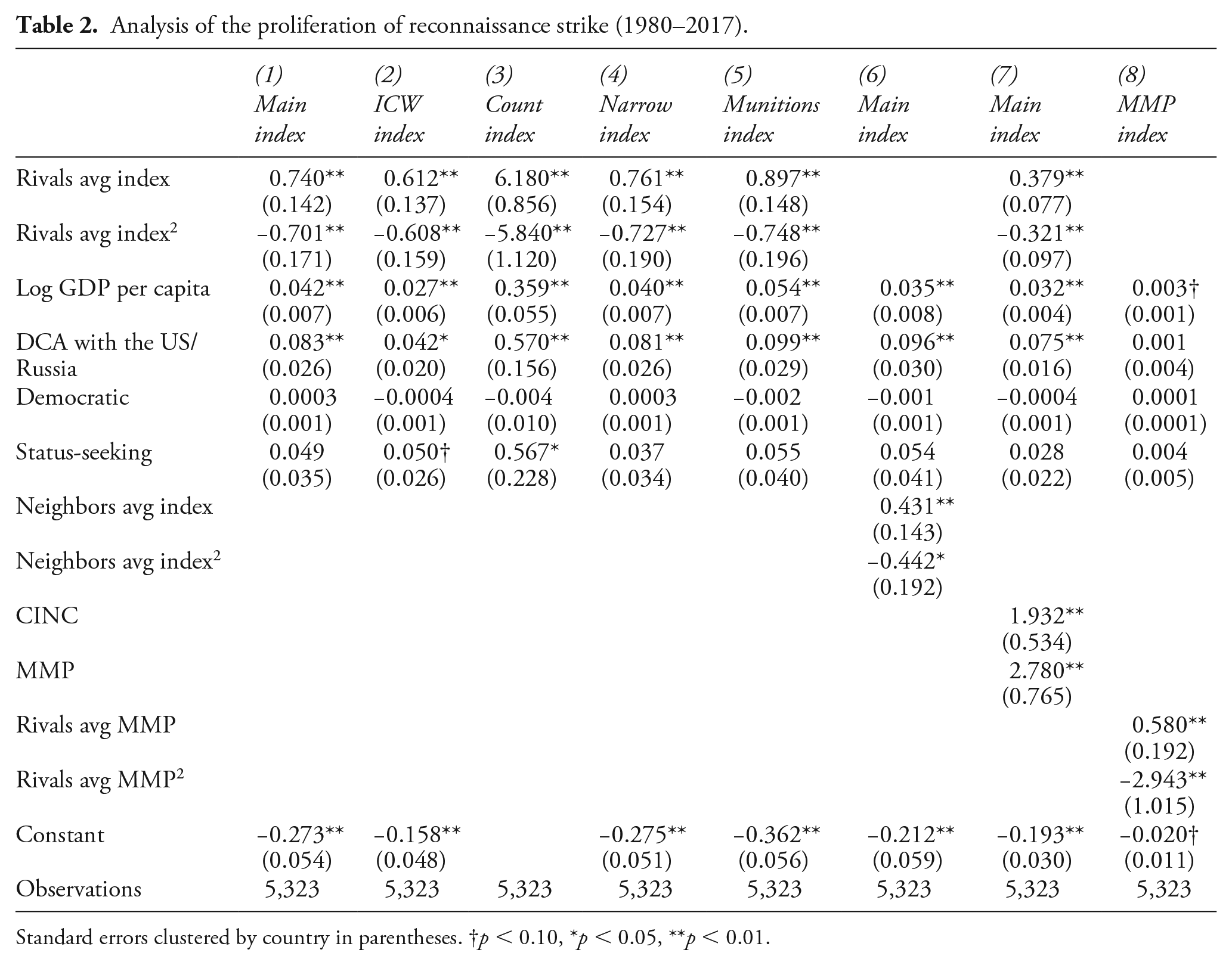
Standard errors clustered by country in parentheses. †p < 0.10, *p < 0.05, **p < 0.01.
Per our core hypothesis we find strong evidence that the relationship between the reconnaissance strike capabilities of a state’s adversaries and proliferation resembles an inverted-U, even when controlling for capabilities. In all models the coefficients on our threat variables are statistically significant (ρ < 0.01), and the negative squared term indicates the presence of an inverted-U relationship. It even holds when dropping the US and/or Russia from the measure of adversary reconnaissance strike capabilities or dropping states from the analysis entirely that are rivals with the US or Russia. This suggests the findings are not driven exclusively by the great powers and the US’ status as a unipolar power post-1991 in particular. Since much of the prior political science literature we draw on to develop our inverted-U theory is focused on unipolar politics (Gowa and Ramsay, 2017; Wohlforth, 1999) and the US in particular (Coe, 2018), this finding suggests our theory can hold more generally. Moreover, that our inverted-U argument holds for narrower measures of precision strike (our munitions-only index), broader measures (our equally-weighted index), and an alternative measure of general military sophistication (MMP) indicates that our theory has broad applicability to the proliferation of advanced conventional weapons systems.
Using estimates from Model 1 above, Figure 3 visually illustrates the inverted-U relationship between security threats and reconnaissance strike capabilities. States that have rivals with moderate reconnaissance strike capabilities have over double the reconnaissance strike capabilities themselves than states that have rivals with very low or very high capabilities. Thus, as hypothesized, states compete with their adversaries in the realm of reconnaissance strike up to a point. But when facing highly advanced adversaries, states have a harder time escaping or matching their competition and are less likely to attempt to do so. While prior game theoretic and qualitative research in political science makes a similar argument (Coe, 2018; Gowa and Ramsay, 2017; Wohlforth, 1999), this finding provides empirical, quantitative support. In the Online Appendix, we discuss the relevance of our findings on the supply-side related to technological capacity and defense relationships, which can also serve to constrain proliferation in certain circumstances.
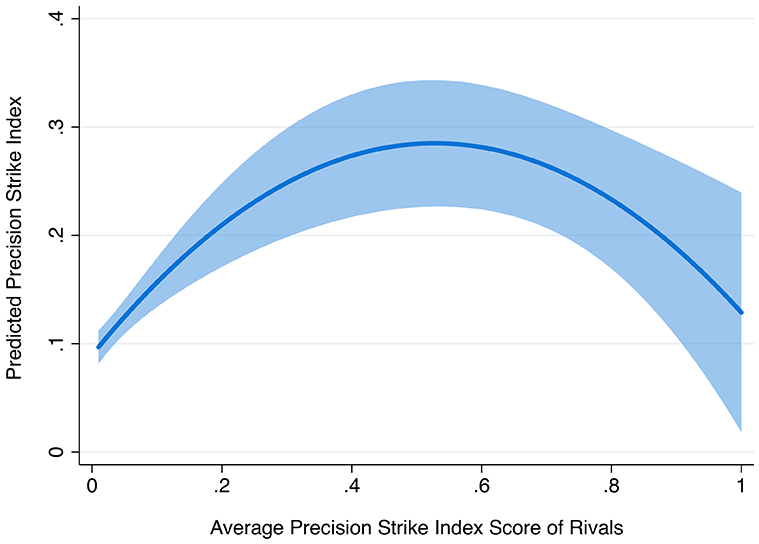
Inverted-U relationship between security threats and reconnaissance strike.
Robustness
In addition to the previously mentioned tests, we also show the robustness of these results across the following situations:
• Beginning the analysis in 1960 or 1988.
• Utilizing year fixed effects to control for secular time trends and country fixed or random effects to control for factors that vary between countries.
• Changing the dependent variable to a logged form or taking the cubed root of the dependent variable to reduce skew.
• Due to the relatively long procurement times for some elements of the reconnaissance strike complex, we demonstrate the results are robust to lagging the independent variables five or ten years.
• Including extra control variables like coup risk, personalist or military regimes, defense spending, or the number of rivals a state has.
The robustness of our results across these tests builds confidence in our main findings.
Conclusion
The reconnaissance strike complex is a critical set of military capabilities that reveal the level of military sophistication a country possesses. This article makes several contributions by introducing a new dataset and theory to analyze the proliferation of reconnaissance strike and advanced conventional capabilities more broadly. We theorize and find an inverted-U relationship between the reconnaissance strike/conventional capabilities of a state’s rivals and its own capabilities. When states face adversaries with highly advanced conventional capabilities, it becomes more difficult to match their enemies’ capabilities, and thus states have incentives to shift resources to other defense strategies. By contrast, previous literature often assumes a monotonically increasing relationship between security threats and proliferation. Our theory and findings on the demand-side complicate realist theories of balancing and help explain both (a) why some states – like the US – continue to invest heavily in conventional capabilities despite an already-large lead over their adversaries and the presence of a guns vs. butter tradeoff (Gowa and Ramsay, 2017; Wohlforth, 1999); and (b) why other states instead opt to invest heavily in non-conventional capabilities like nuclear weapons and proxies rather than balancing symmetrically (Biddle, 2021; Coe, 2018).
With respect to the former point, a key policy takeaway of our project is that what seems like over-investment in conventional capabilities may actually be rational if doing so can help dissuade rivals from attempting to compete symmetrically. Related to the latter point, our theory also suggests the rationality of some states pursuing non-conventional capabilities and not pursuing the full basket of reconnaissance strike capabilities. For example, for a country like Iran, trying to match the US one-to-one in the realm of reconnaissance strike would be extremely difficult if not impossible. On the other hand, adopting specific elements of the complex, such as missiles, and pursuing nuclear weapons may effectively suit their asymmetric strategy, even while pursuing a broader set of reconnaissance strike capabilities would not. A profitable avenue for future research would be to assess why states choose to adopt some alternative strategies (e.g. external balancing or nuclear weapons) over others. Future work should also extend our dyadic approach to analyze whether reconnaissance strike capabilities may spread via more complex network processes (Thurner et al., 2019). For example, our modeling strategy may miss triadic effects (e.g. the friend of my enemy is my enemy) and path dependencies.
Our findings also help move the literature forward by testing the inverted-U theory empirically in a wide-ranging quantitative analysis, whereas prior work making a similar argument has been largely (game) theoretical (Coe, 2018; Gowa and Ramsay, 2017) or qualitative (Wohlforth, 1999) in nature. Our overall findings reinforce the importance of a security logic in explaining proliferation, just of a different sort.
Finally, this dataset, which covers eight elements of the reconnaissance strike complex for every country in the world from 1960 to 2017, is an important contribution in itself. Although this article uses reconnaissance strike capabilities as a dependent variable in order to analyze proliferation, future research could use it as an independent variable to analyze important political phenomena like force posture decisions, battlefield outcomes, and deterrence and compellence efficacy.
Footnotes
Acknowledgements
We thank Christopher W Blair, Daniel Brennan, Kai Burgmann, Camila Celi, Alexis Ciambotti, Julia Ciocca, Jordan Dewar, Kathryn Dura, Catherine Harrity, Lauren Kahn, Ali Khambati, Casey Mahoney, Andro Mathewson, Jackson Min, Elizabeth Peartree, Shira Pindyck, Alexander Rabin, Julie Sonhen, Alex Sun, Noah Sylvia, Joshua Weiner, Karen Whisler, Maxim Yulis, and Jacob Ziemba for invaluable research assistance. We also thank Christopher W Blair, Jonathan D Caverley, Sarah E Kreps, Michael O’Hara, Shira Pindyck, and Michael Warner for helpful comments and advice.
Replication data

Declaration of conflicting interests
The author(s) declared no potential conflicts of interest with respect to the research, authorship, and/or publication of this article.
Funding
We gratefully acknowledge support from the Air Force Office of Scientific Research and the Minerva Research Institute.
Notes
MICHAEL C HOROWITZ, PhD in Government (Harvard University, 2007); Richard Perry Professor of Political Science, University of Pennsylvania (2017–present).
JOSHUA A SCHWARTZ, PhD in Political Science (University of Pennsylvania, 2022); Assistant Professor of International Relations and Emerging Technology, Carnegie Mellon University (2023–present).