




Abstract
What drives the cohesion of secessionist movements? Previous research emphasized the role of internal and external factors but produced mixed results regarding their effects. This article advances scholarship on this question by examining the role of critical junctures as periods of heightened contingency that can shift movements towards fragmentation or cohesion. It focuses on independence referendums and how states respond to them as important critical junctures, and on how they shape interorganizational relations as a key dimension of movement cohesion. Empirically, it explores the effects of the 2017 referendum in Catalonia using a mixed-methods research design that combines qualitative inquiry with network analyses of protest event data. The network analyses showed that the movement was notably less cohesive in the protest arena after the referendum than during the referendum campaign. Qualitative materials were employed to inductively identify strategy framing processes as key mechanisms to explain this development. Frame alignment around the referendum as a shared goal led to more cohesion during the campaign. After the event, a frame dispute over the meaning of the referendum led to diverging strategies and fragmented the movement, as state repression limited the movement’s room for maneuver. The findings suggest that research on secessionist movement cohesion should pay more attention to critical junctures and how secessionists make sense of them.
Introduction
The comparative literature on secessionist conflicts often treats pro-independence movements as unitary actors (Griffiths, 2016; Griffiths and Wasser, 2019; Siroky and Cuffe, 2015; Sorens, 2012), but it has also been acknowledged that movements in fact are often comprised of a multitude of collective actors, ranging from political parties and civic organizations to armed militias and terrorist groups (Cunningham, 2014). Whether these actors work together in the pursuit of independence is an important question. Previous research found that whether a movement is united or divided is decisive for the trajectory and outcomes of self-determination conflicts (Cunningham, 2011, 2014; Krause, 2017; Pearlman and Cunningham, 2012).
What drives the cohesion and fragmentation of secessionist movements? Given the importance of the internal structure of opposition movements, research on its causes has been growing (Fliervoet and Seymour, 2023: 168). Previous research has highlighted that cohesion is the product of ‘dual contests’ within the movement and with the host state (Bakke et al., 2012; Seymour et al., 2016) but has produced mixed findings on the precise effects of these contests (e.g. Cunningham, 2014; Fjelde and Nilsson, 2018; Lawrence, 2010; Mosinger, 2018).
Examining these dual contests during moments of critical contingency promises to shed more light on this question. While the analytical importance of critical junctures and transformative events has long been acknowledged in comparative politics and elsewhere (Capoccia and Kelemen, 2007; Collier and Collier, 2002; Mahoney, 2002; McAdam and Sewell, 2001; Sewell, 1996; Wagner-Pacifici, 2017), the literature on secessionist conflicts has rarely considered them as an explanatory factor. Seymour et al. (2016), for instance, found that the onset of civil war increased movement fragmentation. McLauchlin and Pearlman (2012) showed that ‘repression shocks’ can both enhance and decrease movement cohesion, depending on the organizations’ satisfaction with the movement’s internal structure. Zooming in on such critical junctures has the potential to reveal the mechanisms that drive cohesion and fragmentation.
This article focuses on independence referendums and how states respond to them, which arguably represent the most important critical junctures in secessionist conflicts besides the onset of civil war and the declaration of independence. Referendums are a key strategy for secessionist movements (Cortés Rivera, 2020; Sanjaume-Calvet, 2021). They open up opportunities for civil society actors to mobilize independence supporters and organize protests to put pressure on the host state and attract the attention of the international community (Della Porta et al., 2017). As such, they may foster cohesion among protest groups. However, referendums in liberal democracies rarely lead to independence (Dion, 1996). Instead, they often produce a backlash from the host state (Basta, 2021; Ferreira, 2021). The failure to achieve independence may also demobilize supporters (Lecours, 2018). Counter-secessionist repression and demobilization may in turn create conflict within the secessionist movement (Gade, 2020; Gunzelmann, 2022; Krause, 2023). Independence referendums thus represent moments of heightened contingency during which the actions of secessionist and state actors may have lasting consequences for movement cohesion.
Empirically, the article focuses on the 2017 independence referendum in Catalonia, which was unilaterally called by secessionists and met with severe opposition by the Spanish state. Although the referendum was suspended by the Constitutional Court, two million Catalans cast their votes largely in favor of independence on 1 October and the Catalan parliament declared independence 4 weeks later. This led to a severe institutional crisis, which involved the suspension of the region’s autonomy and a trial that ended with long prison sentences for the movement leaders (Ferreira, 2021; López and Sanjaume-Calvet, 2020).
I develop a novel approach to movement cohesion, which highlights interorganizational relations as a key dimension. Whether secessionist organizations collaborate in collective actions represents a crucial indicator for the movement’s internal structure, but it has rarely been scrutinized (Gade et al., 2019b). Furthermore, research on movement cohesion has predominantly focused on armed groups and violent action (Fjelde and Nilsson, 2018; Gade et al., 2019a, 2019b; Mosinger, 2018). In contrast, this article focuses on collaboration in primarily nonviolent protest, which is fundamental for most secessionist movements (Chenoweth and Stephan, 2011; Griffiths and Wasser, 2019).
I employed a mixed-methods research design that combined protest event data with qualitative materials to address the research question empirically. I elaborated an original event data set of self-determination protest in Catalonia from 2015 to 2019. These data allowed for a more fine-grained analysis than previous data at the year-level and were used to generate networks of interorganizational collaboration in collective action before and after the referendum. Retrospective semi-structured interviews with key organizers were used to identify the mechanisms explaining the results of the network analyses.
I found that the 2017 referendum was the cornerstone for how secessionist actors framed their strategies. Before the event, the referendum as a shared goal provided the basis for cohesion, but conflicts over the meaning of the referendum led to fragmentation afterwards. While these findings emerged inductively from the qualitative materials, they are best captured by the concepts of ‘frame alignment’ (Snow et al., 1986) and ‘frame dispute’ (Benford, 1993). They highlight the role of critical junctures and strategy framing as key mechanisms driving secessionist cohesion.
Conceptualizing cohesion: A relational approach
A central dimension of the structure of a secessionist movement is whether it is cohesive or fragmented. 1 Fragmentation and cohesion can be conceptualized as opposite endpoints of the same spectrum (Bakke et al., 2012; Pearlman, 2011: 25). The most widespread approach is to conceptualize and measure cohesion and fragmentation as the number of active organizations within a movement (Fliervoet and Seymour, 2023: 166). In other words, the more organizations a movement has, the more fragmented it is (Cunningham, 2013a, 2014; Fjelde and Nilsson, 2018; Seymour et al., 2016).
However, this approach has been criticized as too one-dimensional (Krause, 2013; Pearlman, 2011: 8). In response, scholars have developed more complex conceptualizations. Dowd (2015) included not only the number of organizations but also the degree of violence they use. Bakke et al. (2012) added institutions and power as important dimensions. On the other hand, Krause (2013, 2017) and Pearlman (2011) dismissed the importance of the number of organizations. While Krause emphasized the role of power within movements, Pearlman conceptualized movement cohesion as the combination of leadership, institutions and the constituencies’ ‘sense of collective purpose’ (2011: 23).
This article suggests that there is another key dimension of movement cohesion and fragmentation: interorganizational relations. Interorganizational relations may range from conflict to cooperation. 2 Organizations within the same movement might see each other as partners, competitors or even enemies. The relational dimension is distinct from other elements of cohesion and fragmentation. First, unless a movement is fully unified in a single organization, interorganizational relations are independent of the number of organizations. A movement with a large number of organizations that have friendly relations should be considered more united than a movement that is divided into only two polarized blocks. Second, cooperative or conflictual relations are different from power relations. Movements with dispersed power can be quite cohesive if organizations have friendly relations and cooperate. Vice versa, a movement in which most power is concentrated in one organization may be less cohesive if smaller organizations challenge the hegemonic organization.
The relational dimension of movement cohesion has best been approached through the notion of institutionalization. Bakke et al. (2012) even stated that ‘the degree of institutionalization of a movement characterizes the ties between organizations that it comprises’ (2012: 270) but restrict it to ‘formal and informal rules’ (2012: 268). Likewise, Pearlman (2011: 24) defined institutions as ‘the structures and norms that govern social interaction’. However, this structuralist focus overlooks that interorganizational relations can take a myriad of forms. Organizations may collaborate in the absence of rules and norms. Also, the notion of institutionalization largely neglects the conflictual side of interorganizational relations.
This is why it is necessary to conceptualize and study interorganizational relations in secessionist movements as a key dimension of cohesion and fragmentation. The most promising steps in this direction have been made by Gade et al. (2019a, 2019b) in a pair of complementary articles. Drawing on data from the Syrian civil war, they use network analytical tools to study collaboration and conflict within rebel groups. However, their focus is predominantly on the empirical question of with whom rebels cooperate or infight rather than on conceptual concerns.
I propose a relational conceptualization of movement cohesion, which rests on an understanding of social movements as networks of collective and individual actors that share a common identity and engage in conflictual relations with their opponents (Della Porta and Diani, 2020). The central building block at the meso level are collaborative ties. Collective actors may exchange resources and knowledge or may even have overlapping membership (Baldassarri and Diani, 2007). The denser these collaborative ties, the more cohesive the movement. It is an aggregate quality located at the movement level and should be thought of as a spectrum from 0 (absence of collaboration) to 1 (permanent collaboration). The form of collaborative ties may vary with regard to their organizational form (formalized or not), their geographical scope (local, national, transnational), and their durability (single events, campaigns, or long-term alliances) (Brooker and Meyer, 2018; see McCammon and Moon, 2015; Van Dyke and Amos, 2017).
Critical junctures and movement cohesion
Previous research on movement cohesion has emphasized the importance of interactions between secessionists and the state as well as among secessionists themselves – what Cunningham et al. (2012) and Seymour et al. (2016) called ‘dual contests’. With regard to internal dynamics, the ideological proximity of the organizations matters (Gade et al., 2019a, 2019b), as well as the diversity of their demands, and whether they use violent tactics (Seymour et al., 2016). There is less agreement on the role of the state. Seymour et al. (2016) and Fjelde and Nilsson (2018) argue that accommodation increases movement fragmentation, whereas Cunningham (2014) found that it led to cohesion in the long run. Cunningham (2014), Lawrence (2010), and Seymour et al. (2016) suggest that (violent) repression leads to fragmentation, while Fjelde and Nilsson (2018) found no effect.
These mixed findings could be the product of moments of heightened contingency that tip the movement towards cohesion or fragmentation. Such critical junctures are fairly short periods of choice during which the course of history is decided (Capoccia and Kelemen, 2007; Collier and Collier, 2002; Mahoney, 2002). They may have long-lasting consequences and become ‘transformative events’ (McAdam and Sewell, 2001; Sewell, 1996). Recent studies have demonstrated the consequences of these events for coalition building in social movements (Ciordia, 2021; Portos and Carvalho, 2022; Wood et al., 2017). This article builds theory on how critical junctures drive movement cohesion by looking at independence referendums.
Independence referendums represent the most important critical junctures in secessionist conflicts besides the onset of civil war and the declaration of independence (Qvortrup, 2014a). Not all referendums are actual decisions on independence, which ultimately depends on international recognition (Coggins, 2014; Griffiths, 2017). A key factor for recognition is whether a referendum is agreed upon with the host state or pursued unilaterally by the secessionist movement (Sanjaume-Calvet, 2021). Theoretically, the effects of an agreed referendum on movement cohesion are straightforward: if the pro-independence camp wins the vote, secession is very likely and the movement achieves its goal. If the vote is lost, blame attribution and the lack of options going forward is likely to increase movement fragmentation.
The effects of unilateral referendums on secessionist movements are less clear. On the one hand, unilateral referendums represent a crucial opportunity for secessionists. By setting a date for the referendum, secessionists dare the central government to react and thus self-create a window of opportunity (Cortés Rivera, 2020). Bringing in the population of the seceding region can be used to leverage the legitimacy of secession (Sanjaume-Calvet, 2021). Most importantly for the protest arena, referendums can spark the mobilization of supporters (Della Porta et al., 2017). Calling a referendum may also set a short-term goal around which different organizations and parties may rally (Della Porta et al., 2019).
On the other hand, unilateral referendums also carry risks for secessionist movements. Most unilateral referendums do not lead to independence (Sanjaume-Calvet, 2021). In established democracies in particular, secession appears to be virtually impossible (Dion, 1996; Qvortrup, 2014b). The failure to achieve independence may demobilize and exhaust supporters (Lecours, 2018). Similar to agreed referendums, blame attribution and the lack of options going forward may lead to internal conflicts. Finally, unilateral referendums normally lead to a backlash from the host state, including violent repression (Basta, 2021). Repression, in turn, has been found to contribute to internal conflicts within the movement (Gade, 2020; Lawrence, 2010; Seymour et al., 2016).
The remainder of the article focuses on the case of the October 2017 referendum in Catalonia to explore these contrary expectations empirically. I inductively build theory on the mechanisms connecting critical junctures and movement cohesion. The next section describes the data and methods that were used for the empirical part.
Methods and data
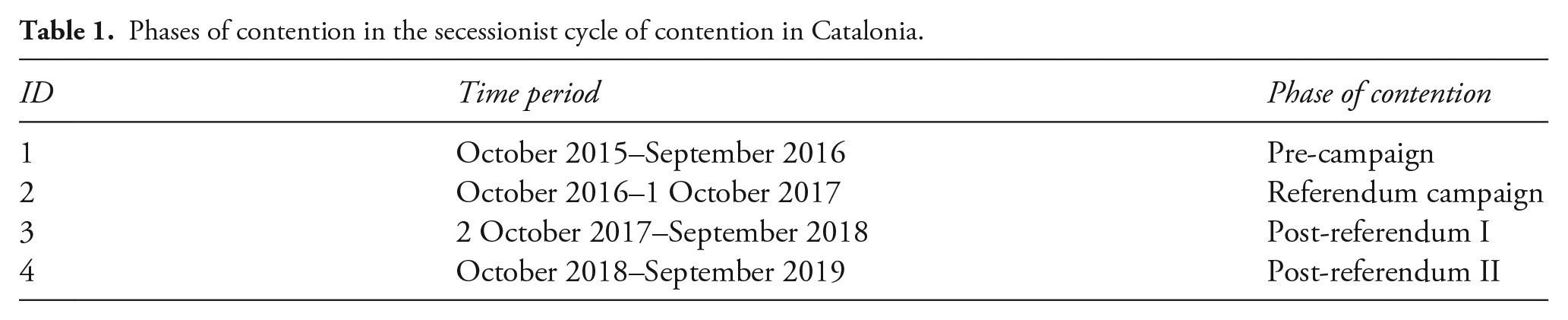
To study the impact of independence referendums on movement cohesion, I employed a mixed-methods research design that consists of two parts. The first part built on previous studies combining protest event and network analyses to analyze movement cohesion over four phases of contention (Bearman and Everett, 1993; Ciordia, 2021; Pirro et al., 2021; Wang and Soule, 2012): the phase before the announcement of the referendum plan in October 2016, during the referendum campaign, during the counter-secessionist backlash right after the referendum, and the contraction of the conflict in the second year after the conflict (see Table 1). The second part drew on qualitative data and in particular on semi-structured interviews with key organizers from the independence movement. These materials were used to explore the impact of the 2017 independence referendum on movement cohesion.
Phases of contention in the secessionist cycle of contention in Catalonia.
Protest event analysis
In this study, cohesion was conceptualized as the density of collaborative ties among collective actors in a secessionist movement. Collaborative ties were operationalized as co-participation in contentious events, that is, when two actors take part in the same protest event (Ciordia, 2021; Wang and Soule, 2012). The more often two actors protest together, the stronger the collaborative tie between them. Actors are usually very conscious of showing themselves with other actors in public, which is why co-participation is a good indicator of collaborative ties (Ciordia, 2020: 72; Diani, 1995: 99).
The data collection covered self-determination (SD) protest events and their participating actors in Catalonia from October 2015 through September 2019. I follow Tilly and others in defining protest as the collective, non-routine act of public claims-making (McAdam et al., 2001; Tilly, 2008; Tilly and Tarrow, 2015). Protest events are claims-making acts that are bounded in time and space. The data collection included the larger category of SD protests rather than just secessionist contention. SD protest refers to all public acts making claims about a group’s control over its own affairs in relation to the state (Cunningham, 2014). These demands can be defensive ones, such as the protection of minority rights, but most will be expansive ones such as greater fiscal or institutional autonomy, as well as calls for outright independence. The reason for including a broader set of claims was that SD protests beyond independence claims provide important opportunities for secessionist actors to collaborate.
Data were collected from two Catalan newspapers: El Periódico and El Punt Avui. The selection is justified by two criteria. The first is geographical proximity, which has been found to increase the propensity to cover protests (Danzger, 1975; Fillieule and Jiménez, 2003; Ortiz et al., 2006). El Periódico is a national newspaper based in Barcelona, while El Punt Avui, is a regional newspaper based in Girona. Being based in Catalonia and having an explicitly regional focus, the two newspapers were preferable over Madrid-based newspapers such as El País or El Mundo. The second criterion is ideological balance with regard to the secessionist conflict in Catalonia. El Punt Avui openly supports Catalan secession from Spain, while El Periódico is known to be opposed to Catalan independence. I suggest that their selection biases should be complementary. Whereas El Punt Avui should be more likely to cover peaceful events, especially in response to counter-secessionist repression, El Periódico can be expected to focus on violent and disruptive actions.
The starting point for the time frame is justified with the regional elections in September 2015, which resulted in a clear pro-independence majority in the Catalan parliament and led to a new phase in the territorial conflict (Martí and Cetrà, 2016; Orriols and Rodon, 2016). At the heart of this phase is the referendum on independence on 1 October 2017. The end of the trial of the Catalan leaders in October 2019 represents the endpoint of the study. Geographically, the project focuses on protests in the four provinces (Barcelona, Girona, Lleida and Tarragona) of the Autonomous Community of Catalonia.
I used a combination of action forms and SD claims as keywords to search the archives of the two newspapers through the online platform Factiva (see Online Appendix 3). I followed Ciordia’s (2020, 2021) strategy for coding the articles. This strategy involves two separate codebooks: one for events and one for event participants (see Online Appendix 2). I used the Discourse Network Analyzer software developed by Leifeld (2016) to perform these codings.
The main part of the data analysis was devoted to reconstructing network patterns among secessionist collective actors before and after the 1 October referendum. This required moving from protest event and participant data to network data, for which I created attendance lists for each of the four time periods. Only secessionist actors that attended at least two protest events were included in the network analyses for each period. To control for the fact that some organizations participate in many more events than others, I followed Ciordia (2020, 2021) in using Jaccard coefficients as a normalized indicator for co-participation. Raw and Jaccard matrices were exported for all four periods separately. Network statistics were calculated in Excel and Visone and are displayed in Table 3 in the following section. Networks were visualized with the basic Visone algorithm, which uses metric multidimensional scaling and stress minimization. Network graphs are available in Online Appendix 4.
Qualitative analysis
The qualitative part of the research design is based on 10 months of fieldwork in Catalonia between May 2018 and March 2019 (see Online Appendix 5). The primary database consists of 30 interviews with key organizers from the most important organizations from all sectors of the Catalan independence movement: Assemblea Nacional Catalana (ANC), Òmnium Cultural, Committees for the Defense of the Republic (CDR), and Universitats per la República (UxR). To increase the diversity of organizational backgrounds, the interviewees varied with regard to organizational level (local and regional), activist experience (from several years to a few months), and geographical location (rural areas, small towns, and several neighborhoods of Barcelona). The names of the interviewees were pseudonymized. All interviews except one were transcribed for analysis, which produced 555 pages of raw data. These materials were supplemented by field notes, seven expert interviews (activist-scholars and journalists), and documents produced by social movement organizations. The additional materials were used to interpret the context and timing of interorganizational relations.
Part of the interview guide comprised questions about the changing relations with other major movement organizations as well as with political parties. The analysis of their answers followed the logic of grounded theory (Charmaz, 2006; Glaser and Strauss, 1967; Mattoni, 2014), trying to identify changing patterns in the relationships as well as how they were connected to the 1 October referendum. Four analytical phases were performed in MaxQDA. First, the interviewees’ statements were coded into three categories: relations within umbrella organizations, among organizations, and between organizations and other actors. Second, I constructed summary grids and tables from which to abstract individual statements and provide an overview for each organization. Third, using the summary tables, I identified patterns for each organization as well as overarching themes. Fourth, I selected representative quotes for each of the themes, which structure the narrative in the empirical section of this article.
Secessionist protest and the October 2017 referendum
The 2015 regional elections marked the beginning of a new phase in the secessionist conflict. It was proclaimed a ‘referendum on independence’ by the secessionist parties Convergència Democràtica de Catalunya and Esquerra Republicana de Catalaunya (ERC), which ran on a single platform called Junts pel Sí (Together for Yes) (Martí and Cetrà, 2016). During the campaign, the new coalition committed to an 18-month process of unilateral secession from the Spanish state in the case of electoral success, but failed to obtain a majority of seats in the Catalan parliament (Orriols and Rodon, 2016). A motion to start secession from Spain shortly after the election was quickly suspended by the Spanish Constitutional Court, which meant that the unilateral strategy promised before the elections had reached an impasse. I consider the year after the regional election to be the first phase under study (pre-campaign, see Table 1 in the previous section).
After surviving a vote of confidence in the Catalan parliament on 28 September 2016, Puigdemont changed course and vowed to call a binding referendum on independence. This can be considered the beginning of the extended referendum campaign, which represents the second phase of the late secessionist conflict. On 6 June 2017, the referendum was officially announced for 1 October of the same year. The Catalan government tried to achieve an agreement with the Spanish government, which rejected the referendum arguing that it was against the Spanish constitution. At the beginning of September 2017, the pro-independence majority in the Catalan parliament passed the ‘Law on the Referendum on Self-Determination of Catalonia’ in a controversial session boycotted by the unionist parties. The Spanish Constitutional Court immediately suspended the law after an appeal from the Spanish government and declared the referendum illegal. On 1 October, riot squads of the Spanish National Police and the Civil Guard attempted to prevent the referendum by entering voting stations and confiscating ballot boxes. The crackdown resulted in more than 900 people being injured and some voting stations had to be closed because of police intervention (Barceló, 2018; Della Porta et al., 2021). More than two million Catalans (about 43% of the electorate) turned out to vote overwhelmingly in favor of independence (more than 90%), while the unionist camp did not participate in the referendum.
The first year after the referendum can be considered the third phase of the late secessionist conflict. On 10 October, Puigdemont stood before the Catalan parliament to declare independence – only to suspend his declaration a minute later. A few days later, the leaders of ANC and Òmnium Cultural were arrested for their role in organizing a protest against the police raids prior to 1 October. On 27 October, the pro-independence majority in the Catalan parliament voted to declare independence. That same day, the Spanish Senate voted in favor of applying Article 155 of the Spanish Constitution, which imposed the temporary suspension of Catalonia’s autonomy and snap regional elections. In the following days, Puigdemont and other members of the Catalan government left Spain to avoid legal prosecution, while others, including Vice President Oriol Junqueras, were arrested. Nevertheless, the secessionist parties defended their parliamentary majority in the elections on 21 December. At the end of March 2018, several former members of the Catalan government were arrested, while Puigdemont was briefly detained in Germany.
The fourth phase of the late secessionist conflict began in October 2018 and was less eventful. It was marked by the judicial trial of 10 Catalan politicians, including former Vice President Oriol Junqueras and the activist leaders Jordi Sànchez and Jordi Cuixart. The trial started in February 2019 and ended with lengthy prison sentences for nine of the accused in October 2019, which is also considered the endpoint for this study.
The protest event data revealed the trajectory of SD protests during the four phases of conflict. Figure 1 shows how the number of SD protests evolved over time. In the first phase, there were fewer SD protests and fewer actors engaging in these protests in comparison to the following phases. The secessionist conflict unfolded mainly in the institutional realm and less so in the protest arena. During the referendum campaign (Phase 2), movement actors organized about a hundred events more than in the previous phase. Most of them took place in September 2017, right before the referendum. This included the protests against the police raids immediately before the referendum, but also the massive mobilization to occupy voting stations and ‘defend’ them against police intervention on the day of the referendum.
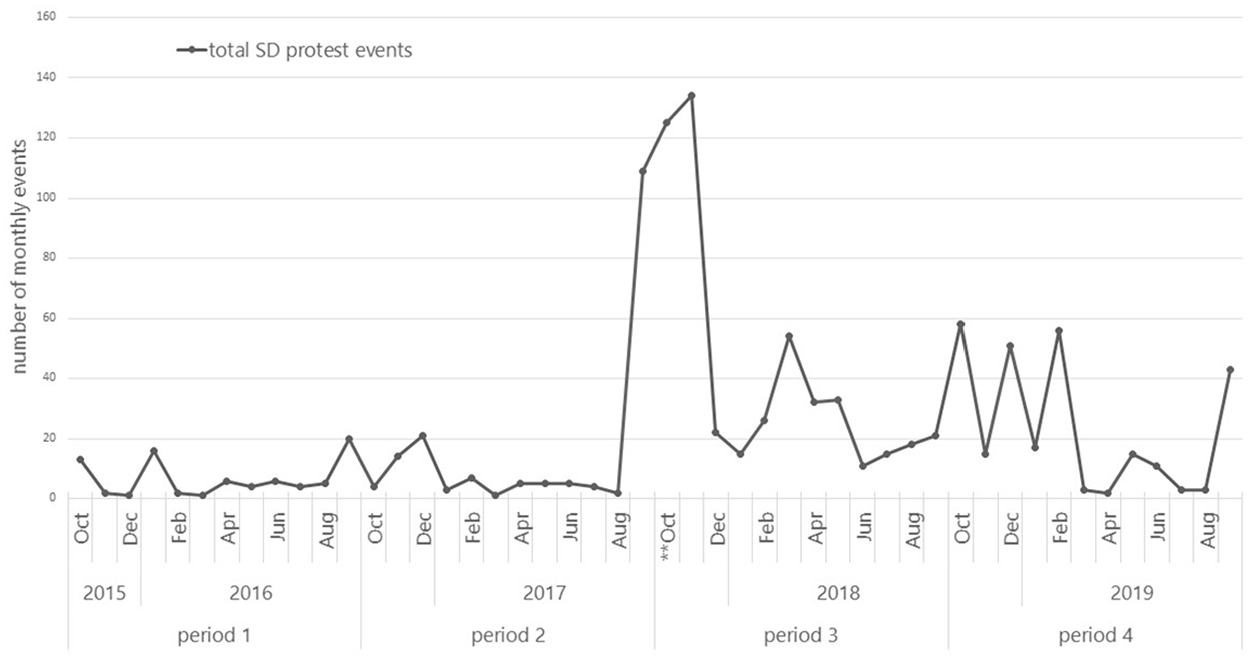
Trajectory of self-determination protest in Catalonia 2015–2019 (N = 1,043).
The first year after the referendum (Phase 3) represented the peak in the number of events. It accounts for about half of the events of the whole period under study. Most of these events took place in the most contentious phase right after the referendum. For instance, the general strike on 3 October turned into a massive protest event against the police violence on the day of the referendum. After the ineffective declaration of independence on 27 October, the level of mobilization dropped until the end of March 2018 when Puigdemont was briefly arrested in Germany. Less than a third of the events in this phase were collaborative (see Table 2). During the second year after the referendum (Phase 4), the level of mobilization rose initially but dropped after the onset of the trial of the Catalan leaders in February 2019. Only when the end of the verdict came closer in September 2019 did the activists initiate a new wave of protest. However, the number of collaborative events dropped remarkably in comparison to previous phases.
Types of SD protest events.
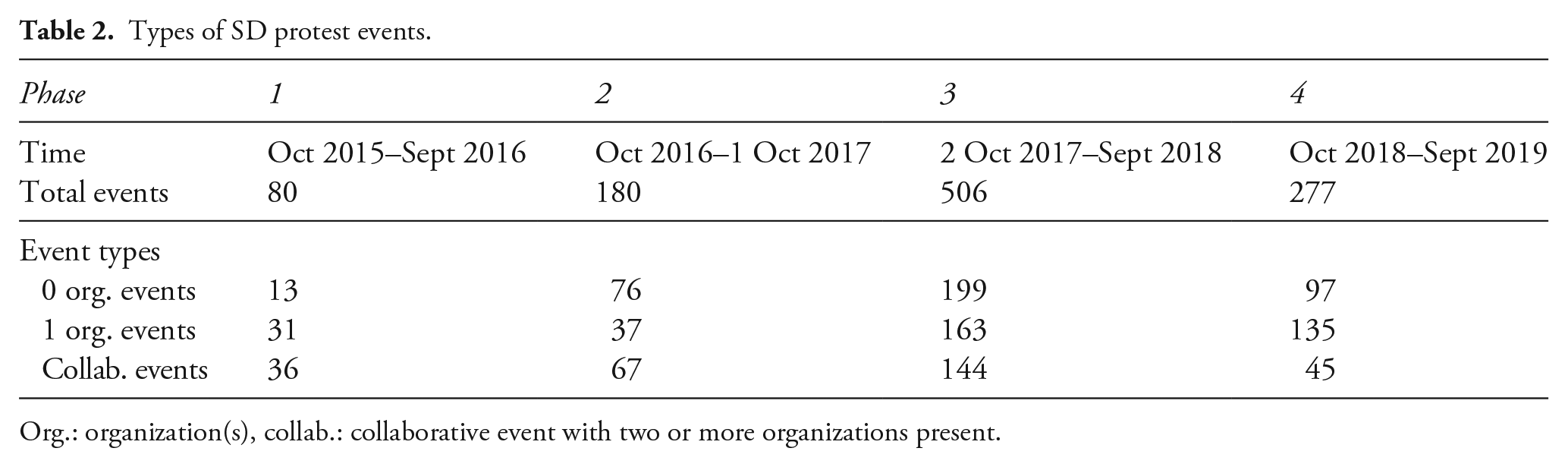
Org.: organization(s), collab.: collaborative event with two or more organizations present.
The data illustrated how SD protest mobilization was closely connected to the 2017 referendum and the dynamics of conflict in the institutional arena. While the level of mobilization was rather low for the first two years after the regional elections, the referendum triggered a wave of protest that lasted for almost one and a half years. Protesters also responded to counter-secessionist actions by the Spanish state, such as the numerous arrests of Catalan politicians and activists. The next section turns to the networks of collaboration in the protest arena to show how movement cohesion evolved over the four phases.
Networks of protest collaboration over time
The secessionist push for a binding referendum and the response by the Spanish state triggered an episode of intense contention in Catalonia. This section focuses on the networks of collective actors in the protest arena before and after the referendum. Network analyses showed that there was less collaboration in the protest arena after the referendum despite this massive mobilization.
The protest event data showed that the two largest social movement organizations, ANC and Òmnium Cultural, played a significant role in the first phase after 2015 but were far from being the only ones (participating actors are displayed in the network graphs in Online Appendix 4). Interest groups such as the Associació de Municipis per la Independència (AMI) or the Associació Catalana de Municipis (ACM), pro-independence trade unions such as Coordinadora Obrera Sindical (COS) and CSC-Intersindical, and smaller organizations such as ERC’s youth organization Joventuts’ Esquerra Republicana (JERC) also collaborated in the protest arena. Institutional actors engaged in the protest arena, too. The pro-independence parties frequently participated in protests as well as the then President of the Generalitat, Artur Mas, and the then President of the Catalan Parliament, Carme Forcadell. These actors formed a network of 17 nodes (see Table 3).
Descriptive network statistics.
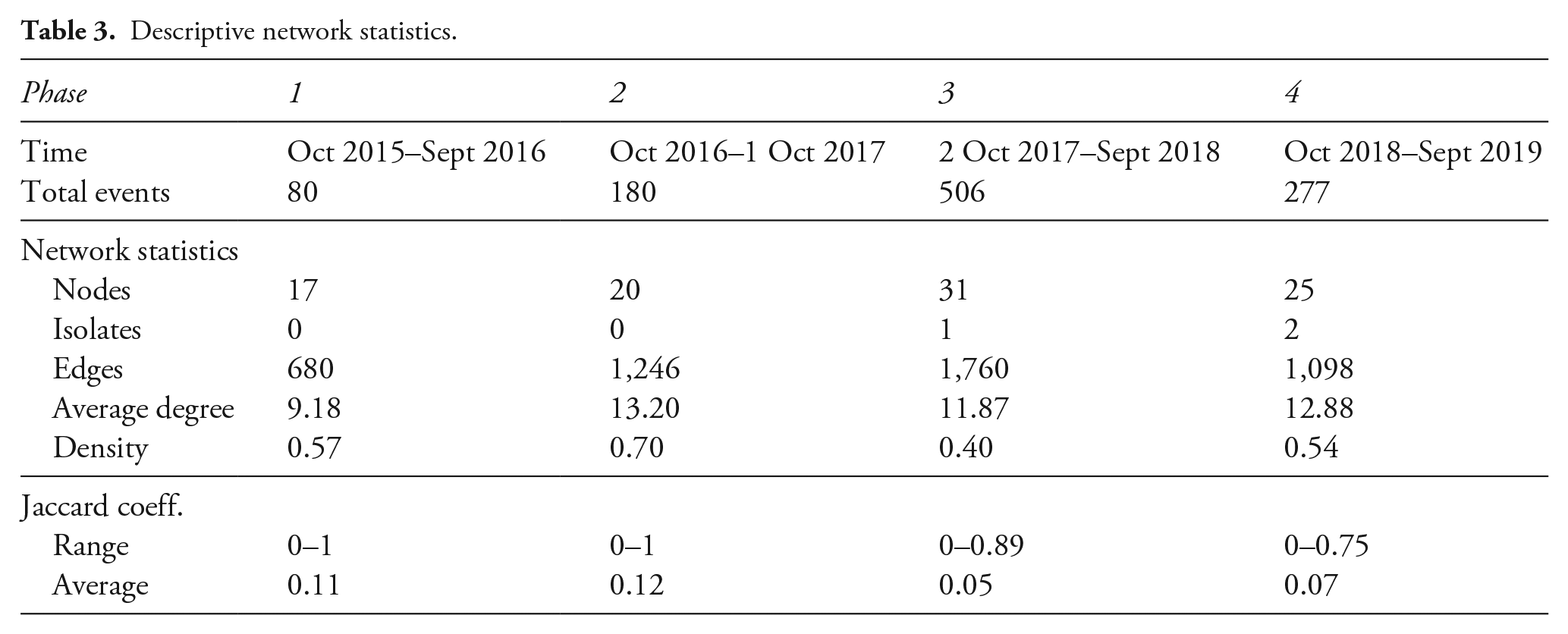
This network changed slightly during the second phase. The network grew from 17 to 20 nodes. The main new actor was the platform UxR, which was formed by the youth organizations Arran, JERC, Joventut Nacionalista de Catalunya, and Sindicat d’Estudiants dels Països Catalans (SEPC), and emerged specifically to mobilize students for the referendum. These groups had particularly tight relations through their participation in UxR. Despite the larger size, the movement was better connected than before, as the density value had risen from .57 in the previous phase to .70. Collective actors also collaborated more often than before: the average Jaccard coefficient increased slightly from .11 to .12. This shows that the secessionist movement became more cohesive during the referendum campaign.
The data indicated that the referendum marked a turning point for the cohesion of the independence movement. In the third phase, the network grew substantively to 31 nodes. However, the protest arena was divided into four key groups. First, most political parties, institutions, as well as ACM and AMI formed one group (on the right side in the network graph in Online Appendix 4). Second, the left-wing actors COS, Alerta Solidària and Endavant aligned with the student organizations through Arran and SEPC as brokers. Third, ANC and Òmnium continued to have tight relations with each other and were at the center of the network, keeping some relations with most other actors in the network. Fourth, the CDR emerged as the most important actor in the network but collaborated only occasionally with other actors. Overall, the network became looser and more dispersed, which is expressed in the drop of both density and the average Jaccard coefficients – despite the increase in the number of events. Density decreased from .70 to .40 and the Jaccard value more than halved from .12 to .05.
In the fourth phase, the number of nodes decreased to 25, while the cohesion of the network remained low in comparison to the pre-referendum phases. Tsunami Democràtic emerged as an actor but remained isolated. The average Jaccard value only increased slightly by .2. Òmnium and ANC collaborated more often with the political parties in comparison to the previous phase. The youth organizations continued to have tight relations but did not increase their collaboration with the rest of the network. The CDR was again the most important player but acted mostly autonomously.
Overall, the descriptive network statistics indicated that secessionist collective actors collaborated less in the protest arena after the referendum on 1 October 2017. Density values and Jaccard coefficients were pronouncedly lower in the two phases after the referendum than in the two before. Established actors organized protest together less often. At the same time, the protest arena fragmented as more actors emerged. New actors such as the CDR decided to call for protests on their own and collaborated with other players only occasionally. This showed that the independence movement was less cohesive after the 1 October referendum. The next section explores the drivers of this process in more depth by turning to the analysis of the qualitative materials.
Framing processes, strategizing and movement cohesion
The network analyses of the protest event data have shown that collaboration in the protest arena increased during the referendum campaign but declined after the referendum. Interviewees mentioned a wide range of factors that made collaboration more difficult after the referendum. These included different organizational models (for example between the formalized ANC and the unstructured CDR), competition (between ANC and Òmnium), tactics (contained vs. disruptive protests), and declining trust between civil society organizations and political parties. These issues captured some of the post-referendum dynamics at the meso level. However, the data analysis also revealed one crucial factor that explained the evolution of cohesion at the movement level consistently over time. Interviewees revealed that the referendum was at the heart of the movement’s strategy frames before and after the event. This section describes how alignment and disputes around these strategy frames impacted collaboration over time.
The phase after the 2015 regional elections was marked by two debates on movement strategy. On the one hand, there were the attempts of Junts pel Sí to win the support of the left-wing party Candidatura d’Unitat Popular (CUP) to form a government. The CUP rejected incumbent Artur Mas in parliament and insisted on a different candidate. This debate continued for several weeks and the CUP did not change its stance until a suitable candidate was found in Carles Puigdemont. On the other hand, the pro-independence parties in the Catalan parliament passed a motion to start secession from Spain shortly after the election. The Spanish Constitutional Court quickly suspended the motion, which meant that the unilateral strategy promised before the elections had reached an impasse. The ruling of the court and the tumultuous election episode sparked a new debate within the independence movement about how to proceed. The CUP and the ANC both proposed holding another referendum on independence, which in contrast to the 2014 vote should be binding this time. After surviving a vote of confidence in the Catalan parliament on 28 September 2016, Puigdemont adopted this proposal and vowed to call a binding referendum on independence.
As the network analyses showed, the movement became slightly more cohesive during the referendum campaign. Increased collaboration in this phase can be explained by frame alignment processes. Puigdemont’s announcement ended the prior debate and the movement rallied around the referendum as a prognostic frame, as expert interviewee Ivan explained: ‘When Puigdemont said he would do it, everybody aligned with this idea’.
The framing process set a tangible and clear goal, which allowed movement actors to concentrate their efforts on campaigning, organizing and mobilizing. The movement also pursued the idea of holding a binding referendum resting on an agreement with the host state, like in Scotland or Québec. However, it soon became clear that this would not be possible. Spanish Prime Minister Mariano Rajoy declared repeatedly that he would not agree to a referendum in Catalonia and that he would be willing to take all necessary steps to prevent a unilateral referendum organized by the regional institutions. In the face of such strong opposition from the Spanish state, it became unclear to most activists how the prognostic frame would play out in practice. However, this did not alter the strategy. In the words of ANC organizer Berta, the goal was still ‘to make the referendum work’.
This was a common thread throughout the interviews. Organizers highlighted that the goal to hold another referendum was shared among all movement actors in the year before 1 October. Or, as CDR organizer Sergi put it: ‘For 1 October, it was important that all strategies converge in one’. Frame alignment became the principal driver of collaboration during the referendum campaign, which led to a cohesive movement in this phase.
The 2017 referendum represented a transformative event for the independence movement. This was also evident in the network analyses. Collaboration in the protest arena decreased considerably and collective actors were less connected. Thus, the movement became much less cohesive after the referendum.
Interviewees again pointed to the role of framing processes for the cohesion of the movement in this phase. In the aftermath of the referendum, a frame dispute emerged on why the event was so important, and what followed from it. The following quote from the interview with CDR organizer Xavi illustrates this debate: It is after 1 October when precisely the substantive goals appear [. . .] This is when the debates start about what to do with the results of 1 October, how to interpret them, how to manage them. It was like ‘is it binding or is it not? Is it sufficient or not? Can we move forward or not?’ And this is where the disagreements between parties, critics, between the ANC, civil society, CDR, and so on start [. . .] This is where the independentist camp starts to break.
The quote points to the struggles of activists to make sense of the referendum. The meaning of 1 October was very much disputed among pro-independence actors. Different readings of the referendum started to emerge.
On the one hand, some activists declared victory for the independence movement. CDR Organizer Carles said in the interview, ‘we believed that we had won the referendum. And that there must be a Republic’. In this narrative, 1 October was first and foremost a legitimate and democratic decision by the Catalan people. The overwhelming ‘Yes’ vote provided sufficient grounds for independence, notwithstanding the abstention of a large part of the population and the interference of the Spanish police in the voting process. What followed from this was a new prognostic frame focused on civil and institutional disobedience, which I call ‘unilateral strategy’.
On the other hand, this narrative attracted a lot of criticism from within the movement. In the view of many activists, it represented a simplification of what happened on the day of the referendum. For CDR organizer Joana, it was ‘not as easy as “we have protested, we have voted, we have won, that’s it”’. It was at least doubtful that the turnout and result of the vote were sufficient to claim victory and justify the declaration of independence. From this perspective, it was not the result of the vote that was important, but the fact that the referendum could take place at all in the face of a massive police intervention. Instead of unilateral action, the movement should try to enhance its support basis, which could be called a new ‘gradualist’ strategy frame.
While the unilateral strategy frame was embraced mainly by the CUP, ANC, the CDR, ERC and Òmnium Cultural followed the gradualist strategy frame. However, interviewees stressed that the structure of the frame dispute did not follow this divide very neatly. In particular in the first months after the referendum, there were plenty of debates between unilaterals and gradualists within these organizations.
The frame dispute had very practical implications. For example, ANC organizer Carme reported that it became very difficult after the referendum to agree about jointly organizing events.
Yes, you notice it, because of course when we normally plan a demonstration we have to find a consensus with all the other parties and entities. Then, of course, you notice that we are a bit more daring, and there are people that are a bit more hesitant right now.
Carme’s statement stressed how the conflict affected collaboration in the movement, which was echoed by interviewees from other organizations. The perception of general conflict after the referendum within the movement was a theme that emerged from all interviews. The frame dispute over strategy made it much more difficult to organize protests together, which matches the findings from the network analyses.
Discussion and conclusion
This article has engaged with the question of what drives the cohesion of secessionist movements, focusing on independence referendums as critical junctures. The combination of network analyses and qualitative interviews has revealed the dynamics of collaboration in the protest arena before and after the 2017 referendum in Catalonia. The independence movement aligned around the referendum as a shared strategy frame, which increased cohesion during the campaign. After the event, a frame dispute over the meaning of the referendum led to a conflict between proponents of a unilateral and a gradualist strategy and to less collaboration.
Strategy framing processes before and after the referendum were tightly connected to counter-secessionist action in response to the referendum. The referendum was ruled illegal by the courts, police intervened in the voting process, regional autonomy was suspended, and the Catalan parliament was dissolved. These counter-secessionist measures limited the movement’s room for maneuver and thus conditioned the internal dispute about strategy framing.
Furthermore, declining collaboration in the protest arena was followed by conflicts among secessionists in the institutional arena. This conflict manifested itself in extended negotiations to form a regional government in 2018, the split of Puigdemont’s party, Junts, from the Partit Demòcrata Europeu Català in 2020, and the breakup of the coalition government between ERC and Junts in October 2022. All in all, it might be difficult for the movement to reach the same level of cohesion as during the referendum campaign.
The continuing low of collaboration through the last phase under study suggests that declined cohesion was not just a short-term change but a lasting transformation of the secessionist protest arena. The study does not include the disruptive episode of contention after the sentence of the trial in October 2019, but it seems unlikely that this episode increased cohesion again. The emergence of yet another important actor (Tsunami Democràtic) and the more disruptive and even violent tactics by the CDR and other groups created more disagreements among collective actors about the appropriate movement strategy.
These findings demonstrate the importance of how secessionists frame critical junctures for movement cohesion. Key strategies such as referendums, elections, mass protests, or the turn to violence may become critical junctures in secessionist conflicts. These critical junctures are essential for secessionists’ strategy frames. While the results emerged inductively from the qualitative analysis, they are in line with a long-standing tradition in social movement studies that stresses the role of framing for mobilization (Snow et al., 1986; Snow and Benford, 1988, 1992). Most importantly, the Catalan case showed that strategy framing is a collective process in secessionist movements. Frame alignments and disputes play a fundamental role for the cohesion of the various collective actors within a movement. However, strategy framing processes do not occur in a vacuum. They are closely connected to how states respond to key secessionist strategies such as referendums, election campaigns, or the turn to large-scale violence.
This insight is in line with a growing body of literature emphasizing the role of secessionist and counter-secessionist strategies for the roots and consequences of these conflicts (Cunningham, 2013b; Griffiths, 2021; Griffiths and Muro, 2020; Roeder, 2023). The Catalan case shows that how secessionists pursue independence and how states respond to them also fundamentally shape the cohesion of secessionist movements. The impact of critical junctures on movement cohesion is closely connected to the ‘strategic playing field of secession and counter-secession’ (Griffiths, 2021; Griffiths and Muro, 2020) on which they unfold. The emerging literature on the causes of secessionist cohesion and fragmentation should thus pay more attention to the elaboration and framing of strategy and the role of critical junctures such as declarations of independence or decisive battles.
Advancing scholarship in this direction promises to understand why the effects of key variables such as repression or accommodation can lead to different outcomes in different cases. Similar to the work of McLauchlin and Pearlman (2012), the findings of this article showed that the effect of repression is dependent on internal factors. More research on the interaction of dual contests (Cunningham et al., 2012; Seymour et al., 2016) is thus warranted.
The methodological innovation of this study is researching movement cohesion using event-level data. The findings demonstrate the immense value of this approach. It would not have been possible to identify the effects of the 2017 referendum on movement cohesion using data aggregated at the year-level. Previous studies relying on such data thus may have underestimated the role of critical junctures as abrupt changes of movement cohesion.
The empirical analysis of a single case limits the generalizability of the substantive findings. However, the Catalan case is far from unique. As argued before, the response of the Spanish state to the referendum represented a key context for frame alignments and disputes within the movement. Similar findings can thus be expected for other unilateral referendums, such as the 2017 referendum in Kurdistan. If the host state refuses to recognize the legitimacy of the results, or even responds with repression, the secessionist movement reaches an impasse that requires a change of strategy, which may lead to radicalization or moderation of action. Diverging strategies in turn lead to declining cohesion. Consequences are likely to be different when independence referendums are agreed with the host state, such as in Scotland, or at least tolerated, as in Québec. But even in these cases, the failure to achieve independence requires secessionists to evaluate their defeat and reconsider their strategies, which may lead to intense frame disputes.
The democratic setting and the presence of strong secessionist parties may have contributed to the decline in cohesion in the Catalan case, because this allowed parts of the movement to advocate for a gradualist strategy focused on enhancing electoral and social support. In non-democracies, this path is often less appealing for secessionists, who may rather rally around more radical strategies if a unilateral referendum fails. This may thus add to explanations of why fragmentation is more likely in democracies (Mosinger, 2018; Seymour et al., 2016).
However, fragmentation is not an automatic result. The contingency inherent in the notion of critical juncture prevents generalizing their effect in one direction or another. Moreover, critical junctures can lead to change, but continuity is also a possible outcome (Capoccia and Kelemen, 2007). Taking the agency of secessionist and counter-secessionist actors into account is key, as already suggested by Seymour et al. (2016).
What is generalizable to any secessionist conflict is strategy framing as a key mechanism for cohesion and fragmentation. Future research can test this mechanism on a broader set of cases. Distinguishing the effects of different types of critical junctures and expanding the range of scope conditions is paramount in such an endeavor.
Footnotes
Acknowledgements
I would like to thank Endre Borbáth, Alejandro Ciordia, Donatella della Porta, Sophia Hunger, Swen Hutter, Martín Portos, Daniel Saldivia Gonzatti, Teresa Völker and the two anonymous reviewers for their valuable comments on previous drafts of this article.
Funding
The author disclosed receipt of the following financial support for the research, authorship, and/or publication of this article: This article was supported with a postdoctoral scholarship by the Fritz Thyssen Foundation (scholarship no. 40.22.0.013PO).
Replication data

Notes
HANS JONAS GUNZELMANN, b. 1990, PhD in Political Science and Sociology (Scuola Normale Superiore, 2021); Postdoctoral Researcher at the Center for Civil Society Research, WZB Berlin Social Science Center (2023–present); research interests: political sociology, protest, social movements, nationalism.