




Abstract
While the international arena is littered with events of war and atrocities, the memory of the Holocaust was institutionalized as the ultimate benchmark of human suffering within the liberal world order. Against the backdrop of such a global memory landscape, this article explores how different memories of trauma interact. Building on literature within international relations, sociology and social psychology, as well as survey data collected from a sample of Syrians, Palestinians and Israelis, its analysis explores how victims of political violence compare their suffering with that of others and why such comparisons slip easily into competition. The analysis found that individuals were competitive with their memories when they showed high levels of patriotic attachment and a real and perceived, yet unrecognized, sense of victimhood. This article thus offers insight into a key issue in peace and conflict studies: the links between traumatic memory, victimhood, international recognition and conflict.
Introduction
The international sphere is littered with memories of wars and atrocities, while ongoing conflicts and displacement continue to produce ever-new experiences of suffering and victimhood. In the words of the historian Edward Gibbon, history is little more than a register of the ‘crimes, follies, and misfortunes’ of mankind (Trevor-Roper and Robertson, 2010: 154). But in our memory, this register consists neither of a complete nor a neutral count of tragic events. It is neither ordered by time nor scale of human suffering, but by which event is widely recognized and officially remembered in contemporary social frames. While today’s world offers no shortage of traumatic historical events that people, countries, and the international community can remember, some events are globally visible whereas others go unnoticed. If we picture the international sphere as populated with tragic memories, at least within the Western hemisphere, the memory of the Holocaust is located on top of what is frequently referred to as a ‘global hierarchy of suffering’. Around the turn of the century, the Holocaust became institutionalized by the UN, the USA and the EU as a symbol of ‘absolute evil’ (Levy and Sznaider, 2002) and a ‘benchmark for human suffering for the entire liberal world’ (Alexander, 2012: 62). As this benchmark, the Holocaust memory serves as a comparison for other traumas that have happened and continue to happen around the globe.
Against the backdrop of a global memory landscape in which the Holocaust sits on top of an institutionalized hierarchy of suffering, this article explores how different memories of trauma interact. It asks about the diverse memory dynamics triggered between victim groups worldwide. To shed light on these dynamics, this article builds on existing international relations (IR) and social psychology studies that have examined memory dynamics on the collective and individual levels. To this discussion, I contribute a case study on a sample of people who belong to diverse groups currently victimized by conflict: Syrians, Palestinians and Israelis. Through a survey sample of 200 individuals within each group, I qualitatively analyze the language that respondents use to narrate and justify which events are most important to remember and why. By focusing on victims’ accounts, I assign agency to people as key conflict actors. The primary aim of this research is to better understand the logic with which respondents position their own memory in relation to other historical and current conflicts, in order to explore what happens when different traumas arise together in remembrance.
Researching the diverse ways in which traumatic memories interact is of wider importance for IR and peace studies in the following ways. First, exploring the memory dynamics between different victim groups promises new insights into the potential links between memory and peace. After all, theoretically and empirically, scholars of IR have so far associated ‘more memory’ with sustainable and long-term peace processes. Under the emerging interdisciplinary concepts of ‘post-conflict reconciliation’ and ‘transitional justice’, scholars have begun to suggest that governments need to seek ‘the truth’ and acknowledge their wrongs while restituting the victims (Elster, 2004; Gabowitsch, 2017; Gibney et al., 2008). Furthermore, within the liberal international order, memory politics have become associated with antimilitarist foreign policies (Berger, 2012; Katzenstein, 1998), sustainable bilateral relationships, friendships and trust between countries (Bachleitner, 2023; He, 2009; Lind, 2008), as well as with international human rights norms and liberal values (Barkan, 2001; David, 2020). The memory of the Holocaust holds its prominent place within the liberal international framework because it was hoped that it would serve as a global warning sign against the repetition of such crimes. Understanding how different victim groups react to this and other traumas thus speaks to a key issue of our time: the links between memory, victimization, international recognition and peace.
The article proceeds as follows: It starts by laying out the wider memory dynamics within the international sphere, and the global hierarchy produced between different memories as a result of international recognition. I then look to existing IR and social psychology works and the memory dynamics these observe between diverse victim groups on the collective and individual levels. These works give evidence of two dynamics: comparison and competition. To them I add my own case study that analyzes these memory dynamics in a survey sample of Syrian, Israeli and Palestinian respondents. Through their individual perspectives, I try to obtain general insights into the way that memory dynamics slip from comparison into competition. Finally, the conclusion serves to highlight the circumstances under which memory dynamics become competitive and conflictual.
Memory dynamics in the international sphere
In the liberal international order of the 21st century, memory has become linked to the hope for peace through George Santayana’s (1905: 284) famous aphorism: ‘Those who cannot remember the past are condemned to repeat it’. The institutional architecture followed suit and established the memory of traumatic historical events in memorials, speeches, political programs and history textbooks. Moreover, victims were heard in courts and represented in media with their cause promoted by international institutions, governments and nongovernmental organizations. The most prominent illustrative example of these deliberate efforts with memory is the Holocaust. Spearheaded by the UN, the USA and the EU, the Holocaust was recognized and institutionalized as a tragic archetype, a ‘global icon’ (Assmann and Conrad, 2010), and the ‘preeminent symbol of suffering’ (MacDonald, 2008). With its memory enshrined in political and educational programs across the globe, it was turned into a ‘benchmark for human suffering for the entire liberal world’ (Alexander, 2012: 62). The principal purpose of these efforts was to prevent future acts of genocide.
The international institutionalization of memories, however, remains unequal: irrespective of the gravity of the events, some memories gain less attention or go entirely unnoticed. When within the liberal Western world, the Holocaust was socially constructed as the preeminent symbol of suffering, it silently crowded out the experiences of colonialism, slavery and communism (Rothberg, 2009). When the Holocaust was installed as the liberal world’s benchmark for human suffering, a ‘global hierarchy of suffering’ was the unintended side-effect. This hierarchy is not based on the gravity of the events, nor does it reflect an estimation of the ‘real’ extent of human suffering, but rather the international recognition granted to trauma. As all memories are social constructions in contemporary social frameworks (Olick and Robbins, 1998), existing power structures determine which traumatic events are recognized globally. Of course, agency matters in this context. As Alexander (2012) stated, ‘social trauma’ appears only if there is an interested party that has the ability and resources to make it visible. In other words, only via agency can a victim group achieve recognition. Moreover, such recognition in the international arena is important, because it affords political rights and gains, both tangible and symbolic, for those acknowledged (Al Azmeh, 2022: 404).
IR authors have begun to explore this phenomenon. They have asked how a global Holocaust memory frame relates to other experiences of conflict, war and suffering on national, regional and global levels (MacDonald, 2008; Mälksoo, 2015; Subotic, 2019). Some of them have found that the Holocaust serves as a comparison with which to place other victim groups within an international hierarchy of suffering, by affording them both a definition of genocide and the political rights that come with it. In these cases, authors regard the Holocaust memory as ‘a bridging metaphor and analogy’ (Alexander, 2012: 83) for victim groups to represent their traumas and gain the desired international recognition for their suffering. Armenians, Bosnians, Rwandans, the people of Kosovo and Darfur, Yazidis, Uyghurs and the Rohingya are examples in point (Barkan, 2001; Gabowitsch, 2017; Levy and Sznaider, 2002).
In practice, however, authors have found that such comparisons easily slip into a competition. As a symbol of victimhood, the Holocaust may provide a vocabulary for ‘the inexplicable’ to others who suffer. Yet, such a typification of victimhood in international politics does not happen for its own sake but because it creates moral ambition and guidance for adequate political responses to it (Alexander, 2012: 62). Having ‘victimhood’ internationally recognized provides tangible political benefits to those who suffer (Lim, 2010). It can lead to security guarantees, military intervention, the granting of statehood rights, legal measures of transitional justice, and financial benefits such as reparations or aid. The example of Israeli statehood and a global preferential treatment post-Holocaust, including its Reparations Agreement with West Germany, have further cemented this link between victimhood memories and political gain in the postwar world (Bachleitner, 2023).
It follows that where international recognition is granted to a group of victims, ‘the social benefits of pity’ (Nussbaum, 1992: 267) are plenty. As a result, IR scholars began to observe a new trend in international politics that they call ‘competitive victimhood’: in competing for a place within the global hierarchy of suffering, victim groups exaggerate and glorify their own suffering at the expense of others (Antoniou et al., 2020; Bar-Tal and Halperin, 2013). This emerging trend is particularly worrisome as it creates a ‘spiral of victimhood’ (Noor et al., 2017) through which different groups compete to achieve not only a place but the top spot of the hierarchy of suffering with all the political gains that come with it.
With their findings, scholars thus highlight the unintended side-effects of the international recognition and universalization of the Holocaust memory (Antoniou et al., 2020: 877; Vollhardt, 2015). Instead of offering a comparative, normative framework and vocabulary through which to interpret suffering, create solidarity worldwide and mobilize public opinion against the threat of repetition (Power, 2002), the Holocaust as a global memory frame sparks a political competition among groups for international recognition of their own – not others’ – suffering (Dinas et al., 2021). It follows that instead of forming cross-cultural and global bonds between those who suffer, comparisons fuel a nationalistic logic (David, 2020; Dean, 2010) to secure a top spot for their own group in a socially created international hierarchy of suffering.
Memory dynamics between different victim groups
Since starting to observe ‘competitive victimhood’ dynamics, IR authors have so far only studied these memory dynamics on the collective level and in three specific examples: First, many scholars look at the competition between the Western European memory frame of the Holocaust and the Eastern European memory frame of the Gulag. They examine the difficulties of Eastern European countries to integrate into a Western-dominated EU memory landscape (Mälksoo, 2009; Subotic, 2019). Furthermore, post-colonial studies look at the ‘crowding out effects’ triggered by the ‘Western’ Holocaust memory frame vis-à-vis the memories of colonialism and slavery (Miles, 2004; Rothberg, 2009; Sznaider, 2020). Thirdly, another group of scholars has explored the competitive memory dynamics within the Arab-Israeli conflict. In the wake of the Holocaust and the international recognition it was granted, the State of Israel was formed by the UN partition plan with immediate implications for the Arab world. It followed that the Holocaust memory became entangled with the Arab-Israeli conflict and entered into a competitive dynamic with the Palestinian memory of the ‘Nakba’, with parties on each side denying the other side its trauma (Bar-Tal and Salomon, 2006; Caplan, 2012; Rotberg, 2006).
What all these works have in common is that they focus on memory dynamics unfolding at the elite level. They study – albeit in diverse examples – how political elites formulate their national memories in relation to relevant others. These relevant others usually occupy a higher position on the international hierarchy of suffering, in terms of recognition and political rights afforded through it: Western European countries in the case of Eastern European countries, the Global North in the case of the Global South, and Israelis in the case of the Palestinians. As a result, their political elites enter into a competitive dynamic to gain equal or greater recognition and political rights for the national groups they represent.
In contrast, no IR studies, to date, have analyzed these dynamics at the societal level or in relation to how people engage with these memory frames. However, people, especially those experiencing victimization through political violence, are key conflict actors. Moreover, very few IR authors have studied memory at the individual level at all. If they do, they look at how people remember their own war experience and what consequences this may have for international outcomes, that is, peace agreements and transitional justice efforts (Acosta, 2021; Bachleitner, 2021). None have thus far explored the memory dynamics between different victims, or how their memories form in relation to those of others. Yet, in a globalized world, victims are likely to compare the experiences of their own group with the experiences and suffering of others.
This article takes this approach and focuses on individuals and their memory dynamics. It defines memories as individuals’ narratives of what happened to groups because of ongoing and historical traumatic events (Wertsch, 2008). Their narratives of such events are their own social constructions that take shape in current societal frames (Olick, 1999; Olick and Robbins, 1998). In an interconnected, globalized world, these frames not only include people’s own social group but also reach beyond it: When creating their social trauma (Alexander, 2012), people not only rely on their own experience but also on that of others, be it historical or contemporary. They, like states and their representatives, are likely to compare their experience or compete with that of other victims. When people compare, they integrate the experience of others and establish empathy and commonalities with their suffering. According to the literary scholar Rothberg (2009: 3–6), memory is ‘multidirectional’ and subject to ongoing negotiation, cross-referencing and borrowing from others. However, Rotberg (2006: 5–14) also observes similar competitive dynamics in individuals, as IR authors have observed on the state level: In remembering, people highlight elements of alterity with others, resulting in the exclusion of the experience of others to stake out the boundaries of their in-group.
Especially when identity claims are based predominantly on victimhood, authors have observed a direct link to competition and, by extension, conflict. Works in social psychology, for instance, illustrate that individuals who have become victimized show ‘uncooperative and anti-social’ behavior: they hold an assumed need to defend themselves (Gollwitzer et al., 2012) and a sense of entitlement to selfish behavior, particularly when they are reminded of their own trauma (Zitek et al., 2010). Experiments show similar outcomes for groups (Bar-Tal et al., 2014; Wohl and Barnscombe, 2008: 1004). In IR, authors point to the phenomenon of victimhood nationalism (Lerner, 2020: 71), finding that when combined with high levels of patriotism, collective identities based on victimhood are likely to become viciously competitive and conflictual (Bell, 2009; Enns, 2012; Lupu and Peisakhin, 2017).
Depending on the social context, memory dynamics between victims thus can unfold comparatively or competitively. However, as studies in IR and social psychology suggest, when combined with high levels of nationalistic attachment and high degrees of actual and perceived victimhood, people are likely to be competitive with their memories.
The case study
Based on existing theoretical and empirical observations on memory dynamics, I am testing these dynamics within the context of current conflicts in the Middle East and the three very different victim groups they have produced: the Syrians, the Palestinians and the Israelis. These groups only have in common that they are currently engaged in conflict. Yet, they face very diverse contexts of victimization: While the Syrians are experiencing a civil war against their own authoritarian regime, the Palestinians face a situation of occupation and protracted conflict with the Israelis over their land. Furthermore, when considering the backdrop of an international memory landscape, on top of which sits the global Holocaust memory frame, these three groups are situated very differently toward it: The Israeli identity was formed in direct response to this trauma, and the Palestinian memory of the Nakba, their expulsion from their land, has become entangled with it as a direct result of Israeli statehood (Caplan, 2012; Rotberg, 2006; Young, 1993). The Syrians, on the other hand, are furthest removed from a global Holocaust memory that is both entangled with Israel and promoted by the liberal West. These three groups are thus most different cases in the spots they occupy on the international hierarchy of suffering: While the Holocaust memory was recognized internationally, and the State of Israel was established, the Palestinians still have no state, and the Syrians continue to lobby their cause to the international community. These cases thus lend themselves well to exploring the memory dynamics that unfold within these groups against the backdrop of unequal international recognition.
To gauge these, together with research assistants from the selected countries, I conducted online surveys with 200 Syrians (N = 200) and 150 Palestinians (N = 150) in 2020, and with 200 Israelis (N = 200) in 2021. The surveys were in Arabic and Hebrew, followed strict ethical guidelines and posed open-ended questions about people’s memories to understand which historical experiences they think are essential to remember and why. Especially in conflict areas, online surveys are helpful because of their mobility, accessibility and anonymity (Sue and Ritter, 2016). To get a feeling for who the respondents are, each survey asked closed-ended questions about their identity characteristics: gender, age, educational level, location, self-identification to a specific group, and degree of nationalistic attachment. To recruit respondents, the five research assistants first created a sampling frame that identified individuals in various geographic locations who originated in Syria, the Palestinian Territories, or Israel. Because they followed a snowball method in their wider social and professional networks, the sample has limitations regarding representativeness, thus yielding disproportionately large numbers of participants who are higher educated compared to the entire population, and more men than women in the Syrian and Palestinian samples. Against this backdrop, it is essential to note that my analysis does not aim to project beliefs extracted from this sample onto the whole population. Instead, it aims to offer a glimpse into the memory dynamics of individuals who belong to different groups experiencing conflict and who are, as a result, also subjected to a degree of collective victimization.
I qualitatively analyzed each answer according to people’s logic as to why they wanted to remember certain events and not others. To highlight the individual characteristics of respondents, wherever excerpts from their answers are cited, I include their gender, location, age, educational level and self-identification in parentheses. In a second step, with the help of statistical analysis, I zoomed in on the individual characteristics of the respondents to explore whether memory dynamics differed according to the respondents’ expressed level of nationalistic sentiment and perceived victimization.
From this design, it follows that this study is first and foremost interested in the logic respondents apply in their memories. While I surveyed individuals, these individuals remember as part of groups in their specific social contexts. Their different circumstances and identity characteristics thus allowed me to attempt an explanation as to why some victims remember comparatively and others competitively.
The findings
To map the memory landscape of each sample group, I asked people which historical event they would like to see remembered internationally. I categorized all answers into the diverse memories that respondents named and coded the responses into those who stressed the importance of exclusively remembering their own conflict (‘Syria/Kurds’ in the Syrian sample, ‘Nakba’ in the Palestinian sample and the ‘Holocaust’ in the Israeli sample); those who stressed remembering other conflicts than their own (coded as ‘others’ in all three sample groups, separating out the ‘Nakba’ in the Israeli case); and those who saw no particular value in memory and therefore did not want to remember any conflict, including their own (coded as ‘none’).
As Figure 1 shows, around 20% of Syrians wanted to exclusively remember their own conflict (plus 15% of Syrian Kurds stressing only Kurdish events). In contrast, approximately 55% of the Palestinian respondents wished to remember only the Nakba. In comparison, around 10% of the Israelis exclusively wanted to remember the Holocaust. Conversely, approximately 58% of Syrians found it essential to remember various other historical events, as did around 20% of the Palestinians and over 80% of the Israelis. Zooming in on these diverse memory landscapes, I found the following memory dynamics in each of the three sample groups.
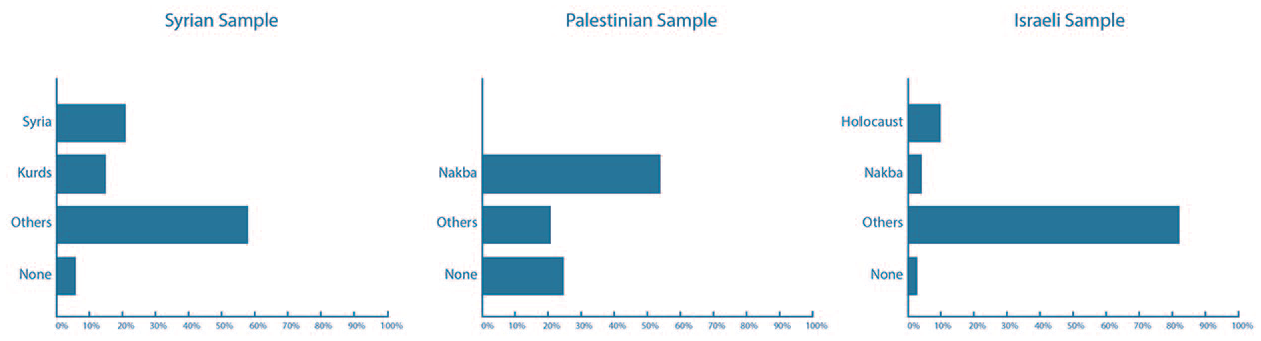
Memory landscape: ‘Historical events that are important to remember internationally’.
The Syrian memory landscape
When asked which historical event they would like to see remembered internationally, in the Syrian sample, a majority of 58% saw the memory of several global and regional conflicts as necessary. Respondents named a wide range of historical events to remember; however, these concerned predominantly Arab/Islamic themes. Most frequently mentioned were negatively perceived events, such as the establishment of the State of Israel on Palestinian land (expressed as ‘the Zionist Israeli occupation of the State of Palestine and Jerusalem’ [male from Syria, refugee in Saudi Arabia, 56, university, ‘Syrian’], or ‘the attack on the Al-Aqsa Mosque’ [female from Syria, refugee in the UK, 34, university, ‘Arab’]). Respondents also stressed the memory of massacres perpetrated by the Ottoman Empire, naming Armenians, Syriacs, Assyrians, Bulgarians and Greeks as victims. Many Syrians equally wanted to remember ‘France’s massacres against the Arab peoples’ (female from Syria, refugee in the UK, 33, elementary school, ‘Arab’), particularly in Algeria. Besides these regional/Arab themes, global events that some respondents wanted to remember included the genocides against the Jews and Armenians (most often mentioned by Kurds in connection to Turkey’s crimes), the atomic bombings of Hiroshima and Nagasaki, World War I and II, South Africa and Rwanda, Srebrenica, slavery, and the extermination of Native Americans as well as the crimes of Stalin.
The importance of remembering these many different events internationally was stressed by respondents from different educational levels, ages, genders, group identifications, and levels of national attachment. The memory of the Holocaust in particular was invoked twofold: While some answers employed the Holocaust as a global memory frame to cross-reference and borrow, it nevertheless always served to gain equal international recognition, if not more, for the Syrian suffering. That a competitive logic underwrites these comparisons furthermore became evident in the frequently expressed sentiment that recognition is a scarce commodity that is unevenly distributed toward Western suffering compared to the plight of Arabs. To give one exemplary excerpt from the data, There are lots of holocausts to remember next to the Jewish one: Syrian holocaust, the holocaust of the Libyans by Mussolini, the holocaust of Algeria at the hands of the French, the holocaust of Egypt at the hands of the French, the holocaust of Sudan at the hands of the British, the holocaust of Palestine at the hands of the Zionists, the holocaust of Iraq at the hands of America (male from Syria, refugee in the UAE, 44, university, ‘Sunni’).
The employment of memory for gain in a world of unequal international recognition was a theme that also ran through the answers of Kurdish respondents within the Syrian sample. These respondents predominantly pointed to the importance of specific Kurdish memories, mainly Turkey’s and Iraq’s massacres committed against the Kurds. With these invocations, respondents wanted their cause to be heard and realized. Interestingly, among the Syrian respondents, the Kurds most strongly formed bonds of empathy with the Jewish and other victims: Because extermination has been practised against many other peoples, for example, the Kurdish people have been subjected to dozens of massacres and are still subjected to them to this day, and our history is sufficient for us to feel the pain of Jews and other peoples who have been subjected to injustice and extermination
(male from Syria, IDP, 36, university, ‘Kurdish-Syrian’). However, while these comparisons create solidarity between victims, they are equally aimed at gaining international visibility and recognition for their own suffering, in this case, Kurdish. As such, while most Syrians stressed the importance of remembering others’ suffering, particularly those crimes committed against fellow Arabs and Kurds, they predominantly invoked these memories to increase the international recognition of their own victimhood and cause.
A similar logic was pursued by the 20% of respondents who insisted on exclusively remembering the Syrian war. These answers usually highlighted the enormity of the Syrian suffering, pointing mainly to the Syrian regime’s use of chemical weapons against civilians in what some called the ‘Syrian Holocaust’. By directly comparing the happenings in Syria with the Holocaust, some respondents equivilated the Syrian suffering to the Jewish suffering during the Holocaust: ‘The Syrian people have been massacred like the Jews’ (male from Syria, refugee in Sweden, 66, university, ‘Kurdish-Syrian’), or ‘The Jewish Holocaust by the Nazis is similar to the Syrian holocaust committed by the Assads, senior and junior’ (male from Syria, living in the United States, 44, university, ‘Syrian’). A majority of respondents, therefore, employed the Holocaust memory frame in the logic of competition for the scarce good of recognition. Interestingly, these respondents all wanted to see the Syrians taking their ‘rightful’ spot on top of the international hierarchy of suffering: ‘We need to remember the Syrian crisis, there is no other comparable example in the modern era’ (female from Syria, refugee in Germany, 41, high school, ‘Syrian’). Respondents who followed this logic also had in common that they exhibited high levels of nationalistic pride.
Overall, most answers in the Syrian sample leaned toward a competitive logic with their memories. In the responses, the Syrian trauma was placed within and on top of a hierarchy of suffering that unevenly recognized only Western suffering: ‘Of course there is a right to remember the Holocaust, but there is another holocaust that no one really cares about and that is the Syrian one’ (male from Syria, IDP, 30, university, ‘Arab-Syrian’). As many answers mourned the invisibility of the Syrians’ suffering on a global scale, the Syrian respondents often employed the Holocaust to exaggerate this and, with its help, stressed the priority of the Syrian cause: ‘In the Syrian holocaust, the Syrian regime annihilated and killed more than the Jews’ (female from Syria, refugee in Saudi Arabia, 52, university, ‘Syrian’).
Taking all answers in the Syrian sample together, and despite their many nuances, the Syrian memory landscape stressed the pre-eminence of Arab/Islamic themes, and viewed recognition as a scarce international good that is unfairly and unevenly distributed toward Western suffering. Arab suffering, in their memories, topped an international hierarchy of suffering – so far, it has simply been overlooked by a Western-centric international community. With this, wherever the Holocaust is invoked, which, in the opinion of Syrians, constitutes a ‘Western’ rather than global memory frame, it serves to compete for international recognition and acknowledgment of their own suffering and claims, be they Syrian, Kurdish, or Arab.
The Palestinian memory landscape
In the Palestinian sample, a majority of 54% placed the memory of the Nakba, ‘the catastrophe’ that led to the establishment of the State of Israel in 1948 and their expulsion from the land, above all other memories, in both gravity and scale: ‘The tragedy of the Palestinian people over a period of nearly a century is the biggest tragedy that has befallen this region, and it expresses the greatest failure of world order and the United Nations’ (male from Gaza, 64, university, ‘Palestinian-Muslim’). Respondents who insisted on the exclusive importance of the memory of the Nakba put the suffering of Palestinians center stage and mentioned only Palestinian events as worthy of remembrance. In addition to 1948, some stressed the memory of 1967, the Sabra and Shatila massacres, and the recurrent Gaza wars. By placing Palestinians on top of the hierarchy of suffering, these respondents viewed memory politics as a zero-sum game in a struggle for recognition and political claims. As a result, some answers coupled their insistence on the pre-eminence of the Nakba with an explicit denial of the memory of the Holocaust and a hinted at its political expedience for Israel.
The frequent rejection of the importance of the Holocaust memory in the Palestinian sample, of course, stems from its central place in the foundation of the Israeli state, and therefore, its close entanglement with the Nakba of the Palestinian people and their subsequent displacement: We must remember what happened to the Palestinians as a result of what happened to the Jews. Had it not been for the Holocaust, the Zionist movement would not have been able to achieve tremendous support from Europe and America, who turned a blind eye to the massacres it carried out in Palestine to achieve the success of their colonial project in Palestine (male from the Palestinian diaspora in New York, 57, university, no group belonging).
This competitive logic was found in responses from varying genders, educational backgrounds, locations, group identifications and levels of national attachment.
A similar logic was apparent in the 21% who stressed the importance of remembering other historical events. Palestinian respondents most often named Hiroshima and Nagasaki; the Armenian, Bosnian and Rwandan genocides; 9/11; the destruction of Libya and Iraq by foreign intervention; and European colonialism as important to remember internationally. However, again, they invoked these memories to break what is perceived by many respondents as a ‘Jewish monopoly on pain’: The Jewish monopoly on pain is the problem. Armenians were massacred as well as Syriacs and Greeks in 1915. Africans were killed by the millions at the hands of colonial powers, and so were Native Americans by white colonialists. There is a lot of pain in human history, but the Zionist movement is the only one that exploited the Holocaust in order to justify control over other people and to escape any accountability and punishment (male from Westbank, 40, university, ‘Palestinian and a member of a religious group’).
While the majority of Palestinian answers did not explicitly deny the Holocaust and its importance, they rejected its unique position on top of the hierarchy of suffering, its prominent recognition within the international community, and the political immunity that flows from it for Israel: ‘It is important to remember the Holocaust if we remember other atrocities as universally as the Holocaust. It is also important to remember that the Holocaust was not a massacre for Jews only, and it is also important to condemn Israel for all the crimes it committed’ (female from Westbank, in the Netherlands, 19, university, ‘Palestinian’).
The lessons learned from the Holocaust memory in the Palestinian memory landscape were that it affords Israel political rights, advantages and immunity. As a result, memory was viewed as a struggle to advance national claims and gain international support. This belief also explains the largest occurrence of the category ‘none’ in the Palestinian sample group: 25% of the Palestinian respondents stated that they did not want to remember at all, pointing to memory as a manipulated tool that has been used by those more powerful, that is, the Israelis. From this mindset, it follows that only a tiny minority of Palestinian respondents internalized and cross-referenced the intended ‘Never Again’ message of the global Holocaust memory and only a handful of answers stressed remembering: ‘Every event in history where we are reminded of the atrocities that we shall never allow again’ (female from Gaza, in the Netherlands, 19, university, ‘Palestinian’). Such a logic was usually pursued by participants with lower levels of expressed patriotic sentiments.
Because of the ongoing conflict with the Israelis and the entanglement between the Holocaust and the Palestinian fate, the Palestinian memory landscape showed a robust competitive dynamic with other memories, particularly with the Holocaust. Memory was viewed by the respondents in the Palestinian sample almost exclusively as a means to leverage political claims. By placing the memory of the Nakba and the suffering of the Palestinians on top of a hierarchy of suffering perceived as being monopolized by the Israelis, many Palestinian respondents sought to advance their national cause vis-à-vis Israel and the world community. With their memories of the Nakba, they seek international recognition, thus either exclusively focusing only on their victimhood or augmenting their victimhood over others. Where memories are intertwined between two unequal parties involved in an ongoing conflict, memories are leveraged to compete for international recognition and the political gains that such recognition affords. The logic pursued with memories in the Palestinian sample did not stem from the hope to learn history’s lessons but rather to apply history to gain recognition and political rights.
The Israeli memory landscape
In the Israeli sample group, 10% of respondents wanted the international community to exclusively remember the Holocaust, whereas a majority of 88% stressed the importance of remembering many other events as well. Some of the events named most frequently were the atomic bombings of Hiroshima and Nagasaki, 9/11, the Armenian genocide, colonialism and slavery. A typical answer from the Israeli sample urged people to remember many if not all historical events of gross human rights violations: ‘Any political assassination, any incident of violation of human rights and liberty should be remembered’ (female from Israel, 37, university, ‘Israeli who lives in a Kibbutz’). Interestingly, the importance of remembering these many different events internationally is stressed by respondents from different genders, ages, and political (left- and right-wing), religious (secular and Jewish) backgrounds, and with varying degrees of national attachment to the Israeli state. Some of them (around 5%), again, across the spectrum, also specifically mentioned the Nakba.
The main reason given by respondents as to why these events are important to remember internationally is ‘historical awareness’ and the belief in the value of learning from history to protect and ensure human rights and liberty for all. For instance, ‘Every civil war and mass death in any country must be kept in mind to learn from it’ (female from Israel, 23, high school, ‘Israeli’). Or, ‘One must choose significant events from all over the world to increase awareness’ (male from Israel, in the UK, 47, university, ‘Israeli’). While any event can serve learning purposes, many respondents highlighted the lessons from authoritarianism: ‘Personally, I feel that the fall of the Soviet bloc should be remembered as a warning flag for human memory of the defects of utopian authoritarian rule. I also think humanity needs a strong dose of anti-populism by remembering the darker sides of the French Revolution’ (male from Israel, 38, university, ‘Jewish’).
The established connex between populism and the memory of the French Revolution in this response reflects a strongly anchored belief that the past can cure the ills of the present. As the reason why different historical events should be remembered internationally, most Israeli respondents thus pointed to the link between remembering and future progress and peace. In the Israeli sample, this belief was held widely across the political spectrum and was held irrespective of their nationalistic attachments, educational level, location or gender. However, where do respondents place the Holocaust among these historical events? Is it placed uniquely on top of what was described as an international hierarchy of suffering, or can it be one of many historical events in their memories?
In this sample group, only three respondents stressed the uniqueness of the Holocaust, and interestingly, they had in common that they each lived outside of Israel, and they each expressed a high nationalistic sentiment. One respondent living in a settlement suggested: ‘We must remember, for instance, the Armenian genocide and the Rwandan genocide; though I don’t believe they are on the same scale as the Shoah’ (male from Israel/settlement, 30, high school, ‘Jewish’). While this respondent distinguished the Holocaust in scale from other events, two voices from the diaspora distinguished it by its organized nature: ‘What distinguishes the Holocaust from other genocides is the planning. There was an orderly plan for the final solution and this should be remembered and noted. It’s not like any other genocide’ (female from Israel, in London, 42, university, ‘Israeli’).
In contrast, other respondents, emphasized the non-unique traits of the Holocaust. This respondent, for instance, did not want to single out the Holocaust within the broader experience of World War II: ‘I think that the lessons of World War II in general and not only the Jewish Holocaust should be remembered’ (male respondent from Israel, 45, university degree, ‘Israeli’). Another respondent went as far as to request sharing the date of Holocaust Remembrance Day with others: ‘I think we could use the same date to commemorate all major massacres, from the Kurdish holocaust, to that of the Jews/Gipsies/and Homosexuals during WWII, including those of today in Syria/Sudan/Eritrea and the massacre of the Rohingya’ (male respondent from Israel, 51, high school, ‘Israeli’). This group of respondents wanted to broaden the number of victim groups to ‘universalize’ the lessons beyond what could be read just as a Jewish message. Interestingly, what all of them have in common is that they each scored low on nationalistic sentiments, and each explained this by pointing to Israeli politics regarding the Palestinian issue. In the conflict, these respondents do not view themselves as victims, but rather view the Palestinians as such.
While this group of respondents warned of the role that the Holocaust memory plays in fostering nationalistic sentiments, a minuscule minority of respondents – largely those who live in settlements, self-identify as ‘Jewish-Israeli’ and claim to hold very nationalistic, Zionist or ultraorthodox views – clearly expressed their memories in these nationalistic terms. Such answers wanted to remember the ‘heritage of the Jewish people’, ‘the exodus from Egypt’ and ‘the deportation of Jews from Arab countries in 1948’. These respondents regarded memory as a national entitlement that serves nationalist goals rather than sending a universalist message.
Despite various nuances, overall, the Israeli memory landscape apparent from this sample group was dominated by the importance of remembering many if not all historical events, including the Holocaust. While a minority of answers viewed the memory of the Holocaust in nationalistic and unique terms, most respondents expressed the explicit need for many memories next to the Holocaust. This is because they placed most hope in the idea that lessons can be learned from history. The higher the awareness, and the broader the repertoire of historical events, the more lessons that can be taught that will resonate widely. In this sample, most Israeli answers thus explicitly rejected the idea of only remembering the Holocaust internationally when there are other memories in other regions and contexts that people can learn from just as well.
Memory dynamics observed in and across the three samples
Following the interpretative, qualitative analysis of the three memory landscapes that emerged from respondents’ answers, I combined each respondent’s view of their conflict with their view of other conflicts to broadly gauge the memory dynamics present in their minds. To this end, I qualitatively assigned the answers to exhibiting either a comparative or competitive memory dynamic. When following a competitive logic with their memories, respondents usually employed memories for their own national causes and stressed the exclusive remembrance of their own suffering on top of an international hierarchy. On the other hand, respondents followed a comparative logic when empathizing with others’ suffering, remembering many different events next to one another and placing their own group among others without having to reach the top spot in the hierarchy. Responses coded as ‘comparative’ did not follow a specific (national) purpose for their own group but rather sought to remember many events in an equal manner in order to learn from them.
As Figure 2 illustrates, between the three sample groups, Palestinians scored highest on competitive memory dynamics, with 62% of respondents, followed by the Syrian sample, with a majority of 58%. In stark contrast, among the Israeli respondents, a minority of less than 10% seemed to view memories in competitive terms, with the vast majority of the Israelis viewing memories according to what I have described as a comparative logic.
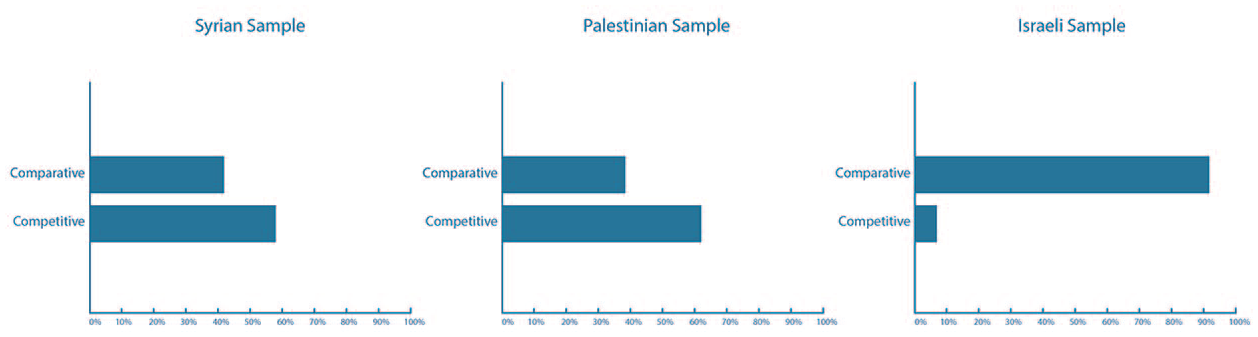
Competitive and comparative memory dynamics in the three samples.
Thinking about the specific political contexts of these three groups already hints at explanations as to why Palestinians and Syrians are more competitive than Israelis in their way of remembering. However, let us try to ignore this context for the moment and check the theories to see whether in-group differences are indeed apparent within and across our samples according to respondents’ levels of nationalistic attachment and their sense of in-group victimization.
Nationalistic attachment and competitive remembrance
From the definitions of comparative and competitive memory dynamics, it is clear that competitive dynamics are associated with nationalistic efforts to improve reputation and gains for the in-group. While the literature on nationalism is versatile and extensive, for the purpose of exploring a potential link between levels of nationalistic attachment and competitive remembrance, I gauged respondents’ levels of national pride by asking them to rank their patriotic attachment on a scale of 1 (not proud) to 5 (very proud). Comparing the three sample groups, I found that Israelis were the least patriotic, whereas Syrians showed high levels of national pride, and Palestinians had even higher levels of national pride (see Figure 3).
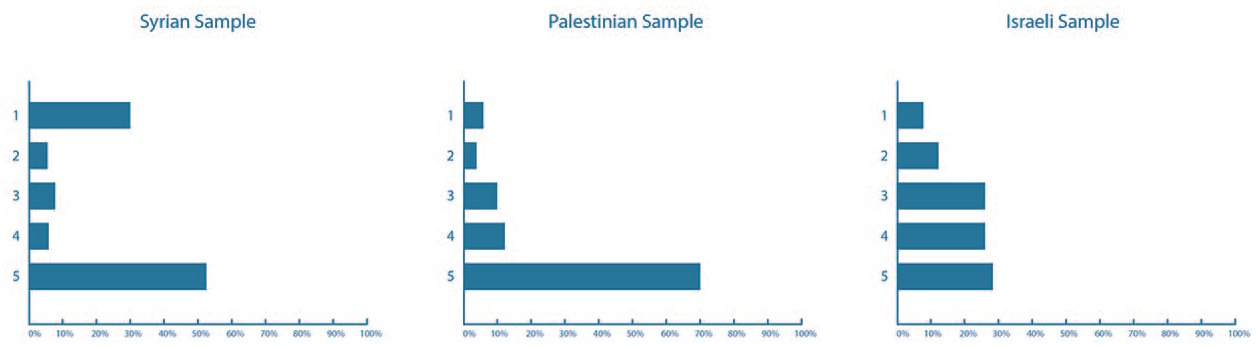
Levels of nationalistic attachment: ‘On a scale of 1 (not proud) to 5 (very proud), how proud are you to be Syrian/Palestinian/Israeli?’.
Furthermore, a statistical analysis of the Syrian and Palestinian samples indeed revealed a strong correlation between those Palestinians and Syrians with a high degree of national pride and those expressing a competitive logic with their memories. In statistical terms, this finding clearly indicated a positive relationship between national pride and competitive remembrance, which was visible across more than one country, confirming that nationalism indeed goes hand in hand with competitive ways of remembering (see Online appendix, Table 3: National pride and competitive remembrance).
When double-checking this finding with related concepts in the sample groups, I found within the Palestinian sample that those who held a positive self-image of their in-group also showed higher levels of competitive remembrance. Similarly, the few Israelis who followed a competitive logic with their memories also strongly delegitimized the out-group, in their case, the Palestinians (see Online appendix, Table 2: Positive self-image/victimhood and competitive remembrance).
In contrast, those Israeli respondents who supported sharing and widening the Holocaust memory to other conflicts all displayed little to no national pride, because they did not support Israel’s treatment of the Palestinians. On the inverse, I found a weak negative relationship between Syrians expressing a higher degree of pride for their country and those indicating a comparative remembrance, confirming once more that comparative ways of remembrance are more likely to be present in individuals with lower levels of nationalistic attachment (see Online appendix, Table 6: National pride and comparative remembrance). Similarly, Syrian refugees showed not only the highest levels of competitive remembrance when compared to those living in the diaspora and those who stayed in Syria, but also the highest levels of national pride.
Perceived victimhood and competitive remembrance
Competitive memory dynamics in the theories were not only associated with higher levels of nationalistic attachment but also with higher degrees of actual and perceived victimhood. This idea makes intuitive sense and, at first glance, also seems to find immediate confirmation when looking at the sample groups: Palestinians and Syrians are without doubt victims of their ongoing conflicts, therefore, they are more competitive with their memories than the somewhat better-off Israelis. Furthermore, the Holocaust already occupies the top spot on the international hierarchy of suffering, with all the political gains it afforded the Israelis. Moreover, while the Holocaust was internationally recognized and Israel was created, the Palestinians still do not have a state (Caplan, 2012). With the impact of the Nakba ongoing, Palestinians therefore have a continued need to be competitive with their memories. The same logic applies to Syrians who still have open political claims with their conflict.
However, apart from these inferred degrees of actual victimhood and recognition, the notions of perceived and unrecognized victimhood are extremely difficult to test, because they are highly intangible and context-specific for each individual and sample group while also embedded in broader political narratives, physical locations, and the personal experience of individuals (Acosta, 2021: 680). Furthermore, I am dealing with a civil war scenario in one sample group (Syrians) and a bilateral conflict between the other two sample groups (Palestinians and Israelis). I can therefore only approximate their levels of perceived victimhood as derived from respondents’ narratives of what is happening to their in-group.
Broadly speaking, I found that in the Syrian sample, most respondents perceived themselves as victims of the ongoing war in Syria. Their general impression was that ‘all Syrians suffer’, with an overwhelming majority pointing to civilians as the main victim group. Within the Syrian sample, I also found that those who blame ‘the West’ for the Syrian conflict were the least likely to show comparative memory dynamics (this relationship was statistically significant. See Online appendix, Table 5: Victimhood and comparative remembrance as a Western concept). The association of the Holocaust memory with Western power thus triggered competitive dynamics in its own right. Furthermore, as stated above, Syrian refugees were found to show the highest prevalence of competitive remembrance and national pride. This finding also corresponds with existing research that observes stronger nationalistic sentiments when groups feel excluded from the host society (‘long-distance nationalism’; Van Hear and Cohen, 2017). When groups are nationalistic and feel victimized through exclusion, they have the most to gain and thus follow a more competitive logic with their memories.
In regard to the Israelis and Palestinians, on the other hand, we can attempt to gauge their perceived victimhood relative to one another. For that purpose, I asked Israeli and Palestinian respondents to explicitly state who is suffering the most under their current conflict situation, coding their answers into ‘in- and out-group’ or ‘both/all’. I found that among the 150 Palestinian respondents, no one mentioned the Israelis, making it abundantly clear that they view themselves as the primary victims in the ongoing conflict with the Israelis. In stark contrast, most respondents from the Israeli sample did not view themselves as the primary victims of the conflict with the Palestinians (less than 5% did). They instead viewed the Palestinians and Gazans (55%) or both sides (45%) as the most affected victim groups.
Taking these findings and the broader historical contexts of the sample groups into account, comparative memory appears to be a luxury: People who feel like victims, overlooked and unheard by the international community, as the Palestinians and Syrians predominantly do, are more likely to follow a competitive logic with their memories. In other words, they want to climb up in the international hierarchy of suffering. In contrast, those who feel less victimized by conflict are less likely to think of memory in competitive terms. Furthermore, in the Israeli case, where suffering has been internationally acknowledged through the institutionalization of the Holocaust memory, and its political purpose has been achieved through the realization of and continued support for the Israeli state, respondents are more likely to remember in a comparative way and share their spot in the global hierarchy of suffering. In clear contrast, where suffering remains unacknowledged and political demands unfulfilled, as seems to be the case with the Syrians and Palestinians, respondents belonging to such groups are more likely to remember in a competitive, nationalistic and exclusive way. As the Palestinian and Syrian responses to the questionnaire underlined, memory for them is yet another option, perhaps even the last resort, to gain recognition and achieve international support for their respective and, importantly, so far unfulfilled causes.
Conclusions
This article has examined memory dynamics among individuals who belong to groups experiencing conflict and explored how their memories of trauma interact. Theories and empirical case studies about the behavior of different victim groups worldwide indicate that their memories can compare or compete. When memories compare, people cross-reference and borrow from others’ suffering. When they compete, people stake out nationalistic claims of uniqueness for their own causes. My analysis of a sample taken from three collectives, the Palestinians, the Israelis, and the Syrians, found that individuals experiencing conflict and victimization indeed predominantly remembered competitively: the Palestinian respondents to the largest extent, followed closely by the Syrians. In contrast, the majority of Israeli respondents were found to remember comparatively. In the face of the evident power inequalities between these three sampled groups, it follows that wherever those in subordinate power positions make comparisons, they slip into competition. Furthermore, within and between the three groups, particularly competitive with their memories are those individuals who exhibit higher levels of nationalistic attachment and feelings of collective victimization. My samples, therefore, broadly confirmed that the perceived and, importantly, unrecognized victimhood of one’s own group renders memories competitive.
In the face of these findings, let us return to the desired link between memory and peace reflected in George Santayana’s aphorism and add a caveat: the way and circumstance under which people and their groups remember the past makes all the difference. People may indeed learn from the past whenever their memories follow a comparative logic. Remembering in a comparative way bears the potential to lend a universalist vocabulary to suffering and establish solidarity between victims, ultimately creating bonds between different victim groups. If people embrace the past in such a productive logic, they are open to learning its normative lessons and might – as a consequence – avoid repeating it.
However, in practice, as was shown in the empirical analysis of this article, comparative memory logics are rare among victim groups and, if anything, emerge only in specific circumstances. Embedded in power inequalities, comparisons slip easily into competition. Under a competitive logic, remembering trauma becomes a zero-sum game of political claims over the scarce resource of recognition of suffering. Where memories compete, they create divisions between individuals and their groups. Each victim group, and the individuals who speak on behalf of it, seek to advance their gains with their memories and aim to climb on top of a global hierarchy of suffering. On this competitive foundation, memories clash with others and potentially create new conflicts. If people embrace the past in a competitive, privative logic, they are likely to repeat rather than avoid conflict.
Thus, the way memory dynamics play out is crucial as to whether memory indeed holds the power to move societies toward a more peaceful future. As the empirical analyses between a sample group of Israelis, Palestinians, and Syrians have shown, comparing memories is a luxury that only those already in preferable positions can afford. As illustrated, among the three surveyed groups, only the majority of Israeli respondents took a comparative route into memory and pushed its demands for ‘all’ to learn history’s lessons. However, in their case, this approach was linked to them feeling the least nationalistic and victimized of the sample groups. In contrast, the Palestinian and the Syrian respondents, who showed higher levels of national pride and strongly identified as victims of ongoing conflicts, followed a competitive dynamic with their memories. For them, memory, that is, their suffering, seems to be their last currency to gain international acknowledgment and thus also further their political rights and claims. In a world of unrecognized and overlooked victims, their memory dynamics create hierarchies of suffering rather than solidarities among those who suffer.
Hence, contrary to what George Santayana has suggested, memory cannot always heal us, but the dynamics triggered between diverse traumas potentially can. For this to happen, memory dynamics need to shift from a competitive to a comparative logic. As this article has illustrated, this shift needs to navigate the obstacles of nationalism and strong patriotic attachments combined with the notion of powerlessness and victimization. Competitive memory dynamics are born in the gap between a strong glorification of the in-group on the one hand and its victimization and a withheld recognition on the other hand.
Altogether, these findings point to the importance of recognizing memories internationally, particularly those thus far marginalized. They also stress the urgency for Western countries to recognize the suffering caused by colonialism and slavery as a global experience next to the existing Holocaust memory frame. Without such recognition, victims will continue their efforts to climb up in what has become a paradoxical global hierarchy of suffering amid what is perceived as a deeply unequal, unfair and amoral world. In such an international climate, memory is competitive and thus more likely to condemn people to repeat conflict rather than learn from it.
Footnotes
Acknowledgements
I would like to thank my research assistants in Syria, Israel and the Palestinian Territories for distributing the survey and translating the responses. I am also indebted to Martin Wallin who kindly assisted with the quantitative analyses of the dataset. Many thanks to the colleagues and students who provided their advice on this article, particularly during presentations at Oxford University’s Department of Politics and International Relations, and at Hertford College’s John Porter Diplomacy Centre. Thank you also to Irena Kalhousová, Daniel Levy, Jelena Subotić, and Jessie Barton Hronešová for their advice on this article.
Funding
The author disclosed receipt of the following financial support for the research, authorship, and/or publication of this article: The IKEA Foundation.

KATHRIN BACHLEITNER, b. 1984, PhD in International Relations (Oxford University, 2019), Senior Scientist, Department of Political Science and Salzburg Centre of European Union Studies, University of Salzburg; current research interests: legacies of war, memories and social trauma, post-conflict reconciliation; recent book from Oxford University Press ‘Collective Memory in International Relations’, and articles in International Security, Cooperation and Conflict, International Relations, Foreign Policy Analysis, and Review of International Studies.