




Abstract
This article is interested in the formation of war legacies and how they interact with social identities. It suggests a bottom-up approach towards examining the societal processes in which individuals create a legacy of war. It posits that through their narratives of conflict, by remembering what happened to them as a group, they mould the meaning and boundaries of how the group will be membered post-conflict. The validity of the theorised link between war memory and group membership is then tested in the case of Syria. In 200 interviews, Syrians provided their narratives of the conflict and their vision of a future Syrian state and society. The findings show that most respondents’ narratives follow a civic rationale, forming a society around civil rights and political ideas rather than around ethnic/sectarian divides. With this, the article contributes a new route for international relations scholars to understand the formation of war legacies through individuals’ narratives of conflict and explains their effects on ties of group belonging while also offering a glimpse into the Syrian ‘we’ amid the ongoing war in Syria.
Introduction
To remember a conflict is to re-member the group. 1 This insight taken from the interdisciplinary literature on collective memory (Olick, 1999) is central to this article. Through it, this article seeks to theorise the formation and role of legacies of war in international relations (IR). While the IR literature so far mainly integrates legacies of war through a top-down perspective, focusing on state-produced memories or stories by political elites (Bachleitner, 2021; Berger, 2002, 2012; He, 2009; Khong, 1992; Khoury, 2018; Lind, 2008), this article suggests their social meaning is established from the bottom up, among the people. With this assumption, the article builds upon the insights offered by the interdisciplinary ‘collective memory’ (Assmann, 2016; Gillis, 1994; Olick et al., 2011; Olick and Robbins, 1998) and ‘social trauma’ (Alexander, 2012; Edkins, 2003) concepts, as well as on a tiny but growing literature within IR that prioritises the individual level when it comes to the construction of social meanings (Rumelili and Todd, 2018; Stanley and Jackson, 2016; Todd, 2018a, 2018b).
If remembering a conflict indeed re-members the group, then we must find a link between the memory of the conflict and the collective affected by war. To operationalise this link, the article investigates the memory of war through people’s ‘narratives of conflict’. It suggests that their stories of what happened to them as a group contain a vision of the future in-group. In other words, who belongs and who does not belong to the collective forms through looking to the past. In IR, the proposition to remember a conflict is to re-member the group thus becomes the hypothesis to socially narrate the conflict is to construct a collective’s identity. As this article aims to show, it is this, the crucial legacy, that war leaves on societies.
Empirically, the article tests the theorised link between war memory and group membership in the recent case of Syria. In 2011, public demonstrations against the ruling regime of Bashar al-Assad spiralled the country into a bloody civil war that continues to this day. With no peace agreement signed, this war’s legacy is still evolving. Yet, its consequences are already enormous and devastating: Within the first five years of conflict an estimated 470,000 people were killed, 1.9 million were wounded, 5.7 million Syrians had become refugees and 6.6 million were internally displaced (Phillips, 2017: 1). War and associated displacement cast what Slavoj Žižek (1997) pointedly called an ‘ontological crack’ into the identities of individuals and their ties with the community. The legacy of war in such ontological terms, that is, in the minds of the affected Syrian people and their ties of collective belonging to a society that has been torn apart by war, has so far received little to no research attention within the political sciences and IR literature. 2
To dig into this side of the legacy of the Syrian war, 200 Syrians were interviewed online through surveys. In applying its theoretical framework, the empirical analysis of the collected data aimed at gaining insights into how ordinary Syrians view their in-group and construct their own ties of belonging with it through their narratives of the ongoing conflict. Via a qualitative content and a follow-up quantitative statistical analysis of the data, the empirical study thus attempts to gauge the meaning of ‘Syrianness’ that emerges from individuals’ narrative of the conflict: Who – based on these stories – belongs to their envisioned in-group, and who does not? Moreover, do Syrians’ narratives of conflict indeed construct a new Syrian ‘we’?
With this, the article’s contribution is to point the way towards a novel, practically viable and replicable bottom-up approach towards social identity constructions amid war for the IR literature and the scholarship on the Syrian conflict. Both have to date mainly explored ‘group identities and war’ from a top-down perspective, focusing on the motivations of elites and their manipulation of social identities (particularly, ethnic and sectarian ties) (for general IR work, see: Checkel, 2017; Fearon and Laitin, 2003; Kalyvas, 2000; Mueller, 2000; Wimmer, 2013; for work on Syria, see: Abboud, 2016; Hokayem, 2017; Lesch, 2013; Phillips, 2017). Building on these, but going beyond them, this article aims to gain new and different insights through a bottom-up perspective. However, and importantly, by focusing on the societal level, the article does not aim to infer generalised opinions from its sample interviews onto the entire Syrian population, nor does it want to prove causality between war memory/trauma and national identity change. It instead relies on the empirical data collected from 200 Syrians to show that narratives of conflict provide valuable insights into the meaning and boundaries of group identity; and, therefore, that individuals form the legacy of war while, through it, also beginning to actively formulate the contours of peace.
Legacies of war and their link to societal meaning-making
Undoubtably, wars and conflict have an impact on people, societies, countries and the global community. However, the scars of war are first and foremost visible in the individuals affected by it through personal loss, death, displacement, injury or poverty. Similarly, collectives, that is, countries and their societies, experience physical and economic devastation and mass migration movements through violent conflict, in addition to a loss of communal ties. The IR literature broadly subsumes these individual and collective experiences of war under the term ‘legacies of war’. However, what precisely is such a legacy of war, and how does it translate into countries and their societies? Moreover, how does a war legacy form, what effect does it have on groups, and how can we understand and trace it within IR?
This article assumes that legacies of war, or the collective and individual experience of conflict, is rendered manifest retrospectively through what the interdisciplinary literature calls ‘memory’ (Assmann, 2016; Gillis, 1994; Olick et al., 2011; Olick and Robbins, 1998). By looking back to their war experience, people and their political leaders try to make sense of what happened to them as a group. This process unfolds through forming a consistent story or ‘narrative’ about the experience of war. Memory, therefore, manifests through narration (Wertsch, 2008). Notably, narratives are never static stories about a past event, but ‘constitutive narratives’ (Somers, 1994): they establish a certain continuity between past, present and future, and thus quasi-narrate the collective into action.
In IR, the described continuity between past, present and future action has so far been discussed mainly under the framework of ‘ontological security’: establishing a balanced ‘state of being’ is essential to agency, be it for individuals or states. The reference point for this balancing act is a ‘continuous identity’ that manifests in the case of countries in their national biography (Berenskoetter, 2014), national or biographical narrative (Mitzen, 2006; Steele, 2008; Subotic, 2016), or even their mnemonical security (Malksoo, 2015). The latter means the securitisation of public memory or an official narrative of the past. With this, all authors clearly hint at what we called memory: the narration of a consistent story that runs from the past into the present and future.
From both the interdisciplinary literature on collective memory and IR’s ontological security scholarship it becomes apparent that individual and collective processes of narration are intrinsically linked with the construction of social identities (Risse-Kappen, 2010: 20). We are the stories that we tell about ourselves; equally, a state’s identity is based on its national narrative (Ringmar, 1996). Therefore, when narratives describe what happened to the group or individual in the past or, to return to our research interest in legacies of war, when conflicts are narrated, these narratives also form who the individual or group is and where it is going (Cruz, 2000). Moreover, as constitutive narration works by way of looking backwards, ‘remembering’ literally becomes a social process that, as Jeffrey Olick (1999: 342) put it, re-members (as in, ‘constitutes’) a group. In this definition, memory in ever-transforming ways moulds a shared sense of belonging into a collective identity (Olick and Robbins, 1998: 122).
Following the link between memory and identity in individuals and societies, this article posits that a legacy of war manifests in social identities through its narration. More specifically, the legacy is said to be transported into the present through ‘narratives of conflict’ that look back to the happenings through memory. Notably, using the term ‘memory’ emphasises the fictional (personal) aspect of these stories: for a legacy to form and impact society, the conflict must not necessarily be recounted with historical accuracy. Instead, what matters is how the conflict is experienced and recollected retrospectively (Bell, 2010: 2). Even if the accounts of the past are unrelated to the ‘historical truth’, they nevertheless present a current interpretation of the past; and this interpretation forms what we call a ‘legacy of war’, which then has the potential to leave its imprint on social identity constructions. With the help of the memory concept, we thus lift the experience of war into the present and move attention to a legacy’s impact rather than on the impact of war itself.
By positing that legacies of war manifest in social identity constructions, this article therefore suggests that, alongside the interdisciplinary literature on collective memory, individuals and collectives by way of recalling past experiences narrate their story in ways which assign meaning and boundaries to a group, and so people interweave themselves into what broadly is called a collective identity. Based on this insight, this article hypothesises that the way a legacy of war is narrated – be it by individuals or collectives – also formulates the ‘we’ of the society in question.
Across the social sciences and humanities, this link between memory and identity has so far been firmly established when it comes to collectives (Bodnar, 1992; Gillis, 1994; Hobsbawm and Ranger, 1983; Schudson, 1993; for explicit IR work on this, see: Bachleitner, 2021; Berger, 1998; Malksoo, 2015; Müller, 2002). Furthermore, nearly all works on nationalism are underwritten by Anderson’s (1983) famous assumption that narratives of the past shape a sense of group belonging to an ‘imagined community’ such as the nation. This past, in the ideal case, references victories and glories, but it may equally include tragic and traumatic experiences (Assmann, 2016). From a nationalistic perspective, the latter does not only have negative consequences for a collective: ‘Suffering unites’, stated Ernest Renan (1882) in his famous Sorbonne lecture in response to his question of ‘What is a nation?’ It follows that for national purposes and to foster social cohesion, political actors everywhere, and especially in times of conflict and afterwards, put forward an official narrative of the past to forge unity among the members of society while broadening the loyalty base and legitimacy of their political claims. In fact, memory’s connection to identity renders the past highly political and exposes any society’s legacy of war to manipulation by its leaders.
Nevertheless, on the societal level, individuals, too, remember the conflict that they experienced. Ordinary people also narrate the story of what happened to them individually and as a group, thus moulding the legacy of war for their community. This part of the formation of war legacies is often overlooked within the political sciences, particularly in IR’s state-level analyses (Bachleitner, 2018; Khoury, 2018). However, individuals also do memory work through their narratives, and the outcome is likely to look different from the memory work done by political elites. When individuals put forward their narratives of conflict, they do not have the same political interests as elites; they need not forge loyalty or solidarity to the nation. Nevertheless, through their narratives, they still interweave themselves with a collective and thus contribute to forming their country’s legacy of war.
The role of individuals in creating a legacy of war
In response to this apparent gap in the IR literature, this article reverts the focus to the bottom-up, the societal level, assigning people agency in creating social meaning and thus also a legacy of war. Unlike existing work on the political manipulation of collective identities amid (often ethnic) conflict (Benhabib et al., 2007; Cederman and Gleditsch, 2013; Chandra, 2012; Coakley, 2012), individuals, through this route, remain ‘active agents’ of their social identity constructions. Of course, that does not imply that their narratives are not influenced from above and by specific contexts. However, people nevertheless are assumed to remain the main subjects of their sense of group belonging that they form through their narratives.
With this micro-level approach, our article adds to a small IR and political science literature that has begun to point the way towards a more complex bottom-up route into social identities; yet, none of its authors explicitly links this process with memories of war. For instance, Stanley and Jackson (2016) generally look at how group identity is generated from ‘everyday narratives’ originating from below. Similarly, Jennifer Todd (2018b: 88) asserts that the ‘grammar of nationality’ – as she pointedly calls common national ties – is never simply the product of official categorisations but made in social practices and disputes. With identity grounded in memory, the memories of conflict must also emerge from ‘social practices and disputes’ among individuals, in other words, from their present interpretation.
So far, however, only the emerging literature on ‘collective trauma’ has begun to describe the details of these social practices and recollection efforts that take place on the societal level (Alexander, 2012; Bell, 2010; Edkins, 2002, 2003; Hunt, 2010; Hutchison, 2016). For individuals, as Jenny Edkins (2002: 245–246) explains, when their ‘everyday normality’ is suddenly ruptured by war and conflict, ‘the world as we knew it’ is shattered and the traumatic event throws ‘into question all the accommodations that people have made in order to carry on with their everyday lives’. Borrowed from the insights offered up in psychological literature (Caruth, 1995; Nemeroff and Marmar, 2018), trauma ‘traumatises’ people not in the often-assumed sense of ‘shocking’, that is, ‘muting’ its victims. It instead opens people’s eyes towards their vulnerability, and in the case of collectives, towards their community. Usually, this fact of life is suppressed within the everyday normality of a ‘secure collective’ or nation (Hutchison, 2016: 41–47). Traumatic events, therefore, touch on nothing less than existence: who a person is (individual identity), as well as the meaning of the community (group belonging), now undergoes serious scrutiny.
Interestingly for our argument, in this literature ‘trauma time’ is described as a time in which people question their social surroundings. Customary ideas of ‘life’, ‘community’, ‘security’, all lose their meaning: ‘Trauma is more than a shocking encounter with brutality or death; in an important sense, trauma is the betrayal of a promise or an expectation’ (Edkins, 2006: 109). This expectation and promise – as Edkins underlines – was a societal one given to the people. Nevertheless, while through war trauma existing ties of belonging to the group in question are shattered, war trauma also demands people revisit and reinvent communal meanings and boundaries. Particularly in this revisiting process, scholars relegate an active role to individuals. Jeffrey C Alexander (2012: 14–30) goes even a step further with this and establishes people’s agency in creating ‘social trauma’ in the first place: Unlike with personal trauma striking its victim, social trauma needs to be established to have happened to society. That means that collective trauma is not objectively harmful to a collective, as individual trauma is to a person. Instead, collective trauma needs to be socially constructed as having abruptly and harmfully affected the collective. Importantly for our framework, this process happens only through active narration.
To socially create the belief that the group was subjected to trauma, individuals must therefore construct a ‘trauma narrative’ that – according to Alexander – touches upon the following elements. First, it must describe the nature of the pain by defining what happened to the collective. Further, it must determine the victim and attribute responsibility to a perpetrator who caused the suffering. Returning to our framework, Alexander’s building blocks of a trauma narrative are precisely what we called a ‘narrative of conflict’. Through narrating what happened to the group in the past, people formulate claims about ‘meaning-making’ vis-à-vis a social group in question. Translated into the terms of our bottom-up approach into legacies of war, individuals’ ‘narratives of conflict’ convey not only the rupture to the group (trauma) but also, and equally, the pathway of how the social group is going to be remoulded in the future. Importantly, this process evolves first and foremost from below.
The case study: Syrians create their legacy of war
What above was described as a societal meaning-making process derived from the legacy of war is occurring in Syria. In 2011, what began as popular uprisings against the ruling Assad regime quickly escalated into a brutal war between the regime and a coalition of opposition forces. Over the next nine years of armed conflict, external, regional and international players entered into the fighting, only to escalate it further into its current, protracted state. The traumatic consequences caused to the Syrian society warrant description: The devastation to the country is enormous, with entire cities and villages swept away, an estimated 470,000 people killed and 1.9 million wounded (Phillips, 2017: 1). It also triggered one of the largest refugee waves in human history: roughly 5.7 million Syrians have fled the country to neighbouring Middle Eastern states and beyond. 3 According to the UN Refugee Agency (UNHCR), a further 6.6 million Syrians were internally displaced. 4 In light of these happenings, the Syrian conflict can – without any doubt – be characterised as a situation of ‘social trauma’ suffered by society and individuals.
However, as Alexander (2012) has suggested, social trauma needs to be narrated to come into being. Equally, as per our theoretical outline, the ontological impact of a war legacy is formed by its interpretation, which was hypothesised to affect the construction of group identities and an individual’s sense of belonging. To operationalise the posited bottom-up link between memory and identity, or in the words of our framework, between a legacy of war and group membership, we interviewed 200 Syrians (N = 200) in 2019 about their ‘sense of group belonging’, their ‘narrative of conflict’ and their ‘vision of the future’. With the help of online surveys, the respondents first rated their belonging to Syria (or to a sub-state group), second, gave their narrative of the Syrian conflict since 2011 and, finally, accounted for their vision of a future Syria.
Furthermore, and to establish a link between these three blocks, each respondent’s answer has been coded as following either a ‘civic’ or ‘ethnic’ rationale. Borrowed from the literature on nationalism, a ‘civic rationale’ views group ties as based on shared ideas and political creeds, whereas an ‘ethnic rationale’ understands them as derived from primordial characteristics. Therefore, a ‘civic rationale’ centres on ideas of liberty, equality or the concept of citizenship. In contrast, an ‘ethnic rationale’ focuses on religious beliefs, ethnicity, language and cultural traditions (Calhoun, 2007; Eisenstadt and Giesen, 1995: 80–82; Reeskens and Hooghe, 2010; Risse-Kappen, 2010: 28 and 36; Valadez, 2007). 5
To extract these logics from the given answers, we used qualitative content analysis to code each individual’s stated sense of group belonging, their narrative of the conflict, as well as their vision of the future separately as following either a civic (1) or an ethnic rationale (2) or a mix of both (1.5). Furthermore, direct excerpts from the Arabic answers in English translation will illustrate the context-specific Syrian meaning of an ethnic and civic rationale in the words of the individuals’ own discursive justifications. Notably, and as per our theoretical outline, through employing either a civic or ethnic rationale in their narrative, presumably agonistic identities could be remoulded, with the direction of this multifaceted process remaining open. Moreover, each rationale may narrow or expand the group’s boundaries in the future (Rumelili and Todd, 2018: 3–8; Todd, 2018a, 2018b: 88). As a result, the meaning associated with Syria might be reinterpreted through the legacy of war in more exclusive or inclusive ways towards multiple possible outcomes.
In either case, however, if the theories hold and group belonging is indeed underwritten by narratives of conflict, a civic or ethnic logic must be found in both individuals’ narrative of the conflict and their future vision of the state. With the help of a follow-up statistical analysis, we, therefore, in the last step, attempt to establish a correlation between all three answer blocks: individuals’ sense of belonging, their narratives of conflict and their future of the state.
All data were collected online, in Arabic and followed strict ethical guidelines. Especially in conflict areas, online surveys are helpful because of their mobility, accessibility and anonymity (Sue and Ritter, 2016). To recruit respondents, research assistants first created a sampling frame that identified individuals in various geographic locations within Syria (essential to do justice to the divisions within Syria) and across Middle Eastern, European and North American countries hosting Syrian refugees. Yet, because we followed a snowball method in the research assistants’ wider social and professional networks, the sample has limitations when it comes to representativeness, yielding disproportionately large numbers of participants who are higher educated, middle-aged men when compared to the entire Syrian population. However, it is essential to note that this analysis aims not to project beliefs extracted from this sample onto the entire Syrian population. Instead, it aims to gain a glimpse – through respondents’ narratives of the conflict – into their vision of the future state and to investigate if there is indeed the established theoretical link between the memory of conflict and group belonging that may help scholars gauge the impact of the legacy of war in Syria.
Syrians’ ties of belonging
In the questionnaires, respondents were first asked to assign themselves to a specific identity category they feel most closely associated with. The options were given as ‘Syrian’ or an ‘ethnic/sectarian group’ of their choice. Figure 1 shows the results in our sample population: A clear majority of 70% of all respondents selected ‘Syrian’ as their first choice. In contrast, and, in the order of frequency of selection, only 14% selected ‘Arab’, 8% ‘Sunnah/Muslim’, 5% ‘Kurdish’ and only one answer contained ‘Shia’ as their selected belonging. Four respondents (that is, 3% of this sample) stated their identity as ‘citizen’, a choice that immediately hints at the presence of a civic rationale in their understanding of the Syrian in-group.
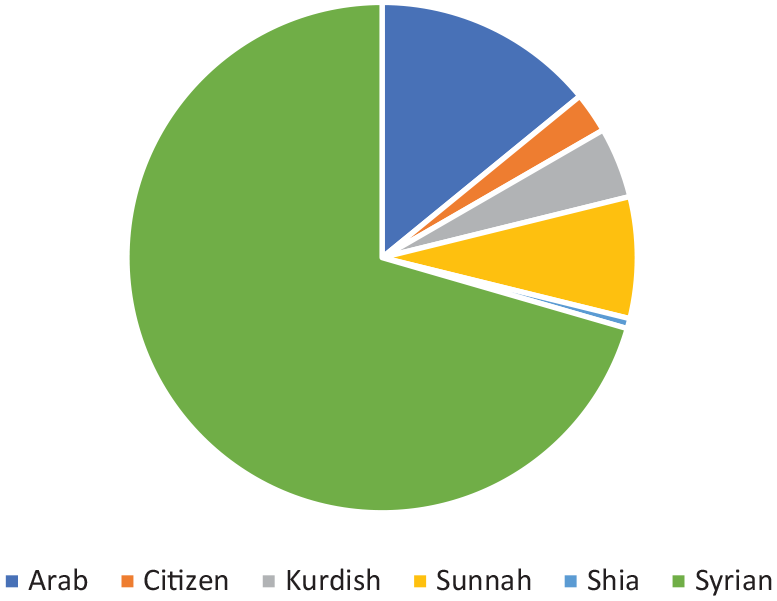
Selected self-identification of Syrians (answers in %).
In contrast, the sectarian self-identifications ‘Sunnah’ and ‘Shia’, as well as the ethnic identification ‘Kurdish’, point to an ‘ethnic rationale’ that is likely to place religious or ethnic ties at the centre of their sense of group belonging. ‘Arab’ is an ethnic identity category as well. Nevertheless, it may also have different, more ‘civic’, political and secular connotations in the specific Syrian context.
Pan-Arabism forms an essential part of Syria’s state-promoted nationalism: the ruling Ba’ath Party under both Hafez al-Assad and his son Bashar al-Assad strongly relied on Syria’s ‘Arabness’ to widen the legitimacy base of an Alawi-minority rule over a Sunni majority. However, Pan-Arabism as a political ideology, while it certainly follows an ethnic rationale by grounding its idea of belonging in a ‘united Arab family’, also contained ‘civic’ elements such as secularism and its political association with the Ba’ath Party’s programme. The self-identification ‘Syrian-Arab’ may therefore go beyond the ethnic rationale based on belonging to the ‘Arab tribe’ and instead follow the state-sponsored idea of Syria, perhaps including adherence to the Ba’ath Party, the Syrian state and its leaders (Aldoughli, 2019; Hinnebusch, 2020).
Similarly, the national identification ‘Syrian’ may also be based on a civic or an ethnic rationale. To be Syrian may carry a different meaning for the majority who chose this identity category. While it may immediately hint at a national logic compared with the ethnic/sectarian categories, its preponderance may merely be attributed to a solid nationalistic sentiment that pre-existed the conflict and was promoted by the regime (Ismail, 2011; Wedeen, 1999). Furthermore, the self-identification as ‘Syrian’ does not say whether the individual identifies with Syria as a Kulturnation (ethnic rationale) or a Staatsnation (civic rationale). As is the case for all national identity categories, identifying as ‘Syrian’ may mean many different things for the respondent and may follow either a civic or an ethnic rationale for their attachment to the nation.
Hence, these findings per se do not say much about the respondents’ ties of belonging to Syria other than that a majority seems to define belonging broadly and in national terms while only a minority of 27% self-identifies with ethnic and sectarian groups. Therefore, before we come to any conclusions, let us see if those self-identifying as Syrian and those self-identifying with an ethnic category indeed also follow diverse rationales when they narrativise the conflict in Syria and the future of their country.
Syrians’ narratives of conflict
In asking respondents about their narrative of conflict, we closely followed Alexander’s (2012) outline of how social trauma is established by narrating what happened to the group through naming victims and perpetrators. We also grouped Alexander’s building blocks of trauma narratives into following what was defined as a ‘civic’ and ‘ethnic’ rationale through qualitative content analysis.
In the context of conflict narratives, a ‘civic’ code meant that the respondent described the conflict and its parties in political terms, whereas an ‘ethnic’ code was assigned when the situation in Syria was described primarily as an ethnic/sectarian civil war. While a complete list of coding descriptions is provided in Annex I (in the supplementary material online), a typical answer that followed a civic rationale in its conflict narrative assigned responsibility to different political players, parties and interests. These were described in formal, political terms, often with hints to authoritarian rule, the state and its security apparatus or the military. Moreover, when describing the Syrian conflict, many answers not only focused on the inner side of it but also its internationalisation. These narratives were coded with ‘civic/political’ if they were told in the language of great-power intervention, regional competition for influence or in terms of political interests and the intervention (or non-intervention) of the international community. Furthermore, those who narrated the conflict in political terms often stated – when asked about the primary victims of the conflict – that ‘all Syrians’ or ‘ordinary citizens and people’ are suffering the most as a result of war and displacement.
In contrast, when the conflict was narrated in ethnic terms, a specific ethnic group, usually the Muslim Sunnis, were singled out as the primary victim group. Furthermore, those recounting the Syrian conflict as following an ethnic or sectarian agenda typically assigned responsibility for the conflict to an ‘Alawi-minority tyranny’ over a ‘Sunni majority’. If they took the international dimension of the conflict into account, they characterised international players as Shiite, Sunni, Islamic, or Western or Judeo-Christian interventionists, which each followed their own ethnic or sectarian agenda. To give an illustrative example, a male respondent from Raqqa explains the Syrian conflict by following an ethnic rationale: The Sunni majority paid the highest cost in this war when counting in killings, displacements and imprisonments. The Arab Sunnah are therefore the group that suffered and continue to suffer the most in the past and the present. The responsibility lies with the Syrian regime, which has been holding on to power since 1970, represented by the Assad family, the son, the Ba’ath Party, the Alawite sect, and the vast majority of businessmen who supported the regime.
As illustrated in Figure 2, however, only 23% of respondents recounted the conflict in such ethno-sectarian terms. Instead, 47%, a clear majority of answers, followed a political/civic rationale in their description of what happened in Syria since 2011. Thus, for example, a man in Aleppo explains: The Syrian regime and the Ba’ath party refused to respond to the demands of Syrians to restructure the regime. However, other countries also have their role to play and hold responsibility for the conflict, particularly those favouring the status quo to serve their own interests. As a result, and without any exception, all Syrians have suffered.
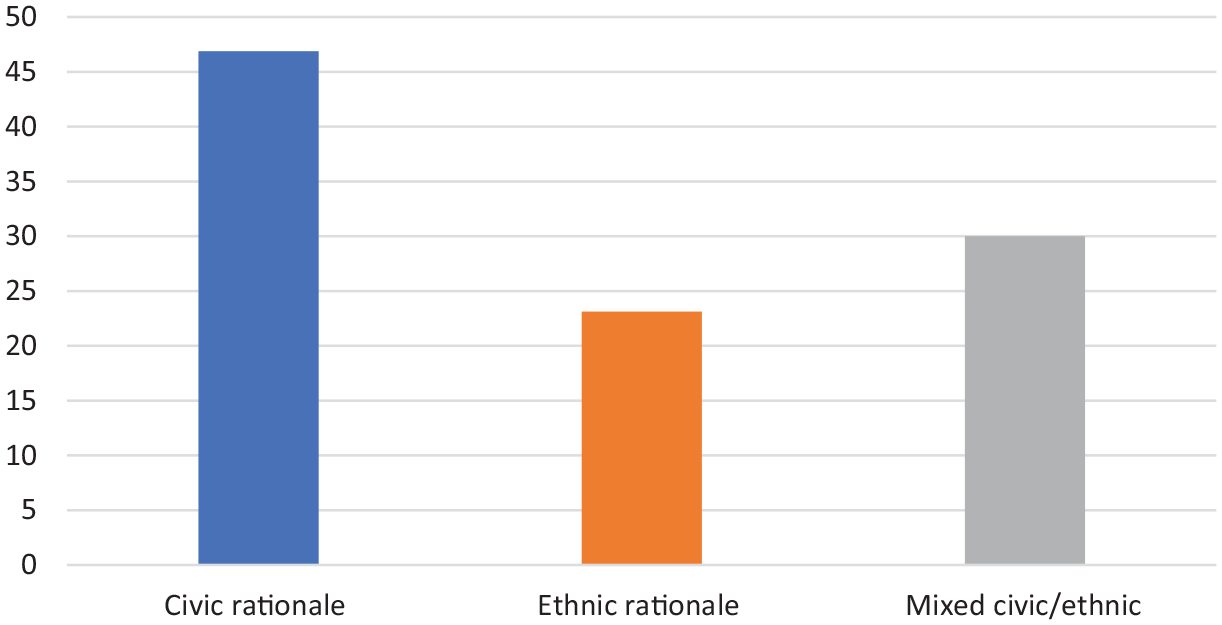
Rationales followed by Syrians in their narratives of conflict (in %).
A woman from Damascus equally tells a political narrative of the conflict: Everyone is after their own personal and financial gains, and none of them cares about the interests of the people. Therefore, the people, the Syrian people, the children, the middle classes and the poor are the main victims of this conflict.
Furthermore, most answers that narrate the conflict in political terms predominantly point to the security apparatus of the state, its army and intelligence service, and the intervention or non-intervention of other countries and the international community as drivers of the Syrian conflict. To use the words of a man from Damascus: ‘Firstly, the regime, is responsible for the escalation of the conflict because it had the power, the influence, the money, the intelligence information in 2011; yet its policy led to violence and intervention from other countries.’ On the other hand, a man from Latakia includes both sides in his political narrative of what is happening to his country: ‘Both the opposition and the regime are equally responsible and behind them the countries that support them. The ordinary Syrian people are the victims of this war.’ Another man from Damascus who follows a similar logic adds: The ordinary people who did not align themselves with any of the conflict’s parties suffer the most! The regime, Russia, Iran, the USA, the Gulf countries, all act in their interests. Bribery and nepotism are rampant. Loyalty should not be assigned to the president. It should lie with the land and the people!
Thus, when it came to assigning responsibility for the conflict, most answers that narrated the conflict in ‘political’ terms connected the ruling regime with escalating the conflict and foreign intervention with lengthening it. Among the most frequently named foreign interveners were Iran (and related Shiite militias such as Hezbollah) and Russia, followed by Gulf countries and, to a significantly lesser extent, the United States. While opinions varied widely about these players, a clear majority of respondents seemed to equate foreign influence with sectarian strife. As a result, an overwhelming majority of answers conveyed a civic rationale in their narratives: their story of the Syrian conflict was not one of primordial, ethnic/sectarian hatred, but rather one of political interests, fuelling the conflict in its internal and international dimensions.
Syrians’ visions of the future
While survey respondents provided their narratives of the conflict in Syria, they also accounted for their vision for peace by describing their ideal future Syrian state and society. Also this part of their answers was grouped into following a ‘civic’ or ‘ethnic’ logic or a mix of both. A full list of coding descriptions is provided in Annex II (in the supplementary material online). However, broadly speaking, respondents’ vision of a future Syria was coded as ‘civic’ when the answers contained an apparent reference to (liberal) democracy, when they envisioned a ‘civic’ state and society based on the rule of law and the idea of citizenship, a separation between religion and politics, a pluralistic yet unified ‘Syrian mosaic of sects’ with solid protection of minorities, or the demand for free market competition.
In contrast, answers were coded with ‘ethnic’ when respondents desired a Sunni majority government but no democracy, the rule of law with no explicit mention of political freedoms, substantial autonomy for particular ethnic groups or even secession, an end to foreign influences (in the sense of disturbing the uniqueness of Syria), or Islamic rule and an Islamic constitution for Syria.
To illustrate respondents’ ‘civic’ vision of the Syrian state in their own words, take, for instance, this response from a man in Raqqa: I want for my country a constitution that brings all people together. I desire the return of the displaced to their cities and villages and to finally get rid of all the militias and foreigners. I want Syria to have a professional army whose loyalty lies with the country and not with individuals. We must restructure some parts of the intelligence services according to the needs of the country. Politically, the ideal situation would be a civic and democratic state made of institutions rather than individuals. A single and unified state that recognises all its peoples and the rights of everyone to live under ‘the roof of one country’. A parliamentarian state with an elected government according to international standards with a message of peace and love instead of a message of hatred and terrorism.
This illustrative answer reflects 48% of our sample’s respondents who followed what we called a civic rationale in their vision of a future Syria (see Figure 3). To give another example, a woman from the coastal region outlines a similar account of the Syrian state and society: Politically, a secular, democratic regime. Economically, a social market. Religiously, a civic and non-sectarian regime, respecting the rights of the majority and all religious minorities guaranteeing equality to all of them. I want no more confessionalism and not again another military regime!
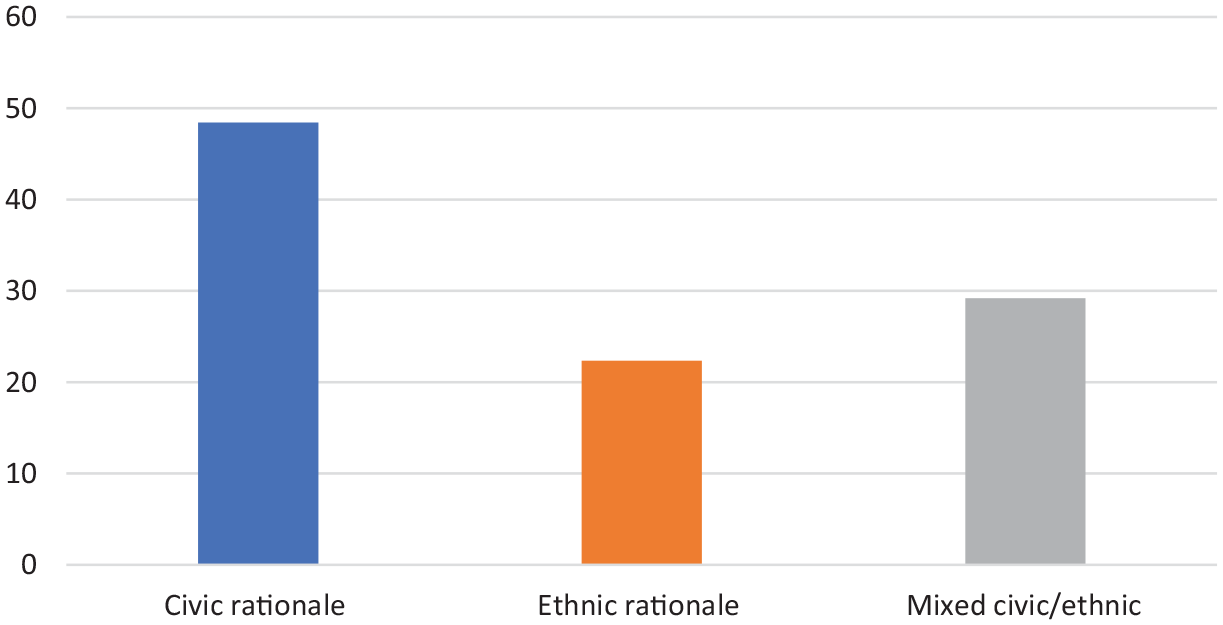
Rationales followed by Syrians in their vision of the future (in %).
Answers like these two, which were grouped under following a civic rationale, always demanded the end of authoritarian, military rule and usually also desired democracy combined with varying degrees of political freedoms. In terms of religion, they furthermore propagated a division between religion and politics, envisioning Syria as a secular or ‘civic’ state. 6 In the words of a man from Efrin: ‘Religion is for God, the Homeland is for All! I want a civic, democratic state based on the principle of citizenship and secularism.’ In contrast, sectarianism, factionalism, Islamism were often associated by these respondents with conflict and fear. A woman from Latakia explains: ‘We need a national project that promotes peace and forgiveness. A national government that encompasses all components of Syria. No more sectarianism, Islamisation, regionalism and radical factions!’
In stark contrast to the majority’s wish to live in a secular state, only a handful of respondents envisioned an Islamic rule for Syria. In their words, the desire for Islamic rule, however, always came with a disclaimer against extremist thought: In terms of religion, Syrians are used to simple understandings and applications of religious rules. I prefer such an understanding, which is mainly concerned with abiding by Islamic ethical standards, and which is distant from extremism (response from a man in Deir al-Zour).
Answers like this one that desired Islamic rule or intermingled ethnic and religious identities with politics were coded under following an ‘ethnic rationale’ in their description of a future Syria. These, however, were with 22% in the clear minority (see Figure 3). Moreover, they varied widely with regards to the political roles they attributed to religion and ethnicity. To give another example of an ‘ethnic’ response, a man from Raqqa who self-identifies as a Sunni Muslim, explains his vision of the future: ‘Politically, I want an arrangement that stops the minorities from controlling the majority. Religiously, however, I want freedom of belief and the freedom to exercise religious beliefs for all groups’.
On the other hand, yet in a related logic, some of those who stated their belonging to the Kurdish minority rejected the dominance of Arab rule on ‘ethnic’ grounds: ‘I don’t want Pan-Arabism to be part of Syria’s future. I am for a federal state in which the Kurds have the autonomy to rule themselves’ (answer from a Kurdish woman from Al Hasakah). This sentiment coming from members of the Kurdish ethnic minority is unsurprising as state-sponsored Syrian nationalism based on Arabism excluded the Kurds while watering out sectarian differences.
However, it is fair to point out that as with the wish for Islamic rule, also with regards to the ethnic make-up of the Syrian society, only a handful of respondents among an already minority group of 22% in our sample wanted an explicit ‘ethnic rule’ or even ‘ethnic separation’. Instead, almost all answers conveyed – with varying degrees of autonomy for minority groups – the wish for a ‘united Syria’ in its current state boundaries: ‘All Syrians’ to use the words of a respondent from Raqqa, ‘belong under the roof of one country’.
In comparison with the ethnic logic, the 48% of respondents who followed a civic rationale outline the future Syrian society based on the idea of citizenship by explicitly rejecting ethnic divides. To varying degrees, some respondents, as a result of this, wished for ethnicity to be insignificant for the political unity of Syrians, while others emphasised strict equality between groups. Furthermore, this opinion was also expressed as demands for equal rights among all minorities and sects or by way of voicing a sense of national pride in Syria’s unique heritage of a ‘mosaic of sects, cultures and civilizations’.
Overall, and as Figure 3 illustrates, in our sample group, a majority of 48% followed a civic rationale, with 29% following a mixed civic and ethnic logic, and only 22% painting a picture of Syria’s future in ethnic or sectarian terms. In the specific Syrian context, the majority’s civic logic reflected an expressed desire for a ‘democratic Syria’ that almost always was understood as ‘freedom from military rule’, but also meant a form of ‘representative’ government, if not a liberal, rule-based government by the people. Respondents guided by this logic also explicitly expressed the idea of a ‘civic Syria, which some interpreted as meaning something along the lines of liberal/civil values by mentioning ‘tolerance’, ‘pluralism’, ‘individualism’ or even ‘citizenship’. Others connected it to ‘secularism’. Equally shared by all respondents was the desire for Syria’s territorial integrity and the unity of all Syrians. While this notion was voiced in terms that demonstrate varying degrees of tolerance for pluralism among respondents, overall, a clear majority in our sample group envisioned their ideal Syria as ‘democratic’ (meaning: ‘representative’), ‘civic’ (meaning: ‘secular’) and ‘united’ (meaning ‘pluralistic’).
Gauging the legacy of war in Syria: Correlations between group belonging, narratives of conflict and visions of the future
Our findings showed that a civic rationale predominantly guides respondents’ narrative of the conflict and their vision of a future Syria. The presented evidence extracted from our sample population points in the direction that on the societal level, the Syrian conflict, the country’s future as well as belonging to Syria are all defined in civic rather than in ethnic terms. The findings from within this sample thus call into question the assertions of many mainstream Western media and academic work that portray the Syrian conflict as leaving a legacy of deepening ethnic/sectarian divides. International media outlets in particular regularly described the Syrian conflict as an ethno-sectarian civil war, painting Syria as an ethnically divided country fuelled by the ethno-nationalist agendas of political elites. In such a portrayal, political players exploit and manipulate a pre-existing mosaic of ethnic/sectarian identities lying dormant below the surface of a repressive dictatorship. The Syrian people, in such accounts, often remain powerless, having their identities abused by mere political manipulation. 7 Along more differentiated lines, yet still predominantly from a top-down perspective, academic work, on the other hand, paints a ‘semi-sectarian’ (Phillips, 2015: 359–360) picture of the Syrian conflict. Most scholars, with that, emphasise the presence of a firm, yet artificial and elite-manipulated, national identity cultivated through the Ba’ath Party’s pan-Arab ideology that stands alongside a multitude of ethno-sectarian players (Aldoughli, 2019; Farouk-Alli, 2014; Phillips, 2015; Schaebler, 2013). What, however, unites all of these works is the underlying assumption that collective identities (be they national or ethnic/sectarian) are predominantly steered by elite manipulation. In discussing the legacy of the Syrian war, they therefore each take a route through political elites and their manipulation of Syrians’ manifold social identities (Abboud, 2016; Hokayem, 2017; Lesch, 2013; Phillips, 2017).
In the minds of our respondents, however, the idea and meaning of ‘Syrianness’ and the ‘Syrian nation’ does not follow such ethnic or sectarian confines but instead references civil and political rights when it comes to defining the Syrian ‘in-group’. In clear contrast to top-down views on the Syrian conflict, ‘Syrianness’, when extrapolating from this sample group, and at this moment in time, seems to be defined in more civic connotations from the bottom-up. On the societal level, if we can infer anything from this small sample to the broader population, the boundaries of the Syrian identity seem to centre on the civic notion of citizenship, thus broadening the Syrian in-group rather than contracting it by way of ethnic divisions. This finding alone encourages further research with a larger population sample to gain a new perspective on what ‘Syrianness’ means to the Syrian people despite or maybe even because of the ongoing conflict in their country.
It follows that while the finding of a prevalent civic rationale is vital to destabilise the widespread belief that an ethnic rationale dominates Syria’s social reality, these results per se do not say anything vis-à-vis the stated hypothesis on a possible connection between war memory and social identity constructions. To return to Olick’s words, to remember the conflict must also ‘re-member’ the group. In order to test this link, we therefore undertook a follow-up statistical analysis of the interviews. For that purpose, we correlated the three blocks of each individual’s answer – ‘self-identification’ (or ‘group belonging’), ‘narrative of the conflict’, and the respondent’s ‘vision of the future’ – and indeed found a weak positive correlation between them: when observations had high values in their ‘narrative of conflict’, they also tended to have high values in their ‘vision of the future’ (See Annex II, Correlations in the supplementary material online).
To avoid interpretative bias, we tested the correlation a second time by removing all observations coded with a mixed civic/ethnic rationale. In that case, the correlation was found to be stronger. Importantly, this only states an observed positive correlation between self-identification, a narrative of conflict and the respondent’s vision of the future, but it does not say anything about the reason for this correlation. However, it nevertheless allows us to broadly conclude that those who followed an ethnic (or civic) rationale in their narrative of conflict are also more likely to follow one in their vision of the future state.
To paraphrase this correlation in the examples from the collected data, a man from Raqqa, who followed an ethnic rationale in his answer, singled out Sunnis as the main victim and assigned responsibility for the conflict to the regime, the army, as well as to their support from Russia and Iranian Hezbollah (Shia) militias in his narrative of the conflict. It follows that his ideal vision of a future Syria was one of Islamic rule.
The same positive correlation, however, also holds in the majority of answers that followed a civic rationale. These usually explicated a political narrative of the conflict and a civic understanding of the country’s future. To illustrate a civic logic running through each answer block, take this full answer from a woman from Aleppo: The country is deteriorating economically with a disintegrating political and security situation. In some parts of the country, the conflict is still active. In other parts, armed gangs terrorise civilians. The poor and working classes suffer above all, in addition to anyone involved with the fighting and their families. Think about all those political detainees who disappeared in prisons, often with their deaths remaining unannounced. Not to mention areas with mixed populations of different sects where massacres and assassinations take place. The regime and its security and intelligence apparatus as well as its military are driving this conflict. So do the regime’s allies, the so-called friends of the Syrian people. In Syria’s future, I want a secular and pluralistic state where all rights are guaranteed and duties are performed. A state where the rule of law prevails. I don’t want any discrimination among Syrians, financial and administrative corruption, lack of judiciary independence, and please no interference of clergy and religion in politics! Instead, we need a social contract that guarantees the participation of everyone and through which we can formulate an inclusive constitution.
While these examples can only serve as illustrations, in numbers, the positive correlation between ‘narrative of conflict’ and ‘future vision’ looks like this in our sample group: out of 75 respondents who followed a civic rationale in their narrative of conflict, 46 also followed a civic rationale in their vision of the state, 20 adopted a mixed idea of the future, and only 9 who tell of the conflict in civic terms follow an ethnic rationale in their idea of the future (see Annex II, Correlations).
What is interesting is that while in the majority of answers we found a civic rationale running through both the respondent’s narrative of conflict and the vision of the future, we also found a positive correlation between all stated self-identifications and a civic rationale in each of their answer blocks. Two follow-up regression analyses between the self-identification ‘Syrian’ or ‘ethnic’ (taking together answers that self-identified as ‘Arab’, ‘Sunnah’, ‘Shia’ or ‘Kurdish’) proved that respondents who state that they identify first as ‘Syrian’ do not have a higher probability of following a civic rationale in their narrative of the conflict and their vision of an ideal future Syria than those who self-identify with an ethnic category. After controlling for the characteristics of age, gender, educational attainment and even for refugee status, the self-categorisation as ‘Syrian’ therefore does not explain whether someone follows a civic or an ethnic rationale. A majority of those who chose an ethnic group as their primary identity still follow a civic rationale in their descriptions of the conflict and their vision of Syria’s future (see Figure 4).
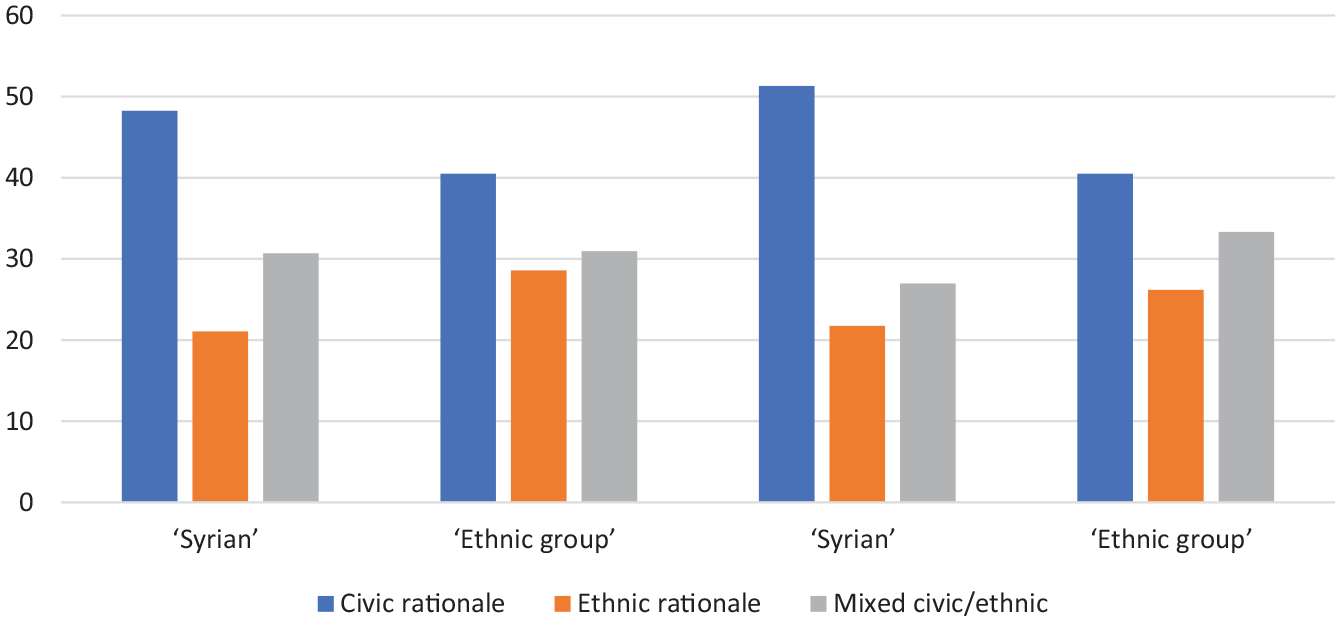
Rationales followed according to the self-categorisation ‘Syrian’ or an ‘ethnic group’ in their narratives of conflict, and their vision of future Syria (answers in %).
This finding holds both in terms of simple counts, as well as in the results of regression analysis. From a simple means test perspective, therefore, on average, it does not matter in a respondent’s civic/ethnic rationale whether the person identifies as ‘Syrian’ or as an ethnic group member: all are equally likely to follow civic or ethnic rationales (see Annex II, Regression Analyses in the supplementary material online).
When taking the specific Syrian context into account, there are several possible explanations for the prevalence of a civic rationale in ethnic identifications. Concerning those who chose the ethnic category ‘Arab’, their idea of Syria is likely to follow the Ba’ath party’s official state nationalism, which combined secular elements with the outline of a modern Syrian-Arab nation. Those who selected ethnic identifications such as Sunnah, Shia or Kurdish, on the other hand, are likely to be attracted to the civic notions of ‘self-determination’ and ‘pluralism’ precisely because they stand in opposition to the state-sponsored national identity entangled in centralised power structures and an Arab dominance (Ismail, 2011: 542). This explanation may also speak to another more minor finding within our data, which cannot be generalised because of the tiny number of people who belong to ethnic identity categories in this sample group. Nevertheless, it stood out that – compared to all other identity groups – only among those who stated to be ‘Kurdish’ or ‘Sunnah’, a slight majority presented an ethnic narrative of the conflict. When moving on to their vision of the future state, only the ‘Sunnah’ category kept this majority. On the other hand, a majority of responding Kurds followed a civic vision for the future of Syria, just as the entire sample population did.
Conclusion
This article explored the formation of legacies of war and their emergence among societies. It located the creation and meaning of a war legacy in the narratives of conflict told among the people. By taking a bottom-up approach to gauge its role, this article posited a connection between individuals’ memory of conflict and social identity constructions. It tested the theories in a sample group of 200 Syrians, analysing their narratives of the Syrian conflict since 2011, their stated sense of belonging to a nation that has slipped into war and their vision of Syria’s future. With the help of qualitative content analysis, we first distinguished responses into following either a civic or ethnic rationale. Second, we performed a statistical analysis to test a correlation between respondents’ self-identifications, their narrative of conflict and their future vision. In finding proof of a positive correlation in a majority of answers, the article hopes to have shown a replicable way to empirically trace with social-scientific methods the thesis put forward by the interdisciplinary literature on collective memory and social trauma: individuals’ interpretations of conflict indeed seem to hold the potential to ‘re-member’ (as in, ‘constitute’) the future in-group.
Furthermore, and concerning the Syrian case study in particular, most respondents were found to follow a civic rationale in their narrative of the conflict. They predominantly described the happenings since 2011 in formal, political terms rather than as an ethno-sectarian civil war. In continuation of this logic, their vision of the future hinted at civic and political rights, secularism and the idea of citizenship. A supermajority of these respondents also identified as ‘Syrian’, underlining the unity of all Syrians under the ‘roof of one country’.
Besides confirming a positive correlation between war memory and group membership, the prevalence of civic identity constructions in this sample group also gathers an altogether different picture of the Syrian reality than what is often presented in media and research. In traditional descriptions, the Syrian conflict comes out as one of politically manipulated social identities, if not as an outright ethno-sectarian war. Despite what the view from the top-down may look like, from the bottom-up, people do not appear as only passively manipulated by power interests. Instead, when viewing the conflict through the eyes of our sample population, we gain a different perspective: when listening to Syrians themselves and granting them an active role in creating their legacy of war, we found the idea of a civic and united Syria prevailing over the impression of an ethnically divided country. Particularly interesting in this regard was the observation that there was little difference between those who identified as ‘Syrian’ or with a selective ethnic group: in their narrative of the conflict and their vision of a future Syria, we found an equally strong prevalence of a civic rationale. While we certainly cannot infer from this small sample to the entire Syrian population, this finding at least may contribute to diversify the view of the stubbornness of the Syrian conflict’s ethnic element.
Furthermore, the case study also hoped to demonstrate the utility of taking a bottom-up approach in research agendas on legacies of war. From our findings, we are inclined to believe that such a bottom-up route enables scholars to gauge the formation of war legacies within societies and their meaning for the future. Further study is encouraged to go deeper into this delicate reinterpretation process of social meanings that starts among the people and transforms existing identity categories from within. Our analysis only provided a first glimpse into this fascinating process that bears the potential to widen or contract the boundaries and meaning of collective identities in more inclusive or exclusive terms. When testing this in larger populations samples, such a finding could also yield crucial policy implications relevant to peace negotiations and to the broader efforts of post-conflict reconstruction, refugee resettlement and transitional justice.
Crucially, pursuing such a bottom-up agenda into war legacies enables individuals to be brought back into these political processes and IR research agendas; but this time, however, not as passive and manipulated victims but as active agents of peace. Thus, people are not only those most affected by war but they also become the agents of its legacy. To express this sentiment in the words of Albert Camus (1945) in his timeless ‘war journal’: In the face of the terrifying prospects opening up to humanity, we see more clearly how peace is the only fight worth fighting. It is no longer a prayer, but an order which should rise up from the people to governments, the order to definitely choose between hell and reason.
If we, as IR scholars, overlook people’s demands, we therefore also overlook prospects for peace, and both manifest nowhere more clearly than in the ways individuals narrate the conflict they experienced. In their narratives, as the example of the Syrians has shown, people not only formulate their vision of a peaceful future but also determine the meaning and boundaries of the society in which they wish to live themselves.
Footnotes
Acknowledgements
I would like to thank Mathis Greussing and Kilian Rieder for their help with the statistical analysis, Esther Fisher for proofreading, my research assistants for collecting the data, and all Syrian respondents who summoned the time and courage to tell their stories.
Funding
The author(s) disclosed receipt of the following financial support for the research, authorship, and/or publication of this article: This project received funding through the author’s IKEA Foundation Research Fellowship and OUP’s John Fell Fund.
